



Abstract

What is thromboangiitis obliterans (TAO) (Buerger disease)?
Thromboangiitis obliterans (TAO), also called Buerger disease or Buerger’s disease, is an inflammatory condition affecting small and medium-sized arteries and veins of the hands and feet. TAO is strictly related to smoking. Although the condition mostly occurs in patients who smoke tobacco, it has also been seen in those who smoke marijuana, in which case the condition is known as cannabis arteritis.
Arteries are the muscular tubes that take blood away from the heart and carry oxygen and other nutrients to the tissues of the body. Veins are the tubes that return the blood back to the heart. In TAO, an inflammatory thrombus—or blood clots with inflammatory cells—forms in the small- and medium-sized arteries and veins, blocking blood flow. It can lead to painful sores on the fingers or toes that may progress to gangrene; and, in some cases, amputation may be needed.
TAO differs from the development of atherosclerotic plaque, which occurs when cholesterol and other fats are deposited in the lining of arteries and can lead to problems such as heart attack, stroke, and peripheral artery disease (PAD). 1 TAO is also different from venous thromboembolism (VTE), which occurs when blood clots form in the larger veins, typically in the legs or the lungs. 2
It is unknown how tobacco and marijuana lead to the formation of inflammatory thrombus (clot). However, researchers believe that these substances may directly cause inflammation and disrupt the function of the walls of the arteries, thus setting the stage for inflammatory thrombus deposition. As smoking rates in North America and Western Europe have decreased, TAO has also become less common in these parts of the world. It is unknown whether vaping nicotine or marijuana may cause TAO.
Who is at risk for TAO?
Although TAO is rare, it only occurs in smokers; geography, sex, and age may influence its prevalence. TAO is more likely with heavy tobacco use and is more common in Asian and Mediterranean countries where people smoke raw tobacco. Men are more frequently diagnosed with TAO than women, which may be related to higher smoking rates among men. However, as the proportion of women smokers increases, the incidence of TAO in women is also expected to increase. TAO is more common in younger or middle-aged people than in older people.
What are the signs and symptoms of TAO?
The first sign of TAO may be a painful, tender hardening of small surface veins that occurs when the vein fills with inflammatory thrombus (clot), called superficial thrombophlebitis. The area around the vein may become warm and red.
People with TAO usually seek medical attention because of pain in the fingers or toes (digits), which can be intense. The digits may become reddish or purplish at the tips, as shown in Figure 1, followed by the development of small sores (ulcers) that often occur around the fingernail or at the tip of the finger. In people who continue to smoke, these ulcers may combine to form a larger ulcer. Sometimes, the ulcers can become infected.
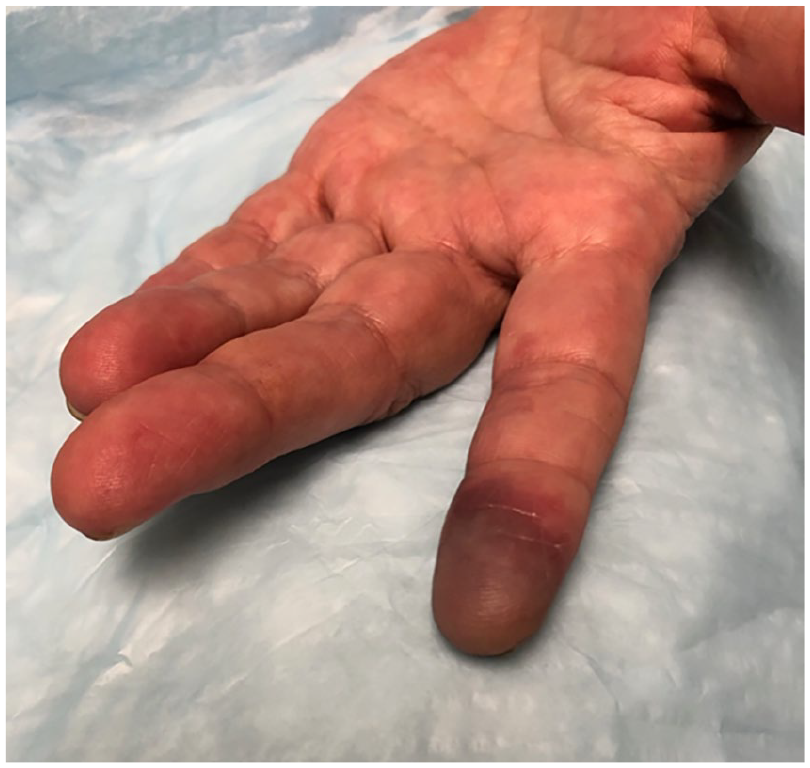
Photograph of a patient with thromboangiitis obliterans related to heavy smoking who developed purple discoloration of the index finger due to lack of blood flow in the small arteries.
Patients with TAO may also have an element of vasospasm. Blood vessels have smooth muscle in their walls that allow them to dilate or constrict to help with temperature regulation and other body processes. In vasospasm, the blood vessel constricts abnormally, further depriving the affected area of blood flow.
Notably, patients who continue to smoke may also develop blockages of larger arteries, which can lead to further worsening of blood flow to the affected limb. Figure 2 summarizes some of the symptoms of TAO.
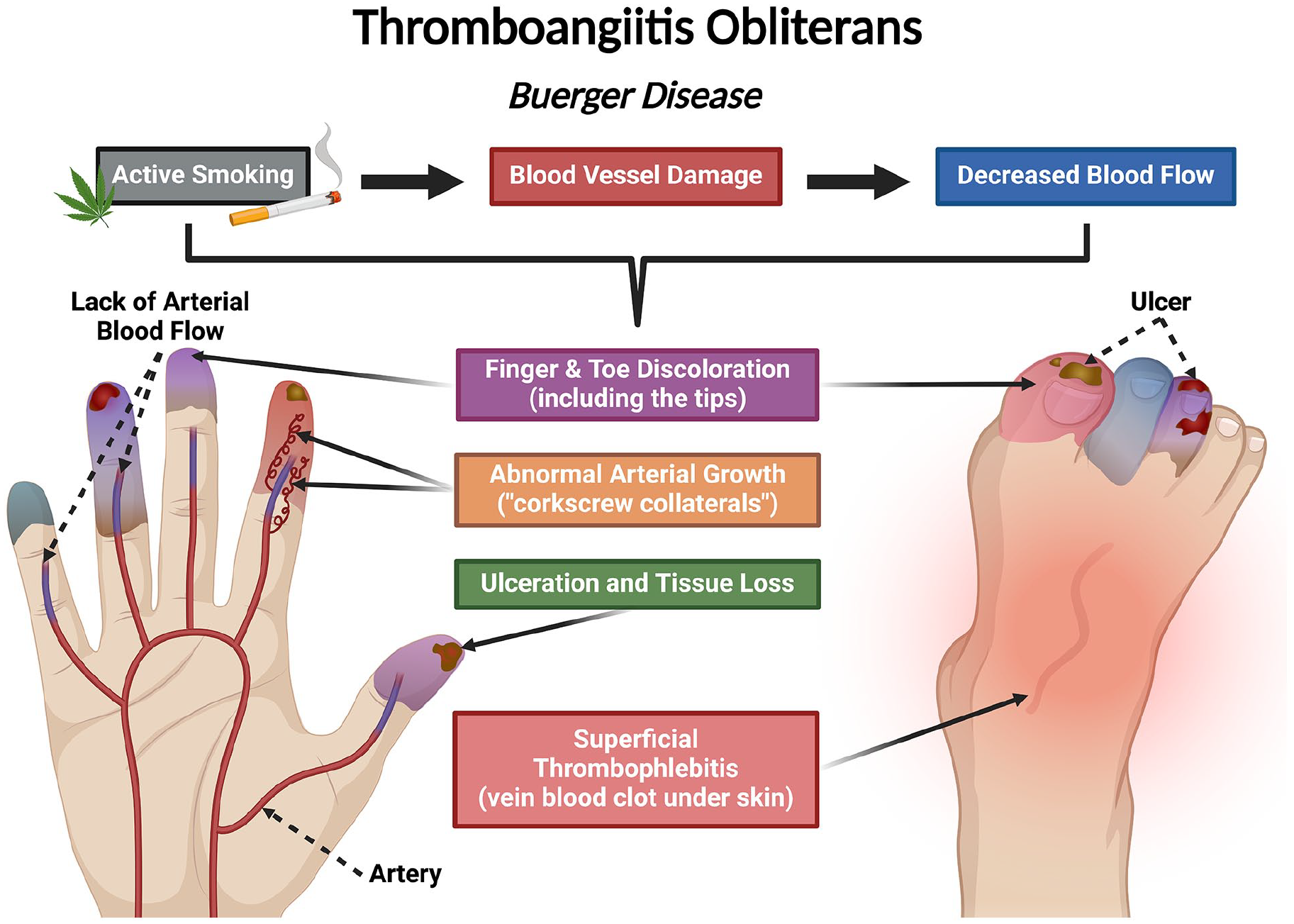
Signs and symptoms of thromboangiitis obliterans. Image created with BioRender.com.
What other conditions have symptoms similar to TAO?
Several other conditions can cause blockages of the smallest blood vessels. Although also strongly tied to smoking, PAD due to atherosclerosis (plaque) can occur in people who have never smoked, and it is more common among people with multiple other risk factors like diabetes, high blood pressure, and a family history of heart attack or stroke. PAD typically affects blood vessels in the calf or thigh, and unlike TAO, it is less common in the arms and hands. Arterial thromboembolic (blood clotting) disease may also mimic TAO. In patients with certain cardiovascular conditions or clotting disorders, blood clots can form in other parts of the body such as the chambers of the heart or the aorta. If these clots break off and travel to the fingers or toes, lesions that resemble TAO may develop. Similarly, plaque that forms in the aorta and other arteries above the level of the digits may break off and shower down to the digits (fingers or toes), causing symptoms that resemble TAO. In addition, uncommon inflammatory disorders can cause inflammation of the small arteries, resembling TAO. Finally, people who have repetitive trauma to the hands—such as workers who use vibrating tools like jackhammers—can have an injury of the small arteries in the hands that can deprive the fingers of blood flow.
All these disorders are differentiated from TAO on the basis of physical examination, blood testing, and imaging. Cannabis arteritis is identical to TAO but occurs in those who use marijuana. Cannabis arteritis is differentiated from TAO by a positive drug test for cannabis.
How is TAO diagnosed?
Because TAO and PAD share a strong common risk factor—smoking—and because both affect the arteries of the legs, it can be difficult to tell the two apart by relying only on physical examination. Most healthcare providers will measure the ankle–brachial index (ABI), which is a noninvasive test using blood pressure cuffs and ultrasound to measure blood flow in the legs. 3 A similar test on the arms, called a wrist–brachial index, can be performed if needed. Both tests should include measurement of blood pressures in the digits because many people with TAO may have a normal pressure at the level of the ankle or wrist.
Furthermore, many patients will have an angiogram to help diagnose TAO, as shown in Figure 3. In an angiogram, a small tube called a catheter is placed through the skin into an artery. The catheter is pushed forward to the area of interest, and dye that lights up on real-time X-ray called fluoroscopy is injected into the arteries. This procedure creates a picture of the affected arteries. Patients with TAO usually have a characteristic finding of areas of a diseased artery with a normal-looking artery in between. There may be development of small bypasses around diseased segments, named ‘corkscrew collaterals.’ However, these abnormalities can also be seen in other arterial diseases. The diagnosis of TAO is based on a combination of findings on physical examination and testing, as well as ruling out other conditions that can cause a lack of blood flow to the digits.
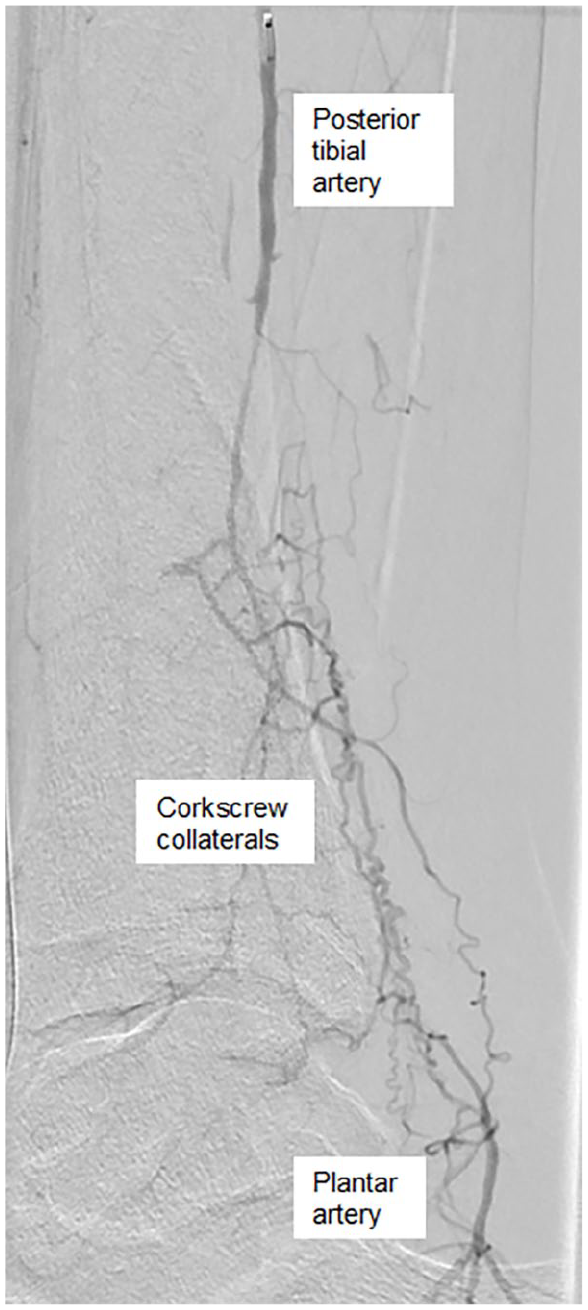
Angiography, in which a catheter is placed inside an artery and dye is injected to show the blood vessels of interest, can be used in the diagnosis of thromboangiitis obliterans. This angiogram shows corkscrew collaterals in the leg between the posterior tibial artery of the calf and the plantar artery of the foot.
Computed tomography (CT) and magnetic resonance imaging (MRI) scans usually are not helpful in the diagnosis of TAO, as the picture quality of the smallest blood vessels in fingers or toes is limited.
In patients with TAO who have superficial thrombophlebitis, a biopsy of the area can provide a definitive diagnosis, but this procedure is usually reserved for patients in whom there remains uncertainty over the diagnosis.
What are the treatment options for TAO?
The first step in treating TAO is total abstinence from tobacco and marijuana products including vaping, chew, and edibles. Because nicotine constricts the small blood vessels, patients with TAO should also avoid all forms of nicotine replacement therapy, including patches, gums, and inhalers, if possible. Oral prescription medications like bupropion and varenicline are safe to use in TAO to help with quitting smoking.
Most medications for TAO have not been studied in large numbers of people, so their benefit is uncertain. Many patients with TAO are prescribed medications known as vasodilators, which help small blood vessels dilate as widely as possible through actions on smooth muscle in the vessel wall. Vasodilator medications aim to allow as much blood flow as possible to the very tips of the digits (fingers or toes) to help sores and ulcers heal. There are multiple different classes of vasodilators, including calcium channel blockers, which are used to treat high blood pressure, and phosphodiesterase inhibitors, which are best known as drugs to treat erectile dysfunction but are also used to treat vasospasm. In some severe cases, hospitalization for intravenous vasodilator therapy is recommended. Intravenous vasodilators are medications that help to relax or open up blood vessels that are constricted, with the goal of increasing blood flow.
Of note, usually, opening up the small blood vessels affected by TAO through surgical or minimally invasive techniques is not possible because they are so small. However, some patients with severe disease have undergone a surgical procedure called sympathectomy. In this procedure, the nerve that causes the blood vessels to constrict or become smaller is cut. It is unknown whether this procedure is beneficial for patients with TAO, so its use is limited.
Unfortunately, some patients with TAO, particularly those who continue to smoke even small amounts of tobacco, may need amputation to address dead tissue (gangrene) on the fingers or toes. Wound healing may be difficult or even impossible in those who continue to smoke.
What type of monitoring is needed?
Patients with TAO need frequent follow-up visits to monitor for worsening of the affected digits, to look for any signs of infection in those with open ulcers, and to reinforce smoking cessation. Vascular testing may be performed periodically, especially if symptoms worsen or if there is concern for disease progression.
Summary
TAO, also known as Buerger disease, is a rare condition that is seen in those who smoke. The disease causes a lack of blood flow to small and medium-sized blood vessels through inflammatory thrombus formation. TAO typically occurs in younger people with heavy tobacco exposure and can cause severe pain in the fingers and toes, sometimes leading to ulceration. In some extreme cases, amputation may be required. The primary treatment of TAO is total abstinence from smoking any tobacco (or marijuana) product. The effectiveness of other medical therapies remains uncertain.
Footnotes
Declaration of conflicting interests
The authors declared no potential conflicts of interest with respect to the research, authorship, and/or publication of this article.
Funding
Dr Elizabeth Ratchford’s work was supported in part by the generosity of David Kotick (1926–2021).
