




Abstract

Keywords
Doppler ultrasound waveform analysis is routinely used for diagnosis and evaluation of arterial stenosis in patients suffering from peripheral artery disease (PAD).1,2
It was previously demonstrated that there is significant heterogeneity of descriptions of Doppler waveforms by French vascular residents. 3 However, this heterogeneity was significantly reduced when using a four-item Doppler classification.3,4
The aim of the present study was to assess the heterogeneity of Doppler waveform descriptions among Chinese ultrasound specialists and the impact of a four-item Doppler classification.
During a national Annual Ultrasound Congress in Beijing (May 5–6, 2019) ultrasound specialist attendees were invited to complete an online questionnaire developed by Scissons. 5 The questionnaire presented 30 Doppler waveforms (15 pulsed ultrasound waveforms (PW) and 15 continuous ultrasound waveforms (CW)). 3 Attendees were invited to describe 30 Doppler waveforms as they would in their usual clinical practice (first round) and then using a four-item classification (triphasic, biphasic, monophasic, and others) (second round). This study was validated by the ethical committee of Rennes (France) and registered on clinicaltrials.gov (NCT03827512).
The Wilcoxon signed-rank test was used to compare the heterogeneity of descriptions between the first and the second round. Comparisons of correct answers (in percent) were compared using the chi-squared test. Statistical analyses were made using R software (Vienna, Austria, http://www.R-project.org). A two-tailed p-value < 0.05 was considered as statistically significant.
A total of 209 participants from 23 provinces in China (Figure 1A) were included in the study: 128 in the first round, 178 in the second; 97 participated in both rounds. The median number of years working in vascular ultrasound was 7 [4–7] years. There were 198 medical doctors and 11 sonographers. Among the 209 participants, 10, 59 and 140 worked in a primary hospital, secondary hospital, and tertiary hospital, respectively.
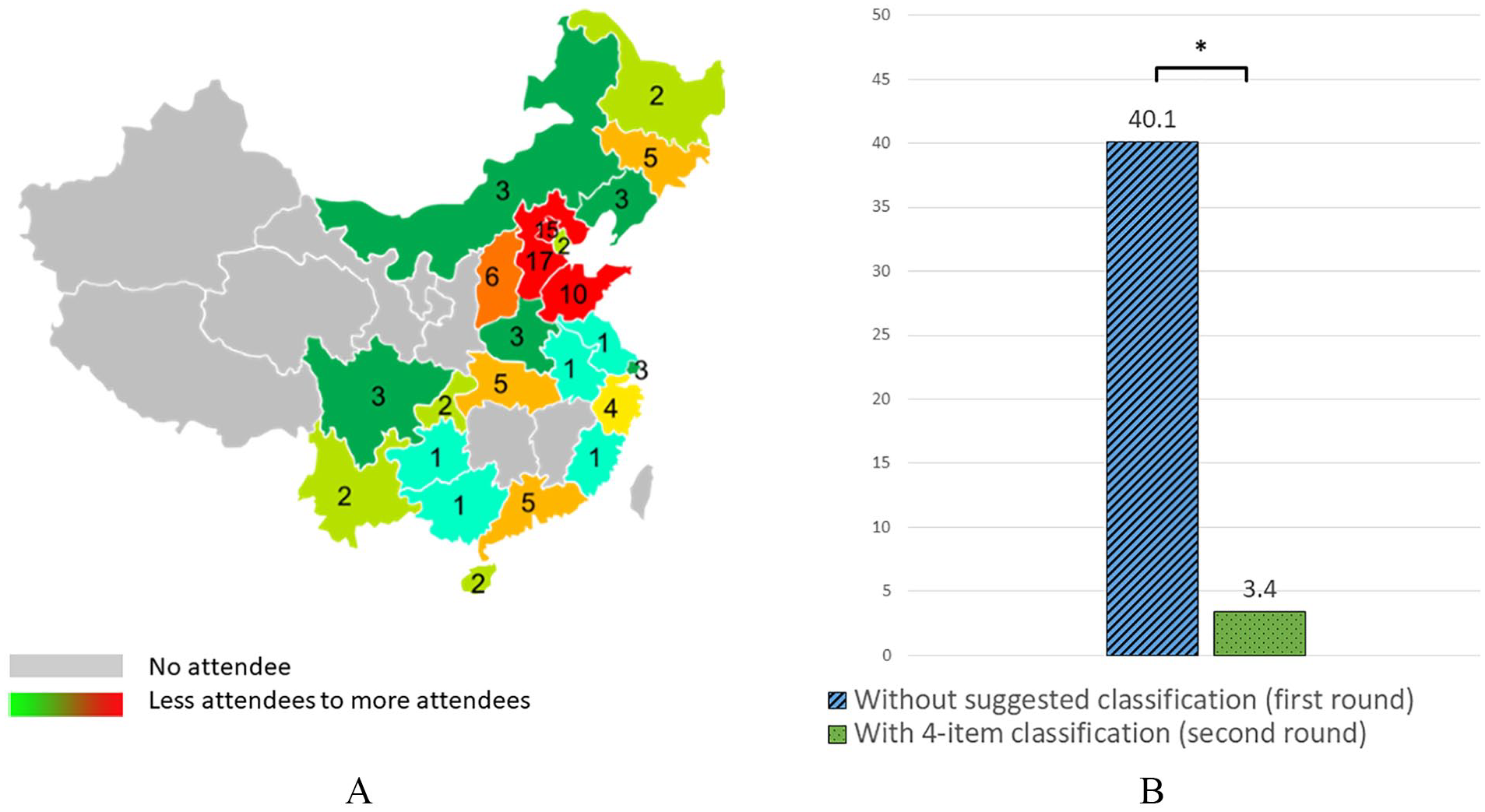
(A) Regional distribution of the congress attendees. (B) Heterogeneity comparison. Number of different responses to the 30 Doppler waveforms among 97 participants who completed both rounds with and without suggested classification. *p < 0.05.
In the first round, among 128 participants, the average number of terms used to describe the 30 Doppler waveforms was 51.2 ± 10.5. Among the 97 participants who participated in both the first and second rounds, the average number of different descriptions was 40.1 ± 8.0 for the interpretation without classification compared to 3.4 ± 0.8 (p < 0.05, Figure 1B) with the suggested four-item classification. An average of 76% (range 9–100%) of Doppler waveforms were correctly identified by the 97 participants who participated in both rounds. There was no statistical difference between the average identification rate of PW and CW (p > 0.05).
Scissons has previously reported that the description of Doppler waveforms is an issue in the USA. 5 Our previous work conducted in France also found that there was a large heterogeneity in the description of Doppler waveforms. 3 There are several possible explanations. First, there is no international consensus defining the different Doppler waveform profiles, despite the fact that Doppler waveform analysis is recommended in the diagnosis of PAD. 6 Second, as shown by Nicolaides and Yao, 7 the same word can be used for the description of different Doppler waveforms. This contributes to maintain the confusion in ultrasound practice.
In the present study, the percentage of correct answers (76%) was similar to the one previously reported by Scissons (74%), suggesting a similar level of vascular ultrasound knowledge between our participants and American sonographers. 5 The number of correct answers is slightly lower than the one reported among French residents, but the number of participants was low (n = 19). 3
Finally, from the results of the present study we also suggest that the number of different answers is statistically reduced when using a classification, as previously found. 3 It might be interesting to see if similar results are found with other classifications, such as the Saint-Bonnet classification.1,2,8,9
To conclude, the results of the present study highlight the heterogeneity of descriptions of Doppler waveforms by Chinese ultrasound specialists and strongly suggest that the use of a dedicated classification can reduce the number of terms used for the description of Doppler waveforms. This improvement of reporting Doppler waveforms and the high percentage of correctly classified waveforms when using a predefined set of terms illustrate that there is an urgent need to standardize Doppler waveform descriptions in order to improve the clinical management of patients with PAD. Such harmonization of waveform descriptions will not be achieved just by bringing out additional recommendations – it requires effort and special attention in the initial vascular training program, continuous training of vascular physicians, and training on simulators, preferably with an online tool.
Footnotes
Acknowledgements
The authors thank the ultrasound specialists for their participation in this study.
Declaration of conflicting interests
The authors declared no potential conflicts of interest with respect to the research, authorship, and/or publication of this article.
Funding
The authors disclosed receipt of the following financial support for the research, authorship, and/or publication of this article: The Beijing Natural Science Foundation (7172209) supported this work.
