



Abstract
We report recruitment strategies for an NIH-funded trial focused on African Americans with peripheral artery disease (PAD). We present complete recruitment efforts for this 1-year trial, 5-year study. Eligibility included the following: African American, a resting ankle–brachial index (ABI) ⩽ 0.99, a short physical performance battery (SPPB) score of 10 or lower, English speaking, telephone access, and absence of coronary ischemia during a submaximal treadmill test. Recruitment included mailings of brochures to zip codes in which more than 50% of residents were African American, advertisements, community events, and physician/clinic referrals. We telephone-screened 3511 persons, of whom 792 did not recall the method by which they learned about the study. We randomized 174 participants. Mailings yielded the highest percentage of randomized participants (n=60, 34.4%), followed by television advertisements (n=42, 24.1%), followed by community events (n=24, 13.8%). In conclusion, to recruit African Americans with PAD for a clinical trial, investigators should consider mailings of brochures, television advertisements, and community events.
Introduction
Lower extremity peripheral artery disease (PAD) affects 8 to 12 million residents in the United States. 1 PAD is commonly defined as atherosclerosis of the abdominal aorta and/or arteries of the lower extremities. 2 Patients may present without lower extremity discomfort (asymptomatic disease) or with reproducible exertional calf, thigh, or buttock discomfort (intermittent claudication) or symptoms of lower extremity discomfort not limited to exertion and/or not requiring cessation of walking (atypical leg symptoms).3,4 Claudication is a symptom which commonly prompts a clinician to seek a diagnosis of PAD. The initial diagnosis of PAD is often obtained by the ankle–brachial index (ABI) – the ratio of systolic blood pressure in the ankle to that in the arm; it is a sensitive and specific non-invasive diagnostic test for PAD. 5
Modifiable risk factors for PAD are smoking, diabetes mellitus, hypertension, and dyslipidemia. 2 Smoking and diabetes mellitus are associated with more aggressive disease. 5 African Americans have a 2.0-fold higher risk for PAD compared to non-Hispanic white individuals.6–8 Reasons for a higher prevalence of PAD among African Americans have not been explained. 9 Also, African Americans with PAD have an increased risk for limb loss compared to non-Hispanic white individuals.10,11 Because of the increased risk for PAD and lower extremity amputations, early and efficacious management is warranted in this high-risk group.
Home-based walking therapy is efficacious for improving walking speed, quality of life, and walking distance among patients with PAD.10–14 A limiting factor for patient adherence to home-based walking therapy is motivation, which can be a barrier among African Americans secondary to a higher prevalence of sedentary behavior. 15 Currently, we are conducting a randomized clinical trial to test the efficacy of a counseling intervention to motivate walking among African Americans with PAD. Although inclusion of minorities in clinical trials should be a goal for most trials, recruiting African Americans into clinical trials can be challenging.16,17 Reasons for these challenges are multifactorial but include mistrust among community members which can stem from lack of time, lack of awareness of value in trial participation, and lack of transparency of among researchers when approaching the community.16,18,19
The purpose of this article is to describe efficacious recruitment strategies for a behavioral intervention trial for African Americans with PAD. This information can inform clinicians and researchers who seek to conduct future trials that will include African Americans with PAD.
Methods
Study overview
The Human Subjects Board of the University of Kansas School of Medicine–Wichita approved the protocol. Participants provided written informed consent. This is a 5-year study, 1-year trial, which included a pilot/feasibility phase in Year 1 with completion of the trial during Years 2 through 5. Of note, the pilot phase of the study (Year 1) was started while the principal investigator was a faculty member at the University of Minnesota, Minneapolis. At the end of Year 1, the principal investigator joined the faculty of the University of Kansas (KU) School of Medicine in Wichita. Year 2 and initiation of the actual trial was conducted in Kansas. Recruitment as initiated in May 2012, with randomization of the final participant in November 2015. The study will end in November 2016. The schedule for recruitment was extended to 42 months versus the originally planned 30 months, given the relocation of the principal investigator and restarting of the study upon relocating. We randomized 174 participants, meeting 85% of our goal of 204.
The objective of the trial is to determine the efficacy of motivational interviewing to motivate home-based (unsupervised) walking, and improve walking distance among African Americans with PAD. The primary outcome is walking distance at 6 months, as measured by the 6-minute walk test. 20 Secondary outcomes include walking distance at 12 months and adherence to home-based walking, as measured by an accelerometer21–23 and questionnaire. 24
To be eligible for the study, participants had to meet the following criteria: African American (determined by self-report), English speaking, and have access to a telephone (required for initial screening and follow-up throughout the trial). We excluded persons who were currently walking for exercise at least 5 days per week (i.e. assessed by a questionnaire); 25 the rationale is that a person who is currently walking for at least 5 days per week is already sufficiently active, and therefore not a member of the target population for our motivational home-based walking intervention. We also excluded persons who had one or more of the following: a prior major amputation (foot or lower leg) or critical leg ischemia (tissue loss, gangrene, or ulcers); rest pain with an ABI <0.4 without prior evaluation by a vascular surgeon (given the need for evaluation for the role of more invasive therapy prior to recommending walking therapy); leg revascularization within 3 months of enrollment or plans for revascularization during the study period (the rationale is that post-intervention recovery and potential complications are likely to limit the patient’s ability to adhere to the study protocol). Further, we excluded persons who reported use of supplemental oxygen, given limited ability to participate in a walking trial secondary to breathing difficulty; myocardial infarction within the preceding 3 months; blood pressure > 200/110 mmHg. Persons interested in learning more about the study would call our study telephone line and speak to a research assistant. If there was continued interest, the potential participant would complete a telephone screen. Telephone screening, conducted by a research assistant, included an assessment of race/ethnicity, identification of any symptoms or signs that would preclude involvement in walking for exercise, and addressed study questions. Participants who were eligible by telephone screen were invited to an in-person visit. The in-person visit involved completing a consent form followed by completion of ankle–brachial index (ABI) and short physical performance battery (SPPB) testing.6,26,27 For ABI testing, participants initially rested for 5 minutes. Following this resting phase, a 5-MHz hand-held Doppler and blood pressure cuff were used to measure systolic blood pressures in both brachial arteries and in both ankles (dorsalis pedis and posterior tibial arteries). Resting ABI was calculated based on the ratio of the ankle and arm pressures. Participants were eligible if they had a resting ABI ⩽ 0.99. SPPB testing is an assessment of gait speed, chair stand, and balance. The testing is used to assess disability in older adults. The scores range from 0 (worst performance) to 12 (best performance). Participants were eligible if they had an SPPB score of 10 or lower. Participants with an SPPB score of 10 or lower are more likely to have a walking disability 28 and potential for improvement from a walking intervention. If participants were eligible following the initial in-person visit (i.e. ABI ⩽ 0.95 and SPPB score ⩽ 10), they were referred for submaximal exercise treadmill testing using the Gardner protocol. 29 If treadmill testing revealed no evidence of coronary ischemia, participants were provided with an accelerometer and scheduled for a second in-person visit to be completed within 1 to 2 weeks of receiving the accelerometer. During the randomization visit, participants returned the accelerometer and completed the 6-minute walk test and surveys.
While the study was originally conducted in Wichita, Kansas, the rate of recruitment was slower than planned. We attributed this slower rate to a low percentage of African Americans residing in Wichita (9%). To help meet our recruitment goal, we extended recruitment to include Kansas City (both Kansas and Missouri) for which 30% of the population is African American. We continued to recruit in Wichita. The University of Kansas Medical Center (KUMC) has three campuses, which are located in Kansas City, Wichita, and Salina. In Wichita, space provided on the KU campus was used to conduct study protocols and exercise treadmill testing was performed at a nearby (within 1 mile of the campus) cardiology clinic. In Kansas City, Frontiers: The Heartland Institute for Clinical and Translational Research (NIH funded CTSA) Clinical Research Unit was used for the conduct of study protocols including treadmill testing. Counseling sessions were conducted over the phone for all participants. In addition to providing a local telephone number for interested persons in Kansas City to reach our staff in Wichita to complete telephone screening, we also trained staff in Kansas City to perform the ABI, SPPB, and our treadmill protocol.
Eligible participants were randomized to one of three study protocols: (1) motivational interviewing; (2) patient-centered assessment and counseling for exercise (PACE);; or (3) control. All participants received a handbook, titled Circulation for Your Soul, which included an overview of risk factors for PAD, the importance of risk factor control with recommendations for achieving control, and recommendations to walk for exercise. Participants randomized to one of the two counseling arms, motivational interviewing (MI) or health education counseling, received bi-weekly counseling sessions (30 minutes maximum) for 3 months followed by monthly sessions for 3 months. MI is based on the assumption that behavior change is affected more by ‘motivation’ than by ‘information’. The goal of MI is to energize change, and to find reasons for change that are consistent with the person’s life goals and values. 30 Our health education counseling addresses behavior change strategies but without much content to increase motivation; it provides the ‘how’ of change rather than the ‘why’. Following the 6-month intervention phase, participants randomized to one of the two counseling arms entered a maintenance phase for 6 months, during which time contact was limited to monthly postcards that participants were asked to complete to confirm or update their contact information. Our control group received telephone calls at months 3 and 9 that were used to address any comments or questions.
Recruitment approaches
Direct mailings
We provided mailings (envelopes containing our study brochure) to persons residing in neighborhoods in which more than 50% of residents were African American. Racial demographic information was provided by Midwest Single Source (http://www.midwestsinglesource.com/).
Clinics/physician offices
We contacted clinics, within Wichita and Kansas City, in which the practice included internal medicine, cardiology, endocrinology, podiatry, and/or ophthalmology to receive permission to leave flyers. For the practices that agreed, we provided study flyers to distribute to patients.
Community centers/events
We scheduled talks and provided PAD screening at no cost at local community and senior housing centers as well as local churches in Wichita. We also participated in several health fairs to provide screenings and/or circulate study flyers and obtain names and telephone numbers of persons interested in completing a telephone screening.
Word of mouth
Participants also became aware of the study by hearing about it from family, friends, or other community members (‘word of mouth’).
Television advertisements
We ran television advertisements on local stations in both Wichita and Kansas City. The advertisements were run following shows that often engaged African American audiences (e.g. Family Feud, Judge Judy).
Newspaper advertisements
Newspaper advertisements were placed in newspapers circulated largely to African American residents. In Wichita, we ran advertisements in the Community Voice, and in Kansas City, we ran advertisements in the Kansas City Globe.
Bus advertisements
In both cities, we placed ads within buses that provided transportation largely within African American neighborhoods.
Radio advertisements
We provided radio advertisements on local radio stations that were labeled as hip-hop music stations, and we also used local public radio.
Other recruitment approaches
Aside from the above, other approaches for recruitment included billboards in both Wichita and Kansas; billboards were located in or near the neighborhoods that were also targeted for mailings. We also provided information about the study to programs in Wichita that targeted African American older adults (Senior Companions; Foster Grandparents; and City Youth). Some participants were made aware of our study from Facebook, the Internet (through the KU webpage or clinicaltrials.gov), or a yearly festival titled Riverfest. Some participants could not recall how they learned about our study.
Each recruitment approach included brief information about the study including a description of PAD (e.g. symptoms), study location, and a telephone number to learn more. During each call, study staff ascertained how callers were made aware of the study. This information was entered into a database known as Research Electronic Data Capture (REDCap).
The exact language used for each recruitment approach is provided in an Appendix, available online as supplemental material.
Eligibility protocol
A research team member would call, if a name and number had been provided, or potential participants would call our study telephone line to learn more about the study and complete a telephone screen. Participants who were eligible by telephone screen were invited to an in-person visit to complete the ABI and SPPB. If eligible following this in-person screen, participants were scheduled for exercise treadmill testing using the Gardner protocol to identify evidence of occult coronary ischemia at a low workload. If there was no evidence of coronary ischemia, participants were scheduled for a randomization visit.
Analysis
Using descriptive statistics, we determined the frequency by which participants became aware of our study and the number of participants randomized relative to a given recruitment approach.
Results
We randomized our final participant on 16 November 2015, and we telephone screened 3511 African Americans. Among these 3511 participants, we randomized 4.96% (n=174). Table 1 provides information on recruitment approaches and the yield from each approach.
Recruitment methods (including multiple sources).

We completed telephone screenings for 2719 persons; 792 persons could not recall how they learned about the study (total n = 3511). Some telephone screened participants (n=313) reported more than one source for learning about the study: 294 reported two sources; 15 reported three sources; four reported four sources. Twelve randomized participants reported learning about the study from more than one source: 11 reported two sources; one reported three sources.
A total of eight different methods were used within Wichita and Kansas City to advertise the trial. Of the persons telephone screened, 1057 resided in Wichita, KS and 1662 resided in Kansas City. The source of recruitment could not be recalled by 792 participants. Of the 3511 participants telephone screened, nearly 50% were excluded during the telephone screen or during as a result of the ABI, SPPB, or treadmill testing.
Among the randomized participants (n=174), there were 11 who reported learning about the study from two sources and one reported three sources (total n=12). In Wichita, the majority of telephone screens resulted from direct mailings (n=394, 37.3%), followed by television advertisements (n=232, 22.0%) and community events (n=119, 11.3%). In Kansas City, the two approaches that yielded the greatest number of telephone screens were direct mailing (n=590, 35.5%) and television advertisements (n=781, 47.0%). Among the 174 participants randomized, 92 resided in Wichita and 82 resided in Kansas City. The recruitment approaches with the lowest yield for randomization in Wichita were radio and bus advertisements: 0.0 and 2.2%, respectively. In Kansas City, the highest percentage of randomized participants learned about the study from television advertisements (37.3%) and direct mailings (36.2%). Word of mouth was the third most common source for randomized participants in Kansas City (7.2%). In Kansas City, study flyers and ‘other’ (1.5% for each) yielded the lowest percentage of randomized participants followed by radio and bus advertisements at 2.8% and 3.1%, respectively.
Recruitment costs are listed in Table 2. Per participant randomized, the most expensive approach was radio advertisements followed by study flyers. Our study flyer is provided in Figure 1. Consort diagrams provide a list of reasons for participant exclusions and the number randomized by city (Figure 2).
Recruitment costs.

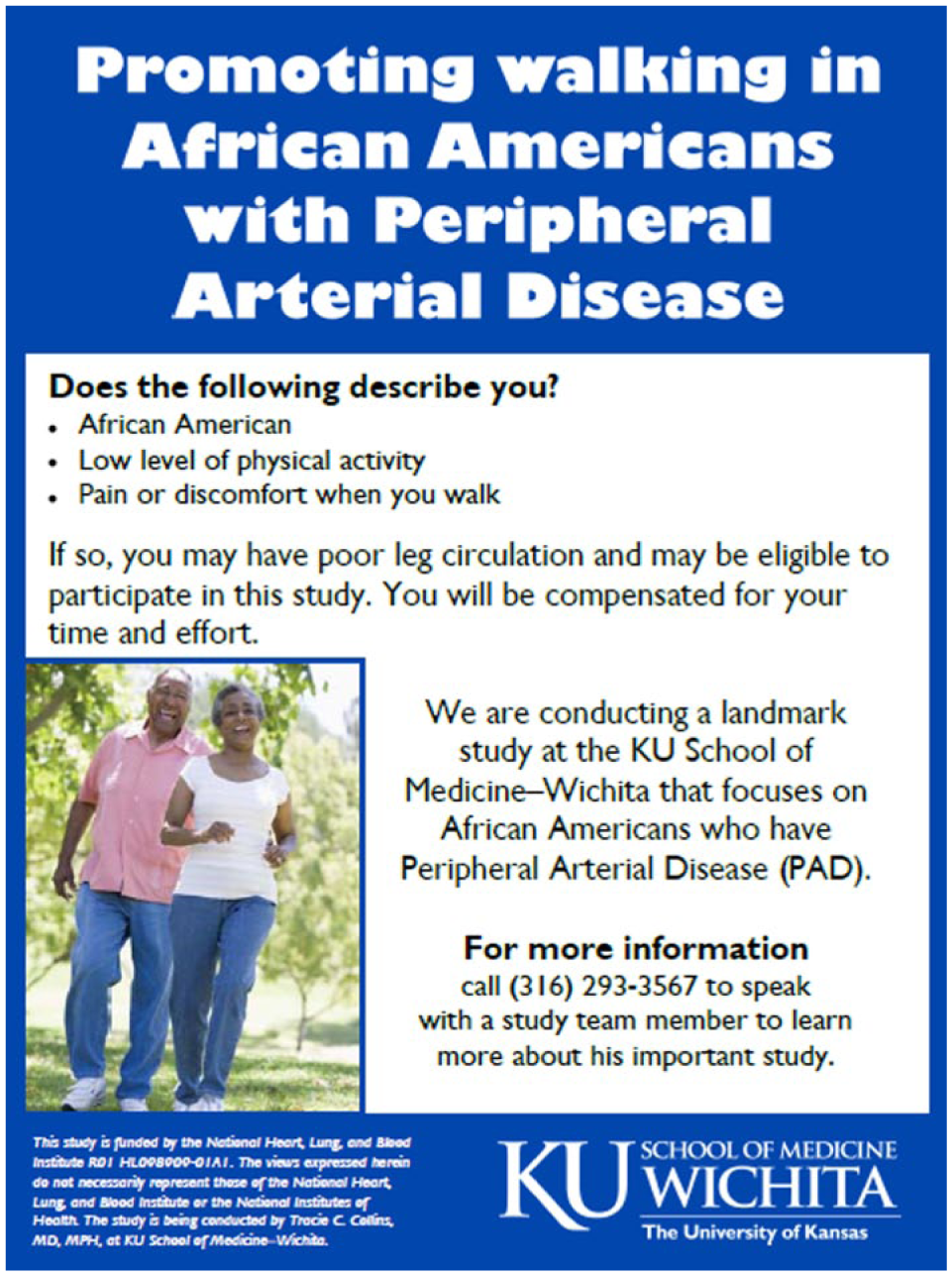
The flyer used to recruit participants.

Consort diagram for recruitment in Wichita and Kansas City.
Discussion
For a behavioral intervention trial focused on recruiting African Americans with PAD, we used several recruitment approaches. Mailings yielded the highest number of randomized participants in both Wichita and Kansas City. Television advertisements provided the second highest yield for both Wichita and Kansas City. Specific to Wichita, community events yielded the third highest percentage of randomized participants followed by word of mouth. In contrast, word of mouth provided the third highest yield of randomized participants in Kansas City followed by community events.
Although newspaper advertisements were among the top five for the highest yield of randomized participants in Wichita, this approach provided a very low yield for randomization participants in Kansas City.
Reasons for the success of the direct mailings may be secondary to the convenience of receiving information in the mail: a more personalized approach to learning about the study with a mailing delivered to your home; and the potential positive impact of learning about a study that targets persons within the community. Given that participants were not asked their perspectives on how they were impacted by receiving a mailing, it is challenging to discern the exact reason that the mailings were so successful.
Community events were highly successful for recruitment in Wichita but less so in Kansas City. With several research staff members available in Wichita, community events held in this city could provide screening on site for a large number of persons. Receiving a free exam (no charge for this exam as it was provided by the research team as compared to receiving a similar exam in a vascular laboratory or physician’s office) and learning about the study likely influenced the large recruitment yield in Wichita. In contrast, because of the distance from Wichita to Kansas (3 hours in one direction), our research team could not provide this approach in Kansas City and the community events largely involved one research team member presenting a talk about PAD and the study.
Television advertisements were quite successful for recruitment in Kansas City. Given the large number of African Americans residing in Kansas City in both Kansas and Missouri, the reach of a television advertisement is large. Up to 30% of residents in Kansas City are African American. In contrast, television advertisements did not have the same yield of participants for Wichita. This may relate to Wichita having fewer residents and a smaller percentage of African Americans (9%). However, despite the variation in size between Wichita and Kansas City, word of mouth provided a high yield of randomizations in both cities. The benefit of this recruitment approach may be related to African Americans having a close-knit community and attending similar social events as well as churches. 31
Newspaper advertisement can potentially reach a large number of participants. However, in our study, newspaper advertisements provided a lower yield of randomized participants. The reach of this type of recruitment approach varies by subscription rates and how affordable a given newspaper is to potential participants. Further, learning about a study from a newspaper advertisement can also be impacted by the days of the week during which the advertisement is placed and whether participants will actually read advertisements within the newspaper. In contrast to mailings, which are brief and easy to read, newspapers require more time as a potential participant must read beyond the first page or pages to actually see the study advertisement. In a prior study conducted in Chicago, IL, involving a walking intervention for patients with PAD, 32 newspaper advertisements yielded the largest number of randomized participants. In this study, the investigators noted that the highest participant response rate was when the advertisement was placed within the first four pages of the newspaper.
Limitations
Several limitations of our study need to be considered. First, all participants in this study were African American and successful recruitment approaches may vary by race/ethnicity as well as other socio-demographic variables. This study was conducted in the Southern Midwest and the findings may not be generalizable to other geographic regions in the United States. Finally, more than 20% of participants could not recall how they learned about the study.
Conclusions
We have completed recruitment for a large-scale NIH funded trial involving African Americans with PAD. Targeted mailings to zip codes with a large number of African Americans, television advertisements, word of mouth, and community events have provided the highest yield of randomized participants. Although targeted mailings have been the most successful, utilizing multiple approaches can increase the yield of randomized participants.
Footnotes
Declaration of conflicting interests
The authors declared no potential conflicts of interest with respect to the research, authorship, and/or publication of this article.
Funding
The authors disclosed receipt of the following financial support for the research, authorship, and/or publication of this article: National Heart, Lung, and Blood Institute of the National Institutes of Health under Award Number R01HL098909. The content is solely the responsibility of the authors and does not necessarily represent the official views of the National Institutes of Health.

References
Supplementary Material
Please find the following supplemental material available below.
For Open Access articles published under a Creative Commons License, all supplemental material carries the same license as the article it is associated with.
For non-Open Access articles published, all supplemental material carries a non-exclusive license, and permission requests for re-use of supplemental material or any part of supplemental material shall be sent directly to the copyright owner as specified in the copyright notice associated with the article.
