




Abstract
This study aims to investigate the complexity of the practices of pedagogies of affect in physical education in response to urgent mental health issues among children and young people. As a proxy for measuring the effects of pedagogies of affect on pupils’ outcomes, self-determination theory (SDT) has informed teaching approaches for student motivation and psychological wellness and, thus, it could be an indicator perspective for mental health. Previous SDT studies in physical education have shown the relationship between pupils’ perceptions of need-supportive and need-thwarting teaching behaviours and affective outcomes. Nevertheless, no attempts have been made to test this teacher–pupil relationship involving observations of naturalistic teaching behaviour. Accordingly, this study examined how these observed teaching behaviours relate to pupils’ affective outcomes represented by basic psychological need satisfaction and frustration, (de)motivation, positive and negative affect, and sense of coherence. Employing a cross-sectional design, this study conducted observations of one indoor lesson per class and administered a set of questionnaires to pupils. In total, 20 teachers and 381 pupils aged 11 to 15 from seven different Scottish secondary schools participated in this study. The results showed that the factor of the observed structure before the activity was significantly related to affective outcomes, while the observed controlling teaching behaviour was related to negative outcomes. Although non-significant relationships between some factors of observed teaching behaviour and pupils’ variables were also found, this observational study is significant as it provides direct evidence of teacher–pupil interactions in the real-life context for developing pedagogies of affect.
Introduction
Studies have shown that the prevalence of health issues among children and young people, particularly mental health issues, is rising (Smith, 2020). For instance, in the UK, Pitchforth et al. (2019) found a six-fold increase in the prevalence of mental illness among 4–25-year-olds in England and a more than two-fold increase in Scotland between 2003 and 2014. Furthermore, the mental health crisis has been exacerbated by the COVID-19 pandemic, increasing the need for mental health support and development in schools post-pandemic (Gagné et al., 2022; Smith, 2020). Thus, it is timely and crucial to develop and implement critical pedagogies to respond to mental health issues in school physical education (PE; Kirk, 2020). Kirk (2020) refers to pedagogies of affect, which advocate for the affective domain to become an explicit focus of teaching in PE rather than a hoped-for by-product of teaching motor skills. Within this context, teachers adopt pedagogies of affect when they focus on teaching and learning in the affective domain. While, as Kirk (2020) shows, there are pedagogies of affect available to teachers, such as teaching for personal and social responsibility (Hellison, 1995) and activist approaches to working with girls (Oliver and Kirk, 2015), work with pedagogies of affect is still in a developmental phase. Therefore, this study seeks to understand the practices of pedagogies of affect that naturally occur in real-life contexts. This is important because it will provide empirical knowledge to equip PE teachers who wish to address affective outcomes.
Measuring the effects of pedagogies of affect on pupils’ outcomes is difficult and complex because it refers to pupils’ feelings, beliefs, aspirations, and attitudes (Wright and Irwin, 2018). However, as a proxy for this relationship, self-determination theory (SDT; Ryan and Deci, 2017) has informed teaching approaches and interventions for pupils’ psychological well-being and motivation, thus it could be an indicator perspective for mental health (Ryan and Deci, 2020). Based on SDT and in the context of school PE, previous studies revealed that need-supportive teaching behaviours impact psychological need satisfaction and autonomous forms of motivation, whereas need-thwarting teaching behaviours predict psychological need frustration and controlled motivation or amotivation (Haerens et al., 2015; Leo et al., 2022a, 2022b, 2022c; Vasconcellos et al., 2020).
A series of observational studies within SDT has been conducted since Haerens et al. (2013) developed the first version of a need-supportive observation tool for teaching behaviour dynamics. Following this, Van den Berghe et al. (2013) developed an observation tool for assessing need-thwarting behaviour and showed its relationship with teachers’ self-reported motivational orientations. Furthermore, De Meyer et al. (2014) tested the relationships between the observed controlling teaching behaviour and students’ controlled motivation, but they did not find any significant relationships between them. More recently, some studies have investigated how observed need-supportive and need-thwarting teaching behaviours related to students’ engagement in learning activities (Cents-Boonstra et al., 2021; González-Peño et al., 2021). Observational studies in the current context are important because they can yield direct evidence of teachers’ naturalistic behaviour (i.e. regular teaching in routine lessons rather than modified teaching in interventions) to achieve pupils’ outcomes and, thus, have high ecological validity (Haerens et al., 2013). In that sense, an observation tool allows for identifying specific critical moments and dynamics of teaching behaviour that might relate to pupils’ affective outcomes in a regular lesson. However, no research has attempted to examine the relationship between observed teaching behaviours and pupils’ variables of affective outcomes.
Need-supportive and need-thwarting teaching behaviours
SDT is helpful in understanding and measuring social contextual factors, such as the impact of teachers’ teaching behaviour on pupils’ affective outcomes; such behaviours are called need-supportive or need-thwarting teaching behaviours. Need-supportive teaching, which has three factors, autonomy support, structure, and relatedness, is of critical importance, as several previous studies have shown that an increase in need support from teachers is related to an increase in pupils’ psychological need satisfaction (Haerens et al., 2013; Ryan and Deci, 2020). Conversely, controlling, cold, and chaotic teachers typically are expected to thwart the psychological needs of pupils, impeding their autonomous motivation and promoting controlled motivation (Haerens et al., 2015; Van den Berghe et al., 2016).
Autonomy support refers to a teacher's instructional and interpersonal behaviour in understanding pupils’ interests, values, and preferences (Reeve, 2009). Autonomy-supportive teachers use various strategies such as offering meaningful choices and providing opportunities for pupils’ ownership of their learning (Haerens et al., 2013). The perception of autonomy support from teachers can lead to an increase in pupils’ autonomous motivation and basic psychological need satisfaction (Behzadnia et al., 2018; Haerens et al., 2015) and enhance their levels of enjoyment and interest (Leptokaridou et al., 2016). Although studies of autonomy support exist extensively (Reeve, 2009), the factor of structure is necessary to enhance need satisfaction, especially competence need satisfaction. Teachers can implement structure with appropriate guidance and clarification to help learners feel competent to engage in activities (Aelterman et al., 2019). The provision of positive feedback and encouragement is a crucial part of the structure and has a positive relationship with motivation and interest (Panadero and Lipnevich, 2022; Stroet et al., 2013). Conversely, negative evaluative feedback (e.g. lack of nurturance) has been shown to have a negative effect (Stroet et al., 2013). The provision of relatedness support refers to the quality of interpersonal relationships between teachers and pupils. This behaviour supports pupils’ relatedness satisfaction, for example, by being attuned and paying attention to what pupils say (Stroet et al., 2013). If pupils perceive higher relatedness support, this predicts relatedness need satisfaction (Sparks et al., 2016), significantly leading to autonomous motivation and behavioural and emotional engagement (Chu and Zhang, 2018; Leo et al., 2023).
In contrast, need-thwarting teaching behaviours such as controlling, cold, and chaotic teaching behaviours result in negative experiences. Controlling teaching behaviour entails forcing pupils to comply with what teachers want them to do, making pupils feel pressure, which, in turn, impacts their psychological need frustration and a lack of motivation (Behzadnia et al., 2018; Haerens et al., 2015). Chaotic teaching involves the creation of a laissez-faire climate by letting pupils do what they want, which, however, results in the less optimal development of student competence (Aelterman et al., 2019; Van den Berghe et al., 2013). Cold behaviour refers to teachers who are unfriendly and distant from their pupils, which can potentially thwart pupils’ need for relatedness (Van den Berghe et al., 2013). The literature has identified that the dark side of teaching is associated with less desirable motivational experiences (Haerens et al., 2015, 2018; Van den Berghe et al., 2016). However, there is still limited observational research on the relationship between need-thwarting teaching behaviours and pupils’ affective outcomes.
Affective outcomes
The term affect refers to the affective domain, which includes matters such as motivation, psychological well-being, and resilience (Teraoka et al., 2021). As an example of conceptualising affective outcomes in a local context, in Scotland's national curriculum (i.e. Curriculum for Excellence), affective outcomes are a significant aspect of learning named Personal Qualities, which includes motivation, confidence and self-esteem, determination and resilience, and respect and tolerance (Education Scotland, 2017). In a global context, SDT has been used to address basic psychological needs, motivation, and psychological well-being and is, thus, a theory for conceptualising affective outcomes. In this sense, this paper uses affective outcomes to address multi-dimensional aspects in the affective domain, including motivational experiences within SDT.
The main idea behind SDT is that every human being has three basic psychological needs (i.e. autonomy, competence, and relatedness) that must be satisfied to facilitate more autonomous motivation (Ryan and Deci, 2017). Furthermore, SDT describes motivation as a continuum, emphasising different types of behavioural regulation (Ryan and Deci, 2017). Autonomous motivation refers to regulations involving experiences of volition and self-expression, and it is considered the optimal form of motivation. Controlled motivation denotes behavioural engagement that is characterised by a sense of internal or external pressure or coercion. Amotivation is defined as a lack of motivation and intention. These motivational experiences based on the principles of SDT have been applied to the PE context across several school-aged populations (Van den Berghe et al., 2014).
Another important concept concerning mental health and affective outcomes is well-being, which has two dimensions: hedonic and eudaimonic well-being (Dodge et al., 2012). On the one hand, hedonic well-being emphasises constructs such as happiness, positive affect, low negative affect, and life satisfaction. On the other hand, eudaimonic well-being focuses on life meaning, human development, resources, and strengths. In relation to SDT, a high level of basic psychological need satisfaction arguably contributes to one's hedonistic well-being. Indeed, previous studies have shown that basic psychological need satisfaction relates to pupils’ well-being, such as positive affect (Behzadnia et al., 2018) and vitality (Haerens et al., 2018). Regarding eudaimonic well-being, in pedagogical research, Lang et al. (2017) proposed that PE can contribute to the successful acquisition of new skills to cope with stress, which are important human capabilities in the affective domain and are key to fostering resilience. Resilience is also central to a salutogenic approach to health promotion, with the notion of a sense of coherence (SOC), where people can see the meaningfulness, comprehensibility, and manageability of their life situation, aiding in the maintenance of their health (Antonovsky, 1996). Pedagogically, SOC emphasises how PE might help individuals live a good life and highlights that people are always in a stage of becoming (McCuaig and Quennerstedt, 2018). Yet, the literature has been limited to investigating the relationship between teaching and eudaimonic well-being, which can be represented by SOC.
Present research
While many studies have examined the relationship between SDT-informed teaching styles and pupils’ outcomes, it is still unknown how observed teaching behaviours relate to pupils’ variables of affective outcomes. As Haerens et al. (2013) noted, observational studies can contribute direct evidence of teachers’ actual behaviour in relation to pupils’ outcomes as these studies have high ecological validity. However, to the best of our knowledge, no previous study has attempted to examine the relation of observed naturalistic teaching behaviours with pupils’ affective outcomes. Therefore, this study aimed to examine how observed need-supportive teaching and need-thwarting behaviours are associated with pupils’ affective outcomes represented by basic psychological need satisfaction and frustration, (de)motivation, positive and negative affect, and SOC.
Methods
Study design
This study employed a cross-sectional design, which involved the observation of one indoor lesson per class and the administration of a set of questionnaires to pupils. Regarding the setup of the observation, one camera was positioned at the corner of a gym to film the lessons, and the teachers were asked to wear a small microphone to record their verbal instruction and communication with pupils. The teachers themselves chose which of their classes would be observed, but we asked them to do nothing different from their regular classes. As a means of validating the observed lesson, all the teachers affirmed that the recorded videos were a good representation of their regular teaching. At the end of each observed lesson, we asked pupils to fill out a set of four different questionnaires on affective outcomes. The contents of the questionnaires are described in the data generation section. The data collection of this study spanned from October 2018 to May 2019. Ethical approval for this study was granted by the ethics committee of the university hosting the research. We explained to the participants that participation was voluntary and that they could decline to participate in the study. Prior to the observed lessons, informed consent was obtained from the teachers and assent from the pupils only since they were taking part in a regular timetabled lesson and the schools were in loco parentis. While the pupils were asked to pass their parents a parent information sheet with an opt-out form, no parents refused. Additionally, approvals from local councils and headteachers were secured before starting the data collection process.
Participants
Participants were recruited through professional contacts at universities in Scotland using a purposive sampling approach (Etican et al., 2016). The participating teachers expressed their responsibility for supporting pupils’ affective outcomes in PE. Within the Scottish context, the participating teachers expressed an explicit commitment to teaching for personal qualities in the lessons to be observed. A total of 20 teachers and 381 pupils aged 11–15 from seven different Scottish secondary schools agreed to participate in this study (see Supplemental Material A). The context of this study was non-denominational and state-funded comprehensive school settings, which cater for approximately 96% of school-aged children in Scotland. The sample consisted of 11 male and nine female teachers. The teachers’ teaching experience ranged from 1 to 14 years. Four teachers were Principal Teachers (i.e. heads of the PE department in their schools). We observed six S1 classes (i.e. pupils aged 11 and 12), eight S2 classes (i.e. pupils aged 12 and 13), five S3 classes (i.e. pupils aged 13 and 14), and one S4 class (i.e. pupils aged 14 and 15). The observed classes included four girls-only classes, two boys-only classes, and 14 co-educational classes. Activities in the observed classes included basketball, badminton, gymnastics, modified ball games, volleyball, and high jump. These activities were part of the normal PE programmes in the schools.
Data generation
This paper reports the quantitative measurements of observed teaching behaviours and pupils’ variables of affective outcomes. Observations were focused on the extent to which teachers behaved in a need-supportive or need-thwarting way. Pupils’ variables were measured using self-reported questionnaires. All the questionnaires were validated and determined as reliable for adolescent populations in previous studies.
Observed teaching behaviour
Teaching behaviour was assessed using the observation criteria of need-supportive and need-thwarting teaching styles, which were proposed by Haerens et al. (2013) and Van den Berghe et al. (2013). The observation measures included overarching factors of teaching style based on SDT, namely, autonomy support (three items), structure before the activity (five items), structure during the activity (seven items), relatedness support (five items), control (seven items), cold (five items), and chaos (four items). Each item was coded periodically (i.e. every five minutes) using a four-point frequency scale, including 0 (never observed), 1 (sometimes observed), 2 (often observed), and 3 (always observed).
A total of 126 intervals (ranging from 4 to 12 intervals per lesson) were coded by two trained observers who are familiar with SDT and pedagogical research. The first observer coded all the intervals twice two weeks apart to assess intra-rater reliability. Intra-rater reliability was adequate at 0.85, which was calculated based on intraclass correlation coefficients (ICCs). Consequently, the second observer independently coded the identical intervals. Inter-rater reliability was adequate at 0.83, which was calculated based on ICCs. Although inter-rater reliability was secured, the two observers had a discussion to reach 100% agreement on the coding to determine the final scores. The final summed scores for the total duration of the lessons were divided by the number of coded intervals to compute the mean scores for each item. Dimensional scale scores were computed by averaging those items reflecting each of the seven factors.
Basic psychological needs
The Basic Psychological Need Scale-Revised adapted to the PE context (Haerens et al., 2015) was used to measure pupils’ basic psychological need satisfaction and frustration with the observed lessons. In total, there were 24 items: four items for autonomy satisfaction (e.g. ‘I felt a sense of choice and freedom in the things I undertook’), four items for competence satisfaction (e.g. ‘I felt confident that I could do the exercises well’), four items for relatedness satisfaction (e.g. ‘I felt that the class members I cared about also cared about me’), four items for autonomy frustration (e.g. ‘I felt forced to do many exercises I wouldn’t choose to do’), four items for competence frustration (e.g. ‘I felt disappointed with many of my performances’), and four items for relatedness frustration (e.g. ‘I felt excluded from the group I wanted to belong to’). A five-point scale was used to score these items: 1 (not true for me), 2 (not really true for me), 3 (sometimes true for me), 4 (often true for me), and 5 (very true for me).
Motivation
The Behavioural Regulation in Physical Education Questionnaire (Aelterman et al., 2012) was used to assess pupils’ motivation towards the lesson they undertook. The items described the reasons why pupils engaged in the lesson. There were 20 items for the statement ‘I put effort into this physical education (PE) class’: eight items for autonomy motivation (e.g. ‘because I find this PE class personally meaningful’), eight items for controlled motivation (e.g. ‘because I had to prove myself’), and four items for amotivation (e.g. ‘I don’t see why this PE class is part of the curriculum’). A five-point scale was used for these items: 1 (not true for me), 2 (not really true for me), 3 (sometimes true for me), 4 (often true for me), and 5 (very true for me).
Well-being
The short form of the Positive and Negative Affect Schedule (Thompson, 2007) was used to measure a wide conception of psychological well-being (i.e. hedonistic well-being) in pupils. The pupils were asked to what extent they felt each of the five positive feelings (e.g. active) and five negative feelings (e.g. afraid). The pupils indicated their feeling at the end of the observed lesson using a five-point scale: 1 (not at all), 2 (a little), 3 (moderately), 4 (quite a bit), and 5 (extremely). In addition, the simplified three-item SOC scale (Lundberg and Peck, 1995) was used to measure the aspect of eudaimonic well-being, which refers to the manageability, meaningfulness, and comprehensibility of life for individuals. The question used to measure manageability was as follows: ‘Do you usually see a solution to problems and difficulties that other people find hopeless?’ The question used to measure meaningfulness was as follows: ‘Do you usually feel that your daily life is a source of personal satisfaction?’ The question used to measure comprehensibility was as follows: ‘Do you usually feel that the things that happen to you in your daily life are hard to understand?’ The pupils were asked to respond to each question with ‘yes, usually’, ‘yes, sometimes’, or ‘no’. For the questions of manageability and meaningfulness, ‘yes, usually’ weighed two points, ‘yes, sometimes’ weighed one point, and ‘no’ weighed zero points. For the question of comprehensibility, the point system was reversed. The scale scores were computed by summing the points, with the total ranging from 0 to 6. A higher score indicated a higher SOC.
Data analysis
We computed descriptive statistics and Cronbach's alpha for each factor of the measurements using SPSS 27. As Taber (2018) noted, Cronbach's alpha values are considered acceptable at α ≥ 0.7, good at α ≥ 0.8, and excellent at α ≥ 0.9. Although Cronbach's alpha values were below 0.7 for some of the factors in this study, we still intended to include these factors in the analysis for explorative purposes. We used Pearson's correlation to examine relationships among the factors of observed teaching behaviours, and relationships among the factors of pupils’ variables of affective outcomes. Also, since the dataset extracted from teachers and pupils was treated as a two-level hierarchical data structure, multi-level correlations were conducted to examine the relationships between observed teaching behaviours and pupils’ variables. The values represent class-level correlation coefficients. Following this, we ran separate hierarchical linear models for each factor of pupils’ variables. The first task in the hierarchical linear modelling was to estimate two-level null models for pupils’ autonomy satisfaction (Null Model A), competence satisfaction (Null Model B), relatedness satisfaction (Null Model C), autonomy frustration (Model D), competence frustration (Null Model E), relatedness frustration (Null Model F), autonomous motivation (Null Model G), controlled motivation (Null Model H), amotivation (Null Model I), positive affect (Null Model J), negative affect (Null Model K), and SOC (Null Model L). The ICC was computed to explain the proportion of variance at the class level. Next, the scores of observed teaching behaviours (i.e. autonomy support, structure before activity, structure during activity, relatedness support, control, cold, and chaos) were included as a level-two variable in the models (Full Models A to L). The scores of observed teaching behaviour were grand mean centred. Multi-level analyses (i.e. multi-level correlations and hierarchical linear modelling) were conducted using the statistical software HAD version 17 developed by Shimizu (2016).
Results
The means, standard deviations, Cronbach's alpha, and correlations for the factors of observed teaching behaviour are reported in Table 1. Cronbach's alpha for the factor of observed cold teaching behaviour was excellent at 0.91. Furthermore, the factors of observed relatedness support and controlling teaching had good reliability at 0.88 and 0.80, respectively. Cronbach's alpha for the observed structure before the activity factor was acceptable at 0.70. The factors of observed autonomy support (α = 0.45), structure during the activity (α = 0.53), and chaos (α = 0.56) had relatively low internal consistency. Despite the low internal consistency, we will include the dimensions in the analysis to report a systematic view of the teaching styles and their relations to pupils’ affective outcomes for explorative purposes. This decision was made with reference to the original works by Haerens et al. (2013) and Van den Berghe et al. (2013) as they also reported a similar issue. We will return to this point in the discussion.
Descriptive statistics, internal consistency and correlations among observed teaching behaviour.
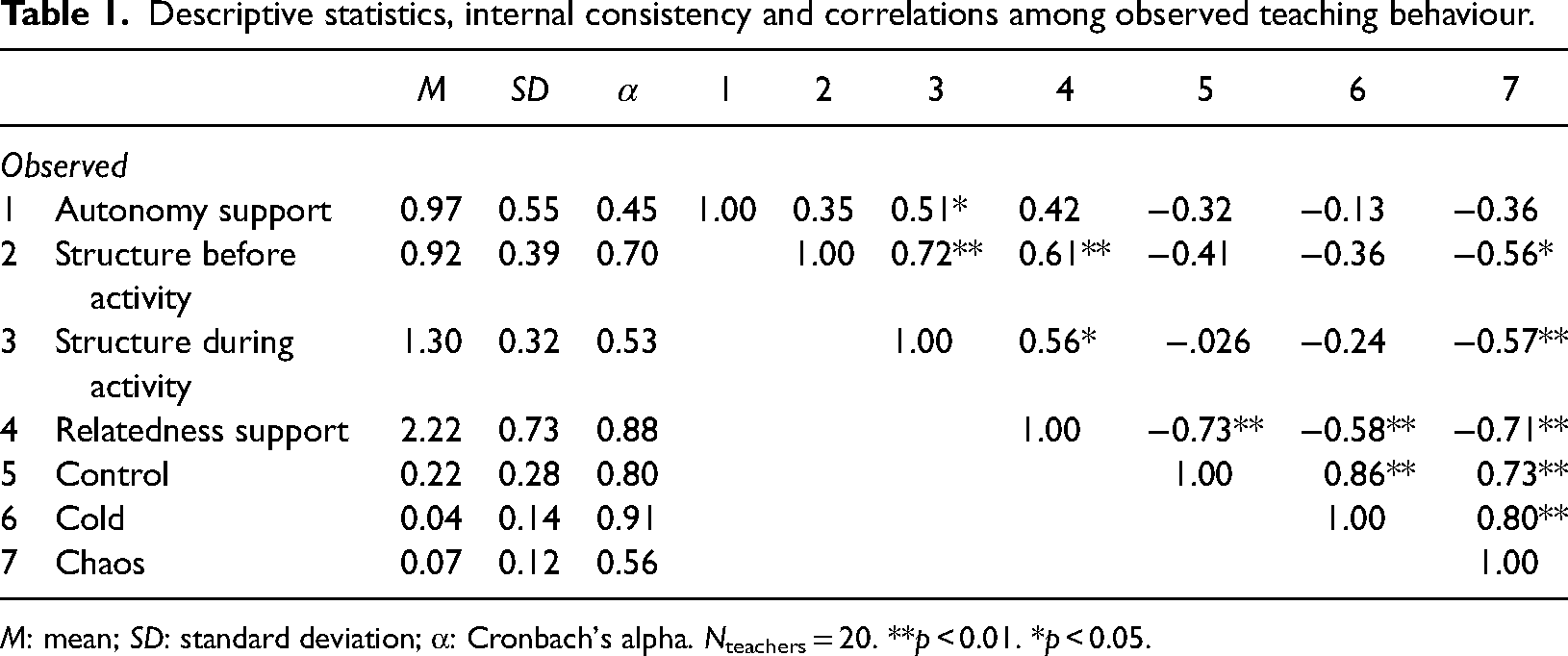
M: mean; SD: standard deviation; α: Cronbach's alpha. Nteachers = 20. **p < 0.01. *p < 0.05.
Regarding the significant correlations among the factors of observed teaching behaviour, the observed autonomy support was positively correlated with structure during the activity (r = 0.51, p < 0.05). The observed structure before the activity was positively correlated with structure during the activity (r = 0.72, p < 0.01) and relatedness support (r = 0.61, p < 0.01), and negatively correlated with chaotic teaching (r = −0.56, p < 0.05). The observed structure during the activity was positively correlated with relatedness support (r = 0.56, p < 0.05) and negatively correlated with chaotic teaching (r = −0.57, p < 0.01). There was a significant negative correlation between relatedness support and all the factors of need-thwarting teaching behaviour (control: r = −0.73, p < 0.01, cold: r = −0.58, p < 0.01, chaos: r = −0.71, p < 0.01), and relatedness support had a significant positive relationship with structure before and during the activity. Among the factors of need-thwarting teaching behaviour, the observed controlling teaching was positively correlated with cold (r = 0.86, p < 0.01) and chaotic (r = 0.73, p < 0.01) teaching. Furthermore, there was a significant positive correlation between cold teaching and chaotic teaching (r = 0.80, p < 0.01). Also, chaotic teaching had a significant negative relationship with structure before and during the activity, and relatedness support.
In terms of the relationships among the pupils’ variables of affective outcomes, the results showed that pupil variables were significantly correlated (see Supplemental Material B). All need satisfaction outcomes were positively correlated with autonomous motivation, positive affect, and SOC, whereas they were negatively correlated with all need frustration outcomes, controlled motivation, amotivation, and negative affect. All need frustration outcomes showed significant positive correlations with controlled motivation, amotivation, and negative affect. In contrast, they were negatively correlated with autonomous motivation, positive affect, and SOC. Autonomous motivation demonstrated a significant positive correlation with positive affect and SOC, whereas it was negatively associated with controlled motivation, amotivation, and negative affect. Controlled motivation was positively correlated with amotivation and negative affect, whereas there was a negative correlation with positive affect and SOC. Amotivation was positively correlated with negative affect and SOC. Finally, SOC was positively correlated with all need satisfaction outcomes, autonomous motivation, and positive affect, while it was negatively correlated with all need frustration outcomes, controlled motivation, amotivation, and negative affect.
In Table 2, the matrix represents class-level correlation coefficients of the relationship between observed teaching behaviour and pupils’ variables of affective outcomes. With regard to the relationships between the observed teaching behaviour and pupils’ variables at the class level, the factor of observed structure before the activity demonstrated a significant positive correlation with all need satisfaction outcomes (autonomy: r = 0.66, p < 0.05, competence: r = 0.63, p < 0.05, relatedness: r = 0.62, p < 0.05) and autonomous motivation (r = 0.69, p < 0.05), whereas it was negatively correlated with all need frustration outcomes (autonomy: r = −0.74, p < 0.05, competence: r = −0.62, p < 0.05, relatedness: r = −0.67, p < 0.05) and amotivation (r = −0.66, p < 0.05). Furthermore, there was a significant positive correlation at the class level between the factor of observed controlling teaching and autonomy frustration (r = 0.57, p < 0.05).
Multi-level correlations between observed teaching behaviour and pupils’ variables of affective outcomes.
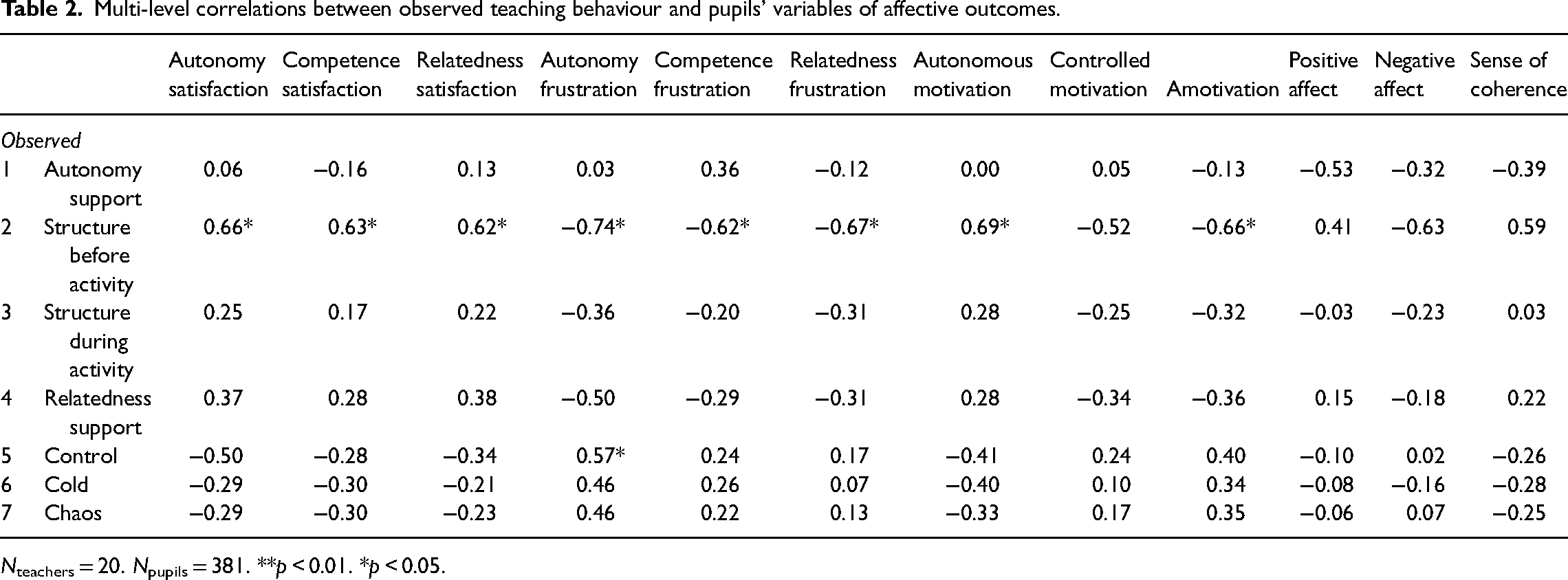
Nteachers = 20. Npupils = 381. **p < 0.01. *p < 0.05.
The results of the hierarchical linear models (see Supplemental Material C) indicated a significant variance at the class level in all null models for autonomy satisfaction (x2(19) = 52.69, p < 0.01, ICC = 8%), competence satisfaction (x2(19) = 70.44, p < 0.01, ICC = 12%), relatedness satisfaction (x2(19) = 61.86, p < 0.01, ICC = 10%), autonomy frustration (x2(19) = 93.75, p < 0.01, ICC = 16%), competence frustration (x2(19) = 69.79, p < 0.01, ICC = 12%), relatedness frustration (x2(19) = 57.52, p < 0.01, ICC = 9%), autonomous motivation (x2(19) = 73.99, p < 0.01, ICC = 12%), controlled motivation (x2(19) = 66.24, p < 0.01, ICC = 11%), amotivation (x2(19) = 59.42, p < 0.01, ICC = 17%), positive affect (x2(19) = 74.24, p < 0.01, ICC = 13%), negative affect (x2(19) = 38.85, p < 0.01, ICC = 5%), and SOC (x2(19) = 31.26, p < 0.01, ICC = 3%). The results from models that included the observed teaching behaviour showed that the factor of the structure before the activity was significantly positively related to autonomy satisfaction (β = 0.54, SE = 0.21, t(12) = 2.54, p < 0.05), competence satisfaction (β = 0.82, SE = 0.24, t(12) = 3.34, p < 0.01), relatedness satisfaction (β = 0.74, SE = 0.28, t(12) = 2.62, p < 0.05), autonomous motivation (β = 0.82, SE = 0.25, t(12) = 3.26, p < 0.01), positive affect (β = 0.68, SE = 0.22, t(12) = 3.10, p < 0.01), and SOC (β = 0.67, SE = 0.27, t(12) = 2.50, p < 0.05). In contrast, there was a significant negative relationship between the factor of the structure before the activity and autonomy frustration (β = −0.68, SE = 0.22, t(12) = −3.10, p < 0.01), competence frustration (β = −0.72, SE = 0.21, t(12) = −3.39, p < 0.01), relatedness frustration (β = −0.58, SE = 0.20, t(12) = −2.83, p < 0.05), amotivation (β = −0.69, SE = 0.27, t(12) = −2.54, p < 0.05), and negative affect (β = −0.34, SE = 0.12, t(12) = −2.85, p < 0.05). Furthermore, as the score of observed autonomy support was higher, the score of competence frustration was significantly higher (β = 0.32, SE = 0.12, t(12) = 2.60, p < 0.05), and the score of positive affect was significantly lower (β = −0.45, SE = 0.13, t(12) = −3.52, p < 0.01).
Discussion
This study aimed to understand the practices of pedagogies of affect that naturally occur in PE in response to urgent mental health issues among young people. In this respect, this study was the first to attempt to examine the relationships between observed naturalistic teaching behaviours and pupils’ affective outcomes, including motivational experiences within SDT. In this section, we will discuss the reliability of the scale for observed teaching behaviours, followed by a discussion of the relationships among pupils’ variables of affective outcomes, and the relationships between observed teaching behaviours and pupils’ variables.
Observed teaching behaviours
The findings showed that the factors of the observed structure before the activity (α = 0.70), relatedness support (α = 0.88), controlling teaching (α = 0.80), and cold teaching (α = 0.91) had adequate levels of internal consistency, while the factors of observed autonomy support (α = 0.45), structure during the activity (α = 0.53), and chaotic teaching (α = 0.56) did not demonstrate a satisfactory level of internal consistency. Indeed, previous studies reported a similar issue. Haerens et al. (2013) reported moderate reliability of autonomy support with a Cronbach's alpha of 0.59. This was also the case in Van den Berghe et al. (2013), where the researchers noted that the internal consistency for observed autonomy support and chaotic teaching was low, with a Cronbach's alpha of 0.30 and 0.48, respectively. These results, including this study's findings, indicate that the current form of the observation tool might not reflect autonomy support, structure during the activity, and chaotic teaching as precisely as the dimensions theoretically proposed in SDT. Alternatively, additional items may be needed to formulate each dimension solely and systematically. Based on SDT research, Aelterman et al. (2019) recently developed a new integrative scale of teaching styles with four factors (i.e. autonomy support, structure, control, and chaos) that are more closely related to each other as an alternative to separate scales for the three psychological needs. This can ensure a more systematic assessment of teaching styles, which could be used for further refinement of the observation tool.
In terms of the relationships among the factors of observed teaching behaviour, it should be recognised that teachers whose behaviour showed higher levels of structure during the activity were more likely to show higher levels of autonomy support, structure before the activity, and relatedness support. The significant teaching behaviours, such as providing students with a rationale for tasks, delivering substantive feedback, and offering necessary help during activities, also contributed to autonomy and relatedness support. Previous studies also showed that providing the aspects of structure in an autonomy-supportive way would benefit optimal pupils’ motivational experiences (Aelterman et al., 2019; Jang et al., 2010). Furthermore, we found a binary relation between relatedness support and need-thwarting teaching behaviours. This result could indicate that the presence of relatedness support, including teachers attuning and empathy, would be necessary to refrain from need-thwarting behaviour.
Relationships among the pupils’ variables of affective outcomes
Regarding the relationships among the pupils’ variables of affective outcomes, in line with SDT, the results showed that need satisfaction was significantly related to autonomous motivation and negatively related to amotivation, whereas need frustration was significantly related to controlled motivation and amotivation, which was consistent with Haerens et al. (2015). The present study also showed that positive affect was related to all need satisfaction outcomes, lower all need frustration outcomes, higher autonomous motivation, lower controlled motivation, and lower amotivation, while negative affect was related to lower all need satisfaction outcomes, higher all need frustration outcomes, lower autonomous motivation, higher controlled motivation, and higher amotivation. Behzadnia et al. (2018) similarly found significant relationships among need satisfaction, need frustration, autonomous and controlled motivation, and positive and negative affect. Importantly, the present study indicated that SOC was related to higher all need satisfaction outcomes, autonomous motivation, positive affect, and lower all need frustration outcomes. This finding aligns with previous research suggesting that meeting the three basic psychological needs and experiencing positive affect are important predictors of a sense of meaning in life (Martela et al., 2018). Furthermore, SOC elaborates on the salutogenic framework for health promotion (Antonovsky, 1996). From a salutogenic perspective, PE has the potential to enhance health and well-being by focusing on understanding the meaning of the activity, as well as recognising the meaningfulness within movements (Fletcher and Ní Chróinín, 2022; Quennerstedt, 2019). For practical implications, when pupils perceive activities as meaningful and connecting with their core values, they are more likely to be motivated to engage in activities (Boonekamp et al., 2021). Consequently, this heightened motivation can lead to more positive affective outcomes.
Relationships between observed teaching behaviours and pupils’ variables of affective outcomes
The results showed that the factor of the observed structure before the activity was significantly related to pupils’ basic psychological need satisfaction, autonomous motivation, positive affect, and SOC, whereas it had a negative association with their basic psychological need frustration, amotivation, and negative affect. This result suggested that teachers who provided clear instructions and rationales for the activities might have made pupils feel more comfortable engaging in the lessons, thereby increasing their autonomous motivation and producing affective outcomes. Teaching strategies in relation to the structure before the activity include adapting tasks to suit each pupil's ability, designing challenging activities, and providing effective models before task participation (Leo et al., 2022a). Conversely, teachers’ provision of ambiguous or unclear instructions and rationales before the activity might impact pupils’ feelings of frustration, demotivation, and negative affect. This finding reinforces the significance of teachers’ provision of structure in fostering pupils’ autonomous motivation and minimising amotivation in PE classes (Chu and Zhang, 2018; Leo et al., 2022a, 2022b, 2022c). Moreover, we found that the observed controlling teaching behaviour had a positive correlation with autonomy frustration. This finding can add to previous research that observed that control was related to controlled motivation and amotivation (De Meyer et al., 2014) and lower student engagement (González-Peño et al., 2021). Also, it should be noted that autonomy frustration had no significant relationship with all the dimensions of teaching styles when including them in the hierarchical linear model. Instead, only the observed structure before the activity had a negative significant relation in the model. In other words, the relationship between observed controlling teaching behaviour and autonomy frustration was significantly correlated interchangeably when simply looking at the two variables, but the correlation may have been influenced by the introduction of the observed structure before the activity, which significantly coincided with the lessons. Nevertheless, the findings indicate that the small effect size limits its application to practice. Probably, it does not mean that observed teaching behaviour has a direct impact on pupils’ psychological variables, though they are significantly correlated. Notwithstanding, the effect size results are meaningful in that they can be used for future research on international and cross-cultural comparisons and future meta-analyses on the influence of observed teaching behaviour on pupils’ outcomes.
It should be noted that no significant relationships were found between the remaining factors of observed teaching behaviours (i.e. relatedness support, cold, and chaos) and pupils’ variables of affective outcomes. A potential explanation for these non-significant associations is the low internal consistency and the sample size used in this study, which could be considered limitations of this study. An explanation for the non-significant relationship between the observed relatedness support and pupils’ affective outcomes is that teachers’ relatedness support, such as being empathic and warm, may not have aligned with pupils’ expectations and needs. It perhaps led to a mismatch between what teachers intended to communicate and what pupils perceived or interpreted. Alternatively, relatedness could be perhaps most influenced by peers rather than teachers (Vasconcellos et al., 2020). Hence, in this study, the fact that teachers’ relatedness support was observed did not mean that there was an increase in pupils’ relatedness satisfaction at the class level, which had little correlation with affective outcomes. Moreover, especially for the factors of control and chaos, we knew we were less likely to observe the participating teachers exhibiting cold and chaotic teaching behaviours since they had expressed an interest in the affective domain during the purposive sampling. If a larger sample size was obtained with simple random sampling, cold and chaotic teaching behaviours could potentially be observed more readily.
Strengths, limitations, and future research
The most important contribution of this study to pedagogical research was examining the relationships between observed naturalistic teaching behaviours and pupils’ affective outcomes, which is crucial because observational studies provide direct evidence of teacher–pupil interactions in real-life contexts. However, there are some limitations to be considered. First, we did not provide a satisfactory level of internal consistency in the observation tool. While Haerens et al. (2013) provided compelling evidence supporting the validity of the observation tool, indicating significant relationships with pupil perceptions, this was probably not the case in the present study. Further investigations are needed to develop an observation tool to measure teaching behaviours as precisely as possible. Second, we filmed only one lesson from each teacher, so teachers’ general teaching style might not have been captured. For instance, even if lower autonomy support was observed in one lesson, it could be an isolated incident, and the teacher might offer higher autonomy support usually, and vice versa. As teachers could behave differently in every lesson depending on day-to-day circumstances, future research should adopt a longitudinal approach to reflect teachers’ general teaching styles and changes. Simultaneously, it should be necessary to consider pupils’ affective outcomes in the long term, rather than in a single lesson, which might produce one-off outcomes.
Conclusions
This study aimed to examine the relationships between observed need-supportive teaching and need-thwarting behaviours and pupils’ basic psychological need satisfaction and frustration, (de)motivation, positive and negative affect, and SOC. The results showed that the factor of the observed structure before the activity was significantly related to affective outcomes. However, no significant relationships were found between the observed relatedness, cold, chaos, and pupils’ variables of affective outcomes. Nonetheless, the study findings are important because, to the best of our knowledge, this study is the first to investigate the relationships between teaching behaviours and pupils’ affective outcomes through observations and in line with SDT research. However, further research is needed to develop an observation tool to measure teaching behaviours in relation to pupils’ affective outcomes and to consider the long-term change in teaching and learning. Overall, this study reaffirms the necessity of implementing pedagogies of affect to respond to the key issues of school PE, especially those related to pupils’ mental health and well-being. Concerning practical implications, the findings of this study implore teachers to practice need-supportive teaching and avoid need-thwarting teaching in their lessons on a regular basis. In particular, the provision of structure appeared to be the most significant form of need-supportive teaching. Teachers can develop the provision of structure by establishing clear expectations for activities, providing appropriate challenges for advanced learners, and offering additional support or modifications for pupils who may require it. This, in turn, helps meet the diverse needs of each pupil, enhancing affective outcomes and potentially contributing to better mental health.
Supplemental Material
sj-docx-1-epe-10.1177_1356336X231186751 - Supplemental material for Examining how observed need-supportive and need-thwarting teaching behaviours relate to pupils’ affective outcomes in physical education
Supplemental material, sj-docx-1-epe-10.1177_1356336X231186751 for Examining how observed need-supportive and need-thwarting teaching behaviours relate to pupils’ affective outcomes in physical education by Eishin Teraoka, Félix Enrique Lobo de Diego and David Kirk in European Physical Education Review
Footnotes
Declaration of conflicting interests
The author(s) declared no potential conflicts of interest with respect to the research, authorship, and/or publication of this article.
Funding
The author(s) received no financial support for the research, authorship, and/or publication of this article.

Supplemental material
Supplemental material for this article is available online.
Author biographies
References
Supplementary Material
Please find the following supplemental material available below.
For Open Access articles published under a Creative Commons License, all supplemental material carries the same license as the article it is associated with.
For non-Open Access articles published, all supplemental material carries a non-exclusive license, and permission requests for re-use of supplemental material or any part of supplemental material shall be sent directly to the copyright owner as specified in the copyright notice associated with the article.
