




Abstract
This study compared the psychological well-being of choral singers to those who took part in five other activities: solo singers, band/orchestra members, solo musicians, team sport players, and solo sport players. These comparison groups were chosen because they each share (or lack) three key features of choral singing: (a) singing, (b) the production of music, and (c) membership of a social group or team. A total of 194 participants completed an online questionnaire to assess their well-being and the extent to which their chosen activity satisfies their psychological needs for autonomy, competence, and relatedness. Analysis indicated that participants who sang in a choir reported similar levels of psychological well-being, happiness, anxiety, depression, and self-esteem to those who took part in the other five leisure activities. Significant differences were found on measures of autonomy and relatedness, but participants in all six groups also reported experiencing similar levels of competence when engaged in their chosen leisure activity. These findings suggest choral singing may not be uniquely beneficial, and any leisure activity that offers opportunities for improvement, mastery of a new skill, or a sense of accomplishment might have a positive effect on our psychological well-being.
There is a growing body of evidence to suggest that choral singing might have a significant positive impact upon psychological well-being (e.g., Clift & Hancox, 2010; Clift, Nicol, Raisbeck, Whitmore, & Morrison, 2007; Stewart & Lonsdale, 2016). For example, recent investigations suggest that choral singing is likely to have a positive impact on an individual’s mood, reduce stress and anxiety, enhance subjective well-being, and increase happiness (e.g., Clift et al., 2007; Clift, Nicol, Raisbeck, Whitmore, & Morrison, 2010; Grape, Sandgren, Hansson, Ericson, & Theorell, 2003; Kreutz, Bongard, Rohrmann, Hodapp, & Grebe, 2004; Linnemann, Schnersch, & Nater, 2017; Sanal & Gorsev, 2014). However, it is not clear whether these benefits are unique to choirs, or what mechanisms underlie the apparent positive relationship between choral singing and well-being.
Clift and Hancox (2010) identified six possible explanations for the positive effects of choral singing: improved mood, focused attention, deep breathing, social support, cognitive stimulation, and regular commitment. However, it is unclear if these perceived benefits could be uniquely attributed to choral singing. This study, therefore, explored whether choral singers report higher psychological well-being than those who regularly take part in other leisure activities, and if so, what aspects of singing in a choir might be responsible for these effects.
To date, there have been only a handful of studies that have compared the psychological effects of choral singing to those of other leisure activities. For example, a number of studies have found evidence to suggest that the social aspect of various leisure activities, including choral singing, attending church, and engaging in sports and creative writing classes, are likely to have a positive effect on people’s psychological well-being (Hills & Argyle, 1998a, 1998b; Pearce, Launay, Machin, & Dunbar, 2016; Stewart & Lonsdale, 2016; Valentine & Evans, 2001). However, previous investigations have rarely extended beyond a comparison of two or three groups and the comparison groups do not seem to have been chosen in a systematic way that is likely to highlight the possible mechanisms responsible for the benefits of choral singing.
In this study, six different activity groups were compared to elucidate the “active ingredient(s)” that might be responsible for the psychological benefits that choral singers seemingly experience when singing with others: choral singers, solo singers, musicians in a band/orchestra, solo musicians, team sports players, and solo sports participants. These comparison groups each share (or lack) three key aspects of choral singing: (a) singing, (b) the production of music, and (c) membership of a social group or team. In each case, previous research has shown that these three factors might serve as likely candidates to explain the apparent psychological benefits of choirs.
Singing
The therapeutic benefits of singing have long been suspected, and this has now been supported by quantitative evidence (Clark & Harding, 2012). Lower levels of negative feelings and higher levels of positive feelings have both been related to regular amateur singing (Grape et al., 2003; Kreutz et al., 2004). Alongside this, evidence suggests that singing may induce significant physiological benefits, such as decreased cortisol levels and improved immune response (Beck, Cesario, Yousefi, & Enamoto, 2000; Beck, Gottfried, Hall, Cisler, & Bozeman, 2006; Grape et al., 2003; Kreutz et al., 2004; Valentine & Evans, 2001). Indeed, a recent systematic review highlighted the possible psychosocial benefits of singing as a therapeutic intervention (Clark & Harding, 2012). This study aimed to compare the psychological well-being of choral and solo singers with that of participants who took part in leisure activities that did not require them to sing.
Musical production
While singing appears to have significant effects on physiological and psychological well-being, these apparent benefits might not be limited to the vocal production of music, and it is possible that these positive effects extend to all forms of active musical production. Research has shown that various forms of music production can have a positive effect on people’s emotional state, self-perception, and overall cognitive function, and in some cases, it can even help individuals overcome psychological trauma (Costa-Giomi, 2004; Gold, Voracek, & Wigram, 2004; Hallam, 2010; Lindberg, 1995; Staricoff, 2004). For example, there is a positive relation between participation in music production and self-esteem (Costa-Giomi, 2004; Lindberg, 1995).
Active music making has also been found to have a positive impact upon the psychological well-being of elderly individuals (Creech, Hallam, Varvarigou, McQueen, & Gaunt, 2013; Hays & Minichiello, 2005). Furthermore, playing music appears to have profound effects upon the emotional and cognitive capabilities of a range of individuals (see Hallam, 2010 for a review). This study, therefore, aimed to compare choral and solo singers to individuals who took part in leisure activities that involved the non-vocal production of music (i.e., solo musicians and musicians in a band/orchestra) as well as with those who took part in non-musical activities (i.e., team sports players and solo sports participants).
Group membership
There is also good reason to suspect that the psychological benefits of choirs might actually have little to do with singing and/or the production of music. Indeed, a number of studies have indicated that the apparent positive effects of choral singing may stem primarily from being a member of a cohesive social group (Dingle, Brander, Ballantyne, & Baker, 2013; Pearce et al., 2016; Stewart & Lonsdale, 2016). For example, Stewart and Lonsdale (2016) found that choral singers and team sports players reported significantly higher well-being than solo singers. Pearce et al. (2016) also showed that feeling part of a collective group or a “community” may promote psychological and physical well-being among choral singers and those in non-singing social groups.
In both cases, these studies suggest that the self-reported well-being of individuals who regularly took part in leisure activities as part of a group or team (i.e., team sports and creative writing/crafts classes) did not significantly differ to those who sang in a choir. With this in mind, this study also sought to compare participants who pursued their chosen leisure activity as part of a social group/team (i.e., choral singers, musicians in a band/orchestra, and team sports players) with those who took part in similar activities on their own as an individual (i.e., solo singers, solo musicians, and solo sports participants). If group membership is responsible for the psychological benefits of choral singing, we might expect people who engage in a leisure activity as part of a group or team to report higher levels of psychological well-being than those who take part in similar activities on their own.
Self-determination theory
A review of research concerned with choral singing and well-being found that many studies on this subject have failed to put forward a coherent theoretical framework to make sense of their findings (Clift et al., 2010). This failure arguably makes it difficult to arrive at any meaningful conclusions about the precise mechanism(s) responsible for the apparent psychological benefits of choral singing. Recent research on this topic indicates that self-determination theory (SDT; Deci & Ryan, 2000) might be suitable for this purpose.
SDT is based on the assumption that we all have the same innate psychological needs: autonomy, competence, and relatedness. The need for “competence” is thought to be satisfied through successfully completing a task, achieving a goal, or the mastery of a skill (Deci & Ryan, 2000). The need for “relatedness” refers to the desire for acceptance and is satisfied through the development of interpersonal relations and social connections (Deci & Ryan, 2000). Finally, the need for “autonomy” is often satisfied when a person feels able to make their own decisions without feeling pressure or restriction from others (Deci & Ryan, 2000). According to SDT, the satisfaction of these three needs forms the basis for our motivation and personality, as well as our happiness and psychological well-being (Ryan & Deci, 2000).
To date, two studies have attempted to apply SDT to better understand the benefits of choral singing. Livesey, Morrison, Clift, and Camic (2012) asked amateur choral singers open-ended questions about the perceived benefits of choral singing. Qualitative analysis of these responses revealed that the perceived benefits were evident in social, emotional, physical, and cognitive domains. Livesey et al. (2012) interpreted some of these benefits in relation to SDT. For example, Livesey et al. (2012) interpreted the reported social benefits of choral singing (e.g., social networking and sense of belonging) as perhaps satisfying participants’ need for relatedness.
Stewart and Lonsdale (2016) were the first to quantitatively assess the satisfaction of these three psychological needs among choral singers. Choral singers, solo singers, and team sport players were asked to indicate the extent to which they experienced satisfaction of the needs for autonomy, competence, and relatedness while engaged in their chosen activity. It was found that choral singers’ self-reported competence and relatedness did not significantly differ to that reported by solo singers and team sport players. However, interestingly, choral singers’ experience of autonomy was significantly lower than solo singers and team sports players.
These findings suggested that specific leisure activities may satisfy a particular set of psychological needs and this may account for their different effects on well-being. In this instance, Stewart and Lonsdale (2016) proposed that choral singers may (inadvertently or deliberately) forego their need for autonomy when they join a choir, but this apparent deficit might be somehow outweighed by the psychological benefits of belonging to a cohesive social group. Through a systematic comparison with several other relevant leisure activities, this study was intended to shed further light on the mechanism(s) responsible for the apparent psychological benefits of choral singing.
The present study
In summary, this study compared the psychological well-being and “basic need” fulfillment of those engaged in six leisure activities (i.e., choral singers, solo singers, band/orchestra members, solo instrumentalists, team sport players, and solo sport players). These six activities were systematically chosen because they each share (or lack) different aspects of choral singing (i.e., singing, musical engagement or being a member of a group). In addition to this, participants’ personality, demographics, and the importance of a participant’s chosen leisure activity to their sense of identity were also examined. In each case, these factors have each been found to influence musical behavior and well-being (e.g., Ingledew, Markland, & Sheppard, 2004; North, Hargreaves, & O’Neill, 2000; Pinquart & Sörensen, 2001; Ryan & Deci, 2001; Stone, Schwartz, Broderick, & Deaton, 2010; Thoits, 1992; Weiss, Bates, & Luciano, 2008), and significant differences on these variables (if found) might confound our analysis.
It is clear that choral singing is a complex, multi-factorial activity; it is a communal/group-based activity and one where participants are actively engaged in the production of music through the careful coordination of several synchronous and asynchronous voices. It is entirely possible that these three factors (i.e., singing, the production of music, and group membership) may not simply be additive, but when integrated into one activity, like choral singing, these factors may interact with each other to have a greater effect on well-being than activities where there is only one or two of these factors present (e.g., team sport or solo singing). If this is the case, we would expect choral singers to report significantly higher well-being than the other five participant groups. However, given that this study was the first to compare these six leisure activities, there were little grounds to make specific predictions beyond this. Through a systematic comparison with other relevant leisure activities, this study aimed to investigate whether or not there are unique psychological benefits associated with choral singing and to offer further insight on the factors that might underlie this.
Method
Participants
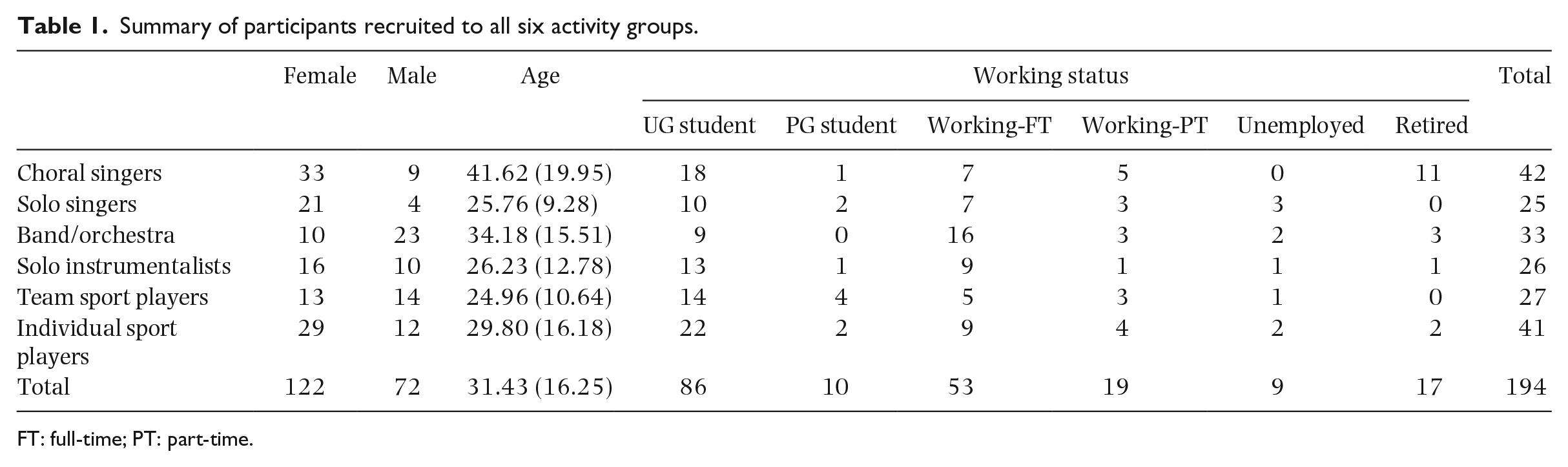
One hundred and ninety four participants (122 females and 72 males) were recruited via email or social media and took part in the study voluntarily. Participants’ mean age was 31.43 years (SD = 16.25) and ranged from 18 to 84 years old. Table 1 displays the number of participants in each of the six activity groups, their gender, average age, and working status.
Summary of participants recruited to all six activity groups.
FT: full-time; PT: part-time.
Measures
Participants were required to complete an online questionnaire concerned with their chosen leisure activity, their well-being, and a variety of other psychological factors. This questionnaire first asked participants if they engaged in one of six activities: (a) choral singing; (b) solo singing (defined as “singing alone and in front of people, with or without accompaniment”); (c) playing an instrument as part of a band/orchestra; (d) playing an instrument as a solo artist (defined as “playing alone and in front of people, with or without singing accompaniment”); (e) playing a team sport; and (f) taking part in an individual sporting activity (defined as “playing a sport or exercising alone [e.g., running] or against another individual [e.g., tennis]”). It was made clear that participants were only eligible to participate in this study if they were aged 18 or over and took part in one or more of the six activities at least once a week. If participants engaged in two or more of the six activities, participants were instructed to select the activity that was most important to them; the selected activity formed the basis of all subsequent questions for each participant.
Hedonic well-being
An adapted version of the hedonic well-being measure (Clift & Hancox, 2010; Stewart & Lonsdale, 2016) was used to assess the pleasure that participants experienced while engaging in their chosen activity. Participants were asked to rate the extent to which they agreed with 12 statements (e.g., “[Playing a team sport] is something that helps me feel a lot happier in myself afterwards”), using a 5-point rating scale (1 = strongly disagree, 5 = strongly agree). Scores range from 12 to 60, where high scores indicate more pleasure gained from activity. In this study, this 12-item scale was found to be internally consistent (α = .81).
Satisfaction of basic psychological needs
The “Basic need satisfaction at work” scale (Kasser, Davey, & Ryan, 1992), originally adapted by Stewart and Lonsdale (2016), was used to assess the extent to which individual’s participation in their chosen activity was perceived to satisfy their needs for autonomy, competence, and relatedness. Participants were asked to rate the extent to which they agreed with 21 statements (e.g., “I feel competent [when I sing solo]”) using a 7-point rating scale (1 = not at all true, 7 = very true). In this study, two of the three sub-scales were found to be internally consistent (autonomy α = .73—seven items; relatedness α = .85—eight items). However, the internal consistency for the competence subscale was found to fall just below the acceptable threshold (α = .69—six items).
Hedonic and eudaimonic well-being
The Mental Health Continuum–Short Form (MHC-SF; Keyes, 2006; Keyes et al., 2008) was used to measure participants’ emotional (i.e., hedonic well-being), social, and psychological well-being (i.e., eudaimonic well-being). Participants were asked to rate how often (e.g., 0 = never, 5 = everyday) they had experienced different scenarios/feelings in the last month. This 14-item measure is divided into three sub-scales: (a) emotional well-being (e.g., “During the past month, how often did you feel happy?”—three items); (b) social well-being (e.g., “During the past month, how often did you feel that you belonged to a community?”—five items); and (c) psychological well-being (i.e., “During the past month, how often did you feel that your life has a sense of direction or meaning to it?”—six items). Scores on each subscale were calculated as the mean of the relevant items. In this study, all three sub-scales were found to be internally consistent (α = .88, .79, and .85).
Overall happiness
The Oxford Happiness Questionnaire–Short Form (OHQ-SF) was used to measure overall happiness (Hills & Argyle, 2002). Participants were asked to rate the extent to which they agreed (1 = strongly disagree, 6 = strongly agree) with eight statements concerning their general well-being (e.g., “I feel that life is very rewarding”). The OHQ-SF scores range from 8 to a 48, where high scores indicate greater happiness. In this study, the OHQ-SF was found to be internally consistent (α = .83).
Life satisfaction
A single item (“How satisfied are you with your life as a whole?”) was used to assess overall life satisfaction (Cummins, Eckersley, Pallant, Van Vugt, & Misajon, 2003). Participants were asked to indicate their life satisfaction using an 11-point scale (0 = completely unsatisfied, 10 = completely satisfied).
Depression and anxiety
The four-item Patient Health Questionnaire (PHQ-4; Kroenke, Spitzer, Williams, & Löwe, 2009) was used as a brief measure of sub-clinical depression and anxiety. Participants were asked how often they have been experiencing four different problems (e.g., “Feeling nervous, anxious or on edge”) in the last 2 weeks, using a 4-point rating (0 = not at all, 3 = nearly every day). Scores for anxiety and depression were calculated as the average of the two relevant responses. Individuals who score under 3 are not considered to have clinical anxiety or depression.
Self-esteem
The Rosenberg Self-Esteem Scale (RSES; Rosenberg, 1965) was used to assess participant’s global feelings of self-worth. Participants were asked to rate the extent to which they agreed with each of the 10 statements (e.g., “On the whole, I am satisfied with myself”), using a 4-point rating scale (0 = strongly disagree, 3 = strongly agree). Scores for self-esteem were calculated by summing responses to all items (i.e., RSES scores range from 0 to 30). In this study, the RSES was found to be internally consistent (α = .92).
Personality
The 10-Item Personality Inventory (Gosling, Rentfrow, & Swann, 2003) was used to measure the “Big Five” personality traits (i.e., extraversion, conscientiousness, openness to experience, agreeableness, and emotional stability). Participants were asked to rate the extent to which 10 statements (e.g., “I see myself as extraverted, enthusiastic”) accurately described them, using a 7-point rating scale (1 = disagree strongly, 7 = agree strongly). Scores for each of the five personality traits are calculated as the average of the two relevant items.
Importance to identity
Taken from the collective self-esteem scale (Luhtanen & Crocker, 1992), the “importance to identity” subscale was adapted to assess the subjective importance of a participant’s chosen leisure activity to their sense of identity. Participants were asked to rate the extent to which they agreed with each of the four statements (e.g., “Overall, [singing in a choir] has very little to do with how I feel about myself”) using a 7-point scale (1 = strongly disagree, 7 = strongly agree). Scores range from 4 to 28, where high scores indicate greater importance of activity choice to identity. In this study, the scale was found to be internally consistent (α = .85).
Results
Preliminary analysis
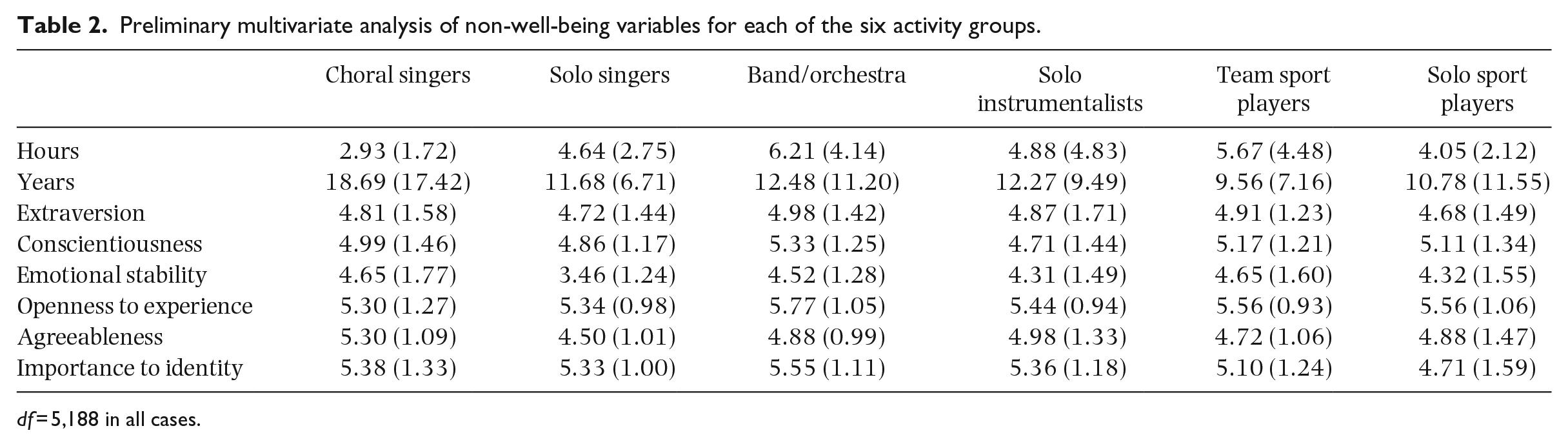
Prior to the main analysis, we checked if there were significant differences between the groups that might affect the analysis. There were significant associations between gender and activity, χ2(5) = 27.83, p < .001, and between working status and activity, χ2(25) = 47.16, p = .005, that can be seen in Table 2. Significant age differences were also found between the six groups, F(5, 188) = 6.35, p < .001,
Preliminary multivariate analysis of non-well-being variables for each of the six activity groups.
df = 5,188 in all cases.
A multivariate analysis of variance (MANOVA) was used to test if there were significant differences between the six activity leisure activity groups on any of the non-well-being variables under investigation (see Table 2 for a summary of group means). Multivariate analysis found significant differences between the six participant groups, F(40, 925) = 1.70, p = .005,
Significant differences were also found between the six groups in the number of years they have been doing the activity, F(5, 188) = 2.77, p = .019,
Main analysis
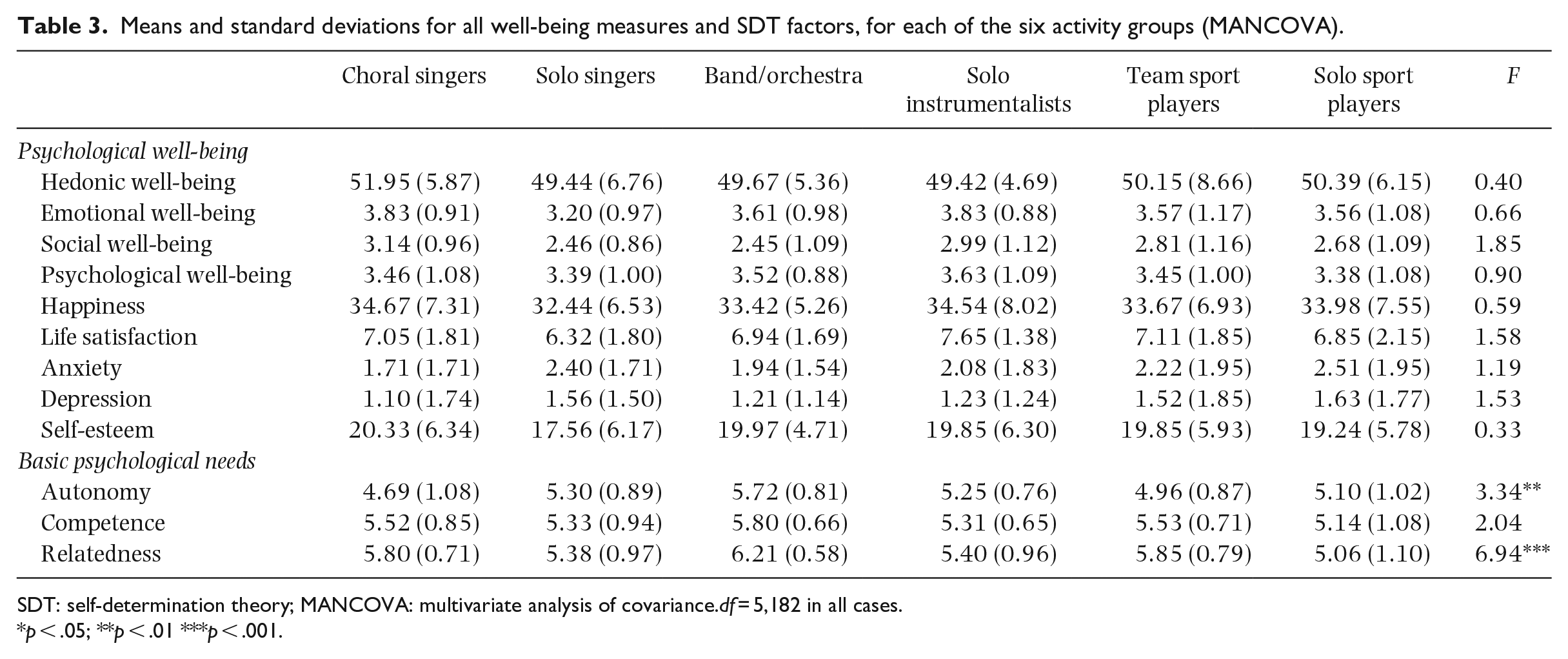
A multivariate analysis of covariance (MANCOVA) was used to assess the extent to which participants in each of the six groups differed on each of the measures of psychological well-being and the extent to which they felt their chosen leisure activity satisfied their basic needs (see Table 3 for a summary of group means) using participants’ gender, age, employment status, their weekly participation (hours per/week), the years engaged in the activity, and emotional stability as covariates. This multivariate analysis found significant differences between the six participant groups, F(60, 875) = 1.89, p < .001,
Means and standard deviations for all well-being measures and SDT factors, for each of the six activity groups (MANCOVA).
SDT: self-determination theory; MANCOVA: multivariate analysis of covariance.df = 5,182 in all cases.
p < .05; **p < .01 ***p < .001.
Bonferroni-adjusted post hoc tests revealed that band/orchestra members reported experiencing significantly more autonomy when engaged in their chosen activity than choral singers (p < .001) and team sports players (p = .031). Band/orchestra members also reported experiencing significantly higher levels of relatedness than solo instrumentalists (p = .007), solo singers (p = .006), and individual sport players (p < .001). Individual sport players were found to report significantly lower levels of relatedness than team sport players (p = .005) and choral singers (p = .002). Figure 1 offers a summary of these significant differences.
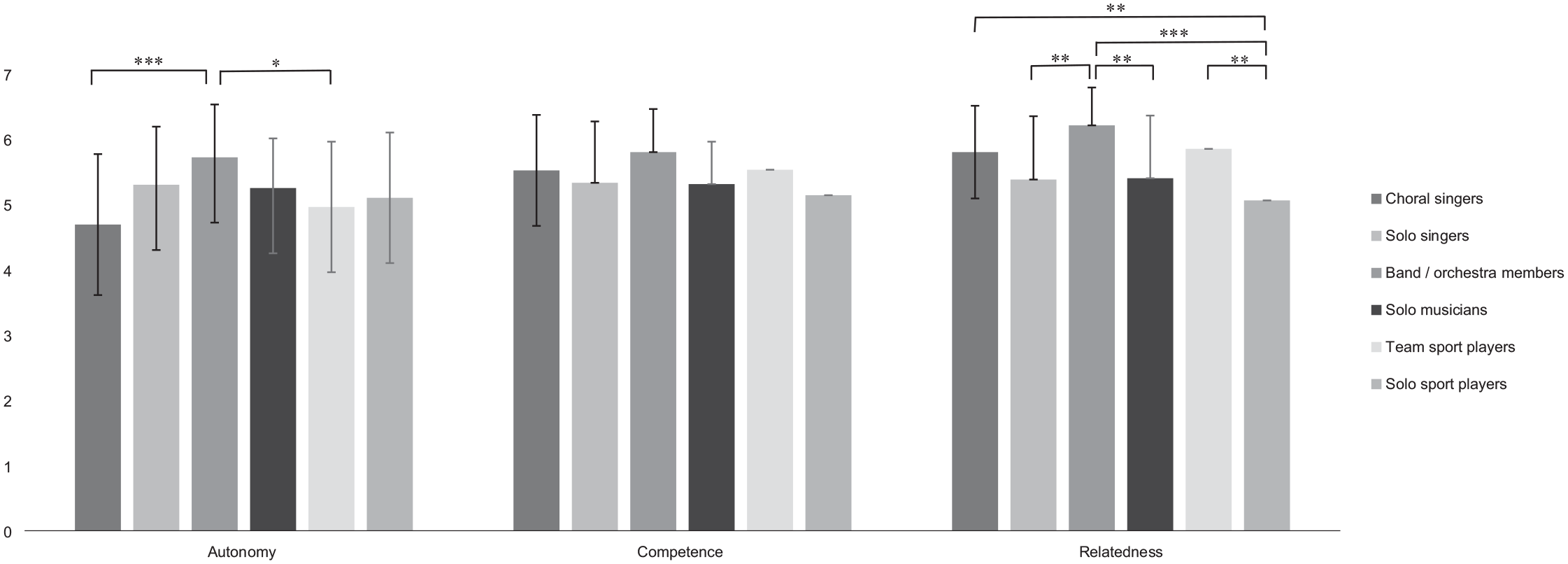
Summary of Post Hoc Analysis for Autonomy, Competence, and Relatedness Scores in Each of the Six Activity Groups.
Several multiple regressions were then conducted to test the extent to which participants’ engagement with their chosen activity (i.e., hours per week and number of years doing the activity and importance of their activity to their identity), and the extent to which it satisfies their basic psychological needs, could predict any of the nine measures of well-being. In each multiple regression, these three measures of engagement as well as self-reported experiences of autonomy, competence, and relatedness were used as predictor variables, and each measure of well-being was used as a separate outcome variable.
Table 4 shows that the number of years engaged in their chosen leisure activity significantly predicted participants’ happiness, self-esteem, and anxiety. Participants’ self-reported experiences of competence during their chosen leisure activity positively predicted scores for hedonic well-being, eudaimonic well-being, happiness, and self-esteem. Similarly, relatedness was found to significantly predict life satisfaction and anxiety; however, autonomy did not significantly predict any of the measures of well-being under investigation. The importance of participants’ activity to their identity was also found to positively predict the hedonic well-being experienced while engaging in that activity.
Standard multiple regression analyses.
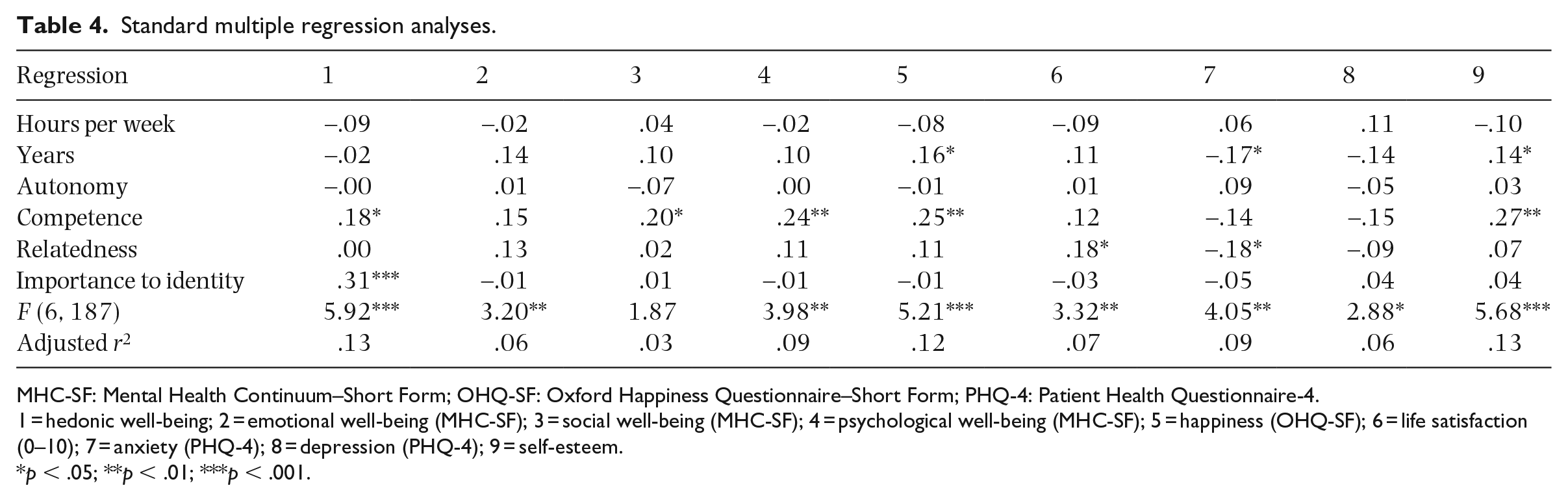
MHC-SF: Mental Health Continuum–Short Form; OHQ-SF: Oxford Happiness Questionnaire–Short Form; PHQ-4: Patient Health Questionnaire-4.
1 = hedonic well-being; 2 = emotional well-being (MHC-SF); 3 = social well-being (MHC-SF); 4 = psychological well-being (MHC-SF); 5 = happiness (OHQ-SF); 6 = life satisfaction (0–10); 7 = anxiety (PHQ-4); 8 = depression (PHQ-4); 9 = self-esteem.
p < .05; **p < .01; ***p < .001.
Discussion
This study compared the psychological well-being of choral singers to those who take part in other musical and non-musical leisure activities pursued either as part of a group or individually. Contrary to initial expectations, there were no significant differences in well-being between any of the six activity groups (i.e., choral singers, solo singers, band/orchestra members, solo instrumentalists, team sports players, and individual sports players). However, significant differences in autonomy and relatedness were found between the six groups. Furthermore, experiencing competence significantly predicted participant’s happiness, self-esteem, hedonic well-being, and eudaimonic well-being, whilst experiencing relatedness predicted greater life satisfaction and lower anxiety. The number of years that participants had engaged in their chosen leisure activity also significantly predicted happiness, self-esteem, and anxiety. What is more, the importance of participants’ leisure activity to their identity positively predicted the hedonic well-being experienced while engaging in that activity.
The present results suggest that choral singing may not be uniquely beneficial. Indeed, it was evident that participants who sang in a choir reported similar levels of psychological well-being, happiness, anxiety, depression, and self-esteem to those who took part in the other five activities under investigation. As an activity that integrates three factors known to have a beneficial effect on well-being (i.e., singing, musical engagement, and group membership), it was predicted that choral singers might report significantly higher well-being than the other five activity groups. However, the findings of the present investigation suggest that this is not the case.
Using SDT (Ryan & Deci, 2000) as a theoretical framework, we compared the extent to which each of the six activities was considered to have met participants’ basic psychological needs for autonomy, competence, and relatedness. Analysis showed that the six activity groups significantly differed on measures of autonomy and relatedness, but not competence. These significant differences imply that while the six activities under investigation may foster similar levels of well-being, it is possible that they may do so via different psychological mechanisms.
Comparison of participants’ relatedness scores showed that participants who pursued their activity as part of a group or team (i.e., choral singers, musicians in a band/orchestra & team sports players) tended to report higher levels of social connectedness than those who took part in similar activities on their own (i.e., solo singers, solo musicians, and solo sports participants). Specifically, participants who played an instrument as part of a band or orchestra experienced significantly more relatedness than solo instrumentalists, solo singers, and individual sport players. Similarly, choral singers and team sport players both reported significantly higher levels of relatedness than those who played sports on their own as an individual.
Comparison of autonomy scores indicated that choral singers and team sport players experienced the lowest autonomy of the six participant groups under investigation. Both groups experienced significantly lower feelings of autonomy than those who played music as part of a band or orchestra. Although all three of these leisure activities are pursued as part of a group, this finding arguably reflects more about the nature of the activity undertaken rather than anything concerning group membership alone. Musicians playing as part of a band or orchestra can play music concurrently or independently, and in many cases will often play a unique role in their group (e.g., playing as a lead or ensemble musician playing in brass, percussion, strings, or woodwind sections). In contrast, those performing as part of a choir or sports team are more likely to take on identical or very similar roles; this arguably means they are more readily obliged to forego their own sense of autonomy and individuality to the collective than musicians who play as part of a band/orchestra.
These significant differences suggest that SDT is likely to be a useful theoretical framework to understand the psychological effects of choral singing and other leisure activities. Despite this, it is somewhat difficult to reconcile the idea that these six activities appear to satisfy participants’ basic psychological needs to differing extents, alongside the absence of significant differences in overall well-being. The proponents of SDT (Deci & Ryan, 2000) would argue that activities or situations that support all three of an individual’s most basic needs are the ones most likely to promote psychological well-being. However, the present findings indicate that well-being might be brought about differently in each of the six activities examined, where participants may not necessarily require the balanced satisfaction of all three needs to experience well-being. For example, choral singers and musicians who play as part of a band or orchestra reported experiencing similar levels of competence and relatedness when engaged in their respective activities, but differed significantly in terms of their feelings of autonomy. Nonetheless, choral singers and members of a band/orchestras reported similar levels of psychological well-being, happiness, anxiety, depression, and self-esteem.
It is possible that individuals (inadvertently or deliberately) engage in a trade-off between their need for autonomy and their need for social connection when they take part in any leisure activity. This is in keeping with Stewart and Lonsdale’s (2016) suggestion that choral singers may forego their needs for autonomy when they join a choir, but the psychological benefits of belonging to such a cohesive social group may compensate for this. The only group to deviate from this pattern of unbalanced needs appeared to be musicians who played music as part of a band or orchestra; analysis indicated they scored highest on all three measures (autonomy, competence & relatedness). Future investigations should explore if an activity must satisfy all three basic needs equally to have a significant beneficial effect on well-being, or if it is simply necessary to have met a minimum threshold in each case.
Interestingly, participants in all six groups reported experiencing similar levels of competence when engaged in their activity. It is therefore entirely conceivable that any activity that offers opportunities for mastery, accomplishment, and improvement has the potential to have a beneficial effect on psychological well-being. This idea was further supported by the findings of the regression analyses. Indeed, it was evident that, regardless of the activity undertaken, feelings of competence significantly predicted participants’ happiness, self-esteem, hedonic well-being, and eudaimonic well-being.
In keeping with the predictions of SDT, relatedness significantly predicted participants’ scores on two measures of psychological well-being. That is, participants were more likely to report greater overall life satisfaction and lower anxiety if they experienced social connectedness and a sense of belonging when engaged in their activity. However, feelings of autonomy did not significantly predict participants’ well-being on any of the seven indices used. This finding is inconsistent with the predictions of SDT and merits further investigation.
Unexpectedly, the number of years that participants engaged in their activity significantly predicted happiness, self-esteem, and anxiety. However, the number of hours engaged in the activity each week did not significantly predict scores on any of the well-being measures. These findings suggest that long-term engagement in any musical or sporting activity might be pivotal to their positive effects on psychological well-being. Indeed, it is possible that the benefits of regularly pursuing an activity, like choral singing, are not immediately apparent for beginners and only become evident once an individual has reached a certain level of expertise/mastery, where they self-identify as a choral singer and/or social relationships with fellow group members have become sufficiently established. However, it is also possible that participants who experience significant psychological benefits from an activity tend to pursue it for longer than those who do not. In any case, these links warrant further investigation.
A recent literature review found evidence for a consensus among researchers that a “musician” is someone with at least 6 years of training (Zhang, Susino, McPherson, & Schubert, 2020); future studies might bear a threshold like this in mind when comparing the impact of different leisure activities on well-being. In this study, choral singers had been singing for significantly longer than those engaged in some of the other activity groups (i.e., individual & team sport players). Perhaps future investigations should aim only to recruit individuals who have pursued their chosen leisure activity for a similar amount of time or at least have exceeded a minimum threshold of long-term engagement.
This study also found that the importance of participants’ chosen leisure activity to their identity positively predicted the hedonic well-being experienced while engaging in that activity. It would, therefore, seem that, regardless of the leisure activity undertaken, the immediate pleasure derived from pursuing a hobby or leisure activity may depend more on the value or personal significance participants ascribe to it rather than anything specific about the activity itself. This is likely to have implications for researchers and health care professionals who are seeking to use leisure activities, like the ones under investigation here, as a means to improve people’s health and well-being (so-called “social prescribing”). Put simply, this finding indicates that individuals encouraged/advised to take part in a particular leisure activity may not necessarily find it enjoyable (and therefore may fail to attend regularly and fully engage when they do) unless they regard the activity as important to their sense of identity.
This study has a number of strengths. Investigating six leisure activity groups that each share (or lack), three key aspects of choral singing (i.e., singing, active musical production & membership of a social group or team) meant that this study was able to determine whether or not choirs are uniquely beneficial and which of these three factors might explain these apparent benefits. Previous studies on this topic have rarely extended their comparison of choral singers beyond one or two other activity groups. Furthermore, these groups often do not seem to have been chosen in a systematic way that is likely to highlight the possible mechanisms behind the effects of choral singing (e.g., arts and crafts groups, attending church, and swimming).
The use of a well-established theoretical framework, like SDT, also meant that this study was able to offer greater insight into the well-being effects of the different leisure activities under investigation. Many studies interested in the psychological benefits of choirs have failed to put forward a coherent theoretical framework to understand their effects on their participants (Clift et al., 2010). To date, only two studies have used SDT to better understand the psychological benefits of choirs (Livesey et al., 2012; Stewart & Lonsdale, 2016); the findings of this study offer further evidence that this theoretical framework is likely to be a suitable candidate for this purpose.
The present findings also serve to highlight the importance of employing a wide range of measures to assess participants’ psychological well-being. In many cases, studies have tended to use only a handful of measures concerned with either the psychological well-being or distress experienced by choral singers (and those in other activity groups); the present investigation arguably offers a more comprehensive and balanced assessment of participants’ well-being. This study also explored, and where appropriate controlled for, the impact of several factors (e.g., sex, age, and personality) known to influence musical behavior and well-being. We recommend that subsequent studies on this topic adopt a similar approach and extend this to include measures of physical health, chronic illness, socio-economic status, income, and the quality of our social networks; each of which have been found to be significantly associated with psychological well-being (e.g., Diener & Biswas-Diener, 2002; Okun, Stock, Haring, & Witter, 1984; Pinquart & Sörensen, 2000; Wikman, Wardle, & Steptoe, 2011).
It is, however, important to mention the limitations of this study. These include unequal/heterogeneous participant groups, a reliance on self-report measures, the failure to assess the number of leisure activities that participants were undertaking, and the non-experimental nature of the data.
Participants in each of the six activity groups differed significantly in terms of (a) sex, (b) age, (c) employment status, (d) weekly participation (hours per/week), (e) years engaged in activity, and (f) emotional stability. Despite controlling for effects of these six variables in the analysis of well-being scores, those significant between group differences are far from ideal. Future studies might consider recruiting a more homogeneous sample (e.g., university students of a similar age and taking part in distinct activities) to study the well-being impact of choirs. However, it must be noted that many of the significant differences found in this study may simply be an unavoidable consequence of wider demographic patterns and preferences. For example, it is well documented that young men are less inclined to sing in public or join a choir than their female counterparts (Harrison, Welch, & Adler, 2012).
This study also failed to consider the possibility that participants took part in more than one of the six activities under investigation. Participants who engaged in two or more of the six activities were asked to answer questions concerning the activity that was most important to them; no record was made of the other activities undertaken. This meant that it was not possible to assume that the six participant groups under investigation were distinct. Indeed, there is every chance that a significant proportion of participants took part in more than one activity. It, therefore, seems important for future research to determine whether or not people who regularly take part in multiple leisure activities report significantly higher well-being than those who only pursue one; these additive or synergistic psychological benefits (if found) may have had a confounding effect on the present analysis.
The skilled nature of the activities under investigation meant that it would be problematic to assign participants randomly to take part in one of the six leisure activities. However, the use of a non-experimental design clearly has several drawbacks; the most significant among these is the absence of a control group. Perhaps future studies should also investigate individuals who take part in passive leisure activities where none of the three factors tested here (i.e., singing, musical engagement, and group membership) are present. Such control groups may yield useful “baseline” data that would allow us to determine the extent to which the well-being benefits reported by individuals may be attributed to active participation in any leisure activity. Previous studies (e.g., Hills & Argyle, 1998b) have examined watching television soap operas as a comparison activity; this could perhaps be employed as a useful passive non-musical control group for future investigations. Similarly, listening to music alone at home might also be an appropriate candidate for this purpose. Although still a musical experience, this activity simply requires individuals to consume rather than to produce or create music.
In sum, the present findings suggest that choral singing may not be uniquely beneficial. Indeed, it was evident that participants who sang in a choir reported similar levels of psychological well-being, happiness, anxiety, depression, and self-esteem to those who took part in the other five leisure activities under investigation. However, significant differences in autonomy and relatedness scores indicated that well-being might be brought about differently in each of the six activities examined. Participants in all six groups also reported experiencing similar levels of competence when engaged in their chosen leisure activity. It is therefore entirely conceivable that any leisure activity that offers opportunities for improvement, mastery of a new skill, or a sense of accomplishment has the potential to have a beneficial effect on our psychological well-being. Most significantly, the present findings are regarded to offer further evidence that SDT is likely to be a useful theoretical framework to understand the psychological effects of choral singing and other leisure activities.
