



Abstract
Health in physical education (PE) has in recent decades received growing public and political attention. PE is recognized as playing an important role in promoting health and well-being among children and adolescents. Critical PE scholars contest the prevalent biomedical perspective on health for its narrow conceptualization of health and its exclusive focus on physical activity and disease prevention. Instead, alternative (critical and/or salutogenic) perspectives that emphasize the holistic nature of health are advocated. Previous research has identified a lack of empirical research on the topic. The purpose of this scoping review was to contribute to knowledge about what characterizes empirical research literature with holistic perspectives on health and discuss the implications for teaching PE. Four databases (SportDiscus, ERIC, Web of Science, and Scopus) were searched for peer-reviewed literature in academic journals between 2002 and 2021. Only 12 out of 3263 identified articles included empirical research with holistic perspectives on health. Using thematic analysis, two distinct themes were identified: (i) “teachers’ philosophies and didactic considerations,” exploring teachers’ understanding and beliefs and implications for PE practice and (ii) “alternative ways to teach,” where teachers engage in co-creating, enacting, and evaluating holistic health-related curricula. The findings indicate that although PE teachers may hold a narrow understanding of health, they are receptive to alternative perspectives and capable of critical reflections and renegotiations, if given appropriate support and opportunities for professional development. Challenging PE teachers’ philosophies and empowering them in the co-creation and implementation of holistic, student-centered curricula can create sustainable opportunities to enhance students’ well-being.
Introduction
The concept of health within the school subject of physical education (PE) has received growing public and political attention in recent decades and the volume of research has increased. Schools in general and PE specifically are recognized as playing an important role in promoting health and well-being (HWB) among children and adolescents (see Harris et al., 2020; Kirk, 2018; McCuaig et al., 2013). Mong and Standal (2019) undertook a literature review to investigate didactic considerations regarding how health was taught in PE. Two categories of rationales were identified—biomedical and alternative perspectives on health. From a biomedical perspective, researchers and stakeholders argue that PE should advocate a public health approach where physical activity (PA) is seen as a central means of avoiding lifestyle-related diseases and maintaining good health (McKenzie and Lounsbery, 2013; McKenzie et al., 2016; Sallis et al., 2012). However, other researchers claim that the biomedical perspective reproduces a narrow understanding of health, which ignores how different environmental and social contexts impact people's health (Cale, 2020; Ennis, 2017; Harris et al., 2016; Kirk, 2018). Quennerstedt (2019a) warns that the logic of the biomedical perspective can lead to “overly reductionist and simplistic solutions and questions to health problems in physical education, such as: we just need all students to do more physical activity, then they’ll have good health” (p. 6). When PE teachers uncritically accept and reproduce this “healthism” approach, with excessive health consciousness situating health issues at the level of the individual, it can result in a very narrow form of PE that primarily aims to promote PA participation for the improvement of physical health (Crawford, 1980; Kirk, 2018; Maivorsdotter et al., 2010). Social, emotional, and mental forms of HWB and what it means to be physically educated (literate) are however neglected (Gray et al., 2015). A further criticism of the biomedical perspective is that it neglects the educational aspects in the curricula, merely focusing on the doing, and not the learning (Ennis, 2017; Larsson and Karlefors, 2015; Tinning, 2015).
The alternative perspectives, according to Mong and Standal (2019), include both salutogenic and socio-critical perspectives and are set against the biomedical perspective. A salutogenic approach to health emphasizes factors that promote the development of health, rather than merely reducing the risk of illness (Antonovsky, 1979). Health is regarded as something dynamic that holistically includes physical, psychological, emotional, and social elements (Quennerstedt, 2008). Socio-critical perspectives focus on social justice and empowerment to enable students to become critical and reflective learners (Gray et al., 2015). From now on these alternative perspectives will be referred to as holistic perspectives. Holistic perspectives on health emphasize sociocultural aspects, strengthening factors, and resources that actively promote health in a relation between the individual and their surroundings (Kirk, 2018; Quennerstedt, 2008; Tinning, 2015). An additional line of research highlights aspects of sustainability where environmental, economic, and societal issues become part of holistic perspectives on health (Lundvall and Fröberg, 2022; Olive and Enright, 2021). According to Gray et al. (2015), it is important that stakeholders, teachers, and students regard health as a holistic concept encompassing social, emotional, psychological, and physical domains to deconstruct and challenge the current and prevalent narrow views of health. A salutogenic strengths-based approach can offer PE teachers a broader and more holistic perspective on health, emphasizing how movement activities can enrich people's lives (Brolin et al., 2018; McCuaig and Quennerstedt, 2016; Quennerstedt, 2019a).
So far, we have acknowledged the potential and possible benefits of embracing holistic, rather than biomedical, perspectives on health. However, Quennerstedt and Öhman (2014) warn that salutogenic approaches might also lead to “healthification” and cause stress and anxiety. If people constantly need to work on maintaining and developing their health, they are “sentenced for life to attending to issues of health and healthy choices on an endless treadmill of health development” (Quennerstedt, 2019a: 10). Thus, perceptive and responsive considerations are vital to creating opportunities for all students to learn health in a healthy manner.
This introduction has shown how prominent scholars are emphasizing a move toward more holistic perspectives on health in PE. One limiting aspect, however, is that most articles concerning holistic perspectives have been theoretical and merely discussed the different perspectives on teaching health in PE. Little has been done to empirically explore and/or implement holistic perspectives in authentic PE settings (Mong and Standal, 2019). The prevailing narrow conceptualization of health and the dearth of empirical research with holistic perspectives on health highlight the need for more research and a broadening of perspectives. Hence, the overarching purpose of this scoping review is to contribute to knowledge about what characterizes empirical research literature with holistic perspectives on health and discuss implications for teaching PE.
Material and methods
Scoping reviews can be conducted with the purpose of: identifying the types of available evidence in a given field; clarifying key concepts in the literature; examining how research is conducted on a certain topic; identifying characteristics related to a concept; and identifying and analyzing current knowledge gaps (Munn et al., 2018). In this paper, a scoping review was conducted to map the existing empirical research literature with holistic perspectives on health in PE and to identify and examine key characteristics related to the concept. The methodological framework from Arksey and O’Malley (2005) guided the process of developing, conducting, and reporting this scoping review. This process included: (i) identifying the research question; (ii) searching for relevant studies; (iii) selecting studies; (iv) charting the data; and (v) collating, summarizing; and reporting the results.
Identifying the research question
The starting point of the scoping review is to articulate a broad, well-defined research question and scope, to generate a breadth of coverage (Levac et al., 2010). Munn et al. (2018) recommend a population, concept, and context (PCC) mnemonic to guide the question development and objectives. Based on the aim of this scoping review, the research question is: in what ways do empirical papers with holistic perspectives on health address the teaching of health in elementary, secondary, and upper secondary school PE? Here, population refers to students and/or teachers, concept concerns holistic perspectives on health, and the context is teaching health in PE in elementary, secondary, and upper secondary schools.
Searching for relevant studies
To identify relevant studies, four databases were searched: SportDiscus, ERIC, Web of Science, and Scopus. The searches were limited to title, abstract and keywords, and peer-reviewed literature published in English language academic journals between 2002 and 2021. The following search string was used: “physical education” AND “health” AND “teaching” AND “education.” A pilot search including various variations of the phrases “holistic,” “salutogenic,” “critical,” and “empirical” in addition to the above-mentioned search string indicated that it was a challenge to pinpoint relevant articles. The selected search string was chosen to source appropriate papers, although we were aware of the risk of ending up with an extensive volume of data. The initial search was conducted in June 2021, and an updated search with the same search string and databases was conducted in January 2022. The 20-year period from 2002 to 2021 was chosen to present a contemporary picture of the field.
The search result was exported from the four databases into EndNote (version X20, Clarivate, Philadelphia, PA, USA) for managing and citing the references. Duplicates were identified and removed through the EndNote system and by manually checking the imported references.
Selecting studies
Based on the specific research question, certain inclusion and exclusion criteria should be articulated to ensure consistency in decision-making, although, unlike the systematic review rationale, the criteria can be revised during the process to properly suit the purpose (Williams and Lee, 2021). When selecting studies, the PCC mnemonic was used to guide the development of inclusion criteria (Munn et al., 2018). The papers were required to involve: (i) PE teachers and/or students (population); (ii) teaching holistic perspectives on health (concept); and (iii) general education elementary, secondary, or upper secondary school PE (context). Furthermore, only empirical studies were included.
Moreover, what health is and is not is a delicate question. As part of these inclusion criteria, the concept of “holistic perspectives on health” was defined. We considered the holistic perspectives on health to involve salutogenic and/or critical perspectives on health, thus moving beyond the biomedical focus on health. More specifically, this meant that health is broader than merely an individual responsibility for the physical body. Rather, learning about health also includes critical thinking about health information, suggesting that not only physiological and cognitive domains, but also affective domains of health are acknowledged. For example, instead of an overwhelming emphasis on PA during class, the holistic perspectives include affective learning as well. The reason for teaching health like this is to empower students to become critical thinkers and come to value a physically active lifestyle and social and emotional HWB.
During the process of selecting papers, the first author (PW) screened the documents and selected potentially relevant papers based on the title and abstract. The other two authors (AF and SL) were consulted during the process in case of uncertainty. Thereafter, all authors were involved in the process of reading and assessing the selected full-text documents for eligibility. The authors met regularly to compare the selection of papers. Any disagreements in the selection of papers were resolved through discussion and reaching a consensus. Reference lists of all the papers included were manually checked for additional papers of relevance. The flow of the process from the search to the final number of papers included is illustrated in a preferred reporting items for systematic reviews and meta-analyses (PRISMA) flowchart (Figure 1).
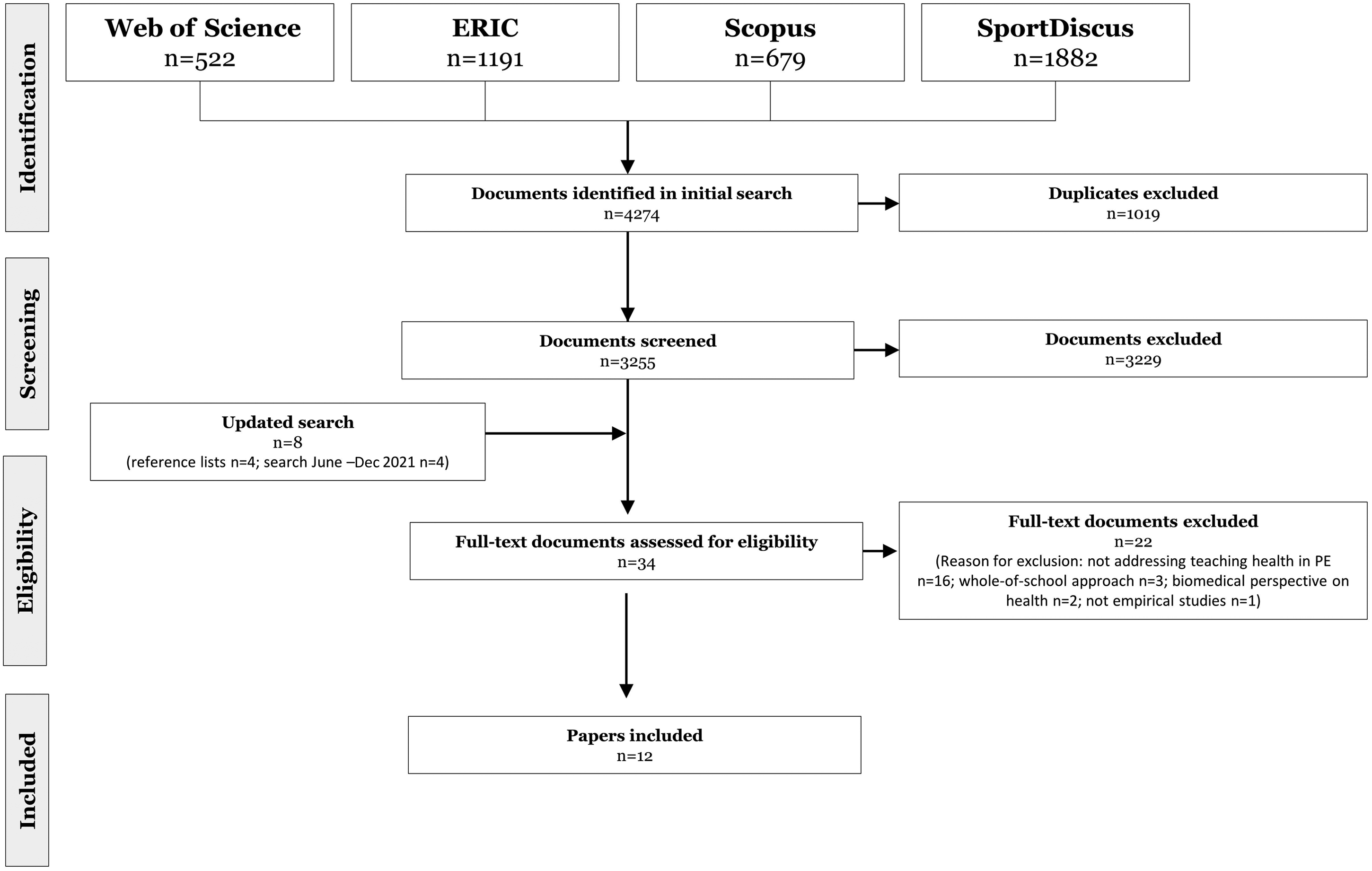
Preferred reporting items for systematic reviews and meta-analyses (PRISMA) flowchart illustrating the review process.
The conceptualization of “holistic perspectives on health,” as defined above, meant that some interesting papers were excluded due to a lack of explicit relation to teaching health in PE. Most of the excluded articles were either theoretical, not explicitly addressing PE in primary, secondary or upper secondary, schools, or biomedically oriented. It should also be noted that exclusively selecting peer-reviewed articles published in academic journals in English meant leaving out the possibility of papers in other languages as well as sources other than published papers (e.g. grey literature).
Charting the data, and collating, summarizing, and reporting the results
According to the methodological framework of Arksey and O’Malley (2005), charting the data refers to the process of data extraction in which a descriptive summary of the results is produced. For each included paper, information about study characteristics was extracted into a table. The data included: (i) author(s) and year; (ii) country; (iii) aim; (iv) study design/empirical source; and (v) main findings (Table 1).
Summary of study characteristics
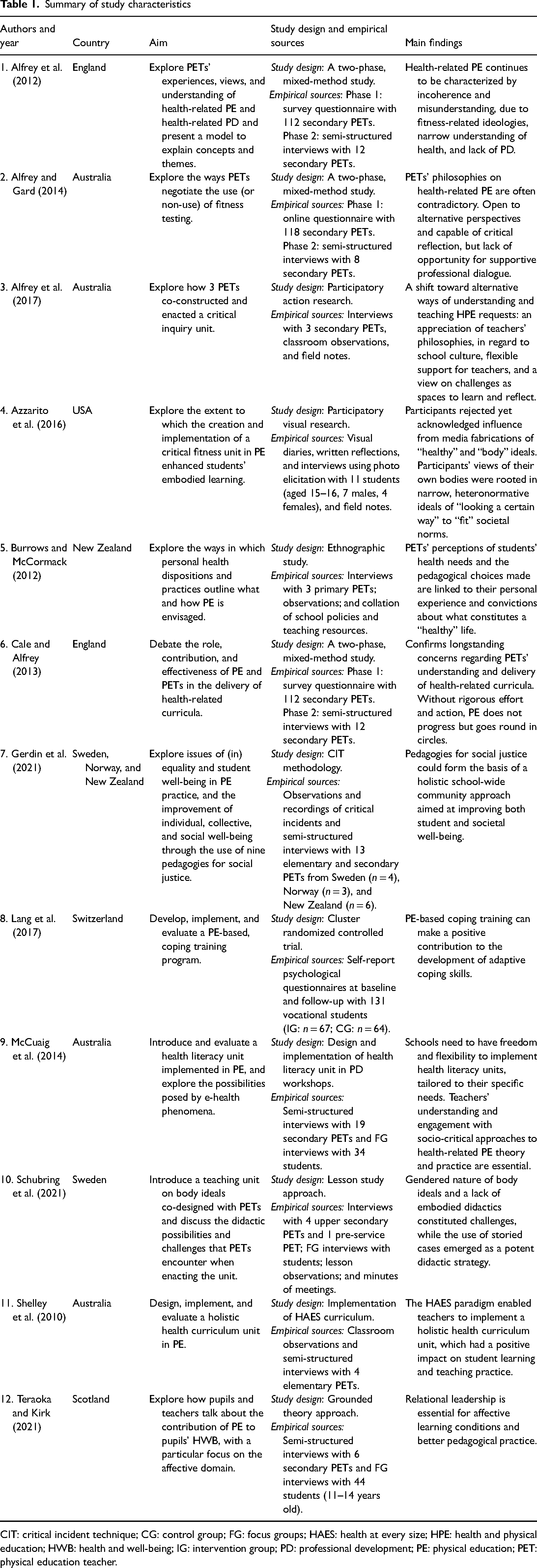
CIT: critical incident technique; CG: control group; FG: focus groups; HAES: health at every size; HPE: health and physical education; HWB: health and well-being; IG: intervention group; PD: professional development; PE: physical education; PET: physical education teacher.
Exploring educational practices suggests a didactic framework for analysis. A rationale for didactical research is that education involves many different choices in terms of why, what, and how (Quennerstedt and Larsson, 2015). Furthermore, Quennerstedt (2019b) claims that “the question of why gives education [what and how] its direction” (p. 617). The analytical process was guided by how the selected papers addressed health as purpose (why), content (what), and form (by what/whom in terms of the resources used), and how this was described when embracing holistic perspectives on health. A thematic analysis was conducted for identifying, analyzing, and interpreting patterns, as suggested by Braun and Clarke (2019). Thematic analysis involves a reflexive process of familiarization, coding, theme development, revision, naming, and writing up (Braun et al., 2017), and was used to abductively generate themes relevant to the analytical questions. In this study, the thematic analysis examined the ways in which researchers explore the beliefs, experiences, and intentions of PE teachers regarding health-related PE. As a first step, the first author (PW) read and coded the studies separately with regard to purpose, content, and form. In the second step, all authors compared and cross-checked the initial codes and themes. The final step was a group analysis by all authors via online video conference.
Findings
In this section, the characteristics of the included studies are summarized prior to the presentation of the thematic analysis. After excluding 1019 duplicates, the initial search resulted in 3255 unique papers. Of these, 26 papers were considered eligible and read in full text, and 11 met the inclusion criteria (Figure 1). The updated search resulted in an additional four papers from reference lists and four articles published between June and December 2021 that were read in full, one of which met the inclusion criteria. In total, 12 papers were selected, assigned a numeric code (1–12), and referenced in text using a numeric style. The main reasons for exclusion of papers read in full were: not teaching health in PE (n = 16) (e.g. content related to but not explicitly addressing teaching health); whole-of-school approaches (n = 3); studies with a biomedical perspective on health (n = 2); and not empirical studies (n = 1). Information about study characteristics is available in Table 1. The thematic analysis of the 12 selected papers is presented in Table 2.
Thematic analysis of holistic perspectives on health by purpose, content, and form.
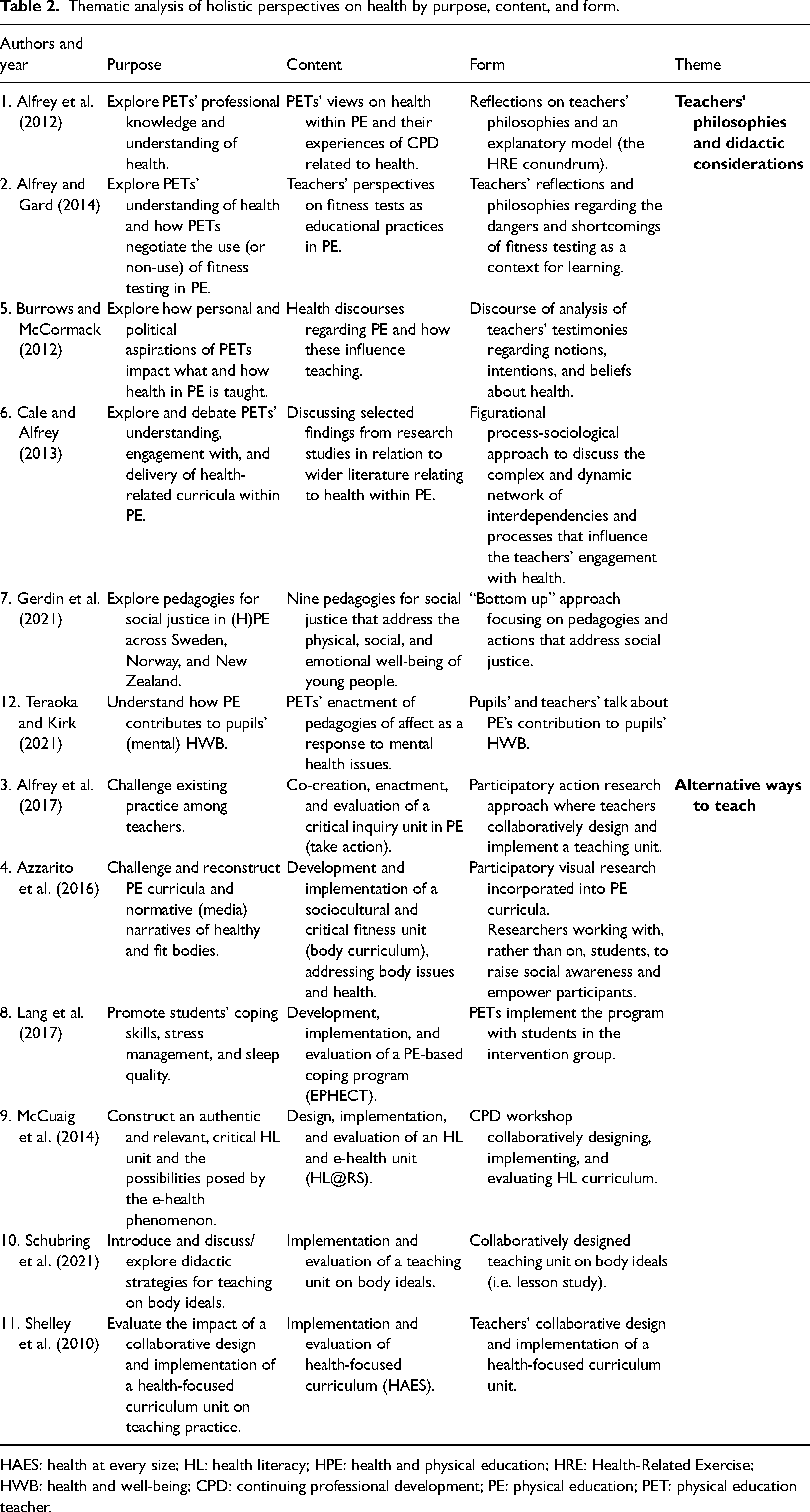
HAES: health at every size; HL: health literacy; HPE: health and physical education; HRE: Health-Related Exercise; HWB: health and well-being; CPD: continuing professional development; PE: physical education; PET: physical education teacher.
Study characteristics
All the included papers were published between 2010 and 2021. Four papers were from Australia (2, 3, 9, 11), two from England (1, 6), one each from New Zealand (5), Scotland (12), Sweden (10), Switzerland (8), and USA (4) and one combined study from Sweden, Norway, and New Zealand (7). Certain authors re-occur in several papers, such as Alfrey (1–3, 6) and Cale (1, 6) where they also share the same empirical data (1, 6). A number of papers (1–3, 5–7, 12) aimed to explore teachers’ understandings of health and didactic considerations regarding teaching health in PE, adopting (semi-structured) interviews with PE teachers as the primary empirical source. A few of these papers (1, 2, 6) used a mixed-method approach and included online questionnaires to gather data. Other empirical sources were classroom observations and field notes (3, 4, 7, 10, 11) and individual or focus group interviews with students (4, 8–10, 12). Six of the 12 included papers (3, 4, 8–11) explored the implementation and evaluation of new health-related PE curricula. Two of these had a teacher’s perspective (3, 11) where the teachers' also engaged in the co-creation and design of the curricula, two had a students’ perspective (4, 8) emphasizing a student-centered approach to learning and the empowerment of students, and two had a combined perspective (9, 10) regarding both teachers’ and students’ views of the implemented curricula and their implications on students’ HWB. A participatory research methodology was used when teacher or student engagement in the research process was seen as essential; this took the form of participatory action research (3), participatory visual research (4), and lesson study (11). Most studies (1–4, 6, 9, 12) were conducted in secondary schools, two studies (5, 11) were about primary/elementary schools, one study (7) was conducted in both primary and secondary schools and two (8, 10) focused on upper secondary or vocational schools. Several papers raise concerns regarding the longstanding narrow understandings of health that PE teachers still seem to hold (1, 2, 4, 6, 12), which limit the abilities to offer a holistic or critical approach to health-related PE. Yet there are signs of a shift toward alternative ways of understanding and teaching of health among PE teachers (3, 7, 12). The call for change and action emphasizes continuing professional development (CPD) (1, 9), re-conceptualized teacher philosophies (2, 3, 5, 6, 12), or new and improved health-related PE curricula (3, 4, 8, 9–11). Papers exploring the implementation of novel PE curricula (3, 4, 8–11) reveal positive results and promising contributions to both the development of PE teaching practice and student HWB. Based on the findings in the papers, one paper presents an explanatory model (1), and three papers explore and suggest new pedagogies with implications for PE practice (7, 10, 12).
Thematic analysis
Two themes were identified through an abductive analysis of the papers: (i) teachers’ philosophies and didactic considerations; and (ii) alternative ways to teach.
Teachers’ philosophies and didactic considerations. In this first theme, researchers explore PE teachers’ understanding and the delivery of health-related curricula within PE in primary and secondary schools, in relation or in contrast to the prevailing biomedical view on health (1, 2, 5–7, 12). These papers aim to increase the knowledge of PE teachers’ personal philosophies and ambitions regarding why and how health in PE is taught. The term “philosophies” describes how personal, incorporated beliefs and ideologies based on prior experience influence PE teachers’ knowledge construction and understanding regarding health-related PE (1). Three studies (1, 5, 6) scrutinize and discuss whether and why PE teachers hold such narrow views on health promotion and the way that PE teachers’ philosophies impact how health is taught. Here, one paper (1) concludes that it is vital to understand the socio-historical development to trace PE teachers’ experiences, views, and understanding over time. Paper 5 aims to explore what discourses have affected PE teachers’ notions about what constitutes health, what guided their intentions, and how their own dispositions and beliefs about health influenced their teaching. Paper 6 explores and debates the contribution and effectiveness of PE in the delivery of health-related curricula with reference to concerns identified within PE research literature. The remaining papers (2, 7, 12) explore PE teachers’ views on more explicit subject content and how these concepts contribute to students’ HWB. Paper 2 scrutinizes how PE teachers regard and negotiate the use (or non-use) of fitness testing in secondary PE as a context for learning, and paper 7 highlights pedagogies identified for social justice and the improvement of individual, collective, and societal well-being through PE practice. Paper 12 explores how pupils and PE teachers talk about and practice pedagogies of affect as a response to mental health issues, arguing that “investigating how teachers talk about physical education's contributions to pupils’ HWB is crucial because their perceptions and beliefs inevitably influence their teaching” (Teraoka and Kirk, 2021: 2). Further, it is contended that “the role of the teacher shifts from making student[s] healthy to a dialectical responsibility to prepare students with resources needed to be healthy while preparing a learning environment that supports health” (Gerdin et al., 2021: 2).
Regarding content and form, one group of researchers conducts a discourse analysis of PE teachers’ testimonies to explore PE teachers’ beliefs and intentions about health and how these influence teaching (5). Another study uses a figurational process-sociological approach to discuss selected findings from a research study in relation to the wider literature (6). Paper 1 reflects on and discusses PE teachers’ philosophies and presents an explanatory model, illustrating how fitness ideologies permeate many PE teachers’ philosophies and influence their health-related education, with the outcome that if PE teachers’ views and understandings are not challenged a status quo prevails. Further, PE teachers’ use of pedagogies for social justice to promote students’ HWB is scrutinized by observing and exploring practices and structures that attempt to reduce inequities (7).
Paper 2 acknowledges a shift in PE teachers’ philosophies, claiming there is an openness to alternative perspectives and critical reflection, while also recognizing a lack of opportunity for supportive professional dialogue and CPD. In paper 3 (included in theme two), the research group builds on these findings and continues by challenging existing practices among PE teachers and initiating a co-created and enacted critical inquiry unit in PE. This shift from exploring teachers’ understanding and delivery of health-related teaching in PE practice, toward engaging PE teachers in co-creating, enacting, and evaluating holistic teaching units in relation to HWB in PE, aligns with the distinction between the two themes found in the analytic process.
Alternative ways to teach. The second theme incorporates papers that aim to challenge and reconstruct PE practices and curricula. There is an emphasis on researchers and participants co-creating and implementing new health-related units in PE to explore alternative ways to teach health and approach students’ HWB, and to empower participants. One paper aims to both introduce a collaboratively designed teaching unit on body ideals and discuss didactic possibilities and challenges encountered (10). Two papers evaluate the impact of a co-designed and implemented health-related curriculum unit, exploring alternative didactic strategies for teaching health (9, 11). Three papers seek to challenge existing practice in PE by adding critical pedagogies into a teaching unit, thereby raising participants’ awareness of critical perspectives on health (3, 4, 9). Researchers emphasize a need to adopt a critical, sociocultural perspective that challenges “the ways that the fitness-driven school PE curricula continue to be colonized by normative global gendered and racialized media narratives of healthy and fit bodies” (Azzarito et al., 2016: 54).
Holistic perspectives on health are addressed in various co-created teaching units implemented and evaluated in PE practices. These take various forms, including a critical inquiry unit in PE (3), a sociocultural and critical fitness unit (4), a PE-based coping program (8), a critical health literacy and e-health unit (9), a teaching unit on body ideals (10), and a health-focused curriculum (11). Creating and enacting teaching units challenges how teachers view their role in the learning process, as well as teachers’ understanding of health-related PE and their didactical repertoire (3).
Regarding form, several participatory, collaborative approaches involving PE teachers are used, such as teachers’ collaborative design and implementation of a health-focused curriculum unit (11), participatory action research (2), CPD workshop (9), and lesson study (10). These approaches have the potential to transform PE teachers’ professional development and expertise (10). Further, students are engaged in a participatory, student-centered teaching unit critically addressing body ideals to raise their social awareness and empower them (4). The paper illustrates constructivist, school-based PE curricula that aim at creating student-centered pedagogical spaces and holding the potential to enhance young people's agency.
Discussion
The purpose of this scoping review was to contribute to knowledge about what characterizes empirical research literature with holistic perspectives on health and to discuss the implications for teaching PE. The findings confirm that empirical papers with holistic perspectives on health, in the research corpus regarding teaching health in PE, are rare (n = 12 out of 3263). The call for more holistic approaches to health in PE remains on a theoretical level and little has been explored or enacted empirically. We hereby acknowledge an emerging call for scholars, as well as PE teachers, to incorporate and elaborate holistic perspectives on health in PE practice (see Gray et al., 2015; Harris et al., 2020; Maivorsdotter et al., 2010; McCuaig and Quennerstedt, 2016; Quennerstedt, 2019a). One of the papers included in the present review (7) acknowledges that PE curricula and policy documents in several countries (e.g. Australia, New Zealand, Scotland, and Sweden) have been revised during the twenty-first century and now refer to the term health in their title (e.g. health and PE or PE and health). These curricula explicitly address holistic HWB, encouraging PE teachers to create learning experiences that contribute to students’ physical, social, emotional, and mental well-being (Dyson et al., 2018; Macdonald et al., 2018; McCuaig et al., 2013). The new Australian health and PE curriculum has been acclaimed as a model for a redesigned curriculum, developing students’ competencies and agency to promote their own HWB and that of others (Cale, 2020; Macdonald et al., 2018). Thus, it is not surprising that many of the included papers emanate from the above-mentioned countries. What remains to be determined is how the curricular changes affect PE teachers’ philosophies and practices. The papers included in this review show traces of elaborated understanding and deliveries of health-related PE.
The included papers share an interest in exploring PE teachers’ understanding and didactical considerations regarding health-related PE. Three papers (3, 7, 12) address a shift from conceptualizing health as the outcome of PA within PE to a salutogenic approach, recognizing health as a complex continuum influenced by social and environmental impacts. These papers demonstrate how holistic strengths-based approaches and pedagogies of affect can support PE teachers to build students’ confidence, motivation, determination, and resilience through PE (see Cale, 2020; Maivorsdotter et al., 2010; McCuaig and Quennerstedt, 2016; Thorburn et al., 2019). Further, Gray et al. (2015) state that critically conscious, student-centered teaching approaches can enable PE teachers to deliver a diverse, inclusive, and sustainable PE curriculum, contributing to students’ well-being. Both identified themes explore critical pedagogies in PE to reflect holistic and critical perspectives on health (3, 4, 7, 9). Critical pedagogies are promoted to address social justice issues in PE, raising participants’ awareness and authority (7) and encouraging students to challenge racialized and heteronormative norms (4). Unfortunately, ethnicity, gender, and heteronormative norms in PE are often reinforced rather than challenged by the actions or inactions of PE teachers (7). Azzarito and Hill (2013) stress the importance of creating an inclusive, non-judgmental learning environment where all students, not just those who are popular and talented, feel comfortable and accepted by teachers and peers. Although critical pedagogy alone cannot achieve the broad range of learning objectives claimed by PE, the perspective is essential to address in PE to create learning environments that also challenge conceptions and contexts around the teaching and learning of HWB (Gray et al., 2015).
The first theme of the thematic analysis, Teachers’ philosophies and didactic considerations, explores and discusses PE teachers’ philosophies, conceptualized as embodied beliefs and ideologies. Primarily mixed-method and ethnographic study designs have been used to collect data in primary and secondary schools. From a critical point of view, several papers (1–3, 6) reaffirm that health-related PE continues to be characterized by a narrow biomedical understanding of health and fitness-related ideologies and call for new holistic and conscious approaches to health (7, 12). One paper (1) argues that PE teachers’ focus upon PA and fitness within health-related PE is “arguably a manifestation of their deeply rooted and often persistent ‘philosophies’ which, for the most part, were strongly attached to sport and fitness ideologies” (Alfrey et al., 2012, p. 485) and need to be challenged. Developing a more holistic understanding of health (and PE) requires that we challenge and deconstruct the prevailing, narrow views of HWB (see Gray et al., 2015; Quennerstedt, 2019a). Ward et al. (2021) stress the transformation from a biomedical, deficiency-based model to a salutogenic, strength-based model of health, since “we cannot continue to do ‘business as usual’, producing the same results, because past-present results consistently have been suboptimal” (p. 1).
One strength of this scoping review is that the analytical process captured processes of change among PE teachers by paying attention to content (what) as well as form (by what/by whom). There is an emerging call for CPD and participatory research methods, strengthening the professional capital of teachers, in PE discourse (e.g. Casey and Larsson, 2018; Ennis, 2017; Gray et al., 2015; Thorburn et al., 2019). Such efforts can support PE teachers with theoretical knowledge and skills to transform their understanding of HWB and develop critical views on current and prevalent pedagogical practices (Gray et al., 2015). In the second theme, Alternative ways to teach, there is an emphasis on empowering participant PE teachers in a reconceptualization and re-design of health-related teaching units in PE. Various participatory approaches, such as action research (3), CPD workshops (9), and lesson study (10), were enacted to explore the transformation of PE teachers’ professional development and teaching in secondary and upper secondary schools. Challenging PE teachers’ understanding and encouraging them to renegotiate (and perhaps challenge) their practice changes the way PE teachers view their role in the learning process and their didactical repertoire (3).
Regarding content, several researchers explore the implementation of health-related teaching units (i.e. 3, 4, 8–11). The different teaching units conceptualize health holistically, and all claim successful contributions to the development of PE practice and student HWB. Even so, the alternative ways of teaching still have a traditional way of using PA and fitness training for the promotion of HWB. As Casey et al. (2020: 4) argue, “finding new ways of doing things or creating new ways of doing old things will not lead us to the forms of school physical education we value.” It is important to raise critical, didactical questions when scrutinizing their implications for teaching and learning health, that is, regarding the educational purpose, what is taught, and the underlying assumptions for that. Back in 2013, Armour and Harris (2013) stated that “no matter how rich, complex, and evidence-based a new framework, policy, model, or resource is, it will fail to achieve what it promises if PE teachers are not persuaded to change their pedagogies and practice” (p. 13). Once again, the importance of supporting PE teachers’ professional development and competence is emphasized (see Thorburn et al., 2019).
Moreover, Quennerstedt (2019a) argues that PE should emphasize students’ active health development and regard the processes of teaching and learning in terms of student influence and agency. In the second theme, Alternative ways to teach, two studies (4, 8) involved students in secondary/upper secondary schools directly in participatory student-centered teaching units, with the ambition to enhance young people's knowledge and agency. Overall, most studies in theme two were conducted in secondary (3, 4, 9) and upper secondary/vocational schools (8, 10) and thus engaged older and perhaps more mature and conscious students. However, papers from both themes (9, 10, 11, 12) included students’ experiences and perceptions in the evaluation process of the implemented teaching unit. Cale (2020) stresses that we need to listen to, engage with, and empower young people if we want to influence their health-related learning and support their agency. One paper (7) emphasizes that PE teachers should involve students in creating an inclusive learning environment that supports students with resources needed to influence their health. Promoting and striving for sustainable and equitable health outcomes in and through PE should provide students with learning tasks and activities that challenge and develop their knowledge and skills to critically reflect and act, both by themselves and with others (Gerdin et al., 2021). PE may be an essential gateway for children to learn life skills and develop patterns for healthy lifestyle behaviors and “is the most effective means of providing all children and youth with the skills, attitudes, values, knowledge and understanding for lifelong participation in society” (UNESCO, 2013: 6).
Although some papers in the initial search offered insights and perspectives regarding sustainability and HWB, namely Lynch (2016) and Olive and Enright (2021), these failed to meet the criteria for inclusion. Furthermore, no papers addressed aspects of sustainability and lifelong learning, such as PA for transportation (e.g. walking and cycling), or the relation between green environments, outdoor activities, and health. This is surprising due to the growing amount of literature describing how green environments positively affect our HWB (Cherrie et al., 2018; World Health Organization, 2016).
Conclusions
This scoping review manifests that although PE teachers may hold a narrow understanding of health and lack didactic competence to deliver relevant health-related PE, they are receptive to holistic perspectives and capable of critical reflection, if given the appropriate support and opportunities for professional development. Adopting holistic approaches to health in PE requires perceptive didactic considerations. This suggests that “If physical education is to make a difference to young people's healthy, active lifestyles, however, the philosophy, approach and experiences it offers to students, need to be re-conceptualized and reconsidered” (Bowler, 2019: 2). Promoting students’ consciousness and agency to develop or maintain their physical, mental, social, and emotional HWB in and through PE is as much about the form and delivery as the content of teaching, where the educative aspects need to be highlighted. This requires challenging PE teachers’ understandings and beliefs and encouraging them to renegotiate their practice, by enacting critically conscious, inclusive, student-centered teaching approaches, contributing to students’ sustainable well-being. The included articles in our review show traces of elaborated didactic considerations and curricula design, but we recommend further research exploring alternative approaches and deliveries of holistic PE curricula.
Another conclusion is that many of the arguments for holistic perspectives on health in PE align with the rationale for education for sustainable development (UNESCO, 2017), which could also suggest a reorientation for future PE. Lundvall and Fröberg (2022) have recently suggested how health in PE can be reframed when sustainable development issues become part of the holistic perspectives on health. The Organisation of Economic Co-operation and Development report Making Physical Education Curricula Dynamic and Inclusive for 2030 (Howells, 2019) argues that: Physical and health education has the potential to become one of the cornerstones of the education of tomorrow that contributes to the holistic development of students, fostering the development of crucial competencies and the physical and mental health of students (p. 12).
Footnotes
Declaration of conflicting interests
The author(s) declared no potential conflicts of interest with respect to the research, authorship, and/or publication of this article.
Funding
The author(s) received no financial support for the research, authorship, and/or publication of this article.
