




Abstract
The aim of this paper is to identify and discuss similarities and differences between the curricula for physical education (PE) in secondary schools in Sweden, France and the canton of Geneva (Switzerland) in the light of PE teaching traditions (PETTs). Teaching traditions concern ideas about the goals of school disciplines and therefore about the kind of learning pupils are expected to acquire. The paper focuses more specifically on two subjects, gymnastics and fitness training, because these physical activities are liable to highlight the similarities and differences across contexts in terms of didactic transposition. A content analysis of current curriculum materials of the three countries was conducted taking the following dimensions into account: (a) the general structure of the curriculum texts; (b) the general recommendations; and (c) the learning outcomes expected from the pupils in terms of knowledge and values, with examples of contents in gymnastics and fitness training. The results show the entanglement of various PETTs in each country: PETT as Sport-Techniques primarily shapes French and Swiss-Genevan curricula, PETT as Health Education is more present in Sweden and, to a lesser extent, in Switzerland, while PETT as Physical Culture Education tends to be more visible in France.
Introduction
The topic addressed in this article concerns the relations between teaching traditions and Physical Education (PE) curricula. A teaching tradition shapes the curriculum of a school discipline in that it contains ideas about goals and the learning outcomes that pupils are expected to master in order to achieve these goals (Lundqvist et al., 2012; Östman, 1996; Roberts, 1988). In this view, the notion of ‘teaching traditions’ is a good candidate for a theoretical contribution to the understanding of teaching through the specificity of subject-didactics and the diversity of national curricula. Teaching traditions are thus a relevant concept for comparative didactics, the aim of which is to ‘provide new theoretical and methodological perspectives for a comparative approach to teaching and learning through didactics’ (Ligozat et al., 2015: 313). By the term ‘didactics’, the authors mean research on teaching and learning in relation to contents and subjects featured in the curriculum. The work reported in this article comes within the comparative international research project ‘Teaching Traditions and Learning’, which aims to identify the limits and possibilities for learning offered by different teaching traditions in three countries: France, Switzerland (canton of Geneva) and Sweden 1 . Moving from authoritative texts to their implementation in classroom practices is not a straightforward process (Briot, 1999; Englund 1986; Goodson, 1987; Lenzen et al., 2012). A curriculum outlines the subject content and the teaching and learning requirements, but the teacher’s selection of content and ways of working contributes to pupils’ meaning-making and critical thinking (Quennerstedt, 2008a).
Through a didactical comparative approach, the paper aims to investigate physical education teaching traditions (PETTs) in France, Switzerland (canton of Geneva) and Sweden. By analysing the three countries’ curricular materials (official texts and additional authoritative resources such as books, websites and teaching documents) we describe their similarities and differences and discuss how PE is integrated in the curriculum as a whole and how it is linked with general education.
In order to reduce and structure the comparative analysis, we have chosen to focus on the content related to two physical activities, namely gymnastics and fitness training, both of which are current PE subjects in the three countries. These physical activities help to highlight the similarities and differences across contexts, in that they originate in different physical cultures and have historically different relationships with PE. Gymnastics has been a lasting reference subject for PE in Europe since the end of the 19th century, even though differences within each national gymnastic tradition should be noted. Fitness training has its roots in aerobics, a physical activity that became popular as a PE subject in the 1980s when aerobic exercise was combined with elements of dance culture. Fitness aerobics appeared more recently in the PE curricula. Moreover, each of the countries chosen for this analysis has its own national history, and education policies differ among the three, all of which provides rich resources for our research.
In this article, attention is first drawn to PETTs as they appear in the sport pedagogy literature. This then leads to the analytical questions and methodology underpinning the research. The results of our comparative approach show that to some extent, PETT as sport-techniques shapes French and Swiss-Genevan curricula more than it does the Swedish curriculum. PETT as health education is more common in Sweden and, to a lesser extent, in Switzerland, whereas PETT as physical culture education is more visible in France. The discussion considers how PETTs impact the institutional contexts of PE teaching and learning in the three countries. The conclusion returns to comparative matters related to the reception of curriculum texts by teachers.
Teaching traditions in physical education
The concept of teaching traditions was first elaborated by Roberts (1988) and Östman (1996) to highlight what counts as content, goals and values for science education. Later, Lundqvist et al. (2012) used the notion to point out how teaching practices are modelled by interpretation of the subject goals and what the curriculum and teaching traditions expect pupils to learn. Three different teaching traditions are distinguished in science education (Östman, 1996; Roberts, 1988): (a) an ‘academic tradition’ that emphasises pupils’ learning of scientific products or processes; (b) an ‘applied tradition’ where pupils learn how to apply scientific knowledge to practical everyday issues; and (c) a ‘moral tradition’ that emphasises the learning of scientific knowledge to address moral or political problems and the relationships between science and social issues.
However, unlike science education, PE has no such typology of teaching traditions, although multiple perspectives on teaching exist. Thus we rely on an overview of the sport pedagogy literature to identify the traditions underlying the official discourses in PE. From this review, some discourses in PE that can be related to the notion of teaching traditions as defined by Roberts (1988) and Östman (1996) are highlighted. Four broad educational directions for PE have thus been identified based on previous research: (a) ‘Teaching PE as Sport-Techniques’, (b) ‘Teaching PE as Health Education’, (c) ‘Teaching PE for Values and Citizenship’ and (d) ‘Teaching PE as Physical Culture Education’.
Teaching PE as sport-techniques
Kirk’s broad historical and epistemological reflection on the past and future of PE shows that ‘Physical Education as Sport-Techniques’ is a teaching tradition that is widely disseminated in western countries (Kirk, 2010: 61). In this tradition, sports techniques are at the core of teaching. PE content typically includes sport-specific movements such as a badminton overhead clear, or more generic and fundamental skills such as throwing, catching or kicking a ball. In this tradition, PE content is based on a molecular approach of dividing and segmenting the content to be learned, and PE teaching favours a hierarchical order from simple to complex elements. Pupils have to master the easier skills before being allowed to confront the most advanced (Marsenach, 1982; Rovegno, 1995). Ennis (1999) points out that this teaching approach coexists with a multisport curriculum model featuring short units of activity, minimal opportunities for sustained instruction, little accountability for learning, and weak or non-existent transfer of learning across lessons. In this approach, teachers attach importance to surface features of motor techniques. Kirk (2010) maintains that ‘PE as Sport-Techniques’ has dominated PE for so long that it still influences how the subject is taught.
On the basis of these arguments related to the view of PE knowledge and values, we argue that this tradition can be a part of the so-called academic tradition identified by Roberts (1988) and Östman (1996) for science education. The idea in this tradition is that pupils are expected to learn the facts and techniques of the ‘mother discipline’, here PE.
Teaching PE as health education
Although health has always been present in PE discourses, its definition has evolved over time in countries and states (Green, 2014; Marshall and Hardman, 2000; Pühse and Gerber, 2005). McKenzie (2001) defines ‘Health-Related Physical Education’ as a process that prepares children and adolescents to develop and maintain a lifelong physically active lifestyle. This health concern is present in many curricular reforms (Öhman and Quennerstedt, 2008; Perrin, 2004; Poggi et al., 2009; Quennerstedt, 2008b). In many countries, the school discipline is called either Health & Physical Education or Physical Education & Health (e.g. in Australia, Canada, Sweden and the USA). The health concern is often related to a political analysis of the increasingly ‘sedentary lifestyle’, the so-called ‘obesity crisis’ and ‘cardiovascular problems’. In this context, PE appears to be a possible solution (Hardman, 2001; UNESCO-MINEPS III, 1998). Consequently, this tradition is based on the idea that PE should teach pupils to manage their physical activity and develop healthy lifestyles. According to this tradition, the link between PE and lifelong physical activity still needs to be firmly established (Green, 2014; Nyberg and Larsson, 2014). The association of health and body with medical and biological power and the dominance of a pathogenic perspective on health have been criticised (Kirk, 2010; Öhman and Quennerstedt, 2008; Quennerstedt, 2008b). Sociological criticism points out the normativity of a ‘healthism’ perspective and the danger of reducing PE to activities that are only related to the development of physical fitness as an individual duty. The risk of interference of such an educational project in the more private aspects of pupils’ lives and the temptation to regulate or even normalise privately chosen behaviour patterns are also underlined (Poggi et al., 2009; Quennerstedt, 2008b; Webb et al., 2008).
Considering the main contents and values put forward, PE as health education can be related to an applied tradition in the sense developed by Roberts (1988) and Östman (1996). The idea in this kind of tradition is that pupils are not just expected to learn how to act within the ‘mother discipline’, but (also) to use their knowledge to solve different kinds of problems, such as taking care of themselves and their health.
Teaching PE for values and citizenship
In the context of social crises and urban violence, school appears to be experiencing a crisis of meaning and disengagement (Gerler, 2013; Wrigley et al., 2012). In this context, PE is expected to transmit values and foster good citizens. The issue of socialisation and citizenship has influenced many curricula in Europe (Loudcher and Vivier, 2006). In the USA, pedagogical models such as ‘Sport for Peace’ (Ennis et al., 1999) and ‘Teaching Personal and Social Responsibility’ (Hellison, 2003) have targeted similar issues. The sport for peace curriculum was designed ‘to reflect the characteristics of peace education with goals and curricular structures specifically focused on promoting nonviolent behavior, a sense of community, and student ownership or empowerment within the school curriculum’ (Ennis et al., 1999: 274). These models illustrate a teaching tradition that we call ‘Teaching Physical Education for Values and Citizenship’, according to which the main objectives are to teach pupils self-responsibility, respect for differences, conflict resolution and participation in the democratic life of the class (i.e. to enhance pupils’ engagement and willingness to interact positively with others: Ennis, 1999). Öhman and Quennerstedt (2008) show that the socialisation content of PE teaching practices is primarily directed towards different components of pupils’ willingness (‘you should want to be physically active, want to do your best and be willing to try all activities’), with a view to pupils governing their own actions in directions that are socially valued. It is worth noting that, in France, the emergence of didactics and its focus on the content to be taught in PE, marked an end to the République des sports, an experiment that spread to more than 80 upper secondary schools and lasted about 10 years (1964–1973). Here the idea was to teach the concept of citizenship by making the children actively participate in a sports republic that reflected the political structure of the French Republic (Loudcher and Vivier, 2006). In sum, PE rooted in this tradition is seen as a place where political volition and the creation of today’s citizens are emphasised.
All these arguments lead us to connect ‘Teaching PE for Values and Citizenship’ to the moral tradition (Roberts, 1988; Östman, 1996). The idea in this tradition is that pupils are expected to learn how to use facts and techniques to solve practical and value-laden problems.
Teaching PE as physical culture education
In this tradition, pupils’ sport and physical experiences through PE are expected to be contextualised in relation to a broad, creative and meaningful definition of body culture (Cliff et al., 2009). That is to say that ‘PE should be constructed and constituted through its relationships to wider issues in society’ (Kirk, 2010: 97). From the literature review, three pedagogical models are selected, all of which are rooted in an integrative vision of physical culture. These are: (1) ‘The Sport of the Child’ (Goirand et al., 2005); (2) ‘Sport Education’ (Siedentop, 2002); and (3) ‘Teaching Games for Understanding’ (Bunker and Thorpe, 1982).
The French pedagogical model, ‘The Sport of the Child’ (Goirand et al., 2005), was created in the late 1970s with the aim of offering pupils original and positive sporting experiences through the reconstruction of a sport adapted for children. Against the molecular vision of teaching PE as sports techniques, this pedagogical model values a holistic and anthropological approach to sport as a modern form of ‘technique of the body’ (Mauss, 1934/1950). The subject to be taught is the rich and complex configuration of knowledge that is at the core of games, sports, dance, outdoor adventure activities, etc. This pedagogical model emphasises the importance of analysing the physical and cultural dimensions of the content, starting from the logic of sociocultural practices. The philosophical thread running through the model is the aim of enabling pupils to construct meaningful, aesthetic and bodily dimensions of physical culture as corporeal practices organised, codified and institutionalised in a particular society (Mascret and Dhellemmes, 2011). This teaching perspective in PE may be related to the pedagogical model developed in the Anglo-Saxon world: ‘Sport Education’.
The ‘Sport Education’ model is defined as ‘a curriculum and instruction model designed to provide authentic, educationally rich sport experiences for girls and boys in the context of school physical education’ (Siedentop, 2002: 409). Its purpose is to immerse pupils in sport culture through increased responsibility in long units of activities. Apart from improving motor learning, it has been shown that this model offers pupils a range of additional learning experiences, such as broad knowledge related to sport culture, the development of social competencies and a critical attitude towards consumerism (Hastie, 2012; Kirk, 2010; Wallhead et al., 2013).
The third pedagogical model, ‘Teaching Games for Understanding’ (TGfU) (Bunker and Thorpe, 1982), aims to challenge the molecularisation of PE when using games as subject content (Kirk, 2010). It focuses on the understanding and mastery of tactical aspects of the game, together with the consolidation of technical skills when necessary in modified game contexts (Bunker and Thorpe, 1982). Kirk (2010) shows how TGfU questions the order of the skill-learning universe in PE and the notion of progression as an additive process by demonstrating that children can learn to play without mastering the linear progression from the molecular level of technique to the mature skill.
These three innovative pedagogical models are related to an idea of PE as an educational contribution to the physical culture of youth understood as ‘a broader corporeal discourse that is concerned with all aspects of meaning-making centred on the body’ (Kirk, 2010: 98). Kirk argues that an important feature of the concept of physical culture is that it counteracts the tendency in PE to consider only or mainly the body in nature (the biological and mechanical body) and to ignore or dismiss as irrelevant the body in culture (the signifying and symbolising body). The notion of physical culture suggests that the human body is in nature and culture simultaneously and that neither can be reduced to the other (Kirk, 2010: 99). The body is, of course, present in the other traditions but is mainly characterised as a biomechanical body, not a cultural and sensitive body.
Relying on the arguments developed by Kirk (2010) about the possibility of a radical reform in PE futures, we can relate this fourth perspective to a teaching tradition that is still in construction. It is noteworthy that the three pedagogical models described above open up new directions towards a more cultural, sensitive, and thus renewed tradition for PE. Following the analogy with teaching traditions in science education (within the limits resulting from the specificity of PE knowledge and values) it might be advocated that ‘teaching physical education as physical culture education’ is not only about learning facts, methods or how to think as a sportsperson; it is also about being socialised into a specific view of embodied culture.
Comparing curriculum discourses to identify the various impacts of PETTs
Considering that teaching traditions are modelled by ideas about the knowledge and values of the school discipline and the kinds of learning outcomes and competences that are expected to result (Östman, 1996; Roberts, 1988), we will now turn to the similarities and differences between the PE curricula in secondary schools in France, the canton of Geneva (Switzerland) and Sweden. The purpose of the analysis is to describe how the four PETTs impact the institutional contexts of teaching and learning in PE. Similarly to the arguments of Marty, Venturini and Almqvist (this issue) the analysis relies on the idea that there are strong relations between the concept of ‘teaching traditions’ and that of ‘didactic transposition’: depending on which traditions impact the curriculum discourses, knowledge and values of the school discipline are privileged in different ways.
Here, the focus is specifically on gymnastics and fitness training, because these physical activities highlight the similarities and differences across contexts in terms of didactic transposition (Caillot, 2007; Chevallard, 1991; Martinand, 2001). This concept acknowledges the chain of transformation, elaboration and reconstruction of content knowledge from social practices to the curriculum texts and then to classroom practices. The focus and analytical questions are: How are gymnastics and fitness training categorised in the curriculum texts? Which selective knowledge and values are pupils expected to learn? Which learning outcomes other than motor skills are highlighted? What kinds of interactions among pupils or between teachers and pupils are recommended?
Methods
This study is a qualitative textual analysis. The material for the study includes the official curricula in France, the canton of Geneva and Sweden. The purpose is to look at the similarities and differences in the latest editions of curriculum texts for PE in secondary schools in order to identify which PETTs are privileged.
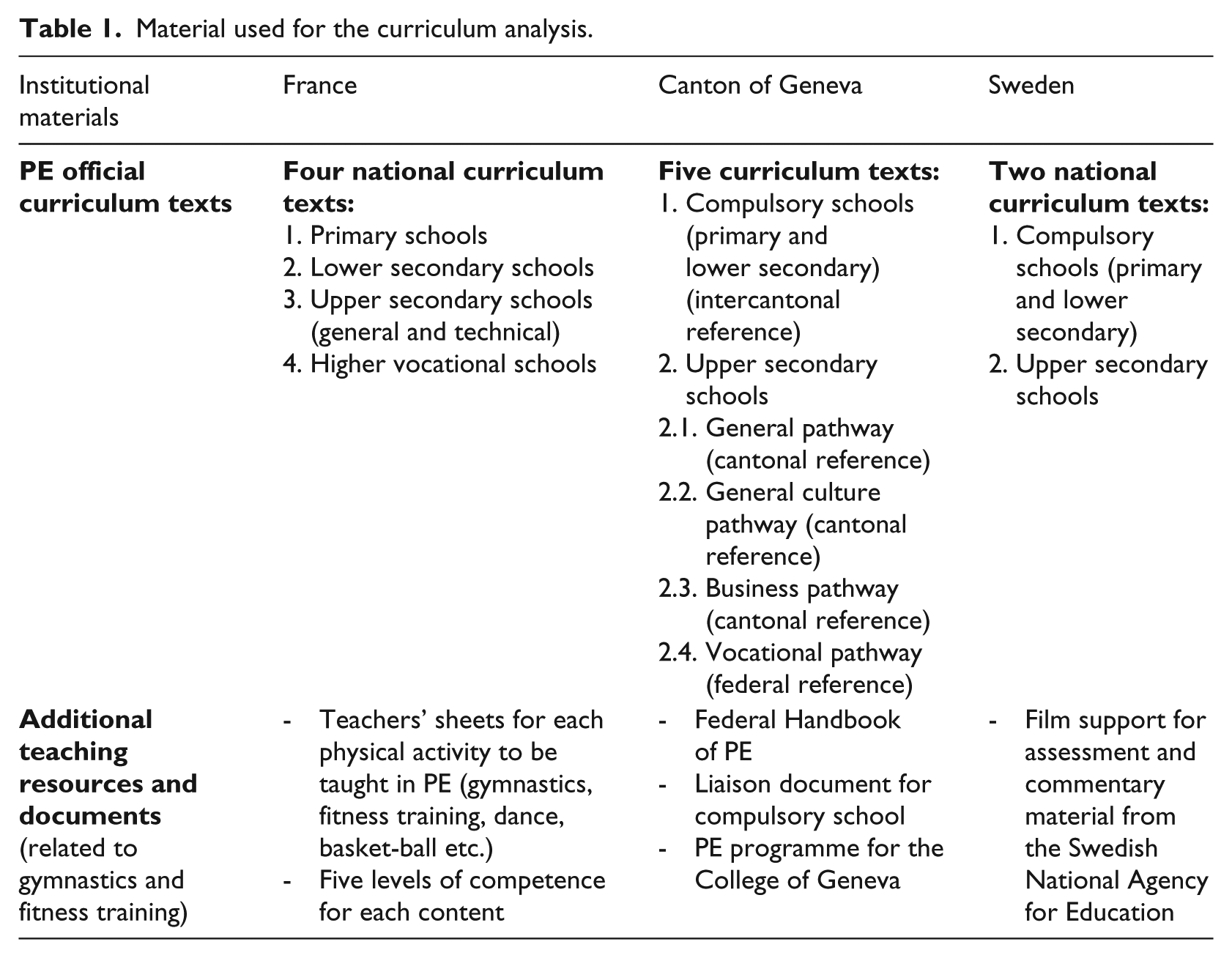
The curricular texts are very different in their organisation and structure, but may use the same concepts. For example, the word ‘health’ is found in the curricular material of all three countries, although a detailed analysis is needed if we are to understand its different contextual meanings. Three dimensions are taken into account for the qualitative textual analysis: (a) the general structure of the curriculum texts, (b) the general recommendations and (c) the learning outcomes that pupils are expected to master and examples of the teaching content in gymnastics and fitness training. In the section ‘general structure’, the name of the school discipline, the number of existing official texts for the whole school system, and the structure of these texts in terms of chapters and sections are indicated (Table 1). We also identify whether physical activities are explicitly recommended and, if so, which selective content is highlighted. In the section ‘general recommendations’, we search for indications of the links between PE and general education (common core of knowledge and learning outcomes, cross-field competences expected, values, etc.), as well as specific aims and whether a hierarchy exists. In the last part, information is provided about the learning outcomes (knowledge, values and skills) that pupils are expected to acquire in gymnastics and fitness training and the extent to which these are assessed. Where possible, we also identify examples of teaching content related to gymnastics and fitness training.
Material used for the curriculum analysis.
Results: A comparative analysis of how PETTs impact the official curriculum in France, canton of Geneva and Sweden
The French curriculum
General structure of curriculum texts
In France, the official name for the school discipline is ‘Physical and Sports Education’. The French national PE curriculum is made up of four texts, depending on the grade and the type of school, all of which are issued by the French Ministry for Education. Three of these texts concern secondary school: (a) middle school (11–15 years) which is the last part of compulsory education (MEN, 2008), (b) high school (15–18 years) (MEN, 2010) and (c) vocational school (MEN, 2009). All the texts are based on a curriculum competence-based approach. The Ministry of Education also publishes resource documents, which are available on its website (53 pages for the middle school, 64 pages for high and vocational schools). These documents are not compulsory but are widely recommended (Table 1).
The French national authorities have set one main educational purpose: ‘The purpose of PE is to train a cultured, lucid, independent, physically and socially educated citizen’. Three major aims structure the PE curriculum (see below). The national curriculum lists physical activities such as sport, games, dance, fitness training and outdoor activities as needing to be taught to achieve these aims. The list includes gymnastics and fitness training. Fitness training consists of aerobics and step aerobics, of which the latter can be only taught at the high school level. This list indicates that the French curriculum pays attention to social and cultural practices as subject references for PE.
General recommendations
The French PE national curriculum text begins by defining how PE contributes to the ‘common core of knowledge and competencies’ (MEN, 2006). This indicates what pupils need to know and have mastered at the end of their compulsory education. The curriculum specifies the contribution of the school discipline to this common core. For example, PE (like other school disciplines) has to enhance pupils’ mastery of the French language, of the use of pictures, tables, computer, and other data-processing tools. PE also has a role in increasing pupils’ exercise of citizenship.
Three interrelated PE-specific aims constitute the core structure of the PE curriculum at each school level: (a) development and mobilisation of individual resources promoting the enrichment of motor skills, (b) health education and management of physical life and (c) access to the heritage of physical culture and sports. The first is linked to the idea that PE should promote and enrich motor skills, where the physical activities are supposed to develop the pupils’ abilities and performances. This indicates how the former multisport PE curriculum influences the text. The official discourse also points out that the development of pupils’ resources contributes to their success and self-esteem. The second aim is linked to the social issue of sedentariness. Here the intention is to promote ‘an active lifestyle or lifelong physical activity’. However, it should be noted that, in the French curriculum, health education and education for citizenship are strongly connected. Many concepts and terms in the national curriculum are attached to the objectives ‘safety, health awareness, preservation of health’ and ‘respect for the rules, social codes’ and so on. In the curriculum, the notion of ‘health’ relates to a broad definition that includes the well-being of each individual and considers health as a social subject. Finally, the third aim can be understood as a reference to the dominant and performative way of using the body in contemporary society. The text advises that PE should enable pupils to access a ‘reasoned, critical and reflective culture about physical activities and sports’. It is added that ‘school physical practices are not a copy of sport practices, but should be arranged according to educational requirements’.
From this initial reading of the current French PE curriculum discourse, we can see that the four PETTs described in the previous sections are combined. In this context, it is important to note that a teaching tradition is not only defined by the selected aims of school discipline and the kind of learning pupils are expected to master, but by the coherence between educational ends and values and the specific and selected contents prescribed. Thus, it should be emphasised that ‘Teaching PE as Physical Culture Education’, which is valued in the French curriculum, integrates various aspects of other PETTs.
Learning outcomes
In the French national curriculum for PE (MEN, 2008, 2009, 2010), the learning outcomes that pupils are expected to acquire are closely related to a competence-based framework made up of five ‘PE-specific competencies’ related to ‘methodological and social competencies’. The PE-specific competencies in gymnastics and fitness training are: ‘to achieve a physical performance with an artistic or acrobatic aim’; ‘to perform and direct physical activity for development and self-care’. The curriculum text clearly indicates that all ‘PE-specific competencies’ are associated with ‘methodological and social competencies’. Examples of these associated competencies to be acquired in artistic or acrobatic gymnastics mention that pupils have to: ‘organise and assume gymnastic social roles and responsibilities’, ‘work as a team and help each other’, ‘create a project by identifying the conditions for the action and its success or failure’, ‘develop perseverance’, ‘conduct self warm up’, ‘identify risk factors, take appropriate decisions’, ‘control emotions’, ‘assess the effects of exercise on the human body’, ‘adopt health principles and a healthy lifestyle’, etc. Here the words that are used in the French curriculum mainly reflect the values and the cultural dimensions of the subject contents to be taught.
The French curriculum gives a list of physical activities connected with each ‘PE-specific competence’. For example, at the middle school level, the list of activities related to the competence called ‘to achieve a physical performance with an artistic or acrobatic aim’ encompasses: aerobics, acrobatic gymnastics, artistic gymnastics, rhythmic gymnastics, circus arts and dance. For each physical activity listed, five hierarchical performance levels are enumerated as pupils’ ‘expected competencies’. For instance, in artistic gymnastics, at the second level, the text says: In accordance with basic safety rules, [the pupil should] work out and perform a controlled sequence of gymnastic elements including ‘flying’, ‘rotating’ and ‘leaning back’. [He should also] judge the performances [of other students] on the basis of a code set up in common. (MEN, 2008)
The curriculum recommends the provision of learning environments that are rich, are meaningful and offer ‘holistic gymnastic experiences’ in order to develop ‘social competencies’. It should be noted that it does not indicate specific sports techniques for the various kinds of gymnastic apparatus used. In addition, it refers to the three social roles in artistic gymnastics: those of gymnast, coach and judge.
As far as step aerobics is concerned, it became part of the French PE curriculum in 2001 and since 2014 has continuously figured in the top 10 activities taught in the country’s high schools (Eloi-Roux, 2015). This physical activity is related to the PE-specific competence: ‘to perform and direct physical activity for development and self-care’. As for gymnastics, the expected competencies (step-specific and methodological-social) are detailed for each level in relation to pupils’ ‘learning or training to be fit’.
Examples of content in gymnastics and fitness training (step aerobics)
For each hierarchical performance level, additional national teaching resources are available to help teachers. The content of these texts is presented under three headings: (a) ‘knowledge about the physical activity, about oneself and about others’, (b) ‘capacities (relating to motor abilities but also to social roles)’ and (c) ‘attitudes towards oneself and others’. These three interrelated topics are combined to express the specific ‘expected competence’, with a view to developing a whole and holistic body experience. In gymnastics, the expected competence is related to a specific situation of school practice. For example, pupils have to create ‘a floor sequence of six elements of four different families’. In step aerobics, pupils have to combine ‘knowledge, capacities and attitudes’ to perform specific training sessions including number of series, intensity, repetition, recovery between series, and also safety parameters like postures preserving physical integrity. This is connected with a long-term health goal: ‘to develop, keep fit and shape an active body’.
To summarise, several indicators (lists of physical activities, words reflecting the values and the cultural dimensions of the physical practices to be taught, a learning environment conceived as rich, meaningful and offering holistic sports experiences and social roles) lead us to consider that the French national PE curriculum mainly comes within the framework of the PETT ‘Teaching PE as Physical Culture Education’, but its delineation indicates that ‘Teaching PE as Sport-Techniques’ is a PETT that still impacts the vision of the curriculum, intertwined or fused with ultimate goals such as ‘to adopt a healthy lifestyle’, which refers to the ‘Teaching PE as Health Education’ tradition. It can be said that the cultural and sensitive body is not completely central in the curriculum discourse.
The Geneva curriculum
General structure of curriculum texts
Switzerland is a federal state and education is a cantonal competence. Consequently, what is true for one canton may be not true for another. As the curriculum texts can differ, the present analysis is restricted to the canton of Geneva, where the school discipline is called ‘Physical Education’ and/or ‘Sport’ and/or ‘Physical and Sports Education’, depending on the curriculum text that is studied. These texts consist of five federal or intercantonal or cantonal texts that relate to the grade and type of school. The compulsory school text (4–15 years of age) is intercantonal (CiiP, 2010–2015), the texts for post-compulsory education – general (DIP, 2010), general culture (DIP, 2011) and business pathways (DIP, 2007) (15–19 years of age) are specific to the canton of Geneva, and the text for post-compulsory education – vocational pathway (OFFT, 2001) (15–19 years of age) is federal (Table 1). Apart from the last, which is specific to sport, these curriculum texts relate to all school disciplines. In most cases, the part dedicated to PE is small. In the intercantonal curriculum text for compulsory school (CiiP, 2010–2015), which relates to primary and lower secondary schools, PE and nutrition come under the disciplinary field known as ‘Body and movement’, which emphasises health concerns rather than the cultural dimensions of PE. None of the official curriculum texts in use in Geneva provide lists of physical activities, although a few examples relating to gymnastics and ‘gymnastics with music’ (which may refer to aerobics) can be found. All the curriculum texts are more or less related to the Federal Handbook of PE, the last edition of which was published in 1998 and is widely used for reference purposes. This handbook is divided into volumes relating to grades and into brochures for the various PE subject areas. These volumes include the following subject areas: (a) ‘living through one’s body, expressing oneself, dancing’, (b) ‘balance, climbing and turning’, (c) ‘running, jumping and throwing’, (d) ‘playing’, (e) ‘outdoor’ and (f) ‘others’. A special volume is dedicated to swimming. As indicated by the terminology in use in the Federal Handbook of PE, the focus is on families of movement patterns, rather than holistic sport experiences. Finally, the selective contents depend on the curriculum texts. For example, the intercantonal authorities have set four themes for compulsory school: (a) fitness and health, which is also transversal to the three others, (b) motor and/or expressive activities, (c) sports practices, and (d) individual and team games.
As a complement to the intercantonal curriculum text for the compulsory school (CiiP, 2010–2015), the Genevan Directorate General for compulsory schools has issued a liaison document for PE, which sets milestones as guides with a view to shared coherence in putting the curriculum into practice. This additional teaching resource gives examples of physical activities for each theme, and recommends that each pupil should do the same activities and that only four activities should be taught per year. It also provides guidelines for assessment. Moreover, the College of Geneva has issued programmes for all school disciplines to complement the curriculum text for post-compulsory education – general pathway (DIP, 2010). The one for PE proposes specific goals and examples of contents for endurance, fitness, gymnastics, athletics and team games. It also provides advice about assessment.
General recommendations
Curriculum texts in the canton of Geneva contain general recommendations, according to which the mission of PE is to contribute to general education and cross-field competencies. For example, in the curriculum text for compulsory school, the purpose of its contribution to general educational is to address ‘health and well-being, personal choices and plans, living together and exercising democracy, and social, economic and environmental interdependence’. The contribution to cross-field competencies is named: ‘learning and development of collaboration, communication, learning strategies, creative thinking and an introspective approach’. Moreover, PE has to pursue specific aims related to social values, such as ‘educating for health, developing physical and motor abilities, contributing to social learning/civic education, increasing awareness of ethics’ (including fair play, violence and doping issues), with the final aim of ‘promoting an active lifestyle or lifelong physical activity’. It is worth noting that sport education and cultural practices are only mentioned in local addendums to the official curriculum texts (liaison document for PE for compulsory school and programme of PE for the College of Geneva). Thus, the general recommendations for teaching PE in Geneva combine the traditions of ‘Teaching PE as Sport-Techniques’, ‘Teaching PE as Health Education’ and ‘Teaching PE for Values and Citizenship’. In the next section we highlight how the selected contents are organised in a hierarchy.
Learning outcomes
In the canton of Geneva, pupils are expected to ‘feel good, be fit, act autonomously in sports learning and training’. They should know: ‘how to run, throw and jump’ (post-compulsory education – business pathway), the ‘basic safety rules related to sports and the use of equipment and facilities’, the ‘basics of tactics, improving one’s sense of anticipation and one’s perception of space and time’, ‘how to accept defeat and learn to win fairly’ (post-compulsory education – general culture pathway). The following is an example of what is expected in ‘sports practices’ (which includes gymnastics) at compulsory secondary school: During, or at the end of the cycle, the pupil should perform a sequence of at least five movements; link several movements in a space containing at least three different items of gymnastics apparatus; stay and/or move forward, backward, sideways in balance; use various racing, jumping and throwing techniques to improve her/his performance; master at least one swimming style; swim at her/his own pace for a fixed duration; perform a dive start; move in a space using a map and/or a compass. (CiiP, 2010–2015)
As can be seen, this logic is reflected in the Federal Handbook of PE and the focus on families of movement patterns. The learning progression throughout compulsory school (primary and lower secondary) is as follows: (a) to acquire motor skills, (b) to develop techniques and motor skills and (c) to train in techniques and develop motor skills. This is indicative of a molecular approach of teaching in which pupils are expected to acquire basic skills before being asked to use them in more complex situations. The discourse highlights the impact of the tradition of ‘Teaching PE as Sport-Techniques’.
Example of content in gymnastics and fitness training
There are few detailed examples of specific contents in the curriculum texts used in the canton of Geneva. The following example for compulsory secondary school can be more or less referred to gymnastics: Sequence of movements in various situations (horizontal bar, rings, floor…). Experimentation and development of phases of flight and/or aerial rotations (springboard, mini-trampoline…).
The curriculum text for upper secondary school – general culture pathway – is different. The following example of a problem-solving task is provided for gymnastics: Pupils will have to develop the resources, skills, knowledge and attitudes allowing them to better exploit their psychomotor potential, construct their project (collective production) and realize it in the safest conditions, thanks to their mastery of different social roles: gymnast, teacher, observer, judge, partner… (DIP, 2007)
This excerpt represents a step towards the tradition of ‘Teaching PE as Physical Culture Education’. ‘Gymnastics with music’ is the only example of content relating to fitness training in the curriculum texts used in the canton of Geneva. It is worth noting that the curriculum text for compulsory secondary school contains links to the Federal Handbook of PE (1998), which is the main source of selective contents for all PE subject areas. For example, gymnastic tasks can be found in the brochure ‘balance, climbing and turning’, where the content mostly consists of segmented elements and exercises in hierarchical order.
It should be noted that culturally representative fitness activities such as aerobics and step aerobics are absent from the Federal Handbook of PE. What serves as the reference for fitness training is a mixture of strength, stretching and conditioning practices and theoretical content related to anatomy and physiology, which privileges the body in nature.
In sum, most indicators (e.g. focus on families of movement patterns, absence of words reflecting the cultural dimensions of the physical practices to be taught, focus on techniques and motor skills in gymnastics, learning environments made up of molecular exercises, progression from simple to complex) lead us to consider that the curricular materials in use in the canton of Geneva are characteristic of a teaching tradition of ‘PE as Sport-Techniques’. However, other indicators (e.g. health concerns as a specific aim, the reunification of PE and nutrition in a single disciplinary field, and examples of content for fitness training) also substantiate the impact of the PETT ‘Teaching PE as Health Education’.
The Swedish curriculum
General structure of curriculum texts
In Sweden, the school discipline is called ‘Physical Education and Health’. Curriculum texts consist of two national texts depending upon grade (Table 1): (a) curriculum for compulsory schools (including preschool class, the recreation centre, primary and lower secondary: 4–15 years) (Swedish National Agency for Education, 2011) and (b) curriculum for the upper secondary school (15–18 years) (Swedish National Agency for Education, 2013a, b). The first is in three parts: (a) fundamental values and tasks of school, (b) overall goals and guidelines for education and (c) syllabuses for each school subject, which are supplemented by knowledge requirements. Neither of the texts provides lists of physical activities other than swimming, dance and outdoor life, although a few examples do relate to gymnastics and ‘movement to music’ (which could refer to aerobics). The national authorities have set three selective themes for compulsory school: (a) movement, (b) health and lifestyle and (c) outdoor life and activities. These mainly reflect health concerns. PE’s cultural dimensions are limited to outdoor education, which is expressed as friluftsliv in the PE context in Scandinavian countries (Redelius and Larsson, 2010). Furthermore, the Swedish National Agency for Education (2013a) provides PE teachers in Sweden with film support and commentary material for assessment.
General recommendations
The overall goals for compulsory school and upper secondary school relate to the norms, values and knowledge that all pupils are expected to acquire at school. The potential contribution of PE is not mentioned. According to the general recommendations for PE and health, the stated aims appear to relate to the PETT ‘Teaching PE as Sport-Techniques’, but above all to ‘Teaching PE as Health Education’ and ‘Teaching PE for Values and Citizenship’. Here the teaching should aim at pupils developing an ‘all-round movement capacity’, an interest in ‘being physically active’ and in ‘spending time outdoors in the natural world’. Pupils should be encouraged to pursue a range of different kinds of activities and have opportunities to develop ‘knowledge about factors that affect their physical capacity’ and how they can ‘safeguard their health throughout their lives’. Pupils should also be given opportunities to develop their ‘interpersonal skills and respect for others’.
Learning outcomes
The knowledge requirements are regulations drawn up by the Swedish National Agency for Education (2011, 2013a). They define what kind of knowledge is to be acquired and the different grades. The following is an example of the knowledge to be acquired for grade A at the end of year nine: Pupils can participate in games and sports involving complex movements in different settings, and vary and adapt their movements well to activities and context. In dance, and movement and training programs to music, pupils adapt their movements well to beat, rhythm and context. Pupils can also swim 200 meters, of which 50 meters on their backs. Pupils can set up goals, and plan training and other physical activities in a well functioning way. Pupils can evaluate activities by talking about their own experiences and applying well developed and well informed reasoning about how activities together with dietary and other factors can influence health and physical capacity. Pupils can plan and carry out outdoor activities suited to different conditions, settings and rules. In addition, pupils can safely orient themselves in unfamiliar settings and use maps and other aids. Pupils can prevent injuries through foresight and giving well-developed descriptions of risks associated with different physical activities. In addition, pupils can handle emergencies in water using different types of equipment during different periods of the year (Swedish National Agency for Education, 2011: 55).
The precision of these expectations is comparable with what we observe in the canton of Geneva but is much lower than in France. There is no reference to gymnastics, and the reference to fitness training (i.e. movement and training programmes to music) reinforces our impression of the predominance of the PETT ‘Teaching PE as Health Education’ and to a lesser extent ‘Teaching PE for Values and Citizenship’. Moreover, the discourse on practice seems to focus on what is expected from the pupils.
Example of content in gymnastics and fitness training
As in Geneva, detailed examples of content are not given in Swedish curriculum texts. An example of ‘movement’ in gymnastics in years 4–6 is: ‘Combinations of basic forms of movements with gymnastics and other equipment’ (Swedish National Agency for Education, 2011: 51). An example of ‘movement’ and ‘health and lifestyle’ in years 7–9 refers to fitness training:
Movement […] movement to music. Bodybuilding, fitness training, mobility and mental training. How these activities affect capacity for movement and health […] movement and training programs to music.
Health and Lifestyle Setting up goals for physical activities, such as improving fitness. Working positions and load, such as during physical activity, and prevention of injury, through e.g. all-round training. (Swedish National Agency for Education, 2011: 52)
To conclude, several indicators suggest that the curriculum texts in Sweden mainly fit into the PETT framework of ‘Teaching PE as Health Education’ and, to a lesser extent, into ‘Teaching PE for Values and Citizenship’. It is noteworthy that there is little mention of PE’s cultural dimensions or what kind of physical activities are to be taught. Words like ‘health’, ‘lifestyle’, ‘movement’ and ‘safe/safety’ appear frequently and seem to be important in the discourse.
Comparison of the three curricula
Table 2 compares the curricular materials in France, the canton of Geneva and Sweden relating to the three dimensions of our analysis and the PETTs.
Comparison of the three curricula: condensed matrix.
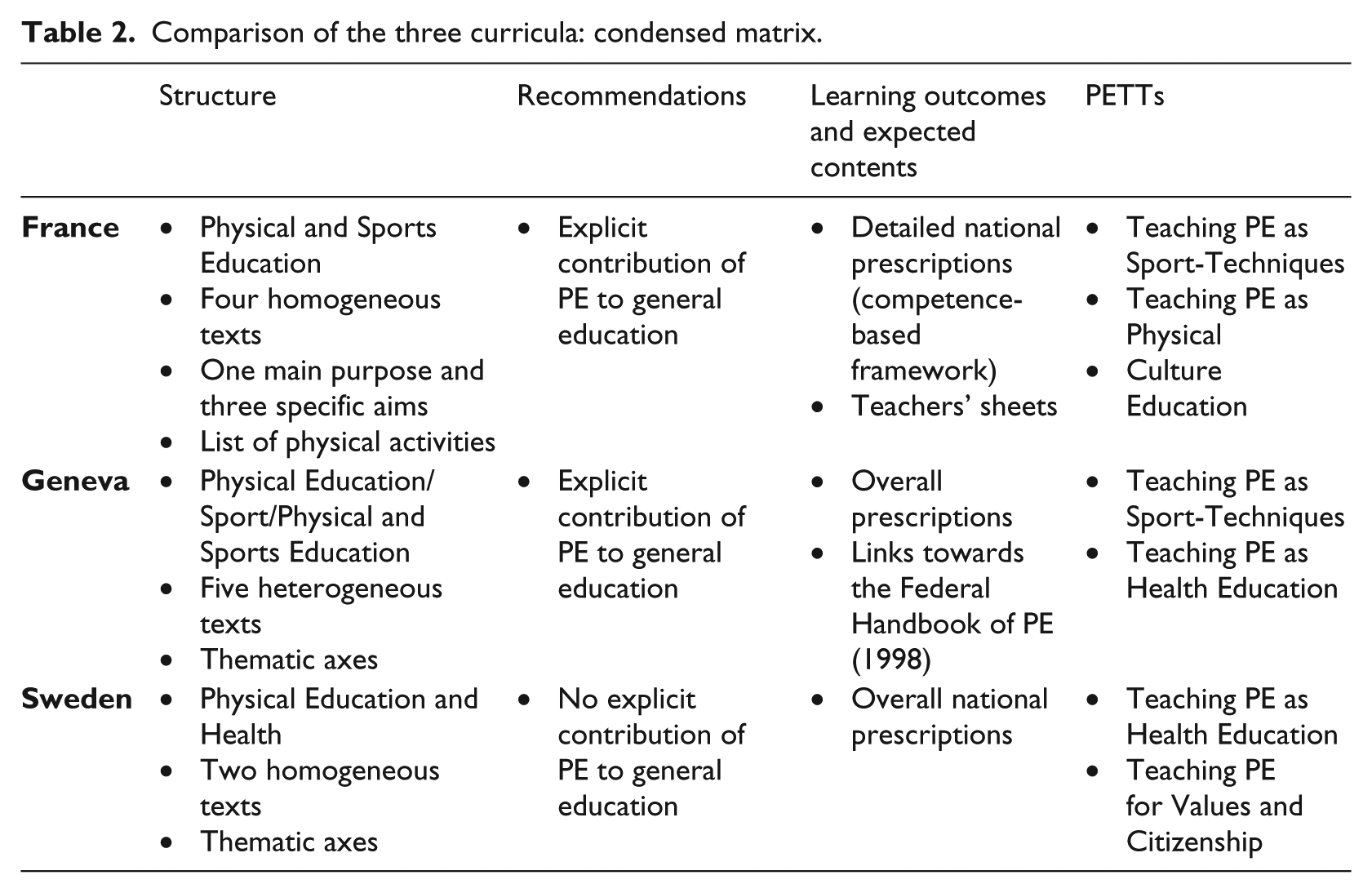
In terms of the organisation and structure of the curriculum texts, PE as a school discipline is described differently in the three countries, which could reveal different perceptions of the purposes of PE. In terms of recommendations, the contribution of PE to general education is not explicitly highlighted in Sweden, but it is in France and Geneva. Sports culture is a major aim in France, a minor aim in Sweden, and it is only highlighted in the local curriculum in Geneva. In France, the knowledge requirements and teaching content are prescribed nationally and are based on a framework of ‘competencies’ for each physical activity. In Sweden and the canton of Geneva, the PE content is described in less detail than in France and is not as nationally prescribed. With the exception of Sweden, additional teaching resources and documents play an important role in illustrating the content to be taught in PE. In Switzerland, the Federal Handbook of PE published in 1998 is still used for reference. In France, the Ministry of Education provides PE teachers’ resources for each subject content. From these respective characteristics, it can be inferred that: (a) ‘Teaching PE as Physical Culture Education’ tends to be the most influential PETT in France, (b) the curriculum texts in the canton of Geneva mainly fall within the framework of the PETTs ‘Teaching PE as Sport-Techniques’ and ‘Teaching PE as Health Education’ and (c) ‘Teaching PE as Health Education’ and, to a lesser extent, ‘Teaching PE for Values and Citizenship’ are the dominant PETTs in Sweden.
Discussion on the comparison of the three curricula
The aim of this paper was to investigate established teaching traditions in France, Switzerland (the canton of Geneva) and Sweden by analysing PE curricular materials and distinguishing similarities and differences among them. Below, we discuss the results in relation to our fourfold categorisation of PETT to identify the impact of those traditions in the three curricula. This leads us to point out the entanglement of various layers of teaching traditions in curriculum discourses.
How do PETTs impact the official curricula? A look into the past
The current curricula are the results of educational reforms and the formalisation of habits and traditions over time. A look at the past helps to understand how established PETTs impact curriculum discourses.
In France, previous analysts of the curriculum have pointed out a strong controversy between two visions of PE: (a) a ‘cultural approach’ valuing physical activities as social practices which should be analysed in order to identify the content knowledge to be taught, and (b) a ‘structuralist approach of human movement’ with a limited number of common dimensions that should be taught (Dugas, 2004; Jarnet, 2009). These two visions still exist in the curriculum, which combines different perspectives on knowledge and values to be taught and how they refer to social practices (Bréhon and Chovaux, 2009; Pasco and Léziart, 2005). Thus it can be said that ‘Teaching PE as Physical Culture Education’, as an integrative vision considering the body in culture (Kirk, 2010), certainly has an influence on the French curriculum, but remains a horizon. Our analysis shows how the French curricular materials integrate many aspects of other PETTs that consider primarily the body in nature, notably ‘Teaching PE as Sport-Techniques’.
In Switzerland, the Federal Handbook of PE has been a reference source for PE teachers since the introduction of the school discipline into the Swiss school system. A historical analysis of the successive editions of this handbook (from 1876 to 1998) shows a sedimentation of various purposes (military, medical and hygienic, sports techniques). The evolution from traditional gymnastics to sports practices over the period between 1975 and 1981 is another example (Cordoba and Lenzen, in press). It supports the idea that curricular materials currently in use in Geneva were inspired by the medical, hygienic and sports aspects of the latter editions of the Federal Handbook of PE; in other words, by a combination of PETTs such as ‘Teaching PE as Sport-Techniques’ and ‘Teaching PE as Health Education’.
Health education has long been a significant part of PE in the Scandinavian countries (Annerstedt, 2008). In Sweden, it was reinforced and made more visible in 1994, when the name of the school discipline was changed from ‘Physical Education’ to ‘Physical Education and Health’. The focus has thus shifted from an emphasis on athletic skills and performance to how the body functions and what contributes to good health (Annerstedt, 2008; Redelius and Larsson, 2010). Moreover, recent educational reforms in the Scandinavian countries have moved towards decentralisation, which means that local decision makers are now responsible for determining what pupils should learn in PE (Annerstedt, 2008; Redelius and Larsson, 2010). The fact that there are very few directives in the curriculum as to which activities should be included in PE is a natural consequence of schools now being goal oriented (Redelius and Larsson, 2010). The identification of a main PETT, ‘Teaching PE as Health Education’ and a secondary PETT, ‘Teaching PE for Values and Citizenship’ in the Swedish curricular materials is consistent with previous analyses. These PETTs show the dominance of a subject content relating to health and characterised by a physiology/fitness, risk and hygiene discourse (Annerstedt, 2008; Larsson and Redelius, 2008; Quennerstedt, 2008b; Redelius and Larsson, 2010). Social development and learning are, on the other hand, acknowledged as an essential field of PE in all the Scandinavian countries, with aims like cooperation, leadership skills, fair play and respect for others (Annerstedt, 2008; Redelius and Larsson, 2010).
As pointed out by previous research, different visions of the school disciplines and different teaching traditions shape any institutional discourse because curricular materials result from political concessions (Englund, 1986; Goodson, 1987; Kirk, 2010; Lundqvist et al., 2012; Östman, 1996; Roberts, 1988). In PE, the content analysis of the three curriculum materials points out the entanglement of various layers of PETT that, rather than an odd mixture of antagonistic visions, are historical traces of the sedimentation of teaching habits.
How do PETTs question the official curricula? A look into the future
In this section, we point out some blind spots in the PETTs that might explain the current contexts of PE teaching and learning in the three countries.
In Sweden, the dominance of the PETT ‘Teaching PE as Health Education’ and, to a lesser extent, ‘Teaching PE for Values and Citizenship’ has led several Swedish researchers to explore ‘what’ to learn in PE, in that knowledge appears to be the blind spot of these two PETTs (Larsson and Karlefors, 2015; Larsson and Redelius, 2008; Nyberg and Larsson, 2014; Quennerstedt et al., 2014; Redelius and Larsson, 2010). Their results show that teachers and pupils find it difficult to articulate what is supposed to be learned in Physical Education and Health. Redelius and Larsson (2010) call for a much stronger emphasis on the kind of PE knowledge that pupils should acquire: ‘instead of talking about what we are to do in PE, we should perhaps talk more about what teachers ought to teach and what pupils are expected to learn’ (p. 699).
In Geneva, where the PETTs ‘Teaching PE as Sport-Techniques’ and ‘Teaching PE as Health Education’ are spread throughout the curricular material, there is also a need to change PE teachers’ mind-sets about ‘what’ to teach and learn in PE, insofar as this ‘what’ is not reduced to superficial knowledge about health issues or motor skills (Nyberg and Larsson, 2014).
Finally, even though the French curriculum texts seem to come closer to the integrative vision of physical culture conveyed by the PETT ‘Teaching PE as Physical Culture Education’, the analysis demonstrates that this emphasis is more than counterbalanced by the dominance of the molecular approach of ‘Teaching PE as Sport-Techniques’, as well as the permanent controversy about ‘what’ should be the core content knowledge in the discipline (Dugas, 2004; Jarnet, 2009).
These reflections lead us to question the role and function of curriculum discourses in teaching and learning practices. As pointed out by many researchers, a teacher’s reception of curriculum discourses is always an interpretation (Chevallard, 1991; Englund, 1986; Goodson, 1987; Lundqvist et al., 2012). More specifically, it should be remembered that PE teachers might value other PETTs or adopt other ways of teaching PE than those promoted in the authoritative texts (Lenzen et al., 2012; Redelius and Larsson, 2010).
Conclusion
The main purpose of this paper has been to pinpoint the different PETTs present in French, Swiss (canton of Geneva) and Swedish curricula. Having identified four broad educational directions for PE that are comparable with the teaching traditions defined for science education, the comparative analysis of curricular materials clearly demonstrates the intertwined influences of various teaching traditions upon each country. ‘Teaching PE as Sport-Techniques’ is mainly influential in shaping French and Swiss-Genevan curricula. ‘Teaching PE as Health Education’ is more present in Sweden and, to a lesser extent, in Switzerland, while ‘Teaching PE as Physical Culture Education’ tends to be more visible in France. Nevertheless, it is worth noting that a gap may exist between the formal curriculum – the research object of this paper – and the enacted curriculum. This could be due to a number of factors, such as teachers’ practical epistemology, how teachers interpret the official texts and how this influences their teaching. In order to determine the precise impact of teaching traditions in the class, and because teaching is only possible through the process of inclusion and exclusion of content (Englund, 1986), it would be necessary to extend the study and to analyse the enacted curriculum.
Footnotes
Declaration of Conflicting Interest
The authors declare that there is no conflict of interest.
Funding
This research was funded by Grant No. 2012-5023 from the Swedish National Research Council.