




Abstract
One strand of comparative didactics aims at discussing the relationships between the theoretical constructions developed within subject didactics and how these can contribute to research about teaching and learning. This article explores the relationships between categories for analysing joint actions of teacher and students (didactic contract, milieu, mesogenesis, topogenesis, chronogenesis) and categories used in the pragmatist approach of classroom discourse analysis (practical epistemology and epistemological moves). We combine both frameworks to feature different types of breaches in the didactic contract and the building of continuity in teaching and learning actions for dealing with these breaches. Analyses are carried out through examples of classroom events in science education and physical education. We argue that these frameworks, when elaborated on and compared, enable us to characterise both generic and specific dimensions of teaching and learning in different subjects.
Keywords
Introduction
The ongoing construction of a broad community for educational research has generated interest in starting a dialogue between traditions of didactic research and how they contribute to expanding the understanding of relationships between learning, teaching and the related content at stake (Hudson and Meyer, 2011; Hudson and Schneuwly, 2007). However, the relationships between theories still need to be examined through empirical examples in order to produce comprehensive frameworks. One strand within comparative didactics is thus to discuss the relationships between the theoretical constructions developed within subject didactics (Ligozat et al., 2015; Ligozat and Leutenegger, 2012; also, see Ligozat and Almqvist, in the introduction to this issue). Within this special issue of the European Educational Research Journal focused on ‘Conceptual Frameworks in Didactics’, this article explores the relationships between two theoretical approaches of teaching and learning on the basis of samples of classroom practices in science education and physical education: the analytical categories of the joint action in didactics (didactic contract, milieu, mesogenesis, topogenesis, chronogenesis) and those of the pragmatist approach to classroom discourses (practical epistemology and epistemological moves). These frameworks are brought together on the basis that they share some common roots in a socio-interactionist perspective of human actions (Wickman, 2012).
Previous work by Ligozat et al. (2011) featured the relationships between the practical epistemological analysis (PEA) and the triple genesis mesogenesis, topogenesis, chronogenesis (MTC) in didactic joint actions in the case of a mathematics lesson in Switzerland. Whereas PEA characterises the meaning-making process situated in the participants’ actions, the MTC triple genesis offers a methodological path to understand institutional dimensions in the teacher’s management of the learning progression.
In this article, we further this exploration in analysing how the teacher and the students overcome discrepancies occurring between their lines of action (named ‘breaches’ in the didactic contract in the didactic joint action framework) and how they manage the continuity between teaching and learning. For doing this, 1) we use both the PEA and the epistemological moves analysis (EMA) in the pragmatist approach to classroom discourses and; 2) we consider the MTC triple genesis within the dialectics of the didactic contract (DC) and the milieu, in the joint action framework in didactics (JAD). We explore the identification of differences, similarities and complementarities between both the theoretical frameworks.
The article begins with a brief presentation of the two frameworks used and their respective analytical tools. Then, we focus our empirical analyses on three classroom events, in which different patterns of breaches in the didactic contract were found. For each Excerpt, both the analytical sets of tools (PEA-EMA and MTC – DC in JAD) are used in parallel. Then the analytical tools are connected to examine the continuity in teaching and learning within each event. The article ends with a comparative discussion of continuity in teaching and learning through the different patterns of breaches in the didactic contract, but also the connections found between the analytical categories of the JAD and the pragmatist approach of classroom discourses.
‘The teacher’s and the students’ didactical joint actions’ and ‘A pragmatist approach to classroom discourse’: a presentation of each framework
In order to explore the relationships between different theoretical approaches towards teaching and learning, we begin by examining the features and backgrounds of both approaches. The purpose of this section is to give an overview of the distinct conceptual constructions of the two approaches. The Joint action framework in didactics (JAD) is a theoretical framework discussed in French-speaking research communities, which combines a situated and an institutional analysis of the contents taught and learnt in the classroom 1 (Amade-Escot et al., 2015; Ligozat and Schubauer-Leoni, 2010; Sensevy, 2010, 2014; Sensevy and Mercier, 2007; Sensevy et al., 2005; Venturini and Amade-Escot, 2014). The Swedish pragmatist approach to classroom discourse articulates a practical epistemology analysis (PEA) of the classroom participants and an epistemological move analysis (EMA) of the direction that learning takes (Lidar et al., 2006; Lundqvist et al., 2009; Wickman, 2004; Wickman and Östman, 2002). Although each framework takes a particular trajectory, both approaches acknowledge the importance of analysing the content of teaching and learning in classroom actions in relation to curriculum choices; both are rooted in a socio-interactionist perspective of human actions (Wickman, 2012). The French and Swedish frameworks used in this article also share ‘a common interest in socio-cultural and pragmatist approaches to the intertwined process of teaching and learning, particularly featured by Dewey’s philosophy, Mead’s social interactionism, and the later works of Wittgenstein on language’ (Ligozat et al., 2015: 316).
Studying the teacher’s and the students’ joint actions: the JAD framework
From the JAD perspective, the teacher and students construct knowledge content in the classroom jointly within an evolving learning environment. This environment, as a milieu, is considered inextricably material, social, institutional and cultural. As many other human joint actions (Clark, 1996; Vernant, 1997), the teacher’s actions and the students’ actions are ‘joint actions’ because their purposes are interdependent. This does not mean that the teacher and the students carry out the same actions together or that they share the same agendas. Didactic joint actions involve separate and distinctive actions that are bound together in certain cooperative patterns. The very nature of students’ actions is reconstructive: at each step of the lesson, the students have to make sense of new tasks, questions or problems set up by the teacher on the basis of their previous experiences. The specific nature of the teacher’s actions is anticipative: at each step of the lesson, the teacher supports the students’ constructions and reorganises them according to the next steps of the lesson plan and the curriculum objectives. Hence, the students and the teacher do not share the same perspective on the timing that the knowledge content unfolds in the classroom; it follows that they cannot have the same responsibilities in this process, either. This distinction is at the core of the theory of didactic institutions developed by Chevallard (1991 [1985]).
The didactic contract and the didactic milieu
The teacher’s and the students’ joint actions are conceptualised through two interrelated concepts: the didactic contract and the didactic milieu.
The didactic contract
Initially featured by Brousseau (1997) in the Theory of Didactical Situations in Mathematics and expanded on in Schubauer-Leoni’s works on social interactions in the mathematics classrooms (Schubauer-Leoni and Grossen, 1993; Schubauer-Leoni and Perret-Clermont, 1997), the didactic contract is most often described as a set of expectations, habits and norms
2
more often implicit between the teacher and the students that specifically concerns the content shaped during transactions. In response to these implicit expectations, the teacher and the students adjust their lines of actions, and content development occurs with unavoidable and successive breaches in the didactic contract. Breaches in the didactic contract are visible when certain discrepancies occur between the lines of actions of the teacher and the students. The breaches in the didactic contract disclose certain purposes that are pursued by the participants, which researchers can use to understand how the participants make sense of the situation in which they participate. Strictly speaking, the didactic contract is not a ‘real’ contract:
3
The theoretical concept in didactics is therefore not the contract (the good, the bad, the true, or the false contract) but the hypothetical process of finding a contract. It is this process which represents the observations and must model and explain them. (Brousseau, 1997: 32)
This evolving and dynamic process begins with the devolution to the students of a learning environment initially designed by the teacher and conceptualised as ‘a primitive didactic milieu’.
The didactic milieu
According to Brousseau, the didactic milieu is ‘all that the students relate to in the learning environment’ and that provides feedbacks on students’ actions. Teacher and students’ joint actions begin with the set up of an initial learning environment. The term ‘primitive didactic milieu’ describes the initial conditions organised by the teacher to engage students in a certain type of action, from which the actual didactic milieu arises. The didactic milieu is defined as a system of objects (material, symbolic and semiotic) that evolves continuously through the teacher’s and the students’ joint actions (Amade-Escot and Venturini, 2009; Sensevy et al., 2005). Because participants (students and teacher) ‘interpret’ or ‘define’ each other’s actions instead of merely reacting to one another’s actions, their ‘response’ is not made directly to the action of one another but instead is based on the meaning which they attach to such action (Blumer, 1969: 79). Hence the didactic milieu also includes the contingent meanings that are made over time by the participants in relation to their own goals and individual agenda. Most of the joint actions are discursive, and students’ attention is directed towards certain events, questions and relationships in the milieu, while others are undervalued or ignored. That is why the intrinsic feature of the didactic milieu lies in its evolution over time through transactions and breaches of the didactic contract.
All of the above highlights the idea that the concepts of didactic contract and didactic milieu are strongly linked in a dialectic dynamic (Brousseau, 1997; Sensevy and Mercier, 2007). Continuous changes in the didactic milieu and successive breaches in the didactic contract are at the core of a contingent process in which knowledge content development is a situated outcome of the teacher’s and the students’ joint actions.
A threefold set of analytical tools: mesogenesis, topogenesis, chronogenesis
Three analytical tools can be used to describe the teacher’s and the students’ joint actions 4 in order to make sense of the didactic contract:
Mesogenesis (i.e. the genesis of the didactic milieu) documents the process by which the teacher and/or students continuously (re)organise the primitive didactic milieu.
Topogenesis (i.e. the genesis of the epistemological positions of the participants) documents how participants share responsibilities related to the content at stake throughout joint actions.
Chronogenesis (i.e. the genesis of the didactic time) documents the evolution of the content as moved by the teacher (and partially by students) during joint actions.
These three geneses (MTC) evolve together simultaneously: ‘to every stage of mesogenesis, there corresponds a topogenetic state and a chronogenetic state’ with regard to the knowledge at stake (Amade-Escot and Venturini, 2009: 29, our translation). In the analytical process, the mesogenesis is the starting point of the analysis upon which the topogenesis and the chronogenesis may be featured.
In summary, the articulation of the didactic contract and the didactic milieu in the JAD framework enables us to understand that the primitive didactic milieu (as a set of material, symbolic, semiotic objects) evolves continuously through the teacher’s and students’ joint actions, namely the mesogenesis. This intertwined process creates breaches in the didactic contract that punctuate and go along with the content progression, namely, the chronogenesis. The breaches of the didactic contract also highlight differences in participants’ meaning-makings and originate forms of responsibility (related to the content at stake in transactions) that each participant may assume, namely, the topogenesis. As an analytical framework, this approach provides a transactional view of teacher-student joint actions in terms of how knowledge content unfolds in learning environments.
The pragmatist approach to classroom discourse: PEA-EMA theoretical framework
In the Swedish pragmatist approach to classroom discourse analysis, human knowledge and situated learning are examined in relation to the purposes and the expectations of a certain practice (Lidar et al., 2006; Lundqvist et al., 2009, 2012; Östman, 1996; Wickman, 2004; Wickman and Östman, 2002). This transactional approach to teaching and learning not only focuses on the epistemological dimension in meaning-making but also on norms and values and their continuity as a consequence of embracing a pragmatic philosophy (Cherryholmes, 1988; Östman, 1996). Building on Dewey’s and Bentley’s work on transaction and Wittgenstein’s later works, this approach views meaning-making as taking place in the encounters that people make with the physical and social environment as simultaneous, mutual influences (Dewey and Bentley, 1949; Wittgenstein, 1958 [1953]).
The Swedish approach stands out in its aim to design specific methods for in situ analyses of both the process and the content of learning – practical epistemology analyses (Wickman and Östman, 2002) – and the role of the teacher in students’ learning – epistemological move analyses (Lidar et al., 2006). All together, the methodology is built from a critical and transactional approach aiming at creating knowledge on didactical issues (Almqvist et al., 2008). The conceptual construction and analytical tools used in the pragmatist approach for analyses of classroom discourses are summarised in the following sections.
Practical epistemology analysis (PEA)
PEA is grounded in classroom discourse analysis as a transformation of experience within a language game taking into consideration both situational and continuous aspects of learning (Quennerstedt, 2013; Wickman, 2004; Wickman and Östman, 2002). The analysis aims at making detailed descriptions of what people do or do not do when they try to achieve something. Four analytical concepts are used to highlight how meaning-making is formed/shaped in the participants’ actions: ‘encounter’, ‘stand fast’, ‘gap’ and ‘relations’:
An ‘encounter’ delineates a specific situation where a person interacts with an action. This involves human beings as participants and ‘things/aspects/objects’ that become part of their experience in this situation. Those objects or aspects can be physical objects, signs, words, utterances, phenomena like natural facts and events, as well as recalled experiences.
During an encounter, certain objects are handled without any questions arising about their use. Such objects and words ‘stand fast’ in the encounter. It should be noted that what stands fast in one situation may be later questioned in another situation. Neither does stand fast necessarily imply a correct use from the observer’s perspective. It simply implies that the meanings of certain words in discourse are self-evident for the participants with respect to this specific situation.
In an encounter a ‘gap’ occurs when an object or word does not stand fast, where there is a need for relevant actions to be able to coordinate with the environment. Gaps can be explicit or implicit. An explicit gap can be noticed when a participant hesitates or expresses a question.
To make the activity proceed, the participants build ‘relations’ that establish differences and similarities to what stands fast and that mark continuity between past and present experiences. Then the gap is filled. If they fail, the ‘gap’ lingers and the activity will stop or the course of action may change direction towards another purpose.
It is important to note that the four concepts of PEA enable a first analysis of meaning-making from the interlocutors’ perspective.
Epistemological moves analysis (EMA)
In their teaching practices, teachers perform many actions, both physical and verbal, that can be considered epistemological in character. These actions call attention in different ways to what knowledge is relevant and which ways of making meaning are valid in a certain situation in a certain practice. EMA accounts for how teachers perform actions helping students to learn. Such actions indicate what is valuable to pay attention to in the specific educational context. Using the term ‘move’ emphasises that a teacher’s action is directed towards a specific purpose for the particular practice (Lidar, et al., 2006; Lundqvist et al., 2009, 2012; Rudsberg and Öhman, 2010). The teacher has a role in telling what counts as relevant by making moves that are aligned with a teaching purpose, not because it is true or false, but because it will be relevant in the following activities. Even though teaching can be understood as discursive, the teacher’s purpose is to get the students to pay attention to certain phenomena, events or questions, and not to others. However, the meanings that are made in the transactions between the teacher and the students result from a mutual process. Consequently, in this analysis, the focus is put on the relationship between a teacher’s epistemological moves made when teaching and the students’ practical epistemologies in their learning process. It is also important to acknowledge that epistemological moves have to be analysed as parts of an event. Epistemological moves are relational, which means that it is not enough to account for a teacher’s actions; it is also necessary to take into consideration the transactional dimensions of student-teacher interactions through statements to determine what function the move has in directing the learning processes. Five descriptive analytical concepts are used (Lidar et al., 2006):
‘Confirming move’: when the teacher confirms that students observe the ‘right’ phenomenon and events; that they act in a relevant way, or that they perform a valid experiment or explain it in a relevant way for this practice.
‘Reconstructive move’: when the teacher helps students to pay attention to aspects they have already noticed but not pursued – the aspects the students are expected to have recognised.
‘Instructional move’: when the teacher gives students concrete instructions for how they must act in the event to see what is worth noticing.
‘Generative move’: when the teacher summarises the relevant information in order to enable students to generate explanations or expected actions.
‘Reorienting move’: when the teacher points out that the learning path needs to take another direction than the one the students have started on.
In summary, this is a methodological framework aiming at understanding how people make meaning in teaching and learning practices. PEA is used with the aim of making detailed descriptions of the students’ meaning-making processes. Using EMA in combination with PEA is a way to illuminate how different moves from the teacher fulfil different functions in the students’ learning processes and thus highlights the role of the teacher for the path that learning takes in practice. Furthermore, this transactional analysis also makes visible how different encounters in the situation (e.g. physical objects, signs and/or earlier experiences) along with the teacher’s actions take part in students’ learning processes.
Methodology and data source
This comparative study on theoretical frameworks was conducted in the context of a larger study aimed at comparing the manners of teaching in natural sciences (including physics, biology and chemistry) and physical education (also, see Marty et al. and Forest et al. in this issue). 5 Several teaching units led by experienced teachers were video-recorded in both subject areas in three different countries (Sweden, France and Western Switzerland). The video recordings of the teaching units were transcribed and we first did a macro-level analysis of the teaching purposes: in each lesson, we looked at the main teacher’s instructions to identify the nature of the tasks, their duration and their learning outcomes. In each unit, and in all three countries, we found some breaches in the didactic contract, i.e. events in which a discrepancy occurs between the teacher and students’ lines of action. Moreover, we could find regular patterns among them: breaches may be initiated by the students or the teacher; breaches may occur in verbal or in physical actions; breaches may also occur in relation to short-term teaching purposes (e.g. performing the task) or broader teaching purposes (e.g. aligning with curriculum aims). In this article, we selected three excerpts in which breaches in the didactic contract occur. Taken together, they constitute a sampling of the main patterns of breaches in the didactic contract that we could identify in our data. We carried out a micro-level analysis of these excerpts, focusing on the fine-grained classroom actions in which the breaches were found. We used both the pragmatist approach to classroom discourses (PEA-EMA) and the modelling of joint action in didactics (MTC in JAD) to feature the continuity of teaching and learning through the breaches in the didactic contract.
The first section of the analysis concerns a science lesson on the theme of energy in Sweden in grade 6 (age 12–13), where students generate two successive breaches in the didactic contract so that the content in discourse drifts away from the scientific practice (a broad teaching purpose). The second section is about the teaching of gymnastics in France (age 11–12) where a student generates a breach in the didactic contract about a bodily experience to be performed in a gymnastic task. It is followed by a second breach generated by the teacher about the social roles involved in the gymnastic practice (a broad teaching purpose). The last one is about the state of matter in science in Switzerland (age 12–13) where two successive breaches of the didactic contract by the students led to both the students and the teacher making unforeseen distinctions that deepened the task towards broader aims in the curriculum. Each excerpt is analysed successively through the lenses of both frameworks and some conclusions are made about the implicit norms embedded in the didactic contract. Finally, in the last part of the article, we draw a comparative discussion of both frameworks on the basis of the empirical characterisation of the continuity in teaching and learning.
Exploring the continuity of teaching and learning through the breaches in the didactic contract: three examples of classroom events
Excerpt 1: energy, meteors and dinosaurs
The context of the classroom event
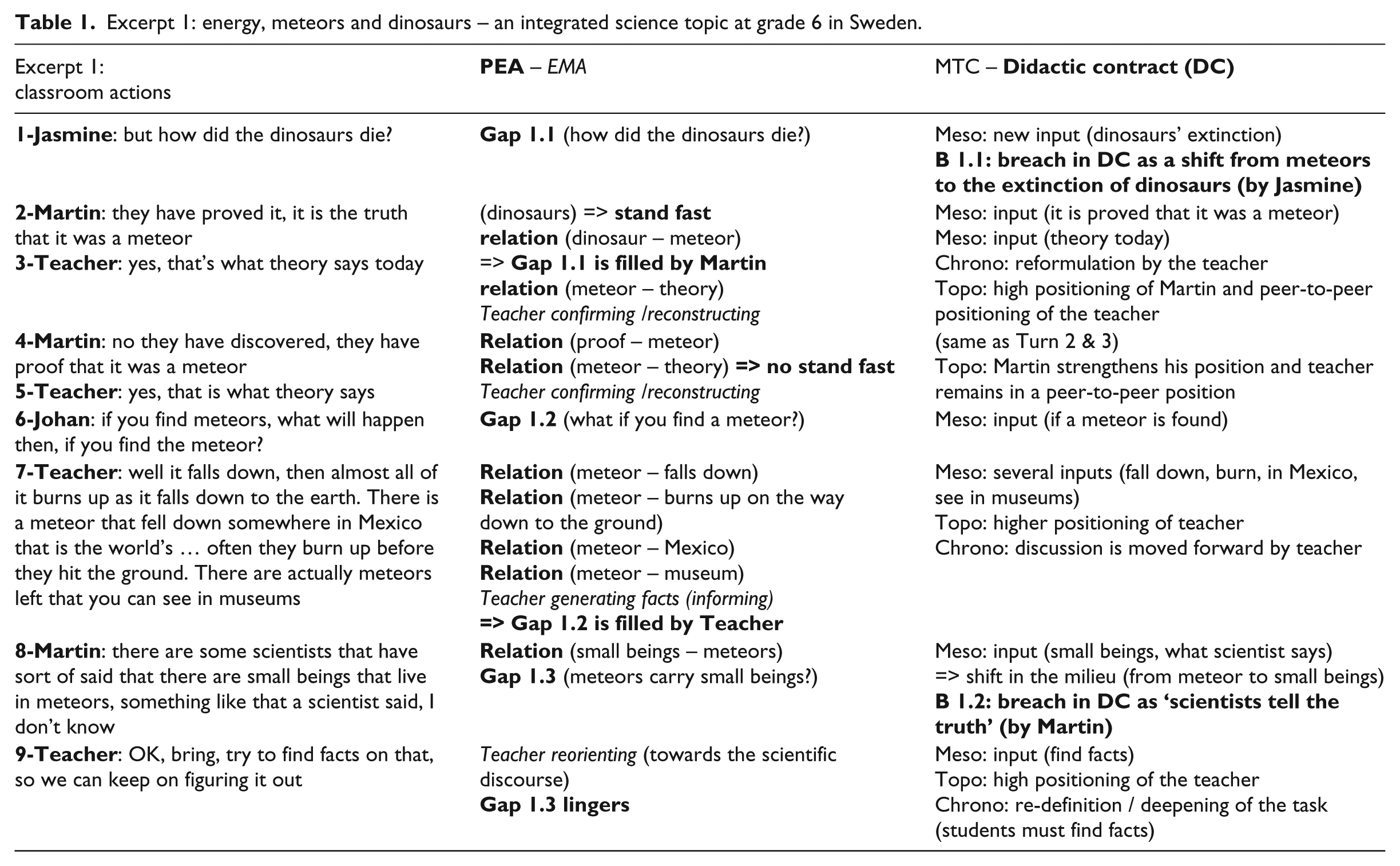
The following Excerpt of classroom actions is taken from a thematic science lesson on energy, in a grade 6 Swedish classroom (the students are 12–13 years old). Energy as teaching content is on the syllabus of the science subjects, namely physics, chemistry and biology; however, what is emphasised is a bit different depending on the subject. The teacher teaches all science subjects, physics, chemistry and biology in this class, and, as with this unit, she often chooses to teach the subjects thematically, including aspects from all three subjects. The Excerpt comes from the first lesson in a series of 10 lessons. During the lessons that follow, different aspects of questions related to energy are introduced as concepts and facts: energy transitions, the important role of the sun for human existence, fossil fuels, renewable energy sources (the sun, water and wind), climate change and consequences for the environment as well as a few different experiments.
The first lesson starts with the teacher reviewing the principle of photosynthesis as a crucial part in the production of energy. The students come up to the whiteboard and write the concepts they relate to energy. Together they conclude that the foundation for all kinds of energy is the sun. The teacher opens up for the students’ questions and lets the students take part in the direction the lesson takes. The students come up with a lot of examples concerning their own experiences about what energy means. At the end of this lesson the conversation expands to other questions, and connections are made between the sun, stars, planets, galaxies and meteors. The conversation discussed in the Excerpt presented in Table 1 lasts for 90 seconds.
Excerpt 1: energy, meteors and dinosaurs – an integrated science topic at grade 6 in Sweden.
Description and analysis using the two frameworks
Analysis using the PEA-EMA framework
At the end of this first lesson in the unit, a student (Jasmine) opens a discussion about why the dinosaurs died. The student’s question shows that there is a gap (Gap 1.1) in the explanation about how dinosaurs died. This is an expansion from the topic that drifts away from the focus on energy. Another student (Martin) fills in the gap by making a relation between dinosaurs and meteors. Martin repeats (Turn 4) his statement about the relation between dinosaurs and meteors, that is, it stands fast. Even though the content is not in line with the theme of the unit, the teacher does not dismiss the issue but she supports it as an interesting question. Here the teacher uses confirming moves (Turns 3 and 5) to verify the student’s question and to fill in the gap. This is done by reconstructing a scientific perspective, ‘yes, that’s what theory says today’. However, ‘theory’ does not stand fast, since Martin keeps on saying that ‘[scientists] have proved that is a meteor’ (Turn 4). Another question is raised by the student Johan, focusing on ‘what will happen if you find a meteor’ (Gap 1.2). The teacher then brings in new facts to the discussion by generating facts about the fall of meteors (Turn 7). Then Martin says that ‘there are small beings that live in meteors’, but he’s not sure. In this situation there is a new gap between meteors and living things in meteors (Gap 1.3). The relations between energy, meteors and small beings living in meteors are less and less consistent. At this point the teacher reorients the students towards a specific discourse, the scientific discourse, which suggests that an explanation must be reasonable within the practice and always confirmed with facts.
Analysis using the JAD framework
Jasmine’s question generates a first breach in the didactic contract (B 1.1) since the death of dinosaurs shifts the milieu towards a historical-ecological perspective on species (instead of focusing on energy). Martin’s answer to Jasmine (Turn 2) exhibits his personal high level of certainty about the causal relation between meteors and dinosaurs, based on the proof supposedly established by scientists (high topogenetic position of Martin). But the teacher subtly lowers this level of certainty (Turn 3), in reformulating with the word ‘theory’ that nuances the word ‘proof’ (chronogenetic shift). At this moment the teacher remains in a peer-to-peer positioning and this allows Martin to maintain his level of certainty in the next utterance (Turn 4). Then Johan shifts the milieu back to ‘meteors’ and their possible consequences ‘if we find them’ (Turn 6). The teacher indicates several facts about the fall of meteors with a higher positioning (topogenetic raise) that moves the discussion forward (chronogenetic shift). Martin shifts the milieu towards some new objects: ‘small beings that live in meteors’ (Turn 8). Martin generates a second breach in the didactic contract (B 1.2) in focusing on what scientists possibly said about meteors (and possibly trusting them too much?). This idea is again rooted in the supposed discourse of scientists, but Martin’s level of certainty is now lower (compared to the causal relationship between meteors and dinosaurs – Turns 2 and 4). This time, the teacher (re)defines the task as ‘finding facts on that’ (chronogenetic shift) in taking simultaneously an even higher positioning (topogenetic raise).
Discussion
From the use of both frameworks, we can uncover certain implicit norms of the didactic contract that unfold in the course of the teacher’s and the students’ joint actions.
Various students’ personal ideas (meteors, dinosaurs and small beings) may be discussed to link the students’ interests to the thematic unit on energy. This is identified through confirming and generating moves (EMA) and peer-to-peer positioning in the topogenesis (JAD).
What scientists say relies upon theories that should not be confused with facts and proofs. This is identified through reconstructing moves (EMA) and reformulations featuring the chronogenesis (JAD).
Students’ ideas should be anchored in facts; they should not just report what scientists have said. This is identified in the teacher’s actions: a reorienting move (EMA), higher positioning in the topogenesis and task re-definition in the chronogenesis (JAD).
In focusing on building a scientific discourse grounded in facts, the teacher heads towards the induction of the students into the scientific practice.
Excerpt 2: performing a gymnastics handstand
The context of the classroom event
The classroom event analysed in this section concerns the teaching of gymnastics in a French sixth-grade classroom, first year of middle school (age 11–12) during the second lesson of a six-lesson unit. For each PE subject, the French curriculum defines the objectives and contents to be taught in terms of ‘physical competencies, knowledge and attitudes’ to be learnt by the end of each school year (also, see Forest et al. in this issue). At the end of grade 6, each student should be able to do the following: In accordance with basic safety rules, on a multi apparatus gym course set: presents a controlled set of simple gymnastic elements (combined or not) including actions such as rotating and leaning back up the inverted body position; helps a classmate performing a simple element; observes and appreciates (her/his) performance on the basis of simple criteria (French Ministry of National Education, 2008).
The classroom event takes place at the very end of the second lesson between the teacher and a group of four male students during a group work related to the learning of a basic gymnastic skill, the handstand. In the assigned task, students have to take in turn each role related to the gymnastics social practice, that are gymnast, spotter 6 and judge. In the role of gymnast, they have to perform a part of the handstand: lean back until reaching the inverted position with only one leg aligned with the upper body and return to the lunge position, while a classmate helps by spotting (Figure 1). The purpose of the task is that students perform ‘an alignment of body segments in a safe environment, thanks to the spotting’ according to the teacher’s instruction. In the role of the spotter, a student ‘help(s) his partner by controlling the placement of hips over the arms and by preventing any fall’. In the judge role, students should ‘observe the practitioners and comment: first, the trial done by the gymnast; second the spotting done by the spotter’. In this task, the teacher asks the students to focus on two criteria: i) the alignment of hands, hips and one leg by the gymnast, and ii) the right way to control the hips over the arms by the spotter: ‘give feedback on the correctness of the performance’ (teacher’s instruction).
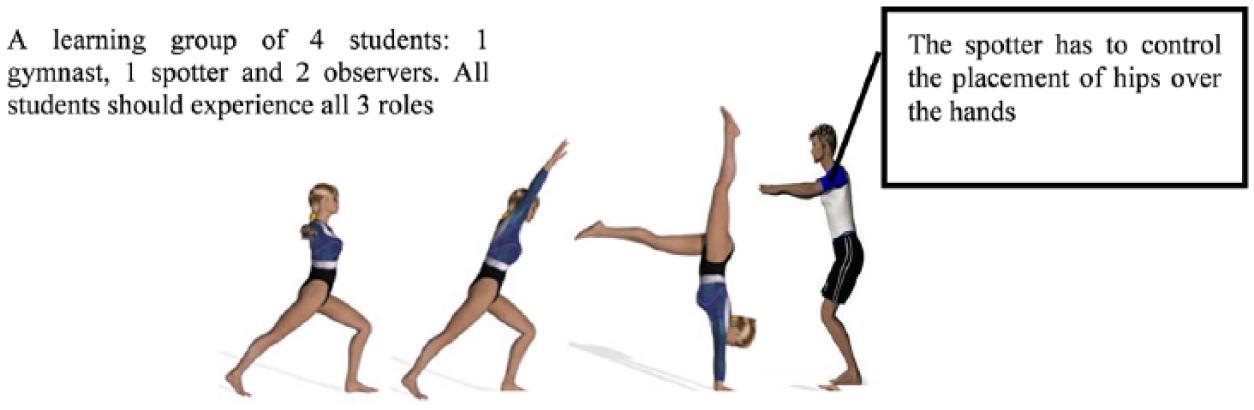
Assigned task in gymnastics.
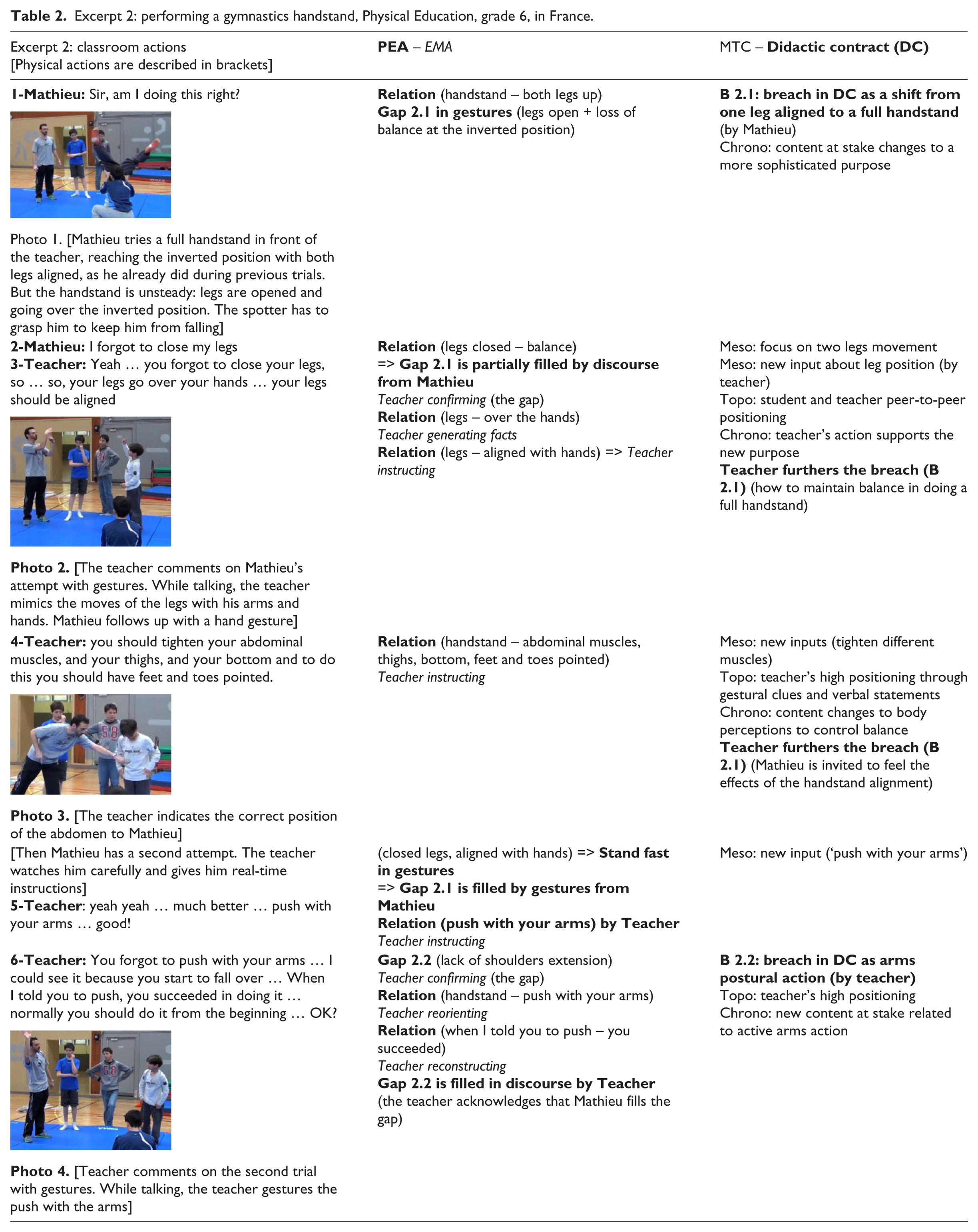
The event described in Table 2 shows the teacher’s actions, as one student, Mathieu, performs the task in the gymnast’s role; one student is in the role of spotter and two other students are judges.
Excerpt 2: performing a gymnastics handstand, Physical Education, grade 6, in France.
Description and analysis using the two frameworks
Analysis using the PEA-EMA framework
The Excerpt, which lasts 35 seconds, starts when Mathieu calls the teacher standing near the group (Turn 1: ‘Sir, am I doing this right?’). In Mathieu’s attempt to do a full handstand (with both legs up), there is a gap (Gap 2.1) about the leg positions (legs are open) and a lack of control of the body balance (Table 2, Photo 1). First, Mathieu fills in this gap in the discourse (Turn 2). The teacher confirms the gap and generates clues about how to fill it (Turn 3: ‘legs should be aligned’), which are in line with the purpose of body segment alignment assigned in the initial task. Then the teacher gives instructions about the tightness of abdominal and thigh muscles (Turn 4). Then Mathieu tries a second full handstand. This time, since no one comments about the legs’ position, ‘closing the legs’ stands fast, which means that Mathieu has filled the initial gap in this encounter. But a new gap (Gap 2.2) arises since Mathieu’s handstand is still not well balanced yet. During the second handstand, the teacher makes a quick instructional move (Turn 5: ‘push with your arms’) that clearly supports Mathieu in filling this new gap in gesture, since the teacher confirms in discourse (Turn 5: ‘good!’). Afterwards, the teacher re-constructs this gap in discourse (Turn 6: ‘you forgot to push with your arms … you started to fall over’) and reorients the learning path towards another direction to avoid falling over (Turn 6: ‘when I told you to push, you succeeded’). This reorienting move is followed by a reconstructive one (Turn 6: ‘normally you should do it from the beginning’). By using these two epistemological moves, the teacher acknowledges that Mathieu has filled the second gap.
Analysis using JAD frameworks
When the teacher approaches the group of students, Mathieu attempts a full handstand with both legs up. This trial generates a breach in the didactic contract (B 2.1), since a full handstand is beyond the task requirements at this time of the unit. Mathieu’s input changes the content towards a more sophisticated purpose (chronogenetic shift). First, the teacher follows up the breach introduced by Mathieu by giving new inputs into the milieu that indicates the faulty positions of the body (Turn 3) and then the correct positions that should be used (Photo 3). The teacher invites Mathieu to experience new corporeal feelings to maintain the alignment over the hands: from abdominal control to toes pointed. He thus expands the content at stake. In doing this, the teacher changes from a peer-to-peer positioning to a higher positioning in discourse (topogenetic raise), from which he reorganises the milieu towards controlling the handstand balance (chronogenetic shift).
After Mathieu’s second attempt, the teacher’s gestures (Photo 4) brings the purposes further, a with new input in the milieu that is specific to the corporeal perception of the handstand (Turn 5 and 6: ‘push with your arms’). In doing this, the teacher generates a second breach in the didactic contract (B 2.2): performing the handstand is no longer just a matter of aligning body segments; it also requires an almost imperceptible body action (called in gymnastics’ technical vocabulary an ‘arms push-down’: a shoulder extension that results from a push with the arms that plays a crucial role in the postural control). This breach introduces new content, which was ‘silent’ until this point of the lesson. Mathieu is then asked to perceive the effects of a complete handstand corporeal experience (Turn 6: ‘normally you should do it [arms push-down] from the beginning’).
During this event, the content promoted by the teacher in the milieu, both in supporting Mathieu’s input (legs closed up) and in addressing them directly (to be tight and aligned to avoid a fall back; to produce arms push-down) only concern the gymnast’s role. The content related to the spotter and the judge roles, which were formerly defined earlier in the lesson in relation to the holistic approach of social roles in gymnastics, does not seem important anymore.
Discussion
From the use of both frameworks, we can uncover certain implicit norms of the didactic contract that unfold in the course of the teacher’s and the students’ joint actions.
Succeeding in doing a full handstand is merely the result of the gymnast’s physical performance based on biomechanical norms. This is identified in the teacher’s generating and instructing moves (EMA), the higher positioning through verbal and gestural clues in topogenesis and the chronogenetic shifts towards body techniques (JAD). Collaterally, there is a toning down of the content related to social and affective norms involved in the gymnastic sport culture as social practices involving relational interactions between gymnasts, spotters and judges.
The corporeal perceptions for controlling the balance of the handstand are supposed to be constructed by the students as a ‘private’ dimension of gymnastics practice. This is identified through the reorienting and reconstructing moves (EMA), the higher positioning in the topogenesis and the change of content (arms push-down) in the chronogenesis. The spontaneous instructions about ‘push(ing) with your arms’ (that was not part of the instruction at the beginning) reflect a disruption in the teacher’s line of action generated by Mathieu’s unbalanced handstand.
In focusing on the gymnast’s performance based on the elicitation of the biomechanical norms, the teacher emphasises the meaning of physical education at school as merely sport techniques (Kirk, 2010; Rovegno, 1995).
Excerpt 3: the particles in the gas state
The context of the classroom event
This last Excerpt of classroom transactions is taken from a teaching unit called ‘Matter and Particles’ at grade 7 (the students are 12–13 years old), video-recorded in an international school in Western Switzerland. The international school curriculum for science at lower secondary grades (7, 8 and 9) is made up of a succession of thematic units designed by the teachers and used by all of them. The recorded unit on matter and particles is taught to a class of 22 students of many different nationalities.
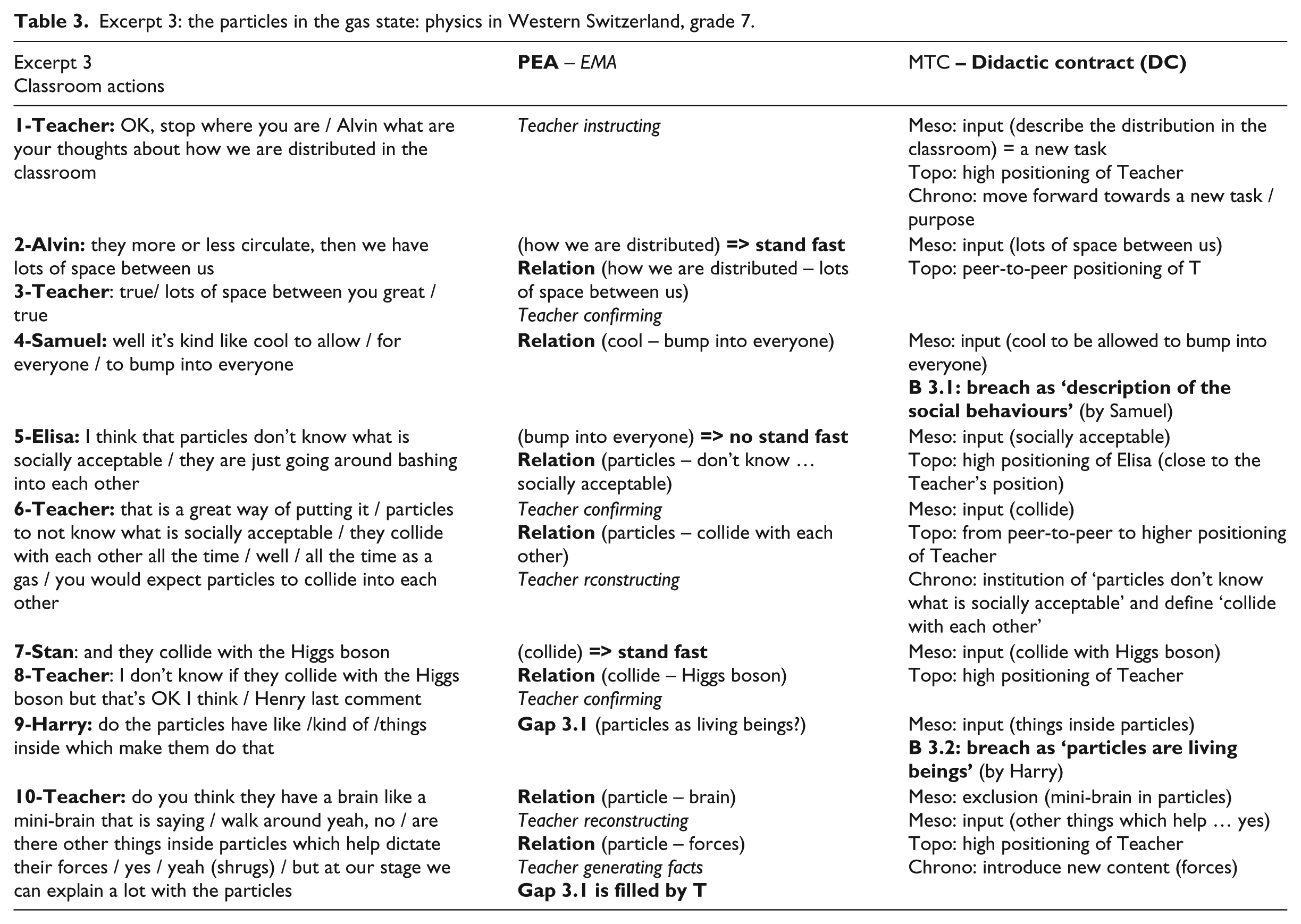
The Excerpt is taken from the fourth lesson in a series of 10. In the second lesson, the teacher introduced a particle model to represent solid, liquid and gas states, using a video simulation. The fourth lesson started with a concept map reviewing the relationships between the states of the matter, particle arrangements and changes in energy or temperature. Then the teacher asked the students to mimic the behaviours of the particles in the solid, liquid and gas states with their bodies in the classroom space. When the students mimicked the gas state, they walked randomly in the classroom. Some students bumped into others deliberately, causing shouts and laughs. After a couple of minutes, the teacher asked the students to stop moving and to describe the distribution of the bodies in the classroom. The Excerpt from the discussion presented in Table 3 lasts 1 minute, 30 seconds.
Excerpt 3: the particles in the gas state: physics in Western Switzerland, grade 7.
Description and analysis using the two frameworks
Analysis using the PEA-EMA framework
The Excerpt starts with an instructional move made by the teacher (Turn 1: ‘look how we are distributed in the classroom’). Alvin creates a new relation in noticing that there is a ‘lot of space between us’ (Turn 2), which is confirmed by the teacher. Then Samuel continues with another relation stating, it’s kind like cool to allow for everyone to bump into everyone’ (Turn 4). But this relation does not ‘stand fast’ 7 since another student (Elisa) says, ‘particles do not know what is socially acceptable’ (Turn 5). Two different meanings of the student’s distribution in the classroom are made: the first one by Samuel is about the behaviours of students, whereas the second one by Elisa is about the particles. The teacher confirms the relation built by Elisa and re-constructs it by introducing the word ‘collide’ to describe the particles’ moves (Turn 6). Then another student (Stan) uses this word again in making a relation between particles and the Higgs boson. The teacher confirms quickly and asks for a last comment. Harry then asks if ‘particles have things inside which make them do that’ (Turn 9), which is a gap in the meaning-making process (Gap 3.1). The teacher fills in the gap by reconstructing (Turn 10: particles don’t have mini-brains) and generating new facts (Turn 10: there are things inside which help dictate their forces). In this Excerpt, the students are given the opportunity to act out how particles move in the gas state. The epistemological moves made by the teacher promote new words for describing the particles (‘collide’; ‘things inside that help to dictate their forces’) that are different from the words used for describing social / living beings. The teacher does not rely upon ‘core science’ words yet (like ‘excitation’, ‘electric charges’, ‘random trajectories’, etc.) to make such a distinction; he sticks to everyday vocabulary.
Analysis using the JAD framework
The Excerpt opens up with the teacher setting up a new task, which explicitly changes the purposes for the students (chronogenetic shift). How do the students make sense of this task? Alvin notices ‘a lot of space between us’ (Turn 2), which is acknowledged by the teacher who remains in a peer-to-peer position. Samuel comments the fun ‘to be allowed to bumping into each other’ (Turn 4), but Elisa highlights the non-social nature of the particles (Turn 5). In emphasising the social behaviours of the students walking around in the classroom, Samuel generated a breach in the didactic contract (B 3.1). His statement does not fit the description of the particles in the gas state. The teacher backs up Elisa and introduces the word ‘collide’ for describing the particles (Turn 6). In doing that, he takes a higher positioning (topogenetic raise) and brings about a new way of describing the particles (chronogenetic shift) supported by Elisa’s input in the milieu. Then, Harry’s question, ‘do the particles have things inside which make them do that?’ (Turn 8) generates a second breach in the didactic contract (B 3.2). The teacher first expands on Harry’s input (Turn 10: ‘do you think they have … a mini-brain’) and then he reshapes the milieu towards his teaching purposes. Mini-brains are excluded, but ‘things inside that help dictate their forces’ (Turn 10) are introduced (chronogenetic shift). This is in line with the discussion of electrostatic forces that will occur in the next step of the lesson, according to the lesson plan that it is written on the white board.
Discussion
Using both frameworks, we can uncover certain implicit norms of the didactic contract that unfold in the course of the teacher’s and the students’ joint actions.
The students’ bodies in the classroom can mimic the behaviour of the particles, but the particles should not be confused with social/living beings. This is identified through words (to be allowed to bump into each other) that do not stand fast (PEA) and Elisa’s high positioning in the topogenesis (JAD), pointing out the contradictory meaning-making about the task.
Modelling in physics is about making distinctions (what to include and exclude) in order to describe an invisible reality. The words used for describing social living beings are not relevant when describing the particles in the matter. This is identified through the reconstructing and generating moves (EMA), the high positioning in the topogenesis and the institution of new words (collide, things that dictate their forces) in the chronogenesis (JAD).
In focusing on the distinctions between the model (students walking around) and the particles, the teacher emphasises the specificity of modelling as the scientist activity when seeking to explain a phenomenon. He also extends learning to the language used in continuity with the students’ everyday experiences.
Comparative discussion
In this section, we discuss the consistent use of both the PEA-EMA framework and the JAD framework for producing an extended analytic approach to examine the continuity of the teaching actions with the learning experience of the students. The discussion is organised into three sections: first, we highlight how the continuity in teaching and learning may be effectively described using the breaches in didactic contract as a starting point of the analysis; second, we stress the commonalities and differences between PEA-EMA and the MTC genesis in JAD and we show how they enhance each other by characterising the teaching actions at play in the excerpts; third, we discuss the epistemological challenges in comparing and combining different analytical frameworks.
Breaches in the didactic contract and the continuity in teaching and learning
The three excerpts feature different types of breaches in the didactic contract. In Excerpt 1 (energy), both breaches occur in students’ statements that drift away either from the main topic at stake (B 1.1: the extinction of dinosaurs instead of energy sources and transformation) or from the expected scientific practice (B 1.2: reporting scientists’ ideas instead of building ideas on facts). In Excerpt 2 (gymnastics), breaches occur in the bodily movements first performed by a student (B 2.1: Mathieu performs a more sophisticated handstand) and then by the teacher (B 2.2: he highlights the role of pushing with his arms that was not discussed before among peers in the group). In both cases, these bodily movements go beyond the task initially defined by the teacher. In Excerpt 3 (particles), breaches occur in the student’s statements that make sense of the experience they had when they mimicked the particles’ moves in the gaseous state (B 3.1: cool to be allowed to bump into each other; B 3.2: do particles have things inside?). In this case, the breaches are constitutive of the modelling activity organised by the teacher, since they are about the distinctions between a model and what it is supposed to account for. This variety of examples confirms that breaches in the didactic contract should be considered as ingredients of the learning progression and not as unwanted or distracting events that the teacher should avoid.
Through the breaches in the didactic contract, the teacher and the students adjust (and re-adjust) their lines of action, thus paradoxically making teaching and learning continuous. In the energy and gymnastics excerpts, the teacher has the responsibility for building continuity, but in the case of the particles Excerpt, we could observe that a student (Elisa) had a prominent role in making a new distinction (particles are not social beings), upon which the teacher relies. In any case, building continuity through the breaches is made by a re-organisation of the milieu (inputs in the mesogenesis according to JAD) or the construction of new relations in discourse (according to PEA). Furthermore, continuity in the processing of the breaches relies upon the anticipative function of the teacher’s action towards certain curriculum requirements. In Excerpt 2, supporting Mathieu in performing a full handstand by referring to ‘push with his arms’ aligns with a short-term purpose of gymnastics in the curriculum (the full handstand), but it excludes the broad purposes of gymnastics as a social practice. In Excerpt 3, making a distinction between social beings and particles is both a short-term teaching purpose about the micro-scale modelling of the states of the matter and also a broad purpose about what modelling means in scientific practice.
Interestingly, gaps in discourse and breaches in the didactic contract do not overlap. This is consistent with the theoretical premises of each framework. Gaps feature the very situated meaning-making process in accounting for the lack of relationships with a word or a gesture in discourse. Breaches in the didactic contract feature certain discrepancies in the adjustment of the teacher’s and the students’ joint actions. Such discrepancies may be rooted in different scales of purposes in the course of the classroom actions. For instance, the teacher’s purpose may be clear at the level of the event itself (as with the second breach by Martin in Excerpt 1), or they may be found at a higher analytical level (as with the first breach by Jasmine in Excerpt 1). But in any case, gaps in discourse and breaches of the didactic contract both contribute to learning progression in providing opportunities for strengthening the meaning-making process.
Characterising the teacher’s actions: PEA – EMA and the MTC triple geneses
In building continuity, the anticipative function of the teacher’s actions is seen in the chronogenetic shifts and the raising or lowering of the teacher’s own position in the topogenesis (according to JAD) and by the epistemological moves made by the teacher (EMA). From our analyses, we found that the five-set epistemological moves (confirming, generating, reorienting, reconstructing, instructing) refine the description of the chronogenetic shifts, and symmetrically, the topogenetic positions strengthen the significance of the epistemological moves. For instance, when teachers use confirming moves, they tend to stand in a peer-to-peer position in the topogenesis, so that the students have the power for further elaborations in the same direction. Conversely, when the teachers use reorienting or instructing moves, they tend to stand in a higher position in the topogenesis, thus taking the institutional responsibility of the direction that learning takes. We posit that chronogenetic shifts and topogenetic positions associated with the five-set epistemological moves provide a useful analytical combination that features the consequences of the teaching actions about the content taught (according to JAD) or the directions that learning takes (according to PEA-EMA). This combination offers new possibilities to nuance the teacher’s actions on the meaning-making process according to the students’ participation in it.
From the teaching actions used to manage breaches in the didactic contract, it is possible to decipher certain implicit norms that unfold in the teacher’s and the students’ joint actions (according to JAD). Taking into consideration what the teacher highlights as important in the students’ responses (analysed by EMA and chronogenetic shifts) and what the students should pay attention to (analysed by EMA and topogenetic raises), unveil the nature of discourse in the classroom. Both analytical frameworks are consistent with each other in pointing at certain implicit norms in the didactic contract. Interestingly, these norms tend to reflect certain teaching traditions that are theorised in curriculum analyses (Englund, 1986; Fensham, 1988, Lundqvist and Sund, 2016; Östman, 1996). Such traditions are specific to the school subjects: science education as ‘induction to science’ (Excerpt 1 and 3) and physical education as sports techniques based on biomechanical norms (Excerpt 2). Further analyses over longer periods of time are needed in order to understand if teaching in each of the classrooms observed is done in a regular manner, consistent with a single teaching tradition. However, these preliminary results are important to understand the function of both frameworks with respect to didactic studies: their analytical categories are definitely generic in the sense that they may be used about various subject contents taught in the classroom, but the very meaning of the results in terms of ‘on what basis is continuity being made?’ is to be built against the backdrop of the school subject and curriculum theories.
An epistemological perspective on the comparison of frameworks in didactics
It is worth noting that this work results from the encounter of two research trends that were born separately in the 2000s European research into ‘Didactics’. Each framework is used in two linguistically different research contexts (i.e. Sweden on the one hand and France and French-speaking Western Switzerland on the other). The Swedish pragmatist approach is based on discourse analysis, relying on the later works of Wittgenstein and Dewey that are available in English (Dewey, 1958 [1929], 1984 [1929]; Wittgenstein, 1958 [1953], 1969). The Swedish pragmatist approach has been extensively developed in English-speaking international research journals (e.g. Lidar et al., 2006; Wickman, 2004; Wickman and Östman, 2002). In contrast, the French-speaking approach to the modelling of didactic joint actions relies upon the French literature in the field of ‘Didactique’ as developed by Brousseau (1986, 1997) and Chevallard (1991 [1985], 1992) in the late 1980s and 1990s. Although some pieces of this literature were translated into English, the analytical categories for modelling joint actions were mainly developed in French (Amade-Escot and Venturini, 2009; Ligozat and Leutenegger, 2008; Sensevy et al., 2000; Sensevy and Mercier, 2007). Analyses carried out using the JAD framework had to be translated, which means that certain words and terms had to be adapted in new English language habits, in order to establish some relationship with the Swedish framework. Interestingly, we experienced that each framework exists as a specific language game that is a language practice interwoven with the researchers’ analytical gases. Switching from French to English to analyse our excerpts also changed the language game in which the JAD framework was built. Such a change creates an unavoidable hybridisation of the French framework within the affordances of the English language. But there is also a hybridisation tendency between the French and Swedish frameworks, since they both share a pragmatic and transactional stance on the development of classroom actions. For instance, at some point, we wondered if the epistemological moves (in EMA) could be said to be ‘topogenetic moves’ or ‘chronogenetic moves’ since both EMA and topogenesis/chronogenesis feature the institutional orientation of the meaning-making process. We ended with a complementary relation, since we considered that EMA is a categorisation of variations in teaching actions, whereas chronogenetic shifts and topogenetic raises reflect the variations about how the content moved within the teacher’s and the students’ joint actions. Controlling this conceptual hybridisation process as much as possible requires reflecting on the implicit grammar of the native language game in which both frameworks are built. This reflection belongs to the core ambitions of comparative research in didactics.
In this article, isolating and focusing on the breaches in the didactic contract, in which teaching is made continuous with learning, created the empirical conditions to establish certain relationships between PEA and the mesogenesis and between EMA and the topogenesis / chronogenesis. The panel of the contents considered (integrated science unit on energy, gymnastics unit in physical education and the physics unit on the properties of matter) and the diversity of the cultural contexts (Sweden, France and Switzerland) strengthen the significance of the relationships found between both frameworks. In any case, breaches in the didactic contract happen, and the teaching actions used in building continuity highlight the generic dimensions of teaching beyond the specificity of the content, which can be understood in the convergence of the epistemological moves’ analysis and the topogenesis/chronogenesis analysis.
Conclusion
The three classroom events illustrate how teaching and learning are documented by a highly detailed analysis using two sets of frameworks and their analytical tools. Each Excerpt illustrates various patterns of breaches in the didactic contract. The pragmatist approach to classroom discourse (PEA-EMA) enables researchers to produce a high-resolution analysis of the epistemic relations built from the participants’ perspective through a fined-grained description of teacher actions during events. The studying of didactic joint actions with the meso, topo and chrono (MTC) geneses allows a high-resolution analysis of the institutional control on the meanings to be learnt. Both frameworks help to make sense of the evolution of the didactic contract and the unavoidable mismatches in the didactic joint actions. The two approaches help in deciphering the dynamics of classroom actions and suggest that the implicit norms of the didactic contract can also be a step towards understanding certain teaching traditions in action. More generally, this contribution takes forward our conceptual knowledge in didactics, exhibiting some important complementarities between the two analytical frameworks for analysing the incredible uncertainty of teaching and learning. These findings plead for further research on the possible integration of the analytical categories of JAD and those of the pragmatist approach to classroom discourses.
Footnotes
Declaration of Conflicting Interests
The author(s) declared no potential conflicts of interest with respect to the research, authorship, and/or publication of this article.
Funding
The author(s) disclosed receipt of the following financial support for the research, authorship and/or publication of this article: The authors are grateful to The Swedish Research Council (Vetenskapsrådet) for the financial support given to the project ‘Teaching traditions and learning. Comparative didactic analysis of science education, physical education and health in Sweden, Switzerland and France’ (Grant no. 2012-5023).