




Abstract
Since the 2000s, the Joint Action framework in Didactics (JAD) has been developed in the context of the expansion of the French-speaking research in Comparative didactics. Studies carried out with this framework typically investigate how knowledge content develop in teacher-student classroom interactions. From a quite different perspective, classroom research on teaching quality has also developed considerably in recent years. Despite the many efforts to better understand relations between generic versus subject-specific dimensions of teaching, this dichotomy remains strong in the debates on teaching quality. This contribution explores a comparative model for characterizing the quality of teaching practices from the conceptual categories of the Joint Action framework in Didactics (JAD-MTQ). Based on the comparison of teaching and learning practices in two school subjects—physics and contemporary dance—this paper pursues a twofold objective: (1) proposing a provisional set of generic criteria for capturing content-specific dimensions of teaching quality; and (2) highlighting certain methodological conditions for ensuring qualitative analyses of these dimensions of teaching quality.
Keywords
Introduction
In line with the concerns of this special issue on the development of comparative research in Didactics, this article brings into comparison teaching and learning practices in two distinct school subjects—physics and contemporary dance—to progress towards the construction of a generic model capturing content-specific dimensions of teaching quality.
Since the 2000s, the Joint Action framework in Didactics (JAD) has been developed in the context of the expansion of the French-speaking research in comparative didactics (Mercier et al., 2002; Sensevy, 2011, 2012; Sensevy and Mercier, 2007; also see Ligozat, 2023). Studies carried out with this framework typically investigate how knowledge content develop in teacher-student classroom interactions. For more than a decade, these studies have shed light on what is taught and possibly learnt (e.g., Ligozat et al., 2018), who is enabled to learn what (e.g., Amade-Escot and Verscheure, 2023; Verscheure and Debars, 2019), and which patterns of teaching actions can be modelled to understand consequences for learning (e.g., Amade-Escot and Venturini, 2015; Sensevy, 2014, Tiberghien and Malkoun, 2010; Tiberghien and Venturini, 2019). From this whole set of empirical research, the JAD framework has proved its capacity to describe and explain classroom teaching and learning practices about various subjects (mathematics, sciences, physical education, French language, etc.) from a generic set of concepts borrowed from major theoretical frameworks developed in the French-speaking didactic research.
From a quite different perspective, classroom research on teaching quality have also developed considerably in recent years, supported by the technological advances made possible by video recordings of classroom practices (Klette, 2023). Many observation frameworks for measuring, comparing, and discussing the quality of teaching have been set up for purposes as diverse as steering education systems, predicting students’ outcomes, or the professional development of teachers (Bell et al., 2019). According to Hill and Grossman (2013), for classroom analyses of teaching quality to support teachers in improving their practices, they must involve content analyses. Klette (2023) reviewed nine observation manuals in use in North America and Continental Europe and she notices that there are few agreements about how this aspect of teaching quality can be best captured. Praetorius and Charalambous (2018) compared the analyses of classroom practices in mathematics, by three categories of frameworks: content-generic, subject-specific, and hybrid. Noticing that there are less differences than similarities in the conclusions that each framework made, they suggest that the use of generic frameworks could be fruitfully supplemented with targeted subject-specific frameworks. Despite the many efforts to better understand relations between generic versus subject-specific dimensions of teaching, this dichotomy remains strong in the debates on teaching quality, somewhat echoing that of general didactics versus subject-specific didactics in European countries (Hudson and Meyer, 2011).
In this paper, we argue that comparative didactics research provides ways to reduce the dichotomy between generic and subject-specific frameworks for analyzing teaching quality. We suggest using the generic concepts of the JAD framework to develop a model for analyzing teaching quality based on the knowledge-content development in classrooms.
The objective of this paper is twofold: (1) proposing a provisional set of criteria for analyzing content-specific dimensions of the quality of teaching practices, which can be worked about different school subjects; and (2) highlighting certain methodological conditions for ensuring qualitative and systematic analyses of the dimensions of teaching quality. First, we begin by reviewing the foundations of the comparative didactics stream of research (“Didactique comparée”; Mercier et al., 2002) in the French-speaking tradition of Didactics. Second, we present the main features of the JAD framework elaborated in this tradition. Third, we formulate assumptions and preliminary criteria for examining teaching quality with this framework. Fourth, we compare two teaching sequences, one in science (physics), and one in physical education (contemporary dance), from which we draw a comparative model for analyzing content-specific dimensions of teaching quality (JAD-MTQ). Finally, we discuss the relevance and limitations of our assumptions and categories underlying this model, at this stage of its development.
Why comparing and how to compare teaching and learning? Comparative didactics
Whereas comparative education has a long-standing career in examining similarities and differences between educational systems structures, teaching cultures, curriculum policies, and political agendas underlying educational reforms in different countries (e.g., Schriewer and Holmes, 1992; Winther-Jensen, 1996), the rise of comparative didactics in European countries is a recent development (Almqvist et al., 2023; Caillot, 2007; Ligozat et al., 2015). In this paper, we take the perspective of the French-speaking tradition for comparative didactics (“Didactique comparée”) to argue that comparison is not just a methodological approach, but also an epistemological act advancing and strengthening the field of subject didactics.
In French-speaking countries, the development of Didactics is characterized by the emergence of a set of subject didactics as research and intervention domains focusing on teaching and learning disciplinarily organized content. 1 This focus is supported by two key ideas: (a) the notion of didactic system 2 as an undividable triadic relation between knowledge content, students, and teacher, and (b) the didactic transposition as an institutional process of knowledge transformation for teaching, starting from academic/expert knowledge—and social practices at large—to the definition of school subjects in curriculum texts, pursued by the recontextualization of content through the selection of tasks and classroom interactions (Schneuwly 2021, following Chevallard, 1985; also see also see works in the Anthropological Theory of the Didactic : Chevallard and Bosch, 2014).
Subject didactics remains a fragmented research domain because they are primarily rooted in the epistemology of the school subjects and their related academic disciplines (Caillot, 2007; Schneuwly, 2011). However, in a special issue of the “Revue française de pédagogie” laying the foundations for comparative didactics, Mercier et al. (2002) suggested to address two fundamental directions to overcome the fragmentation of subject didactics: (a) clarify the function of the content in learning and teaching practices and how this content is (re)constructed in the classrooms (i.e., the part of the transposition process that is enacted by teachers in classrooms); (b) within the activities of the teacher and the students related to the knowledge taught/learned, clarify what is “generic” that is, what can be related to a teaching (or learning) process; what is “specific” that is, what is related to the knowledge taught/learned and the disciplinary cultures. These research directions address the empirical study of human practices involved in knowledge transmission, for which the seminal anthropological distinction between the specific and the generic is postulated. 3
These premises open the way for studying the specific and generic characteristics of teaching and learning practices through comparisons of their empirical manifestations: different knowledge content and subjects; at different school levels (e.g., contrasting primary and secondary school practices); according to different pedagogical practices (e.g., inquiry-based learning versus transmissive approaches); in different cultural or national contexts; and—to a certain extent—in different social contexts (not only in schools, but also in nurseries, museums, vocational training, leisure clubs, etc.). In this view, the didactic system becomes the very object of investigation for considering the content (re)constructed in learning activities. The knowledge content is no longer the starting point of the study but a constitutive component of the many dimensions (social, cultural, linguistic, psychological, etc.) at play in teaching and learning practices.
Thus, the nature of comparison invoked here goes beyond experimental (or direct) comparisons consisting in finding differences and similarities between designed-comparable terms. 4 Comparative didactics shares the same epistemological concerns as other social sciences about what make terms comparable (Vigour, 2011). As shown by Detienne (2008) in his work on the territorialization of communities at different times and in different geographical regions, a prior definition of a tertium comparationis (third comparing term) allows to perform indirect comparisons that is, it makes possible to compare terms that are seemingly very different at first glance. The power of the third comparing term relies upon its double generic/specific dimension, neither too general, nor too specific to a particular culture or context to allow the symmetrization of facts and events observed in different contexts (e.g., in this paper, teaching how to create and interpret a contemporary dance choreography in physical education, and teaching changes of state of the matter in science).
To sum up, beyond a mere methodological approach, comparison in comparative didactics is the matter of building new knowledge about teaching and learning practices embedded within subject matter cultures. Comparative didactics addresses research questions that cannot be dealt with from the single perspective of a subject didactics, nor by pooling together results obtained by each subject didactics. To discuss the dimensions of teaching quality related to the knowledge content development in classrooms, there is a need to build some tools for systematic investigation of key aspects of knowledge transmission in classrooms across school subjects. In the following section, we present the basic principles of the JAD framework 5 that was precisely developed as a third comparing set of categories for comparing teaching and learning practices.
The Joint Action framework in Didactics (JAD)
The notion of “didactic joint action” was first coined in the early 2000s for capturing the idea that (i) the teacher and the students jointly (re)construct some knowledge content in the classroom within an evolving learning environment; and (ii) “we cannot understand the teacher’s action in the classroom (and therefore the processes of re-actualization of knowledge in a specific teaching project), without describing the modes of participation of the students” (Schubauer-Leoni and Leutenegger, 2002: 233, our translation).
The elaboration of the JAD framework is rooted in social-interactionism that marked the study of human communication in the 80s–90s, but also the pragmatic turn in social sciences focusing on situations, as the loci of transactions between humans and their environment (Dewey, 1938). First, the JAD framework relies upon a conception of knowledge as “a power to act in a given situation within a given institution” (Sensevy, 2012: 505). Second, human actions are social acts (Mead, 1934/1967), in which certain features of participants’ conducts behave as stimuli for their partners, who respond to it. The response features the meaning of the conducts taken by participants. Social acts are joint actions, in which different lines of action are interdependent for making sense of—and behaving adequately in—a situation. In this view, most actions that human beings take are joint actions, but the didactic ones are very specific (Sensevy, 2014; Sensevy and Mercier, 2007): in their joint actions, the teacher and the students stand in asymmetric positions because they do not have the same responsibilities, and they do not share the same perspective on the knowledge content development. This distinction is at the core of the first characterization of didactic systems developed by Chevallard (1985/1991) in the Anthropological Theory of the Didactic (Chevallard, 1992, 2007).
(a) Teaching actions are programmatic: the teacher knows before the students what will be the outcome of the situation encountered and what question will generate the next situation—and more importantly, the teacher is able to change the function of meanings made in a situation, with respect to the next one.
(b) Learning actions are reconstructive: in each new situation encountered (and organized by the teacher), the students have to (re)consider what they already know to transform an undetermined situation into a determinate one (e.g., solving a problem, answering a question, etc.).
From these theoretical foundations, a set of concepts were selected to build a model of teaching and learning as a joint process (Ligozat and Schubauer-Leoni, 2010; Schubauer-Leoni and Leutenegger, 2005; Sensevy, 2011, 2012; Sensevy and Mercier, 2007).
First, two interrelated concepts borrowed from the Theory of Didactic Situations in Mathematics (Brousseau, 1997) allow to conceptualize situations in which learning occurs as a joint process to that of teaching:
(c) The milieu consists of material and symbolic components with which students (and the teacher) act upon, use, talk about, interpret, etc. in carrying out instructional tasks. It comprises both the conditions for knowledge development (features of tasks) and the actual knowledge development over time in the classroom interactions.
(d) The didactic contract characterizes the interdependency of actions taken by the teacher and the students in the classroom. These actions are based on a set of rules, expectations—most often tacit—that participants assign to each other about what must be done and how. Hence the didactic contract progressively defines what knowledge content may be learnt as purposes of actions in the milieu.
Components of the milieu are directly accessible to the teacher and the students (and observable by the researcher), whereas dimensions of the didactic contract are played out implicitly in the classroom interactions, unless certain participants do not act according to them, 6 and hence make the rules, norms and expectations visible in the “response” of the others.
Second, the articulation between the milieu and the didactic contract can be further described dynamically within the teacher-student interactions, through a set of three geneses (Chevallard, 1985/1991, 1992).
(e) The mesogenesis describes the evolution of the components of the milieu as objects of meaning constructed by the teacher and the students. It includes designations/definitions of components of tasks, rules of action, meanings relations constructed, and possible tensions or contradictions raised between the components of the milieu by participants (teacher or students).
In the course of the mesogenesis, it is possible to spot two categories of moves:
(f) The topogenesis describes the moves in the division of responsibilities between the teacher and the students in meaning-making towards knowledge content development. This division is reflected by positions (high/low) taken in discourse by the teacher (e.g., dominating, accompanying, distancing). These positions assign a space of action to the students with respect to the meanings to be constructed from the task (mesogenesis). When the teacher’s positioning is rather low, students can also move their own positions (high/low) in making convergent/divergent meanings with the purpose of the task.
(g) The chronogenesis describes the moves in knowledge content development in the classroom. Based on meanings constructed about the task (mesogenesis), these moves regulate the knowledge content development over time through various kinds of actions in discourse performed by the teacher (e.g., remind /anticipate; (re)define, (re)lauch, (re)orient; confirm, rebuild, extend). The students can also participate in the knowledge content development, depending on the space of action allowed to them by the teacher (topogenesis), and the degree of convergence of the meanings they make with the purpose of the task.
The asymmetrical relationship of the teacher and students in didactic joint actions is featured by the programmatic actions of the teacher in managing the topogenesis (i.e., giving some specific responsibilities to the students) and the chronogenesis (i.e., moving the knowledge content forward). This triple genesis offers a grammar to decompose the teacher and the students’ joint action in the (re)construction of knowledge content in the classroom. For instance, in studying the effectiveness of teaching reading at grade 1 in France, Sensevy (2014) stressed the importance of the teacher’s accompanying discourse as a low topogenetic position for enabling the student to “articulate reasons” for justifying their epistemic beliefs in classroom discussions. In comparing knowledge content developments at primary school and lower secondary school science classrooms, Marty et al. (2023) considered continuities and discontinuities between the meanings made in the learning situation by the students and what features the chronogenesis governed by the teacher.
Assumptions about teaching quality from the standpoint of the JAD framework
A first assumption is interdependence: one cannot consider the quality of teaching without also considering the quality of learning. More precisely, we need to consider opportunities given to students to participate in the knowledge content development in classroom interactions (cf. topogenesis and chronogenesis). A second assumption is conditionality: the quality of teaching is high if the students manage to make certain meanings that converge towards the knowledge content development intended by the teacher. This condition is fulfilled if the components in the milieu are resourceful for the students to address the purposes of learning situations (featured by expectations in the didactic contract). Hence, the structure of the learning situations (managed by the teacher) is an important dimension to consider.
Thus, we consider the quality of teaching according to the opportunities given to students to increase their power of action in various categories of situations and to make sense of (construct meanings about) this power of action, by studying the consequences of their actions in these situations. Among these consequences, are the “responses” of others to actions by a self that enable her to make meaning of her own actions (Joas, 1985, following G.H. Mead’s distinction of meaning and the consciousness of meaning). Situations, interactions, and reflexivity, as empirical manifestations of “didactic joint actions,” constitute some theoretical foundations for thinking teaching quality. From this perspective, observing students’ actions and the meanings they construct in situations is central to studying teaching quality, because it enables teaching to be seen as a “response” to the student’s actions (as well as the students ‘action are responses to the teacher’s ones): Do the learning situations—organized and managed by the teacher—support certain types of students’ actions? Do the teacher’s “responses” enable the students to act further and to understand the relevance of their actions for a category of situations? In other words, to what extent can students participate in teaching?
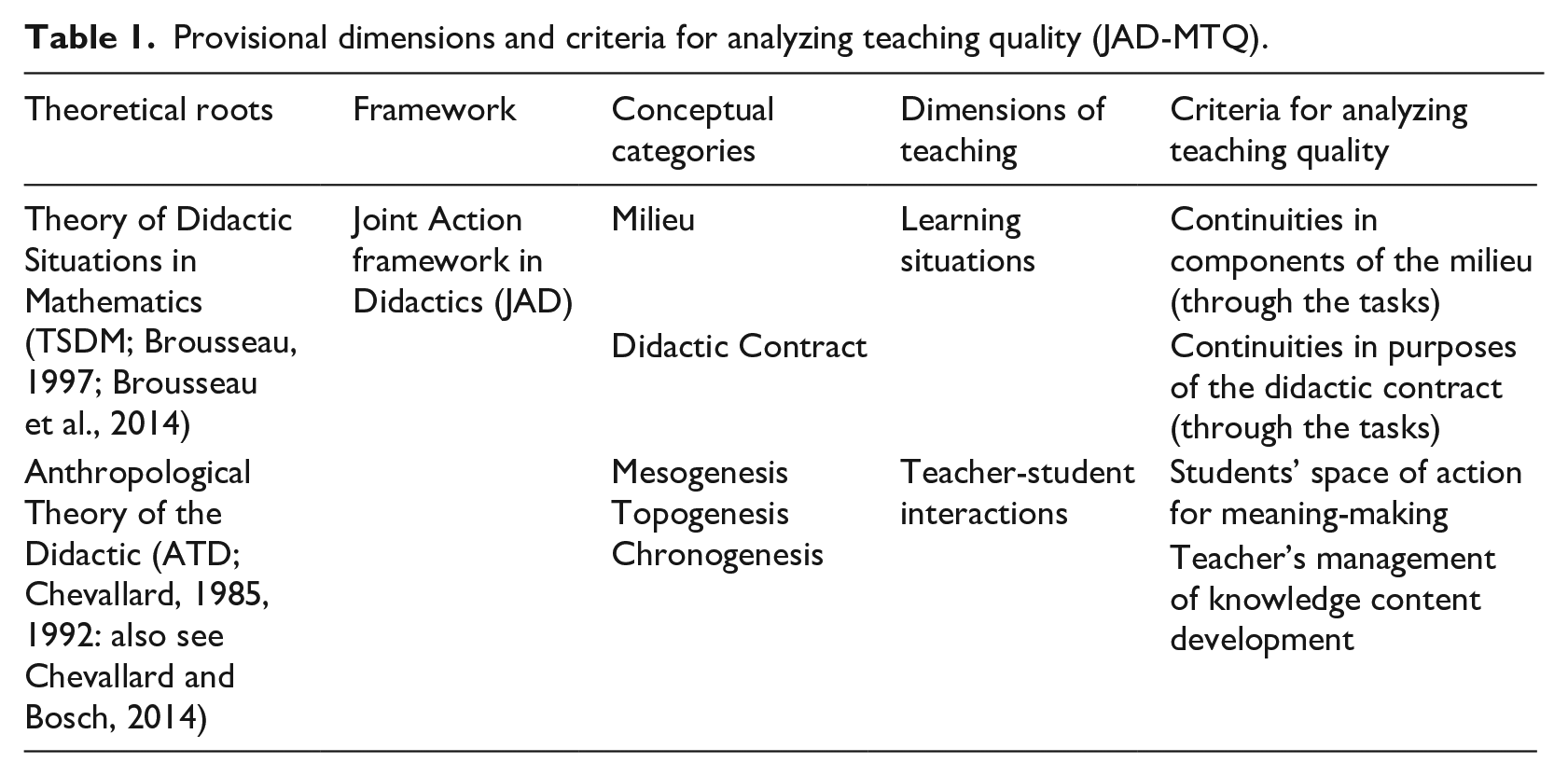
In line with these assumptions, two dimensions of teaching quality may be examined through a provisional set of criteria (Table 1). A first dimension is the quality of learning situations offered to the students, that is, situations that provide learning opportunities aligned with the purposes of the teaching sequence. In this set, we consider continuities in components of the milieu and continuities in the purposes found in the didactic contract, through the tasks proposed to the students. A second dimension is the teacher-student interactions, that is, interactions that open and maintain a space for students to act and build certain meanings, and that generate some knowledge content development. Both dimensions are grounded in the conceptual categories of the JAD framework, and they are operationalized with provisional criteria of teaching quality derived from the JAD categories.
Provisional dimensions and criteria for analyzing teaching quality (JAD-MTQ).
Research context and methodology
Data selection
The terms brought to comparison in this paper consist of two teaching sequences, one in science and one in physical education (PE), which were video-recorded in the French-speaking Cantons of Switzerland, in the context of previous research projects lead by the authors.
The science teaching sequence was recorded as part of a research project comparing science teaching traditions in different countries (see Almqvist et al., 2023). The main goal of the science unit selected is to teach the notions of states of matter and changes of states in physics. The teacher, Béatrice, 7 is a specialist teacher in physics and chemistry. The unit encompasses 7 lessons of 90 minutes taught in French to 12–13 years old students in an international private school (grade 7).
The PE teaching sequence was recorded as part of a doctoral research aiming at understanding how knowledge content develop when students assess their peers in learning contemporary dance (Buyck, 2023). The sequence encompasses 6 lessons of 90 minutes taught in French to 11–12 years old students in primary public schools. It is implemented by Patrick, a specialist teacher in physical education (PE) in Geneva teaching in the last year of elementary school students (grade 6).
These two teaching sequences, as two terms of comparison, were chosen because they offer two significant contrasts:
1) In terms of knowledge transposition, the Science sequence targets the learning of physics concepts and models that are well established in the academic community of physicists (e.g., the properties of the three main states of matter, the energy laws of their transformations, the role of liaising forces between particles, etc.). Conversely, the PE sequence targets a broader panel of diverse knowledge content in contemporary dance (e.g., artwork aesthetics content, bodily techniques, use of stage, alignment with music, etc.) that cannot be referred to any specific academic domains.
2) In terms of structure, tasks in the Science sequence are organized to follow a thematic progression, relying on written summaries for reminding what has been done before. In the PE sequence, lessons are very standardized regardless of content specificity. An introductory discussion is followed by a warm-up task. Then a few “technical tasks” focus on certain bodily techniques that are prioritized by the teacher. Finally, the students work their choreography as it was presented to a public (an “authentic task”) for closing the lesson.
Research question
Relying upon the categories defined in the JAD framework, we explore the two dimensions of teaching previously exposed and their related criteria to elaborate a comparative model for analyzing content-specific dimensions of teaching quality (JAD-MTQ). We use the set of categories presented in the previous section to compare two teaching sequences that are very different in knowledge content and structures. More precisely, we address the following questions: (1) What does the analysis of continuities in the milieu and the didactic contract show about the quality of the learning situations offered to the students? (2) What does the characterization of the student’s space of action and the development of knowledge managed by the teacher show about the quality of teacher-student interactions? (3) More generally, how do the JAD framework and related methodological analytical steps enable to capture similar phenomena and provide comparable pieces of evidence in both teaching sequences?
Units of analysis
Since classroom actions are made of discourses, gestures, and handling various kind of physical and semiotic objects (as components of the milieu), our analytical process shares certain commonalities with discourse and multimodal analyses in classrooms (Jewitt et al., 2001; Mercer, 2010). In particular, the co-constructed nature of discourse cannot be captured through the study of individual utterances in isolation from the preceding/succeeding ones. The analysis of classroom actions (interweaving discourses and bodily moves) requires considering several levels of context that are expanded in different durations (Dalland et al., 2020). Beyond the use of the JAD framework as a “tertium comparationis,” the comparison of teaching and learning practices in different school subjects relies upon the definition of comparable units of analysis in terms of crossing different timescales of events and grain-sizes of the content considered.
Lemke (2000) described the typical timescales of the organization of human activities in classrooms: from single utterances (few seconds) to teacher-students-teacher-etc. sets of utterances as a semiotic pattern (few minutes), which enter into longer patterns featuring topics or tasks being worked out, which are in turn nested into the institutional times of a lesson (1 hour typically), and sequences of lessons completed over days and weeks. Moreover, the cumulation of very detailed analyses at a lower scale does not enable to structure analysis at a higher scale: “Activities at higher levels of organization are emergent, their functions cannot be defined at lower scales, but only in relation to still higher ones. [. . .] Going ‘up’ we know the units, but we know neither the patterns of organization nor the properties of the emergent higher-level phenomena” (Lemke, 2001: 25). Making sense of classroom events requires to combine both top-down (from longer timescales down to shorter timescales) and bottom-up (from shorter timescales up to longer time scales) analytical processes.
For analyzing multimodality in science classrooms, Tang et al. (2014) also consider the compositional grain-size of the representations systems used in classroom activities: “For a written text, compositional grain-sizes could range from letters as the smallest components, to words, phrases, clauses, sentences, paragraphs, pages, and sections. For a visual diagram, the components could range from lines or shapes to the entire diagram” (p.307). Since the JAD-MTQ focuses on how the knowledge content that are being built within the teacher-student interactions (and not just representation systems), we suggest considering the grain-size of content typically found in tasks, topics, notions, instructions, words definitions, etc. (i.e., components of the milieu).
Long timescales allow considering large grain-size content, whereas short timescales allow examining fine grain-size content. In line with Tiberghien and Malkoun (2010) and Tiberghien and Sensevy (2012), we use three main levels of units of analysis, named MACRO, MESO, and MICRO levels of units. MACRO and MICRO levels are rather easy to define: (i) the MACRO level is the duration of the observed teaching sequence (several lessons) allowing to consider the succession of thematic units in the teaching sequence; (ii) the MICRO level captures events which last from few seconds up to a minute, allowing to consider meanings made in speech acts (along with bodily moves in many cases). In between, “an intermediate scale is necessary to consider one or several relevant units which indicate a level of organization. [. . .] this scale corresponds to about 10 minutes (from a couple of minutes to about 40 min depending on the unit chosen)” (ibid, p.157). The MESO level is more dependent on the nature of teaching-learning activities and social organizations in subjects privileged by teachers than the MACRO and MICRO levels.
In considering both the science and the PE teaching sequences, we suggest to split this intermediate level in two sub-levels: (i) the UPPER-MESO level accounts for the succession of teaching phases of 10–40 minutes, in which an instructional task is given to the students (within a thematic unit, TU); (ii) the LOWER-MESO level accounts for interactive episodes of 2–10 minutes, in which a topic is discussed (within a task).
In Figure 1, we sum up the nested structure of units of analysis (from MACRO to MICRO levels) used to segment teaching and learning activities in our data.
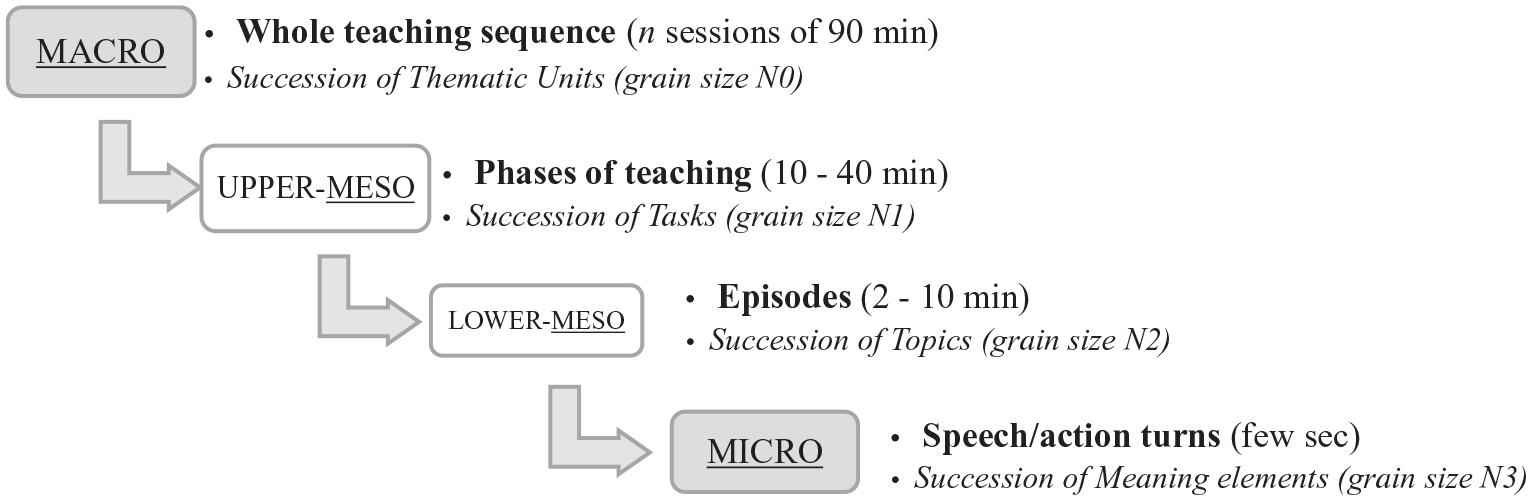
The structure of units of analysis.
Common structure of analysis
From the transcription of the video-recorded data of the teaching sequences, the first analytical step is to build a “timeline” of the evolution of classroom actions. The structuration of units of analysis into MACRO, MESO, and MICRO levels interlocked within each other allows to build a synopsis of the relations between the classroom segments of activities (Tiberghien and Sensevy, 2012). The synopsis reflects priorities pursued by the teacher in terms of knowledge content selection and organization of classroom interactions.
The most salient methodological function of a synopsis is to provide a systematic contextualization of each unit of analysis up the levels. The synopsis of the Science teaching sequence and the PE teaching sequence are tables structured by the levels of units of analysis that we have defined, combining timescales and grain-size of content. The largest grain-size of content is inscribed in the MACRO level (N0 column; cf. Tables 2 and 5). The succession of tasks (as an intermediary grain-size) is inscribed in the UPPER-MESO level (N1 column; cf. Appendix 1 and 2). Then, in our synopsis, the finest grain-size of content are found in the LOWER-MESO level (N2 column; cf. Appendix 3 and 4). 8
We use a three-layered analytical strategy to support the comparability of both the Science and PE teaching sequences (cf. Figure 2).
a) a MACRO level description of the overall knowledge structure of the sequence, based on the relations between the thematic units (TUs; grain-size N0) found in the whole teaching sequence; the analytical process is based on the ends in view inferred by the researcher from the tasks proposed by the teacher. This level of description helps to make decisions about the selection of units to be analyzed at lower levels.
b) an UPPER-MESO level analysis of the learning situations organized by the teacher for the students; to carry out this analysis, we decompose lessons into teaching phases (also corresponding to a decomposition of TUs into tasks; grain-size N1). In line with the JAD-MTQ criteria, this analysis considers continuities found in the milieu (what is accessible in the material and symbolic world, through gestures and discourses) and the purposes of the didactic contract (what must be achieved and understood from the components of the milieu), 9 through the teaching phases (or tasks).
c) a LOWER-MESO level analysis of the teacher-student interactions within selected episodes occurring during the achievement of a task (within a teaching phase). To carry out this analysis, the teaching phases are decomposed into episodes (or topics; grain-size N2). Since we are interested in characterizing the students’ space of action within the teaching structure (topogenesis) and the knowledge content development (chronogenesis), we focus on teaching phases (or tasks): (i) in which students have individual or group work to carry out (i.e., some specific responsibilities assigned by the teacher); and (ii) in which there is a follow-up collective review after individual/group work (i.e., we can observe the subsequent knowledge content development managed by the teacher).
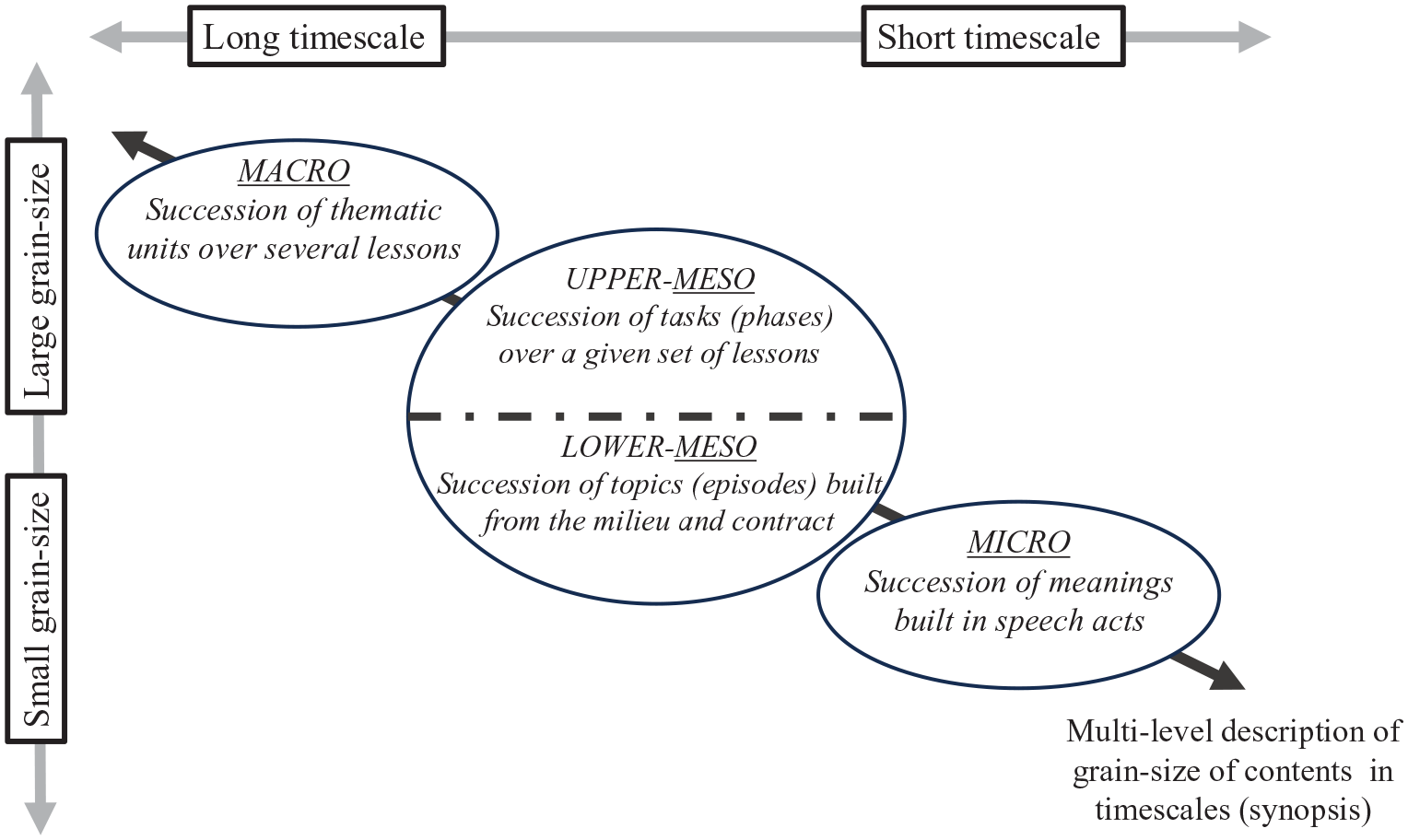
Combination of classroom timescales and grain-size of content in analytical levels.
In this paper, the MICRO level is not investigated per se, but analyses at the UPPER-MESO and LOWER-MESO levels rely upon the selection of speech acts, and sometimes body acts (grain-size N3) belonging to the MICRO level. Moreover, we have prioritized the operationalization of the milieu and contract categories at the UPPER-MESO level, and the operationalization of student’s space of action (topogenesis) and knowledge content development (chronogenesis) at the LOWER-MESO level. However, these concepts may also be used at other levels (e.g., the didactic contract and the milieu may be used as meta-descriptors of the dynamics of the teacher-student interactions; cf. Ligozat et al., 2018).
Results
Analysis of the science teaching sequence (Béatrice’s classroom)
MACRO level description
This section discusses the overall knowledge structure of the sequence, based on the relations between the thematic units (TUs; grain-size N0) found in the whole teaching sequence (cf. Table 2).
Macro scale synopsis of the thematic units in the Science classroom.
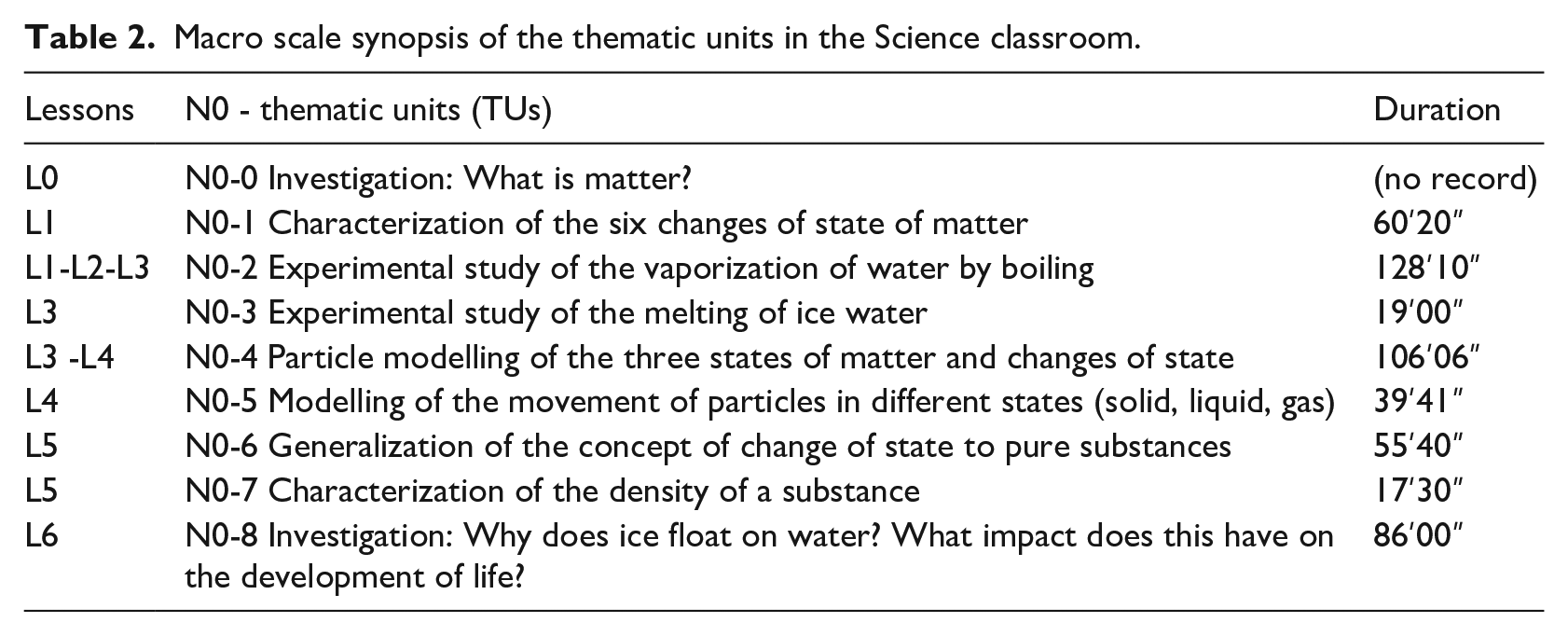
First, in this Science sequence, the TUs follow one another chronologically in time. However, they are not strictly spread out over the duration of a lesson (90 minutes); they can last less than one lesson or expand over two or more lessons.
Second, TUs have different functions in the sequence. We can find a progression between the first three TUs and the next five ones, reflecting an increased complexity, but also the epistemological role of models in physics to enable the building of new knowledge. This progression reflects certain choices in the content/tasks selection made by Béatrice, which can be traced back to the “Two World Model” for teaching physics (Tiberghien, 1994; Tiberghien et al., 2009). TUs N0-1, N0-2, N0-3 explore the observable phenomena related to states of matter and the change of states, hence building up an empirical reference for characterizing these phenomena. Then, a theoretical model (Democritus’ particles) is introduced (N0-4), enabling to reach a deeper understanding of the observable phenomena previously studied (N0-6 and N0-7) and to develop new lines of reasoning about more complex issues involving those phenomena (N0-8).
In the following sections of the analysis, we focus on the first three TUs as a functional set of contents staging the “macroscopic” conceptualization of physics phenomena, 10 in Béatrice’s teaching sequence. Moreover, since the first three thematic units include experimental studies during which students are invited to take certain specific responsibilities, these TUs offer good opportunities for observing relations between the students’ space of action and the knowledge content development.
UPPER-MESO level analysis
This section explores the continuities in components of the milieu and in purposes of the didactic contract, between the teaching phases (or tasks) successively unfolded within the three first thematic units (Figure 3).
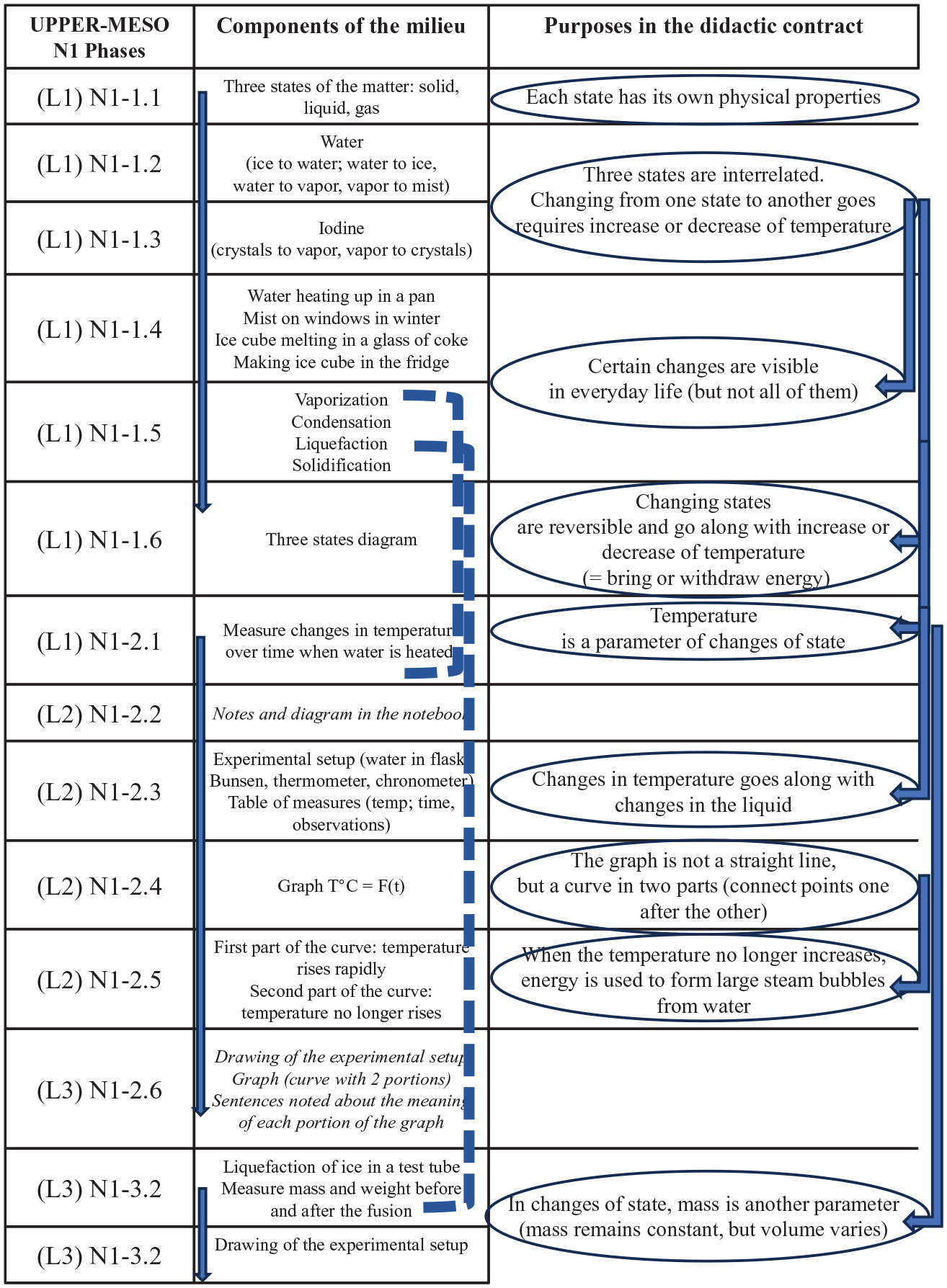
Continuities in the milieu and in the didactic contract in the Science classroom.
Going through the teaching phases, we find three sets of components of the milieu, each corresponding to a TU.
In set 1, starting from the reminder of the properties of three states of matter, the milieu develops with experimental demonstrations of four changes of state of water, and two changes of states of iodine. The changes of state of water are re-examined through analogies with everyday experiences, and then designated with scientific terms. Finally, a three states diagram is introduced, integrating the designation of the three states of matter, the designation of the relations between states, and the variation of energy needed in changing states (by means of increase or decrease of temperature). This first set supports at least three main purposes featuring the didactic contract: that states of matter are interrelated and reversible, that changes in states goes along with increase or decrease of temperature (described as a supply or withdrawal of energy) and hence, that temperature is an important parameter in changes of state.
In set 2, the milieu develops towards the experimental exploration of temperature variations in the vaporization of water, thus scaffolding a specific component of the first set. An experimental protocol is designed, then implemented for making observations and measures. A graph of the evolution of temperature over time is plotted, from which two moments are identified: rapid increase of temperature then stabilization. This second set of components of the milieu supports new purposes related to the use of graph as representation systems of variations of measurements in physical experiment. It also prompts a distinction between temperature and energy (which were assimilated in the first set), since the vaporization of water occurs at constant temperature, but requires a supply of energy.
In set 3, the milieu develops toward the experimental exploration of another change of state of the water that is, liquefaction. Measures of mass and weights before and after the change of state support a new purpose: the identification of another parameter at play in changes of states, that is, that mass remains constant, but volume varies.
From this UPPER-MESO level of analysis, we can state that each thematic unit (N0-1; N0-2; and N03) is characterized by continuous relations between the components of their milieu. The expansion of certain components (like vaporization and liquefaction of water) also supports deepening and further distinctions in knowledge content development, featured by the purposes in the didactic contract.
LOWER-MESO level analysis
This section of the analysis examines selective episodes of classroom interactions to describe the students’ space of action and the teacher’s management of knowledge content development.
Lesson 2 is devoted to the continuation of TU “N0-2 Experimental study of the vaporization of water by boiling” (started in Lesson 1 and continued in Lesson 3). This TU is the longest one in term of overall time spent (128 minutes) and it is also the one in which the students spend the longest time working in groups to carry out an experiment in practical laboratory session (cf. Appendix 2). After a reminder of the six possible changes of state of the matter and the correlated temperature variations (N1-2.2), the student groups are asked to run an experiment to answer the question (written on the worksheet) “what happens to temperature when water is heated?” (N1-2.3). Measures of the temperature every minute are first recorded in a table, as well as qualitative observations of the water in the flask. Then the teacher asks the students to make a graph of the temperature variation as a function of time (N1-2.4). The students’ space of action, opened when they started the experiment, is now extended with the responsibility of plotting a graph from the set of points that correlates temperature and time. The choice of a correlation model depends on the shape of the set of points, but also on the meaning given to these points. This meaning is related to observable changes about the water in the flask, which implies that the students must take several results from the experiment in consideration. In the following excerpt, the teacher goes around the groups to check the graphs (Table 3).
Graph construction in work group in the Science classroom.
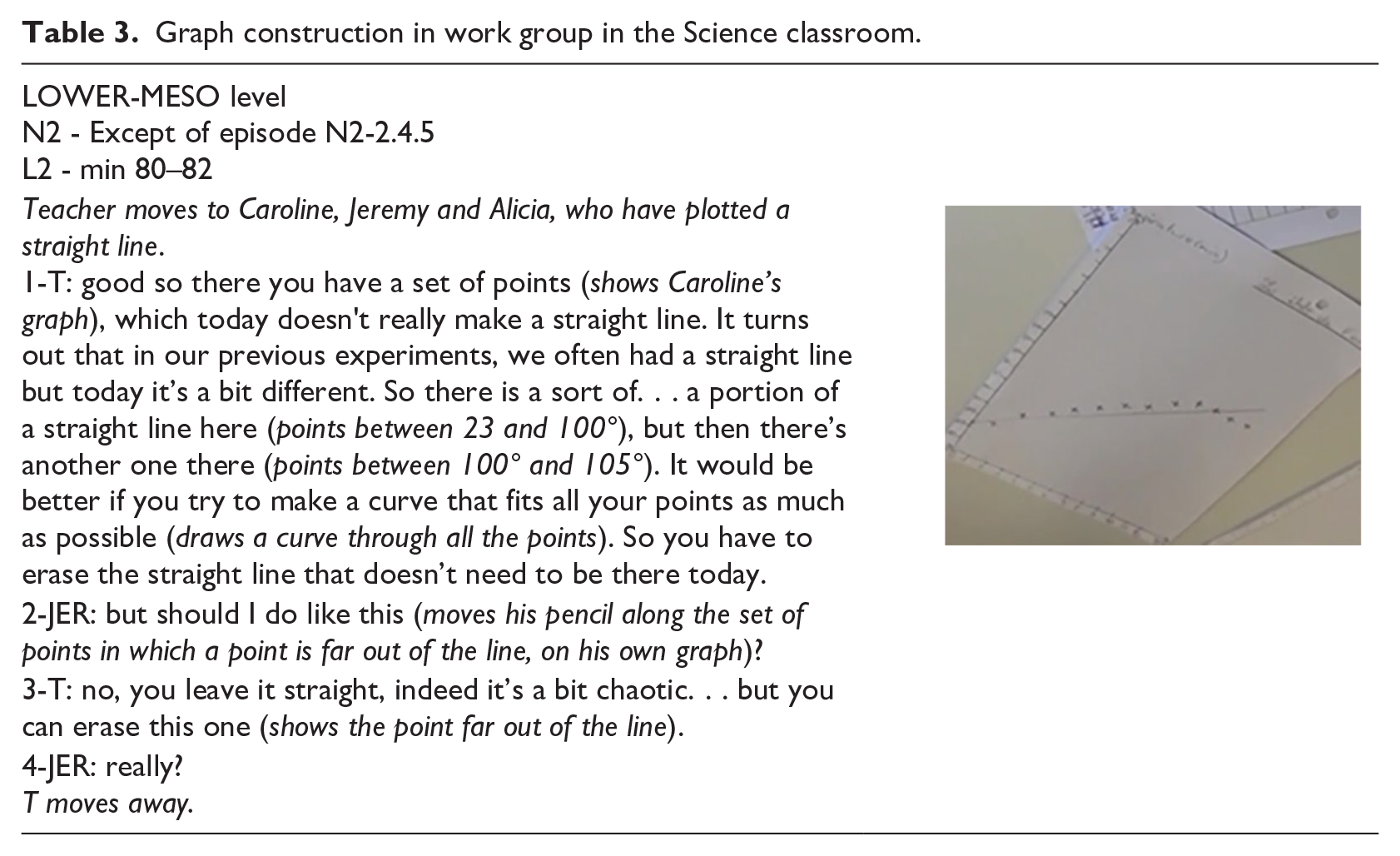
This excerpt highlights how the students’ space of action is suddenly closed off by the teacher. The graph as a straight line constructed by the students does not correspond to the teacher’s expectations; this is a major breach in the didactic contract since the evolution of the temperature is not a linear function in this experiment. The teacher indicates the breach through a succession of re-orientations carried out in a dominating discourse. First, the straight line is rejected (ST1 - not a straight line today) and replaced by two portions of straight line (ST1—straight line here. . . another one here). Then two rules are imposed (ST1—make a curve that fits all points; erase the straight line), bypassing what the students have done. When Jeremy wondered what he should draw with a point far away from the others (ST2), the teacher gives new rules (ST3—leave it straight; erase this point). These rules generate a new breach in the didactic contract, as they introduce a contradiction with a previous rule (make a curve that fits all points). The rationales of these rules remain implicit for the students (the shape of the graph had to make the stagnation of the temperature at boiling point visible; sometimes a measurement might not be significant if it was too far away from the others).
This excerpt shows an example of very little coordination between the students’ inputs and the manner the teacher takes them into account in this episode for developing knowledge. The teacher reorients the students’ actions through several patterns: rejection, substitution, bypassing that goes along with a dominating position. The meaning (the set of points is a straight line) that the students had constructed is dismissed by the teacher, without having the opportunity to understand why.
Onwards, in Lesson 2, after having checked the graphs in each group (and transformed most graphs into a two-parts curve), the teacher asks the students to explain the evolution of temperature when water is heated (N1–2.5). This is performed through several sub-questions addressed to the classroom collective, creating a succession of episodes. In the first one, the students are asked to explain what happens to the temperature and to the water (N2–2.5.1). A new space of action is opened for the students who now have the collective responsibility of formulating their understanding of the graph plot, and to correlate this plot to the states of the water (Cf. Table 4).
Temperature evolution on the graph in the Science classroom.
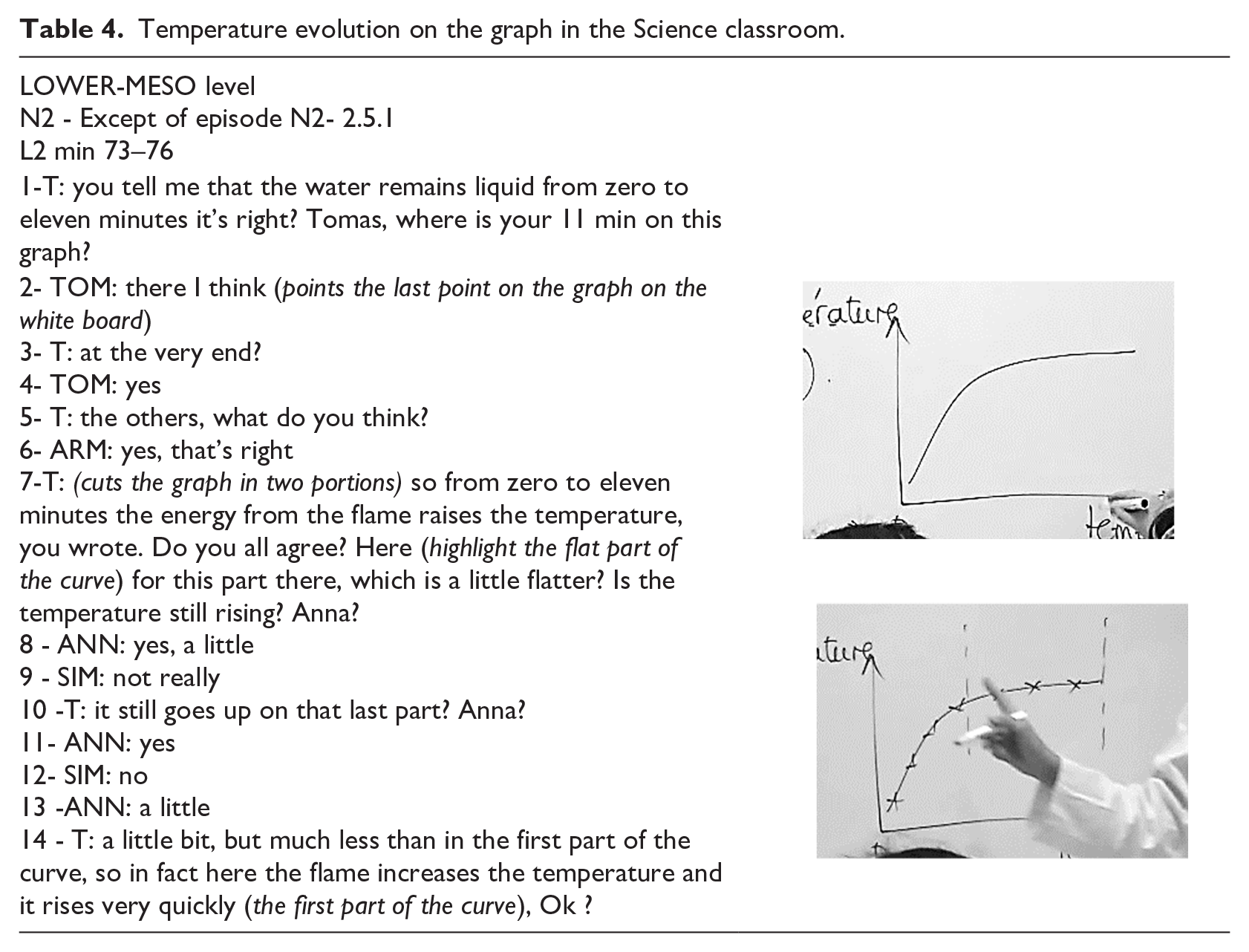
This excerpt highlights how the students’ space of action remains opened for a while in the collective discussion, and then come to a closure when the teacher provides the correct interpretation of the graph. Tomas (ST2 and ST4), Armel (ST6), and Anna (ST8 and ST11) successively unveil their reading of the graph as a continuous increase of the temperature over the whole duration of the experiment (11 minutes). These meanings made by the students do not correspond to what the teacher expects. This generates a breach in the didactic contract since changes in the variation of the temperature should be noticed. The breach lingers over several relaunches made by the teacher, keeping a low positioning for accompanying the students’ elaborations (ST3 “at the very end?”; ST5 “the others, what do you think?”; ST 7 “is the temperature still rising?”; ST 10 “still goes up on the last part?”).
In ST7, the teacher makes a major input, by drawing two parts on the graph and designating the “little flatter” second part. Simon tries a new meaning relation (ST9 and ST12 “temperature rise”—“no, not really”), but it is not the case for Anna who sticks to a continuous increase of temperature all along the curve (ST11). The teacher then adopts a dominating discourse and indicates the relevant meanings relations to be made about the graph (ST14). This indication rebuilds from the previous input the teacher made in ST7, but it transforms Tomas, Armel, and Anna’s meaning previously made (“a little bit, but much less than in the first part”). Only one student (Simon) identified the temperature plateau on the curve, and in any case, meanings made by the students about the graph are based on the shape of the graph, but very little contextualized with the observable changes in the water. An agreement seems to be found in the wording of the explanation of the temperature evolution, but the observable changes in the water remain implicit (we believe this information would have highly helped students understand that there are changes in the evolution of temperature).
This excerpt shows how the teacher tries a coordination between the students’ meanings made about the measures on the graph and the knowledge content that must be developed about the graph and more generally about temperature evolution in the vaporization of the water. Although the teacher uses an accompanying position, allowing some space for the students to try several answers at the beginning, this episode ends with a subtle transformation of the student’s meanings made for finding an agreement, without producing the rationale of this piece of knowledge content developed.
Conclusions about the science classroom
Reviewing the two levels of analysis (UPPER-MESO; LOWER-MESO), we now have a broader picture of the strengths and weaknesses of the teaching practices at play in this Science sequence. At the UPPER-MESO level, we found a structure of tasks based on strong continuities within and between sets of components of the milieu. These continuities enable the gradual clarification of the teaching purposes that make the core knowledge content development in the classroom. The UPPER-MESO level of analysis provides evidence of teaching quality on the structure of the teaching sequence. However, at the LOWER-MESO level, we found evidence that the coordination between the meanings made by the students and the classroom overall knowledge content development is weak. Outcomes produced in the students’ space of action are little taken up and explored by the teacher. The expected pieces of knowledge to be built are imposed in the end. Of course, the knowledge content development in the classroom must be based on valid scientific explanations, but despite the time spend by the students in elaborating meanings about this experiment, the building of these valid explanations is made without them (or with very few of them). In this perspective, the quality of this teaching sequence observed in the UPPER-MESO level of analysis is mitigated by the results at the LOWER-MESO level of analysis.
Analysis of the contemporary dance teaching unit (Patrick’s classroom)
MACRO level description
This section discusses the overall knowledge structure of the sequence, based on the relations between the thematic units (TUs; grain-size N0) found in the whole teaching sequence. In the Dance teaching sequence, we can identify four consecutives TUs of six two-periods-in-a-row lessons. We synthetize them in the table below (cf. Table 5).
Macro scale synopsis of the thematic units in the Contemporary Dance classroom.
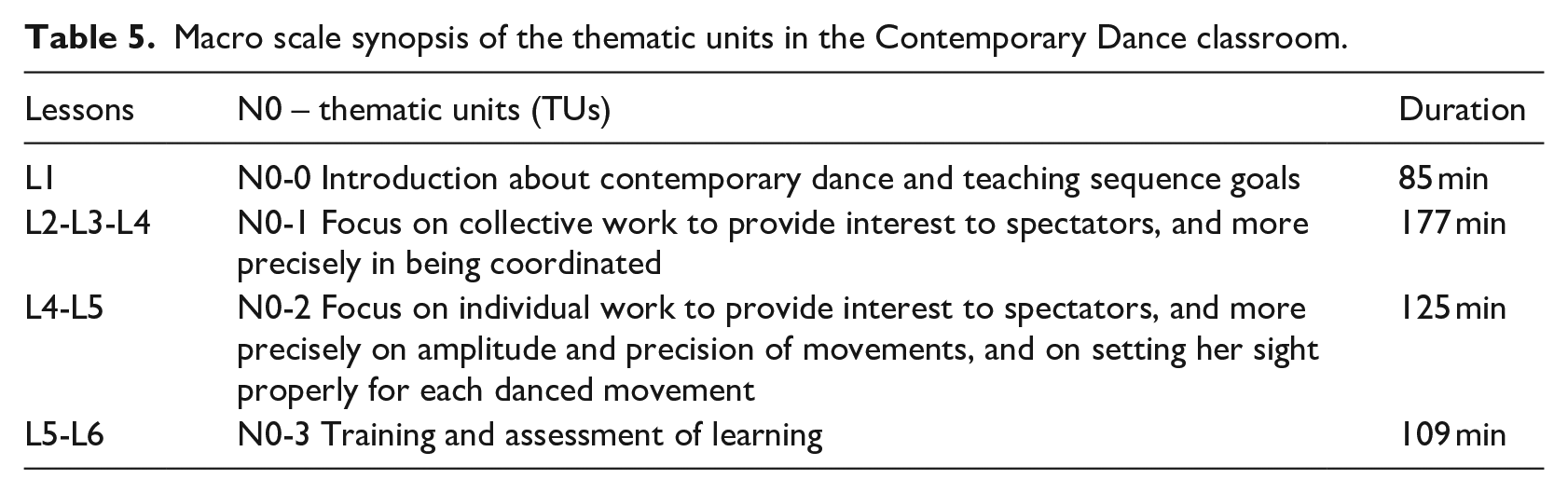
Each TU is organized in a singular way, due to the specific structural organization of PE tasks. 11 In this sequence we can find some roots of each TU distributed different tasks (and types of tasks) no matter their chronological order. Therefore, in the PE sequence, TUs are identified and reconstructed by analyzing the content(s) covered by each task.
When looking across the TUs, a major part of the sequence is focused on the coordination of the dancers as an important strategy to enhance collective effect of a choreography. The number of tasks, the time dedicated, and the variety of tasks for coordination of the dancers demonstrates that this knowledge content is significant in Patrick’s teaching project. Hence, in the following sections we will focus our analyses on TU N0-1.
UPPER-MESO level analysis
From the perspective of MACRO description, we focus this UPPER-MESO analysis on TU N0-1 (cf. Appendix 4 for further development about this TU). From this table, we rebuild and synthetize the milieu and the associated purposes we found in the following way (cf. Figure 4):
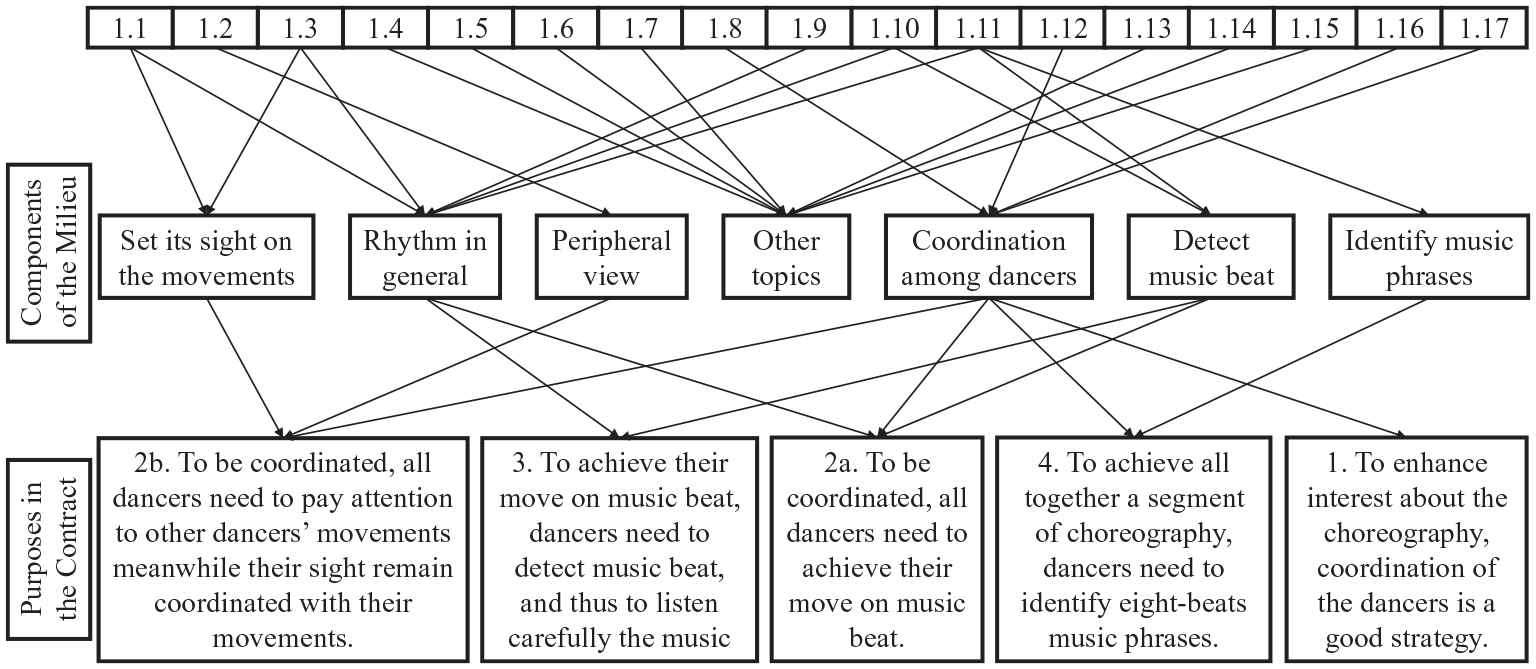
Continuities in didactic milieu and didactic contract in the PE classroom.
The components of the milieu are randomly distributed in the sequence of tasks. In some tasks, several components can be found. For example, in task 1.1, there are references to sight placement, as well as elements relating to attention to rhythm. In task 1.11, there are references to rhythm, to listening to the beats of a piece of music, and to the musical structure of eight-beat musical phrases. Certain components are also found in several non-sequential tasks. For example, work on rhythm is covered successively in tasks 1.1, 1.3, 1.9, 1.10, and 1.11. Similarly, the content of coordination is dealt with in tasks 1.8, 1.12, 1.6, and 1.7. Finally, certain components are introduced sporadically without being recalled. This is the case, for example, with “peripheral sight” (task 1.2 only) and “musical structure” (task 1.11 only). On the other hand, some components are much more recurrent than others. This is particularly true of components linked to rhythm in general (five tasks) and coordination in general (four tasks). Between these two extremes, other components are laid which are generally called upon without any apparent relations to the preceding or following content.
In the lower part of the diagram (cf. Figure 4), we have reconstructed the purposes of the didactic contract as they are explicitly presented by the teacher in succession in each task (horizontal order). A content analysis of the relations between these purposes led us to number them (as 1, 2a, 2b, 3, and 4) to figure out a sequence that would correspond to the end-in-view of TU N0-1.
There is a complex range of knowledge content that the teacher brings to support the coordination of the dancers. The teacher calls up four levels of content: (i) the choreography is more interesting if the dancers are coordinated; (ii) two ways of being more coordinated (2a. peripheral sight + 2b. rhythm of the music); (iii) ways of spotting the rhythm of the music; and (iv) understanding the structuring of musical phrases to ensure dancers start at the same time or master delayed entrance). Nevertheless, the purposes pursued by the teacher are not dealt with in an ordered structure, but rather randomly. It follows that (i) the purposes of the didactic contract are dealt with separately from one another; (ii) some purposes are more frequently addressed than others. In the end, the succession of tasks is not correlated with the order of the purposes in the didactic contract.
Therefore, conversely to the Science sequence, we cannot delineate teaching phases (as time segments) that unfold one after the other to achieve a goal (in this case, the construction of the content “coordination of the dancers” as an effective strategy for enhancing the interest in watching the choreography). Even if certain continuities may be found in the milieu and in the purposes of the didactic contract (as shown by the reconstruction of steps 1 to 4), these continuities do not support an obvious overall knowledge content progression.
LOWER-MESO level analysis
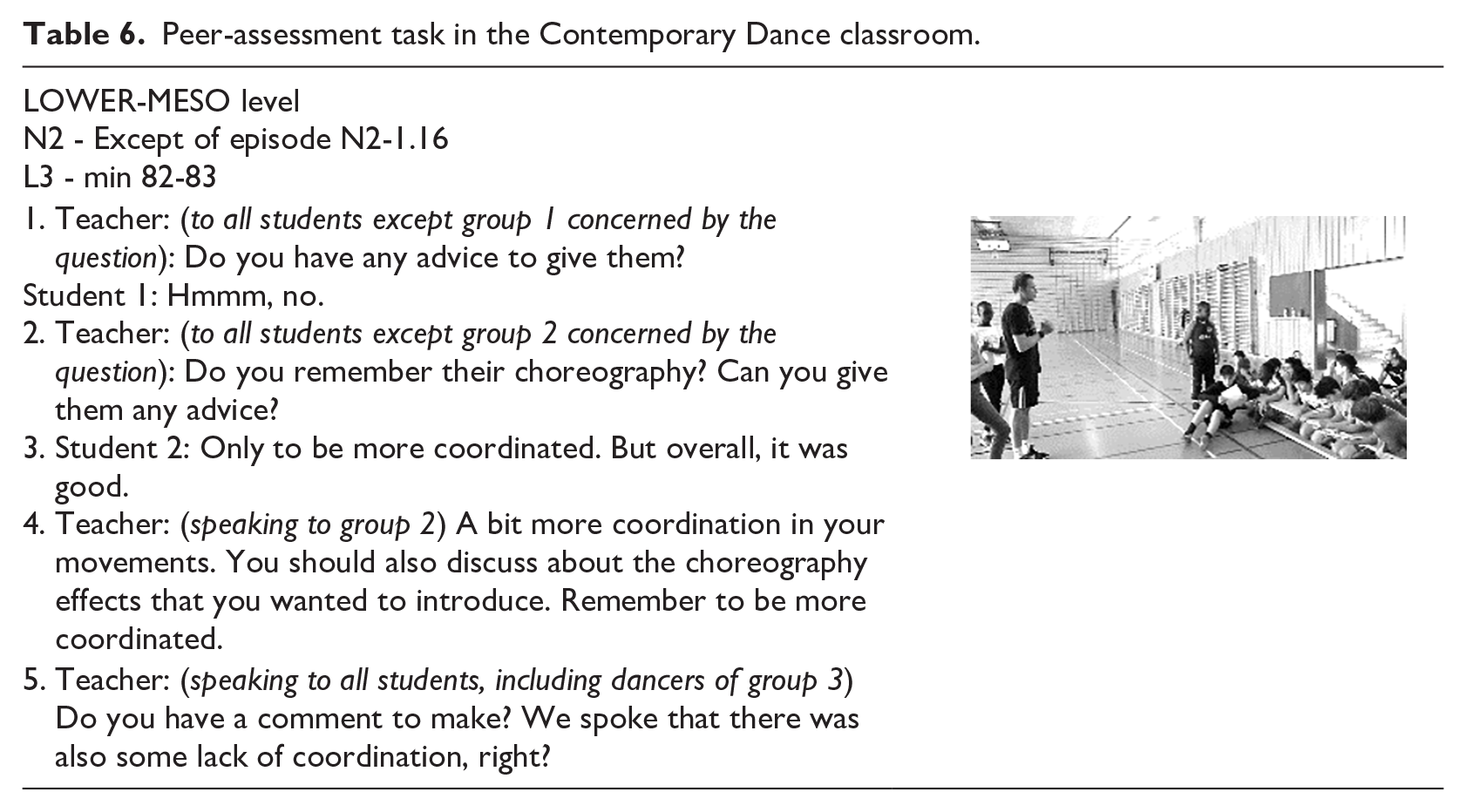
This section of the analysis examines selective episodes of classroom interactions to describe the students’ space of action and the teacher’s uptake of meanings made by the students. The first episode (Cf. Table 6) is selected in a peer-assessment task; the second episode (cf. Table 7) is selected in a collective discussion task.
Peer-assessment task in the Contemporary Dance classroom.
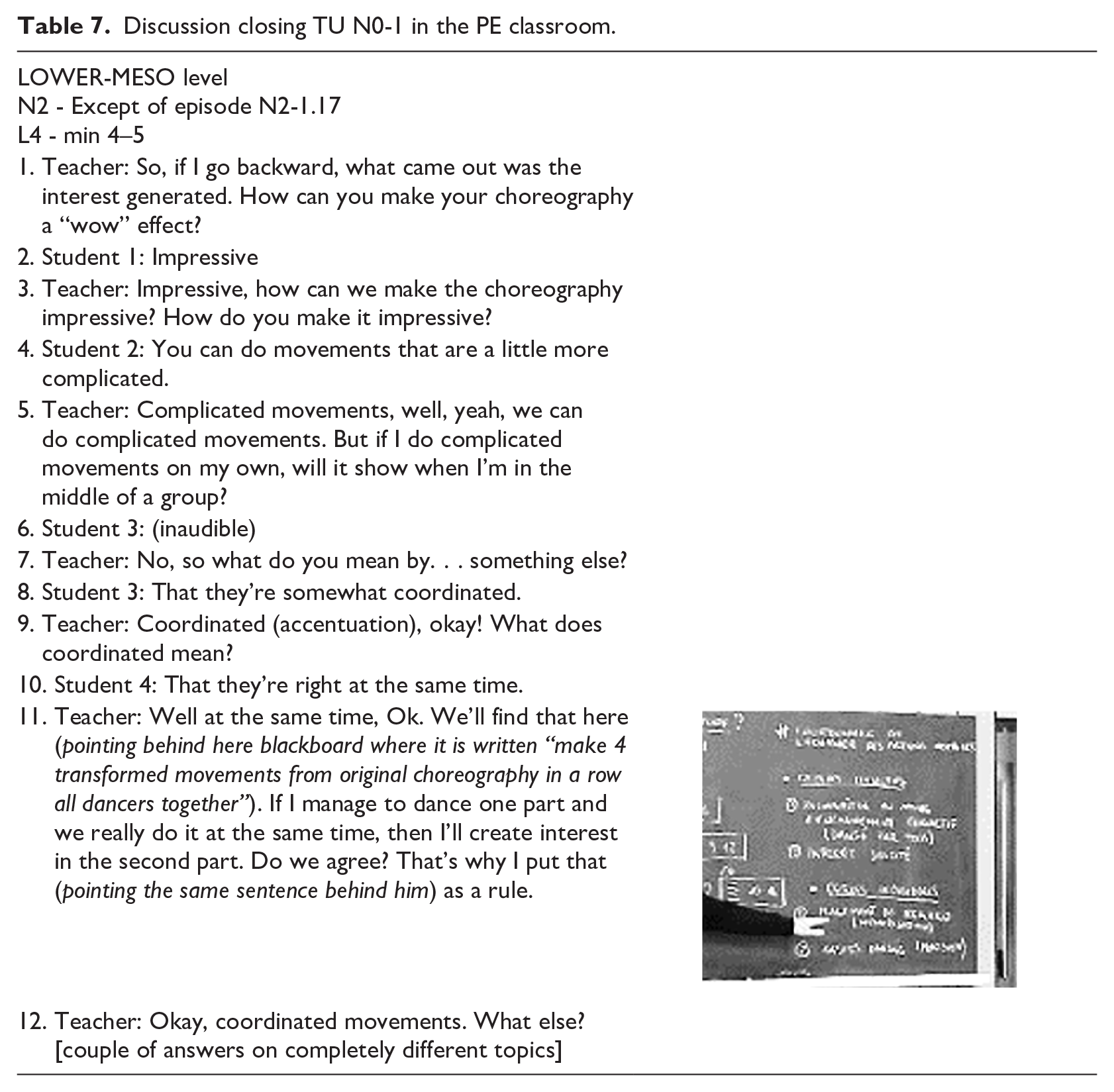
Discussion closing TU N0-1 in the PE classroom.
This first excerpt (cf. Table 6) features the end of the peer-assessment task 2.16, which occurs at the end of Lesson 3. In all peer-assessment tasks, the teacher addresses successively all student-assessors’ groups in charge of assessing the choreography presented by a specific group. A space of action is then opened for the students, in which they have to use different assessment criteria (each time adapted to the lesson’s objectives) provided by the teacher. At lesson 3, those criteria are: (i) Did dancers modify and integrate movements 9 to 12 from the original choreography they had to transform? (ii) Did the music match the choreography? (iii) Was it original/Did you like it or not? 12 Student assessors answer in terms of “yes” or “no.” In lesson 3 (unlike lessons 1, 2, 4, and 5), no further comments are to be made by assessors following each choreography, neither does the teacher provide those developments. Then the teacher recalls part of the protocol of lessons 1 and 2: assessors’ students may give a qualitative advice about what they could improve to enhance their choreography. In this episode, all choreographies are discussed in one single moment. This episode is also the last space of action given to students for highlighting the link between choreographies and content learnt in previous tasks before closing TU N0-1 (cf. Table 6).
In this excerpt, the students have a space of action to construct meanings about the evaluation of their peers’ choreography. Student 2 identifies “being more coordinated” (ST3) as a crucial component in improving their choreography. The teacher echoes Student 2, adopting an accompanying discourse first, then he confirms the importance of coordination (ST4). However, there is no further knowledge content development about this component. What “being well-coordinated” means is not recalled or rebuilt (neither by the teacher nor by the students) in relation to the knowledge content development about coordination that was made explicit in the previous tasks (e.g., 2a, 2b, 3, and/or 4 in Figure 4).
The second episode (Cf. Table 7) occurs at the beginning of lesson 4, also at the end of TU N0-1. The teacher briefly reminds about the context of this lesson (the fourth over six lessons). A couple of minutes later, the teacher asks the students seated in front of him: "How can you make your choreography generate a “wow” effect 13 ?". In this task, the students have the responsibility to bring up some content previously developed in the various tasks preceding this moment of discussion before the teacher moves to some new tasks featuring the next TU (N0-2). With the question opening this task, we understand that there is a space for students to discuss and take part in the knowledge content development (cf. Table 7).
In this excerpt, students are given space to respond a very open-ended question. The meaning "impressive" (ST2) is immediately echoed and relaunched by a follow-up question by the teacher ("how to make it impressive"; ST3) adopting an accompanying discourse. The next meaning made by Student 2 (“complicated movements”; ST4) is also echoed by the teacher, but this time much narrowed toward the expected response: “if I do complicated movements on my own” (ST5). This input by the teacher, now adopting a dominating discourse, clearly orients the question toward an expected response relating to a group effect. The students’ space for action then suddenly closes, as this third reformulation of the question leaves them with no choice. By answering “they are somewhat coordinated” (ST8), Student 3 repeats a meaning that is already built in the teacher’s question. This answer comes third in a series of two narrow relaunches that leave no other possible outcome. Therefore, there is no evidence that the students could take part in the construction of purpose 1 in the didactic contract (c.f. Figure 4). This conclusion contrasts with the teacher’s going back to an accompanying discourse ("coordinated (accentuation), okay!” coordinated movement!"; ST9), as if the students would have come up with this answer only by themselves.
In the second part of this except, the teacher re-opens a space of action for the students (“what does coordinated mean?”; ST7), and they have the responsibility to contribute to the development of the successive purposes in the didactic contract (2 to 4, on figure 4) featuring knowledge content development about coordination. Student 4 builds the meaning “to be at the same time” (ST10). The teacher echoes this response in an accompanying discourse, but he does not further it (as he did in excerpt 1). Adopting a dominating discourse, the teacher then recalls what is displayed on the board, stating that coordination is necessary at a specific point in the choreography, when there is a requirement to dance together on at least one transformed part of the choreography (“we’ll find that here”; ST11). The teacher then repeats this answer, bringing back the previous input he made (“If I manage to dance one part and that we really do it at the same time, then I’ll create interest”). In other words, while this probing question (ST5) was an opportunity to address purposes 2 to 4 (cf. Figure 4), the teacher sticks to purpose 1, by making it explicit.
Both these excerpts show that the teacher opens some space for the students to construct some meanings about the peer-assessment criteria in relation to the choreography watched. In excerpt 1, this space of action is sustained, through an accompanying position taken by the teacher, echoing and confirming the meaning made by the student. In excerpt 2, the teacher also tries an accompanying position, but he also makes inputs that narrow the student’s space of action and that does not leave room for developing new knowledge content. In both cases, the meanings made by the students are somewhat taken up by the teacher, but these uptakes are not productive since they do not lead either to the strengthening of former knowledge content (except 1) or the development of new knowledge content (except 2).
Conclusions about the Contemporary Dance classroom
At the UPPER-MESO level, we pointed out that tasks are supported by components in the milieu that could be related to “coordination of the dancers” as a unifying purpose. Nevertheless, we showed that these components are organized randomly, rarely successively, and with unequal frequency. The tasks are thus disconnected from one another. This is also revealed by the analysis of the two excepts at the LOWER-MESO level, showing that tasks 1.16 and 1.17 are not linked (1.16 does not introduce 1.17; 1.17 does not build on the results produced in 1.16), although both deal with the same content.
At the UPPER-MESO level, we were also able to identify 4 sub-levels of teaching-learning stakes relating to coordination, thus revealing a complex structure of content enabling the construction of this knowledge. Nevertheless, we could see that these issues were not dealt with in a logical order (teaching process) that would facilitate links by students (learning process). The LOWER-MESO analysis of the two excerpts closing this TU shows that these links were neither constructed by the students (in their answers to the teacher’s questions), nor made explicit by the teacher (neither in the formulation of the question, nor in the way he takes up these answers). Therefore, the discontinuities in the knowledge content development pointed out at the UPPER-MESO level are confirmed in the LOWER-MESO level analysis.
Discussion of results
By comparing two teaching sequences, one in Science and the other one in PE, we pursued two objectives: (i) exploring two dimensions of teaching for capturing knowledge content-specific aspects of teaching quality, which can be worked in different subjects; and (ii) highlighting certain methodological conditions for ensuring qualitative analyses of teaching quality. First, we summarize the teaching patterns that were found for both teaching dimensions (learning situations and teacher-student interactions), and we discuss their relations with respect to other research in didactics. Second, we discuss the foundations of the model, leading us to suggest additional criteria that emerged from the empirical comparison. Finally, we point out the limitations of the study and further work that need to be done.
Comparison of patterns of teaching in the Science and PE units
In the Science sequence, we found strong continuities in components of the milieu and strong continuities in purposes of the didactic contract at the UPPER-MESO level, suggesting that connections between the tasks are facilitated for the students. The quality of learning situations may be judged as rather high. However, this quality statement is mitigated at the LOWER-MESO level by the low coordination between meanings made in the students’ spaces of action and the knowledge content development managed by the teacher. The quality of teacher-student interactions in knowledge content development may be judged as rather low. In this classroom, despite the opportunities given to the students for acting (either physically or discursively), the outcomes have little impact on the knowledge content development, which remains mostly in the teacher’s hands. The structure of the subject (physics) seems to dominate the teaching process without leaving opportunities for discussing uncertainties arising in the learning process.
In the PE sequence, we found few continuities in components of the milieu and few continuities in purposes of the didactic contract at the UPPER-MESO level, suggesting that students experience difficulty in building connections between the tasks. The quality of learning situations may be judged as rather low. This statement is strengthened at the LOWER-MESO level by lacking knowledge content development in interactions. In this classroom, the teacher considers the meanings made by the students as self-sufficient. There is no furthering/rebuilding that would allow them to make sense of their action with respect to other components of knowledge distilled in the sequence. The quality of teacher-student interactions in knowledge content development may be judged as rather low. In that case, a weak result on the criterion of “teacher’s management of knowledge content development” may find its origin in the scattered way of organizing the tasks (cf. Figure 4) at a higher level.
A low quality in teacher-student interactions, either by a lack of teacher uptakes of the meanings made by the students (in Science) or by a lack of knowledge content development by the teacher (in PE), means that the students do not have opportunities to make meanings of the consequence of their actions in tasks. This result can be regarded in the light of research relating students’ interests in subjects and their orientation toward a professional career. In analyzing the students’ construction of taste in science classrooms through the occurrence of aesthetic words in classroom interactions, Anderhag et al. (2015) found that students’ taste for science subject is stronger when teachers consistently follow-up on how students acknowledge purposes, norms, and values of the science practice and so ensuring that they could participate successfully. In Béatrice’s classroom, the meanings made by the students are not explored but rather confronted with “correct” scientific explanation (e.g., about the graph plot). In Patrick’s classroom, the students have a voice to discuss peer-assessment criteria in dance, but it is not made continuous with some knowledge content development (e.g., about coordination of dancers). Both these teaching patterns may lead to a loss of interest in school subjects through a subtle exclusion process revealed by the grammar of teacher-student interactions in knowledge content development.
Beyond these teaching patterns linked to the two dimensions that we explored with provisional criteria (cf. Table 1), the analysis of the structure of thematic units (at MACRO level) and teaching phases (at UPPER-MESO level) of each sequence also reveal some teaching patterns related to the subject epistemology.
In Science, Béatrice’s sequence is structured according to the “Two world” didactic model that is well-established in the physics subject (Tiberghien, 1994; Tiberghien et al., 2009). However, knowledge purposes expected from learning situations are mostly focused on concepts and experimental procedures of physics, reflecting a narrow academic tradition for teaching science (Lidar et al., 2018). Epistemic knowledge, that is, broader social practices in which scientists engage themselves (such as the role of empirical observations in modeling activities, the function and diversity of scientific inquiry types, the value of scientific argumentation in establishing knowledge, etc.; see OECD, 2025) are not included in Béatrice’s teaching.
According to Physical Education Teaching Traditions (PETT, Forest et al., 2018), Patrick’s teaching unit is globally anchored in a PETT as physical culture education. Nevertheless, the selection of content and tasks show interferences with two other traditions. (1) When the students present their choreography on stage, there is couple of lessons in which Patrick gives up the assessment criterion “interest generated by the choreography” to avoid students comparing themselves and possible bullying behaviors. This choice collides with the purposes of PETT for Values and Citizenship. (2) When teaching certain dance techniques, Patrick includes technical tasks that are not related to the general purpose of the contemporary dance teaching unit (reflecting PETT as sport-techniques). The lack of continuity that we found between learning situations is at least partially ground in the tensions between different PE teaching traditions.
These results have important implications in developing our model for analyzing content-specific dimensions of teaching quality (JAD-MTQ).
Consequences for the development of the JAD-MTQ
The teaching patterns found lead us to examine the relationships between the two dimensions of teaching quality that we initially suggested: (i) the quality of learning situations does not warrant the quality of teacher-student interactions, and more precisely the teacher’s uptakes of the students’ meanings made; (ii) the quality of teacher-student interactions may be related to the quality of situations, and more precisely the way the tasks offered to the students are structured.
The first implication is methodological: multi-level analyses are required to allow cross-checking between several timescales/grain-sizes, and therefore a systematic coding process within a single scale/grain-size is insufficient. The threefold analytic structure we used ensures that, in the implementation of the comparison, we apply our analytical categories to comparable grain-size/timescales. The construction of synopses linking at least three timescales/grain-sizes (MACRO, UPPER-MESO, and LOWER-MESO levels) enables a systematic mapping of the structure and content of the sequence. This mapping is both a decision-making tool for choosing the units of analysis when going down the levels and a relevance check of the results produced by the categories of analysis by means of contextualization. If one cannot draw upper-level patterns from the mere aggregation of lower-level patterns in dynamic systems (Lemke, 2001), the analysis of lower-level patterns allows to deepen the interpretation of upper-level patterns, and possibly nuance their impact on the system. In other words, the set of dimensions and criteria that we suggest is more than a framework: it is a model, in which certain components of teaching and learning practices are represented and interrelated, with respect to selective theoretical assumptions.
The second implication is epistemological: to use this system of criteria requires mastering issues related to the subject taught/learnt, and hence being familiar with the related subject didactics research. As Mercier et al. (2002) put it, comparative didactics is not general didactics: it relies upon the developments made by subject didactics, and in the meantime, it produces new knowledge about teaching and learning across subjects and contexts. The provisional set of categories worked in this paper is an example of this, showing very concretely that comparative didactics is more than a methodological approach, it is an epistemological act. In using our system of criteria for making statements on the quality of situations and the quality of interactions, two new criteria emerged from both analyses of the Science and PE sequences (cf. Figure 5 below).
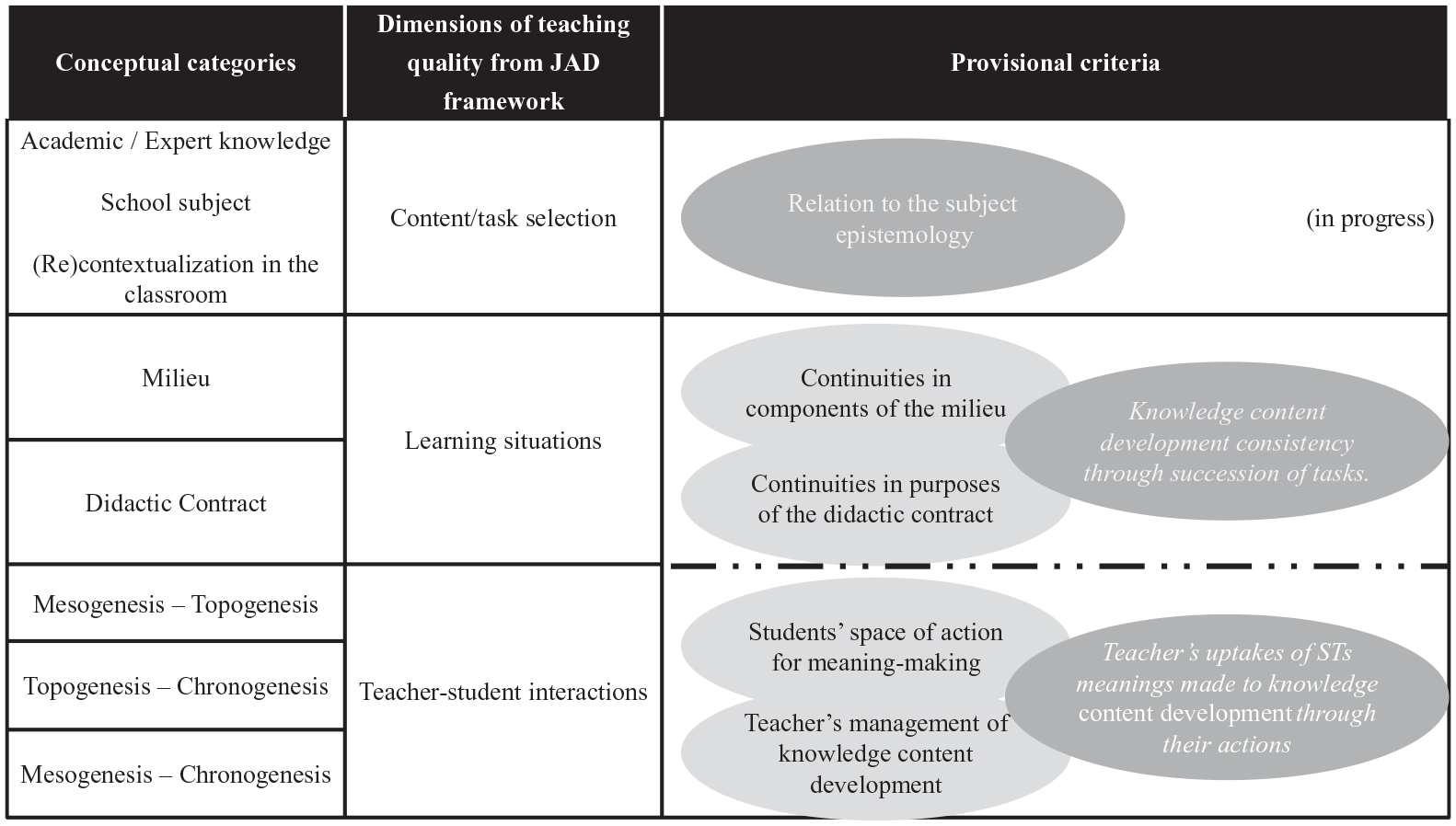
JAD-MTQ improvement from the comparison of the Science and PE sequences.
The LOWER-MESO analysis allows to consider the importance of the coordination between the students’ space of action and the teacher’s management of the knowledge content development. What the teacher takes up from the students’ space of action to nurture the knowledge content development features the students’ participation in the teaching process. This criterion implies taking into consideration not only the student’s discourses, but more broadly, their actual actions in the milieu of the learning situations.
The UPPER-MESO level analysis allows to consider the importance of the coordination between the continuities in the milieu and the contract in learning situations. This coordination features the connections between the situations experienced by the students, through the succession of tasks organized by the teacher. At the UPPER-MESO level, we do not analyze the learning situations as experienced by the students, but only the potential of these situations based on the tasks that structure them. Hence, we suggest a criterion addressing the overall structure of knowledge content development through the succession of tasks occurring in a teaching sequence (or even a single lesson). At this level, this criterion reflects the epistemic 14 relations in the purposes, to be identified by the students in performing the tasks. In the Science classroom, these purposes are progressively unveiled during tasks and recalled before starting a new task. Conversely, in the PE classroom, purposes are randomly distributed across tasks, making it harder for a student to make sense of the direction that the knowledge content development takes.
Moreover, the MACRO analysis of the Science and PE teaching units unveils the need of a third dimension featuring the didactic transposition of knowledge (see introduction of comparative didactics in previous sections). This dimension includes—at least—a criterion about the subject epistemology (teaching traditions, references to didactic models, etc.) embedded in the content and tasks selected by the teacher. Consecutively, considering content specificity in studying teaching quality requires to rely upon results of certain pieces of research in subject didactics.
On this basis, our initial model for analyzing teaching quality from the JAD framework (cf. Table 1) may be augmented by adding one criterion to each of the two dimensions presented, and by considering the need for an additional dimension meant to discuss the selection of content and tasks in teaching quality (cf. Figure 5).
In bringing to comparison two very different teaching sequences, both in terms of subjects and in terms of structures of tasks (cf. Figures 3 and 4), our cases study allows to think of a set of criteria as a system for examining teaching quality. However, our study remains exploratory, and contextualized to the comparison of only two teaching and learning practices. Further development of the JAD-MTQ model, supported by both new empirical analyses need to be done to clarify the use of the criteria we suggest, and possibly expand them.
Concluding remarks
In this paper, we have used a comparative approach for exploring a set of provisional categories of the content-specific dimensions of teaching quality. This approach is an epistemological act providing conditions for developing models that are broader in scope than the ones traditionally built by subject didactics. We suggest that the JAD-MTQ is an interesting candidate for analyzing teaching quality for at least two reasons: (i) it can capture content-specific dimensions of teaching, and some aspects of the quality of learning; (ii) it considers a large range of indicators (large and short timescales, large and fine grain-sizes) with a small number of criteria. Further research is now needed to deepen the characterization of the tasks and content selection dimension. Some descriptors of each criterion also need to be clarified for facilitating their handling by an extended community of researchers and practitioners. Although this model is built from comparative research in didactics, we expect that it can be used as an autonomous model for examining teaching quality in different school subjects.
Supplemental Material
sj-pdf-1-eer-10.1177_14749041241257282 – Supplemental material for Comparative didactics: Toward a generic model for analyzing content-specific dimensions of teaching quality
Supplemental material, sj-pdf-1-eer-10.1177_14749041241257282 for Comparative didactics: Toward a generic model for analyzing content-specific dimensions of teaching quality by Florence Ligozat and Yoann Buyck in European Educational Research Journal
Supplemental Material
sj-pdf-2-eer-10.1177_14749041241257282 – Supplemental material for Comparative didactics: Toward a generic model for analyzing content-specific dimensions of teaching quality
Supplemental material, sj-pdf-2-eer-10.1177_14749041241257282 for Comparative didactics: Toward a generic model for analyzing content-specific dimensions of teaching quality by Florence Ligozat and Yoann Buyck in European Educational Research Journal
Supplemental Material
sj-pdf-3-eer-10.1177_14749041241257282 – Supplemental material for Comparative didactics: Toward a generic model for analyzing content-specific dimensions of teaching quality
Supplemental material, sj-pdf-3-eer-10.1177_14749041241257282 for Comparative didactics: Toward a generic model for analyzing content-specific dimensions of teaching quality by Florence Ligozat and Yoann Buyck in European Educational Research Journal
Supplemental Material
sj-pdf-4-eer-10.1177_14749041241257282 – Supplemental material for Comparative didactics: Toward a generic model for analyzing content-specific dimensions of teaching quality
Supplemental material, sj-pdf-4-eer-10.1177_14749041241257282 for Comparative didactics: Toward a generic model for analyzing content-specific dimensions of teaching quality by Florence Ligozat and Yoann Buyck in European Educational Research Journal
Footnotes
Acknowledgements
We would like to thank Laurence Marty, Per-Olof Wickman, and the reviewers for their interesting and supportive comments, which helped us to improve this paper. We are also grateful to Ignacio Monge who contributed to the transcription and elaboration of the synopses of the Science teaching sequence from raw data.
Declaration of conflicting interests
The author(s) declared no potential conflicts of interest with respect to the research, authorship, and/or publication of this article.
Funding
The author(s) disclosed receipt of the following financial support: Data collection for the Contemporary Dance teaching sequence was funded in Yoann Buyck’s doctoral grant by the Swissuniversities P9 Programme “Didactique des disciplines” (2017-2021). Data collection for the Science teaching sequence was funded in the project “Teaching traditions and learning. Comparative didactic analysis of science education, physical education and health in Sweden, Switzerland and France” (2014-2018; Grant no. 2012-5023) by the Swedish Research Council (Vetenskapsrådet).

Supplemental material
Supplemental material for this article is available online.
Notes
Author biographies
References
Supplementary Material
Please find the following supplemental material available below.
For Open Access articles published under a Creative Commons License, all supplemental material carries the same license as the article it is associated with.
For non-Open Access articles published, all supplemental material carries a non-exclusive license, and permission requests for re-use of supplemental material or any part of supplemental material shall be sent directly to the copyright owner as specified in the copyright notice associated with the article.
