




Abstract
Physical education (PE) can be a context in which students are ‘educated through the physical’, which includes the possibility to learn social inclusion as an important life skill and contributor to the greater good of society. A key goal in the Norwegian educational system is that such positive life skills become internalised in students. The aims of this study were to understand students’ experiences of and behaviour towards social inclusion – such as passing the ball – in team activities and how the teacher facilitated the learning of social inclusion. We use Dewey’s pedagogical perspective on education, and Johnson and Johnson’s cooperative learning model to discuss possible consequences and implications of our findings. The participants consisted of two secondary classes from two state schools in Norway, where one class was investigated in depth. Methods comprised written narratives, interviews, observation and video recordings of PE lessons. Data creation was triangulated, and thematic analysis was conducted. The results highlighted a paradox between students’ experiences of and behaviour towards social inclusion in team activities. Students disliked socially exclusive behaviours, but they often provided positive feedback when the behaviour was seen as successful in the context of a game; furthermore, students could themselves behave in a socially exclusive manner. Although the teacher could ‘teach by telling’ the students to pass the ball or by having rules, passing the ball did not become internalised in students. We discuss a model of ‘learning through experiences and reflections’, according to which students may learn to become socially inclusive beings.
Introduction
There are different ways of thinking about physical education (PE). For example, PE can be thought of as ‘education of the physical’ and as ‘education through the physical’ (Anderson, 1997; Goudas, 2010; Laker, 2000). Although ‘education of the physical’ is important, thinking of PE as ‘education through the physical’ allows the potential for developing life skills in PE (Cronin and Allen, 2017; Cronin et al., 2018, 2019; Goudas, 2010). Life skills include aspects such as ‘behavioral (communicating effectively with peers and adults) or cognitive (making effective decisions); interpersonal (being assertive) or intrapersonal (setting goals)’ (Danish et al., 2004: 40). As such, this definition of life skills includes social skills, and PE might be an important context for learning such skills (Bailey et al., 2009).
The Norwegian context
The present study was conducted in Norway, where state schools educate approximately 95% of students in grades 1–10 (Veland et al., 2009). Norwegian society is in general considered egalitarian with a relatively small number of students living in poverty, modest cultural diversity, and only small differences between schools (Veland et al., 2009). Although Norwegian society is in general considered egalitarian, there has been an increasing number of students living in poverty in recent years (Epland and Normann, 2020). At secondary school, most students are in the same class from grade 8 to grade 10 (age 13–16 years), and the teacher usually teaches two or more subjects. The Norwegian curriculum for PE (grades 8–10) states that one of the main learning outcomes is to ‘acknowledge differences between oneself and others in movement activities and to include all, regardless of prerequisites’ (UDIR, 2019a: 8). Therefore, the present article focuses on social inclusion as a life skill. Furthermore, to be counted as a life skill, social inclusion needs to become an internalised part of students and be employed in different settings (Gould and Carson, 2008; Pierce et al., 2017). Indeed, a key goal of the Norwegian education programme is for students to learn positive skills that become internalised (UDIR, 2019b). In other words, students’ social skills, such as social inclusion, should be carried throughout their education and into their everyday life in society (Casey and Quennerstedt, 2020).
Social inclusion in PE
Social inclusion and exclusion in PE have been investigated in different ways. Munk and Agergaard (2015) noted that research has focused on exclusion as ‘something being done’ to students and has been directed towards social categories such as gender, physical skills and minorities. In contrast to searching for exclusion based on groups, Munk and Agergaard (2015) investigated the complex interactions within a group of students and found that students’ lack of physical skills and necessary social relationships might lead to exclusion in activities. We acknowledge that categories such as gender, physical skills, social relationships and minorities may influence social inclusion and exclusion in activities in PE. However, in this study, we analysed the students’ experiences of social inclusion and exclusion in situations within team activities in relation to their learning of social inclusion. In this way, we examined social inclusion as a skill of each individual student within a group and how it was learned within situations in PE; for example, whether students passed the ball to each other during team activities such as floorball, and, thus, how social inclusion was learned through passing the ball in cooperation with the team.
Within the context of PE, social inclusion is important because it influences the social interactions in PE and the creation of meaningful experiences. Beni et al. (2017) noted that social interactions were identified (together with fun, challenge, motor competence and personally relevant learning) as important for creating meaningful/positive experiences in PE. In contrast, by citing an example from Carlson (1995), Beni et al. (2017) also noted that social interaction may lead to negative experiences with ‘feelings of isolation’: ‘I don’t feel that I am a part of gym. I feel left out, not really a part of that team feeling’ (471). A Norwegian study (Røset et al., 2020) showed that students who did not receive the ball in team activities and/or received negative comments were less motivated to participate in the activity. Thus, social exclusion might lead to negative experiences in PE and social inclusion might lead to positive experiences (Beni et al., 2017). Furthermore, social inclusion is an important aspect of cooperation (Deering, 1996) and might be learned in PE. However, simply participating in PE and sports does not automatically lead to positive outcomes such as being socially inclusive (Bailey et al., 2009; Opstoel et al., 2020), and grouping students together does not automatically lead to cooperation (Dyson and Casey, 2016) or social inclusion. Therefore, social inclusion could be considered as a social skill that might be learned within the framework of the cooperative learning (CL) model (Dyson and Casey, 2016; Johnson and Johnson, 2009). Although the PE teacher did not specifically apply the CL model in this study, it can be used to highlight elements within PE lessons where social inclusion may be learned in team activities.
Cooperative learning in PE
Casey and Goodyear’s (2015) review of CL in PE indicated the potential of CL as a pedagogical model to contribute to learning within physical, social, cognitive and affective domains (Bailey et al., 2009). It was emphasised that further research was required on the affective domain to clarify the contribution of the model (Casey and Goodyear, 2015). To achieve learning within these four domains in PE, CL is built on five elements, which we apply here to PE (Casey and Goodyear, 2015; Dyson and Casey, 2016; Johnson and Johnson, 1991, 2009). (a) Positive interdependence includes an understanding that each student is mutually dependent on each other for success and everyone must do their part of the work. Thus, a shared goal is important. (b) Promotive face-to-face interaction includes students encouraging and helping each other to increase the group’s effort to achieve and complete the tasks to reach the shared goal. (c) Individual accountability includes each student being accountable for his/her effort on the team, and that peers expect a contribution from each other. (d) Social skills (interpersonal small group skills) include communication between students and asking for clarification, discussing, asking peers to contribute and giving praise for their contribution. (e) Group processing includes reflecting on their performance, functioning as a group, and setting and reflecting on goals: what is the goal and how is it to be achieved?
Casey et al. (2009) suggested that CL should be introduced over a few lessons of a unit before students become comfortable working in their groups and can begin cooperating with each other. Regarding social skills, Casey and Goodyear (2015) found that CL had the potential to teach students to cooperate, work together as a team to learn, develop good social relations, and to show care, concern, empathy and respect for each other, while supporting and encouraging each other to learn. Therefore, the CL model may be a useful framework for examining social inclusion in team activities. However, considering Dewey’s (2015) idea of learning through experience, the starting point should be the students’ experiences in the activities.
The educational perspective of Dewey includes his idea of experience and education, that is, the need for the experience of children and young people in schools to be ‘one of education of, by, and for experience’ (Dewey, 2015: 29). Casey and Quennerstedt (2020) argue that adding Dewey’s idea of education and experience to Johnson and Johnson’s (2009) five elements would broaden the educative element to CL in PE: Such an educative element would redirect focus towards the capacity of further and richer experiences, expanding the possibilities for further actions and experiences where cooperation is lived, and thus being something that should be discovered in an embodied process of inquiry (Casey and Quennerstedt, 2020: 1030).
Aims of the study
Considering Dewey’s notion that school (PE) should be education of, by, and for students’ experiences and the importance of social inclusion for students’ meaningful experiences (Beni et al., 2017), the first aim of this study was to investigate students’ experiences and learning regarding social inclusion in team activities. The second aim was to investigate how the students learned to become socially inclusive in team activities. In this way, the present study may contribute to discussion on including Dewey’s educative element in the CL model (Casey and Quennerstedt, 2020) through adding ‘real-life’ experiences of social inclusion and learning to socially include others through team activities.
Method
This study formed part of a larger research project investigating experiences and learning in PE. One of the overarching themes, ‘social inclusion and exclusion in team activities’, resulted in this article. The triangulation of multiple methods (Abdalla et al., 2018) was based on Rorty’s (1982) philosophical pragmatism and pragmatist methodology (Allmark and Machaczek, 2018; Feilzer, 2010; Morgan, 2007). Pragmatists are interested in investigating human needs and helping to solve these needs (Rorty, 1982). The present study indicated a need for students to become socially inclusive in team activities, and thereby the overarching theme ‘social inclusion and exclusion in team activities’ was created from the field. Data were gathered through written narratives, observation combined with video recordings, and interviews. These methods were triangulated to complement each other and to reduce the limitations of each single method (Appendix 1). Furthermore, these methods together with the theoretical framework of CL (Casey and Goodyear, 2015) and the educative element of Dewey (Casey and Quennerstedt, 2020) allowed us to investigate and discuss students’ learning in PE (Quennerstedt et al., 2014). The number of interviews and observations were chosen to gather sufficient data for a clear understanding of the situations and perspectives (Braun and Clarke, 2019). In the interviews, all participants and the researcher spoke Norwegian, and the quotations in the Results section have been translated into English. The process of translation of the quotations was undertaken with the support of a professional translator and quotations were checked for their intended original meanings (Van Nes et al., 2010).
Participants
The data creation was conducted at the end of grade 8 and was completed by the end of grade 9 (i.e. age 13–15 years). The participants came from two secondary school classes from two different schools in the south of Norway. In total, there were 49 students: 24 (eight girls and 16 boys) in one class and 25 (13 girls and 12 boys) in the other; in addition, two male PE teachers participated, who were also the main teacher for each class.
Ethical considerations
The school principals, teachers and students were informed of the study verbally and in writing, and the students’ guardians were informed in writing. Written consent was obtained from the teachers, students and the students’ guardians. This study was approved by the Norwegian Centre for Research Data (NSD-58504) and the Ethics Committee of the Department of Sport Science and Physical Education at the University of Agder.
Data creation
The process of data creation consisted of five stages (Appendix 1). The first dataset comprised written narratives of situations (peers, teachers and tasks) in PE that the grade 8 students liked the most and the least. The second dataset consisted of individual interviews of 12 students based on the first dataset to gather richer data (Patton, 2014), as well as an interview with their two PE teachers. The third data creation stage consisted of observation and video recordings of 14 PE lessons (eight in one class and six in the other). The fourth data creation stage comprised written narratives from all students conducted at the end of each PE lesson concerning situations they liked the most and the least in the PE lesson. More detailed information on these datasets is available elsewhere (Hovdal et al., 2020). The fifth dataset consisted of interviews with students (11 boys and eight girls) and their PE teacher from one class. The student interviews were related to their narratives created after the PE lessons, observations and video clips from the PE lessons. For example, the researcher asked, ‘From this video clip, can you tell me about the passing of the ball?’ The interviews with students were also related to the socio-cultural environment and cooperation in general. The interview with the PE teacher focused on the degree of cooperation between students and their learning to cooperate in class, both in general and specifically in different team activities and situations. For example, the researcher asked, ‘How do the students learn cooperation in this class?’ and ‘From this video clip, can you tell me about the cooperation?’ The notion of social inclusion was later extracted from the interviews.
Follow-up questions were used to ensure that answers were sufficiently detailed (Rubin and Rubin, 2011). For example, when a student commented that he should pass the ball more often, the researcher could reply ‘Why should you pass the ball more often?’ or ‘In which situations would you not pass the ball?’.
Data analysis
The interviews and video recordings were transcribed, and together with the written narratives and field notes, a thematic analysis was conducted (Braun and Clarke, 2006, 2019; Braun et al., 2016). The data were organised using NVivo 11 and analysed with the six basic steps outlined by Braun and Clarke (2006): (a) familiarising yourself with the data; (b) generating initial codes; (c) searching for themes; (d) reviewing themes; (e) defining and naming themes; and (f) producing the report. The transcripts and written narratives were read several times, in addition to viewing the video recordings, to glean an overall sense of the relevant data in this study (Braun and Clarke, 2006). Initial codes were generated systematically from all data sources (Appendix 2), and we looked for potential themes, which were then reviewed (Braun and Clarke, 2006). The processes of defining and naming the main themes (Appendix 2) were ongoing processes that overlapped with producing the report (Braun and Clarke 2006), for which we selected vivid, compelling examples that related back to the aims of the study and the literature (Clarke and Braun, 2006). To highlight the complexity of the students’ experiences and learning, we include an example of one student (David) in the Results section. Appendix 2 illustrates how the themes were constructed from the data.
Creating the overarching theme
The creation of the overarching theme in this study – social inclusion and exclusion in team activities – arose from repeated readings and views of the interviews, narratives, field notes and video recordings (Creswell and Creswell, 2017). Our interest in the created overarching theme started after a student wrote in his first narrative that he did not like floorball because he did not feel included. We interviewed him to further explore his experience with this activity and situation (Rubin and Rubin, 2011). In the interview, he said that he felt that he was not included in floorball because his more skilful group members did not pass the ball to him; at the same time, he said that he might do the same (i.e. not pass the ball) in football, in which he said he was a much better player. Thus, we became interested in investigating inclusion in team activities. This interest was strengthened after the total of 453 narratives conducted after each PE lesson were analysed (Appendix 2). From these, 242 narratives consisted of situations that students liked in PE. Figure 1 quantifies the qualitative themes where students described positive situations from each observed and video-recorded PE lesson (Creswell and Creswell, 2017). The figure illustrates the themes about which students overall had the most positive narratives; in turn, this allowed us to investigate the overarching theme in greater depth through interviews (Rubin and Rubin, 2011) in the fifth data creation stage. The number of narratives within each theme is included in parentheses. As shown, the themes ‘fun activity’ (60) and ‘team activities’ (62) had the highest overall number of narratives. Within ‘team activities’, the subtheme ‘team activities with ball’ had the highest number of narratives (57).
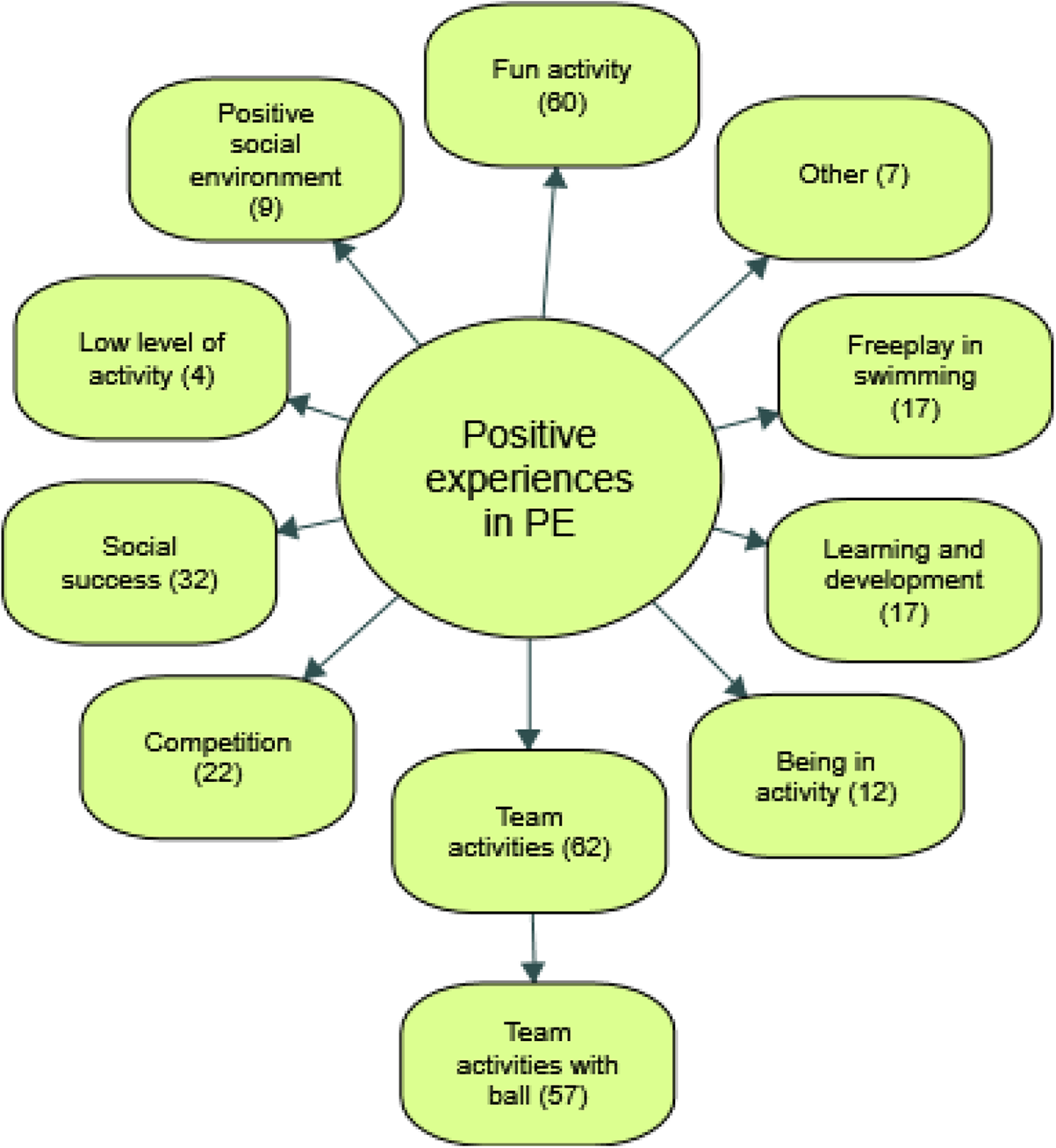
Themes created based on the students’ narratives written after each PE lesson.
Results
To understand the students’ experiences and behaviour concerning social inclusion and social exclusion that we present first, we focus on the following themes: the positive feedback given in team activities, the paradox between students’ experiences and actions of socially exclusive behaviour, and how social inclusion was learned in team activities.
Students’ experiences of social inclusion and exclusion
The theme ‘team activities with ball’ had the highest number of positive narratives in PE lessons (Figure 1) and students were interviewed about this theme. Figure 2 presents students’ experiences in team activities with a ball. They had experiences of social inclusion as ‘cooperating and helping each other’, ‘passing the ball’ and ‘working together’. The students had experiences of social exclusion such as ‘ruining the game for others’, ‘keeping the ball to themselves’ and ‘losing the ball’.
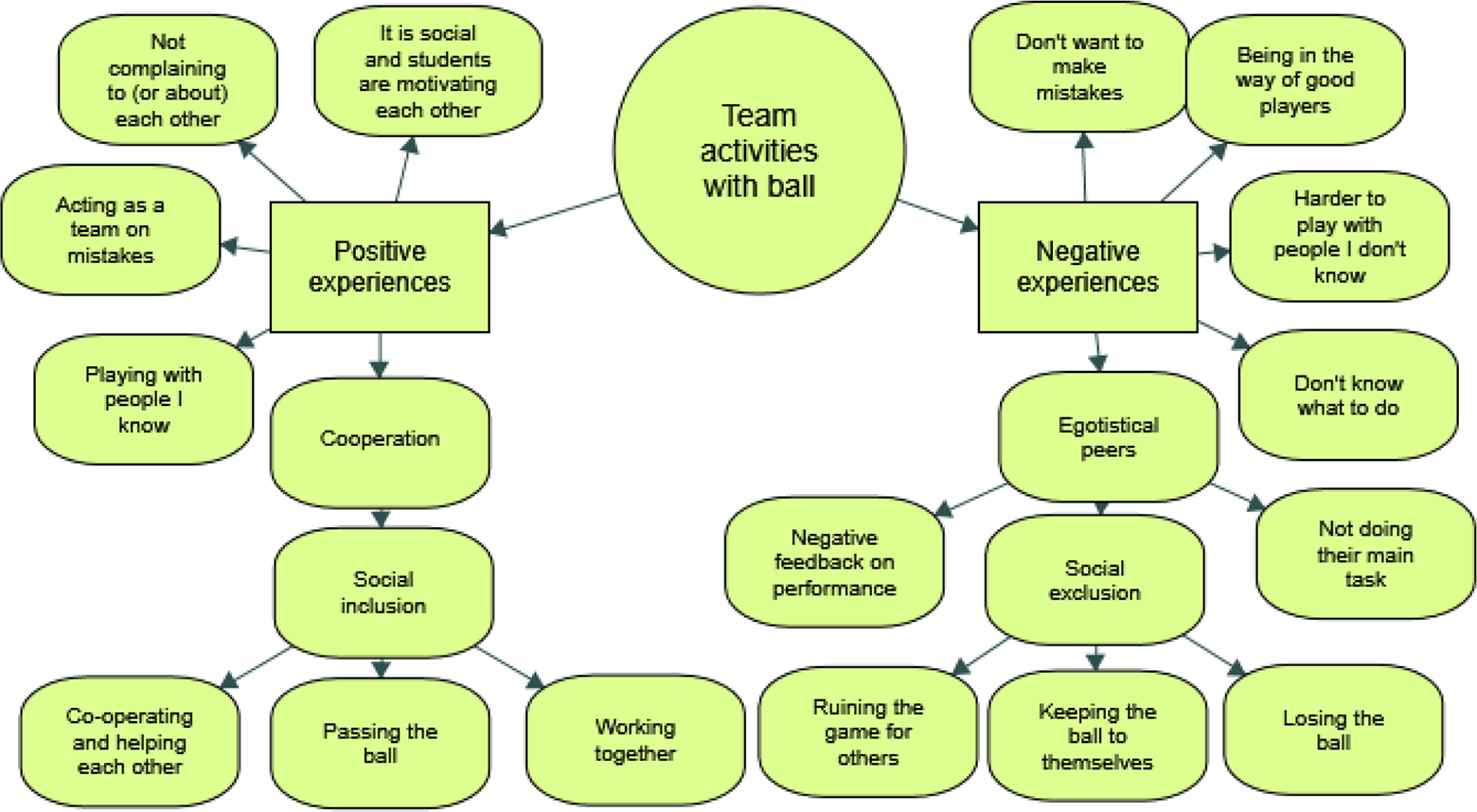
Themes created based on students’ interviews (fifth dataset), which included video clips of situations in PE activities.
We investigated further whether the students’ experiences of social exclusion were sufficiently important to warrant changes. In their interviews, students said that some peers were ‘egotistical’; furthermore, such group members could make the activity ‘more boring’, ‘it was annoying’, ‘they were less fun to play with’, ‘you might try less hard because you never got the ball’, ‘it was irritating that you tried to include others in activities you were better at, but others did not do the same in activities they were better at’, and ‘sometimes it was okay not to pass the ball, as long as it did not happen too much’. Hence, students seemed to have an incentive to tell others who were behaving in a socially exclusive manner to pass the ball more often. At the same time, socially exclusive behaviour might become normalised, as noted by Clara: We have, sort of, gotten used to it. Because it is the same [students who do not pass the ball]… It is a difference between who is wanting the ball for themselves, and others, who do not want the ball, you notice a difference. But…that is not something one can do much about really.
Positive feedback in team activities
In their interviews, students responded that they received the most positive feedback in team activities, as expressed by Cassandra: It is most often when we are in teams. Because you are doing something good for the team, sort of. Yes, I feel that. At least, if they score a goal or manage to win the ball, or something like that. Then they [the students] say something positive.
The paradox between students’ experiences and actions of socially exclusive behaviour
The following section is based on all five data creation stages. David wrote in the first narrative that he did not like floorball because he felt that he was not included, and reported in the subsequent interview the following: There are several teams, and some [students] are better than others. Yes, and then they…well, those who play floorball [outside school] might be better than others, and maybe they want to do it themselves. So then, so then, there would not be so much play together. mm, I probably learned that when I play football, then I maybe should pass the ball more often myself. Not just playing with myself but play as a team.
In the second interview with David after the observation and video recordings, he was asked about cooperation in general. He said that he passed the ball more often in football now, since the first interview. When he was asked about the narrative in which he related he liked the cooperation between him and one particular teammate, he said that cooperation in the team was generally good. David said that he and his teammate passed the ball back and forth to each other, playing wall passes. He was asked whether the kind of situation would influence him to pass the ball or not: Not for me, at least. I kind of pass the ball to everyone. When we pass [the ball] to each other, it leads to scoring goals. Well, I saw that we had a good passing game. I did not count properly, but it was not that many [passes], hehe.
Learning social inclusion in team activities
The PE teacher said in his second interview (fifth data creation stage) that the class mostly talked about team activities (cooperation and social inclusion) before the lessons; based on observation, the teacher used an instructional method (external control) during the activities to get the students to pass the ball. This was later supported by interviews with the students, in which they said that the teacher could tell them to ‘pass the ball’ or there was a ‘[teacher] rule’, such as they had to pass the ball to everyone on the team. The students also suggested that the teacher should state clearly at the start of the activity that players had to pass the ball and, furthermore, should remind the students to pass the ball during the activity.
The students reported in the interviews that they learned social inclusion and cooperation in team activities in the following ways: ‘by playing the game’, ‘the teacher told them to cooperate or by having rules to pass the ball’, ‘by changing the teams’, ‘by passing the ball in pairs before the start of a game’, and ‘the teacher said that passing the ball more often would lead to getting better grades’. Based on observation and video recordings, only two of these means of learning social inclusion seemed to be of any importance. First, although some students had a lower skill level in passing the ball in the different ball activities, it was nevertheless sufficient for some cooperation with group members. Second, when the PE teacher told the students to pass the ball, they passed the ball more often in that particular activity, but not in the next. The researcher therefore asked Ole about how their team cooperated in a floorball activity: We do not plan anything, sort of… I don’t think I learned anything that I didn’t know, sort of. I think I knew most of it before [the activity].
In one specific situation, the teacher tried to improve the boys’ handball game (the activity was divided between the boys and the girls) by stopping the game and asking questions and giving information. On one of these occasions, one student was not paying attention and was playing with the ball, and others just seemed to be waiting to go on with the game, based on where they were looking and their lack of participation in the talk. One student, Birger, was asked about how he would remember information best from these talks: The teacher provides information, but [the students] also pay attention. The teacher gathers us in a half-circle and then we pay better attention than when we stand still on the court and focus on playing. Because he [the PE teacher] said a bit much in a short time, I didn’t catch everything. I would have remembered it [the information] best if I had answered correctly…you remember it better when you give the right answer, instead of him [the PE teacher] telling you that you should play like this, and yeah, you will not get the same feeling, sort of. Then you just feel that you get an instruction [external control], ‘this is how you do it’. Instead of him asking you, and let you do some of the work. I remember it best when he just tells us. In that video clip, it was not like that. But many times, many students answer and a lot of it is wrong. And then it becomes like, okay. You get confused sort of, if you are not sure yourself. And people are giving a lot of answers and talking over each other. And the teacher gives us [the right answer] afterwards, but you have heard so many things that…you do not pay attention in the same way.
In summary, although students had the highest number of positive narratives in PE related to ‘team activities with ball’, they disliked when peers demonstrated exclusive behaviour in these activities. In team activities, the students could experience group members passing the ball, not passing the ball, not playing in their (correct) position, and a feeling of irritation when group members did not pass the ball, as well as enjoyment when scoring goals. Team activities could therefore provide both positive and negative experiences for the students. In the case of the exclusive behaviour of others, the students were motivated to speak up, but rarely did so because they did not think it would help. In contrast, the students could provide positive feedback when exclusive behaviour led to a successful outcome for the team and further showing exclusive behaviour themselves. The teacher could ‘teach by telling’ the students to pass the ball or by having rules, but such behaviour was not transferred to the next activity in which the teacher did not interfere in the students’ passing of the ball. In situations where the teacher stopped the activity to teach students to cooperate, the students could lose concentration and not ‘catch’ everything the PE teacher said if he spoke too much; information was remembered best by students when the teacher asked questions without just one correct answer already decided.
Discussion
The aims of this study were to investigate students’ experiences and learning concerning social inclusion in team activities and how the PE teacher facilitated the learning of social inclusion. To this end, we examined the social, contextual and pedagogical circumstances (Bailey et al., 2009) in PE activities. Our discussion focuses on the following three aspects: the paradox between the students’ experiences and their behaviour, the PE teacher’s approach to social inclusion, and how students might be taught social inclusion in team activities.
The paradox between the students’ experiences and their behaviour
The findings revealed an apparent paradox in some of the students’ behaviour. We discuss this paradox through the students’ implicit and explicit goals (Warburton and Spray, 2017) because they influence the students’ understanding of and behaviour in the world. The students’ explicit goal of social inclusion seemed to be overruled by their implicit goal of receiving positive feedback within the activities (Warburton and Spray, 2017). For example, in football activities, the students applauded and gave positive feedback when peers successfully dribbled and scored through socially exclusive behaviour. Furthermore, the students did not, in general, speak up when they had experiences of their group members’ socially exclusive behaviour, possibly because they did not think they could change this behaviour. Bandura (2012) noted that people are less likely to do something if they do not believe they can obtain the outcome they desire. Consequently, the students may say that cooperation and inclusion in a team are important, but during the activities, the social environment influences the students’ goals (e.g. successful dribbling and scoring goals) towards what gives them a good feeling. Casey and Quennerstedt (2020: 1031) argue that the teacher should ‘recognise that students have different ends-in-view when participating in cooperative learning activities’. As a result, it may be important to both reach a shared explicit goal before the activity (Casey and Quennerstedt, 2020) as well as work at the explicit goal throughout the activity.
The PE teacher’s approach to social inclusion
The PE teacher is an important part of the social environment and the creation of the environment. In this study, the teacher used an instructional teaching style (external control) to tell students to pass the ball or by having a rule to pass the ball. The students wanted their teacher to tell their group members to pass the ball more often when some members behaved in a socially exclusive manner. Thus, it appears that the PE teacher’s instructional teaching style (external control) accorded with what the students wanted. However, the pedagogical circumstance (Bailey et al., 2009) of ‘teaching as telling’ (Liebermann and Pointer Mace, 2008: 226) did not appear appropriate because students did not seem to learn to become socially inclusive in the activities. To extrapolate from Dewey’s work on democracy and education (1966), although PE teachers may compel students to pass the ball by means of a rule, it will not change their disposition to not passing the ball. Hovdal et al. (2020) showed that handling behaviour issues through the teacher’s external control (e.g. being very clear and nagging) had short-term effects, but not necessarily long-term effects, and further argue that learning in these situations was necessary. Thus, as indicated by Dewey (1966), there is a difference between passing the ball as a physical result through external control and passing the ball through intellectual endeavour. Therefore, the goal should be to include the students’ disposition for social inclusion by developing within them an internal and persistent direction in the right way concerning social inclusion (Dewey, 1966). Dewey rejected any move to impose ultimate or external ends of education (Hildreth, 2011). Instead, he used the term ‘ends-in-view’, which ‘keeps our attention on the ends of the particular task at hand and reminds us that ends are always provisional and changing throughout the course of educational experiences’ (Hildreth, 2011: 34). If the students cannot anticipate the possible consequences of their behaviour and the teacher does not point these out, then it would be impossible for students to guide their actions intellectually (Dewey, 1966). Instead, their actions would be influenced by their (blind) desires (Dewey, 2015) or their implicit goals (Warburton and Spray, 2017), as the present study showed. In this case, increasing the students’ autonomy (Sun et al., 2017) within the activity might reduce the degree of social inclusion in the teams.
One may argue that if the teacher used external control to make students pass the ball in all the activities, then it may lead to the habit of passing the ball. Nevertheless, it would still not become an intellectual action that might be transferred to other domains in life as a life skill (Dewey, 1966; Pierce et al., 2017). There is a difference between passing the ball through external control or habits and passing the ball through intellectual control based on the possible consequences of the action (Dewey, 1966). In this case, the goal of the teacher is to influence the students in a positive direction through intellectual behaviour based on the possible consequences of the students’ behaviour (Dewey, 1966). Furthermore, through sharing the students’ experiences in the activities and agreeing on rules and goals, it might be said that the students are also part of a social control (Casey and Quennerstedt, 2020; Dewey, 2015). Therefore, Dewey indicates the need for a balanced consideration of the individual and the social ‘ends-in-view’ of education (Hildreth, 2011).
Teaching social inclusion in team activities
Opstoel et al. (2020) and Dyson and Casey (2016) noted that simply participating in PE or grouping students together does not necessarily lead to positive outcomes, such as learning to socially include others. Teachers might be inspired by the elements of the CL model (Johnson and Johnson, 2009) for teaching students social inclusion, although we recognise that ‘education is a complex endeavour and that education rarely functions in mechanistic ways, where a certain input or intervention will produce a certain outcome’ (Quennerstedt, 2019: 613). Casey and Quennerstedt (2020) argue that there should not be one single notion of CL and included Dewey’s notion of the importance of experience in education. We now discuss the students’ ‘real-life’ experiences inspired by the five areas (elements) in the CL model (Johnson and Johnson, 2009), which might be important for learning social inclusion in team activities/cooperative activities, and to build on the discussion of Casey and Quennerstedt (2020).
The PE teacher and the students should agree on a shared explicit goal (Casey and Quennerstedt, 2020), which would be learned within and throughout the activity. The students might be motivated to share an explicit goal or a reality with others where the students perceive the same events in similar ways (Higgins, 2019) and verify with others what the right end or goal is, thereby making it meaningful and worthwhile to pursue (Cornwell et al., 2017). Based on the present study, we would emphasise the importance of learning throughout the activity. Learning to pass the ball through external control, which may lead to the habit of passing the ball, is not the same as understanding why one should pass the ball. However, learning that one should pass the ball through reflection (e.g. before the PE lesson or activity) does not necessarily lead to passing the ball, as shown in this study. Moreover, students should want to pass the ball within the activity due to the possible consequences for themselves and others (Dewey, 2015). Therefore, PE teachers should consider the behavioural (passing the ball), cognitive and social (understanding why one should pass the ball), and emotional aspects (wanting to pass the ball) of learning (Bailey et al., 2009).
In team activities, the students could experience group members passing the ball, not passing the ball, not playing in their (correct) position, and a feeling of irritation when group members did not pass the ball, as well as enjoyment when scoring goals. In sum, students had several different experiences in the activities. The teacher should use these experiences to create shared meanings and future experiences (Casey and Quennerstedt, 2020). In this way, the teacher would facilitate a discussion connecting the shared goal in the activity with the students’ experiences. Experiences connected with, for example, social inclusion, could be reflected upon and the students and teacher should consider further actions to create a social environment that may lead to more and better learning of social inclusion and positive experiences. The role of the PE teacher during the activities is to analyse and observe the behaviour connected with the shared goal and to prepare important questions that may in turn lead to students learning of/in the situations. We see that this part of the process has similarities with group processing in the CL model (Johnson and Johnson, 2009). According to Dyson and Casey (2006: 6): ‘Group Processing is best understood as a reflective, guided discussion that is student-centered, that is, guided by the students rather than driven by the teacher’. Both group processing and social skills are important parts of the learning (Johnson and Johnson, 2009).
The teacher’s role is to guide this discussion in a constructive direction through asking questions and providing students with relevant information (Dewey, 1966; Sutherland et al., 2019). One may argue that asking questions should be the first consideration, to provide students with the opportunity to share experiences that may lead to further experiences (Casey and Quennerstedt, 2020). Moreover, the teacher should guide the students in a constructive direction through these questions by asking more leading questions and/or giving information when appropriate. However, the teacher should be aware of the time spent on talking, because as noted in this study, the students disliked the teacher talking too much, as they would lose concentration and end up not listening, which reduces the learning experiences (Bailey et al., 2009; Beni et al., 2017).
Students in the present study seemed to be individually accountable when they successfully dribbled and/or scored goals but not when they did not pass the ball. Johnson and Johnson (2009) and others (e.g. Dyson and Casey, 2016) have argued that students should take responsibility for doing their part of the task for their group and learn something in the process, and that students should be able to rely on their group members doing their tasks in the group (positive interdependence). Following Dewey (2015) and the importance of students’ experiences, the teacher must ask the individual student how they performed their part in the cooperation with group members, their experiences of this, and what else they could do. In case someone forgot to pass the ball or chose not to pass the ball (or for other reasons), as did David in this study, the teacher should explore how individual students might help their group members (to remember) to do this during the activity, thereby increasing the belief that this kind of behaviour can be affected and changed (Bandura, 2012). That said, students should be allowed to dribble the ball, as long as it does not become ‘too much’; what counts as ‘too much’ would have to be based on the experiences of the students and the PE teacher and the aims of the activity.
To create an environment in which students help each other to do their part, it is necessary for them to feel physically and emotionally safe (Dyson and Casey, 2016). To this end, small groups might serve better in promoting the explicit role of encouraging and learning from each other (Dyson and Casey, 2016). In contrast to the conventional fixed number of players in sports, PE activities such as handball, football and floorball could instead have a varied number of group members. Taken together, the five elements of CL could provide a useful reflective framework for teachers when learning outcomes in team activities are focused on social inclusion (Dyson and Casey, 2016). For instance, are students encouraging and helping each other to pass the ball? (‘promotive face-to-face interaction’); are students individually accountable when not passing the ball? (‘individual accountability’).
Model 1 illustrates how students ‘learn through experiences and reflections’. The model is based on the present findings, in particular on the need to highlight the paradox between the students’ expressed desired behaviour of others (social inclusion) and their actual behaviour, the group processing element in the CL model (Dyson and Casey, 2016; Johnson and Johnson, 2009), as well as Dewey’s notion of experience and growth (Casey and Quennerstedt, 2020).
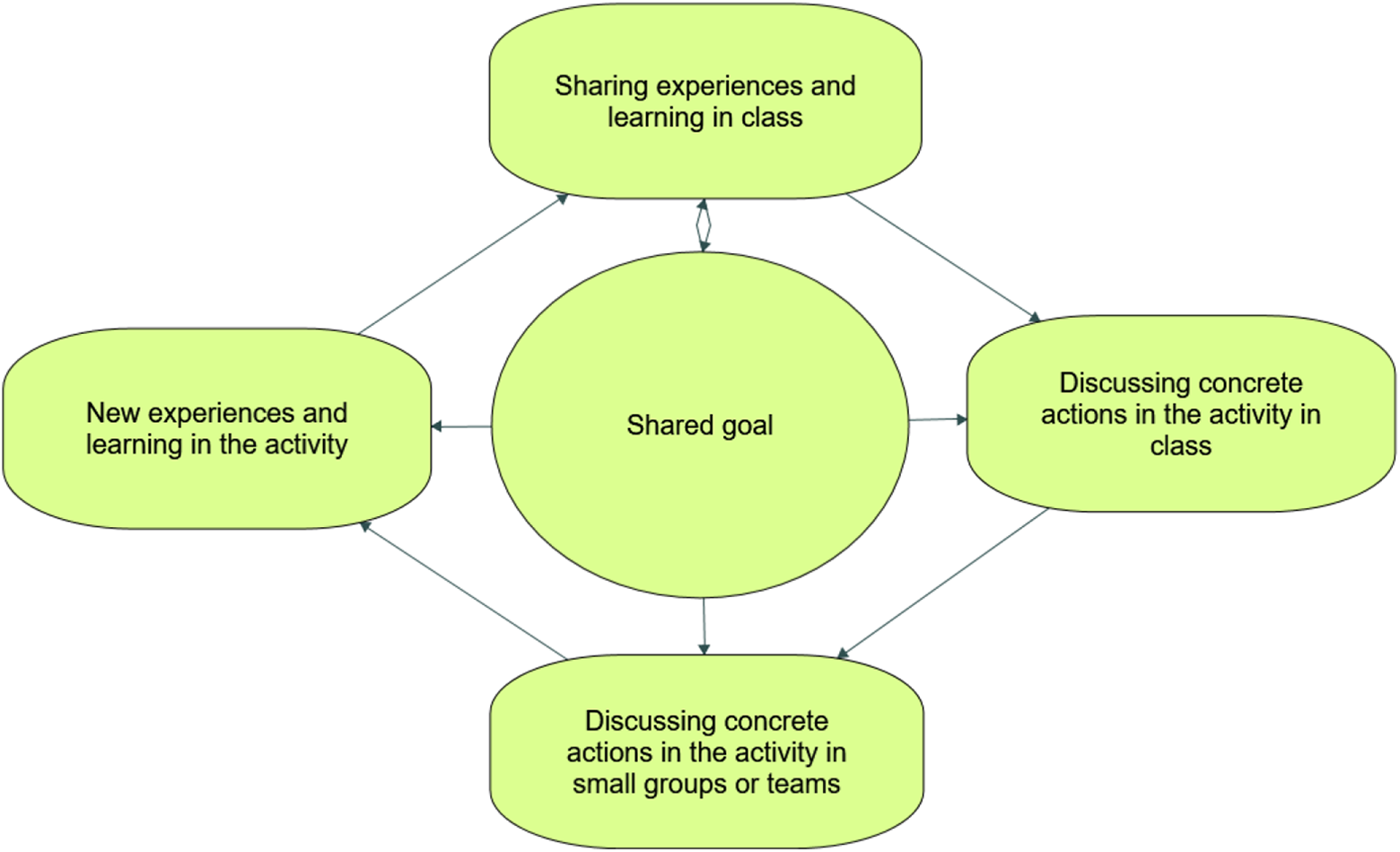
‘Learning through experiences and reflections’ illustrates how the shared explicit goal of classes/groups could influence each part of the cycle, from ‘sharing experiences and learning in class’ to achieving ‘new experiences and learning in the activity’.
At the beginning of the activity, the PE teacher should facilitate a discussion on a shared goal, for example, ‘social inclusion’ in the activity. The students and teacher should share their experiences and learning, followed up by proposing concrete actions that can be taken in the activity to achieve the shared goal. This exercise should probably be conducted with students arranged in a half-circle around the PE teacher to increase the possibility of the students paying attention. Yet, this process should not be too time-consuming, otherwise students would lose concentration and focus. Thereafter, the students break into small groups/teams and decide how they are going to implement these concrete actions in the activity. The most ‘time-consuming’ part of the model should be the students’ experiences and learning during the activity and the PE teacher’s observation and analysis of the students’ behaviour and implicit goals within the activity. After the activity, students again share their experiences and learning in the class guided by the teacher. This model reflects a circular method of learning social inclusion, or whatever is the chosen shared goal. When the teacher and students are satisfied with the social inclusion in the groups/teams, they agree upon a new shared goal. This learning process is not linear, and the class might later return to the initial shared goal of social inclusion in the team, if necessary. At the end of the PE lesson, the students and the teacher discuss how to apply their learning in PE (intellectually) in other situations in their everyday lives (Dyson and Casey, 2016; Sutherland et al., 2019). By combining the concrete learning of social inclusion (or other skills) in situations in PE with the intellectual learning of how to be socially inclusive in other parts of their everyday life (e.g. in other school subjects, free time in school, in their leisure time activities, etc.), the learning might become an internalised part of students (Pierce et al., 2017; UDIR, 2019b).
Conclusion
Physical education can be a context in which students are ‘educated through the physical’, which includes the possibility to learn social inclusion as an important life skill and contributor to the greater good of society. A key goal in the Norwegian educational system is that such positive life skills become internalised in students. This study showed that students may have experiences of socially exclusive behaviour as performed by others, but they do not necessarily act to reduce this behaviour. On the contrary, they might unknowingly facilitate it by giving positive feedback if it leads to a successful outcome (e.g. scoring goals). Although students might dislike socially exclusive behaviour, they may act in a socially exclusive manner themselves. This indicates the need for teachers to observe and analyse social inclusion in team activities to elucidate students’ implicit goals in the activity, and together with the students’ experiences in the activity, to discuss and agree upon a common explicit goal. We conclude by suggesting that the five elements of CL (positive interdependence, promotive face-to-face interactions, individual accountability, social skills, and group processing) provide a useful reflective framework for teachers to address a variety of issues; for example, are students individually responsible for passing the ball to others? Are students asking their peers to contribute? Furthermore, the learning of social inclusion must take place throughout the team activity and be based on the students’ experiences, as argued by Dewey, and as shown by our model of ‘learning through experiences and reflections’.
Supplemental Material
Supplemental Material, sj-pdf-1-epe-10.1177_1356336X211002855 - Students’ experiences and learning of social inclusion in team activities in physical education
Supplemental Material, sj-pdf-1-epe-10.1177_1356336X211002855 for Students’ experiences and learning of social inclusion in team activities in physical education by Dag Ove G Hovdal, Tommy Haugen, Inger Beate Larsen and Bjørn Tore Johansen in European Physical Education Review
Supplemental Material
Supplemental Material, sj-pdf-2-epe-10.1177_1356336X211002855 - Students’ experiences and learning of social inclusion in team activities in physical education
Supplemental Material, sj-pdf-2-epe-10.1177_1356336X211002855 for Students’ experiences and learning of social inclusion in team activities in physical education by Dag Ove G Hovdal, Tommy Haugen, Inger Beate Larsen and Bjørn Tore Johansen in European Physical Education Review
Footnotes
Declaration of conflicting interests
The authors declared no potential conflicts of interest with respect to the research, authorship, and/or publication of this article.
Funding
The authors received no financial support for the research, authorship, and/or publication of this article.

Supplemental Material
Supplemental material for this article is available online.
References
Supplementary Material
Please find the following supplemental material available below.
For Open Access articles published under a Creative Commons License, all supplemental material carries the same license as the article it is associated with.
For non-Open Access articles published, all supplemental material carries a non-exclusive license, and permission requests for re-use of supplemental material or any part of supplemental material shall be sent directly to the copyright owner as specified in the copyright notice associated with the article.
