



Abstract
Teachers are designers and an essential act of the profession is the crafting of learning experiences to meet specific purposes. In this study, we follow a Norwegian physical education (PE) teacher in the design and teaching of a unit informed by a pedagogical model called the practising model (PM). Two research questions guided the study: (1) How does a teacher experience conducting a teaching unit informed by the PM? (2) How does the teacher's role enactment develop throughout the teaching unit? Qualitative data were gathered from workshops, observations from PE sessions in a 10th-grade class, and interviews with the teacher and his students. By applying the joint action in didactics framework, we discuss three key findings: (1) a rough start – feelings of chaos and inadequacy, (2) a shift in the teacher's role enactment, and (3) closing in on the students’ practising. The study concludes that applying the PM framework challenged the usual PE practice of this class. Too many different learning trajectories and didactic sub-milieus, a reconceptualisation of roles and teaching strategies, and epistemological breaches and task overload challenged the teacher considerably. The turning point for the teacher emerged as a conceptual shift, leaving behind the role of an organiser, and instead pursuing the role of a close, curious, and questioning teacher, drawing on different teaching styles to meet students’ needs. Modelling new pedagogical reforms and establishing adequate pedagogical tact certainly requires practising the practice, allowing new roles, expectations, requirements, and strategies to settle as the new normal.
Introduction
Teachers are designers and an essential act of the profession is the crafting of learning experiences to meet specific purposes (Wiggins and McTighe, 2005). Within physical education (PE), Bailey et al. (2009) suggested that this craft could contribute educational benefits within physical, social, affective, and cognitive domains. However, this seemingly rich and promising potential has also led to challenges and tensions. Siedentop (2002) spoke of a legitimisation crisis, where the content knowledge of PE was unclear, McNamee (2009) observed that conceptual unity was difficult to establish, and Kirk (2010) addressed the need for radical reform. Kirk (2013: 974) suggested that PE needed to take ‘particular and different forms in contrast to its current and traditional one-size-fits-all, sport technique-based, multi-activity form’. On these grounds, models-based practice (MbP) gained traction as one such particular and different (re)form (Casey, 2014; Casey et al., 2021; Kirk, 2013; Lund and Tannehill, 2015). Casey and Kirk (2021) describe MbP as an approach that draws on a range of pedagogical models, where each model provides design specifications that direct teaching and learning towards a distinct purpose and learning outcome. In this study, we direct attention towards one such pedagogical model: the practising model (PM), and we set out to answer the following research questions: (1) How does the teacher experience conducting a teaching unit informed by the PM? (2) How does the teacher's role enactment develop throughout this teaching unit?
Outline of the PM
Through the work of Aggerholm et al. (2018), the PM was coined as an independent pedagogical model, seeking to complement existing models within MbP. Aggerholm et al. (2018) prepare the ground for the PM by showing how Arendt's (1958) three fundamental forms of human activity, labour, work, and action, correspond with three dominating orientations in PE: health and exercise, sport and games, and experience and exploration. Relying on Sloterdijk's (2013) claim that Arendt's account of vita activa is incapable of grasping the human activity of practising, Aggerholm and colleagues continue to explore the implications of a pedagogy oriented at this phenomenon. However, practising is not a new educational phenomenon. Sloterdijk (2013) attributes practising a fundamental role in human existence and development, although the German scholar Otto Friedrich Bollnow argued that practising had been misunderstood and discredited as a necessary evil (Bollnow, 1978, cited in Aggerholm, 2021). On these grounds, the creators of the PM contended that existing pedagogical models would have difficulties with delivering this educational phenomenon. The PM was therefore introduced to capture practising as a meaningful process grounded in a holistic account of experience and learning, informed by phenomenological philosophy and Sloterdijk's (2013) anthropological analysis of practising. Practising is thus positioned as an activity that does not rest on necessity (labour), is not an instrumental activity (work), and is not an autotelic disclosure of human plurality (action) (Aggerholm, 2015).
Concerning the language, we follow Aggerholm et al. (2018) and use the term practising. The nouns and verbs that describe this form of activity (practising) in Norwegian (øving/øve) easily lose meaning when translated into the British English verb practise (with s) or the American English verb practice (with c), the latter also being similar to the noun practice.
The PM provides didactical guidance through four non-negotiable features. These are: challenging teachers to acknowledge students as individual subjects and to provide meaningful challenges; helping students focus on their aims; helping specify and negotiate standards of excellence; and providing the students with sufficient time (Aggerholm et al., 2018). The PM framework also presents seven hallmarks of practising: agency, content, goal, verticality, uncertainty, effort, and repetition. In short, students must have agency for what they are practising, and their practising must be grounded in content and directed towards a goal. The goal of practising can be inspired by others, but at the same time, it is self-referential as it involves a transformation of one's capabilities. This transformation points towards the verticality in directing attention towards what is not yet possible. This can be an uncertain endeavour that requires courage, effort, and active repetition. Active repetition refers to repetition as not just a mindless drill but as an active process undertaken for intrinsic reasons. Thus, it is not the content of PE that changes when applying this model, it is the way students relate to content. This provides meaning to the process and makes the learning outcome more akin to problem-solving (Aggerholm et al., 2018).
The current state of research
In general, there exists a broad body of literature within the field of pedagogical models that are of relevance to this study. Casey (2014) and Silva et al. (2021) contributed two extensive reviews. They portrayed a teacher who underestimated the complexity of a new model, found the implementation hard and time-consuming, felt like a beginner again, and found that management tasks took precedence over teaching and learning tasks, contributing to a diversification of the teacher's role. In short, teachers struggled to shake off a traditional teacher-led approach. Casey and Dyson (2009) referred to this as a conceptual shift; Pill et al. (2017) called it the difficulty of trusting students to behave and engage appropriately when provided with greater autonomy; Casey and MacPhail (2018) addressed it as a reconceptualisation of teaching; and Bjørke et al. (2021) referred to it as a tension between previous and new teaching styles. Success criteria for a change process seemed to be the teacher's willingness and motivation to change, their knowledge about and experience with a model, sufficient time to produce and sustain change, support mechanisms through colleagues or university researchers, and efficient scaffolding strategies. Furthermore, Goodyear and Dudley (2015) suggested that teachers should operate as activators of new learning possibilities, a process in which Mosston's (1966) spectrum of teaching styles can provide a guiding framework, allowing teachers to draw on the most suitable style a given situation seems to call for.
Narrowing the scope, looking at the PM more specifically, Lindgren and Barker (2019) contribute a student perspective, but leave the teacher's experiences largely unexplored. In short, they found that developing new movement dispositions through practising takes time. Furthermore, progress can be difficult to notice for both students and teachers, calling for sensitivity towards the small aspects of learning. Vlieghe (2013) and Brinkmann and Giese (2023) provide theoretical contributions to the broader phenomenon of practising as a distinct educational activity between knowing and not knowing, discussing its relevance from an educational and a Bildung theoretical perspective.
To sum up, existing literature from the implementation of other pedagogical models provides a solid body of knowledge for understanding the teacher's role in such practices. However, these practices differ fundamentally from the PM in both theoretical and philosophical grounding, purpose, and desirable learning outcomes. Even though the study from Lindgren and Barker (2019) provides some directions related to the teacher's role in the PM, there is a gap in contemporary approaches to PE that relates to the teacher's role within the PM.
Theoretical framework
In this study, we applied the joint action in didactics (JAD) framework (Amade-Escot and Venturini, 2015). JAD belongs to the French didactic research tradition, following the pioneering work of Brousseau (1997). Drawing on Amade-Escot (2006), didactic research concerns itself with the didactic system that brings together teachers, students, and the knowledge taught. JAD provides a framework that allows for closeness and sensitivity to teaching situations and does not reduce the elements of the system to isolated parts. Thus, such a framework will allow us to analyse complex teaching situations in which the phenomenon of practising operates within and across all elements of the didactic system.
The JAD framework provides three key concepts: didactic transposition, didactic milieu, and didactic contract. Together, they form a didactic game, which is a didactical joint action between the teacher and the students (Amade-Escot and Venturini, 2015). The didactic transposition can be understood as a process by which something is changed from one position to another. It highlights that ‘the knowledge to be taught and the knowledge actually taught and learned undergo complex transformation processes at various stages’ (Amade-Escot, 2006: 345). Brousseau (1997) argued that didactic transposition is inevitable but necessary; thus, it must be kept under epistemological surveillance.
The didactic milieu is all that acts on the student and/or the student acts on. According to Amade-Escot and Venturini (2015: 419), it includes ‘a primitive set of conditions from which knowledge and associated meanings are intended to be construed through joint actions’. Regardless of how well a teacher designs the didactic milieu, students will encounter resistance due to what Brousseau (1986/2002) called learning obstacles. These obstacles belong to the learning process itself. They cannot be avoided, and it is hard to predict them. Hence, research into didactics tries to identify these obstacles (Amade-Escot, 2006).
Brousseau (1997) stressed that the triadic nature of the didactic system is bound by an implicit contract. The term contract is used to identify the set of negotiations, often implicit and tacit, between teachers and students about the content taught. It is not a formal and fixed contract but a never-ending negotiation, the outcome of which is the mutual responsibility of the teacher and students. Thus, learning becomes a joint action in which students seek out information and the teacher becomes a resource. Described as tacit and implicit, the didactic contract appears only when it breaks down. These breaches emerge in action and continually change the content taught. They are not under the direct control of the teacher and are thus hard to identify and take care of (Amade-Escot, 2006; Brousseau, 1986/2002).
Furthermore, the JAD framework presents four analytical tools to account for the teacher's actions: definition, devolution, managing uncertainty, and institutionalisation (Amade-Escot and Venturini, 2015). Definition is about initiating a didactic interaction between students, teachers, and the environment. To do this, the teacher must design a set of conditions in which the knowledge content is embedded. This can be understood as the primitive didactic milieu. In this milieu, students should be able to identify some preliminary goals; however, they do not necessarily match the final learning outcome targeted by the teacher. Devolution is about maintaining didactic interaction through a constant movement of power and responsibility between teachers and students. The teacher must act in such a way that the students agree to establish a relationship that is appropriate to the didactic milieu and the targeted knowledge content. Managing uncertainty is about monitoring the situation so that students modify their actions to make them more relevant. When students choose inappropriate learning strategies and do not adjust their course, it is the teacher's responsibility to intervene. Institutionalisation is about pointing out to students that they have reached a partial or complete level of knowledge. It is important to do this at some point during the interaction to sustain development.
Methods
This study is part of an interactive action research project (Postholm, 2007). The overall ambition was to explore and further develop the phenomenon of practising within PE. For this purpose, a research group was established, consisting of three Scandinavian-speaking university researchers and two PE teachers from a lower secondary school in Norway. The first author of this article (first university member) was responsible for the collaborative work with the teachers. The second university member co-authored this article and worked closely with the first member in the planning of the project and the analysis of data. The third university member is an expert on the phenomenon of practising and contributed his knowledge to discussions within the research group.
The entire project spanned 1.5 years, containing two 6-week teaching units. The empirical data on which this article is based are from the first teaching unit. Figure 1 presents the empirical work related to this unit, involving workshops (WS1–WS5) between the teachers and the first author and interviews with both teachers (IVt1, 2, and 3) and students (IVs1).
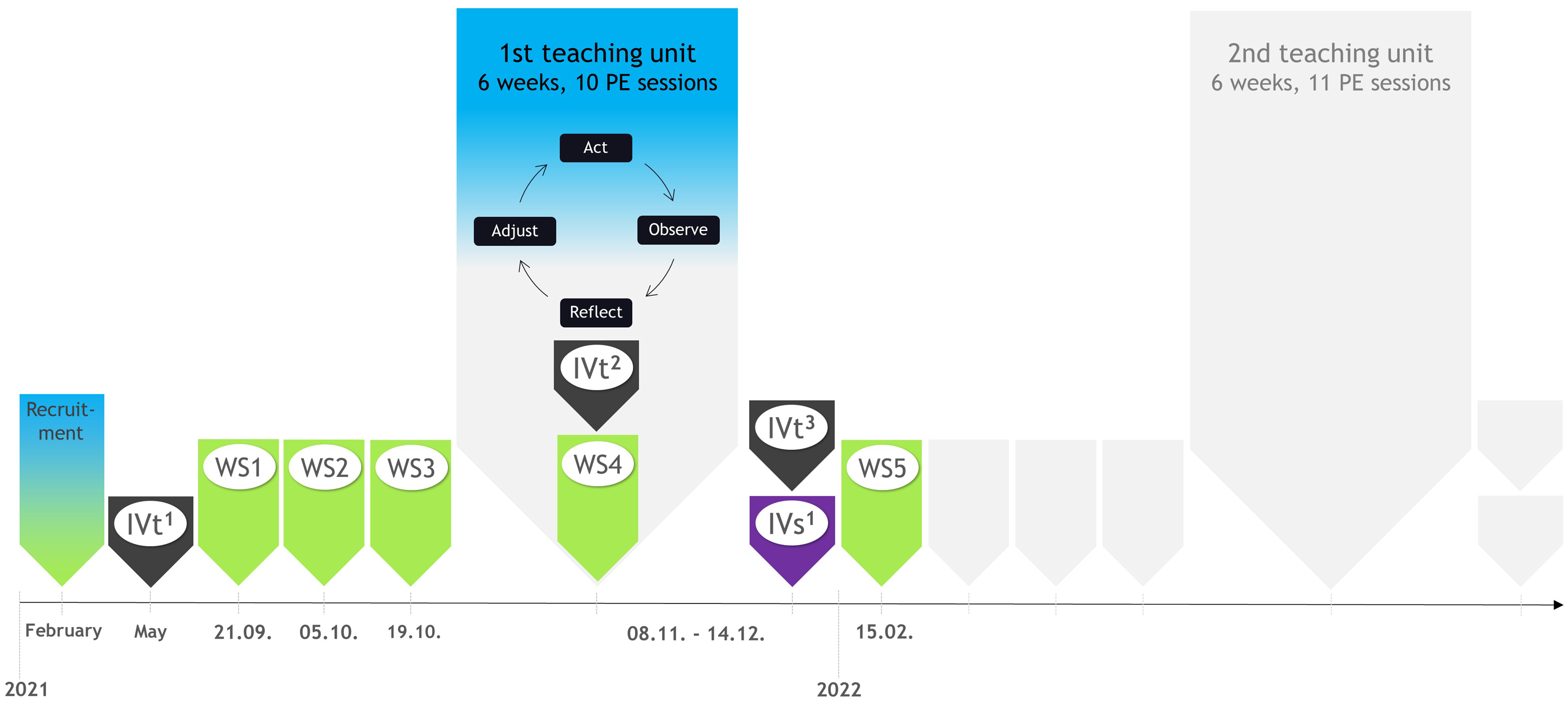
The empirical timeline of the study.
Model fidelity
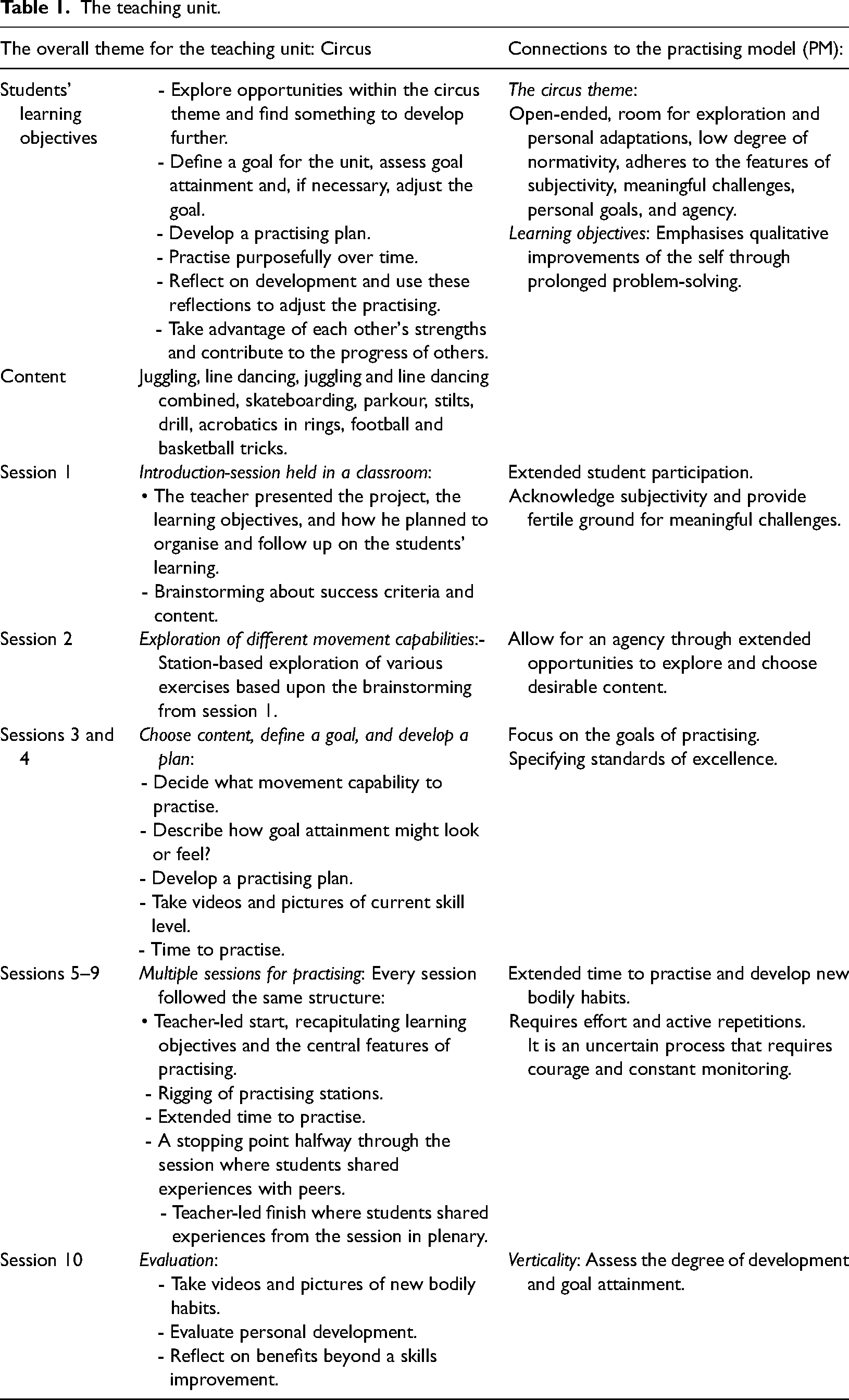
Hastie and Casey (2014) provided three elements that should be addressed concerning model fidelity. First, they suggest a rich description of the curricular elements of the unit. The sections on pedagogical collaboration and the content of the teaching unit (see Table 1) are intended to provide these descriptions. The second element is a detailed validation of model implementation. Regarding this, we would like to make a distinction between implementing and modelling. Drawing on Casey et al. (2021), we consider the verb modelling to refer to a flexible and context-sensitive approach that is less about copying blueprints. Since empirical research on the PM is limited, translating the model's features into practical teaching has rested upon constant exploration and negotiation of the model's key features, to which both teachers and the first author have contributed. The two other university members also provided comments throughout this process. We believe this has strengthened fidelity concerning how key features have been translated and applied. The sections on pedagogical collaboration and the content of the teaching unit describe this process. Hastie and Casey (2014) also argued that a method section should include a detailed description of the programme context, including the previous experiences of the teacher and students with the model. The next section serves this purpose.
Recruitment, participants, and context
Through open invitations to all PE teachers in lower secondary schools in two municipalities in central-eastern Norway, five teachers from three different schools were included. These teachers participated in the first interview (IVt1) and WS1. After this, the number of participants was reduced to two teachers from the same school. This was done to enable close collaboration between the participants. David is the teacher we report on in this study. He is a 32-year-old trained PE teacher with six years of professional experience. For the last two years, he has held the main responsibility for a 10th-grade PE class (age 15–16 years) with 27 students: 14 boys and 13 girls. Neither David nor his students had previous experience with the PM. However, a new curriculum was introduced in Norway in 2020 that explicitly focuses on practising in terms of content, process, and assessment (Ministry of Education and Research, 2020). Therefore, facilitating practising in PE was not a new concept for David.
Adam, the other teacher referred to in this study, carried out the same teaching unit with his PE class and participated in workshops. Since his teaching was not observed and his students were not interviewed, he contributed to this study by sharing his experiences through the workshops.
Pedagogical collaboration
The collaboration between the first author and the teachers was inspired by Lewin's (1946) cycle of change. Through five sequential objectives – to think, plan, act, evaluate, and reflect – we aimed at exploring, acting, and developing the PM. Before the teaching unit, IVt1 and WS1–WS3 formed the communicative space wherein we conducted the initial thinking, planning, and reflecting. Workshops were informed by Vidal's (2006) future workshop methodology. This guided the collaborative work through two distinct phases: a critique phase and an innovation/utopia phase. In WS1, the first author started by presenting the PM framework. We then entered the critique phase, formulating questions, dilemmas, and contradictions concerning the PM and the upcoming action. The utopia phase that followed tried to suggest solutions to the predicted challenges.
WS2 and WS3 were practical. Drawing on the material produced through WS1, David, Adam, and the first author designed the teaching unit (Table 1 presents the content of the unit). This collaboration translated principles into practice, both adhering to the key features and adjusting to the local context and the teachers’ knowledge and experience. The planning process and drafts were also discussed with the two other university members. During the teaching unit, the first author and the main teacher, David, conducted post-session debriefings, allowing us to identify challenges and/or success criteria and to address these before the next session. In WS4 we evaluated and revised the teaching plan for the second half and in WS5 we evaluated the unit and set the course for the second unit.
The teaching unit.
Data collection
Different methods were applied to extract data from the workshops. In WS1, the teachers’ experiences were extracted using Post-it notes. Material from WS1 was brought into WS2 and WS3 as a resource for the design of the teaching unit. The first author also recaptured WS1–WS3 through his field notes. WS4 and WS5 were characterised as discussions between the teachers and the first author and were audio recorded.
The observational data contributed perspectives on David's work throughout the teaching unit. Drawing on Tjora (2019), a semi-structured observational guide was applied to have the flexibility to pursue incidents that were difficult to predict. The PM's key features worked as a priori categories that guided the observations. Concerning these, we were interested in how the teacher executed the teaching plan, facilitated the practising, interacted with students and content, and how students responded to his work.
The post-session debriefings conducted with David were grounded in three questions that we revisited after each session: Did the session work out as planned? What were the success factors in this session? What did not work and needs to be changed? These conversations were captured through note-taking and included in the first author's field notes.
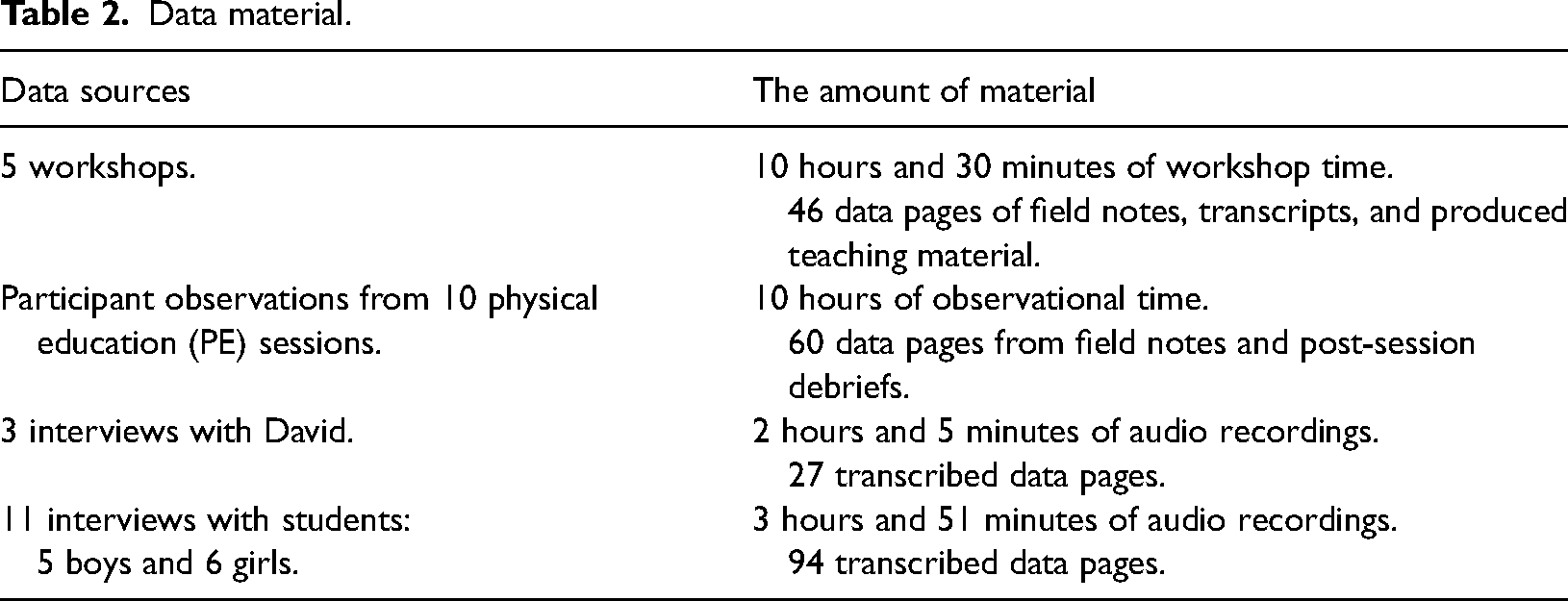
Data material.
Analysis
The analysis was divided into three phases. The first phase was the constant analysis conducted after each session and through the workshops. This process addressed experiences and observations from the action phase and enabled us to make changes as the project progressed. This process was grounded in the heart of the action research design, in which a cyclical process of acting, analysing, and revising are key features.
After the teaching unit, the first author embarked on a systematic analysis of the collected data, following Braun and Clarke's (2022) reflexive thematic analysis. The first author transcribed all data sources verbatim and spent time familiarising himself with the material. Grounded in the research questions, the material was then coded by applying a short word or sentence to a specific text passage. This process was inductive and sensitive to the empirical material to preserve the participants’ formulations and choice of words. A total of 149 initial codes were produced. Based on these codes, the first and second authors worked together to generate overarching themes, constantly comparing and checking them against the data sources and the initial codes to identify any disconfirming evidence. Through this process, a clear duality emerged in the teacher's experiences. There were differences between experiences early and late in the unit, which testified to change and development in role enactment. Such differences can be exemplified through two of the themes, which we labelled ‘chaos and inadequacy’ and ‘looking forward to every session’. The experiences, or codes, that constitute these themes are from different periods of the teaching unit. This alerted us to a change process, the complexity of which was not captured by the initial coding and thematisation.
To better understand this change process, we revisited the data material with a particular focus on the workshops. We repeatedly compared the teacher's experiences at different times against the pedagogical collaboration in the workshops, aiming at discerning the teacher's change process. This eventually created three main themes: (1) a rough start – feelings of chaos and inadequacy, (2) a shift in the teacher's role enactment, and (3) closing in on the students’ practising.
Concerning language, all participants spoke Norwegian and their language was preserved throughout the analysis process. When suitable extracts had been chosen to communicate our findings, they were translated into English. The second author also consulted the English translations to ensure that the meaning was preserved.
Trustworthiness
We have strived to provide transparent and thorough descriptions of all aspects of recruitment, context, collaboration, data collection, and analysis (Merriam, 2009). Drawing on Patton's (2002) different triangulation methods, we applied data source triangulation and analyst triangulation to strengthen the overall validity. Data source triangulation was applied to compare and cross-check the consistency of the information. The analyst triangulation can be divided into two different processes: first, the first author's prolonged collaboration with the teachers established a communicative space where experiences and perspectives were constantly negotiated. This correlates with what Johnson (1997) labelled interpretive validity. Second, the contributions of the second and third university members provided discussions around data collection and analysis. Through this, we tried to increase dependability by constantly checking possible researcher bias, challenging each other's views, and focusing on the discovery of situations that did not conform to our expectations (Johnson, 1997).
Ethical considerations
Information about the project was given both in writing and orally through a parent/guardian meeting at the school. The first author also visited the class and talked about the project. The teacher, his students, and the students’ parents/guardians gave their informed consent to participate in this study. To secure confidentiality, all participants were given aliases, and no identifying descriptions or characteristics were reported.
Results
In the following section, we will present the three themes that the analysis produced. The first theme presents data of a descriptive nature, primarily from the first half of the unit. The second theme deals with the teacher's change process and provides insight into the cyclical nature of action research. The last theme presents the outcome of this change process.
A rough start – feelings of chaos and inadequacy
In the first half of this teaching unit, David faced challenges that required more of him than anticipated. The first author's field notes provide insight into some of these challenges: A group of students are exploring juggling and some boys are doing different football tricks. Two girls are hanging from the roof in the acrobatic rings, while others are arranging a parkour run, practising on stilts, balancing on a slackline, spinning a drill rod, or exploring different ways of doing a slam dunk. After the class is over and the students have left the hall, the teacher suddenly says that he has forgotten the two girls on skateboards. They were practising outside. He sighs in despair over himself. (Field notes, Session 2)
This excerpt communicates several of David's difficulties. First, the number of individual learning trajectories among the students proved difficult to embrace. After Session 3, David was frustrated: ‘Damn, I feel inadequate with so many processes going on at the same time’ (Field notes, Session 3). Students expressed their concerns as well, as exemplified by Amanda: It was difficult for him when everyone was doing different things … it got chaotic in the gym … somehow no room for everyone … he couldn’t focus on giving feedback on how to improve. (IVs1)
Noah felt the consequences of what Amanda described above. In the interview after the unit, he stated that ‘it was difficult when we, all by ourselves and right from the start, had to decide on how to practise … it is difficult to figure out how to improve’ (IVs1).
Second, the practising of so many different circus elements generated an organisational puzzle. Elements that had high equipment requirements, such as parkour, acrobatics in rings, and acrobatic slam dunk with basketball, seized space in the gymnasium. The jugglers pulled out into the hallways or found a free corner inside the gym. The ones doing tricks with footballs or going on stilts were directed to an area outside, and the girls practising on skateboards were in another building. In the interview after Session 5, David was asked to summarise the first half of the unit. As the following quote shows, this phase was demanding: This is very unfamiliar and organisationally very demanding. I feel like a headless chicken running around, spending half an hour organising and helping students get started … I don’t have time for all the students. (IVt2)
In short, David felt that he did not have enough time to support all the students and that he did not possess the knowledge and skills required in such a diverse landscape. Olivia provided the student perspective: He rushes back and forth between students, so there is very little time per student. But it's not his fault and I don't know if he could have helped me that much either, like … I don't know how good he is at such exercises [acrobatics in rings]. (IVs1)
A shift in the teacher's role enactment
In the first interview conducted with David (IVt1), he stated that he had been more of a traditional teacher before. Through WS1–WS3, we tried to address the shift away from the traditional teacher-led approach by designing a unit that we thought would provide fertile ground for a stronger student voice and freedom of choice. However, through observations and post-session debriefings from the first four sessions, it became clear that this had inflicted too great of a challenge on David. Even though we had discussed this after each session, we had been reluctant to make changes so early in the unit because we feared that this would deprive the students of agency, something we wanted them to establish in this phase of the project. We decided to address these contradictions in WS4.
To invite the teachers into a conversation around these challenges, the first author opened WS4 by presenting a prediction that was raised by one of the teachers in WS1: I don’t think we will have the time necessary to facilitate so many different processes. And if I’m right – how should we then gain insight into and be able to support the actual process of practising something? (Field notes, WS1)
The first author asked the teachers to consider this prediction against their experiences from the already conducted sessions. David and Adam had somewhat different experiences. Adam felt that the unit was not too different from his usual practice. However, he agreed that there was probably a bit more chaos than there used to be. David's experiences were marked by greater deviations from previous teaching arrangements: I’m walking around, thinking that it's chaos in here [the gym], that I must focus and get to grips with these organisational aspects, and through that also regain control over the group … I wish that I was able to overlook the chaos a bit more. (Audio recordings, WS4)
Further analysis showed that these reflections sparked a discussion about how to position oneself closer to the students. Using the seven characteristics of practising – agency, content, goal, verticality, effort, uncertainty, and repetition – we discussed the challenges they faced. We acknowledged that extended student autonomy, varied student needs and development, and pushing the teacher into an unfamiliar role might feel chaotic at this point in the unit. This was especially true since this was the first encounter with such a pedagogical scenario for both teachers and their students. David elaborated on this assumption: They usually don’t need to think this much themselves. They are given tasks and instructions to which they can respond. But in this project, a whole lot more is required of everyone … it's unfamiliar for them too, and they must be allowed to spend some time on this adjustment. (Audio recordings, WS4)
The teachers and the first author concluded that addressing the concept of uncertainty was the most pressing issue. This uncertainty included student concerns about organisational and equipment demands, appropriate exercise selection, technical inadequacy, and not knowing how to proceed. We perceived that this uncertainty also affected the quality of the repetitive process. David suggested trying to observe the students more to see whether they could regulate this uncertainty on their own. If they could not, he would have to intervene and try to understand their subjective needs, then collaborate with them to find a solution rather than provide corrections straight away.
The analysis shows that two measures emerged from WS4. First and foremost, the teachers should actively engage in individual students’ practising to help them reflect on their experiences and support or challenge their choices. Second, through assessing practising plans and providing feedback on these, they should identify common challenges among students and address these before and after each session. David concluded: ‘If I manage to make them more aware of their own experiences, I hope it will give them a clearer direction and not least the ability to regulate the practising more independently’ (Audio recordings, WS4).
Closing in on the students’ practising
The analysis reveals that David enacted the measures established in WS4, and slowly but surely, changes emerged. An important change was linked to students’ development. Developing new movement capabilities took time, and the analysis of student data shows that many of the students needed 7–10 sessions of hard work to experience that this effort produced an acceptable return. After WS4, the teacher's role enactment also changed significantly, and this extract from the first author's field notes provides insights into David's work: David gathers the students. After a quick pep-talk about focus, persistence, and quality in their practising, he kicks off the session. Within the first 30 minutes, the teacher has ‘touched base’ with all his students. He approaches them with a smile on his face and invites the students to display their skills. He observes a couple of attempts before he starts to ask questions like ‘How did it feel? Any progress? What do you do differently now?’ Some students only get a thumbs up and a pat on their back. Others receive explicit tips on how to adjust or even a demonstration from the teacher. (Field notes, Session 7)
The student interviews also provided perspectives on how David supported their learning in the second half of the unit. Ella described an episode where David helped her with juggling in session eight: David came over and watched me practise. After a while, he said: ‘you stress too much and give yourself too little time … can you feel it? Try to relax and keep your arms and hands in a lower position’ … I suddenly understood what was needed … and it worked, so I kept reminding myself of that. (IVs1)
Other students, such as Jenny, experienced a more questioning teacher: ‘he asks a lot of questions … we must think a lot ourselves’ (IVs1). Furthermore, Sandra stated that ‘he comes by, watches, and gives feedback and tips. He cares about your development and that motivates me’ (IVs1). David summarised his change process at the end of the unit: That's the key – finding solutions together. This provides the students with greater ownership and a belief in mastery (IVt3).
For the next unit, I must dare to give them the freedom to make independent choices so that they themselves create that experience of mastery. (Audio recordings, WS5)
Discussion
In the following section, we discuss the teacher's experiences and role enactment using the JAD framework and other relevant and related literature.
Different learning trajectories
As the first theme shows, David felt that organisational demands took precedence over teaching and learning tasks, contributing to the diversification of his role. On a general basis, these findings coincide with previous research on other pedagogical models (Casey, 2014; Silva et al., 2021). However, this study of the PM shows that these experiences developed because of the number of different learning trajectories and David's lack of ability to support these. We consider this development to be a result of the PM's call to acknowledge subjectivity and provide meaningful challenges and sustainable agency. As shown in Table 1, this was something that we tried to provide fruitful conditions for. A practical consequence of these design decisions turned out to be a learning environment in which students had different goals related to a wide variety of activities. Within other pedagogical models, there will also be differences in student development, but their learning trajectories usually have the same endpoint defined by the teacher. This is where the PM differs. Since the endpoint of practising is self-referential, it can generate unique learning trajectories, subsequently making the role of the teacher considerably diverse and complex, something the first result section revealed. A relevant question in this matter is when student autonomy becomes incompatible with the teacher's responsibility for students’ development. This cuts straight into Immanuel Kant's pedagogical paradox of how to cultivate freedom under constraints (Louden, 2007). The JAD framework can help us understand this initial challenge through the concept of the primitive didactic milieu. In a traditional one-size-fits-all approach to PE (Kirk, 2013), there exists one such milieu and one set of associated constraints. However, our design decisions from WS1–WS3 led to the emergence of many different primitive didactic milieus that all called for individual and differentiated constraints. Viewing the circus as the overall milieu, each student's exercise emerged as a unique primitive didactic sub-milieu. According to Verscheure and Amade-Escot (2007), all such primitive didactic sub-milieu occupy a unique niche within the teacher's consciousness.
David's consciousness did not have room for so many different niches and his ability to cultivate them was reduced. From the perspective of the analytic concept of definition (Amade-Escot and Venturini, 2015), David had difficulties defining the students’ didactic interactions within these primitive didactic sub-milieus. In the results, we exemplified this through the voices of Amanda, Noah, and Olivia, who described how definitions were too vague, and the design of conditions in which the knowledge was embedded too fragile. Perspectives derived from the literature on scaffolding complement this discussion. Van de Pol et al. (2010: 272) described scaffolding as a ‘dynamic intervention finely tuned to the learner's ongoing progress’. Contingency, fading, and transfer of responsibility are presented as characteristics of a teacher's scaffolding work. In particular, the contingency perspective is relevant, being about providing responsive, differentiated, and calibrated support. To do so, the teacher must consider each student's behaviour and determine their needs. This task proved difficult with so many different learning trajectories. David was not tuned into all the individual student needs and was subsequently unable to provide adequate support. For the students, this was experienced as too abrupt a fading and transfer of responsibility on David's part.
Demarcating the overarching theme seems crucial to reduce the number of primitive didactic sub-milieus. This will improve the teacher's conditions for providing well-adapted primitive didactic interactions and scaffolds for each sub-milieu.
When tradition meets ambition – epistemological breaches and task overload
During the first three sessions, David tried to establish an early didactic contract with his students. In this contract, his role as a direct instructor was reduced and the students' responsibility was increased. In this devolution (Amade-Escot and Venturini, 2015), David clearly challenged the didactic contract right from the start. Casey and MacPhail (2018) and Bjørke et al. (2021) found similar challenges. Although their findings relate to other models, such as Cooperative Learning and Sport Education, they discuss tensions between previous and new teaching styles. In our study, this tension can be understood through what Amade-Escot and Marsenach (1995) label epistemological obstacles and breaches. Both David and his students brought preconceptions of how and why knowledge and skills are to be learned in PE. As David addressed himself, ‘they usually don’t need to think this much … in this project, a whole lot more is required of everyone’. This brought epistemological breaches and, as WS4 discerned, one of the most pressing consequences of these breaches was the growing uncertainty among the students. Looking at the PM framework, uncertainty is highlighted as a key feature. Brinkmann and Giese (2023) even argued that negative experiences due to uncertainty hold productive potential. In Boekaerts and Corno's (2005) work on self-regulated learning, the concepts of task overload and unrealistic task conditions are used to describe a situation in which students are no longer able to self-regulate and stay on the growth track. These perspectives help explain why growing uncertainty was a problem more than a potential during the middle section of the unit. It seems that many of the students experienced an overload related to what was expected of them, as with Noah, who communicated uncertainty about how to proceed. He did not possess the tools and strategies to handle the conditions to which he was subject, and within his didactic sub-milieu, he seemed to experience the scaffold as too fragile. Consequently, the productive potential of uncertainty was not cultivated or harvested.
Negotiating and clarifying responsibility and key tools and strategies before putting the PM into play can prepare the ground for such a reconceptualisation of teaching, reduce potential overload, and increase the likelihood that the model reaches its full potential.
A new modus operandi – negotiating responsibility
David's changing role enactment from WS4 onwards reflects what Casey and Dyson (2009) described as a conceptual shift. The pedagogical collaboration in and around WS4 identified challenges that needed our attention. Subsequent discussions prompted the teachers to invest more time with each student while they were practising. As described in the third result section, this changed David's modus operandi. Regarding this change, it is important to recognise the unit's temporal aspect. Undoubtedly, both the students and David needed time to adjust. Moreover, the students certainly needed time to develop their skills. Thus, time itself can be considered an enabling factor for both students’ development and David's change process. But although the saying suggests that time heals all wounds, early and adapted support might speed up this process. Exactly this became a crucial element of David's work throughout the second half of the unit. David read diaries and provided feedback on these. He discerned common features in the students’ experiences and addressed them in plenary. Moreover, he actively moved around, seeking out and participating in each student's practising while reflecting, discussing, and analysing to develop their skills together with them. David's new strategies aligned with the analytical concept of managing uncertainty (Amade-Escot and Venturini, 2015), and by using perspectives from Van de Pol et al. (2010), we can characterise this strategy as carefully considering individual student needs before providing adapted support. His strategy thus became more flexible and grounded in curious and stimulating conversations, something which Ella, Jenny, and Sandra's reflections provide evidence of. They described a teacher that observed and gave a thumbs up, asked questions to stimulate reflection and/or provided direct instructions if needed. This correlates with Goodyear and Dudley's (2015) description of an activator of new learning possibilities and even though Mosston's (1966) spectrum of teaching styles was not applied explicitly, our analysis reveals that David eventually drew on several different styles to meet different needs and activate new possibilities. Moreover, Lindgren and Barker (2019) suggested that tacit instances of learning probably happen often when students are practising. The challenge is that they are rarely noticed. We suggest that David's conversations brought such tacit instances to the surface, making them available for reflection and cultivation. Here, Aggerholm's (2015: 101) concept of questioning comportment provides an interesting perspective. Aggerholm describes this as ‘a way of relating to your performance, and a particular way of revealing the meaning of the world’. It seems that David's questioning comportment stimulated his students to pursue a more awakened, vigilant, and meaningful way of responding to movement experiences – qualities that resonate well with the concept of active repetition in the PM framework.
In the end, David's refined role enactment can be understood as the development of better pedagogical tact (Van Manen, 1991). Such a pedagogical performance does not rest upon authoritarian and controlling attitudes. On the contrary, it is grounded in a sensitive and attentive, but still restrained, presence that seeks to find the rhythm of the students and to improvise together with them. This tactfulness eventually positioned David more favourably to negotiate responsibility, re-establish the didactic contracts, and institutionalise knowledge (Amade-Escot and Venturini, 2015).
Concluding remarks
In this study, we have investigated a teacher's experiences and role enactment when conducting teaching based on the PM. Applying the PM framework was indeed a radical reform and the crafting of learning experiences to meet this framework's key features challenged the usual PE practice of David and his students.
The most prominent finding connects to David's changed role enactment throughout the unit. The need for such a change was sparked by a reconceptualisation of established roles and teaching strategies. This led to what we identified as epistemological breaches and task overload. Furthermore, by applying the JAD framework, we identified and discussed the emergence of too many different didactic sub-milieus, each with a unique learning trajectory. This made it difficult for David to provide adequate support to all his students. On these grounds, we suggest that it is crucial to demarcate the overarching theme and clarify responsibility before putting such a pedagogical reform into play.
The important turning point for David emerged as a conceptual shift, where he left the role of an organiser and instead pursued the role of a close, curious, and questioning teacher that drew on a range of different teaching styles. We suggest that this is a question of pedagogical tact, and even though David closed in on this, it seems like practising the practice for more than just one unit is needed to allow new roles, expectations, requirements, and strategies to settle as the new normal for such a pedagogical scenario.
Even though this study contributes some preliminary findings related to the PM, the teacher's perspective should be nuanced through research from different contexts and content and investigated over an extended period. In addition, student assessment within the model is left unexplored, and the students’ experiences also need more attention.
Footnotes
Declaration of conflicting interests
The author(s) declared no potential conflicts of interest with respect to the research, authorship, and/or publication of this article.
Funding
The author(s) received no financial support for the research, authorship, and/or publication of this article.
