




Abstract
In this paper, we describe and reflect on the Critical Incident Technique (CIT) methodology used to explore how secondary school health and physical education (HPE) teachers address social justice in their teaching practice. The paper is informed by data generated as part of an ongoing three-year international research project involving eight physical education teacher education (PETE) researchers from three different countries. One of the general aims of the project was to develop teaching strategies to assist HPE teachers to refine and develop their practices so that they may become more inclusive and engaging for all students, thus helping contribute to more equitable educational outcomes. The specific aim of this paper is twofold: to describe the methodological framework of the research project and, secondly, to reflect on the challenges encountered in the research process along with the limitations and further potential of this research approach. We argue that the use of CIT methodology has allowed us to document rich descriptions of examples of teaching for social justice and to identify teacher practices that resonate with critical perspectives, or what we have come to call ‘social justice pedagogies’. We conclude by asserting that our use of CIT methodology in this project serves as a political quest to reaffirm the social justice agenda in HPE practice through providing teachers with examples of social justice pedagogies. It is not an attempt to espouse a one-size-fits-all social justice model for HPE since social justice teaching strategies are enabled and constrained by the contexts in which they are practised.
Introduction
Since the 1980s, research advocacy for social justice in school health and physical education (HPE) and physical education teacher education (PETE) has continued to thrive in many countries, including the USA (e.g. Lynch and Curtner-Smith, 2019), Canada (e.g. Robinson and Randall, 2016), the UK (e.g. Kirk, 2020), Australia (Wrench and Garrett, 2012), New Zealand (e.g. Ovens and Tinning, 2009), Sweden (e.g. Larsson et al., 2018) and Norway (e.g. Moen et al, 2018). While teaching for social justice has for many years been an ideologically attractive idea, reports of its uptake in PETE have recognised the challenges of enacting teaching strategies that challenge the values and beliefs of many of the young people preparing to be teachers (Ovens et al., 2018). In relation to the context of school PE, research shows that many current HPE practices privilege or marginalise certain students based on their gender, sexuality, bodies, ethnicity and religion (e.g. Landi, 2019; Öhman et al., 2014; Robinson, 2019; Webb and Quennerstedt, 2010). Sirna et al. (2010) even suggested that many HPE teachers tend to be insensitive to such social justice issues.
As HPE teacher educators and researchers, we acknowledge that school HPE should play a crucial role in providing students with a foundation for healthy and active lifestyles (Doll-Tepper and Scoretz, 2001; Hardman, 2011), yet we also recognise that the way HPE is taught in schools is often socially unjust as it does not always provide all students with equitable opportunities to achieve these goals. Amongst the extant literature base of advocacy for social justice in HPE, there is far less literature that specifically reports the ways in which teachers address issues of social justice in their own practice (Tinning, 2018). Notable exceptions include Fitzpatrick (2013), Lynch and Curtner-Smith (2019), McIntyre et al. (2016) and the extensive body of activist research by Oliver and colleagues (e.g. Oliver and Kirk, 2015; Oliver and Lalik, 2004). In addition, with the exception of Fitzpatrick’s (2013) ethnographic study of a single teacher, we are not aware of other studies that have observed and reported on the enactment of social justice pedagogies in HPE classrooms.
With this identified research gap as a backdrop, we embarked on a three-year international research collaboration called ‘Education for Equitable Health Outcomes – The Promise of School Health and Physical Education’ (EDUHEALTH) that explored how HPE teachers in New Zealand, Sweden and Norway address issues of social justice in their teaching. The EDUHEALTH research team was comprised of eight PETE teachers (four female and four male) from Sweden (4), Norway (2) and New Zealand (2), all of whom had between five and 15 years of experience in PETE and research portfolios that focused on issues of social justice in HPE, PETE and/or sport. Since all participant researchers can be identified as ‘white’, we acknowledge O’Sullivan’s (2018) concern that the ‘PETE community globally has not been successful in diversifying the network of [H]PE students [and] teacher educators/scholars’ (p.537) and how this may have influenced the representation and analysis of findings presented in this paper. Nevertheless, as a collaborative group of researchers, we share Tinning’s (2012) belief that it is ‘how HPE teachers think and feel about education, social justice, physical activity, bodies and health that will be their most important graduate attribute’ (p.224). We simultaneously acknowledge that descriptions of teaching practices and strategies that intentionally bring social justice to the forefront of classroom practice can provide teachers who embody a disposition for social justice with a repertoire of social justice pedagogies (Kavanaghs, 2017).
The general objective of our cross-cultural study was to identify teaching practices that address issues of social justice: what we are calling ‘social justice pedagogies’. The findings of the study will not be reported in detail in this paper since they are published elsewhere (see e.g. Mordal Moen et al., 2019; Smith et al., 2020). Rather, the specific aim of this paper is twofold: (a) to describe and discuss the methodological framework used in our research project; and (b) to offer some self-reflexivity (Richardson, 2000) on the challenges encountered in the research process along with the limitations and further potential of this methodological approach. In this paper, we argue that our innovative use of Critical Incident Technique (CIT) methodology allowed us to explore and provide new insights into teacher practices/actions that promote social justice outcomes in the context of secondary school HPE. Although CIT is a well-known methodology that has been used previously in educational research (e.g. Colnerud, 1997, 2015; Tripp, 1993, 2012), in this project we apply CIT to the HPE context, which, to date, has only been done once and as part of a PETE programme where the focus was on developing quality PE teaching (see Coulter et al., 2020). In the present study, we instead use CIT as a way of interrogating and drawing attention to teaching practices for social justice in HPE.
Social justice and health and physical education
The theoretical underpinning of teaching for social justice has emerged from a range of theoretical positions, including psychological perspectives such as humanism (Maslow, 1943), through to a broad tent of critical theories (Lather, 1998) that emanated from the critical theories of the Frankfurt School. More recently cultural theories of inequity, such as critical race theory (Ladson-Billings, 1998), feminism (Butler, 1988) and queer theory (de Lauretis, 1991) have been featured. In the field of HPE, attempts to enact these theories, and move from analysis to taking action against inequity, have been articulated in critical pedagogy (Kirk, 1986), student-centred pedagogy (Oliver and Kirk, 2017) and more recently transformative pedagogy (Tinning, 2017).
We share Bell’s (1997) conceptualisation of social justice as both a process and a goal, with the process of ‘doing’ social justice work occurring in teacher practice. Throughout the project we have remained cognisant that the quest for social justice in HPE is complex, in part, due to differences in understandings of the concept ‘social justice’ and the relevance of context (Hill et al., 2018; Schenker et al., 2019). In their investigation of PETE educators’ understanding of social justice, Hill et al. (2018) reported that conceptions of social justice ranged from humanistic approaches that focus on awareness of equity of opportunity through to imperatives to take action for democracy, empowerment or critical reflection. Accordingly, we embarked on this research project with a working definition of social justice that spanned the gamut of theoretical positions, including humanism, post-structural theory and critical theory searching for teacher actions that ranged from creating an awareness of inequity and consciousness raising through to taking actions on structures that (re)produce inequities. In embarking on a research project with a broad definition, we were aware that we would walk a tightrope between being open to a range of teaching practices that address social justice and Bialystok’s (2014) warning that if social justice is not well defined from a critical perspective, neoliberalism may try to co-opt it for its own aims.
In our attempt to further define what counts as pedagogies for social justice in HPE we drew on the work of Wright (2004), who defined such teaching practices as those that ‘are primarily interested in assisting students to examine and challenge the status quo, the dominant constructions of reality and the power relations that produce inequities, in ways that can lead to advocacy and community action’ (Wright, 2004: 7). Specific to the context of HPE, we sought explicit examples of teachers’ actions that helped students identify, challenge and disrupt the status quo and inequitable power relations (Fitzpatrick, 2019). These examples included practices of inclusion, reflection, consciousness raising, instruction about oppression, prejudice and inequity, focused on issues such as gender (Dowling, 2009), racism (Fitzpatrick, 2013), democracy (Dover, 2013), motor elitism (Hunter, 2004) and understandings of bodies (Tinning, 2010).
Our working definition of social justice and the examples of teaching practices from the literature provided a framework for what we were ‘looking for’ during the observations and nature of the questions asked during the interviews. CIT provided a method that enabled us to move beyond advocacy for social justice pedagogies and search for teaching practices that ‘recognise and act on social inequities rather than further marginalise groups of students due to e.g. gender, sexuality, ethnicity or socio-economic standing…’ (Schenker et al., 2019: 127).
Study context
In Sweden and Norway, the enactment of social justice is related to social welfare policies involving public health, democracy and solidarity (Norberg, 2011). The Education Acts of both Norway and Sweden emphasise the importance of the school system resting on fundamental democratic values and equitable access for all (Gerdin et al., 2019). Although these socially democratic values are entrenched in policy in both Sweden and Norway, a new and emerging focus on economic competitiveness and commercialisation is displacing notions of social equity from recent public policies (Gawell, 2015). Historically, New Zealand has shared a similar socially democratic society. Government reforms of the mid to late 1980s based on free market politics of neoliberalism (e.g. Tomorrow’s Schools, 1989) rather than socially democratic values have coincided with an increase in social inequalities (Wilkinson and Pickett, 2010). This has resulted in indigenous Māori as well as other minority ethnic groups such as Pasifika students being marginalised in the school system and suffering poorer educational outcomes than their Pākēha (European New Zealanders) counterparts (Gerdin et al., 2019). New Zealand has, for many years, become an increasingly diverse multi-ethnic, multi-cultural and multi-lingual society and, as such, was seen by the Swedish and Norwegian researchers to be a ‘case’ of interest as their own countries are becoming increasingly diverse. Conversely, the New Zealand researchers had a particular interest in how the principles of social democracy embedded in Scandinavian society ‘played out’ in school HPE practice.
In all three countries, a focus on social justice is reflected in HPE curricular documents (e.g. New Zealand Ministry of Education, 2007; Skolverket, 2011; Utdanningsdirektoratet, 2015). Despite a wealth of published advocacy for the importance of enacting a social justice perspective in HPE (e.g. Fitzpatrick, 2013; Kirk, 2020) and the role of PETE in ensuring that HPE teachers are prepared for this task (e.g. Larsson et al., 2018; Philpot, 2016), to date the adoption of a social justice perspective in HPE is sporadic and remains largely aspirational. Research in all three countries suggests that despite the introductions of new curricula and attempts by PETE educators to enact social justice pedagogies in their teacher education programmes, there is only limited disruption to the conservative practices of HPE teachers (e.g. McIntyre et al., 2016; Säfvenbom et al., 2015).
In order to become familiar with the three different educational contexts, the EDUHEALTH researchers from each country (New Zealand, Sweden and Norway) gave presentations to the collective group that focused on familiarising the ‘outsiders’ with the geopolitical and educational contexts and contemporary issues of democracy, equity and social justice in HPE. School visits in each respective country served to further our understanding of education and HPE in the different countries. It was during these meetings that we designed a study based on the principles of CIT methodology (Flanagan, 1954; Tripp, 2012) to help us understand how HPE teachers address social justice issues.
Critical Incident Technique methodology
CIT is a qualitative research methodology that was developed as a way of identifying the significant factors that contributed to the success or failure of a particular event or practice (Flanagan, 1954). CIT is also known as critical incident analysis, critical incident report and critical incident reflection (Butterfield et al., 2005). Although each iteration may have subtle differences in the methods through which data is collected, the logic of all critical incident methods rests on the assumption that not all incidents are equally important.
CIT was designed initially to understand the behaviours and decision-making of pilots and skilled machine operators (Corbally, 1956). CIT is now utilised to study employees in service contexts (Gremler, 2004), counselling (Dix and Savickas, 1995; McCormick, 1997), medicine (Humphery and Nazarath, 2001), health services (see Viergever, 2019), marketing (Derbaix and Vanhamme, 2003; Keaveney, 1995) and social work (Mills and Vine, 1990).
Initial data collection methods focused on observations by expert observers. Flanagan (1954), who completed some of the early studies of pilots, described CIT as a set of procedures for collecting ‘first-hand reports from objective records’ (p.328) through direct observations. The strength of CIT is its high degree of focus on ‘things’ that help in a particular activity (Viergever, 2019) as it enables a researcher to identify the significant factors that contributed to the success or failure of a particular event or practice (Flanagan, 1954). More recently, driven partially by pragmatism and the prohibitive cost of observations (Butterfield et al., 2005), CIT informed studies have collected data through individual interviews, group interviews, questionnaires and open records to enable the respondent to give an account of the personal meaning of recalled incidents in relation to their own attitudes, values and orientation.
CIT has been used in education research (Le Mare and Sohbat, 2002) including studies of ethical conflicts (Colnerud, 1997, 2015), perceptions of quality PE teaching (Coulter et al., 2020) and teacher decision-making (Tripp, 1993, 2012). Research in the context of education has led to both adaptations in how CIT is used and indeed the purposes of using CIT. For example, Tripp (1993) promoted the use of CIT to examine socially critical imperatives in teaching. Using Habermas’ (1972) knowledge interests as a theoretical framework for analysis, Tripp focused on incidents of teacher reflection and socially critical analysis that privileged questioning the assumptions upon which practice is based (Tripp, 1993). The strength of CIT in the context of this study is that it offers the researchers an insight into good examples of context specific social justice pedagogies.
Angelides (2001) further argued that an analysis of critical incidents can be used in two different ways: by researchers interested in collecting qualitative data quickly as a method for doing a case study and also, at the same time, in a participatory way that contributes to understandings that can be useful for the purpose of school improvement. Importantly, their classification as critical incidents is based on the significance and the meaning that the teachers attribute to them. Halquist and Musanti (2010) add to this understanding by stating that critical incidents afford both the participant teachers and educational researchers ‘turning points’ in ways of thinking about and reflecting upon the complex contexts of school practices/experiences.
In education contexts, it is rare for critical incidents to be sensational events that are difficult to miss; rather, they may be aspects of regular practice or non-routine minor incidents that happen in everyday school practice (Tripp, 1993). Tripp (1993) further suggested that ‘critical incidents are not “things” that exist independently of an observer and are awaiting discovery like gold nuggets or desert islands, but like all data, critical incidents are created’ (p.8). The use of critical incidents invites us to think about an approach to qualitative research through which we as researchers and practitioners can engage in systematic and collective inquiry of issues of power, structure and relationships with research participants (Halquist and Musanti, 2010), which is central to our understanding of social justice pedagogies in HPE.
Critical Incident Technique in Education for Equitable Health Outcomes – The Promise of School Health and Physical Education
In taking heed of Tripp’s definition and the work of Angelides (2001) and Halquist and Musanti (2010), the collection and analysis of data in EDUHEALTH was therefore guided by the notion that critical incidents in relation to social justice pedagogies in HPE are co-created and (re)interpreted by both teacher and researcher in contextual ways. EDUHEALTH employed a ‘bottom up’ approach as we sought to understand teacher actions that address social justice and the thought processes of teachers behind those actions. The EDUHEALTH project used cross-nation observer teams of three observers to filter teaching practices through multiple culturally located social justice lenses. Data was collected through exploratory observations and stimulated-recall interviews (Lyle, 2003) looking for, and interrogating, socially critical approaches being enacted in the name of HPE.
Critical incidents in the context of this study focused on teaching behaviours, strategies, decisions and artefacts that foregrounded issues of equity and social justice. Heeding the advice of Corbally (1956), we narrowed the scope of the observations from broad concepts of quality teaching to focus on ‘critical incidents’ that, as mentioned at the start of the paper, aim to help students identify, challenge and transform existing unequal power relations. This distinction represents a departure from many previous critical incident studies that endeavoured to create a compendium of incidents required by an expert pilot or salesperson.
Heeding Blackmore’s (2013) assertion that, in the modern global world where context matters, a single theory of social justice is inadequate, we based our observation template on literature from the ‘big tent’ of critical pedagogy (Lather, 1998) (see Figure 1). The literature included teaching for equity (Freire, 1970), social justice (Kincheloe, 2008), examining power (Apple, 1982), democratic education (Fernandez-Balboa, 1995), transformative pedagogy (Ukpoduku, 2009) and reflection (Smyth, 1989). The template was developed over 24 months through an iterative process informed by discussions about social justice issues in each context and early exposure to school HPE classes in all three countries. The observational template and interview guide were piloted in each country.

Education for Equitable Health Outcomes – The Promise of School Health and Physical Education observation template.
The observation data collected included a description of the context, the teacher and the class and descriptions of captured incidents, including the actions of the teacher, the response of the students and, in the final column, initial coding of the type of social justice issue that may have been addressed (see Figure 1). The ‘prompts’ listed in the observation template focused on both the social justice issues that were addressed in lessons and the teaching approaches used in the HPE lessons. Although the prompts helped guide the observation, the template focused on descriptions of practice rather than having observations directed by observational categories.
Participants
The data collection involved observations of 20 HPE lessons and subsequent post-lesson teacher interviews. The lessons were taught by 13 teachers from four schools in New Zealand, four schools in Sweden and three schools in Norway. The teachers were selected through purposive sampling (Bryman, 2016) as we were seeking to report on good examples of social justice pedagogies rather than making claims about the practices of all HPE teachers. The teachers were familiar to the research team and based on our experiences working with them in PETE programmes and supervisors of PETE students on practicum, they were selected as examples of HPE teachers more likely to be inclusive, reflective and willing to challenge social norms and inequities in schools. The seven male and six female teachers ranged in age from 32 to 49 with between three and 25 years’ teaching experience.
The observations were restricted to compulsory HPE classes with 13–15-year-old students in co-educational schools. Ten of the 11 schools were public schools. One school was a ‘charter’ school in a low socio-economic area in a small Swedish city. The schools ranged from large urban through to small rural schools. A multi-cultural school demographic was a common feature of many of the schools in all three countries.
Data collection
Classroom observations
The classroom observations focused on identifying critical incidents that appeared to be addressing issues of social justice. All the observations were completed by at least three observers with a minimum of one observer from each country (except for one observation that included only a Norwegian and Swedish researcher). Each teacher was observed teaching one or two lessons. The use of a multi-national observer team was a key principle of the study and the broader EDUHEALTH project, based on the proposition that local researchers familiar with the context come with taken-for-granted assumptions about teacher practices. To ensure that the unique perspective of each observer was noted, we worked independently and recorded ‘captured incidents’ that we considered important. In the data collection, captured incidents ranged from a classroom artefact used in teaching, a brief interaction, through to a structure or theme that could have extended through the whole lesson. As an example of a captured incident that represents a whole lesson structure, one of the Swedish researchers observing a teacher in New Zealand recorded: The instructions were about the lesson agenda connected to a hybrid-version of Hellison’s social levels and a Māori-perspective traceable in the NZ HPE curriculum. The teacher starts about talking Manaakitanga (as I recall), that is a Māori-word for caring. The use of Māori culture and Māori-words may be seen as a critical incident, even if it can be traced back to the NZ HPE curriculum. At the beginning of the lesson, one boy does not have a bike. It appears that all the others do. A teacher or teacher aid goes to the basement and gets one for him, so that he doesn’t miss out [on the lesson].
The concept of a captured incident is an additional step that has not previously been reported in CIT methodology. Captured incidents were incidents that an individual observer believed were focused on social justice. We called on the concept of a captured incident as an incident worthy of further exploration as a possible social justice pedagogy. Any decision to turn a ‘captured incident’ into a critical incident required a description of the deeper structures that produced the incident (Tripp, 1993) (see Figure 2).
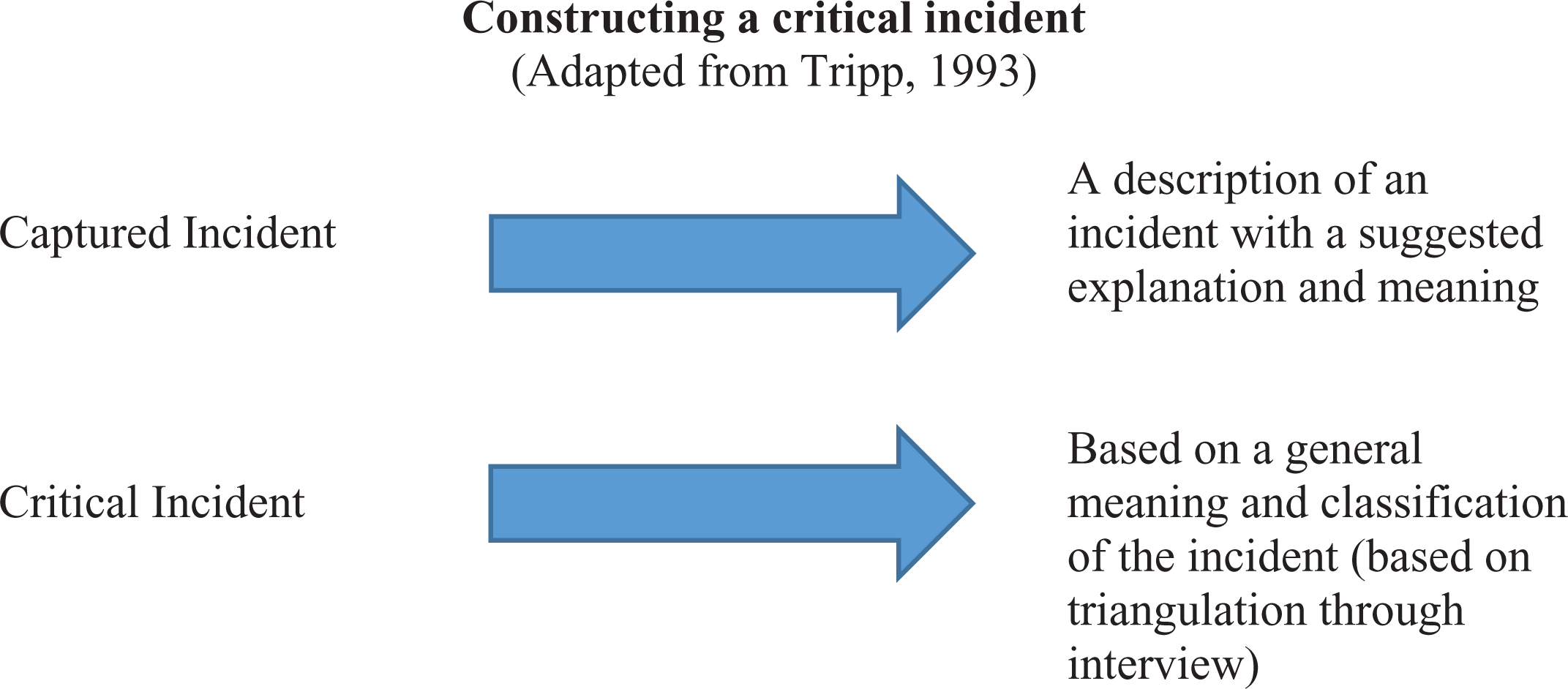
Constructing a critical incident (adapted from Tripp, 1993).
Our premise in adding captured incidents to our methods was that observations alone were not sufficient to understand the thinking behind teacher actions nor the intended consequences. Tripp (1993) suggested that teacher judgements are made on an ethical basis; they come from a set of values that serve to make sense of the context in which the practice happens. A deeper understanding of the teachers’ thinking could not be gained through observations alone; instead, we recognised the value of exploring observations through subsequent stimulated-recall interviews.
Interviews
The stimulated-recall interviews were semi-structured interviews guided by principles of CIT and cross-cultural interviewing (Patton, 2002). The interviews were led by research members from the host country with supplementary, follow up questions from non-native researchers. In New Zealand, all interviews were in English while interviews in Norway were completed in Norwegian. Follow up questions were translated by the host researcher when received, although in most instances the teacher-participants answered questions without translation. Despite the suggestion that interviews would be conducted in their first language, many of the teacher-participants in Sweden consented to be interviewed in English and used Swedish only when they wished to ensure clarity in their answers, or they were not confident of doing so in English. In all cases, the teacher-participants willingly answered questions presented in English as their understanding of verbal English exceeded their ability to answer all questions. Throughout the study, we remained cognisant of Rubinstein-Ávila’s (2013) suggestion that researchers conducting studies in international settings ought to be actively present and always critical of the limitation of one’s hermeneutic horizons (Gadamer, 2004).
The list of captured incidents was generated directly after observations when the observers met and discussed what had been observed and recorded. The discussion led to a shared understanding of what the focus of the subsequent stimulated-recall interviews should be. The list included captured incidents common between observers and the captured incidents of individual researchers. Interviews lasting 40–70 minutes were conducted at the schools where the observations took place immediately after, or almost immediately after, the observed lessons. All interviews were recorded and transcribed. To understand the basis of the captured incidents, the EDUHEALTH researchers interviewed the participant-teachers using a combination of open questions designed to enable the teacher to suggest incidents for social justice and specific questions designed to afford the teacher an opportunity to explicate the thinking behind the practice (Figure 3).
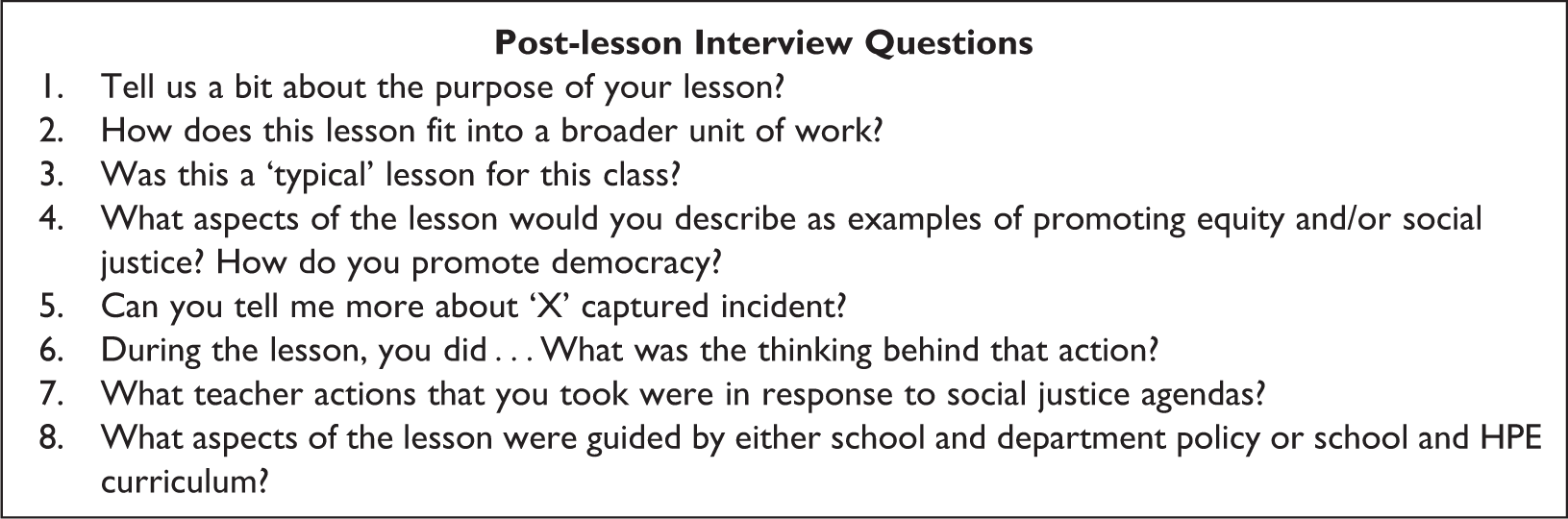
Interview guide.
Following Edvardsson’s (1992) suggestion that initial questions should focus on asking the participant to offer examples in their own words, the teachers were asked to reflect on their own espoused social justice pedagogies. The observers then discussed the captured incidents, seeking clarification about the purpose of the teachers’ actions. The stimulated-recall interviews probed captured incidents and created a nuanced and shared understanding of the teachers’ practices, through the combined perspectives of the teacher and native and non-native researchers that resulted in a co-constructed critical incident relating to social justice pedagogies in HPE. These interviews identified additional data and ‘fleshed out’ some of the recording of observation data. In many cases, observation data was completed during the interview. As an example, one researcher recorded: …the teacher’s relationship with the students was seen to be important. In this case the teacher expressed it as being a caring mother figure as much as a teacher who was giving sound, experienced and knowledgeable guidance to her students…She constantly questioned the students and waited for them to share their views about what was acceptable and what was not before supporting or otherwise what had been said in the interest of developing shared socially acceptable practices.
An example of how a captured incident was constructed as a critical incident following an interview can be seen in relation to the observation of a new immigrant student in a school who was ‘sitting out’ (not participating) during part of a swimming session (see Figure 1) and then swimming at a later time during the lesson with another student while the rest of the class was diving in the attached diving pool. The teacher stated: …she talked to me about swimming like she didn’t want to swim with boys…So she came and she did it and I’m really proud of her…[then] she said can I go and do this [swim while other students were diving] and of course, but then I wanted to have a look and then I saw the other student come [and swim with her] and then I felt a bit more safe for me too.
Data analysis
Many researchers who use CIT consider data analysis to be the most important and difficult step in the CIT process as several hundred critical incidents can be difficult to work with and classify, and there is generally no one right way to describe the activity, experience or construct (Butterfield et al., 2005). Given that the purpose of the study was to document and provide rich details of the social justice pedagogies used in different contexts and countries, a six-phase thematic analysis approach that consisted of familiarisation with data, initial and advanced coding, identifying and naming themes and reporting findings (Braun and Clarke, 2006, 2013) was employed to seek out themes that were important to the research questions. As pointed out by Hastie and Glotova (2012), these themes did not ‘magically appear or emerge’ (p.313); rather, they were produced within the paradigm of critical qualitative research for social justice (Denzin, 2010) and aforementioned principles of teaching for equity and social justice.
Observation data for each teacher-participant from each individual researcher were collated by one member of the research team and placed in a single Word file. Interviews were recorded and transcribed by a university-approved transcriber. Nine of the interviews that were conducted in English were analysed by all individual researchers. The four interviews conducted in Swedish (1) and Norwegian (3) were transcribed and analysed by everyone on the Swedish and Norwegian research teams. The Scandinavian researchers then collaboratively helped translate the Swedish and Norwegian transcripts into English to enable the two monolingual New Zealand researchers to code the interviews.
Data was at first analysed separately in each of the three individual cultural contexts (New Zealand, Norway, and Sweden). The first two phases of analysis involved familiarisation with the data and individual open coding (Braun and Clarke, 2013) of the observation notes and transcripts by all members of the research team. Once individual researchers had read and thought about data, through a process of sifting and sorting (Lichtman, 2006), initial themes were identified and named. Researcher pairs from each country then met to compare, cross-check and reduce initial codes and themes into common/shared codes and themes.
The third level of analysis was a group analysis by all members of the research team. Initial themes from each country were shared electronically and discussed as a group through an online video conference meeting. Initial themes included ‘Teacher-student relations’, ‘Didactic-pedagogical adaptation’, ‘Disposition for social justice’, ‘Taking critical action for social justice’ and ‘Explicitly planning to teach for inclusion and social justice’. All of the themes were then mapped against each other by one of the lead researchers, reframed based on the research questions as three themes and distributed to all members of the research team. A final group analysis at a second online video conference meeting was used to ensure that the themes captured perspectives from our diverse culturally located lenses. These three themes were (a) ‘Relationships’, (b) ‘Teaching for social cohesion’ and (c) ‘Explicitly teaching about and acting on social inequities’.
Reflexively, we are conscious that interpretation of data includes tension, struggle and crisis and, in the context of the EDUHEALTH project, this means that one is struggling with and against each other about meanings (Barnacle, 2005). The value of the analytical and interpretive collaborative work lies in the fact that consistency is not only sought between interview data and an interpreter, but also between the data and multiple interpreters. The strength of the three levels of analysis lies in the preservation of individual and culturally located lenses, which provided important insights and perspectives from the outside that helped us to see our own context/culture in a different light. However, we also acknowledge that a truly ‘shared’ understanding may never be possible as the social justice pedagogies we identify as themes occur in culturally located contexts and that we as researchers interpret our world through our own socio-cultural lenses (Uljens, 2015).
A self-reflexive look at Education for Equitable Health Outcomes – The Promise of School Health and Physical Education
The previous sections of the paper have illustrated the theoretical and methodological framework for the study, providing descriptions of the methods used to collect and analyse data. We argue that our use of CIT methodology has enabled us to cut through the ‘noise’ of a complex HPE teaching environment and focus on producing descriptions of how HPE teachers address social justice in their teaching. Through a research design based on the principles of CIT, we ‘captured’ incidents of HPE teaching practice that appeared consistent with teaching for social justice. We were able to check on this assumption through interviews with the participants. The interviews enabled the participant-teachers to articulate the intent and the meaning of their practice (Punch, 2014). The combination of collecting data through observations, artefacts and interviews was critical to the insights into, and examples of, social justice pedagogies in HPE derived from this research project.
Notwithstanding the strength of the data collection methods to observe social justice pedagogies and heeding Tracy’s (2010) suggestion that excellent qualitative research can only be achieved through ‘self-reflexivity, vulnerability, honest and transparency…’ (p.841), we now turn the critical lens inwardly and highlight some of the challenges for ourselves and other researchers calling on CIT methodology for international collaborations, and specifically for researchers exploring how teachers teach for social justice in HPE.
An initial challenge to the study was our own life histories and previous roles as observing teacher educators. As we discovered through the pilot observation process, in many ways we had to recalibrate our observation lenses from our typical roles in preservice teaching doing assessment of practicum in PETE programmes where we focus more broadly on quality teaching, to our role in this project with a much narrower focus on social justice pedagogies. The skill of narrowing down the scope of the observation away from all critical incidents in teaching that cater to all interests to a singular focus on teacher actions that address social justice issues was acquired through the pilot process. The pilot observations thus served to develop a level of skill and expertise on the part of the researcher (Cope et al., 2015) as ‘critical incident observers’ of social justice pedagogies in HPE.
A second challenge for the EDUHEALTH project and for any international collaboration is the recognition of, and mutual respect for, the theoretical and culturally located frames of reference through which researchers analyse data. Our initial enthusiasm for the collaborative research project was followed by a recognition that we could not identify a single theory of social justice that could serve as a framework for the collection and representation of data. As we now move into the next phase of the project and represent the findings, we are further recognising the value of having an openness to the ‘big tent’ (Lather, 1998) of teacher actions that address social justice. In addition, our initial forays into cross-cultural understandings have highlighted the different social justice issues in HPE and the enabling and constraining policies and practices of our different societies and the differences of ‘outsider’ perspectives (Gerdin et al., 2019). Rather than positioning the culturally located frames of reference as problematic, we have embraced the outsider perspectives as being integral to the success of the project as they disrupted the taken-for-granted perspectives of the insiders. Through the eyes of the ‘outsiders’, we offered new perspectives on how HPE in the country of the ‘insider’ may have been shaped by cultural values that are embedded in and shape individual societies. For example, through the eyes of the ‘outsider’, we were challenged to re-examine aspects of indigenous culture and language that were infused in the practices of some teachers in New Zealand, while the social-democratic principles of Sweden and Norway were evident in inclusive policies such as school lunches (Sweden) and the provision of modified equipment to include students with different levels of ability and disability. These critical incidents were generative of reflection and reframing of our own conceptions of social justice that had previously been restricted to our own societal contexts.
A third challenge encountered in a study where both participants and researchers came with three different first languages occurred during stimulated-recall interviews. In each context, the home-country-based researchers led the interviews and offered interviews in the teacher’s first language. All of the teacher-participants in New Zealand and three of the teachers in Sweden were interviewed in English. All three of the Norwegian participants were interviewed in Norwegian. The implication is that the interview responses in languages other than English had to be translated for the English-only speaking researchers so that they were also able to code and analyse this part of the data. We recognise both the primacy of language afforded by one’s first language and also the epistemological and ontological questions of how language reflects knowledge and understanding that might not be as accessible in a second language or lost in the translation (Gadamer, 2004; Rubinstein-Ávila, 2013). Reflexively, we are still ‘weighing up’ the advantages of minimising the volume of transcript translation for our English-only researchers by conducting some interviews in Sweden in English against the limitations of responding in a second language.
An additional consideration for the EDUHEALTH project was the ability of monolingual New Zealand researchers to understand teaching practices delivered in Swedish and Norwegian languages. Somewhat surprisingly, the impact of the lack of access to language was minimised through both our inherent ‘feel’ for, and understanding of, social justice issues and social justice approaches (see Figure 1) and through post observation clarification questions (e.g. What did your instruction on the board say? How did you select your groups?) that in most (but not all) cases confirmed our initial interpretation. Nonetheless, we accept that a lack of direct access to language may have impacted on our understanding of teaching practices across the three different contexts.
Our experiences using CIT in a collaborative international project have reinforced a number of key learnings. As a point of departure, the use of CIT to make sense of teacher practices in this project was enabled by our own initial understanding of, and commitment to, social justice. Reflexively, we recognise that the combination of initial knowledge sharing opportunities in each context and pilot observations has been crucial in helping us to scrutinise our own researcher and teacher biographies. Secondly, one of the strengths of the project has been the insights provided by ‘outsiders’ in each context as they ask new questions of taken-for-granted practices. The collaboration has also reminded us of the primacy of language and the importance of being open to using both native and non-native language when collecting and analysing the data. Finally, the time spent in HPE classrooms using CIT methodology informs our practice as HPE teacher educators and enables us to give examples of and discuss social justice pedagogies as enacted in school HPE practice and not just advocate for it in theory.
Conclusion
We want to conclude by asserting that our use of CIT methodology in the EDUHEALTH project was a political quest to reaffirm the social justice agenda in HPE practice through providing teachers with examples of social justice pedagogies, and not a search for either the ‘holy grail’ of social justice pedagogies nor an attempt to espouse a one-size-fits-all social justice model for HPE. Yet we recognise that increasingly HPE teachers are working in conditions that are hardly conducive to inspiring social transformation (Ovens and Lynch, 2019), making examples of good practice all the more important. This research, which explored how HPE teachers enact social justice pedagogies, has served to reinforce our understanding of the importance of context. Social justice teaching strategies are enabled and constrained by the contexts in which they are practiced, yet we have also observed similarities in approaches to social justice pedagogies across all three contexts, including ‘pedagogies of care’ (Mordal Moen et al., 2019) and ‘teaching for social cohesion’ (Smith et al., 2020).
The CIT methodology used in the EDUHEALTH project enabled us to provide insight into both the practices that privilege social justice in HPE contexts and rich descriptions of the contexts in each country that enable these practices. As such, this paper serves as an argument for a research methodology that has enabled members of an international research team to begin the process of building on the seminal advocacy work of Fernandez-Balboa (1995), Kirk (1986) and Tinning (1985) by providing examples of the enactment of social justice pedagogies in school HPE.
Footnotes
Declaration of conflicting interests
The author(s) declared no potential conflicts of interest with respect to the research, authorship and/or publication of this article.
Funding
The author(s) disclosed receipt of the following financial support for the research, authorship, and/or publication of this article: This project has received funding from the European Union’s Horizon 2020 research and innovation program under grant agreement No 734928.
