



Abstract
This paper draws on critical discourse analysis to examine how health and physical education (HPE) curricula from Sweden, Norway, South Africa, Australia, and New Zealand may influence possibilities for the enactment of social justice in schools. The findings highlight the presence of social justice intentions across the five curricula as related to embodied movement experiences, social cohesion, and activism. That said, the findings simultaneously suggest that the language used to orient teaching towards social justice objectives is often elusive. In this paper, we contend that despite the presence of social justice intentions in these five HPE curricula, the articulation and function of the language within the curriculum documents do not necessarily support the enactment of this in practice. To conclude, we therefore suggest that more work is needed to ensure that curricula and other supporting artefacts and resources can better support both teachers’ practice and students’ learning in raising awareness of, and addressing, social justice outcomes in HPE.
Introduction
This paper examines how health and physical education (HPE) curricula from Sweden, Norway, South Africa, Australia, and New Zealand may influence possibilities for the enactment of social justice agendas in schools. The point of departure for this paper is the EDUHEALTH project, which drew on a concept of teaching for social justice as practices that challenge the status quo and power relations that perpetuate inequities (Wright, 2004). The EDUHEALTH project highlighted how contextual factors, including regulative and normative structures (e.g. laws, Educational Acts, and school curriculum documents), as well as cultural-cognitive conditions (e.g. HPE culture and teacher beliefs), impacted understandings of pedagogies for social justice (Linnér et al., 2022). For instance, what is regarded as important content for the teaching of social justice, and for whom social justice is sought varies from one context to another (Gerdin et al., 2019; Schenker et al., 2019). Indeed, increasing attention is being paid to social justice in HPE curricula internationally with some curricula having positioned HPE as a context to foster both active and critical engagement with movement and physical activity (e.g. ACARA, 2015; Ministry of Education, 2007; UDIR, 2020). In this paper, we therefore wanted to build on our previous work by analysing HPE curricula from our respective contexts to explore both the similarities and differences when it comes to the language used to frame the role and purpose of HPE and how such language can be understood from a social justice perspective.
Despite a sociocultural shift (Cliff, 2012) in curricula towards practices that support social justice, relatively little is known about the commonalities or discontinuities about the language selected and used across different contexts that serve to promote social justice in practice. The importance of this study lies in reports from previous research on HPE practice that have repeatedly highlighted that the realization of the intentions of official curriculum texts is far from assured (Gray et al., 2022; Lambert and Penney, 2020; Ruin and Stibbe, 2021). With this as a backdrop, the specific aim of this study was to interrogate how the linguistic and discursive representations of HPE curriculum documents may enable and/or constrain social justice agendas in HPE practice. In this paper, we have drawn on a critical discourse analysis (CDA) (Fairclough, 2001) of HPE curricula in Sweden, Norway, South Africa, Australia, and New Zealand to explore the language and discourses inherent in the curricula across these different contexts and what implications these representations have for social justice in HPE.
Critical discourse analyses of HPE curricula
HPE curricula are designed to guide what is taught and learned in the name of HPE (Linnér et al., 2022). HPE curricula can also be viewed as texts embodying discourses that articulate ideas, beliefs, values, and practices. Through discourses we assign meaning to the world, shaping and influencing it, thus constituting our reality (Hall, 1992). According to Fairclough (2001), discourses are made up of three interrelated parts: textual dimensions that include the linguistic features and structures within a document, the discursive dimension that positions a text within broader discourses, and the social dimension which examines how power relations, historical factors, and social factors influence and are influenced by discourse.
Gee et al. (1992) therefore articulate discourse analysis as any study that ‘may be concerned with any part of the human experience touched on or constituted by discourse’ (p. 228). The ‘critical’ in CDA highlights an interest in demystifying ideologies and power (Wodak and Meyer, 2009), and an aim of addressing injustice and inequality (Fairclough, 2009). CDA explores the relationships between texts and discursive events located in wider social and cultural structures, and analyses how discourse systematically constructs the social world, often producing and reproducing unequal power relations (Fairclough, 1995). Luke (2002) proposed that CDA must simultaneously focus on a microanalysis of texts and a macroanalysis of the social formations in which the texts themselves are implicated.
CDA has been used in previous research to draw attention to how multiple and competing discourses, subject to negotiation and (re)construction, circulate in HPE (Olofsson, 2005; Philpot, 2019; Rossi et al., 2009). Some scholars have focused on examining the discourses at play in various HPE textbooks (Hsu and Chepyator-Thomson, 2010; Lundin and Schenker, 2022; McDonald, 2013), whereas other research analyses official HPE curriculum documents (Alfrey et al., 2023; Ekberg, 2021; Gray et al., 2022; lisahunter, 2004; McEvilly et al., 2014; Rossi et al., 2009; Selkirk et al., 2021). Ekberg's (2021) utilization of Bernstein's (2000) concepts of classification and framing to analyse the Swedish HPE curriculum is particularly relevant to this study. According to Bernstein (2000), the principle of classification describes the relations between different kinds of categories, for instance, school subjects or parts of one specific school subject. Classification therefore relates to distribution of power and to hierarchies since it isolates and limits different categories (Bernstein, 2000). In short, classification corresponds to the didactic question of what is supposed to constitute the ‘content’ in an educational context, such as HPE practice. Framing relates to the processes of transferring and acquiring, which are natural parts of every educational context. Framing includes principles of control and communication, and, additionally, principles of social relations. Consequently, it relates to the question of how the content that is to be communicated can be expressed and communicated in the educational context (Bernstein, 2000). Regarding a school subject such as HPE, which has a wide content area and consists of two parts (health education and physical education) that are often separate curriculum areas, the classification as well as the framing is presumably weak, which means that the content is constantly negotiated by teachers. Drawing on classification and framing, Ekberg (2021) argued that due to its weak classification and framing, Swedish HPE continues to be informed by a wide range of different knowledge domains.
Rossi et al.'s (2009: 75) study is also particularly relevant to this paper since they used CDA to examine the Australian state of Queensland's HPE curriculum ‘to explore the relationships between the emancipatory/social justice expectations /…/ and the language details of learning outcomes that indicate how the expectations might be satisfied’. Through analysing the verbs and individual word choices of documents, Rossi et al. (2009) found that most verbs that describe what students will do (and therefore the circumstances that teachers must create for this to happen) are devoid of any critical action aimed at social change or social betterment. Instead, students are required to spend much of their time describing, explaining, and demonstrating, seemingly little time performing, and almost no time engaged in activities that might be considered to be resisting, challenging, or taking action. Rossi et al. (2009: 87) conclude that ‘One wonders then if the syllabus can genuinely encourage an emancipatory agenda. Such an outcome is perhaps only possible through the practices of teachers who already hold such agendas and work beyond the rhetoric of the outcomes’.
More recently, Selkirk et al. (2021) performed a CDA of the Canadian secondary HPE curriculum in the province of Ontario to explore how language is interwoven within ideologies of PE to represent inclusivity. In this study, the authors identified three key discourses: ‘equity and inclusion’, ‘opportunity’, and ‘positive outcomes’. Based on these findings, they optimistically argue that inclusivity can be enabled ‘through overt language and intention and, as such, holds the possibility for actionable change by emphasizing expectations that offer choice and opportunities beyond traditional notions of normative PE’ (Selkirk et al., 2021: 8). However, they conclude with a call to examine ‘discourse in action’ and to interrogate how these discourses of inclusivity are enacted in everyday HPE practice across different contexts.
Gray et al. (2022) further examined how curriculum discourses act to shape how PE is conceptualized across the four UK countries of England, Northern Ireland, Scotland, and Wales. They found that performance discourses relevant to developing motor competencies for sports continue to dominate as a ‘truth’ in defining the main purpose of PE (as it is known in the UK). They conclude that ‘there is a need for teachers to critically engage with both curriculum and pedagogy to consider what and who is valued in PE, and how this aligns (or not) with contemporary physical cultures’ (Gray et al., 2022: 588). Collectively, these studies highlight that in relation to social justice, HPE curricula are an important regulatory structure that, despite good intentions, needs to be valued by HPE teachers in order for the discourse to emerge as both words and actions (Gee, 1999).
This study is part of a larger international research collaboration which involves HPE teachers and researchers from five countries examining the curriculum and practices from a social justice perspective, and working together in further identifying and supporting socially just teaching practices. An important aspect of this research agenda involves critically scrutinizing the language of the HPE curriculum documents to explore how these may enable or constrain social justice in practice. In the next section, we will briefly introduce the five different study contexts and discuss how the HPE curriculum documents were analysed before presenting our findings.
Methodology
Study contexts
The contexts of Sweden, Norway, South Africa, Australia, and New Zealand share the fact that their most recent curricula that focus on PE and health have shifted from a predominant focus on skill and biological and physical health to pay greater attention to identity and the social and cultural influences on movement, physical activity, health, and well-being (Cliff, 2012; Gerdin and Schenker, 2021; Østerlie and Kristensen, 2023) that is reflected through name changes such as ‘Life Orientation’ (LO) in South Africa (Prinsloo, 2007), ‘Physical Education and Health’ in Sweden (SNAE, 2011), and ‘Health and Physical Education’ in New Zealand (Ministry of Education, 2007) and Australia (ACARA, 2015). Although this sociocultural turn (Cliff, 2012) is present in all five of the countries in this study, the broader sociohistorical contexts that have contributed to these changes differ in many ways.
Sweden and Norway are two countries that have been considered world leaders in preventative healthcare practices, policies, social welfare systems, and equality of opportunity in education (Gawell, 2015), but recent fundamental changes to these societies present new challenges. Indeed, how to promote health equity by ensuring positive health outcomes for all of their increasingly diverse populations, due in part to a rising number of immigrants in recent decades, is one of the most profound social justice challenges currently facing Sweden (Public Health Agency of Sweden, 2021). In the Swedish and Norwegian contexts, broader values synonymous with Nordic social democracies (Gawell, 2015) position schooling as a key pillar in promoting a sense of justice, generosity, tolerance, and responsibility. For example, the Swedish Education Act (2010) states that no one should be subjected to discrimination, and concern for the well-being and development of individuals should permeate all school activities. In Norway, the Educational Act (Norwegian Education Act, 1998) states that education has to provide insight into cultural diversity, as well as promote democracy and equity. In line with these aims, the new Norwegian HPE curriculum (UDIR, 2020) has moved further away from traditional exercise and physical health towards a broader understanding of movement and health. As part of the new HPE curriculum, students are expected to explore their own identity and movement capabilities to a greater extent, and critically reflect on how this links with different perspectives on movement, body, exercise, and health. Similarly, the Swedish national HPE curriculum calls for a wider and more inclusive concept of movement than merely being associated with traditional, organized competitive sports (Svennberg, 2017).
South Africa is internationally renowned for transforming from a segregated society during the Apartheid regime to a society that acknowledges the rights of all people and celebrates its diversity in terms of race, culture, religion, and language. In recent times, however, there have been renewed fears of widening social inequalities and polarization along class and racial lines (Southall, 2019). In South Africa, what we would term HPE is subsumed within a broader subject called LO. This subject involves: The study of the self in relation to others and to society and addresses skills, knowledge, and values about the self, the environment, responsible citizenship, a healthy and productive life, social engagement, recreation and physical activity, careers and career choices. (Department of Basic Education, 2011: 8)
Australia and New Zealand are two countries that are both trying to redress the ongoing effects of colonization, with their Indigenous populations, such as in many other parts of the world, still being overrepresented in most negative economic, educational, social, and health indices (Anderson et al., 2016). In Australia and New Zealand, a focus in part on addressing the impacts of colonization is present and explicit in HPE curricula. Teachers in Australia are required to evidence competency against a rigorous set of national standards, some of which mandate teachers to have a comprehensive working knowledge of Aboriginal and Torres Strait Islander histories, cultures, and languages as well as strategies to promote respect and reconciliation through practices (ACARA, 2015). In addition to a similar requirement for all teachers to demonstrate a commitment to the principles of Te Tiriti o Waitangi, 1 the New Zealand HPE curriculum aims to embrace the concept of ‘hauora’, a Māori 2 understanding of total well-being as a key underlying concept in the HPE curriculum (Meier and Culpan, 2020).
Data analysis
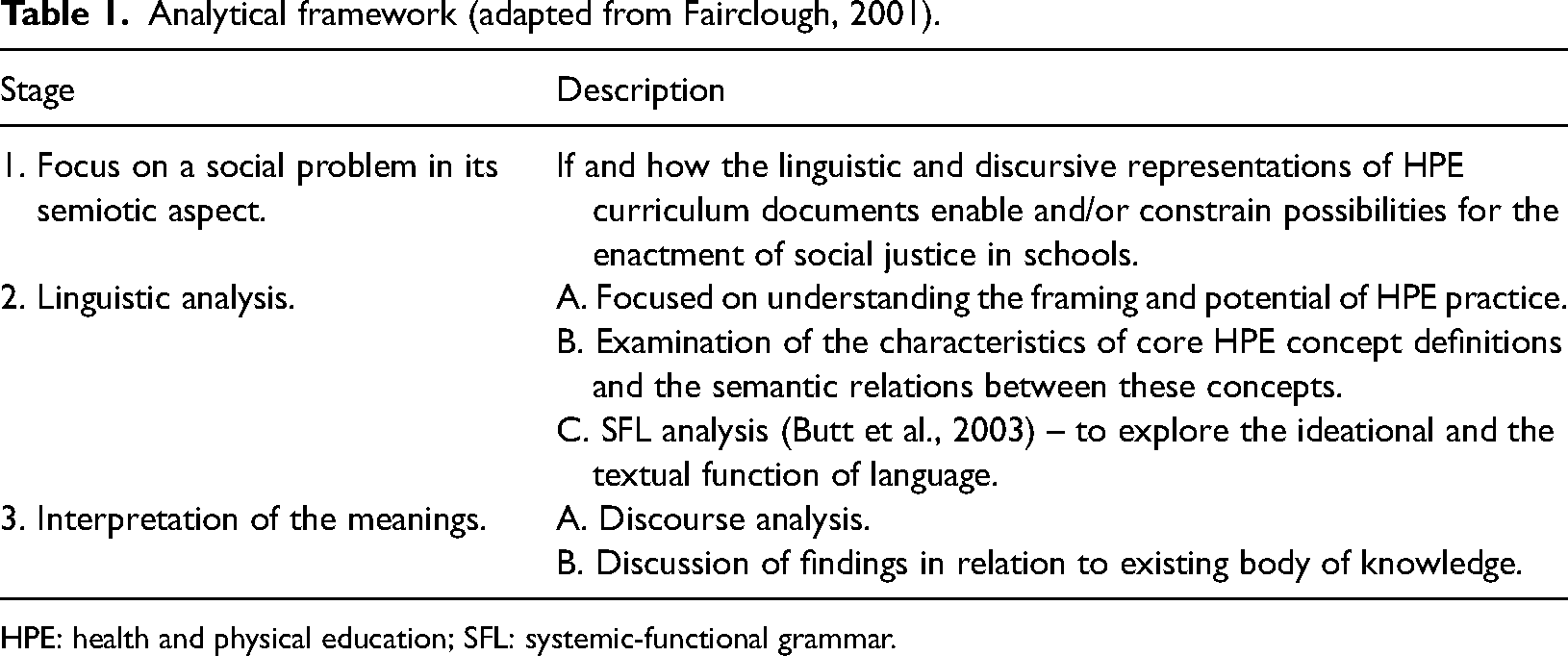
As CDA is more of an approach to analysis than a succinct method, it is important to justify and describe the methodological framework used in this paper. In what follows, we present a modification of Fairclough's (2001) three-step analytical framework that was developed and used by Rossi et al. (2009) to examine HPE curriculum documents (see Table 1).
Analytical framework (adapted from Fairclough, 2001).
HPE: health and physical education; SFL: systemic-functional grammar.
Fairclough (2001) proposed an iterative process of CDA that involves three interconnected steps. The first step involves identifying and describing the social problem to be investigated. In this study, the social problem or concern we are interrogating is if, and how, the discursive and linguistic representations of HPE curriculum documents may enable and/or constrain possibilities for the enactment of social justice in schools. The analysis of the official HPE curricula included documents from Sweden (SNAE, 2011: Kursplan för idrott och hälsa, years 9–12), Norway (UDIR, 2020: Læreplan i kroppsøving, Levels 10 and Vg1, Vg2, and Vg3), South Africa (Department of Basic Education, 2011: National Curriculum Statement (NCS), Curriculum and Assessment Policy Statement (CAPS), Levels 10–12), Australia (ACARA, 2015: The Victorian Curriculum and Assessment Authority, Levels 8 and 9), and New Zealand (Ministry of Education, 2007: The New Zealand Curriculum for English-medium teaching and learning in years 1–13, Levels 5–8). Although the levels differ between the countries, they all equate to students aged 14–16. More specifically, the curriculum analysis focused on the sections containing the introduction, aim, scope, and key content/learning areas, which have corresponding sections in the five curricula for all school subjects and for all stages. Other sections of the curricula, such as the ones describing learning objectives and criteria for assessment, were not included in the analysis since there are few similarities between the five curricula in this regard, therefore bringing into question the feasibility and utility of such a comparison. Although we recognize from the outset the limitation of this partial analysis, we argue that the sections included in our analysis still provide a helpful starting point for discussing the espoused intentions of the curriculum documents.
The second stage in Fairclough's framework is an analysis of text. We focused on understanding the framing and potential of HPE practice by examining the characteristics of core HPE concept definitions and the semantic relations between these concepts (Saeed, 2016). The semantic analysis aims at categorizing the concepts as, for instance, vague, specific, concrete, palpable, etc. The semantic analysis of concepts (words as well as groups of words) was completed through a systemic-functional analysis (Butt et al., 2003; Halliday and Matthiessen, 2014), which contributes to an understanding of how the content of the curricula is organized and formulated.
In a semantic analysis, the lexicon of a specific subject matter or technical area is studied. The focus of semantic analyses is on meaning, and the analytical tools used in this study were drawn from lexical semantics. The purpose of this stage was to illustrate how the meanings of different words are interrelated, where the terms ‘concept’ and ‘reference’ are crucial: for instance, the concepts point out different references in the real world, and the scope of these references affect the vagueness and specificity of the concepts. A concept is defined as a complex mental representation, whereas the reference of a word is the collective concept in which every referent of the word is included (Saeed, 2016; Zimmermann and Sternefeld, 2013), such as a simple word (swimming), a compound (breaststroke), or a phrase (active warming-up).
The systemic-functional analysis (Butt et al., 2003; Halliday and Matthiessen, 2014) involved an analysis of the curricular documents by using linguistic tools from systemic-functional grammar (SFL) (Butt et al., 2003). The specific aim of the SFL analysis of the curricula was to investigate which fields of knowledge and which activities appear in the curricula of HPE, and how these are presented linguistically (Halliday and Matthiessen, 2014). These are referred to as the ‘ideational’ function and the ‘textual’ function of the language, respectively. The analysis of the ideational function focuses on participants (e.g. the people, etc., who are connected to the processes), and processes (e.g. different types of verbs). An ideational analysis examines when and where processes have requirements on the participants and how the combination of processes and participants affects the content or focus of a text or sentence. There are four types of processes (Halliday and Matthiessen, 2014): material (to DO), relational (to BE), mental (to THINK), and verbal (to SAY). Material processes (e.g. run, paint, and hammer) belong to the physical world and normally require some kind of energy from the participants involved. The relational processes (e.g. be and become), on the other hand, denote abstract relations and describe how things are constituted. Compared to the material processes, the relational processes do not require any energy, and there is no apparent change once the relational process has taken place.
The participant ‘initiating’ the process is the first participant, namely the one who paints, says, or thinks something, whereas the participant who is ‘exposed’ to the process is the second participant (e.g. the things painted, said, or thought). Most text types are dominated by a certain type of process, although all types can appear in the same text; for instance, a literary text contains material processes to drive the story forward and mental processes to let the reader follow the mind and thoughts of a character (Halliday and Matthiessen, 2014). The analysis of the textual function is performed with a specific interest in how the hierarchies and complexity of clauses affect the content and function of the text.
The processes and participants are organized in free, bounded, and embedded clauses. As the label indicates, free clauses can appear on their own, and the content of free clauses is open for response (from a receiver) (Halliday and Matthiessen, 2014). The example ‘The students left the room’ is a free clause: either the students left the room, or they did not. Bounded clauses, such as the underlined parts of the examples ‘The students left the room
The third and final step of the CDA involves interpretation of the meanings and implications of these texts. Our identification of discourses was informed by previous research on the enactment of critical and social justice pedagogies in HPE. It should be noted, however, that for the purposes of this study, which sought to highlight enabling discourses of social justice, we did not focus on reiterating previous critiques of prevailing discourses of individualism, neoliberalism, ableism, etc. (e.g. Gray et al., 2022; Rossi et al., 2009). More specifically, this meant that we first coded and categorized what we saw as significant words or expressions found in the curricula such as ‘physical capacity’, ‘learning in, through and about movement’, ‘build and manage respectful relationships’, ‘develop their interpersonal skills’, and ‘take positive action’. Once this initial coding and categorization had been completed, we named a number of tentative common discourses, for example, physical ability, movement, inclusion, personal and social responsibility, and social change. In this paper, we restrict our findings to common discourses that could to some extent be identified across all five contexts.
At this point, we should also note that members of the research team were involved in different parts of the CDA analysis described above. All research members first identified the focus and aim of the analysis (see Stage 1 in Table 1). A small group within the research team with expertise in linguistic analysis led the second stage of analysis and shared the findings with the broader research team. Informed by the linguistic analysis, a second smaller group completed the third stage of the CDA, with the rest of the group providing feedback on both levels of analyses. The whole team then discussed and revised the key findings and mapped them against the aim of the study and the existing body of knowledge, which led to the representation of the findings presented in this paper.
Our analysis converged around three main themes: (i) enabling embodied movement experiences; (ii) building awareness of inequities, social cohesion, and a sense of shared responsibility towards social justice; and (iii) students as agents of social change. Based on these themes, we then revisited the initial discourses that were identified and by drawing on previous research on critical and social justice pedagogies in HPE, we named three common discourses across the five different contexts: embodied movement, social cohesion, and activism.
Findings
The findings of this study begin with the linguistic analysis of language used in the five curricula. We then report on the three central discourses related to a social justice agenda identified across the five HPE curricula.
Linguistic analysis
Firstly, the textual part of the SFL analysis shows that the curricula contain few bounded clauses, that is, information regarding place, time, manner, or cause, which contributes to more specific meaning. The lack of bounded clauses results in a lack of clarity regarding why certain elements should be included or how and under what circumstances teaching practices should be carried out. For example, the documents do not contain information or explanations regarding why the different teaching content is to be included, nor any directives regarding how the teaching is supposed to be performed in the classroom. This opens up the potential for different interpretations regarding the content and focus of the subject. On the one hand, this lack of prescription could be viewed as an opportunity for teachers to construct practices that suit their particular context and students. On the other hand, the lack of specificity negates any requirement to fulfil the intentions of the curricula.
Secondly, the analysis of the textual function shows that there are many infinitive phrases where content is written without mentioning any actors (e.g. the students): embedded clauses and phrases are, as the label suggests, embedded in another clause and are even more bounded than bounded clauses. An example of this (not taken from the curricula analysed here) would be ‘…give the student
The most common processes in the curricula (descending scale).
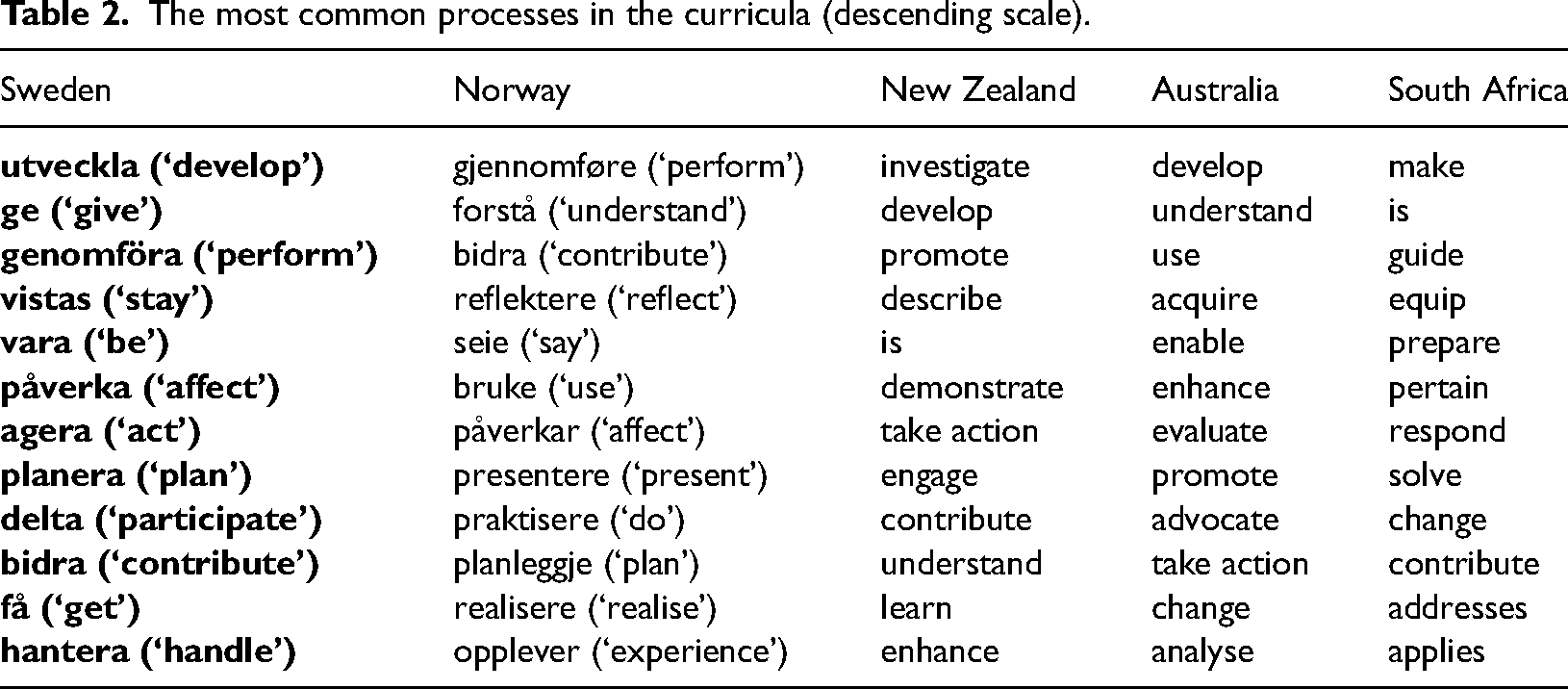
Material processes that focus on the process of doing dominate in the free clauses in the five curricula. These processes should indicate activities and things to be done, but this is not the case, since the material processes are seldom concrete. The most common processes in Sweden are ‘develop’ and ‘give’, in Norway ‘perform’ and ‘understand’, in New Zealand ‘investigate’ and ‘develop’, in Australia ‘develop’ and ‘understand’, and in South Africa ‘make’ and ‘is’. This means that the activities and elements in the classroom are not defined by the processes, but by nouns. Although the majority of processes are vague, the analysis does also show that all curricula to a lesser extent foreground critical thinking through use of verbs such as ‘participate’, ‘investigate’, ‘solve’, and ‘evaluate’. Australia and New Zealand take this a step further and suggest that learners should be ‘taking action’, a concept synonymous with Freire's (1970) democratic pedagogy. Yet the control or the power to initiate action seems to remain with teachers as processes are often expressed in the passive, where the students are to be given something instead of doing something themselves (e.g. the student must develop different skills). These linguistic expressions mean that the responsibility for this doing/learning is transferred to the teacher, which further reinforces the interpretation space for the teacher, for instance, when it comes to which type of skills the students are expected to learn.
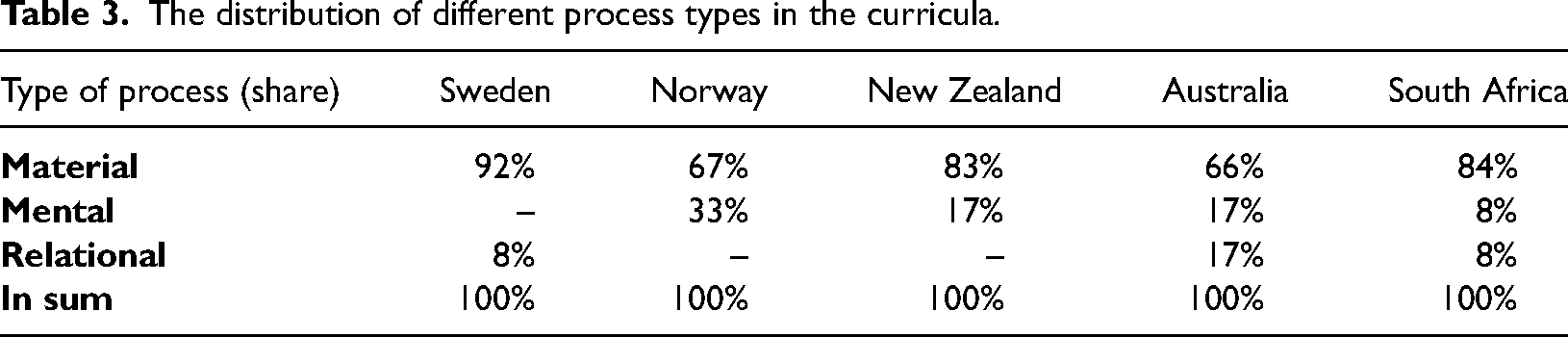
Relating to discourse, there appears to be a discursive battle between HPE as an ‘activity subject’ and a ‘knowledge subject’ (Quennerstedt et al., 2014), where the material processes relate to the activity, and mental and material processes relate to knowledge. As was pointed out earlier, material processes require some (physical) energy and effort of the participant, whereas no such effort is required in mental processes. It is obvious that the material processes dominate in all five documents, which speaks in favour of HPE as an ‘activity subject’. The distribution of different process types is illustrated in Table 3 (rounded to the nearest whole number).
The distribution of different process types in the curricula.
In texts where vague and unspecific processes dominate, the first and second participants – the nouns – of the processes are crucial. Aside from the nouns connected to students, education, and the name of the specific school subject, the potential core concepts are predominantly abstract: Sweden – förmåga (‘skill’), förutsättningar (‘prerequisites’), and kunskaper (‘knowledge’), Norway – føresetnader (‘prerequisites’), New Zealand – skills, learning, and development, Australia – skills, learning, and strategies, and South Africa – development, opportunities, and knowledge (see Table 4). The potential core concepts are presented then as abstract and vague rather than as concrete and specific; for example, they are typical hyperonyms/super-ordinated concepts (Saeed, 2016; Zimmermann and Sternefeld, 2013).
The most frequent nouns in the curricula (descending scale).
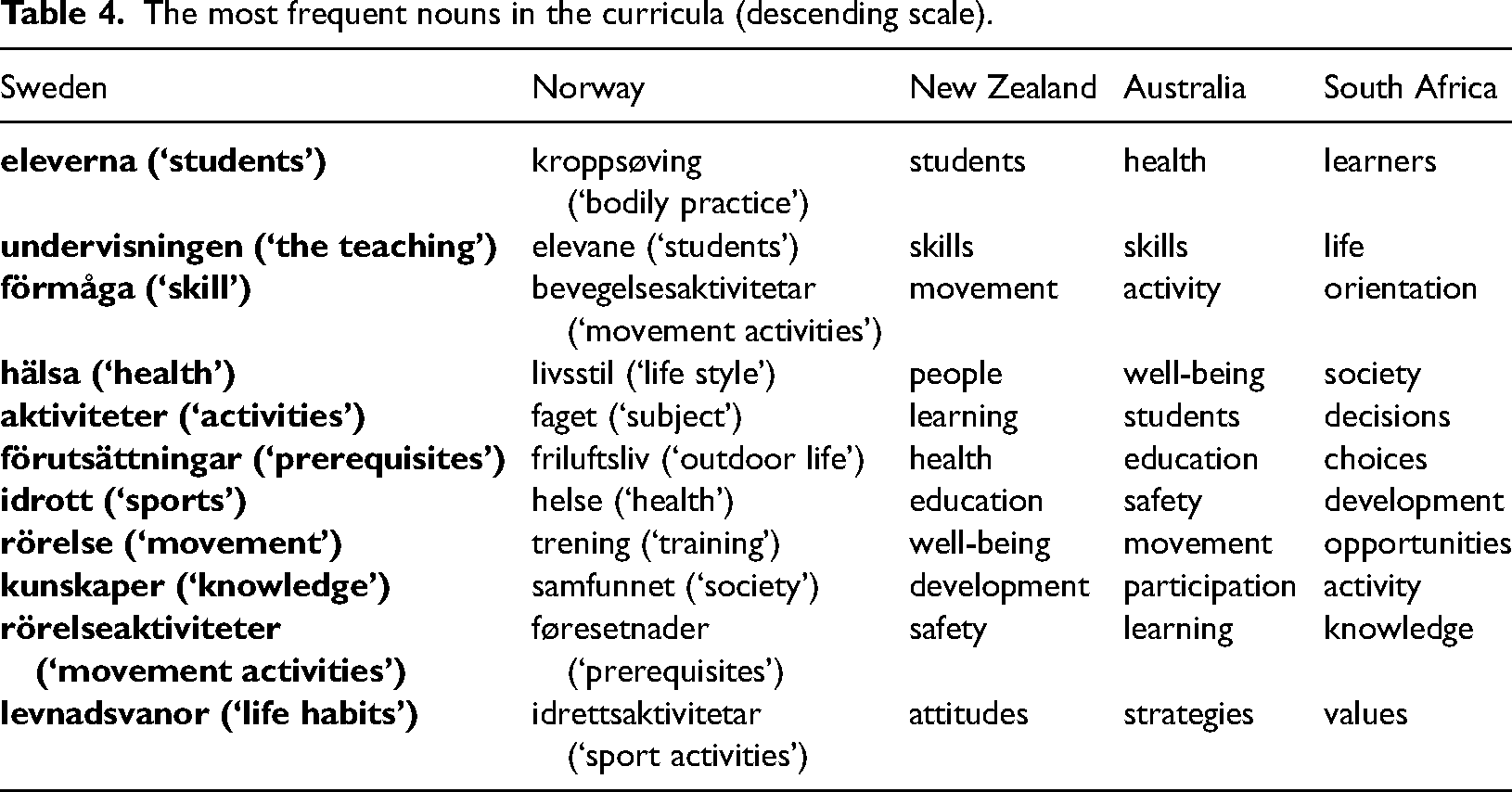
The overall result of the semantic and the SFL analysis illustrates a general vagueness of the nouns/concepts in the curricula. It has also been illustrated that the processes are equally vague; for instance, they do not contain much content of their own but are supported by the nouns surrounding them. As the surrounding nouns are also vague, unspecific, and often abstract, the result is that the terms, as well as the full sentences, become porous and difficult to use or ‘translate’ into consistent practices of enactment (i.e. to something that can constitute the content of an HPE lesson). The semantic analysis of the processes reveals that the most frequent ‘secondary’ participants (förmåga [‘skill’], kunskaper [‘knowledge’], aktiviteter [‘activities’], förutsättningar [‘prerequisites’], and möjlighet [‘opportunity’]) are obvious hyperonyms, which means that they are abstract and not specific. This opens up a wide range of possible interpretations; the linguistic form that is used to mediate the content of HPE in the curricula leaves the HPE teacher free to choose the content of the subject and how this is to be implemented in class.
In sum, the linguistic analysis shows that the articulation and function of the language within the curriculum documents are characterized by an elusiveness that leaves it open to interpretation and therefore has consequences for realizing social justice outcomes in HPE practice. However, in taking heed of Fairclough's (2001) critique of strictly linguistic analysis for concentrating exclusively on textual analysis and for working with a simplistic and superficial understanding of the relationship between text and society, we now turn our attention to the macroanalysis (Luke, 2002) of discourses that shape these five HPE curricula. It should be noted that the discourses outlined and discussed below were constructed by focusing on our interpretation of longer passages of the curricula as opposed to the linguistic analysis detailed above, which focused on analysing individual words/phrases. In addition, while the linguistic analysis involved analysing all words/phrases within the selected parts of the curricula, our discourse analysis specifically explored discourses of social justice.
Discourse analysis
In our analysis of the different HPE curricula, we identified three central discourses related to a social justice agenda. Table 5 provides an overview of these discourses, including examples from the five HPE curricula included in the analysis.
Overview of discourses that articulate with a social justice agenda in health and physical education (HPE).
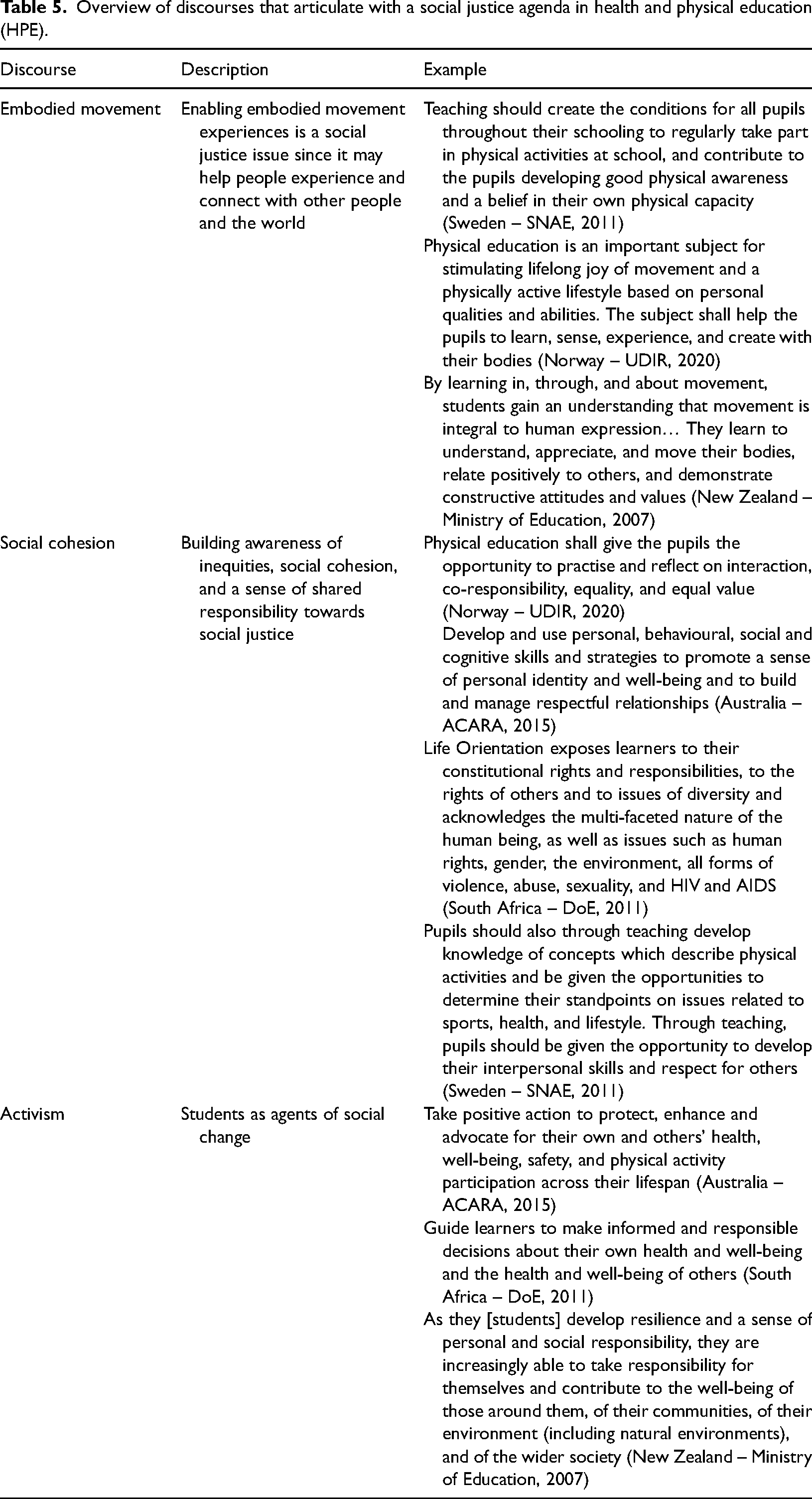
Embodied movement is the first discourse apparent across the five curricula. As a discourse, ‘embodied movement’ positions the teaching of HPE as promoting social justice due to its aim to support students’ development of embodied movement capabilities and knowledge. These excerpts highlight how HPE curricula foreground creating conditions/experiences for students to ‘sense’, ‘reflect’, and be ‘challenged’ in, through and about movement (Arnold, 1979). In Sweden, for instance, emphasis is placed on the students developing ‘good physical awareness and a belief in their own physical capacity’ (SNAE, 2011), while the Norwegian curriculum states that HPE should stimulate students’ ‘lifelong joy of movement and a physically active lifestyle’, but also help them to learn, sense, experience, and create with their bodies (UDIR 2020). Similarly, in New Zealand, there is a focus on learning and ‘accepting challenges in health related and movement contexts’ in order for them to be able to ‘reflect on the nature of wellbeing and how to promote it’ (Ministry of Education, 2007: 22). The desired outcome of being physically active moves beyond mastery of specific content or skills to what this participatory competency enables. What is important is the embodied experiences of ‘becoming’ and ‘belonging’ in the world – what is enabled through physical activity and movement and not physical activity/movement per se. Through experiences of movement, students are able to connect with others and the world around them which can lead to increased individual, social and societal health and well-being (Gerdin et al., 2021).
The second discourse of social cohesion relates to students’ roles in building a socially cohesive society. Social cohesion is much deeper than cooperation; teaching for social cohesion requires teachers to have a deep understanding of societal issues and means to engender trust, common identity, solidarity, and shared loyalties (Smith et al., 2021). In Norway, the curriculum states that HPE supports students’ learning about, and reflecting on, ‘interaction, co-responsibility, equality and equal value’ (UDIR, 2020), in Australia, there is a focus on building ‘respectful relationships’ (ACARA, 2015) and the South African curriculum draws attention to ‘the rights of others and to issues of diversity’ (DoE, 2011: 9). In Sweden, there is a specific focus on students developing ‘their interpersonal skills and respect for others’ (SNAE, 2011) in HPE. These statements align with claims from many scholars that HPE can and should enhance interpersonal relations and social cohesion (Benn et al., 2011). The need for social cohesion may be especially relevant in current times characterized by social unrest and greater social inequity (Wachtler et al., 2020).
The third discourse, activism, conveys the meaning of students as active agents of social change. This expresses the idea that HPE should help build students’ awareness of inequities and a sense of shared social responsibility for social inequities that can ultimately contribute to social justice. This third discourse aligns with Freire's (1970) notion of critical consciousness, where HPE enables students to take actions that not only support their own but also others’ well-being. The Australian curriculum, for instance, places emphasis on students’ ability to ‘take positive action to promote not only their own but also others’ health, wellbeing’ (ACARA, 2015). In South Africa and New Zealand, social responsibility for the ‘health and wellbeing of others’ is of particular concern. The New Zealand curriculum extends this focus on well-being to include ‘their environment (including natural environments)’ (Ministry of Education, 2007: 22). These statements demonstrate the intention that student learning should include an understanding of inequity (Rossi et al., 2009), but also that teaching for social justice in HPE requires teachers to both teach about social injustice and take action on social inequities (Philpot et al., 2021). A focus on the students as agents of social change reflects the aim that HPE practices should develop students’ ability to take action on social inequities themselves, both in and beyond HPE (Philpot et al., 2021).
Despite the presence of elusive language, as shown in the linguistic analysis, this section has highlighted that the HPE curricula foreground intentions to address contextually relevant social justice issues that can be further developed in future curricular revisions. In the next section, we will discuss some overall implications of this paper for future thinking and research on HPE curriculum development and practices.
Discussion and conclusions
The aim of this paper was to investigate how the linguistic and discursive representations of HPE curriculum documents may enable and/or constrain possibilities for the enactment of social justice in HPE practice. In order to do so we have drawn on Fairclough's (2001) three-step analytical framework of CDA. The linguistic analysis demonstrates that each specific curriculum is characterized by a weak classification (Bernstein, 2000) of what knowledge the students should actually acquire and develop. Similar to the findings of Rossi et al., (2009), the types of verbs (processes) in the curriculum documents foreground activities and actions, but due to the lack of subordinated clauses, there is little specific information which exemplifies why, when, and how activities/actions are to be performed. There is also a lack of language regarding who (or what) is responsible for these activities and actions as part of student learning in HPE. In addition, the verbs are often represented in a passive voice, which allows for both implicit and external agents/performers. A school subject with a strong classification has an identity of its own and is consolidated towards other subjects, whereas a subject with a weak classification is open to influence and interference from outside (Bernstein, 2000; Ekberg, 2021). This language creates uncertainty and a lack of assertiveness around questions of who is responsible and how social justice can be foregrounded.
The discourses of embodied movement, social cohesion, and activism were identified as commonalities across the five HPE curricula. Collectively, the curricula signalled a move away from the scientization of movement towards more individual and subjective movement experiences (Culpan and Bruce, 2007). A discourse of embodied movement – if constituted by an emphasis on experiencing, reflecting on and understanding movement from diverse perspectives – may also reflect an increasingly social agenda in HPE. However, as the initial linguistic analysis shows, the elusiveness of language used in these curricula allows for different interpretations by teachers and ultimately decisions around content that may retain a narrow focus on the individual performance of sporting ability/skill at the expense of social justice agendas (Kirk, 2020). Discourses related to social cohesion and activism, identified most explicitly in the colonized countries of South Africa, Australia, and New Zealand, provided a greater focus on identifying and acting on inequities and power imbalances (Rossi et al., 2009). Indeed, the findings shared in this paper also highlight some differences across curricula. For instance, the Australian and New Zealand curricula have a greater focus on (students) taking action (Alfrey et al., 2017). In New Zealand, there is a focus on creating change, but it is somewhat unclear what needs to change, whether it is the student(s) or the surrounding society (Gerdin et al., 2019; Schenker et al., 2019). Still, processes such as take action, change, promote, and advocate underline an action-oriented intent that is not evident to the same extent in the other curricula analysed. Recent studies on the delivery of HPE in New Zealand have, however, shown that teachers are not necessarily taking heed of these curriculum intentions in practice (McIntyre et al., 2016) and that social justice remains an elusive concept (Philpot, 2023).
Furthermore, the South African LO subject has the greatest emphasis on (re)building a country and society where the inclusion and design of this subject can be seen as a social justice initiative in itself. An explicit focus in the South African curriculum is the holistic development of the students, as indicated in the LO curriculum by processes such as guide, prepare, equip, and contribute. However, it should be noted that the LO subject involves areas/content far beyond the subject area in the other countries’ curricula. Although LO holds great potential in theory, several researchers have drawn attention to the problem with enacting this curriculum in practice (Jacobs, 2011) citing, for instance, a lack of training for teachers of this school subject (Prinsloo, 2007).
In contrast, the Swedish and Norwegian curricula appear to be based on the reproduction of traditional cultural norms and knowledge more so than the other three curricula. Sweden seems to have the greatest focus on the ‘physical’. Words such as get, participate, and be, indicate that students automatically acquire knowledge through participating in HPE. From this perspective they are offered and given knowledge, meaning that the students are seen as passive recipients of pre-determined HPE knowledge. This reaffirms the privileged position of an ‘activation discourse’ over a ‘social constructionist discourse’ of learning in Swedish HPE (Larsson and Nyberg, 2017). The Norwegian curriculum, which is inspired by the concept of ‘Bildung’ (UDIR, 2020), appears to have more focus on generic knowledge and competencies such as ‘experiencing’, ‘reflecting’, and ‘understanding’, but still in relation to what can be seen as traditional cultural norms and knowledge as, for instance, associated with maleness and whiteness (Flintoff and Dowling, 2019).
In conclusion, this paper has demonstrated that despite the espoused intention of the five curricula to foreground a social justice agenda in HPE through a focus on embodied movement, social cohesion and activism, the articulation and function of the language in all of these five national curriculum documents does not adequately express how these social justice intentions are meant to be realized in practice (Rossi et al., 2009). As a collective of international researchers working across five countries, we propose that there is a need for more consistent/explicit content and intended learning focused on the raising of awareness and the addressing of social inequities (that also accounts for contextual differences) to be integrated into future HPE curriculum documents. Social justice needs to be a starting principle when redesigning and implementing new HPE curricula. If the aim of curricula is, in part, to promote action (pedagogical practices) that addresses relevant social justice issues, then, on the one hand, policy writers should consider using more explicit language that leaves less ‘wiggle room’ for HPE teachers to be uncertain about the expectations. On the other hand, HPE curricula that are too prescriptive run the risk of ignoring context and limiting individual teacher agency (Priestley et al., 2012).
Previous research also shows us that changes to curriculum alone may be insufficient to change teachers’ practices (MacPhail and Lawson, 2020). More than 50 years ago, Goodlad (1966) stressed that curriculum documents will always be interpreted differently and to create change in teaching practices in HPE requires a change in the social contexts in which curricula are interpreted and enacted. More recently, Curtner-Smith (1999) suggested teachers’ interpretations of the HPE curriculum were influenced by a range of factors including experience, gender, initial teacher education, other teachers, and institutional constraints. Collectively these studies and the findings of this study suggest that initial teacher education and in-service teacher education must continue to engage teachers in discussions about how curricula are manifested in teaching practices. As pointed out by Gee (1999), the curriculum needs to be valued by teachers in order for it to emerge as both words and actions. This aligns with Rossi et al.,'s (2009) observation that it is the teachers rather than the curriculum who are key in realising social justice outcomes. An important part of this, as Selkirk et al., (2021) recently pointed out, involves exploring how discourses of social justice are understood and responded to by teachers (and their students) in HPE practice.
In reflecting on the results of this study, we recognize both the opportunities and limitations that the linguistic and discursive representations of HPE curriculum documents provide for the enactment of social justice agendas. To conclude, we therefore suggest that policymakers can draw on these findings to consider how curricula can be written to better ensure that social justice intentions are embedded in practice. In addition, there is more work needed in terms of how we, as HPE teacher educators and researchers, can better support and involve teachers in enacting the social justice agenda in HPE through pedagogical enactments of curricula.
Footnotes
Declaration of conflicting interests
The authors declared no potential conflicts of interest with respect to the research, authorship, and/or publication of this article.
Funding
The authors received no financial support for the research, authorship, and/or publication of this article.
