




Abstract
The way school Health and Physical Education (HPE) is conceptualized and taught will impact on its ability to provide equitable outcomes across gender, sexuality, ethnicity, religion and social class. A focus on social justice in HPE is pertinent in times when these ideals are currently under threat from neoliberal globalization. This paper draws on data from the initial year of an international collaboration project called ‘Education for Equitable Health Outcomes – The Promise of School Health and Physical Education’ involving HPE and Physical Education Teacher Education researchers from Sweden, Norway and New Zealand. The data in this paper record the researchers’ presentations and discussions about issues of social justice and health as informed by school visits and interviews with HPE teachers in the three different countries. The analysis of the data is focused on what is addressed in the name of social justice in each of the three countries and how cross-cultural researchers of social justice in HPE interpret different contexts. In order to analyse the data, we draw on Michael Uljens’s concepts of non-affirmative and non-hierarchical education. The findings suggest that researching social justice and health (in)equality across different countries offers both opportunities and challenges when it comes to understanding the enactment of social justice in school and HPE practices. We conclude by drawing on Uljens to assert that the quest for social justice in HPE should focus on further problematizing affirmative and hierarchical educational practices since social justice teaching strategies are enabled and constrained by the contexts in which they are practised.
Introduction
School Health and Physical Education (HPE 1 ) has the potential to make a unique contribution to the physical, cognitive, emotional and social development of young people (Morgan and Bourke, 2008). Despite such potential, the way HPE is currently taught and conceptualized in some schools and countries does not provide all students with equal opportunities to achieve these goals. Indeed, research worldwide continues to show how certain HPE practices reward students based on gender, sexuality, bodies, ethnicity and religion, and contribute to inequality and discrimination by putting students into either privileged or marginalized positions (Dowling, 2016; Fitzpatrick, 2013; Gerdin, 2016; Öhman et al., 2014). Although HPE has the potential to contribute to public health, it can be counter-productive and in fact unhealthy for some students (Schenker, 2018). Öhman et al. (2014) further highlight how HPE is often strongly influenced by neoliberal individualism, where students are seen to be responsible for their own health and the students are blamed for their ‘failure’ to achieve health. Unfortunately, the role of HPE in contributing to, or challenging, such an ideological perspective is seldom considered. In addition, these neoliberal approaches to health also tend to negatively impact the most on marginalized and/or minority groups in society (France and Roberts, 2017; Rashbrooke, 2013).
A focus on equity, democracy and social justice in HPE can be seen as pertinent in times when these ideals are currently under threat from neoliberal globalization (Azzarito et al., 2017). Azzarito et al. (2017) further caution that school curricula based on principles of global neoliberalism have emphasized competitive-based rather than equity-based goals, that in turn lead to the marginalization of the social justice project. As used here, the social justice project is concerned with equity and the achievement of equitable health outcomes. Social justice pedagogy takes into account many variables including gender, sexuality, ethnicity, religion and social class, and in the context of HPE, physicality. A pedagogy focused on social justice embraces emancipatory practices or processes that have the goal of helping students identify, challenge and transform existing unequal power relationships relating to physical activity and health (Wright, 2004).
In this paper we report on the initial findings from a larger research project called ‘Education for Equitable Health Outcomes – The Promise of School Health and Physical Education’ (EDUHEALTH) which is a collaboration between three universities in Sweden, Norway and New Zealand focusing on social justice in HPE. Culpan and Bruce (2007) suggest that Sweden, Norway and New Zealand (along with Australia) are somewhat unique in that socially-critical perspectives and social justice issues foreground each country’s contemporary HPE curricula. The aim of the EDUHEALTH project is to contribute to the understanding of how teachers of HPE teach for social justice by examining their teaching practices. Our cross-nation exchanges offer opportunities to identify some of the broader societal values and structures that may enable and constrain social justice practices in HPE and recognize the different meanings of social justice in different contexts; however, they also offer challenges in translating social justice goals and concepts across cultural/national lines.
The aim of this paper is to explore: (a) how cross-cultural researchers interpret the enactment of social justice in different school contexts; and (b) the challenges of researching social justice in schooling and HPE across (and within) contexts. In order to achieve this aim, the paper draws on data generated as part of our initial exchanges and interpretations of the societal contexts of each country, along with school visits that included HPE class observations and informal interviews with teachers and students. We begin by providing some background on the societal and school HPE contexts in each country before outlining our methodology and presenting some initial findings. The paper concludes with some tentative implications and discussion of the experiences of the project to date.
The societal contexts and social justice/equity issues of schooling and HPE in Norway (PE), Sweden (PEH), and New Zealand (HPE)
Sweden and Norway are two countries that have been considered world leaders in preventative health care practices, policies, social welfare systems, and equality of opportunity in education, but recent fundamental changes to these societies present new challenges (SOU [Swedish State Public Reports], 2016: 55). During the nineteenth century, the labour movement, the temperance movement, the religious revivalist movement, and later, the sport movement, played important roles in the introduction of a democratic welfare society in both Sweden and Norway. These welfare systems are characterized by a general public social security system and a high level of social services, which are provided by the state (Gawell, 2015). Highly influenced by the social democratic movements, the state promoted a ‘welfare society’ as a good home for all citizens based on the principles of consensus and equality (Gawell, 2015). These principles influenced policies associated with housing, education, health care, child care, elderly care and taxation. Today, these two Nordic countries are regarded as a homogeneous region and share many socially-democratic traditions that have structured their societies (Bergsgard and Norberg, 2010). Sweden and Norway promote positive health outcomes via widely acknowledged socially-democratic policies at a societal level, but these two countries now find a greater need to examine and manage the health outcomes of their increasingly diverse populations, which is also seen in research on the practices of the school subject HPE.
In Norway, PE (‘Kroppsøving’) is a compulsory subject for pupils aged 6 to 18. The Norwegian PE curriculum is influenced by the concept of ‘Bildung’ which is a German term that involves more than just educational outcomes. While education focuses on learning outcomes or competencies, Bildung seeks positive growth with a holistic focus on personal, intellectual, and moral maturity (Hagtvedt, 2011). Norwegian PE policy aligns with the broader education goals of equality through the promotion of fair play, equal opportunity for all, and respect for others (Udir [The Norwegian Directorate for Education and Training], 2015). Despite these positive aims, traditional teaching styles and limited forms of ball games and fitness activities endure as the dominant forms of PE in Norway (Moen et al., 2018; Säfvenbom et al., 2015), with many teachers reporting difficulty meeting the diverse needs of students (Moen et al., 2018). Not surprisingly, boys find more satisfaction in PE than girls (Klomsten et al., 2005; Moen et al., 2018), pupils with disabilities are often excluded (Svendby, 2016), and pupils involved in competitive youth sports are more satisfied with PE than pupils who are not active in sports (Dowling, 2016; Moen et al., 2018; Säfvenbom et al., 2015).
Similar to Norway, contemporary PEH (‘Idrott och hälsa’) in Sweden is characterized by a strong tradition of sport and ball games. Despite new curricula in Sweden calling for teachers to address equity (Skolverket [Swedish National Agency for Education], 2011), PEH teachers still have problems catering to the needs of all their pupils (Ekberg, 2016; Larsson et al., 2018; Redelius et al., 2015; Svennberg, 2017) with achievement and higher grades in PEH often being linked to active participation in sport clubs (Svennberg, 2017; Thedin Jakobsson et al., 2012). Pupils who do not participate in organized sport in their leisure time experience feelings of anxiety and inability (Ekberg, 2016). The PEH teachers themselves tend to focus more on making the pupils interested in and motivated to do (more) physical activity and sport rather than health (Schenker, 2018). Further, higher grades are generally attained by boys with a Swedish background and who have well-educated parents (Svennberg, 2017).
New Zealand has a different political and socio-economic climate. Although a heavily protectionist society until the mid-1980s, New Zealand also enjoyed the fruits of a socially-democratic society with strong state welfare support for its citizens. However, at the point of the neoliberal turn, New Zealand embraced neoliberalism like many other countries around the world. Indeed, over the last three decades, New Zealand has embraced neoliberal policies, which have seen a movement towards individualism and a competitive market (Apple, 2001). This turn saw the privatization and decentralization of many public responsibilities. Today, New Zealand is characterized by its very diverse populations in terms of social, cultural and, in particular, economic determinants (France and Roberts, 2017). These privatization policies, along with individualism and personal responsibility governance have led to growing social health inequities associated with low socio-economic lifestyle pressures, such as family violence, at risk children and youth, growing rates of morbid obesity and mental health issues, notable among lower socio-economic groups including many indigenous Māori and Pacific Islanders (Ministry of Health, n.d.b).
On the more positive side, New Zealand’s colonial history of domination by the European colonizers and corresponding marginalization of Māori people have in more recent times led to state and public policies that seek to redress the ‘wrongs’ of the past. Initiatives within education that seek to address privilege and marginalization particularly as they relate to Māori or Pacific Island student success, including projects such as Te Kotahitanga (Ministry of Education, 2008) and the Pasifika Education Plan (Ministry of Education, n.d.a), are equally significant in terms of New Zealand’s efforts to address social justice issues facing its most marginalized populations.
Indeed, New Zealand education is well known for its holistic and bi-cultural view of health work and health education (McCuaig et al., 2013). The New Zealand HPE curriculum is unique in that it embraces the indigenous Māori perspective of ‘Hauora’. Hauora is a holistic conception of health, encompassing physical, mental, social, and spiritual dimensions (Ministry of Education, 2007). This embraces Māori cultural values of a strong focus on family and community (whanau) and thus the well-being of not just the self but also one’s family and community (Durie, 2004). The HPE curriculum also advocates for socially-critical perspectives that embrace principles of social justice and the recognition of diversity (Ministry of Education, 2007). This curriculum evolved from a period of increased research activity relating to socially-critical perspectives and pedagogies. Unfortunately, most of the research findings about classroom practices are similar to those found in Norway and Sweden. New Zealand HPE teachers do not readily heed the curriculum call and have even today not noticeably enacted socially-critical initiatives (Gerdin et al., 2018; McIntyre et al., 2016).
Based on this apparent difficulty of translating policy and curriculum focus on social justice and equity into teaching practice, the aim of the EDUHEALTH project is to examine how socio-critically HPE practices can be implemented more successfully. As part of this, the focus of this paper is on exploring cross-cultural researchers’ interpretations of social justice issues and highlighting some of the challenges of researching social justice in schooling and HPE across (and within) contexts. In the next section, we outline our methods for generating and analysing the data related to social justice in HPE discussed in this paper.
Methodology
The first year of the EDUHEALTH project focused on knowledge sharing and first-hand experiences of the three different countries’ contexts via exchanges by the central members of the project team. During these exchanges the visiting research team members familiarized themselves with the different research contexts. The research team involved in these exchanges consisted of five female and four male PE teacher educators, most of whom are experienced HPE teachers in their respective countries, with between five and 15 years of research experience in the fields of Physical Education Teacher Education (PETE) and HPE. The data reported on in this paper were generated through: exchanges; presentations; school visits; observations; informal teacher/student interviews; reflective journaling; and discussions.
Exchanges and presentations
The initial exchange took place in Auckland, New Zealand during which the researchers from each country presented on their respective societal and educational contexts, with a specific focus on contemporary issues of democracy, equity and social justice, as they relate to PETE and HPE. These presentations, which were done amongst the research team, intended to share existing knowledge and expertise to create a collective understanding. The team also drew on the expertise of Emeritus Professor Richard Tinning, a prominent researcher in the field of socially-critical perspectives in HPE, who emphasized the need to focus on the unique contribution that HPE can make, and should be making, in the name of equitable health outcomes.
During the New Zealand exchange, we experienced and discussed the significance of Māori culture and the Treaty of Waitangi in New Zealand society and education. Time was spent taking part in and discussing traditional Māori customs (e.g. the ‘pōwhiri’, a welcoming ritual) and spaces (e.g. the ‘wharenui’, a Māori meeting place), in an attempt to generate a shared understanding of how indigenous culture relates to issues of social justice and equality. Subsequent exchanges occurred in both Sweden and Norway.
In Sweden and Norway, we observed some of the more obvious socially-democratic practices in action. These practices, such as a similar informal ‘dress code’ for principals, teachers, non-teaching staff and students, students addressing their teachers by their first name and free school lunches (in Sweden) eaten together (students and teachers) serve to break down the hierarchical power relationships that can reinforce social inequalities. We also discussed the reason for the absence of single-sex schooling or divisions based on sex or ability, the promotion of student self-responsibility and social obligations towards others, and non-confrontational teaching approaches in the two countries.
School visits, observations and interviews
The exchanges in all three countries also included several school visits. For these initial school visits, care was taken to include a diverse range of schools and HPE classes. In total eight schools were visited. In New Zealand, three different secondary schools were visited: a single-sex public girls’ and religious semi-private boys’ school in affluent areas of Auckland, and a co-educational school in a lower socio-economic area of Auckland. In Sweden, three schools were also visited, including two urban schools and one rural school in the South of Sweden – all secondary, co-educational and public. In Norway, the visits involved one primary and one secondary urban school, both co-educational, public and located in the East of Norway. During these visits the research team varied between working in pairs and small groups but always ensuring that researchers from at least two countries were present. Table 1 shows an overview of the participating researchers and school visits. In the findings the researchers’ names are all pseudonyms. Prior to making the school visits all schools and hosting HPE teachers had been sent information sheets about the project and verbally agreed to participate. In the information sheets it was also explained that no data or information obtained from the teachers or the students would be stored and used in publications at this stage of the project. Ethical approval was sought and granted in all three countries.
Overview of participating researchers from each country and school visits.
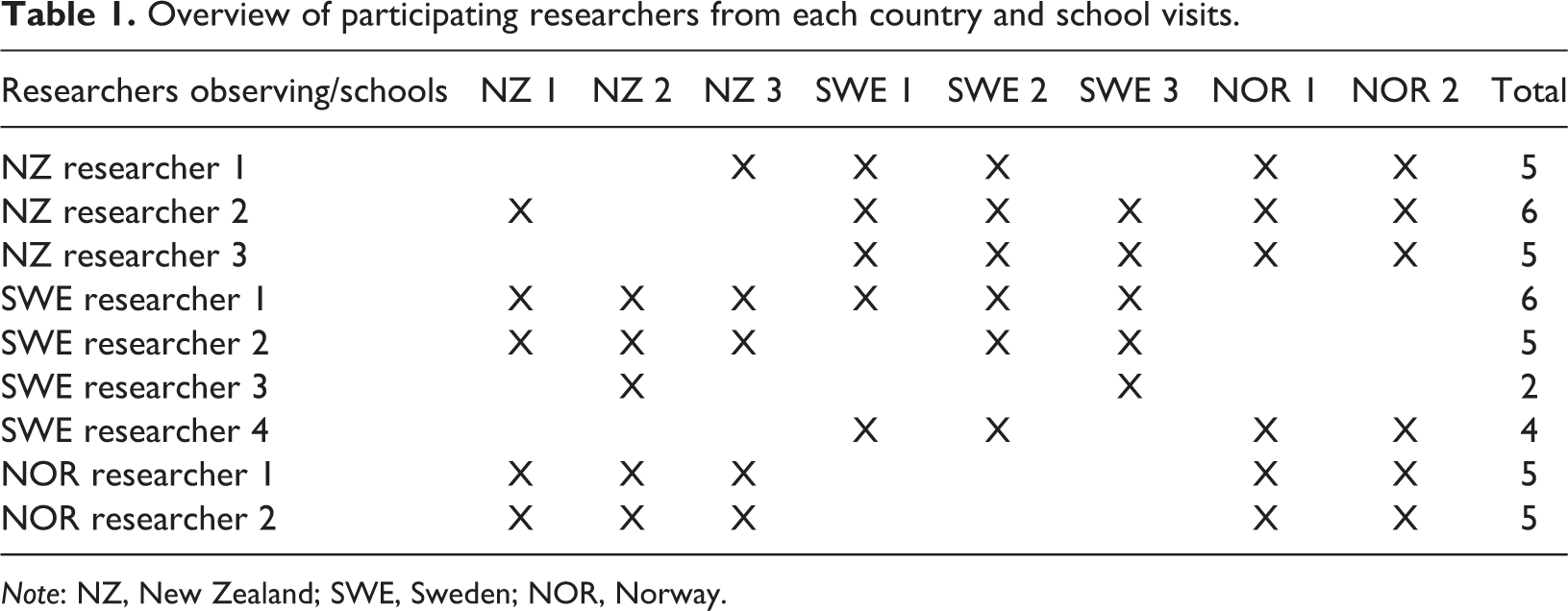
Note: NZ, New Zealand; SWE, Sweden; NOR, Norway.
The school visits were designed to provide a shared knowledge about and greater understanding of each other’s specific context. A central part of this learning resulted from HPE class observations and the researchers’ informal interviews with the teachers at each school.
During the school visits at these eight schools, two to three HPE classes were observed at each school (20 lessons in total). Although the observations to some extent were open-ended (Patton, 2002), a preliminary observational template inspired from the use of Critical Incident Technique methodology (Tripp, 2012) was also trialled during these school visits.
The interviews were largely conducted in an unstructured manner, what Patton (2002) would describe as informal conversational interviews where the questions asked arose from the context being observed. The teachers were asked questions related to the observed schooling and HPE practices with a specific focus on inclusion, democracy, equity and social justice issues. Other questions, for instance, in New Zealand involved asking about the wearing of school uniforms whereas in Sweden and Norway they focused on aspects of schooling such as teacher dress codes or students addressing the teachers by their first names and in Sweden free lunches. Although the hosting HPE teachers and researchers introduced the school contexts, the visiting researchers took the lead in terms of asking questions and interpreting the context from their own cultural lenses. At least one host researcher always took part in these conversations though to provide clarifications if needed since cross-cultural interviewing increases the chance of misunderstandings and interpretations (Patton, 2002).
The researchers made reflective journal notes after each visit. The notes were shared and discussed within the research group. This way the visits were followed by extended discussions within the research team about the school visits, observations and interviews that had been done. These discussions generated a deeper understanding of the different national contexts, for instance, that social justice might mean different things both between and within different countries. The discussions also involved recognition that understanding and researching HPE across different contexts offers both opportunities and challenges. Based on these data generated through our exchanges, presentations, school visits, observations, interviews, reflective journaling and discussions the team further refined the research questions and methods to be used in the continued implementation of the EDUHEALTH project.
Data analysis
Our analysis of the data began with a thematic analysis (Hastie and Glotova, 2012) which involved the generation of themes from the data as co-constructed by the researchers. These themes were ‘Different approaches to social justice issues in each country’ and ‘Challenges of researching social justice in HPE across (and within) contexts.’ A third theme ‘Implications for social justice in HPE practice’ arose as we reflexively considered the implications that our observations and discussions of the broader social justice issues in each country had for further understanding and researching social justice in HPE practice.
As pointed out by Hastie and Glotova these themes did not ‘magically appear or emerge’ (Hastie and Glotova, 2012: 313), rather they were informed by our existing knowledge and positioned within the paradigm of critical qualitative research for social justice (Denzin, 2010). We then introduced our theoretical lens for examining these themes to shed light on what is addressed in the name of social justice and how cross-cultural researchers of social justice interpret different contexts in HPE. For this, we drew on two key concepts from the work of Finnish educational theorist Michael Uljens (1997, 2015).
According to Uljens, the quest for social justice in democratic educational institutions should focus on transforming society through non-affirmative and non-hierarchical education. The principle of non-affirmativity assumes that the task of educational practice is to problematize established norms, practices, and knowledge, yet in a non-determined way. A non-affirmative education recognizes existing societal norms and practices yet questions their influence for educational purposes. At a personal level, non-affirmative education simultaneously recognizes the autonomous, free and self-active individual while provoking the individual to ‘become free and self-active’ (Uljens, 2015: 28, italics in original). Non-hierarchical education starts with the premise that education is situated neither solely inside, nor outside of, society; ‘it is not super or sub-ordinate to society but attempts to mediate between the two’ (Uljens, 2015: 27). In addition to acknowledging society and its problems in their current form, a non-hierarchical education should work toward ideals that develop something that may not yet exist in society. With Uljens’s beliefs underpinned by these non-affirmative and non-hierarchical principles, he argues that schooling should be problematizing the present state of affairs in a non-affirmative fashion, while at the same time preparing individuals for an existing world. Ultimately, education should prepare individuals for participation in a democratic society, with a guaranteed relative degree of freedom for the state, district, principal, teacher and student.
In the following thematic presentation, we focus on the differences in approaches to social justice in each context and the challenges of addressing and interpreting social justice and health (in)equalities across our three different school HPE contexts. We then discuss the findings in relation to Uljens’s concept of non-affirmative and non-hierarchical education.
Findings and discussion
The exchanges in New Zealand, Sweden, and Norway have highlighted different social justice issues in HPE and the enabling and constraining policies and practices of our different societies. In presenting and discussing the findings of this study, we have drawn on data from emails and reflective journaling to highlight two themes that resonate with the research team as we grapple with the challenges of an international collaborative research project on social justice in HPE. Not surprisingly, the cross-cultural researchers’ notes and conversations were predominantly drawn to the significant differences observed as ‘outsiders’ (Patton, 2002). While it is not within the scope of this paper to explore why these differences exist, needless to say, many are supported by structural differences such as school rules, funding, and the different forms of diversity that existed in different schools. Nonetheless, in what follows is an attempt to provide some examples and discussions of social justice issues in each country as generated in our EDUHEALTH project thus far.
Different approaches to social justice issues in each country
The first themes to emerge from our initial exchanges and discussions were the cross-cultural researchers’ interpretations of the different approaches to how social justice issues were being addressed in each country. In Swedish and Norwegian schools explicit non-hierarchical social and professional educational practices were highlighted in the discussions within the research team while in New Zealand non-affirmative education through cultural recognition of Māori language, culture, and values featured prominently.
Non-hierarchical social and professional educational practices
In one of the schools the differences in the clothing worn by teachers drew attention of the researchers in their colleagues’ environment. In Norway, Robert reflected on the informality of teachers’ clothing, stating: The principal introduced herself. She was wearing jeans and a t-shirt. It turns out that all staff dressed in a very similar way, a way that would be seen to be somewhat unprofessional in New Zealand, especially for a principal. (Robert (New Zealand), observation notes, school visit, Norway) Schools and playgrounds are often open areas with little control to prevent outsiders coming onto the school grounds. (Warren (New Zealand), reflective journal, school visits, Sweden and Norway)
The New Zealand researchers observed the benefits of free school lunch programmes in Sweden and suggested that they were a more effective means of achieving equity than the uniforms that are prevalent in New Zealand: The free-lunch programmes in schools are an interesting egalitarian feature of schools in Sweden. As an outsider, this structure of eating a big hot meal at lunch time, lining up, and carrying your tray to the rack seems to carry on beyond the school years. The same process occurs in our hotel. Many Swedes seem to have significant meals at lunch time. There seems to be far less availability of ‘fast food.’ Are there any other consequences (unintended or otherwise) to these free-lunch programmes? (Martha (New Zealand), reflective journal, school visit, Sweden) The teacher uses two team games – ‘Around the World’ and ‘Capture the Flag’, to build inter-student communication and cooperation (bulding social cohesion)…Games are trivial (and this is their value) because at the end of the day the game outcome is not about the score but the meaningfulness of the social interaction. (Warren (New Zealnd), observation notes, school visit, Sweden)
Cultural diversity and recognition – non-affirmative education
Our observations highlight differences in how each country recognizes cultural diversity, and in particular, the needs of their indigenous communities. In New Zealand, the international researchers noted the focus on cultural identity that featured prominently at New Zealand schools and in PE classrooms. The artefacts included flags, Māori meeting houses on school campuses, and posters in classrooms: The cultural identity is important. Students are sometimes described by their cultural identity, e.g. Tongan, Samoan, Māori, NZ European/Pakeha, South East Asian, Other Asian, Fijian, Other Pacific people, etc. In some sort of open garage two men worked with handcraft – they made Māori art to the Māori meeting house. The house had been moved from being hidden behind the school to instead being the first thing people meet coming to school…(Katherine (Sweden), reflective journal, school visit, New Zealand) Inclusive. For all. Rainbow flag. No fees. Strengthen cultural identities. Trying to meet students with varying needs – different methods and contents. School uniform but not so strict during PE. Māori culture in forefront. (Kelly (Norway), reflective journal, school visit, New Zealand)
For the Nordic researchers, this emphasis on culture, which included the presence of cultural rituals in HPE classes, initiated debate as to whether cultural recognition and the celebration of cultural diversity helped to focus efforts to improve equality and equity or led to a stigmatization of certain cultural group/identities, which in turn reproduced further inequalities. For these researchers, the targeted efforts to improve the lives of certain cultural groups is therefore viewed to be a double-edged sword: it can help provide opportunities and resources for marginalized groups to have equal opportunities in society, but at the same time it can hinder equitable outcomes since it reproduces these groups as the marginalized. The New Zealand researchers would not agree with the double-edged sword view, believing that policies and practices that seek to promote and value Māori language, culture and values appropriately return a sense of place and voice to Māori people in New Zealand. Such practices can then also be seen to demonstrate the shift from focusing on equity/equality to the targeted redistribution of resources (France and Roberts, 2017) and celebration of difference (Azzarito et al., 2017). Furthermore, the New Zealand researchers questioned the lack of visibility of the indigenous Sami people in education in Sweden and Norway. It should be noted, however, that both the Swedish and Norwegian Educational Acts and curriculum documents include the recognition of Sami culture and language (Skolverket [Swedish National Agency for Education], 2015; Udir [Norwegian Directorate for Education and Training], 2015).
The growing ethnic and cultural diversity of Swedish and Norwegian societies due, in part, to the recent influx of new immigrants and refugees, raises similar debate as in New Zealand as to whether social justice is better served through integration into an existing society or a broadening and acceptance of multiculturalism in an established society (Gerrevall et al., 2018). As Uljens’s (2015) non-affirmative theorizing stance would have it, the social justice agenda in schools is to prepare future generations for a more equal and socially just world, where everyone’s interests are recognized, which is what, for instance, New Zealand could be regarded as addressing in its attempt to better recognize Māori and Pacific Island cultures. On the other hand, these attempts by New Zealand at addressing social justice for Māori and Pacific Island cultures might result in other minority cultural groups becoming the new marginalized ones in society. That is, the school subject of HPE may (re)produce racialized stereotypes and marginalization, but it could also be reimagined as a space of recognition and educational success for marginalized/minority groups such as Māori and Pasifika youth (Fitzpatrick, 2013).
Challenges of researching social justice in schooling and HPE across (and within) contexts
The second theme identified was the challenges of understanding and researching HPE across and within countries/contexts. The initial meetings in each country, school visits, presentations on each context, pilot observations and interviews have reinforced the challenges of international collaboration. Based on our own reflections and reading of international literature, we concluded that often, when researchers engage with journal articles and literature on HPE, they apply these findings to their own HPE context without recognizing how each context socially constructs a unique form of HPE. For instance, one of the authors of this paper on their visit to New Zealand noted that: …health education and physical education are taught as separate subjects and often by different teachers? When reading, using, and citing articles and books on New Zealand HPE, I have always assumed that these two subjects are taught in an integrated manner just as they are in Norway or Sweden. (Kelly (Norway), reflective journal, school visit, New Zealand)
The EDUHEALTH collaboration has clarified that our interpretation of pedagogical work for social justice is defined by our own contexts. In one instance, when a New Zealand researcher was pointing out some of the significant buildings and symbols displayed in a school, one of the Nordic researchers questioned how they linked to social justice: [Warren] has pointed out symbols in some schools and their locations (e.g. flag, meeting house, clothes with messages), that can send inclusive signals to all or just to certain groups – and depending on the country’s history and politics I argue that each country has to define whether these symbols are in line with social justice or not. (Katherine (Sweden), email conversation) This class is taught in English because half of the lessons for IB [International Baccalaureate] students have to be in English and the other half in Swedish. He states that it prepares the students for a global world (which I see as being a contribution to a critical incident in itself). (Warren (New Zealand), observation notes, school visit, Sweden) In three classes we have seen the classes divided into gender groups. This happened at [school 1] when the boys played football and the girls threw the shotput. We saw it in [teacher 1’ s] class during some of the interval training and we saw it in [teacher 2’ s] high jump class where the boys were at one end while the girls stayed at the other. (Robert (New Zealand), reflective journal, school visit, Sweden) The teachers also stress the importance of having the same experiences (the same education) across Sweden – thus the curriculum must be implemented the same. My interpretation is that there is little scope for tailoring PEH solutions (practices) to different contexts. (E.g. Does a homogenous PEH curriculum serve the same purpose in Stockholm as it does in Karlshamn? – would individual communities benefit from having more agency in their teaching) (Robert (New Zealand), EDUHEALTH meeting notes) [the students were] Only girls from really exclusive families.…The main building filled with art. Everyone should look the same [school uniforms] – but the badges could symbolize different things…The school (can be seen as representing the society) should support them. Not clear what social justice means for the school or the girl? (Kelly (Norway), reflective journal, school visit, New Zealand)
The aforementioned discussions and differences challenged us to develop a deeper examination of our own taken-for-granted contexts at both a macro and micro level. Using Uljens’s (2015) concept of non-affirmative education, which requires us to problematize our taken-for-granted practices, we (as described and discussed above) examined our own societal norms and how these intersect with democratic principles. Uljens (2006) further argues that although schooling should prepare young people for living in an existing society, schools should not be subordinated by current political, religious or economic interests. Schooling formats based on, for instance, gender or religion risk contributing to normative socialization and indoctrination into a certain (e.g. gendered) way of seeing and being in the world (Uljens, 2006). Although, we as cross-cultural researchers of social justice interpret each other’s context differently (and will continue to do so), we share the belief that a non-affirmative education, in for instance school HPE, should therefore continue to draw on the principles of socially-critical pedagogy where the problematization of knowledge construction is privileged, where questions are asked of how the dominant ways of thinking about health, physical activity, sport, the body and self have come to be, and where students are challenged to change the structures that create social inequities (Philpot, 2017; Tinning, 2012).
The implications for social justice in HPE practice
A third theme that arose during the exchanges between countries was the implications of the differences in approaches to social justice for HPE practice. The professional discussions facilitated through the first phase of the EDUHEALTH project offered a focus on the implications for ourselves as PE teacher educators in relation to democracy, social justice and equitable health outcomes. One important goal of the larger EDUHEALTH project is to improve our understandings of how PETE programmes and in-service HPE interventions can improve the socially-critical pedagogies of PETE students and graduates.
The research project EDUHEALTH grew out of the key participants’ lived experiences as PE teacher educators in three different countries and universities. In Sweden and Norway, many researchers argue that even when issues about gender, equality and social justice are raised in PETE, this form of knowledge is not valued by the students. PETE seems to have difficulties engaging the students in these issues and critically examining the power/knowledge relations that exist within HPE (Larsson, 2009; Moen, 2011). As a collaborative group of researchers, we share Tinning’s belief that it is ‘how HPE teachers think and feel about education, social justice, physical activity, bodies and health that will be their most important graduate attribute’ (Tinning, 2012: 224, italics in original). PETE students and HPE teachers need to develop pedagogical approaches that foreground equality, social justice and socially-critical perspectives so that they can better understand the consequences of their teaching practices and learn how to deal with and resolve pedagogical challenges based on such approaches.
A challenge for us as PE teacher educators and an important goal of the larger EDUHEALTH project is therefore how we can engage our PETE students to think and care about socially-critical perspectives and develop such approaches in their teaching of HPE in our multicultural, multi-linguistic complex learning environments. We question how each country is interpreting and implementing its HPE curriculum in response to their own social justice demands. Reflexively we question whether HPE should be preparing students to be more accepting and inclusive in a world determined by competition and a focus on the individual rather than society or should the focus of HPE be on shifting social norms towards more collective interests (Uljens, 2015). In order to reaffirm the social justice project in today’s increasingly globalized world, we share Azzarito et al.’s belief that recognizing ‘diverse young people’s embodiment and ways in which their embodiment is affected by pedagogical practices in PE, sport, fitness, health, and the media is important to developing effective strategies for including diverse lived experiences and realities’ (Azzarito et al., 2017: 215). Inspired by this belief, the EDUHEALTH project explores the pedagogical practices of HPE teachers in each of our three respective countries.
Based on the experiences and findings to date, we argue that Uljens’s (2015) non-affirmative and non-hierarchical democratic education have the potential to provide a fruitful lens for researchers who are interested in analysing how PETE and HPE students and teachers operate within current society. Non-affirmative and non-hierarchical education conceptualizes the world as both a static reality but also as a reality in a dynamic process of change and movement, affirming individuals as beings in the process of becoming, that is, as uncompleted beings in, and with, an uncompleted reality (Uljens, 2015). The school subject of HPE, and the practices and identities which are constructed therein, can also be seen as in such a process of becoming, thus pointing to the potential of foregrounding equity, democracy and social justice as the guiding educational principles.
In the final section of this paper, we offer some tentative (possible) conclusions and what implications these might have for the future understanding and researching of social justice and health (in)equality across different school HPE contexts.
Conclusions
The EDUHEALTH project exchanges in Sweden, Norway and New Zealand have highlighted different social justice issues in school HPE and allowed us to explore how environments and social norms enable or constrain HPE practices across these different contexts. However, the challenge for our research team is to move beyond gaining knowledge about our respective current social contexts, to using this knowledge to act on them. We must use our agency as teacher educators and researchers of HPE to embrace the possibilities conceived in the Swedish, Norwegian and New Zealand contexts, to provoke self-reflection in a manner that has the potential to transform but not indoctrinate and to recognize the autonomy of individuals while triggering a desire to become somebody else (Uljens, 2015). Indeed, we argue this also to be true for HPE school teachers and their own practice. Reaffirming the social justice agenda as part of both school HPE and our PETE programmes in times of increasing segregation and inequality as brought on by neoliberal globalization (Azzarito et al., 2017) can therefore be seen as crucial.
In summary, we consider the international exchanges, presentations, school visits and discussions described above as crucial for attempting to develop a shared understanding of how to research social justice and health (in)equality across different school HPE contexts. As such, this paper is also instructive for all international collaborators who embark on research in foreign spaces without consideration of an ‘insider’s’ understanding of the context of the research. Our ‘shared’ understanding is continually, and forever, developing. Addressing the differences and contradictions within each schooling and HPE context will help us construct a shared understanding of the concept of social justice in relation to HPE so that we can then utilize it in our international collaborative knowledge-sharing and research project. However, we also acknowledge that a truly ‘shared’ understanding may never be possible since we always observe and interpret our world through our own socio-cultural lenses (Uljens, 1997).
We want to conclude by reasserting Uljens’s (1997, 2015) view that in our quest to reaffirm the social justice agenda in HPE we need to focus on transforming HPE through problematizing affirmative and hierarchical educational practices and recognizing that social justice teaching strategies are enabled and constrained by the contexts in which they are practised. As part of the EDUHEALTH project we hope to provide insight into both the non-affirmative and non-hierarchical practices that privilege social justice in HPE contexts, and rich descriptions of the contexts in each country that enable these practices to occur.
Footnotes
Declaration of Conflicting Interests
The authors declared potential conflicts of interest with respect to the research, authorship, and/or publication of this article: The results presented in this article only reflects the authors’ views and the European Union is not responsible for any use that may be made of the information it contains.
Funding
The author(s) disclosed receipt of the following financial support for the research, authorship, and/or publication of this article: This project has received funding from the European Union’s Horizon 2020 research and innovation program under the Marie Skłodowska-Curie grant agreement No 734928.