



Abstract
Embracing diversity and the demand for social justice are key concerns in modern societies, and it is imperative for physical education (PE) to address student diversity and promote social justice. However, achieving these goals presents challenges for PE teachers. In this context, social justice pedagogies (SJPs) provide guidance on how to address these demands. Although the concept of SJPs has been extensively theorized, there is a research gap concerning concrete teaching practices related to social justice. Despite a growing literature base, knowledge about specific teaching practices that PE teachers employ in their professional practice remains limited. This study aims to gain a deeper understanding of how SJPs can be realized in PE. Following an exploratory qualitative design, semi-structured interviews were conducted with Austrian secondary school PE teachers (n = 20) to explore teaching practices aligned with SJPs. Qualitative content analysis, informed by SJPs, was applied to analyze the data. The results reveal various teaching practices related to SJPs, such as considering student diversity when selecting teaching content, making individualized adjustments, and promoting social skills and fairness. These teaching practices include teaching goals, content, didactic-methodical approaches, teacher–student(s) interactions, and grading. Based on the findings, this paper discusses how these teaching practices reflect the theoretical considerations of SJPs. It concludes that the explored teaching practices demonstrate opportunities for enacting SJPs in PE.
Introduction
Embracing diversity and the demand for social justice are ongoing societal concerns. Societies should strive for more social justice, as stated in the Declaration of the United Nations (2015), a goal toward which they are, to some extent, already working. But what constitutes social justice? There are numerous theories on (social) justice, e.g. the theory of justice by Rawls (1971) or the capability approach by Nussbaum and Sen (1993; Sen, 2009). In this paper, we understand social justice in line with Bell (2016) as the equitable participation of all social identity groups in a society shaped to address their collective needs, realized through democratic, inclusive, and collaborative means that respect diversity and avoid oppressive methods. In this way, social justice can provide benefits for all since the ultimate vision is a world where resources are distributed more equitably, ecological sustainability is upheld, and all individuals are respected, empowered, and interconnected within a safe, secure society (Bell, 2016). However, fostering social justice remains a challenge, as reflected in the existing economic inequality, political oppression, and unequal power hierarchies (Gibson et al., 2022). Both education (Gibson et al., 2022) and sport in general (United Nations Office on Sport for Development and Peace, 2013) are seen as means to potentially promote social justice. Paradoxically, attention is also drawn to the marginalization and injustices present in these areas, e.g. concerning access to education and educational outcomes (Gerdin et al., 2022), and, e.g. ableism, fatism, healthism, (hetero)sexism, racism, and classism in sport (Lynch et al., 2022). Accordingly, two demands can be identified for education and sport: to become more socially just themselves and to contribute to broader social justice.
These demands are particularly relevant for physical education (PE) (Vickerman et al., 2021). Various authors have highlighted the urgent need for PE to address student diversity and contribute to social justice (Azzarito et al., 2017; Fitzpatrick, 2019; Kirk, 2020; Tinning, 2020). This need for action is well-documented. PE is still permeated by injustices, marginalization, and othering (Azzarito et al., 2017; Dagkas, 2016; Fitzpatrick, 2019). These injustices manifest in forms of ableism, (hetero)sexism, fatism, healthism, racism, classism, and more (Lynch et al., 2022). Berti et al. (2010) and Thorjussen and Sisjord (2018) show that students perceive these injustices in PE as well. Furthermore, positive effects attributed to PE, like inclusion and the promotion of social skills such as respect and tolerance, do not occur automatically; PE must be specifically designed to realize its potential (Bailey, 2006; Bailey et al., 2009; García López and Kirk, 2022). In addition, the growing influence of neoliberalism at the societal level contrasts with the desired developments toward social justice. Neoliberal individualism inherently emphasizes competition and performance, which can lead to a preference for competition-based approaches over equity-focused ones in PE. By centering on individual achievement and personal responsibility for one's circumstances, neoliberalism downplays or outright denies the existence of structural inequalities and discrimination. This perspective conflicts with the aims of social justice, which seek to address and dismantle these systemic barriers in order to create more equity (Azzarito et al., 2017; Fernández-Balboa, 2017). The need for action is further supported by the mediating role social justice plays concerning students’ cognitive and social outcomes. Molinari et al. (2013) confirm in a study with 614 students that there is an association between students’ perceptions of fairness in class and their achievements at school.
These reasons for the need for action regarding diversity and social justice are also applicable to the German-speaking context, as recent research confirms (Becker et al., 2018; Frohn and Tiemann, 2022; Giese and Ruin, 2018; Grimminger, 2013; Grimminger-Seidensticker and Möhwald, 2020; Ruin and Stibbe, 2023). The present study was conducted in Austria. The demands of addressing student diversity and contributing to social justice are broadly enshrined in the Austrian PE curriculum. According to the curriculum, PE aims to enhance cooperation, teamwork, self-esteem, and the inclusion of disadvantaged students, as well as problem-solving behavior and conflict resolution strategies in connection with societal issues (e.g. prejudices/stereotypes) (Bundesministerium für Bildung, 2016). However, the curriculum lacks specific and comprehensive proposals for realizing these aims (Meier et al., 2022). Here, social justice pedagogies (SJPs) can provide guidance. The theoretical foundations of SJPs are similar to concepts for addressing student diversity and contributing to social justice in German-speaking literature (Meier and Reuker, 2022). In this respect, Gaum (2019) has already stressed parallels between concepts in German-speaking literature and critical pedagogy. SJPs are suitable for this study because they cover the above-mentioned requirements of PE within one framework.
The previous remarks emphasize the importance of PE embodying social justice principles and contributing to their realization. SJPs can serve as a theoretical framework for this purpose (Gerdin et al., 2022). However, little research has focused on teaching practices that enact SJPs. Thus, there is a research gap regarding how the theoretical considerations of SJPs can be enacted in PE (Scanlon et al., 2022). Empirical studies specifically dedicated to the enactment of SJPs in PE have so far been limited to the exploration of best-practice examples (Gerdin et al., 2022; Lynch and Curtner-Smith, 2019). This study aims to expand and enrich this research by investigating teachers’ perceptions and espoused views relating to SJPs, thereby showing opportunities for how SJPs can be enacted in PE. The underlying research question is: What teaching practices can be identified in interviews with PE teachers focusing on their teaching in general that align with the theory of SJPs and thereby represent an enactment of SJPs?
Teaching for social justice in PE
Although the vision and associated benefits of social justice have been thoroughly discussed in scientific literature, teaching practices aligned with SJPs receive far less attention in comparison (Gerdin et al., 2021). Various authors highlight that the realization of SJPs represents a major research gap. For example, “limited research has focused specifically on the enactment of social justice in HPE [health and physical education] practice” (Linnér et al., 2022: 228), “there seems to be a lack of understanding around the ‘how’ question; ‘how’ can we teach about, through, and for social justice” (Scanlon et al., 2022: 452), and “What is needed, however, are more strategies as to what SJE [social justice education] looks like and how it can be enacted within our classes on a daily basis, along with plans to ensure that we do not perpetuate inequity” (Lynch et al., 2020: 9). As Philpot et al. (2021) ascertain, there are only a few empirical studies that focus specifically on the realization of SJPs in PE. Gerdin et al. (2022) conducted a research project titled “Education for equitable health outcomes, the promise of school health and physical education” (EDUHEALTH) to address this research gap. Their aim was “to identify successful school HPE teaching practices, which promote social justice” (Gerdin et al., 2022: 3) by analyzing the teaching practices of 13 teachers from Sweden, Norway, and New Zealand. They observed HPE lessons to identify critical incidents concerning social justice and then interviewed the teachers to ascertain their thoughts on the observed incidents. The teachers selected for the project were known to the researchers as teachers with a great commitment to social justice. Consequently, it was a purposive sampling of teachers known for their good practices concerning the enactment of SJPs (Gerdin et al., 2021). As a result, the authors identified nine pedagogies for social justice and supported them with practical examples from the teachers studied. These nine pedagogies include caring, understanding, inclusion, building relationships, fostering reciprocal respect, democracy, social cohesion, addressing student diversity, and the explicit thematization of social justice (Gerdin et al., 2022).
Other studies also contribute to the understanding of social justice issues in PE. Fitzpatrick conducted a critical ethnographic study in 2007 and analyzed the enactment of critical pedagogy of one “best-practice” teacher over a year. The teacher's critical teaching practices were characterized by “[b]uilding the environment,” “[d]econstructing power,” “[p]layfulness,” “[s]tudying critical topics” and the teacher's “embodied critical orientation” (Fitzpatrick and Russell, 2015: 164–166). Similar results were obtained by Lynch and Curtner-Smith (2019), who studied the realization of transformative pedagogy by one elementary teacher through ethnography. In contrast to these rare best-practice examples, other studies indicate teachers’ difficulties in addressing student diversity and teaching for social justice. Dover (2013) identified challenges such as resistance at the individual and institutional levels, as well as a lack of resources (personal and curricular). Fine-Davis and Faas (2014) carried out a questionnaire survey with 320 students and 208 teachers on equality and diversity in the classroom and concluded that teachers need enhanced strategies to address student diversity. In addition, a systematic review by Silva et al. (2021) on the enactment of student-centered teaching reinforces that teachers face several challenges when implementing such teaching practices. Moreover, Gorard (2011), based on a large-scale study with 13,000 students, highlighted the significant influence of teachers: “Teachers appear to be a major influence on young people's sense of justice and the principles they apply in deciding whether something is fair” (Gorard, 2011: 35). Therefore, it can be concluded that teachers’ teaching practices concerning social justice are quite important.
However, teaching practices concerning social justice remain a research gap. As Gerdin et al. (2020) stated in their outlook on the EDUHEALTH project, “future studies could therefore […] include a larger and more varied sample of teachers” (Gerdin et al., 2020: 6917) to explore how teachers realize SJPs in PE. Furthermore, the context specificity of social justice (Schenker et al., 2019) increases the need for research on the enactment of SJPs.
Diversity and SJPs
We understand diversity in a broad sense, encompassing differences among people that impact outcomes. Typical diversity categories include social class, gender, migrant background, language, religion, physical conditions (such as general physical fitness or bodily constitution), disabilities, sexual orientation, and more (Vertovec, 2015). However, the perception of any given characteristic as otherness can vary based on context, situation, and individual perspective (Lynch et al., 2022; Steyn, 2015). Additionally, these categories are interrelated, and each student is attributed a unique set of characteristics that can contribute to the perception of otherness (intersectionality of diversity categories) (Azzarito et al., 2017; Lynch et al., 2022; McCall, 2005; Vertovec, 2015). Therefore, this article refrains from focusing on specific diversity categories, and instead refers to diversity in general.
The demands of addressing student diversity and contributing to social justice in PE are addressed by SJPs. The concept of SJPs parallels critical pedagogy (Kirk, 2020), Freire's (1992) pedagogy of the oppressed, Tinning's (2002) modest pedagogy, and transformative pedagogy (Lynch and Curtner-Smith, 2019) and has its roots in the human rights movement (Gibson et al., 2022). As Hahn Tapper (2013: 412) states, the term SJPs “has no single meaning or use.” Nevertheless, the various definitions and uses of SJPs share many commonalities. A characteristic of SJPs is their conceptualization as “both a goal and a process” (Bell, 2016: 3). Consequently, SJPs involve teaching in a socially just manner and contributing to a change toward social justice beyond the classroom. Regarding the goal, SJPs aim to ensure that all people can actively participate in a society designed to cater to their needs—regardless of which social identity group they feel they belong to in any given situation. Regarding the process, achieving this goal involves a democratic, inclusive, and respectful approach that recognizes human diversity, group differences, and the ability of individuals to work together collaboratively for meaningful change (Bell, 2016). By teaching for all students, breaking up heteronormative conceptions and unequal power relations, as well as promoting critical thinking, SJPs aim to address student diversity and contribute to a change toward social justice (Azzarito et al., 2017; Gibson et al., 2022).
Building on these theoretical foundations of SJPs, the following teaching principles can be proposed to inform their enactment (Adams, 2022; Nieto and Bode, 2018):
Addressing and challenging stereotypes, structural inequalities, and discrimination, as well as disadvantages and unequal power relations within the group; Providing individual support to all students to help them realize their potential; Shifting the focus from a deficit-oriented approach to emphasizing and nurturing the strengths and talents of students; Being attentive to social relationships and group dynamics among students; Recognizing and valuing students’ learning outcomes; Utilizing reflections, experience-based learning, and promoting critical thinking to facilitate transfer.
These teaching principles can guide the realization of the process and goal of SJPs (Adams, 2022).
Methodology
The present study used an exploratory qualitative research design to explore teaching practices that address student diversity and represent an enactment of SJPs, thereby showing opportunities for how SJPs can be enacted in PE. This investigation was conducted through interviews with 20 PE teachers, focusing on the broader, context-specific practices aligning with SJPs they indicated they used, rather than examining the implementation of specific pedagogies, such as the nine pedagogies for social justice identified by Gerdin et al. (2022). Given that teaching practices are inherently context-dependent (Schenker et al., 2019) and Gerdin et al. (2022) do not claim to provide an exhaustive list of pedagogies, an open-ended research design is helpful. Consequently, an exploratory qualitative interview approach is particularly suitable for exploring PE teachers’ perceptions and espoused views relating to SJPs (Creswell, 2014). The material and methods used for this research are detailed below.
Participants
The sample criteria for selecting PE teachers were that they had completed university-based teacher education (excluding lateral entrants, i.e. teachers who entered the profession through alternative pathways) and that they were teaching PE at a secondary school in the eighth, ninth, or 10th grade (students aged about 14–16 years).
The sample consisted of 20 PE teachers from 16 different secondary schools, including 15 general academic secondary schools and one secondary school specializing in economics and business studies. The teachers had a mean age of 38.8 years (SD = 8.364; min = 30, max = 60). Among them, 10 PE teachers identified as female, nine as male, and one as non-binary. On average, the participants had professional experience as PE teachers for 10.78 years (SD = 8.761; min = 2, max = 34). They had been teaching the students in their studied class at least since the beginning of the school year when data collection occurred. The data collection took place in spring 2023, ensuring that the PE teachers had been teaching their students for at least three quarters of the school year. All teachers reported that they taught PE in a single-sex setting, with six indicating that they occasionally also taught in a coeducational format. Teaching in a single-sex setting is a typical requirement for Austrian PE and usually the standard; however, exceptions are possible. The data collection took place in Vienna, Austria, with a special effort to recruit classes from schools in different districts of the city. This approach was taken to capture a range of social justice-related issues, such as the distribution of individuals with a migrant background. Research on the situation in Vienna indicates that migrants are disproportionately represented in economically disadvantaged situations, which can affect employment stability, educational attainment, health outcomes, and housing conditions (Stadt Wien, 2020). The diversity of the students taught by the teachers in the classes selected for this study was particularly evident in dimensions such as social class, migrant background, physical conditions (such as general physical fitness or bodily constitution), language, and religion. In contrast, diversity in the dimensions of gender, sexual orientation, and disabilities played a much less significant role in the classes.
Ethical approval for the research project was obtained from the Ethics Committee of the University of Vienna on December 28, 2022, prior to data collection (reference number of the decision of the ethics committee: 00908). Participants provided written consent before commencing the interviews.
Data collection
For the interviews, a semi-structured guide was developed, consisting of various topics, including general introductory questions that led into the interview themes, detailed teaching practices, and closing questions. The PE teachers were not informed in detail about the specific research focus beforehand. Instead, they expected an interview about their general approaches to planning and teaching PE. Similarly, during the interview itself, diversity and social justice in PE were not explicitly addressed; direct questions on these topics were avoided to prevent creating an examination-like atmosphere or eliciting socially desirable responses (Qu and Dumay, 2011). As this study explores teaching practices related to SJPs through interviews, it inherently focuses on teachers’ perspectives, limiting conclusions about the actual enactment in PE.
To initiate the interviews and encourage the interviewees to narrate, PE teachers were asked about their daily work as a PE teacher and their students (Could you please describe your students? Are there any commonalities, similarities, or differences among them?). This initial characterization of their students was intended to indirectly focus on diversity. The second part of the interview delved into the teaching practices in detail. In accordance with Butt (2008) and Scheid and Friedrich (2015), this part covered teaching goals, content, didactic-methodical approaches, teacher–student(s) interactions, and grading (e.g. What are goals of your PE classes, and how do you define them (and why)? What should your students learn in PE (and why)? In your opinion, what is the fundamental purpose or benefit of PE?). The PE teachers were still not directly asked about addressing student diversity and social justice. Instead, they were asked in general about their teaching practices, including goals, content, didactic-methodical approaches, teacher–student(s) interactions, and grading. This approach aimed to uncover the actual value that the PE teachers placed on diversity and social justice while minimizing the risk of eliciting socially desirable answers. If teachers did not refer to diversity aspects they had previously mentioned when characterizing their students, the interviewer followed up with direct questions about how these diversity aspects were addressed in their teaching. The interview concluded with questions about demographic and background information and offered the teachers an opportunity to add or summarize anything they wished.
The interviews were mainly conducted face-to-face at the teachers’ schools in quiet, private rooms. For organizational reasons, three interviews were conducted via Zoom. All interviews were carried out by the first author. The interviews lasted an average of 52 minutes (min = 34, max = 79).
Data analysis
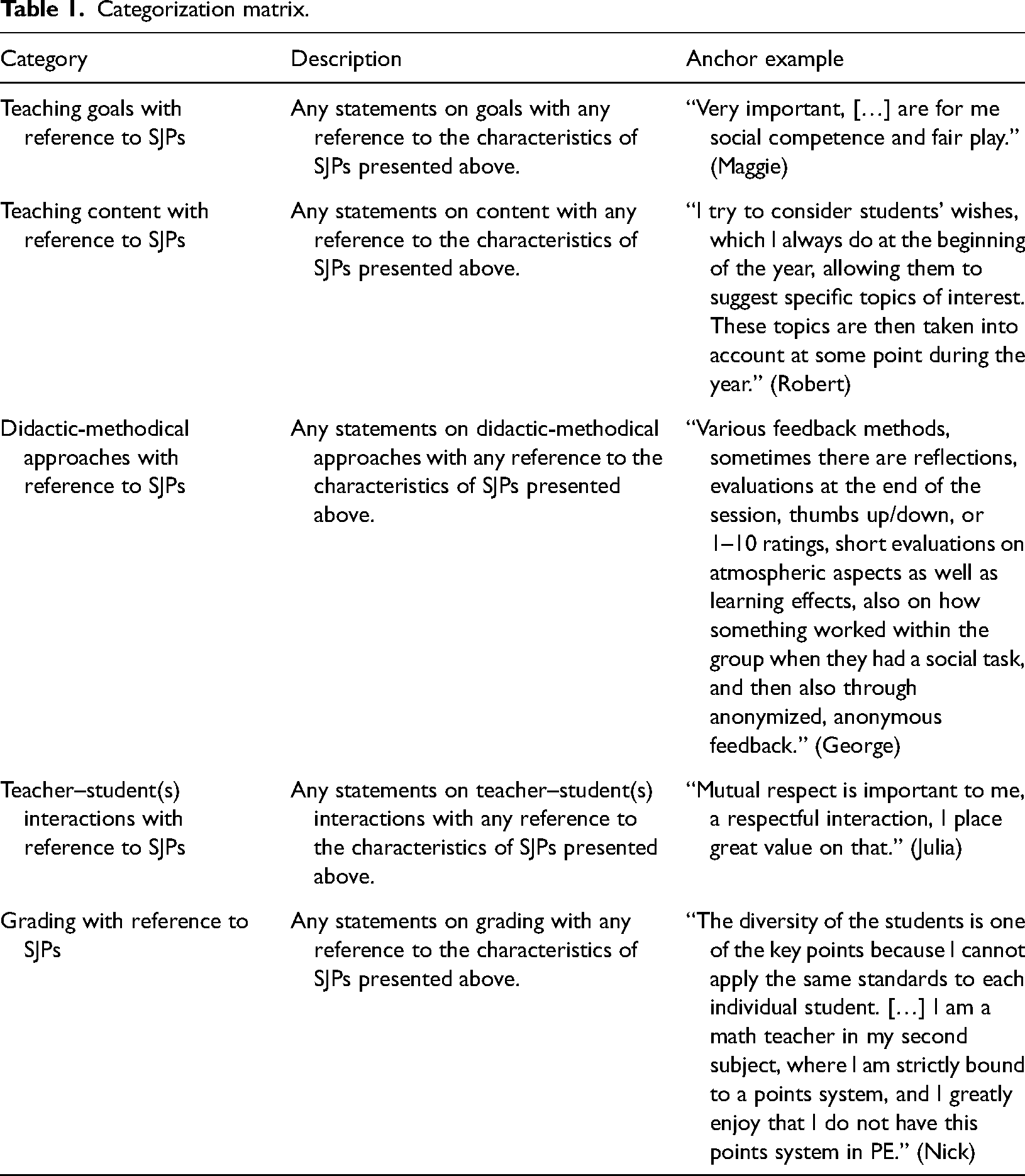
The interviews were recorded and transcribed verbatim, and the teachers’ names were pseudonymized. The data were analyzed using qualitative content analysis according to Mayring (2014). Codes were extracted from the data using the software MAXQDA, based on mutually agreed-upon coding guidelines by the two researchers. To analyze the teachers’ reported enactments of SJPs, a two-step coding process was employed. First, the teaching practices were organized according to the previously derived topics: goals, content, didactic-methodical approaches, teacher–student(s) interactions, and grading. Second, these codes were further subcategorized into practices aligned with SJPs or not, using the comprehension of SJPs described above. In alignment with the research question and the focus of this paper, the analysis focused on how teachers enact SJPs. Therefore, only the teaching practices related to SJPs are analyzed in detail and presented in the Results section. Although teaching practices without reference to SJPs were also identified in the data, they are not the primary focus of this paper, which aims to explore teachers’ perspectives on their efforts to address student diversity and contribute to social justice. The categories for both steps—(1) categorization of teaching practices into goals, content, didactic-methodical approaches, teacher–student(s) interactions, grading, and (2) subcategorization into SJPs or not—were developed deductively. The interviews were conducted in German, as both the participants and the interviewer were most comfortable expressing themselves in this language. After the analysis, a translation process was carried out, during which selected statements were translated for use as quotes in the paper. Table 1 shows the categorization matrix.
Categorization matrix.
To ensure the quality of the coding process, each researcher independently coded five interviews (25% of the total data) using the deductive category system. Interrater reliability was then calculated using Cohen's kappa coefficient (K) to test the agreement between the two researchers. The kappa value was κ = 0.94 for 90% overlap of coded segments, indicating near-perfect agreement (Landis and Koch, 1977). In addition, discrepancies in coding were compared and resolved through consensus.
Findings and discussion
Several teaching practices related to SJPs were identified in the data. To provide deeper insights into these teaching practices, the results of the qualitative content analysis are presented following the structure of the categorization matrix. It is important to note that the successful enactment of SJPs requires a holistic approach. Each individual teaching practice identified in the data with reference to SJPs reflects only specific aspects of SJPs when considered on its own, rather than representing the full scope of SJPs. Due to the complexity of SJPs and the complexity of their enactment in PE, the Results and Discussion sections have been merged, incorporating the authors’ interpretations of how the identified teaching practices relate to aspects of SJPs.
Teaching goals with reference to SJPs
The interviewed PE teachers named several teaching goals that seem to be related to SJPs. In this category, various facets of social competence are emphasized. The teachers indicated that they aim to enhance their students’ social behavior and competencies, particularly their ability to work in teams and resolve conflicts: I also have a few goals that have more of a social aspect, like how they interact, so generally speaking, verbally, and of course, body language […]. Resolving disputes, conflicts, that's also part of PE, learning how to deal with conflicts and how to resolve them. (Jack)
Furthermore, teachers indicated that they aim to promote fairness and to improve students’ ability to handle victories and defeats: I hope that fairness and social competence will develop or be experienced in PE. […] I hope that dealing with wins or losses will be experienced and improved. (Robert)
These goals regarding social competence, fairness, and teamwork form a basis for social interaction in line with SJPs. However, due to the often vague and superficial statements made by the teachers, their precise understanding of concepts such as social competence remains unclear.
Another goal mentioned within this category is to challenge performance norms. Performing well does not necessarily mean that one must, for instance, meet a specific limit, or that there is only one right way to do an exercise. Teachers explained that they aim to convey this understanding to students, thereby addressing their individuality: What I definitely don’t want is for them to have to meet any limits, be completely exhausted if they don’t achieve them, and feel frustrated because they can’t progress. I aim to avoid that and counteract it by showing them various things and trying to address everyone. (Charlotte)
Consequently, the indicated goals not only include enhancing social skills like teamwork and handling victories and defeats but also individualizing motor performance-related goals and being aware of student diversity when setting specific teaching goals. By not focusing exclusively on motor performance but instead prioritizing student-centered approaches and critically examining movement-related norms, it becomes possible to prevent discrimination and empower students individually.
When we compare these teaching practices with the previously described understanding of SJPs, it is evident that the stated goals provide an important foundation for SJPs. However, they do not encompass the full scope of SJPs. For instance, the goals formulated by the teachers do not address the dismantling of stereotypes and inequalities or the joint critical reflection on these issues at any point.
Teaching content with reference to SJPs
The codes in this category primarily refer to two aspects: considerations for content selection and socio-pedagogical teaching content related to SJPs. Regarding content selection, teachers stated that they consider factors such as students’ interests and desires, emotional states, individuality, and religious fasting periods like Ramadan. Emphasizing the importance of listening to students’ voices is particularly relevant when deciding on teaching content and is a key aspect of SJPs. By listening to students’ voices, teachers can reduce structural inequalities, create less hierarchy, and thus decrease the unequal power dynamics between teacher and students.
Additionally, teachers mentioned socio-pedagogical teaching content aligned with SJPs. This teaching content reflects the previously presented goals and forms an important foundation for SJPs. It includes fostering respect, tolerance and self-reflection, managing aggression, conducting team-building exercises, and addressing conflict resolution: I do a lot of team-building exercises. In a double period, we have time, and I just notice that it really benefits the social cohesion in class or that it provides a good opportunity to address conflicts. (Ryan)
In some cases, (normative) motor performance is partially excluded and/or made voluntary as part of the subject matter: Long jump in the upper grades, for example, we just jump far without measuring, or only those who want to know will measure. (Julia)
Here, the teacher explained that she removes the often inherent performance pressure in sports, allowing students the freedom to decide whether measuring their performance is part of the teaching content or not. This approach fosters a more inclusive and less competitive environment, aligning with the principles of SJPs.
Didactic-methodical approaches with reference to SJPs
The data reveal various didactic-methodical approaches that contribute to the enactment of socially just goals and content. One key aspect is involving students in the design of the teaching process. Teachers reported reflecting on lessons with students, encouraging their suggestions, and incorporating them into teaching practices: I also engage in reflection with the students during lessons, for example, discussing why something isn’t working and gathering ideas from them. It's not about insisting that something must work just because I, as the teacher, say so, but rather about involving the students. (Emma)
This can lead to more equal power dynamics between teacher and students, and students may feel more valued when their thoughts and suggestions are heard.
Teachers often indicated using approaches to accommodate the individuality of their students, thereby trying to support all students, which is an important aspect of SJPs. For example, offering different activities simultaneously, allowing students to choose their preferred option, or asking whether they want to continue with the teacher's task or pursue a different individual activity. To consider students’ individuality, teachers also reported offering exercises at various difficulty levels and letting students choose their preferences: I demonstrate various exercises to them, ranging from easy to challenging, where they can experiment and gauge for themselves. If they feel they’ve mastered one station, they can move on to the next. (George)
Alternatively, or additionally, teachers said they allow students the freedom to adapt exercises themselves or seek supporting materials or assistance from classmates, which again can lead to more empowerment, aligning with SJPs: Usually, a dynamic naturally evolves, and they know they’re allowed to further develop exercises on their own. (Maggie)
Further approaches aim to avoid singling anyone out, thereby paying attention to the social relationships in class, or through free exploration, allowing students to discover their own movement solutions, thereby understanding that there is not just one correct way to move and critically thinking about performance norms: Sometimes, I just state the goals and encourage them to experiment. I give them ten minutes to move freely, allowing them to discover that there isn’t just one right way, but multiple possibilities to move. (Caroline)
Another didactic-methodical approach involves guiding team selection processes; for example, to prevent certain students from always being left until last, encouraging students to form fair teams themselves: I gradually incorporate the practice of students forming their own groups over time, ensuring fairness, and it really works well. (Jack)
Further approaches aim to reduce the hierarchical gap between teacher and students, including giving mutual feedback, students taking on the role of referee, or even students leading segments of the class. Additionally, there are approaches where socially just behavior is promoted more directly. Teachers aim to promote social learning by discussing and reflecting on situations or behaviors together with students, rather than simply punishing misbehavior. Such reflections can facilitate the transfer beyond the classroom according to SJPs: I take the time to discuss situations with the students, asking them what felt right or wrong and why they felt that way. This helps them also learn how to express themselves using I-messages, and that's what I aim to encourage. (Nick)
Additional approaches include not immediately intervening in conflicts but allowing students to resolve them independently. Teachers also indicated that they act as role models to break gender stereotypes, such as male teachers supporting female colleagues to challenge gender norms: Dodgeball, the simplest ball game. […] The boys often look down on some girls with a dismissive attitude, thinking, “Well, you’re a girl, so it's okay.” In such situations, either I or my colleague frequently join the game to support the girls. […] They need to see my female colleague succeed. Some students have even asked me, “Doesn’t it bother you when your colleague beats you?” I tell them, “No, because she throws well. Everyone has their strengths and weaknesses. There are many things she excels at more than I do, and it has nothing to do with gender or physical capability. It's sometimes about training, sometimes about talent. Just as one of you might be a better thrower, she might excel in mathematics or something else, and will find and enjoy her own talents […].” (Nick)
Moreover, teachers mentioned employing cooperative game formats that require students to collaborate, enhancing teamwork skills, and thereby fostering social relationships.
Teacher–student(s) interactions with reference to SJPs
Teachers emphasized the importance of mutual respect, empathy, and appreciation in their interactions with students: So, the most important thing is, of course, that students feel valued, that communication is respectful, and that it's genuine. Especially for those students who aren’t as proficient in sports, they likely experience moments in PE where they feel they can’t do something, […] it's important to me that they find value in PE and feel appreciated by me. (Robert)
They highlighted the teacher–student relationship as less hierarchical compared to other subjects, fostering communication on an equal footing. This can create a more equal power relationship between teacher and students, aligning with SJPs. Equal communication is established through mutual respect and by soliciting and taking feedback seriously, striving to implement it whenever possible: In feedback, I inquire about aspects such as the atmosphere in class, their comfort level, and whether there are situations where they feel concerned about potential embarrassment. I seek feedback regarding whether the teacher addresses their needs and demonstrates genuine interest in them as individuals. I consider these aspects to be highly important. (George)
Part of fostering communication on an equal footing and thereby cultivating a less hierarchical relationship includes students being able to inform the teacher about mistakes: I’m a very direct person, even with the students, but likewise, the students also know they can tell me if I make mistakes. It just always needs to happen with the necessary respect from both sides, without being demeaning or offensive. (Nick)
Teachers also indicated that they admit their own errors and apologize to the students, establishing mutual respect and expectations: And that's essentially my approach. I always try to establish a sort of mutual expectation: what you demand from me, I expect from you as well. Likewise, if I’m running late, I apologize, just as I would expect from my students. (Henry)
Furthermore, teachers said that they endeavor to consider the individuality of their students during interactions, addressing their needs, feelings, desires, or current life situations, and taking these into account: I believe I have the ability […] to recognize a bit how the other person is, how they react. There are children with whom I know I can speak differently—they’ll forgive a casual remark, they’ll find it cool—while others, I know I need to maintain greater distance. (Luke)
Overall, teachers described the relationships and interactions between themselves and students as amicable and personal, aiming to create a supportive and inclusive environment, which is an important aspect of SJPs.
Grading with reference to SJPs
Teachers emphasized a holistic approach to assessment, considering various aspects beyond normative motor performance. Herein, teachers also explicitly highlighted social aspects as being relevant to grading: Relevant for the grade are: How do they interact? How do they contribute to the group? How do they complete tasks? And how do they approach the tasks—not in terms of performance ranking, but in terms of their motivation to complete the task, their effort, and their interest in improving? (Andrew)
Teachers also drew upon the competency areas prescribed in the curriculum, ensuring versatility in assessment: My grading is based on four competencies, which is not my own idea, but rather a requirement for PE. These include subject competence, […] method competence, […] self-competence, […] and social competence. (Luke)
When incorporating motor performance into grades, teachers described that they use an individual reference norm, strongly considering each student's uniqueness. Students can excel in various ways: Our grades simply reflect whether someone has performed very well, well, satisfactory, sufficiently, or not sufficiently. But why can’t someone who isn’t athletic do their tasks well? I don’t understand that. I often have this discussion with other colleagues. (Nick)
Students also have the opportunity to demonstrate performance through different avenues: I have a student who tries, but just can’t seem to succeed. However, what she does is she helps everyone who needs assistance, she gives tips, she understands theoretically how it works, but just can’t do it herself. And for me, that's also very good. (Caroline)
Consequently, teachers critically questioned the primacy of motor performance and also indicated that they convey this perspective to the students: They should also understand that it's not so important how good they are; that's actually important to me, and I always tell them that it's not crucial how skilled they are in a sport. (Maeve)
Thus, grading is diverse and individual, yet not subjective. The described versatility in assessment can support the shift from a deficit orientation to a potential-oriented approach, as it allows students to demonstrate their abilities across a variety of areas. This can contribute to reducing structural inequalities. A transfer can be facilitated through the critical reflection on the primacy of performance norms. Furthermore, teachers said that they ensure transparency in grading by informing students well in advance about their grading criteria, providing opportunities for improvement, and sometimes requesting self-assessment from the students.
Discussion and conclusion
The results indicate that the daily teaching practices identified in the analysis reveal several practices related to SJPs. These practices include goals related to SJPs, such as promoting social competence, fairness, interpersonal skills, and questioning performance norms. These goals are also reflected at various levels, including content, didactic-methodical approaches, teacher–student(s) interaction, and grading. Specifically, the data reveal teaching practices such as incorporating diversity in content selection, integrating socio-pedagogical content into PE, accommodating individuality through various exercises, facilitating collaborative reflection on lessons, actively seeking feedback from students on teaching, fostering a respectful and less hierarchical relationship between teachers and students, and employing grading practices that allow students to demonstrate performance in multiple ways while considering social aspects.
When comparing the identified teaching practices with SJPs, it becomes evident that some aspects of SJPs are well reflected, while others remain vague. Although all identified teaching practices are related to SJPs, they do not encompass them comprehensively. For example, the identified teaching practices rarely address or question stereotypes, unequal power relations within the group, or structural inequalities. Regarding stereotypes, only gender stereotypes were addressed. In this context, PE teachers described how they respond to prejudiced statements made by students and take on a role-model function to counteract gender stereotyping. However, other types of stereotypes and the intersectionality of different diversity categories were not mentioned in the data (Azzarito et al., 2017; Lynch et al., 2022; McCall, 2005; Vertovec, 2015). Addressing and breaking up unequal power relations within the group is only mentioned implicitly. Teachers indicated that they focus on promoting cooperation and teamwork within the class but do not deliberately challenge these power dynamics. Concerning the power relations between teachers and students, the identified teaching practices aim to create less hierarchical relationships and foster communication on an equal footing. However, the data do not discuss or challenge structural inequalities, highlighting a significant area needing further attention (Azzarito et al., 2017; Fitzpatrick, 2019).
In contrast, a more comprehensive picture emerges regarding teaching practices that focus on providing individual support and enabling students to realize their individual potential. This also involves recognizing and valuing individual learning outcomes and focusing on students’ potential rather than their deficits. Various teaching practices identified in the data support this approach, such as simultaneously offering different exercises or levels of difficulty, allowing for individualized adjustments to exercises, valuing students’ achievements, and designing lessons where performance deficits are not the main focus. For example, PE teachers indicated that they strive to achieve this by not working with predetermined performance standards. However, descriptions of these practices sometimes remain vague, suggesting a potential tension between neoliberal characteristics and social justice desires (Azzarito et al., 2017; Fernández-Balboa, 2017). While the teaching practices include offering a wide variety of content in PE to accommodate diversity, the concrete enactment of how diversity and individual needs are addressed is often unclear. Additionally, it is uncertain whether these practices help students understand their own strengths or those of others. This lack of clarity may be a critical issue, as researchers emphasize the importance of students’ awareness and perception within SJPs (Thorjussen and Sisjord, 2018). Moreover, the data highlight teaching practices that focus on social relationships and group dynamics among students. Many of the identified teaching practices aim to enhance social interactions, conflict resolution skills, and similar objectives. Previous research supports the significant role teachers play in building relationships (Gerdin et al., 2021), aligning with teaching principles of SJPs (Adams, 2022). Overall, while the identified teaching practices reflect SJP considerations, it remains unclear how and to what extent, for example, joint reflections lead to critical questioning and whether the impact extends beyond the PE setting.
In general, the data highlight teaching practices that primarily provide a strong foundation for the enactment of SJPs in PE, while teaching practices that are truly transformative are less evident. Drawing on Bell (2016), the findings mainly reflect practices that foster a more socially just PE, but fewer that explicitly aim to achieve the transfer goal. The urgent need for PE to address student diversity and contribute to social justice, as emphasized by Azzarito et al. (2017), Fitzpatrick (2019), Kirk (2020), Tinning (2020), and others, is not sufficiently reflected in the identified teaching practices. A similar pattern can be observed in the understanding of diversity underlying these practices. The data reveal little awareness of the variety of potential diversity categories (Vertovec, 2015) and their intersections (Azzarito et al., 2017; Lynch et al., 2022; McCall, 2005; Vertovec, 2015), as evidenced, for instance, by the fact that only gender stereotypes are explicitly addressed. The discussed vagueness of the identified teaching practices and the incomplete enactment of SJPs suggest a potential lack of guidance for teachers on different levels. This may occur at the policy level, as highlighted by Meier et al. (2022) concerning the Austrian PE curriculum, and/or at the educational level, as described by Shelley and McCuaig (2018) for PE teacher education. Thus, the results support the need for improving teacher preparation to better address student diversity and promote social justice in PE.
Even though the teaching practices discussed are somewhat vague, they collectively indicate ways that can contribute to the enactment of SJPs in PE. Successful enactment of SJPs requires consistency across all aspects of teaching. If a teacher, for example, aligns with SJPs in some areas but resorts to counterproductive teaching practices elsewhere, the potential for PE to address social justice issues is not fully realized (Bailey, 2006; Bailey et al., 2009; García López and Kirk, 2022). Further research could provide more detailed insights into how teachers enact SJPs and the overall success of these efforts.
Footnotes
Author note
Stefan Meier is now at the University of Augsburg, Germany.
Acknowledgments
We would like to thank all participants for their willingness to take part in the study.
Author contributions
Franziska Heidrich: conceptualization, data curation, formal analysis, investigation, methodology, project administration, writing—original draft, and writing—review and editing. Stefan Meier: formal analysis, validation, and writing—review and editing.
Data availability
In accordance with the ethical guidelines of data protection by the University of Vienna and General Data Protection Regulation (GDPR), participants retain the right to request the deletion of their data until the end of the study. Consequently, it is not possible to share the data of this ongoing study.
Declaration of conflicting interests
The authors declared no potential conflicts of interest with respect to the research, authorship, and/or publication of this article.
Ethical approval and informed consent statements
The Ethics Committee of the University of Vienna approved our study (approval: 00908) on December 28, 2022. Respondents gave written consent for the study and data management, and signature before starting interviews. In accordance with the ethical guidelines of data protection by the University of Vienna and the GDPR, participants were thoroughly informed about the purpose and procedures of the study. They were also briefed on the specific use of the collected data, which encompasses exclusive utilization and analysis for scientific purposes, pseudonymization of the data followed by anonymization upon the end of the study, publication of study results without any identifiable information pertaining to the participants, and the secure storage of the data. Participants were given the opportunity to ask questions regarding the study and retain the right to request the deletion of their data until the end of the study. All these aspects were comprehensively communicated to the participants, and they provided their informed written consent to participate and for publication prior to the commencement of the study.
Funding
The authors received no financial support for the research, authorship, and/or publication of this article.
