



Abstract
This study examines the history of Google Arts & Culture (GA&C) platform through a web archival analysis of its websites, mobile applications, and institutional communications. By reconstructing a historical timeline, it analyzes how the platform’s sociotechnical design and institutional positioning have shifted over time. Methodologically, the study combines web and app archival analysis, partner-facing email records, as well as interviews with a GA&C employee and institutional representatives. The findings reveal three interrelated dynamics. First, GA&C emerged through a process of convergence, consolidating diverse digitization, preservation, and storytelling initiatives under a unified corporate brand. Second, particularly on its mobile app, the platform has increasingly prioritized user-facing engagement strategies, including gamified and AI-enabled experiences, diverging from earlier institution-centered design principles. Third, despite its self-presentation as a technological facilitator, GA&C has exercised sustained editorial power by curating content, defining thematic priorities, and shaping cultural narratives. These dynamics position GA&C as a networked and platformized memory institution whose governing logic increasingly privileges user engagement over institutional needs. The study contributes a historically grounded account of platformization in the cultural sector and highlights its implications for institutional participation and cultural mediation.
Keywords
Introduction
Digital platforms have become increasingly central to how cultural heritage is accessed, circulated, and repurposed. Over the past decade, large-scale aggregators of digitized artworks, museum collections, and archival materials have expanded well beyond their initial preservation and access-oriented mandates, becoming infrastructural intermediaries between cultural institutions, audiences, and commercial technology ecosystems (Capurro and Severo, 2023; Valtýsson, 2022; Wilson-Barnao, 2022). This shift has taken on renewed significance in the context of generative AI, where digital cultural collections are increasingly positioned as valuable training data for commercial models. Recent licensing agreements, such as those involving Getty Images, Shutterstock, and major AI companies, signal a broader transformation in which cultural content is reframed as a strategic resource within data-driven economies (Lamba, 2025; Mayo, 2024). Against this backdrop, platforms aggregating and curating cultural heritage are no longer peripheral or purely benevolent actors. Instead, they are becoming cultural gatekeepers where questions of value extraction and institutional authority are negotiated.
Google Arts & Culture (GA&C) occupies a distinctive position within this emerging landscape. Launched in 2011 as the Google Art Project, the initiative has become the largest privately operated cultural heritage platform, partnering with over 3,000 museums, archives, and cultural institutions worldwide. Despite its scale and longevity, however, GA&C has mostly escaped sustained critical scrutiny compared to Google’s more commercially visible products. Early on, the initiative was managed under the auspices of Google Cultural Institute (GCI), an organizational entity whose role, mandate, and internal positioning within Google were never clearly specified (Pfanner, 2011). Unlike heritage platforms that prioritize search and decentralized contribution (e.g., Europeana or Wikimedia), or other Google products driven by algorithmic recommendation systems, GA&C is characterized by highly curated content shaped by human editorial decisions (Cao, 2025), a feature that sets it apart within both the cultural and platform ecosystems.
Understanding GA&C therefore requires a historical perspective. Existing scholarship on the platform has tended to analyze it through snapshots at particular moments in time, focusing on its interface, narratives, or partnerships as they appear in a given iteration (Kizhner et al., 2021; Pesce et al., 2019; Rodríguez-Ortega, 2018; Valtýsson, 2020; Wilson-Barnao, 2017). While such studies have generated important insights, they risk obscuring how the platform’s orientation, affordances, and institutional address have shifted over time. Platform infrastructures evolve through incremental redesigns, strategic rebranding, and changing relationships with users and complementors. In the case of GA&C, examining these transformations longitudinally is particularly important given the platform’s dual positioning both as a partner-facing infrastructure supporting digitization and storytelling and as a user-facing product increasingly oriented toward playful experiences. By tracing GA&C’s historical development, this study contributes to media and communication scholarship that emphasizes platforms as evolving sociotechnical arrangements with distinct governing logics and temporal trajectories (Helmond et al., 2019; Tiwana et al., 2010).
Methodologically, this study adopts a web archival approach to reconstruct the 14-year history of GA&C. Drawing on archived versions of the platform’s websites and mobile applications, institutional email communications, as well as interviews with a GA&C Program Manager and institutional representatives, the analysis moves beyond official mission statements and origin narratives (Sood, 2011) to examine how the platform has been positioned toward both partner institutions and individual users over time. This approach allows for close attention to interface changes, discursive shifts, and the gradual introduction, and sometimes removal, of features that are no longer visible in the platform’s current form.
The findings reveal three interrelated dynamics. First, GA&C emerged through a process of convergence, bringing together diverse heritage initiatives and institutional forms under a unified corporate umbrella, centralizing content visibility and user attention within Google’s ecosystem. Second, particularly in its mobile app, the platform has increasingly shifted away from institution-centered navigation structures toward gamified and AI-enabled experiences designed to engage individual users. Third, despite its self-presentation as a technological facilitator, GA&C has consistently exercised editorial power by curating content, defining thematic priorities, and shaping cultural narratives. Taken together, these dynamics position GA&C as a networked memory institution (Pessach, 2008) with its own preferences, constraints, and modes of engagement.
Literature review
From digital convergence to networked memory institutions
The vision of a universally accessible virtual space – one that brings cultural collections beyond the museum’s physical walls to the wider public – has its intellectual and institutional roots across the twentieth century: from avant-garde artists in the 1920s who reconfigured the gallery space into a navigable database using new technologies (Huhtamo, 2010), to the idea of ‘museums without wall’ (Malraux, 1974) that facilitated serendipitous discovery by connecting previously unrelated objects, and to museum practitioners in the 1990s who first experimented with the web to create online programs that complemented visits to the physical museum (Bearman and Trant, 2018; Schweibenz, 2019). These early experiments foregrounded the interactive elements and participatory potentials of the museum experience, exploring how emerging media technologies could transcend the limitations of physical display to foster new forms of audience engagement.
This focus on interactivity and user participation can be situated squarely in the notion of ‘convergence culture’ that emerged in the early 2000s. Jenkins (2006: 2) defined convergence as ‘the flow of content across multiple media platforms, the cooperation between multiple media industries, and the migratory behavior of media audiences who will go almost anywhere in search of the kinds of entertainment experiences they want’. Despite the criticism of overlooking structural inequality and the commercial exploitation of user participation (Hay and Couldry, 2011), Jenkins correctly framed media convergence as not just a technological shift, but rather a broader social trend that fundamentally alters the boundaries between existing industries, markets, and audiences.
In the cultural heritage sector, a similar technological, institutional, and professional convergence, enabled by digitization and networked communication, has been unfolding in the past few decades. For instance, Rayward (1998: 207) argued that the emergence of an electronic information system would ‘require a major redefinition and integration of the role of archives, museums and research libraries’. Schweibenz (2004: 3) predicted that the trends of digitization and increased public access would ‘blur the differences between cultural heritage institutions, and in the long run these institutions will merge into one memory institution’. Marty (2014: 613) emphasized the need for ‘cultural heritage information professionals to transcend the traditional boundaries between libraries, archives, and museums to meet information needs in the digital age’. Hvenegaard Rasmussen et al. (2022) highlighted the common intellectual ancestry, shared policy goals, and collaborative professional practices among Scandinavian memory institutions.
In other words, convergence in the cultural heritage context means the gradual dissolution of the boundaries between different types of traditional memory institutions, which are increasingly embedded with the same digital infrastructure and operate with similar functional capabilities and social expectations. It was against this backdrop of media convergence that different types of memory institutions began to collaborate with external digital platforms. Rodríguez-Ortega (2018) considered these platforms, from GA&C to the EU-funded Europeana, as meta-archives that aggregate distributed cultural corpora by imposing a uniform metadata structure, classification system, terminology, and interface design.
Importantly, these trends of convergence, both within and beyond cultural heritage institutions, are increasingly enabled, and controlled, by private technology companies. Responding in part to the growing privatization of public cultural memory, Pessach (2008: 73) observed that commercial repositories emerging in the 2000s for the production and distribution of cultural works – such as Getty Images, iTunes Music Store, and Google Books – took on a derivative function in shaping cultural representations and preserving social memory, effectively functioning as networked memory institutions that ‘select, document, contextualize, preserve, index, and thus canonize elements of humanity’s culture, historical narratives, individual, and collective memories’. As private technology companies became increasingly involved in collective social remembering, Pessach (2008: 74) argued that the power to remember and to forget were ‘gradually being concentrated in clusters of commercial enterprises with very particular interests, beliefs, ideologies, and preferences’.
Platforms as gatekeepers of cultural memory
The concentration of the power to remember and forget within commercial enterprises is fundamentally architected through digital platforms as intermediaries, ‘fueled by data, automated and organized through algorithms and interfaces, formalized through ownership relations driven by business models, and governed through user agreements’ (Van Dijck et al., 2018: 9). The power of platforms stems from the creation of a multi-sided market that facilitates direct interaction and value exchange between interdependent groups: platform providers, end users, advertisers, and third-party complementors (Poell et al., 2022). By acting as matchmaking intermediaries with strong network effects (Rochet and Tirole, 2003), platforms reduce the search costs of accessing specialized content, from social connections (Van Dijck, 2013) to products in the gig economy (Scholz, 2017; Van Doorn, 2017; Wachsmuth and Weisler, 2018), yet this infrastructure of intermediation is by no means neutral (Gillespie, 2010, 2017). Through algorithmic curation and interface architecture, platforms create engagement and extract value through the datafication of user interactions (Mayer-Schönberger and Cukier, 2013; Mejias and Couldry, 2019; Van Dijck, 2014), inevitably creating a digital enclosure where traditionally public goods are increasingly governed by proprietary interests (Andrejevic, 2007; Boyle, 2008; Pélissier, 2021). The result is what Poell et al. (2019: 5) defined as platformization: ‘the penetration of the infrastructures, economic processes, and governmental frameworks of platforms in different economic sectors and spheres of life’, as well as ‘the reorganization of cultural practices and imaginations around platforms’.
The process of platformization provides the technical and economic basis for the gatekeeping role played by companies like Google. Unlike traditional media gatekeepers collecting and curating information based on editorial judgment (Shoemaker and Vos, 2009), Google’s gatekeeping power is both algorithmic and infrastructural. Search engines constitute a primary interface through which users access information, with ranking algorithms determining what sources become visible, prominent, or effectively invisible (Rieder, 2005, 2012). This form of algorithmic gatekeeping (Germano and Sobbrio, 2020) operates through technical mechanisms such as indexation, ranking, and personalization, as well as traffic capture features such as knowledge panels, featured snippets, and increasingly AI-generated overviews, which diminish incoming web traffic to content sources (Chapekis and Lieb, 2025). Together, these mechanisms shape hierarchies of relevance and authority while embedding commercial logics (Gillespie, 2014; Pasquinelli, 2009), including advertising revenue optimization and self-preferencing practices (Bougette et al., 2022; Modi and Modi, 2024), directly into the ordering of knowledge.
However, this algorithmic gatekeeping is compounded by bias and opacity: from the proprietary nature of ranking algorithms, to the limited transparency around indexation and display criteria, and the difficulty of contesting decisions across the entire pipeline (Introna and Nissenbaum, 2000; Rieder and Sire, 2014). As a result, Google’s control over search visibility reflects and reinforces a ‘technological rationality’ (Bilić, 2018) that both privileges and naturalizes computational efficiency, scalability, and data-driven optimization over human judgment, while embedding commercial imperatives and power relations into the very logic by which knowledge is ordered and accessed.
These dynamics extend beyond general web search into Google’s domain-specific projects, where similar gatekeeping logics are instantiated within particular knowledge sectors. In the case of news publishing, Google Search and Google News have become central distribution infrastructures, shaping journalistic visibility and reconfiguring publishers’ economic and editorial strategies (Kleis Nielsen and Ganter, 2018). In academic contexts, Google Scholar plays a comparable role by indexing scholarly outputs and ordering them through citation-based metrics, effectively governing the visibility of research, researchers, and institutions (Goldenfein and Griffin, 2022). Google Books, the company’s first major foray into digital cultural heritage, expands this gatekeeping function by combining large-scale digitization with selective previewing, metadata control, and search-driven access to textual corpora, raising concerns about ownership, access, and the privatization of cultural memory (Marcum and Schonfeld, 2021; Thylstrup, 2019; Vaidhyanathan, 2011). Together, these projects demonstrate how Google’s gatekeeping power is not confined to a single search interface but reproduced across specialized platforms that organize distinct forms of knowledge.
As a domain-specific initiative where digitization, curation, and platform governance converge, GA&C perfectly instantiates the process of platformization in the cultural heritage sector. It is deeply integrated into Google’s core infrastructural services (e.g., Search, Analytics, and YouTube) and, to use van Dijck et al.’s (2018) platform anatomy, fueled by data (both images and metadata) collected from partner institutions, organized through an interface regime with particular affordances, and governed by mechanisms such as datafication and content curation. Against this backdrop, existing scholarship has examined GA&C from several interrelated perspectives, including how the platform generates business and advertising value for museums in the tourism industry (Pesce et al., 2019; Wilson-Barnao, 2017), how its limited user affordances encourage passive viewing and fall short of the ethos of participatory culture (Valtýsson, 2020), how content curation on the platform can act as a form of cultural canonization (Rodríguez-Ortega, 2018), and how bias in collections and uneven global representation can perpetuate forms of digital cultural colonialism (Kizhner et al., 2021).
However, these studies, conducted over the past decade, are often based on snapshot analyses of GA&C at particular moments in time. As the platform has continued to change, some of the arguments and empirical claims advanced in these studies – from interface design to representational politics – may no longer fully account for the platform’s current configuration. More importantly, this emphasis on static moments has left the platform’s own historical development underexamined. While the platform has undergone substantial changes since its launch in 2011, its developmental trajectory, grounded in empirical historical evidence, has yet to be systematically documented. To address this gap, this study foregrounds the longitudinal dimension of platform studies (Helmond et al., 2019; Tiwana et al., 2010) and asks: How has the development of Google Arts & Culture reconfigured the platform’s roles and priorities in relation to participating cultural institutions and individual users? By focusing on the platform’s discursive positioning toward both institutional partners and users, this study examines how processes of convergence and divergence unfold over time, thereby revealing the preferences and ideologies, explicit or otherwise, embedded in GA&C’s development trajectory.
Methods
To reconstruct an empirically grounded timeline of GA&C, this study adopts web archival analysis as its primary research method, supplemented by interviews conducted as part of a broader research project on digital cultural heritage. 1 This approach enables a historical analysis of GA&C’s functional development, interface design, and discursive positioning toward both institutional partners and individual users. It constructs a longitudinal account of the platform’s changing orientation, while foregrounding the productive power of interfaces in shaping norms and modes of engagement (Stanfill, 2015). In addition, a walkthrough approach is applied to historical versions of the GA&C mobile app to examine its intended uses and embedded cultural meanings (Light et al., 2018).
The first component of the web archival analysis draws on the Internet Archive’s Wayback Machine (WM) to examine historical versions of the GA&C website, with particular attention paid to changes in homepage layout, navigation structure, visual hierarchy, and mission statements. This site-biographical approach allows for longitudinal comparison and has been employed in previous research to trace the history of news organizations, government services, national web domains, and online communities (Arora et al., 2016; Brügger and Schroeder, 2017; Rogers, 2017). Following Brügger (2018), archived websites are treated not as direct copies of the live web, but as ‘reborn digital’ media that function as historical artifacts produced through specific sociotechnical processes of crawling, snapshotting, and preservation. As such, the WM functions as a ‘knowing infrastructure’ (Ogden et al., 2024), one that not only stores web content but also shapes what forms of historical knowledge can be produced from it.
It is important to note the limitations of relying solely on the WM as a method. Archived websites do not preserve an original version of the live site, but rather a situated reconstruction shaped by crawl frequency, technical constraints, and human intervention (Ben-David and Amram, 2018). As a result, the data may be incomplete, with missing pages, broken links, or absent images, and archived snapshots often represent temporally and spatially inconsistent fragments rather than a unified whole (Ankerson, 2015; Brügger, 2018). To address these limitations, the WM analysis is supplemented with additional sources and methods, including archived mobile applications, email communications, and interviews. This triangulation allows the study to contextualize gaps and inconsistencies in the archived record while strengthening the reliability of historical interpretation (Paßmann and Gerzen, 2024).
The second component focuses on historical versions of the GA&C mobile application. APK (Android Package Kit) files were accessed through the APKMirror website, which hosts over 85 archived versions of the GA&C app alongside official release notes, as of December 2025. This enables a longitudinal analysis of changes in app functionality, interface design, feature prioritization, and modes of user engagement. Examining app iterations complements the website analysis by capturing shifts in mobile-first strategies and user-oriented design decisions that are not always visible in the web interface alone.
Finally, this study draws selectively on interview material generated as part of a larger research project on digital cultural platforms. In total, 20 interviews were conducted with representatives from participating cultural institutions between late 2023 and early 2024. In addition, one participating institution shared a complete archive of email communications from the GA&C team between 2016 and 2023. These emails shed light on the platform’s outreach efforts and value proposition towards partner institutions, especially how GA&C maintained relationships with participating institutions while navigating ongoing changes to the platform itself. An additional interview with a GA&C Program Manager was conducted in March 2024, focusing on the rationale behind platform design decisions, internal understandings of the initiative’s goals, and responses to common external critiques. For the present study, interview material is used selectively to contextualize and clarify findings emerging from the web archival analysis, particularly in relation to institutional expectations, perceived platform shifts, and discursive positioning.
Results and discussion
The history of Google Cultural Institute
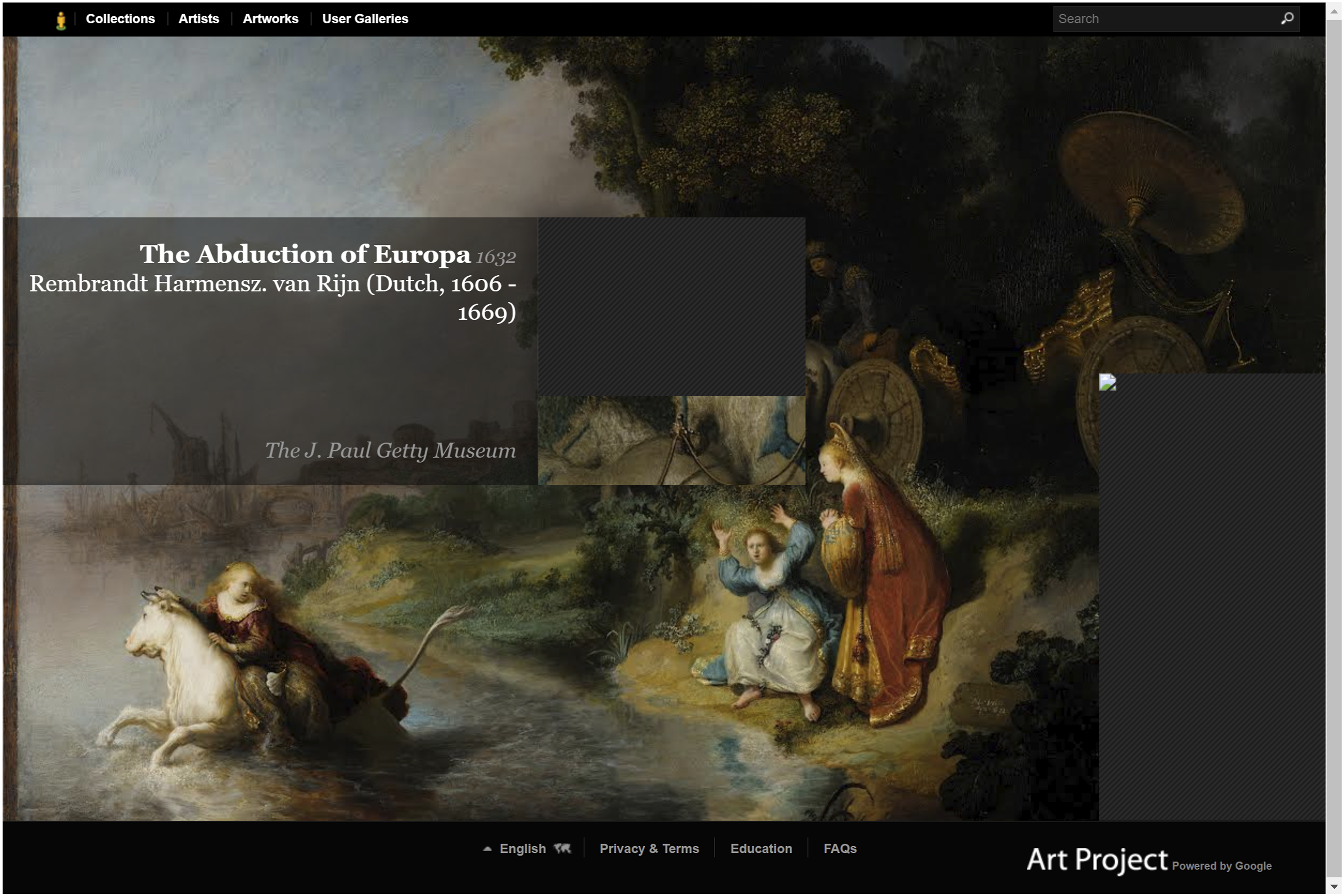
The Google Art Project has been regularly archived since its launch in February 2011. The original website included a homepage listing the 17 initial institutional partners and an FAQ page with a link to the initiative’s YouTube channel (Figure 1). This minimalistic interface design received an update in April 2012, when the initiative announced its first major expansion, along with new tools and social media integration (Sood, 2012). This update marked an important step forward for the platform’s editorial role, however rudimentary, by introducing a featured artwork and later a Featured section on the homepage (Figure 2). Art project homepage (archived February 1, 2011). Art project homepage (archived April 4, 2012).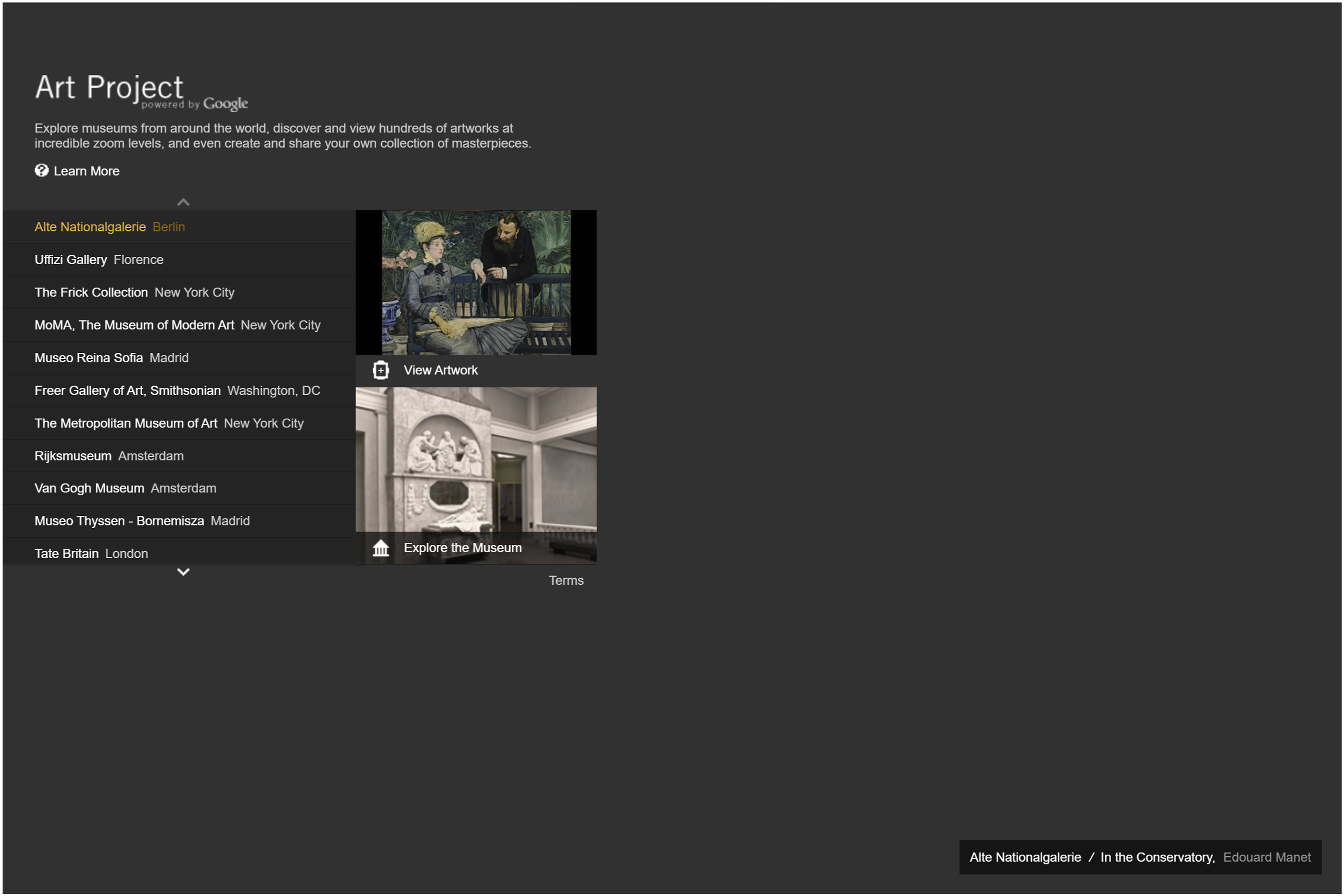
As the Art Project continued to grow, the Google Cultural Institute (GCI) was also expanding. The earliest archived GCI website (Figure 3) consisted of two tabs, Home and About, with links to six different projects: the Art Project, three digitization projects, and two 3D modeling projects using Google Earth technologies. In fact, Google’s vision for GCI grew out of two of these pilot projects with The Israel Museum and Yad Vashem, which predated the launch of the Art Project (Pfanner, 2011). At this stage, it is important to note that the Art Project and GCI were hosted on separate web addresses, while the other five projects resided on their institutional partners’ websites. This setup made the GCI website a de facto informational portal that directed web traffic and user attention to its partners, rather than operating as a centralized content-hosting platform. GCI homepage (archived March 28, 2012).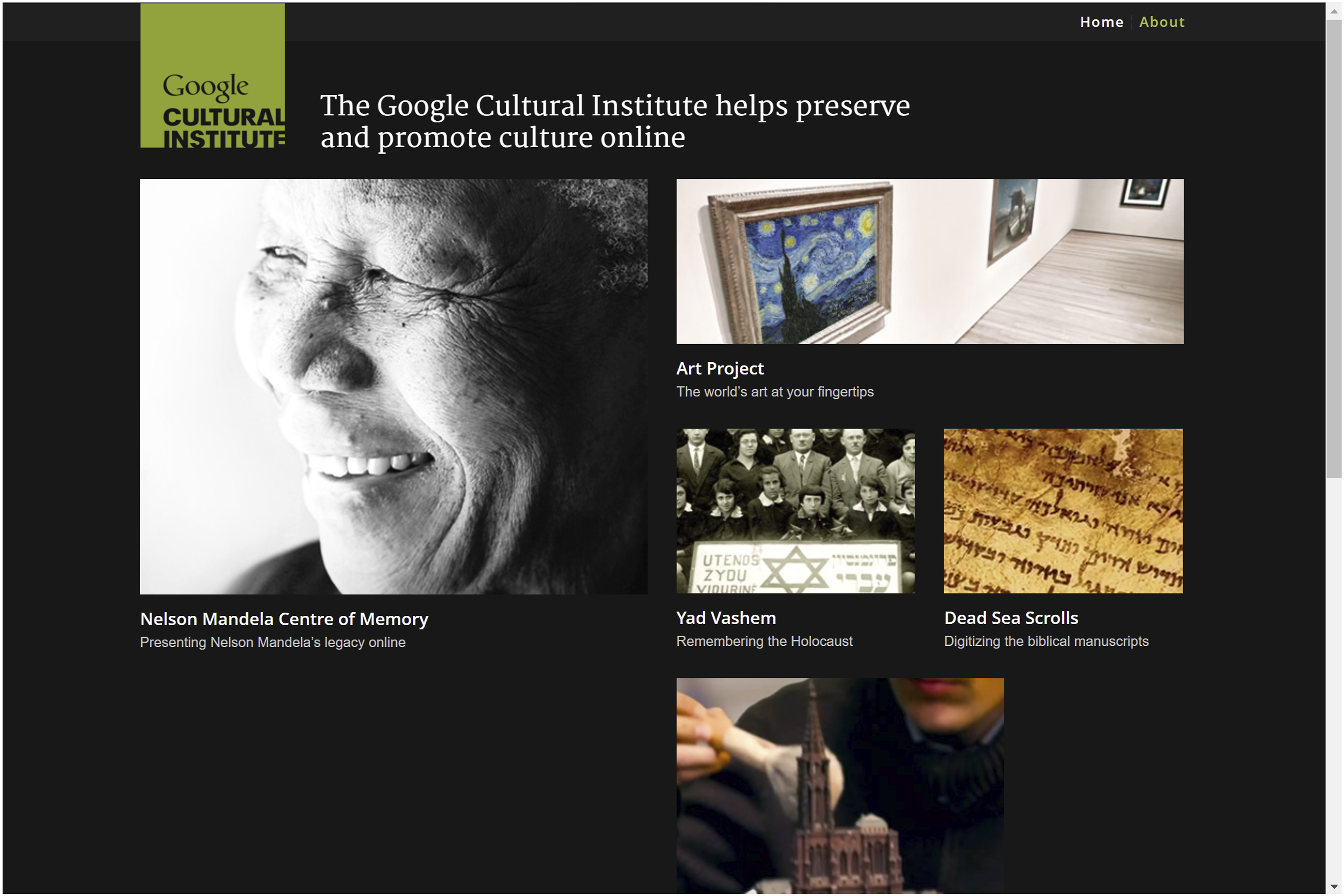
This portal configuration began to change in May 2012 when GCI launched the World Wonders Project on its own website. This projects featured 132 heritage sites from 18 countries through virtual tours, 3D models, and YouTube videos, supplemented by information provided by partner organizations – including UNESCO, the World Monuments Fund, and Getty Images – and downloadable educational materials for classroom use (Blaschke, 2012). In June 2013, the previously separate Art Project website migrated to the GCI site. With this integration came a new homepage that remained stable until the platform was rebranded as Google Arts & Culture in 2016. This version of the homepage (Figure 4) showcased three featured sections – Art Project, Historical Moments, and World Wonders – and included additional sections such as Collections, Exhibits (curated by partner institutions), and Gigapixels (individual objects with advanced zoom functionality). GCI homepage (archived May 31, 2016).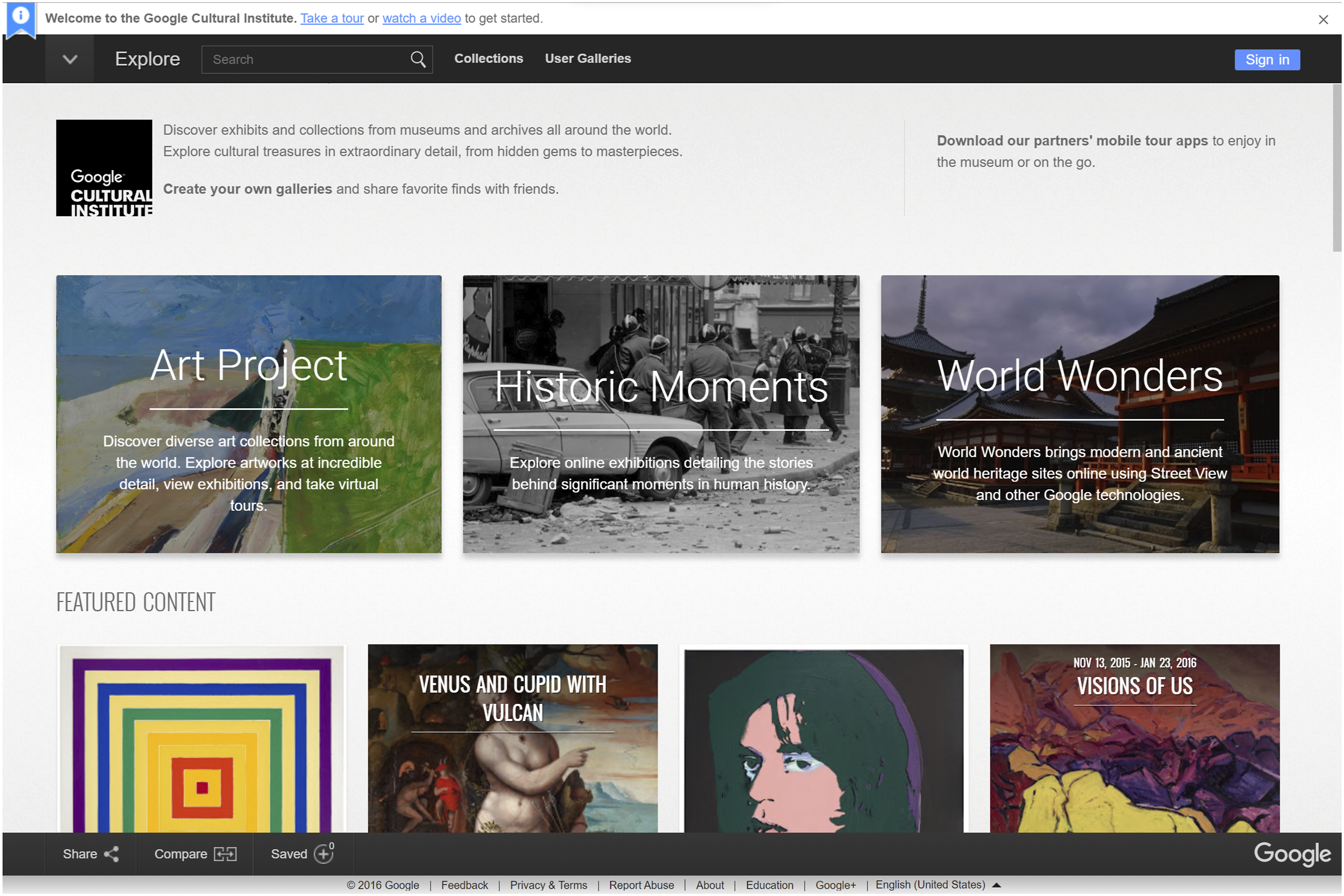
Google formally introduced the rebranded Arts & Culture platform in a blog post in July 2016 (Osborn, 2016), although a beta version of the new website had been running for over a month. This redesign removed the three previously featured sections dedicated to art, history, and heritage sites, circumventing the disciplinary boundaries and instead blending everything into a unified Arts & Culture label. The redesigned homepage continued to demonstrate the platform’s editorial intervention with recurring sections such as Your Daily Digest and later Today’s Top Picks (Figure 5). GA&C homepage (archived July 26, 2016).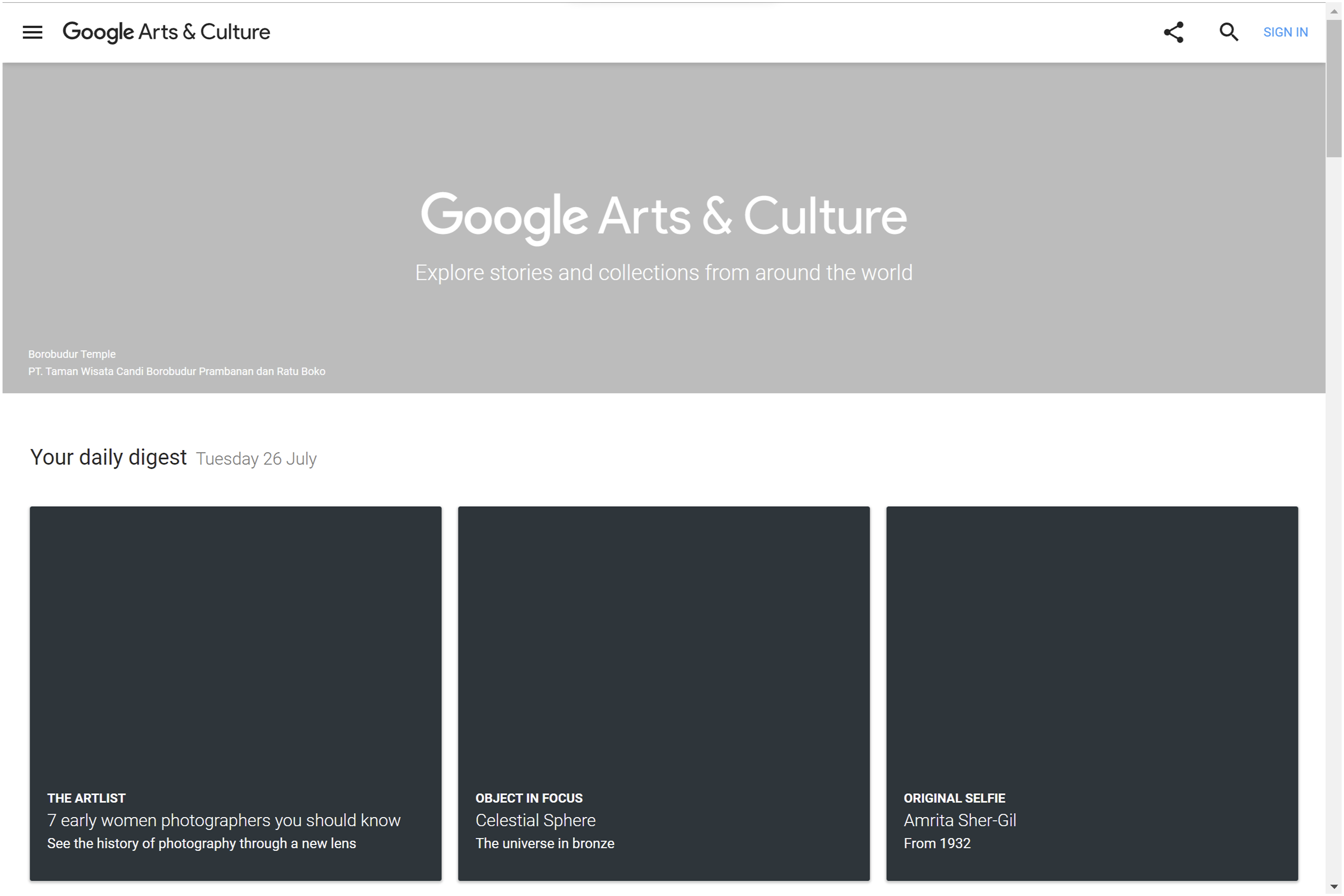
Between this update and April 2020, several navigation elements (Home, Discover, Nearby, Favorites) were relocated from the side menu to the top navigation bar, bringing the interface into close alignment with its current form as of December 2025. Since then, the only two additional tabs added have been explicitly oriented toward interactive and experimental features: Play (June 2021) and The Lab (October 2025).
Along with the redesign, the platform also began, without any official announcement, to phase out the GCI label and streamline its identity under the new GA&C brand. Old URLs for the Art Project and GCI redirected to GA&C, and references to GCI and its past activities were gradually removed from the About page and Terms of Service. GCI’s old YouTube channel, still verified to this day, was vacated, and its content migrated to the new GA&C channel. Finally, to put a visual nail in GCI’s design coffin, the platform introduced a new logo in January 2023, replacing the old Doric temple-inspired design with a stylized amalgamation of the letters G, A, and C forming an ampersand. Initially rendered in Google’s signature colors, this logo was updated to a monochromatic version 6 months later.
Importantly, this visual shift did not involve the removal of any partner institutions, which had already been pushed deeper into the menu as the number of partnerships continued to grow. Rather, the change marked the disappearance of any visual reference to the institutional aesthetics traditionally associated with cultural heritage institutions. The Doric temple motif, invoking architectural permanence, public stewardship, and institutional authority, was replaced by an abstract, corporate mark closely aligned with Google’s brand identity. What faded out was thus not particular institutions, but the symbolic framing of the platform as an institute-like cultural entity distinct from the company itself (Figure 6). History of visual rebranding of GA&C, showing the transition from an institute-inspired design language to a consolidated corporate platform identity.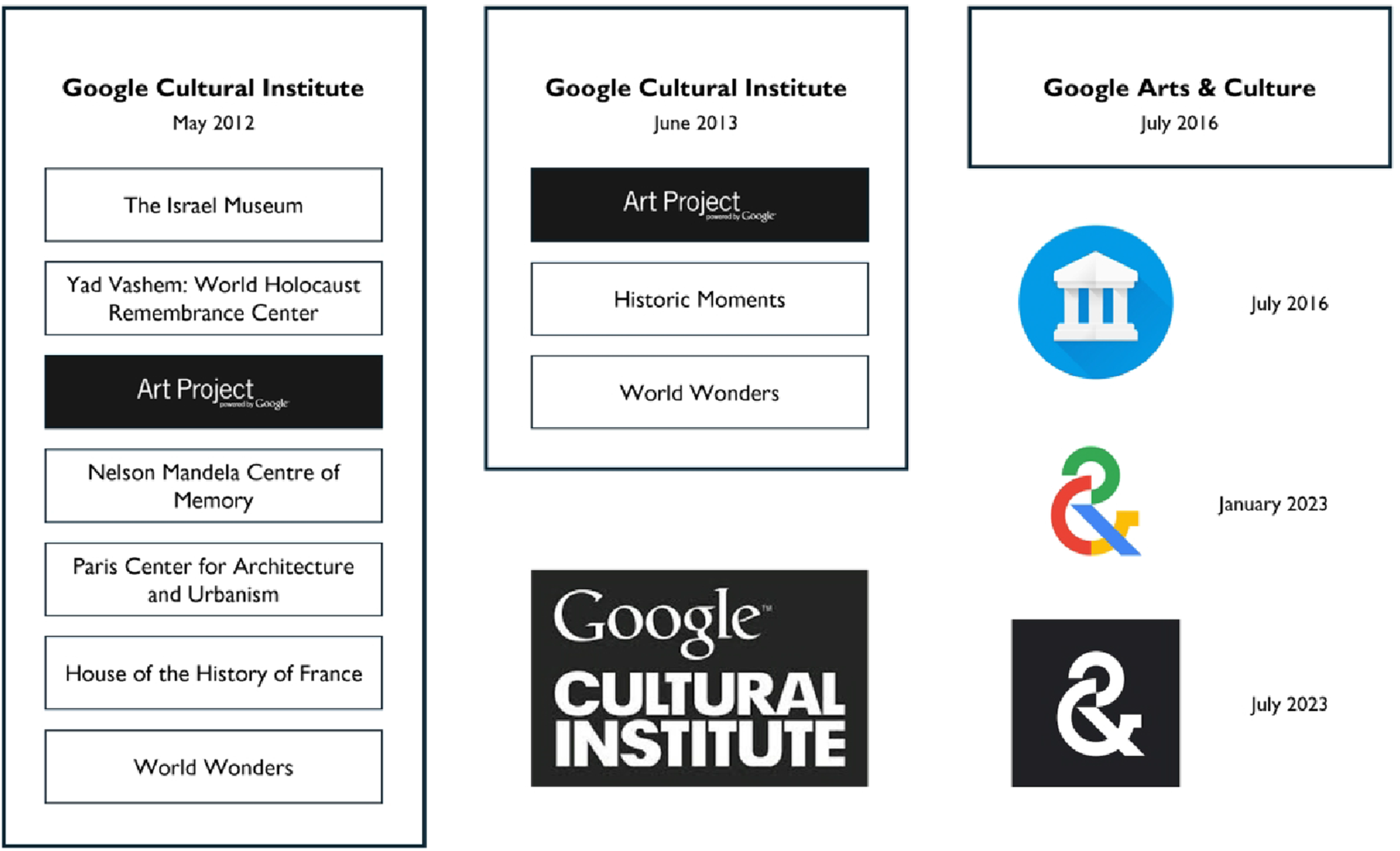
From its initial creation to the eventual dissolution of GCI as a distinct institutional label, the history of what is now GA&C was neither linear nor fully coherent. Multiple small-scale digitization, preservation, and storytelling initiatives preceded and co-existed with the Art Project, reflecting an experimental phase in which different forms of cultural engagement and different types of memory institutions were provisionally assembled under a loosely defined institutional umbrella. This looseness was not merely rhetorical: GCI was never constituted as an independent legal entity, and participating institutions always entered into service agreements directly with Google Inc. or its regional subsidiaries, even as the GCI label continued to circulate informally among employees and partners. The gradual phasing out of the GCI label, alongside its residual presence in legacy interfaces and partner-facing materials (e.g., the partnership signup page), can thus be read as a vestige of the platform’s eclectic and experimental origins rather than as a clearly demarcated institutional transition.
Over time, these heterogeneous initiatives were consolidated organizationally, visually, and infrastructurally into a single, centralized platform operating under Google’s corporate brand. This consolidation marked a broader process of convergence (Jenkins, 2006): not only of art, heritage, and historical content, but also of web traffic and user attention, which were progressively redirected away from partner institutions’ own online environments toward a networked memory institution (Pessach, 2008) deeply embedded within Google’s wider ecosystem. Seen through its web archival history, the early development of GA&C can therefore be understood as a process of platformization in itself (Poell et al., 2019, 2022), one that reconfigured the digital presence of cultural institutions by subsuming diverse institutional practices within a unified, branded intermediary infrastructure.
The gamification of user experience
If the archived web history of GA&C was characterized by convergence, the development of its mobile application followed a markedly different trajectory. Rather than reproducing the experience of the web, the app became a space for experimentation, differentiation, and active reconfiguration of user engagement. In this sense, the mobile interface functioned less as a derivative access point and more as a strategic testing ground where new forms of interaction, navigation, and participation could be trialed and iteratively refined. Tracing the app’s version history therefore provides a revealing window onto shifting platform priorities, as design changes were introduced incrementally and documented explicitly, rendering otherwise opaque strategic decisions empirically legible.
Before launching its own mobile app in November 2015, GCI provided free tools that enabled partner institutions to develop their own apps (Tansley, 2014). This dispersed and customized form of infrastructural support was supplanted by a centralized mobile access point with the release of the official GA&C app. As with the early development of the website, the mobile app also redirected the flow of web traffic and user attention away from participating institutions and back to the platform itself, further consolidating the process of platformization.
Between November 2015 and December 2025, a total of 85 versions of the app’s APK files were archived and made available for download via the APKMirror website. Each release was accompanied by update notes, including a What’s New section and a more extensive Description of the app. The Appendix lists all versions for which new information was added to the What’s New sections; the Description texts are excluded due to their length. Unless otherwise specified, all screenshots included in the following analysis were captured on July 29 of 2024.
The early versions of the GA&C app, from November 2015 to June 2018, are no longer directly accessible or usable. Versions 1.0.1 to 4.0.3 automatically redirected users to the platform website when launched and displayed an error message when Internet access was disabled. Subsequent versions, from 4.1.2 to 6.2.0, prompted users to update the application, presumably due to deprecated technical or security parameters (Figure 7). Consequently, although the APK archive allows the documentation of version histories, the direct analysis of the app is only feasible from version 6.3.12 onward. Earlier iterations can be examined only indirectly, through static screenshots and update metadata, a limitation that mirrors the partial and uneven recoverability characteristic of web archival research more broadly. Early versions of the GA&C mobile app: version 1.0.1 (left) and version 3.0.9 (middle) automatically redirect users to the platform website, while version 4.1.2 (right) prompts a mandatory update, preventing direct use of these early app iterations.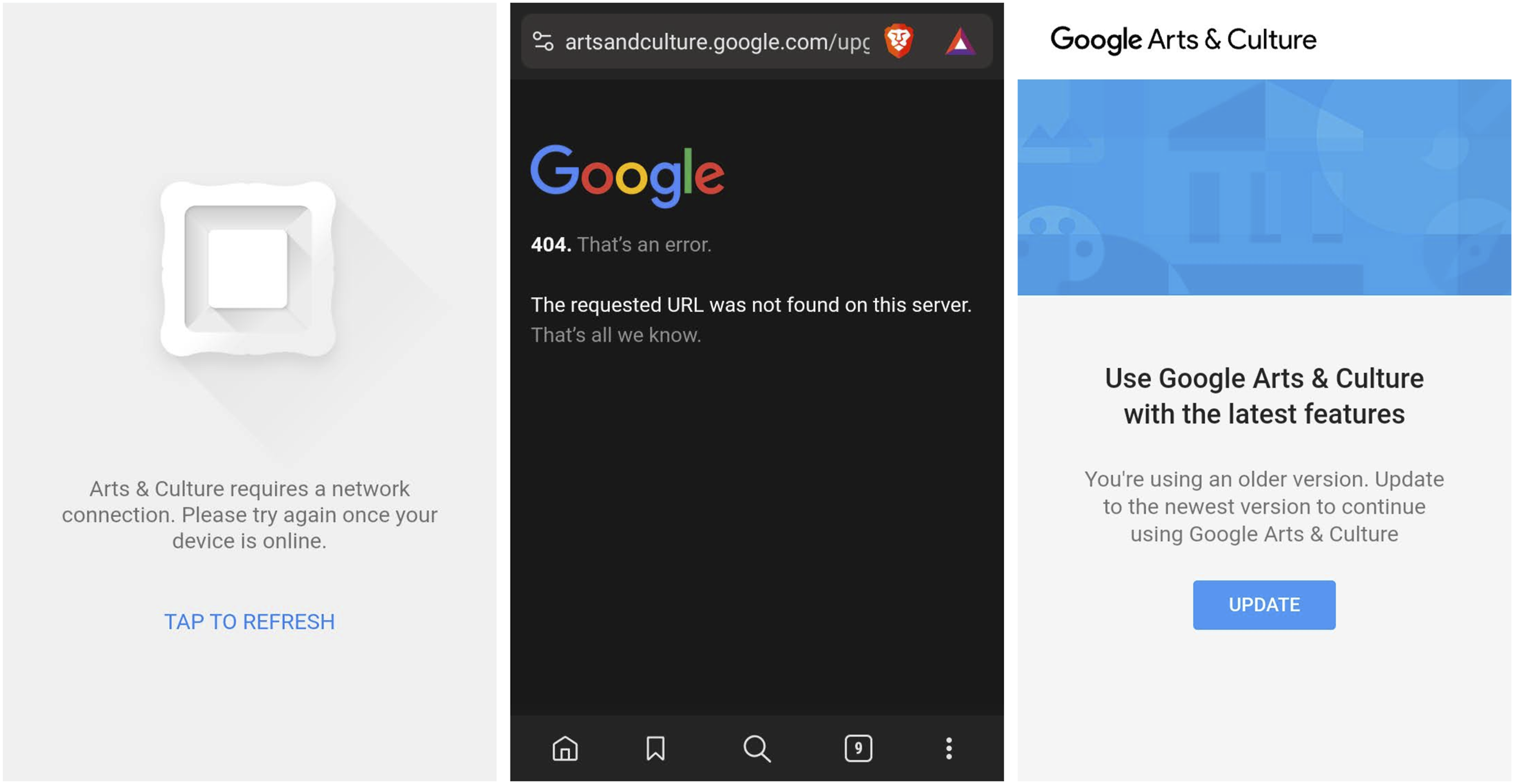
The earliest usable iteration of the app (version 6.3.12, June 2018) closely mirrored the design principles and content strategies of the platform website. It featured four primary tabs, Home, Explore, Nearby, and Profile, while the sidebar menu reproduced the same sections found on the web interface, slightly optimized for mobile use (Figure 8). This interface structure remained largely unchanged until version 6.5.13 (November 2018). Earliest usable version (6.3.12) of the GA&C app.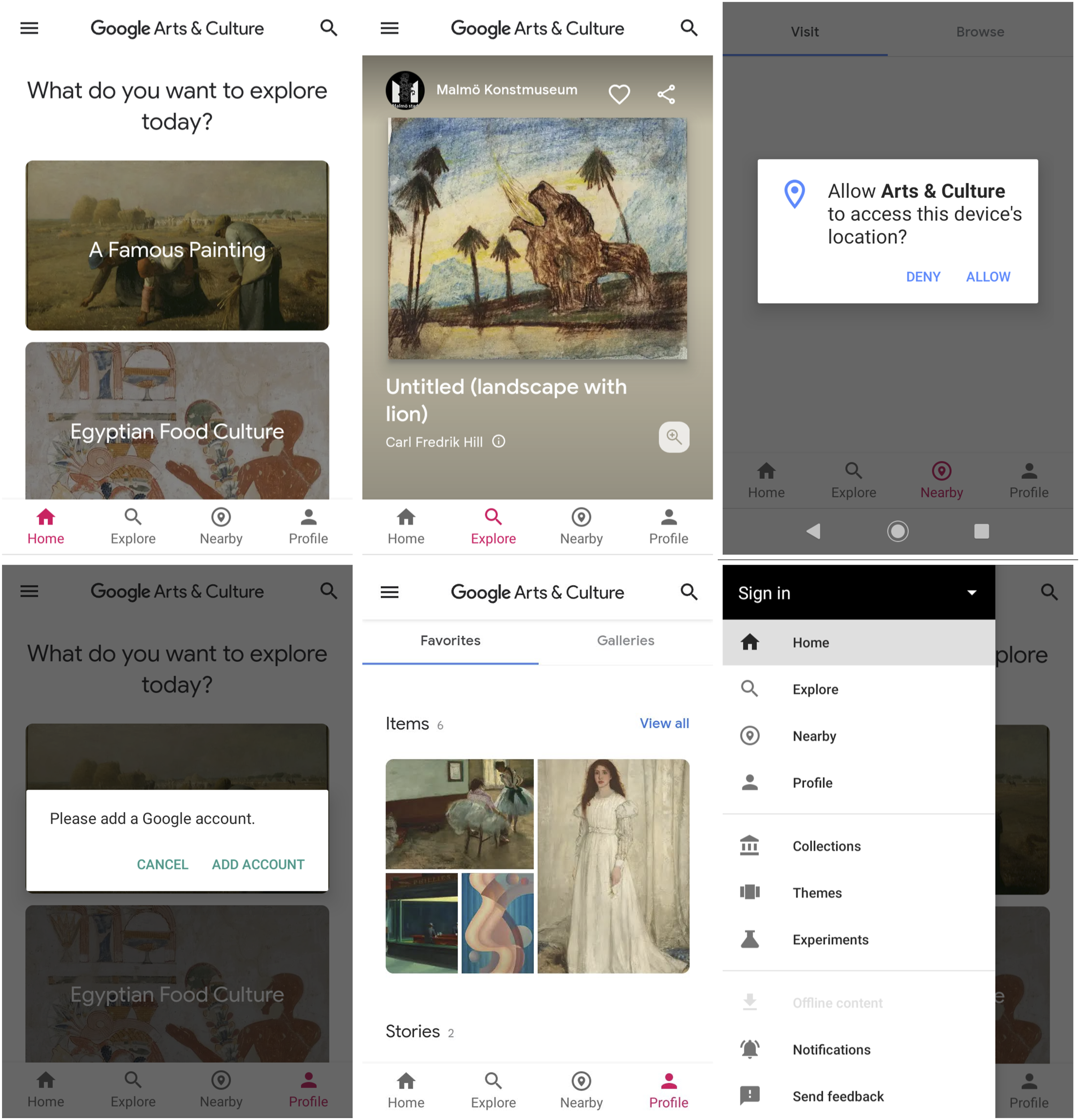
The app’s first major departure from the website was introduced in version 7.0.11 (January 2019), when a camera icon was added to the center of the navigation bar. Subsequent versions made this icon increasingly prominent (version 7.5.21) and stylized it using Google’s primary colors (version 8.0.16) (Figure 9). This tab provided direct access to camera-based, XR-enabled features such as Art Selfie, Color Palette, Art Projector, and Pocket Gallery. Prior to this change, users had to scroll through the homepage or rely on the search function to locate these features. The introduction of the camera tab likely responded to the viral popularity of Art Selfie on social media. Despite documented technical limitations and racial biases in facial matching (Shu, 2018), the feature briefly propelled the app to the top position among ‘free education applications’ in the Google Play Store (Duino, 2018). Subsequent updates expanded this category with additional camera-based features, including Art Transfer, Art Filter, Pet Portraits, and a generative AI-powered second edition of Art Selfie (Shepherd, 2024). During this period, a Cast function was also introduced in version 8.0.16 (and later removed in version 10.2.3), enabling image projection onto a second screen, while a Favorites tab, marked by a heart icon, replaced the Profile tab, which had never supported a customizable user profile beyond a linked Google account. The addition of a camera tab: version 7.0.11 (left), 7.5.21 (middle), 8.0.16 (right).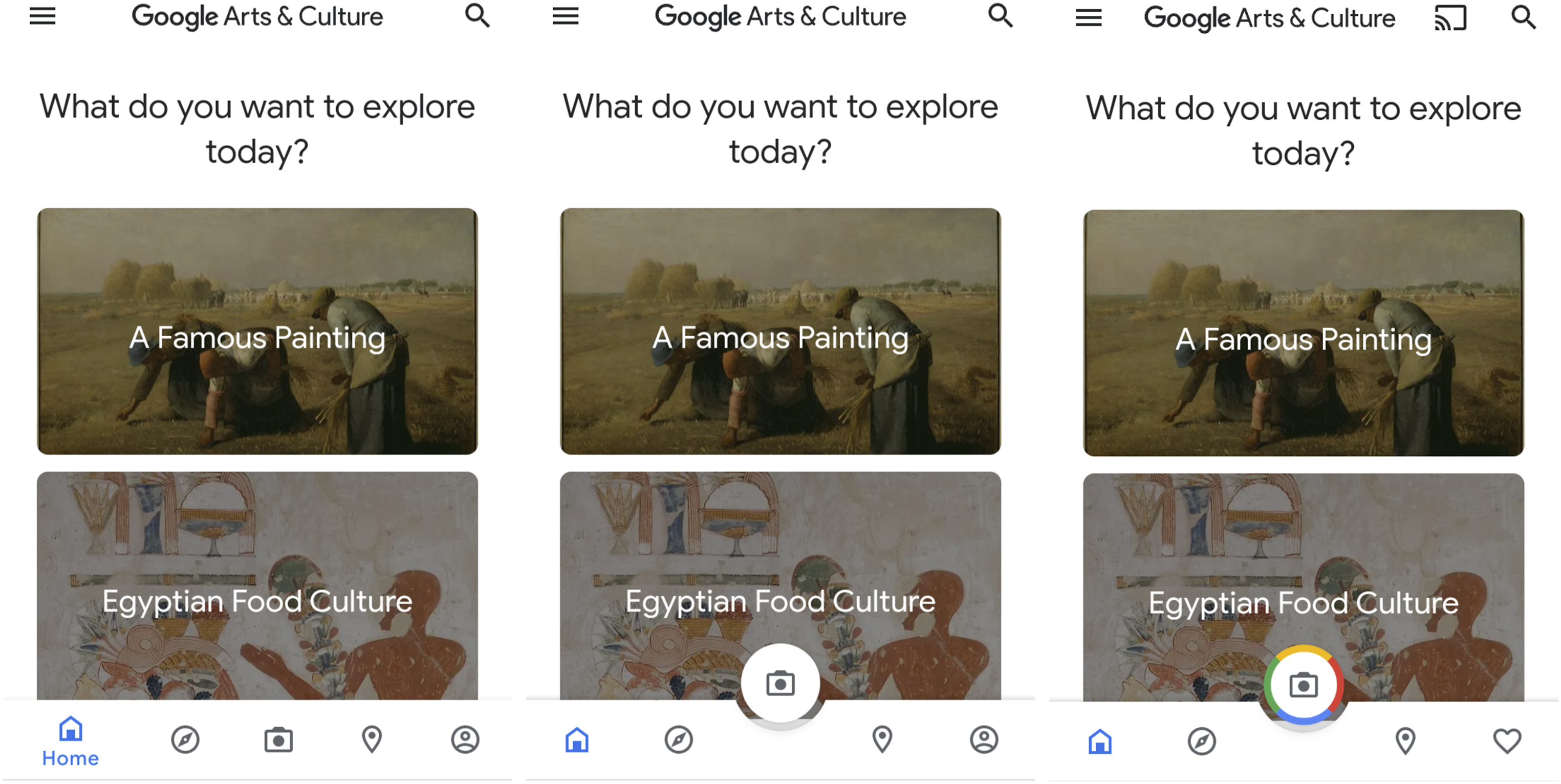
In version 8.0.19 (December 2020), an Achievement section was added to the sidebar menu, allowing users to view badges earned through in-app activities such as using specific features or creating personal galleries. While playful interactions had long been embedded in the app’s camera-based features, the explicit adoption of ludological terminology, such as ‘achievements’ and ‘badges’, marked a clearer embrace of gamification as a design orientation. This shift became more visible in June 2021, when a Play tab was also added to the website’s navigation bar. Shortly thereafter, version 8.4.8 of the app (September 2021) introduced a reconfigured navigation bar: the Nearby tab was moved to the sidebar, and a Play tab, initially represented by a game controller icon that was later refined, was added to the main interface (Figure 10). The addition of a Play tab: version 8.4.8 (left, middle), 9.0.27 (right).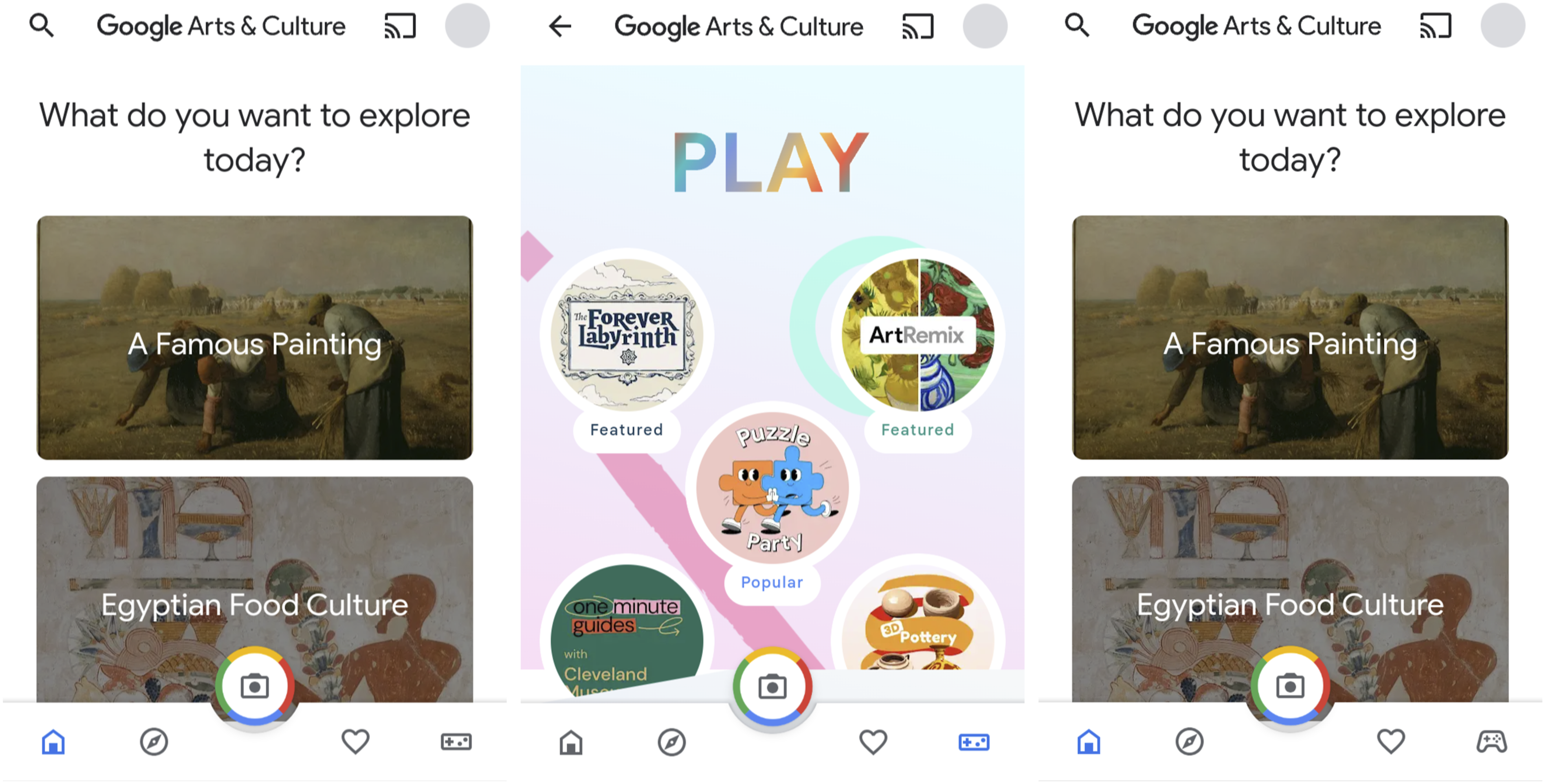
The most significant design overhaul occurred in version 10.2.3 (July 2023), which consolidated the app’s navigation into three primary tabs: Explore, Play, and Inspire (Figure 11). Rather than reproducing the platform’s web structure in a mobile-friendly format, the Explore tab foregrounds six featured items, followed by curated pathways organized by artistic medium (e.g., visual arts and crafts), thematic topics (e.g., nature, fashion, and food), and browsing modes (e.g., collections, themes, and Street View). The Play tab aggregates a growing collection of camera-based features and interactive games, while the Inspire tab marks the most pronounced departure from earlier designs. This section adopts a vertically scrolling interface reminiscent of short-form social media feeds, in which users swipe sequentially between visually dominant ‘posts’, sometimes accompanied by auto-play videos. The redesign of the GA&C app in July 2023 (version 10.2.3).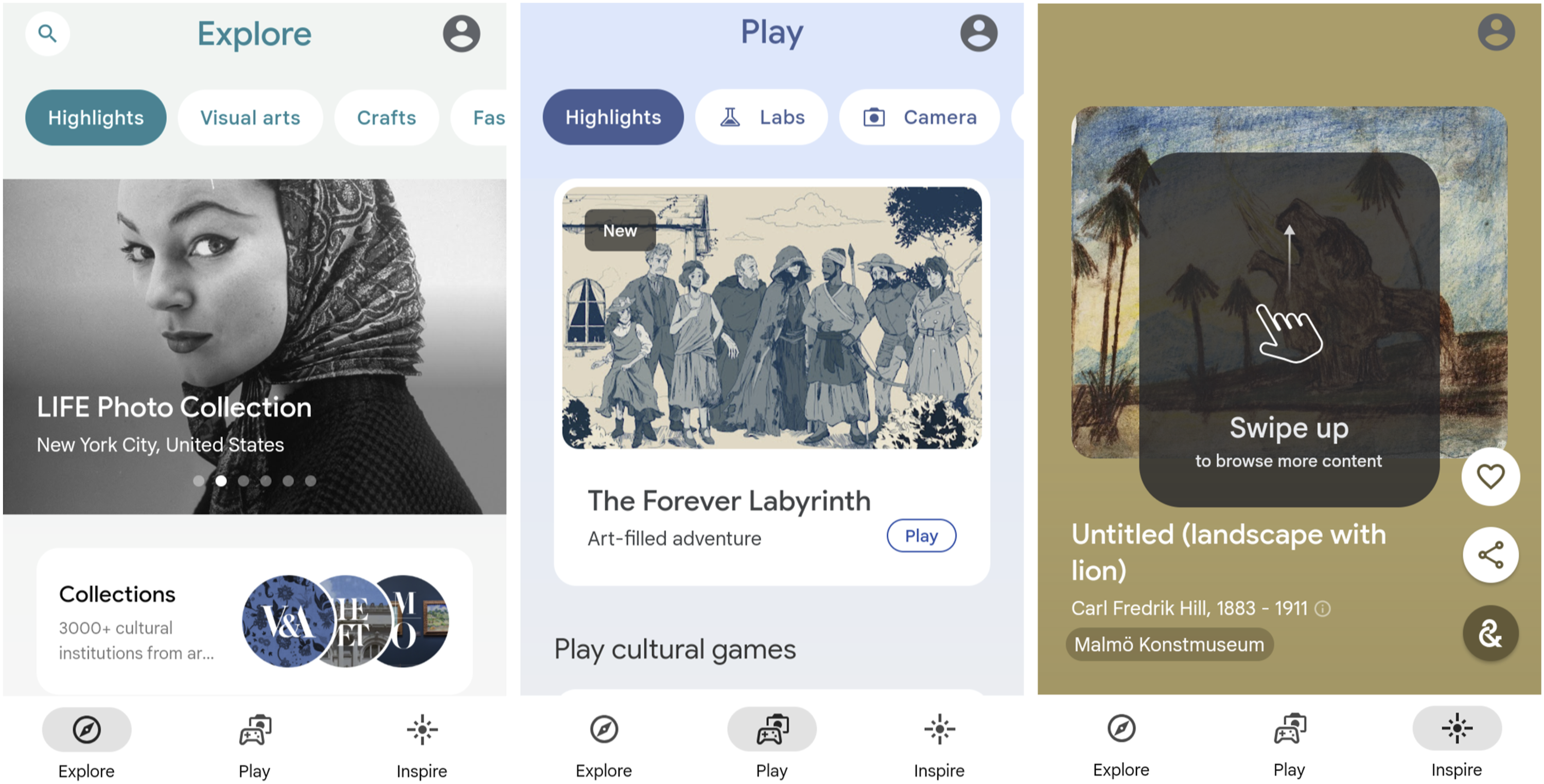
Coinciding with this mobile redesign, July 2023 also marked a notable interface intervention on the platform’s website. While the Play section remained the designated space for games, two features enabled by generative AI were introduced as shortcuts positioned directly above selected artworks (Figure 13). Art Remix used Google’s Imagen model to generate new images based on descriptive user prompts, while Poem Postcard uses a large language model to produce short poems accompanying the artwork. In August 2024, a third shortcut, Art Zoom Out, was added, enabling users to extend an artwork’s visual frame through generative prediction. By embedding these features within the display of the artwork itself, GA&C reconfigured the spatial hierarchy of content, juxtaposing playful experiences alongside institutional content. This interface intervention provides further evidence of the platform’s commitment to playful experience, a shift whose implications for institutional visibility are discussed in the next section. The addition of a dedicated Studio tab: version 11.1.25. Screenshot captured on December 18 of 2025.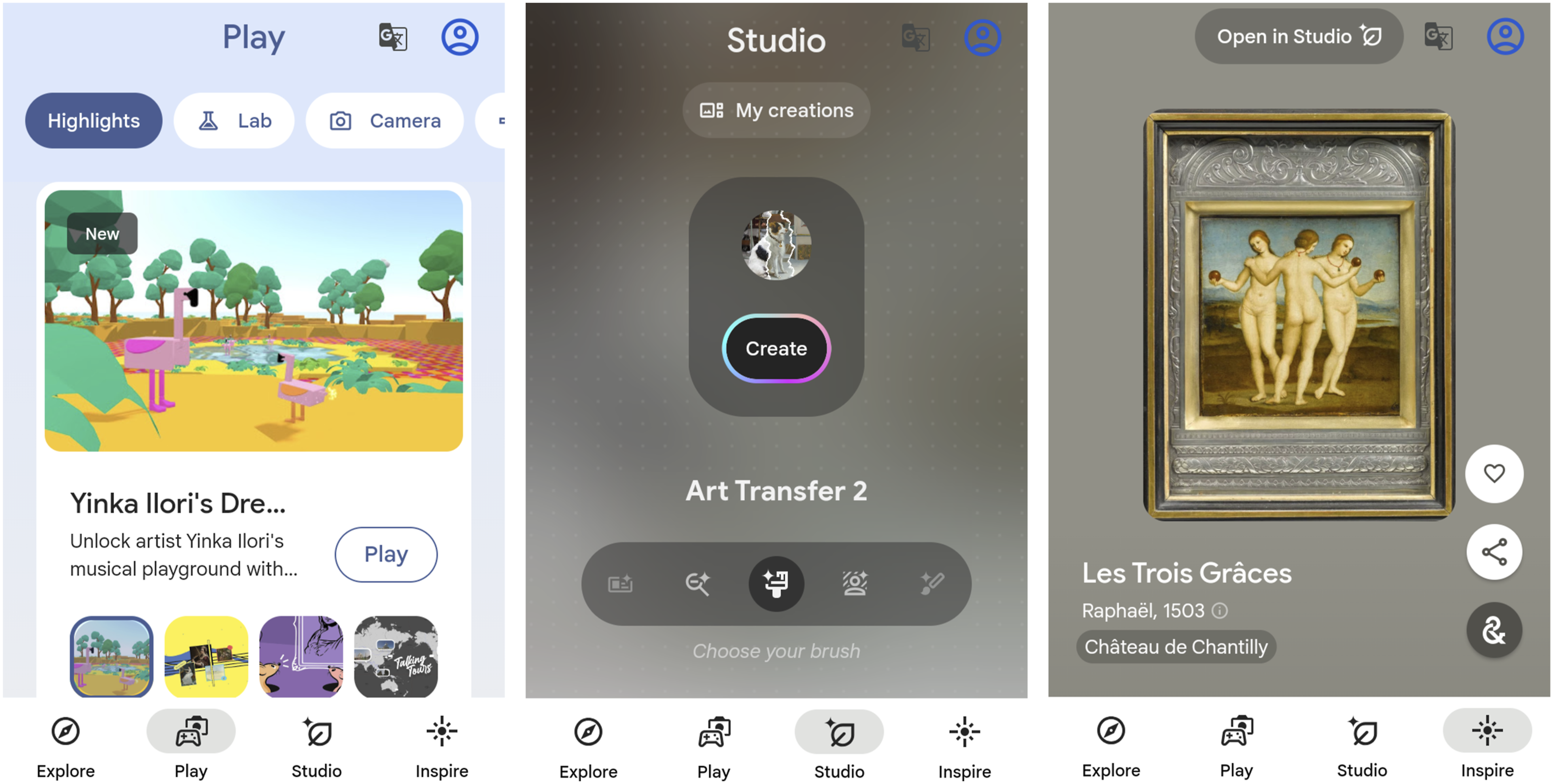
Finally, version 11.1.25 (April 2025) of the mobile app introduced a dedicated Studio tab, consolidating features enabled by generative AI, including the three games described above, into a single interface space (Figure 12). This design decision formalized previously dispersed experimental tools and signaled that AI-driven playful experience had become sufficiently central to the app’s identity to warrant its own navigational category. At the same time, an ‘Open in Studio’ shortcut was added to posts in the vertically scrolling Inspire tab, allowing users to directly activate AI features from within content feeds rather than navigating to them separately. This intervention closely mirrors the design logic previously observed on the website, where game shortcuts were layered directly on top of artworks. Across both interfaces, these shortcuts operate as infrastructural nudges that redirect user attention away from browsing, contextual reading, or institutional interpretation toward immediate interaction. In doing so, the app further entrenched play, rather than exploration or curatorial framing, as its intended mode of user engagement. The addition of two game shortcuts on select artworks on the GA&C website. Screenshot captured on October 29 of 2023.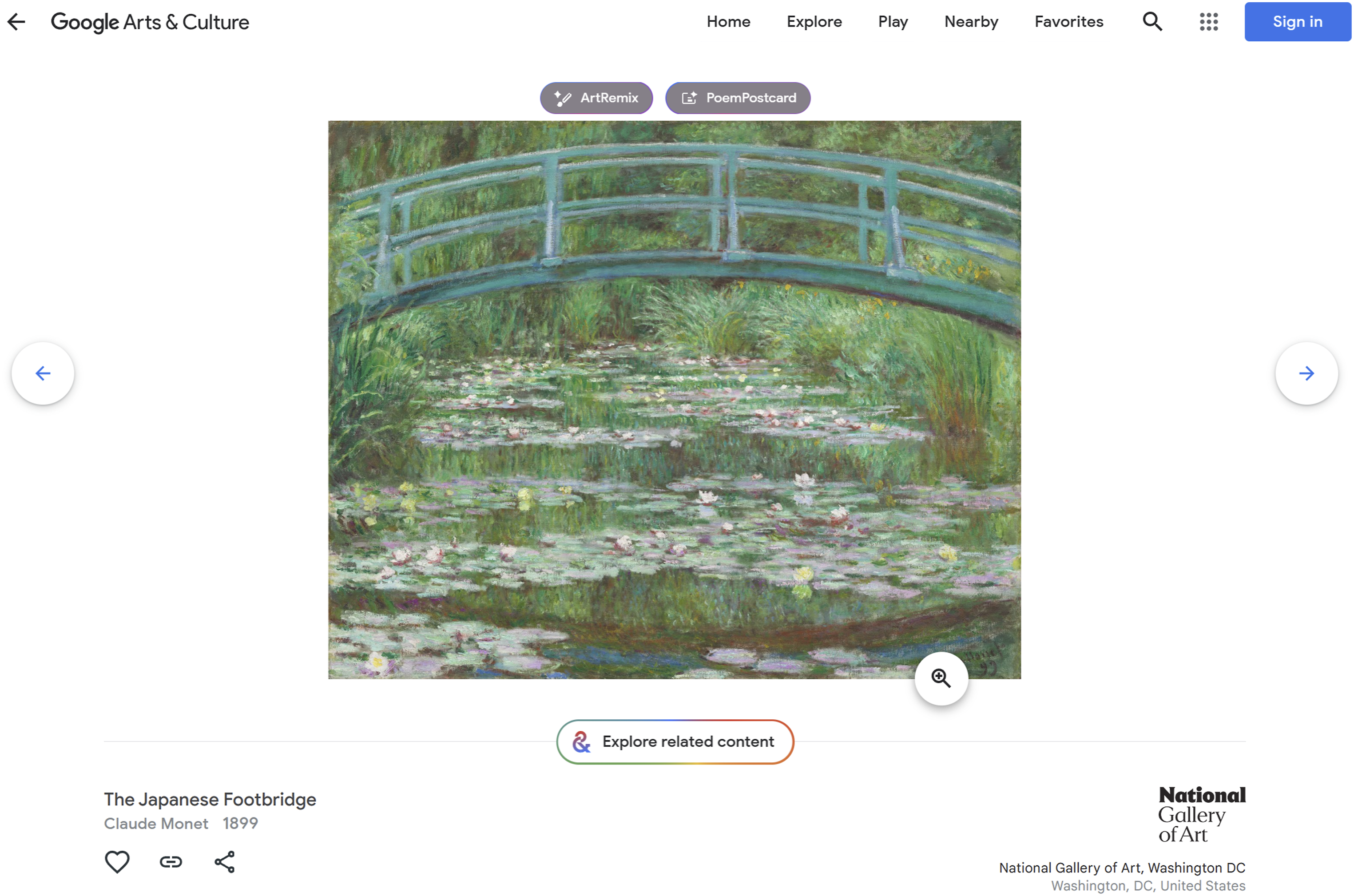
Although the complete history of the GA&C app cannot be reconstructed due to technical limitations that prevent the use of its earliest versions, the app’s discrete versioning system and detailed update records make it possible to trace incremental design and functional changes over time. Compared to the website, where updates were introduced continuously with limited public records, these versioned releases provide clear evidence of evolving platform priorities. Based on this analysis, the development of the app between November 2015 and December 2025 can be broadly divided into three phases: • Versions 1–6: replication of the web experience in mobile-friendly formats • Versions 7–9: experimentation with camera-based features and interactive games • Versions 10–present: prioritization of mobile-native navigation and playful experiences increasingly enabled by generative AI
This periodization points to a gradual but consequential divergence of the mobile app from its web counterpart. What began as a mobile-friendly extension of the website progressively recentered user interaction around mobile-native affordances, including camera-based XR functions, activity-driven features, and media consumption formats resembling those of social media platforms. The introduction of Achievement badges and the consolidation of games and interactive features into dedicated interface spaces foregrounded play not as an auxiliary experiment, but as a preferred mode of engagement and therefore an increasingly normative statement about the platform’s intended use (Stanfill, 2015).
The GA&C Program Manager also confirmed in the interview that this reorientation was deliberate rather than incidental. According to the PM, playful experiences were explicitly framed as a means of broadening access to cultural content and engaging users who might otherwise perceive art and museums as inaccessible or irrelevant. In this framing, gamification functions as a strategic mechanism for lowering perceived cultural barriers and sustaining user attention. However, once playful experiences and game features are no longer confined to discrete sections but increasingly embedded in the presentation of individual artworks, this strategy also reshapes how institutional content is encountered and interpreted. It is at this point, where platform design decisions intersect directly with institutional authority, visibility, and control, that the question of platform orientation becomes unavoidable.
Platform orientation and institutional positioning
As GA&C consolidated previously dispersed access points into a single, centralized platform and increasingly foregrounded gamified experiences, the position of cultural institutions within this ecosystem became less self-evident. While institutional partners continue to supply the collections, metadata, and symbolic legitimacy on which GA&C depends, the platform’s evolving design logic raises a more fundamental question: who is this platform ultimately for? The following analysis brings together three interrelated layers of evidence: the platform’s mission statements as a discursive value proposition, partner-facing email communications as traces of operational practice, and interviews with cultural institutions that situate both discourse and practice within lived institutional experience.
Over the past decade, changes in GA&C’s mission statements point to a gradual reorientation of the platform’s stated purpose. Earlier formulations explicitly emphasized infrastructural support for museums and archives, including references to the provision of ‘free tools and technologies’ designed for the cultural sector. In later iterations, this language was replaced by broader references to ‘working with cultural institutions’ and an increasingly prominent emphasis on access, discovery, and global audiences. As summarized in Appendix 2, this shift is marked less by a single rupture than by the steady removal of institution-facing commitments from the platform’s self-description, alongside the consolidation of a unified, user-oriented platform identity. This orientation was also reiterated by the PM, who emphasized in the interview that the platform prioritizes education and accessibility.
This discursive shift aligns with findings from prior research showing that institutional support within GA&C was often limited, uneven, or difficult to operationalize in practice, particularly in relation to digitization services, metadata interoperability, and the usability of content creation tools (Cao, 2025). As a result, partner institutions are increasingly positioned as content contributors rather than active collaborators or infrastructural stakeholders. In this sense, while the platform continues to invoke institutions symbolically, its evolving mission increasingly centers value creation around modes of access and engagement exclusively prescribed by the platform.
Partner-facing email communications provide further evidence of the operationalization of this changing orientation. The analyzed archive, consisting of twelve emails sent between 2017 and 2023, was shared by a U.S.-based partner institution (Appendix 3). While limited in scope, these records offer insight into how GA&C communicates with institutional partners and what forms of engagement are encouraged. In terms of content, the emails fall into three broad categories: greetings, milestone reviews, and content or feature updates. Taken together, these communications emphasize ongoing partnership, continued contribution, and feature promotion, rather than consultation over platform design or the articulation of institutional needs.
Notably, several emails functioned as invitations to participate in themed projects curated by the GA&C team. Such projects, often organized around artists, regions, or commemorative events, highlight the platform’s editorial role in selecting themes, constructing narratives, and coordinating institutional contributions. As the PM confirmed, while institutions may suggest topics or be consulted as subject-matter experts, participation is largely structured around agendas and timelines defined by the GA&C team. As argued elsewhere in more detail (Cao, 2025), this editorial logic positions GA&C not merely as a content intermediary but as an active cultural gatekeeper whose curatorial decisions shape institutional visibility and interpretative framing across the platform.
While mission statements and email communications reveal how GA&C articulates its role and manages partner relations, interviews with cultural institutions shed light on how these dynamics are experienced in practice. The interview material mobilized here draws from a subset of previously unused responses that specifically address institutional reactions to the addition of game shortcuts layered directly on top of artworks, as discussed in the previous section (see Figure 13).
Interviewees consistently emphasized the absence of direct communication regarding the introduction of these features. Only one participant reported having encountered the AI-based games prior to the interview, and none recalled receiving advance notice through email channels. Instead, the addition of the shortcuts was announced only via an official Google blog post (Shepherd, 2023). For most institutions, awareness of the games and the interface reconfiguration emerged only through incidental discovery. This lack of communication, according to the PM, was attributed in part to the limited capacity and constant turnover within the GA&C team. The U.S. team, for instance, managed over 700 partnerships but consisted of only one full-time employee and three contractor coordinators at the time of the interview.
Beyond the lack of notification, interviewees also raised concerns about how these features recontextualized institutional content. Several participants described discomfort when AI-generated content was associated with collection images that were scientific, historical, or culturally sensitive. Concerns included misleading labels, a lack of attribution or contextual framing, and the absence of technical configurations to disable these features at the item level, or to control how content was transformed. It is worth noting that gamification was not perceived by most interviewees as inherently problematic. Rather, many described the way AI features were introduced on the platform, particularly the absence of control parameters, as a ‘missed opportunity’ for establishing a dialogue between traditional art mediums and new media technologies.
Interviewees also highlighted how such changes exposed asymmetries in control embedded within the platform’s interface architecture. Decisions about feature placement and prominence were firmly platform-driven, with limited opportunities for institutional input, consent, or negotiation. Some participants also noted internal tensions within their own organizations, particularly between curatorial staff concerned with interpretative accuracy and technical or communications teams tasked with maintaining platform partnerships, who may be more open to experimenting with new technologies. These observations echo earlier findings regarding the role of internal institutional dynamics in shaping engagement with the GA&C platform more broadly (Cao, 2025).
Taken together, these layers of evidence point to a platform whose orientation toward cultural institutions is marked by strategic ambiguity. Institutions remain indispensable as content providers and sources of legitimacy, yet they occupy a peripheral position in decisions that shape interface design, feature prominence, and modes of engagement. This ambiguity was explicitly acknowledged by the PM, who described the platform’s primary audience as deliberately open-ended, encompassing both partner institutions and end users without clear prioritization. Rather than resolving the question of who the platform is for, this openness enables a configuration in which institutional participation is assumed, while institutional authority is increasingly displaced by platform-defined priorities centered on user engagement, interactivity, and AI-enabled playful experiences.
Conclusion
This study examines how Google Arts & Culture has evolved over the past 14 years and what this trajectory reveals about the platform’s role in an increasingly platform-dependent cultural sector. By reconstructing the platform’s web and app histories alongside partner communications and interview insights, the analysis demonstrates that GA&C’s development has been neither linear nor merely technical, but deeply shaped by shifting priorities around access, engagement, and control.
First, the findings show that GA&C emerged through a process of convergence. Multiple digitization, preservation, and storytelling initiatives, initially fragmented and experimental, were gradually consolidated under a single corporate brand and interface. This consolidation did not merely unify institutional participation, but it also redirected user attention, web traffic, and critical visibility away from individual partner institutions toward a centralized, Google-branded platform embedded within a broader ecosystem of services.
Second, the platform’s recent development reveals a marked shift toward gamification and user-centric design, particularly within the mobile app. Interface changes increasingly prioritize playful, immersive, and AI-enabled experiences over institutional representation and content navigation modeled on traditional memory institutions. While gamification is framed by the platform as a means of accessibility and engagement, the analysis shows that these features were often introduced without meaningful communication with partner institutions regarding their preferences or needs, reinforcing asymmetries between platform providers and institutional complementors.
Third, the study highlights GA&C’s editorial role in shaping cultural narratives and institutional visibility. Through curated front pages, themed projects, selective invitations, and interface-level feature placement, the platform has always been actively curating cultural content rather than merely hosting it. These editorial interventions challenge the platform’s self-description as a neutral facilitator and reveal how governance increasingly operates through design decisions that structure what users see, how content is contextualized, and which institutions are foregrounded.
These findings suggest that GA&C occupies an ambivalent position in the cultural heritage sector. Cultural institutions remain indispensable as content providers and sources of legitimacy, yet they are increasingly peripheral to decisions that shape how their content is presented, transformed, and encountered. This ambiguity, acknowledged even by platform representatives, allows GA&C to address both cultural institutions and end users without fully committing to either, while prioritizing forms of engagement increasingly defined and prescribed by the platform.
The implications of this study extend beyond GA&C. As generative AI, extended reality, and platform infrastructures continue to reshape cultural production and circulation, similar dynamics are likely to intensify across the sector. Understanding how platforms govern culture through interfaces, editorial choices, and engagement-oriented design is therefore crucial for assessing their long-term impact on institutional autonomy, cultural authority, and public knowledge. Continued critical scrutiny of cultural platforms, particularly through longitudinal and institution-centered research, will be essential as these technologies become further entrenched in the infrastructures of memory and meaning-making.
Supplemental material
Supplemental material - Google arts & culture and the platformization of cultural heritage: Convergence, gamification, and shifting positions of institutional partners
Supplemental material Google arts & culture and the platformization of cultural heritage: Convergence, gamification, and shifting positions of institutional partners by T. Leo Cao in Convergence.
Footnotes
Acknowledgments
I would like to express my sincere gratitude to all the interviewees who generously shared their experiences and insights. I am also deeply grateful to Dr. Sharon Strover for her thoughtful feedback on an earlier version of this manuscript. My thanks extend to the reviewers and editors for their constructive feedback on the final version of the article. Finally, I would like to thank the Center for Advanced Internet Studies (CAIS) for its support in completing this article.

Ethical considerations
The Institutional Review Board at the University of Texas at Austin approved the interview protocol on June 12, 2023 (IRB ID: STUDY00004522). The IRB determined that this protocol meets the criteria for exemption from IRB review under 45 CFR 46.104 (2)(ii) Tests, surveys, interviews, or observation (low risk).
Consent to participate
Participants gave verbal consent to participate before starting the interview.
Consent for publication
Participants gave verbal consent for publication before starting the interview. Their identities have been anonymized in accordance with confidentiality requirements.
Funding
The author received no financial support for the research, authorship, and/or publication of this article.
Declaration of conflicting interests
The author declared no potential conflicts of interest with respect to the research, authorship, and/or publication of this article.
Data Availability Statement
The screenshots of the Google Arts & Culture platform used in this study are publicly available and can be accessed as described in the methods section. The interview transcripts are not publicly available due to confidentiality and ethical considerations.
Supplementary Material
Supplemental material for this article is available online.
Note
References
Supplementary Material
Please find the following supplemental material available below.
For Open Access articles published under a Creative Commons License, all supplemental material carries the same license as the article it is associated with.
For non-Open Access articles published, all supplemental material carries a non-exclusive license, and permission requests for re-use of supplemental material or any part of supplemental material shall be sent directly to the copyright owner as specified in the copyright notice associated with the article.
