



Abstract
Current scholarship on platforms does not fully account for how platforms produce content. To demonstrate this limitation, we examine the platform Google Arts and Culture (GAC) revealing distinct forms of cultural production. While GAC functions as a repository, allowing users access to objects, sites, and exhibitions, it is more than a digitization project. GAC is a content producer providing narrativized content, as well as games, and opportunities to curate digital collections and produce creative projects. Unpacking these dimensions, our study demonstrates how cultural production functions on GAC and the users that this enables. We argue that GAC facilitates four types of cultural production for distinct groups of cultural producers. Focussing on the cultural production of the platform, we further contend that GAC occupies a unique hybrid role as facilitator and author. We point to this authorial role because it is largely obscured. Assessing how GAC wields cultural control, we characterize its distinct functionality as a ‘super user’ on the platform: facilitating end-user engagement with content, moderating the content uploaded to the platform by institutions, and producing and promoting its own curated content. Analyzing GAC’s affordances as a super user extends our theorization of platformized cultural production with respect to non-monetized platforms. Based on these findings, we call for scholars to attend to the ways in which platforms can function as cultural actors, in addition to their role as technical intermediaries structuring the means of engagement.
Keywords
Introduction
Established in 2011 to ‘make museum artwork more accessible’ (Sood, 2011, 2021), Google Arts and Culture (GAC) offers free virtual access to premiere cultural institutions and their collections (Proctor, 2011). 1 GAC has an explicit non-profit purpose, however, it has direct ties to the larger for-profit entities of Google and Alphabet Inc. While it is beyond the scope of this study to detail the ways that GAC may mine user data or otherwise seek to profit from the platform, the company arguably reaps a range of benefits from the initiative. As such, we do not take at face value that GAC operates merely for social good. From the outset, GAC was rapidly engaged by museum partners, garnering 151 participating museums across 40 countries in its first two years (Knowles, 2012). In a quantitative assessment of the platform in 2023 we found that GAC provided access to over seven million items from 2965 institutions, across 99 countries, making it one of the largest cultural repositories in the world. As of June 2025, the site boasted material from over 3390 partner institutions’ collections. The scope of the platform raises larger questions about how its cultural content is controlled, including issues of cultural ownership, as well as who is benefiting from shepherding visitors towards GAC and away from individual institutional online presences. GAC is a key platform for public access to culture, thus it is necessary to critically examine in order to understand how the platform asserts control over our understandings of culture, and also how GAC’s digital infrastructure limits the ways we engage with and conceive of culture. Within this larger conversation about control over cultural content, our study seeks to understand how cultural production functions on GAC and the implications of this functionality.
While the platform features games, interactive components, and personalized search and save functions, GAC foregrounds conventional understandings of cultural consumption, providing high-resolution images and information about cultural objects and sites. The platform also offers Museum Views (drawing on Google’s Street View function), allowing users to explore galleries and objects virtually. In amassing a significant repository of cultural objects and sites GAC can be understood in relation to other aggregate initiatives like GoogleBooks and educational cultural platforms SmartHistory and Europeana. Initially appearing as a straightforward heritage digitization project, further scrutiny of GAC via a digital walkthrough reveals the platform has multifaceted cultural offerings. GAC functions as a global repository through its online collection, preserving and providing access to intangible and tangible heritage – including art, objects and sites – through educational offerings and games. Understanding GAC as merely an aggregator obscures the range of users that the platform engages. This approach also overlooks the distinct forms of cultural production occurring on the platform.
GAC’s role as content producer is a vital component of the platform that is not addressed in scholarship. We attend to platforms as content producers in this article because GAC has clear parallels to other platforms like Spotify, an audio streaming service that creates playlists for users and offers recommendations for content via algorithms (Eriksson et al., 2019; Mok et al., 2022). The curation and gatekeeping undertaken by these platforms demonstrates how they act as cultural producers in their own right. Their choices shape how users engage content on their platforms. This a vital but understudied area of platform research, which sits apart from scholarship addressing other aspects of these platforms, like monetization, labour, and aesthetics.
In this study we identify the types of cultural producers and different formats of cultural production on the platform, enabling an unacknowledged and broad range of users to take on roles as cultural producers, highlighting that GAC itself facilitates distinct forms of engagement with digitized content through their outsized role as a structural force in the narrativization, curation, and promotion of content on the platform. We assert that GAC’s diverse range of cultural producers is a significant and distinct dimension of the platform. Building on this and focussing on GAC’s affordances, we also suggest that GAC occupies a distinct role as a ‘super user’ on the platform. In computing, super users are defined by their privileges within a digital system or software, namely their high level of access that allows them to do things within a system that the average user cannot (Ross and Pillitteri, 2024: 11; see also Grampp and Morris, 1984). We take the definition of super user used in software or system security 2 and expand it to describe GAC because GAC has different access, privileges, and power within the platform than other institutional users (as both institutional users and GAC provide curated content for end-users to engage). This role notably conveys significant cultural power (in the Bourdieusian sense) to GAC, as it not only produces content providing a perspective on how to interpret and understand the cultural objects, but also holds the balance of control in terms of what other institutions are granted use of the platform and what content is promoted. GAC does not fit neatly into established platform types, as it both platforms culture (provides the infrastructure and administration for the platform to run) but also produces cultural content and in this role exists within the platform structure. Thus, we position this case study as part of a broader call for scholars to look beyond aggregation and monetization to attend to the diverse and significant dimensions of cultural production on platforms. While we document the distinctive features of this platform in this article to allow it to be read in comparison to more ubiquitous social media platforms, we also use this analysis to demonstrate how understanding GAC as a super user extends our theorization of platformized cultural production.
Literature review
Our study draws on literature on GAC, museum studies, and critical approaches to platforms and cultural production. Existing work on GAC focuses on specific elements of the platform such as its high-resolution images (Beil, 2013), virtual art museum tours (Wasielewski, 2022), analyses of the global scope of GAC partner institutions and platform content (Kizhner et al., 2021), and how GAC reinforces cultural institutional hegemony (Bayer, 2014). While the digital nature of GAC has been subject to examination (Mansfield, 2014; Wani et al., 2019), our study focuses on the platform holistically, to determine how GAC facilitates cultural production – a dimension of the platform that has yet to be addressed in the literature. In so doing, we demonstrate that the cultural producers and cultural production on GAC do not fit neatly into established scholarly frameworks.
GAC is a non-monetized platform that aggregates and curates cultural objects and sites from collections around the world, managing engagement amongst a variety of users. We draw on two definitions of platforms in this study. First, we follow Thomas Poell, David Neiborg and Brooke Erin Duffy who define platforms as ‘data infrastructures that facilitate, aggregate, monetize, and govern interactions between end-users and content and service providers’ (2021: 5). Second, we draw on Tarleton Gillespie’s definition, ‘platforms are: online sites and services that (a) host, organize, and circulate users’ shared content or social interactions for them, (b) without having produced or commissioned (the bulk of) that content, (c) built on an infrastructure, beneath that circulation of information, for processing data for customer service, advertising, and profit’ (Gillespie, 2018: 18). While GAC fits these definitions of platforms, there is one notable component that does not describe GAC. GAC does not have a monetization scheme or advertise, which is significant because definitions of platforms note this component frequently and it is often a key point of analyses of platform users, content creation, labour, algorithms, moderation and governance policies (Boxman-Shabtai, 2019; Duffy, 2020; Duffy et al., 2021; Nieborg and Poell, 2018; Soha and McDowell, 2016; Woodcock and Johnson, 2019).
GAC states that it will not ‘directly monetize the content nor charge users a fee to access the content’, nor will it ‘show ads’ (Google Arts & Culture, 2025b: n.p.). The non-monetization of GAC reflects the platform’s mandate to facilitate access to art, culture, and heritage, and speaks to Google’s aim to organize and make accessible global information (Vaidhyanathan, 2012). We do not think this disqualifies GAC as a ‘platform’ because it provides the aggregate, hosting, organizational, and infrastructural components that are highlighted above. It is, however, worth considering how non-profit or non-commercial entities fit into the platform ecosystem given the scholarly emphasis on understanding platforms through the language of economy (Kenney and Zysman, 2016).
Along with the monetary frame, platforms have also been assessed in relation to their dynamics of moderation (Gillespie, 2018; Roberts, 2019); governance structure (Caplan and Gillespie, 2020; Duffy and Meisner, 2023; Gorwa, 2019); algorithms (Duffy, 2020; Pasquale, 2015); and in terms of platform content with respect to aesthetics (Hearn and Banet-Weiser, 2020; Hund and McGuigan, 2019; Schreiber, 2017) and genre or style (Boxman-Shabtai, 2019; Kennedy, 2020; Soha and McDowell, 2016; Schellewald, 2021). Platforms have been theorized through content creators in terms of authenticity (Kreling et al., 2022; Pruchniewska, 2018; Tolson, 2010; Van Driel and Dumitrica, 2021), monetization (Houssard et al., 2023; Kopf, 2020), and labour (Duffy, 2016; Duffy et al., 2021; Glatt, 2022; Woodcock and Johnson, 2019). While cultural production is a central component of platforms studies that focus on content creators, the role of the platform in cultural production has not been a central question in platform studies, as platforms that rely on enduser-generated content are the largest and thus most examined.
In assessing a platform that partners with cultural institutions to generate the core of its content, most prominently museums (which are a central constituency of GAC’s institutional partners), we also draw on museum studies scholarship. These institutions, like platforms, are gatekeepers; with research establishing that museums advance taste cultures and class distinctions (Bourdieu, 1984), the construction of social values (Luke, 2002), and the promotion of nationalism (Anderson, 2006). Museums are also contested colonial institutions (Coombes and Phillips, 2015; Lonetree, 2012), grappling with difficult legacies, including, in settler colonial states, their work to capture and commodify Indigenous ‘belongings’ (Robinson, 2024; Wilson, 2016). As Tony Bennett (1995) contends, these institutions wield power and serve as sites for social performance. We suggest that this power is also transferred to GAC, as it operates as both the technical intermediary between end-users (average visitors) and institutions who use the platform, while also serving as a cultural intermediary who curates, frames, and narrativizes art, heritage materials, and cultural objects for public consumption (a content production function similar to traditional museums and cultural institutions). Here, it is important to note that GAC is dependent on partnering cultural institutions to provide the content on the platform. These institutions give GAC legitimacy, underpinning the value of the platform.
Our study contributes to ongoing efforts to consider the impact of digitality on cultural institutions broadly (Bertacchini and Morando, 2013; Given and McTavish, 2010; Marty, 2009). To date, research has focused on the way social media and the internet has changed engagement with archives and arts and heritage content (Giaccardi, 2012; Kalfatovic et al., 2008; Lichty, 2021; Verde and Valero, 2021), and on how digital-first cultural heritage is archived, preserved, or understood (Cameron and Kenderdine, 2010; Keough and Wolfe, 2012; Parry, 2013). Notably, within the work on digitalization and cultural institutions, many scholars demonstrate the ways digitalization efforts have been used as a response to colonial legacies of these intuitions (Brown and Nicholas, 2012; Opp, 2008). GAC is an outlier as a non-monetized cultural platform that boasts significant capacity for cultural production. It is also unique in that it hosts content that largely does not come directly from cultural producers but is instead added to the platform by cultural institutions controlling these works. For these reasons GAC is a prime site for scholarly examination to assess its breadth and functionality, and the implications of its control over cultural goods.
Method
We employ mixed methods to map and analyze GAC. Our primary method is a qualitative digital walkthrough (Light et al., 2018), which we use to provide an analysis of the current iteration of the platform. This method foregrounds description and allows us to identify how GAC shapes users’ experience. The walkthrough method specifies comprehensive and systemic engagement with the platform as a general user would, contextualizing this general user experience through attention to the initiative’s aims, operating model, and governance (Light et al., 2018: 882). Each author undertook separate simultaneous walkthroughs to map and analyze GAC, which were captured through screen recordings. Individual recordings were made for each of the main pages on the GAC platform: Home, Explore, Play, Nearby, and Favorites. The videos vary in length, ranging from one to thirty-three minutes, forming the primary data for this study and basis for the subsequent description and analysis of GAC.
Our walkthroughs did not approximate institutional users’ experience of the platform. To become an institutional user, institutions must apply and be approved by GAC. Institutional users are provided access to a restricted part of the platform (which is not public-facing) where they can upload items, curate online exhibitions, and create content for the public-facing side of GAC. As such, the institutional user experience of the platform is not accessible to the public or average user of the platform, and therefore was not engaged with during the walkthrough as the method requires researchers engage as an average user of the platform. Instead, we conducted our walkthrough as average visitors (‘end-users’), seeking to understand the scope of the offerings. To capture frequent content changes on the homepage we also undertook an additional series of daily walkthroughs for one month focused solely on the homepage. These thirty-one additional walkthroughs ranged were an average of ten minutes in length. This allowed us to assess what content changed with each refresh, daily and weekly over the course of the month.
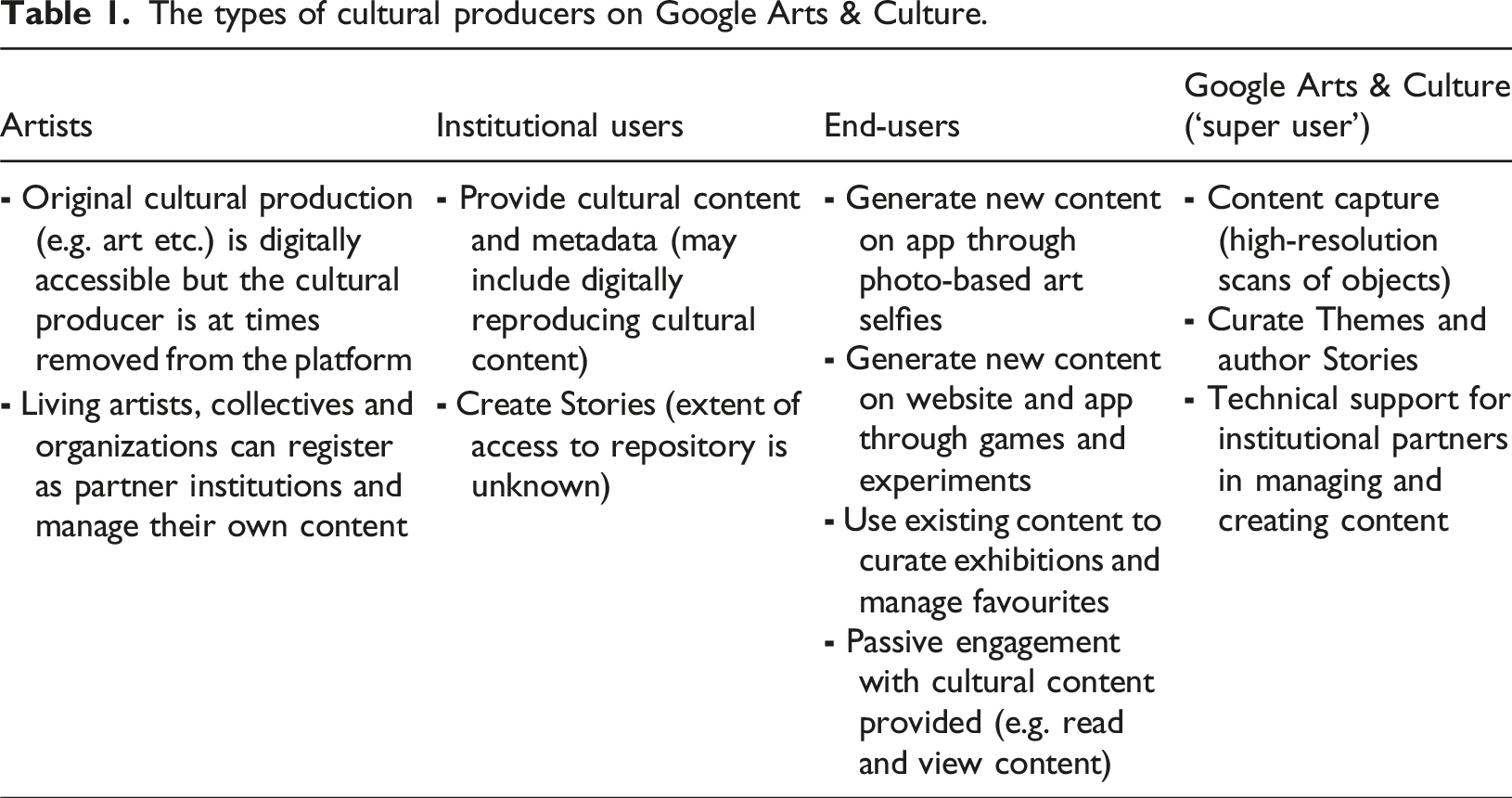
The types of cultural producers on Google Arts & Culture.
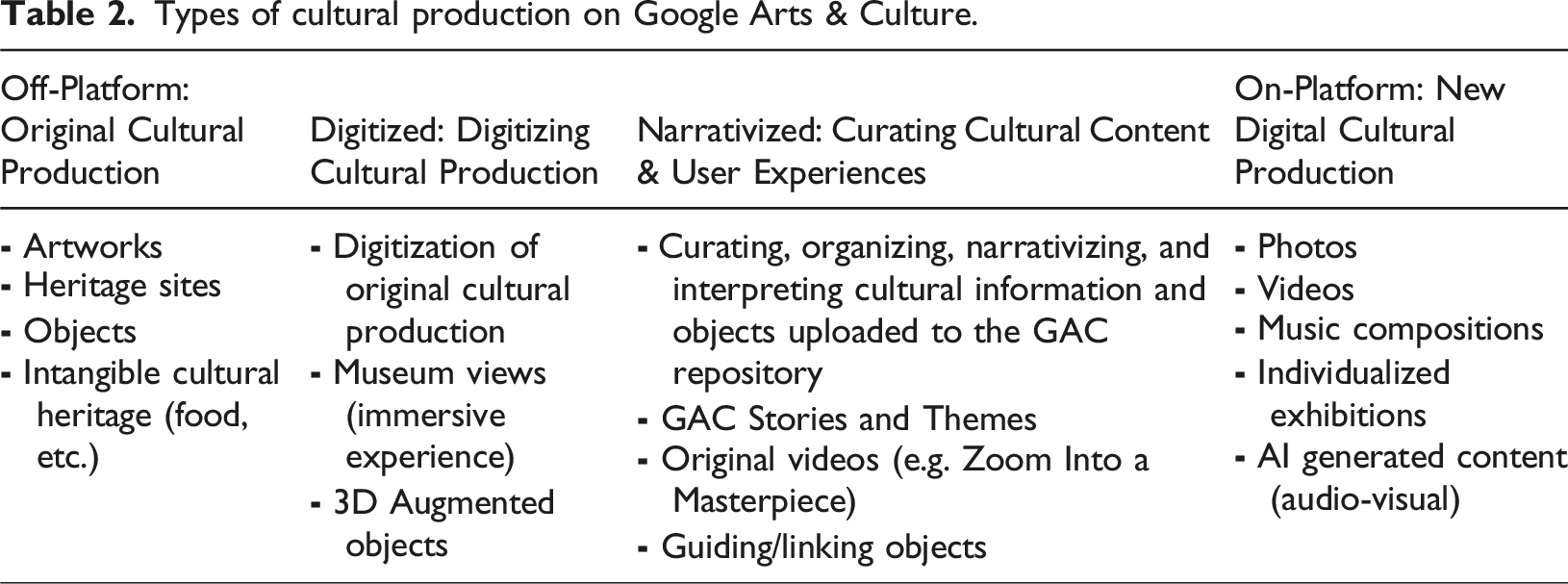
Types of cultural production on Google Arts & Culture.
GAC is a porous platform and there is no single linear route through GAC, nor an end or completion point. Rather, GAC has a circuitous logic, continually directing users towards another related artwork or ‘Story’ (a term used to refer to virtual exhibits or narrativized collections of objects and images). Thus, the ‘expected use’ that structures the walkthrough method is challenging to map because how a user engages with the site will influence the content they are subsequently presented. While recognizing the limitations of the walkthrough to map a single trajectory through the site, we contend that the method does reveal GAC’s circuitous logic. To mitigate this challenge, for each walkthrough we created new Google accounts and used an incognito browser with a cleared cache. This allowed us to begin our walkthrough with as little associated data as possible, creating a more standardized experience of the platform.
To further assess the scale and scope of GAC we also employed quantitative methods to identify and categorize the forms of content production on the site, the types of content producers, and the partner institutions affiliated with GAC. As the partner institution data cannot be scraped from the site using automated means, we manually clicked through the alphabetical sorting option and visited each institutional partner’s page to add up and tabulate the information provided. The site does not tabulate this information for public users, masking its scope. We identified GAC’s partners and tracked partner location (city, country, region), the content they have uploaded to the site (number of Stories, themed collections, and items), and Museum Views (which allow for embodied engagement with a digital facsimile of the museum). Additionally, we categorized the nature of these institutional partners, attending to the nature of their funding and mission. This analysis charted the scope of the content contained on GAC. Our quantitative assessment is an extension of our walkthroughs as all of the data is contained on the GAC platform.
Results
Results of our walkthroughs and quantitative analysis of the GAC platform are summarized in the following two sections, which outline the distinct forms of cultural production on GAC and the different categories of cultural producers present on the platform, which allows us to demonstrate GAC’s unique affordances as a super user.
Cultural producers
While Nieborg and Poell (2018) argue that cultural production is increasingly contingent on platform companies, GAC provides an example where cultural production is not only facilitated by the platform, but also produced by it. On GAC there is more than one category of cultural producer. This is notable, as much of the discussion about content creators and content creation on platforms highlights the role of end-users, or, the ways in which there are different strata of content creators: influencers with large audiences and monetized opportunities, micro-influencers with smaller accounts, and those making content without a large audience (Khamis et al., 2017; Marwick, 2018). Our walkthroughs identify four distinct cultural producers on the platform (Table 1).
These producers include: (1) Artists: who produce original cultural content that makes up the majority of the content on the platform. This role does not give them specific access to the platform, as their work is often uploaded by institutions, but they can engage as an end-user or seek an institutional user role. (2) Institutional users (referred to on the platform as Institutional Partners): the primary content facilitators for GAC, contributing ‘raw data’ through images, meta data, and curating online exhibitions. (3) End-users: who generate new content on the site and app through digital photos, audio-visual content, and their own galleries. Finally, (4) GAC is part of the cultural production ecosystem of the platform because alongside the technical solutions for heritage preservation that they offer partners (thus contributing to digitalization efforts), GAC is credited as the author on many of the sites curating Stories (online exhibitions) with materials uploaded by institutions. 3 This capacity leads us to identify GAC as a distinct user, what we define as a super user.
The resulting distinct categories of cultural producers broaden the definition of who produces culture online beyond the convention of end-users providing platform content. Notably, our walkthroughs reveal GAC as an active cultural producer, rather than mere aggregator or intermediary. We outline this capacity in our discussion below. Additionally, parsing these cultural production roles demonstrate the vulnerable status of artists on the platform, whose work is represented but not (in most cases) under their direct control, bringing to mind discussions about the precarity of cultural producers on platforms (Duffy et al., 2021; Pruchniewska, 2018). The range of cultural producers identified through a walkthrough of GAC demonstrates the need to assess the nature of cultural production on platforms. This allows for a better understanding of the actors and entities involved in cultural production, as well as the extent of their agency. Thus, we find that GAC is not just a technical intermediary, as platforms are often described (Poell et al., 2021), but a cultural one as well: GAC not only facilitates cultural production, but it also engages in it.
Types of cultural production
As noted, GAC is a platform through which cultural materials are aggregated, made accessible, and produced into new formats. GAC is unique because the category of ‘cultural producer’ on the site encompasses both end-users and institutional users, as well as including GAC itself. The platform is also unique for the fact that many cultural goods are represented on the platform not due to the original cultural producer, but due to institutional ownership or control of these cultural works. That is, artist’s works may be represented on the platform due to their circulation in the cultural economy via museums and cultural institutions. During our walkthroughs we identified four categories of cultural production happening on the platform: (1) Off-Platform; (2) Digitized; (3) Narrativized; (4) On-Platform (Table 2).
Off-Platform
GAC promises users the space to engage with original art, culture, and heritage materials held in collections by legacy cultural organizations such as museums, galleries, archives, and libraries. This ‘material-original’ cultural production happens off platform and is not connected to GAC. These materials make up the bulk of the site’s archive and underpin its rationale and functionality. In most cases the artists and authors of these works are not responsible for their inclusion on GAC and these creative producers are not necessarily active on the site (for example, many of the artworks and objects are historical). While artist collectives and individual artists can create partner accounts and control their work on GAC, this is rare. This type of cultural production is not dependent on GAC to be created, circulated, or consumed, but the reach of this material is broadened by its inclusion on GAC.
Digitized
GAC works with partner institutions to digitize existing original artworks, historic documents, monuments, and physical locations, as well as other relevant cultural materials. GAC boasts significant technical capacities to digitize collections, producing both 3D models, as well as 360-degree videos that promise audiences art from any angle. ‘Street View’ offers users the experience of touring famous sites and landmarks, or the option to ‘step inside must-see museums around the world’ using Google Street View, enhanced to include the insides of famous buildings, sites, monuments and more. ‘Art Camera’ is perhaps the most sizeable digitized content produced by GAC, which offers to digitize original artwork at scale, such that end-users can ‘zoom into’ artworks to see the textures of the artwork invisible to the naked eye when viewed in a museum or gallery (the images boast gigapixel resolution). Part of GAC’s larger preservation efforts to digitize art, culture, and heritage materials, this type of cultural production sits between preservation and facilitation as the digital versions of the original artwork are what show up on GAC and what constitute GAC’s collections. Institutional users can digitize and upload materials as well, and as such this category of cultural production is not tied to a specific cultural producer, but rather is user specific. End-users cannot upload digital materials to GAC’s repository, but all institutional users can. Creating a digital version of existing materials is a specific type of production that is required for GAC to function and is part of the foundation of the platform through providing images, text, and metadata.
Narrativized
Narrativized cultural production makes up a significant portion of GAC’s home page programming. GAC, institutional users, and third-party contributors curate content into Stories. Stories are small curated online exhibitions usually created by a single institutional user or GAC. Documents that outline how Stories can be created on GAC by institutional partners show a ‘drag and drop’ system where images, video, and text are added to specific input boxes that determine the output. A drag and drop format indicates that Stories are made by people, not algorithms, and that there are limited ways text, image, and video can be used, similar to how content can be uploaded within specific parameters on other social media platforms. Some Stories have authorship credits referencing specific individuals, other Stories have authorship that indicates the curating was done on behalf of, or by an organization or institution. This element of the platform is an important dimension of cultural production and serves to highlight GAC’s role as a cultural producer. This manner of narrativized cultural production also distinguishes GAC from other cultural platforms who employ AI algorithms for cultural production. 4 For comparison, Spotify employs AI algorithms to generate personalized content for users and Google Photos uses algorithms to assess and group image content.
Themes are a collection of Stories around a single concept, topic, or idea often listed as a collaborative effort with multiple partner institutions. Stories and Themes highlight the significance of both GAC and institutional users to the overall look and feel of the platform as these populate the home page and are key entry points into the content on GAC. The active curatorial role that GAC plays in shaping end-user experience by narrativizing content through Stories and Themes suggests GAC functions beyond an aggregator (facilitating cultural production), but that it has a significant role in the production of the experience on the platform. This role is notably obscured on the site. 5 Both GAC and institutional users function as corporate curators and this type of cultural production is distinct in terms of how cultural production in online spaces is understood, as it is often end-users who are the main drivers of cultural production on platforms (Duffy et al., 2019; Poell et al., 2021).
On-Platform
GAC-specific cultural production is made by end-users of the site. GAC-specific cultural products include users curating their own collections by ‘favoriting’ individual artworks from the larger GAC repository (the material-original cultural production listed above) and options to create a variety of visual and audio-visual materials within the platform. For example, users can create art-selfies where a self-portrait is collapsed into an existing famous artwork or use a portrait of their pet to compare it to famous artworks from around the world. Users can also use one of GAC’s forty-seven interactive experiments (many AI-based) to generate their own audio-visual materials through things like Paint with Music where GAC offers users the chance to hear their painting or to create an opera with four distinct voices called ‘Blobs’. While the final product can be shared via social media or email, these GAC-specific modes of cultural production do not become part of GAC’s central repository or archive but can only be made on or through the platform. This mode of cultural production engages the end-user through active participation and is the main mode of active engagement for end-users. Though the entirety of the site is for end-users to navigate and explore, this is the only space that might be classified as ‘participatory’ in so far as it is the only avenue for end-users to engage in cultural production (Jenkins and Carpentier, 2013). While the kinds of cultural production end-users can engage in are limited by the AI experiments developed and offered by GAC, the final product cannot be monetized by the end-user. In this way the dynamics of cultural production possible on GAC for end-users are distinct from most other platforms where creators can monetize the content they create on the platform (Boxman-Shabtai, 2019; Duffy, 2020; Duffy et al., 2021; Nieborg and Poell, 2018; Soha and McDowell, 2016; Woodcock and Johnson, 2019). Note that ‘on-platform’ is distinct from the ‘digitized cultural production’ explained above. On-platform is a type in which new forms are being created online, rather than objects from the real-world being documented and captured digitally for upload on the platform. This type of cultural production can best be understood as a form of bricolage (following Dick Hebdige, 1979) or remixing that offers the potential for the creation of new meanings.
Discussion
Our analysis focuses on two aspects of our findings related to narrativized cultural production. First, we contend that GAC occupies a unique role on the platform as facilitator and author, which is notable as its authorial role is largely concealed (see footnote 5 ). To understand this capacity, we introduce the concept of a super user to discuss the significant power that GAC wields on the platform. Second, this assertion allows us to suggest that acknowledging GAC’s role as a super user extends our theorization of platforms, as these dynamics exist in other platforms such as Spotify, where the platform takes on a similar corporate curatorial role that can structure how users engage the content on the platform. As such, we call for scholars examining cultural production on platforms to attend to the ways in which platforms may, at times, function as actors themselves, in addition to their role as technical intermediaries structuring the means of engagement.
On GAC narrativized content like Stories (the GAC terminology for online exhibitions) are created using individual pieces of content (largely artworks and artifacts) uploaded by institutions. As detailed above, Stories on the platform are authored not only by museums, cultural institutions, and other institutional partners, but by GAC itself. Without focussing our analysis on the different forms of content the site allows for (e.g. AI generated audio-visual content by end-users, narrativized exhibitions and individual Stories, individual catalogued audio, visual, or 3D content) we would not have been able to ascertain that GAC itself was a cultural producer, responsible for many of the Stories. This contribution is vital to understand because GAC provides narration and explicit curation of the data uploaded by institutional partners. While clicking on a specific institution allows the public to see the individual items an institution has uploaded, as well as their Stories, there is no tab for GAC as an ‘institutional partner’ nor is there any upper-level navigation that allows users to look through all the Stories on the platform. Thus, our analysis reveals that while GAC is a key content producer, beyond its role as the technical intermediary and administrative control, this role as a cultural producer (shaping and narrating how these objects are understood) is obscured by the platform.
That GAC itself produces and curates featured content is a notable finding that is not readily apparent through users’ routine engagement with the site. Thus, our quantitative assessment demonstrated the extent of GAC’s authorship role in the initiative, revealing an unusual set up for a platform. We suggest that GAC plays a significant role on the site, both platforming culture and narrativizing culture. This is significant insofar as GAC itself works with the art, heritage materials, and cultural artifacts uploaded by institutions as curator to shape how users understand and engage these materials. Indeed, much of the curated cultural production on the platform is produced by GAC. This is unusual in comparison with most platforms where the bulk of cultural production lies in the hands of end-users, or, in the case of GAC what institutional users might contribute. Thus, a key finding of our study is that GAC occupies a hybrid role as a technical intermediary (platforming culture) and as a cultural producer (narrativizing culture). This is important as GAC is largely recognized as a digital repository (it is at its core a large database of cultural objects and sites) and does not account for the power that GAC holds not just in what content can be uploaded to the platform, but in how that content is curated, narrativized, and further, what narratives are promoted. We argue that GAC is an important case study because of GAC’s authorial role as cultural actor and its largely unacknowledged authorship of cultural content on the platform. Seen in this way, we might read GAC’s curatorial function as analogous to other more traditional media forms that curate broadcasting, such as television and radio. However, GAC’s role in cultural production on the platform should also be understood within a wider field of possibilities where the platform takes an active role in content production and promotion, such as Spotify’s curated playlists for end-users, or promotion, such as TikTok’s recommendation algorithm. While the extent of GAC’s use of algorithms to generate content is unclear, the platform curating and promoting certain narratives presents an interesting example that is especially pertinent as AI increasingly plays a role in what we see on our screens.
Stories offer the best example of how GAC is producing content through online exhibitions. GAC Stories reveal GAC is drawing on materials from institutional users but deploying them in new ways. In so doing, they are narrativizing this content, giving it shape, telling end-users how to view these images and objects, understand these artworks, and more broadly, how to understand culture. This is a significant and elided fact about the platform. Put another way, GAC is interpreting the materials on the platform, not just functioning as a repository for uploaded content.
It is unclear who exactly undertakes this work and the perspectives guiding their choices. To date, there is no public-facing data about who at GAC contributes to these Stories, if there are guidelines or procedures for submitting a story to be featured on GAC, policies for removal of Stories, and further there is no indication of if there is an editorial board, editorial policies, or oversight into this narrativized content. As such, a significant issue with GAC’s hybrid aggregate and authorial role is the lack of transparency around GAC’s actions. There are no accessible policies on what guides GAC’s selections of cultural content, raising questions about what narratives GAC champions or marginalizes. This lack of accountability also raises questions about who exactly authors GAC’s Stories, who can moderate GAC’s content, and who has authority to authorize or remove cultural production. Put more broadly, this causes us to ask: what editorial policies guide GAC’s management of cultural content? Thus, we find that GAC narrativizes and curates content but is not held accountable for this role. Comparatively, Europeana (an online database of European art and culture similar to GAC) has extensive credits for all online exhibitions and its shorter digital stories are often credited to an individual, and where appropriate include their institutional affiliation (Europeana, 2025). While some stories are attributed only to the Europeana Foundation (or subsections like Europeana Photograph or Europeana Music), these are not the majority of stories published on the platform. Our study reveals the extent to which GAC’s authorial role is not made prominent on the platform, as GACs role is only revealed through a quantitative assessment of the types of cultural production and cultural producers on GAC. As noted, there is no way to isolate GAC content on the site in a summary manner. Thus, we suggest that scholars of cultural production on platforms need to attend to the ways in which these platforms themselves take on authorial roles.
The implications of GAC’s role are significant – they are demonstrating and wielding cultural control by authoring Stories and commissioning Themes. The majority of front page content on GAC is Stories and Themes to engage users. We suggest that GAC draws on the cultural legitimacy of institutional users (who have established credibility) to wield its own control. Specifically, what goes unnoticed by end-users is that GAC may be mobilizing these cultural objects in new ways or ways that institutions might not prioritize. For example, on the home page GAC advances a reading of objects through colour, which, while an element of formal art historical analysis, is not largely used as a means of grouping non-related items. Time is another organizing principle that GAC offers. While these seem to be innocuous categories it is important to realize that these function to render content visible to users and provide a primary framework to understand content, taking precedent over other readings.
We introduce the term super user to point to GAC’s authorial power on the platform. GAC has the ability to take art and cultural objects uploaded by institutions and narrativize them without any clear oversight or public accountability. The term emphasizes the control GAC wields as super users have levels of access that the average users do not. While institutional users can also create Stories and provide a narrativized engagement with cultural objects, GAC still controls which Stories and Themes are featured on the home page, which are promoted, and ultimately has the power to delete any content without any notice. GAC’s moderation policy is succinct: ‘Google reserves the right to remove content without notice’ (Google Arts & Culture, 2025a: n.p.).
GAC’s capacity as a super user has significant potential to shape end-users experience and access to cultural objects. This leads us to question: what happens when we give up control of how we understand culture? To be clear, it is not just that GAC provides digitized content, but the fact that we are allowing GAC to tell us what items go together and what categories we can use to understand art--essentially, how groups of objects and cultural materials can be narrativized. At times this aligns with established art historical frameworks, such as understanding the oeuvre of a particular artist or an artistic movement. At other times, this offers new means of understanding material. But why cede that control to GAC? There are institutional users on the platform who may be more informed and credible in explaining how to read objects or why they should be narrativized at all. We take issue with how GAC makes these authorial dimensions of cultural narratives unclear – by presenting as a straightforward repository, which may mislead users.
Acknowledging super users and their special privileges allows us to better understand platform affordances and who can exert more authority over cultural production. GAC functions beyond a simple platform to end-user dynamic. While end-users typically understand the power of institutions, we contend that GAC’s presentation as facilitator overshadows its authorial role as super user. More importantly, this role as super user undercuts GAC’s stated emphasis on transparency and democratization.
Conclusion: Extending our theorization of platforms
Dominant approaches to platform studies do not address how platforms also actively produce content and thus do not fully explain the dynamics of GAC. We suggest that the breadth and functionality of cultural production on the platform is a significant element of GAC. Moreover, we argue that cultural production by GAC necessitates scholarly attention and analysis to see how these dynamics play out on other platforms. GAC is not monetized 6 , it does not facilitate advertising, its end-users do not form a distinct bounded online community, and its content moderation is decidedly minimal. Thus, GAC is an unusual platform in that it reveals some of the limitations of dominant threads of analysis in platform studies. This can extend our theorization of platforms insofar as expanding thinking about platforms beyond their role as facilitators.
What does this mean for platform studies? We argue that GAC is an instructive case study because the platform is also creating content that has an outsized role in shaping user experience of the platform. Thus, GAC demonstrates why we need to disabuse ourselves of the assumption that platforms are not actively involved in content production. The cognate example of Spotify is a helpful analogue here. Spotify also provides similar narration of content, such as its curated playlists, which give end-users a predetermined lens through which to understand the meaning of a particular set of songs (e.g. a specific playlist for a specific mood or activity). GAC is doing the same thing when it creates Stories. It is bringing together different cultural objects and telling us which ones are important, which ones should be seen, and how we should understand them. Thus, we suggest that our analysis of GAC can broaden our understanding of how platforms contribute to cultural production.
Admittedly, GAC offers a complicated landscape for assessing cultural production; there are artists, institutions, end-users, and GAC itself engaging and producing content on the platform. These complex dynamics need to be acknowledged, rather than taken for granted. Or, put more plainly, we need to understand that each set of cultural producers has different capacities on the platform. This is another implication of our assessment of GAC that may be helpful when assessing other platform examples.
Museums have a long history of collecting, narrativizing, and controlling culture; deciding whose stories are told and how. Thus, GAC is not unique as a powerful institutional actor that organizes, exhibits, and narrates culture. However, it is distinct in that: (a) platforms rarely produce content and (b) typically when institutions curate and narrativize cultural materials there is accountability and public-facing information about who makes these decisions. In this respect, GAC is unusual because it does not make clear what policies, standards, and guidelines structure the curated content it produces. In a 2018 interview GAC creator Amit Sood responded to a question about some Stories (online exhibitions). Arts reporter Anna Somers Cocks asked: ‘these are complex, sophisticated projects, so have you got editors, curators or scriptwriters?’ to which Sood replied: ‘No, what we have is a content group’. Sood explained: ‘Base content comes from the partners [the museums]; it creates the corpus. Then each partner gets access to a curating and storytelling tool. The curators become the editors, so 95% of all the stories you see here will have been told by the museums themselves. In some cases, we will also provide help’. Addressing an example of an exhibit drawing on collections from different museums, he notes the support GAC provides, ‘…so we found a person to write the story, and we have one or two people who work with freelance writers’ (Somers Cocks, 2018: n.p.). Despite this admission, our study finds that GAC authorship of cultural content has grown significantly since this period.
In our digital walkthrough the majority of Stories featured on the home page of the platform were listed as authored ‘by Google Arts and Culture’. On the date of this writing, four out of five Stories featured on the home page (December 18, 2023) are by Google Arts and Culture, as well as the ‘Story of the Day’. On the home page the ‘Do the Cultural 5’ for the day (a mix of videos and Stories) has three of the ‘Cultural 5’ Stories authored by GAC (the other two are videos, one co-produced with GAC). Thus, GAC’s authorship has a significant presence on the platform. GAC’s mandate to make art accessible and to widen the audience for art, heritage, and culture is commendable, but black-boxing information about how decisions about presenting culture are made obfuscates GAC’s responsibility of platforming art, culture, and heritage.
The platformization of cultural production is significant because platforms are assuming control over larger swaths of our lives and utilizing terms of service and other tools to gatekeep and police how they can produce and in what ways on their platforms. On GAC, the limitations of the different cultural producers are significant for study not only because institutional partners have a set number of tools to curate and present content, but more broadly because platforms like GAC become a key means for how the public can access culture through digital modes. Paying attention to how platforms also function as users, curating, disseminating, and promoting content, allows us to critically assess the cultural control and influence that these initiatives wield, and in turn, how digital infrastructure allows for, and limits, the possibilities for cultural production.
Footnotes
Acknowledgements
The authors thank Nicole Delellis, Talia Méndez Mahecha, and Effie Sapuridis for their research assistance.

Ethical considerations
There are no human participants in this article and informed consent is not required.
Funding
The authors disclosed receipt of the following financial support for the research, authorship, and/or publication of this article: this research was undertaken, in part, thanks to funding from the Canada Research Chairs Program.
Declaration of conflicting interests
The authors declared no potential conflicts of interest with respect to the research, authorship, and/or publication of this article.
Data Availability Statement
The data that support the findings of this study are available from the corresponding author, S.E.K.S., upon reasonable request.