




Abstract
This study examines how cultural heritage institutions utilize Google Arts & Culture (GA&C), a Google initiative that provides a publishing platform for institutions to showcase their collections and engage with users. Based on semistructured interviews with 23 cultural institutions and one Google employee, the study provides an empirical account of platform adoption beyond dominant commercial and social media contexts. Theoretically, it contributes to platform studies by analyzing how platformization unfolds in the cultural sector, where traditionally public institutions engage with external platforms under varying organizational constraints. Methodologically, it offers a situated perspective on how institutions make sense of platform governance, digital strategy, and content production in everyday practice. Findings reveal persistent challenges in aligning institutional needs with platform affordances. While institutions were drawn to GA&C's promise of greater visibility, infrastructural support, and storytelling tools, these benefits were often undermined by limited technical resources, communication breakdowns, and logistical hurdles. Internal dynamics, from institutional memory to internal collaboration, proved to be the most significant factor shaping institutional participation, leading to fragmented and short-lived use of the platform. The kind of infrastructural alignment central to platformization never fully materialized. As a result, GA&C remained a peripheral tool rather than an integrated component of institutional digital strategies, highlighting the contingent, partial, and often fragile nature of platform adoption in the cultural sector.
Keywords
Introduction
This study examines how cultural heritage institutions, such as museums, libraries, and archives, have engaged with Google Arts & Culture (GA&C), a lesser-known Google initiative with the stated mission to “preserve and bring the world's art and culture online so it's accessible to anyone, anywhere” (Google, 2020). Launched in February 2011 as the Art Project, the initiative debuted with 17 prominent partners, including the Metropolitan Museum of Art, Tate Britain, the Uffizi Gallery, and the Van Gogh Museum (Sood, 2011). As of January 2025, the platform hosts more than 3300 cultural institutions worldwide. Through a content management system and a suite of publishing tools, 1 institutions can upload images and create interactive digital exhibits, known as stories, on their own landing pages (Figure 1), as well as participate in thematic collaborations with other partners.
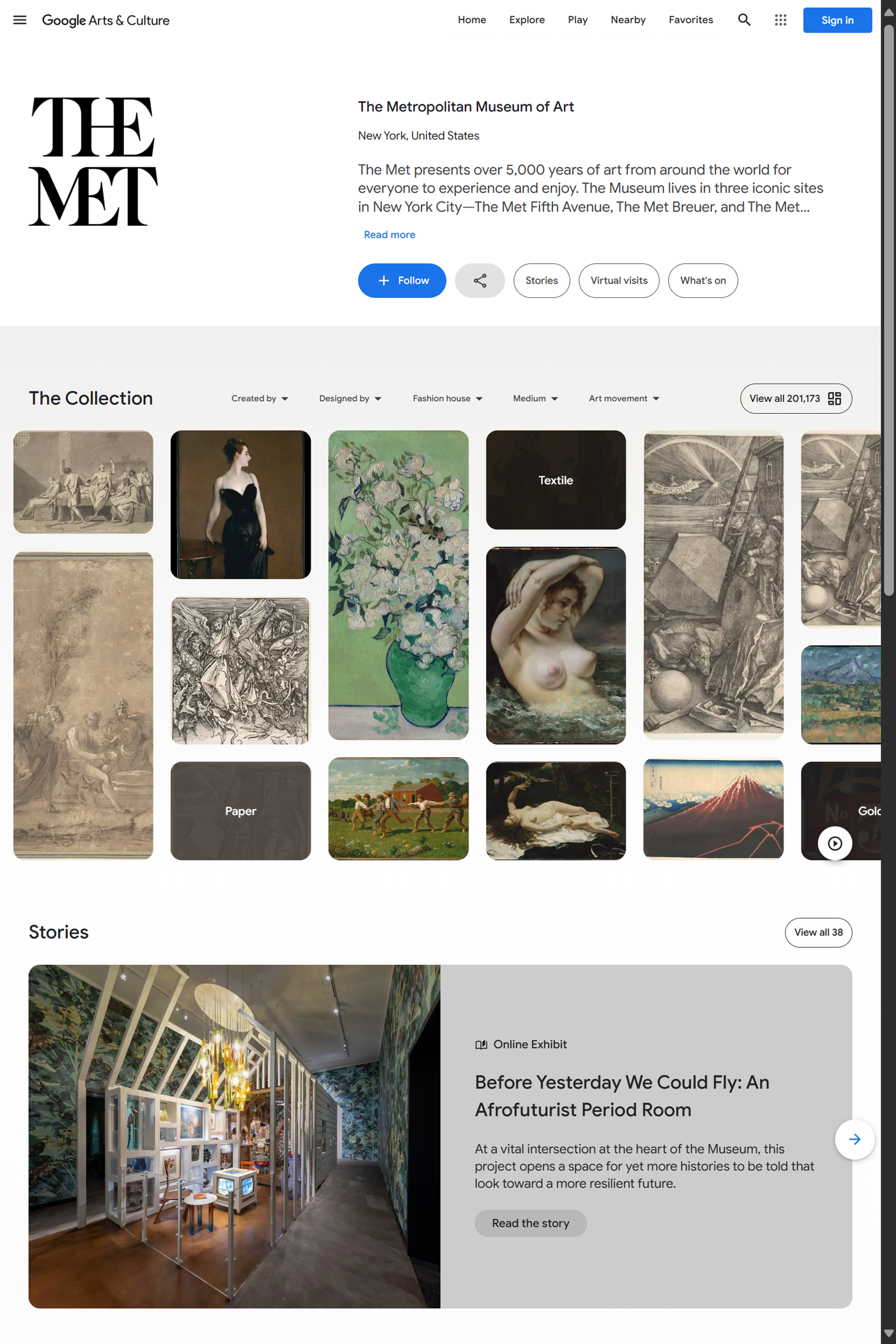
Landing page of a partner institution on Google Arts & Culture (GA&C). Screenshot taken 22 April 2025.
The Art Project emerged at a time when most cultural institutions had yet to establish a meaningful online presence. Google's invitation coincided with the sector's early experiments with the web, which were often fragmented and exploratory (Bautista, 2014; Laws, 2015; Russo, 2012). A decade later, the COVID-19 pandemic accelerated the urgency of digital engagement. Faced with closures and shifting audience expectations, many institutions turned to online platforms—some for the first time, others by reviving dormant partnerships—as stopgap measures to maintain public access. Despite the promise of visibility and infrastructural support, however, many struggled with limited resources, internal fragmentation, and inconsistent communication. In practice, institutional participation on GA&C remained ad hoc and experimental, driven more by individual enthusiasm than by sustained institutional commitment.
The ubiquity of private platforms in mediating access to public cultural resources has long sparked debate among scholars and cultural commentators. Some warn that such entanglements risk commercializing and enclosing the cultural commons, transforming cultural heritage into yet another domain of social life rendered as data, ready to be extracted, commodified, and circulated within an increasingly platform-dependent capitalist paradigm (Boyle, 2003; Dulong de Rosnay & Stalder, 2020; Pélissier, 2021; Pessach, 2008; Vaidhyanathan, 2011; van Dijck, 2014; Zuboff, 2019). Others have focused more narrowly on GA&C, analyzing its technological affordances, branding and marketing value, contributions to public access and participation, and implications for representation and canonization (Kizhner et al., 2021; Pesce et al., 2019; Rodríguez-Ortega, 2018; Valtýsson, 2020; Wilson-Barnao, 2022). Yet, much of this scholarship either critiques the platform's structural logic without examining how it operates in practice or evaluates its features without accounting for the institutional contexts in which those features are adopted, adapted, or ignored. What remains underexplored is how cultural institutions themselves experience platformization on the ground: how they navigate GA&C amid evolving priorities, resource constraints, and internal digital strategies.
This study addresses this gap by shifting the focus from what GA&C offers to how cultural institutions actually use it. Drawing on semistructured interviews with institutional partners, it provides a situated and contextualized account of how cultural institutions interpret and engage with the platform in their everyday work. This empirical approach contributes to platform studies by tracing how platformization unfolds beyond the familiar contexts of social media, entertainment, and gig work. It also foregrounds how platform logics shape practices within traditionally public institutions in ways that are often invisible at the interface level, revealing the contingent and negotiated nature of platform governance (Katzenbach & Ulbricht, 2019; Poell et al., 2019). Practically, the study offers insight into the organizational conditions that shape the success or failure of digital initiatives, especially when mediated by third-party platforms. As cultural institutions continue to adapt to an increasingly platform-dependent environment, understanding these dynamics will be critical for evaluating the evolving role of private platforms in shaping institutional practice and cultural memory.
Literature review
Public sectors and platform dependency
The global dominance of platform companies has profoundly transformed a range of social sectors, particularly those grounded in longstanding commitments to public values, social mandates, and professional codes. Scholars have characterized this shift as the emergence of a corporate-dominated platform ecosystem, operated primarily by U.S.-based technology companies that provide core infrastructural services while integrating a wide range of sector-specific platforms. Within this ecosystem, traditionally public sectors—including journalism, urban transportation, health care, and education—are increasingly mediated by profit-driven platform providers, giving rise to tensions between the protection of public values (e.g., equality, privacy, access) and the implementation of market-oriented logics predicated on datafication, commodification, and algorithmic content curation (Bucher, 2018; Mejias & Couldry, 2019; van Dijck et al., 2018).
At the heart of this platformization process lies the adoption of infrastructural services by end users and platform complementors (Poell et al., 2022), who are third-party entities creating content or offering additional services to end users (McIntyre & Srinivasan, 2017). Examples of infrastructural services include cloud computing and data storage, content delivery networks, software development kits (SDKs), application programming interfaces (APIs), data analytics, and payment systems. This process often impels complementors to align their content strategies and business models with the technical parameters and governing frameworks of platform providers (Nieborg & Poell, 2018; Tiwana, 2014), resulting gradually in a convergence of the platformization of infrastructure and the infrastructuralization of platforms (Plantin et al., 2018; van Dijck, 2021). Platformization therefore entails not merely the penetration of technological infrastructures, economic processes, and regulatory frameworks but also the reorganization of cultural and professional practices across sectors (Poell et al., 2019).
This radical reorganization in turn intensifies platform dependency, if not total infrastructural capture (Nechushtai, 2018): complementors increasingly embed their modes and means of production within platform-provided services to such a degree that financial stability and creative autonomy can be substantially undermined. As Poell et al. (2022) demonstrated in industries ranging from gaming and publishing to podcasting, social media, and journalism, the adoption of platform infrastructures not only formalizes platform-dependent cultural production but also cements the infrastructural and sociopolitical power of platforms over time. Once end users and complementors integrate deeply with platform systems, the escalating cost of exit further consolidates this dependency, entrenching the structural dominance of platforms across numerous social sectors (van Dijck et al., 2018).
Cultural institutions and digital strategies
At the other end of the platformization equation, the encounter of cultural heritage institutions with platforms is not merely reactive but shaped by their evolving digital strategies. These strategies reflect a growing recognition within the cultural sector that, despite a traditional emphasis on physical artifacts and on-site experiences, digital tools are essential rather than peripheral to the fulfillment of institutional missions (Economou, 2016; Parry, 2010; Taylor & Gibson, 2017; Valtýsson et al., 2022). These missions include expanding access to cultural heritage, enriching audience engagement, and, increasingly, promoting social inclusion and community participation (Bautista, 2014; Huvila et al., 2022; Laws, 2015; Myrczik, 2020). The turn toward public participation, open access, and online experience has prompted many cultural institutions to reassess not only the digital technologies they adopt but also the organizational principles that govern their use.
However, the pursuit of such strategies occurs within institutions historically characterized by slow technological adoption, siloed internal teams, and uneven digital expertise (Knight Foundation, 2020; Lutman et al., 2021). As Parry (2007) observed, even as museums started experimenting with computers in the 1960s, curatorial beliefs and practices often clashed with the affordances and logics of computer systems. These frictions persist today, as museums continue to negotiate the operational and epistemological implications of standardization, automation, and platform engagement.
Digital strategy in cultural heritage institutions is therefore deeply entangled with internal dynamics and professional divisions (Anderson, 1999; Hvenegaard Rasmussen et al., 2022). Internal debates on the use of information management technologies often reveal fundamentally divergent perspectives, reflecting and reinforcing entrenched beliefs and power relations among curators, IT specialists, educators, and administrators (Peacock, 2007). Case studies of digital initiatives further underscore the importance of collaboration and communication across functional groups (Cachia, 2014; Petrelli et al., 2016; Pietroni, 2019), suggesting that institutional change depends as much on cultural negotiation as on technical innovation.
The emphasis on internal heterogeneity echoes the historical shift associated with the new museology, which challenged curatorial dominance and highlighted the informational, educational, and social roles of museums (Stam, 1993; Vergo, 1989; Weil, 1999). This intellectual movement, alongside the pressure of neoliberal cultural policy (Bennett, 1990), helped lay the groundwork for increased collaboration with private-sector partners in the name of accountability and public service. As platform complementors, cultural institutions therefore bring with them not a unified agenda but a multiplicity of goals and priorities, contributing not only to the complexity of platform governance but also to the variability of platform use in institutional practice.
Boundary resources and platform practices
As the cultural sector expands its presence in the digital realm, partnerships with external platforms appear to provide compelling solutions: expanded audience reach, enhanced technical capabilities, and scalable infrastructural support at minimal direct cost. Yet, these perceived benefits must often be weighed against competing internal priorities and contested professional values. Thus, understanding how the alignment between platform infrastructures and institutional strategies unfolds in practice requires attention to specific mechanisms shaping institutional engagement on the ground (Nieborg & Poell, 2018).
Central among these mechanisms is the deployment of boundary resources, which codify and standardize access to a platform's infrastructural services, both enabling and controlling platform complementors (Ghazawneh & Henfridsson, 2013). Originally introduced to describe technical tools (e.g., SDKs, APIs) that allow third-party developers to build on platform infrastructures, the concept has since evolved to encompass a broader set of tools, protocols, and communication channels (e.g., terms of service, content guidelines) that define the conditions of participation in platform ecosystems (Poell et al., 2022).
In the case of GA&C, boundary resources include onboarding materials, content management systems, metadata standards, style guidelines, and analytics dashboards. By mediating access to visibility, interoperability, and technical capacity, these resources allow institutions to access and contribute to the platform, while simultaneously making their participation conditional upon platform infrastructures. Questions of platform dependency and governance, then, become tangible at the level of mundane and routine platform practices (Duffy et al., 2019): who within an institution uses which tools, what barriers they encounter, and how institutional priorities map onto, or clash with, platform configurations.
Focusing on boundary resources also helps situate this study within broader debates in platform studies. The cultural heritage sector, shaped by public mandates and professional values, diverges in important ways from the commercial and user-centric contexts most often studied in the literature. Yet empirical accounts of how cultural institutions actually engage with GA&C remain scarce. This study addresses this gap by foregrounding the perspectives of institutional users, offering insight into how platform participation is navigated, negotiated, and at times resisted from within.
Methods
This study employs semistructured interviews to examine how cultural institutions engage with GA&C in practice. Given the focus on organizational dynamics and institutional practices shaped by platform dependency, interviews provide a situated understanding of decision-making processes and internal power relations. This approach aligns with existing research on platform practices in the cultural sector and has proven effective in identifying strategies, routines, and experiences related to platform adoption (Nieborg et al., 2020). To contextualize institutional rights and obligations, the platform's content guidelines and partner agreements were also reviewed, with two such agreements obtained via public records requests and contributions from interviewees.
The study focuses on U.S.-based institutions, in part due to the country's distinctive cultural policy landscape, which, unlike many European counterparts, offers limited centralized public support for the arts at the federal level (Cherbo et al., 2008). As a result, U.S. cultural institutions often rely on private funding and philanthropy, granting private entities disproportionate influence in the sector (Mulcahy, 2016; Wyszomirski, 2004). U.S.-based institutions also represent the largest national group on GA&C, accounting for approximately 25% of all institutions. As of October 2023, 673 U.S.-based institutions were hosted on GA&C, providing a relatively cohesive sample within a shared policy environment. However, this U.S.-centric focus limits the generalizability of this study, as institutional structures and platform adoption patterns may differ significantly across regions.
A purposive sampling strategy guided recruitment from institutions either currently on GA&C or those that had considered joining. Recruitment took place through the Museum Computer Network (MCN) Forum and the MCN 2023 Annual Conference to reach professionals working in digital roles. Between October 2023 and March 2024, 20 interviews were conducted with representatives from 23 institutions, including three participants who had worked with GA&C across multiple organizations. Two interviewees facilitated introductions that led to an interview with a Program Manager (PM) from the GA&C team in February 2024. Each interview lasted 60–90 min.
The 23 institutions and their contributions to GA&C are listed in Table 1. All but two institutions (#8, #17) are U.S.-based. Two (#18, #19) considered but ultimately declined to join the platform, while two others (#20, #21) were in active negotiations and requested anonymity. Though not typical GA&C partners, two additional institutions (#22, #23) were included due to their sectoral involvement and familiarity with the platform. To ensure anonymity, job titles were omitted, but all interviewees held roles related to digital technologies, including chief digital officers, directors of technology, digital records managers, and curators of digital experience.
List of interviewed institutions with the number of items and stories on GA&C (as of October 2023).

To assess sample representativeness, data were collected in October 2023 from all U.S.-based GA&C institutions (N = 673), including the number of items uploaded and stories created (Figure 2(a) and 2(b)). The average institution uploaded 8011 items and created 5.6 stories, with item counts heavily skewed by a few major contributors. Sampled institutions currently on the platform (n = 17) showed a similar but less extreme skew (Figure 2(c) and 2(d)). Despite the purposive and convenient recruitment process, the sample reflected a wide range of participation levels, offering a meaningful understanding of institutional experiences across different organizational settings.

The distribution of item (a) and story (b) counts for all U.S.-based institutions (N = 673, outliers excluded for legibility). The distribution of item (c) and story (d) counts for the population and sample (outliers included, but numbers log-transformed for legibility). Only institutions currently hosted on the platform (n = 17) were included in the sample.
Interview questions addressed three broad areas: the digital strategies of the institution; the establishment of the partnership, including perceived benefits and concerns, internal deliberation, and communication with GA&C; and the use of platform tools and features, including content strategies and workflow impacts. Interviews were transcribed and analyzed in ATLAS.ti 24 using open and axial coding (Corbin & Strauss, 2015). This iterative process drew on narrative analysis (Riessman, 2008) and thematic analysis (Braun & Clarke, 2022) to examine how participants framed and reflected on their experiences, revealing patterns in institutional decision-making, organizational responses, and the implications of platformization in the cultural sector.
Results and discussion
The editorial logic of GA&C
Despite its 14-year history and periodic updates via Google's official blog, the internal structure and strategic positioning of GA&C within the company's vast ecosystem remain opaque. However, the interview with the PM offered valuable insights into the team's organization, decision-making processes, and modes of communication with partner institutions. More importantly, it illuminated the platform's central role in content editorialization, providing a sharp counterpoint to persistent and mythical narratives that portray platforms as neutral facilitators merely enabling users to tell their own stories (boyd & Crawford, 2012; Gillespie, 2017).
The GA&C team, led by a Director, is divided into several functional groups (Figure 3). The Content team includes PMs assigned to countries or regions, Coordinators who manage daily partner relationships, and an Editorial team that collaborates with institutions on content development. The Engineering team comprises Product Managers responsible for specific features (e.g., games, apps), often working alongside Google engineers unaffiliated with GA&C. Meanwhile, the Marketing team oversees outreach, and a Paris-based Lab focuses on creative projects that engage users and showcase institutional collections.
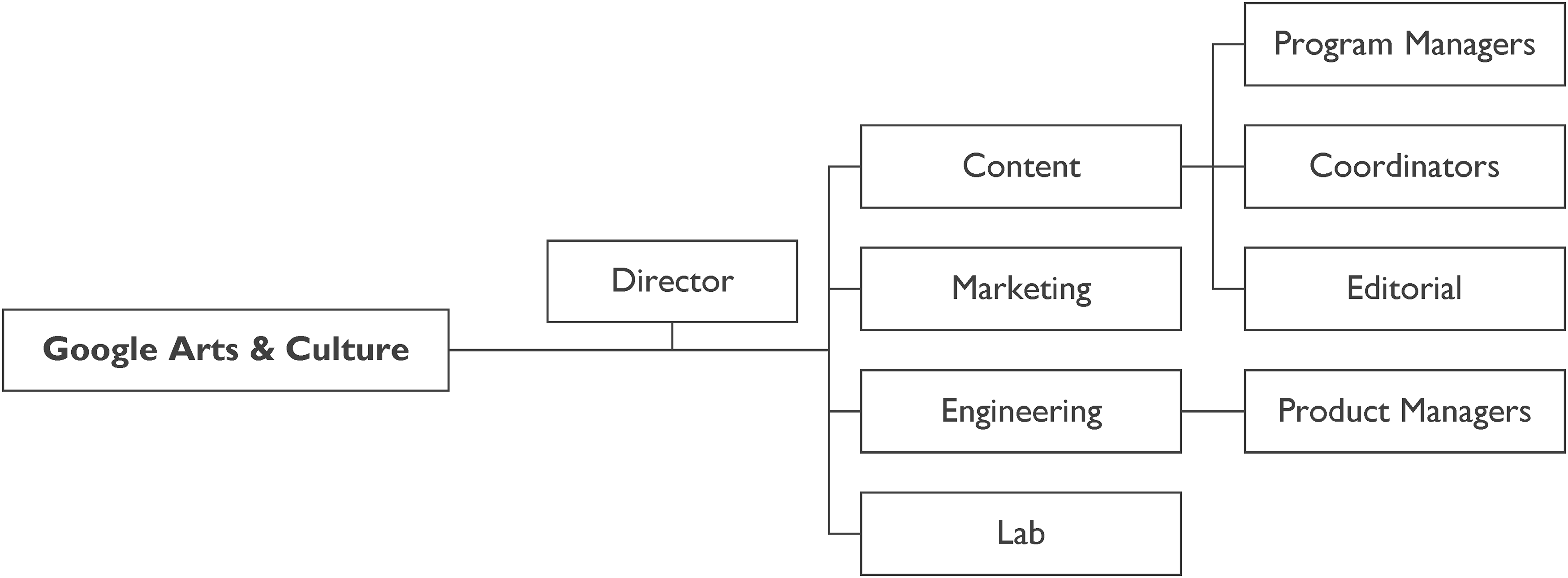
The organizational structure of Google Arts & Culture (GA&C).
Despite Google's vast resources, the GA&C team itself is relatively small. The PM did not disclose exact staffing numbers but noted that most team members are based in London and Paris, while the U.S. presence consists of only one full-time PM and three Coordinators, all short-term contractors. The PM reiterated a common misconception, among partners and the public, that GA&C draws on the full institutional capacity of Google, whereas in reality the team operates under tight constraints in both funding and staffing.
The platform's editorial role begins at the point of entry. Although GA&C is nominally invite-only, institutions can also apply through an online form. When asked about admission criteria, the PM clarified: We don’t discriminate on who can join the platform. If you are a cultural nonprofit with stories to tell and a collection to share, you’re welcome to join. We do only work with not-for-profit institutions, but it's a very visual platform. […] It's not necessarily that you have to be a collecting institution, but there does need to be some form of images.
Institutions that initiate contact with GA&C are internally referred to as long-tail partners. Unlike most platforms that allow any individuals or organizations to sign up and share content, albeit with varying degrees of moderation (Gillespie, 2018), GA&C exercises its gatekeeping role by manually reviewing institutional credentials and evaluating applications before granting access. However, as the PM emphasized, due to limited team capacity, this review process is not always prioritized and can therefore take several months.
Other institutions, termed project partners, are directly invited by GA&C to join the platform and collaborate on themed projects. This already suggests a more hands-on and persistent approach to content creation on the part of GA&C. One example shared by the PM illustrates this process: We are launching in May a project celebrating America's Chinatowns. We are working with the National Trust for Historic Preservation and 15–16 local Chinatown organizations on the ground, such as the Museum of Chinese in America and the Center for Asian American Media [CAAM] in San Francisco. We reached out to CAAM because they seem like a great fit. They’re not a partner, but they would be an amazing contributor to this Chinatown project.
Topics for special projects can be proposed either by partner institutions or by GA&C staff. According to the PM, country managers play a key role in identifying themes that align both with Google's broader priorities and with ongoing debates in the cultural sector. This collaborative process not only reinforces the platform's editorial function but also reflects a distinctive mode of operation for institutions as platform complementors, one shaped by ongoing negotiation over both thematic direction and modes of storytelling, rather than open-ended or autonomous contribution. As the PM described: The National Trust for Historic Preservation was the one who brought the Chinatown topic to us and said, “Gentrification is happening everywhere, these Chinatowns are being lost, and it's an important preservation project for immigrant culture and American culture.” We’re able to align it with a big cultural moment, Asian American Heritage month in May, so it made a lot of sense for us.
While this approach respects domain expertise and encourages thematic alignment, it also reinforces the central role of the GA&C team in shaping what appears on the platform. Editorial intervention is not limited to project planning, which includes outreach emails inviting institutions to participate, but also extends to recurring features such as “Today's top picks,” “Today in history,” and “Collection of the day.” These sections are curated, and sometimes directly authored, by the UK-based editorial team, with little to no algorithmic input in content selection.
This reliance on human intervention directly challenges the algorithmic logic that governs most platform operations. Instead, content creation on GA&C reflects a sustained commitment to what Gillespie (2014) termed the editorial logic, a model grounded in human expertise, professional training, and institutional validation. From partner selection to topic curation, content decisions on the platform are shaped by editorial deliberation rather than algorithmic optimization. While algorithmic sorting continues to structure the allocation of social resources and condition the visibility of cultural content on platforms (Bonini & Gandini, 2019; Bucher, 2018; Katzenbach & Ulbricht, 2019), GA&C illustrates the enduring relevance of editorial logic, especially in the cultural heritage sector, where institutional authority and interpretive expertise remain central. The challenge for GA&C, then, is not whether to editorialize but how to do so with transparency and accountability, while cultivating trust with its institutional partners.
Platform dependency versus strategic adoption
How, then, do cultural institutions adapt to the platform's governance dynamics? Although platform dependency is a growing concern across many sectors (Nechushtai, 2018; Poell et al., 2022; van Dijck et al., 2018), participation in GA&C tends to be more selective and peripheral. Rather than fully integrating the platform's infrastructural services into their core operations, many institutions treat it as one of many experimental outreach tools, adopting with great strategic caution and limited operational investment.
Interviewees recalled responding to Google's entry into the cultural heritage space with a mix of excitement, curiosity, and skepticism. For some, it was encouraging to see a major technology company take interest in arts and culture, especially at a time when the sector was still hesitant about digital engagement. Several noted past failed attempts to create shared digital infrastructures (e.g., Bridgeman Images, ARTstor) and viewed GA&C as a chance, especially for smaller institutions, to gain visibility typically reserved for globally recognized art museums.
Skepticism among interviewees tended to focus less on Google's status as a private company and more on questions of long-term viability. Some framed the project's origins within the optimism of the early 2010s, a period marked by techno-utopian ideals and greater public trust in the technology industry (Vaidhyanathan, 2011). At the time, Google was often perceived as a more ethical alternative to companies like Microsoft, and cultural institutions were more inclined to take its overtures at face value, a view that, as one interviewee noted, now seems hilariously naive in hindsight.
Regardless of Google's reputation, interviewees highlighted several perceived benefits of the partnership for cultural institutions: the creation of a unified portal backed by a well-resourced and reputable technology company, increased accessibility and discoverability of institutional collections, and enhanced user engagement through education and entertainment. In practice, these perceived benefits often translated into a certain degree of alignment between what the platform offered and what institutions needed at a given time. Many interviewees mentioned specific features that motivated their participation, such as interactive storytelling tools that eliminated the need to build web infrastructure from scratch, zoomable high-resolution images that could be embedded into institutional websites, and navigable gallery spaces powered by Street View technologies. Rather than investing in their own digital infrastructure, some institutions selectively adopted these boundary resources to develop digital capabilities and expand their online presence.
In terms of content, institutions often saw GA&C as a way to reach younger, nontraditional audiences. Some tailored their content to be more accessible, treating the platform less as a repository for scholarly research and more as a tool for entry-level engagement for school-aged learners and casual users simply browsing the platform. For individual items, digital teams usually worked with curatorial colleagues to identify collection highlights based on exhibition catalogs or institutional websites, sometimes in consultation with legal teams to clear copyright issues. For online exhibitions, some institutions joined specific projects with loosely defined topics already assigned by GA&C, while others repurposed existing content (e.g., blogs, social media, publications) into a story-driven format specified by the platform. Only two institutions created new content specifically for the platform, with one of them receiving direct funding from Google to support a full-time, temporary staff member on content creation.
Participation was also shaped by circumstantial factors. Google's outreach sometimes aligned with internal organizational shifts within institutions. In some cases, Google's invitation arrived just as new digital departments were forming, providing a timely opportunity for new collaboration. At other institutions, working with GA&C exposed gaps in their existing digital strategy, prompting the expansion of the digital teams or even longer-term restructuring at the institutional level. The onset of the COVID-19 pandemic also played a key role, spurring some institutions to revisit their dormant presence on the platform to maintain visibility during lockdowns. Some used the platform to preserve exhibitions disrupted by the shutdown, while others embraced it simply because it offered a low-risk storytelling space when internal resources were severely strained.
Ultimately, institutions joined and used GA&C for a mix of strategic and pragmatic reasons, whether to experiment with audience engagement, test new storytelling formats, or respond to shifting external conditions. While they leveraged the platform's infrastructural services, content creation was largely driven by the practical need to repurpose existing material, and not by pressures to produce content that might diverge from institutional missions or priorities. In other words, the kind of infrastructural capture, creative constraint, or outright platform dependency seen in other public sectors simply did not take hold. As one interviewee who had worked with GA&C at three different institutions put it: In all the places that I worked at, [GA&C] was a platform that we were happy to engage with, but it was never considered a major initiative that would have a meaningful, deep impact on our digital strategy. It was always a “nice to have” but never a “need to have.”
This never-need-to-have mentality helps explain the degree of operational autonomy that institutions have maintained when working with GA&C. Unlike the deeper forms of infrastructural entrenchment seen in other sectors (Duffy et al., 2019; Poell et al., 2022), cultural institutions have strategically approached GA&C as a peripheral, low-stakes engagement opportunity. However, it would be misleading to suggest that they are somehow immune to platform entanglement. The apparent absence of dependency here is less a result of institutional resistance than of the platform's limited strategic investment and the uneven resources and priorities across participating institutions. As the next two sections will show, it is precisely this combination of insufficient platform support and fragmented institutional capacity that has shaped the platform's marginal, ad hoc adoption in the cultural heritage sector.
Boundary resources without institutional support
One central mechanism that conditions the alignment between platform infrastructures and institutional practices is the provision of boundary resources, which simultaneously enable and control the participation of complementors and users in a platform ecosystem (Ghazawneh & Henfridsson, 2013; Poell et al., 2022). Google Arts & Culture's boundary resources mediate partner institutions’ access to technical capacity, content visibility, and data interoperability, but they also encode a particular vision of how cultural memory should be organized, displayed, and circulated, reflecting a technocentric logic often at odds with how the cultural heritage sector has functioned for decades (Giannachi, 2016; Marcum & Schonfeld, 2021; Wilson-Barnao, 2017).
From onboarding instructions and content management systems to metadata templates and analytics dashboards, these tools are meant to streamline institutional participation. In practice, however, they are rigidly designed, minimally supported, and often poorly aligned with institutional priorities. More critically, they presume institutions will adapt to the platform's technical parameters with little regard for the sector's longstanding operational constraints (Hvenegaard Rasmussen et al., 2022; Knight Foundation, 2020). Exacerbated by the lack of responsive human support, the result is not just technical friction but deeper misalignments between the institutions’ public missions and the platform's one-size-fits-all infrastructure. Instead of fostering collaboration, these boundary resources frequently became sites of confusion or conflict.
Digitization Support. For many institutions, the appeal of platforms like GA&C was not just the opportunity to showcase collections online but also the prospect of technical support for digitizing objects. While some interviewees mentioned that Google dispatched its custom-built Art Camera to scan select artworks in high resolution, most already had digital collections when they joined. Yet, that was not always the case for smaller institutions. The Mesoamerica Center, for instance, was interested in the platform's 3D scanning and display capabilities. Lacking the infrastructure and resources to conduct 3D scanning in-house, the Center hoped to leverage Google's resources. However, as a staff member recalled: In that transition process [in 2016], they reduced what they were giving to cultural entities. All the tech knowhow […] was probably eliminated, and all they provided was a platform, a publishing interface. Ultimately, it seemed like I would have to scan everything on my end. That was the whole reason I wanted Google to do it.
While this was the only explicit complaint about unmet digitization support, it was likely not an isolated incident. As the GA&C PM clarified: We do digitize, but again it's a question of bandwidth. […] I would love it if we could digitize every institution that came to us, and this is where I think the misconception comes in, that we have all of Google's budget on hand to send photographers and scanners, which we don’t.
Communication. Beyond the lack of digitization support, the Mesoamerica Center also faced challenges in communication with the GA&C team: My big frustration was all the emails back and forth. […] I was handed off to four different people, with different titles every time, and none of them were answering my questions. […] When you look at these emails, they read like you were having a conversation with a bot!
Unlike inadequate digitization support, which primarily affected smaller institutions, staff turnover and communication disruption were common across many partners. As another interviewee recalled: In less than two years, we went through six different contacts for our account before we even got the partnership live. It was crazy! […] There was no account management, no handoff, and no customer service.
Other institutions reported, especially after the pandemic, that their dedicated contact person was replaced by a generic email address. The underlying issue seemed again to stem from the small GA&C team and limited resources. Communication was further strained as coordinators managing partner relationships were often short-term contractors. As a result, institutions struggled to receive consistent guidance, turning long-term collaborations into frustrating cycles of reintroduction and delay.
Motive. The lack of communication had an unintended consequence: many institutions were unclear about Google's ultimate goals. When asked if they had any questions for the GA&C team, the most common response was: Why? What's in it for them? As one interviewee put it: Why do you still exist? […] What purpose within the Google corporation does this serve? It's been over 12 years, but we’ve never really had an answer to that question.
Without a clearly communicated mission, many speculated on Google's motives, referencing its reputation for monopolistic practices in various social sectors. As one interviewee commented: Now I look at it, Google is basically using us for art washing in the extreme. […] How evil can we be? Look at all this great museum stuff that we did! You trust museums, right?
Other criticisms included clout chasing, exploiting data for AI training, and contributing to the “continued gentrification of the Internet.” Specifically regarding AI training, especially in light of the 2023 Hollywood strikes, interviewees expressed a mix of pragmatism and resignation. On one hand, they noted that their contract with Google already permitted broad use, even if not AI-specific. Some even defended the right of Google, or anyone else, to reuse public domain images, including for AI training. On the other hand, the sense of resignation resulted mostly from the realization that Google had long scraped the web to improve its proprietary technologies. As one interviewee explained: We don’t have full autonomy. […] Most of the stuff that's on the platform is public domain and open content. […] People could take our entire collection, put it into some sort of datasets, and still do AI with it, and there's nothing we can do about that regardless.
In other words, the risk of datafication and commercialization of cultural heritage collections (Mejias & Couldry, 2019; van Dijck, 2014; Wilson-Barnao, 2017) was understood by institutions as an inevitable “cost of doing business” with Google. While this cost was sometimes outweighed by perceived benefits, the lack of transparency continued to undermine institutional trust in GA&C.
Content creation. While institutions strategically use the platform to share items and stories, the process is resource-intensive, compounded by recurring challenges related to copyright clearance, metadata standards, and the storytelling interface. While the debate about Google's motives may be explicitly political, these logistical challenges operate on an infrapolitical level, embedded in the technical and procedural infrastructure of platform participation and reflecting deeper dynamics of standardization, power, and subversion (Thylstrup, 2019).
Google Arts & Culture only accepts individual items that are copyright-free or copyright-cleared (Google, 2021), but it requires partner institutions to check rights and permissions, an intensive task requiring legal expertise and time commitment that many institutions simply do not have. As one interviewee explained: Compared to contracts we had with other third-party distributors […] that would work with rights holders to make content available, Google flipped it and the contributing partners were responsible for rights clearance. That puts more work on the organizations.
Even when copyright is not an issue, and institutions are willing to share all the public domain images, the platform's disregard for metadata standards in the cultural heritage sector poses another major obstacle. As one interviewee explained: One issue was the way data itself was organized. […] They didn’t look at CDWA, CCO, or any of these established cultural heritage data standards that many other aggregators had worked on for decades. For our data to fit into their schema, it was like a being square peg in a round hole.
Several institutions described having to “shoehorn” or “massage” their metadata into GA&C's template, a clunky and laborious process. Another issue was the inability to synchronize manually uploaded data with institutional databases. Although GA&C offers a Large Scale Data Program to automate updates, only one interviewee knew of the service, and their system was never successfully connected. As a result, these extra burdens led many institutions to contribute fewer items than they otherwise would have.
Finally, some institutions reported challenges with the platform's rigid storytelling interface, which disrupted internal workflows between curatorial and digital teams and discouraged broader use of the storytelling feature. As one interviewee explained: Everyone got distracted with the interface. […] Is it a composing environment? Is it a design tool? It's trying to do all of these things to the detriment of each one and of all the others. […] It's like designing the publication while you’re writing it.
Several interviewees expressed appreciation for Google's efforts and shared positive experiences working with the GA&C team, including offering feedback on making story texts more accessible and engaging, respecting the authoritative voice of partner institutions, and connecting with Google developers on technical issues. Nonetheless, the platform's boundary resources ended up functioning less as enabling tools than as inflexible infrastructures that imposed significant burdens on participating institutions. Across issues of onboarding, technical support, copyright clearance, metadata compatibility, and content creation, these resources presumed institutional adaptation to platform logics without offering sustained support. Rather than providing seamless infrastructural services that gradually induce platform dependency, GA&C created multiple points of friction that clashed with the established practices of the cultural heritage sector, without offering institutional support to overcome them. These challenges, however, do not mean that partner institutions are simply reactive or overpowered by platform constraints. As the next section shows, some of the misalignment also stems from internal limitations within cultural institutions themselves, such as fragmented organizational structures, limited technical capacity, and shifting institutional priorities.
Cultural institutions as unready complementors
While much critical attention has focused on the power asymmetries embedded in platform infrastructures, the challenges of participating in GA&C also highlighted internal constraints within cultural institutions themselves. Platformization, in other words, involves not only the penetration of infrastructural systems, economic logics, and governance mechanisms but also the reorganization of cultural practices around platforms (Poell et al., 2019). Cultural institutions are not simply passive recipients of these dynamics. Rather, they act as platform complementors who negotiate, adapt, and sometimes resist platform logics in ways that reflect their own internal frictions and limitations (Duffy et al., 2019). Across interviews, participants described fragmented institutional memory surrounding digital initiatives, persistent tensions between curatorial and digital departments, and limited efforts to assess or act upon platform analytics. Not only did these challenges hinder sustained engagement with GA&C but they also point to a deeper ambivalence within many institutions about the role of digital platforms: what such participation is meant to achieve and who within the organization should be responsible for it.
First, institutional memory around digital initiatives was often fragile, particularly due to staff turnover within digital teams. Unlike more established curatorial roles, positions within digital teams were often more precarious and vulnerable to restructuring (Merritt, 2021). Many institutions also scaled back their involvement in digital initiatives after the pandemic, shifting resources to in-person programming. As a result, engagement with external platforms was rarely a sustained institutional priority and continuity was difficult to maintain. With documentation and handover processes typically informal or incomplete, crucial knowledge about past projects, from overarching goals to basic login credentials, could be lost almost overnight. As one interviewee recalled: In my last few hours, it was pretty much transferring all the passwords over, and that's it! There was no chance of having a discussion about our intent behind these various projects, so most of those things that I was working on probably just stopped right at that point.
This fragility was not limited to any one organization. Another interviewee emphasized that the challenge of sustaining long-term digital initiatives was just as much an institutional issue as a platform one, cautioning against overemphasizing Google's responsibility: Staff turnover at Google is a convenient scapegoat, but I also think that staff turnover at the museum is a big problem too. These are long projects, and sustainability has to be prioritized and built into the responsibility of a position, not just the interests of an individual.
Second, persistent tensions between digital and curatorial teams often undermined internal collaboration. A fundamental philosophical divide about the value of digital initiatives regularly surfaced, particularly when confronting new technologies. When discussing AI-based features on GA&C, one interviewee remarked, “Well, I am not a curator, let's put it that way, so I have a much broader tolerance for stuff like this.” Another added, “I could see our curators freaking out in a bad way about all this! If you’re speaking with them, they would be extremely upset and would want to take everything down!”
This epistemological divide sometimes extended to misunderstandings about the platform's intended use and target audience. As many interviewees recalled, curators often approached GA&C as a venue for scholarly research or exhibition-making, submitting a large number of images and lengthy narratives in line with traditional curatorial practices. Digital staff, by contrast, understood the platform's technical constraints and storytelling norms, often having to intervene, negotiate, and scale down contributions and reframe content in ways that better fit the format.
This friction sometimes surfaced in routine production tasks. Curators often struggled with the platform's seemingly arbitrary technical constraints, such as automatic image cropping to optimize for different screen formats and the 280-character limit per image. As one interviewee recalled: Our curators found it very frustrating because of the length requirements. The web is not their native platform. They write books, exhibition labels that are four paragraphs long, and they came at this thing, thinking this is a digital exhibition tool, but it's not. It's a lot more like a blogging platform, a short form medium. I understand that as a web developer, but a scholar really struggles with that.
For many interviewees, digital teams ended up functioning as intermediaries between the external affordances of the platform and the internal structures of their institutions. They were tasked with negotiating expectations, translating technical constraints, and often performing both technical and emotional labor in the process (Grandey, 2000; Morris & Feldman, 1997). As one interviewee noted: Our difficulty was the relationship with curators. They wanted control over everything! […] It's frustrating to hear someone outside of the technological sphere say, “Google can do anything! Why am I being presented with this barrier?” As a middleman, this was really frustrating!
At the same time, institutions that found more success with the platform often did so by actively working to bridge these internal divides. Through targeted training, iterative collaboration, and patient engagement, digital teams helped curators become more comfortable with the platform's limitations and possibilities. One interviewee reflected: It's taken some education, training, or just informational encouragement to get our curators and senior staff more comfortable with the platform. […] Basically, it was just working with them through a bunch of different angles to see what's possible on the platform.
Finally, although every interviewee cited expanded reach as a primary reason for partnering with Google, few institutions actively engaged with the analytics GA&C provided to assess the partnership's impact. In one rare case, a digital lead used engagement statistics to demonstrate value to curators, but such data-informed collaboration remained an exception. Most participants admitted to rarely checking the analytics, while some were even unaware that such data were available.
For those who did engage with the analytics, the data offered limited value. Institutions typically received two monthly spreadsheets with basic metrics such as page views and visitor counts, but the absence of interpretive tools or contextual insights made it difficult to evaluate actual audience engagement. Several interviewees voiced frustration at the opacity of the data. One contrasted GA&C's sparse reporting tools with other Google products such as Google Analytics or YouTube, which offer comprehensive dashboards with rich audience insights. It seemed implausible to them that a company like Google would make content decisions without more sophisticated analytics, raising the possibility that more detailed data existed internally but was not being shared.
This lack of accessible metrics had practical consequences. As one interviewee put it, without a clear sense of audience engagement, they were unable to advocate for more institutional investment in the platform. Decisions about whether to dedicate staff time or resources to GA&C had to be made “blind,” based more on assumptions of reach than on demonstrable outcomes. This absence of meaningful analytics made it especially difficult for digital teams to justify the platform's value to skeptical colleagues. Convincing curators or senior leadership to engage with or support GA&C initiatives was challenging enough; doing so without concrete data only deepened the sense of ambivalence and inertia around digital participation.
Ultimately, it was internal dynamics, more than the affordances of GA&C itself, that most profoundly shaped how institutions engaged with the platform, echoing previous findings that successful digital initiatives in museums hinge as much on organizational conditions as on technical capacity (Cachia, 2014; Petrelli et al., 2016; Pietroni, 2019). The challenges interviewees described—fragile institutional memory, siloed collaboration, and ad hoc decision-making—reflect broader structural issues within the cultural heritage sector. As documented in the Knight Foundation's (2020) study on the digital readiness of U.S. museums, many institutions continue to operate with minimal digital staffing, underdeveloped digital strategies, and limited integration of audience data into institutional workflows. These findings were echoed throughout interviews: digital initiatives were often sustained by the energy of a few individuals rather than embedded in stable roles, while collaboration across departments remained uneven and sometimes fraught. Even basic impact assessment proved difficult, not only due to GA&C's rudimentary analytics but also because most institutions lacked the internal infrastructure or cross-team coordination to make meaningful use of available data. In this light, institutional participation in GA&C appeared less as a strategic extension of digital priorities and more as an opportunistic response to external possibilities. The result was a form of engagement that was partial, often experimental, and deeply contingent on interpersonal relationships and fluctuating internal capacities, rather than rooted in long-term planning or shared institutional vision.
The platformization of arts and culture?
Setting aside its ambitious mission statement and broader critiques of Google's role in privatizing the internet, GA&C proved to be an underresourced and fundamentally misconceived initiative. While it offered cultural institutions a publishing platform with storytelling tools to reach new audiences, it primarily engaged with digital teams that often lacked the authority or resources to integrate the platform into broader institutional strategies. Google Arts & Culture carried the weight of the Google brand, attracting interest and raising expectations, but it did not have the company's vast resources. This misconception, along with limited resource capacity and high staff turnover, hampered communication and constrained what the platform could realistically offer its institutional partners.
For participating institutions, GA&C was rarely a priority amid the many competing demands of the post-pandemic cultural sector. For most, the platform fell under the purview of digital, IT, or media teams, if such teams even existed, who relied on curatorial input for content decisions but lacked the institutional influence to secure long-term investment. The few success stories were exceptions rather than the rule, typically driven by enthusiastic employees or proactive negotiations across departments. Others scaled back their involvement as digital initiatives lost urgency and resources shifted back to in-person programming. In many cases, institutions treated GA&C as an experiment, an opportunity to refine their digital strategies rather than a long-term commitment. Across these scenarios, the platform's integration remained highly contingent, shaped by shifting priorities, institutional restructuring, and fragile internal collaboration.
Crucially, the platform's infrastructural promises never fully materialized. Rather than embedding Google's digital infrastructures into the cultural sector and reshaping institutional structures in the process, interviewees described a more fragmented reality. Institutions had to digitize their own collections, and Google's decision to bypass sector-wide metadata standards made it impractical to integrate GA&C with existing content management systems. The platform's rigid interface and lack of meaningful analytics further complicated its adoption, forcing institutions to adjust their workflows without clear justification for its long-term value. In the absence of robust support or integration, many gradually abandoned the platform, while others invested in developing their own tools more closely aligned with institutional needs.
From a platform studies perspective, GA&C offers an important counterpoint to dominant narratives of seamless infrastructural integration and entrenched platform dependency (Poell et al., 2022). Its editorial logic centered on curatorial expertise rather than algorithmic popularity, operating at odds with the data-driven incentives that define many platformized sectors (van Dijck et al., 2018). Moreover, the lack of infrastructural alignment reinforced the platform's peripheral status and limited its adoption within institutional workflows. Crucially, the core functions of most cultural institutions remained grounded in in-person experiences and long-standing curatorial practices, making them less susceptible to the kind of platform dependency that has restructured many public sectors. Institutions were also strategic in their engagement, often selecting specific content or programs for participation rather than pursuing full integration. In this sense, the very conditions that made GA&C difficult to embed also shielded institutions from the more coercive dynamics seen elsewhere, highlighting a distinctive and more contingent trajectory of platformization in the cultural heritage sector.
Google Arts & Culture therefore exemplifies a form of platformization that is neither fully extractive nor seamlessly integrated, instead occupying an ambiguous space where institutions contribute valuable cultural data without clear mechanisms for control. Over time, however, cultural organizations have nonetheless contributed thousands of images, narratives, and metadata to one of the world's most dominant private technology companies. While the platform's FAQ states it will not “directly monetize” this content, the disclaimer itself points to the potential value of these cultural resources in training AI models or improving products such as Search and YouTube (Pesce et al., 2019; Wilson-Barnao, 2017). Interviewees were aware, if somewhat resigned, to the reality that their collections, once published online, could be repurposed by for-profit entities in ways beyond their control. Google Arts & Culture may not have privatized the cultural sector in the way some media and platform scholars predicted (Dulong de Rosnay & Stalder, 2020; Pessach, 2008; Vaidhyanathan, 2011) but the broader trend of datafication in arts and culture is already well underway, driven by dynamics larger than any single platform.
Looking ahead, future research could extend this study in several directions. First, while this analysis focuses on institutional participation, relatively little is known about how different user demographics, such as educators, students, or casual browsers, actually engage with the platform. Empirical studies of user experience, including platform walk-throughs or case studies, could provide important insights into GA&C's public impact. Second, platform adoption is shaped by more than digital teams alone. Future work should include curators, educators, and senior leadership to explore how strategic decisions are made and how they differ across institutional roles. Third, because this study centers on U.S.-based institutions, comparative research in other regions, with alternative platform ecosystems or stronger public funding models, could reveal additional dynamics. Finally, as generative AI continues to reshape cultural production and access, future research should also examine how private platforms condition the exploitation of cultural data for algorithmic training and how these shifting dynamics impact the authority, visibility, and autonomy of cultural institutions.
Footnotes
Acknowledgments
The author would like to express my sincere gratitude to all the interviewees who generously shared their experiences and insights, which were invaluable to this research. The author is also deeply grateful to Dr Sharon Strover for her thoughtful feedback on an earlier version of this manuscript. The author thanks extend to the reviewers and editors for their constructive feedback on the final version of the article. Finally, the author would like to thank the Center for Advanced Internet Studies (CAIS) for its support in completing this article.

Ethical considerations
The Institutional Review Board at the University of Texas at Austin approved the interview protocol on June 12, 2023 (IRB ID: STUDY00004522). The IRB determined that this protocol meets the criteria for exemption from IRB review under 45 CFR 46.104 (2)(ii) Tests, surveys, interviews, or observation (low risk).
Consent to participate
Participants gave verbal consent to participate before starting the interview.
Consent for publication
Participants gave verbal consent for publication before starting the interview. Their identities have been anonymized in accordance with confidentiality requirements.
Funding
The author received no financial support for the research, authorship, and/or publication of this article.
Declaration of conflicting interests
The author declared no potential conflicts of interest with respect to the research, authorship, and/or publication of this article.
Data availability statement
The interview transcript is not publicly available due to confidentiality and ethical considerations.