



Abstract
Late modern society has been conceptualized as a spectacle, a metaphor that brings to light not only its commodification but also the benumbing impact of mass media on the audience’s political agency. This study turns attention to the spectacle in the age of social media. Building on a growing body of research on the spectacle of suffering, we compare reactions to the 2022 Itaewon Halloween stampede, which claimed more than 150 lives, across Korean-language and English-language posts on the social networking platform, X (previously Twitter). Our research draws on two computational techniques, topic modeling and network analysis, to examine the emotive and evaluative character of the discourse as well as its structural features. The analysis reveals significant differences between the two corpora. While the English-language network, in which corporate media accounts are most prominent, dehumanizes the victims and parrots the official version of events, the Korean-language network, driven by ordinary users, evinces empathy and draws attention to administrative failures – serving as a prelude to large-scale protests across South Korea that forced the government to concede its responsibility for the tragedy. We argue that even though the spectacle remains relevant as a concept to understand mediatized public life today, it is not quite as monolithic as it was originally conceptualized. Instead, the logics of social networking have rendered a fractured spectacle, with different networked publics producing different representations of and reactions to public events in the digital attention economy – leading to different political consequences.
On Halloween night in 2022, a stampede broke out among young partiers at Itaewon, a popular neighborhood in Seoul, killing more than 150 people. The toll made the ‘Seoul Halloween crowd crush’ one of the deadliest disasters in recent Korean history (New York Times, 2022). While most of the victims were South Korean, the dead included people from 14 other countries. News about the stampede spread quickly via social media. Graphic visuals of the tragedy, shared online, sparked horror and outrage of their own, leading social media companies to ask users ‘to refrain from spreading disturbing video footage or ungrounded information’ (Korea Times, 2022).
This research examines the Itaewon stampede as a spectacle as it unfolded in real-time in front of a global audience in the form of social media posts, photos, and video clips. As Debord (1967) noted, ‘[t]he spectacle is not a collection of images, but a social relation among people, mediated by images’ (thesis #4). 1 Debord considered the proliferation of visual media in late modernity to have diminished social relations by making them ‘unreal’. But as Gotham (2007) has argued, Debord’s conceptualization of the spectacle as ‘a single totality that dominates society from the top down’ (p. 71) has its limits, especially in the epoch of social media and fragmented publics.
Our study turns attention to how different ‘networked publics’ related to victims of the Itaewon stampede as a spectacle mediated through digital networks. boyd (2011) defined networked publics as ‘the imagined collective that emerges as a result of the intersection of people, technology, and practice’ (p. 39). Social networking platforms allow users to connect with each other across space and time. But in practice, this doesn’t mean they constitute a singular public sphere. Instead, such platforms comprise a multitude of disjoint networks that come into being on account of users’ varied sociocultural backgrounds, ideologies, interests, and objectives (Weller et al., 2013).
Specifically, we compare how networks of Korean-speaking and English-speaking users on the same platform – X (previously Twitter) – responded to the Itaewon stampede. Our analysis draws on two computational methods, topic modeling and network analysis, to assess both textual and structural features of the corpora. It reveals significant differences between the two networked publics. The English-language network, dominated by corporate media accounts, dehumanizes the victims and accepts the official version of events as a verified truth. Meanwhile, ordinary users drive the Korean-language network and they not only self-identify with the victims but use the digital platform to question the official account and point out how administrative letdowns led to the tragedy – prefacing nationwide protests that forced the government to concede its failure.
We conceptualize these differences in terms of a fractured spectacle – distinguishing it from the ‘total’ spectacle that Debord wrote about and emphasizing its multifaceted character. Our study indicates that differently constituted networked publics related differently to the victims and produced different meanings of the disaster, partly because the logics of social networking enabled the emergence of different kinds of spectacle, with conflicting images and contradictory interpretations. This has both societal and scientific implications. While Debord (1967) contended that the spectacle demanded ‘passive acceptance’ of reality as produced by capitalist relations of power, we argue that the fractured spectacle contains the potential for active reinterpretation and resistance. Too, our research underlines the epistemological peril of taking English-language posts as representative of social media response to global events in general, as many scholars including the authors of this study are wont to do.
Spectacle in mass media
Debord (1967) conceptualized the spectacle as a metaphor illustrating the commodification and commercialization of all aspects of life in late modernity and its deleterious consequences for political citizenship. In the first paragraph of Society of the Spectacle, he professes, ‘Everything that was directly lived has moved away into a representation’. His primary claim was that ‘images’ – or representations of things – had come to occupy such a central place in society that imagery was now all that mattered: ‘Where the real world changes into simple images, the simple images become real beings’ (#18). Being a representation had, as a result, become more important than being real and social life was no longer about how people related to each other directly but rather about how they related to each other’s images.
The spectacle emerged as a consequence of the evolving logic of capitalist modes of production and consumption and it signaled the complete takeover of social life by the market-based economy. The first phase of this takeover comprised ‘the obvious degradation of being into having’ (#17; our italics) – or the fetishization of accumulation that capitalism demanded, which reduced the meaning of life to its material possessions. The next phase was the ‘sliding of having into appearing’ (#17, our italics). In other words, the façade of possessing in representations of the self through images – which now mediated how one related to and was received by the world at large – could imbue to life its ‘immediate prestige’ and stand in for life itself. Debord added that ‘the spectacle is affirmation of appearance and affirmation of all human life, namely social life, as mere appearance’ (#10).
Embedded in the spectacle and entranced by its reification of representation as reality, the political citizen – now a mere ‘spectator’ – loses their capacity for critical thinking and, with it, the potential for resistance to power. Estranged from life and ensconced within the ‘false consciousness’ of a ‘pseudo-world’ replete with ‘pseudo-needs’ for ‘pseudo-goods’ with ‘pseudo-uses’, the spectacle renders human activity ‘the autonomous movement of the non-living’ (#2). Indeed, Debord’s chief concern with the spectacle was this depoliticizing effect that it had on human consciousness and its broader implications: ‘The spectacle is the nightmare of imprisoned modern society which ultimately expresses nothing more than its desire to sleep’ (#21).
While locating the spectacle in the long history of capitalist tools of oppression and control, Debord noted that ‘mass media’ were ‘its most glaring superficial manifestation’. Even as newspapers and magazines, radio and television enabled, and thus gained power over, ‘instantaneous communication’ that was essential to the administration of mass society, such communication was inherently unilateral: ‘The concentration of ‘communication’ is thus an accumulation, in the hands of the existing system’s administration, of the means which allow it to carry on this particular administration’ (#24).
Debord’s insights on the totalizing and benumbing effects of mass media as part of mass culture drew from and simultaneously inspired many critiques of the emerging ‘culture industry’. Benjamin (1968), for instance, lamented the ‘mechanical reproduction’ of art – the manufacture of imitations of an artwork on an industrial scale for the market – for robbing the original of its ‘authenticity’ and, insofar as human beings achieved self-expression through art, inducing ‘self-alienation’ in the process. Going still further, Baudrillard (1994) proposed the simulacra, or copies of copies that no longer had an original nor pretended to represent anything real, and yet were accorded an authenticity of their own that recursively imposed upon and reshaped ‘(hyper)reality’. He thus called it the ‘precession of simulacra’ (p. 1). Deleuze (1994), however, allowed for the possibility that in repetition and reproduction, ‘the very idea of a model or privileged position is challenged and overturned’ (p. 69).
The concept of spectacle is not without its critics either. Gotham (2007) argues that Debord offered ‘a monolithic conception of the spectacle as a totalizing force of hegemony that disempowers the masses and shortcircuits the capacity for collective resistance and progressive change’ (p. 73). He identifies several limitations to this approach, including a disregard for the dialectic between structure and agency, inattention to relations of power based on gender and race, and the neglect of contradictions inherent in capitalism itself. These limitations, he suggests, weaken the spectacle’s ‘explanatory power and empirical merit’ (p. 73).
Nonetheless, Debord’s spectacle has informed empirical research on a variety of subjects. Some of it focuses on staged ‘media events’ (Dayan and Katz, 1992) such as talk shows (Tolson, 2001) and sporting competitions (Tomlinson and Young, 2006). Other studies have looked at the manufactured spectacularity of unexpected happenings, including terrorist attacks (Livingston, 2019) and disasters (Kellner, 2007), in the news.
Chouliaraki (2006) turns attention to the spectatorship of ‘distant suffering’ – or how tragedies ranging from shootings in Indonesia to famine in Argentina are presented in Western TV news narratives. Stressing the ‘asymmetry of power’ between spectators sitting in their living rooms and ‘the vulnerability of sufferers on the spectators’ television screens’ (p. 4), Chouliaraki examines the affective qualities of various forms of news coverage and considers the possibilities of public action ‘at a distance’ they are likely to elicit. The book identifies different ‘regimes of pity’ that TV news evokes among Western audiences toward the suffering of distant ‘others’, which are analyzed along the dimensions of multimodality (representation of suffering in language and image), space-time (representation of proximity/distance to suffering), and agency (representation of action vis-à-vis suffering). But she argues that while pity can lead to intimacy – or ‘the spectator’s non-reciprocal feeling of closeness’ (p. 21) toward those they watch on the screen – such intimacy is bereft of the potential for action. Ultimately, TV news fails to create a sensibility of care and engagement with the sufferers, which she claims can stimulate meaningful public action with material impact, because the ‘model of the public [in the news] is its very own community – that of Western social life’ (p. 187).
Suffering, spectacle, and social media
Chouliaraki views the spectatorship of suffering in terms of ‘witnessing’, which according to Peters (2001) has ‘two faces: the passive one of seeing and the active one of saying’ (p. 709). Passive witnessing comprises observing events as they happen; active witnessing involves telling others what one has seen and thus creating public awareness about events one has privately witnessed. Television, according to Chouliaraki, fails to build empathy vis-à-vis distant suffering as witnessing doesn’t translate into action. But this is where some scholars view the emergence of social media platforms to have made a difference.
Von Engelhardt and Jansz (2014) examined the impact of ‘Kony 2012’, a video released on social media by a U.S.-based organization about the atrocities committed by a Ugandan warlord, Joseph Kony. The video, which focused on the efforts of a single Western male campaigner against Kony, was universally panned because instead of exploring the roots of the conflict or giving voice to its Ugandan victims, it exalted ‘Western heroism’ and reproduced a neocolonialist White Savior narrative. It turned the agony of sufferers into a Debordian spectacle for Western consumption. Even the ‘actions’ it recommended, like purchasing T-shirts, bracelets, and posters of the campaign or writing on Twitter to celebrities to increase the campaign’s visibility (Madianou, 2015), were self-serving. Nevertheless, Von Engelhardt and Jansz found that watching the video helped cultivate a moral responsibility to act on behalf of the Ugandan victims among the Dutch-based respondents of their survey. The authors argued that criticism of the video ‘should not disguise the fact that the scale of engagement created by Kony 2012 … was unprecedented in the field of online humanitarian communication’ (p. 468).
But reporting in a survey that one feels the moral responsibility to act is not quite the same as taking social or political action in response to the anguish of people one learns about online. Several studies report social media users are apathetic toward distant suffering. For instance, Huiberts (2020) found surprising levels of indifference among Belgian social media users’ attitudes toward earthquake victims in Nepal. Focus group participants in her study expressed lack of interest in the travails of people ‘too distant, both culturally and physically’ (p. 50). They themselves contrasted it with their concern for victims of a recent terror attack in Paris, which they viewed as more proximate – not just physically but also because Paris was a part of ‘Western culture’. Huiberts concluded that despite platforms like Facebook providing the ‘affordance’ of global connectivity, sociocultural distance ‘is not easily overcome’ (p. 51). Many participants were not even aware of platform affordances like the safety button and the donation button, which could be useful for learning about and responding to distant suffering; they doubted that these features would foster greater proximity if used. However, unedited videos posted by victims did have an impact on the participants as they were seen as ‘more “real,” authentic, and credible than the polished and edited version generally presented by broadcast media’ (p. 52).
Other studies have examined the reasons behind social media users’ apathy – or, more specifically, how they rationalize their apathy. Scott (2015) found that users in Britain blamed both the medium and the message. In focus group discussions, participants explained their disinterest and disengagement from international development by claiming there was too much information online and relevant information was hard to find. But they also expressed skepticism toward blogs and posts from people working in international development as well as from ‘real people’ sharing their living conditions. These discursive strategies allowed the respondents to maintain a high moral stance in the face of inaction. However, younger participants were more forthright and ‘willing to admit to not being interested in international development or developing countries, than to admit to becoming lost online’ (p. 647).
Half a century ago, Debord (1967) conceptualized the spectacle as a benumbing and depoliticizing technology that raised the species of the ‘non-living’. Half a century later, these studies would suggest that the spectacle has reached its zenith in the social media age: users are perpetually online and watching the world unfold before their eyes, yet utterly disengaged and unwilling to act toward it. Indeed, the signifier ‘user’ is the ultimate illusion in this spectacle, signifying an agency that the signified has no claim to. And yet, this is only a partial image. Studies on the spectacle of distant suffering on social media fly in the face of mounting political conflict and citizen action around the world over the past 15 years or so, as evident in the Arab uprisings, various color revolutions, and campaigns such as #BlackLivesMatter and #FridaysForFuture. The findings of Von Engelhardt and Jansz (2014), Scott (2015), and Huiberts (2020) indicate that everyone doesn’t care about everything. But this should not, on its own, be taken to imply that no one cares about anything. Indeed, these studies themselves provide some evidence of mediatized care: the Belgian participants in Huiberts’s focus groups, for instance, did care about victims of the Paris attack, with whom they shared sociocultural proximity.
Ong (2015) critiques such research for its failure ‘to record the voices of people whose experience of suffering is not defined by distance but proximity’ – and especially those ‘who self-identify as sufferers’ (p. 5). His ethnographic study of television audiences in the Philippines paints a more nuanced picture. Interview respondents across different social classes were uniformly apathetic toward the ‘distant suffering’ of earthquake victims in China. However, responses diverged vis-à-vis the representation of poverty in their own country. While ‘middle- and upper-class television audiences tend to switch off’, lower-income people were more likely to ‘affectively engage’ with ‘narratives about poor, destitute Filipino people like themselves’ (pp. 11-12).
Ong’s analysis indicates that the research program on distant suffering and its mediatized representation and reception paints a bleak picture partly because of its fixation with ‘distance’ – which television and internet are supposed to dissolve (Brantner and Stehle, 2021) – and fetishization of the ‘cosmopolitan consciousness’ (Chouliaraki, 2006). Akin to liberalism, modernism, and colonialism, cosmopolitanism is a moral and political ideology that seeks Western solutions to the problems being faced by the rest (see also, Delanty, 2006). Much like the Kony 2012 video, these studies on ‘distant suffering’ talk about the suffering of people in Asia, Africa, or Latin America but pay little heed to the voices of the sufferers: their research designs disregard the possibility of agency, of care or responsibility, among them.
Digital publics: Networked, affective
Instead of chasing the chimera of cosmopolitanism, our study takes seriously the concept of ‘public’ and specifically how publics arise and act in digital settings. From Dewey to Habermas, the conceptualization of public has been contested in academic literature for a century (for an overview, see Calhoun, 2013). Livingstone (2005) defines the public as a collective with ‘a common understanding of the world, a shared identity, a claim to inclusiveness, a consensus regarding the collective interest’ (p. 9). Building on this conception, Boyd (2011) proposes the notion of networked publics to understand how publics come into being on social networking platforms and how the affordances of such platforms configure – but not determine – their actions. Accordingly, they define the networked public as ‘the imagined collective that emerges as a result of the intersection of people, technology, and practice’ (p. 39).
Boyd (2011) turns to platform affordances to explain how the technology structures networked publics and their actions. But unlike some other scholars, who view affordances as very specific features of platform design – ‘like’ and ‘share’ buttons, post lengths, and so on – their conception of affordances is at a higher level of abstraction (see also, Bucher and Helmond, 2018). Persistence refers to the automatic recording and archiving of expressions in networked settings; replicability to the ease with which online expressions are duplicated and shared; scalability to the extensive visibility of expressions in social networks; and searchability to the facility of finding other users’ expressions, and users themselves, through a platform’s search function.
These affordances work in tandem with each other. For instance, persistence is significant as an affordance not just because online expressions are archived but because they may be searched and found even after years. And online expressions are scalable partly because they are easily replicable. But as Boyd emphasizes, these affordances configure rather than determine the constitution and agency of networked publics. Although anyone can search for anyone online, users tend to find and connect with particular users to form their personal friendship/follower networks on a platform. Similarly, all online content is scalable but not every expression achieves the same visibility on a network: some posts get only a few views or shares, some get millions. Ultimately, networked publics come into being not simply because networking technologies connect people. Rather, they emerge in and through sociotechnical practice – or what people actually do within networks and how their actions are shaped by, but also recursively influence, their identities and interests.
Papacharissi (2016) brings to attention the important role played by affect in the constitution and actions of networked publics. Various networked publics ‘are activated and sustained by feelings of belonging and solidarity, however evanescent those feelings may be’ (p. 310). Indeed, it is the presence of affective bonds that explains why networked publics are not merely technologically connected individuals but, as Boyd (2011) conceptualized, an ‘imagined collective’ that emerges from and engages in shared sociotechnical practices. Papacharissi specifically refers to the formation of publics around action- or community-oriented hashtags, such as #ThisIsACoup and #BlackLivesMatter: ‘The circumstances that drive each of these public formations are different, but it is a public display of affect that unites, identifies, or disconnects them’ (p. 308).
She adds that homophily, or users interacting with other like-minded users, and locality, referring to physical or sociocultural proximity, are key predictors of affect in networked publics (Papacharissi, 2016). We argue that this is in line with the empirical research on the spectacle of suffering in mass media (Chouliaraki, 2006) and social media (Huiberts, 2020; Von Engelhardt and Jansz, 2014), which searches for cosmopolitanism but unwittingly finds communitarianism instead.
In this study, we therefore turn our attention to how different networked publics were activated and acted in response to the Itaewon stampede – a localized tragedy that simultaneously became a global spectacle. In particular, we compare Korean- and English-language users as distinct networked publics on X (previously Twitter), a globally available social networking platform that also has a significant presence in South Korea and among overseas Koreans. Our comparison looks at topics of conversation in the tweets but also situates them within emergent social networks formed by these publics. Conceptually, following Gotham’s (2007) critique, we are interested in reconceptualizing the Debordian spectacle as ‘plural, conflictual, contested’ in the age of social networking platforms – or what we call the fractured spectacle. RQ1. What were the different topics of conversation in Korean- and English-language reactions to the 2022 Itaewon stampede on X? RQ2. What were the structural differences in the networks constituted by Korean- and English-language reactions to the 2022 Itaewon stampede on X and what were the most prominent voices within each networked public?
Method
Our empirical analysis was based on a comparison of two data sets of X posts about the Itaewon stampede – one in Korean, the other in English – collected via Twitter Developer using the platform’s API. English is spoken globally and the English-language networked public is likely to be more diverse than the Korean-language networked public. Nonetheless, we adopt this research design because it helps illustrate that despite its predominance, the norms and values of English-language speakers are not universal and do not represent the character of online discourses in other languages.
X is a global social networking site that is also quite popular in South Korea. Multiple cross-cultural studies of networked public discourse that are comparable to this study have relied on X as their source (e.g., Choi and Park, 2021; McKinley et al., 2024). The stampede occurred on the night of October 29, 2022. Data were gathered over a week beginning November 30, 2022. The search queries ‘Itaewon Stampede’, ‘Itaewon Halloween’, and ‘Seoul Halloween’, along with their respective hashtags, were identified for collecting English-language data after a review of stampede-related tweets on the platform. Similarly, Korean-language tweets were mined using the search queries ‘이태원 참사’ (Itaewon Tragedy) and ‘이태원 할로윈’ (Itaewon Halloween). A total of 32,901 tweets were collected, including 26,246 Korean-language and 6,655 English-language posts.
Two separate computational techniques were used to answer the two research questions, respectively. For RQ1, we relied on topic modeling, specifically Latent Dirichlet Allocation (LDA), an unsupervised machine learning approach that parses a set of documents into clusters of words that appear in close proximity more frequently than random chance (Blei, 2012). These clusters represent semantically meaningful themes or ‘topics’, whose meanings are interpreted by the researcher based on their conceptual framework and deep familiarity with the subject of the documents. Topic modeling was carried out with the help of SAS Text Miner. Preprocessing included the identification of parts of speech and multi-word terms; tokenization, or splitting the text into individual words; stemming, which reduces all words to their root forms; lemmatization, which groups different inflected forms of the same words together; combining of synonyms; and removal of stopwords, or words that are so commonly used in the language that they don’t contribute to the analysis.
LDA is a probabilistic method that provides topics that are descriptive of a given corpus. Details of machine generated topics can be modified to adjust the number of words in each string as well as the number of topics to be generated. A manual review of various iterations of machine generated strings is necessary to ensure that unique topics are generated. If repeated topics emerge, the number of strings should be reduced to generate mutually exclusive topics. Upon manual iterations, it was identified that each topic cluster was best represented by a string of five tokens.
Similarly, the process of topic generation was repeated numerous times to derive unique topics that did not overlap. Five mutually exclusive topics were derived from the English-language data set, illustrating the main topics of conversation in the global audience of the Itaewon stampede. The same process was repeated for Korean-language tweets and also yielded five mutually exclusive topics of conversation in the local audience of the stampede. The results were interpreted and translated by the lead author, who is a native speaker of Korean and is also fluent in English.
For RQ2, we used the Large Graph Layout (LGL), which is effective for visualizing large networks, to build retweet networks from the Korean- and English-language data sets. Each X user in a data set was a node within their network while retweets constituted the ties among the nodes. Various network measures were computed to quantify structural differences between the two networks. These included indegree centrality, representing the number of retweets of the posts of each user, a measure of users’ relative prominence and influence within a network (Hanneman and Riddle, 2005). The measure was used to identify the crowd-enabled elites, comprising ‘individuals or institutions that organically rise to dominant positions in the process of network formation’ (Shahin et al., 2024: 217). We also computed network-level measures including diameter, or the longest distance between two nodes in a network; density, or the ratio of actual ties to the number of possible ties in a network; and centralization, which represents the average degree centrality of all nodes in a network.
Results
Chouliaraki (2006) developed a framework with three dimensions – multimodality, space-time, and agency – to analyze the spectacle of ‘distant suffering’ for the global audience in mass media. We interpreted our own findings with reference to the same framework in order to understand (a) how the spectacle of proximal suffering might be different from distant suffering and (b) how the spectacle in social media might differ from mass media. However, we extended this framework by adding the dimension of network structure to look at how the structural properties of networked publics bear upon the reception of and reaction to distant/proximal suffering.
Multimodality
Multimodality refers to the representation of suffering across multiple media forms. For mass media, this implies text, images, and video (Chouliaraki, 2006). On social media, multimodal research looks at how users employ the sociotechnical affordances of platforms for ‘emotive or evaluative correspondence’ (Jovanovic and Leeuwen, 2018: 683). Previous multimodal research on X has focused on affordances such as hashtags, hyperlinks, and account mentions (Kreis, 2017; see also, Shahin and Dai, 2019). Accordingly, our multimodal analysis examines the emotive and evaluative character of posts, paying attention to the platform’s affordances.
English-language networked public: summary of topics.
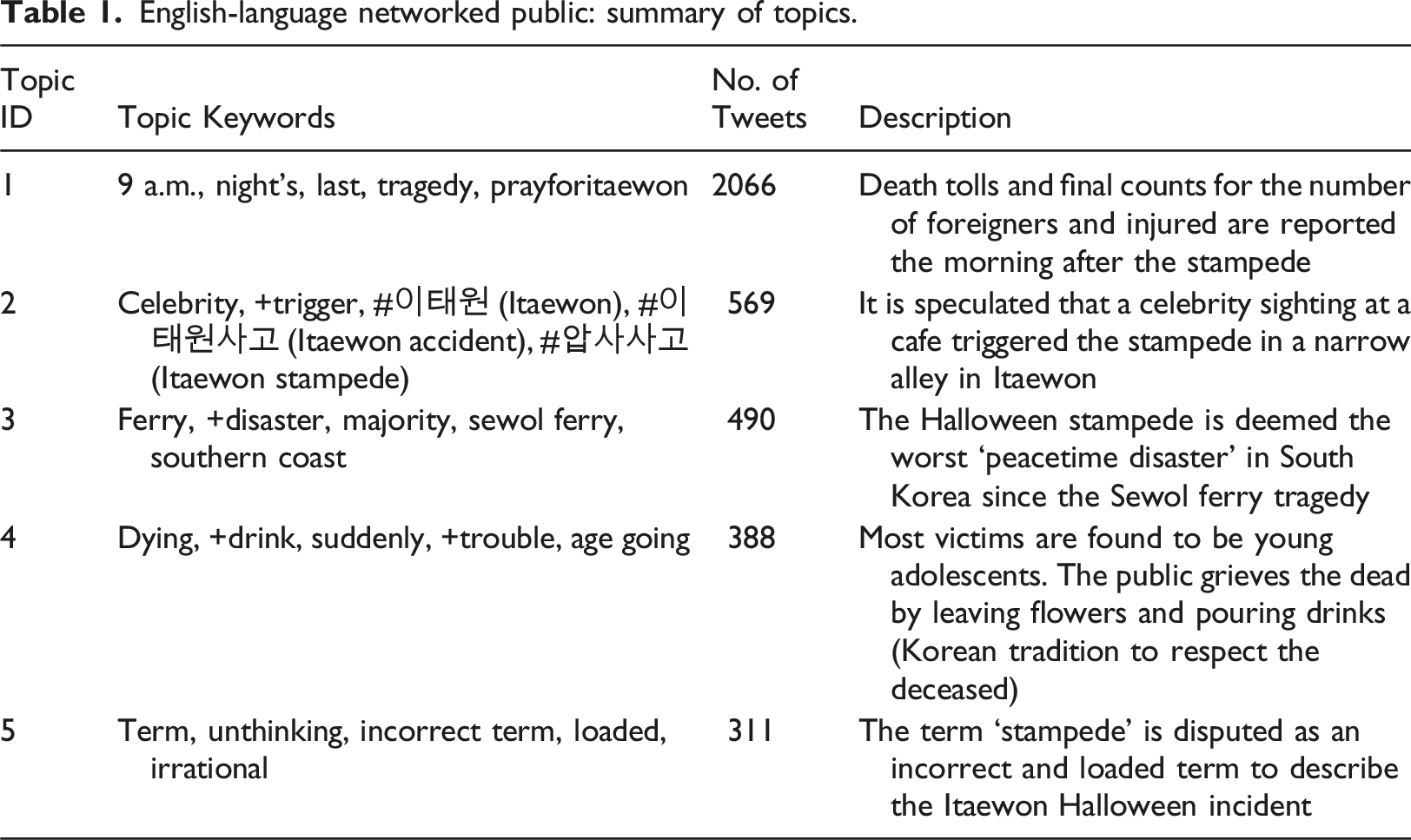
Many posts reporting aggregate tolls simultaneously offered ‘condolences’ to the families of the victims. This ostensibly complicates the dehumanization. But the homogeneity of such statements made them appear perfunctory and ritualistic themselves, especially as they were almost always followed by standard hashtags such as #PrayforKorea and #PrayforItaewon. Often, such posts also included hyperlinks to the online news reports with further factual information about the tragedy.
South Korea is well-known globally for its culture industries and many Korean celebrities have a cult following in the West (Jin, 2019). In multiple ways, the English-language discourse represented the stampede, too, as part of celebrity news and gossip. For example, Topic 2 included posts that claimed the stampede was triggered by the sighting of a celebrity at a nearby café – implicitly exoticizing Koreans and specifically the stampede victims as succumbing to irrational celebrity fanaticism. In addition, the most retweeted death toll update came from @Kpop-Herald, the X account of K-pop Herald, an online news service that offers the ‘latest k-pop news on music, fandom, fashion, idol photos and videos’.
Korean-language networked public: summary of topics.
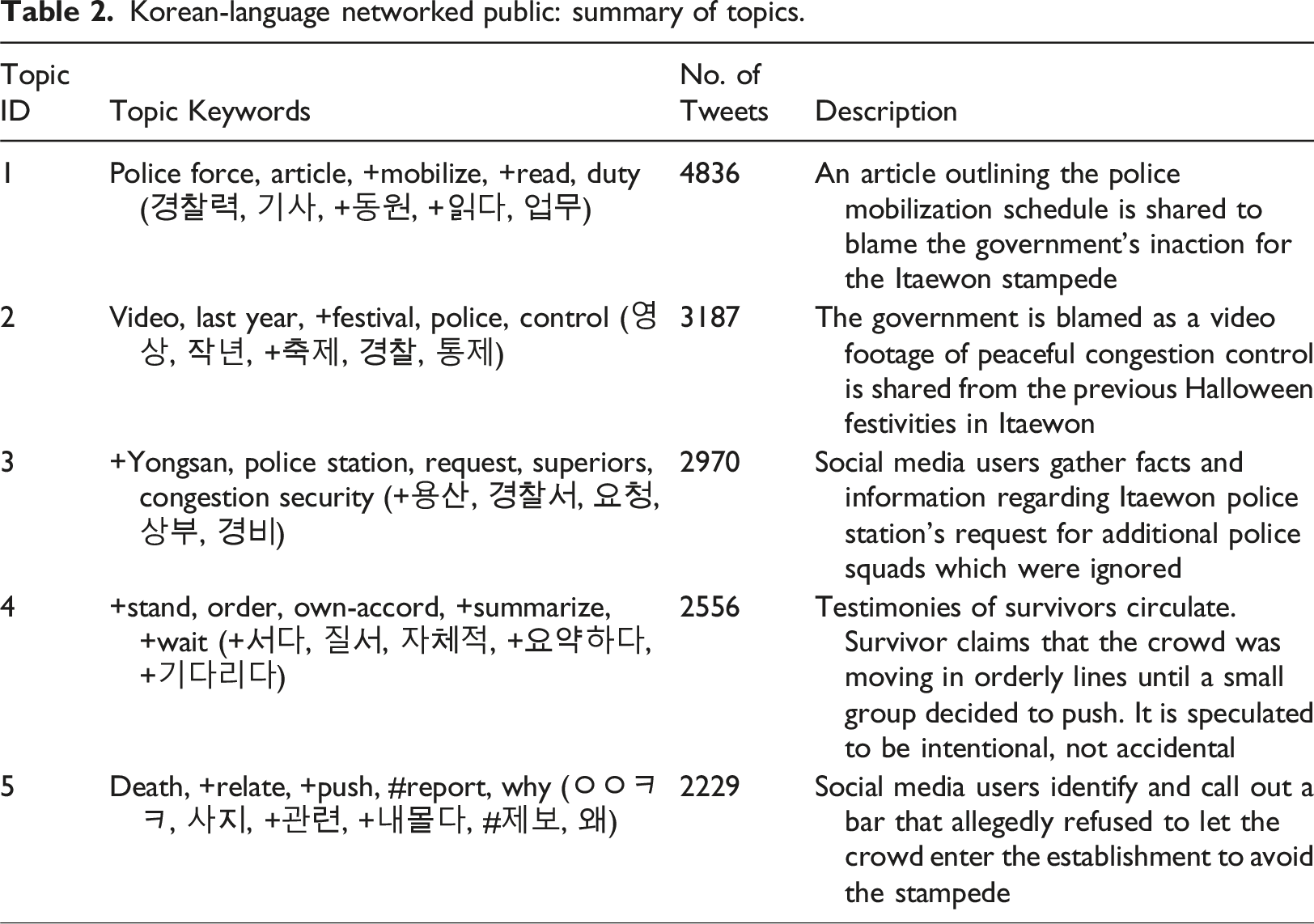
Another topic of conversation included posts in which Korean users of X turned into ‘citizen journalists’ providing summaries of their own investigations into what had happened and why. Several tweets featured testimonies from survivors of the stampede. But even here, the purpose was mainly to identify who ought to be blamed for the deaths. For example, some posts blamed a bar for allegedly refusing entry to people who were trying to avoid the stampede. Others speculated that the stampede was not accidental but caused intentionally by a group of people who did not want to wait in a line.
Not all the tweets in the English-language network were dehumanizing, however. One topic, albeit small in proportion, included tweets that evinced empathy for the victims, especially on account of their age. ‘Hearing about young people going through this and suddenly dying makes me feel troubled’, said one post on how Itaewon was grieving for its dead, quoting an interview with a Korean boy.
Space-time
The English-language and Korean-language networked publics situated the tragedy quite differently in space and time. English-language posts typically referred to the stampede as having taken place in Seoul, the city. ‘Seoul’ was, indeed, the second-most frequently used term in the data set, after ‘Halloween’. Many posts also mentioned Itaewon, but typically not without mentioning Seoul. The hashtags #Korea and #SouthKorea featured in the most prominent tweets, although #Itaewon was also frequently used. This suggests that the global audience on X primarily viewed the disaster as taking place in the city or the country. The specific location, Itaewon, was added either as additional detail or as a hashtag that would enhance the visibility of the post on the platform.
In contrast, ‘Itaewon’ was the most frequently used term in the Korean-language data set while neither ‘Seoul’ nor ‘South Korea’ featured in the top 10. It indicates that for Korean-language users, this was a highly localized tragedy and they could relate to it at the level of the neighborhood in which it occurred. This is not the sympathy of an obligatory condolence but the empathy of people who knew it could just as well have been them at the disaster because of their familiarity with where it took place. It also suggests a sensibility that the audience of these posts are users who can connect with the tragedy and its location just like their authors – a form of community-making. Some posts even mentioned the specific police station within whose jurisdiction the stampede occurred. For instance, one post said, ‘…all of Yongsan police [station’s] resources were sent to the mass-assembly and were not sent to Itaewon’.
The stampede was temporally contextualized by both networked publics, but again in quite different terms. In English-language posts, the stampede was described as ‘the worst peacetime disaster in South Korea since the Sewol ferry sank off the country’s southwestern coast in 2014’. The two tragedies, Itaewon stampede and Sewol ferry's sinking, are not related to each other – except in numerical terms. Such tweets underscored the dehumanization of victims of the stampede: they revealed that the English-speaking audience viewed them as a statistic, worth noting because of its scale. Other temporal markers, such as timestamps for death tolls (e.g., 9 a.m. Sunday) reinforced the representation of a human disaster as a curve on a chart.
Meanwhile, Korean-language posts contextualized the stampede vis-à-vis the previous year’s Halloween party at Itaewon – which had proceeded unremarkably because the presence of the police prevented any mishap, according to X users. This indicates their concern for the people who had died, not as a number but as a human loss made all the more tragic because it might have been preventable. In this discourse, the stampede is not one of a series of stand-alone dots on a timeline of interesting events but a part of Koreans’ lived history. Other prominent temporal markers included terms like ‘day of’ and ‘yesterday’, demonstrating a concern with what happened during the stampede and how Korean-speaking users should make sense of it rather than book-keeping after the fact.
Agency
This dimension focuses on the kind of actions depicted in the discourse as well as who was showed to have acted – and who wasn’t (Chouliaraki, 2006). There is very little agency in the most prominent topics of the English-language discourse. The stampede is deemed to have just happened on its own, as if it was a ‘natural disaster’. The authors of the X posts in these topics can do no more than offer condolences. Even for their audience, there was little more to do than ‘pray’. Some smaller topics were, however, different. One topic recounts the actions of local residents as they mourned the dead by pouring drinks and leaving flowers for them. Another topic illustrates cause and effect – the stampede, according to its tweets, was ‘triggered’ by the sight of a celebrity. In this topic, the people partying at Itaewon are effectively blamed for their own deaths. But another topic takes issue with this narrative and even with calling the disaster a ‘stampede’ at all. As one post put it, ‘Stampede is not only an incorrect term, it is a loaded word as it apportions blame to the victims for behaving in an irrational, self-destructive, unthinking and uncaring manner’. In this tweet, the X user is assuming agency themself by speaking on behalf of the victims being turned into perpetrators.
This sentiment is taken further in the Korean-language tweets. Agency in this discourse is almost entirely assumed by the networked public itself. The most prominent topics here categorically lay the blame on the government and the police for allowing the disaster to take place by not taking preventive measures. Korean-speaking users of X took it upon themselves to investigate and uncover information about police deployment, whose mismanagement, they argued, caused the tragedy. Indeed, the networked discourse itself became a form of social action geared toward holding the authorities responsible for their inaction.
Network structure
Besides the topics of conversation, our analysis also paid attention to the properties of networks constituted by the English-language and Korean-language posts. In particular, we computed the indegree centrality of all users, or nodes, to identify the hubs – the users that wielded the most influence within each network in terms of retweets. Drawing on Shahin and colleagues (2024), we call them crowd-enabled elites, whose influence is not predetermined but draws from situated interactions in emergent issue-based networks. Although having a high social capital, for instance through a large following on a platform like X, can help a user wield influence in such networks, even users with very few followers can rise to prominence and become a crowd-enabled elite, for instance when a particular post goes viral.
In the English-language networked public, the top crowd-enabled elite was @Kpop_herald (2,065 ties), followed by @nytimes (1,591). Both of these are news outlets. As noted earlier, @Kpop_herald is the X account of K-pop Herald, which provides news about the Korean popular music industry and its stars. Meanwhile, @nytimes belongs to the U.S.-based New York Times, one of the world’s biggest news organizations. Although their indegree centrality is much higher than any other account in the network, the top-10 crowd-enabled elites included other news accounts such as @inquirerdotnet and @ajenglish. The high indegree centrality of such X accounts indicates the prominence of news reports in the English-language discourse about the stampede and supports the findings of topic modeling.
In contrast, the Korean-language networked public was dominated by the accounts of individual users. The top-three crowd-enabled elites in this network were moolpa* (3,178 ties), innerca* (2,961), and Istgpg* (2,542). 2 Indeed, all top-10 elites were ordinary social media users. Their preeminence is also in line with the results of topic modeling, which suggested that the prominent topics in the discourse were not factual news stories or ritualistic messages of condolences but posts looking for answers to understand how a stampede could take place at a hub of Korean social life, a place many ordinary Koreans are deeply familiar with.
The two networked publics also differed significantly in terms of diameter, or the longest distance between two nodes in a network. A smaller diameter indicates a more centralized network, with a small number of nodes being highly influential. Meanwhile, a larger diameter suggests more decentralization, or a network with different hubs forming multiple, weakly connected cliques. The diameter of the English-language network was 6 while that of the Korean-language network was 9. This is likely because a few news organizations with global followings formed the core of the English-language network. On the other hand, the crowd-enabled elites in the Korean-language network were ordinary users, each of whom formed disparate cliques interconnected with weak ties, constituting a more decentralized network.
Discussion and conclusion: Fractured spectacle
The 2022 Itaewon stampede turned into a spectacle on social media – a commodified representation of reality (Debord, 1967). While the disaster was ‘directly lived’ by people who gathered to party in Itaewon on that fateful Halloween night, it was vicariously consumed by millions of others, in South Korea and around the globe, as a stream of posts, photos, videos, hashtags, and hyperlinks. As Debord would argue, this representation might pretend to be reality but was only a distortion of it. Moreover, the act of representation transformed the tragedy into a commodity. For social media companies, whose business model under surveillance capitalism relies on extracting market value from human experiences, all ‘user engagement’ on their platforms is a source of vendible data (Zuboff, 2019). For social media users, posting, sharing, liking and so on are the means of negotiating visibility – and the social, psychological, and economic benefits that accrue from it – in the online attention economy (Beller, 2012).
But this spectacle was far from the unified, uninterrupted totality that Debord had conceived it as. It was, instead, a fractured spectacle, whose different aspects conflicted with and even contradicted each other. The ways in which English-language and Korean-language networked publics related with and represented the stampede and its victims were vastly different.
In the English-language network, the prominence of mass media accounts meant that victims were often represented as numerical aggregates, remarkable as an anomalous statistic rather than as human beings. References to the stampede as a stand-alone point in time, with neither cause nor effect, accentuated their dehumanization. Pity for ‘young’ victims and ritualistic expressions of sympathy for their families reinforced their construction as a distant other. Many people know South Korea through the global ‘idols’ produced by its culture industries: the tragedy became a part of the torrent of celebrity news and gossip from the country. The stampede in the English-language network thus closely resembled the Debordian spectacle. The networked public related almost exclusively to mediatized representations of the disaster rather than to its actual victims. Members of this public uncritically accepted the authoritative version of events as reality. As distant spectators of suffering with no skin in the game, so to speak, they had little reason to do otherwise – echoing the findings of Von Engelhardt and Jansz (2014), Scott (2015), and Huiberts (2020).
In contrast, the Korean-language discourse was driven by posts from ordinary users. Members of this networked public were mainly concerned with how and why the disaster took place. Instead of accepting what happened as a fact of life and moving on, they blamed the government and the local police for failing in their duty to protect the crowd at Itaewon. They also took it upon themselves to investigate the specific reasons for this failure, serving a function the professional media was evidently unable to perform. The predominant emotions were regret at the avoidable loss of life and anger at those they believed to be responsible for it. In doing so, they evinced a visceral connection with the victims. They were spectators too, but not ritualistically sympathetic spectators of distant suffering. Instead, the Korean-language networked public comprised empathetic spectators of proximal suffering – people who could ‘self-identify’ with the sufferers themselves (Ong, 2015). It was as if the tragedy had happened to them. In doing so, they constituted what Papacharissi (2016) called an affective public, evincing ‘bonding and solidarity’ (p. 310).
We, therefore, propose the fractured spectacle as a concept that brings to attention the variety of social representations that become possible as a consequence of the sociotechnical affordances of social media – and the diversity of social relations that ensue from them. As the term suggests, our view does not preclude Debord’s (1967) conceptualization of the spectacle in the age of mass media. Indeed, our analysis shows that it remains deeply relevant for understanding social media, where mass media outlets retain a significant presence, not only as corporations competing in media markets but also as content producers with global followings on social networking platforms. As Chadwick (2017) has argued, it may be better to think of the contemporary environment as a ‘hybrid’ media ecosystem, in which the logics of newer and older media forms ‘compete and coexist’.
These logics include the blurring of boundaries between ‘producers’ and ‘consumers’ of media messages, with production no longer monopolized by a relatively small number of media corporations but including the vast majority of the erstwhile audience as well. To be sure, this doesn’t imply equivalence among users as many early scholars of the internet and social media assumed, because distribution of power to reach users in the emergent attention economy is quite asymmetrical (González-Bailón and Wang, 2016). Often, it can be skewed in favor of resource-rich media organizations, as we saw in the case of the English-language discourse.
But the same logic opens up the possibility of alternative voices gaining traction and bringing attention to different perspectives within situated networked discourses – or what Shahin and colleagues (2024) have called the ‘crowd-enabled elites’ (see also, Shahin and Hou, 2025). This, in turn, gives rise to Boyd’s (2011) ‘networked publics’, loose agglomerations of users who come together at particular moments in time, often to share views about and emotions toward emergent issues of common concern. In our study, for instance, ordinary users took center stage in the Korean-language discourse, not only identifying and empathizing with the victims but also calling out administrative failures and investigating the reasons behind them. The result is a fractured spectacle, allowing different representations of an event like the Itaewon stampede and different ways of relating to its victims.
The fractured spectacle, as a concept, has both societal and scientific implications. Debord (1967) expected the spectacle to be benumbing and depoliticizing, and that is largely what we found in the English-language network. But the political angst that we discovered in the Korean-language network was a prelude to, and potentially even a precursor of, sustained ‘real life’ political action. Candlelight vigils for the victims and protests against the administration broke out in several cities across South Korea in the days following the stampede (Guardian, 2022). Nor were these protests short-lived – they continued even a year later and that eventually forced the government to accept its responsibility for the disaster (Time, 2023). So, the fracturing of the spectacle can lead to diverse political repercussions.
The fractured spectacle has important implications for future research. First, scholars should not treat English-language discourse as representative of all networked interactions, especially when it relates to issues and events happening in places where English is not the native language. As our analysis indicates, the discourse can vary vastly across different languages, even on the same social networking platform. Second, research on the mediatization of suffering on social media should not look only at ‘distant’ spectators but also consider ‘proximate’ spectators and their reactions to it (Ong, 2015). However, proximity does not need to be exclusively geographic or linguistic: it can take other forms. Research on digitally networked movements such as Black Lives Matter (Shahin et al., 2024) and #MeToo (Suk et al., 2024) suggests empathy for suffering can cross such boundaries when it generates ‘resonance’ among networked users – for instance, among marginalized communities across different countries. In other words, proximity can emerge through similarity of experiences across physical and cultural distance.
The limitations of our study design can also inspire further research. For instance, we have only looked at networked discourses on a single platform: X. Cross-platform studies can shed more light on how platform affordances shape the constitution of networked publics and, in turn, the ways users represent and react to distant or proximal suffering (Boyd, 2011; Oz et al., 2024). Moreover, we have compared English-speaking users, who constitute a fairly diverse group spanning the globe, with Korean-speaking users, who are socioculturally more homogeneous. Our research design doesn’t allow us to distinguish between socioeconomic categories within these networked publics. But previous research (e.g., Ong, 2015) suggests that such differences can be analytically significant, even among proximate spectators. Future research can adopt mixed-methods approaches, for instance computational analyses of networked discourses with in-depth interviews of purposively sampled users, to address these limitations.
