



Abstract
Social media channels, particularly Twitter/X, played a significant role as information platforms during the COVID-19 pandemic. As journalists are crucial actors on that platform, an analysis of the content and tone of their tweets during the pandemic can reveal the role they played in shaping public understanding of this public health crisis. Our analysis focuses on Germany where the government enforced relatively strict anti-COVID-19 measures and where strong opposition to these measures emerged outside the mainstream media. We analyzed almost 10.000 tweets of 247 journalists of mainstream media during a 14-month-period. To shed light on journalists’ watchdog versus collaborative role orientation, computational methods were used to extract themes and tone in their pandemic-related tweets. Furthermore, network analysis was utilized to identify influential actors in journalists’ interactions with experts and other users on Twitter. The findings revealed that journalists tweeted most about topics like the economy, protests, and Chancellor Merkel’s ability to implement a restrictive containment policy. As demonstrated by the network analysis, journalists frequently interacted with cabinet members and pro-government experts on Twitter during the pandemic. The analysis also revealed that some tweets were characterized by an anti-protest and anti-lockdown tone, but these came from different groups of journalists.
Introduction
The global coronavirus pandemic, which began to impact countries around the world, including Germany, in January 2020 was an immediate and disruptive event comparable to a natural disaster. Once initial cases were detected, the situation quickly escalated into a public health emergency. The measures implemented to control the spread of the virus in Germany affected virtually every sector of public life. The handling of the outbreak and its aftermath drew overwhelming attention from the media for several months (Boberg et al., 2020; Maurer et al., 2022; Mellado et al., 2021; Quandt et al., 2020). However, the state’s pandemic policy also sparked a political debate between those who advocated restrictive measures that could potentially impinge on personal rights and those who supported less restrictive measures. In Germany, the coalition of CDU (Christian Democratic Union, Conservatives) and SPD (Social Democratic Party, Social Democrats) led by Chancellor Angela Merkel implemented restrictive measures. However, its actions encountered considerable criticism from politicians and protesters outside established parties and were not unanimously supported by expert scientific opinion (e.g., Schrappe et al., 2021).
After the first few months of the pandemic, media researchers criticized German mainstream media for offering coverage that unconditionally supported the government’s policy (Jarren, 2020; Meier and Wyss, 2020). According to this criticism, the themes and tone of the media coverage were consonant with promoting and validating the government’s pandemic related policies and disregarded critical voices and themes that questions them. Of note, the COVID-19 pandemic and its political repercussions unfolded within a digital information ecosystem where a significant amount of information was disseminated and received through online platforms. Twitter (now “X”) has become the most prominent platform for political debates on current events, and this is especially true in health crises (Dagoula, 2022; Hagen et al., 2021). Within this digital information ecosystem, journalists play a vital role in amplifying or downplaying certain topics, information sources, and opinions (Mills et al., 2021; Molyneux and Mourão, 2019). Some studies show that journalists tend to adopt Twitter as platform for personal, subjective opinion on current affairs (Molyneux and Mourão, 2019; Mourão and Chen, 2020). Thus, analyzing the content of political journalists’ tweets during the coronavirus pandemic provides a means to assess their personal views and voices on the pandemic.
The topics journalists as individuals feed to networked publics in their tweets form an important part of the hybrid information ecosystem. A recent study analyzing tweets of political journalists found that their tone on Twitter regarding political protests can differ from their media organizations’ tone (Mourão and Chen, 2020). Therefore, one objective of this study was to investigate the range of topics political journalists 1 discussed in their tweets about the COVID-19 pandemic in Germany and the tone of these tweets. Prior to analyzing journalists’ coverage of the global pandemic on Twitter, we first discuss pandemic journalism, especially in the context of journalistic role concepts and with a view towards politicization of the coronavirus global pandemic. We also address patterns of elite orientation within journalists, focusing specifically on Twitter.
COVID-19 coverage, journalistic roles, and networks
Previous research focusing on media coverage of public health crises has shown that journalists tend to frame such crises in an event- and consequences-oriented pattern. For example, a study based on newspaper coverage of public health epidemics in the U.S. found that journalists primarily focused on dangers posed by the disease and the actions of the government (Shih et al., 2008). The authors of this study found a conflict frame to be more frequent when the health issue had a political dimension. A study on COVID-19 coverage in 37 countries that examined the role of journalism during the first year of the pandemic highlighted the prominence of government officials and their decisions as drivers of the coverage, indicating that the traditional role of journalists as watchdogs was superseded by that of a loyal facilitator of government officials (Hallin et al., 2023).
Beyond a monitorial role, journalists’ roles may be situated between collaborative, radical (watchdog), and facilitative role orientations (Christians et al., 2009). In the case of the coronavirus pandemic, a collaborative role orientation would entail journalists using Twitter to report on the measures taken by the government in response to the pandemic, adopting a supportive tone and highlighting topics that helped justify these measures. This role is called “a loyal facilitator of government” by Hallin and colleagues (2023: 1981). In contrast, a radical watchdog role orientation would entail challenging the government by tweeting about topics the government avoided and highlighting critical voices. A facilitative (or civic) role would mean that journalists would act as enablers of a broad discourse on issues related to the pandemic, including voices outside the political elite and health experts that support the government’s measures. However, the importance of the civic role of journalists may shift during a pandemic, as shown by a study that examined German and Finnish journalists’ perceptions of their roles during public health crises one year prior to the global pandemic (Klemm et al., 2019). According to this study, important aspects of this civic role, such as reporting on protests and public criticism of state policies, may be downplayed during such crises for the benefit of mobilizing the public to follow official government policy guidelines.
Several authors have pointed out that pandemic coverage in other democracies was politicized along a divide between supporters and critics of a strict containment policy and that this was manifested in different political language used to report on the pandemic (Borah et al., 2024; Wondemaghen, 2023). As shown by analyses conducted in the U.S., liberal- and conservative-leaning media differed in the topics they covered, as well as in their word choice and framing of COVID-19 coverage (Borah et al., 2024). According to their study, the left-leaning media “supported the shutdowns and actively advocated for them” (Borah et al., 2024: p. 424). In contrast, the right-leaning media covered shutdowns in detail but “primarily to criticize these restrictions and make them a political issue” (p. 425). There is also evidence that opinion-leading media, such as The Guardian in the U.K., used strong political language, including stigmatizing labels, to frame people with views on restrictive measures that deviated from the political majorities’ view as deniers, conspiracy theorists, or political radicals (Wondemaghen, 2023).
Coverage of the pandemic in Germany
After the first two months of the pandemic, observers of leading German news media outlets claimed that they were reporting in a one-sided manner, with content stage-managed to support the government and legitimize its far-reaching emergency measures (Jarren, 2020). According to these observers, the German news media had become too preoccupied with the government’s narratives and were uncritically disseminating them (Meier and Wyss, 2020). Citing this critique, Quandt et al. (2020: p. 23) noted that according to their critics, German news media outlets “showed a lack of distance to official institutions, politicians, and ‘the elite', resulting in an affirmative coverage and a one-sided portrayal of the situation, essentially constructing a false reality.”
Thus far, two studies (Maurer et al., 2022; Quandt et al., 2020) have systematically examined news media coverage of COVID-19 in Germany based on a broad media sample. Quandt et al. (2020) analyzed more than 100,000 news items related to the pandemic that were published on the Facebook pages of German (mainstream) media between January and March 2020. Maurer et al. (2022) coded 5000 news items about the coronavirus pandemic that were published by leading German media organizations, either on a website or in a TV news program. Using topic modeling, Quandt et al. (2020) found that the coverage concentrated on the political elite and agreed with government policy on COVID-19 prevention measures. Indeed, based on their analysis of the topics covered, none of the views expressed on the pandemic and the response to it seemed to differ substantially from those of the government. Using manual coding, Maurer et al. (2022) found that the majority of topics were in line with the narratives put forward by the governing coalition, echoing Quandt et al.’s (2020) findings. They concluded that the government set the media agenda and that the coverage marginalized opposing views on prevention measures taken by the political authorities. In line with that, scientific views presented in the coverage were those of official health authorities and experts who generally supported the government’s policies. Coverage of critical issues, such as the problems, hardships, and undesirable effects of restrictive measures in various sectors of society, was sparse. Furthermore, the framing of critical opinions opposing restrictive policy measures was consistently negative and harsh (Maurer et al., 2022). Comparing these results with those of a study that focused on pandemic coverage by non-mainstream news outlets suggests that alternative outlets were the only segment of the German media to highlight different issues and promote narratives that deviated from those of the mainstream media (Boberg et al., 2020). These issues were organized under themes labeled as “failure of governments in crisis management” or “economic crisis due to misguided political action,” policy measures to combat the pandemic were judged as irrational, and the federal government was accused of spreading fear (Boberg et al., 2020: p. 8). To sum up, views on the pandemic that differed from those of official sources were largely ignored by the mainstream media in Germany (Maurer et al., 2022) but covered by alternative (online) news channels and actors on social media platforms (Boberg et al., 2020).
Elite networks on twitter
A significant aspect of the pandemic was that it took place in a fully developed digital communication ecosystem, where many people turned to social media platforms for information and guidance (Quandt and Wahl-Jørgensen, 2022). Unlike the mainstream media, in social media spaces like Twitter, journalists can add a personal spin to news stories, focus on different topics, and cite different voices. Thus, analyzing the content of tweets is a promising way to examine the attitudes and views of individual journalists about COVID-19, which are potentially separate from the profile of their media and their institutional role.
When the coronavirus crisis erupted, Twitter quickly emerged as an important networked sphere. The platform’s relevance as an incubator of topics, precursor of public opinion, and enabler of knowledge formation arguably increased during the pandemic, as has been demonstrated during previous pandemics like the Zika virus (Hagen et al., 2021). Twitter is shaped by individual accounts by anti- and pro-government politicians, experts, and journalists who play an important role in legitimizing and amplifying voices on this social media platform. On the Twitter platform, as well as outside this platform, journalists network with political elites, and health experts. Discursive tweets (i.e., messages that address other actors) are of particular importance for opinion formation and expression in the journalistic community (Schumacher et al., 2023). Indeed, previous research has suggested that journalists primarily use Twitter to develop and test narratives and spin in journalistic communities rather than to communicate with a wide audience (Mourão, 2015). Given that tweets help to propel issues into the public sphere, actors with opinions about the policy response to the pandemic, whether they agreed with those propagated in the mainstream media or not, were eager to engage with journalists, e.g., by addressing them directly in tweets or otherwise trying to gain their attention on the platform.
According to the literature, elite figures, especially politicians, still dominate cited tweets of journalists, reinforcing and echoing a preference for established, official, and elite sources (e.g., Von Nordheim et al., 2018; Wallsten, 2015). Kapzidzic et al. (2022) previously showed that when German journalists used tweets as sources in political and economic news, these tweets came primarily from politicians. Against this background, we assume that a concentration on political elites is also likely to be found in interactions between journalists and other users on Twitter. Regarding media coverage of the pandemic disseminated through social media platforms, Mellado et al. (2021) underscored that politicians were the most prominent actors cited, especially on Twitter. In the context of the pandemic, if it could be shown that journalists were uncritically interacting mainly with elites from government parties and health experts who supported the government’s policy response, this would indicate a collaborative rather than a watchdog role.
Research questions
Analyzing tweets of journalists with a Twitter/X account is a way to measure the journalistic community’s contribution to the dynamic online space of public debate, where the flow of information and opinion is less controllable than in the relatively protected and curated channels of media organizations. Tweets can (in)directly reveal the personal opinions of journalists and their stance toward current events. The topics and tone of journalists’ tweets may also indicate a gap between editorial policies that constrain what journalists can say in the coverage and journalists’ personal opinions. Clearly, the attitudes of journalists as a community of Twitter users can differ from those of their employers. Thus, journalists’ tweets provide valuable information in the assessment of journalism’s role in public opinion regarding the pandemic and its handling. Regardless of whether journalists’ tweets distanced themselves from mainstream media messages about COVID-19 or reinforced these, their tweets contributed to shaping public understanding of the pandemic and forming a background for political decision making.
Furthermore, drawing on findings on divergence in the tone of pandemic coverage between left-liberal and conservative, right-leaning media outlets obtained from the U.K. and the U.S. (Borah et al., 2024; Wondemaghen, 2023), we assumed that journalists from left-leaning outlets (e.g., Der Tagesspiegel, Süddeutsche Zeitung) adopted a critical tone toward protests of restrictive policy measures, whereas those from right-leaning outlets (e.g., Die Welt, Bild/Bild am Sonntag) adopted a critical tone toward strong state intervention. 2
Having established the relevance of journalists’ tweets to understand their role in the formation of public opinion about the COVID-19 pandemic, we analyze three research questions: RQ1. What themes emerged from journalists’ tweets about the pandemic between March 2020 and April 2021, and what do they tell us about journalists’ role in the public debate about it? RQ2. Which actors were highly present and got a lot of attention in Twitter conversations involving journalists about pandemic-related topics, and what does this indicate about journalists’ relation to political power during the pandemic? RQ3. Did journalists’ tweets contain political frames on pandemic policy and events, and did they differ, depending on whether the journalists were employed by right- or left-leaning media outlets?
Methods
Sample and corpus
This study was based on an analysis of tweets posted by 247 German journalists, all members of the “Bundespressekonferenz” (BPK), a journalistic organization to which many journalists reporting about national political matters belong. All BPK members with an active Twitter account were included in the study. The activities of these journalists were tracked using DMI TCAT, a real-time tracking tool designed for research (Borra and Rieder, 2014) between 1 January 2020 and 30 April 2021. The DMI TCAT instantly tracked the accounts of interest using the Twitter API. The resulting corpus contained more than 300,000 tweets. From these tweets, we filtered 121,072 tweets that contained @-mentions and @replies, as we aimed to combine topic modeling with a network perspective (see Honeycutt and Herring, 2009). In this way, we concentrated on messages that were exchanged in a dense, interlinked network consisting of the “established political commentariat of professionals engaged in political debate” (Bruns and Highfield, 2013: p. 672). As we decided to exclude retweets, the corpus was limited to tweets written by the journalists themselves. In the next stage, we filtered all those tweets that referred to COVID-19 in the text using the keywords “Virus,” “Pandemie” [pandemic], “COVID,” “Corona,” “Inzidenz” [incidence], “Lockdown,” “#Corona,” “#Lockdown,” and “#Coronapandemie” [coronavirus pandemic]. This search yielded 9771 tweets from 247 accounts which, after manually checking for false positives, constituted the corpus for the subsequent analyses.
Analytical approach
We used several computational methods to analyze the material. First, we applied topic modeling, an unsupervised machine learning technique, to detect the topics contained in the journalists’ tweets about the coronavirus pandemic. Second, we used network analysis to track the prevalence of specific topics and users in different parts of the network. Third, we conducted a keyness analysis 3 (Gabrielatos, 2018), a computational method widely used in comparative discourse studies (Gabrielatos, 2018) to detect differences between subcorpora. Similar word-based approaches have been applied for automatic frame or spin detection in political tweets and media coverage (Luther and Miller, 2005; Stier, 2016). This analysis reveals whether specific frames are introduced by key terms in tweets from journalists affiliated with left-liberal and conservative media organizations.
Topic modeling
In this study, we used a common topic modeling variant, latent Dirichlet allocation (LDA) (Blei et al., 2003). LDA is a “generative probabilistic model assuming that a document is composed of a set of (latent) topics, where each topic is composed of words” (Pirri et al., 2020: p. 4). Topics are latent meanings behind the visible clusters of words that tend to co-occur across the documents of the corpus. As Farrell (2016: p. 93) succinctly stated, topics “emerge inductively as algorithms learn the hidden patterns underlying a collection of texts.” A tweet is modeled in LDA as a mixture of topic proportions, where the topics themselves generate the words in each tweet.
As topic modeling relies upon the bag-of-words approach, the corpus had to be re-processed before the actual analysis. After tokenization, common stop words, @mentions, numbers, symbols, and URLs were removed (Maier et al., 2018). However, hashtags were kept because they contained relevant information about the subject of the tweet. After cleaning, the corpus consisted of 23,491 unique terms and 9771 tweets. Before topic modeling can provide meaningful results, the tokenized and cleaned corpus was pruned to eliminate terms that occurred either too frequently or too rarely to be useful to inform the modeling procedure. If a word occurred in less than 0.1% or more than 5% of the tweets, it was filtered out. After this step, 1492 terms and 9350 tweets finally remained in the corpus. Topic modeling was then carried out using the STM package for R (Roberts et al., 2019).
An important caveat in topic modeling is the interpretability of topics. Chang et al. (2010) demonstrated that human coders were required to determine whether topics emerging from LDA were equivalent to human-identifiable themes. As there is no gold standard in most cases against which to compare the results of topic modeling, prior knowledge of the thematic domain of the corpus helps researchers to label a modelled topic. To determine tentative numbers of topics (k) for our model, we drew on previous research that modeled topics in tweets or a comparably thematically constrained corpus. The final choice fell on k = 10, as this number promised the strongest semantic coherence of the topics’ constitutive terms and the topics could be interpreted most intuitively.
To aid the labeling of the topics, we used the results of an exploratory, qualitative content analysis of an extract from the corpus (random sample of 1000 tweets), which was carried out before topic modeling. Based on a thorough reading, this partial corpus was condensed by a human coder into themes which aided the interpretation of the algorithmically determined topics. Finally, to test the concordance of the content of each tweet as understood by a human coder with the topics assigned to them by the model, a reliability check was run with 1500 tweets. The test yielded good-to-satisfactory reliability coefficients for most topics (Table 3, Appendix 1).
Results
Overview of the topics
Figure 1 shows the topics represented by their most frequent and distinctive terms along with their respective proportions in the corpus.
4
In general, we found that single topics did not dominate single tweets and that a mixture of topics contributed small amounts to a tweet’s content. Proportion of 10 Topics (with highest β-value keywords) in the corpus of 9771 Tweets.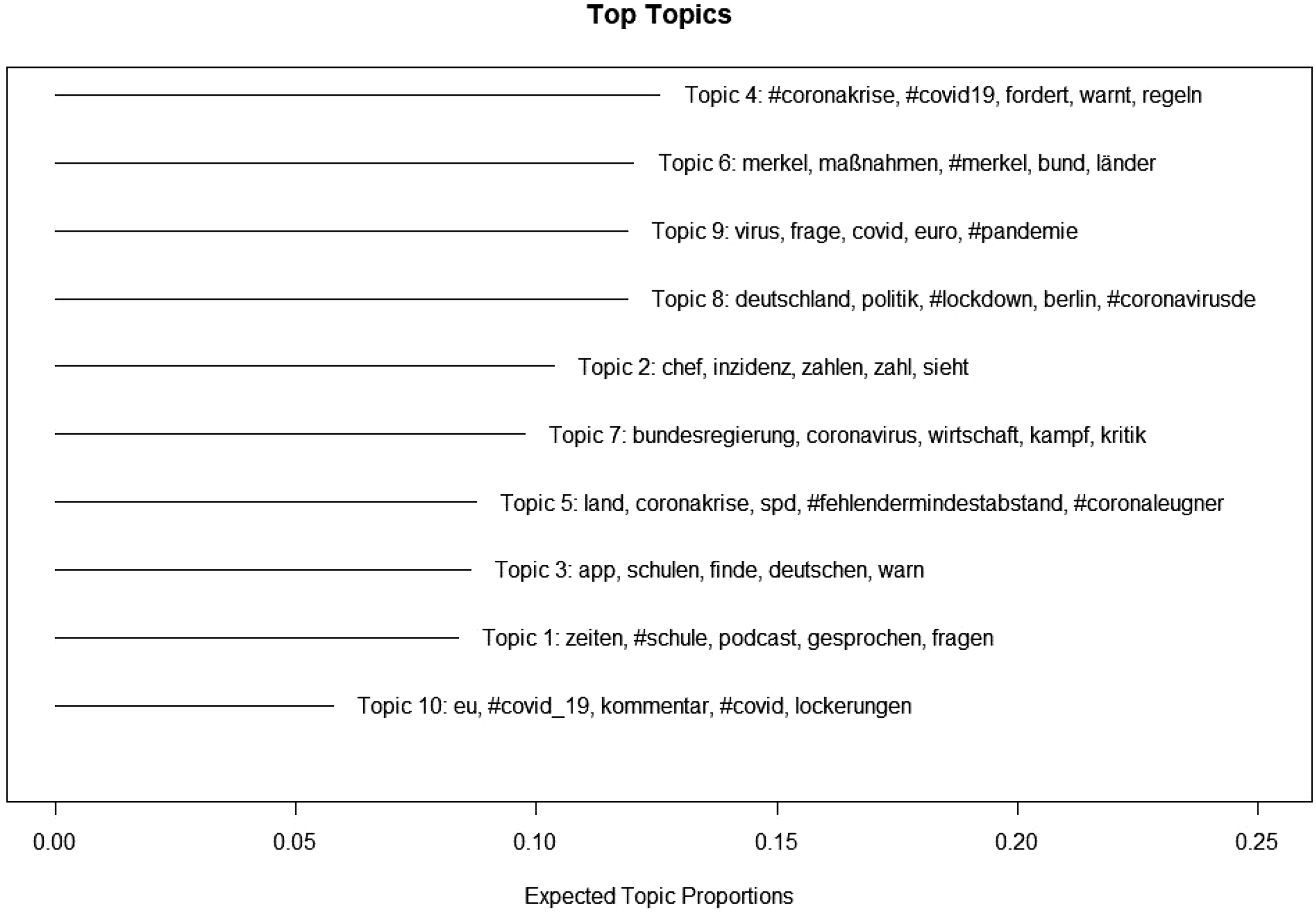
Topic 1 was related to the situation in schools as indicated by the terms school and school hour. The salient terms (in italics) included president and Hubig, which referred to the president of the Standing Conference of the Ministers of Educations of the Federal States. Topic 2 dealt with the dynamics of COVID-19 cases, the consequences for available intensive care beds in hospitals (Intensivstationen [ICUs]), and related health system issues. This interpretation fits with the appearance of names, such as Wieler, who was the director of the RKI, the scientific institute that advises the government on pandemics. Topic 3 dealt with vulnerable individuals, self-protection measures, and means to trace infections promoted by the authorities (Warn [warning], App, Bundeswehr [Army]). Topic 4 focused on the broader societal and economic impact of the pandemic, which was presented here as a crisis (#Coronakrise, [corona crisis]) and focused on the needs and demands the pandemic created in various domains. Topic 5 contained evaluative terms (totally, wrong, coronavirus denier), but what it was about was more difficult to interpret. Tweets closely associated with this topic suggested that it dealt to some extent with attacking critics of pandemic-related policy. Topic 6 was about the government’s political response to the pandemic. Terms referring to Chancellor Merkel, political institutions, and political actions were most salient (chancellor, states, plan, decision, summit, Merkel). Topic 7 was mainly about protests and criticism of the government’s policies, as indicated by terms like police, canceled, criticism, and demonstration. Topic 8 focused on the shutdown of public life and a discussion of the negative side effects of this measure. Topic 9 dealt with vaccines, and Topic 10 concentrated on international aspects of the crisis, such as elsewhere in the European Union (EU) and the U.S., as well as the role of the EU in dealing with the pandemic.
As shown in Figure 1, topics dealing with the broad societal impact of the COVID-19 pandemic and the demands it created (Topic 4), Chancellor Merkel’s pandemic-related policies (Topic 6), vaccination (Topic 9), and the lockdown measure (Topic 8) accounted for the largest shares in the corpus. Our interpretation of the topics was based not only on the top terms but also on plots that show the prevalence of a topic over time (Figures 3 and 4, Appendix 2). Taking the example of Topics 6 and 7, peaks in topic prevalence can be matched to events corresponding with the topic. For example, whenever Merkel made noteworthy statements about the pandemic or held a conference with heads of state governments (called coronavirus summits) or whenever the Bundestag approved a new policy response on the pandemic, there was a peak in the prevalence of Topic 6 (Merkel’s pandemic-related policy). The same parallelism between peaks of tweeting activity and events was found for Topic 8 (announcement of shutdowns) and Topic 7 (demonstrations and protests).
Both the prevalence of terms in the topics and the importance of the topics in the corpus suggested that journalists primarily tweeted about the government’s (evolving) position. Although several large-scale demonstrations against the restriction of civil rights and liberties took place, the demands of the protesters were much less discussed in the tweets than the reasons for the government’s strategy. While two topics dealt with the protests, one (Topic 7) focused more on the demonstrations, and another (Topic 5) concentrated more on countering the criticism and ostracizing the critics. In general, the content structure of some of the topics aligns well with the collaborative role of journalists. In particular, the topics addressing the government’s policy (Topic 6), the delegitimization of protests (Topic 5), and the development of incidence figures (cases) and the potential impact on the capacity of ICUs (Topic 2) constitute a supportive context for the government’s policy. Conversely, only the topic on the lockdown (Topic 8) can be linked to a more power distant, watchdog role. The remaining topics are within the scope of a monitorial role, partly enriched with civic aspects (Topic 1, 3 and 4).
Twitter users in the network
To answer the second research question, we used a network analysis approach to analyze which users – close to power or opposing the government – were influential in conversations around different topics and whether some topics engaged more users than others.
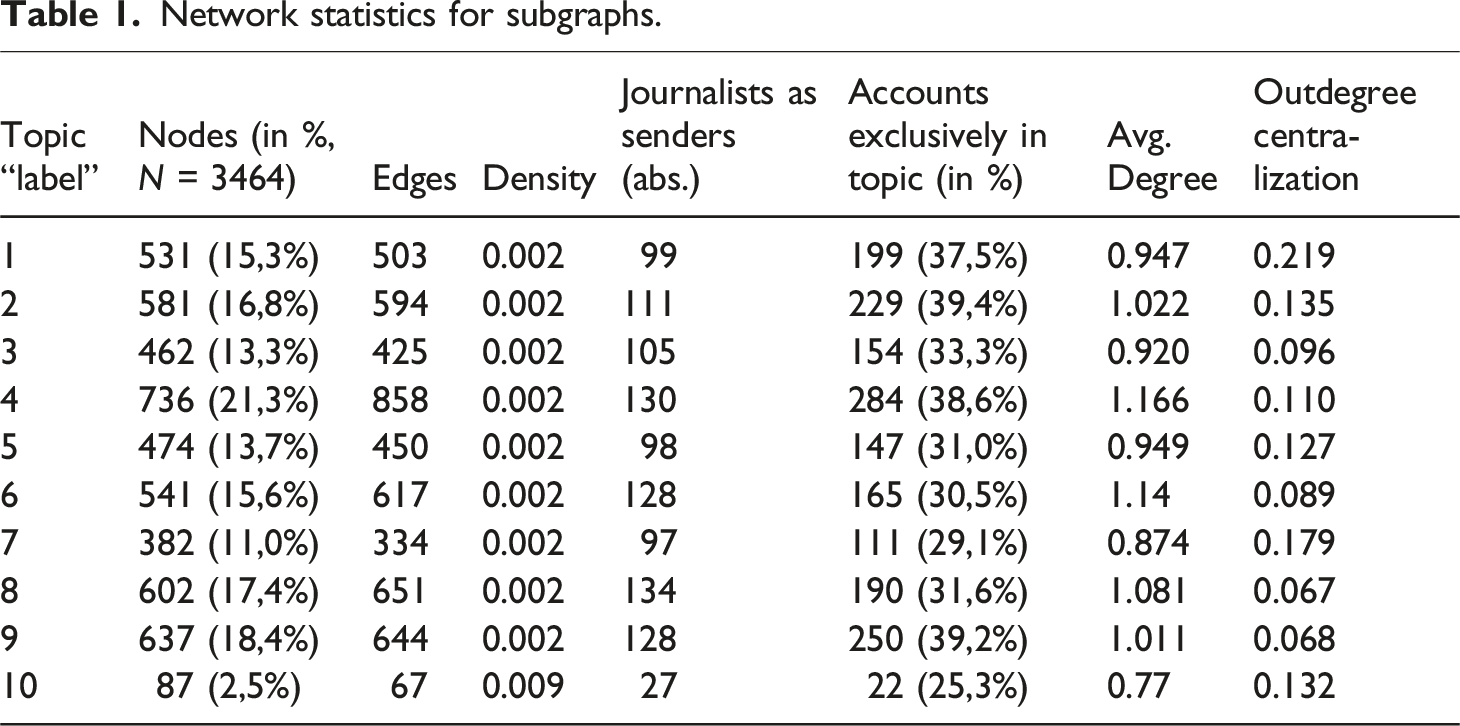
Network statistics for subgraphs.
Accounts that get most interaction from journalists.
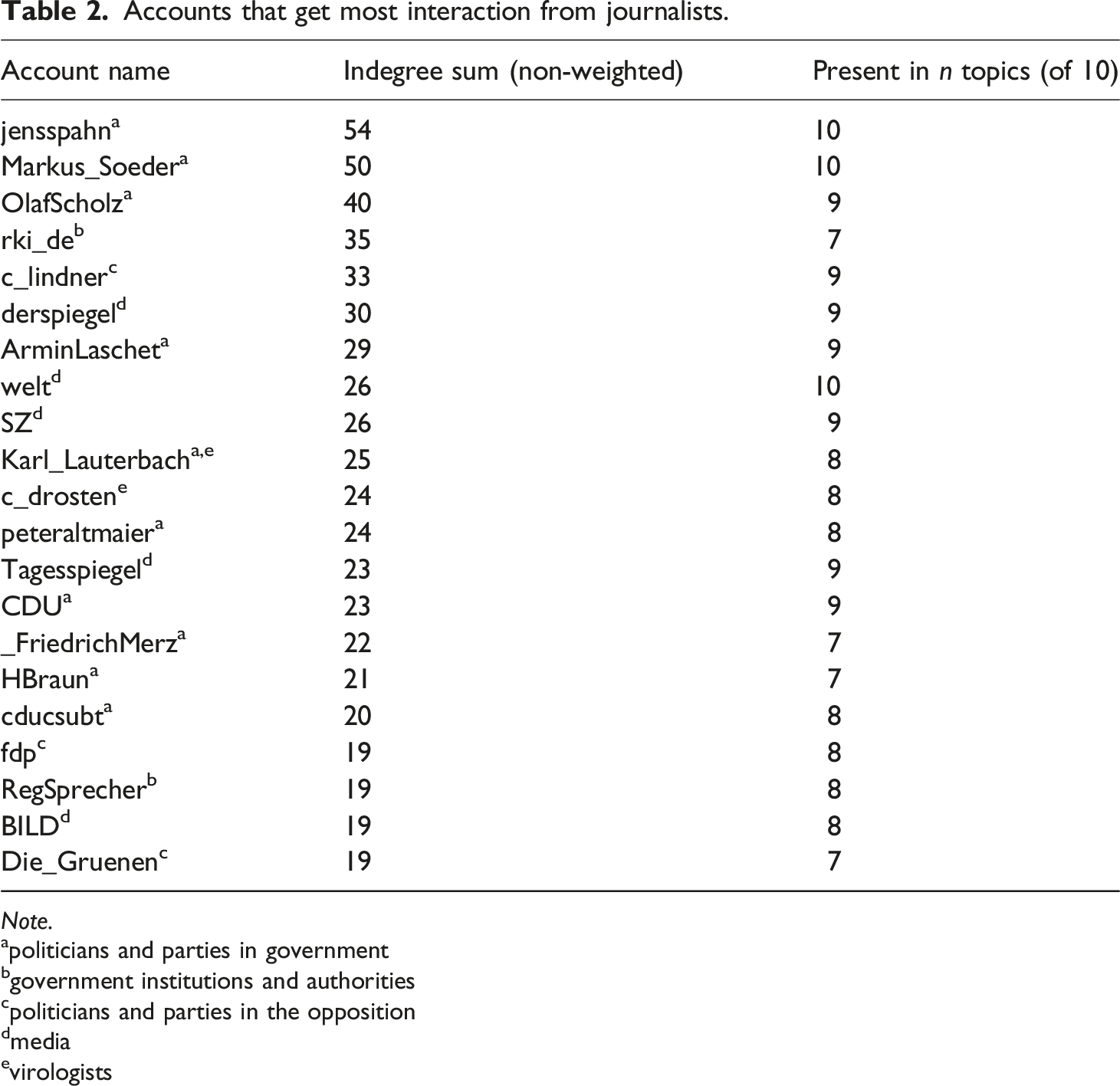
Note.
apoliticians and parties in government
bgovernment institutions and authorities
cpoliticians and parties in the opposition
dmedia
evirologists
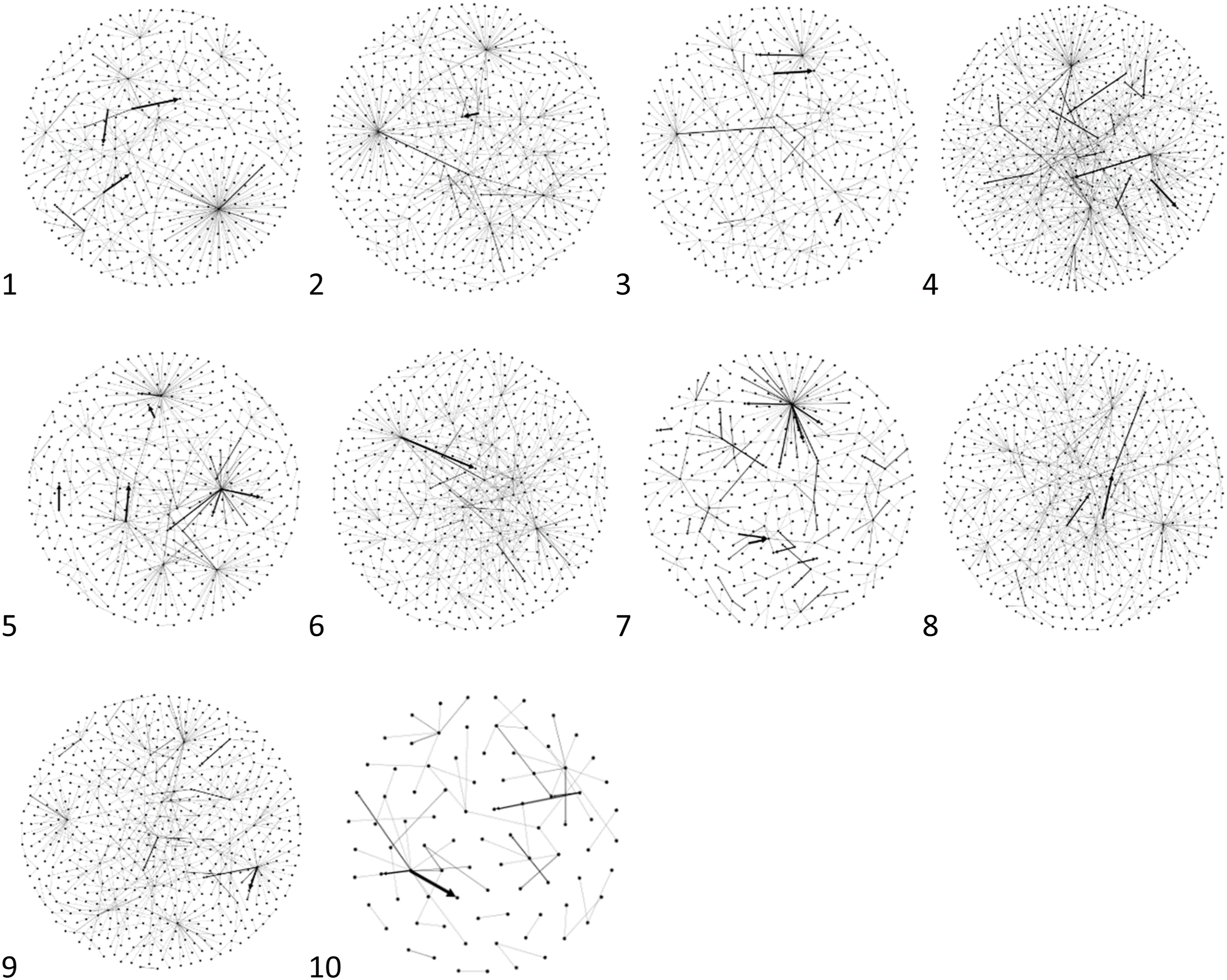
Network Visualization (Subgraphs) for all Topics. Note. Algorithm: Fruchterman-Rheingold, computed for each subgraph. Labels not shown.
A focused analysis of the journalistic users who tweeted showed that only seven of the journalists tweeted on all 10 topics. 229 out of 247 journalists were involved in discussions of at least one of the topics. However, only 50 journalists tweeted exclusively on one topic. Topics 1 and 7 exhibited comparatively more centralized subgraphs, as indicated by their respective outdegree centralization measure (Table 2). In these cases, their most active journalist account actively linked to 69 other accounts, for Topic 7, and 117 accounts, for Topic 1 (Table 2). Besides identifying such connective journalists within a particular topic, we also focused on those who were overly active across topics: Among the seven journalists who tweeted about all topics, we cannot find a single journalist with a particular focus on health/medical issues.
Regarding the recipients of @mentions, we examined the lists of users per topic. The lists tended to include different sets of users for most topics, making it difficult to identify distinct topic-user patterns. Furthermore, when we focused only on the most mentioned users, we found mainly the recurring top users mentioned in Table 3. Nevertheless, some accounts, especially accounts with an affinity to the right-wing opposition party Alternative for Germany, which clearly opposed restrictive containment measures, were most visible in Topics 8 and 9. Left-leaning actors, such as “Fridays for Future,” were more present in Topics 2, 4, and 5. In other cases, the type of a non-journalistic account seemed to correspond to the topic. For example, police reports were present in Topics 7 (demonstrations) and 8 (shutdown of public life).
Political tone of the tweets
The detection of terms that are influential for the framing of the pandemic and the policy response in tweets of different groups of journalists, was conducted using a keyness analysis. The key status of a term within a subcorpus was determined based on two metrics, the log likelihood (LL) score (G2) and the difference coefficient. The first metric indicates the statistical significance that a term occurs more frequently in a subcorpus while the second, ranging between 0 and 1, measures the strength of its distinctive effect (values closer to 1 indicate a stronger effect) (Gabrielatos, 2018). 6
The analysis reveals different frames in the tweets of journalists affiliated with different media. For example, in the tweets of the journalists from the most left-leaning medium, taz, the terms Inzidenz [incidence, cases], Intensivstationen [ICUs], Corona-Toten [the corona dead] were among the most distinctive. They refer to the framing of the pandemic as a dramatic threat to the health of individuals and the capacity of hospitals. Furthermore, the disproportionate use of terms Coronaleugner [corona denier], #Antisemitismus [antisemitism], #fehlendermindestabstand [lack of social distancing] in tweets of journalists from the left liberal Tagesspiegel suggests that protests and skepticism are framed as forms of political extremism or irrationality. For example, a typical tweet says: “Harmless? No way! The #Corona deniers on the streets are also united by #Jew-hatred. […]” 7 . In contrast, the distinctive terms in the tweets of Bild journalists indicate that the lockdown measure is framed as a danger (Mega-Lockdown [mega lockdown], Knallhart-Lockdown [hard lockdown], droht [threatens]). At the same time, terms such as plant [plans], Merkel, Kanzlerin [chancellor] clearly attribute responsibility for these decisions to the head of government, Angela Merkel, which is a typical framing element. This framing is epitomized by tweets like these: “Merkel threatens with mega lockdown!” and “Mega lockdown despite these curves?”.
The journalists at Die Welt do not engage in as much politicization of the pandemic as their colleagues at Bild, but through employing terms such as Coronabonds [corona bonds] their tweets frame the pandemic in terms of controversial fiscal policy measures. 8 The keyness analysis, together with the qualitative analysis, thus indicates that for tweeting journalists from Welt and Bild a major political problem is not seen in the protests, as for their counterparts from Tagesspiegel, but in certain government measures. Finally, it can be argued that the tweeting journalists at Sueddeutsche Zeitung present the pandemic in a manner that is least political. The distinctive terms such as Handwaschbecken [wash hand basin], lesen [to read], Kaffee [coffee] make the events appear as a daily routine with no political meaning.
Discussion
Based on our analysis, we conclude that the themes that were revealed through the topic modeling method are similar to those previously found in mainstream media (Borah et al., 2024; Maurer et al., 2022; Quandt et al., 2020). German journalists did not heavily utilize their Twitter accounts to disseminate COVID-19-related topics and ideas that diverged from those covered by mainstream media outlets. Furthermore, they engaged with the same figures on Twitter (government officials, media, health experts, public figures) that they frequently used as sources in their news coverage (Kapidzic et al., 2022). Nevertheless, our word-level analysis showed that journalists did not adopt a uniform tone when tweeting about pandemic-related topics. Journalists from the left-leaning Der Tagesspiegel and the right-leaning Die Welt and Bild/Bild am Sonntag, whose tweets were analyzed in more detail, contributed to the political framing of anti-government protesters on the one hand and political measures such as the shutdown on the other. The difference in the tweets of German journalists working for right- and left-leaning newspapers is consistent with findings of different political stances on these issues in the journalistic coverage of those writing for influential left- and right-leaning media outlets in the U.S. and the U.K. during the pandemic (Borah et al., 2024; Wondemaghens, 2023). This may indicate a similar pattern of politicization of the pandemic by German media actors.
The purely data-driven analysis of the topic structure in political journalists’ tweets included various themes, such as governmental politics, with the emphasis on Chancellor Merkel’s authority to define the line to follow, the coronavirus pandemic as a crisis for society, and the economic impact of pandemic-related policies. The topic modeling and tonality analysis both suggested that most tweets were aligned with the policy agenda set by public authorities. According to our network analysis, some of the most prominent virologists, who quickly became media figures during the pandemic, and leading media outlets received additional attention in journalists’ tweets.
Based on our analysis of the journalists’ tweets, few political journalists in the mainstream media acknowledged the topics brought up by non-mainstream media outlets or the protest movements. Neither did they use Twitter to bridge the gap between supportive and critically oppositional publics concerning COVID-19 containment policy. Rather, the thematic structure of the tweets indicated that political journalists heavily emphasized the talking points of mainstream media in their tweets and gave scant attention to voices beyond actors of the political center, leading media outlets, and top virologists. Political journalists of mainstream media organizations on Twitter displayed a particular fascination with the chancellor’s efficacy in negotiating policy decisions with heads of federal states (Ministerpräsidenten), party leaders, and top-level cabinet members. Tweets from these journalists with a more critical tone toward authority revolved around the controversial political decision to halt public life and economic activity, commonly known as Lockdown. The journalists’ focus on the government was evident in frequent references to political figures in tweets in their networks. As journalists on Twitter closely monitor ongoing political events, it is not entirely unexpected that government-related actions related to the pandemic received significant attention on this social media platform. However, the prominence given to health experts who supported the government’s strict containment measures indicates a certain imbalance between support and (rational) critique of the government’s pandemic policy. Health experts who voiced fundamental concerns over these measures on Twitter were not represented in the journalists’ networks.
In terms of dissenting perspectives on government measures and political opposition to these measures, we found a tendency among tweeting journalists to discredit critics. Thus, journalists’ tweets seemed to aim to legitimize the government’s policy rather than defend the right to demonstrate against it. This finding is in line with Maurer et al.’s (2022) observation about coverage by German mainstream media of the pandemic during the same period. It also corroborates Klemm et al.’s (2019) finding about a re-interpretation of the role of journalists as mobilizers of the public in the context of health crisis. During such crises, journalists step away from their roles as facilitators of democratic debate and instead adopt roles as mobilizers of public opinion, encouraging the public to comply with official policies. In sum, in a public health crisis like this, journalists’ tweets are more an extension of their institutional role and their newspaper’s line than personal contributions to a debate.
Our study has some limitations. In relation to the methodology, the topic modeling was based on a corpus that was shaped differently by the contributing journalists, thus potentially influencing the visibility of certain topics and opinions. Nonetheless, topic modeling appears justified, as it reflects the emergence of discussions on Twitter originating from journalists. In future research, it would be valuable to delve deeper into identifying the roles of journalists in constructing and disseminating frames during the pandemic through an automated classification of tweets. This would also pave the way for a more systematic analysis of potential correspondence between the political slant in the coverage of the coronavirus pandemic in right- and left-leaning media organizations and the tweets of the journalists they employ. Moreover, it would be interesting to investigate potential changes in the thematic structure of tweets (and news coverage) between May 2021 and mid-2022 when most COVID-19-related restrictions were lifted. Lastly, comparing journalists’ Twitter activity in various countries, as done by Mellado et al. (2021) and Amiel et al. (2023) for news coverage of the pandemic during 2020 could provide a more complete understanding of the conduct of journalists.
Supplemental Material
Supplemental Material - No watchdogs on twitter: Topics and stances in political journalists’ tweets about COVID-19
Supplemental Material for No watchdogs on twitter: Topics and stances in political journalists’ tweets about COVID-19 by Peter Maurer and Christian Nuernbergk in Journalism
Footnotes
Declaration of conflicting interests
The author(s) declared no potential conflicts of interest with respect to the research, authorship, and/or publication of this article.
Funding
The author(s) received no financial support for the research, authorship, and/or publication of this article.

Supplemental Material
Supplemental material for this article is available online.
Notes
Appendix
Author biographies
References
Supplementary Material
Please find the following supplemental material available below.
For Open Access articles published under a Creative Commons License, all supplemental material carries the same license as the article it is associated with.
For non-Open Access articles published, all supplemental material carries a non-exclusive license, and permission requests for re-use of supplemental material or any part of supplemental material shall be sent directly to the copyright owner as specified in the copyright notice associated with the article.
