



Abstract
Drawing from the theories of networked gatekeeping and affective publics, this study compares how news media and social media users shaped the discourse surrounding the 2021 Atlanta spa shootings. We investigate both the substantive (topics) and affective (emotions) dimensions of news articles and tweets, showcasing how institutional media and the public engage in the social construction of mass shootings involving people of underserved communities. To do so, we built two datasets: 964 news articles and 265,951 tweets. The findings from the computer-assisted content analysis reveal that Twitter users focused more on humanizing the victims and contextualizing the Atlanta spa shootings within the broader framework of anti-Asian racism, in contrast to the news outlets. Twitter users expressed significantly greater anger and fear than what is reflected in the news articles. This study also demonstrates that the news stories failed to acknowledge the intersecting identities of the victims. The findings contribute to our understanding of how journalists and individuals shape agendas and convey their affective reactions through news and social media. We suggest actions that can be taken to create a more inclusive and culturally responsive media environment.
Keywords
On March 16, 2021, a 21-year-old man named Robert Aaron Long fatally shot eight people, most of whom were women of Asian descent, at three spas in the Atlanta area (NPR, 2021). Many people expressed concern and indignation as the incident occurred amid a surge in xenophobia and hate crimes targeting Asian Americans and Pacific Islanders during the emergence of the coronavirus pandemic (Hauser, 2021). The way the news media initially handled the incident also drew criticism from some social media users, advocates, and journalists, who pointed out that the language used in media hypersexualized Asian women and amplified the perpetrator’s words without questioning them (Constante, 2021; Jones, 2021). In response, the Asian American Journalists Association (AAJA) published a guideline on how to report the Atlanta spa shootings as well as anti-Asian violence (Asian American Journalists Association [AAJA], 2021).
Against this backdrop, this study explores how news media and social media users shaped, disseminated, or contested the narratives about the Atlanta spa shootings in the month following the incident. Our study aims to shed light on the involvement of various actors, such as journalists and Twitter users, in gatekeeping, and to examine how different agendas and sentiments surrounding the incident were formed and spread across different channels. According to the networked gatekeeping theory, with increased interactivity and connectivity of the digital media environment, not only institutional media but also social media users can diversify stories told on social media platforms and add narratives to stories, thereby creating “a networked flow of information” (Meraz & Papacharissi, 2013). Thus, we first use semi-supervised topic modeling and semantic network analysis to compare topics in news and Twitter posts. 1 Then, we use sentiment analysis and identify emotions in news and tweets based on affective publics theory to explore the affective dimension of the narratives around the Atlanta spa shootings. We focus on fear and anger, which are known drivers of political engagement (Brader & Marcus, 2013).
By comparing public reactions and news responses to the case, this research highlights the networked public’s potential to amplify marginalized voices (Papacharissi, 2014). Given that people can now take advantage of social media as a space for public commentary on social issues and events, individuals can challenge the once-dominant gatekeeping role of traditional news outlets (Blevins & Lee, 2022), such as by diversifying media agendas and spotlighting women of color who often go unnoticed in the news (Stillman, 2007). Along with comparing different news and social media topics, we also provide exemplars demonstrating how Twitter users explicitly evaluated news stories and journalistic practices.
Furthermore, this research illustrates how affective publics express their emotional responses, which researchers interpret as evidence of the public’s digital connectivity (Papacharissi, 2014). While some researchers associate affective publics with irrationality and poor decision-making (e.g., Chaput, 2010), our findings call for re-evaluating the role of affective publics. We view them not as impulsive or irrational but as catalysts for social change, highlighting the transformative potential of emotional responses in public discourse. Findings also imply that emotions may shift individuals’ focus from personal concerns to shared issues, strengthening social awareness and solidarity among people (Jasper, 2011).
The practical implication of the findings lies in our suggestions on what can be done to create a more inclusive and culturally responsive media environment. We found some Twitter users challenged problematic news coverage and personalized victims while some journalists lacked in giving deserved attention to underserved communities and their intersecting identities. When hate crimes targeting specific communities are on the rise, news practitioners should be more sympathetic to the communities deeply impacted and more conscious of choosing which aspects of the incident or language to highlight.
Case Study: Atlanta Spa Shootings
Case studies are effective in addressing how and why questions through an empirical investigation of “a contemporary phenomenon (the ‘case’) in depth” (Yin, 2014). We use the Atlanta Spa shootings as a case to demonstrate how news coverage and social media users have differently shaped narratives involving victims with intersecting identities, namely working-class Asian females. As we examine substantive and affective aspects of media representations, we offer plausible explanations for why such disparities occur.
Literature Review
Networked Gatekeeping: Agendas Across News and Social Media
When news organizations functioned as the sole gatekeepers, only selected stories could flow through the system while keeping others out, thereby controlling and shaping the public’s knowledge and social reality (Shanahan et al., 1999). This could potentially hinder the public’s comprehensive understanding of their social environment. However, within a hybrid media environment, institutional media can interact with digital media, creating a great potential for a flow of pluralistic information (Chadwick, 2011). Media boundaries have evolved to allow increased citizen participation, forming a more decentralized democratic discourse; communication has shifted from fixed and linear to more dynamic, where the public can easily share information with one another (Reese & Shoemaker, 2016). Thus, the power now flows across an interconnected network of old and new media, and actors in the hybrid media system produce or navigate the information flow in ways that meet their goals and affect the agency of others (Chadwick, 2011). In this light, gatekeeping is no longer a one-way and a top-down process, but rather the public records, shares, and disseminates information or even aggregates their values by assimilating and reprocessing the news, and thus, engaging in a networked gatekeeping (Barzilai-Nahon, 2008).
The process of networked gatekeeping on social media networks can be observed through the analysis of the growing influence of decentralized crowds as well as the “revised, rearticulated, and reworked” narratives around incidents or issues that they created (Meraz & Papacharissi, 2013). Social media users frequently bring overlooked, diverse public perspectives of events to the mainstream (Aday et al., 2012). For instance, during the 2011 Egyptian uprisings, social media users, particularly individual journalists and citizen-led groups relabeled the uprisings as a “revolution” as they connected with others and collaboratively engaged in news filtering and curating (Meraz & Papacharissi, 2013). In a study of the 2017 Quebec Mosque shooting, researchers examined the topics that emerged from Twitter posts and found that one of the prominent topics in users’ conversations was the criticism of biased coverage by mainstream news media (Kwon et al., 2019): They called out the lack of attention given by media outlets to non-White victims. While they did not explicitly use the term “gatekeeping,” we argue that the topic is a manifestation of agendas, which is an outcome of the gatekeeping process. Taken together, the public can use social media networks to construct agendas that deviate from the news agendas and circulate oppositional narratives against dominant narratives (Poole et al., 2019). Social media discourse can be characterized as being more fragmented and pluralized than the news discourse (Kim et al., 2016), as individuals respond to stories and actively curate and reconstruct their media environment (Xiong et al., 2019). To examine how the Atlanta spa shootings were depicted in news and social media, we first examined how mass shootings have been socially constructed in the news media, with a particular emphasis on the representation of historically marginalized races and genders.
News Media Construction of Mass Shootings: Race and Gender
Social identities, such as race, ethnicity, and gender, are important in understanding how news media portrays perpetrators and victims of mass shootings. These identities influence which incidents or individuals receive media attention and shape how the narrative unfolds (e.g., Schildkraut et al., 2018; Stillman, 2007). When the perpetrator of mass shootings or crimes is a person of color, their race tends to be emphasized in the story (Greer, 2007), and the incident itself also receives greater media attention than those involving White perpetrators (Schildkraut et al., 2018). Regarding Asian perpetrators, news stories often highlight their perceived failure to assimilate into the country (Chuang, 2012).
However, incidents involving victims who are people of color often go unnoticed in the news: Journalists put different news values on endangered women’s bodies based on the victims’ social class or race—victims who are upper-class White women gain more media attention than women of the lower class or women of color (Stillman, 2007). Thus, Asians have traditionally been rendered invisible in mainstream news media (Paul & Sui, 2023), unless they are perpetrators of crimes.
When examining the media representation of Asian women, it is important to understand that their portrayal often reinforces the construction of otherness and perpetuates gender stereotypes that culturally depict them as “exotic sexual objects or commodities” (Chan, 1987). Consalvo (1998) examined news articles that marginalized an Asian woman who was a victim of gender-based violence by highlighting her foreignness, someone who did not speak English fluently, and dependent on men: The news portrayed her as a possible commodity that her husband could acquire or select, suggesting that she married to immigrate to the United States. Such stereotypical selections and depictions of racial and gender identities suggest how news media has highlighted the otherness about people of color, particularly Asians, causing their living presence and humanity to be viewed as less important than those of others. The narratives surrounding the Atlanta spa shootings exemplify such racialized and gendered stereotypes, or invisibility.
We argue that the Atlanta spa shootings should also be understood through the lens of a long history of racialized and gender-based violence that has been permeating in the United States (Endo, 2021). By recognizing the interconnectedness and interdependencies of racial and gender identities, we gain insight into the intricate nature of individuals’ lived experiences, and we can better understand racism when we consider multiple marginalities, such as gender and class (Atewologun, 2018).
Initial news coverage of the Atlanta spa shootings simply stated “8 dead” without explicitly mentioning that the majority of the victims were of Asian descent (Ishak, 2021), and the focus shifted toward portraying the suspect as someone suffering from sexual addiction and a regular churchgoer attempting to suppress his sexual urges (Hesse, 2021). Many reported that the spas had previously been investigated by the police regarding prostitution, although there was no evidence indicating that any of the victims were involved in sex work (Contrera et al., 2021). These not only sensationalized the incident but also dehumanized the victims and the affected communities, ultimately leading to victim-blaming. Particularly, linking massage parlors to sex workers could be seen as a form of racism against Asian women, objectifying their bodies and unfairly blaming sex workers, which can feed the animosity and discrimination that could further contribute to racially motivated and gender-based acts of violence (Solis, 2021).
Manifestations of Networked Gatekeeping: Topics Around the Atlanta Spa Shootings
A core idea in networked gatekeeping is that the interplay between gatekeepers and gatewatchers leads to dominant frames that shape the structures of news narratives (Meraz & Papacharissi, 2013). Gatekeeping research has focused on the forces determining which information passes through the gate and how stories are shaped, timed, and presented (Shoemaker & Vos, 2009). While one aspect of gatekeeping research investigates the dynamics between different roles and relationships, such as gatekeepers and the gated, another important focus involves analyzing news content, specifically comparing stories to show what journalists decided to publish or reject (White, 1950; see also Scott & Gobetz, 1990, for content analysis of broadcast networks’ news coverage; Haselmayer et al., 2017, for a comparison of news coverage with party press releases). Employing computer-assisted content analysis, we examine topics (news agendas) that we view as outcomes produced by gatekeepers. As we uncover different agendas (such as anti-Asian racism, the shooter’s alleged sex addiction, and his religious beliefs) in news media and Twitter, this study presents how different actors have created various agendas around the issue. This approach will contribute to our understanding of who perpetuated stigmatizing and harmful stereotypes about Asian women and shift blame toward the victims (Whitehurst & Price, 2021). This study also examines how social media users developed alternative or counter-narratives. We further explore word associations and interconnected term clusters through semantic network analysis to identify key conversational topics or emerging concepts within the text (Eddington, 2018). Accordingly, our initial research questions are as follows:
Affective Publics on Social Media: Emotional Connectivity
On top of the substantive dimension of conversation (topic and semantic network of content), we also investigate the affective dimension of the discourse around the Atlanta spa shootings. Affective practices, such as sharing sentiments, shaping the tone of the language, or using specific language to establish urgency, enable relational interactions among the public (Lünenborg, 2019; Papacharissi, 2014). These practices empower the networked public by amplifying their emotions and raising awareness of issues (i.e., affective publics, see Papacharissi, 2014). While some associate these emotion-driven actions as irrational, others argue that emotional responses do not inherently result in irrational actions (Scherer, 2011). Instead, such responses could foster “a more thoughtful and attentive citizenry” (Marcus et al., 2000). Aligning with this latter perspective, our study views the role of affective publics as contributing to a decentralized information environment and encouraging a more engaged public sphere.
Affective publics use social media to intervene and challenge the dominant political narratives, such as by creating and sharing memes, posting messages, liking, sharing, and commenting on others’ posts, and using hashtags (Lünenborg, 2019). These actions blend opinions and facts, leading to interactions that circulate the flow of these emotions and encourage public engagement (Papacharissi, 2014). As a result, affective publics can shape the storytelling structure, collaboratively filtering and curating news content and introducing and disseminating alternative, underrepresented narratives (Papacharissi, 2014, 2016).
In social movements and online civic engagement, affective publics have engaged in social justice efforts to tell their own stories while disrupting mainstream media and framing social issues or incidents as something relatable to themselves rather than adhering to existing frames (Blevins et al., 2019). What appears to be a mundane activity of adding a hashtag to a social media post could also be an act of establishing affective ties between people and promoting virality; as a result, social movements emerge (Suk et al., 2021). While this line of research employed affective publics as their conceptual framework, they did not investigate how “emotional” social media users are, nor did they evaluate the sentiment or emotions expressed in social media posts. We assess the emotions appearing in tweets to examine how social media users exhibit affective expressions and compare them to those appearing in news stories. Our focus is on two key emotions, anger and fear, which have been shown to be driving forces in social movement and connective actions.
Anger and fear are two high-arousal emotions that fuel citizens to engage and take part in political activities (Brader & Marcus, 2013), as well as righteous indignation (Jasper, 1998). Anger gets aroused when people experience injustice, and it motivates people to take action and get involved in a given issue (Rodgers, 2010). Fear is triggered by a sense of threat to moral beliefs or daily life (Jasper, 1998), which can heighten awareness of the issue or situation and motivate actions (Kleres & Wettergren, 2017). We expect that compared to news media (as institutions) discourse, public discussions on social media would exhibit greater affective expressions. The public’s tweets tend to show great sympathy and condolences to others, such as victims of a crime (Kwon et al., 2019), while mainstream media employ neutral rather than emotionally charged language that is distinct from the emotion experienced by individual bodies (Wahl-Jorgensen, 2018). In response to the Atlanta spa shootings, Twitter users might have perceived racial and gender injustice in both the shootings and in the handling of the incident by the society, police, and news media. This perception might have sparked anger, propelling them to voice concerns about the mistreatment of historically marginalized communities. Their recognition of the biased news representation of the perpetrator (a White male) and the victims (predominantly Asian females and those from working-class backgrounds) might have triggered fear, viewing it as a threat to their own and others’ safety, and thus raising awareness about the issue. This heightened sense of injustice might have led to an increased participation in expanding the discourse around the shootings, with a focus on the experiences of underserved communities and their members.
This study analyzes the expression of anger and fear in news stories and tweets, comparing the frequency of these sentiments on each platform. Applying the affective publics framework, we expect that these emotions would be more pronounced in tweets than news stories; the perceived unfair treatment of shooting victims may elicit emotional reactions on Twitter. We also investigate the specific topics that have elicited these emotions:
Methods
Data Collection and Processing
This study collected the news and Twitter data published between March 16, 2021, and April 17, 2021, from the date of the shooting spree to one month after the incident. We chose this time frame to concentrate on public reactions to the initial news coverage of the incident. For news data collection, we used Factiva, a global news database, to gather every news article containing the words “Atlanta,” “spa,” and “shooting” published in any news source in the United States. After removing the duplicates, we had 964 articles.
For Twitter data, we used Twitter API by using the “academictwitterR” package (Barrie & Ho, 2021) to gather tweets using any one of the following twelve keywords: “Atlanta spa shooting,” “#Atlantaspashooting,” “Atlanta spa mass shooting,” “Atlanta-area spa shooting,” “Atlanta area spa shooting,” “Atlanta area spa,” “Atlanta-area spas,” “Young’s Asian Massage,” “Gold Massage Spa,” “Gold spa,” “Aromatherapy Spa,” or “Robert Aaron Long.” Unlike the news data collection, where we only used three key terms, we used more specific keywords with the Twitter data, such as places where the incidents happened and the shooter’s name, to find the most relevant tweets while avoiding too much noise. The total number of tweets identified with the 12 keywords was 265,951. Using the R package “quanteda” (Benoit et al., 2018), we pre-processed the text data by tokenizing and removing punctuation, numbers, symbols, and common stop-words (e.g., “the,” “is,” “are”) in English. Words that appeared fewer than 20 times were excluded from the analysis.
Data Analyses
Topic Modeling
To answer RQ1, we employed two steps of topic modeling to find which topics were highlighted in news and Twitter. To see the overall patterns of the topics, we first compiled a list of keywords and topics based on preliminary structural topic modeling (STM) of news articles (Roberts et al., 2019). Based on these results, we built a list of nine topics, each accompanied by its associated words that were theoretically relevant, drawing from existing literature (see Online Supplemental Appendix F for a detailed explanation of the process). For instance, the race and/or gender of both the victims and perpetrators play an important role in news attention and the way it is covered (Stillman, 2007); we labeled and added keywords and topics associated with racial, ethnic, and gender identities of the victims and the perpetrator in our analysis. The media’s focus on the Atlanta spa shooter’s Baptist church connection (Bailey & Armus, 2021) and his claim that he had a sex addiction diverted public attention from the possibility that he may have been motivated by racism (North, 2021). Despite the absence of proof linking the victims to sex work, such a claim was also a part of the media narrative (Rossi & Ellefson, 2021). We incorporated these references into three separate topics: shooter’s church affiliation, shooter’s sex addiction, and massage parlors associated with sex work.
Using these topics and seeded words, we ran seeded Latent Dirichlet Allocation (LDA) topic modeling, which is a semi-supervised machine learning approach that enables theory-driven textual analysis by predefining topics and associated words and determining how frequently each topic occur within the dataset (Watanabe & Xuan-Hieu, 2020). We applied the predefined list and seed words to the news and Twitter datasets to assess the frequency with which each topic emerged (see Table 1). For each story and tweet, one topic was assigned. This two-step process enables us to consider both the “theoretical relevance and empirical frequency” (Watanabe & Zhou, 2020).
A List of Seeded LDA Topic, Seed Words for the Topic Modeling, and Top Words Associated With Each Topic.

Note. We selected top words that are not included in the seed words, or search terms used for data collection. Grant and Yue are names of the victims (Hyun Jung Grant and Yong Ae Yue).
Pairwise Co-Occurrence Semantic Network
To explore the difference between news articles and Twitter discussions around the Atlanta spa shooting, we mapped a co-occurrence semantic network for each. Semantic networks can present how the keywords were used and associated with other words within a discourse. Semantic network analysis has been increasingly used in communication studies for discourse analysis and comparisons (e.g., Qin, 2015). We removed high-frequency words (e.g., “Atlanta,” “shooting,” and “people”) to make the outputs of the semantic networks more meaningful. Then, we calculated the frequency of co-occurrence for any pair of tokens, which reflects the number of articles/tweets containing the word pair (e.g., “Asian”–“hate”). Word pairs with a higher frequency tend to be placed in a more central position in the outcome semantic networks. To present a clearer network structure, we removed word pairs that appeared in fewer than 300 news articles and 3,500 tweets. We visualized the networks using the R package “igraph” (Csardi & Nepusz, 2006).
Emotion Analysis
Using the NRC Word–Emotion Association Lexicon dictionary to calculate the emotions of news and tweets (Mohammad & Charron, 2013), we tested if tweets exhibit greater anger and fear than the news. Using the “quanteda” package (Benoit et al., 2018), we calculated the emotion score of anger and fear for news and Twitter discussions. The range of emotion scores for a post or a news story is from 0 to positive infinity. See Online Supplemental Appendix A for more details about the NRC lexicon.
Results
Descriptive Results
We first looked at the number of published articles and tweets between March 16, 2021, and April 17, 2021 (see Online Supplemental Appendix B). Both news and tweets reached their peak immediately after the incident on March 16, 2021. Subsequent to the initial surge, there was a substantial decrease in the quantity of both news stories and tweets. Around April 15, the number of news stories increased slightly when there was another mass shooting in Indianapolis. The level of news stories and tweets remained low thereafter.
Among the top 15 news sources were mainstream news, such as CNN, USA Today, and Washington Post, as well as the Georgia-based newspaper, The Atlanta Journal-Constitution (see Online Supplemental Appendix C). By looking at the number of retweets, 2 we found that Asian American activists, independent journalists, celebrities, and athletes played a central role in shaping the Twitter discourse. We provide two examples of the most frequently retweeted posts in Online Supplemental Appendix D.
Topic Modeling: Agendas
For RQ1, which compares the topics on Twitter and in the news media, we ran preliminary STM topic modeling, expanded the topics and keywords based on previous literature and popular press, and performed semi-supervised topic modeling. Nine topics that we identified from the preliminary STM topic modeling are shown in Table 1. We conducted topic modeling analyses for the news and Twitter dataset, respectively, and there were variations in the top words between them. News stories that featured the topic of the shooter’s sex addiction frequently used the words “Reynolds,” “Bryant,” and “Crisp.” Reynolds is the county sheriff who released a statement after the shootings, Bryant is the Atlanta Police Chief who held press conference, and Crisp is the county where the suspect was apprehended; this indicates that journalists repeatedly referenced the official statement which included the perpetrator’s purported assertion that he “had some issues, potentially sexual addiction” (Sundby, 2021). The top words associated with the same topic in tweets were “white,” “dead,” “murdered,” “parlors,” and “male.” Twitter users discussed the perpetrator’s gender and racial identities, as well as the consequences of the shootings.
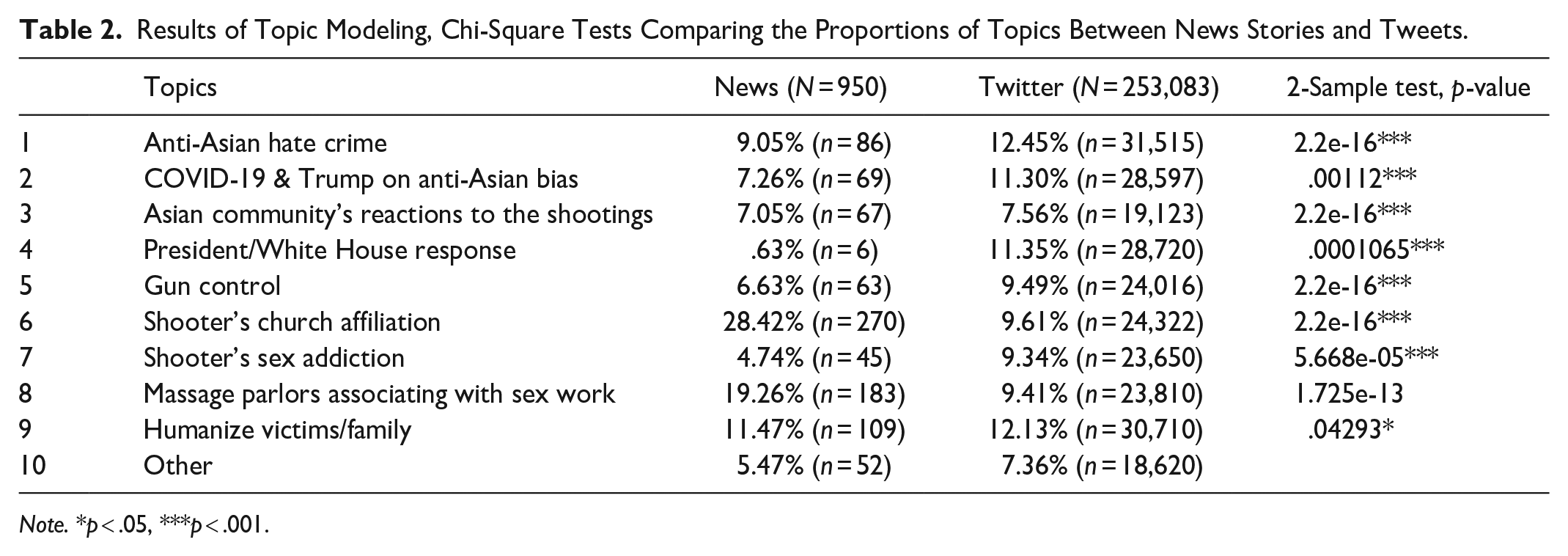
RQ2 questioned whether significant differences emerge in topic frequencies between news and Twitter discourse. We analyzed the distribution of topics between news stories and tweets, comparing their proportions (see Table 2).
Results of Topic Modeling, Chi-Square Tests Comparing the Proportions of Topics Between News Stories and Tweets.
Note. *p < .05, ***p < .001.
On Twitter, the deviation between the proportions of the nine topics was not very large, but for the news stories, the deviation in the topic proportions was relatively larger. The topics that appeared most frequently in the news were the shooter’s church affiliation (28.42%) and linking the victims and their workplace with the sex industry or prostitution (19.26%). Twitter users focused on (the increase in) anti-Asian hate crimes (12.45%) and the personalizing of victims and their families (12.13%). The topics of the president/White House response and gun control received more attention on Twitter; the topics that received more attention in news media include the shooter’s church affiliation. Association of massage parlors with sex work received more highlight in the news, but the differences in the proportions were not statistically significant.
Pairwise Co-Occurrence Semantic Network: Contextualizing the Agendas
Figure 1 shows the semantic network of the news and Twitter dataset; the nodes and edges represent concepts and semantic relationships between concepts (Pirnay-Dummer et al., 2012). The semantic network of news stories is more centralized with a single huge cluster of words than that of Twitter. The network of news stories also displays a denser arrangement of edges connecting these nodes, indicating that it has more groups of interconnected words that share similar meanings. In contrast, Twitter’s semantic network displayed more dispersed clusters, characterized by a spread-out structure with occasional clustering around key nodes. This pattern highlights that the Twitter discourse was rather fragmented, addressing a range of topics.

Semantic networks of news stories and tweets.
There are phrases that frequently appear in both the news and on Twitter, such as “asian”–“american”–“women,” but there are terms exclusive to each source. In the news articles, the suspect’s name, Robert Aaron Long, is connected with terms such as “21,” highlighting his age. On Twitter, the words linking to the suspect’s name predominantly feature the words “bad” and “day.” In the news, there is a centralized structure focused on words such as “president,” “Biden,” “COVID,” and “pandemic.” These keywords signify a concentrated thematic focus on political reactions and broader contexts. On Twitter, we observed connections between terms, such as “condolences” and “gofundme,” as well as between victims’ names and their specific attributes (e.g., “hyun”-“jung”–“grant”–“dedicated”–“single”-“mother”; “loved”-“dancing”). This suggests that Twitter users personalized the victims, and as they shared the stories of individual victims, they also supported their families and communities through fundraising or petitions. In addition, the connection between “stay” and “silent” suggests that Twitter users encouraged others to break their silence and speak out.
Emotion Analysis: Anger and Fear
H1 hypothesized that Twitter discussion around the Atlanta spa shooting presented greater anger and fear than news articles. We ran two t-tests to compare the mean score of emotions between them. As shown in Table 3, compared to the news, Twitter discourse scored significantly higher in both anger, t(1026.3) = −15.193, p < .001, and fear, t(1015.3) = −10.898, p < .001. H1 is supported.
Results of T-Tests Comparing the Mean Scores of Emotions.

Note. M = mean, SD = standard deviation, CI = confidence interval.
p < .001.
In addition, we looked at the frequency of words that are classified as showing anger or fear. While there were several anger and fear-related words commonly used across both news reports and Twitter conversations, such as “shooting,” “violence,” and “hate,” social media users tended to use more intense emotional words such as “beast,” “rampage,” “terrorist,” and “horrific,” which did not often appear in the news (see Online Supplemental Appendix E).
RQ3 asked in which topics anger and fear are prominent; we summarized the scores of anger and fear for news and tweets, respectively. As presented in Table 4, the highest levels of anger were observed in tweets related to the topics of “humanize victims/family” and “anti-Asian hate crime.” Fear was most prevalent in tweets with the topics of “humanize victims/family” and “shooter’s church affiliation.” In news, anger was most prevalent in “gun control” topic, followed by “massage parlors associating with sex work.” Fear was also highest in the “gun control,” followed by “shooter’s church affiliation.”
The Average Scores for Anger and Fear in News and Tweets, Categorized by Topic.

Discussion
The public engages in the gatekeeping process, actively creating meaning for social events or issues. Individuals use social media to express their opinions, mobilize support, release emotions, and raise awareness on a certain topic or event (Kwon et al., 2019; Papacharissi, 2014). In the context of the Atlanta spa shootings, we investigated the appearance of nine unique agendas, occurrences of related words, and the manifestation of two negative emotions—fear and anger—in news stories and tweets.
In this study, we show that topics and word clusters appearing in the institutional news media were often related to the incident’s location, the assault, and police reports, suggesting that the news tended to deliver the who, what, when, where, and why. The institutional news media continue to be lacking in their treatment of racial and ethnic minorities in their coverage of mass shootings. Although we are not the first to emphasize the invisibility of victims’ intersecting identities in news coverage, in the context of the Atlanta spa shootings, news coverage of Asian (American) working-class women was even more problematic because it hypersexualized the victims by equating them with sex workers and stressing the shooter’s sex addiction (Ishak, 2021). Although there is no evidence to suggest that the victims were involved in sex work, we found that the news media prominently used terms like “porn,” “sex work,” and “prostitute,” in their stories. Such reporting embroiled the victims in a broader narrative at the intersection of biases based on race, class, and gender (Rossi & Ellefson, 2021). Even if the victims or spas were engaged in sex work, this would not justify the degradation of a human life, and making such traits prominent would only exacerbate the long-term discrimination suffered by Asians, Asian/Americans, and Pacific Islanders women, particularly working-class women (AAJA, 2021). To minimize harm, journalists should develop greater empathy and comprehension of the intersecting identities of individuals and communities being severely impacted.
Contrary to common skepticism around social media as a place for constructive public discourse (e.g., Kruse et al., 2017), our findings show that Twitter users critiqued problematic news reporting practices, pointing out that news media unquestioningly quoted the perpetrator and the police. Some testimonies denied any associations of the spas with sex services. These findings underscore social media’s potential as an alternative channel to expand agendas and bring more sensitivity to underserved communities, such as by effectively addressing (racial and gender) injustice amid the increasing trend of online hate targeting minorities. We present some examples: “Police said”? The news media must stop taking official pronouncements at face value [. . .] A long time client angrily denies the spa was providing sex services. He was there for a stiff neck & back pain. One victim was there to install shelves for the spa. They were hardworking people who provided for their families & contributed to the society. 2 Atlanta spa shooting locations are across street/adjacent to former Otherside Lounge bombed in 1997, another act of terror by another weak, white male who loves God; guns. History continues to repeat itself, we don’t ask why but victimize victims and justify a bad day. #wtf
Twitter users also broadened the discourse surrounding the incident, offering alternative narratives to humanize the victims by depicting them as “hardworking small-business owners” and “dedicated mothers to their sons.” This also included personalized content reflecting one’s personal connection to the victims. Importantly, Twitter users brought attention to the intersection of sexism and racism faced by Asian/American women by placing the case within the broader context of the escalating number of hate crimes against Asians. For instance, For Asian American women “racism and sexism have always been inextricably intertwined. For them, racism often takes the form of unwanted sexual come-ons, and sexual harassment is often overtly racist.” #STOPAsianHate—How #Racism and #Sexism Intertwine to Torment #Asian-American Women. LEARN. AMPLIFY. ACT.
Even though the legal interpretation of the Atlanta spa shootings was deemed as not racially motivated, it is important to address how this case has affected specific racial/ethnic groups, regardless of the perpetrator’s motivations (AAJA, 2021), as this mass shooting caused a tremendous trauma, grief, and pain. This holds particular significance within contemporary American society, where a majority Americans stand against explicit racism or racially motivated violence, yet the “structural context of racism” endures (el-Nawawy & Elmasry, 2018). By contextualizing the incident, the public can develop a more nuanced understanding of the community’s struggles and experiences. In addition, as shown in the topic modeling, social media users called for a stricter gun control, which drew attention to an important issue that is mostly ignored by the mainstream media.
Our case study of the Atlanta spa shootings demonstrated that significant differences exist in affective expressions between the news media discourse and the public’s social media discourse: Social media users tended to show greater anger and fear. By comparing the difference in topics and strength of emotions (i.e., anger and fear), our findings support the theory of affective publics (Papacharissi, 2014), which suggests that the public becomes re-energized about politics through the facilitation of feelings and emotions in collaborative interactions among citizens (Lünenborg, 2019). We found that Twitter users’ expression is more personalized and emotional—namely, they expressed significantly higher emotions of anger and fear than it is reflected in the news articles. Given that these strong emotional expressions have been proven to be powerful enough to encourage social activism and collective actions (e.g., Hasan-Aslih et al., 2019), we argue that their negative emotions could be a catalyst for social change. Although our data do not provide direct evidence showcasing the psychological mechanism of fear and anger in raising people’s awareness, a substantial body of research has demonstrated that emotions play a crucial role in igniting collective action. They can motivate individual participation and draw increased attention to collective issues, thus enhancing solidarity (Jasper, 2011). Because emotionally negative messages are more likely to be shared on social media and the contagiousness of negative emotions spreads rapidly among the networked public (Stieglitz & Dang-Xuan, 2013), we propose that such emotions confer greater power to social media users by increasing their online presence and engagement, which can challenge dominant political narratives.
Although there were some ways in which social media users did a better job of shaping narratives of the Atlanta spa shootings than the news media, the findings demonstrate that there is still room for growth in public discourse. After the Atlanta spa shooting, the AAJA urged people and the news media to use more accurate and direct language when discussing anti-Asian violence, such as “anti-Asian sentiment/hate/rhetoric/violence” or “assault against Asians,” rather than euphemisms such as “anti-Asian racism/bias” (AAJA, 2021). Both news and Twitter word associations did not show a decrease in using euphemisms or efforts to use more direct terms. Considering the effect of word choice or specific rhetoric, especially on the targets of that language (e.g., Chavez et al., 2019), we recommend that journalists and the public be especially meticulous and cognizant of the words they use.
Conclusion
We investigated the news and Twitter discourse on the Atlanta spa shootings by examining their topics, word associations, and emotions. The news media lacked attention or sensitivity for the intersecting identities of marginalized groups affected by the mass shooting, whereas social media users made significant contributions in humanizing the victims and proposing solutions, such as advocating for stricter gun control. Despite the invisibility of Asians in news media, the emergence of digital activism and online engagement led by Asian communities, to direct their anger from and fear of being considered perpetual foreigners in American society, might have challenged this traditional perception. Such online activities sparked the Stop Asian Hate movement and protests after the Atlanta spa shootings, calling for a restoration of community solidarity and social protections for Asian Americans. While our study specifically addressed the Atlanta spa shootings within the context of rising anti-Asian hate, its implications extend beyond the Asian American community. Given its contagious nature, hate can quickly spread from one group to other historically marginalized groups. Our study emphasizes the need for journalists and citizens to be cognizant of the potential impact of the agendas promoted in news and social media. This awareness is critical from a social justice perspective, underscoring the broader applicability of our findings.
This study contributes to our comprehension of how institutional news media and social media users have (re)constructed the discourse in distinct ways; it provides insights into the cognitive and emotional dynamics among individuals and current journalistic practices. We have shown the role of social media users in shaping the narrative of a tragic event involving Asian women, a demographic often underrepresented in crime news reporting. Social media users mold their thoughts, identities, and beliefs through their interactions, transforming storytelling in ways unlike traditional gatekeepers. Previous studies that employed a networked gatekeeping framework have predominantly used social media data (e.g., Meraz & Papacharissi, 2013; West, 2017; Xu & Feng, 2014). By taking a comparative approach, it enables us to uncover disparities in their respective agendas and identify broader patterns and trends that might remain unclear when analyzing a single case. At the same time, we note that Twitter and news discourse are not entirely distinct. For instance, Twitter users can be quoted in news articles, and news outlets themselves account for a significant portion of Twitter content. Still, analyzing them allows us to examine how the incident was socially constructed differently on each platform, considering the unique characteristics of Twitter and news discourse. As journalists are re-assessing their norms and practices to adjust their roles in response to the growing impact of audience participation in the news-production process (Tandoc & Vos, 2016), future research could investigate how they monitor and interact with other news outlets and audience feedback, either to revise their news judgment or to maintain their gatekeeping function.
We acknowledge limitations. This study provides results from cross-sectional analyses, but the findings cannot demonstrate a causal relationship, or interaction, between news discourse and social media discourse. It is plausible that the news media, which initially failed to question the suspect’s word or provide a thorough understanding of the incident, might have recognized public reactions and published more in-depth content in their follow-up stories. Future studies could look at if the networked discourse on social media can change how the event is situated in the narrative of a journalistic text. Researchers can explore the interactions between news media and public discussions by collecting longitudinal data, aggregating multiple cases, and/or introducing other analysis strategies, such as time-series regressions. These additional examinations would help us better understand if and how social media can contribute to news media, such as if there is a catalytic event that engages more people to the point of garnering media attention, or how the emotional intensity of key topics discussed on social media discourse may change over time in response to changes in news coverage, and vice versa.
We focused on Twitter to determine how social media users (re)interpreted and (re)constructed the narratives around the shootings. Although we concluded that Twitter could generate more constructive discourse than the news media, affective publics can also engage in disruptive forms of participation, attacking social justice efforts or spreading extremist ideas (Blevins et al., 2019). 3 Given that Twitter provides limited information about social media users or public opinion, we encourage future studies to include not only a greater dataset across different cases but also a larger variety in social media platforms. Considering the fragmentation of social media platforms, such as alt-right communities shifting from Twitter and Facebook to Parler or Telegram (Bryanov et al., 2022), researchers can compare the cross-platform differences in how users on each platform discussed a public issue or event (e.g., Chen et al., 2023). 4 In addition to focusing on social media, it would be beneficial to conduct studies connected with the offline community. For example, by taking ethnographic approaches on Asian American and Pacific Islander communities or activists, future research can explore interactions between different actors, determine how the public reacted to the incident, discover the dominant discourse created by institutions and the media, and analyze how counter-narratives were constructed.
Supplemental Material
sj-docx-1-sms-10.1177_20563051241269278 – Supplemental material for It’s Not Just “8 Dead”: Examining News and Twitter’s Social Construction of the Atlanta Spa Shootings Through the Lens of Networked Gatekeeping and Affective Publics
Supplemental material, sj-docx-1-sms-10.1177_20563051241269278 for It’s Not Just “8 Dead”: Examining News and Twitter’s Social Construction of the Atlanta Spa Shootings Through the Lens of Networked Gatekeeping and Affective Publics by Gyo Hyun Koo and Bin Chen in Social Media + Society
Footnotes
Acknowledgements
We acknowledge Gayoung Jeon for her input to the earlier version of this draft. This paper is a project of the Data & Democracy Research Group. We extend our thanks to Dr. Josephine Lukito for providing feedback and covering the cost of the APC charge.
Declaration of Conflicting Interests
The author(s) declared no potential conflicts of interest with respect to the research, authorship, and/or publication of this article.
Funding
The author(s) received no financial support for the research, authorship, and/or publication of this article.

Supplemental material
Supplemental material for this article is available online.
Notes
Author Biographies
References
Supplementary Material
Please find the following supplemental material available below.
For Open Access articles published under a Creative Commons License, all supplemental material carries the same license as the article it is associated with.
For non-Open Access articles published, all supplemental material carries a non-exclusive license, and permission requests for re-use of supplemental material or any part of supplemental material shall be sent directly to the copyright owner as specified in the copyright notice associated with the article.
