




Abstract
Delivery platforms use algorithmic control mechanisms to control couriers’ work. Despite studies looking at how algorithmic control manifests on different delivery platforms, there is a dearth of research exploring how delivery platforms communicate their approaches to algorithmic control, what kinds of strategies delivery workers adopt to mitigate algorithmic control, and to what extent information regarding such ‘algoactivistic approaches’ is shared among communities of delivery couriers who in many cases are in direct competition with one another. To that end, two studies are conducted. Study 1 analyses five publicly listed delivery companies’ annual reports (n = 14), highlighting a lack of transparency on how the platforms’ algorithms function. In Study 2, a netnographic approach is used to conduct interviews (n = 12) and a qualitative analysis of delivery workers’ online discussion forum posts (n = 830) on the discussion forum Reddit. Four approaches to mitigating algorithmic control are found, and the way these are shared among couriers is considered.
Keywords
Introduction
Over the last decade, digital labour platforms have emerged en masse, posing changes to traditional notions of work and employment (Woodcock and Graham, 2020). Particularly notable is the global, cross-sectorial and multilateral nature of digital labour platforms, whereby, depending on the type of platform and its users, digital labour platforms may facilitate remote ‘click’ or ‘cloud’ work (e.g. Amazon MTurk), white collar freelancing (e.g. Fiverr), as well as geographically tethered on-demand work (e.g. Uber, Wolt), among others (Woodcock and Graham, 2020). A shared feature across different types of digital labour platforms is their role in facilitating and directing work through algorithmic control practices, that is, automated processes and design features of the platform that determine how work is conducted, for example, allocate tasks and oversee their completion (Wood et al., 2019). Recent academic literature has started to explore different forms of algorithmic control on different types of digital labour platforms, for example, logistics and transportation (Huang, 2022), manufacturing and online retail (Schaupp, 2021), creative industries (Schörpf et al., 2017) and professional services (Wood et al., 2019), noting the multitude of control practices platform companies adopt.
Studies have also started to look at different strategies platform workers themselves adopt to mitigate algorithmic control (Woodcock, 2021), for example, by exploiting what Ferrari and Graham (2021) call fissures in algorithmic power. Tension between platform workers and platform companies stem largely from power asymmetries (Rosenblat and Stark, 2016), whereby information on the principles, processes and other ways in which the platforms’ algorithms carry out automated decision-making is not transparently communicated to platform workers. Rather, for many digital labour platforms, the algorithms running the platform are key sources of competitive advantage. Research has highlighted how this leads platform workers to spontaneously experiment with the affordances and limitations imposed by the platform to ‘game the system’ (Möhlmann and Zalmanson, 2017), and to some extent, use digital media and other forms of communication, for example, online discussion forums and in-person meetups, to create social relationships with one another, for example, publicly or privately share ‘tips and tricks’ to mitigate power asymmetries from the bottom-up (Bucher et al., 2021; Maffie, 2020; Vilasís-Pamos et al., 2024).
Even though still being somewhat nascent, digital labour platforms have proven to be crucially important in terms of the global economy. For example, the European Council (2023) recently estimated there to be 28 million people working through digital labour platforms in Europe, and that this would increase to 43 million by 2025. To put guardrails around platforms, the EU has in early 2024 agreed on a new Platform Work Directive, to be adopted to national law by member states within the next few years. The Directive also includes new rights for platform workers to be informed if specific types of algorithmic control mechanisms are being used on them. However, given the complexity of algorithmic control practices currently in place – explored in detail in the next few sections of this paper – and the multinational reach of digital labour platform companies, extending outside of the EUl, there is a need for more research on digital labour platform governance vis-a-vis algorithmic control to guide policymaking and industry practice. Specifically, there is a need to examine how publicly listed digital labour platform companies communicate their algorithmic control approaches in their annual reports, that is, reporting material that is legally required from them (macro-level), contrasting these with platform workers’ day-to-day in situ experiences of algorithmic control in practice (micro-level). It is particularly important to shed light on the kinds of approaches workers use to mitigate algorithmic control (Cini, 2023; Tuomi et al., 2023), focussing on information sharing of so-called algoactivistic approaches between platform workers themselves. On many platforms workers are classified as independent contractors rather than employees, presenting a novel form of entrepreneurial networking and collaborative competition that requires further study (Tassinari and Maccarone, 2020; Jost, 2022).
Acknowledging the multiple different shapes and forms digital labour platforms may take, the present study focuses on what Woodcock and Graham (2020) refer to as geographically tethered digital labour platforms, honing in on one type of such platforms in particular, that is, platforms that facilitate the delivery of goods, for example, restaurant meals, to end-users. Such platforms are generally referred to as delivery platforms throughout the rest of this paper. Overall, the study adopts an exploratory multi-method approach combining two empirical studies to answer the following research questions (RQs): RQ1: How do publicly listed delivery platforms communicate their approach to algorithmic control in their annual reports? RQ2: What kinds of communication strategies to mitigate such control emerge among delivery platform workers? RQ3: In what ways is information about such mitigation shared between workers?
The rest of the paper is divided into five parts. We start with a literature review, whereby we first provide some brief background context on digital platforms, with a specific focus on the characteristics of delivery platform mediated work. We then introduce the concept of algorithmic control in more detail, both in general and in the context of delivery platforms. Based on this theoretical foundation, we introduce the methods used in our two empirical studies, that is, 1) document analysis of publicly listed platform companies’ annual reports, offering an aggregated top-down view of communication vis-a-vis algorithmic control, identifying best practices and common gaps, and 2) a netnographic study, that is, looking at platform workers’ first-hand experiences on a specific delivery platform to provide a bottom-up view, identifying actual strategies for coping with the impacts of algorithmic control. After this we present our findings study by study, discussing these in relation to our three research questions. Finally, we conclude by considering the limitations of our approach, and stemming from these, suggest several avenues for future research.
Delivery platforms
The term ‘platform’ has gained substantial discursive purchase over the last decade and a half, despite its longstanding etymological origins and different meanings in various semantic areas (Gillespie, 2010). In a computational sense, platforms can be understood as applications that run on digital devices that are connected to the Internet and which have the capacity to facilitate and mediate a wide range of activities between different user groups including communication, the production and exchange of expressive content, products, political debate, and, not in the least, work (Helmond, 2015). Platform companies extract value from these activities in myriad ways. Aside from collecting rent through user fees, platform companies rely on (user) data as a means of profit generation and competitive advantage, which sets them apart from being mere websites (Van Dijck and Poell, 2016). These data are knowingly or unknowingly provided by users of these platforms, whereby the platform gains detailed information about the preferences, interests, characteristics, behaviours, geolocation, etc. of users, which, in turn, can be used to ‘optimise’ and scale exchanges.
Delivery platforms are apps that enable and mediate a variety of services in relation to delivery. They are primarily financed through capital investment and operate globally (e.g. Deliveroo) or within national contexts (e.g. Meituan). Delivery platforms bring together multiple users for whom the apps fulfil different purposes. User groups include consumers who place food orders with retailers that operate on the apps; retailers, for example, restaurants, who use these apps as outsourced delivery services; and couriers (also termed ‘riders’) who use these apps to earn income by picking up and transporting orders from retailers to their consumers (Ashton et al., 2022). Each of these user groups is presented with a different interface to either order products or to match up their demand for or supply of delivery labour, providing the platforms with data throughout their use of the app. Platform companies thus occupy privileged positions as intermediaries between the various users of delivery apps by governing the exchange of data, and the related commodification of data and value extraction (Srnicek, 2017). In the context of platform work this leads to power asymmetry, as in the case of delivery platforms, most platforms do not employ their couriers but instead enter a business-to-business partnership where one partner dominates over the other.
This power asymmetry is compounded by social factors, whereby research has highlighted that many delivery platform workers are migrants or domestic migrants (Altenried, 2022). For these already precarious social groups, the typically under-regulated and informal character of platform work provides transitionary income opportunities without statutory benefits and entitlements that are usually associated with standard employment, for example, sick leave (Van Doorn et al., 2022; Pires et al., 2023). Delivery platforms are geographically tethered meaning that in order to connect service providers (retailers and couriers) and customers, the process requires spatial proximities and temporal synchronicities (Woodcock and Graham, 2020). Couriers must complete their work as allocated by the platform, at a certain location and time, own responsibility for all dangers, and comply with the platforms’ temporal pace (Vallas and Schor, 2020), with limited opportunity to influence the direction to which the platform is developed (e.g. new feature updates) (Tuomi and Ascenção, 2023). For example, depending on the platform company’s business model, couriers are usually paid through a set drop-off delivery fee or a distance-based fee system that couriers have to accept. Such fees, as well as the related distance and time involved, are algorithmically determined by the platform company’s app, meaning that they are the result of computationally planned instructions (Woodcock, 2021). The fact that the criteria for the determination of such fees are non-transparent implies that – the couriers – in the case of this paper, majority of which are sole proprietors – have little autonomy over how their work is calculated and rewarded (Kusk and Bossen, 2022), as we will further detail in the next section.
Before moving on, however, it should be noted that not all delivery platforms classify their couriers as independent contractors. Some delivery platforms, for example, Lieferando, employ their couriers, while others, for example, JustEat, employ their couriers in some markets and use independent contractors in others. To study the novel forms of entrepreneurial networking and collaborative competition (Tassinari and Maccarone, 2020; Jost, 2022) that takes place between non-employed delivery couriers, in this article, the focus is primarily on delivery platforms that do not, in the majority of the markets they serve, employ their couriers.
Algorithmic control
Algorithmic control refers to the ‘managerial use of intelligent algorithms and advanced digital technology as a means to align worker behaviours with organisational objectives’ (Wiener et al., 2021). Following Edwards’ (1979) view on organisational control as contested terrain structured around three basic processes of direction, evaluation and discipline, Kellogg et al. (2020) conceptualise algorithmic control through six mechanisms: direction through algorithmic restricting and algorithmic recommending; evaluation through algorithmic recording and algorithmic rating; disciplining through algorithmic replacing or algorithmic rewarding. Recent research suggests an additional mechanism, algorithmic sanctioning, which includes methods such as limiting workers’ access to the platform via temporary deactivation for noncompliance or inappropriate conduct (Lippert, 2023).
Besides such forms of rational, direct control, algorithmic control can also take the form of indirect, normative control (Vallas and Schor, 2020), by which workers are made to appear to act voluntarily in accordance with platform’s goals and targets and the imperatives of gamification elements, rating and ranking positions, algorithmic nudging via push notifications delivering explicit recommendations for action and enacting entrepreneurial freedom (Work et al., 2022). In this vein, different facets of organisational control may overlap, strengthen, and complement one another, but they can also conflict and destabilise one another (Veen et al., 2019). For instance, although platforms offer workers more autonomy and freedom (Wood et al., 2019), they may equally contribute to the development of new forms of employment precariousness (Van Doorn, 2017).
Despite its novelty, algorithmic control already manifests in various forms exemplified by practices of algorithmic nudging (Griesbach et al., 2019), algorithmic fee setting or surge pricing (Duggan et al., 2020), algorithmic performance evaluations (Gerber and Krzywdzinski, 2019) and worker account deactivation (Goods et al., 2019). These examples underscore the emergence of diverse mechanisms of control across different platforms, tailored to platform companies’ specific needs to maintain control while bypassing the imposition of a standardised spatial and temporal environment to homogenise the workers (Altenried, 2020). To compensate for this lack of direct physical control over couriers, delivery platforms in particular have recently been found to control workers by additional dimensions of fabrication of working space (Heiland, 2021a) and working time (Heiland, 2021b).
Working space is illustrated by courier routing (Kusk and Bossen, 2022) and creation of specific, platform-designated ‘wait points’ (Tassinari and Maccarrone, 2020), whilst additional dimension of time as an element of control appears in the form of compounded non-paid waiting time between picking up orders (Veen et al., 2019; Kusk and Bossen, 2022) and hectic working schedule (Popan, 2021), along with competition amongst workers for most profitable shifts by means of performance (Heiland, 2021a). The particularity of this spatial-temporal axis of control in delivery is due to the fact that the sector faces two distinct difficulties (Gonzalez-Jimenez et al., 2022): The first is the constant, fast-paced movement of new orders and delivery ‘on-demand’, given for example, the perishable nature of food (Ashton et al., 2022). A second difficulty is seasonality, for example, peak hours during which most food tends to be ordered for delivery. When demand is strong and courier availability is low, delivery platforms either stop accepting orders, orders are processed in batches by the algorithm, or the supply of couriers is increased through various algorithmic control mechanisms (e.g. push notifications), creating the need for spatiotemporal control of couriers. Some companies, like DoorDash, provide extra pay at predetermined rates during periods of high demand (Griesbach et al., 2019) or harsh weather conditions.
Coupling aforementioned control mechanisms with informational asymmetry and algorithmic opacity is central to the success of many platforms in managing vast and dispersed workforce without direct physical control. First, informational asymmetry is oftentimes accomplished through algorithms that continuously monitor and assess couriers based on comprehensive data collected through feedback, ranking, and rating systems (Duggan et al., 2021). Second, algorithmic logic is inherently opaque, with algorithms being black-boxed in terms of how they evaluate courier performance (Veen et al., 2019) and distribute orders. Instead of showing couriers the complete scope of orders submitted by clients in their area, delivery platforms usually offer specific single orders that they must either approve or reject within a brief response window, for example, 30 or 60 s (Griesbach et al., 2019). Many platforms also conceal the ultimate location to which an item must be delivered, thus reducing employees’ understanding of the labour and the after-expenses profitability of the work. Although the employment of these common mechanisms is prevalent among delivery platforms, variations in their implementation exist across other platforms (Griesbach et al., 2019).
Similar to the ‘contested terrain’ defined by Edwards’ (1979), the labour process theory posits that control can never be absolute and is matched by workers’ resistance (Burawoy, 1979). In the context of algorithmic control, such ‘algoactivism’ describes the mobilisation of workers in resistance to the use of aforementioned algorithmic mechanisms of control (Kellogg et al., 2020). Individual resistance is illustrated, for example, by couriers making strategic decisions about which orders to accept and reject (Griesbach et al., 2019), manipulating geo-spatial data by GPS manipulation (Veen et al., 2019) and multi-platform work (Au-Yeung and Qiu, 2022). In terms of collective actions, although due to the nature of their work the workers tend to be cut off from each other, research has found evidence on successful organisation on online discussion forums, social networks (Wood et al., 2019), solidary groups and labour unions (Tassinari and Maccarrone, 2020).
The dynamics of platforms suggest new governance mechanisms for work and employment. Platforms may externalise employment relations by, for example, relinquishing elements of worker evaluation to customers and by strategically receding from the explicit management of employees by using opaque algorithmic control strategies, while retaining the capacity to allocate tasks and set contracts with workers via a combination of centralisation of power and decentralisation of control (Vallas and Schor, 2020). Delivery platforms, due to their contextual conditions, present specific boundary conditions for studying algorithmically controlled digital platforms and the new challenges that societies need to navigate. Further, it should be noted that despite general similarities, delivery platforms’ practical approaches to algorithmic control may vary (Tuomi et al., 2023). Given the global nature of many delivery platforms, there might also be differences within the platform itself, whereby the platform is continuously developed via a/b testing across its different markets. This calls for research that combines both top-down and bottom-up approaches to understanding algorithmic control.
Methods
The empirical work presented here consists of two studies, Study 1 and Study 2. Overall, the focus of the research is on five delivery platforms that operate globally: Deliveroo, Delivery Hero, DoorDash, JustEat, and UberEats, with one global platform examined more closely: Wolt, a sub-brand of DoorDash.
In Study 1, document analysis of five global food delivery platforms’ annual reports (n = 14) is conducted to address RQ1: How do publicly listed delivery platforms communicate their approach to algorithmic control in their annual reports? This is followed by Study 2, whereby a netnographic approach is adopted integrating two streams of data through qualitative thematic analysis: semi-structured interviews with platform workers, n = 12 and platform workers’ forum posts scraped from a public online discussion forum, n = 830. Study two focusses on one sub-brand of the aforementioned five delivery platform companies: Wolt, a sub-brand of DoorDash. Given Wolt’s use of independent contractors over employed couriers in most markets the company operates in, the platform was chosen as case exemplar to explore RQ2: What kinds of communication strategies to mitigate such control emerge among delivery platform workers, and RQ3: In what ways is information about such mitigation shared between workers?
An overview of the adopted research design, aimed to explore the studied phenomenon from multiple points of view by leveraging the triangulation of data sources and research methods, is presented in Figure 1. In effect, the chosen research design was deemed appropriate for comprehensively exploring algorithmic control communication and mitigation strategies in delivery platforms. The rationale was that looking at multiple companies’ annual reports gives a top-down view of communication vis-a-vis algorithmic control, identifying best practices and common gaps, while looking at platform workers’ first-hand experiences on a specific delivery platform gives a bottom-up view, identifying actual strategies for coping with the impacts of algorithmic control. Overview of the adopted research design.
Study 1: Document analysis
To understand how platform companies communicate their approach to algorithmic control, annual reports (n = 14) from five global delivery platforms were analysed using document analysis. Annual reports were chosen as the focus of analysis as all of the analysed platforms are publicly listed companies. Previous studies on corporate communication and governance have found that analysing the annual reports of publicly listed companies is a useful method for assessing their ethical conduct (Bowman, 1978; Yuthas et al., 2002). Annual reports are official documents that listed companies are legally required to publish, as opposed to many other forms of voluntary communication the company may do, for example, marketing, media releases, newsletters, interviews, technical reports, etc. In effect, annual reports are a tool for assessing the company’s short- to long-term strategic priorities and key risks the company perceives as important (Bowman, 1978). According to Stanton and Stanton (2002), by evaluating annual reports, researchers can assess how openly a company discusses its ethical practices, compliance with regulations, and handling of potential ethical issues. We see that this transparency is important for holding companies accountable to shareholders, regulators, and the general public, who increasingly pay more attention to companies' ethical conduct. Further, examining the annual reports of multiple companies within the same industry may help identify leaders and laggards in ethical conduct, encouraging poorly performing companies to improve their practices to meet industry standards or exceed them.
Documents included in the analysis.
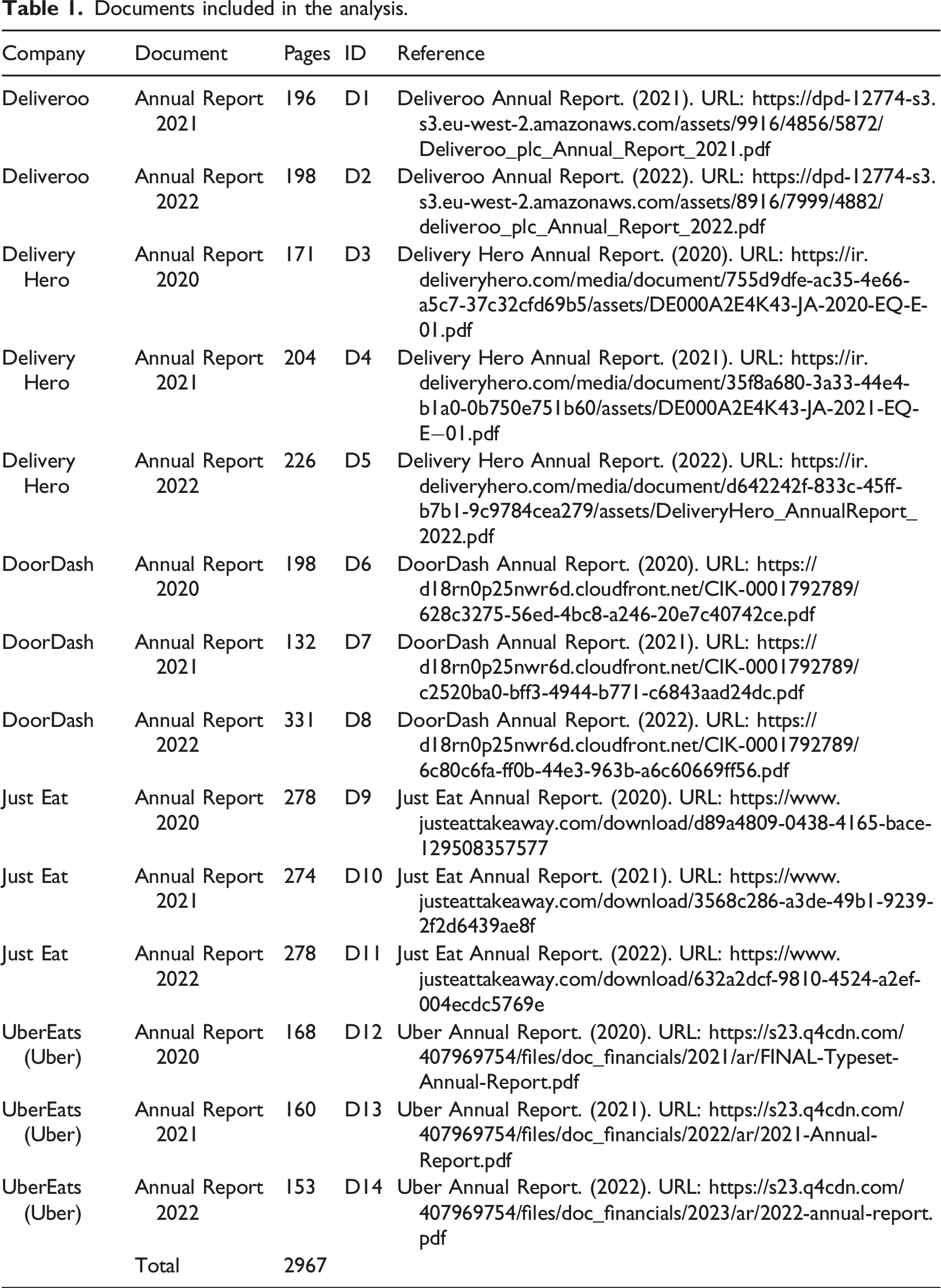
Documents matching the inclusion criteria (n = 14) were downloaded from platform companies’ websites and then analysed using specific search terms relating to algorithmic control, as identified in prior literature. Specific search terms used were: ‘machine’ AND ‘learning’ OR ‘ML’ OR ‘artificial’ AND ‘intelligence’ OR ‘AI’ OR ‘algorithm’ OR ‘ethic’ OR ‘responsibility’ OR. ‘CSR’. Overall, 2967 pages of corporate reporting material were included in the document analysis. Hits to the keyword searches were imported to Excel and manually checked by one researcher for contextual relevance regarding algorithmic control. Duplicate hits were removed, as were any hits referring to other parts of the report than body of text (e.g. titles, legal statements). Table 1 presents an overview of the analysed delivery platforms and the reports included in document analysis.
Study 2: Netnographic approach
To build on Study 1’s qualitative document analysis, a netnographic approach was adopted, focussing on one sub-brand of a global delivery platform: Wolt, a sub-brand of DoorDash. Netnography, defined by Kozinets (2014) simply as doing ethnographic research online, is a set of primarily qualitative research approaches where a significant amount of data is shared publicly on the Internet, for example, on online discussion forums or other forms of social media. This approach, combined with more traditional qualitative research methods, that is, interviews, has been found to yield a rich overall view of a studied phenomenon, leveraging triangulation of research methods. In line with the chosen overall research design, this approach was deemed to have potential to yield important bottom-up information on algorithmic control communication and mitigation strategies from the worker point of view. The netnographic approach followed Costello et al. (2017), whereby both active and passive forms of netnographic research approaches were adopted, facilitating an abductive process of zooming in and out of data to formulate a view necessary to comprehensively debate the practical and theoretical influence of delivery platforms’ algorithmic control practices on work and employment.
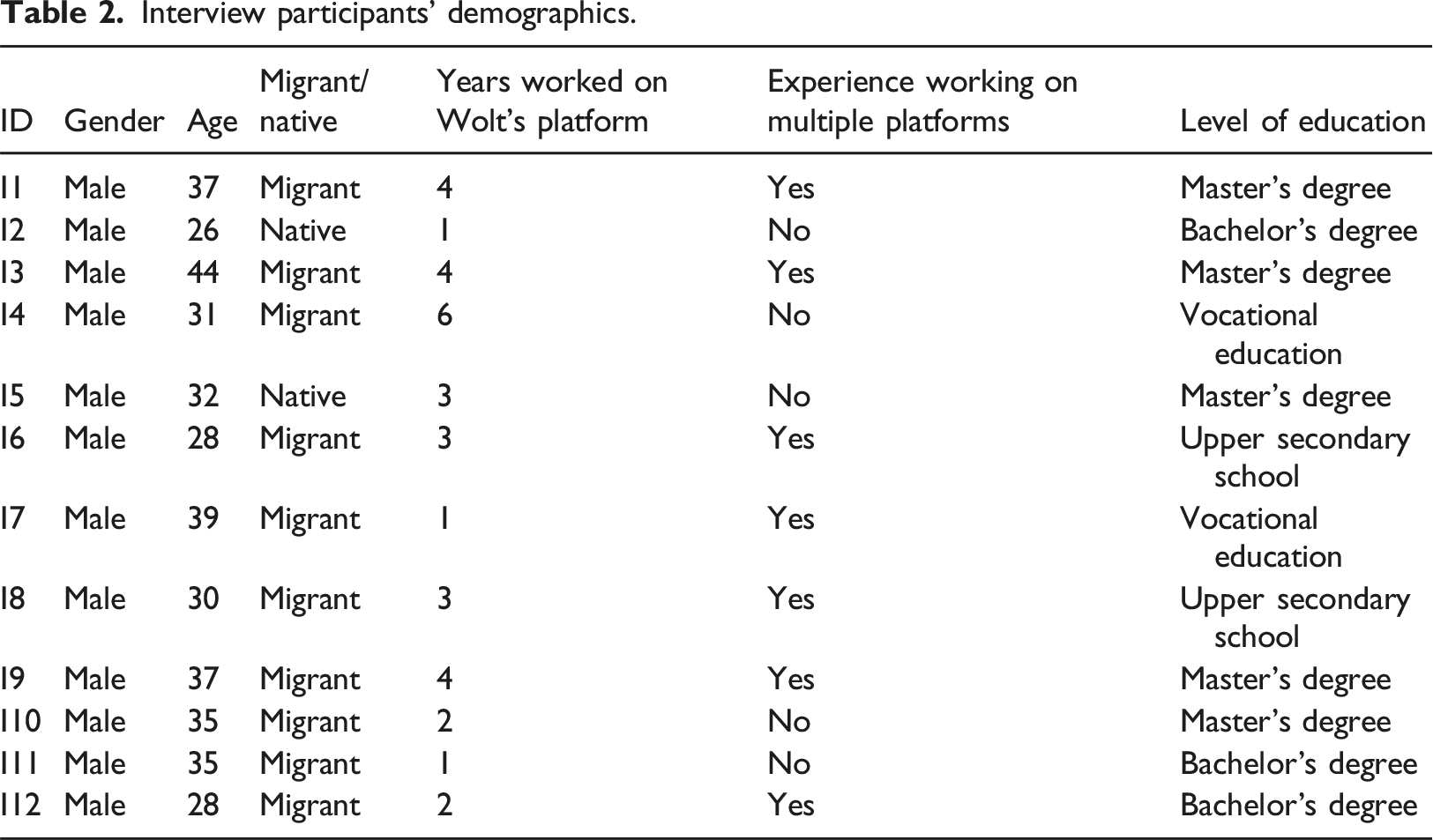
In practice, the netnographic approach integrated two streams of data: semi-structured interviews with platform workers, n = 12; and platform workers’ forum posts scraped from an online discussion forum, n = 830. Data were collected in two waves: interviews in May-September 2023 and discussion forum posts in November 2023.
For the interviews, participants were recruited through a combination of selective and snowball sampling by posting a public invitation to participate in the interviews on an online discussion forum dedicated to delivery platform workers. As the focus was on one specific platform, Wolt, only workers with experience of working on Wolt’s delivery platform for more than a year were included in the study. At the end of each interview, participants were encouraged to suggest further interviewees by re-posting the interview invitation to their local courier-only WhatsApp groups, as previous research has highlighted social media as a valuable tool for platform workers to share stories (Vilasís-Pamos, 2024). To gain a balanced sample, particularly female couriers were encouraged to participate.
An interview guide based on the literature review was developed, consisting of 22 questions. The interview guide was tested with a food delivery platform expert external to the study, and after the test, one question was slightly revised. After this, a total of 12 interviews were conducted with food delivery platform workers, with the shortest interview lasting 24 min and longest 59 min (avg. 41 min). 10 interviews were conducted in English, two in Finnish, and they were all held online on a teleconferencing platform. The conversations were audio recorded and interview transcripts were anonymised and manually transcribed immediately after the interviews, after which recordings were deleted. The interviews conducted in Finnish were manually transcribed in Finnish and then professionally translated to English.
Interview participants’ demographics.
Regarding the online discussion forum posts, the discussion forum Reddit was identified as the most active public forum among Wolt delivery workers. Other discussion groups besides Reddit were also identified, for example, on Facebook and WhatsApp, but these were found to be invite-only, so Reddit was deemed as the best approach for the netnography. As a sampling strategy, all discussion forum posts, including forum thread start posts and comments, were manually scraped from the Reddit forum r/WoltPartners. The forum is not officially affiliated with the platform, and is moderated by volunteers. The final scraped material consisted of 117 unique forum threads spanning from November 2020 to November 2023 and included 830 comments in total. During the scraping process, posts and comments identified as spam or advertisement (n = 53) were identified and manually excluded from the final data set. Overall, r/WoltPartners has around one thousand members with new comments posted every few days.
The qualitative data was compiled to NVivo and analysed thematically using template analysis (King, 2012). Template analysis is a qualitative analysis technique that facilitates the processing of multiple sources and formats of data (Brooks et al., 2015), whereby a first initial coding template was generated by analysing the interview transcripts, moving gradually from descriptive codes to more abstract categories and themes of code. The initial analysis template, consisting of 4 first-order, 12 second-order and 45 third-order codes, was then used to analyse the discussion forum posts, iteratively testing and re-testing the established codes, categories of codes and themes for theoretical validity. Analysis was carried out by the lead author and cross-checked by another author. In the end, four conceptually distinct major themes were identified in the entire corpus of qualitative data.
Results
The following two sub-chapters present the findings of the two empirical studies conducted herewith.
Study 1: Document analysis
Hits to the defined search terms.
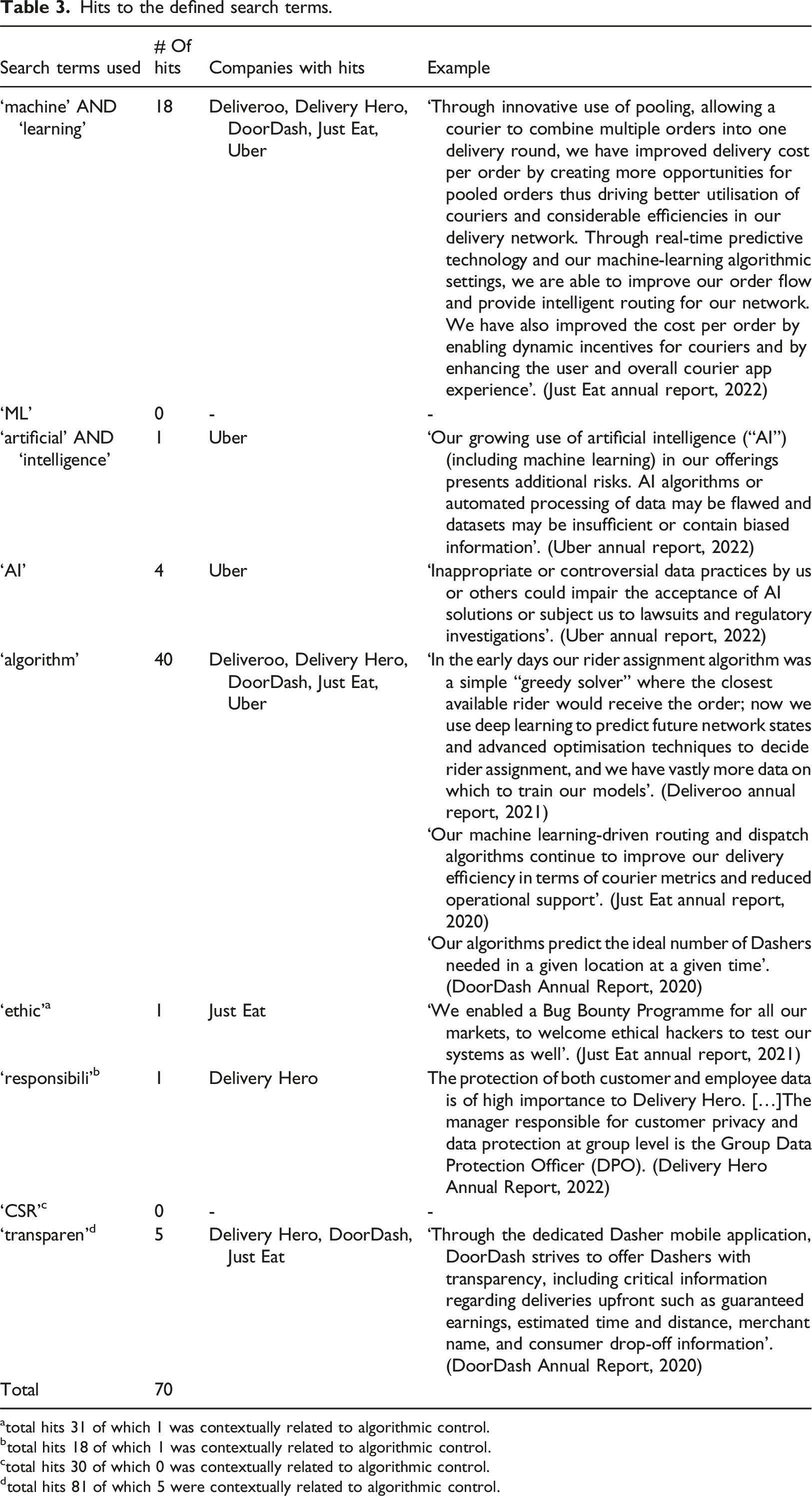
atotal hits 31 of which 1 was contextually related to algorithmic control.
btotal hits 18 of which 1 was contextually related to algorithmic control.
ctotal hits 30 of which 0 was contextually related to algorithmic control.
dtotal hits 81 of which 5 were contextually related to algorithmic control.
Overall, when topics related to algorithmic control and its transparent conduct were discussed, the tone was either extremely surface level or abstract, or extremely technical and clearly meant for a specific audience, for example, machine-learning engineers. For example, JustEat’s Annual Report (2022) discusses how the company continues to develop their algorithms to improve efficiency in terms of ‘courier metrics’, and that one of the recent initiatives has been enabling ‘dynamic incentives’ for couriers. However, the report does not go into detail about what such metrics or incentives are, or how they have been implemented on the platform. In their reporting, Deliveroo is more specific about the technologies used for algorithmic control, stating that the company uses ‘deep learning to predict future network states and advanced optimisation techniques to decide rider assignment’. However, the company does not actually state which deep learning models or what kinds of optimisation are used, or how these are trained, despite noting the agglomeration of data from user interactions: ‘we have vastly more data on which to train our models’ (Deliveroo Annual Report, 2021).
The lack of transparency regarding the operation of the algorithm is evident in DoorDash’s annual reporting, too, whereby the company promises ‘to strive to offer Dashers with transparency, including critical information regarding deliveries upfront such as guaranteed earnings, estimated time and distance, merchant name, and consumer drop-off information’ (Door Dash Annual Report, 2020). However, the company only discusses the transparency of the delivery task, not the transparency of the system dispatching those tasks or the product design decisions that the company has taken to develop the system. Overall, on first glance the keyword search produced most hits for search terms relating to ethics, responsibility and transparency vis-a-vis technical language. However, upon closer examination only seven hits actually related to algorithmic control, and those that do, only discuss this in the context of data privacy.
Overall, the current strategies publicly listed platform companies use to communicate algorithmic control practices in their legally required annual reporting seem inadequate and ambiguous. All of the analysed delivery companies mentioned AI and algorithms in their annual reports to varying extents, but mainly in passing and never in the explicit context of AI ethics or algorithmic transparency.
Study 2: Netnographic approach
The qualitative template analysis of the entire corpus of data (interviews, online discussion forum posts) sought to understand the communication and mitigation approaches delivery platform workers adopt to mitigate algorithmic control and the ways in which information about such practices is shared with fellow platform workers. However, it should be noted that as the focus in Study 2 was particularly on one food delivery platform (Wolt) in one geographic area the platform operates in (Finland), the generalizability of the findings to all types of food delivery platforms across their global markets should be approached with caution.
Regardless, four types of communication and mitigation were found: 1) App-related, that is, communication and mitigation approaches related to the platform’s mobile application and its underlying algorithms, 2) Task-related, that is, communication and mitigation approaches related to the delivery task, 3) Work-related, that is, communication and mitigation approaches related more broadly to day-to-day experience of delivery work, 4) Community-related, that is, communication and mitigation approaches related to building informal camaraderie and a global-local worker community to help cope with the demands of delivery platform work. Figure 2 presents a summary of the types of communication and mitigation approaches delivery workers adopt. Overall, the adopted communication and mitigation approaches were found to vary on two axes: how static or dynamic the approaches were, as well as how platform-agnostic or platform-specific the approaches were. Strategies for communicating and mitigating algorithmic control on delivery platforms.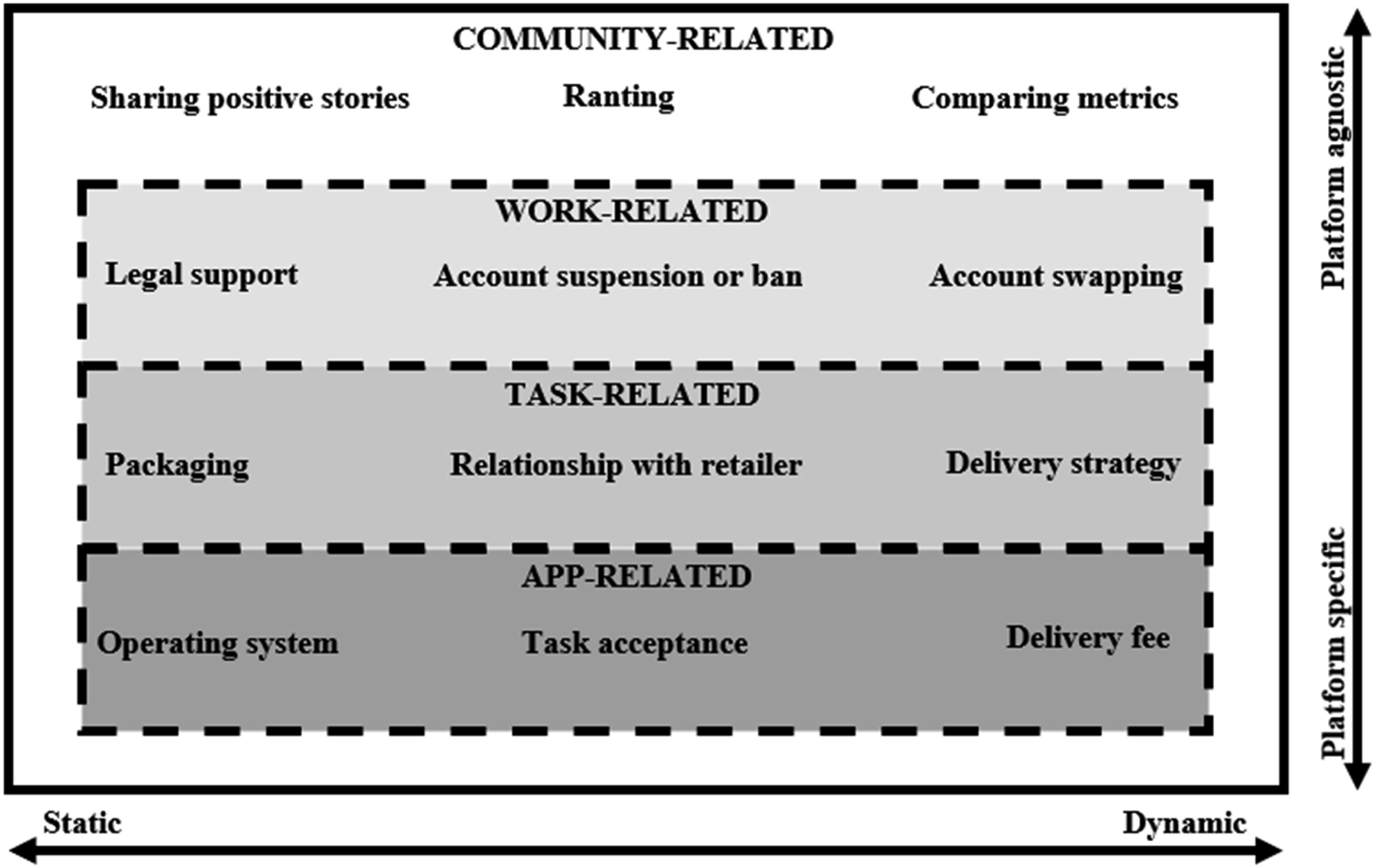
App-related communication and mitigation approaches
Three types of communication and mitigation approaches related to delivery platforms’ mobile applications were found: approaches related to the operating system and other technical equipment that formed the boundary conditions of using the platform’s app, along with approaches related to optimising the acceptance of tasks or maximising the expected delivery fee.
In terms of the operating system, delivery platform workers were found to actively share information with one another regarding the compatibility with the platform’s app with specific manufacturer’s mobile phones (e.g. Samsung), the specific operating systems and system updates (e.g. Android), and the use of external apps (e.g. Google Maps) to compliment the delivery platform’s own app in day-to-day work. A key discussion point was sharing tricks to optimise power consumption to ensure the longevity of couriers’ phone battery. Besides optimising power usage, several workers were found to report app crashes in real-time, seeking to affirm if other couriers were experiencing the same issue. Finally, a vocal minority of couriers also discussed the different settings and authorisations the platform’s app required for it to work. Couriers, for example, reported the delivery platform’s app controlling the use of the phone too much, for example, forcing push notifications from the app to disturb other apps or phone calls. As put by one interviewee: ‘Every activity that goes into your phone is recorded. In normal life, I think it’s evil, to keep track of everything that is going on’ (I2).
Besides the operating system, delivery platform workers were vocal about their approaches to managing task acceptance rates and remuneration. Highlighting power asymmetries on delivery platforms, some couriers reported having received personal messages from the platform’s support personnel expressing concern over their low task acceptance rate, hinting at repercussions if the situation did not improve. On the platforms analysed in this study, the courier generally has a time limit determined by the platform (e.g. 30 or 60 s) to accept or decline a task they are being offered, and deep strategizing was found to be involved in determining the optimal approach to accepting or declining offered tasks. Indeed, many strategies for boosting one’s task acceptance rate were found, from gaming the platform’s system to receive multiple orders from a single restaurant (‘bundled-orders’) to using external apps that faked the couriers GPS signal to increase their chances of receiving orders from, for example, the city centre when the courier was still driving towards it, to trying to predict hotspots and peaks of orders by regularly checking the consumer-facing delivery application for which restaurants offered special deals or free delivery. Several couriers also reported regularly screenshotting the app to collect proof that could be used against the platform if tasks that had already been queued all of a sudden disappeared. In terms of delivery fee, many couriers openly shared their earnings, for example, per task or per day, constantly comparing differences in, for example, base salary, limited time bonus pay used by the platform to nudge couriers to work at a specific time, for example, a holiday period, as well as bonus pay for difficult weather conditions, for example, heavy wind or rain. If couriers in some city or country were found to have better conditions, this could be used as leverage against the platform to improve conditions in other geographical areas. Illustrating the apparent power asymmetry and the need to find ways to mitigate for it, one interviewee commented: ‘The fact that the algorithm is not open to us couriers, I understand that it’s a business secret for the company, but still, we don’t really know or understand how it works, it’s a pretty closed environment. So for us couriers it’s mainly through experimentation. We don’t really know how the system works, in the background’. (I4)
Task-related communication and mitigation approaches
In terms of communication and mitigation approaches related to the actual delivery task, two types of approaches were found. First, couriers discussed experiences regarding different delivery methods, from petrol car to electric car to bike or e-bike, to scooters or electric unicycles. As the choice of delivery method had a perceived impact on the tasks the platform dispatched to couriers, the consensus seemed to be that all delivery methods had their own merits, and that competitive advantage was gained from determining which delivery method to use under what contextual circumstances, for example, time of day, day of the week, time of year, specific city, etc. Several couriers reported using multiple methods of delivery over, for example, a fiscal year. The pros and cons of using ancillary service providers, for example, leasing an electric bike, were also debated, along with issues related to parking and avoiding tickets or other penalty charges. One long online discussion forum thread was centred on dealing with thieves, sharing tips and tricks for how to prevent theft and guidance on what to do in case something does get stolen. In terms of perceived algorithmic control, this was related to the notion that the platform tracked couriers’ task acceptance rates, influencing their decision-making on when and how often to take a break or where and for how long to store their vehicle.
Besides the delivery method, a key point of discussion was optimising interaction with restaurant partners and the storage of delivered items. In terms of the latter, couriers regularly shared tips for securely storing items in their heat bags, as well as carrying their own extra tape or plastic bags to further strengthen the original packaging provided by the retailer. Overall, when it came to optimising interaction with retailers, there seemed to be rich tacit knowledge circling around regarding what specific restaurant or restaurant chains to avoid and under what circumstances (e.g. time of day), whereby some retailers were found to be consistently late in delivering orders, hindering couriers’ earning potential. Interestingly, one of the analysed delivery platforms had implemented an algorithmic control strategy explicitly for mitigating couriers’ wasted time, whereby after a long enough delay from the retailer side, couriers received a monetary bonus as a compliment. As put by one interviewee: ‘Nowadays, the app has an in-built system where after ten minutes delay from the restaurant’s side, [the platform] gives you extra money because of the delay. So if the delay is only like eight minutes, you feel sad as you almost got the delay money. In those cases I sometimes ask the restaurant to hold the order for a while longer’. (I5)
Work-related communication and mitigation approaches
To complement task-related communication and mitigation approaches, three types of more general work-related approaches were found: legal support, avoiding account suspension or ban, and approaches to account swapping. In terms of legal support, couriers were found to help one another regarding taxation, visas, accounting, or setting up one’s own company. Besides legal boundaries, couriers actively discussed how specific platforms’ internal policies should be interpreted and to what degree they could be contradicted without fear of reprimand, for example, account suspension or ban. Topics discussed included, for example, using platform company’s clothing, interaction with retailers or consumers, dealing with complaints, or taking time off. For example, couriers noted that even though they had flexibility to take (unpaid) leave whenever they wanted, the platforms also had policies regarding extended inactivity leading to account suspension. To mitigate this, couriers debated ways to ‘fake’ activity, for example, strategies for swapping accounts between one another without being detected by the platform’s algorithm. Overall, couriers were seemingly keen to provide assistance and help each other in the case of fellow couriers’ account being suspended or banned. One particularly lengthy discussion forum thread detailed how one courier had gotten banned, and how through the help of other couriers the community was eventually able to lift the ban.
Community-related communication and mitigation approaches
In terms of community-related communication and mitigation approaches, three general types were found. First, couriers were eager to vent to each other about working on the platform and its problems. While the majority of complaints were aimed at the platform directly, other stakeholders, including the restaurant partners, customers, and city officials (e.g. parking enforcement officers) also got their share. However, despite its challenges, there was also a strong contradictory narrative around food delivery platform work, whereby couriers regularly shared positive stories about their work and day-to-day interactions. There was a strong sense of camaraderie, and couriers’ positive experiences seemed to be contagious. Sharing key performance indicators from one’s own account was particularly common, for example, distance travelled during a particularly busy day or number of orders delivered or money earned over a specific holiday period. As put by one interviewee: ‘For the 13 years I’ve lived here, as an immigrant, I can say, [the platform] has been like, it’s created a lot of work opportunities for immigrants. I can say that without any doubts. [The platform] has really changed the lives of many foreigners here. So I don’t wanna undermine that, even if I have to say some little negative things about the app, that alone surpasses any negative that comes to mind when you think about [the platform]’. (I6)
Overall, mixed approaches to information sharing in relation to the identified communication and mitigation approaches were found, varying between the global and local level of delivery platform communities. First, through which channel and with whom information was shared seemed to vary, whereby some information was shared among all fellow delivery platform workers, while other information was only shared to a closed group of confidants. In the case of online discussion forums, most information regarding communication and mitigation approaches was shared openly with everyone, and in many cases, sharing information, asking help and comparing the algorithmic control situation with the broader global worker community was a key value derived from engaging in discussion in the first place. However, some information, particularly information regarding specific actions for circumventing the way the platform’s algorithm worked, were only shared privately, with messages prompting other interested users to ‘DM’ (direct message) the forum thread starter privately for full details.
Second, in the case of face-to-face information sharing, most participants reported sharing general pleasantries with other fellow couriers in situ, in front of restaurants, parking lots or other hub areas daily or weekly. However, when it came to having deeper conversations concerning, for example, ways to optimise one’s productivity or monetary output, workers reported a preference for sharing these types of information only with those who share the same ethnic background, for example, those who speak the same language or come from the same country. Although at least partially due to plain convenience (i.e. proximity, language barrier), there seemed to be a general narrative of offering help to one’s own social sub-group over other, competing groups.
Discussion
The ways in which delivery platforms utilise algorithms to control work changes traditional understanding of management and organisation. This exploratory study sought to understand how delivery platforms communicate their approaches to algorithmic control, what kinds of communication and mitigation approaches workers adopt to mitigate such control, and in what ways information about such strategies is shared between platform workers. Studying these topics answers recent calls for further research and directly extends still emerging conceptual understanding of algorithmic control and algoactivism (Jiang et al., 2021; Kellogg et al., 2020).
As highlighted by Study 1, all of the analysed delivery platforms made some mention to AI in their annual reporting. However, little to no mention of transparency and ethical use of AI was found, highlighting the informational asymmetry and ‘black-boxed’ nature of AI noted by previous research (Veen et al., 2019). Overall, major delivery platforms’ communication of their algorithmic control practices seemed lacking. When transparency was discussed in the context of platforms’ technology usage, it primarily related to data privacy. This could be attributed to the lack of commonly agreed upon regulatory frameworks for algorithmic control, as highlighted by recent research (Bucher et al., 2021). While the rules around data privacy and informed consent have become relatively well-established, most notably through the EU’s General Data Protection Regulation (GDPR), the governance of algorithmically controlled work on digital platforms remains more of a grey area. These findings thus provide new evidence for the need for formal guardrails regarding the ethical use of AI to control workers, in general and in the context of geographically tethered digital labour platforms. The EU’s Platform Work Directive, agreed in early 2024, is a step in this direction, whereby when eventually incorporated into national law by member states, platform companies have to inform workers about the use of automated monitoring and decision-making systems. The Directive also includes a mention of human oversight for specific types of decisions, for example, account suspensions. However, given the complexity of algorithmic control and the ambiguity of the Directive’s text, that is, what exactly should be included and what excluded, there is likely to be a wide grey area that platform companies have to navigate through some form of self-regulation.
Indeed, our review of delivery platforms’ legally required annual reporting regarding their algorithmic control practices resonates well with van Maanen’s (2022) notion of AI-washing, whereby large technology companies have a tendency to ‘wash away’ concerns raised over their AI-related policies: the companies highlight the benefits of AI but downplay concerns. While understandable given annual reports’ primary audience, that is, shareholders and potential investors, the lack of AI transparency publicly listed companies’ mandatory reporting material is in stark contrast with said companies’ heavy reporting on user privacy. Based on the document analysis, there seems to be a need to move away from AI ethics guidelines and manifestos to openly discussing actual policies and changes to close the theory-to-practice gap (Rojas and Tuomi, 2022). Further conceptual and practical research is imperative in understanding how this could be actualised, particularly as platform companies situated in the EU start to adopt their stances to the Platform Directive.
One potential avenue for further exploration is offered by the large social media platforms, which themselves have been under public and legal scrutiny for longer than delivery platforms. For example, Meta launched its Oversight Board in 2020, formed to provide independent opinion on sensitive content moderation issues. Since its launch, the Oversight Board has garnered criticism (cf. Cowls et al., 2022) and generated much debate, and the jury is still out on whether an independent ethics board is the way forward. Other approaches that have emerged include, for example, platform cooperativism (Scholz, 2016), which pushes for the collective ownership and democratic governance of platforms, or deliberative governance (Tuomi and Ascencao, 2023), which emphasises transparency through collaborative design. According to Tuomi and Ascencao (2023), the key elements of a successful platform governance model should include a fora for openly discussing new features of the system before implementation, a structured process for impact monitoring, be user-led, and include a systematic process for evaluating the overall structure of the algorithmic control system, emphasising explainability and transparency. It should be noted that both formal and informal examples of such a fora already exist in the context of platforms, for example, Lyft’s Driver Advisory Council convened by the platform since 2016 to support product development (Lyft, 2019), or the Indie Sellers Guild, a non-profit organised by independent sellers on the arts & craft marketplace Etsy since 2020 to promote sellers’ rights vis-a-vis the platform. However, while these examples of self-regulation represent steps in the direction of more collective platform governance, the degree to which current approaches are transparent or hold real rather than soft-power to influence the way in which platforms are developed is debatable, given the lack of legal requirement.
Indeed, given the current lack of leadership in this area, as illustrated by our analysis of delivery platforms’ annual reports, a first-mover position could yield positive results for delivery platforms. Interestingly, extending the formal analysis conducted herewith beyond annual reports to also include platforms’ other forms of communication, for example, their websites, blogs and press releases, that is, material that they are not legally required to publish, yields some more insight on platforms’ algorithm-use. For example, Wolt, a sub-brand of DoorDash, has produced a 26 page report on algorithmic transparency (Wolt, 2023), while Glovo, a sub-brand of Delivery Hero, has a dedicated section on its website reserved for algorithms (Glovo, 2023). However, the information provided here, too, lacks transparency and specificity regarding any frameworks used for operationalising and overseeing algorithmic control practices from product development to deployment. Similarly, Deliveroo states on their website that they have ‘initiated a review framework to help us detect and mitigate conscious or unconscious bias that could be built into our algorithms’ (Deliveroo Annual Report, 2021). However, no further detail about the framework or its actual operationalisation is offered, for example, what the framework looks like, how it is applied in practice, who has ownership or veto-power over decisions, or at what frequency are any assessments of the framework or decisions conducted.
Turning the discussion to the communication and mitigation approaches that delivery workers themselves adopt to mitigate algorithmic control (Study 2), four types of communication and mitigation approaches were found: App-related, Task-related, Work-related, and Community-related. Altogether, our findings build on Jiang et al.’s (2021) research on algoactivistic approaches in ridesharing, offering the viewpoint of a three-sided logistics platform as opposed to a two-sided ridesharing platform. Overall, this article finds new evidence of algorithmic control and highlights strategies for mitigating it, going beyond the typical focal point of algorithmic control research: the operations of the platform’s mobile application (Vallas and Schor, 2020). In terms of the platform’s mobile app, our findings complement, for example, Gonzalez-Jimenez et al.’s (2022) research on the complexity of delivery task acceptance, however, this article also finds evidence that goes beyond task acceptance, re-affirming issues surrounding the boundary conditions of engaging in platformic work (e.g. technical equipment) (Wood et al., 2019) along with the dynamic nature of optimising monetary rewards gained from delivery tasks (Doorn, 2020). Our findings also offer fresh insight into communication and mitigation approaches regarding delivery workers’ interaction with the retailer (Ashton et al., 2022), providing a couriers’ view on managing the retailer as a stakeholder in the delivery task through, for example, which restaurants to avoid to optimise task completion rates or carrying their own extra packaging material, for example, own tape or extra plastic bags, to ensure successful delivery. We find this to be in line with Bucher et al. (2021), whereby we find some evidence of anticipatory compliance to pre-emptively mitigate delivery platform’s algorithmic control approaches, for example, receiving poor end-user ratings due to delayed orders or food/drink spills. However, in our study communication and mitigation approaches around anticipatory compliance seemed to go beyond the delivery task to also include emotional and practical support for fellow couriers to avoid suspensions, or to offer support for those whose account had already been suspended or banned from the platform.
Interestingly, we find that the majority of the different types of algoactivistic approaches platform workers adopt in delivery are seemingly platform-agnostic, whereby only App-related algoactivistic approaches were found to be strongly tied to a specific delivery platform, Wolt, and its proprietary technology. This article argues that all the other algoactivistic approaches – Task-related, Work-related, and Community-related – are more general, that is, not directly related to a specific platform’s app, and should therefore be applicable to all major delivery platforms with only slight modifications. Even for App-related algoactivistic approaches, the emerging trend of multi-apping – food couriers working for multiple delivery platforms simultaneously – has increasingly homogenised the experiences of working across different platforms (Popan, 2023). Thus, the algoactivistic approaches concluded in this article highlight the similarities between different delivery platforms’ business models and exacerbates platform companies’ general approach of guarding its algorithm as a business secret (Möhlmann and Zalmanson, 2017). Overall, our findings highlight how delivery couriers adopt complex communication and mitigation approaches, formed around tried-and-tested informal best practice solutions, in order to push against the platforms’ algorithmic control mechanisms and work-related policies, but also to optimise the surrounding work environment to proactively adapt to the constraints of spatio-temporally bound nature of on-demand delivery (Heiland, 2021a, 2021b).
In terms of information sharing, our findings provide interesting new insight into the novel forms of entrepreneurial networking and collaborative competition in platformic work. Contrasting how traditional entrepreneurs share information and collaborate with their direct competitors (Jost, 2022), our findings paint of picture of openness and solidarity among platform workers to mitigate the overall power asymmetry vis-a-vis the delivery platform (Duggan et al., 2020; Pires et al., 2023; Tassinari and Maccarone, 2020; Vilasís-Pamos et al., 2024). Additionally, the practice of information sharing among platform workers, particularly through community-related algoactivistic approaches, plays a role in bringing these workers together. Previous studies highlight social media’s effectiveness in mobilising platform workers for actions like strikes (Tassinari and Maccarrone, 2020), but also to share day-to-day stories of platform work (Pires et al., 2023; Poell et al., 2022). Our findings bring further evidence of the latter, suggesting that sharing information through platforms like online forums can enhance community solidarity. However, this does not address the challenge of achieving systematic organisation by established institutions such as trade unions, especially given that many platform workers are migrants who often consider their work temporary (Newlands, 2022) or as transitionary (Pires et al., 2023). This also leads to another important finding in this article, which highlight a distinction between online and offline worker communities of specific delivery platforms, whereby informal social support systems seem to spontaneously emerge once the platforms’ official support structure fails or in anticipation of it not being transparent and on the workers’ side. Although similar findings have been highlighted by others (Maffie, 2020; Mieruch and McFarlane, 2022; Vilasís-Pamos et al., 2024), the emergent social support system seems to be more complex than prior research has indicated, with its own social norms and structural hierarchies, for example, the ‘apprenticeship model’ discussed by Pires et al. (2023). In particular, our findings indicate that information is more openly shared among members of a worker’s own social reference group, for example, those with a common language or a cultural background, than with others.
Conclusion, limitations and future research
Digital labour platforms, including platforms that facilitate delivery services, bring significant changes to work, from how it is organised to how it is managed to what even constitutes as work in the digital labour platform era (Ashton et al., 2022). A key point of scholarly debate has been the algorithmic control practices platforms use to control a global and distributed workforce on-demand (Kellogg et al., 2020), noting that some platforms employ more lenient, some more strict versions of algorithmic control (Kusk and Bossen, 2022). Research has also started to explore fissures in algorithmic control (Ferrari and Graham, 2021), including strategies platform workers adopt to counteract or undermine the algorithm (Jiang et al., 2021) and how these might be discussed by workers on digital media (Pires et al., 2023; Vilasís-Pamos et al., 2024). However, there is a lack of understanding of how publicly listed delivery platform companies communicate their approaches to algorithmic control in their legally required reporting material, that is, annual reports. Further, there is also a dearth of understanding of the kinds of communication and mitigation approaches delivery platform workers adopt to mitigate such control, and how these approaches are shared with fellow delivery workers.
To that end, two studies were conducted. Offering an aggregated top-down view of communication vis-a-vis algorithmic control and identifying best practices and common gaps, Study 1 analysed five publicly listed global delivery companies’ annual reports from past three fiscal years (n = 14). Based on the analysis, we highlight a general lack of transparency regarding the platforms’ algorithms despite several mentions of the use of AI to facilitate platformic work (Ferrari and Graham, 2021). After this, Study 2 adopted a netnographic approach, looking at platform workers’ first-hand experiences on a specific delivery platform, Wolt, to provide a bottom-up view of communication vis-a-vis algorithmic control, identifying actual strategies workers adopt to cope with its impacts. In practice, in Study 2, we conducted semi-structured interviews (n = 12) and a qualitative analysis of delivery workers’ online discussion forum posts (n = 830).
Based on these, strategies for mitigating algorithmic control are found, revolving around four types of communication and mitigation approaches: 1) App-related, that is, communication and mitigation approaches related to the platform’s mobile application and its underlying algorithms, 2) Task-related, that is, communication and mitigation approaches related to the core service provided, 3) Work-related, that is, communication and mitigation approaches related more broadly to day-to-day work experience of delivery, 4) Community-related, that is, communication and mitigation approaches related to building informal camaraderie and a global-local worker community to help cope with the demands of delivery platform work.
Overall, the findings contribute to improving conceptual and practical understanding of food delivery platforms, and the algorithms that underlie them, as part of the ongoing ‘uberization of work’ (Fleming, 2017). Critically, prior research has noted how many tech-startups leveraging artificial intelligence tend to ignore AI ethics due to resource constraints and a fast pace of ‘moving quick and breaking things’ (Rojas and Tuomi, 2022). However, as these startups scale-up, mature, and reach a global market leadership position, the expectations for their conduct change in the scrutinising eye of their shareholders, lawmakers, and the general public, calling for new forms of platform governance and increased focus on transparency (Tuomi and Ascenção, 2023). This is particularly the case with publicly listed companies as these already have more regulatory reporting expectations than unlisted companies.
Despite carrying out two empirical studies, the research presented herewith has limitations that should be considered. First, only delivery platforms originating from Europe or North America have been studied. Further research should explore algorithmic control practices and the communication and mitigation approaches that emerge on other major delivery platforms, for example, Meituan (Huang, 2022). In the same vein, even though the majority of our interview participants had experience of working on multiple delivery platforms, multi-apping (Popan, 2023) was not the focus of our study, and thus more research is needed to understand worker experiences in the context of multi-platformic work. Second, prior research has highlighted the particularly precarious position of migrants on delivery platforms (Van Doorn, 2022), along with the often-gendered nature of logistics platform work (Van Doorn, 2017). Although not the focus of the present study, it should be noted that all of the participants in the interviews were male and the majority were migrants. This was despite our best efforts to collect a more balanced sample. Further studies are thus needed to better analyse the racialised and gendered experiences of delivery platform workers, particularly in relation to algorithmic control. Third, platforms themselves are often studied under the assumption that they are static, homogeneous entities, while in reality most major delivery platforms undergo major development all the time as well as operate under different logics and make constant A/B tests in different geographic locations, for example, countries or cities. While our research design, combining both a top-down view of multiple delivery platforms (Study 1) and a bottom-up view of one delivery platform in particular (Study 2) offer some insights, the overall complexity of studying digital labour platforms calls for more longitudinal research on specific platforms, as well as more case studies on specific platforms across different geographic areas. Finally, the types of information platform workers share with each other, as well as the significance of information shared between different channels, for example, different online discussion forums, warrants more research. In particular, in this study we did not explicitly look at the phenomenon of platform ‘influencers’, that is, the degree to which more experienced platform workers teach more junior workers, as our focus was on what was discussed, rather than who said it. Regardless, further research could look at this ‘apprenticeship model’ (Pires et al., 2023) further by, for example, examining patterns in poster usernames and forum threads on discussion forums such as Reddit.
Footnotes
Declaration of conflicting interests
The author(s) declared no potential conflicts of interest with respect to the research, authorship, and/or publication of this article.
Funding
The author(s) disclosed receipt of the following financial support for the research, authorship, and/or publication of this article: This work was supported by the Työsuojelurahasto; 210336.
