




Abstract
This study analyses YouTube videos about delivery riders in Spain as well as the channels in which the videos were uploaded. The aim is to understand the ways that riders are represented in the videos and determine the labour imaginaries that emerge in the context of platformization, which includes work that depends on platforms that use computer architecture and automation systems to arrange exchanges between people, goods, and corporations, such as the work of delivery riders. This article shows how platformization of labour intersects with cultural production because delivery riders’ work has become a video theme in the YouTube platform. Moreover, in some cases riders (or aspiring ones) use YouTube and other social media to interact, share knowledge and organize their job. Based on a thematic analysis of delivery riders' YouTube videos (n = 40) from 26 channels mined with YouTube Data Tools, this study presents a typology of channels in which riders appear. It also categorizes the main representations of riders as well as the imaginaries that emerge about this type of labour in YouTube videos. The analysis indicates that delivery riders’ work has a transitory nature, which is expressed in the analysed videos. Moreover, the study demonstrates that immigrants are the people who tend to do this type of work in Spain, and shows how being an immigrant plays a particular role in the way riders are represented or gain their social conceptions and aspirations about this kind of work.
Introduction
The main objective of this article is to analyse the videos on YouTube about delivery riders in Spain and the channels in which they were uploaded. The aim is to understand the ways riders are represented in these videos and determine the labour imaginaries (Dawney, 2011) that emerge in the context of platformization. Thus, in this article, we see the work of delivery riders as a labour practice that includes conceptions and definitions that can determine people’s choices, activities and aspirations; and even more so when they become a type of content on the YouTube platform.
The platformization of labour includes all the jobs that depend on platforms with computer architecture and automation systems (software, hardware, algorithms, AI) for arranging exchanges between people, goods, and corporations that directly affect workers (Casilli and Posada, 2019; Van Dijck et al., 2018; Poell et al., 2022).
Helmond (2015) explains that platformization entails the consequences of the rise of platforms as “the dominant infrastructural and economic model of the social web” (p. 1). This corresponds to the way that delivery riders portray and discuss their platform work on social media (Chan, 2019; Kinder et al., 2019; Holikatti et al., 2019. Therefore, social media is central to delivery riders’ media consumption ecosystem.
This article analyses the videos about riders on YouTube. Riders are considered workers-on-demand because they carry out their delivery jobs via apps and online platforms. This type of workforce involves individuals who use the internet, smart devices, and private platforms to contact organizations and potential clients for doing traditional jobs in a flexible way, such as transportation, food delivery, cleaning, shopping, among others (De Stefano, 2016).
Some studies have shown how Uber drivers use social media like YouTube to share their experiences as workers, to communicate their expertise through stories of their everyday work and their relationships with the affordances of the platforms, data infrastructures and end-users (Chan, 2019; Guerra, 2021). This article expands this line of work by carrying out a thematic analysis of delivery riders’ YouTube videos (n = 40) from 26 channels to identify the main topics that emerge when riders self-represent their work on social media. We analysed YouTube channels and the video themes because this social media platform promotes exposure and presence as key elements for achieving success (Poell et al., 2022) for people who create content with the aim of becoming visible online. Moreover, as explained by Scolere, Pruchniewska, and Erin Duffy (2018), online visibility is crucial for workers from different areas who are encouraged to promote themselves on social media platforms as today’s economy values reputation and self-presentation highly. That is, not only social media workers and content creators devote time and energy to their online presence. Workers with other jobs have the secondary task of promoting themselves in social media platforms; they can become content creators and build their own brand (Rosenblat, 2018). Therefore, the research questions of this article are:
What type of YouTube Channels represent the rider’s perspective on platform work?
How is the job of the delivery rider represented – or self-presented – in YouTube videos?
What are the social imaginaries about work expressed through their videos? To answer these questions, we identified the most relevant videos related to the topic in Spain. We then performed a qualitative analysis of videos from 26 channels that have riders as their descriptors to obtain a deeper understanding of the stories and practices that they share. The analysis demonstrates that the riders represent their work in their videos as having a transitory nature (associated particularly with being an immigrant). It is also shown how delivery riders transform their work into popular culture content via social media production in a similar transitory manner. Moreover, the analysis evidences that immigrant communities continue to be the people who tend towards this type of work, particularly because it is the “entrance door” to another country.
Gig economy and precarity
In the context of the gig economy, scholars have identified that on-demand workers find themselves in a paradox (De Stefano, 2016). On one hand, concepts like autonomy, flexibility, and freedom are part of the promise delivered by these platform companies (Rosenblat and Stark, 2016), which includes the idea of no longer having human supervision (Woodcock, 2020). On the other hand, this kind of work increases labour precariousness: with long working hours, low profits and no social benefits (Means, 2018; Shapiro, 2018).
These platforms also use certain technical elements in their design, such as data processing and information asymmetry (Rosenblat and Stark, 2016), as a way to exercise power and control over workers’ behaviour (Calo and Rosenblat, 2017; Rosenblat and Stark, 2016; Woodcock, 2020). This causes real potential consequences, such as temporary or permanent account deactivation (Barnes and Kirshner, 2021; Rosenblat and Stark, 2016). It therefore decreases the workers’ decision-making power in relation to the interaction systems for which they are not trained and which can constantly change without notice (Shapiro, 2018).
Hence, similarly to what happened with Uber drivers in the United States (Rosenblat, 2018), tensions and legal battles have been generated in a large number of countries regarding the status of independent workers or employees (Kessler, 2018). This situation has been especially complex considering that gig platforms “generate new chances” for migrants (Van Doorn and Vijay, 2021: p. 3). The tradition of this type of work is to be a temporary job with a low income (Van Doorn, 2017), enabling immigrants to generate an income and to send money to their home countries (Van Doorn and Vijay, 2021; Díez Prat and Ranz Martín, 2020). Therefore, workers use platforms to meet their daily needs, while they must cover the costs of their everyday work themselves and have no protection. Moreover, they must maintain their work material, such as cars, petrol, breaks, health insurance, and tax payments, among others (Kessler, 2018).
In the particular case of Spain, the so-called ‘Rider Law’ (Royal Decree-Law 9/2021) came into force in August of 2021. It aimed to change how algorithms and artificial intelligence control the production process in the food delivery sector, stop the ‘false self-employed’ conditions, and the subordination in rider practices, such as the limitation of choosing work schedules or remuneration (Waeyaert et al., 2022).This resolution was imposed after a process by several activist riders who organized networks like ‘Riders x Derechos’ and lived through a constant process of disciplinary surveillance, excessive working hours, and lack of social guarantees (Díez Prat and Ranz Martín, 2020). It is considered a first step towards regulating platform labour (Todolí-Signes, 2021). However, it is still not implemented regularly (Báez, 2021).
Thus, it has been observed how the spaces for adapting and navigating the platform are as important as dealing with the precarious work context, and its individual and social consequences (Kalleberg, 2018), which require developing a holding environment to stay in this type of temporary jobs (Sutherland et al., 2019).
The intersection between platformization of labour and cultural production
Platforms are building a connected infrastructure of social life, which contributes to determining the ways people communicate, buy and behave (Van Dijck et al., 2018). Therefore, social and cultural life are subjected to a process of ‘platformization’ (Helmond, 2015). Platformization evidences the way economies, governments, culture, and social relationships depend on the governance and infrastructures of digital platforms (Nieborg and Poell, 2018) for carrying out different activities and tasks.
Labour is part of platformization because different types of work and production depend on platforms with computer architecture and automation systems to be carried out (Casilli and Posada, 2019). According to the International Labour Organization (ILO, 2021), the wide access to cloud computing services and infrastructures has led to digital platforms penetrating practically all sectors of the economy. In addition, there are three platform types in which it is possible to observe the platformization of labour: (1) platforms that provide digital services and products to individual users, like social media; (2) platforms that are mediators for the exchange of goods and services, such as e-commerce and business-to-business; and (3) platforms that aid different users, such as businesses, workers and consumers, to exchange labour, which includes digital labour platforms like delivery rider platforms such as Glovo, Uber Eats, Deliveroo, and Just Eat, among others (ILO, 2021, p.31). Most of these platforms have a complex relationship with worker conditions. This is because the platformization of labour includes a series of irregular employment activities and informal working arrangements without proper guarantees, such as paid leave and social security (Casilli and Posada, 2019).
Moreover, platformization of labour also involves understanding the context and the working conditions of different sectors and places in which these platforms operate (Abílio et al., 2021). This includes delving into the complex relationships between the work, the workers’ social contexts and digital platforms without being dualist.
Therefore, in this article, we focused on delivery riders in Spain and their use of YouTube. In order to understand the intersection between platformization of labour and platformization of cultural production, we look at two types of labour platforms: social media and delivery services.
Cultural production is at the centre of this platformization process and, therefore, determines different aspects of the creation of media products and digital content (Poell et al., 2022). Platforms play a significant role and influence the processes through which producers, intermediaries, and industries create content and organize its circulation.
It is not surprising that the penetration of platforms in cultural industries has modified how these industries function (Nieborg and Poell, 2018). Contemporary cultural creators, whether professional or amateur, rely on the framework of platform production. It can be stated that there is an ecosystem of platforms (Van Dijck, 2013) and that this ecosystem has given rise to a new category of creative workers: content creators (Cunningham and Craig, 2019), usually known as YouTubers, Instagrammers, Tiktokers, and so on.
Riders as well as other on-demand workers are also part of the ecosystem of cultural production platforms. These workers tend to use social media because they lack interaction with other co-workers or managers as they do not have a common physical working space. Thus, a series of cases have been identified in which workers create content and groups on social media to provide support, share knowledge among peers, and organizes themselves in a larger ecosystem of digital platforms external to their work (Kinder et al., 2019).
Through Facebook groups or YouTube channels, new workers interact with more experienced ones, learning tactics for their daily work and for using the platforms. Some of them develop a level of expertise both in the job and in the creation of information channels (Chan, 2019), and develop as ‘micro-entrepreneurs’ (Holikatti et al., 2019) who cooperate and at the same time compete with each other to obtain job opportunities (Corbel et al., 2021).
For example, the creation of specific channels to provide information that is not easily accessible is combined with the creation of support communities that empower new workers, as well as the riders’ aim to gain visibility as content creators (Chan, 2019), and in some cases to become coaches of these types of practices (Soriano and Cabañes, 2020). In turn, people seek information within online communities, sometimes even before starting to work on an on-demand service platform (Holikatti et al., 2019).
These cultural platforms are also used to gain support and solidarity because these spaces, which are outside the work platform, give users a voice for their opinions (Chan, 2019). Thus, the production of new spaces and digital content evidences the ‘specialization’ of workers’ practices that are shared to generate community and support while making content creators’ opinions and experiences visible.
However, platformization does not have a uniform character. According to De Kloet et al. (2019), platformization can have large differences depending on the localities and actors that are involved in this process. Moreover, platforms can often copy ‘the features of other platforms, and users adopt practices and vernaculars from other users’ De Kloet et al. (2019, p. 254). Therefore, in this article, we explore this interweaving between riders and cultural production on the YouTube platform in Spain.
Methods
We constructed our analysis corpus using YouTube’s API v3 and its ‘Video List’ module from the software package YouTube Data Tools (Rieder, 2015) to analyse the representation of delivery riders on YouTube in Spain, and to understand the ways these delivery riders transform their labour into popular culture content via social media production on YouTube. The search formula included the keywords ‘glovo, deliveroo, uber eats, amazon flex’, and was restricted to Spain. The search was carried out on 21 September 2021. With this search we obtained a results list with 250 videos ranked according to YouTube’s search engine.
These results were manually filtered according to the following inclusion criteria: (a) that the video was about delivery workers, (b) in Spain, and (c) not from ‘traditional’ media outlets, like TV or radio shows. Therefore, the number of videos was reduced to 40 videos from 26 channels.
To analyse the data, we created an online coding sheet that included information about the video, such as title, channel, URL, and video description, as well as different topics related to our research questions, such as theme, type of channel, position of the rider in the channel and video (narrator, protagonist, interviewee, object of narration, or recipient). The labour imaginaries that appear in the video’s discourse were also included.
This coding sheet included both bottom-up options to build the classification of channels and space for qualitative data and notes from the researchers. In order to contextualize the information about the people present in the videos, we observed the titles, video thumbnails, descriptions, playlists, and other features of every channel. We used thematic analysis to identify and organize patterns related to our initial research questions, a procedure used in communication studies (Braun and Clarke, 2012; Onu and Oats, 2018). All authors viewed all the videos and coded the data. The emerging themes were compared inductively to build the emerging categories presented in the results sections.
Following the ethical guides of the Association of Internet Researcher (frankze et al., 2020), comments from end-users were paraphrased and anonymized to guarantee their privacy. Moreover, most of the video quotes were translated from Spanish into English, which further prevents recognition.
Analysis
The analysis of delivery rider content in YouTube videos is structured in three sections.
The first section is dedicated to describing the channels. Thus, we analyse how the studied YouTube videos about this type of platform work are related to wider narratives structured around YouTube affordances, which frame videos inside the channel’s wider environment (Postigo, 2016). That is, we present a typology of these channels to determine the types of YouTube channels that represent the rider’s perspective on platform work.
In the second section, we analyse the narrative patterns that appear in the videos to understand the ways in which the rider’s work is (self) represented. Thus, we identify typologies of riders that emerge in the videos.
In the third section, we continue focusing on the narratives and discourses that emerge in the videos by looking at the social imaginaries about this kind of labour.
The context of the delivery rider’s videos in Spain: The YouTube channels
Classification of YouTube channels in our sample.
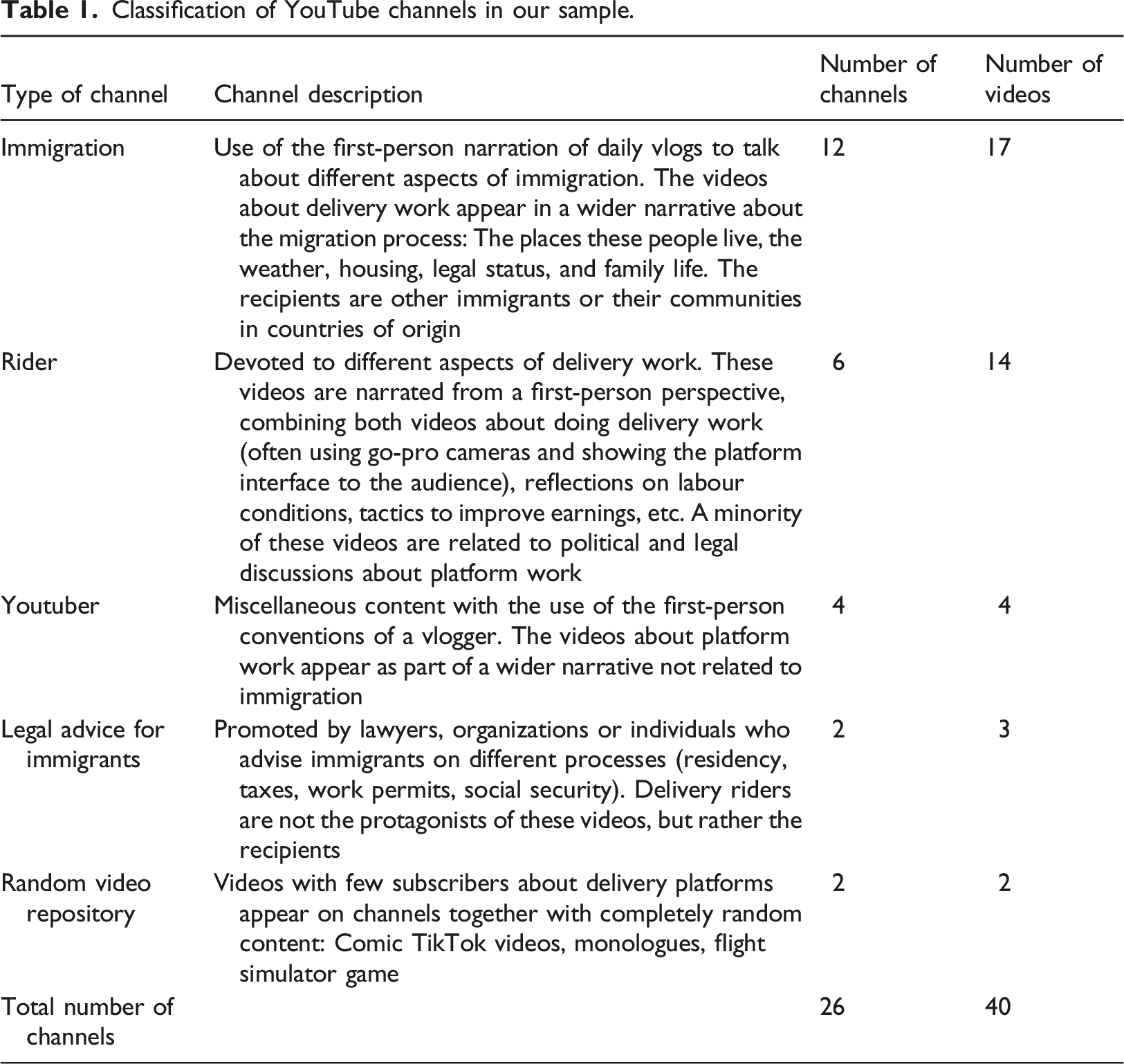
We detected that the majority of the videos were uploaded to channels dedicated to immigration (n = 12). These channels mainly belong to people from Venezuela, with a strong presence of people from Bangladesh, Morocco and other countries. They are located in different urban places of Spain, including Madrid, Barcelona, Sevilla, and Tenerife. The videos about delivery work appear next to others dedicated to different aspects of the immigration experience: the weather and culture of another country, legal status, taxes, and family life. The comment section of the videos is often a place for advice and exchange, where people who have recently established themselves in Spain or are still in their home countries ask practical questions, like how much do people earn, how to become a legal resident or obtain political asylum, or the prices of housing or public transport. This demonstrates that YouTube is another site where platform workers informally share their knowledge (Chan, 2019).
The other channels, which we have classified as YouTubers, Legal Status for Immigrants and Random Repository, share this mixed thematic nature: although they have posted a few videos about delivery work, these users do not have a consistent approach to this theme on their channel. One creator might post a vlog about delivering food on a bicycle one day and months later post a gameplay, a snippet from a cricket game or a video about a family holiday.
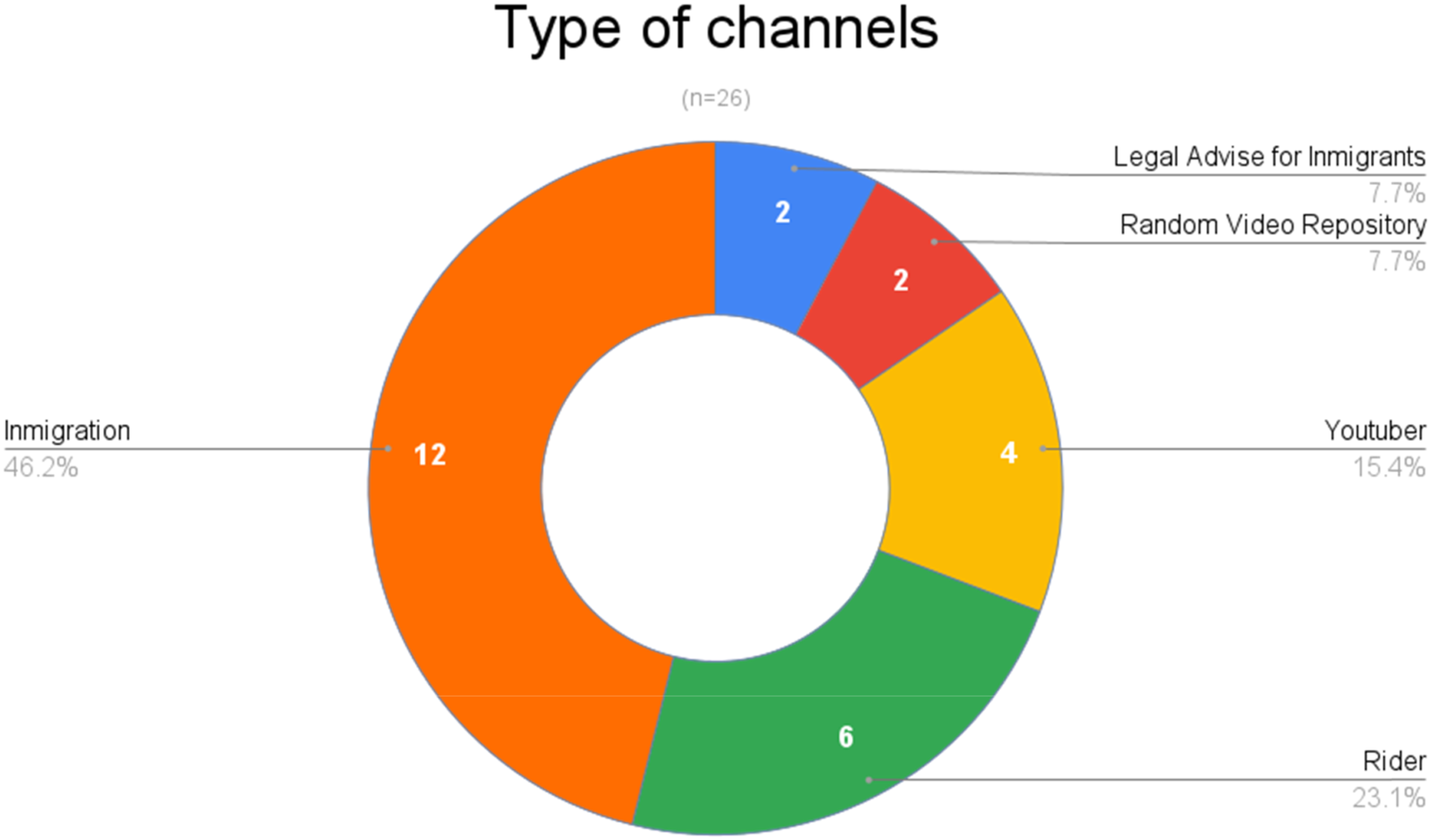
Graph 1 shows six channels from the typology Rider that are completely devoted to delivery work in Spain, which have posted 14 videos in our sample. However, only two have posted consistently during the previous 2 years about different aspects of their daily life as platform workers, and one of them stopped uploading videos in December of 2020. This might be related to the temporary nature of platform work and the precarious conditions both as platform workers and aspiring content creators. When they tried to gain popularity and build a dual identity as delivery workers and YouTubers, they did not succeed in building an audience.
Representation and Self-representation of delivery riders in their videos
Our analysis of representation and self-representation of delivery workers in the videos shows that, in most of them, delivery riders are the subjects of the enunciation (n = 25), while in six of them, delivery riders are represented through the point of view of another person; in this sense, they become the object of the narration.
There are three narrative forms in which delivery riders appear when they are the object of the narration: a) as interviewees about a platform, b) as the “guide” or side-kick of an established Youtuber who publishes a video about ‘what it is like to work as a delivery rider’, c) or as the addressed audience of videos about legal advice published by lawyers.
When delivery riders are the subject of the enunciation, they are the protagonist or the narrator of the video. In this sense, we are dealing with processes of self-representation. This type of video uses two different enunciative strategies exemplified in Figure 1.
On one hand, these videos use a first-person perspective that embraces a Go-Pro aesthetic to show the audience different aspects of the delivery process. On the other hand, they use the emblematic YouTuber-style monologue, that employs a frontal frame to the camera, and the I–you axis to address the audience and ritualized forms of communication to enhance interaction with the audience (Scolari and Fraticelli, 2017; Tomasena, 2020). Frames from a video with the alternation of the subjective point of view and the monologue.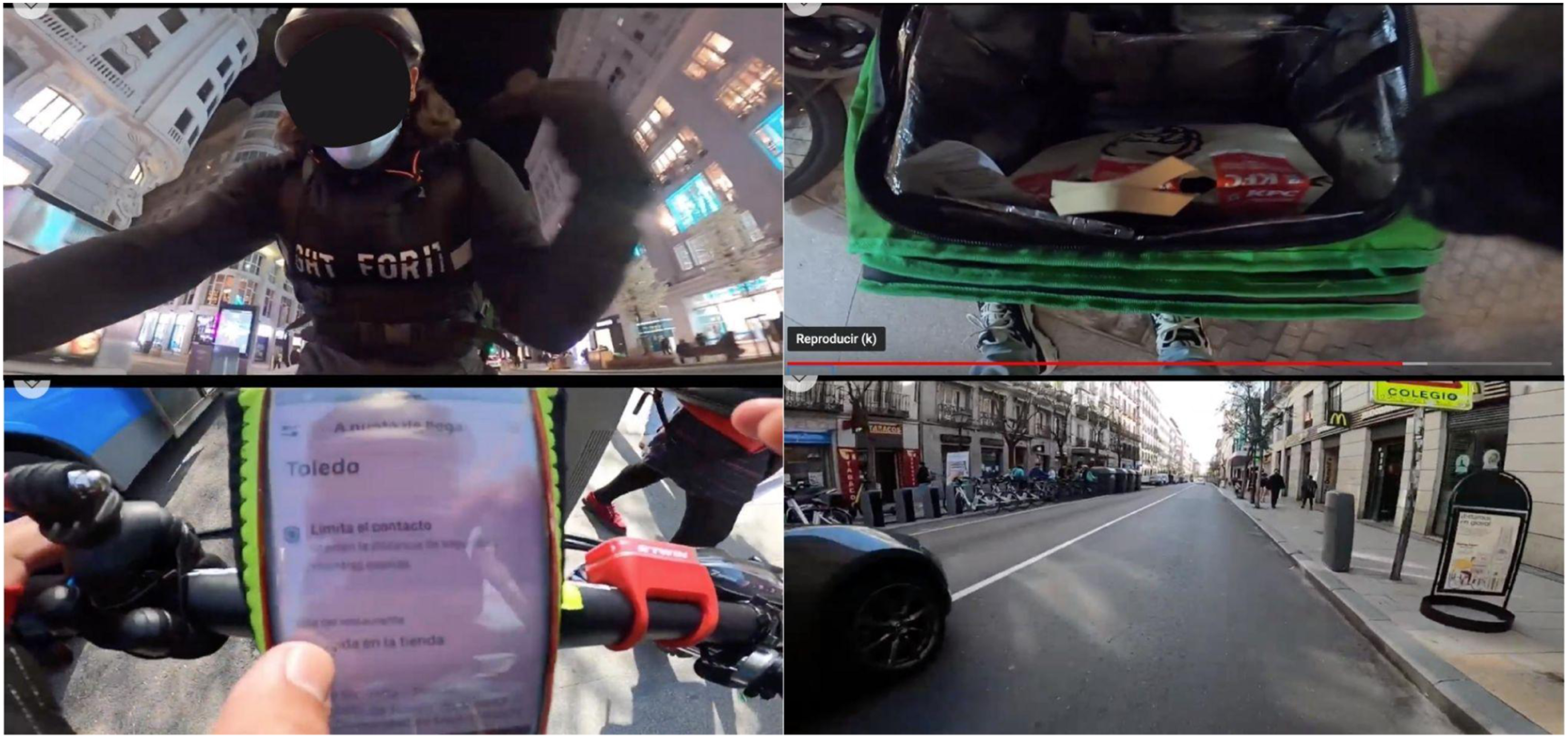
Following Verón (1985), who used the concept of ‘reading contract’ to conceptualize how every mediated communication establishes a relationship between the enunciator and the enunciatee of the message, we analysed how the different forms of enunciation in the videos approach the audiences in different ways and give the delivery blogger a distinctive type of representation. We detected three types of representations of delivery riders expressed through their reading contracts: (1) the experience sharer, (2) the counsellor, and (3) the resigned rider.
In the case of the experience sharer, the delivery vlogger uses the subjective point of view to build the illusion that the audience is having the experience through the protagonist’s own eyes. We see the whole delivery process: the dead hours waiting for an order, the interactions with restaurants, the rush of the urban traffic, the sweat and the physical effort involved in taking the delivery to its final destination – in which they usually don’t show the client’s faces. In this sense, the enunciatee participates as an embodied witness, following the old lesson from novelists and filmmakers: ‘show, don’t tell’ (Lodge, 1992).
On the contrary, the counsellor is mainly a vlogger who relies on telling to address the audience in a more vertical way. In this reading contract, the enunciator is someone who knows about delivery work; the enunciatee is the recipient of his/her advice, and the relationship they establish is a knowledge transfer. The rider builds his position as an expert who explains, gives advice, mentors, and prevents the audience from committing the same mistakes he/she has made. The usual topics in these videos include practical tips on ways to earn more money, identify the best places and times to get more orders, how to do the paperwork to become a self-employed worker or discuss whether it is profitable to invest in a motorcycle.
These enunciative strategies are often mixed in the same video. A YouTuber can frame the delivery process through his subjective point of view while using voiceover to explain something to the audience, and then turn the camera around and talk directly to the camera while he/she is moving.
In contrast to these types of narratives, which show the riders in an active role in their day-to-day activities, the third type of narrative in our sample is defined by the rider’s response to working conditions. We have called this ‘the resigned worker’, and it is related to the political conditions of delivery work. Even when six videos have an open militant opinion against the platform’s conditions, like some videos that protest against the ‘Rider’s Law’, most of the critical aspects of delivery work addressed in the videos are viewed from the point of view of someone who has no choice but to accept the current state of things. In this narrative type, the protagonist is not trying to rebel against the labour system or ‘hack’ the platform to improve the work conditions. It is just someone documenting their life. However, as we will see in the next section, this enunciative position cannot be dissociated from precarious immigrant conditions.
Labour imaginaries
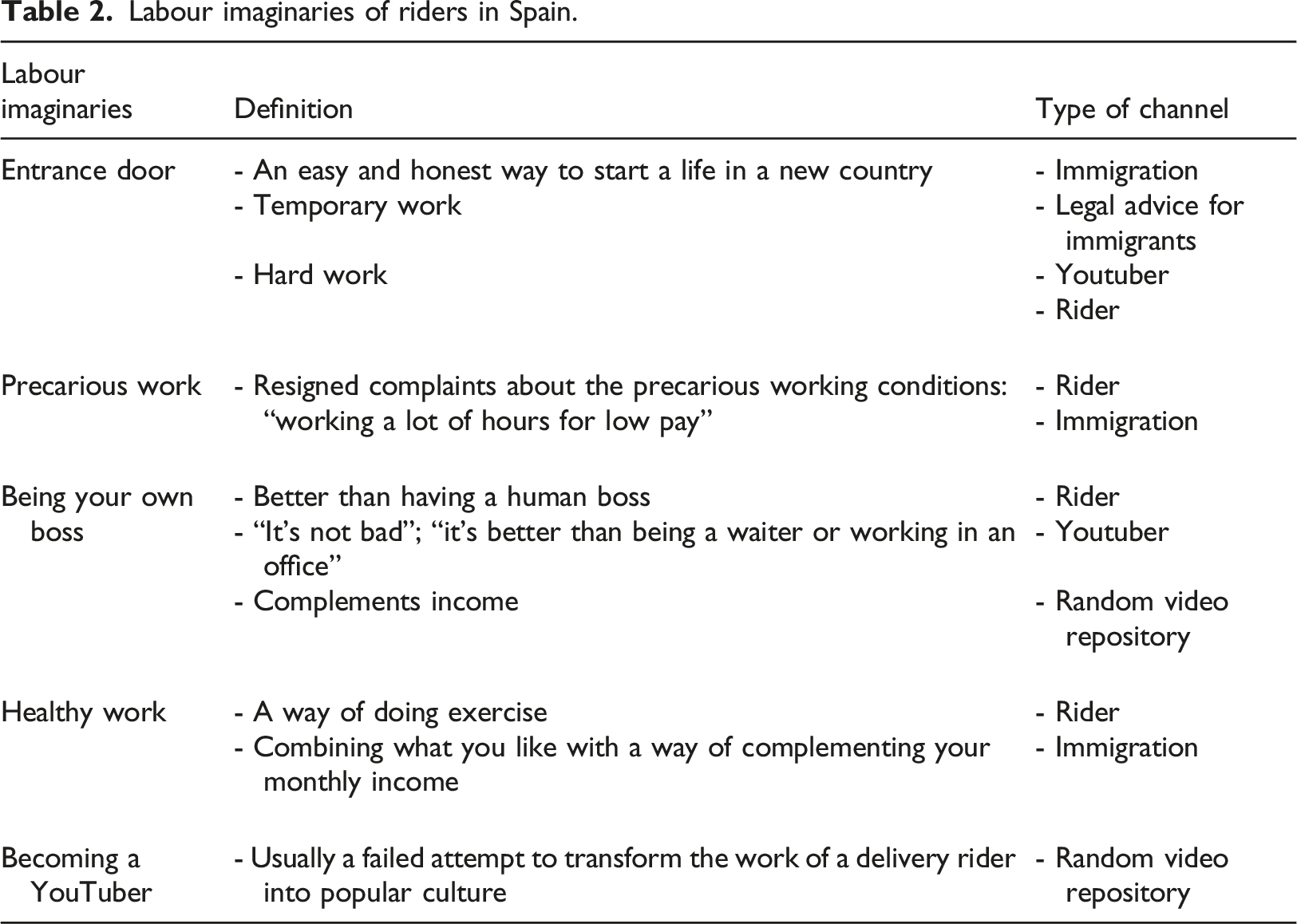
Labour imaginaries of riders in Spain.
The entrance door
In the analysed YouTube videos, there was a prominent presence of immigrants working as delivery riders, whether they represented themselves or were part of other people’s videos. Thus, it was inevitable that the delivery work was seen as an entrance door to starting a life in Spain. This labour imaginary was reinforced through the videos of bloggers, lawyers, riders, and immigrant communities. It was common to see bloggers with an immigrant community audience making videos that usually explained ‘how to become a rider in Spain’. In addition, the few videos from the channels dedicated to legal advice for immigrants that included the delivery rider topic tended to classify the work of delivery rider as a job for foreigners or political exiles. These videos are focused on the ways people can arrange their paperwork to work for delivery platforms as self-employed workers or how to pass from illegality to legality in the case of workers without documentation.
One channel dedicated to the Venezuelan immigrant community, interviewed around 10 riders, all of whom had immigrated from Venezuela to Spain (mainly male riders except for three female riders). One of the main aspects that was mentioned by these immigrant workers was that to be a rider was ‘an honest way of immigrating’. However, it was not unusual to see that this work was considered hard work by many of them as it implies making long trips to ‘be able to pay the bills’. Nonetheless, this was seen as a way of living without having to be marginalized and illegal. Therefore, this ‘honest way of making a living’ is only an initial option until they can get a better job, often related to their labour background in their home countries.
We also detected in the videos made from the first-person point of view of male riders from Morocco and Venezuela. In the videos, they stated that this job involves a lot of physical work and requires delivering many orders to receive a fair amount of money, or that sometimes they spend hours waiting for orders and do not get any. In accordance with this, we detected videos from Venezuelan and Colombian male riders in which they were sitting in a place near restaurants waiting for an order to enter the system of the platforms they were using (Glovo, Uber Eats, or Deliveroo – present in Spain until the rider law was passed), and complaining about how hard it was to get orders.
Precarious work
Another labour imaginary that emerged in the videos was one of precarious work. The precarity identified in the videos was related to two aspects: (1) the platforms’ lack of transparency; and (2) work conditions, such as delivering orders in extreme weather conditions or waiting long hours for only a few orders.
The first two are associated with the fact that platforms tend to have opaque policies and unclear information about their algorithms and functions (Basili and Rossi, 2020; Chan, 2019; Shapiro, 2018), which come with the threat of deactivation or denying access to users when they do not follow the rules (Basili and Rossi, 2020). In a video by a Bangladeshi male rider, it was possible to see this relationship between the riders and the platform. Similar to other videos, this worker was complaining about how dependent he was on the Uber Eats platform, as he showed that he did not receive any delivery orders during many hours and he could barely pay his bills. In another video by a male immigrant from the Dominican Republic, the rider explains his disappointment because there is almost no work and he is feeling very cold during the winter while waiting for an order. However, he was not able to leave as this could affect the window of hours he could have in the next few days. This shows the ways that platforms can impose control over workers’ behaviour, as pointed out in previous works (Calo and Rosenblat, 2017; Rosenblat and Stark, 2016; Woodcock, 2020)
Another example of precarity identified in the videos is a Venezuelan blogger who worked as a rider. He made a monologue complaining about the conditions offered by the Glovo platform, and explained that riders are deceived by the platforms and subjected to the platform algorithms. The feeling of being deceived is because riders from this company receive a quick training and are told that they could reach a thousand euros a month. However, not everyone manages to get this amount and they have to pay a lot of money to the Spanish Social Security without proper legal advice. The ex-rider explains about the work conditions: ‘This is a form of precarity. You have to prostitute yourself. You can’t get working hours on weekends. You have to ride 7 km by bike in winter. Although in theory you can only do a maximum of 5 km’. Referring to the hours, he explains about the lack of clarity in the functioning of the algorithmic decision-making of the platform, as the ex-rider complains that he cannot always access working hours at the times when people tend to order more (weekends) while surpassing the kilometres that riders are allowed to do in one day.
The severe weather or geography in which riders have to travel is also part of this precarity. In one video by a Moroccan rider showing a day of delivering packages, we can see that he has to go to places that are difficult to access (he has to walk up a lot of stairs), and difficult to find, as some people do not fill out the address in the application correctly. Despite these difficulties, most of the riders that were immigrants tended to reflect on their work in a relieved way. An example of this is a Venezuelan male rider who complains about all these conditions but sees it “as a relief to have a complementary income to pay the monthly bills”.
Being your own boss and the idea of a healthy job: Incrementing a monthly income
The complementarity of the delivery rider job was also present in the imaginary that places this type of labour as a form of being your own boss. Phrases like, “It’s worse to work as a waiter because you have a fixed schedule and a boss” or “At least you don’t have the inconvenience of an office, with a boss on top of you” was recurrent in videos that portray this labour imaginary. However, all the people that see the possibility of being their own boss related it to the process of being an immigrant, because arriving in Spain is not easy since “there is not a lot of work” that they can do. Furthermore, in one of the videos, another Venezuelan male rider explains that although you do not have a boss it does not mean that you work less. Thus, indicating once again that this work involves a lot of effort.
Another case in which rider work was associated with a monthly income increment was when this work was presented as a healthy job. This type of labour imaginary emerged in videos of people that were better established in Spain, as was the case of a Venezuelan who affirmed working in an office in the city of Madrid and combining this with what he liked most: riding a bike and making some extra cash for himself. “It’s a complementary job that you can combine with your hobby: riding a bike and getting some money for that. Obviously, this cannot be your only job as it is very hard work that requires physical effort which you need to be prepared for”.
In summary, both imaginaries indicate that this kind of job is temporary, complementary, and requires physical strength.
Becoming a YouTuber
During the research process, we could identify attempts to become a YouTuber by making delivery riding work into popular content by male delivery riders from Bangladesh, Brazil, Colombia, Morocco, and Venezuela. Although the majority of these attempts were a failure, it was possible to detect the importance that the imaginary of being a content creator plays in our society.
A common feature of the videos was that the riders recorded themselves as YouTubers and asked the viewers to follow them and comment in the video section. Thus, they showed a recurrent concern among cultural creators: the metrics (Poell et al., 2022). However, metrics were not the only element that evidenced this attempt to become a YouTuber. In some cases, like the ones presented by the experience sharers, we could see riders talking directly with the audience, asking them to follow their experience in the typical proximity of a vlogger.
However, as we explored the wider narratives of the channels, we could see that some riders stopped doing videos with this theme and only got more views over time when they made a more miscellaneous content.
Nonetheless, it was not uncommon to find some videos that used money as a key element for attracting viewers. These videos did not explain in depth how to make money as a rider. That is, they had titles and keywords that worked as clickbait for trying to catch people’s imaginations, and attracting their interest to this type of work based on their hopes of making a decent living.
Conclusions
This article’s main goal was to analyse the videos on YouTube about delivery riders in Spain and the channels in which they were uploaded. The aim was to understand the ways riders are represented in these videos and determine the labour imaginaries that emerge in the context of platformization.
Contrary to our assumptions, derived from the literature about Uber drivers on YouTube (Chan, 2019; Guerra, 2021), most of the channels in our sample are not completely dedicated thematically to delivery work. In this sense, only six channels from our sample perform the task of what Chan has described as creating a ‘dual identity of these aspirational brand-builders’ (Chan, 2019, 2049) both as delivery workers and online content creators.
The vast majority of channels are related to immigration processes. They frame platform work as an essential part of wider issues, like getting legal status, housing, travelling, and so on. We have identified five channel typologies: Immigration, Rider, YouTuber, Legal Advice for Immigrants, and Random Video Repository.
In relation to the representation of riders in the analysed videos, we detected that riders appear in most of them as protagonists and narrators of their stories, using two forms of representation: the subjective point of view, using a ‘Go-Pro aesthetic’ that builds an enunciative position as ‘experience sharer’, and the YouTuber-style monologue in which the enunciator constructs authority as an ‘expert’.
Although we did not study in depth how end-users interact with these contents in the comments section of the videos, it became clear that audiences usually ask questions and reply to the advice given by these delivery vloggers. This is consistent with other studies that have documented how social media platforms facilitate the interchange of knowledge between experienced users and new ones (Chan, 2019; Holikatti et al., 2019).
In this article, we also identified five categories of labour imaginaries related to the delivery rider’s work: the entrance door, precarious work, being your own boss, healthy work, and the attempt to become a YouTuber. In all these imaginaries, we could detect the ephemerality of on-demand work, because, in most of the videos, nobody aspires to having this type of work in the long-term. In fact, most of the videos showed how this work serves as a complementary income or a way of surviving with dignity in a foreign country. The temporary nature of this work is also reflected in the production of the videos. We observed that many channels that include videos with the rider theme were no longer produced or, as already pointed out, were part of a broader narrative of the channel. Furthermore, it was possible to observe the paradox of flexibility versus precariousness of this type of on-demand work beyond the category of the precarious work labour imaginary. On one hand, it is expressed in the positive side of being your own boss, and doing sports, as identified by Soriano and Cabañes (2020); however, on the other hand, it replicates a discourse that also comes from companies that own these platforms and that obscures the precarious aspect of this type of job (Rosenblat and Stark, 2016; Shapiro, 2018). Therefore, it was no surprise that some videos tried to cash in on the idea of making money. Money appears to be a central point in the narrative of riders and works as clickbait because it can attract people even before they consider working as a rider or immigrating.
Moreover, in this study, we found a higher than expected representation of YouTube channels and content on migration and legality processes. This reinforces two situations that have been observed recently in the context of the gig economy. On one hand, this type of on-demand job of traditional services continues to be racialized and precarious, only now under the operation of platforms (Van Doorn, 2017); that is, under the platformization of labour (Casilli and Posada, 2019). This reveals the ways platform companies take over a space in which they intend to ‘give opportunities’ to people who otherwise would not be able to access a job due to their migrant status: “state-sanctioned production process that shapes the conditions under which labour platforms can operate successfully, by taking advantage of exploitable migrants and their need for easily accessible work opportunities. At the same time, however, these migrants also take advantage of the opportunities labour platforms make available – even while taking on a disproportionate amount of physical, economic and mental risk” (Van Doorn et al., 2022, 3).
On the other hand, online content creation can be understood as a response to the information asymmetry (Baylos Grau, 2021; Rosenblat and Stark, 2016) and the opacity of these platforms and their algorithms (Shapiro, 2018), which generates the need to create new spaces for informal learning and for explaining the daily work and contextualizing it in on-demand work (Chan, 2019; Holikatti et al., 2019).
Therefore, this study sheds light on how the immigration status is an important variable to be explored when studying the representation of on-demand work and the imaginaries that emerge from this type of work, which need to be researched further.
Footnotes
Declaration of conflicting interests
The author(s) declared no potential conflicts of interest with respect to the research, authorship, and/or publication of this article.
Funding
The author(s) disclosed receipt of the following financial support for the research, authorship, and/or publication of this article: Ministerio de Ciencia e Innovación award number PID2019-109846RB-I00 (PLATCOM), Ayudas para contratos predoctorales para formación de doctores 2020 (PRE2020-091799), and Planetary Wellbeing - Universitat Pompeu Fabra - Barcelona, Action 1.2 - Planetary Wellbeing Initiative. It also received the support of European Union (Next GenerationEU), the Spanish Ministry of Universities and the National Plan for Recovery, Transformation and Resilience through Pompeu Fabra University (Ayuda Margarita Salas).
