



Abstract
This article examines the Black Rifle Coffee Company brand, its fans, and its connection to right-wing violence. By incorporating the literature on brand culture and the concepts and tools from fan studies, I show how Black Rifle merchandise develops into wearable symbols of white supremacy and reactionary politics celebrated by a fan culture and integrated into a tactical ensemble. While both Black Rifle’s promotional content and fans’ actions point to how capitalism provides a permission structure for white masculine supremacy, only by combining these approaches do we reveal the tactical body. I argue that the tactical body is a fannish embodiment of white supremacist conspiracy theories and a playful form of political engagement designed to actualize a revenge fantasy of insurrection. While I focus primarily on how Black Rifle fans play out their tactical canon in online and physical spaces, this case study points to a larger trend of tactical brands profiting from white male grievances and political tribalism.
Keywords
Introduction
Founded in 2014, Black Rifle Coffee Company has spent years promoting itself as a ‘gun-toting’, ‘freaking freedom-loving’ collection of unapologetic masculinity, particularly through a collection of videos on its dedicated YouTube channel (“About Us—Who We Are,” 2023). The founders of Black Rifle, Evan Hafer, and Mat Best, may claim the company is just a veteran-owned and operated coffee provider. However, Black Rifle has expanded into a lifestyle brand with its own merchandise, digital newspaper, podcast, and YouTube comedy channel. At times, the company has presented itself as a conservative alternative to Starbucks, while at others a gun rights comedy troupe. Black Rifle’s transmedia promotional content never explicitly mentions Donald Trump, but they do take aim at many of the same targets of the MAGA movement. Their YouTube videos frequently mock social justice advocates, progressive politics, and what they frame as ‘hipster coffee’ culture. Black Rifle characterizes inclusivity and tolerance as misguided, unpatriotic, and feminizing the typical American male and threatening the very fabric of the country. Courting this demographic led to controversy as Black Rifle had to answer questions about their company’s corporate responsibility when repeatedly linked to far-right extremism (Breland, 2021). In an interview with the New York Times, Hafer blames the media and a select group of fans for Black Rifle’s lousy reputation (Zengerle, 2021). While the founders of Black Rifle are happy being the sole provider of coffee for gun-loving patriots, Hafer insists that he cannot control when some fans take the brand’s messaging too far. How do you build a cool, kind of irrelevant, pro-Second Amendment, pro-America brand […] without doubling down on the MAGA movement and also not being called a [expletive] RINO
1
by the MAGA
2
guys? (Zengerle, 2021: para. 10).
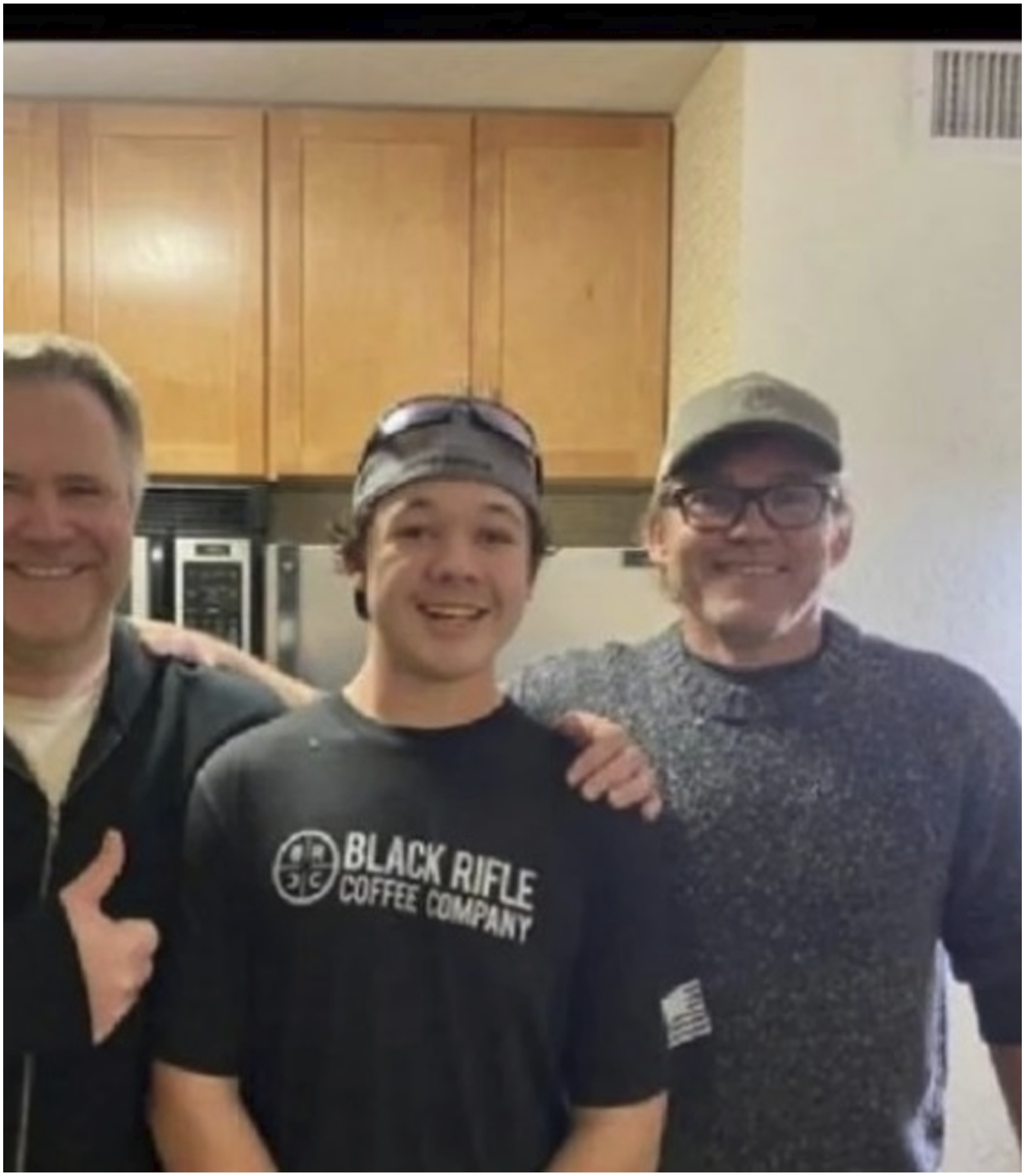
Accusations that Black Rifle was supporting and profiting off far-right extremism intensified after Eric Gavelek Munchel, who received the nickname ‘zip tie guy’ on social media for carrying several sets of plastic handcuffs during the events of the Capitol Insurrection, was photographed multiple times within the Capitol Building (Department of Justice, FBI, 2021). Wearing a bulletproof vest over a battle dress uniform and armed with a ‘Taser Pulse’ weapon, Munchel was also donning a baseball cap with the logo for Black Rifle Coffee Company (see Figure 1). Black Rifle’s founders might have dismissed it as an isolated incident if it was simply one perpetrator of far-right violence. However, a photo of Kyle Rittenhouse went viral a year earlier, showing the teenager out on bond shortly after killing two Black Lives Matter protestors in Kenosha, Wisconsin (Johnson, 2020). In the photo, Rittenhouse proudly brandished a Black Rifle t-shirt (see Figure 2). A promo code for Black Rifle Coffee Company was tagged at the bottom of his post. While not affiliated with any official extremist organization, the actions of Muncel and Rittenhouse resemble a more significant trend of domestic terrorist groups (such as the Proud Boys, the Oath Keepers, and the Boogaloo Movement) showing up to political protests, government buildings, and voting stations with the intent to intimidate and incite violence. What is also troublesome is their choice of ensemble, an assortment of military-grade gear intended for war, including helmets, body armor, and assault rifles. Each of these militia groups may have unique motivations and agendas. However, what connects them is an affection for the tactical lifestyle and a prevalence for spreading (and believing in) white supremacist conspiracy theories.
3
What Muncel and Rittenhouse see as an unchecked evil slowly corrupting American society has motivated them to prepare for an impending civil war, escalating into acts of domestic terrorism. An image of Eric Muncel inside the capitol building during the capitol insurrection. The screenshot was taken from FBI documents. An image of Kyle Rittenhouse days after shooting two protesters. The screenshot was taken from twitter.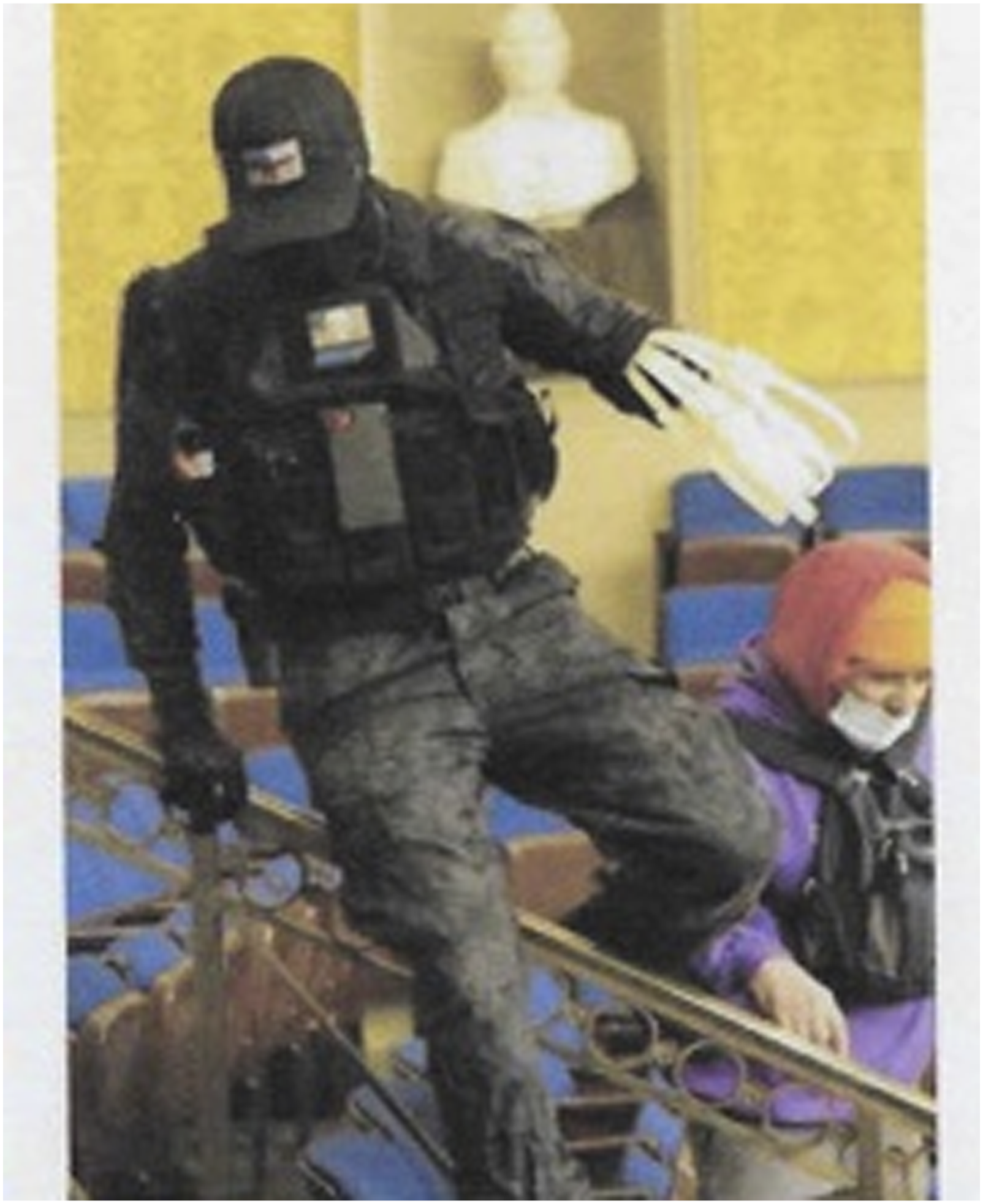
This article presents a case study examining the Black Rifle Coffee Company brand, its fans, and its connection to right-wing violence. By combining the literature on brand culture and the concepts and tools from fan studies, I show how Black Rifle merchandise develops into wearable symbols of white supremacy and reactionary politics celebrated by a reactionary fan culture and integrated into a tactical ensemble. I begin by reviewing the growing scholarship on the connection between fan practices and those conducted by reactionary communities (Lamerichs et al., 2018; Petersen, 2022; Reinhard et al., 2022; Stanfill, 2020). I will then discuss how contemporary brand culture goes beyond the products sold but becomes indistinguishable from lifestyles, identities, and political action (Arvidsson, 2005; Banet-Weiser, 2012). My analysis of the Black Rifle brand will first center on its many promotional materials, which are rife with white supremacist and reactionary discourse. The second layer of my analysis examines the comment sections of Black Rifle’s dedicated YouTube channel to show how fans poach and operationalize the more militant and incendiary culture war narratives to tell stories about themselves and the world around them. While both Black Rifle’s promotional branding and fans’ actions point to how capitalism provides a permission structure for white masculine supremacy, only by combining these approaches do we reveal the tactical body. I argue that the tactical body is a fannish embodiment of white supremacist conspiracy theories and a playful form of political engagement designed to actualize a revenge fantasy of insurrection.
Theory: The presence of the tactical body in reactionary fandom
Reactionary fandom and reactionary brands
Fan scholars are becoming increasingly concerned with the darker side of fan practices, including the spread of misinformation and conspiracies (Lamerichs et al., 2018; Petersen, 2022; Petersen et al., 2023; Reinhard et al., 2022), harassment of marginalized communities (Blodgett, 2020; Phillips, 2015, 2018; Massanari, 2017), and mudding of political discourse (Pande, 2018; Williams and Bennett, 2022). The characteristics of identity politics, which motivated women and marginalized fans to form supportive communities and produce alternative works, have become (or perhaps have always been) the centerpiece of far-right and hate-centered communities. The intersection of politics and fans of popular culture has a storied history in fan studies (De Kosnik, 2008; Ruddock, 2005; Sandvoss, 2013; Van Zoonen, 2005). Fan scholars have explored how fan communities engage in ‘fan activism’ or ‘fan-based citizenship’ to motivate others to engage in the public sphere (Hinck, 2019; Jenkins and Shresthova, 2012). Conversely, fan scholarship has also explored how affective attachment drives individuals and communities to spread political messaging and deploy fannish tactics (Davisson, 2016; De Kosnik, 2008; Erikson, 2008; Miller, 2020). Politicized fandom may now be an established feature of contemporary politics, significantly shaping citizen participation in political debate and the democratic process (Dean, 2017).
Stanfill (2020) has stressed the importance of expanding our understanding of fandom to other aspects of politicization, including growing racial tension, cultural wars, and conflict in fandom. ‘Reactionary fandom’ does not simply describe fan communities that embrace right-leaning politics but reactionary communities and movements that adopt fannish practices. As part of a roundtable discussion pointing to new territories for future research in fan studies, Petersen et al. (2023) proposed interrogating how fandom relates to conspiracy theories movements such as QAnon, militia groups like the Proud Boys, and acts of right-wing terrorism like Capitol Insurrection. Exacerbating the toxic potential of fandom is the tendency for some communities to center their fandom around white visibility politics. Wanzo (2015: 1.4) argues that ‘an investment in whiteness may be foundational to some groups of fans’. In some cases, affection for a fan object can be fueled by a sense of ‘representation duty’, doubling as political activism (Martin, 2019).
Black Rifle may be fundamentally a coffee company. However, Black Rifle is also a transmedia brand, with an identity based to a much greater extent on the ‘values, commitments and forms of community sustained by consumers’ (Ardvidsson, 2005: 236). Black Rifle markets its products as the ultimate cultural war weapon in the fight against the encroachment of progressive, queer-friendly, multicultural, and feminist-inspired values. This brand does not exist in a vacuum but binds to other tactical-themed brands and personalities thanks to an ever-expanding digital ecology. Given that fan scholarship often explores the liminal spaces where various narratives converge to form a metadiscourse (Hills, 2020; Jones, 2021), the tools and concepts from fan studies allow scholars to broaden our understanding of what inspires individuals and communities to select products and brands as symbols of identification.
While fandom surrounding particular brands, or ‘brandom’, is often applied to entertainment, sports, and media companies (Guschwan, 2012), Affuso (2013) suggests that most contemporary brands operate within the language and logic of fandom. The logic of neoliberalism now involves spheres traditionally understood as separate from the everyday workings of capitalism, such as civic and political engagement (Banet-Weiser, 2012). Companies know that consumption processes are often linked to self-identity and market their products as symbols for broader social issues and causes (Ouellette, 2012). The rise of user-generated content paired with efforts of contemporary capitalism to predict consumer behavior has led to ever-expanding niche markets and an ‘increasingly more sophisticated and complete exchange between the consumer and the brand in a shifting cultural environment’ (Banet-Weiser and Lapsansky, 2008: 1250). Thus, it should not be surprising that a brand centered around gun-loving, Liberal trolling coffee drinkers has manifested in our digital economy.
Fan embodiment and fan play
While the literature has been abundant on the long history of political reactionarism (Berlet & Lyons, 2000; Sullivan, 2021a) and the rise of far-right communities in America (Kelly, 2017; Kitts, 2021), this article interrogates reactionary fandom through the framework of fan embodiment and play to understand better how fans utilize tactical brands to play out stories about themselves and the society in which they live. Examining fan communities through the framework of fan bodies and embodiment is a growing subset of fan studies. Recent scholarship has focused on how fan bodies are constructed, remediated, and transformed through fans’ lived experiences and active participation in digital media (Affuso and Scott, 2023; Wiliams, 2020; Lamerichs, Böhmer, Nguyen et al., 2018).
Bodily sensations of touch and sensory experiences are prominent in fandom (Rahman, Wing-Sun, and Cheung et al., 2012). Literature on performative fan practices, such as cosplay, suggests that the act of playing out roles of fantasy characters is an ‘embodiment of a fan’s affective relation to a text’ (Lamerichs, 2014: 1). Thus, cosplay is a process whereby fans actualize ‘an existing story in close connection to the fan community and their own identity’ (Lamerichs, 2011: 1.2). Fans’ reasons for cosplay may vary and cosplayers do not necessarily share the same interests, motives, or experiences. What connects most cosplay enthusiasts, however, is a desire to ‘write and perform their chosen character upon their own bodies’ (Transformative Works and Cultures, 2015: 3.2). While most fan scholars discuss cosplay’s transgressive potential, some have interrogated problematic types of costuming. Jaworowicz-Zimny (2019) examines the controversial wearing of Nazi uniforms in the Japanese subculture of ‘military cosplay’. Similarly, Strauss’s (2003) ethnographic work on Civil War reenactors highlights the fuzzy separation between wearing the uniforms of Confederate soldiers for historical accuracy and demonstrating empathy for the antebellum South, Lost Cause mythology, and white hegemony.
Cosplay may be typically experienced firsthand at fan convention sites. However, fans also turn to online spaces because it allows them to extend the cosplaying experience and reach spectators outside the play space. Thus, embodied performances are not always tied to physical locations but can exist across various media as a ‘transmedial process’ (Lamerichs, 2015). Much fan scholarship has focused on how costume culture transcends the fan convention grounds to online environments. However, few studies examine the inverse. Annexing participatory sites like YouTube may be the first step in reclaiming territory thought to be lost, but these revenge fantasies manifest in the real world as white men dressed ready for war. As I will show in the following analysis, Black Rifle fans do not simply play out their revenge fantasies online but integrate merchandise into their tactical ensembles and display them in public spaces. The body is central to this form of political engagement because these fans are playing, or ‘fleshing out’, a ‘preferred version of reality’ and laying ‘their subjective desires onto the world’ ((Reinhard et al., 2022): 8).
Comparing traditional cosplay with tactical embodiment may be disheartening. Some may wish to protect the practice of cosplay by defining it as inherently feminine, transgressive, and liberating. Others may see these performances as more closely aligning with LARPing or live-action role-playing (Mackay, 2017), for Black Rifle fans are essentially adopting the role of a character (i.e., soldier, spy, masculine hero) and are motivated by immersion in a story world (i.e., white supremacist conspiracy theories). However, the purpose of this study is not to define Muncel and Rittenhouse as LARPers or cosplayers. Instead, I wish to extend the tools of fan studies to highlight how the behaviors and practices traditionally considered fannish are fundamental to reactionary communities. Numerous and varied motivations sometimes inspire embodied performances. Thus, I will follow Mishou’s (2023) strategy of reading both cosplayers and the costumes produced as texts. Like cosplayers and Civil War reenactors, Black Rifle fans also construct an ensemble to present to an audience. Disturbingly, the desired intent is not to entertain or bring joy to an audience but to intimidate, harass, and, in some cases, kill.
Referring to tactical embodiment as playful is not meant to minimize the consequences or ignore the victims of right-wing extremism. Play is not always benign but can potentially be very serious, toxic, and dangerous (Huizinga, 1978; Sutton-Smith, 2009). Using theories of play is also not intended to suggest that Black Rifle fans are entirely immersed in a game-like ‘magic circle’ (Huizinga, 1978; Juul, 2011), unable to decipher fantasy from reality. As I will show in my analysis, some Black Rifle fans take very seriously their role in fighting against what they perceive as a collection of traitors destroying the country and would take umbrage with my characterization of tactical ensembles as playful. Conversely, other Black Rifle fans might accuse me of misinterpreting their political commentary and defend their words and actions as simple ‘trolling’ (Phillips, 2015; Phillips and Milner, 2018). 4 As many scholars note, however, play helps describe the ambivalent nature of online participation, particularly the ‘synergetic back-and-forth between playful fiction and “serious” collective action practices’ (Zeeuw and Gekker, 2023: 2). Play also highlights how political participation works in the digital age. Rather than a coherent and consistent political message from a centralized source, political discourse is co-constructed by ‘an ecosystem of amateur internet produsage’ and through ‘a serpentine pipeline of digital-cultural interactivity and networked internet platforms’ (Packer and Stoneman, 2022: 256).
Many fan scholars have discussed how the more performative and playful forms of political engagement have become popular with far-right communities (Lamerichs et al., 2018; Petersen, 2022; Petersen et al., 2023; Tuters, 2019). As (Reinhard et al., 2022) write, conspiracy theories such as those spread by QAnon could be interpreted as transmedia story worlds, existing across numerous online platforms and constructed through fan labor. Like fan fiction, the narratives that orbit Black Rifle’s brand do not have a single authorial vision but are more of a collaborative storytelling experience with its own fan-produced canon. While fan scholars should undoubtedly be concerned with how Black Rifle fans contribute to this ‘fanon’ (Mittell, 2009), we must not ignore how these conspiracy theories get embodied by their actions.
Conceptualizing the tactical body
Days before his involvement in the Capitol Insurrection, Eric Muncel expressed anger toward what he considered a stolen election (Department of Justice, FBI, 2021). Providing a preview of what he planned to wear during the ‘Stop the Steal’ rally, Muncel posted several photos on social media, including one showing off an ensemble he had pieced together (see Figure 3). Holding a shotgun in one hand and a ‘thin blue line’ modification of the American flag in the other, Muncel positions himself before a Fox News broadcast of former President Donald Trump. In an almost superhero-like pose, Muncel proudly shows off an attire expressing an identity centered around a homology of ethnonationalism, militant masculinity, and white male grievance. Accenting his tactical ensemble is a Black Rifle hat. Eric Muncel shows off one version of his tactical ensemble on social media. The screenshot was acquired from FBI documents.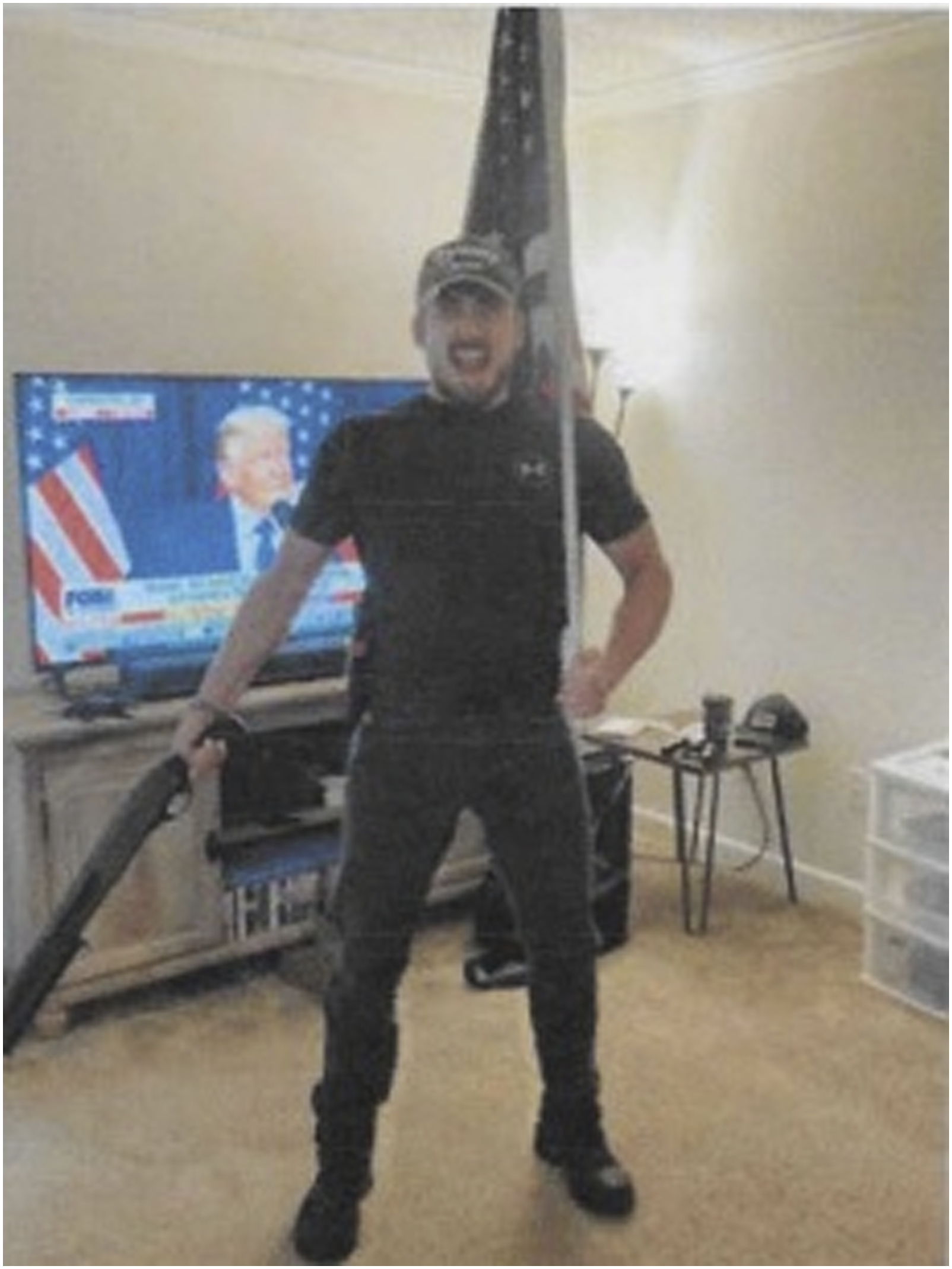
Black Rifle is certainly not the only brand with ties to militant extremism and does not hold exclusive rights to expressions of white male grievance. This case study points to a more significant trend of consumer products used as monikers for an embodied and playful form of political engagement designed to actualize a revenge fantasy of insurrection. I use the term tactical body to typify this expression. The word ‘body’ taps into a long tradition of examining bodies as sites of social experiences and political struggle (Butler, 2011; Haraway, 2006; Harcourt, 2009; Spivak, 1978). At the same time, I could use many words to indicate the militant aspects of this embodied expression. However, ‘tactical’ signals what has developed into a subcultural aesthetic, lifestyle, and consumer market. A simple Google search reveals a tactical moniker recognized by online communities and algorithmically amplified in our digital economy with an ever-expanding ecosystem of online personalities, communities, and content.
To put it differently, the tactical lifestyle shares many of the characteristics of a fan identity (Chadborn et al., 2017; Lamerichs, 2011; Tussey, 2023), highlighting the interaction between online reactionarism, consumer culture, and fandom, which best defines what has developed into a popular mode of political participation in the digital age. The tactical body is also ‘tactical’ in another crucial way. Fan scholars suggest that by acting out roles of fantasy characters in public, fans are ‘poaching’ the spaces, converting them into safe or home-like places (Crawford and Hancock, 2018). Those who play out the tactical body also attempt to convert spaces to make them more comfortable. Some are satisfied with annexing digital spaces, such as Black Rifle’s YouTube comment section. Others desire to reassert their dominance and power in public spaces, showing up to political protests, government buildings, and voting stations heavily armed and ready for war.
While some might see the tactical body as closely aligned with doomsday prepper culture, I suggest that critical differences make this subculture distinct and uniquely dangerous. A desire to regain agency and control during uncertain times may be a driving force for Preppers (Kelly, 2016), but prepping is fundamentally a defensive, precautionary, and speculative practice. Preppers enact their apocalyptic fantasies by ‘bunkering down’, sustained by a list of potential disasters energized by mass media and real-world disasters (Garrett, 2021; Mills, 2019). There are also notable ideological differences between preppers and the tactical body. Ethnographies of doomsday prepper culture challenge the prevailing assumption that contemporary prepping is predicated on fringe right-wing ideologies (Barker, 2020; Huddleston, 2016). Although there is overlap with the performative behaviors and vocabulary, those who play out the tactical body are not simply preparing to defend themselves against potential threats and disasters but actively conspiring to retrieve and restore white men’s place at the top of the social hierarchy. The tactical body possesses a ‘white-man-as-victim’ mentality and self-righteous anger over what they consider to be a dispossession of certain ‘God-given rights’ taken away by government bureaucrats and given to less deserving people (Kimmel, 2017). Of course, white supremacy is not simply the main component of the tactical body; it is the glue that binds the other elements together (gun enthusiasm, citizen-protector mentality, fears of changing demographics, aggrieved entitlement, and feelings of victimhood). Its inherent stickiness attracts other toxic byproducts of internet culture, intensifying a preexisting crisis motif that rationalizes a longing for angry White men to go on the offensive. As demonstrated by the actions of Muncel and Rittenhouse, this type of play does not remain confined to digital spaces but, once it reaches a fever pitch, erupts in the real world as acts of violence. Muncel was not the only perpetrator of right-wing violence to integrate Black Rifle merchandise into a tactical ensemble. I will show that many Black Rifle fans poach the company’s imagery to signify right-wing political ideology.
Methodology
To demonstrate how fans navigate their fan identity with the Black Rifle brand, I will implement a critical discourse analysis to scrutinize the texts integral to Black Rifle’s branding strategy, including fan responses on the company’s dedicated YouTube channel. As Poole (2010: 138) states, critical discourse analysis has become a necessary ‘interdisciplinary approach to the description and analysis of texts in terms of their wider social and political significance’. This school follows the critical tradition of viewing texts as artifacts that reflect and create contemporary social, cultural, and political realities. One of its most influential practitioners, Fairclough (2013), writes that this methodology can examine the complex interrelationship between language use and social systems to answer questions about related discourse and its power relations. While those who implement this methodology have never attempted to provide one single or specific theory, I follow the roadmap provided by those who have used it in the past (Janks, 1997; Wodak and Meyer, 2009). I first begin with a textual analysis of the videos found on Black Rifle’s YouTube profile while being aware that this is only one lens through which to consider the data. As I establish patterns in the discourse at work in Black Rifle videos, I also consider the social conditions that affect textual production, including structures of power and ideology. Black Rifle’s YouTube videos are juxtaposed with its other ‘paratexts’ (Gray, 2010), including promotional content on the company’s website, social media accounts, and podcasts. I compare these themes with other forms of politically reactionary content, including popular white supremacist conspiracy theories and the talking points of right-wing media. In the analysis below, I show how Black Rifle is not merely selling products but developing a brand centered around cultural war politics.
Fan scholars have also used critical discourse analysis to highlight how online virtual fan spaces become key sites where fans reproduce, reinforce, and racialize masculine hierarchies (Gong, 2016). Given that norms of technologies are not simply determined by their design but also, to a large extent, by the community of users whose actions provide a field guide for others, the YouTube comment section reveals important ways fans interact and extend primary content in unique ways. As part of the second discursive layer, I closely analyze the comment sections of over 300 Black Rifle YouTube videos between 6/01/21–2/10/2023. YouTube comments may be a rare research area, but it is one of the platform’s most widely used communication features. I did not read every comment in the Black Rifle YouTube catalog. Instead, I focused on the ‘most popular’, ‘most viewed’, and most commented. I collected a large sample of comment data, approximately 100,000 comments temporarily stored on my personal computer for analysis. The comment section consists of mainly unstructured text fragments, which makes analysis very cumbersome. However, by sorting them into similar narratives, expressions, and talking points, I discovered consistent themes. While many commenters express their affection for Black Rifle coffee and related products, a significant fan clustering uses the space to express anger toward a world they see corrupted by progressive politics. By putting the data from the comment sections in dialogue with Black Rifle’s promotional content, I show how fans not only connect the narratives in these videos with other reactionary content but also how fan responses blend and shape the discourse itself.
Critics of this methodological approach may suggest that I only focus on the more incendiary and threatening comments to characterize the Black Rifle fan base as extreme and dangerous. YouTube is notorious for offensive comment sections, and a few toxic fans should not define a brand’s identity. While my attention tends to focus on the more incendiary remarks, they are easy to find. The following fan comments are often the most ‘liked’ and ‘replied’, rising to the top of each comment section. It is also essential to state that I am not attempting to create a snapshot of the most common Black Rifle YouTube comment or paint a picture of the average Black Rifle fan. Instead, I wish to highlight how Black Rifle’s gun-loving, liberal-trolling narratives and related products become raw material for some fans to play out the tactical body. I removed their online names in each excerpt to protect fans’ virtual privacy.
Analysis
Black rifle as a tactical brand
Black Rifle’s success is due in large part to its YouTube channel. Mat Best, a former Army Ranger, has created several YouTube videos most fittingly described as slapstick and sketch comedy, spoofs of martial arts and action movies, and montages of men playing with guns. While much of the humor centers around the experiences of military veterans and the celebration of gun culture, Black Rifle also frequently mocks what they frame as the weakening of the American man. Unsurprisingly, traditional standards of hypermasculinity and a celebration of gun culture are central to their definition of manliness. In one of Black Rifle’s most popular videos, titled ‘How to be American’, Best addresses an array of issues that he has with contemporary American culture, from the media’s framing of the war on terrorism to criticisms of law enforcement (Black Rifle Coffee Company, 2016). The video begins with Best loading a magazine into an assault rifle while asking the viewer, ‘Are you tired of the pussification of the American male who is too afraid to defend himself?’ The camera then pans to a male character wearing stylish glasses and talking in an effeminate accent. Best mocks the character’s declaration that ‘violence shouldn’t exist’ by responding with, ‘All right buddy, say it to that asshole’. A cut reveals a man wearing a cloth face covering and headwear yelling, ‘Death to America!’ Best kicks the character meant to signify his perception of the typical aggressive Muslim before picking up a cup of coffee. Retreading the negative portrayals of Muslims prevalent in American media is a common theme in Black Rifle’s YouTube videos. The company’s success is tied directly to its fondness for offensive humor. Many ‘jokes’ are glaringly racist, sexist, and homophobic, but the creators and their fans frequently defend the absurdity of the gags as ironic or evidence that they are ‘in on the joke’. Aware that these jokes will cause controversy, the founders of Black Rifle admit this is part of the appeal. Evan Hafer, the company’s CEO, admits that even the name ‘Black Rifle Coffee Company’ was chosen because it would ‘piss people off’ (Black Rifle Coffee Company, 2022). The inherent offensiveness of Black Rifle content is meant to ‘trigger’ gun control and social justice advocates. 5 Given that online algorithms have been known to privilege and reward controversial content (Massanari, 2017; Nobel, 2018), Black Rifle’s offensive humor makes their videos more likely to go viral.
Reflecting the creators’ deeply ingrained prejudge and contempt toward Muslims and their heritage (amplified by their time as soldiers fighting the Taliban in the War on Terror), Black Rifle’s videos are vivid expressions of Islamophobia, portraying the Muslim people as a dangerous (yet, somewhat inept) enemy of America. Unsurprisingly, Black Rifle’s success is primarily due to it receiving national attention after releasing a highly Islamophobic meme (Warner, 2021). 6 Shortly after Starbucks CEO Howard Schultz promised to hire 10,000 refugees globally (Woodyard, 2017), Black Rifle responded with their own promise. In the hopes of showing how their priorities differ from Starbucks, the company released a statement vowing to ‘hire 10,000 veterans (Linehan, 2017)’. The post included a meme, the top half depicting three Muslim militants holding AK-47s. 7 In stark opposition to the deliberate misrepresentation of the people Starbucks had vowed to hire, the lower image shows a white American soldier presumably aiming his weapon at the militants above. Characterizing any support for refugees as anti-American, Black Rifle frames their values in line with those defending the United States from its enemies. The meme infers that Starbucks supports Muslim terrorist groups like the Taliban and ISIS, creating a false dichotomy; either one supports American troops (often framed as white men) or those seeking political asylum (usually portrayed as dangerous non-white terrorists). While much of Black Rifle’s humor mocks Starbucks for being tied to hipster culture, they also imply that Starbucks’ vow to hire victims of war is unpatriotic, even treasonous. It also plays well into the narrative popular in many conspiracy theories that ‘Liberal’ companies and their patrons are enabling and sometimes abetting underground crime syndicates (Contrera, 2021). 8
Mocking those brutalized and mistreated by law enforcement is another repeated ‘gag’ in Black Rifle videos. Although the Black Lives Matter movement is never directly mentioned, Best is alluding to the many protests of police brutality when he says, ‘Many people have opinions about what it’s like to be a police officer, but they never walked the thin blue line’ (Black Rifle Coffee Company, 2016). This statement is not simply a passing reference to a phrase that has developed into a marker signaling opposition to the racial justice movement. The company markets a particular bag of coffee labeled the ‘Thin Blue Line’, a roast that the website claims is ‘created to benefit law enforcement officers and their families (“Thin Blue Line,” 2022)’. Black Rifle also signals its bias by featuring a pro-military/police online publication, ‘Coffee or Die Magazine’. The creators frequently position themselves as unofficial partners of law enforcement, self-appointed defenders of their families, communities, and the nation. Rather than interpreting the disproportionate killing of Black men by police officers as evidence of systemic racism in American law enforcement, Black Rifle reinforces the popular myth that police killings are justified based on the victims’ actions. After Best gives a cop a high five, the same flamboyant character reappears, wearing a tightly fitted pink T-shirt with a handkerchief tied around his neck. ‘Oh my god, why did he not arrest you?’ the man asks. Best turns to the camera and says, ‘Because we didn’t break the fucking law’. Best positions himself as deserving dominance by mocking his counterpart’s political beliefs and portraying the man as ‘inferior’ based on his stereotypically feminine attributes. Whether this unnamed character typifies a hipster or simply a problematic depiction of homosexuality, this characterization is frequently used in Black Rifle videos to embody another threat faced by the ‘patriots’ in these videos. While portraying terrorists and Black Americans as dangerous has a long history in American media, Black Rifle also warns of a more immediate threat. Social justice warriors, Liberal politicians, gun safety advocates, and marginalized subsets of masculinity are essentially neutering the only type of masculinity that can defend the country from these threats. Black Rifle not only characterizes these bombastic performances of retrograde masculinity as necessary to restore order and reclaim white masculine dominance but also critical to protecting the country from its enemies.
In an increasingly competitive branding environment, Black Rifle has successfully carved out a space in our digital economy by taking advantage of controversy and stirring up hate. The underlying tonal, behavioral, and aesthetic characteristics of the discourse present throughout Black Rifle videos could easily fit within Sienkiewicz and Marx’s (2022) definition of ‘right-wing comedy’. While traditional media spaces may have made it difficult for this type of humor to settle into a coherent and profitable entertainment brand, the growth of digital media spaces (such as YouTube) has provided more options for narrowly defined audiences. Conservative comedians and right-wing comedy have enjoyed significant influence in these spaces. One of the defining characteristics of right-wing comedy is the desire to offend (or to troll) a select group of people. Phillips (2015: 7) defines trolling as mimicking and mocking what ‘the dominant culture regards as good, appropriate, and normal’. The primary intention of trolling is to cause disruptions or exacerbate conflict for amusement. At one time, trolling was more of a localized phenomenon, mostly restricted to platforms like Reddit and 4Chan, constructed around anonymity and ambivalence (Phillips and Milner, 2018). Today trolling has emerged as a full-blown subculture, with brands like Black Rifle generating amusement at the expense of women, non-White communities, and those who do not conform to heteronormative ideals. Indeed, triggering Liberals with overt prejudice against the historically marginalized is often framed as the punchline of many Black Rifle jokes.
Beyond the actual goods, Black Rifle is also making and selling raw materials for the tactical body. While the unlikely pairing of guns and coffee is integral to Black Rifle’s brand, attached to the product is also a story of white male victimhood. This story is familiar, intimate, and personal for the Black Rifle founders and their fans, who imply that corrupt politicians and social justice warriors are redistributing their power and authority to the undeserving and incapable.
Black Rifle videos offer a rationale for being armed and provide an array of enemies for Black Rifle fans to direct their grievances. Their videos frequently take aim at government bureaucrats, democrats, social justice warriors, Muslims, the queer community, and Black Lives Matter protesters. Although Black Rifle rarely directly mentions these threats by name, the coded language is easily decipherable. Conveniently, Black Rifle fails to mention the frequent mass shootings committed by white men, many of whom release manifestos vowing revenge for the same grievances expressed by Black Rifle. Black Rifle may dismiss their problematic discourse as harmless humor, but the following section illustrates how seriously some fans take the threats presented by their videos.
The tactical body and fan complicity through play
As mentioned earlier, Black Rifle frequently justifies the right to own and carry firearms by naming an array of potential threats. Fans throughout Black Rifle’s YouTube comment sections echo this sentiment. However, while Black Rifle’s promotional materials may imply that those supporting the Black Lives Matter movement are criminals or enabling criminality, their fans are not as vague or tactful. Comments repeatedly delineate the divide between the supposed ‘criminals’ who protest law enforcement and the ‘law-abiding citizens’ fighting alongside them. As one commenter demonstrates, this boundary often falls along racial lines: …[cities] are being looted and it is also only the cities that are run by democrats, rural country belongs to Republicans in suburbia is free game but the Democrats have lost there [sic] share of suburbia and they never had a chance in the hills. Because of them rioting and destroying their own cities the red pill has been spreading faster than coronavirus.
The above comment follows in the tradition of right-wing politicians, including former President Donald Trump, who frequently use the word ‘cities’ to signify racially diverse parts of the country while characterizing the ‘rural country’ as housing true ‘patriots’ (often implied to be white).
9
While this is just one comment, it is reminiscent of the fan community’s quickness to connect fears of racial unrest to other frustrations towards national demographic changes, female empowerment, and growing LGBTQ+ tolerance. Fans often echo many of the popular talking points of right-wing media, which not only repeatedly blur the line between patriotism and nationalism but also whiteness and Americanness. Frequently mentioned are politicians who advocate for stricter gun laws and states with harsher gun restrictions, providing more targets for fans to direct their rage. The comment section is also littered with rhetoric that aligns with ‘the great replacement’, a conspiracy theory often cited by perpetrators of mass shootings (Cosentino, 2020; Ekman, 2022). Many, including one commenter, allude to an impending confrontation between a corrupt government that has overstepped its authority and the heavily armed men eager to ‘take back’ the country: They hate us for not depending on them. They hate us for being self-sufficient. They hate us for our values. They hate us for our religion. They hate us. And soon rough men will need to visit violence domestically to let the eagle soar free once again. They hate how we believe in individual liberties and individual responsibilities.
Black Rifle’s dismissals and mockery of the public outrage over the recent incidents of police brutality are troublesome alone, but how fans react to these narratives highlights how quick some fans are to connect a ‘stand your ground’ rationale popular with gun rights activists with racist attitudes towards crime. 10 The way Black Rifle validates its superiority by positioning itself in contrast to vilified forms of masculinity resonates well with fans. ‘Because we didn’t break the fucking law’ is a repeated line in the comment section, animating an array of rants and tirades. Some fans celebrate the statement, while others define the type of people likely to break the law. Fans frequently use coded language to suggest that they might need to defend themselves against violent Black and Brown men at any moment. Mocking notable victims of police brutality (such as George Floyd) and voices in the Black Lives Matter movement (such as Colin Kaepernick) is a current theme in the comment section. While a few commenters attempt to push back against the dominant discourse, pointing out the inherent racism in these videos or the many examples of cops acting shamefully, they are quickly shot down by an endless array of right-wing talking points. Ironically, one commenter even attempts to deflect accusations of racism with a blatantly racist remark.
The DEMOCRATS’ agenda is racism, in order to stay in office, they want to perpetuate the myth that blacks need the government in order to live so they keep offering more and more benefits at taxpayer expense to not work and to have as many kids as possible while remaining unmarried. Prove me wrong.
While racist and threatening remarks may be common on YouTube, the way fans connect Black Rifle’s implicit call to protect the nation with white male grievances and racist attitudes toward crime is beyond disturbing. Frequently mentioned in Black Rifle comment sections is Kyle Rittenhouse. Fans often characterize his decision to arm himself with an AR-15-style rifle when crossing state lines to ‘protect’ businesses against a supposed onslaught of criminals as a dutiful response to the ‘call to arms’ decree implied by Black Rifle’s transmedia campaign. Most gun advocates would probably stop short of defending mass shooters, domestic terrorism, and other acts of gun violence. However, many Black Rifle fans have positioned Rittenhouse as one of the gun-carrying ‘good guys’ bringing justice to a society that has permitted unchecked criminality. It should not be surprising that Rittenhouse has developed into a martyr in right-wing circles. Although acquitted of all charges in his criminal trial (Sullivan, 2021b), many gun rights advocates still see him as a victim of negative media reporting, gun control advocates, and ‘the Liberal agenda’ (Bort, 2021). Black Rifle fans extend this narrative, characterizing Rittenhouse as a heroic vigilante, one of the few men brave enough to fight against a system unwilling to protect its citizens.
It is impossible to know if the founders of Black Rifle consciously intended for their company to become a symbol of far-right politics. They often respond to fans in contradictory ways, at times encouraging problematic speech while at other moments resisting what they see as going too far. Perhaps the founders wanted to carve out a segment of the digital economy for gun-loving coffee lovers. Black Rifle fans are unsurprisingly perplexed by what they see as mixed signals in the company’s messaging. Black Rifle CEO Hafer may have feared that any connection with far-right extremism would be detrimental to the company’s longevity, promising he would ‘gladly chop all of those people out of my [expletive] customer database and pay them to get the [expletive] out’ (Zengerle, 2021: para. 54). Nonetheless, Black Rifle’s reluctance to endorse Rittenhouse’s actions was seen by fans as an unforgivable betrayal, causing a mass exodus from the company (Bachman, 2021). A select group of commenters still express contempt for Black Rifle, frequently accusing the company of misleading their fans or secretly being a ‘bunch of liberal supporters’.
Your company is a fraud. You are not supporting conservative values that you try to claim. Not supporting Kyle and his innocence. Being against freedom groups. Never will buy from you. Never.
While originally intended to sell coffee, Black Rifle’s YouTube page developed into a space for fans to create and share stories centered around gun rights narratives, reactionary politics, and white supremacist ideology, almost like a fan fiction forum or archive. Fans do not stop at contributing to ‘tactical canon’ but play out this story world by constructing their own tactical ensembles. Fans frequently post photos of Black Rifle merchandise with other tactical gear, including body armor, shooting gloves, belts, holsters, pistols, and assault rifles. They also name and sanction targets to direct their anger and revenge. The Black Rifle fan base has anointed themselves as armed protectors, prepared and ready to defend their family and country against an impending war, one which they claim not to desire but helped to canonize. Whether against a wave of criminals or a corrupt government, the desired intent of the tactical body is to actualize a revenge fantasy that does not remain confined to internet spaces but manifests as right-wing violence and terrorism.
The parallels between fan play and tactical embodiment are disturbingly apparent. As Mountfort et al. (2019: 29) write, cosplay is an embodied citational act in which fans’ ‘bodies are transformed into texts that make reference to other, publicly available texts’. An integral part of the practice of cosplay is the way a costume allows a participant to broadcast their affection for and identification with a media text (Lamerich, 2014) ‘and immediately be accepted, recognized and embraced within a community of other fans’ (Nichols, 2019: 275). Unlike traditional cosplayers who construct costumes with swords, shields, guns, wands, and other (often harmless) props to reference popular cultural texts, Black Rifle fans are assembling references to a variety of white supremacist narratives, including the discourse surrounding Black Rifle’s transmedia profile. However, just as cosplayers appropriate, transform, and perform an existing story in close connection to their own identity (Lamerichs, 2011), Black Rifle fans are not just citing materials from the source but collectively editing and co-creating a playful embodiment of this tactical fanfiction through the constructing of a tactical ensemble, and providing a ‘behavioral script’ for other fans to follow (Coppa, 2014).
Conclusion
In this study, I examined the YouTube profile of Black Rifle Coffee Company, its fans, and its connection to right-wing violence. Using the tools and concepts from fan studies, I showed how the discourse surrounding Black Rifle’s promotional materials and the responses from fans not only interrelate but also inform and intensify each other. This discursive relationship also reveals the tactical body, a fannish embodiment of white supremacist conspiracy theories and a playful form of political engagement designed to actualize a revenge fantasy of insurrection. Understanding the tactical body as a fan embodiment and playful expression paints a better picture of how white supremacy and reactionary discourse become enacted (and rewarded) in digital spaces. Like many fandoms, Black Rifle fans have formed a community around a shared sense of belonging, rituals, and traditions. Disturbingly, white male grievance and racist attitudes toward crime make up a significant portion of this community’s online participation.
My argument is decidedly not that all Black Rifle fans are domestic terrorists or desire to overthrow the government. Black Rifle’s YouTube content taps into a much broader cultural symbolism, echoing images from popular culture of armed men who use guns to reclaim their masculinity as they save their families, communities, and the nation. What separates Black Rifle’s brand from traditional expressions of heroic white masculinity is how fans select and amplify the more militant and violent narratives embedded in Black Rifle’s videos and embrace it as a playful form of political expression. Black Rifle is undoubtedly not the only company that embraces a militaristic, nationalistic, and gun-centric aesthetic, and the tactical body is not exclusive to this fan base. This case study warns of a more significant trend of tactical companies profiting from growing cultural tension and political tribalism. Given that algorithms quickly construct consumer identities around similar content and products, Black Rifle is just one company in an ecosystem of brands centered around the tactical body. Future studies could examine other intersections of brand messaging and fan play, revealing similar or contrasting fan embodiments that may arise after a simple cup of coffee.
Footnotes
Declaration of conflicting interests
The author(s) declared no potential conflicts of interest with respect to the research, authorship, and/or publication of this article.
Funding
The author(s) received no financial support for the research, authorship, and/or publication of this article.
