




Abstract
Holding the greatest area of rainforest in the world, Brazil has seen the adoption of a far-right anti-environmental agenda under the administration of Jair Bolsonaro. This agenda was backed by a transnational infrastructure of right-wing media outlets on online platforms, including the conservative YouTube channel Brasil Paralelo. Our research attempted to understand how environmental conspiracies in Brasil Paralelo’s documentary Cortina de Fumaça (in English, smokescreen) took advantage of both digital platform affordances and political alignment with the far-right government to gain social adherence and relevance. By carrying out topic modeling on more than 13,000 comments and network analysis of 982 recommended videos on YouTube, we aimed to analyze the following: (1) which narratives fostered in the documentary have reverberated among the audience that published comments on its YouTube page and (2) what type of video does YouTube recommend for users who watched Cortina de Fumaça. Our results show that far-right anti-environmental discourse is instrumentalized as yet another component of modern culture wars, where environmental conspiracies are placed side by side with other conspiratorial claims regarding politics, gender, religion, and other ideological subjects.
Introduction
Since Jair Bolsonaro was elected Brazilian president in 2018, the country’s environmental mismanagement has attracted international attention (Abessa et al., 2019). His administration has attempted to criminalize indigenous and traditional peoples, environmentalists, and non-governmental organizations (NGOs; Conselho Indigenista Missionário, 2020). He has questioned the work of scientists and institutions, making debilitating cuts in research investments and refuting technical input (Spring & Marcello, 2020). Bolsonaro’s contempt for environmental issues and the principles of Environmental Law (Associação dos Advogados de Trabalhadores Rurais [AATRBA], 2020) has translated into record deforestation, land grabbing, illegal mining on indigenous land, and violence against indigenous people and environmental activists (Global Witness, 2021).
Besides the dismantling of environmental institutions and regulations as well as climate change denialism, Bolsonaro’s government has promoted a cultural and educational war by means of historical and scientific revisionism (Watts, 2018). His coordinated and controversial online efforts have been described by the international press as an “industry of lies” (Phillips, 2018). They are embedded in a worldwide trend: social media have been increasingly serving the interests of authoritarian, populist, and spurious initiatives (Abessa et al., 2019). In Brazil, online platforms have been exploited to spread anger, polarization, and fear using disinformation campaigns and conspiratorial claims. As a far-right politician, Bolsonaro’s communication strategy has been based on aggressive discourse, politically incorrect statements, misleading information, and declarations discrediting mainstream media (Santini et al., 2021), mirroring former US President Donald Trump’s ideological discourse and public communication style (Fuchs, 2018).
Social media platforms and YouTube, more specifically, allow right-wing extremists to broadcast their unfiltered opinions, to connect and engage viewers and ultimately to affect the public’s agenda (Rauchfleisch & Kaiser, 2020). Despite having an estimated 138 million users in Brazil (Kemp, 2022), YouTube has been understudied in the Global South (Santini & Barros, 2022). Although YouTube declared that only 1% of its content is conspiratorial, the problem does not lie in the amount of extremist content, but in its amplification, especially for new users (New America, 2022). Locally, an emblematic example is Brasil Paralelo, which produces revisionist and conservative propaganda documentaries. The company originally published on YouTube and a members-only streaming service but during Bolsonaro’s administration their content has been broadcasted by TV Escola, a state television channel linked to the Ministry of Education (Eller & Alfano, 2019). During the 2022 Brazilian elections, the Supreme Electoral Court suspended the launch of a conspiratorial documentary and the monetization of the Brasil Paralelo YouTube channel for attacking the integrity of the Brazilian electoral system, spreading disinformation, and favoring Jair Bolsonaro’s candidacy (Tribunal Superior Eleitoral, 2022).
In June 2021, Brasil Paralelo launched the environmentally themed documentary Cortina de Fumaça (smokescreen) that denies growing deforestation in the country, distorts indigenous claims, villainizes activists and NGOs, and justifies agribusiness initiatives in protected areas (Rudnitzki et al., 2021). The video surpassed 1.8 million views on YouTube in 3 months, which might be related to the company’s massive investments in paid social media content. Until July 2022 when the general elections campaign started, Brasil Paralelo was the record holder for political advertising spending on Facebook (Ghirotto, 2022) and Google (Stabile, 2022), using a strategy similar to The Epoch Times (Roose, 2020). Such investments may indicate that rather than an organic engagement with the channels’ contents, Brasil Paralelo’s huge audience numbers are a result of an expensive plan of publicity investment.
Similar to other Brasil Paralelo’s productions, Cortina de Fumaça builds upon conspiracy theories connected to “globalism,” a political slogan employed by the far-right in opposition to nationalist and patriotic ideals (Gragnani, 2019). Thus, the aim of this article is to critically consider how environmental conspiracies take advantage of both digital platform affordances and political alignment with far-right governments to gain social adherence and relevance. By analyzing environmental conspiracy theories advanced by the Brasil Paralelo documentary Cortina de Fumaça and scrutinizing the impact of its content on YouTube, we propose the following two research questions:
RQ1. Which narratives fostered in the documentary have reverberated among the audience that publish comments on the documentary’s YouTube page?
RQ2. What type of video does YouTube recommend for users who watched Cortina de Fumaça?
To answer RQ1, we have employed a topic model approach to automatically analyze the contents of over 13,000 comments published in Cortina de Fumaça’s YouTube page. Network analysis of recommended videos was performed to answer RQ2, by exploring patterns of reinforcement and contradiction among connected content and creators. We found that anti-environmentalist conspiracy theories were used to gain popularity for far-right political agendas, amplifying culture war narratives. The analysis of comments demonstrated that people responded to the political claims of the conspiratorial narratives put forth by Cortina de Fumaça. Among the analyzed videos, conspiracies, and hyperpartisanship appeared to be the main link between recommended content.
In the next section, we present some key theoretical assumptions for the research, explaining the conceptual background, research framing, and the Brazilian environmental scenario. Afterwards, we present the data and methods employed in the research. In this section, we indicate Cortina de Fumaça’s main arguments and explore the presence of environmental conspiracy theories in many of them. We then present the methodological steps for both topic modeling and network analysis as well as the limitations of our analysis. Finally, we describe our results and discuss them.
Background and Framing
YouTube has grown as a reliable source of educational content and information for millions of users; however, evidence has shown that it also promotes conspiratorial, extremist, and uninformative content (Kaiser et al., 2021; Miller, 2021; Paolillo, 2018). Despite recent legislative and corporate efforts to mitigate disinformation in digital media in some countries, such as the United Kingdom, the European Union, and Brazil (European Commission, 2021; Internet Matters, 2020; Senado Federal Brasileiro, 2020), experts question the real motivations and effectiveness of several of the changes adopted (de Oliveira, 2020; Meyer et al., 2021; Rogers, 2020). Authors argue that there is a conflict of interest between these declared objectives and the very logic of the platform’s business model, based on programmatic advertising, since YouTube continues to profit considerably from the viralization of harmful and extremist content (Avaaz, 2020; Rieder & Sire, 2014).
Kaiser and Rauchfleisch (2020) argue YouTube enables isolated groups to create and consume their own alternative media (Puschmann et al., 2016) that often reject the mainstream media’s framing (Haller & Holt, 2019). If, on one hand, this aspect gives voice to historically marginalized groups (Kaiser & Rauchfleisch, 2020), on the other hand, it has also become a platform for problematic actors such as jihadists (Conway & McInerney, 2008; Klausen et al., 2012). YouTube has been associated with the promotion of conspiracy theories, extremism, and climate disinformation content (Allgaier, 2019; Avaaz, 2020; Santino & Scofield, 2022). Due to the complexity and confidentiality of the algorithms behind the recommender system (Camargo, 2020), there is still no consensus on the extent to which this bias results from user input (Hosseinmardi et al., 2021), the company’s commercial choices (Córdova, 2016), or technical obstacles in the system’s programming (Fisher & Taub, 2019; Tufekci, 2018).
Researchers have highlighted that recommendation systems are not just mediators, but are actively responsible for boosting the consumption of certain content over others (Figueiredo et al., 2011; O’Callaghan et al., 2015; Zhou et al., 2010). Content promotion and/or moderation is in line with the economic goals of the platforms (Avaaz, 2020), but often clashes with public interest. The discussion about the role of the platform in content moderation encompasses algorithmic structure and curation (Bossetta, 2018; Hosseinmardi et al., 2021; Soriano & Gaw, 2022) and commercial partnerships with hyper-partisan content producers (Córdova, 2016). MIT Technology Review showed that the company has been experimenting with recommending content that is increasingly targeted to users and their consumption habits, to maintain its addictive potential (Hao, 2019). In an attempt to keep users on the platform at any cost, Lauren Bryant (2020) draws attention to the risk of YouTube becoming a powerful tool for recruiting far-right supporters.
YouTube has been a key platform for the emergence of an integrated right-wing information ecology (Córdova, 2016) that has offered unique opportunities to build (trans-)national networks of engagement, recognition, and support through which conspiracy theories circulate (Heft et al., 2021). Conspiracy theories can integrate computational propaganda and disinformation campaigns designed to infiltrate multiple web spaces, benefiting from the decontextualization of information as it crosses platforms (Del Vicario et al., 2016; Krafft & Donovan, 2020; Moffitt et al., 2021). There is mounting evidence that Brazil is part of a larger digital infrastructure that connects right-wing pundits and politicians as well as civil society groups that engage in cross-platform disinformation campaigns and use YouTube as a source of conspiratorial content (Santini et al., 2022).
A common definition of conspiracy theories places them as beliefs that provide explanation on the existence of secret agreements by multiple actors in order to achieve a hidden goal, widely considered to be unlawful or malevolent (Byford, 2011; Zonis & Joseph, 1994). Tucker et al. (2018) have argued that conspiracy theories hinge on communities of belief that are crucial in generating sustained attention and distribution to reach a critical social mass. A growing body of knowledge looks beyond orchestrated campaigns to consider the activities of “unwitting crowds” of online participants, granting a participatory character to disinformation campaigns (Starbird et al., 2019). Conspiracy theorists also profit from the fragmented nature of online communication as they build upon factitious informational blends that mix together factual content with distorted, inaccurate, false, or misleading information (Rojecki & Meraz, 2016).
With regard to the environmental field, belief in conspiracy theories threatens the world’s efforts to fight the climate crisis. Research has shown that exposure to environmental conspiracy theories decreases people’s intentions to engage in politics or to reduce their carbon footprint (Jolley & Douglas, 2014) and also decreases pro-social and environmental behaviors and science acceptance (van der Linden, 2015). Studies analyzing citations, social influence, and other digital media connections have demonstrated that climate contrarian communities are more connected to extremist or conspiratorial groups, political far-right and conservatives than to other groups that debate the climate (Kaiser & Puschmann, 2017; Santini & Barros, 2022).
Since 2015, YouTube publicly set out to contribute to the United Nations guidelines in the fight against climate change by preventing their systems “from serving up content that could misinform users in a harmful way, particularly in domains that rely on veracity, such as science, medicine, news, or historical events” (Official YouTube Blog, 2019). Research about socio-environmental disinformation on YouTube has grown in recent years, however, there are still few studies that analyze climate denialism from the perspective of specificities and regional and cultural variations (Santini & Barros, 2022). In a broader context, empirical research on the subject is still focused on the English-speaking world, reinforcing the demand for studies on the Global South (Capstick et al., 2015).
Senkman and Roniger (2019) argue that many Latin Americans embrace conspiratorial narratives when theorizing the geopolitical marginality of their nations as a means to make sense of covert imperialist strategies of domination. Because of the abundance of forests and natural resources such as fresh water and minerals in the region, Latin America conspiratorial imagery often includes environmental issues. Even if in Brazil, environmental conspiracies have similarities to the Global North scenario, the country’s position in the Global South and especially its particular environmental context creates important differences. While in the Global North climate denialism is mostly connected to the defense of fossil fuels (Collomb, 2014), in Brazil, land use interests are the main drivers of the anti-environmental lobby (Miguel, 2020).
Brazilian public opinion is not yet as polarized as its American counterpart regarding climate change. A recent survey conducted by Instituto Tecnologia e Sociedade (ITS, 2021) showed that only 5% of Brazilians believe that global warming is not happening and, among the ones that recognize it is true, only 12% believe human action has no influence over the matter. The first relevant appearance of climate denialism in Brazilian media happened in 2012, just before the deadline for a presidential veto regarding a bill that was meant to promote the flexibilization of Brazilian Forest Code. Denialists arguments were used by politicians linked to agribusiness to justify the approval of a looser law for land use in the country (Miguel, 2020).
In 2018, Jair Bolsonaro was elected with the promise to “put an end to the industry of environmental fines” (Rajão et al., 2022), opening the doors to impunity for illegal deforestation . During his administration, the Amazon accumulated deforestation records year after year (Agência Brasil, 2021; Dantas & Manzano, 2021; Rajão et al., 2022). The environmental debate in Brazilian social media became more immersed in a politically polarized scenario. For instance, disinformation about the 2020 forest fires in the region of Pantanal shared on Facebook was marked by a highly ideologically polarized context. The debate was driven by political figures and had hyper-partisan vehicles as its main sources of information (Recuero & Soares, 2021).
Nationalist discourses play an important role in Brazilian environmental contrarian movements. The conspiracy theory of an international plot to take over the Brazilian Amazon Forest is not a recent one, and since the 1990s, NGOs, environmental defenders, and indigenous people have been accused of being representatives of international interests in the region (Zhouri, 2002). Environmental nationalism has recently been gaining strength as a result of frequent mentions in Bolsonaro’s speeches. He often accuses foreign countries of threatening Brazilian sovereignty over its forests and also portrays NGOs and indigenous leaders as representatives of foreign interests (Silva, 2020).
Jair Bolsonaro denies the existence of deforestation in Amazonia by frequently stating that the Amazon Forest is practically untouched. He attributes naturally occurring, seasonal factors for the forest fires in the region (Silva, 2020) and has even suggested that NGOs themselves had started 2019 fires in the Amazon to discredit his government (Lapper, 2022). Similar to the climate denialism seen in the Global North, in this discursive strategy, economic activities should not bear the blame or responsibility for environmental problems.
In this article, we claim that as in the United States, the Brazilian contrarian movement plays a growing role in modern culture wars. The concept of culture wars was originally observed in the USA political context. The term was first employed in James Hunter’s (1991) book “Culture Wars: The Struggle to Define America,” published in 1991 and addressed the political reactions to moral changes in society. The author describes a war between orthodoxy and progressivism to define the United States through the setting of standards for the family, art, education, law, and politics. In the 1990s, culture wars was a concept mainly restricted to English language, however, since the 2000s, we have seen the rise of the term employment in languages other than English which points to the globalization of such conflicts (de Melo & Vaz, 2021). James Hunter’s original list of issues dividing the nation included mainly moral issues. However, since then, we have seen the inclusion of new themes that, at first glance and until recently, did not seem to be capable of generating culture wars, for instance, the fact that in the pandemic of COVID-19, the refusal of masks and vaccination became a way to signal belonging to a political identity (de Melo & Vaz, 2021).
The similarity between some key claims of Brazilian and North American contrarianism is not a coincidence, since Brazilian climate deniers connected to the government import much of their narratives from works and conferences promoted by American conservative think-tanks (Miguel, 2020). Olavo de Carvalho, Jair Bolsonaro’s “intellectual guru” (Winter, 2018), claimed global warming was a plot to implement a leftist program aimed at building a global government. As such, climate contrarianism is presented as a strategy to fight communism and its project against Christian civilization (Miguel, 2020).
Despite the long tradition in social science and humanities on conspiracy theory studies, there is an emerging need for international research to tackle the relation between conspiracy theories, environmental denialism, and the role of social media platforms. Considering the Brazilian environmental context, our article questions the extent to which YouTube provides an ideal platform for disseminating conspiratorial content and radicalizing audiences.
Material and Methods
In this section, we will briefly describe the content of the Cortina de Fumaça documentary and then present the two approaches for data collection and analysis, respectively: topic modeling of the video comments and network analysis of recommended videos. Afterwards, we present the limitations of our analysis.
Object of Study: The Cortina de Fumaça Documentary and Conspiratorial Claims
Launched in June 2021, the documentary Cortina de Fumaça portrays environmentalism as a smokescreen to hide political and economic interests involving land usage in Brazil. Almost 2 h in length, the film shifts from economic and technical arguments to conspiracy theories that suggest external enemies. Some central arguments of the documentary, in order of exhibition, are as follows:
Due to poverty and lack of development, indigenous people have a cultural practice of infanticide;
For many decades, environmentalists have depicted humans as destructive parasites and claim the world is facing ecological disaster, but these projections have never transpired due to scientific developments;
Until the 80s, Brazil had to import food as the land was infertile, but scientific research and technological innovation promoted by the military government allowed agricultural exploration in infertile land, turning Brazil into the third biggest producer in the world;
Greenpeace has became a corrupt and anti-scientific organization that was co-opted by the political left, and NGOs in Brazil denounce threats to the Amazon just to gain money from foreigners;
Norway and other countries that send money to Brazil for environmental preservation actually aim to steal Amazonian resources, threatening Brazilian sovereignty;
European countries use deforestation as an excuse to boycott Brazilian agriculture and protect their own farmers;
Indigenous people often want progress and integration with “civilized” society, but the left, the NGOs, and anthropologists want to isolated them from technological resources, maintaining them vulnerable to political manipulation;
There is no deforestation in Brazil.
A large part of the film’s argument is based on ideas that have been spread by anti-environmental groups since the 1990s and that were synthesized in the book “Máfia Verde: O Ambientalismo a Serviço do Governo Mundial” (translated as “Green mafia” in its English edition), first published in 2001 by the Mexican author Lorenzo Carrasco (Rudnitzki et al., 2021).
Carrasco develops a plot in which environmental NGOs and indigenists who are “sponsored by foreign countries, which want to stall the development of the Amazon and interfere in Brazilian sovereignty” (Mello, 2019). The author also claims that what he calls an “environmental-indigenist agenda” is part of a globalist movement, which he explains as a global regime limiting sovereign states, forcing them to comply with a structure of world government (Mello, 2019).
Santini et al. (2022) have shown that junk news outlets in Brazil have been building up conspiratorial theories of an emerging global oligarchic project, a so-called supranational hegemonic “New World Order” program, pursued by evil foreigners with a progressive agenda. Such ideas were not only central to the documentary’s narrative, but are also very influential among Jair Bolsonaro’s allies (Mello, 2019).
Topic Modeling
To understand the most prominent topics that came up in the documentary and were discussed among the audience, we collected all comments published on the video’s YouTube page on 23 September 2022 using YouTube Data Tools (Rieder, 2015). The dataset contains 13,081 comments.
Before running computer-assisted content analysis, preprocessing textual data are a crucial step (Maier et al., 2018; Vijayarani & Ilamathi, 2015). All preprocessing steps were conducted in R programming language. Since our corpus consisted of texts written in Portuguese, some steps varied from what is usually done when preprocessing English texts such as accentuation removal. The description of preprocessing steps is important because such choices and even their order may create important differences in topic modeling results (Maier et al., 2018).
Our first step was to convert all letters of the comments to lowercase. After that we used a function to remove all Portuguese accentuation in the words. A third step was to analyze all n-grams with 15 or more occurrences with the aim of finding compound words. Since compound words are semantically different from the words that form them, treating them in its singularity may improve the model. When creating a Document Feature Matrix with the quanteda package (Benoit et al., 2018), we also removed numbers, URLs, and symbols. Finally, we removed stop words in Portuguese and removed all words with less than three letters.
Stemming or lemmatizing techniques are often employed in text mining procedures. Because of the limitations in using such techniques for the Portuguese language, we decided not to employ any of them. Research has shown that, even in English texts, stemmers might not produce any meaningful improvement in topic modeling (Schofield & Mimno, 2016).
We have employed a computational text analysis procedure, namely topic modeling, in which a collection of textual documents is clustered into different meaningful topics. There are a variety of topic modeling techniques, and for each of them, there are different algorithms that can be run in different programming languages. Among the many available options, we chose to employ in our research the Structural Topic Model STM R package (Roberts et al., 2014), a probabilistic topic modeling method where topic coverage and word distribution are approximated through Bayesian inference.
In the field of social sciences, STM has been employed to evaluate the framing of international newspapers in research conducted by Roberts, Stewart, & Airoldi (Roberts, Stewart, & Airoldi, 2016), analyze survey responses to understand measures of ideology (Bauer et al., 2017), investigate representation of women and ethnic groups in TED talks (Schwemmer & Jungkunz, 2019), among many other applications.
Just like the widely employed technique Latent Dirichlet Allocation (LDA; Blei et al., 2003), STM is a mixed-membership topic model in which a topic is defined as a mixture of words where each word has a given probability of belonging to a topic. In turn, a document is a mixture of topics, meaning that a single document can be composed of multiple topics. The number of topics is defined by the researcher using mainly interpretability evaluation, but some statistical scores in STM may help determine the best K value (number of topics), like semantic coherence and exclusivity for each model and topic.
We decided to employ STM instead of other topic modeling techniques because, compared to other solutions, the package has many useful features to help establish the most suitable K value, besides a broad array of options to explore, analyze, and present findings using a variety of plotting tools.
To ensure replicability, STM offers spectral initialization, which assures that no matter the seed that is set, the same results will be generated (Roberts, Stewart, & Tingley, 2016). A common issue among mixed-membership topic models is that the estimation can be sensitive to initialization. In STM, it is possible to use an initialization based on the method of moments, known as spectral initialization, since it uses a spectral decomposition of the word co-occurrence matrix.
Another important setup parameter of STM is the amount of topics. Two important measures that can help determine the best K value are semantic coherence and exclusivity. Semantic coherence indicates that top words within a topic may co-occur in documents, while exclusivity means that high-probability words for the topic do not typically appear in other topics (Roberts et al., 2014). Semantic coherence is a metric that correlates well with human judgment of topic quality; however, it can be easily improved by simply modeling fewer topics. This is why it is interesting to also consider a metric like exclusivity. Even if the mentioned measures may indicate a better fit to the model, human judgment about the interpretability of the outcomes is the most determinant indicator for K-value choice (Chang et al., 2009).
Considering the relative homogenic aspect of our textual data, we defined that 30 would be the maximum K value for an adequate interpretability. After checking the means of topics’ semantic coherence and exclusivity for all models with K values between 5 and 30, we analyzed the outcomes’ interpretability of the models with best fit. We selected the K = 9 model as the most suitable (Figure 1). To select relevant comments that can exemplify the topic’s subjects, we filtered all comments with 40 or more likes, which left us with 258 results from which we chose examples that matched with each topic’s description.
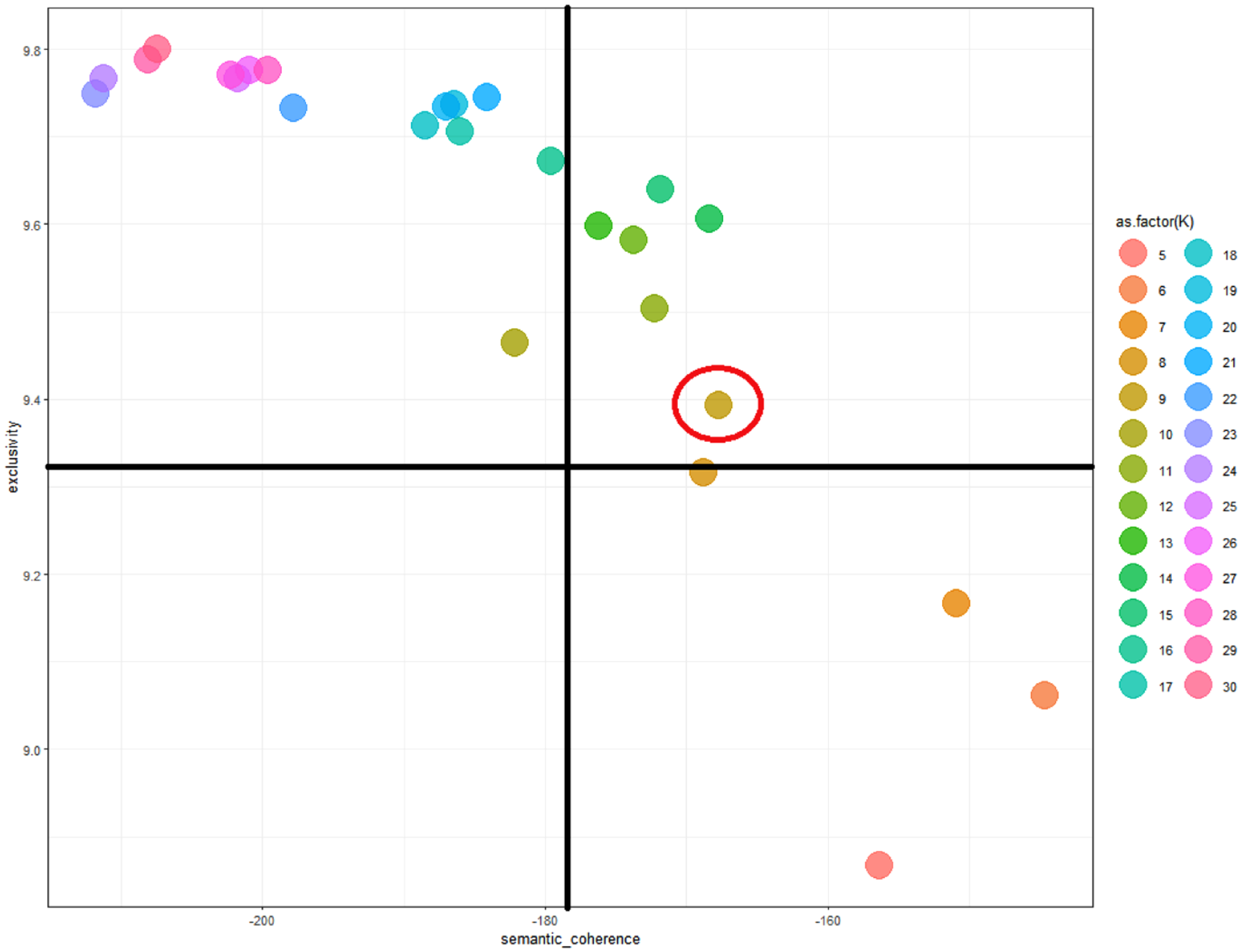
Means of topics’ semantic coherence and exclusivity for models with different K values. Models with best fit should be closer to the upper-right intersection between the axes.
Video Recommendation Network
The personalized user experience on YouTube is mediated by a system that calculates and offers content recommendations in different ways for each section of the website’s interface. Our research focuses on the list of suggested videos for each watched video, displayed in the sidebar or in the feed, in mobile devices (Schmoyer, 2020).
Recommendation lists are the result of algorithms programmed to predict interests and optimize user retention time on the platform based on data from previous interactions (Bendersky et al., 2014; Covington et al., 2016). They constantly vary according to factors such as individual user behavior and the behavior of other users with similar characteristics, such as demographics and consumption patterns and trends (van Dijck, 2013). According to members of YouTube’s technology team, recommendations are currently responsible for about 90% of video consumption on the platform and users are more likely to watch a video by suggestion of the site than through active search (Schmoyer, 2020). Since suggested videos are the main way the platform influences sequential video consumption, mapping these recommendations is essential to identify possible trends and problems, such as the promotion of harmful or conspiratorial content.
With YouTube Data Tools (Rieder, 2015), we collected suggested videos in two interaction degrees, that is, the 49 videos suggested from the original video, Cortina de Fumaça, then 49 more suggested videos from each of the 49 initially recommended videos. Our dataset, retrieved on 23 September 2022, includes 982 videos with 13,635 connections between them. The videos were published by 410 different channels.
We watched and qualitatively analyzed the main theme of the 49 videos in the first interaction degree of recommendation. Coding was done by research assistants and revised by the authors. We plotted the recommendation network using the software Gephi 0.9.2 (Bastian et al., 2009) and applying the force-directed algorithm ForceAtlas2 for the layout (Jacomy et al., 2014). Regarding the second interaction degree of recommended videos, we examined the top recommended channels by number of videos on the dataset to classify their content and identify partisanship.
Limitations
One of the limitations of the topic modeling approach is its inability to properly determine the public sentiments about each subject, even if some positive or negative words may provide a general view. Even if our analysis has shown that, in general, comments were supportive to the film’s discourse, we were not able to quantify this support. The main limitation of our network analysis is the fact that YouTube’s recommendation algorithm is highly affected by temporal factors, and our data represent the scenario at the very moment of data collection. Such dynamism in recommendation change may have created a time-biased description of the issue, and our analysis itself is not capable of telling the extent of such bias. However, based on previous studies mentioned in the article, there is evidence to support that, even if the recommended videos themselves may change over time, the aggregation logic that seems to prioritize homophily and radicalizing content remains a constant.
Results
In this section, we will first present the results of our topic modeling. After that, we will describe the results of the network analysis, exploring both the first interaction degree of recommendation (49 videos recommended for viewers of Cortina de Fumaça) and the second interaction degree (49 videos recommended for viewers of each of the recommended videos in the first degree).
Topic Modeling
Our topic modeling revealed nine topics discussed in the comments posted on Cortina de Fumaça’s YouTube page, shown in Figure 2, in order of prevalence. In Appendix A, we show the most relevant words for each topic and examples chosen among the most liked comments, in Portuguese and English. Two types of relevant words are presented: “Highest probability words,” the words within each topic with the highest probability, and “FREX words,” the words that are both frequent and exclusive (Roberts, Stewart, & Tingley, 2016).

Proportional prevalence of main subjects in Cortina de Fumaça’s comments on YouTube.
Based on our topic modeling approach, 34% of the textual data was clustered in two topics in which many of the top words are commonly used for praise like “congratulations,” “excellent,” “sensational,” “amazing,” and “fantastic.” The topic labeled as “praise for the channel” was even more relevant than the one that mostly concentrated praise for the film itself which may indicate a strong community sense between Brasil Paralelo’s audiences. For this topic, we found among the most liked comments content such as “I was someone before BP, today I am someone else! Thank you for this work, I already contribute with pride!” 1 Among the most liked comments praising the film, we found content like “Great documentary. ‘You will know the truth, and the truth will set you free’.” 2 The similarity between the topics “Praise for the channel” and “Praise for the film” can also be verified by an STM function that estimates topic correlations using thresholding measures. Figure 3 shows a high correlation between both topics (0.43).
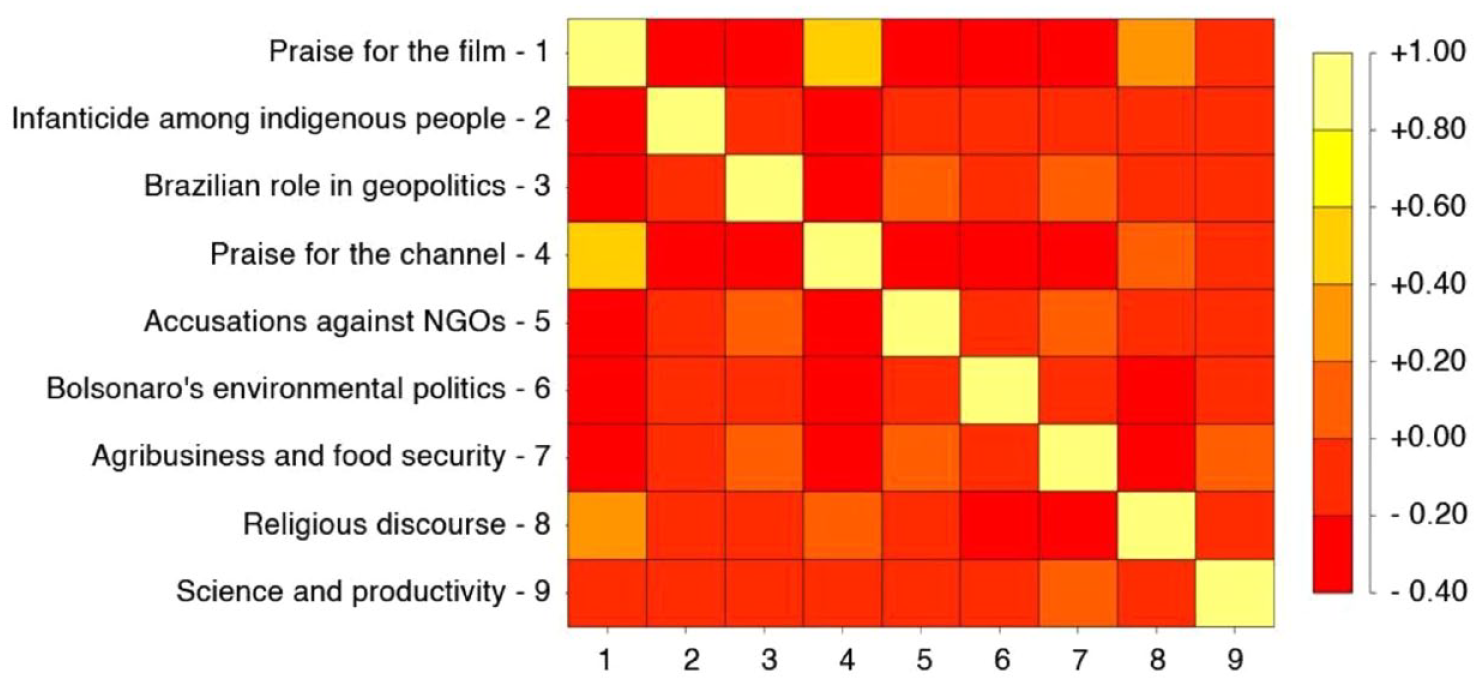
Graph of topic correlations using thresholding measure.
The topic labeled as “religious discourse” also includes praise-related lexicon in its top words list, but with a particularity; we found terms like “God,” “bless,” “Jesus,” and “enlighten,” a vocabulary associated with the Christian tradition. This topic does not constitute a subject itself, but rather shows a tendency for religious discourse throughout the video’s comments. We found, among the most liked comments, content like “Our country was destined by God for greatness. Every Brazilian should put their hand on their heart saying they are proud to live in this land.” 3
The topic “Bolsonaro’s environmental politics” has, among the top words, the names of two Brazilian politicians: far-right president Jair Bolsonaro and Aldo Rebelo, former member of a Brazilian communist party and of past left-wing governments in the country. He was the rapporteur of a bill that weakened environmental legislation in Brazil, approved in 2012 (Rudnitzki et al., 2018). Rebelo is interviewed in the movie and his statements support the documentary’s accusations against NGOs and foreign countries, aligned with current far-right anti-environmental claims used by Bolsonaro and his supporters. His past as a communist is used to legitimize the arguments made by many of the commenters. FREX words in this topic show the presence of discussions about the 2022 presidential elections, especially about the Brazilian electronic voting system that has been accused of being fraudulent by Bolsonaro and his supporters, despite the lack of evidence. We found that support for the Bolsonaro administration was accompanied by elements like a messianic description of the president and allegations of fraud in the Brazilian voting system.
“Brazilian role in geopolitics” is a topic that concentrates on the relation between Brazil and the rest of the world. The presence of words like “Amazonia” and “granary” indicates that the discussions also focus on land use issues. Between the most liked comments, we can find conspiratorial arguments, attacks against foreigners and nationalist discourse, as in comments like “What annoys me is that no one stands up and makes these gringo terrorists run away from our beloved country.” 4
The topic “Accusation against NGOs” brings together content that associates NGOs with corruption and the political left and foreign interests, demonstrated by the presence of words like “left,” “media,” “money,” and “politicians.” Among the most liked comments, we found content like “I believe that Brazil would be a first world country if indigenous people were free from corrupt NGOs. After all, Brazilian natives have a great love for the homeland and lands of their ancestors.” 5
In the topic “Infanticide among indigenous people,” indigenous children and Bolsonaro’s former minister Damares Alves are central. In the film, she is described as a savior of children that defends indigenous babies from being killed. Among the most liked comments on this subject, we highlight these examples: “Minister Damares’ lines are touching . . . it is crystal clear that she is a person who really cares about others. She is honest.” 6
Some of the most frequently occurring words in the category “Agribusiness and food security” are related to food production such as “hunger,” “population,” “food,” “feed,” and “agribusiness.” The FREX words of this topic are related to the global market, that is, “market,” “export,” and “dollar.”
Scientific arguments played a minor role in the comments posted by the documentary’s audience, since the topic “science and productivity” represented only 2% of the corpus and was not significantly present in any of the most liked comments. The top words of the topic, that is, “science,” “environment,” “agricultural,” and “pasture,” are connected to some of the claims in Cortina de Fumaça about the high productivity of Brazilian agriculture due to scientific research.
Network Analysis
We categorized the themes for each of the 49 videos suggested by YouTube for viewers of Cortina de Fumaça. In Figure 4, we present resulting themes from our analysis. Each video is referred to according to its code in Appendix B, where YouTube IDs, original, and translated titles can be found.

Distribution of themes in the 49 videos suggested by YouTube in the first interaction degree of recommendation for the movie Cortina de Fumaça.
Only five of the videos recommended by the YouTube algorithm were about the “environment.” Among the recommended videos on this theme, three were also published by Brasil Paralelo: two videos were versions of Cortina de Fumaça (an English version [R10] and a special exhibition [R17]), and one of them focused on climate change denialism (R33). The other two videos had positive environmental framing: one denounced the destruction of a Brazilian biome called Cerrado (R1) and the other discussed the consequences of the lack of sanitation among a population in the Amazon region (R20).
The most prominent subject in YouTube recommendations was “Politics and State,” which included 23 videos, almost half of the total. Much of the video content involves right-wing framed political polarization such as accusations against left-wing governments in Latin America (R3, R7, R22, R38), accusations against left-wing leaders and parties in Brazil (R11, R18, R36, R42), the villainization of a “communist ideology” (R29), and the exaltation and defense of far-right president Jair Bolsonaro (R21, R48). We also found right-wing framed historical revisionism, like the romanticization of European crusades and colonization as well-intentioned trips to spread Christianity throughout the world (R15), the relativization of the horrors of slavery in Brazil (R23), and the attempt to frame the 1964 Brazilian military coup as having saved the country from communism (R2, R9, R18). Other recommended films focus on conspiracies about unsolved criminal cases or accidental deaths, like unfounded claims that left-wing parties and politicians had been involved in the murder of political figures (R5, R8, R13). YouTube also suggested films that attack institutions such as justice (R6, R26, R43) and legacy media (R26, R46).
The recommendations favor conservative points of view by addressing cultural goods such as exalting classical music over popular music in a political framing of right versus left (R4) and criticizing culture promoted by liberals for being full of ideology, in opposition to a “high culture” (R35). Conservative points of view about education were also among the topics suggested, with a video that claimed that the French Revolution and communism ruined education that was better off when it was part of a Christian tradition (R28). YouTube also recommended a video claiming an alleged harmful loss of religious morals, accusing counterculture of having expelled Christianity from the formation of values (R30). Conservative perspectives about gender and sexuality were also present in the recommendations with videos that condemned the feminist movement as an anti-Christian movement (R14) and criticized the idea of gender identity and LGBTQIA+ civil rights (R12, R32). Finally, we also found conservative positions on race, specifically in a video that relativizes racism in Brazil, claiming the left promotes victimization of Black people and opposing racial quotas in universities and public service (R40).
At the first interaction degree of recommendation, of the 49 suggested videos, 39 were published by the Brasil Paralelo Channel. With three recommendations, the far-right hyper partisan “Mundo Polarizado | Olimpio Araujo Junior” was the only other channel with more than one recommendation in the first interaction degree. The other eight videos were published by eight different channels.
Figure 5 shows the complete recommendation network which considers the two interaction degrees, mapping the 13,635 connections between 982 videos published by 410 different channels. Highly connected videos are shown together in the plot, indicating recurring recommendations between the content. To better analyze the content patterns, we identified and highlighted the most recommended channels by number of videos on the dataset. Brasil Paralelo’s videos (in dark blue) represent 20.7% of all recommended videos in the network, including nine of the 10 most recommended videos. When we observe this second-degree interaction network, Cortina de Fumaça receives so few recommendations that it appears as one of the smaller nodes on the network.
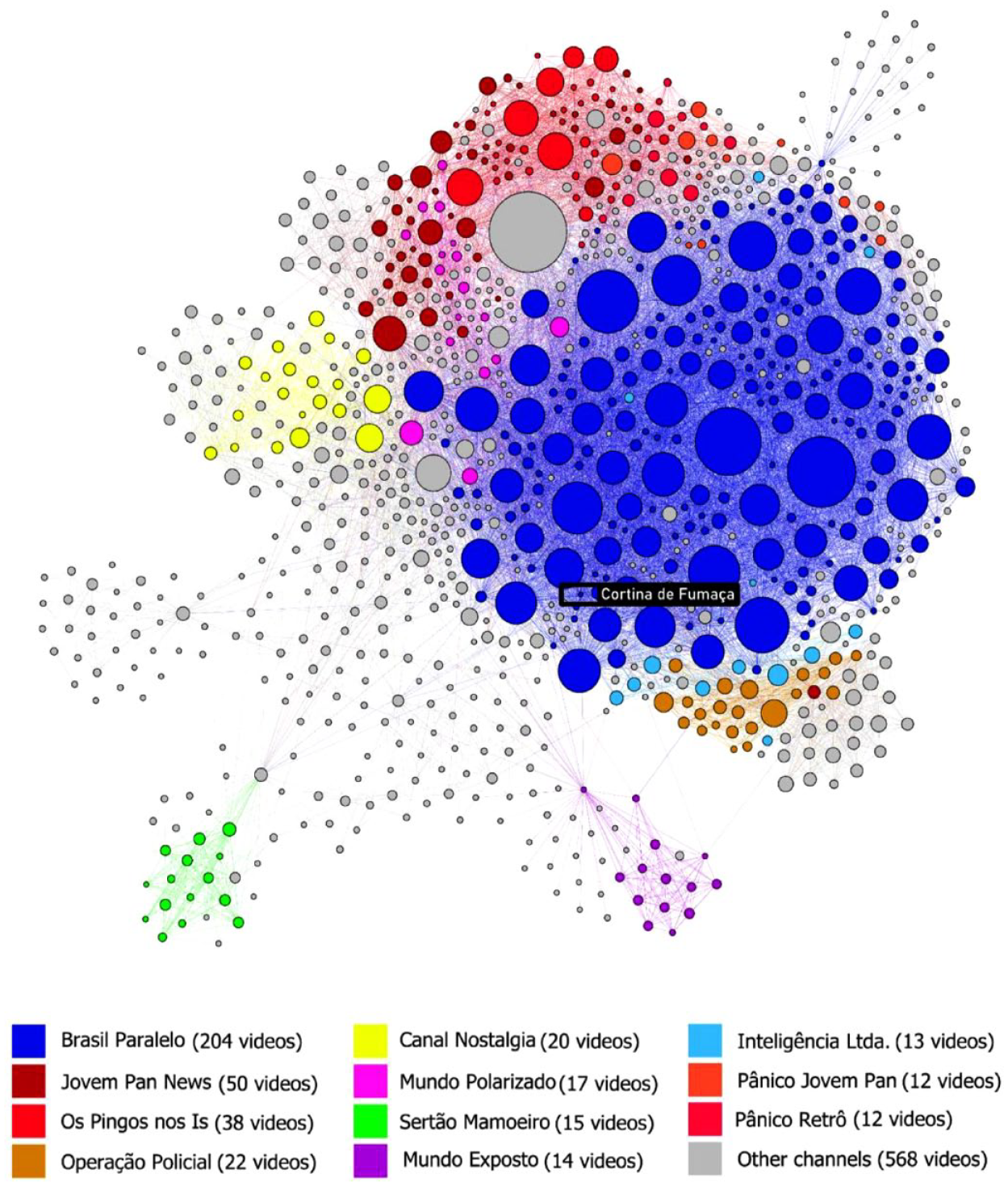
Network of suggested videos at two interaction degrees from Cortina de Fumaça’s film. Each node represents a video and each connection is a recommendation. Node size represents the volume of recommendations received. Node colors were defined according to the channel of origin and videos from less relevant channels were set in gray.
Other than Brasil Paralelo’s videos, the main cluster also concentrates videos from different channels connected to Jovem Pan Group (Jovem Pan News, Os Pingos Nos Is, Pânico Jovem Pan, and Pânico Retrô). In the network, they are highlighted in different tones of red. Described as a Brazilian “Fox News,” Jovem Pan is a multimedia communications group, with broadcasting stations across the country. The group has made YouTube its main arena and has become the most supportive of the Bolsonaro government in the Brazilian mainstream media (Costa, 2022).
Besides Brasil Paralelo and Jovem Pan channels, the main cluster also includes one other right-wing biased channel: Mundo Polarizado (in pink), a vlog of far-right conspiracy news. In the main cluster, we also found the channels Nostalgia (in yellow) focused on educational curiosities for young people, Inteligência Ltda (in light blue), a podcast of interviews with personalities from different areas, and the channel Operação Policial (in brown), with documentaries on crimes and police operations.
The other two channels with the most recommended videos are located in smaller, distant clusters at the bottom of the network. Mundo Exposto channel (in purple) is the most conspiratorial among the top channels with more suggested videos, including, for example, videos about aliens in Egypt. However, most of the content is about day-to-day curiosities. Sertão Mamoeiro (in green) focuses on the daily life of people in the northeast region of Brazil.
When analyzing the 10 largest nodes in the two-degree interaction network, nine of the videos belong to Brasil Paralelo. The only exception is the most recommended video of the dataset: a live video of the morning news show from a Jovem Pan regional news channel namely Jovem Pan News Bauru. The video entitled Jornal da Manhã Bauru - 09/23/2022 was live at the time of data collection. In the network, the node appears in gray because the channel had no other recommendations.
Discussion
The topic modeling of the video comments has shown that, out of the nine topics in our analysis, two of them are highly connected to environmental conspiracies: “Brazilian role in geopolitics” and “Accusations against NGOs.” Both topics put forth claims about an international plot to overtake the Amazon and its wealth as a means to undermine Brazilian sovereignty, but we cannot affirm that all the text clustered in such topics is conspiratorial. Encompassing 19% of analyzed corpus, the prevalence of these topics indicates that conspiratorial claims reverberated significantly among the public that posted comments on the Cortina de Fumaça YouTube page. Top words indicate who is portrayed as the common enemy: the agents behind the plans for domination include NGOs, political left, the media, politicians, and even the Brazilian Supreme Court (STF), as well as foreign countries, such as Norway, for their role in donations to the Brazilian government’s Amazon Fund (Albuquerque, 2019).
Conspiracies also appeared in other topics. Despite being a topic with a mostly economic lexicon, “Agribusiness and food security” includes conspiratorial comments connected to the film’s claims about a plot to reduce the competitiveness of Brazilian agriculture in the world market. The topic labeled as “Bolsonaro’s environmental politics,” in addition to containing the majority of comments about the far-right politician’s political measures, also included proofless claims about fraud in the Brazilian electronic voting system, a subject not connected to environmental issues and not mentioned in the film. Such presence shows that commenters placed the documentary’s environmental discussions inside a broader political scenario, where environmental conspiracies appear side by side with other kinds of conspiratorial claims that circulate in the far-right political field.
The religious discourse traversing the video’s comments also shows that identity to far-right partisanship plays an important role in partisan discourse, even when the subject of the documentary has no connection to religious subjects. This might be explained by the increasing alignment of partisan and ideological identities, which causes the convergence of partisanship with other salient social identities like race and religion (Mason, 2015). Such alignment amplifies the perception of belief dissimilarity between two groups, increasing negative outgroup feelings (Bougher, 2017). We argue that this process also leads to an increase in an individual’s susceptibility to belief in conspiracy theories, since the rise in negative political sentiment makes it easier to perceive the other side as evil-minded individuals that orchestrate a plan for domination.
“Infanticide among indigenous people” is a topic that reinforces the dichotomy between “good” and “evil.” Former Bolsonaro’s Minister Damares Alves is represented in many comments as the personification of good and a children’s savior, while “leftists” are accused by some commenters as being responsible for the death of indigenous babies. This topic is also related to the strong religious identity of the Brazilian far-right, since Damares Alves is also an evangelical minister and her discourse frequently incorporates a Christian ethos.
Our network analysis has shown that, in Cortina de Fumaça’s first level of recommendation, environmental issues were rarely suggested by YouTube, whereas the platform’s algorithm favored videos based on conspiracy theories that reinforce the idea of an ongoing global culture war, with Brazil as a central arena in recent years. The proportionally small number of environmental content recommendations for someone watching Cortina de Fumaça shows that, on one hand, the public is not significantly being driven by YouTube Algorithm to watch more environmental conspiracies. On the other hand, the analysis of the other videos in the network has confirmed the insertion of the environmental debate in an ideological network involving issues regarding partisanship, gender, art, culture, education, history, among others.
Most videos in the first-level recommendation are other productions from Brasil Paralelo channel. When looking at the second-level recommendation and its 982 videos, we observed that, among the most recommended channels, six are right-wing hyper-partisan channels responsible for 414 recommended videos. This finding confirms previous research that indicates the use of YouTube contributes to the extremism of its users (Tufekci, 2018, 2019). Tufekci (2018) refers to YouTube as one of the most powerful instruments of radicalization in the 21st century. According to the researcher, thanks to its recommendation algorithm, YouTube induces the average user to take deeper and deeper dives toward radical content.
An emergent hypothesis is that this is due to a financial logic, since the platform’s revenue depends on the advertising resources of the videos watched by users, whose attention is more easily won by “incendiary content” (Avaaz, 2020; Tufekci, 2018, 2019). Tufekci (2018) also reports that far-left and far-right channels are commonly recommended, even to users with a media diet based on mainstream news sources. That is, one of the effects of YouTube video consumption would be to increase political polarization.
The results of both topic modeling and network analysis lead us to the understanding that in Brazil, environmental debate is gradually entering modern culture wars. The inclusion of environmental issues in the frame of culture wars creates a dangerous neglect of the scientific aspect of the environmental debate in favor of position-taking based on ideological group membership, which demands a specific alignment to positions on different issues, not only restricted to moral ones. As our study has shown, Brazilian framing of environmental issues as part of the culture wars involves a nationalist discourse about sovereignty in land-use choices, science denialism, and conspiratorial claims that construct the idea of a plot involving internal enemies (left-wing politicians, legacy media, NGOs, and indigenous people) and external enemies (foreign countries aiming to overtake Amazon wealth or to weaken the competitivity of Brazilian agriculture).
The fact that the second-level recommendation network shows that Cortina de Fumaça represents a small node in the network may indicate that environmental issues are not yet a relevant subject in Brazilian culture wars. As we have previously argued, Brazilian public opinion is not yet as polarized as North America’s regarding climate change. However, such ongoing movement of social identities alignment that takes advantage of digital platforms affordances may gradually change this scenario.
Our study shows that environmental issues were instrumentalized as political ammunition, in line with far-right outrageous discourse, hateful commentaries, conspiratory denialism, and populist communication. Brasil Paralelo and other propagators of environmental denialism in Brazil are taking advantage of the radicalization potential of YouTube recommendation algorithms, thereby surpassing algorithm filter bubbles to widen their reach and gain higher levels of exposure. Our study demonstrates how the far-right instrumentalized YouTube affordances as part of an active and intentional strategy of propaganda, in which Brazil is engaged both as consumer and as producer of culture war narratives. Our results demonstrate that YouTube’s recommender system facilitates extremist content, by inducing the average user to take deeper and deeper dives into radical and problematic content chains. Future research can take advantage of the methodology developed here to expand the scale of analysis and verify whether similar situations also happen in different videos on environmental issues.
The ethical aspects of this discussion go beyond the debate on algorithmic bias, involving the platforms’ political and marketing choices. This leads researchers to question the very application of recommendation systems in platforms used as sources of information worldwide. The conspiratorial and denialist plots put forth by Cortina de Fumaça reinforce a deep-rooted relation between environmental contrarianism and the economic interests of the agribusiness sector in the country. Operating a strong communication strategy, ideological and political groups in Brazil are denouncing alleged globalist collusions. The film and the comments posted by its audience portray environmental activism as being fostered by sectors of the international establishment with shady and profiteering interests, building upon the polarizing potential of environmental debate in Brazil, and the conspiratorial appeal of a supposed foreign interference.
In the country that holds the greatest area of rainforest in the world, the strengthening of a public opinion contrary to environmental preservation can have disastrous impacts, especially in the lack of political support for measures to reduce greenhouse gas emissions and encourage a sustainable land use. Halting this process requires the possibility of a democratic auditability of the algorithms of platforms like YouTube and communication strategies that aim to bring the environmental debate back to the scientific field. A war usually demands the reduction of internal divergences and the decrease in the diversity of perspectives to unite a group to defeat the common enemy (de Melo & Vaz, 2021). Such a phenomenon may make it harder to break crystalized beliefs in environmental conspiracies, since such belief becomes part of an individual’s very ideological identity.
Footnotes
Appendix A
Topic, Main Subjects, Top Words, Topic Proportions, and Examples.

| Topic | Main subject | Highest probability words | FREX words | Topic proportions | Examples |
|---|---|---|---|---|---|
| 1 | Praise for the film | parabens, excelente, conteudo, sensacional, assistir, conhecimento, top (congratulations, excellent, content, sensational, watch, knowledge, top) |
parabens, excelente, conteudo, sensacional, assistir, top, esclarecedor (congratulations, excellent, content, sensational, watch, top, enlightening) |
0.161 | “Obrigada, pessoal, por este conteúdo INCRÍVEL.Se todos os brasileiros assistissem . . . ” (Thank you guys for this amazing content. If all Brazilians watched . . .). “Ótimo documentário ‘Conhecereis a verdade, e a verdade vós libertar’.” (Great documentary. “You will know the truth, and the truth will set you free”). |
| 2 | Infanticide among indigenous people | indios, ingles, damares, indio, ministra, indigenas, criancas (indians, english, damares, indian, minister, indigenous, children) |
ingles, damares, indio, legenda, legendas, versao, ditadura (english, damares, indian, subtitle, subtitles, version, dictatorship) |
0.088 | “Chorei com a Damares, quanta maldade meu Deus. Precisamos fazer a nossa parte também para salvar essas crianças.” (I cried with Damares, how evil my God. We also need to play our part to save these children). “As falas da Ministra Damares são emocionantes . . . é claro como a água que ela é uma pessoa que realmente se importa com os outros. É verdadeira.” (Minister Damares’ lines are touching . . . it is crystal clear that she is a person who really cares about others. She is honest.) |
| 3 | Brazilian role in geopolitics | brasil, pais, mundo, brasileiros, paises, amazonia, terra (brazil, country, world, brazilians, countries, amazon, land) |
potencia, gigante, potencial, celeiro, pararelo, amada, noruega (power, giant, potential, granary, parallel, beloved, norway) |
0.095 | “Essa ‘história’ sobre reservas indígenas, quilombos e etc., nada mais é que uma lacração da soberania nacional e das riquezas disponíveis, com dois objetivos principais: impedir o desenvolvimento do país, demonstrar poder e criar uma reserva estratégica de recursos (minerais e agrícolas) para gestão e uso da futura e próxima gestão global.” (This “story” about indigenous reserves, quilombos, and so on, is nothing more than a co-opting of national sovereignty and its available wealth, with two main objectives: to prevent the country’s development, demonstrate power and create a strategic reserve of resources (mineral and agricultural) for management and use of a future and upcoming global management). “O que me irrita é que ninguém se levanta e coloca esses terroristas gringos pra correr do nosso amado país.” (What annoys me is that no one stands up and makes these gringo terrorists run away from our beloved country). |
| 4 | Praise for the channel | brasilparalelo, filme, producao, canal, incrivel, documentarios, fantastico (brasilparalelo, film, production, channel, amazing, documentaries, fantastic) |
documentarios, fantastico, orgulho, filmes, oficial, trailer, inscreva (documentaries, fantastic, pride, films, official, trailer, subscribe) |
0.185 | “Eu era uma pessoa antes do BP, hoje sou outra! Obrigado por esse trabalho, já contribuo com orgulho!” (I was someone before BP, today I am someone else! Thank you for this work, I already contribute with pride!). “Hoje vejo esse canal como a única esperança para nossas gerações futuras, nossos filhos e netos. As escolas estão tomadas por mentiras, a imprensa e jornalismo também só ensinam mentiras. Torço muito para esse canal crescer cada vez mais e mostrar a verdade!!!” (Today I see this channel as the only hope for our future generations, our children and grandchildren. The schools are taken over by lies, the press and journalism also only teach lies. I hope very much that this channel will grow more and more and show the truth!!!). |
| 5 | Accusations against NGOs | ongs, esquerda, vamos, midia, dinheiro, governo, politicos (NGOs, left, let’s go, media, money, government, politicians) |
stf, corrupto, podre, voltar, culpa, mortes, manobra (stf, corrupt, rotten, return, blame, deaths, maneuver) |
0.091 | “Creio que o Brasil seria de primeiro mundo se os indígenas fossem livres de ONGs corruptas. Afinal de contas os nativos Brasileiro tem um grande amor pela pátria e terras de seus antepassados.” (I believe that Brazil would be a first world country if indigenous people were free from corrupt NGOs. After all, Brazilian natives have a great love for the homeland and lands of their ancestors). “O documentário faz uma série de denúncias; ONGs, fundos internacionais, ausência de soberania e outros temas polêmicos foram bem explicitados; Vale à pena ser assistido!” (The documentary makes a series of denunciations: NGOs, international funds, lack of sovereignty and other controversial issues were well explained. Worth watching!). |
| 6 | Bolsonaro’s environmental politics | amazonia, bolsonaro, aldorebelo, cara, video, canal, governo (amazonia, bolsonaro, aldorebelo, guy, video, channel, government) |
voto, foda, conferencia, auditavel, kkkk, impresso, aldo (vote, awesome, conference, auditable, hahaha, printed, aldo) |
0.123 | “BOLSONARO HERÓI NACIONAL ENVIADO DE DEUS” (BOLSONARO NATIONAL HERO SENT FROM GOD). Aldo Rebelo (comunista) esfrega a verdade nua e crua na cara da esquerda que insiste em jogar contra o Brasil. Parabéns pelo material! Virei membro!! (Aldo Rebelo [communist] rubs the naked truth in the face of the left that insists on playing against Brazil. Congratulations on the material! I became a member!!). |
| 7 | Agribusiness and food security | fome, falar, populacao, alimentos, alimentar, brasileiro, agronegocio (hunger, talk, population, food, feed, brazilian, agribusiness) |
mercado, pagar, metade, precos, salario, exportar, dolar (market, pay, half, prices, salary, export, dollar) |
0.078 | “Já iniciou a nova guerra mundial: segurança alimentar.” (The new world war has already begun: food security). “O Brasil tem um enorme potencial hídrico, energético, econômico, mineral, e agropecuário. Só não somos a maior potência do planeta porque as elites não querem que prosperemos, essa mesma elite que nos controla, que nos domina.” (Brazil has an enormous water, energy, economic, mineral, and agricultural potential. The only reason we are not the greatest power on the planet is because the elite don’t want us to prosper, this same elite that controls us that dominates us). |
| 8 | Religious discourse | documentario, deus, maravilhoso, video, precisa, otimo, deveria (documentary, god, wonderful, video, need, great, should) |
abencoe, jesus, chorei, gostei, chorar, trecho, ilumine (bless, jesus, cried, liked, cry, excerpt, enlighten) |
0.155 | “Nosso país foi destinado por Deus a grandeza. Todo brasileiro deveria bater no peito dizendo que tem orgulho de viver nesta terra.” (Our country was destined by God for greatness. Every Brazilian should put their hand on their heart saying they are proud to live in this land). “Não é só um documentário, são denúncias gravíssimas. Brasil Paralelo que documentário necessário. Deus abençoes todos vocês.” (It’s not just a documentary, it’s serious allegations. Brasil Paralelo what a necessary documentary. God bless you all.) |
| 9 | Science and productivity | mundo, ciencia, meioambiente, brasil, filme, agricola, pasto (world, science, environment, brazil, film, agriculture, pasture) |
ciencia, pasto, traz, segue, produtividade, favoravel, soa (science, pasture, brings, follows, productivity, favorable, sounds) |
0.024 | No examples found between the most liked comments |
Appendix B. List of Recommended Videos from Cortina de Fumaça (First Degree of Interaction)
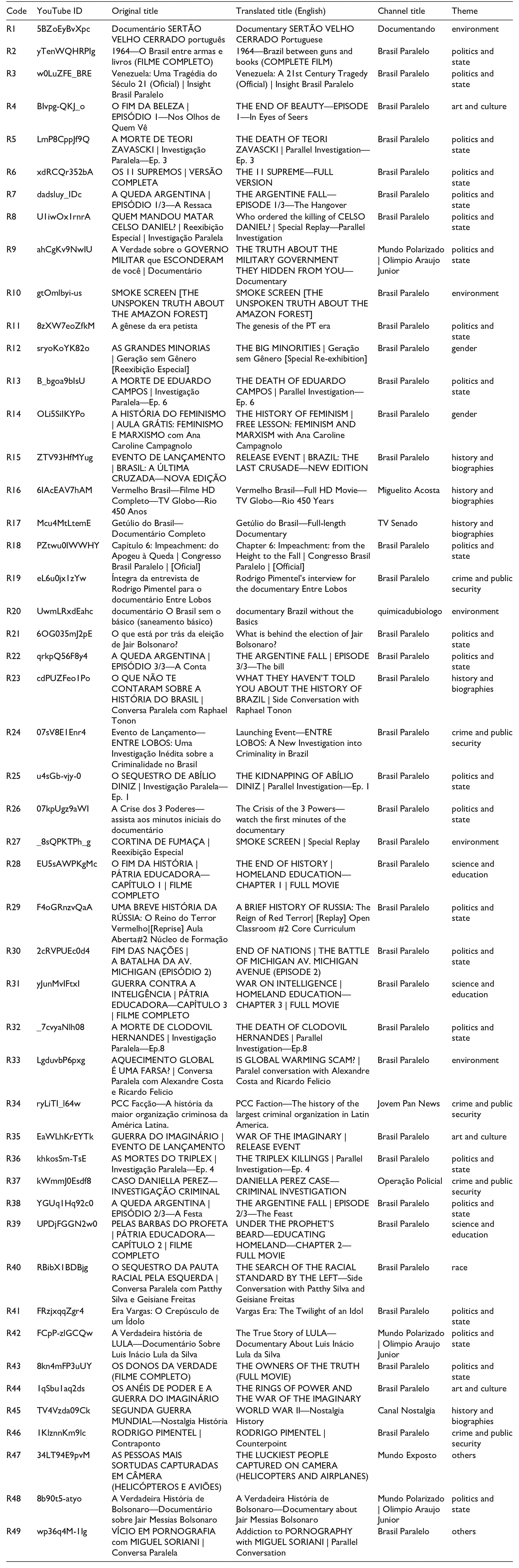
| Code | YouTube ID | Original title | Translated title (English) | Channel title | Theme |
|---|---|---|---|---|---|
| R1 | 5BZoEyBvXpc | Documentário SERTÃO VELHO CERRADO português | Documentary SERTÃO VELHO CERRADO Portuguese | Documentando | environment |
| R2 | yTenWQHRPIg | 1964—O Brasil entre armas e livros (FILME COMPLETO) | 1964—Brazil between guns and books (COMPLETE FILM) | Brasil Paralelo | politics and state |
| R3 | w0LuZFE_BRE | Venezuela: Uma Tragédia do Século 21 (Oficial) | Insight Brasil Paralelo | Venezuela: A 21st Century Tragedy (Official) | Insight Brasil Paralelo | Brasil Paralelo | politics and state |
| R4 | BIvpg-QKJ_o | O FIM DA BELEZA | EPISÓDIO 1—Nos Olhos de Quem Vê | THE END OF BEAUTY—EPISODE 1—In Eyes of Seers | Brasil Paralelo | art and culture |
| R5 | LmP8CppJf9Q | A MORTE DE TEORI ZAVASCKI | Investigação Paralela—Ep. 3 | THE DEATH OF TEORI ZAVASCKI | Parallel Investigation—Ep. 3 | Brasil Paralelo | politics and state |
| R6 | xdRCQr352bA | OS 11 SUPREMOS | VERSÃO COMPLETA | THE 11 SUPREME—FULL VERSION | Brasil Paralelo | politics and state |
| R7 | dadsluy_IDc | A QUEDA ARGENTINA | EPISÓDIO 1/3—A Ressaca | THE ARGENTINE FALL—EPISODE 1/3—The Hangover | Brasil Paralelo | politics and state |
| R8 | U1iwOx1rnrA | QUEM MANDOU MATAR CELSO DANIEL? | Reexibição Especial | Investigação Paralela | Who ordered the killing of CELSO DANIEL? | Special Replay—Parallel Investigation | Brasil Paralelo | politics and state |
| R9 | ahCgKv9NwIU | A Verdade sobre o GOVERNO MILITAR que ESCONDERAM de você | Documentário | THE TRUTH ABOUT THE MILITARY GOVERNMENT THEY HIDDEN FROM YOU—Documentary | Mundo Polarizado | Olimpio Araujo Junior | politics and state |
| R10 | gtOmlbyi-us | SMOKE SCREEN [THE UNSPOKEN TRUTH ABOUT THE AMAZON FOREST] | SMOKE SCREEN [THE UNSPOKEN TRUTH ABOUT THE AMAZON FOREST] | Brasil Paralelo | environment |
| R11 | 8zXW7eoZfkM | A gênese da era petista | The genesis of the PT era | Brasil Paralelo | politics and state |
| R12 | sryoKoYK82o | AS GRANDES MINORIAS | Geração sem Gênero [Reexibição Especial] | THE BIG MINORITIES | Geração sem Gênero [Special Re-exhibition] | Brasil Paralelo | gender |
| R13 | B_bgoa9bIsU | A MORTE DE EDUARDO CAMPOS | Investigação Paralela—Ep. 6 | THE DEATH OF EDUARDO CAMPOS | Parallel Investigation—Ep. 6 | Brasil Paralelo | politics and state |
| R14 | OLi5SiIKYPo | A HISTÓRIA DO FEMINISMO | AULA GRÁTIS: FEMINISMO E MARXISMO com Ana Caroline Campagnolo | THE HISTORY OF FEMINISM | FREE LESSON: FEMINISM AND MARXISM with Ana Caroline Campagnolo | Brasil Paralelo | gender |
| R15 | ZTV93HfMYug | EVENTO DE LANÇAMENTO | BRASIL: A ÚLTIMA CRUZADA—NOVA EDIÇÃO | RELEASE EVENT | BRAZIL: THE LAST CRUSADE—NEW EDITION | Brasil Paralelo | history and biographies |
| R16 | 6IAcEAV7hAM | Vermelho Brasil—Filme HD Completo—TV Globo—Rio 450 Anos | Vermelho Brasil—Full HD Movie—TV Globo—Rio 450 Years | Miguelito Acosta | history and biographies |
| R17 | Mcu4MtLtemE | Getúlio do Brasil—Documentário Completo | Getúlio do Brasil—Full-length Documentary | TV Senado | history and biographies |
| R18 | PZtwu0IWWHY | Capítulo 6: Impeachment: do Apogeu à Queda | Congresso Brasil Paralelo | [Oficial] | Chapter 6: Impeachment: from the Height to the Fall | Congresso Brasil Paralelo | [Official] | Brasil Paralelo | politics and state |
| R19 | eL6u0jx1zYw | Íntegra da entrevista de Rodrigo Pimentel para o documentário Entre Lobos | Rodrigo Pimentel’s interview for the documentary Entre Lobos | Brasil Paralelo | crime and public security |
| R20 | UwmLRxdEahc | documentário O Brasil sem o básico (saneamento básico) | documentary Brazil without the Basics | quimicadubiologo | environment |
| R21 | 6OG035mJ2pE | O que está por trás da eleição de Jair Bolsonaro? | What is behind the election of Jair Bolsonaro? | Brasil Paralelo | politics and state |
| R22 | qrkpQ56F8y4 | A QUEDA ARGENTINA | EPISÓDIO 3/3—A Conta | THE ARGENTINE FALL | EPISODE 3/3—The bill | Brasil Paralelo | politics and state |
| R23 | cdPUZFeo1Po | O QUE NÃO TE CONTARAM SOBRE A HISTÓRIA DO BRASIL | Conversa Paralela com Raphael Tonon | WHAT THEY HAVEN’T TOLD YOU ABOUT THE HISTORY OF BRAZIL | Side Conversation with Raphael Tonon | Brasil Paralelo | history and biographies |
| R24 | 07sV8E1Enr4 | Evento de Lançamento—ENTRE LOBOS: Uma Investigação Inédita sobre a Criminalidade no Brasil | Launching Event—ENTRE LOBOS: A New Investigation into Criminality in Brazil | Brasil Paralelo | crime and public security |
| R25 | u4sGb-vjy-0 | O SEQUESTRO DE ABÍLIO DINIZ | Investigação Paralela—Ep. 1 | THE KIDNAPPING OF ABÍLIO DINIZ | Parallel Investigation—Ep. 1 | Brasil Paralelo | politics and state |
| R26 | 07kpUgz9aWI | A Crise dos 3 Poderes—assista aos minutos iniciais do documentário | The Crisis of the 3 Powers—watch the first minutes of the documentary | Brasil Paralelo | politics and state |
| R27 | _8sQPKTPh_g | CORTINA DE FUMAÇA | Reexibição Especial | SMOKE SCREEN | Special Replay | Brasil Paralelo | environment |
| R28 | EU5sAWPKgMc | O FIM DA HISTÓRIA | PÁTRIA EDUCADORA—CAPÍTULO 1 | FILME COMPLETO | THE END OF HISTORY | HOMELAND EDUCATION—CHAPTER 1 | FULL MOVIE | Brasil Paralelo | science and education |
| R29 | F4oGRnzvQaA | UMA BREVE HISTÓRIA DA RÚSSIA: O Reino do Terror Vermelho|[Reprise] Aula Aberta#2 Núcleo de Formação | A BRIEF HISTORY OF RUSSIA: The Reign of Red Terror| [Replay] Open Classroom #2 Core Curriculum | Brasil Paralelo | politics and state |
| R30 | 2cRVPUEc0d4 | FIM DAS NAÇÕES | A BATALHA DA AV. MICHIGAN (EPISÓDIO 2) | END OF NATIONS | THE BATTLE OF MICHIGAN AV. MICHIGAN AVENUE (EPISODE 2) | Brasil Paralelo | politics and state |
| R31 | yJunMvIFtxI | GUERRA CONTRA A INTELIGÊNCIA | PÁTRIA EDUCADORA—CAPÍTULO 3 | FILME COMPLETO | WAR ON INTELLIGENCE | HOMELAND EDUCATION—CHAPTER 3 | FULL MOVIE | Brasil Paralelo | science and education |
| R32 | _7cvyaNlh08 | A MORTE DE CLODOVIL HERNANDES | Investigação Paralela—Ep.8 | THE DEATH OF CLODOVIL HERNANDES | Parallel Investigation—Ep.8 | Brasil Paralelo | politics and state |
| R33 | LgduvbP6pxg | AQUECIMENTO GLOBAL É UMA FARSA? | Conversa Paralela com Alexandre Costa e Ricardo Felicio | IS GLOBAL WARMING SCAM? | Paralel conversation with Alexandre Costa and Ricardo Felicio | Brasil Paralelo | environment |
| R34 | ryLiTI_l64w | PCC Facção—A história da maior organização criminosa da América Latina. | PCC Faction—The history of the largest criminal organization in Latin America. | Jovem Pan News | crime and public security |
| R35 | EaWLhKrEYTk | GUERRA DO IMAGINÁRIO | EVENTO DE LANÇAMENTO | WAR OF THE IMAGINARY | RELEASE EVENT | Brasil Paralelo | art and culture |
| R36 | khkosSm-TsE | AS MORTES DO TRIPLEX | Investigação Paralela—Ep. 4 | THE TRIPLEX KILLINGS | Parallel Investigation—Ep. 4 | Brasil Paralelo | politics and state |
| R37 | kWmmJ0Esdf8 | CASO DANIELLA PEREZ—INVESTIGAÇÃO CRIMINAL | DANIELLA PEREZ CASE—CRIMINAL INVESTIGATION | Operação Policial | crime and public security |
| R38 | YGUq1Hq92c0 | A QUEDA ARGENTINA | EPISÓDIO 2/3—A Festa | THE ARGENTINE FALL | EPISODE 2/3—The Feast | Brasil Paralelo | politics and state |
| R39 | UPDjFGGN2w0 | PELAS BARBAS DO PROFETA | PÁTRIA EDUCADORA—CAPÍTULO 2 | FILME COMPLETO | UNDER THE PROPHET’S BEARD—EDUCATING HOMELAND—CHAPTER 2—FULL MOVIE | Brasil Paralelo | science and education |
| R40 | RBibX1BDBjg | O SEQUESTRO DA PAUTA RACIAL PELA ESQUERDA | Conversa Paralela com Patthy Silva e Geisiane Freitas | THE SEARCH OF THE RACIAL STANDARD BY THE LEFT—Side Conversation with Patthy Silva and Geisiane Freitas | Brasil Paralelo | race |
| R41 | FRzjxqqZgr4 | Era Vargas: O Crepúsculo de um Ídolo | Vargas Era: The Twilight of an Idol | Brasil Paralelo | politics and state |
| R42 | FCpP-zlGCQw | A Verdadeira história de LULA—Documentário Sobre Luis Inácio Lula da Silva | The True Story of LULA—Documentary About Luis Inácio Lula da Silva | Mundo Polarizado | Olimpio Araujo Junior | politics and state |
| R43 | 8kn4mFP3uUY | OS DONOS DA VERDADE (FILME COMPLETO) | THE OWNERS OF THE TRUTH (FULL MOVIE) | Brasil Paralelo | politics and state |
| R44 | 1qSbu1aq2ds | OS ANÉIS DE PODER E A GUERRA DO IMAGINÁRIO | THE RINGS OF POWER AND THE WAR OF THE IMAGINARY | Brasil Paralelo | art and culture |
| R45 | TV4Vzda09Ck | SEGUNDA GUERRA MUNDIAL—Nostalgia História | WORLD WAR II—Nostalgia History | Canal Nostalgia | history and biographies |
| R46 | 1KlznnKm9lc | RODRIGO PIMENTEL | Contraponto | RODRIGO PIMENTEL | Counterpoint | Brasil Paralelo | crime and public security |
| R47 | 34LT94E9pvM | AS PESSOAS MAIS SORTUDAS CAPTURADAS EM CÂMERA (HELICÓPTEROS E AVIÕES) | THE LUCKIEST PEOPLE CAPTURED ON CAMERA (HELICOPTERS AND AIRPLANES) | Mundo Exposto | others |
| R48 | 8b90t5-atyo | A Verdadeira História de Bolsonaro—Documentário sobre Jair Messias Bolsonaro | A Verdadeira História de Bolsonaro—Documentary about Jair Messias Bolsonaro | Mundo Polarizado | Olimpio Araujo Junior | politics and state |
| R49 | wp36q4M-1Ig | VÍCIO EM PORNOGRAFIA com MIGUEL SORIANI | Conversa Paralela | Addiction to PORNOGRAPHY with MIGUEL SORIANI | Parallel Conversation | Brasil Paralelo | others |
Declaration of Conflicting Interests
The author(s) declared no potential conflicts of interest with respect to the research, authorship, and/or publication of this article.
Funding
The author(s) received no financial support for the research, authorship, and/or publication of this article.
