




Abstract
Telepresence robots are increasingly used in schools as a way of including students who are unable to be physically present in the classroom with other students. The use of such robots is intended not just to help students follow their education but also to serve a social purpose. However, the extent to which the robots actually afford socializing needs to be explored further. This article analyzes how, to what extent, for whom, and under what circumstances the telepresence robot AV1 affords social contact for the heterogenous group of homebound Norwegian upper secondary school students. Building on Jenny Davis’ mechanisms and conditions framework of affordances, we focus on how AV1 affords for different students in specific circumstances. Our analysis draws on interviews with 11 upper secondary school students in Norway and finds that individual traits and circumstances such as health issues and social networks are important aspects when assessing whether a technology affords socializing. Based on our findings, we argue for expanding the mechanisms and conditions framework to include not just its current focus on perception, dexterity, and cultural and institutional legitimacy, but also the users’ emotions.
Introduction and research question
Long-term health issues can lead to individuals being physically isolated from others. For children and youth, this can lead to isolation from one of the primary institutionalized sites of social contact, namely the classroom. It is feared this may lead to loneliness (Newhart et al., 2016).
In recent years, new media technologies have been developed and implemented in the classroom to remedy physical isolation among school students (Newhart et al., 2016). One such technology is telepresence robots. Different telepresence robots have been developed with an aim of offering ‘presence at a distance’ (Johannessen et al., 2023: 154), allowing social interaction between those controlling the robot and those physically present with the robot (e.g. Johannessen et al., 2023; Newhart et al., 2016; Weibel et al., 2020; Søraa et al., 2021). Telepresence robots thus mediate human-to-human interaction and are not the kind of social robots that autonomously perform quasi-social interactions. In this study, we focus on one such telepresence robot, AV1, which has been designed by the Norwegian company No Isolation to help school students have a telepresence at school via the robot. AV1 was released in 2016 and, by June 2023, there were approximately 2500 active robots in European countries (mainly Norway, Sweden, Denmark, Germany, and the UK). AV1 works by connecting two remote parties, typically the homebound student (who follows the robot through an app on a phone or a tablet) and teachers and classmates in the classroom in which the robot is typically placed. AV1 has various features that can be seen in Figure 1. AV1’s features. Picture and description from No Isolation’s web site: ‘1. When the student “raises their hand,” the top light flashes. 2. A live feed from the classroom is streamed through the microphone and the camera. 3. Student uses the eyes to express emotions. 4. A motor in the neck lets the head turn 80° up and down and side to side. 5. The light strip signals if AV1 is connected or not. 6. The robot has an integrated 4G sim so it is always online. 7. The student’s voice is heard from the speaker. 8. A motor at the bottom allows the robot to turn 360°. 9. TPE coated backside that provides great grip. 10. On the back, there is a charger input, battery level indicator, and network quality indicator. 11. AV1 is durable and transportable. It has a hard outer shell’. (No Isolation, NA).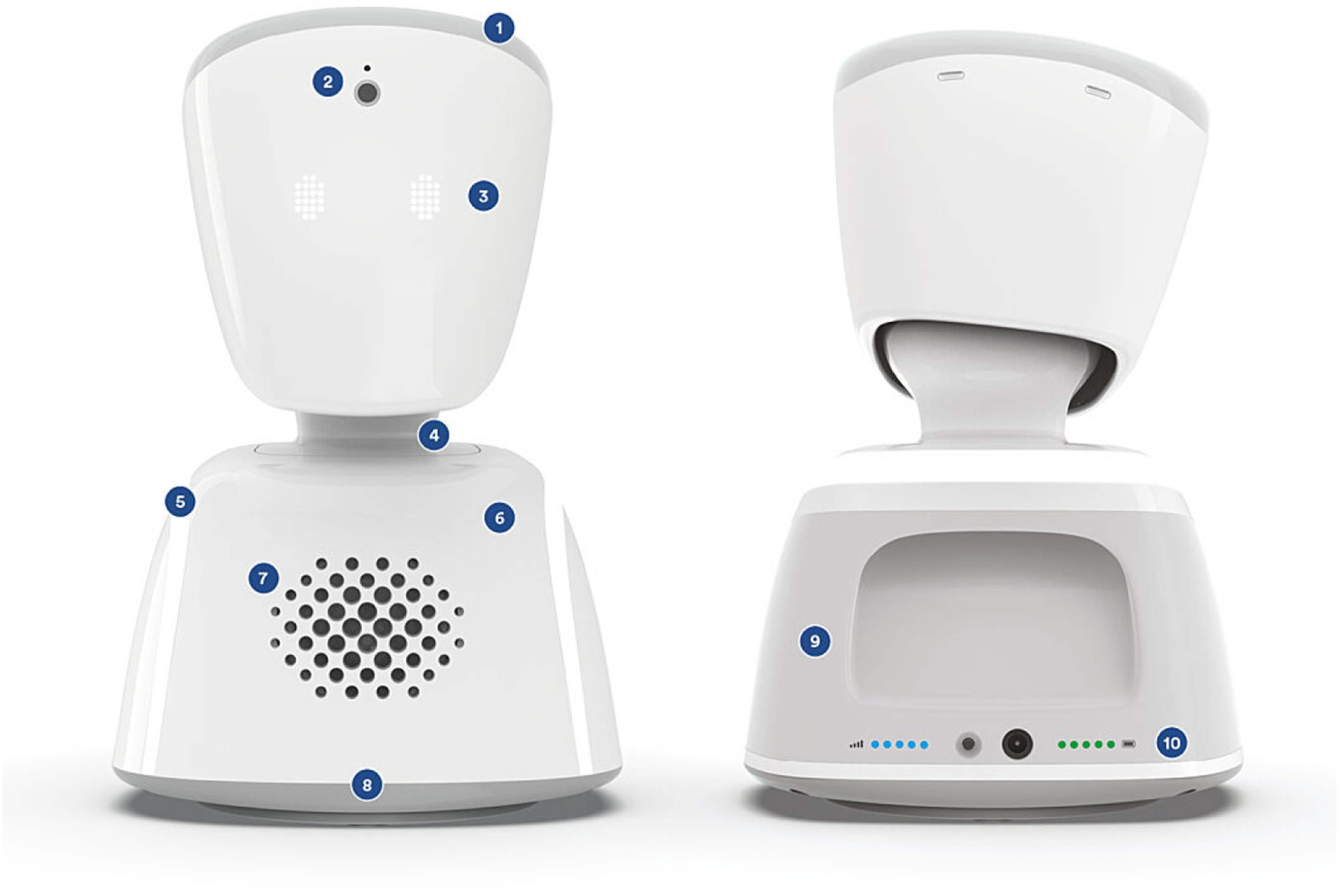
The app connected to AV1 allows homebound students to see, hear, and speak through the robot and allows them to control AV1’s movements (see Figure 2). The app is thus a crucial interface that mediates the homebound student’s experiences with the robot. The interface of the AV1 app. Picture from No Isolation’s web site. Photo: Christian Sinibaldi.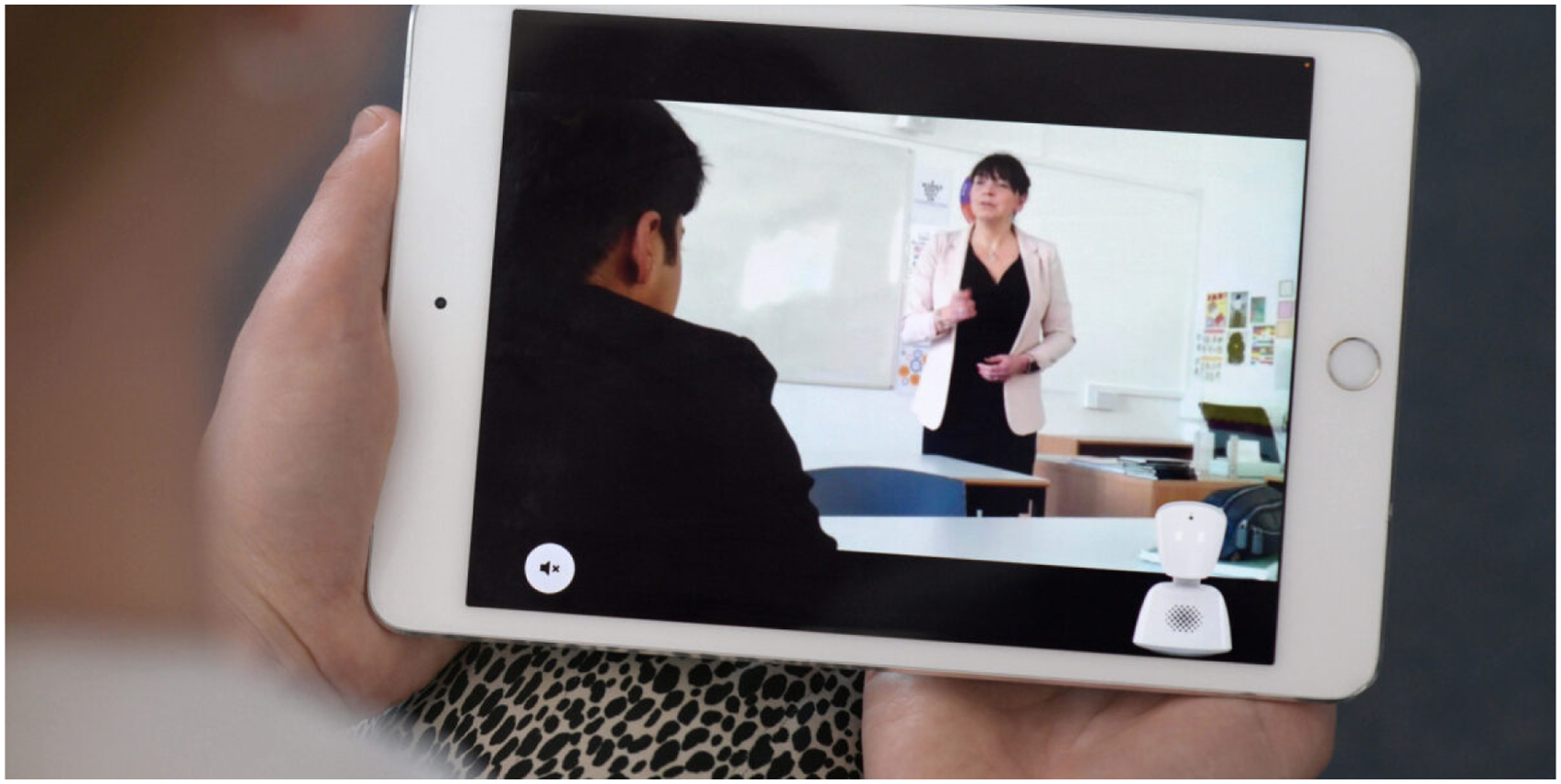
There are reasons to be optimistic about using a social telepresence robot to remedy potential feelings of isolation and loneliness when children and youth are physically isolated from their classmates. Although digital media do not necessarily enhance social inclusion when individuals are socially isolated in school settings (Kaur and Saukko, 2022), opportunities for digital communication can have a positive effect on individuals and their social interaction when they are faced with limited opportunities for physical interaction (Ji et al., 2022; Taylor-Jackson et al., 2021). Research shows that online technology can enhance sociability if individuals do not have easy access to, or capacity for, offline face-to-face social engagement, or if they use online technology ‘to bolster or create relationships with prospective or existing offline friends’ (Waytz and Gray, 2018: 480). Online technologies can thereby provide ‘a “better than nothing” substitute for people for whom face-to-face social interactions are challenging or difficult to find’ (Waytz and Gray, 2018: 482). Previous research has also linked digital communication with reduced feelings of loneliness and an ability to maintain social relationships (Gabbiadini et al., 2020; Ji et al., 2022; Tillema et al., 2010). One-to-one communication through social media has been found to help young people who do not have many in-person social experiences to deal with this situation (Marciano et al., 2022). Previous research has also found that students like the fact that telepresence robots can help them to connect socially with friends and reduce their sense of loneliness (Johannessen et al., 2023; Newhart et al., 2016; Weibel et al., 2020). At the same time, however, ‘there is not a simple relationship between social Internet use and loneliness’ (Nowland et al., 2017: 74), and use of technologies can both reduce and increase feelings of loneliness (Nowland et al., 2017). Consequently, we need to appreciate how online technology can both enhance and diminish sociability depending on its use (Waytz and Gray, 2018).
In this study, we draw on relational understandings of affordances (Davis, 2020) to explore whether and how AV1 affords socializing for young homebound people. Specifically, we build on Jenny Davis’ mechanisms and conditions framework, which is developed to facilitate fine-grained analyses of user-technology relationships and how these depend on complex interplays between technologies, users, and circumstances (Davis, 2020). Accordingly, our study asks the following relational research question: How, to what extent, for whom, and under what circumstances does AV1 afford socializing for homebound Norwegian upper secondary school students? To answer this question, the article analyzes interviews with 11 16–18-year-old students in upper secondary school in Norway, a strategic focus that helps to uncover variations in a group largely in the same circumstances in relation to age and educational level. With an in-depth analysis of how AV1 affords, the study sheds light on key heterogeneities within a seemingly homogenous group, thereby showing the importance of focusing on relational contextuality when implementing new media technology. Our study also highlights an emotional aspect of affordances, which may prove to be an important addition to future studies using Davis’ mechanism and conditions framework.
Social contact though media technology
To understand the socializing affordances of AV1, it is helpful to situate our investigation within the broader literature on social contact through media technology. On a general level, discussions of new interpersonal communication media often employ technologically determinist rhetorics, in which the media is positioned as inevitably changing our social connections – either negatively or positively (Baym, 2015). It is typical, for instance, to question the authenticity of new forms of mediated interaction, deeming them less real than face-to-face interactions (Baym, 2015) or suggesting that new technologies make humanity less human (Miller and Sinanan, 2014). Similarly, many commentators take offline face-to-face interaction to be a ‘gold standard’ against which any mediated alternative is inherently deemed lacking (Cerulo, 1997).
Unlike these determinist and broad-brush discourses on technology, this article follows those researchers who ask more relational questions about the consequences of new media. In these studies, the ‘impact’ of new technologies are seen as dependent on a range of mediating and interacting ‘variables’, including how the technology is used, by whom, and under what circumstances. As discussed also in the previous section, some of this research reports that new media can affect social connections positively, for instance in relation to individuals who are physically isolated from others due to problems such as chronic illness, or who are otherwise unable to connect in offline environments (e.g., Gabbiadini et al., 2020; Grieve et al., 2013; Ji et al., 2022; Tillema et al., 2010; Taylor-Jackson et al., 2021; Marciano et al., 2022). Under such circumstances, media technologies are often considered ‘a feasible tool to enhance social connectedness’ (Hofer and Hargittai, 2021: 3) and potentially essential for individuals’ wellbeing (Grieve et al., 2013; Hofer and Hargittai, 2021).
Unsurprisingly, however, the results of such relational investigations are mixed, and much of the research on digital social connectedness finds both positive and negative outcomes (Nowland et al., 2017; Taylor-Jackson et al., 2021). Video games, for example, have been found to put social relations at risk but also to have positive social effects (Jansz and Martens, 2005). Similarly, in the same way social media can positively affect individuals’ social interaction, the use of social media can also have the opposite effect by reducing physical interaction and engagement (Taylor-Jackson et al., 2021). A key reason for such incongruences is that the effects of new media are context-dependent. For instance, Marinucci et al. (2022) found that the role of online connections in relation to loneliness depends on the availability of face-to-face interactions. When individuals do not have many available offline interactions, online connections play an important role in reducing loneliness; when individuals have adequate offline social connections, however, ‘online interactions could not add further to psychological wellbeing, with this highlighting the limits of online interactions as subordinate surrogates of offline ones’ (Marinucci et al., 2022: 6). A similar story has also been highlighted for the technology under study, telepresence robots, as children and youth have been found to have various experiences with the sociality of the robots’ properties (Johannessen et al., 2023; Newhart et al., 2016; Weibel et al., 2020). Such findings suggest a need for a context-sensitive approach to understanding whether and how AV1 affords socializing; in the next section, we outline such an approach.
Affordances
This study takes a ‘social shaping’ perspective, locating the consequences of technologies with neither just technology nor people but rather in their complex interplay (Baym, 2015). Specifically, we draw on the notion of affordances. This concept was originally introduced and defined by Gibson (1966) as ‘simply what things furnish, for good or ill’ (Gibson, 1966: 285), before being further developed by Norman in 1988 (2013), 1 who – crucially for our purposes – stresses that an affordance is a relationship rather than a property. Specifically, Norman defines affordance as ‘a relationship between the properties of an object and the capabilities of the agent that determine just how the object could possibly be used’ (Norman, 2013: 11). Since Norman, the concept has been embraced by social scientists and media and communication scholars (e.g., Costa, 2018; Evans et al., 2017; Hutchby, 2001; Jones, 2019; Kammer, 2020; Shaw, 2017). While this has led to the co-existence of ‘multiple, and often contradictory, definitions’ (Nagy and Neff, 2015: 2), the media researcher Kammer argues that the concept’s conceptual core remains the same, namely that affordances refer to ‘the possibilities for action that an environment or artifact offer a living being’ (Kammer, 2020: 337).
Ever since Norman’s contribution, a common thread in discussions of affordances has been their relational character (e.g., Costa, 2018; Davis, 2020; Evans et al., 2017; Hutchby, 2001; Kammer, 2020). As put forward by Nagy and Neff, ‘[a]ffordances are not only related to the design features of devices but also to the psychological and social characteristics of human-technology interaction’ (Nagy and Neff, 2015: 7). Accordingly, it is not enough to focus only on what a technology is able to offer to its potential users; the focus must also be placed on the human users.
To capture these relational aspects of human-technology relationships, our article finds particular inspiration in Davis’ (2020) mechanisms and conditions framework, which, in our view, represents the most clearly articulated relational approach to the study of affordances. As its name suggests, Davis’ framework lays out a series of mechanisms and conditions of importance for analyzing a technology’s affordances. In regard to mechanisms, this is a framework ‘in which technological objects do not just afford or not afford but request, demand, encourage, discourage, refuse, and allow’ (Davis, 2020: 65); in regard to conditions, the point is to ‘ask not only how objects afford but also for whom and under what circumstances?’ (Davis, 2020: 84). According to Davis, these conditions include perception, dexterity, and cultural and institutional legitimacy; that is, the way potential users interpret an object’s features (perception), the users’ capacities to enact an object’s functions (dexterity), and how social structural factors such as norms, values, rules, and laws inform human-technology relations (cultural and institutional legitimacy). Consequently, in her affordance framework, Davis recognizes that the way in which a technology such as AV1 affords will vary from person to person and from context to context (Davis, 2020). We apply these insights in our Analysis section, but first, we present the study’s data and methods.
Methods
Data collection
Affordances ‘are specific to a given social and cultural context’ (Costa, 2018: 3649). This study specifically focuses on a Norwegian context. In Norway, students in upper secondary school typically have one core class of approximately 15–30 classmates with whom they take the majority of their lessons. When students start upper secondary school, they will often not know all or any of their classmates from previous schooling, which is why upper secondary school can be considered a new social context.
The data on which this article is based comprise interviews with homebound upper secondary school students using the AV1 social telepresence robot. As part of a larger project, 69 interviews were conducted with 37 homebound children and young people, all of which were largely conducted by the second author and another senior researcher in the project (see (Johannessen et al., 2023) for a discussion of key findings). On average the interviews lasted 45 min and were conducted either in the students’ homes or via telephone. This article focusses specifically on 11 of the 37 students (and their guardians) who attended upper secondary school. Of these, 10 were female and one was male. The reason for concentrating on this subsample is to keep certain contextual factors ‘constant’ (e.g., age, educational context, and educational level), which allows for more fine-grained analyses of the many factors that influence whether and how the robot affords socializing for the students in question.
Data analysis
The analysis was conducted in several steps. Initially, both authors read the interviews thoroughly to identify topics that would be interesting to explore. One of the topics identified was that of the robot’s affordances. To explore this further, the first author coded all interviews according to identified affordances in the computer-assisted qualitative data analysis software NVivo. The results of this coding process were then discussed among both authors and, based on this discussion, an analysis was drafted of the circumstances under which the robot did and did not afford socializing. However, this initial analysis failed to communicate thoroughly the relational aspects of affordances; by analytically distinguishing a set of circumstance-related ‘variables’, we found ourselves unable to show their many interactions among the individuals we talked to. For this reason, we decided to focus more holistically on each of the 11 students in our sample. By treating each of them as individual cases – and situating our analyses against our findings from our sample as a whole (Johannessen et al., 2023), we decided to structure our Analysis section according to three upper secondary school students for whom AV1 afforded sociality in different ways and to different extents. When situated against our findings more generally, the three stood out as ‘model’ cases who display key variations within our sample. To protect their identity, all students are referred to using gender neutral terms and pseudonyms that are gender neutral in the English language.
Analysis: Socializing though AV1
In the following, we explore how AV1 affords socializing for upper secondary school students. We take ‘socializing’ to include not just active forms of social contact (e.g., participating in a conversation) but also more passive forms, such as listening in on a conversation or observing a school parade or theater. The key is that the activity in question leaves the user with a sense of ‘being social’, and that there is a perceptual salience of other social actors (Cummings and Wertz, 2022). In general, our findings indicate mixed experiences with the robot as a social tool, with some being very satisfied, some being disappointed, and many falling in between. 2 As we will show, the question of whether and how the robot affords socialization depends on a range of individual and social factors, including health conditions, personality traits, social network, and other circumstances of use.
Before delving into these user-related issues, we want to highlight some important features of the technology itself. Most obviously, AV1 is explicitly designed to allow socializing: it serves as a tool for audiovisual communication between the homebound child and the class; it is designed to be an ‘untethered’ and mobile device that allows for more fluid interactions than stationary technologies; it has a humanoid shape that encourages contact; and it is ‘scripted’ (Akrich, 1994) to be an individualized avatar for the homebound student whose mere presence in class can serve as a ‘communicative reminder’ for concerned teachers and classmates (Johannessen et al., n.d.). These material features are all crucial for understanding AV1’s potential to afford socializing, helping us understand why many students appreciated the robot as a useful social tool.
That said, we must also highlight a series of technical aspects which, at times, could serve to discourage or even refuse socializing. Key among these was the recurring problems of latency and problematic Internet connections. For instance, one student described how latency created significant problems with turn-taking in conversations: […] if more than two people speak at the same time I can’t hear anything. None of what any of them are saying. If I talk, I can’t hear what the others are saying, but if I talk… There might be like a ten second delay so that if I say something, then it [the sound] arrives quite a long time after they were done talking about it. (Jamie)
Similarly, another student described how Internet problems left them unable to participate in conversation: ‘[…] I ended up not being a part of the conversation, since I just felt like I was bothering them […]. There were just interruptions so there kind of wasn’t any point’ (Brook).
These descriptions show how technical issues can ‘erect barriers to a line of action’ (Davis, 2020: 71) and help explain why some of the students in our sample was less impressed with the robot as a social tool. 3
However, it is not just such technical aspects that define whether the robot can be successfully used for socializing among upper secondary school students. Rather, it transpired in several interviews that whether or not the robot afforded socializing was determined by various individual and social factors. To demonstrate this, the following sections give an in-depth presentation of three of the 11 users in our sample. 4 These are chosen because of being ‘model’ cases in our material: the first showing a case where the robot failed to afford socializing, the second a case where it succeeded, and the third a case in which the robot afforded socializing in limited but also indirect and unexpected ways. As such, each case represents an analytically distinct way in which the robot did or did not afford socializing for the upper secondary school students in our sample, and the aim of the analysis is to unpack the complex interplays by which these outcomes were ‘achieved’. The analysis is structured according to Davis’ concepts of perception, dexterity, and cultural and institutional legitimacy, as introduced in the theoretical framework (Davis, 2020), and the three students are referred to by the pseudonyms Dakota, Frankie, and Jamie.
Dakota: Failed socializing
When the interviews were conducted, Dakota was a 16-year-old upper secondary school student diagnosed with chronic fatigue syndrome, a syndrome that makes them unable to physically go to school (at the time of the interview, Dakota had attended school physically less than two full days). Seeing as Dakota had barely been physically present at school, they did not know their classmates, and they generally find it difficult to maintain friendships or have social contact with others.
In relation to perception, the interviews suggested that Dakota and Dakota’s mother did not perceive that AV1 would afford socializing for Dakota. When asked about whether using AV1 was partially intended to help Dakota socialize with other students, Dakota’s mother answered that ‘it was mostly meant for attending classes, because [Dakota] didn’t know the other students’. Dakota not knowing the people with whom they could socialize thus appears to affect their perception of the robot as something that affords socializing.
Besides perception, Dakota not knowing their classmates also had implications for the status dynamics relating to cultural and institutional legitimacy (Davis, 2020). In the social system of the classroom, Dakota’s status is, in practice, that of an outsider. This, in turn, appears to influence how the robot affords – for socializing and other uses. As Dakota’s mother explains: (Sighs.) [The problem is] that it [AV1] is not rendered harmless [for the class]; I mean, I think it works best when the students in class know each other. […Because then it would have been] a class that knows [Dakota], [but …] this one doesn’t know [Dakota]. (Mother of Dakota)
Owing to the fact that Dakota’s classmates (and teachers) do not know Dakota, the robot does not encourage socializing, as socializing is mainly encouraged among people in a social network. In this case, it appears that the robot does not afford socializing when the student does not already have a social network. 5 This corroborates previous studies that found that social technologies can help to reduce loneliness when they extend and supplement the offline world (Nowland et al., 2017; Tillema et al., 2010). For Dakota, their classmates are not people they know, so the potential online social world does not overlap with an existing offline social world.
Nevertheless, even if Dakota had known their classmates, the robot may still not have encouraged socializing due to their health issues, which leads to the issue of dexterity, namely Dakota’s capacity to make use of AV1’s functions (Davis, 2020). Dakota is diagnosed with chronic fatigue syndrome, which is something that limits the robot’s affordance for them. Chronic fatigue syndrome is an illness that severely affects the energy levels of several of the students we interviewed. This is explained by a parent of another student (an 18-year-old upper secondary school student with chronic fatigue syndrome): [The robot is used at school] to do school things, not to do the social bit. If you have chronic fatigue syndrome, you spend a lot of energy on everything, everything from dressing to brushing your teeth, to all kinds of things. So then it’s better to conserve your energy. And when school is the focus, we use it [AV1] for that. (Parent of Alex)
As this parent explains, even mundane activities demand a lot of energy. As a consequence, the robot does not encourage socializing because the syndrome made any form of socializing too demanding. However, Dakota’s mother explained: ‘now we have to limit time with friends, [they] can’t actually do that… but [they don’t] have the energy – I mean, it’s not really about limiting it, it’s about [them] not being able to do it’ (mother of Dakota). In other words, Dakota is unable to spend time with friends. Having chronic fatigue syndrome is not necessarily the same as not being able to socialize through the robot entirely, 6 but for some students like Dakota, AV1 did not afford socializing because their condition made synchronous socializing in any form too demanding – despite the technology’s properties allowing for socialization.
Frankie: Successful socializing
The next student, Frankie, was 16 years old at the time of the interview and in a rather different situation than Dakota. Frankie has had physical health problems their entire life and had, at the time of the interview, recently had an operation that left them unable to go to school. Frankie is described as having a social personality, and Frankie describes having many friends at school.
In relation to perception, that is, the way the student perceives the robot’s features (Davis, 2020), it was evident that Frankie perceived the AV1 robot as something that could be used to socialize. This can be seen in a description of the first time they used the robot: [The first time I used the robot] was at a friend’s house… [The friend] had it, because I had given it to [them] before my operation. And then… I don’t remember if it was before or after my operation, but I was in [Norwegian city]. And then… I connected [to the robot] at [their] house. And then […] we were gaming. At [their and their] brother’s house. And then I connected and was sort of able to join and… talk to [them] and stuff. (Frankie)
From this description, it is evident that Frankie firstly has the mental capacity to be social with friends, secondly, has friends, and thirdly, wants to socialize. Accordingly, Frankie is well-disposed to perceive AV1 as a tool for socializing. Frankie explains that it is ‘cool’ that the robot is physically present in the classroom with their classmates and says that their favorite thing about AV1 is ‘having the opportunity to connect and participate at school… socially, I mean. To kind of be present in the most realistic way possible’ (Frankie). The fact that Frankie perceives the robot as something that encourages socializing is partly due to their circumstances, characteristics, and personality traits, but also, of course, the robot’s design. AV1’s design encouraged Frankie to socialize, as is evident in the following quote: If they were eating or something, then I would turn [the head of AV1] myself. But there were times when they kind of went… for instance, there was this one time when we went to the cafeteria. Then they turned me towards people […] it was natural for them to turn it [the robot] towards the people I wanted to talk to. (Frankie)
In Frankie’s case, their dexterity – the fact that Frankie does not have a diagnosis that severely affected their mental energy levels, as was the case for Dakota – appeared to encourage socializing. In other words, mental energy levels can affect the students’ dexterity (Davis, 2020) and Frankie appears to have the mental capacity to converse with friends. In Davis’ words, Frankie is able to utilize the features of AV1 due to their mental energy levels (Davis, 2020). It suggests that this may therefore be a trait needed for the AV1 robot to properly encourage socializing.
Cultural and institutional legitimacy also plays a role for the extent to which AV1 affords socializing for Frankie, as the fact that Frankie knows their classmates seems essential to the relationship Frankie’s classmates have to the robot. To a certain extent, the robot essentially becomes Frankie, as Frankie explains in the following quote about the first time the robot was introduced in class: [My best friend] took me [i.e., the robot] into the classroom and said: “Now Frankie’s here! It is Frankie!” And then everybody was just like “what, is it Frankie?” And it was lunchtime, so a lot of people were in the cafeteria buying lunch, and then they came in one by one and kind of went like… “what, you have Frankie?” and people gathered around… around the AV1… (Frankie)
Whereas the robot is unfamiliar and strange to Dakota’s classmates, Frankie’s classmates appear to consider the robot an extension of Frankie – a person they know. It is Frankie. The classmates’ relationship to the robot is therefore, like in Dakota’s case, in line with their relationship to Frankie: in Frankie’s case, that means someone they want to socialize with. Consequently, Frankie is in a privileged position owing to their status and accompanying valued status traits (Davis, 2020).
Jamie: Limited but also indirect and unexpected socializing
The last student is Jamie, a 17-year-old diagnosed with cancer. Owing to their illness, they need to stay home approximately 1.5 days a week. On these days, Jamie uses the robot primarily for educational rather than social purposes. This is not for a lack of friends: Jamie started upper secondary school before being diagnosed with cancer and have several friends at school. Jamie is thus an example of a student having a social network in class but still not largely using AV1 for socializing. The reason for this is primarily that Jamie goes to school physically most days of the week, and thus have frequent ‘offline’ contact with these classmates. In other words, they have extensive opportunities for ‘offline’ socialization and prefer these to the limited interactions offered by AV1, using the robot instead to attend classes and keep up with coursework.
There were, however, some examples of Jamie using the robot for social purposes, especially in the absence of ‘offline’ opportunities, as Jamie explains here: Speaking of socializing: I’ve had lunch at school using the robot. […] The alternative is just to sit and stare at a white wall and watch rubbish TV, you know. [… With AV1] I can choose to participate if I want to. So then it doesn’t feel like… I’m missing out. (Jamie)
Jamie thus describes using the robot to socialize when it is the only alternative for socializing in a certain context. As can be seen in previous research (Marinucci et al., 2022), this suggests that if face-to-face interactions are not available, robot-to-face interaction will suffice. Furthermore, the fact that Jamie has used the robot for socializing in school suggests something about the cultural and institutional legitimacy in this situation: Jamie knows their classmates and, like Frankie, this allows Jamie to extend their social activities. 7 And in terms of dexterity, Jamie appears perfectly capable of interacting with AV1’s functions. They have the mental energy to do so and are cognitively and physically able to navigate the app connected to the robot.
Still, as Jamie typically had ample opportunities for ‘offline’ interactions, they did not perceive these socializing affordances as particularly important. As similarly seen in previous research (Marinucci et al., 2022), it seems that when a student has adequate offline social connections, social interaction through the robot does not play such an important role in remedying social isolation and loneliness.
8
Adding to all of this, Jamie also seemed to downplay the robot’s role as a social tool because of their frequent experiences with Internet problems. As they explain: [T]he internet in [town] where I go to school is a little overloaded, so it’s quite often fairly bad – I mean, the connection to the robot is a bit on and off… So often I’ll maybe hear like every other word, and it’s also a bit tricky to see what they write on the board. A lot of those kinds of things make me a bit… Like I don’t want to try to talk anymore, because they’re only hearing half of what I’m saying. (Jamie)
Owing to the poor Internet connection, Jamie struggles to hear what their classmates say, in the same way their classmates struggle to hear what Jamie says. Inevitably, this affects the extent to which the robot affords socializing, which again emphasizes the importance of considering both the user and technology, and the relationship between them, when analyzing affordances.
While the above suggests that AV1 afforded socializing only to a very limited extent for Jamie, it is important to consider some additional and more indirect effects of using the robot. Specifically, we find it worth pausing on how Jamie praised the robot for allowing them to save up energy in order to be social offline. As Jamie explained, using the robot at home, for school purposes, freed up time and energy that they could use to meet up with classmates and other friends outside of school: [By following classes via the AV1 …] it’s so much easier and there’s a lower threshold for staying home on the days when I’m tired, and that allows me to more easily endure taking part in social events… For instance: my little brother is having a family gathering today and I can get through that just fine – it’s not a problem at all because I’ve been able to regulate when I’m at school and stuff this week, and I can have a sleepover with friends on fall break. So that’s nice! (Jamie)
Using the robot at certain times during the week thus allows Jamie to save up enough energy for social activities that are not school-related, such as family gatherings and staying over with friends. In addition, Jamie also explains that by using the robot they are able to remain in class with the same classmates throughout upper secondary school, which Jamie suggests would make them less lonely, as they explain here: ‘[If I hadn’t used AV1], [t]hen I kind of would have had to get into a new class while all my friends from my year moved on, and that probably wouldn’t have made me feel any less lonely’ (Jamie). Under these particular circumstances, then, AV1 could afford socializing in indirect and largely unexpected ways, allowing Jamie to achieve what they perceived to be an optimal balance between academic and social commitments while ill.
Discussion and concluding remarks
This article has drawn on Davis’ affordance theory to analyze how, to what extent, for whom, and under what circumstances the telepresence robot AV1 affords social contact for the heterogenous group of homebound Norwegian upper secondary school students. Focusing on three ‘model’ cases, we have shown how individual traits and circumstances of students have a significant bearing on whether and how the technology affords socializing. For Frankie, the robot encouraged them to socialize – Frankie’s friends could bring the robot to lunch, Frankie could turn and talk to people, and so on. However, even though the design of the robot was the same, it did not encourage socializing for Dakota, who has chronic fatigue syndrome and is unfamiliar with their classmates. This suggests that characteristics of the students and their social circumstances are crucial when trying to understand how technology can be used to remedy social isolation and loneliness, as successful socializing depends on the relationship between the user and the technology. Furthermore, it is crucial to consider multiple contextual features and their interactions, as having seemingly similar circumstances may not result in the same outcome. For instance, both Frankie and Jamie knew their classmates and liked being social, but they did not use AV1 for socializing purposes to the same extent. Accordingly, analyses of affordances require in-depth investigations on a case-by-case basis.
While our analysis has largely applied Davis’ framework to make sense of our data, we also believe our case can help extend theorizing on affordances more generally. Specifically, we see traces in our data of the importance of emotion for how a technology affords, for whom, and under what circumstances. While overlapping somewhat with Davis’ notion of perception, the issue of emotion is analytically distinct in its highlighting of the affective, evaluative, and intensively felt aspects of human-technology relationships. There are some hints of this in the analysis above, for instance where Frankie refers to AV1 as ‘cool’, a term suggesting a certain attraction and affection towards the robot, which likely made Frankie more motivated to fully explore and exploit the technology’s capabilities. Similarly, others conveyed clear negative emotions towards the robot and its use, as evident, for instance, when another upper secondary school student in our sample explained that the use of AV1 could enhance their feeling of loneliness: I: Some of the people we’ve talked to have mentioned that the robot can increase their feelings of loneliness, because it allows them to see everything they’re missing. Is this something you can relate to? Student: Yes. [...] Because when you sit [and use the robot], you see – […] there is a place, and I want to be there. And then when you can't [be there] – and you see what you're missing, then – for me, it's better to just close yourself off, like, “don't think about it”, “pretend you're on holiday or something like that” – even if that holiday never ends...!
Accordingly, the user’s emotional reactions are crucially intertwined with whether a technology can be said to request, demand, encourage, discourage, refuse, or allow certain actions (Davis, 2020). While Frankie’s positive feelings was part of why AV1 allowed and encouraged them to engage in socialization, this other student’s negative feelings could, at times, discourage or even refuse use of the robot for the same purposes. Thus, the role of emotions in shaping technological affordances is a critical, yet often overlooked aspect of affordances – as evidenced in emotion not being explicitly theorized in Davis’ framework. There are some exceptions, such as the work of Nagy and Neff, who write that the affordances of technologies ‘are related to certain emotional experiences of their users’ (Nagy and Neff, 2015: 7). However, there is a clear need for developing a deeper understanding of this emotional dimension of affordances, as it can provide valuable insights into how users engage (or not) with technology, with the potential to guide the design and deployment of more effective and user-friendly technologies.
In conclusion, whether social contact through media technology is considered adequate depends on the user(s) in question. For some, offline face-to-face communication maybe the best way to satisfy the need for social connectedness as is traditionally believed (Taylor-Jackson et al., 2021). For others, this may not be the case. Thus, even though technology has been found to help remedy feelings of loneliness when offline social contact is not possible (e.g., Gabbiadini et al., 2020; Grieve et al., 2013; Ji et al., 2022; Marciano et al., 2022; Tillema et al., 2010; Taylor-Jackson et al., 2021), the question of whether it actually succeeds is not a simple one. The issue of affordances is not a question of what a technology can and cannot do, but what it can and cannot do for whom and under what circumstances (Davis, 2020). Does a student, for instance, already have friends in school? Do they like to be social? Do they have good social skills? Even if the answer to all these questions is ‘yes’, the answer to whether or not a technology such as AV1 will afford socializing is still ‘maybe’ and ‘it depends’. While this insistence on ‘it depends’ might seem defeatist, it actually entails a series of positive implications for researchers, practitioners, and policymakers. For researchers, it makes it clear that questions of affordances must be settled through empirical inquiry rather than broad-brush speculation (Jones, 2019). For those responsible for adopting or implementing a technology, it highlights the importance of recognizing how different individuals may react differently to the same technology, and of taking such individual factors into consideration when introducing technologies like AV1 in schools or other social settings. From a design perspective, it makes it apparent that we need to consider individual and social differences when creating technology intended for social interaction. And from a policy standpoint, this relational view should urge caution against ‘one-size-fits-all’ approaches and direct policymakers’ attention to how the same device can have unintended and negative consequences for certain groups, even while benefitting others.
Footnotes
Declaration of conflicting interests
The author(s) declared no potential conflicts of interest with respect to the research, authorship, and/or publication of this article.
Funding
The author(s) disclosed receipt of the following financial support for the research, authorship, and/or publication of this article: This study is supported by Norges Forskningsråd (301840) Gjensidigestiftelsen.
