



Abstract
Photo sharing is one of the most popular online social media activities and has been associated with changes in mental health. Research investigating the effect of sharing photos on a social media user’s social connectedness, loneliness, and well-being has generated conflicting results. This study analyzed the effect of Instagram photo sharing on the relationships among social connectedness, loneliness, and well-being. The study focused on photos sharing separate to viewing photos to understand the specific effect of photo sharing. The research measured how those with transient and chronic levels of loneliness respond differently to photo sharing, which has not been previously considered. Well-being and loneliness are conceptualized as dependent variables that have a relationship with social connectedness as an independent variable, which is moderated by the number of photos shared. Results from an online survey of 373 participants found Instagram photo sharing does significantly moderate relationships among social connectedness, loneliness, and well-being. Highest levels of photo sharing were found to have the largest moderating effect. Levels of well-being decreased as social connectedness and photo sharing increased. Differences were found for types of loneliness where photo sharing was most beneficial at low levels of social connectedness for transient loneliness. In contrast, for those experiencing chronic trait loneliness, high levels of photo sharing were associated with highest levels of loneliness when social connectedness was high. One obvious implication for social media and policy may lie in education for users and technology enhancement for optimal photo sharing levels that minimize loneliness and maximize well-being.
Introduction
We live in an age where the online world offers a modern and accessible way of interacting with others. Social media technology has become a key influencer of psychological aspects of human experiences, such as social connectedness, loneliness, and well-being. While the use of Social Networking Sites (SNSs) may not replace the need for face-to-face connection, the activity of photo sharing has been linked with enabling a sense of connection thereby reducing loneliness and improving well-being (Carpenter et al., 2015; E. Y. Cornwell & Waite, 2009; Ţigănoaia, 2015). The aim of this study is to understand whether Instagram photo sharing moderates the relationships among social connectedness, loneliness, and well-being. The relationships with social connectedness are first considered with types of loneliness to understand the effects of photo sharing on the relationships between levels of social connectedness and loneliness. Second, the relationship between social connectedness is considered with well-being to understand if photo sharing may influence this relationship. This study is the first to consider sharing of photos separate to viewing of photos on Instagram and that photo sharing is a moderator on relationships between social connectedness with types of loneliness and well-being. This study is also the first to investigate SNS user’s experiencing different types of loneliness who may respond differently to photo sharing depending on whether loneliness is experienced as short-term state loneliness or longer term trait loneliness.
Related Work and Hypotheses Development
Instagram is one of the fastest growing SNS platforms for sharing of photos or videos with other users (Fardouly et al., 2018; Instagram, 2019; Malik et al., 2015). SNS use has been linked to influencing levels of social connectedness, loneliness, and well-being. Past research has had mixed findings on the issue of whether SNS use improves or worsens these variables. Some studies have found that SNS use could be beneficial for social connectedness, loneliness, or well-being (K. Lee et al., 2013; Pittman & Reich, 2016; Ryan et al., 2017). Other studies have found SNSs use may not be beneficial for social connectedness, loneliness or well-being (Chae, 2018; Meier & Reinecke, 2020; Rothschild, 2015; Ryan et al., 2017; Scott et al., 2018; Wang et al., 2018). However, these studies only considered the direct association that SNS use or photo sharing has with social connectedness, loneliness, and well-being rather than photo sharing potentially moderating existing relationships between social connectedness, loneliness, and well-being. These studies also did not consistently differentiate between viewing and sharing photos or those experiencing different types of loneliness. Differentiating between viewing and sharing photos and those experiencing different types of loneliness is important for understanding the specific factors relevant to photo sharing.
Instagram Photo Sharing
Photo sharing is how one shares information about themselves visually through photos they or others have taken (Meshi et al., 2015; Wang et al., 2018). Instagram offers its users the ability to post pictures and videos with the option of applying different manipulation tools, such as filters or photo editing techniques to transform an image (Hu et al., 2014). Photo content can be shared directly on the user’s personal Instagram feed, in Instagram stories, or to other users through direct messaging (Hu et al., 2014). For the purpose of this study, photo sharing is defined as posting photos directly on a user’s personal Instagram feed. People choose to photo share to elicit interaction from others and encourage them to do the same (Al-Saggaf & Nielsen, 2014). In this sense, photo sharing makes it possible for people to interact with each other, which has been found helpful in alleviating feelings of loneliness (Al-Saggaf & Nielsen, 2014). Interaction with photos shared allows users who feel socially excluded to facilitate a diverse range of online interactions of a social nature to restore a sense of belonging and connectedness (Alkis et al., 2017; Schneider et al., 2017). Photo sharing can be used to connect socially, especially when loneliness may be motivated by wanting to form new bonds or connections (Reissmann et al., 2018). An increase in interactions through photo sharing could be linked to higher levels of social connectedness and well-being due to forming emotional bonds or fostering intimacy from the responses of photos shared (Pittman & Reich, 2016).
Social Connectedness
Social connectedness is part of the human desire to connect with others to create, develop, and maintain satisfying relationships. Social connectedness levels can fluctuate over time based on different social interactions or other influences. Social connectedness is an outcome of having high levels of satisfaction with social connections (Dohyun & Shin, 2013; Satici et al., 2016). Conversely, social disconnectedness is the opposite and is experienced when there is a shortfall in desired personal contact, companionship, and social support (Bevinn, 2011; E. Y. Cornwell & Waite, 2009). Social disconnectedness can create feelings of being isolated and rejected, resulting in higher levels of loneliness and lower levels of well-being (Bevinn, 2011). Social connectedness can, therefore, have a direct relationship with loneliness and well-being.
Loneliness
Social connectedness is specific to how one connects with others; however, loneliness can be more broadly defined as an outcome influenced by social disconnectedness or other factors. Loneliness comes in many forms and is a unique experience based on different individual characteristics and social circumstances (Bevinn, 2011; Overland, 1991). Loneliness can arise instinctively when relationships are sensed to be deficient in quality or quantity (Scott et al., 2018; Weijs-Perrée et al., 2015). It may be distinguished from feelings of social disconnectedness as loneliness is an individual perception and experience of relationships, whereas social disconnectedness is more directly related to interactions with others. Physical responses to loneliness range from headaches, feeling nauseous, crying, being accident-prone, and withdrawing from others (Overland, 1991). This can result in self-destructive behaviors that have been linked to negative outcomes depending on each individual’s circumstances, such as suicide, depression, anxiety, emotional distress, boredom, self-deprecation, higher stress levels, social discomfort, and hostility toward others (Armour, 2017; Bevinn, 2011; Y. Cornwell, 2014; Jung et al., 2012; Overland, 1991; Rainer, 2018; Rothschild, 2015; Satici et al., 2016). Higher levels of social connectedness have been found to correlate with lower levels of loneliness (Armour, 2017; Jose & Lim, 2014). Lonely SNS users have reported using photo sharing in an attempt to improve levels of social connectedness and loneliness (Scott et al., 2018). Therefore, photo sharing could affect the relationship between social connectedness and loneliness.
State and Trait Loneliness
An individual can experience loneliness as a state, trait, or combination of both. For most people, loneliness is experienced as a state, being a transient reaction to a situation when desired levels of social contact or connectedness are not met (Overland, 1991). Trait loneliness may be felt more intensely, or for extended periods, based on psychological predispositions and may not be influenced by activities that would usually improve loneliness (Cacioppo et al., 2013). Differential reactivity theory suggests there are differences in how individuals can respond to the same stressors and feelings (Cacioppo et al., 2013). According to this theory, responses may vary in the same situation when trait loneliness is a factor (van Roekel et al., 2018). Thus, different loneliness levels can be experienced and influenced by photo sharing very differently depending on whether an individual is experiencing state or trait loneliness. This is a critical factor and may explain some of the conflicting results where some studies have found the use of SNSs improves loneliness, while others found the use of SNSs worsens loneliness. Indeed, existing studies on SNSs have measured loneliness; however, they have not recognized the differences in types of loneliness experienced. In addition, photo sharing has not been considered as a moderator of the existing relationship loneliness has with social connectedness. To examine these relationships and determine if there are differences in how photo sharing affects levels of loneliness for those experiencing state and trait loneliness, the following hypotheses were tested:
Hypothesis 1. Photo sharing on Instagram has a moderating effect on the association between the levels of social connectedness and loneliness for individuals experiencing state loneliness.
Hypothesis 2. Photo sharing on Instagram has a moderating effect on the association between the levels of social connectedness and loneliness for individuals experiencing trait loneliness.
Psychological Well-Being
Feelings of social disconnectedness can be directly related to lower levels of well-being (K. Lee et al., 2013). Well-being is highly correlated with the strong human instinctive need to belong, which suggests a direct relationship with social connectedness. People crave social interaction, social relationships and the feeling of belonging (Ahn & Shin, 2013; Bevinn, 2011), and when these feelings are lacking, well-being levels may decrease. Psychological well-being is a subjective perceived experience that relates to one’s overall satisfaction with life represented in either a positive or negative way (Ahn & Shin, 2013). Social disconnectedness, whether accompanied by loneliness or not, has been found to correlate with lower psychological well-being levels (Armour, 2017; Overland, 1991).
Psychological well-being can be related to quality of life, where if one’s well-being levels reduce, a lack of satisfaction with and enjoyment of life can result. Quality of life suffers when one’s desires to feel socially accepted and have high-quality interpersonal relationships are not met (Bevinn, 2011). This supports a direct link between social connectedness and well-being. For example, if well-being remains high regardless of higher levels of social disconnectedness, then quality of life may not be impacted and actions to improve social connectedness may not be warranted. Improvements in well-being have been demonstrated when self-presentation is performed through activities, such as sharing of photos on SNSs (K. Lee et al., 2013). Conversely, other studies have found time spent online had a small negative association with well-being with no significant associations between well-being with SNS use and posting activities, such as photo sharing (Meier & Reinecke, 2020). The conflicting results could conjecture that photo sharing may not have a direct association with well-being and instead could moderate the relationship with social connectedness. The moderating effect of photo sharing on the relationship between social connectedness with well-being was analyzed through the following hypothesis:
Hypothesis 3. Photo sharing on Instagram has a moderating effect on the association between the levels of social connectedness and well-being.
Previous studies have considered photo sharing as having a direct relationship with loneliness and well-being; however, investigation is warranted as to whether photo sharing may be a moderating variable on the relationships between social connectedness with loneliness and well-being. Figure 1 summarizes the hypothesized research model where photo sharing is expected to moderate the relationships between social connectedness with types of loneliness and well-being.

Hypothesized moderation model of the role of photo sharing on the relationship between social connectedness and state loneliness.
Method
Participants
Five hundred and thirty-one (531) responses were collected through an online survey. In total, 148 responses did not meet the eligibility criteria of sharing photos during the last week. All questions were mandatory. Ten outliers who reported sharing 212 photos or more per week or receiving likes or comments above 3,300 were excluded as the rates were considered unlikely to be an accurate representation of photo sharing behavior in such a brief period. A total of 373 responses met all validity criteria and were included in the study.
Table 1 outlines the sociodemographic statistics for age, gender, relationship status, and income. Of the 373 participants, 22.6% (n = 74) were male, 77.1% (n = 252) were female and 0.3% declined to answer (n = 1). Participants’ ages ranged from 18 to 67, with a mean age of 25.9 (SD = 10.17). Age statistics found a younger sample with 73% of respondents aged below 25. This aligns with Instagram user demographics in that 71% of adults aged 18–24 used Instagram in 2018 (Smith & Anderson, 2018). Almost half of the respondents, 51.7% (n = 169), reported being in a relationship (i.e., married or had a partner) with 48.3% (n = 158) reported being single. Reported income levels were at the lower end with 43% reporting incomes below AUD$15,599 (Australian Bureau of Statistics, 2019), which may be due to the majority of the sample being at the younger age range of below 25 years old.
Sociodemographic Statistics.

Note. Summary of sociodemographic statistics outlining the frequency and percentage of each category (Maclean et al., 2020).
Higher levels of female representation and younger age demographic may influence social connectedness, loneliness, and well-being levels. Research has found stronger correlations exist between a sense of social connectedness and loneliness for women than for men among younger individuals (Lee & Robbins, 2000, as cited in Rothschild, 2015). A correlation assessment was conducted between the social connectedness, loneliness, and well-being with age and gender, which found no significant relationships based on the correlation outcomes between the variables that could be considered as potentially influencing the results of this study.
Validity Assessment
To confirm the validity of responses, participants answered the short form true false Marlowe–Crowne Social Desirability Scale (Sârbescu et al., 2012). Correlations of the responses against the other variables assessed the validity of participant responses and whether participants may be rating themselves to be more desirable in areas that usually have a low probability of occurrence, which may indicate that responses across the data collection constructs may be unreliable (Sârbescu et al., 2012). A non-significant correlation with the social desirability scale provides evidence that responses for other scales were not attributable to social disability bias (Fraboni & Cooper, 1989; R. M. Lee & Robbins, 1995; Leite & Cooper, 2010). To assess whether social desirability bias was apparent in the current sample, correlations analyzed the social desirability scale against the social connectedness, loneliness, and well-being scales. The scales had no correlation with the social desirability scale, which confirmed the validity of responses.
Measurement
Table 2 summarizes the variable statistics for each measurement. Photo sharing was measured using the respondents’ self-reported total number of photos shared on the user’s personal Instagram feed during the last week. Social connectedness was measured using the Social Connectedness Scale (1995) (R. M. Lee & Robbins, 1995). A comparable mean for the scale is 4.82 (SD = 1.33; R. M. Lee & Robbins, 1995), suggesting lower levels of social connectedness reported for the participants in this study than might usually be expected. The scale has a high internal reliability based on Cronbach’s alpha level of α = .94 in keeping with extant data on reliability for this scale, α = .91 (R. M. Lee & Robbins, 1995).
Variable Statistics.
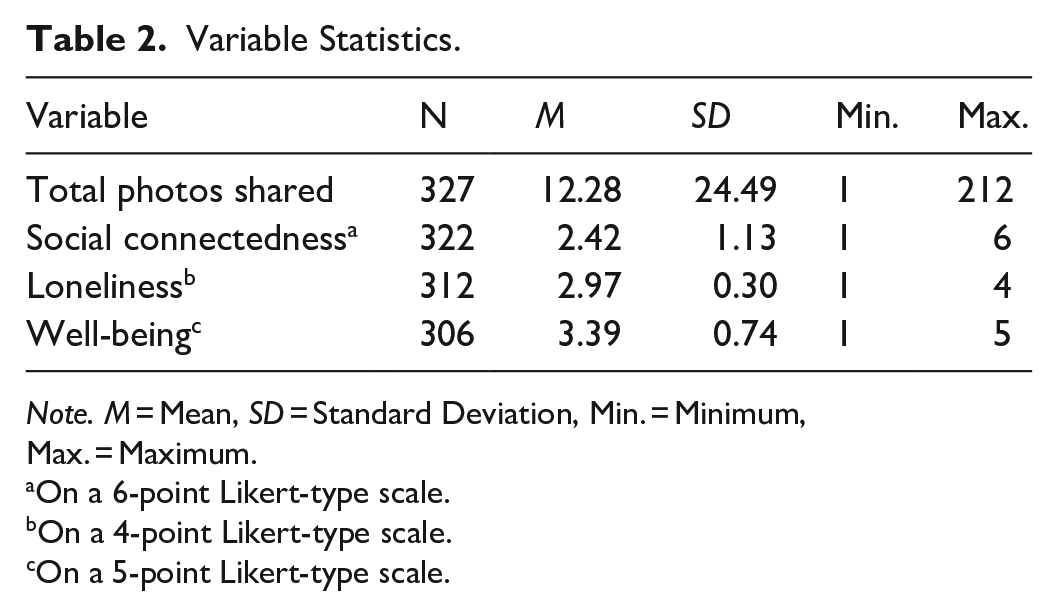
Note. M = Mean, SD = Standard Deviation, Min. = Minimum, Max. = Maximum.
On a 6-point Likert-type scale.
On a 4-point Likert-type scale.
On a 5-point Likert-type scale.
Levels of current loneliness were measured using the UCLA Loneliness Scale (1996) (Russell, 1996). Comparable statistics were M = 2.60 and SD = 0.52 (Borae, 2013). The scale had a low internal reliability based on Cronbach’s alpha level of α = .50 as compared with α = .90 found in another study (Borae, 2013). Given the Cronbach’s alpha levels, the results may be considered as having lower internal reliability. However, internal reliability should not be the only factor considered when assessing the reliability of scales. A combination of Cronbach’s alpha with additional reliability and relationship statistical tests should determine the reliability of the scale when the Cronbach’s alpha result is low (Cumming, 2014). The results from the scale were assessed to be complete and of a reasonable quality. The determination of the scales reliability was based on a combination of correlation assessments, sample sizes, and analysis methods used to validate the hypotheses, which suggests the scale was reliable for hypotheses testing and is suitable for the study (Cumming, 2014).
Respondents completed the UCLA Loneliness Scale, first, for the period of “in the last two weeks” and second, in relation to “in general, looking back over your lifetime.” The UCLA Loneliness Scale has been used in a similar fashion to confirm those experiencing trait loneliness (Gerson & Perlman, 1979; Hector-Taylor & Adams, 1996; Robinson et al., 1991; Spitzberg & Canary, 1985). Respondents classified as experiencing trait loneliness were those who scored in the top third of both scales (Gerson & Perlman, 1979; Robinson et al., 1991). The remaining respondents were classified as not experiencing trait loneliness and therefore experiencing state loneliness. Using the method described, 35% of respondents were classified as experiencing trait loneliness and the remaining 65% were classified as experiencing state loneliness. The combined mean for the trait loneliness scale was 59.61 (SD = 6.53) and the combined mean for the state loneliness scale was 59.31 (SD = 6.33). For the purposes of the study participants were classified as outlined at the point of data collection, however, this is not to suggest that those participants classified as “state lonely” for example, cannot be understood as also being consistently lonely in some measurable way commensurate with trait loneliness.
Well-being was measured using the Warwick-Edinburgh Mental Well-Being Scale (WEMWBS, 2006; NHS Health Scotland, 2016). WEMWBS includes statements asking respondents about how often they experience certain feelings and thoughts in relation to “interest in other people” and “feeling close to other people” (NHS Health Scotland, 2016). The scale had a high internal reliability based on a Cronbach’s alpha level of α = .88. The results were in line with the comparable mean of 3.7 (SD = 0.84) found in an extant study (Santos et al., 2015), and a high level of reliability, Cronbach’s α = .89, was identified in this study (NHS Health Scotland, 2016).
Procedure
To test the hypotheses of the study, survey data were collected from participants who had Instagram accounts. Participants were recruited through Facebook, Instagram, and online survey groups. The questionnaire was accessed through an online survey link and included an information sheet agreed to by the participants. The link was shared across various online international research community groups and websites such as Facebook, Instagram, and Survey Circle. There was no targeting of particular countries or regions. Ethical approval from the university’s Human Research Ethics Committee was obtained prior to data collection (Protocol No. H19047).
Data Analysis
Data analysis was performed in IBM SPSS Statistics Version 26 using multiple regression analysis and Model 1 of the PROCESS v3.3 “add on.” For the Likert-type scale ranges, the total score for each participant was calculated by averaging the individual summed item scores, where higher scores indicated higher levels on the scales. The mean score for each participant provides a score that can be compared to the Likert-type scale range (Gravetter & Wallnau, 2007, pp. 3–9). The determination of whether results are significant was based on the analysis of p values and the size of the effect, in accordance with American Statistical Association (ASA) guidance (Wasserstein & Lazar, 2016). The interaction plots “Low” ranges are one standard deviation below the mean, “Mid” ranges are the mean, and “High” ranges are one standard deviation above the mean.
A review of other studies that used similar analysis methods was completed to validate the approach of moderation testing. Wisniewski et al. (2017) adapted an approach using Confirmatory Factor Analysis (CFA). CFA usually requires at least four constructs with at least three variables per construct (Wisniewski et al., 2017). The PROCESS add on is a popular SPSS analysis approach to moderation. It has returned over 40,000 Google Scholar results and the SPSS PROCESS moderation method used in this research allows for multidimensional results that answered the hypotheses to be derived without the need for CFA (Hayes, 2017). The moderation analysis provides outcomes for building profiles using low-, mid-, and high-level classifications to generate specific themes related to the moderation effect of photo sharing (Hayes, 2017). Bartsch and Dienlin (2016) analyzed the hypotheses for their research questions with Structural Equation Modeling (SEM). Their participants answered only 77% of results in their final model indicating a high number of missing values making SEM a suitable technique. SEM is a technique also used for confirmatory analysis rather than exploratory (Hooper et al., 2018). However, the PROCESS add on is specifically designed to test moderation in the scenario this study was analyzing and there was no missing data. The PROCESS add on automatically estimates the parameters of the regression equations and the results are largely identical to using SEM (Hayes et al., 2017). There is also some complexity to drawing a graphical model in SEM, however, the PROCESS add on can provide the same results without the need to draw a path diagram (Hayes, 2017). Therefore, the PROCESS add on in SPSS for moderation testing is deemed an appropriate way to test the hypotheses.
Results
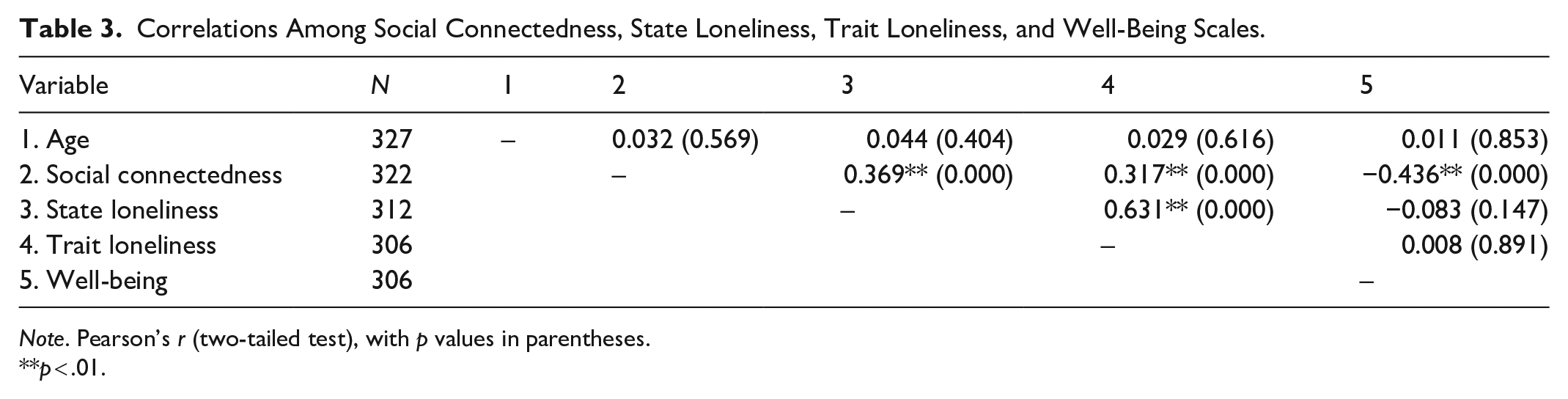
Table 3 below shows the correlation assessment among the variables of age, social connectedness, loneliness, and well-being.
Correlations Among Social Connectedness, State Loneliness, Trait Loneliness, and Well-Being Scales.
Note. Pearson’s r (two-tailed test), with p values in parentheses.
p < .01.
Social connectedness was found to have a significant relationship with all variables except for age. The analysis shows higher levels of social connectedness were associated with lower levels of loneliness. In comparison, the results show lower levels of well-being were associated with higher levels of social connectedness. There is a positive relationship between state loneliness and trait loneliness, which is to be expected as higher levels of trait loneliness would exist for trait lonely respondents also experiencing state loneliness. A Spearman’s correlation assessment was used to assess gender with the variables in Table 3 and no significant correlations were found.
The results of moderation analysis without and with the photo sharing interaction are summarized in Figures 2 and 3, respectively. The results confirm there are existing relationships among social connectedness, state loneliness, trait loneliness, and well-being. Furthermore, the analysis shows photo sharing moderated these relationships and differences were found between those experiencing state and trait loneliness.

Results of the multiple regression analysis excluding the effect of the photo sharing moderator.

Results of the moderation analysis including the effect of the photo sharing moderator.
State Loneliness
It was expected that Instagram photo sharing would have a moderating effect on the association between the levels of social connectedness and loneliness for individuals experiencing state loneliness. The results of the first phase without the moderator variable of photo shared were significant at the .0001 level and accounted for 3.7% of the variance in state loneliness levels, R2 = .037, F(2,197) = 3.757, p < .025. After controlling for the moderator of photo sharing, the results were significant at the .005 level and accounted for an increase of 3.7% (ΔR2 = .037) to 7.4% of the variance in state loneliness levels, R2 = .074, F(1,196) = 7.935, B = 0.002, t(196) = 2.817, p < .005. These results confirmed Hypothesis 1, that levels of photo sharing moderate the relationship between state loneliness and social connectedness for users experiencing state loneliness. Examination of the interaction plot as shown in Figure 4 showed an enhancing factor for high levels of photo sharing where loneliness levels were higher, social connectedness levels were also high. Thus, the lowest levels of state loneliness were experienced when low social connectedness and high photo sharing levels coexisted. The highest levels of state loneliness were found at high levels of social connectedness for all levels of photo sharing.

Interaction plot showing the moderating effect of photo sharing on the association between social connectedness and state loneliness.
Trait Loneliness
It was expected that Instagram photo sharing would have a moderating effect on the association between the levels of social connectedness and loneliness for individuals experiencing trait loneliness. The results of the first phase without the moderator variable of photo shared were significant at the .0001 level and accounted for 10.1% of the variance in trait loneliness levels, R2 = .101, F(3,302) = 11.264, p < .000. After controlling for the moderator of photo sharing, the results were significant at the .0001 level and accounted for an increase of 8.8% (ΔR2) to 18.9% of the variance in trait loneliness levels, R2 = .189, F(3,105) = 8.1295. The results supported Hypothesis 2, that levels of photo sharing moderate the relationship between loneliness and social connectedness for users experiencing trait loneliness.
The interaction variable was found to be significant at the p < .06 level, B = 0.001, t(105) = 1.9399, p = .055. While the result is above p < .05, the p value should not be the only indicator of a significant effect (Wasserstein & Lazar, 2016). The increase of the effect on the dependent variable of trait loneliness by 8.8% (ΔR2) to 18.9% indicates a moderating effect which is further evidenced by the non-parallel lines of the interaction effect in Figure 5. Examination of the interaction plot as shown in Figure 5 showed an enhancing effect for levels of trait loneliness across all levels of social connectedness as photo sharing increased. At low and mid levels of photo sharing across all levels of social connectedness, trait loneliness levels remained the same. At low-social connectedness, levels of trait loneliness remained the same for all levels of photo sharing. However, high levels of photo sharing seemed to have an effect at mid and high levels of social connectedness, associated with higher levels of trait loneliness.

Interaction plot showing the moderating effect of photo sharing on the association between social connectedness and trait loneliness.
Well-Being
It was expected that Instagram photo sharing would have a moderating effect on the association between the levels of social connectedness and well-being. The results of the first phase without the moderator variable of photo shared were significant at the .0001 level and accounted for 19.9% of the variance in well-being levels, R2 = .199, F(3,302) = 24.988, p < .0001. After controlling for the moderator of photo sharing, the results were significant at the .0001 level and accounted for an increase of 3.9% (ΔR2 = .039) to 23.8% of the variance in well-being levels, R2 = .238, F(3,302) = 31.3688, B = 0.004, t(302) = 3.582, p < .000. The results confirmed Hypothesis 3, that levels of photo sharing moderate the relationship between well-being and social connectedness. Examination of the interaction plot as shown in Figure 6 showed at mid levels of social connectedness, well-being levels decreased and remained stable regardless of levels of photo sharing. The most noticeable variance in well-being from photo sharing levels was shown when respondents were experiencing high levels of social connectedness, where higher photo sharing levels were associated with the highest levels of well-being, in comparison to mid and low levels of connectedness.

Interaction plot showing the moderating effect of photo sharing on the association between social connectedness and well-being.
Discussion
There are many influential factors that can affect changes in levels of social connectedness, loneliness, and well-being. A number of important findings from this study contribute to understanding the complexities of how photo sharing may moderate relationships between social connectedness with types of loneliness and well-being.
State Loneliness
Photo sharing moderated state loneliness most noticeably when low social connectedness was experienced. The results found SNS users experiencing state loneliness and low social connectedness may be leveraging higher Instagram photo sharing levels. This result shows levels of photo sharing appeared to reduce loneliness where low social connectedness is being experienced. These results align with those of a previous study in which SNSs communication functions, such as sharing of photos, were associated with higher levels of social connectedness, which reduced loneliness (Ryan et al., 2017). Other research found users reported photo sharing improved levels of social connectedness and loneliness (K. Lee et al., 2013; Scott et al., 2018). The results of this study indicate that when social connectedness is high, photo sharing has no effect on the relationship with state loneliness. In fact, loneliness levels remained high. Loneliness levels may be explained by other research in which loneliness remained high regardless of photo sharing due to SNSs potentially not fulfilling the needs of lonely users. Potentially, face-to-face interactions may be required to offset high levels of state loneliness (Ryan et al., 2017).
Trait Loneliness
At low levels of social connectedness, loneliness levels were low and photo sharing found no moderating effect. The results indicate that higher levels of photo sharing may be beneficial for social connectedness but potentially not for loneliness levels for users experiencing trait loneliness. Extant research found that trait lonely individuals may always feel lonely regardless of online or offline social circumstances (Overland, 1991), which may explain why the highest levels of photo sharing were related to high levels of loneliness even when social connectedness was high for trait lonely participants. Higher levels of trait loneliness being experienced even though social connectedness was high could be associated with excessive use of SNSs that is hindering offline interactions due to users spending extended periods of time on social media attempting to offset feelings of loneliness (Ryan et al., 2017). Other research that found trait loneliness may be felt more intensely or for extended periods (Cacioppo et al., 2013) could support why high levels of trait loneliness may not be influenced by high levels of photo sharing.
Differences Between State and Trait Loneliness
The analysis of the moderating effect of photo sharing on the relationship between social connectedness and loneliness identified differences for users experiencing state and trait loneliness. The different results could indicate the highest levels of photo sharing have an effect across all levels of loneliness. However, photo sharing may have the most benefit when an SNS user is experiencing state loneliness at low levels of social connectedness. In contrast, for those experiencing trait loneliness, high levels of photo sharing may actually be detrimental to loneliness levels even if social connectedness levels were high. These differences warrant consideration of how Instagram photo sharing levels effect loneliness where trait loneliness is a factor. Previous research also found those experiencing different types of loneliness respond differently to activities that influence levels of loneliness (van Roekel et al., 2018). Differential reactivity theory reinforces these findings as those experiencing state and trait loneliness respond differently to how photo sharing moderates the relationship with social connectedness (Cacioppo et al., 2013).
Well-Being
There are many dimensions and manifestations of psychological well-being (Meier & Reinecke, 2020). In this study, levels of well-being were lower as social connectedness and photo sharing levels were higher. This may be explained by online interactions potentially reducing offline face-to-face social connectedness activities, which could hinder the well-being of users (K. Lee et al., 2013). The results could also be explained by other research that found time spent online had a small negative association with well-being (Meier & Reinecke, 2020). Higher levels of photo sharing could be related to spending more time online posting photos. In addition, other studies found high-quality interpersonal face-to-face experiences were most beneficial for well-being levels (Bevinn, 2011). Offline face-to-face interactions may be lacking when more time is spent online sharing photos which could negatively affect well-being. The moderating effect of low and mid levels of photo sharing were associated with minimal variance in the effect on well-being levels. This result indicates the highest levels of photo sharing were most relevant for influencing well-being levels. Therefore, higher photo sharing levels may be most effective for increasing levels of well-being when high levels of social connectedness were being experienced for SNS users.
Conclusion
This study investigated gaps in other research by examining how photo sharing may moderate the relationship between social connectedness with loneliness and well-being. Differences were found as to how photo sharing moderates the relationship among social connectedness with types of loneliness, which is an important finding for SNS user’s experiencing loneliness. The findings in this thesis provide new information regarding the effect of Instagram photo sharing on its relationship with social connectedness for reducing loneliness and improving well-being.
Theoretical Considerations
The results of this study strengthen the understanding of previous research and theories when being applied to the relationships and effects among SNS photo sharing, social connectedness, loneliness, and well-being. First, this study differentiated between sharing versus viewing Instagram photos, where previous studies had not separated these measurements. The study found that photo sharing moderates the association between loneliness and well-being. Therefore, photo sharing can be considered a moderator on the association between other feelings or emotions rather than having a direct effect.
Second, this study established that photo sharing moderates the association between social connectedness, loneliness, and well-being. This study is the first to link photo sharing to moderating the relationships between social connectedness and well-being. The investigation of the effects on loneliness and well-being in conjunction with social connectedness confirms that, while they may be separate measurements, photo sharing predicts different outcomes based on changes to social connectedness.
Third, this study found differences in how users experiencing different types of loneliness respond to photo sharing when social connectedness levels change. This reinforces the idea that experiences relating to SNS photo sharing differ for those experiencing state loneliness versus trait loneliness. Differential reactivity theory suggests that there are differences in how individuals respond to the same stressors and feelings (Cacioppo et al., 2013). Differential reactivity theory could be applied to SNS users experiencing levels of state and trait loneliness and how differences may apply for the relationship with social connectedness when moderated by photo sharing.
Practical Implications
This study contributes to a better understanding of SNS photo sharing and the variety of factors that may influence levels of social connectedness, loneliness, and well-being. This known ambiguity has very real consequences for SNS providers and users looking to optimize online SNS photo sharing technology to foster safe online environments. These findings could form the basis of future SNS policy to ensure that photo sharing technology development favors the most effective use for social connectedness, loneliness, and well-being benefits. The results of this research shed light on the complexity associated with the varying photo sharing levels that can either improve or worsen social connectedness, loneliness, and well-being. This is important so users understand how the act of photo sharing may moderate relationships between social connectedness, loneliness, and well-being. In addition, development of education packages for users may provide an opportunity to increase knowledge about the self-management of SNS photo sharing and the purpose of their photo sharing to ensure optimal social connectedness, loneliness, and well-being outcomes.
For those experiencing trait loneliness, low and mid levels of photo sharing were associated with the lowest levels of loneliness across all levels of social connectedness. This indicates that these levels of photo sharing may be beneficial for users experiencing chronic trait loneliness. Conversely, the highest levels of photo sharing were most beneficial to loneliness for those experiencing short-term state loneliness. This may be because those experiencing trait loneliness are looking for positive interactions to help improve levels of loneliness and finding these online through close contacts may help achieve improvements in loneliness (Ryan et al., 2017; van Roekel et al., 2018). This is an important finding for SNSs, as photo sharing levels not aligned to the best outcome for loneliness may actually worsen levels being experienced rather than improve them. Consideration should be given to drive future technology enhancements and the current use of SNS technology in ways that positively influence mental health, due to the growing issue of loneliness in today’s society (Campaign to End Loneliness, 2015). SNSs could introduce measurements to ethically assess whether a user is experiencing state or trait loneliness. Photo sharing functions could then be enhanced to allow users to self-monitor levels of social connectedness, loneliness, and well-being based on different photo sharing levels. Such a function would allow users to monitor and be aware of their own social connectedness, loneliness, and well-being levels over time.
Future Research and Limitations
Although participants were asked to log into their Instagram accounts to verify the information provided, the study did not validate if the information provided was correct due to privacy issues with obtaining data from actual accounts. Approximate figures are useful to understand the perceived relationships between variables and the filtering out of outliers identified responses that may not be valid. Future studies may enhance results by validating information from Instagram accounts. There is great difficulty in establishing causality between psychological factors, such as perception and emotions. This process is further complicated when considering the impact of historical factors that may also be influencing social connectedness, loneliness, and well-being levels. While this study’s scope focused on understanding the moderating effect of photo sharing, a natural progression would be to understand direct psychological assessments for participants in more detail to understand other influences, potentially using longitudinal studies monitoring variables over time.
There was an over-representation of female and younger people in the demographics of the study. This was not deemed to be an issue for the results of this study, as measurement was based on Instagram users regardless of age or gender. Given the purpose of the study was to analyze all Instagram users, no specific types of users were targeted so as not to skew or influence the results.
The study was focused on understanding the effect of SNS photo sharing. Other studies could analyze further differences and other effects that might arise when also looking at the types of photos shared along with reactions received to sharing photos. The effect of viewing photos and sharing of videos were specifically excluded from the study so the relationship with photo sharing could be better understood. Additional insights could be gained from investigating the effect of viewing photos or sharing of videos as distinct from photo sharing as differences may arise when inclusion of viewing of photos and/or sharing of videos is considered.
Footnotes
Declaration of Conflicting Interests
The author(s) declared no potential conflicts of interest with respect to the research, authorship, and/or publication of this article.
Funding
The author(s) received no financial support for the research, authorship, and/or publication of this article.
