




Abstract
In recent years, some political commentators and mainstream media outlets in the United Kingdom have pejoratively labelled young people, especially university students, a ‘snowflake generation’ – a term used to mock their perceived intolerance and over-sensitivity (Fox, 2016; Gullis, 2017; Slater, 2016; Talbot, 2020). This article challenges this discourse by drawing on findings from a large-scale study (N = 810) conducted on a university campus in England that critically examined student’s perceptions of and attitudes to different forms of online harassment, including abusive, offensive and harassing communications, using survey and interview data. Key findings indicate that online harassment is so pervasive in digitised spaces that it is often viewed as the ‘norm’ by the student population who appear willing to tolerate it, rather than take actions to address it, which challenges pejorative claims that they are intolerant and easily offended ‘snowflakes’. Respondents who identify as female and transgender are more likely to be targeted by online harassment. We argue that the label ‘snowflake generation’ is diverting attention away from student’s everyday experiences of online harassment and its adverse effects, particularly on women and transgendered people, which has the potential to create a gender-related digital divide (Jane, 2018). The implications of these findings for the higher education sector will be outlined.
Keywords
Introduction
In recent years, an increasingly dominant discourse has emerged in the United Kingdom, which has pejoratively labelled young people, especially university students, a ‘snowflake generation’ – a term used to mock their perceived intolerance and easily offended nature (Nicholson, 2016). 1 Initially, these claims were advanced by more extreme right-wing voices, including Claire Fox (2016a: 4), the former revolutionary communist party activist turned Conservative politician, who argues that young people, who she calls the ‘Snowflake Generation’ (Fox, 2016a: 57), are ‘thin-skinned’ and represent a ‘new breed of hyper-sensitive censorious youth’ (Fox, 2016b: np). However, in recent years, these negative characterisations of young people, which discursively constitute them as hypersensitive ‘snowflakes’, have also gained traction in the mainstream media. For example, writing in the Daily Mail, Joe Pinkstone (2018: np) argued that young people who have grown up immersed in digitised spaces have become a ‘mentally fragile generation of millennials’ who he names ‘snowflake iGen’. An article that featured in The Independent uncritically asked if the ‘snowflake generation’ is ‘really about to kill off comedy’ (Brown, 2018: np).
Right-wing commentators have also claimed that university students’ ‘hypersensitivity’ (Fox, 2016b: np), over-attachment to ‘identity politics’ and ‘political correctness’ (Slater, 2016: 3) has led to a growing movement of censorship on university campuses that is adversely affecting freedom of speech. These claims have been dismissed by the UK Joint Committee on Human Rights (2018: 4) who state censorship on UK university campuses ‘is not a pervasive problem’.
However, the idea that university students are a hypersensitive, censorious ‘snowflake generation’ continues to circulate in mainstream media spheres in the United Kingdom, on the right and left of the political spectrum. The Sun and The Express have both featured articles in recent years that claim so-called ‘snowflake student unions’ (Sullivan, 2018: np) ban practices or organisations that university students find offensive due to their ‘over-sensitivity’ (Talbot, 2020). While traditionally left-wing and liberal media outlets such as The Guardian, have challenged claims that students are stifling freedom of speech (Scott-Bowman, 2017), other left-leaning liberal media outlets, such the Huffington Post, have also perpetuated the discourse of ‘student snowflakes’ in news stories that claim they are ‘struggling to cope with ideas different from their own’ and are ‘too emotionally vulnerable’ (Gullis, 2017: np).
These prevailing discourses, which characterise university students as hypersensitive and easily offended ‘snowflakes’, coexist alongside other contrasting reports from student unions, who indicate that this demographic is routinely exposed to offensive, abusive and harassing forms of online communications (National Union of Students (NUS), 2016; see also Universities UK (UUK), 2019). The NUS (2016) found that student populations at UK universities often consider online shaming, threats and abuse as the ‘norm’ within their daily routine of social media posts and messages, which they believe has played a role in creating a culture of fear and intimidation.
While online harassment has been identified as an issue by the higher education sector, there is a dearth of empirical research about the extent, nature and impact of online harassment in students’ peer-to-peer interactions on UK university campuses (Myers and Cowie, 2017). For example, while gendered forms of online harassment on UK university campuses have been recognised as a significant issue in recent years (e.g. UUK, 2016, 2019), there is a lack of empirical research that critically examines and compares gendered differences in student’s experiences and perceptions of and attitudes to these practices in locally specific contexts. Moreover, there is limited research on university students’ attitudes to different forms of online harassment. In a sociocultural context where young people are described as overly sensitive and easily offended ‘snowflakes’, how do university students from this demographic perceive offensive, abusive and harassing forms of communication? Are there gendered differences in student’s experiences of and attitudes to different types of online harassment including its gendered and sexualised forms? We contend that the lack of research about these social issues works to conceal the scale, nature and impact of online harassment in student’s peer groups, and thus, indirectly serves those who wish to pejoratively label this demographic the ‘snowflake generation’ (Nicholson, 2016).
This article aims to address these research gaps. We present data from a large-scale study (N = 810), which is the first to critically examine the extent, nature and impact of online harassment in student’s peer-to-peer interactions on a university campus in the United Kingdom, including their perceptions of and attitudes to these practices and how they would respond to specific incidents, if at all. The purpose of this study is two-fold. Firstly, it aims to provide data about the extent, forms and impact of online harassment in student’s peer groups on a university campus in the United Kingdom, a context which remains under-researched (Myers and Cowie, 2017). Secondly, this article aims to use this empirical data to challenge pejorative characterisations of UK university students as easily offended ‘snowflakes’, by exploring their experiences and toleration of offensive and abusive online communications, and as a corollary, how these forms of harassment may affect levels of online engagement, thus reproducing a gendered ‘digital divide’ (Jane, 2018; Van Dijk, 2005). Before we present our data, we will firstly explain how we define online harassment. We will then review a range of literature that critically examines how online harassment reflects and reifies forms of social division, marginalisation and inequality in digitised spaces, which enables us to contextualise our research concerns.
Defining online harassment
Within the context of this study, we adapt a definition of online harassment presented by Jones et al. (2013: 54): ‘online harassment is defined as threats or other offensive unwanted behaviours targeted directly at others through new technology channels (e.g. Internet, text messaging) or posted online for others to see that is likely to cause them harm, unintentionally or otherwise’ (our adaption in italics). Online harassment can take many forms, such as spreading malicious rumours, sending abusive direct messages and the non-consensual sharing of personal content, including sexual images. If perpetrators of online harassment target an individual’s actual or perceived identity, such as their gender, sexuality, race, religion or disability – known as ‘protected characteristics’ in the United Kingdom (Equality Act, 2010), these practices constitute hate crimes (Crown Prosecution Service, 2017). Online hate crimes can include any form of online communication that is motivated by hostility or prejudice against any individual or group because of their actual or perceived gender, sexuality, race, religion and/or disability, such as inciting violence against them.
Online harassment can manifest in different ways, depending on the individual and social group targeted. For example, studies consistently show that women are more likely to be targets of gendered-based online harassment than men (Pew Research Centre, 2017; see also Southern and Harmer, 2019). Studies have also indicated that young women in the United Kingdom are more likely to experience sexualised forms of online harassment, than men (Her Majesty’s Government (HMG), 2019). For example, a YouGov (Smith, 2018) survey, which involved 2121 women and 1738 men, found that 40% of British women (aged 18–34) have been sent an unsolicited sexual image from someone who was not a romantic partner, compared with 26% of men who have had the same experience. These forms of online abuse and harassment are recognised as a digital extension of physical forms of gender-based abuse and violence against women in society (Gillett, 2018).
A significant number of studies have indicated that online harassment can have a range of adverse emotional, psychological and physiological effects on those subjected to these practices, including stress, anxiety, fear, panic attacks and, in more extreme cases, suicidal thoughts (e.g. Amnesty International, 2017; Ditch the Label, 2017; Lenhart et al., 2016). The specific characteristics of online communication, such as the far reach and permanency of online content, can often facilitate and exacerbate online harassment and its adverse effects.
Online harassment can also negatively impact on the victim’s motivation to use and engage with digitised spaces. Lenhart et al. (2016) found that young women who have witnessed or experienced online harassment were more likely to self-censor what they post online than those who have not been subjected to these practices, to minimise the risk of experiencing further harassment. Scholars have referred to these adverse effects of online harassment as ‘silencing’ strategies as they impede women’s online participation and citizenship (Banet-Weiser and Miltner, 2016: 172; see also Jane, 2018; Megarry, 2014). By impeding women’s ability to participate in online spaces, gender-based online harassment plays a significant role in marginalising and excluding these gendered subjects in these contexts (Harmer and Lumsden, 2019). We will now consider some theoretical concepts which help us to understand these social practices and their adverse impacts, including those that manifest in student’s peer-to-peer interactions.
Digital divisions and inequalities
Social forms of division, marginalisation and exclusion produced in digitised spaces have been theorised using various concepts, such as a ‘digital divide’, which describes ‘forms of stratification’ (Muschert and Gunderson, 2017: 11) that emerge in digitised spaces in ways that reproduce and in some cases exacerbate inequalities between social groups. Early research on the digital divide primarily recognised online inequity as a technological and economic problem. For example, Van Dijk (2005) examined the forms of social stratification and social inequity that result from unequal access to digital technologies, the Internet and the skills required to use digitised spaces, which often means populations are not able to fully engage with and benefit from online communication, knowledge and citizenship. However, this scholarship primarily conceptualised digital divisions and inequities in terms of technological access and skills. Subsequent research identified lack of willingness or motivation to use digital spaces as an issue that should be considered when critically examining the digital divide (Scheerder et al., 2017).
In recent years, scholars have broadened how the digital divide is conceptualised by drawing on sociological theories to reveal how social inequalities are reproduced by the historical and structural inequities that underpin digitised spaces. For example, scholars have employed feminist theory to reveal how societal divisions, particularly those that are gendered, are reproduced within and through digital technologies (e.g. Kendall, 2002; Jane, 2016, 2018). These studies have revealed that men have dominated the development of both digital technologies and digitised spaces, which has worked to reproduce gendered inequities in these contexts. For example, Massanari (2015) has revealed how the algorithmic politics of certain platforms such as Reddit aggregate material in ways that prioritise the interests of young, White, heterosexual men (see also Banet-Weiser and Miltner, 2016).
There is some research that critically examines the role of online harassment in producing digital divides in male-dominated digitised spaces, though this remains an under-researched area. For example, Jane (2018) draws on feminist theory to explore how gendered cyberhate, which targets women with forms of harassment, abuse and threats in digitised spaces, forces some to disengage from these spaces, which adversely affects their online participation and digital citizenship. She argues that ‘the impact of gendered cyberhate on targets is impeding online participation and digital citizenship and therefore does constitute a new dimension of existing, gender-related digital divides’ (Jane, 2018: 186). Her research reveals how these online forms of abuse, harassment and hate reproduce deep-rooted gendered inequalities in digitised spaces by adversely affecting women’s online participation and citizenship, which expands upon how digital divides are understood.
However, the relationship between digital divides and online harassment remains under-researched. For instance, studies do not address the way in which online harassment reproduces social inequalities, including those that are gendered, by negatively impacting on an individual’s motivation to participate in online spaces (Helsper and Reisdorf, 2017; Van Dijk, 2020). Consequently, the digital divide literature does not explain the extent to which online harassment reproduces social inequalities in student populations on UK university campuses by adversely affecting gendered subject’s motivation and willingness to engage in online spaces. This article will address these empirical and theoretical gaps by examining how online harassment can adversely affect students from specific gendered groups in ways that impede or reduce their digital engagement and thus create a gender-related digital divide (Jane, 2018). We argue that politicised discourses in the broader social context, which pejoratively describe university students as a ‘snowflake generation’ (Nicholson, 2016), mask these social forms of marginalisation and exclusion.
Methodology
To address our research concerns, we employed a ‘convergent parallel research design’ (Snelson, 2016: 9), which primarily used a large-scale survey (n = 795) to gather relevant data from students on the university campus. This was supplemented with qualitative data collected from in-depth interviews with respondents (n = 15). These combined research methods allowed us to ‘triangulate’ (Snelson, 2016: 9) our data and deepen our understanding of particular aspects of students’ experiences.
The survey began by gathering relevant demographic data from the student population. The second section of the survey gathered relevant statistical data about the extent, nature and severity of online harassment respondents have directly experienced and/or indirectly experienced 2 in their peer-to-peer interactions with other students at the university campus. These data were collected by asking respondents to respond to a range of scenarios representing different forms of online harassment using response options based on an adapted 6-point Likert-type scale (see Table 1 of Appendix 1).
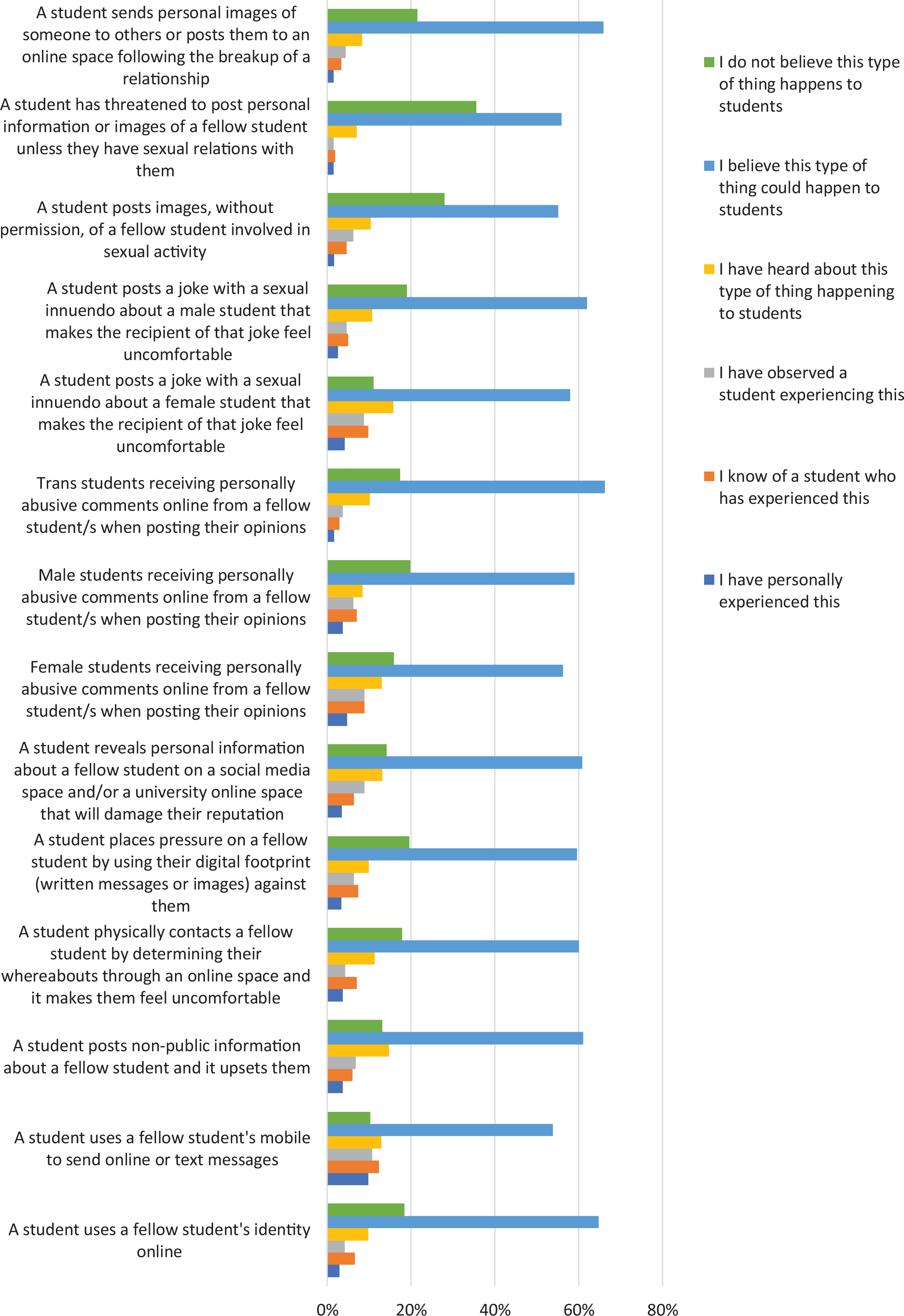
Bar chart showing respondents’ experiences and perceptions of different forms of online harassment.
The final section of the survey was concerned with exploring student’s perceptions of and attitudes to different forms of online harassment observed and/or experienced in their peer-to-peer groups on the university campus and how they would respond to them, if at all. To address these research concerns, survey participants were asked to respond to a series of scenarios representing different types of online harassment, using a range of response options based on an adapted 6-point Likert-type scale, which enabled them to indicate how they would respond to specific incidents, such as whether they would want to report them to the university and/or student’s union, or not (see Table 2 of Appendix 1). The online survey was sent to 8000 students on the university campus, who are all aged 18 years and over, with a return sample of 795 students. This sample was representative of the student population with a confidence limit of 95% and confidence interval of 4.
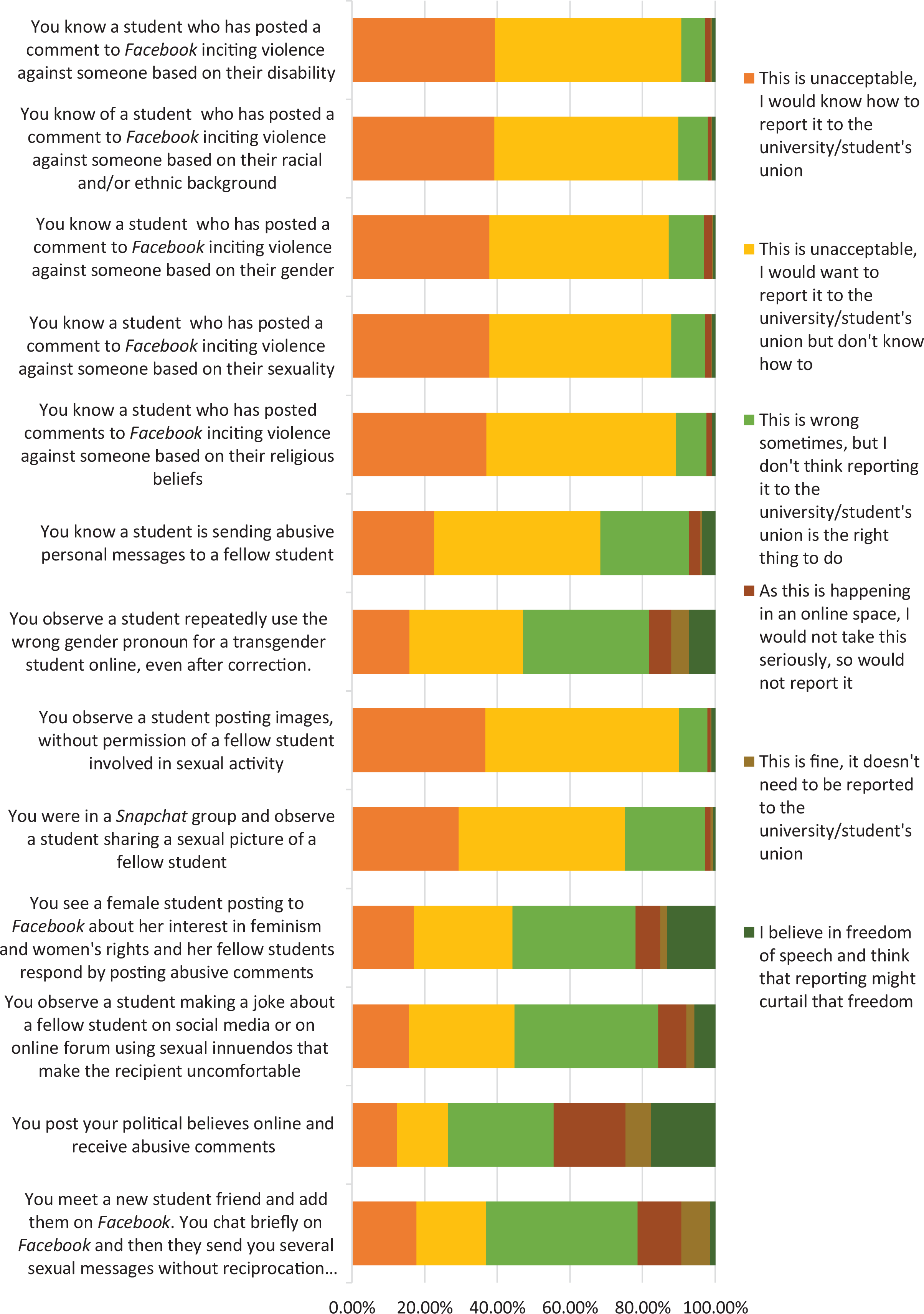
Bar chart showing respondent’s attitudes towards reporting different forms of online harassment.
In-depth qualitative interviews (n = 15) were conducted with survey respondents who felt they had experienced online harassment in their peer-to-peer interactions on the university campus. The research team encountered some difficulties in recruiting participants for the research interviews, which were influenced by a number of sociocultural issues. For example, some participants acknowledged that they were initially reluctant to speak to researchers about their experiences of online harassment in their peer groups as they felt embarrassed and ashamed that they had been targeted. Similar findings have been observed in other studies, including Cowie and Myers (2017: 10) who found that university students who are subjected to cyberbullying in their peer groups often feel ‘a range of emotions, such as fear and shame’. These difficulties in recruiting participants meant the interview sample was relatively small. However, the interview sample was comprised of participants from a range of demographic backgrounds, which enabled a deeper understanding of their subjective perceptions of and attitudes to online harassment and its impact on them.
Qualitative data from the survey and interviews, namely, open-ended comments and interview transcripts, were analysed thematically, using codes generated from the relevant literature and those that emerged during the research process. All research data were collected and analysed between May 2018 to March 2019. In what follows, we divide our findings into three themes that emerge from our research: the prevalence of online harassment, common forms of online harassment and attitudes to reporting online harassment. Understanding the prevalence and forms of online harassment within student’s peer groups and their attitudes to reporting specific incidents to authorities on the university campus will better enable us to assess the claim that the current generation of university students are ‘hypersensitive’ snowflakes (Nicholson, 2016).
The prevalence of online harassment
One of the aims of this study was to understand the prevalence of online harassment in student’s peer groups on the university campus. Our campus-wide survey found that 21.94% of respondents (n = 620) said they have experienced online harassment in their peer-to-peer interactions on the university campus and 5% thought they may have (n = 620). 3 This figure is lower than Government estimates, which suggest that 41% of young people have experienced online harassment (HMG, 2018). However, as we explore later in this article, online harassment is often perceived to be the ‘norm’ by some research participants (see also Myers and Cowie, 2017); therefore, some respondents may not have reported that they experienced online harassment in our survey because they did not recognise their experiences in this way.
Our survey indicated that there are gendered differences in student’s experiences of online harassment in their peer-to-peer interactions on the university campus; 25.9% of female respondents report that they had experienced online harassment and 7.1% feel they might have. In contrast, 18% of male respondents reported that they had experienced online harassment and 3.3% thought they might have. Therefore, 7.9% more women, than men in our sample, reported that they had experienced online harassment in their interactions with their student peers on the university campus. The findings are consistent with other studies, which have indicated that girls and women in the United Kingdom are more likely to be subjected to online harassment (Ditch the Label, 2017; UUK, 2019). However, other United Kingdom-based studies have reported no gendered differences in young people’s experiences of online harassment. In a study that critically examined the online experiences of 320 adolescents (aged 13–18 years) in the United Kingdom, Popovac (2017) found that female and male participants had similar experiences of cyberaggression and cyberbullying.
This study found that transgender students are also more likely than male students to experience online harassment in their peer groups on the university campus. Our survey findings indicated that over half of transgender respondents (54.2%) have either experienced online harassment (54.2%) in these digitised spaces or think they may have (16.7%) (n = 28) (p = 0.000). These findings are consistent with other studies, which have shown that individuals and groups from transgendered communities in the United Kingdom are more likely to experience online harassment (Ditch the Label, 2017).
Common forms of online harassment
Another aim of this study was to understand the prevalence of different forms of online harassment in student’s peer-to-peer interactions on the university campus. Survey participants were asked to respond to a range of online scenarios representing different types of harassment (see Figure 1 below for a bar chart showing these scenarios, responses options and results; a full list of results is available in Table 1 of Appendix 1). Respondents could choose multiple responses; therefore, we report the percentage of respondents who selected each response. In what follows, we draw on this survey data to present three forms of online harassment that were perceived to be the most prevalent in their peer groups on the university campus, including data about student’s indirect experiences of these practices. Qualitative interview data are used to examine these practices in more depth.
The form of online harassment most prevalent among survey respondents is the non-consensual use of another student’s mobile phone to send text or online messages; 9.84% of respondents had experienced this form of harassment, 12.3% knew of a student who had experienced this, 10.66% had observed this happening to a student, 12.91% had heard of this happening, 53.89% believed this could happen, while only 10.25% did not believe this could happen (n = 488). Qualitative interviews enabled us to speak to students who have been personally affected by these non-consensual practices, including those who have being coerced into giving their mobile phone to their student peers. In the following extract, a young woman (aged 19 years) describes a fresher
4
initiation ceremony she took part in, which is prohibited on the university campus. In the following interview extract, she describes how she was coerced into giving her mobile phone to an older student: You’re told if you don’t do this, you have to down a drink…. so you’ve to choose between downing a drink or giving someone your phone so that they can send a message from your account…. I mean I’ve had it happen to me.
The second most common form of online harassment experienced by survey respondents is abusive comments received when posting one’s opinions online. When presented with an online scenario that described a young woman receiving abusive posts from her student peers when she posted her opinions online, 4.74% of female respondents had personally experienced this, 8.87% knew of a someone who had, 8.87% had observed it happening, 12.99% had heard of it happening, 56.29% believed it could happen, while only 15.88% did not believe it could happen (n = 485). When respondents were presented with the same scenario, except that it involved male students, 3.71% of male respondents reported that they had personally experienced this, 7.01% knew of a peer who had experienced this, 6.19% had observed it happening in their peer groups, 8.45% had heard of it happening, 58.97% believed this could happen, while only 19.79% did not believe this could happen (n = 485). These findings suggest that female students are slightly more likely to be subjected to these forms of online harassment than their male counterparts in their peer-to-peer interactions.
Unsolicited sexual innuendos were perceived to be the third most common form of online harassment, in survey respondent’s peer groups and findings suggest that women are more likely to experience these practices than men. When presented with an online scenario that described a woman receiving unwanted sexual innuendos from her fellow students, 4.16% of female survey respondents had experienced this form of harassment, 9.77% knew of it in their peer groups, 8.73% had observed it happening, 15.8% had heard of it happening, 58% believed it could happen and 11.02% did not believe it could happen (n = 481). When presented with a similar form of harassment targeting male students, lower percentages of survey respondents had experienced, knew of, observed or heard of this happening in their peer groups on the university campus – 2.48%, 4.96%, 4.55% and 10.74% respectively. These findings are consistent with other studies which suggest women in UK universities are more likely to experience unwanted sexual advances, than men (Brook, 2019). Within this study, a slightly higher number of survey respondents (61.98%) indicated that they believed their male peers could receive unwanted sexual innuendos in their online student peer groups. However, the number of respondents who did not believe this would happen to their male peers (11.02%) is lower than the number of respondents who did not believe it would happen to their female peers (19.01%) (n = 484). We were able to further explore participant’s experiences of online sexual harassment through our in-depth qualitative interviews.
The prevalence of image-based forms of sexualised online harassment in student’s peer groups emerged as a common theme in our qualitative interviews. Image-based forms of sexual online harassment have broadly been defined as ‘the non-consensual creation and/or distribution of private sexual images’ (McGlynn and Rackley, 2017: 534). The creation and distribution of unsolicited sexual images of male genitalia, often known as ‘dick pics’, was perceived to be a common practice among our research participants, with many young women viewing it as the ‘norm’ (see also Smith, 2018). Some female research participants spoke about receiving unsolicited ‘dick pics’ from male online users, often in response to images they posted of themselves on social media platforms, such as Facebook and Instagram, which were not sexually explicit, suggestive or provocative. In the following extract, a young woman (aged 19 years) speaks about her experiences: I post pictures of my cats on Instagram and stuff and you’ll get a message from someone with an explicit picture from guys of their privates…and I never asked for that.
Research has suggested that some young men who send unsolicited pictures of their penis to young women may not perceive this practice as harassment, but rather hope that it will generate sexual interest from the recipient (Salter, 2016). Within the context of this study, all the young women who received unsolicited ‘dick pics’ from men indicated that this experience had made them feel very uncomfortable, with some admitting they felt victimised, whatever the intentions of those who had sent these images.
Some young women who had experienced and/or observed image-based online sexual harassment indicated that they chose to disengage from social media to reduce their risk of being further subjected to these practices. These views are expressed by a young woman (aged 25 years) in the following interview extract: I know a lot of people like literally just post lots of pictures of themselves…I don’t really post anything anymore…because I’ve had like weird messages from people before in the past…like unwanted dick pics.
To summarise our findings so far, the data about the scale and forms of online harassment experienced by our survey respondents highlight two key trends. First, while respondent’s personal experiences of online harassment are relatively low, they believed that different forms of online harassment are prevalent in their peer groups, which include using an individual’s mobile phone without their consent, sending abusive comments and unwanted sexual innuendos. Over half of our survey respondents indicated that they believed various forms of offensive, abusive and harassing communications could take place in their peer-to-peer interactions. The second trend is that students who identify as female and transgender are more likely to experience online harassment than those who identify as male. These findings indicate that social inequalities between gendered groups, which are structured by deep-rooted gendered inequities in masculinised digitised spaces (Jane, 2016; Kendall, 2002), are being reproduced in and through digital technologies. Gendered inequalities also emerge as a common theme in the data in the last section of this article, where we consider our respondent’s attitudes to reporting online harassment.
Attitudes to reporting online harassment
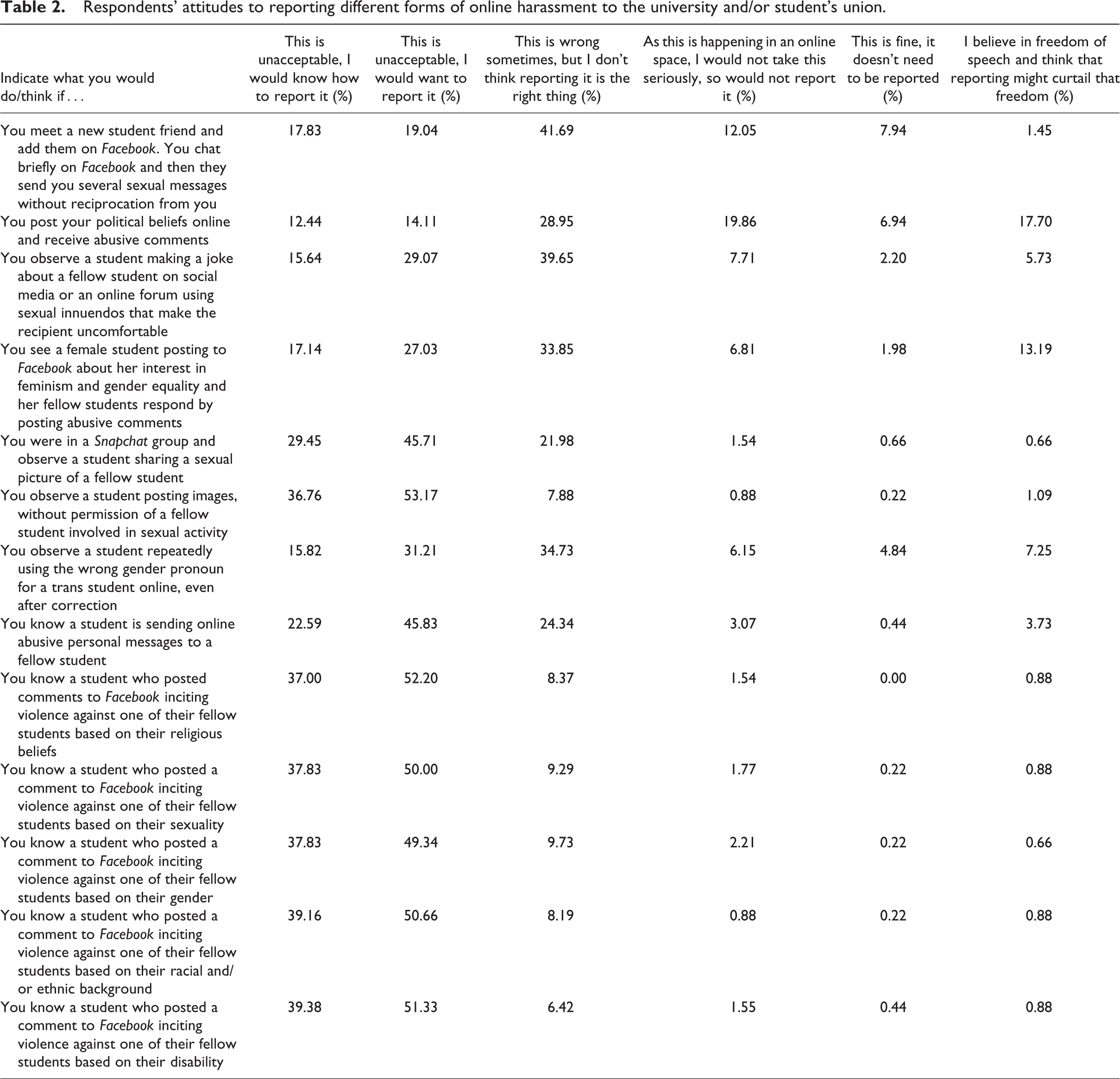
One of the aims of this study was to analyse student’s attitudes to different forms of online harassment experienced and/or observed within their peer groups on the university campus and how they would want to respond to specific incidents, if at all. This study was particularly concerned with analysing whether students would want to report specific incidents of online harassment to the university and/or the student’s union, which was explored by asking participants in our campus-wide survey to respond to a range of online harassment scenarios and their likelihood to report them (see Figure 2 below and Table 2 of Appendix 1).
This analysis revealed that respondent’s attitudes to reporting incidents of online harassment to the university and/or student’s union vary significantly depending on their nature and perceived severity. The vast majority of survey respondents (consistently over 85%; n = 452) indicated that they believe online hate crimes, which involve inciting violence against specific social groups – women, Lesbian, Gay, Bisexual and Transgender communities, Black, Asian and minority ethnic communities, religious groups and those with a disability, are unacceptable and they would want to report such incidents to the university and/or student’s union. Nevertheless, students were less likely to report other less extreme forms of online harassment, such as abusive and harassing communications, which we will now explore.
Survey respondents were least likely to want to report abusive comments received from their peers after they had posted their political views online. When presented with a scenario that asked what they would do if they posted their political beliefs online and they received abusive comments, 73.45% of respondents indicated that they would not want to report this incident to the university and/or the student’s union. Respondents could also indicate why they would not report such online incidents; 28.95% of respondents thought it was wrong sometimes, but not worth reporting, while 19.86% would not take the abuse seriously as it is happening in an online environment and 17.70% thought that it was a freedom of speech issue and therefore not worth reporting (n = 418). Respondent’s lack of willingness to report these politicised forms of online abuse or take other actions to address them challenges prevailing discursive practices that pejoratively label university students over sensitive ‘snowflakes’ who are easily offended by opinions and views they disagree with (Nicholson, 2016). In recent years, the NUS (2016) has observed that politicised abuse has become increasingly prevalent among student communities in the United Kingdom, which they agree is often facilitated by social media and ‘anonymous posts that create a culture of fear and intimidation’ (np). In a report that critically examines these practices, they state ‘we now see less interest in persuading or influencing, and more in attacking and abusing those with different views or interests’ (NUS, 2016: np).
Similar views were expressed by some of the students who participated in this study who remarked that politicised forms of online abuse were perceived to be relatively common among their peer groups. For example, one young man (aged 22 years), who had been active in student political societies on the university campus for a few years, remarked that his peers, particularly those in politicised online spaces, ‘expect to be subjected to online harassment’. However, the interviewee felt that his female peers, including those who are politically active online, experienced more online harassment than other gendered groups, which he felt sometimes impeded their online participation in politicised spaces. He remarks ‘women, in particular will tell you about people in their society or local political party going on to their online accounts…and stalking them and sending them nasty comments’, which caused some to disengage from these digitised spaces. Our research team conducted interviews with women who were involved in political societies on the university campus, who spoke about altering their online behaviour after they had expressed their political views online. Some of these participants chose not to publicly post their political beliefs online to avoid being further subjected to abusive comments.
These locally specific practices reflect patterns of behaviour in the broader national context where UK female politicians, who have been subjected to online abuse and harassment, can withdraw from online practices, which can adversely affect their political participation (Southern and Harmer, 2019). We argue that these practices indicate that online gendered harassment is a barrier to digital inclusion as it can impede female subjects from participating in online spaces, which thus represents a gender-related digital divide (Jane, 2018).
Within this study, survey respondents were less likely to want to report gendered forms of abuse directed at female students to the university and/or the student’s union. When presented with an online scenario that described a woman receiving abusive comments from her student peers when she posted her interest in feminism and women’s rights to Facebook, the majority of respondents (55.82%; n = 455) indicated that they would not want to report this incident to the university and/or student’s union. Significantly, this scenario had the second highest number of respondents indicating they would not want to report it to university and/or student’s union because they believed in ‘freedom of speech’ (13.19%). There were gendered differences in the research participants who chose this response option; 17.3% of all male respondents versus only 3.6% of all females indicated that they would not report this incident to the university and/or student’s union because they believed in freedom of speech (p = 0.000). 6 Thus, male respondents are significantly more likely than female respondents to refer to ‘free speech’ to explain why they would not want to report abusive comments directed at women who express support for feminism. These practices are occurring in digitised spaces where ‘networked misogyny’ (Banet-Weiser and Miltner, 2016: 171) has become prevalent and women who express their support for feminism are often subjected to high levels of abuse from individuals and groups (Jane, 2016), including ‘alt-right’ and men’s rights activists who justify their behaviour using ‘free speech’ rhetoric (Siapera, 2019).
A small number of respondents (6.81%) indicated that they would not want to report online abusive comments directed at women who express support for feminism to the university and/or student’s union because they ‘did not take it seriously as it was happening in an online space’. Similar views were expressed by young women who participated in our qualitative interviews, including those who had been subjected to these practices. For example, in the following interview extract, a young woman (aged 21 years), who is involved in the feminist and political societies on the university campus, explains why she did not consider reporting the abusive comments she received online when she expressed her support for feminism on Facebook: I never took it that seriously…or thought about reporting it because I just thought that they were not issues…because they’re online… I think if I was receiving messages from a guy…and he was on my courses…and I’m getting like 20 abusive messages a day from him and if he was being aggressive and threatening to assault me…then…I’m going to report it, yeah.
Conclusions
In this article, we have critically examined the extent, nature and impact of online harassment in student’s peer-to-peer interactions on a university campus in England, including their perceptions of and attitudes to these practices, and how they would respond to them, if at all. Key findings revealed that a quarter of the student population surveyed had personally experienced online harassment or thought they may have. However, there was a widespread perception among these research participants that a range of offensive, abusive and harassing communications could take place in their peer-to-peer interactions, which suggests that they perceive these practices to be prevalent in these digitised spaces. Indeed, online harassment appears to be so prevalent in digitised spaces that some perceive it to be relatively acceptable and the ‘norm’. Moreover, our findings suggest that some respondents, who have grown up immersed in digitised spaces, have developed a certain level of tolerance to offensive, abusive and harassing digital communications, with some willing to disregard these practices. These findings have been observed by others, including UUK (2019: 24) who note that students are
This study found that there are gendered differences in student’s experiences of online harassment in their peer-to-peer interactions on the university campus: research participants who identify as female or transgender are more likely to experience online harassment in these digitised spaces than those who identify as male. Some gendered subjects who had been subjected to online harassment report that this experience had adversely affected their willingness and motivation to engage with digitised spaces. For example, some young women who had experienced online sexual harassment, such as unsolicited ‘dick pics’, chose to disengage from social media to reduce their risk of being subjected to these practices again. These findings are consistent with other studies, which have observed that some women exclude themselves from online spaces to minimise their risk of being subjected to further harassment (Jane, 2018; Megarry, 2014).
We argue that these findings indicate that online gendered harassment is a barrier to digital inclusion as, in varying degrees, it can demotivate and impede women from participating in online spaces, which thus represents a gender-related digital divide (Jane, 2018). These practices reflect and reinforce deep-rooted forms of gendered marginalisation and exclusion in digitised spaces, which have historically been masculinised (Kendall, 2002; Massanari, 2015). In recent years, those who have objected to and challenged these gendered forms of marginalisation and inequality, including university students, have been pejoratively labelled ‘snowflakes’ (Nicholson, 2016). Writing critically about these practices, Rivers (2017: 48) states that ‘[t]he label ‘snowflake’ is…being used to undermine a new generation of activists who are raising valid and justifiable concerns and challenging persistent and continued social and political inequality’. From this vantage point, the pejorative label ‘snowflake’ can be viewed as a ‘silencing’ strategy (see also Regehr and Ringrose, 2018), which works to discredit and undermine those who challenge gendered forms of marginalisation and inequality.
Tackling gendered forms of marginalisation and inequality, including those practices that emerge from gender-related digital divides, presents a significant challenge for the UK higher education sector, especially given the centrality of digital spaces in contemporary social and pedagogical practices. There is an urgent need for preventative and educational interventions that actively engage university students in critically thinking about online harassment as a serious issue, which can adversely affect those subjected to these practices and can have legal consequences for perpetrators (HMG, 2019). Further research is needed to better understand the perspectives of these perpetrators, which should be used to develop appropriate preventative and educational interventions. For example, there is a need for further research that aims to better understand the perspectives and attitudes of young men who engage in specific forms of online harassment, including those who send unsolicited ‘dick pics’ to young women or those involved in alt-right activity. This research can in turn be used to develop appropriate interventions to address these practices within university campuses, which should aim to address specific issues, such as digital consent, freedom of speech, its limitations, potential harms and associated responsibilities. In addition, further research is needed to critically examine how students’ motivation to use different digital spaces might be structured by their experiences of gender-related online harassment and how this intersects with other forms of harassment based on their race, religion, sexual orientation and disability. This research could help us better understand the relationship between student’s experiences of gender-related online harassment, its normalisation and their motivation to engage in digital spaces socially and pedagogically. Insights emerging from this research can, in turn, help universities to focus their effort and resources, to better mitigate against a gender-related digital divide.
Footnotes
Authors’ note
The authors confirm that the data supporting the findings of this study are available within the article [and/or] its supplementary materials.
Funding
The author(s) disclosed receipt of the following financial support for the research, authorship, and/or publication of this article: The research for this article was supported by funding from the Higher Education Funding Council for England (HEFCE) ‘Safeguarding Catalyst Fund’. HEFCE has now been replaced by the Office for Students. Some of the data presented in this article has been used in another published paper, which uses a different analytical perspective (see Haslop and O’Rourke, 2020).
Notes
Appendix 1
Respondents’ attitudes to reporting different forms of online harassment to the university and/or student’s union.
| Indicate what you would do/think if… | This is unacceptable, I would know how to report it (%) | This is unacceptable, I would want to report it (%) | This is wrong sometimes, but I don’t think reporting it is the right thing (%) | As this is happening in an online space, I would not take this seriously, so would not report it (%) | This is fine, it doesn’t need to be reported (%) | I believe in freedom of speech and think that reporting might curtail that freedom (%) |
|---|---|---|---|---|---|---|
| You meet a new student friend and add them on Facebook. You chat briefly on Facebook and then they send you several sexual messages without reciprocation from you | 17.83 | 19.04 | 41.69 | 12.05 | 7.94 | 1.45 |
| You post your political beliefs online and receive abusive comments | 12.44 | 14.11 | 28.95 | 19.86 | 6.94 | 17.70 |
| You observe a student making a joke about a fellow student on social media or an online forum using sexual innuendos that make the recipient uncomfortable | 15.64 | 29.07 | 39.65 | 7.71 | 2.20 | 5.73 |
| You see a female student posting to Facebook about her interest in feminism and gender equality and her fellow students respond by posting abusive comments | 17.14 | 27.03 | 33.85 | 6.81 | 1.98 | 13.19 |
| You were in a Snapchat group and observe a student sharing a sexual picture of a fellow student | 29.45 | 45.71 | 21.98 | 1.54 | 0.66 | 0.66 |
| You observe a student posting images, without permission of a fellow student involved in sexual activity | 36.76 | 53.17 | 7.88 | 0.88 | 0.22 | 1.09 |
| You observe a student repeatedly using the wrong gender pronoun for a trans student online, even after correction | 15.82 | 31.21 | 34.73 | 6.15 | 4.84 | 7.25 |
| You know a student is sending online abusive personal messages to a fellow student | 22.59 | 45.83 | 24.34 | 3.07 | 0.44 | 3.73 |
| You know a student who posted comments to Facebook inciting violence against one of their fellow students based on their religious beliefs | 37.00 | 52.20 | 8.37 | 1.54 | 0.00 | 0.88 |
| You know a student who posted a comment to Facebook inciting violence against one of their fellow students based on their sexuality | 37.83 | 50.00 | 9.29 | 1.77 | 0.22 | 0.88 |
| You know a student who posted a comment to Facebook inciting violence against one of their fellow students based on their gender | 37.83 | 49.34 | 9.73 | 2.21 | 0.22 | 0.66 |
| You know a student who posted a comment to Facebook inciting violence against one of their fellow students based on their racial and/or ethnic background | 39.16 | 50.66 | 8.19 | 0.88 | 0.22 | 0.88 |
| You know a student who posted a comment to Facebook inciting violence against one of their fellow students based on their disability | 39.38 | 51.33 | 6.42 | 1.55 | 0.44 | 0.88 |
Author biographies
 . Twitter: craigh_.
.