




Abstract
This study uses a domestication approach to digital inequality. The aim is to uncover whether and why less-educated families benefit less from Internet use than highly educated families. The predominantly quantitative approach of digital divide research provides little explanation as to why digital inequalities exist. Interviews were conducted with the heads of 48 Dutch families. The results showed that Internet use and routines in the home are shaped differently for families with different educational backgrounds. In all four phases of domestication, the highly educated demonstrated a critical view toward the Internet, resulting in considered use and redefinition. Less-educated members tended to be less interested in Internet developments and overall have a less reflective stance. Inequalities between different social strata already arise in the early stages of domestication and are magnified in the subsequent phases.
Introduction
A focal point of digital inequality research has been the identification of determinants of Internet access. While discussions have moved away from binary distinctions between those who have and do not have an Internet connection to motivation, material access, skills, usage, and outcomes (e.g. Blank and Groselj, 2014; Wei et al., 2011), digital inequality research is still heavily dependent on quantitative approaches and remains at a descriptive level. It thus provides little explanatory power (Scheerder et al., 2017). Although these approaches help identify what segments of the population benefit most from the Internet, they do not explain why determinants result in beneficial Internet use. To provide such an understanding, it is necessary to step back from the common quantitative approach used in digital divide research (Helsper, 2012; Mason and Hacker, 2003). Little empirical attention has been paid to social contextual factors, such as how the Internet is embedded in family life or how one’s job stimulates (advanced) Internet use.
A framework to investigate how social contextual factors influence the way in which people use and benefit from the Internet is offered by domestication theory (Haddon, 2006, 2007, 2011; Silverstone et al., 1992). With its socially constructive perspective, this theory may provide useful insights on how Internet use is embedded in people’s social and cultural contexts. This study seeks to unravel how the Internet domestication process plays a role in digital inequalities. In-depth interviews with members of 48 Dutch families with different compositions and educational backgrounds were conducted in the Netherlands. Educational level of attainment was chosen as selection criteria (24 low and 24 high) as it can be considered one of the most important contributors to digital inequality (Scheerder et al., 2017) and as important component of socioeconomic status (SES) (Shavers, 2007). By adopting a qualitative approach, we explain how a family’s educational background contributes to digital inequalities in the home and family context. The following research question will be addressed: How do families with lower and higher educational backgrounds domesticate the Internet?
Theoretical framework
Digital inequality
While digital divide research once started with a general focus on information and communication technologies (ICTs), in the past decades, it has mostly focused on the Internet. The first-level digital divide focuses on differences in the distribution of Internet access, which was originally perceived as a binary distinction (Mehra et al., 2004; Riggins and Dewan, 2005). Since Internet access has increased in most Western countries, having a connection is no longer considered the primary condition for benefiting from the Internet. A second-level digital divide (Hargittai, 2002) emerged regarding skills and types of use (e.g. Van Deursen et al., 2016; Zillien and Hargittai, 2009). Recently, scholars have started to focus on the outcomes of Internet use or the ways in which people can benefit from the Internet.
Research has identified a large variety of determinants to explain the first-, second-, and third-level divides (Scheerder et al., 2017). On a more general level, the majority of uncovered determinants are limited to sociodemographic and socioeconomic indicators, such as age, gender, educational level, and income. This line of work has been very important to uncover who is benefiting most from Internet use and who is lagging behind. For example, those who are more highly educated possess higher levels of different types of digital skills (e.g., Correa, 2015), use the Internet in a more capital-enhancing manner (e.g., Hargittai and Hinnant, 2008), and thus benefit most from Internet use (e.g., Van Deursen et al., 2017). However, factors that could offer more in-depth explanations as to why some people benefit more from using the Internet than others are largely overlooked. Domestication theory offers a useful framework for identifying the sociocultural influence on digital inequalities, as it takes a social shaping approach to understanding technology and the social constructs in which technology use actually takes place (Richardson, 2009).
Domestication theory
Domestication focuses on the development of what technology means to users and non-users and how it is immersed in daily life (Silverstone et al., 1992). Besides, the theory offers explanations for how individuals integrate new technologies into their particular social context. This sociocultural perspective contrasts with the materialist perspective that is often applied to digital divide research, in which the social context and one’s daily life aren’t considered. The influences of the household and working place (Haddon, 1992) are emphasized in the process of attaching meaning to and making the Internet one’s own. According to domestication theory, the Internet is integrated into daily routines in such a way that people shape it to their preexisting practices and values, for which the domestication process is likely to differ between each household and individual (Silverstone and Haddon, 1996). Within domestication theory, four phases can be distinguished (Hynes and Rommes, 2005):
Appropriation addresses the acquisition and possession of Internet access and devices to use the Internet. This phase explains how families give substance to the purchasing process, such as who decides to buy a new device. Furthermore, appropriation concerns the motivations and reasons for Internet use. This focuses on the initial use of the Internet and the process of getting to know the Internet and its corresponding devices. The Internet is appropriated when it enters the home and use is initiated; it is now a domestic object within the home.
Objectification focuses on the expression of style, taste, and values, for example, by how the devices are aesthetically given a place within the home (Chambers, 2016) and thus concern the spatial aspect of domestication (Berker et al., 2006). For example, placing a desktop computer in a home office differs from displaying it in the living room where it is central for every household member. Objectification is also about exploring the features and possibilities of an ICT when it is given a place in the home, but for the Internet to be incorporated it has to be actively used, such as in a particular task or Internet activity (Silverstone et al., 1992).
Incorporation focuses on the place of Internet in the daily routines of the user. It emphasizes that the Internet is not only part of the daily family routine but also influences it (Berker et al., 2006). This phase concerns the way the Internet is assimilated into temporal routines (Chambers, 2016) and how it is used within those routines while it is also influenced by contextual factors such as gender and status (Birkland, 2013). For example, having one laptop in the household involves organizing schedules and the regulation of which activities can be employed and which cannot.
Finally, conversion concerns the relations and interactions of the household members and the outside world. Devices have become familiar, and their use is integrated into the daily routines of the household and its individual members. At this point, domestication can be called successful, rather than finished, since the shaping of use, values, and display will never be fully completed (Berker et al., 2006). The symbolic enhancement of the household’s public image takes place during the conversion phase, such as by talking to others outside the household about one’s Internet use. While the meanings that household members associate with the Internet will stabilize and the Internet as an object has become a matter of course, conversion is a process of continuous negotiation (Mansell, 1996; Silverstone, 2006).
Although these phases in theory occur chronologically, in reality, the phases often overlap and can return later on in the domestication process (Hynes and Rommes, 2005). A process of the redesign and redefinition of a device may also take place, such as when a device is integrated into another device (e.g. after connecting a TV to the Internet, it may obtain another meaning for the user). Inherent to domestication is that it is an ongoing process. The domestication process can be considered successful when the technology at hand is no longer perceived as new and has become part of the daily routine (Berker et al., 2006). At this point, the meanings of the Internet are reflected upon and may change at any point (Mansell, 1996; Silverstone, 2006).
Inequalities in domestication
In early domestication studies, the focus was predominantly on unraveling participant’s personal meaning of media or ICTs in general (as the Internet wasn’t omnipresent at the time of investigation). Participants were predominantly selected on the basis of their work situation, family structures, or age (e.g. Haddon and Silverstone, 1993; Hartmann, 2005; Russo Lemor, 2005). Later, domestication studies focused explicitly on the Internet instead of adopting a more holistic view on ICTs (e.g. Bakardjieva, 2005; Hynes and Rommes, 2005). Very few of these studies are linked to digital inequality (Bergman and van Zoonen, 1999; Richardson, 2009; Ward, 2005) and (to our best knowledge) none of them looked specifically at the role of educational attainment in relation to how the Internet is domesticated. In the current contribution, we use educational differences as a starting point for unraveling differences in the domestication process between families. Furthermore, we consider one’s educational background as part of the larger social context. Domestication studies typically adopt a narrow view of one’s social context: the home. Yet, the home is not the only place in which the Internet is used and family members are not the only peers who can influence or teach an individual (Haddon, 2011). Given the ubiquity of the Internet adds considerable dimensions to the domestication process, the household context should be extended (Haddon, 2006, 2011), or as Haddon argues, “the strength of the domestication approach lies in providing the context to people’s ICT decisions” (p. 314).
Method
Participants
A total of 48 families were recruited in the eastern part of the Netherlands. Recruitment took place by means of a flyer designed for this particular study. In order to approach a diverse sample and pursue an adequate representation of the Dutch population, the flyer was distributed both door-to-door as well as on several social media platforms. Participants could subscribe on a website, after which they were contacted by telephone. Families were selected by means of quotas for educational level (high and/or low) and household characteristics, specifically children and marital status. Having children and marital status are considered important as one’s family structure is important in domestication processes (Punie, 2005). Intermediate vocational education and every educational level below was classified as “less-educated,” and higher vocational education and everything above was “highly educated.” A family was classified as “highly educated” in the case of both a less- and a highly educated head of the household. We aimed for equally distributed types of families over the higher educational attainment groups (HEA) and lower educational attainment groups (LEA) by considering household characteristics as determined by two variables: having children (living at home) and marital status (Table 1). While the distribution of families with and without children is almost equal, the percentage of single parents is higher in the less-educated group than in the highly educated group. This disparity is representative of the Dutch population (Central Bureau of Statistics, 2017).
Family composition of participating families.
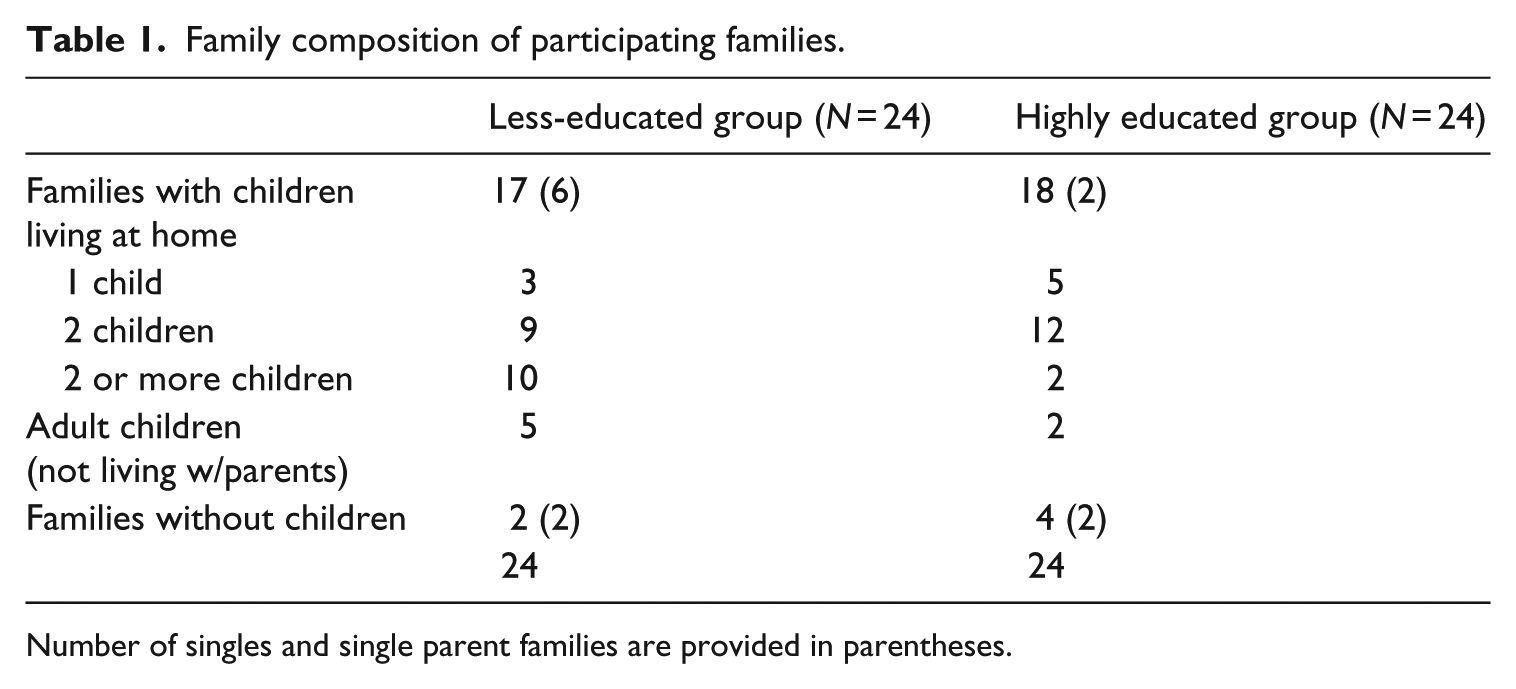
Number of singles and single parent families are provided in parentheses.
Procedure
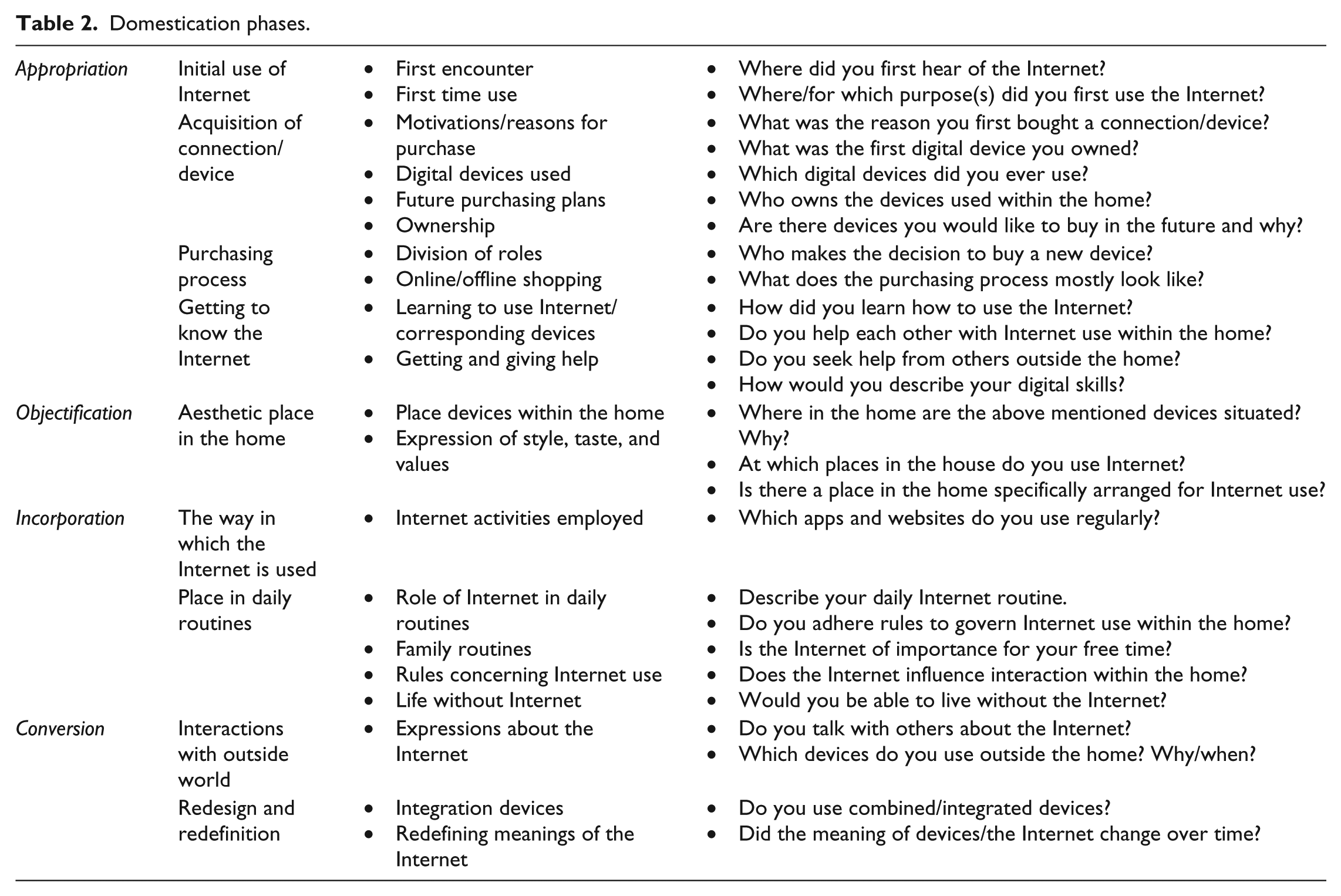
The head(s) of every recruited family completed an online questionnaire that was used as input for semi-structured interviews. The characteristics of all four phases of domestication were translated into online survey questions. The answers to these questions were used as a starting point in each semi-structured interview (Table 2, Supplemental Appendix A). Both (step) parents or adults, or the only head in single (parent) families, were interviewed at the participant’s homes. The interviews lasted for approximately 1 hour. The research aim and procedure were introduced before each interview. The participants were then asked to sign a form that states informed consent.
Domestication phases.
Analysis
Each interview was transcribed and read to determine latent themes within the given answers. Then, a first coding scheme was established. Within this scheme, the four domestication phases served as overarching categories under which the latent themes were classified. All transcripts were then coded within Atlas.ti. Amendments were made to the coding scheme when necessary during coding, such as when certain Internet activities could be specified into subactivities (Supplemental Appendix B). The core findings corresponding to the overarching themes were identified.
Results
The results of the interviews will be discussed for each domestication phase, comparing LEA with HEA.
Appropriation
Initial use of Internet
Within both LEA and HEA, about half of the members heard about the Internet for the first time because a family or household member talked about it. The other half of the HEA-members first heard about the Internet at school or at work, with school also being the place where the Internet was used for the first time: We had to follow computer lessons. The final part was on programming and my primary school teacher couldn’t figure it out. Eventually I taught him how to do that, I had already learned it myself at home. (HEA13)
When HEA-members found out about the Internet either at work or at school, this was mostly the result of their age and life stage at the moment the Internet emerged. LEA-members relatively often found out about the Internet because it was generally known. The majority of this group used an Internet connection for the first time just to “search for something”: For me, it was solely for business purposes. In the beginning I thought: do I really need it? But eventually I couldn’t refuse anymore. (LEA17)
Acquisition of a connection and device
LEA-members often purchased an Internet connection because they felt they had to “keep up with times,” as a type of obligation: The kids needed it for school so therefore we had to purchase a connection. Having a PC was a welcome extra for us. (LEA2)
HEA-members wanted to connect to the Internet at home because of the convenience, making this a more voluntary choice. For the younger HEA-members, it wasn’t a choice because the Internet was already present.
Concerning device ownership, most family heads now share devices, except for smartphones: We use each other’s devices. Our kids are in an iPad school, so therefore we purchased two separate iPads. (HEA18) The kids aren’t allowed to have their own tablet, but they do use ours. (HEA2)
When family members have one or more devices for themselves, these devices are mostly used for work. This especially accounts for those in HEA. Furthermore, HEA-parents are critical toward device ownership for their children; they tend to postpone it as long as possible. Families in which everyone has his or her own devices are mostly families with a single parent; the majority of this type of ownership thus was applicable to LEA-families: The kids have their own devices. The middle one has a tablet, a laptop and an iPhone, the youngest has an iPhone for gaming. He turns five next month. (LEA22)
Independent of status group, nearly all families own at least one laptop, one tablet, and a mobile phone, and about half of both groups still own a desktop computer. There are not many differences concerning the types of devices that families own, although HEA-families usually have more pieces of each type. Mainly HEA-members possess one or more “other” devices that connect to the Internet, such as a game console or smart TV.
Getting to know the Internet
The way in which people first learned how to use the Internet does not specifically differ between status groups, but it is mostly dependent on age. While householders under the age of 40 often learned to use the Internet unconsciously through learning by doing, older family members often needed courses or the help of children or other experts. The way in which household members now seek support differs. The heads of HEA-families help their children more often. LEA-children often help their parents. Mutually helping each other, no matter what role in the family, is more common in HEA: No, I can no longer help my children, we passed that stage. It is now the other way around. (LEA1) We do help the kids, but it’s also the other way around. M. can still help us, or he helps his sister with something. (HEA18)
In turn, seeking help from a member outside the household, but within the social network, is more common among LEA-families. This does not stem from the availability of experts in LEA-member’s social network, but from their own skill level. HEA-members solve problems themselves more often.
Some of the HEA-members indicated an early, general interest in ICTs. This was often given practical meaning by joining a computer club: I still had to come to class, but the teacher didn’t ask me questions anymore. He understood so much less than I did. I started programming independently. (HEA13) Computers were my hobby and the Internet was part of it. I joined a computer club to gain more experience and knowledge. (HEA16)
Most of these members now have ICT-related jobs. This combination of an overall, early interest in Internet, together with a job in ICT, reflects the early adoption of the Internet but also keeping up with new developments. The ability to pursue one’s ICT-interest was dependent on whether parents could afford and would support buying computers and software or joining a computer club. In regard to getting help or helping others, these people often are the experts within the family or their larger social network.
Purchasing process
The Internet consumption process differs between LEA and HEA due to having or not having an expert or early adopter in the family. In HEA-families, early adopters or ICT-interested family members largely determine the purchasing process. Generally, these household members perform online research and create a shortlist. If applicable, the other head of the family indicates his or her requirements, after which a final choice is made. Often, the expert already indicates a “first choice”: I mostly conduct research. I read reviews and read through things endlessly. The result is often a shortlist of two or three devices that I present to her. (HEA11)
For most of the members in both groups, the type of product would determine if they would gather information by contacting experts and if they would buy in a physical or online shop. Clothing and digital devices are products that people would rather buy in a shop because of the face-to-face contact with a seller and the possibility of getting a warranty. Older people often let themselves be guided by warm or professional experts before making decisions. Another reason for buying in physical stores is that people want to support local entrepreneurs (especially in rural areas). A purchasing desire expressed several times within HEA was domotica (home automation). The highly educated, ICT-working heads expressed a strong interest but also a critical view toward purchasing and integrating such devices into the household. Most of these HEA-members are waiting until these technologies mature: The problem with the Internet of Things is that there’s a fine balance between ease of use and security […], so it is at the expense of safety. (HEA15)
A few LEA-members mentioned an interest in domotica, mostly in relation to “fun.” Interest in buying a smart TV in the near future was mostly expressed by LEA-members, since many HEA-families already own such a device. Other than that, most families did not have specific wishes.
Objectification
Aesthetic place in the home
The Internet is being used in both groups throughout all rooms, as well as outside the house and on different devices. The general rule seems to be that the device that is most handy and practical is being used—often a smartphone or tablet. People switch to tablets and laptops when a device with a bigger screen or detached keyboard is needed, such as for watching a movie or writing reports. A home office is mostly present when at least one head of the family has a job in which working at home is an option and Internet is required, mostly among HEA-members. In cases where a desktop computer is present, this is often placed in a quiet and spacious room so the employee can work undisturbed: I am mostly in our home office actually, because it’s comfortable and I can work very concentrated over there. (HEA23)
Some LEA-families have a “game room,” where household members can entertain themselves without disturbing others: I don’t need all that equipment in my living room, and certainly not in the kid’s bedrooms, so we created a kind of gaming room. (LEA25)
Expression of style, taste, and values
Overall, the physical placement of devices has little to do with the expression of values, tastes, or styles, but is a result of personal interest. Independent of status group, most people do not have a strong desire to own the latest devices or to place a device in a central place in the home. When people prefer to own the newest devices, this is because of a predilection for gadgets, not because they like to show off. Having a strong brand preference often results from familiarity and habituation, so they do not have to adapt to new operating systems: I do have a large preference for Apple, but that is because I’m used to it and find the system very user friendly. I would never want the most expensive and newest device. (HEA20)
While people do consider the appearance of devices such as smart TVs, this is because of personal aesthetic preferences. It seems that because the Internet and its corresponding devices are (physically) omnipresent, devices no longer are used to distinguish oneself from one another. Only in one LEA-family did the heads buy the newest devices to look good, which had to do with the fact that they own a fashion store and therefore want to “match their appearance with their image.” HEA-families mention specific functionalities that are important when orienting to new devices, such as processor speed and memory. In contrast, LEA-families focus more on value for money or price quality: It’s about the functionalities of the device in combination with the purpose you’re using it for. (HEA16) The price—quality ratio should simply be right. (LEA13)
Incorporation
Place in daily routines
The way people go through the incorporation phase differs between people who have a job and those receiving unemployment benefits. The latter was only applicable in LEA and argued that they do not have a fixed pattern of Internet use but use it whenever they feel like it. There are differences among working people. HEA-members check notifications and news in the morning, use the Internet as part of their work during the day (or working shifts), and use it as a source of relaxation during the night or after work. Most LEA-members also use the Internet whenever it is deemed useful or desired, with the addition that the Internet is used throughout work shifts if it is inherent to the type of job: Nah, it just goes on during the day. The computer is on until I go to bed. (LEA16)
Finally, an equal number of members from both groups have a fixed Internet routine in the morning, mostly checking notifications and news. After this routine, the pattern varies depending on their specific activities that day.
The way the Internet is used
There are not many differences between LEA and HEA concerning the type of Internet activities performed; information seeking, shopping, and following the news are mentioned most. Both of the groups use the Internet for work-related purposes and for social media. However, in regard to work-related Internet use, for LEA-members, most of the time Internet use has organizational or administrative purposes, while HEA-members oftentimes cannot perform their job itself without an Internet device. This also reflects the reasons why people use devices outside of the home, as “working externally” was mentioned much more in HEA. Concerning social media, LEA-family heads use it as a way to maintain social contacts, while HEA-members more often use it for professional purposes: I play games via Facebook, it’s called Facebook Room […]. It is pastime. (LEA16) I’m on LinkedIn for networking. Searching for that one person who’s got something I need. (HEA4)
While online shopping delivers financial benefits for both groups, convenience and time savings are more important among HEA-members. A trend observed within HEA was that the meaning and usefulness of social media are undergoing redefinition. Some participants deleted their Facebook account or at least shifted to professional social media use only, as the meaningfulness of social media platforms are critically reflected upon. The main reason for quitting specific social media is that its prime uses shifted away from being social with friends and family to a place where everyone expresses opinions or places unwanted content: The purpose of Facebook has changed over the years. Nowadays it is more for reading articles, not for maintaining social contacts, for which it was meant originally. (HEA20) It ignores what it was actually made for. […] It has nothing to do with social contacts anymore. (HEA24)
Family routines
The Internet has influenced household routines and interaction from the moment it entered the home for both groups. For about one-third of members of both groups, the Internet facilitates maintaining contact between household members when away from home. However, an equal number consider the Internet a disturbing factor for communication within the home. Household members, both parents and children, often are occupied by smartphones and have less attention for others: We used to watch TV altogether, now we’re increasingly doing our own thing, individually. (LEA10) Look at our sons, it will come anyway sooner or later. But we also want to tell them that there is an outdoor playground, or one can paint inside. Enjoy it. (18)
HEA-parents seem to be concerned with consciously thinking of ways to diminish this tendency. While rules are present to regulate household Internet use (e.g. restrictions on type of websites and fixed times online) in both groups, HEA-parents more often use the Internet as an educational source or for finding information about upbringing: I’m consciously working on that. For school for example, I’m searching for the apps that are important for learning numbers and letters. (HEA11) I search for information, about babies and when they sleep through the night for example. Everyone wants their baby to sleep through after week 12, so I searched for how I should approach it. (HEA6)
Life without the Internet
Most HEA-members believe that living without the Internet would take some effort but is possible, except for work-related tasks and online governmental services. It would just involve finding another way to perform tasks. LEA-members consider living without the Internet impossible. Those with unemployment benefits or those who are retired consider it important for entertainment and believe they are highly dependent on the Internet for the fulfillment of their daily routines: I just had an Internet breakdown lasting two days. I couldn’t do anything online, then you got me! (LEA16) If the Internet doesn’t work over here, it’s not a disaster. Internet is convenient, but there are so many other things by which you could be entertained. For work it’s another story though. (HEA4)
Conversion
Interaction with world outside the home
Within both groups, most members talk about the Internet. However, conversations do not involve expressing or promoting people’s own or newly acquired knowledge. In most cases, it is about content found online. Some HEA-members talk about new developments, stemming from personal interest, or advocate for responsible Internet use: I do like to talk about the Internet at work, but also in other spheres. It’s awareness. I start preaching a bit, about what is wise and what isn’t. (HEA18)
Beyond that, the “negative influence” of the Internet on social behavior is a conversation topic. The omnipresence of digital devices makes buying or displaying a device for people’s own status obsolete: The anti-social aspects, that everyone is always with their phone. For me that’s a reason not to be fond of the Internet at all. (LEA7) What’s brought up sometimes, is the annoyance. The continuous use of mobile phones by people, I think that’s something that annoys us all. (HEA23)
Nearly all members of both groups consider the presence of and using the Internet a matter of course. The “taken for granted” stage seems almost saturated. Only some senior members stressed that using the Internet does not always come naturally to them.
Redefinition
Redefinition first happens through changed device functions. Within both groups, about one-third noticed that their smartphone has increased in functionality and has taken over the functions of other devices, such as e-mail and music. Second, redefinition concerns connecting different devices, such as combining smartphones with activity trackers to support workouts, or a tablet to television to stream movies. The latter type of redefinition occurs more in HEA: Before, you used a mobile phone only to make phone calls, nowadays also for gaming and reading. It has actually become a computer. (LEA23) We don’t have a TV subscription anymore […]. There is a TV, but that’s only for casting YouTube or other online services. (HEA21)
HEA members often have thought out motives for integrating devices. They more often delve into the functionalities and added value. The integration should eliminate other devices, make daily routines easier or even fully facilitate daily practices: I’d like to have domotica devices, new developments that can make our life more convenient. […] The goal is always time saving and productivity. (HEA16) I’d like to have a smartwatch, but at this moment the application is limited. I don’t see the added value yet. (HEA11)
Redefining personal meanings of the Internet
In addition to the redefinition of devices, the redefinition of the Internet in general is often mentioned. HEA-members seem to increasingly want to disconnect in their free time and are consciously doing so. Some of them want to go “back to the past” by performing activities without the Internet, giving examples such as going outside for a walk, playing board games with family members or reading a paper book. They consider the Internet a convenient tool in facilitating routines in daily life and making life easier and faster but not as something on which they are fully dependent. Both this dependency and the disruption of conviviality in the home are reasons to reconsider the added value of the Internet: You shouldn’t participate because everyone is doing so. You just have to ask yourself: what can I yield from it? (HEA25) The trick is to take care that the Internet isn’t going to dominate. That might be the biggest mistake. (HEA16)
Disconnecting is a result of consciously weighing, and thus defining, what being online yields. The fact that a large part of HEA-members use Internet at work already results in a desire to disconnect in free time. Disconnecting might help them spend quality time with their family or on their own, but it also helps in developing themselves or their children in nondigital ways: I don’t know if I’m suitable for this subject anyway, I notice that I’m going back. I feel the need for “being old school” again. (HEA9) I’m online because the Internet is there, it’s available. Otherwise, I would watch news programs on TV or I would practice sports more. In that sense, I actually see the Internet more as a limitation. (HEA17)
While the Internet remains of high importance in daily lives, it is increasingly seen as a means to facilitate daily routines and to take over chores that don’t need human action. As a result, HEA-families save time that can be used for other activities. Of course, the possibility to redefine and disconnect in such a way is dependent on having the resources to do so: being able to find the right services online (digital resources and skills) and having the economic resources to invest in these services.
Only a few LEA-members want to spend less time online sometimes, but their motives differ from those of the HEA-members. Somewhat older householders prefer to disconnect because they grew up and used to live without the Internet and know that, for them, performing offline activities can be just as pleasurable as being online (Table 3): Well, I had rather seen it somewhat more personalized. We used to have a bank office. If you had any problem, you would go there. That way you can talk to them and explain the problem. (LEA21)
Summary of differences in domestication phases between highly educated groups and less-educated groups.
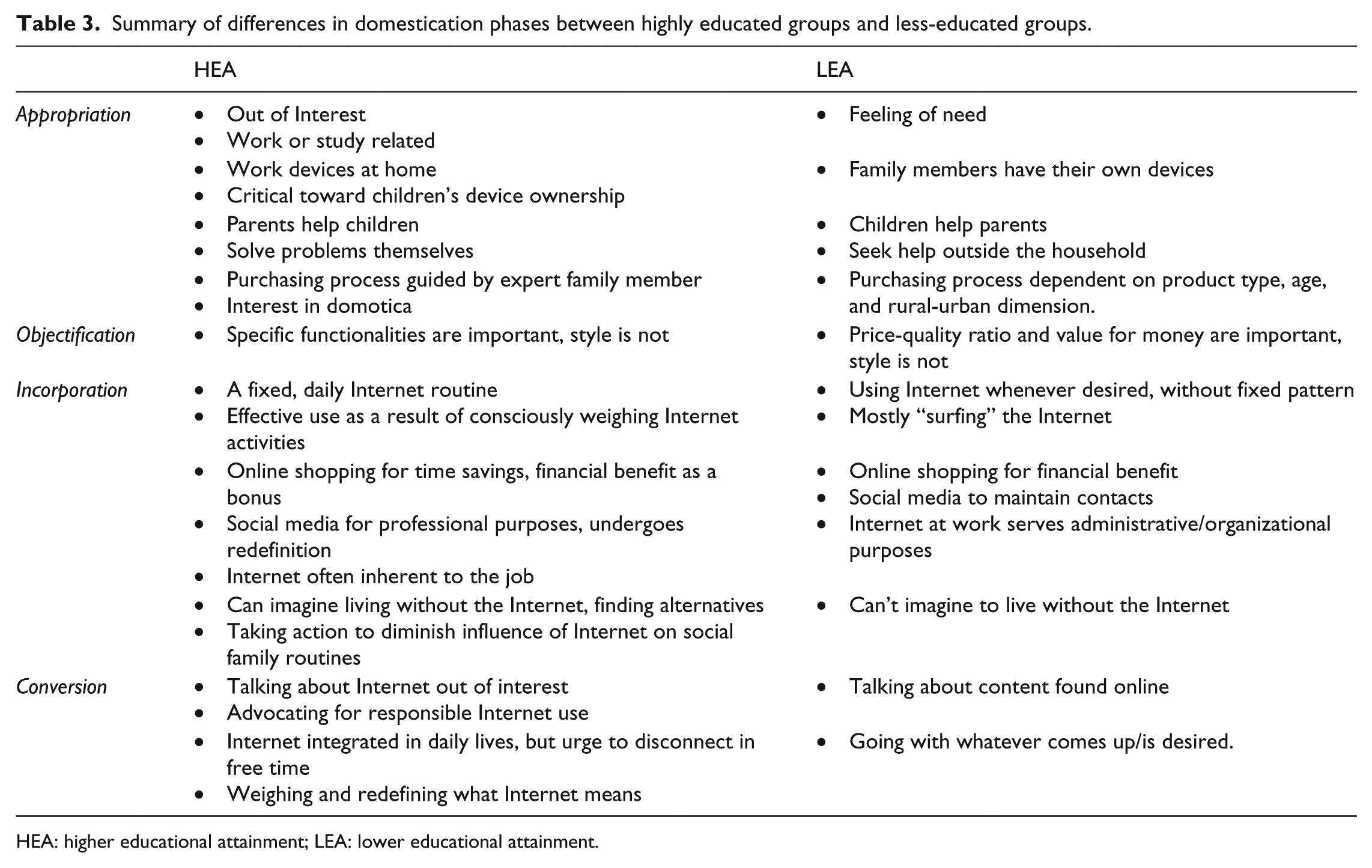
HEA: higher educational attainment; LEA: lower educational attainment.
Conclusion and discussion
The purpose of this contribution was to better understand how a family’s educational background might contribute to digital inequalities. We did so by looking at differences in the appropriation, incorporation, objectification, and conversion phase of the Internet domestication process. Before discussing differences, it is worth stressing that LEA- and HEA-members had things in common, for example, as they engaged in similar activities online, including serious (work and organizing purposes) and leisure activities. Recent investigations reveal that while a broad range of activities is now common among people with different levels of education, relative differences increase, causing those with higher levels of education to reinforce their already strong positions in society (Van Deursen et al., 2015; Helsper, 2012). Some of the differences in all four of the domestication phases provided potential explanations as to why Internet use and routines are shaped differently for families with different educational backgrounds.
For HEA-members, Internet appropriation can be summarized as pro-active, reflective, and critical, which results in overall well-considered Internet use. Departing from the appropriation phase, HEA-members generally have positive and specific reasons for Internet adoption, including using the Internet in the course of employment. Purchases are researched in a systematic way, valuing various technological features, and parents are mostly able to solve any issues for themselves and their children. They have a critical stance toward recent Internet developments which is, for example, reflected in postponing the moment when their children start using the Internet, or in limiting or even ceasing to use social media themselves. In general, LEA-members adopt an initial stance that is less dedicated to continuously evaluating the usefulness or remunerative character of specific devices and activities at stake. Furthermore, parents in LEA-families are more likely to be assisted by their children and also request help from others in their social network. Online, LEA-members seek value for money when making purchasing decisions and value the Internet’s financial benefits more. Their relatively limited developed Internet skills and knowledge make them feel obliged to use the Internet in order to “keep up” with others. Although some routines in Internet use were present, they often use it spontaneously.
The observed differences between LEA and HEA can be considered in light of the concept of information habitus (Bourdieu, 1980; Robinson, 2009). Habitus refers to the mental structure that individuals develop during their life, while growing up in a particular social environment. Individuals with a corresponding social background, as shaped by educational level, will develop a similar habitus and correspondingly act on it. HEA-members adopt a stance or habitus of “studious leisure”, which results in consciously exploring possibilities and benefits that the Internet has to offer. HEA-members attempt to limit unnecessary activities, while LEA adopt a stance or habitus that could be denominated as “keeping up with the crowd.” These are important observations that receive little attention in common digital divide research that typically presents sociodemographic indicators for differences in types of access (Scheerder et al., 2017). Differences in the Internet domestication process between the lower and higher educated are likely to contribute to important phases of Internet appropriation where inequality presents itself: motivation, material access, Internet skills, uses, and the tangible outcomes obtained from Internet use (Van Dijk, 2005; Van Deursen et al., 2015; Hargittai, 2002). Although we did not link our domestication results explicitly to these phases of inequality, new insights and explanations of why differences in education contribute to digital inequality are offered. The differences already take shape in the early stages of domestication. A sequential process seems to take place, in which the initial stance toward the Internet seeps through to subsequent phases and is transferred to children. The results even suggest that differences in the initial stances toward the Internet are reinforced in subsequent phases. Overall, considering digital inequalities form a domestication perspective is able to add deeper explanations to traditional notions of stratification based on economic class (Weber, 1947).
On a final note, based on the above, one might expect that HEA-members perceive the Internet as more important than LEA-members. However, while HEA-members do consider the Internet as a helpful tool to support daily tasks, they do not perceive it as something indispensable. Their reflective stance makes them rethink the value of the Internet for their own life, in several cases even resulting in an urge to disconnect in their free time. In contrast, LEA-members regard the Internet as undoubtedly indispensable in their daily lives; as something they could not live without. This is reflected in their urge to “keep up with the crowd.”
Limitations and future research
In the current contribution, we normatively assumed that differences in Internet domestication are likely to result in digital inequality. Future research might take the considerations of one’s social context one step further by empirically linking Internet domestication to different stages of digital inequality. This might help us to better understand how social inequalities are reinforced by the use of technology (Van Deursen et al., 2015; DiMaggio and Garip, 2012). If the normative assumption drawn in this study that differences in the domestication process might lead to differences in objective benefits derived from Internet use holds true, an important question that remains is whether LEA-members actually consider themselves as being marginalized. As we did not delve deep into the agency and efforts of low-education users in mitigating inequalities, future research should further explore this question from the LEA-members’ perspective. The results on the subjective importance of the Internet among LEA- and HEA-members raise questions about the “more Internet is better” viewpoint that so often accompanies (quantitative) digital inequality research. Here, it is typically assumed that those who use the Internet more frequently and extensively reap the most benefits. Future research should examine if extensive Internet use indeed leads to more beneficial outcomes, or that HEA-members’ urge to disconnect might actually abate negative effects of Internet use (therewith increasing the relative amount of benefits).
In addition, HEA-member’s urge to disconnect touches upon the idea of being “alone together” (Turkle, 2011). Many HEA-participants expressed their concerns about how the Internet nowadays negatively affects their relationships. A large amount of those participants also expressed their desire to increasingly “go offline” for more qualitative interactions. Future research might study how different educational groups perceive the idea of being alone together and how the Internet and its various applications play a role here.
We used educational level as a proxy for SES when recruiting families. One’s educational level is considered one of the most important factors when studying digital divides (Scheerder et al., 2017). However, SES could be approached more comprehensively by also considering people’s income and profession (Shavers, 2007). One’s income could, in the light of digital inequalities, cause differences in the economic resources people possess, therewith influencing the types and number of digital devices people with different backgrounds own and use (Van Deursen and Van Dijk, 2019). However, since educational level, profession, and income often cohere, educational level serves as a reliable derivative.
Although some consequences of age were discussed in the results section, as this was not a determinant considered for recruitment, we could not make explicit statements about its effects. Apart from being a LEA- or HEA-member, differences appeared mainly in the way the older and younger interviewees got in touch with the Internet. Being older also has consequences for the way people go through other domestication phases, for example, in how they value the Internet. With this in mind, a recommendation for future research is to more comprehensively consider age as a determinant.
Finally, this study was conducted in the Netherlands, a highly developed country in which even the poorest people have Internet access. The results of applying domestication theory to study digital inequalities in developing countries are likely to be different because differences between people with higher and lower SES are much bigger in terms of offline resources that affect their physical Internet access, Internet skills, uses, and outcomes. We expect that the identified differences will be larger in developing countries, in which many people might still be in the initial phases of domesticating the Internet, while others use the Internet in an advanced way.
Supplemental Material
Appendix_A_and_B_NMS – Supplemental material for Internet use in the home: Digital inequality from a domestication perspective
Supplemental material, Appendix_A_and_B_NMS for Internet use in the home: Digital inequality from a domestication perspective by Anique J Scheerder, Alexander JAM van Deursen and Jan AGM van Dijk in New Media & Society
Footnotes
Funding
The author(s) received no financial support for the research, authorship, and/or publication of this article.

Supplemental material
Supplemental material for this article is available online.
Author biographies
References
Supplementary Material
Please find the following supplemental material available below.
For Open Access articles published under a Creative Commons License, all supplemental material carries the same license as the article it is associated with.
For non-Open Access articles published, all supplemental material carries a non-exclusive license, and permission requests for re-use of supplemental material or any part of supplemental material shall be sent directly to the copyright owner as specified in the copyright notice associated with the article.
