




Abstract
This study explores the industrial underpinning and the cultural logic of social media celebrity. Social media visibility may be considered as an alternative way to fame as it bypasses the gatekeeper role played by the entertainment and mass media industries. However, the institutionalization of social media platforms like YouTube and the professionalization of amateur content creation may lead to social media becoming a new locale for industrialized celebrity manufacturing. Taking YouTube beauty vloggers as an example, this study shows that being a celebrity on social media is economically embedded in an industrial structure constituted by the platform’s business model, technical affordances, the advertising market, and commercial cultural intermediaries. Social media celebrity’s status is achieved not only through a set of affiliative, representational, and celebrification techniques, but also by engaging in meticulous entrepreneurial calculation considering the abovementioned industrial factors. This emerging industrial structure is associated with a new cultural logic of celebrity that distinguishes the fame native to social media from that on the silver screen and television. This study shows that social media celebrity is characterized by staged authenticity, managed connectedness with audience, the abundance of celebrity figures, and the cultural preoccupation with self-sufficient uniqueness.
Keywords
Introduction
If we understand fame as the status where ‘an individual rises above the rest of population’ and ‘poses an imagination of self upon them’ (Braudy, 1986: 17), the conditions and strategies to achieve such status and the content of the imagination change throughout history. In other words, this status is sensitive to the social structure and the extent and modes of communication in a society (Braudy, 1986: 587). Fame in the form of modern celebrity is characterized by its reliance on the electronic mass media, an exuberant entertainment industry, and a consumer market that emerged in the early 20th century in Western societies (Marshall, 1997; Rojek, 2001; Schickel, 2000; Turner, 2014). Modern celebrity is conceptualized as industrially manufactured media representation, which is traded as a highly replaceable cultural commodity (Gamson, 1994; Turner, 2014).
The advent of social media has brought new dynamics and temporality into celebrity culture (Gamson, 2011; Turner, 2010). Its participatory affordances enable ordinary aspirants to fame to conduct self-branding and self-celebrification practices, thus maintaining an audience of peer users as their fan base. As a result, celebrity status may be achieved in a DIY manner, bypassing the gatekeeper role of media and entertainment industries (Turner, 2014). This type of celebrity personality and celebrity practices have been referred to as ‘micro-celebrity’ (Marwick and boyd, 2011; Senft, 2008), as they ‘operate within a relatively limited and localized virtual space, drawing on small numbers of fans such as the followers of a particular subcultural practice’ (Turner, 2014: 72). The YouTube beauty vlogger (also called beauty guru or beauty YouTuber), who uploads beauty- and lifestyle-related videos, attracting views and subscribers for one’s channel, is a token of this new type of celebrity. However, as ordinary people are gaining access to celebrification techniques, social media platforms like YouTube are undergoing a process of institutionalization. More and more homegrown YouTube stars are turning into professional content creators (Burgess, 2012; Kim, 2012; Morreale, 2014). Beauty vloggers stand in the frontier of this professionalization process as they align precisely with beauty and fashion consumer verticals, thus receiving more opportunities for various forms of monetization (Lobato, 2016).
Against such a context of institutionalization of YouTube and the professionalization of content creators, this study takes the beauty vlogger as an example to demonstrate that YouTube channels are becoming another locale for industrialized celebrity manufacturing. Besides conceptualizing ‘micro-celebrity’ as a set of self-representational techniques that borrow from mass media celebrity culture (Gamson, 2011; García-Rapp, 2017; Jerslev and Mortensen, 2016; Marwick, 2016; Tolson, 2010; Turner, 2014), it may be argued that social media also gives rise to a new type of celebrity with its distinctive industrial strength and cultural logic. While I am sympathetic to the label ‘micro-celebrity’ proposed by Senft (2008) and Turner (2014), this study refers to celebrity practitioners represented by beauty vloggers as social media celebrities. This is because, first, I would like to emphasize the fact that their fame is native to social media platforms. Second, many successful beauty vloggers operate within a mainstream discourse of consumerism and also display a disciplined, hegemonic femininity in their media representation (Keller, 2014). Some of them can even aggregate large audiences within certain demographics, comparable to those of TV programs (Vonderau, 2016). In this case, beauty vlogging is not necessarily a subcultural practice.
While previous studies regarding the industrial factors of YouTube are often conducted at corporate level, either focusing on a technical and political economic analysis of the platform, or the industrial logic of intermediary firms operating around it (Cunningham et al., 2016; Lobato, 2016; Van Dijck, 2013; Vonderau, 2016), this study tries to complement previous research by focusing on vloggers and YouTube channels at a local level. Through an ethnographic approach, I explore the entrepreneurial calculation involved in managing a YouTube beauty channel. More specifically, I examine how beauty vloggers’ celebrity status is achieved by navigating through several factors including the platform’s technical affordances, revenue model, beauty and fashion consumer market, as well as commercial cultural intermediaries. Combining previous studies’ findings on social media celebrities’ representational techniques and my empirical investigation of the entrepreneurial calculation, I discuss the cultural logic of this new type of celebrity, explaining to what extent and in what respects it is different from traditional celebrity.
Literature review
The self-representational techniques of social media celebrity
Previous studies on social media celebrity prioritize the investigation of aspirants’ performative and representational strategies (Gamson, 2011; García-Rapp, 2017; Jerslev, 2016; Marwick, 2016; Turner, 2014). These studies demonstrate how the logic of branding and celebrification, which used to be reserved for media professionals and traditional celebrity, now infiltrates ordinary people’s everyday life. Micro-celebrities construct an image of the self to be consumed by peer users, thus attracting them as a fan base. Popularity is the goal in this practice, and a set of affiliative techniques are used (Marwick and boyd, 2011). However, what has been branded and celebrated seems to be very different. Whereas traditional celebrities’ image is characterized by extraordinariness, perfection, glamour, and distance, social media celebrities attract attention through the performance of ordinariness, intimacy, and equality (Gamson, 2011; Turner, 2014).
For instance, Jerslev (2016) finds that the famous British vlogger Zoe Sugg (Zoella) addresses her viewers like a girl next door, informally, and by discussing mundane everyday events. Although uploading makeup tutorials, she adopts a position equal to her fans by rejecting her role as a professional expert. She also films confessional videos, honestly exposing moments of uneasiness in her life. Also focusing on beauty vloggers, García-Rapp (2017) explores how different types of video content help gurus maintain their celebrity status. She finds that although beauty know-how videos may attract viewers at first, it is vlogs allowing viewers to know the guru’s life through affective connections that turn viewers into loyal subscribers. The number of subscribers on YouTube is an important popular marker indicating a guru’s ability to attract engaged and repeatedly returning audiences.
The representation of ordinariness, intimacy, and equality by social media celebrities creates a sense of authenticity characterizing their videos. However, authenticity is a performed effect and it is always relational and context-dependent (Grazian, 2005). It is through a comparison with traditional celebrities’ perfection, extraordinariness, and traces of heavy industrial production that we can feel authentic about a no-makeup look facing a camera in the setting of a bedroom. In other words, authenticity on YouTube does not refer to a reflection of reality without mediation; instead, it is a specific means and content of representation. As Marwick (2013b) discovers, for fashion bloggers, authenticity specifically means three things: ‘a palpable sense of truthful self-expression’, ‘a connection with and responsiveness to the audience’, and ‘an honest engagement with commodity goods and brands’.
We may also notice that personalities in reality TV have long been employing the self-branding and self-representational practices. Andrejevic (2004) shows that openness and self-disclosure are the preferred qualities for candidates in reality TV programs, and the strategies to establish intimacy, ordinariness, and equality are not native to the Internet either. Corner (2002a: 260) suggests that reality TV’s sense of authenticity is achieved by the ‘documentary imperative’, featuring content such as high-intensity incidents, anecdotal knowledge (first-person gossipy accounts), and snoopy sociability (amused bystander witnessing routines in other people’s working life). It’s not difficult to discern the traces of this imperative in popular vlog videos such as ‘one day in my life’, ‘my morning routine’, and other confessional videos.
Having in mind the representational techniques underscoring social media celebrity, this study tries to complement our understanding regarding the newest development in social media celebrity culture from the perspective of industrial factors. In order to do so, we first need to understand that attention and influence on social media are not only a matter of personal aspiration to fame, but are also the need of marketers and publicists as a tool for communicating commercial messages.
Social media celebrities as social media influencers
The contemporary Internet is multifaceted and multipurpose, as it is embedded in a wide array of social activities as infrastructure (Hine, 2015). Homegrown stars are regarded by marketing and publicity practitioners as social media influencers, whose media visibility and original content can be leveraged to promote brand messages. Hearn and Schoenhoff (2016) state that the authentic and trustworthy personal brand of social media celebrities can be capitalized by companies and advertisers for consumer outreach. From one perspective, they extend traditional celebrities’ function of personalizing the process of consumption (Dyer and McDonald, 1998). From another perspective, marketers now search for brand storytellers instead of someone who only lend their name to the brand. The trustworthy and intimate relationship between the influencers and communities, built through narratives, helps contextualize brand images and messages (Khamis et al., 2017).
Not only do brands seek out for celebrity influence among audiences, marketing practices in today’s converging media environment also actively contribute to the production of celebrity image (Hackley and Hackley, 2015). The media exposure and representation brought about by endorsement contributes to celebrity status and celebrity image. The reciprocal relationship between the marketing system and celebrity is also implicated in the quantitative models developed by marketers to identify social media influencers. Among other popular metrics such as the number of followers and reposts, the number of industry events or brand cooperations that a social media celebrity has participated in is also an important index in evaluating his or her popularity (Booth and Matic, 2011).
The institutionalization of YouTube
In order to understand the newly emerging industrial structure behind social media celebrity, we may first turn to its predecessor: traditional celebrity in the entertainment and mass media industries. The birth of American motion picture industry demonstrates the starting point of industrialized celebrity production (Gamson, 1994; Schickel, 2000). From then on, film stars, TV personalities, and singers become commodities manufactured and traded for the aim of profit, introducing a break from the earlier forms of theatrical and artistic fame. Rein et al. (1987) suggest that celebrity stands in the center of this business, supported by and supporting eight subindustries, including entertainment, communication, publicity, representation, appearance, coaching, endorsement, and legal and business services industry. Comparably, the business model of commercial intermediary firms operating around YouTube resembles very much this structure. Lobato (2016) finds that many tasks performed by different types of multichannel networks (MCNs) are actually extensions of existing media work.
The industrial underpinning of social media celebrity is closely associated with the platform’s technical affordances and business model. Kim (2012) argues that YouTube used to be a ‘virtual village’, where amateurs share their user-generated content in online communities. Now, it has been institutionalized into a platform inhabited by professionally generated content. He points out that as legacy media are strategically digitalized, new media like YouTube also imitate the role of television, by legally managing the distribution of broadcasting content and smoothing links between contents and commercials. The series of copyright lawsuits by YouTube have forced the platform to implement strict copyright policies, making user-generated original content a crucial revenue target.
YouTube’s industrialization process is also evident in how the company discursively constructs its business as a facilitating but neutral ‘platform’, thus positioning itself strategically among users, advertisers, professional content creators, and legislative regulators (Gillespie, 2010). In Gillespie’s observation, the word ‘platform’ in the contemporary IT industry ‘suggests a progressive and egalitarian arrangement, promising to support those who stand upon it’ (Gillespie, 2010: 350). In this sense, for ordinary users, YouTube empowers them to speak and interact freely; for advertisers and professional content owners, YouTube helps them to connect with their target audience efficiently. YouTube also actively manages its legislative environment, again by discursively constructing the business as a platform. In some policy issues, YouTube emphasizes its role as the facilitator of unfettered circulation of information. In other cases, it downplays this active role, presenting itself as a mere intermediary, and thus leaving the liability of controversial content to content providers and users.
Besides YouTube’s strategic self-positioning against various constituencies, the institutionalization process can also be observed from how YouTube positions its users. In 2010, the famous ‘Broadcast Yourself’ logo was removed from YouTube’s home page. Instead of conceptualizing users as broadcasters, they are now positioned as content creators. In the ‘creator hub’ function, directions are listed to support users to ‘create and share great videos’, ‘connect with fans’, and ‘build a business and get help to grow’. The guidance presupposes that users upload videos with the intention to achieve large numbers of views and economic rewards. Both Burgess (2012) and Van Dijck (2013) emphasize the role of interface design in directing usage. As the creator hub invites professional video providers, the user-friendly, TV-like video display page invites more audience-centric users.
Cunningham et al. (2016) theorize the institutionalization of YouTube against a larger context of industrial convergence and the emergence of a new screen ecology. The industrial culture of mass media featuring premium content is interpenetrating with IT companies’ cultural logic of ‘scale, automation, permanent beta, repaid prototyping and iteration’ (Cunningham et al., 2016: 379). The result is a clash of business cultures between the IT industry and Hollywood’s incumbents. They point out that as both business models aim at monetizing screen content, companies like Google/YouTube and Facebook have already developed large user bases and have access to extensive behavioral data, enabling them to configure the audience precisely and deliver advertisements more efficiently. In a similar vein, Van Dijck (2013) argues that the unique selling point of YouTube, compared to the broadcast industry, is its ability to bring specified audience groups to content and advertisers. While the search engine function is the connecting force in this process, what YouTube lacks is attractive professionally produced content. Of course, YouTube also cooperates with major broadcast producers to fill their channels. Nevertheless, this premium content model meets fierce competition with other transaction- and subscription-based platforms such as Netflix and Amazon in the online video distribution ecology (Cunningham and Silver, 2013). Thus, homegrown creators, who can provide advertiser-friendly contents and engaged subscribers, become a strategic niche for YouTube in this new screen ecology.
Homegrown YouTube stars are professionalized with the help of commercial cultural intermediary companies like MCNs. Most MCNs ‘provide non-professional creator with technical, promotional and advertising services, in exchange for a share of customer’s ad revenue’ (Lobato, 2016: 351). On the one hand, these services are the extension of media work done by media buyers, ad agencies, agents, and managers in the traditional entertainment industry. On the other hand, MCN’s business model aims at scale and volume by devoting more resources to top-level talents (the big personalities) and automated, impersonal services to a large pool of potential talents. The flourishing of MCN companies helps YouTube professionalize homegrown content creators as they can increase the quality of videos and avoid copyright infringement. More importantly, as an increasing number of users sign up for the YouTube Partner Program, the ad revenue they can get is significantly lowered. MCNs therefore become an important middleman to reintroduce market scarcity and bridge professional content creators with their economic sources on the advertising market (Cunningham et al., 2016).
Data collection
In this study, I apply digital ethnography as an approach to explore the entrepreneurial calculations that YouTube beauty vloggers conduct when managing their accounts and media representation. Rather than rendering beauty videos as multimodal texts, an ethnographic approach enables me to view vlogging as a contextualized cultural and economic practice on YouTube (Hine, 2000; Varis, 2016). It helps me explore how beauty-related content is produced with a prospect of channel growth and audience engagement.
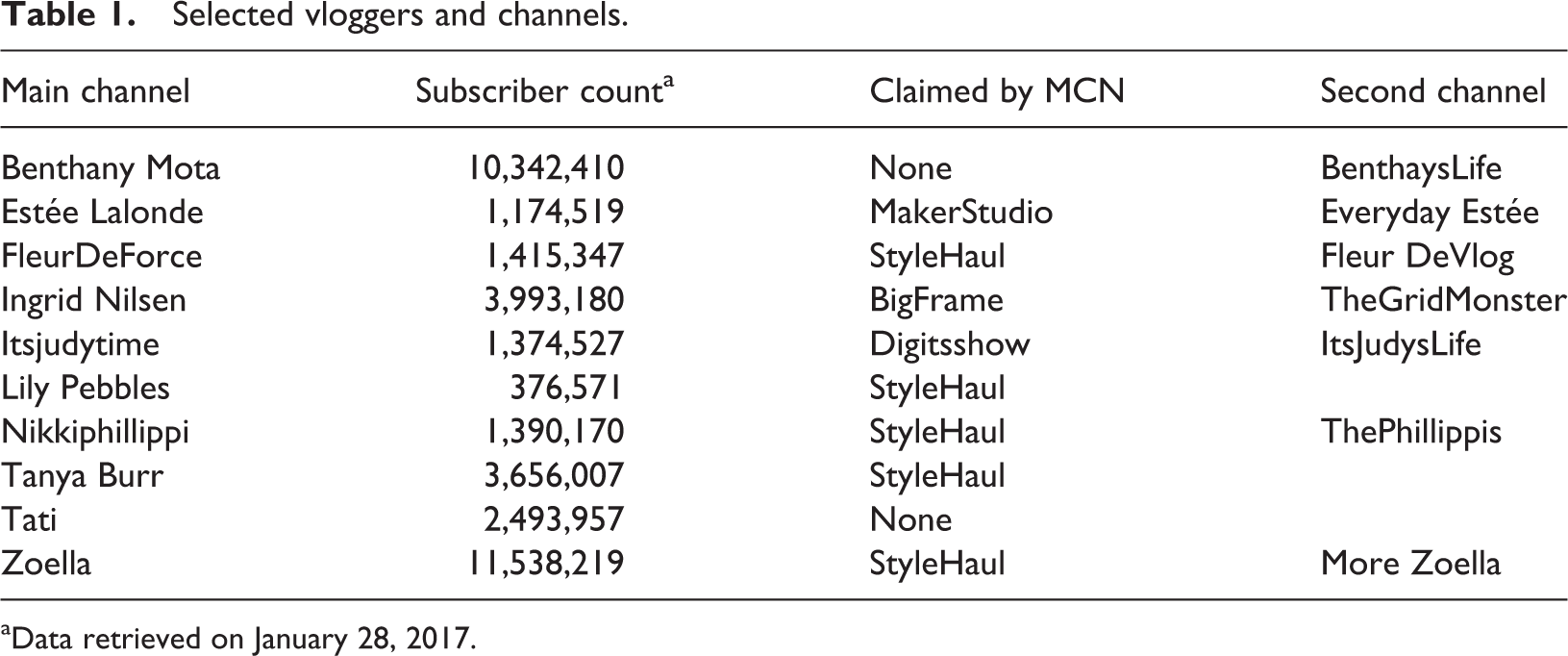
As a YouTube user myself, I also watch beauty- and lifestyle-related videos. In this sense, I regard myself as an insider in the YouTube beauty community with certain emic knowledge about the field – useful as a basis for this systematic ethnographic study. In terms of research participants, I did not rush to select the most subscribed to personalities, or the ones that have attracted the most attention from mass media. Instead, I relied mostly on YouTube’s algorithm by searching with a series of keywords such as ‘beauty gurus’ and ‘beauty vloggers’. These are the terms often used to refer to beauty vloggers in news media. The search results were then based on the popularity algorithm including but not limited to the number of subscribers, views, and ratings. In this way, I approached the field as an ordinary user interested in beauty-related information. After I clicked into each channel, other related channels were recommended by YouTube. This sampling method is similar to snowball sampling; however, in this case, I made use of the ‘connective affordances’ of YouTube (Van Dijck, 2013). The sample size in the current study is 10 beauty vloggers and 17 YouTube channels, as 7 of the vloggers have a second life vlog channel besides the main beauty channel (see Table 1).
Selected vloggers and channels.
aData retrieved on January 28, 2017.
The data collection process is divided into three steps and the major instrument is observation (see Figure 1). First, in order to make myself familiar with the vloggers’ content, I watched their five most recent videos and top ten all-time most viewed videos. The observation also included the information boxes for the videos, an important location for search engine optimization practices. I also browsed the general layout and design of the channels to see how content is organized by the vloggers. Second, having gathered knowledge of the general content and format of beauty vlogs, I turned to third-party analytical tools to gain an overview on the development of the vloggers’ main channels. The websites Socialblade.com, VidStatsX.com, and ChannelMetrics.com provide diachronic data analytics based on various popular metrics. 1 It was at this step that I chose Tati Westbrook’s channel (user URL: glamlifeguru; screen name: Tati) as a major focus for the third step of observation, because her channel has experienced a significant growth since September 2015. 2 Third, I watched more videos by Tati from her playlists. I then explored how she reflected on her YouTube career in an interview with Tubefilter, and how she was discussed by audiences in the discussion sections on Reddit and GuruGossip. 3 The discussion threads on these two websites provide more general reflections on Tati’s channel and her overall style as a vlogger.
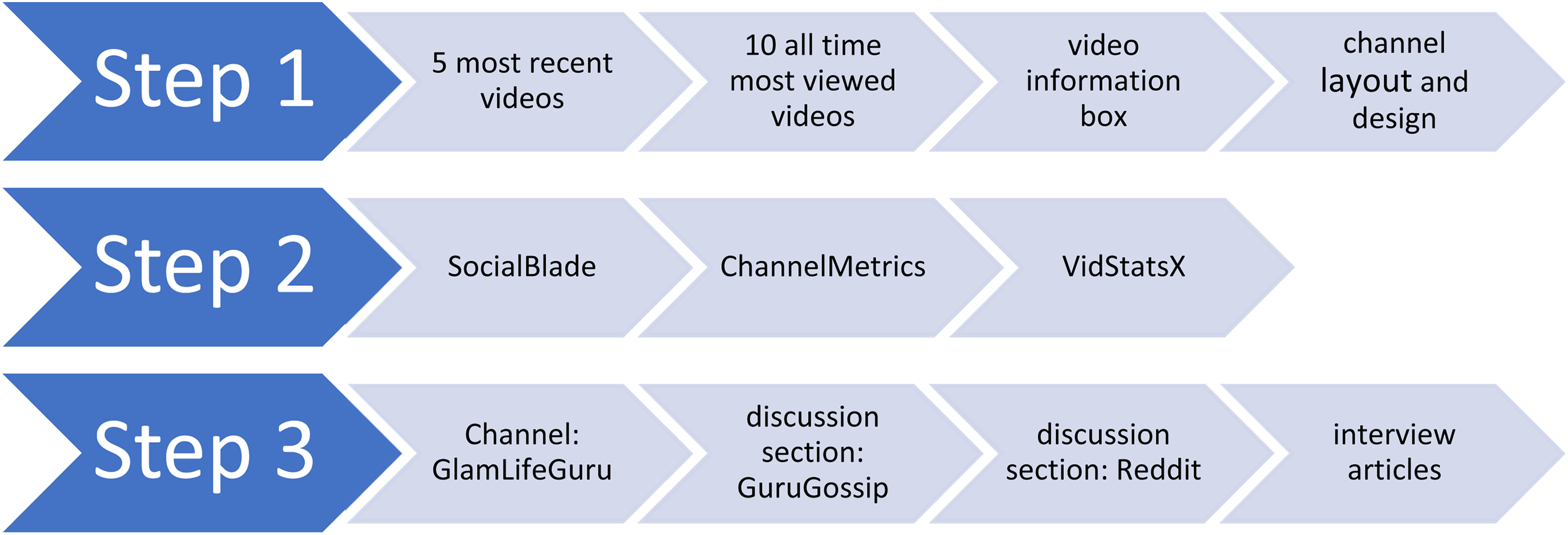
Data collecting procedure.
Entrepreneurial calculation
Beauty vlogging at the conjuncture of industries
As discussed above, traditional celebrity is economically embedded in an industrial structure of multiple stakeholders. Comparably on YouTube, a beauty vlogger is also positioned at the conjuncture of several industries: a social media platform, commercial cultural intermediaries, and the advertising market. For entrepreneurial vloggers, making YouTube videos may start as a hobby but then become their occupation. In Tati Westbrook’s interview with Tubefilter, she claimed that she started the channel with a clear goal to make beauty vlogging her career. 4 Indeed, successful content creators can make millions of dollars per year. In June 2015, Forbes published a list of ‘The World’s Highest Paid YouTube Stars’. 5 Michelle Phan, the role model for many beauty vloggers, had earned $3 million from her channel and her makeup product line over the past year.
Beauty vloggers monetize their videos in several ways. The first is through the YouTube Partner Program. Content creators can join the program by displaying automatedly distributed advertisements in their channels and videos, and share 55% of the ad revenue with YouTube. A key factor in this means of monetization is cost per mille (CPM), or cost per thousand views. For every 1000 ad views, advertisers pay a certain amount of money to YouTube and content creators. We should note that CPM is an advertiser-oriented figure, instead of creator-oriented. It is the advertisement market on YouTube that decides CPM instead of content creators. When the need for YouTube ads is high, for instance, in holiday seasons, the ad prices are high. Some ads are placed by bidding for keywords, so if a keyword is popular among advertisers, the CPM for that ad is also high. In this situation, content creators need to optimize their content and metadata of their videos so as to make sure high CPM ads appear in their channels.
Many beauty vloggers now sign up for a MCN. In general, MCNs can provide content creators with technological, financial, legal, talent developing, and marketing solutions. In return, MCNs extract certain amounts of revenue from content creators. Previous studies have shown that MCN stands in the middle ground of industrial convergence between traditional entertainment industries and IT companies and is one of the major forces in professionalizing amateur content creators (Cunningham et al., 2016; Lobato, 2016). In Table 1, we can see that 8 of the 10 vloggers I have selected are claimed by top MCNs. It is not surprising that five of them have joined StyleHaul, since it specializes in the beauty and lifestyle vertical.
MCNs can help beauty vloggers to develop branded content, indicating that beauty and fashion industries nowadays also need a ‘hype’ or ‘vibe’ in the digital world through images of social media celebrities. Beauty vloggers in this case are ‘social media influencers’ or ‘key opinion leaders’ in marketing lingo, whose authenticity and trustworthiness can be leveraged for commercial messages. This is where we see the tension between communal and commercial cultures. In beauty- and fashion-related videos, vloggers are expected to give honest reviews and recommendations. A common situation I have discovered is that vloggers express explicitly in their videos that they are in collaboration with a brand, or a certain company sends the product to them. Here, my findings regarding vloggers’ attitudes toward being authentic are consistent with those of Marwick’s (2013b), who believes that one should engage with advertising honestly and set personal experiences of the products as a prerequisite to endorsement.
Sometimes, vloggers try to make brand sponsorship a win-win situation for everyone by providing discount links for the sponsored products in videos, so that vloggers get paid, companies get sales, and subscribers get discounts. There are also national policies regarding advertising in online content. For instance, the Advertising Standards Authority issued new guidelines for YouTube product placement and advertising in the United Kingdom. Now YouTubers need to put the word ‘Ad’ in the title of their videos. This new policy received certain criticisms from content creators. The famous British beauty vlogger Fleur stated in an interview with BBC that putting the word ‘Ad’ in a video title sends out a far stronger message than required, distracting viewers from the content when a 10-min video only contains 30 s of paid content. 6
Beauty vlogger channel format
Beauty vloggers’ channels publish beauty-, fashion-, and lifestyle-related content. Nowadays, it is common for a beauty vlogger to have two or more channels: one ‘main channel’ posts beauty-related videos, while the second channel focuses on their daily activities and other miscellaneous content. García-Rapp (2017) also discovered that beauty gurus’ videos can be categorized into two types: commercial-oriented and community-oriented. The former is represented by beauty know-how videos and the latter by vlogs. While vlogs in the early days of YouTube often featured a user sitting in their bedroom talking directly to the camera, now vlogging is more and more associated with the ‘slice of life’ idea, where YouTubers take the camera with them (almost) everywhere they go and document their daily lives. For instance, London-based beauty vlogger Estée Lalonde’s second channel is called ‘Everyday Estée’. 7
These vlogs indeed demonstrate social media celebrities’ representational techniques of interactively disseminating information about one’s everyday and private life (Gamson, 2011), but we should also note one economic consideration behind them. Contemporary marketing strategies prioritize storytelling which contextualizes brand information in the celebrity endorser’s life, casting the brand in a cultural ambience (Hearn and Schoenhoff, 2016; Khamis et al., 2017). I find that beauty vloggers also embed branded messages in ‘slice of life’ vlogs by, for instance, inviting viewers to peep into a mundane morning grooming routine where sponsored products are featured. In this case, what is promoted is not only a good product, but a contextualized product suitable for a busy Monday morning. We can see that while marketing strategies try to blur the generic boundary between advertisement and content, fusing them into ‘story’, on YouTube, it is also difficult to draw a clear line between community-oriented and commercial-centered videos.
In vloggers’ main channels, there are three major types of content: tutorial, consumer review, and consumption exhibition. One may know a beauty vlogger first from his or her makeup tutorials, where the vlogger does makeup in front of the camera. The makeup looks are anchored in certain social settings (e.g. holiday makeup, everyday makeup, beach makeup) or imitate role models (e.g. the Kardashian look). Although these videos are titled as ‘tutorials’ and audiences may indeed acquire skills they are eager to learn, many vloggers like to suggest that ‘this is how I do it’, or ‘you look beautiful in your own ways’. It seems that they do not fully embrace the expert role, but instead adopt a more modest position of sharing knowledge and experiences with community members. Here we can identify a sense of equality in the videos as discussed by previous studies (García-Rapp, 2017; Jerslev, 2016; Smith, 2016).
Apart from makeup tutorials, there are also other types of beauty-, fashion-, and lifestyle-related tips that vloggers may include in their main channel. Consumer review video is another important type of content, yet it is an umbrella term for several topics. For instance, ‘monthly favorite’ is a series that most vloggers film at the end of each month or the beginning of next month, where they give a summary on beauty, fashion, and other personal products that they have enjoyed using. Another category is consumption exhibition. It shows what vloggers have bought, what they have in their bags, house tours, or even what they eat during a day. Compared to product reviews, exhibition videos only demonstrate what has been purchased or used, instead of giving detailed user feedback on the products. Vloggers tend to be cautious about this distinction, since their credibility depends on giving honest and precise information about products. Haul video is also a place where vloggers request for their subscribers’ opinions about whether they would like to see a more detailed review or try-on videos.
Normativity versus personal creativity
In all the three types of beauty videos mentioned above, there are certain fixed titles, topics, and tags, for instance, ‘monthly favorites’ ‘products used-up’, ‘beauty/fashion haul’, and ‘20 dollar/pound/ makeup challenge’. These content formats and titles function as norms for content production in the YouTube beauty community. Many vloggers try to catch up with a trendy or viral topic to the extent that a media hype is created. It is not new for media content production to be self-referential in the digital era; the time-honored news industry is famous for that. However, a new concern for social media celebrities on YouTube is the searchability of content. By following the trendy topics, vloggers can increase the searchability of their videos, as they are creating something that people can find and already know beforehand. This explains why makeup tutorial videos receive more views compared to vlog videos, as discovered by García-Rapp (2017), since know-how content tends to be searched by nonsubscriber viewers. Here, we can see that to gain more media visibility, beauty vloggers produce content taking into consideration the technical affordances of the platform. Other search engine optimization strategies include, for instance, feeding detailed product and video information to the information box, that is, the metadata of the video. In the YouTube creator hub, the guidelines also suggest content creators make their URL name consistent with how viewers and subscribers address them, so that precise search results can be yielded when users search with a vlogger’s name.
A recently emerged topic in product review videos is called ‘first impression’. Although we don’t know who first came up with this name, Judy from channel ‘itsjudyslife’ is an early adopter of this topic. Judy is a professional vlogger, mother of three girls. She owns three YouTube channels: a beauty channel, a vlog channel, and a mom channel after she gave birth to her first child Juliana. 8 The whole family’s everyday life is on YouTube and her three children are ‘YouTube kids’, whose lives have been documented in vlogs from the moment they were born. In the ‘first impression’ video, Judy usually begins to wear a product in test from early morning and then gives the first impression review. What makes the videos different (from the literal meaning of ‘first impression’) is that she continuously takes photos and films video clips every few hours to report whether the beauty product functions well. The detailed reviews, as embedded in Judy’s busy and sometimes frustrating domestic life, aim to give the audience practical reviews. The product should not only look good in front of camera and on the red carpet for 2 h (like what we see in mass media celebrity endorsed advertisements), but also endure the demanding tasks of being a professional, a wife, and a mom throughout the day.
However, if a beauty vlogger only follows the normativities of content creation, one cannot be distinguished from other competitors in the YouTube beauty community. While previous studies discover that a social media celebrity’s sense of uniqueness can be expressed by staging one’s private life, I find that in terms of video content, one also needs to be innovative. Tati Westbrook’s channel ‘glamlifeguru’ is a good example to demonstrate the balance between innovation and normativity of YouTube content creation. Based on statistics from VidStatsX (Figures 2 and 3), 9 we can see that her channel began to grow slowly and steadily from January 2013. Since September 2015, the channel experienced a surge in its total number of subscribers, monthly video views, daily gained subscribers, daily gained views, and total subscribers gained.
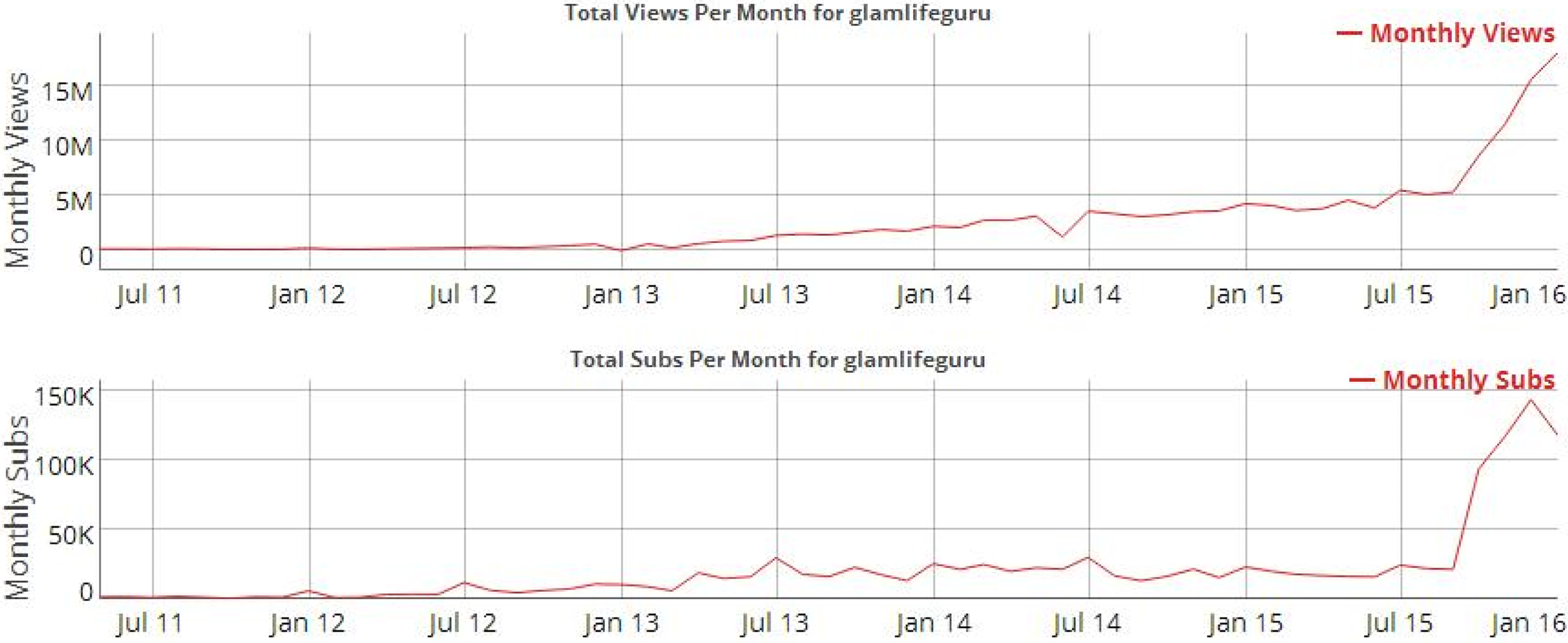
Total views and total subscribers per month for glamlifeguru.
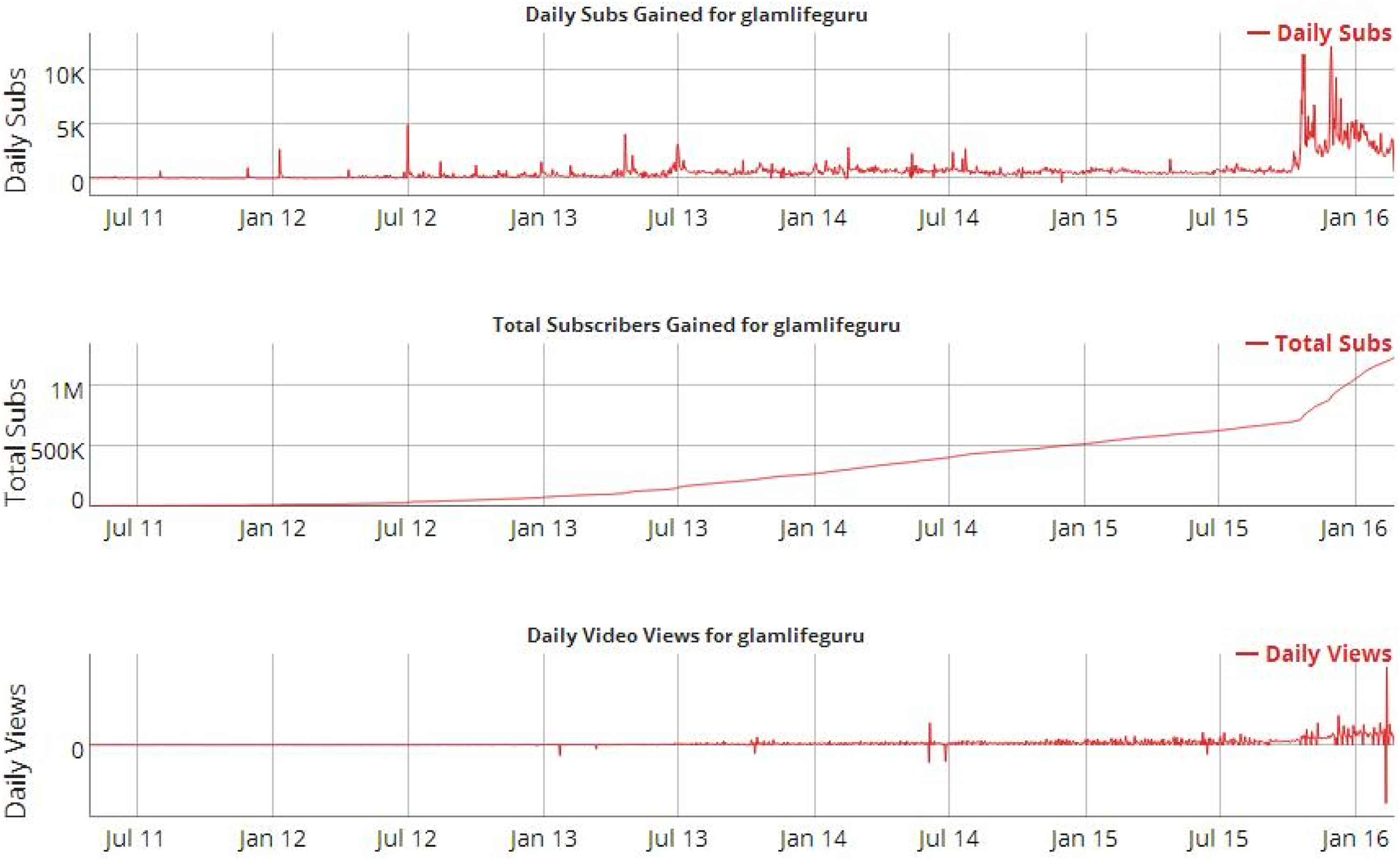
Daily subscribers gained, total subscribers gained, and daily video views for glamlifeguru.
In Tati’s video list, I find that from June 2013 she began to upload videos in a series form. Every Monday, she goes to drugstores to discover cosmetics that are on sale, often using coupons clipped from the Sunday paper. The video is titled ‘Madness Monday’, referring to the fact that beauty products can be purchased at very low prices as long as customers are on the lookout for discount opportunities and coupons. On Tuesdays, she introduces a beauty tip, which she calls ‘Tip Tuesday’. On Thursdays, she gives feedback on what she has bought on Monday in videos titled ‘Hot or Not Thursday’. Some of the extra products she buys on Mondays are given as gifts to subscribers on Fridays, hence ‘Give Away Friday’. In her interview with Tubefilter, she also highlights her high uploading frequency as a feature making her unique among YouTube beauty vloggers. 10 Moreover, the video titles include not only the series name, but also the specific product, drugstore name, or more general topics like review or haul, which helps to optimize searchability.
Another unique point of Tati’s channel is mentioned in both her interview with Tubefilter and one of her videos. 11 She acknowledges that in the beauty vlogging community she is relatively older, especially when the earlier days of YouTube was dominated by teens. She constantly ‘got strange hate’ for ‘being old and still doing YouTube’. She believes nowadays the platform has become more mature and her professional reviews provide a good position to engage with more mature audiences. In the guru discussion section on Reddit, users also raise the topic of her age. In Figures 4 and 5, both users express the positive aspects of being an older guru on YouTube. The first user thinks Tati’s opinion is different from other younger but homogeneous gurus. The second user likes Tati’s voice since many younger vloggers yell through the whole video. 12 From my fieldwork, I also find that Tati’s videos are more serious in terms of style compared to younger vloggers, for instance Bethany Mota in my sample, who features a cheerful and playful style. 13

Tati is different from other ‘cookie-cutter-clone’ younger gurus.

Tati’s voice is soothing.
While Tati’s commitment to consistent updates and her unique position of giving more mature opinions may explain the steady growth of her channel, I now try to explore what contributes to the sudden growth of her channel. Many factors may lead to such growth, including keywords and metadata search engine optimization, featuring and recommendation by fellow YouTubers and of course new attractive content. An explicit change in Tati’s channel is that she has introduced a new series ‘WTF super luxury product first impression’, in which she purchases and reviews luxurious cosmetics at the top end of the price range. Again, the first impression video was an earlier established trending topic, but Tati locates her niche market specifically in extreme luxurious products. In the interview with Tubefilter, she expresses that audiences are curious about ridiculously overpriced products. According to the statistics from ChannelMeter, in the most viewed videos within 30 days, the top three positions are all taken up by WTF series videos (Figure 6). 14
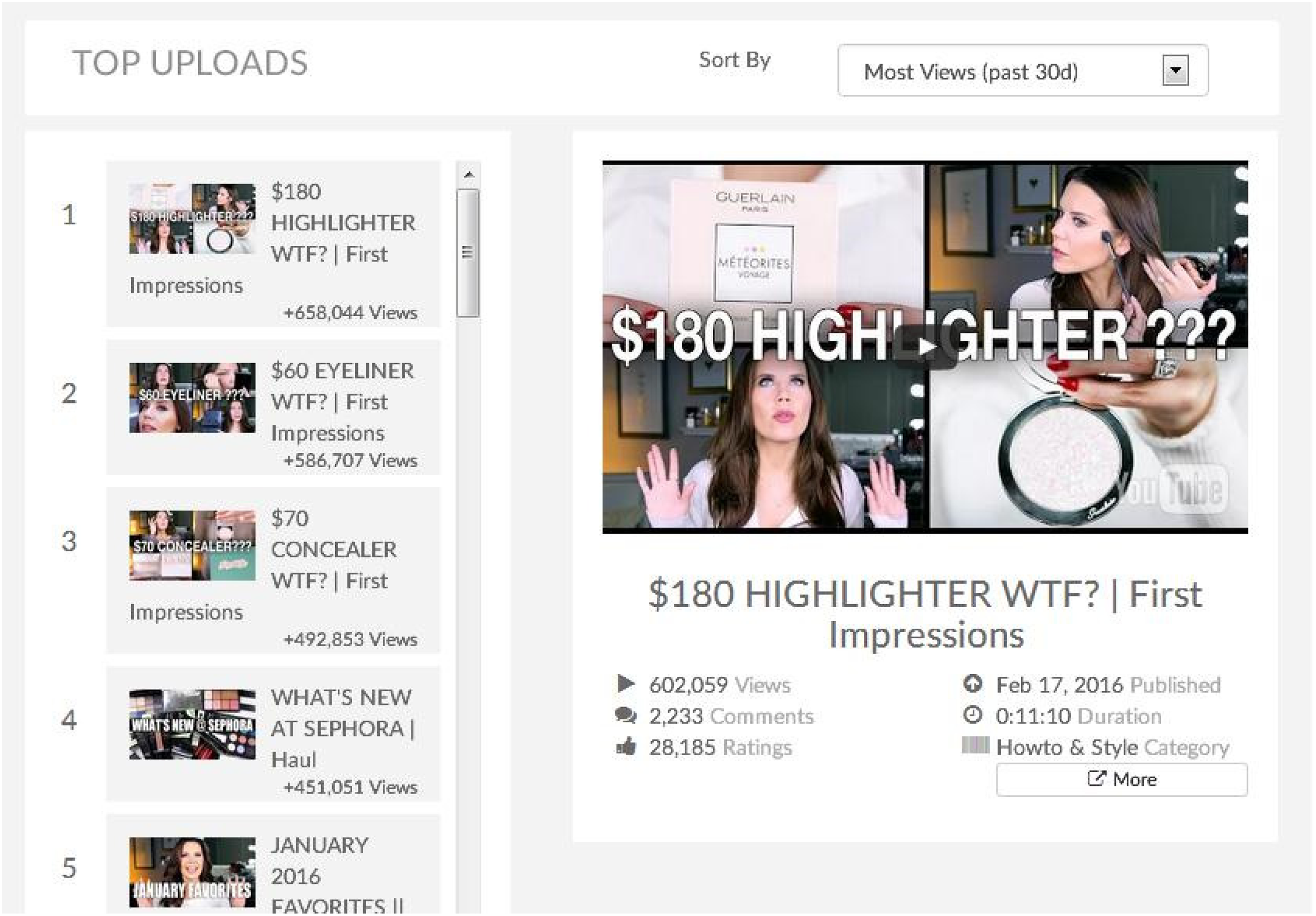
Most viewed videos within 30 days for glamlifeguru.
However, from Tati’s all-time most viewed video ranking, we can see that her content is organized clearly along the price range in the makeup market (Figure 7). 15 First of all, four WTF videos appear in the top six most viewed videos. A 2012 video ‘$20 makeup challenge’ is on the fifth place. I think this is not only because the video has accumulated views for a long period, but also because it features one of the most established tags that audiences may search videos with. Similarly, other top-ranking videos all give reviews on more affordable drugstore products, such as ‘Drugstore favorites and hate it’s’ and ‘Luxury products regret buying’. In a video titled ‘Best Drug Store under 10 Dollar’, Tati explains that she wishes to continue the ‘high and low’ theme in her channel. 16 This designing of theme suggests that beauty vloggers need to envision market segmentation, as consumers with different purchasing power may expect to watch different video content. In doing so, vloggers can attract more views and subscribers.
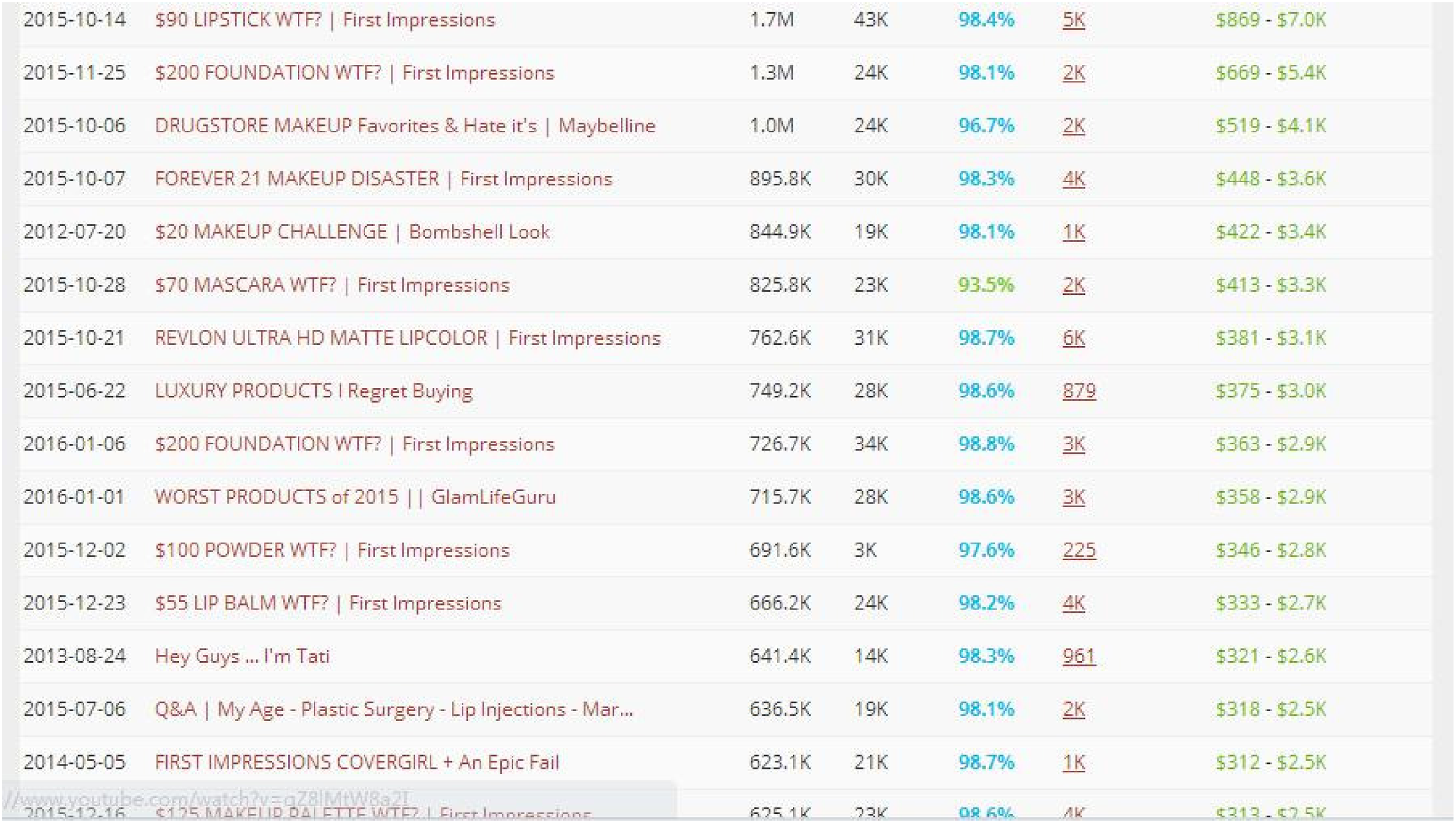
All-time most viewed videos for glamlifeguru.
The high and low topic is indeed regarded by viewers as a prominent feature in user discussions on Reddit, although they tend to receive this topic with critical reflection. The threads in Figures 8 and 9 show that audiences raise doubts on Tati’s unbiasedness and her attitudes regarding products at both ends of the price range. 17 Especially when she can afford and enjoy more expensive products, her opinions on the affordable ones are constantly questioned.

Tati’s ashamed attitude toward expensive makeup is disingenuous.
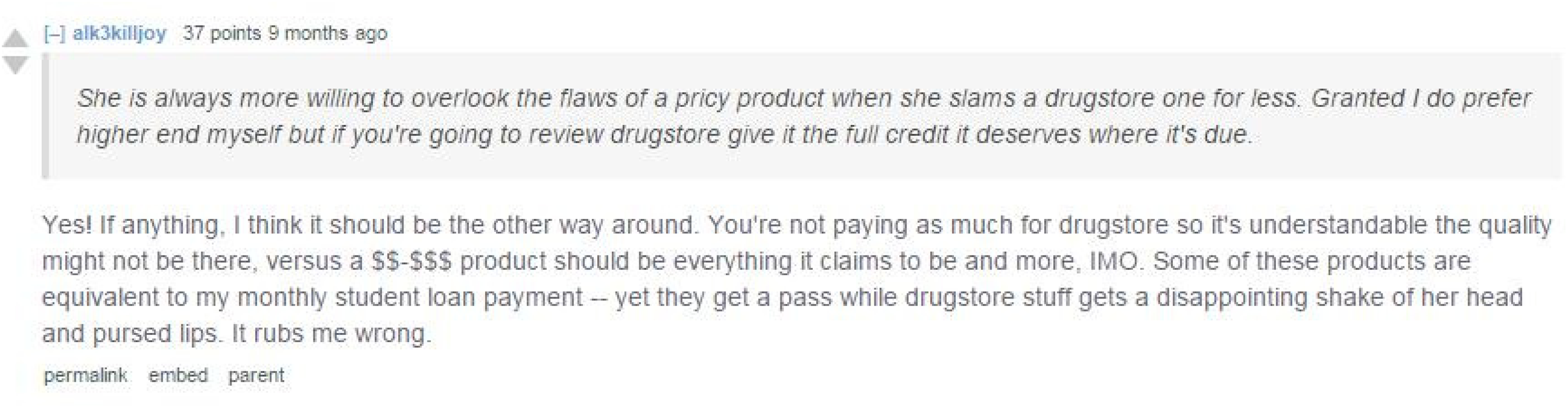
Tati slams drugstore products.
Around the time of her channel breakthrough, Tati also embarked on brand collaboration. In October 2015, Tati launched a makeup line which she curated within the brand Birchbox, and also a subscription box including Tati-approved beauty/skin-care product samples. In this case, Tati’s celebrity image was materialized into products that can be purchased online, thus helping to make her name known to customers beyond her YouTube circle. Besides increasing Tati’s media visibility, this collaboration is also an example of how contemporary marketing practices take place at the interplay between celebrity endorsers’ image and brand image. The products curated and selected by Tati are not simply labeled with her name. The product concepts and features, such as ‘a smudge-proof bright lipstick’, demonstrate Tati’s unique makeup style and lifestyle. 18 The samples in the subscription box also crystallize her makeup and grooming know-how.
Upload timing, frequency, and budget control
I have mentioned that many YouTubers now have two or more channels. Apart from the beauty-related content, they also film ‘slices of life’ vlogs, showing the everydayness in their lives. This is indeed one way to produce more content and generate more revenue. I also find that beauty vloggers embrace seasonal series such as ‘Vlogtober’ (vlog + October) or ‘Vlogmas’ (vlog + Christmas). During these two months, they increase the frequency of uploading and also touch upon seasonal and holiday topics. Beauty and fashion content is very sensitive to seasonal change, and the advertising need for season-sensitive products is also high at the turn of seasons. Therefore, vloggers usually follow the trend of seasonal topics by uploading videos such as ‘Fall makeup haul’ or ‘Beach/pool makeup tutorials’, not only to cater for viewers’ needs to receive more views but also to attract high CPM ads for their videos. Vloggers become even more productive in December and the vlogs often start with Christmas tree shopping and decorating and then continue to New Year’s Eve. The other side of the YouTubers’ financial story is the budget control in making videos. Scripted content such as sketch comedy may require professional cameras, sound and lighting systems, and film studios. It also costs more time to film and edit. In contrast, everyday life vlog videos are easier to make and more budget-friendly.
The cultural logic of social media celebrity
From guesswork authenticity to staged authenticity
Drawing on previous studies on social media celebrities’ self-representational strategies and my analysis on the industrial factors, I now reflect on the cultural logics of social media celebrity. First, social media celebrity has a new approach to authenticity which I call ‘staged authenticity’. Celebrity practitioners establish a sense of authenticity through the interactive representation of the intimate and private self, and they adopt affiliative techniques to show equality and commonality with fans. However, we should not forget that in traditional celebrity culture, authenticity is also an important element. Fans and audiences seek the authenticity of a celebrity by collecting endless gossip articles which tell them what the glamorous stars really look like in their private lives, when the stage curtain falls (Gamson, 1994). Nevertheless, a basic celebrification strategy, which was already adopted in the era of Julius Caesar, is to make one’s private life as raw material feeding the public image (Braudy, 1986). The paparazzi industry demonstrates this point, as studio-controlled, if not studio-fed privateness is disclosed to audiences. As such, authenticity for traditional celebrity is a nonstop recursion, a guesswork between reality and fiction, and between private and public.
On social media, however, the recursive play between celebrity as a character on stage and celebrity as a professional in life stops. As an assumedly non-scripted genre, the ‘slice of life’ vlog creates a situation where celebrity practitioners play the role of themselves in their own lives for the sake of staging their lives. Here, the Goffmanian distinction between the ‘front region’ and the ‘back region’ has collapsed (Goffman, 1956). Beauty videos such as ‘my shower routine’ and ‘get ready with me’ stage the back region of a vlogger’s life in front of the camera. Following MacCannell (1973), these videos exemplify staged authenticity: the fostered impressions of certain back regions have been entered, supporting people’s belief of authentic experience. With traditional celebrities, we need to play the guesswork regarding authenticity underneath the public image, behind the front stage, while with vlogs, the subtext is ‘authenticity is here and now, actually there is nothing else more than authenticity’. Of course, all these efforts made by vloggers to bring audiences closer to their private lives do not mean we can really walk into their lives. Beauty vlogger Zoe Sugg (YouTube channel: Zoella) complained in her tweets that some viewers tracked down her house and rang her doorbell. She even installed CCTV to stop them. 19 In this regard, I argue that one of the elements in the cultural logics of social media celebrity is a generic innovation called staged authenticity.
From managed distance to managed connectedness
Related to the concept of authenticity is connectedness. Traditional celebrities keep a distance from their audience. According to Gamson (1994), such distance is kept intentionally so that only the controlled and managed celebrity images are released with the purpose to protect their commodity value. Therefore, celebrities used to be watched from afar, or imagined by scraping pieces of information available in gossip magazines and interviews together. Celebrity teams also didn’t care about audience reception very much, as the major publicity work for traditional celebrity used to be one-way communication and to ‘get the word out’ and ‘hit as many places as possible’ (Gamsom, 1994: 114). This is because a celebrity’s direct market is entertainment companies and media outlets, not audiences.
This is not the case for YouTube beauty vloggers. In the fieldwork, I find that they consider the direct feedback and requirements from viewers and subscribers seriously. Not only do they ask for suggestions for video content, express the motivation to make friends on YouTube, but also learn about audience reception by navigating through the popular metrics and data analytics of the platform. In a recent video from the British vlogger Lily Pebble, she shows how she plans video ideas and keeps track of channel analytics on a planner. 20 For social media celebrity, popularity and audience reception can be easily quantified and reflected through various popularity metrics such as the number of views, subscribers, and likes. These are important factors in evaluating a beauty vlogger’s market value, used as an index for marketers to identify social media influencers (Booth and Matic, 2011). The involvement of audience reception in the production of celebrity content is not new, as reality TV has paved the way to this ‘demotic turn’ (Turner, 2010, 2014). Contest shows have long been incorporating audience votes through the Internet, telephone, and SMS (Hartley, 2008). What is new for social media celebrity is the ability to maintain such engagement continuously. It is also common for vloggers to maintain multiple media presences on different platforms. For example, a quick ‘popping-into’ the local drugstore is tweeted, and products instagrammed at close-up, potentially leading up to a beauty haul or review video based on audience reaction. The multi-platform representation, afforded by handy mobile devices, also enables a vlogger to be connected with subscribers and followers continuously and in real time. In this sense, the cultural logic of social media celebrity is characterized by their ever present and accessible connectedness to audiences.
From scarcity to abundance
In mass media, the competition for fame is fierce and the career as a celebrity precarious. One reason for the highly replaceable and disposable nature of celebrity is traditional media and entertainment industries’ business model which features big investment in premium content. On the one hand, the silver screen or television are not scalable media, thus accommodating only limited numbers of celebrities. On the other hand, to secure profits and reduce risks, content production is highly formulaic (Gamson, 1994). The producers therefore also need formulaic celebrity personalities but ever fresh new faces. This may explain why modern celebrity is criticized for being differentiated from one another by marginally different personalities (Boorstin, 1971).
Social media celebrities also tend to be homogeneous, as described by the audience in the Reddit discussion thread (Figure 1) as ‘cookie-cutter-clone’ beauty vloggers. However, due to the industrial logic of YouTube and MCNs, the homogeneous social media personalities will not be disposed and replaced by new ones. Instead, multiple ones can be aggregated to market verticals and monetized together. This is the same logic of the long tail business model characterizing e-commerce websites like eBay or Amazon, where products in low demand or low sales volume can collectively make up a market share and rival with the best sellers. Moreover, the scalability of MCN and YouTube also means they can hold ever-increasing numbers of personalities. Of course, this does not mean the absence of hierarchy in the status of social media celebrity. The scarcity can be reintroduced with the pyramid service model of MCNs, where big personalities receive 360-degree personal services with many brand cooperation opportunists, while smaller channels participate in the network independently with the help of automated online tools (Lobato, 2016).
From meritocracy to self-sufficient uniqueness
When we argue that social media celebrities perform ordinariness in their vlogs, it’s easy to forget that the film star was also a token of ordinary people. The rags-to-riches story of the soda fountain girl was the antithesis to aristocracy in the early 20th century. Celebrities on screen are ordinary people in the sense that they have achieved their status through self-effort instead of bloodline. Therefore, ordinariness in traditional celebrity culture has an emphasis on meritocracy. Of course, we may also argue that celebrity is a result of sheer fabrication within the cultural industry, which can happen to any ordinary person with mediocre ability and without much effort. Celebrity in this case has nothing to do with merits. Nevertheless, the result of celebrity manufacturing is a larger-than-life representation which features extraordinariness.
In social media celebrity culture, ordinariness is about both less and more than meritocracy. As to media discourse outside of the digital world, mainstream news articles still narrate YouTubers like Dane Boedigheimer in a self-made (wo)man script (Morreale, 2014). But the story has a twist to it – the ‘this just happened’ effect – as YouTubers are motivated by a desire of personal expression and creativity, not the ambition to achieve material gains. Within the digital world, I notice from my fieldwork that vloggers claim efforts not to achieve the best of something, but to be oneself. Both vloggers and viewers are very cautious about making personal judgments on beauty and fashion styles. Some vloggers refuse the role as a makeup expert, and they simply share how they do it and what is suitable for them. This may be partly due to the fact that what I have observed are cultural activities related to consumerism, which is legitimated by a discourse of consumption entitling self-expression and personal agency. In this scenario, no one is better than another as every ordinary person is endowed with his or her uniqueness. Also importantly, the technical affordances of social media encourage users to be self-expressive about cultural taste and identity, so that these preferences and behavioral data can be capitalized for commercial use (Van Dijck, 2013). Therefore, social media celebrities’ sense of ordinariness is not about someone with a humble beginning climbing the social ladder. Instead, it embraces the self-sufficient uniqueness endowed to every ordinary person.
Discussion and conclusions
In this study, I suggest that social media like YouTube has given rise to a new type of celebrity with its distinct industrial underpinning and cultural logic. Taking beauty vloggers as an example, I have demonstrated that their celebrity status is situated at the industrial conjuncture of the social media platform, commercial cultural intermediaries, and beauty and fashion consumer market. Digital ethnography was conducted at multiple sites including vloggers’ YouTube channels, interview articles with vloggers, audience discussion forums on Reddit and GuruGossip, and third-party YouTube analytic websites. It was found that many famous beauty vloggers are managed by MCNs and they incorporate branded content and participate in offline brand activities. The vloggers create content with entrepreneurial calculation and a prospect of channel growth. A series of contradictions are negotiated between a vlogger’s role as a community leader and a brand ambassador, between personal innovation and the cultural and technical normativities of beauty vlogging. The vloggers also envision the segmentation of the beauty consumer market so as to attract a wide range of audiences with varied purchasing power. Moreover, the vloggers also react to the seasonal fluctuation of CPM rates actively, yielding new content and new genres in the YouTube beauty community. From these findings, we can see that although beauty vloggers have more agency over their public profile compared to traditional celebrities, they still need to answer to many industrial forces which make their celebrity status possible in the first place.
Social media celebrity is the newest metamorphosis of fame in the networked society, characterized by a new cultural logic distinguishing it from traditional celebrity. The boundary between the celebrity’s private and public image has collapsed and authenticity is staged in purportedly non-scripted vlogs. Rather than keeping a managed distance from the audience, social media celebrities maintain managed connectedness with viewers and subscribers. Audience reception is attached with more weight in deciding a vlogger’s success due to easily quantifiable popular metrics of the platform. As we see more figures perform celebrity practices in more fields of the public sphere, the industrial model of social media and MCNs provide monetization solutions through aggregation and scalability. Therefore, social media celebrity is characterized by abundance rather than scarcity. The new version of fame in the digital world trumpets liberal democracy and modern individualism to a new level by bringing every user the possibility of differentiating oneself from the rest of the network. The sense of meritocracy in modern celebrity culture has been diluted, and self-effort is replaced by self-sufficient uniqueness.