




Abstract
It has long been assumed that social media would equalize election campaigning by providing cheap means of communication for smaller parties who lack a strong mass media presence. Yet given the increased political importance of social media, parties with more professional staff and resources could also gain the upper hand in online campaigns. So far, knowledge of the development of online campaigning in a rapidly changing political and technological landscape remains limited, as only few studies have taken a longitudinal and cross-country approach. This paper conducts a comprehensive analysis of more than 12,000 unique candidates from all 28 European Union (EU) member states in the 2014 and 2019 European Parliament (EP) elections. We theorize and empirically assess how party size and parties’ EU position relate to the presence, the activity and the salience of the EU among EP candidates on Twitter (now X). In the 2019 election, parties with a bigger national vote share and Europhile parties were more likely to be present and use Twitter more frequently to tweet about the EU. Overall, the findings point to a “normalization” of online election campaigning and a further convergence of first and second-order elections.
Keywords
Introduction
Social media are playing an increasingly important role in contemporary democracies (Tucker et al., 2017). In election campaigns, platforms such as Facebook, Twitter (now X), and more recently Instagram or TikTok, allow candidates and parties to directly reach voters and opinion leaders such as journalists and celebrities. Social media have especially been regarded as powerful tools for activists and political parties with fewer resources and a lack of mainstream media attention to put their causes in front of a wider audience. Albeit much attention on online election campaigning in national elections, there is still a lack of research on social media’s role at the European level. While European integration has long been regarded as a project of political elites (Hooghe and Marks, 2009), amid a lack of contestation of so-called “second-order” European elections (Schmitt, 2005), European politics has become more politicized since at least the 2000s. Social media can play an important role bringing European issues closer to citizens and ultimately enhance the legitimacy of European Union (EU) decision-making. Candidates in European Parliament (EP) elections and elected Members of European Parliament (MEPs) can use social media to directly engage with citizens (Fazekas et al., 2021), mobilize turnout (Popa et al., 2020), coordinate and campaign with peers across countries (Stier et al., 2021) and promote a transnational European identity (Bossetta et al., 2017). With the increasing adoption of various social media platforms by citizens in all European countries, it becomes an intriguing question how their use by political elites evolves and interacts with changes in the broader environment of European politics.
Existing literature on social media use during election campaigns has revealed many novel insights, amid several shortcomings. Chief among them is that many studies continue to focus on the United States, a source of innovation when it comes to online campaigning, yet one with unique characteristics not applicable elsewhere. In the US, online campaigning and the social media culture in general are highly professionalized, resource-intensive and celebrity-oriented. Additionally, genuine cross-country research is still scarce, despite significant variation in how political actors across Europe have picked up social media, depending on a host of country-specific structural factors. Besides a lack of cross-country studies, another glaring omission in the literature is the absence of longitudinal analyses. Online election campaigning keeps evolving constantly as more political elites take advantage of the communicative capacities of social media. Contemporary European party systems are also subject to dramatic changes against the backdrop of transnational political crises (Hutter and Kriesi, 2019), new political cleavages (Hobolt and De Vries, 2015; Treib, 2021) and the rise of populist parties (Rooduijn et al., 2020). Scholarly understanding of how such changes in the political communication environment affect social media use by election candidates is still limited.
In this paper, we study online campaigning on Twitter during the 2014 and 2019 elections for the European Parliament. 1 For three reasons, EP elections offer an ideal case for testing how changing political environments affect online election campaigning. First, EP campaigns take place across all EU member states, providing a unique set of (national) election campaigns in diverse institutional settings that can be studied simultaneously in one integrated research design. Moreover, the temporal distance between the two periods under study (5 years) makes for a significant time frame during which noteworthy systemic changes unfolded. Second, we are observing a period during which both radical left and right populist parties made significant electoral gains. Their increasing vote shares were accompanied by a proliferation of populist rhetoric in Europe and a pivotal role of social media in keeping these parties relevant in public discourses. Third, the time period was marked by an increasing use of social media platforms on the demand side of political communication – citizens. Accordingly, politicians also expanded their online presence. While in 2014, 40% of EP candidates had an account on Twitter, the share increased to 54% in 2019. 2
In our theoretical discussion, we revisit several prominent streams of thought. The first are studies investigating an equalization vis-a-vis a normalization of online campaigns (Gibson and McAllister, 2015). Here, a longitudinal analysis is particularly insightful as it can indicate how technological adoption unfolded as a reaction to existing attention imbalances and mainstream news coverage (Jungherr et al., 2019). We also discuss how the EU dimension of political competition and the conflict between pro and anti-EU parties might be reflected in patterns of social media usage and the instrumental salience or de-emphasis of EU-related issues in Twitter communication (Fazekas et al., 2021). As the nature of competition on the EU has evolved considerably in the last decade (Beaudonnet and Prohuber, 2024; Font, 2024; Hutter and Kriesi, 2019), the extent to which online political campaigning is shaped by these structural changes at a time of heated public debates about social media’s impact on democracy is still an open empirical question.
We make use of a meticulously compiled dataset of all candidates from the (back then) 28 member states of the EU standing in the EP campaigns 2014 and 2019. The pooled structure of the dataset allows us to compare over-time changes in electoral campaigning. Studying a cross-national setting ensures that the sample covers a wealth of institutional, political and societal variations in terms of electoral systems, the presence of different types of mainstream and niche parties, Internet use and other important factors. We hypothesize that the forces dominant in national politics should have gained ground in online campaigning in the 2019 EP elections, relative to a more level playing field in 2014. As central outcome variables, we study candidates’ (1) adoption of Twitter, (2) the intensity of their Twitter use, and (3) the salience of the EU in their tweets. Overall, our findings provide support for the normalization theory of online political campaigning. The increased adoption of Twitter is driven by larger political parties that are also similarly active on Twitter, after lagging behind smaller parties in the 2014 EP election. Substantively, the findings underline the decreasing second-order character of EP elections, with an overall increase in the salience of EU issues, driven by pro-European political parties. Beyond improving our understanding of evolving online campaigns over time, the study demonstrates how social media data enable new insights on the dynamics of party politics across time and space.
Twitter use in election campaigns and the case of the EP elections
Twitter, or now X, is not only an important tool for political discources and activism worldwide but also a fundamental building block of the political information environment surrounding electoral campaigns. Specifically, Twitter is essential in helping candidates address important campaign issues and at least occasionally interact with voters (Jungherr, 2016; Sältzer, 2022; Stier et al., 2018). For challenger parties, it is a key way to put out in the open messages that are unfiltered by traditional gatekeepers (Jungherr et al., 2019). Politicians’ messages can also travel beyond Twitter’s core user base to broader parts of the population thanks to amplification by political opinion leaders such as journalists (Oschatz et al., 2022; Wells et al., 2016). As a consequence, Twitter is used to strategically place information in ways that can decisively affect the news cycle and even divert media attention from topics that can be potentially harmful (Barberá et al., 2019; Lewandowsky et al., 2020). With such concrete benefits for election campaigning, it is unsurprising that the platform has gradually become integrated in the campaign repertoires of political parties and candidates alike. While this integration was initially more prominent in high-stakes competitions such as national election campaigns, research has shown that Twitter is now key in EP election campaigns too (Nulty et al., 2016), with 85% of the MEPs who served in 2015 and 2016 owning a Twitter account (Daniel et al., 2019).
While research on the use of social media at the European level remains limited compared to national contexts, important insights exist about the different ways in which Twitter affects political communication during EP elections. Larsson (2015) and Daniel et al. (2019) have focused on the question of permanent campaigning aiming to better understand how Twitter is used in “quieter” periods outside the busy time of elections. While the first, earlier, study found that permanent campaigning was limited, the second study demonstrated that the level of communication on the platform has become sensitive to the legislative cycle and especially to national, domestic developments that may demand increased communication. A number of studies have used hashtags and @-mentions to explore more dynamic elements of political communication during EP electoral campaigns, such as the evolution of topics and emotional tone in Twitter communication, and the level of integration of the EU dimension within national and cross-national conversations. Using tweets from and to political actors sent during the 2014 EP campaign, Lorenzo Rodríguez and Garmendia Madariaga (2016) found that diverse personal and institutional factors – not unlike those faced in national campaigns – affect not only EP candidates’ opportunity to adopt new communication tools but also the intensity of using them. Using tweets from the same electoral campaign, Nulty et al. (2016) found that the televised debate of the pan-European lead candidates (Spitzenkandidaten) had a prominent influence on communication on Twitter, with the content and emotional tone of messages reflecting preferences along the EU dimension of political contestation rather than traditional left-right differences. The nomination of Spitzenkandidaten for the first time, a move designed to bring the EU closer to citizens and bolster turnout, has significantly distinguished the campaign from those preceding it by further polarizing those favoring and those skeptical towards the EU (Popa et al., 2016).
The move to introduce the Spitzenkandidaten system generated new scholarly interest on parties’ personalization efforts in EP campaigns and beyond. Social media are considered pivotal in this process, generating questions about the extent to which especially Twitter could be used by individual candidates to inform and interact with the public, as well as to communicate politicized issues (Braun and Schwarzbözl, 2019; Theocharis et al., 2016). Relying on Twitter data from the 2014 EP election, Fazekas et al. (2021) examined how candidates communicated with the public about EU issues in comparison to other political issues. They found only a limited EU issue expansion as Twitter users also generally engaged less with tweets concentrating on EU issues – compared to non-EU issues. Obholzer and Daniel (2016) found that MEPs representing more citizens were more likely to use Twitter, and to use it more frequently too. They showed that this was also the case for those MEPs more likely to lose their seats, confirming Twitter’s importance as an innovative and necessary instrument in the campaign toolbox. Their research also showed that variation in electoral institutions impacts campaign strategies, with national party, voter and legislator characteristics playing an important role. One of the studies using data from the 2019 EP election confirmed the abovementioned patterns (Daniel and Obholzer, 2020). In another study of MEPs, Font (2024) showed that EU salience was higher among pro-EU parties under increased competition for votes. Stier et al. (2021) showed that despite the opportunity for low cost transnational communication, Twitter candidates primarily directed their campaign communication towards the national arena, though they do note that the Spitzenkandidaten system creates incentives and opportunities for more Europeanized campaigns.
Overall, this literature has offered a number of illuminating insights regarding not only the determinants of Twitter adoption and use by EP candidates but also the strategic choices made in terms of how, when and why certain issues (EU-related or not) should be communicated. Nevertheless, an important limitation of this strand of research is the absence of longitudinal analyses that would allow us to observe stability and change in not only institutional factors and campaign strategies, but also broader political developments such as the strengthening of populist parties with their bombastic and sophisticated social media use. The only other longitudinal comparison of online EP campaigns we are aware of is that of Daniel and Obholzer (2020). Yet this paper only investigated Twitter use by MEPs instead of all candidates and did not specifically focus on the explanatory factors that we will discuss in the next section.
Most research investigated the use of social media, i.e., the number of posts sent by politicians. Sometimes also adoption, i.e., the presence with a dedicated account on a platform is investigated, without properly theorizing about the differences. These differences are especially important to consider when studying the role of party resources and over-time changes. Bigger parties might have more resources and party-organizational support to register an account and add the necessary professional materials like images. Still, being active on social media might require a deeper engagement with the platform and its audiences. Hence, different strategic concerns and elite characteristics might be underlying both dimensions. And finally, understanding of variation in the actual content of political communication by EP candidates is still limited. In their essence, EP campaigns should be about European integration. But traditionally, research on EP campaigns has found that in particular mainstream parties de-emphasize the EU in their platforms (Braun and Grande, 2021). One way to assess the prominence of the EU dimension of political competition is to analyze the salience of EU-related appeals in election communication. Whereas Fazekas et al. (2021) have shown that EU issues were marginalized in Twitter communication by 2014 EP candidates, they also caution that politicization of the EU might increase with a more widespread use of Twitter by Eurosceptic parties. Furthermore, the more firm establishment of the Spitzenkandidaten system and the relatively higher amount of public attention devoted to the 2019 EP elections (Kritzinger et al., 2020; Partheymüller et al., 2020) also suggest that there might be variation over time.
Against this backdrop, our paper aims to explain patterns of online campaigning across three different behavioral dimensions: (1) adoption of Twitter, (2) the intensity of Twitter use, and (3) the salience of the EU in EP candidates’ tweets.
Equalization versus normalization of online election campaigning
It has long been assumed that digital technologies would empower niche parties, enabling them to engage directly with voters, highlight underrepresented issues, and challenge the narratives of established parties. This “equalization” scenario might particularly play out in European politics, where mainstream parties were long willing to concede the initiative in the politicization of European politics to issue entrepreneurs (Braun and Grande, 2021; Hobolt and De Vries, 2015). Still, recent research has found that parties of all stripes are increasingly campaigning on European issues (Fazekas et al., 2021; Font, 2024; Nulty et al., 2016), potentially resulting in a “normalization” of European online campaigning. In the following, we theorize how two crucial factors, party size and party positions on European integration, shape the playing field in social media use by EP candidates.
Party size
The opportunity for faster, more voluminous and significantly cheaper modes of communication that digital media provide to political parties and candidates may act as an equalizer by enabling smaller parties to balance deficits that they have in comparison to major, well-resourced parties by intensely adopting and using such tools (Hansen and Kosiara-Pedersen, 2014). Such deficits may have to do with the expertise that dedicated and sophisticated consultants and campaign strategists can provide. Previous research provides some evidence that a levelling of the playing field does indeed materialize online (Jacobs and Spierings, 2016), at least in terms of the adoption of digital channels. Larsson and Kalsnes (2014), for example, have shown that in Sweden and Norway, the most active politicians on social media could be labelled as “underdogs” (younger, in opposition and out of the political limelight). Social media more generally are ideal arenas for outsiders (e.g., small parties) with fewer resources and restricted access to political gatekeepers to challenge the supremacy of established actors (Jungherr et al., 2019).
At the same time, in a systematic review of the use of Twitter by parties and candidates during election campaigns, Jungherr (2016, p. 84) marked as a key finding that the platform was not heavily used by resource-strapped campaigns, making it unlikely to change existing power balances between parties or candidates. This finding underlines the continuing relevance of the theoretical idea of a “normalization” in the use of information and communication technologies by political elites. Accordingly, a number of studies have come to support that parties richer in resources and bigger in size continue to have more sophisticated online presences (Gibson et al., 2014; Gibson and McAllister, 2015). Beyond activity, evidence from Israel indicates that bigger parties were also more successful in drawing online engagement (Lev-On and Haleva-Amir, 2018; Samuel-Azran and Yarchi, 2020) which creates positive feedback loops and incentives to invest further in their online presence. Finally, it can be expected that resources and party professionalization play an important role as we enter the “fourth era” of campaigning whereby parties increasingly rely on data-driven scientific techniques (Römmele and Gibson, 2020). In light of growing evidence for the normalization theory, we would expect candidates from larger parties to be more likely to be present on social media, as well as be more active users, compared to more resource-strapped, smaller parties. Given the increasing contestation of EU issues by mainstream parties, we also expect party size to play a role in explaining EU salience in EP candidates’ tweets.
Party size is positively associated with EP candidates’ likelihood of having a Twitter account.
Party size is positively associated with the number of tweets posted by EP candidates.
Party size is positively associated with the number of tweets on the EU posted by EP candidates.
Moreover, with the ongoing professionalization of social media campaigning, this pattern should become even more pronounced over time, mirroring established patterns in more traditional modes of political campaigning. More specifically, we expect evidence to support a normalization of online campaigning:
The relationship between party size and Twitter adoption, Twitter usage intensity and EU salience was stronger in the 2019 EP campaign, compared to the 2014 EP campaign.
The European dimension: Eurosceptics versus Europhiles
From the perspective of citizens, EP elections are regarded as second-order elections, meaning that national concerns dominate voters’ attention and voting decisions (Reif and Schmitt, 1980). Traditionally, EP elections were used by challenger parties such as UKIP as vehicles to enhance their profile and actively contest the preexisting political order, creating a favorable political landscape for the equalization of online digital campaigning. Yet the recent financial and political crises contributed to the increasing politicization of EU integration, with some variation across member states (Hutter and Kriesi, 2019; Pirro et al., 2018). Accordingly, there is growing evidence based upon studies of the 2014 EP election, that the lack of contestation of EP elections has started to change and that pro-EU parties and candidates do actively campaign in EP elections (Adam et al., 2017; Fazekas et al., 2021; Font, 2024; Nulty et al., 2016), lending legitimacy to the transnational political system. For instance, the EP party group Renew Europe that was campaigning on a steady Europhile platform in 2019 gained a substantial number of seats in the 2019 EP campaign compared to 2014 (Mudde, 2019; Treib, 2021). This speaks for a normalization of online campaigning for the European Parliament along established party positions on European integration.
But how should the politicization of EU issues evolve over time? Some studies have found that pro-EU candidates have become somewhat more likely to talk about the EU (Fazekas et al., 2021; Maier et al., 2021), especially when facing a strong challenge from their Eurosceptic counterparts (Braun and Grande, 2021). This higher propensity to focus on the EU among pro-European politicians is also reflected in recent trends observed in the social media communication of national MPs and MEPs across Europe (Castanho Silva and Proksch, 2022; Font, 2024). In addition, a large proportion of both far-left and far-right parties started to “soften” their Eurosceptic stances, no longer arguing for a full rejection of the EU and rather focusing on more subtle and less bombastically articulated demands to reform the EU (Treib, 2021). The impact of the failed post-Brexit policies in the UK on public opinion in other member states made it even more difficult for challenger parties to argue for a hard Euroscepticism (Walter, 2021). Some Eurosceptic parties therefore shifted their frames away from the EU towards cultural and economic issues (Pirro et al., 2018).
Taken together, we expect that candidates of Europhile parties have become relatively more likely over time to adopt and actively use Twitter for their EP campaign and also put a higher salience on EU-related topics in their Twitter communication. We therefore expect evidence in line with an “EU cheerleading” hypothesis:
A party’s pro-EU position is positively associated with EP candidates’ likelihood of having a Twitter account.
A party’s pro-EU position is positively associated with the number of tweets posted by EP candidates.
A party’s pro-EU position is positively associated with the number of tweets on the EU posted by EP candidates.
Again, in line with an increasing normalization of online election campaigning over time, we expect an increasing alignment of EP candidates’ behavior with a party’s position on European integration across both election cycles:
The relationship between a party’s pro-EU position and Twitter adoption, Twitter usage intensity and EU salience was stronger in the 2019 EP campaign, compared to the 2014 EP campaign.
Research design
Data
We use the tweets by all candidates standing in the 2014 and 2019 EP elections. For both campaigns, the Twitter accounts of candidates were researched as part of the Euromanifesto Study (Schmitt et al., 2016; Stier et al., 2020). To enable a comparison across both datasets, only parties that gained at least 2% of the national votes in the respective election were included. In total, the data covers 12,086 unique candidates. The time period was synchronized so that both datasets cover a total of 27 days, which includes the 4 days after the respective election date. A description of the Twitter datasets including time series figures and a breakdown of parties and candidates per country can be found in Online Appendix Section S1.
Dependent variables
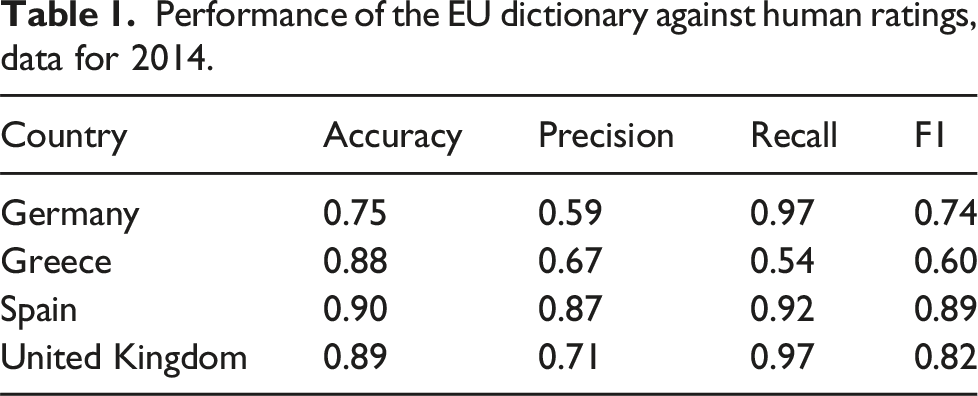
Performance of the EU dictionary against human ratings, data for 2014.
Explanatory variables and control variables
To measure the over-time effects of party size, we take the national vote share from ParlGov (Döring and Manow, 2019). A party’s vote share in the previous election at the national level should be a central determinant of its available resources for EP campaigning. In contrast, a party’s vote share in second-order EP elections does not necessarily translate into additional perks such as public funding beyond the few candidates who made it into the EP. By deriving party size from the national level, we also avoid issues of endogeneity and reverse causality. After all, EP candidates campaign on Twitter to increase their vote shares on the EU level. If parties did not exist or did not take part in the previous national election, we assigned the value 0 (e.g., the Brexit Party in 2019). The EU positions of parties come from the 2019 version of the Chapel Hill Expert Survey (CHES) (Polk et al., 2017).
As control variables at the individual level, we include a dummy for incumbency to control for the staff and resources to manage social media accounts available to MEPs. We also control for the gender of candidates. As controls on the party level, we include political ideology (left/right) taken from CHES and a dummy indicating that a party was participating in the national government at the time of the respective EP election. Social media have especially been used by populist parties to bypass traditional media gatekeepers and directly reach their supporter networks (Jungherr et al., 2019; Thomeczek, 2024) and voters (Popa et al., 2020). There is also a confluence of populism and Euroscepticism (Pirro et al., 2018). We therefore include a dummy for populist parties from the PopuList for both election periods (Rooduijn et al., 2020). Descriptive statistics for all used variables can be found in Online Appendix Section S2.
Modelling strategy
To assess over-time changes, we pooled all candidates from both elections in one dataset. To account for the interdependence of observations, we identified candidates who were standing in 2014 and 2019. As no unique identifier for each candidate was available in both datasets, we used the text similarity measure cosine to match candidate names. The results were ranked by decreasing cosine similarity and all matching names inspected, cutting off the list below a cosine threshold of 0.82 after which the matches included only false positives. In total, we identified 944 candidates standing in 2014 and 2019 belonging to parties that received at least 2% of the national votes.
We use hierarchical models with candidates nested in parties nested in countries. To detect temporal changes, we interact our main explanatory variables of interest with a year dummy indicating the 2014 or 2019 election. For analyzing the presence of Twitter accounts we fit binomial models. For explaining the frequency of tweets, which is a count variable of the number of posts, we fit negative binomial models instead of Poisson models due to the presence of overdispersion. In the negative binomial models measuring EP salience, where the count of tweets containing a reference to the EU is the dependent variable, we include a logged count of the total number of tweets per candidate to account for general differences in the likelihood to tweet. To facilitate the statistical estimation of the hierarchical models, all variables were centered before inclusion in the regressions.
Results
EP candidates’ Twitter campaigning by party size and EU position.
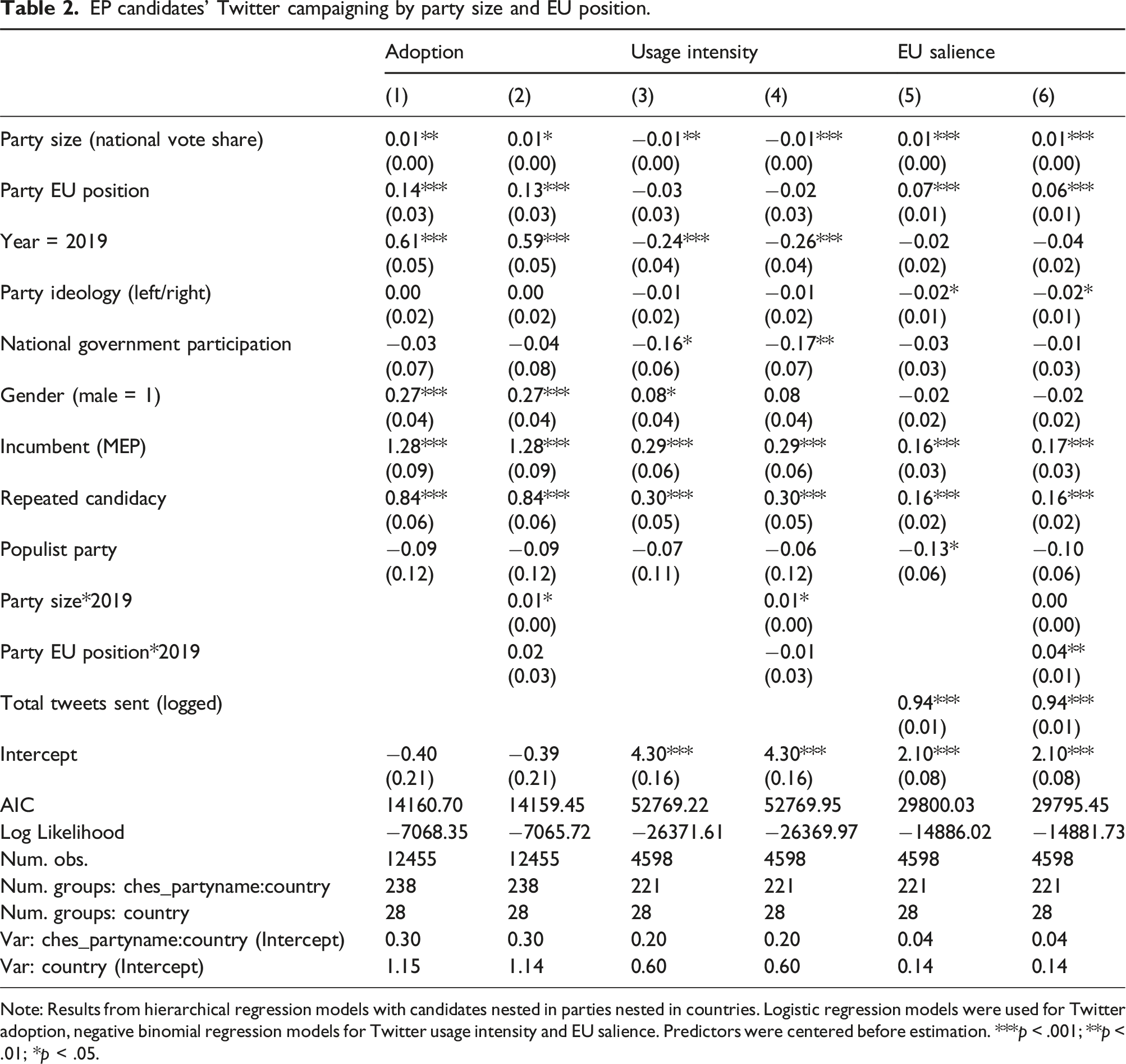
Note: Results from hierarchical regression models with candidates nested in parties nested in countries. Logistic regression models were used for Twitter adoption, negative binomial regression models for Twitter usage intensity and EU salience. Predictors were centered before estimation. ***p < .001; **p < .01; *p < .05.
Models 1 and 2 in Table 2 test the expectations of the normalization theory regarding Twitter adoption. The results of Model 1 indicate that party size (p Predicted effects of party size on Twitter adoption, usage intensity and EU salience from Table 2, including 95% confidence intervals. Predicted effects of party EU position on Twitter adoption, usage intensity and EU salience from Table 2, including 95% confidence intervals.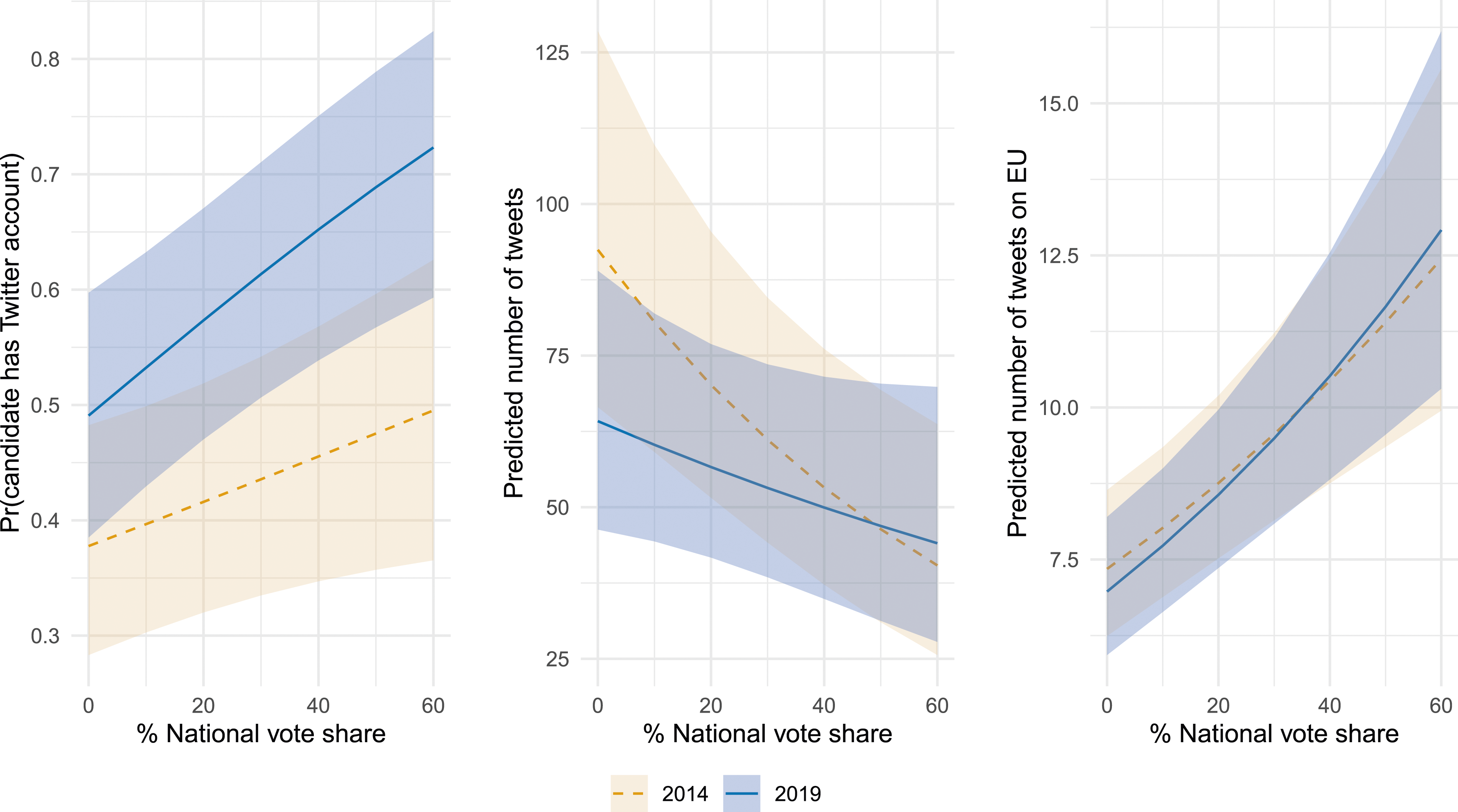
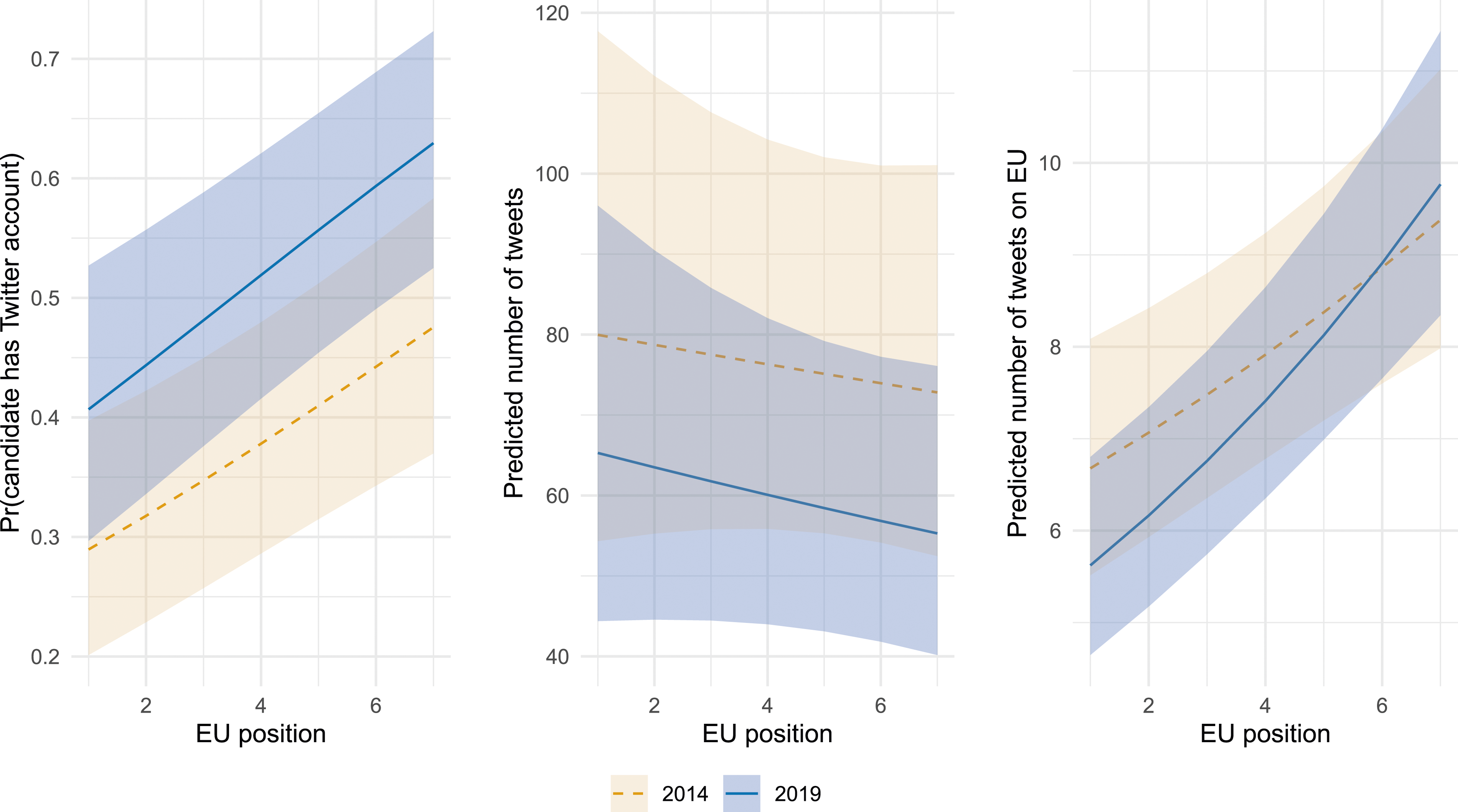
In terms of usage intensity, the results of Models 3 and 4 indicate that party size was actually negatively correlated with Twitter usage intensity. Still, this relationship had became significantly weaker by the time of the 2019 campaign, as shown by the significant interaction term in Model 4 and the middle panel in Figure 1. A similar negative slope can be found for EU position in Figure 2, but without any significant effects. Despite the apparent reduction in the negative association of party size over time, H1b and H3b need to be rejected. The normalization of online campaigning only seems to translate into changing patterns of adoption, not usage intensity.
Finally, Models 5 and 6 explain EU salience in tweets by EP candidates. The positive and statistically significant coefficients for party size and a positive EU position (both p
Finally, H2 and H4 predicted consistently stronger associations over time for all tested hypotheses. While all significant interaction effects pointed towards stronger effects in 2019, in line with a normalization of online election campaigning, only half of the six interaction effects were significant.
Discussion and conclusion
This article investigated to what extent changes in the landscape of European politics in recent years have been mirrored in election candidates’ online campaigning. To this end, we investigated the tweets by all candidates during the 2014 and 2019 European Parliament election campaigns. Studying the same election in 28 developed democracies over time allowed us to keep relevant contextual variables constant while constructing a country sample that is highly diverse in terms of institutional settings, the degree of campaign professionalization and political cultures.
We tested the (in)consistency of prominent theoretical explanations of online campaigning across three relevant behavioral dimensions: the adoption of Twitter, the intensity of using the platform and candidates’ likelihood to address the EU in their tweets. The results show that candidates from larger parties were more likely to have a presence on Twitter across both elections, and this relationship has even become significantly stronger in the 2019 EP election. Party size was also a consistently positive predictor of EU salience in candidates’ tweets across both elections. While candidates from smaller parties tweeted more than those from larger parties in the 2014 EP election, this “underdog advantage” has also weakened in the 2019 EP election.
The major dividing line between parties in European politics is their position towards further European integration. This stance also influences EP candidates’ use of Twitter for online campaigning. Pro-EU parties were more likely to own a Twitter account across both elections and the EU was more salient in their tweets, pointing to a changing landscape in EP elections. In line with similar results on the 2019 EP election from expert surveys (Maier et al., 2021) and newspaper coverage (Braun and Grande, 2021), our analysis revealed that the politicization of EU-related issues is no longer dominated by the rhetoric of parties that are openly hostile to the EU.
Even though candidates from bigger parties and pro-EU parties benefit from more favorable conditions to gain traditional forms of news coverage, they were still more likely to be present on Twitter. Where the normalization theory only partly holds is the active use of Twitter after registering an account, where we could observe a level playing field along party size and the spectrum of EU positions. These disjointed findings might point to a “window dressing” strategy: candidates from mainstream parties might feel stronger pressures and have professional support to be present on Twitter and use it as a broadcasting tool to put out their traditional press releases (Theocharis et al., 2016). However, niche parties such as Volt might still gain more from social media by actively using digital platforms for organizational purposes and engagement with citizens, lacking a strong mainstream media presence.
One could speculate about a number of developments between 2014 and 2019 that might explain the increasing reliance of bigger parties on the social media platform. On the side of technological affordances, Twitter’s doubling of the available number of characters for each tweet from 140 to 280 in 2018 allowed for greater control over the message content, transforming the platform into a more attractive tool for big party communication specialists to (somewhat) more eloquently spread party positions. Between 2014 and 2019, the Twitter user base not only increased but a number of notable campaigns such as #MeToo and #BlackLivesMatter took place, bringing the platform’s potential for viral communication and mobilization to greater attention. Lastly, one cannot neglect the “Trump phenomenon”. It is hard to believe that political elites who were skeptical about the potential benefits of social media before 2016 remained unconvinced after seeing how former US President Trump used Twitter to dominate the public agenda.
Taken together, the findings point to an increasing alignment of online campaigning with well-known explanatory models of campaign professionalization (Römmele and Gibson, 2020). Although other studies of online election campaigning in national political arenas also tend to identify a playing field that is skewed towards mainstream parties, we undertook the first study of the normalization of social media campaigning for the European Parliament. It is a novel finding that pro-EU candidates were even more likely to emphasize EU policy and politics in their tweets, whereas it was traditionally found that pro-EU forces rarely campaign on European issues. The fact that a normalization of (digital) campaigning unfolds even in EU politics, where fringe parties were considered to be prolific issue entrepreneurs (Hobolt and De Vries, 2015), indicates that EP campaigns continue to lose some of their second-order pedigree.
While the paper relied on the most comprehensive compilation of EP candidates’ online campaign activities to date, we focused on just one platform. In contrast to the elitist medium Twitter/X, its competitor Facebook is used by a bigger share of the electorate and might therefore be the platform of choice for Eurosceptic and populist forces across Europe (Kruschinski and Bene, 2022; Thomeczek, 2024). Despite recent negative developments in terms of API-based access to platform data, especially after the takeover of Twitter by Elon Musk, it is necessary to expand our research design by collecting longitudinal data from X for subsequent EP campaigns. X remains a platform filled with people who seek political information and connect with professional networks. Considering the value of this audience to political elites and the platform’s capacity to capture mainstream media attention and set the agenda when used strategically (Barberá et al., 2019), X will keep playing a critical role in political communication. Still, the exodus of many opinion leaders from X as a form of protest against the political stances of Musk demonstrates that the situation remains dynamic and multiple social networking sites need to be taken into account to arrive at a holistic picture. The findings of the paper demonstrate that it remains a primary task for political scientists to keep studying how campaigns evolve in times of continued digitization and rapidly changing political environments.
Supplemental Material
Supplemental Material - Online election campaigning in changing political environments: A comparison of the 2014 and 2019 European Parliament elections
Supplemental Material for Online election campaigning in changing political environments: A comparison of the 2014 and 2019 European Parliament elections by Sebastian Stier, Sebastian A Popa, Yannis Theocharis and Brian Boyle in Party Politics
Footnotes
Declaration of conflicting interests
The author(s) declared no potential conflicts of interest with respect to the research, authorship, and/or publication of this article.
Funding
The author(s) disclosed receipt of the following financial support for the research, authorship, and/or publication of this article: Sebastian Stier acknowledges funding from the Volkswagen Foundation (Award Number: 94758). Sebastian Popa acknowledges funding from the EUENGAGE project (grant agreement No. 649281-EUENGAGE-H2020-EURO-2014-2015/H2020-EURO-SOCIETY-2014).

Supplemental Material
Supplemental material for this article is available online.
Notes
Author biographies
References
Supplementary Material
Please find the following supplemental material available below.
For Open Access articles published under a Creative Commons License, all supplemental material carries the same license as the article it is associated with.
For non-Open Access articles published, all supplemental material carries a non-exclusive license, and permission requests for re-use of supplemental material or any part of supplemental material shall be sent directly to the copyright owner as specified in the copyright notice associated with the article.
