



Abstract
Recent scholarship demonstrated that Facebook is a fertile space for populist political communication as its unmediated and viral nature make populist appeals highly efficient in mobilizing voters. However, less attention has been paid to the way these populist messages appear through political actors’ Facebook communication, and what post- and page-level factors they are associated with. We investigate these questions in the context of the 2019 European Parliament election based on a unique cross-national dataset covering twelve European countries. In this study, we categorized 8,074 Facebook posts published on the main Facebook pages of sixty-seven parties. Our findings show that different populist appeals are used in specific ways. For example, at the post level, anti-elitism is frequently used in relation to economy, labor and social policy, and immigration; people-centric appeals are associated with labor and social policy and used when parties call for action, while out-group messages are not related to other topics beyond immigration. “Ideational populist” communication is more frequently articulated in European level and related to the topics of economy and labor and social policy. At the party level, it seems that there are still sharp differences between populist and non-populist parties in their communication.
Keywords
Introduction
By providing populist movements with a suitable platform to invoke the support of ordinary people against the establishment, research has found that social media has facilitated the rise of populism in many Western democracies (Gerbaudo 2018). Significant scholarly attention has recently been paid to how populist rhetoric is adopted by politicians in various (non)electoral contexts (Bos and Brants 2014; Ernst et al. 2019; Jagers and Walgrave 2007) and how such rhetoric diffuses through public discourse (Mazzoleni and Bracciale 2018). However, while much existing scholarship has primarily focused on the prevalence of populist communication in political discourse (Ernst et al. 2019; Reinemann et al. 2016), less attention has been paid to the overall context of its use. This is an important shortcoming because if populist communication is a strategic tool (Weyland 2001), it is important to uncover the conditions under which it is more or less likely to appear. In this article, we focus on these conditions through a more granular analysis of the use of populist appeals. First, at the (social media) post-level, we examine whether variations in content (topics and political level) are related to the use of populist appeals. Furthermore, we bring attention to the relationship between populist appeals and party-level ideological leaning. We do this analysis within the context of the 2019 European Parliamentary (EP) elections, applying a quantitative content analysis of 8,074 Facebook posts from political parties representing twelve states and from across the ideological spectrum.
Populism and Social Media
Due to its inherent ambiguity, populism has remained theoretically and conceptually contested. We adopt the “thin-centered ideology” approach of populism (Mudde and Kaltwasser 2018), which captures populism as a “thin-centered ideology” that depicts the political sphere as a Manichean struggle between pure people and the elites (Mudde and Kaltwasser 2018). However, in line with several authors (e.g., Reinemann et al. 2016), we also argue that populism can be understood as a framework of communication that draws upon the main elements of this “thin-centered ideology.” The first is people-centrism, where populism refers to “the people” as a single entity with a homogeneous will. Here, the appeal to the unspecified “people” allows populists to address the largest possible target group (Wahl-Jorgensen 2018). Second, anti-elitism is used to portray the elites as corrupt, self-serving, and interested only in maintaining their own power while ignoring the will of the people, which only the populists will represent and defend. As a third element, references to dangerous “others” are also frequently included (Jagers and Walgrave 2007; Reinemann et al. 2016), but with Mudde and Kaltwasser (2018), we argue that this element is not conceptually related to populism and ignore it in our study.
Recent scholarship demonstrated that social networking platforms (SNPs), especially Facebook, are a convenient and fertile space for populist political communication to proliferate (Engesser et al. 2017). They enable the publication of multimedia content, with unlimited frequency at relatively negligible cost. This allows populist appeals to reach a mass audience through bypassing the filters of journalistic gatekeepers who frequently present populist arguments in a negative way (Wettstein et al. 2018)—though cross-genre and -country differences are important here (see, Blassnig et al. 2019). Research shows that political communication on SNPs is characterized by higher levels of populist sentiment (Engesser et al. 2017; Mazzoleni and Bracciale 2018), and populist actors are more prominent on SNPs than on other media channels (Ernst et al. 2019). Also, populist appeals provoke more reactions, comments, and shares from users on SNP than non-populist appeals, which increases their reach (Bene et al. 2022; Blassnig and Wirz 2019; Cassell 2021; Hameleers et al. 2018).
Existing works, however, mostly focus only on the prevalence of the dimensions of populist communication, while less attention has been paid to the overall context of their strategic use. This is a surprising gap as several scholars emphasized that populist communication is a context-dependent strategy (Cranmer 2011; Weyland 2001), which has two important consequences for our knowledge of populist communication. First, populist elements are consciously combined with other content (De Bruycker and Rooduijn 2021) rather than used independently from the immediate context of communication. Second, their usage is conditioned by actors’ political positions and strategic goals (Schmuck and Hameleers 2020). If populist communication is a strategic tool, it is important to uncover the conditions under which it is more likely to appear and identify the elements of communication and political contexts that are strongly associated with the use of populist appeals and populist communication. Even though populist appeals and communication are generally popular on social media platforms, political actors need to consider other strategic aspects as well because their inappropriate usage can result in boomerang effects (Hameleers et al. 2019). For this reason, populist appeals and communication are more likely to appear in certain communication contexts than in others (De Bruycker and Rooduijn 2021).
Contextual factors can be captured on both content level and party level. While some research has focused on certain contextual factors such as topics (De Bruycker and Rooduijn 2021) or actors’ political positions (Schmuck and Hameleers 2020), research on the relationship between specifics of communication and actors on the one hand and the presence of populist appeals and posts on SNPs on the other hand is widely lacking. To fill this gap, our main research objective is to explore what post- and page-level factors were associated with the populist appeals and posts parties used on Facebook during the 2019 EP election.
Another gap is related to the empirical treatment of populist communication. While it is often emphasized that the joint use of people-centric and anti-elitist narratives can be understood as populism (Hawkins and Rovira Kaltwasser 2018), populist communication research predominantly investigates the two appeals in separation (e.g., Mazzoleni and Bracciale 2018). This approach can be rightfully criticized from the conceptual perspective of the previous approach, but it can also be justified by the fact that populist communication—especially on SNPs—mostly appears in fragmented form (Engesser et al. 2017). This means that actors often apply only one of these elements in their posts. If research focused only on the presence, antecedents, and effects of fully populist communication (e.g., Hawkins 2009; Rooduijn and Pauwels 2011), a large portion of populist appeals would be overlooked. While these appeals may not meet the threshold of the “thin-centered ideology” definitions of populist communication in themselves, they can be seen as embedded in an on-going communication flow where they in combination with the other fragmented appeals may still form a populist narrative (Sorensen 2021). For instance, Jagers and Walgrave (2007) showed that parties which use people-centric communication are more likely to adopt other populist elements in their overall communication strategies. To untangle these complex relationships, it is fruitful to break populist communication down into its components.
Our research aims to fit both research traditions. On the one hand, following the practice of mainstream populist communication research, we investigate the strategic contexts of each populist appeal separately to yield findings that can be directly contrasted with the literature from this strand of research. On the other hand, we also put emphasis on the co-occurrence of these populist appeals to show how truly populist posts appear on parties’ Facebook communication. Since the definition of populism is built on the Manichean conflicts between the pure people and the corrupt elite, we conceptualize populist posts as the joint usage of the people-centric and anti-elitist appeals in one post. This is in line with Hawkins and Rovira Kaltwasser’ (2018) conceptualization, who argued that based on the definition of populism “one cannot categorize a particular discourse as populist solely on the basis of anti-establishment rhetoric or purely on references to ‘the people’ as a political body that is morally superior” since “the peculiarity of the populist set of ideas lies precisely in the combination of these element” (p. 3). Our hypotheses are thus related to both individual populist appeals (anti-elitism; people-centrism) and populist communication (anti-elitism and people-centrism combined in the same post) and bring together common factors from populism research by focusing on two levels: post level and party level (Figure 1).
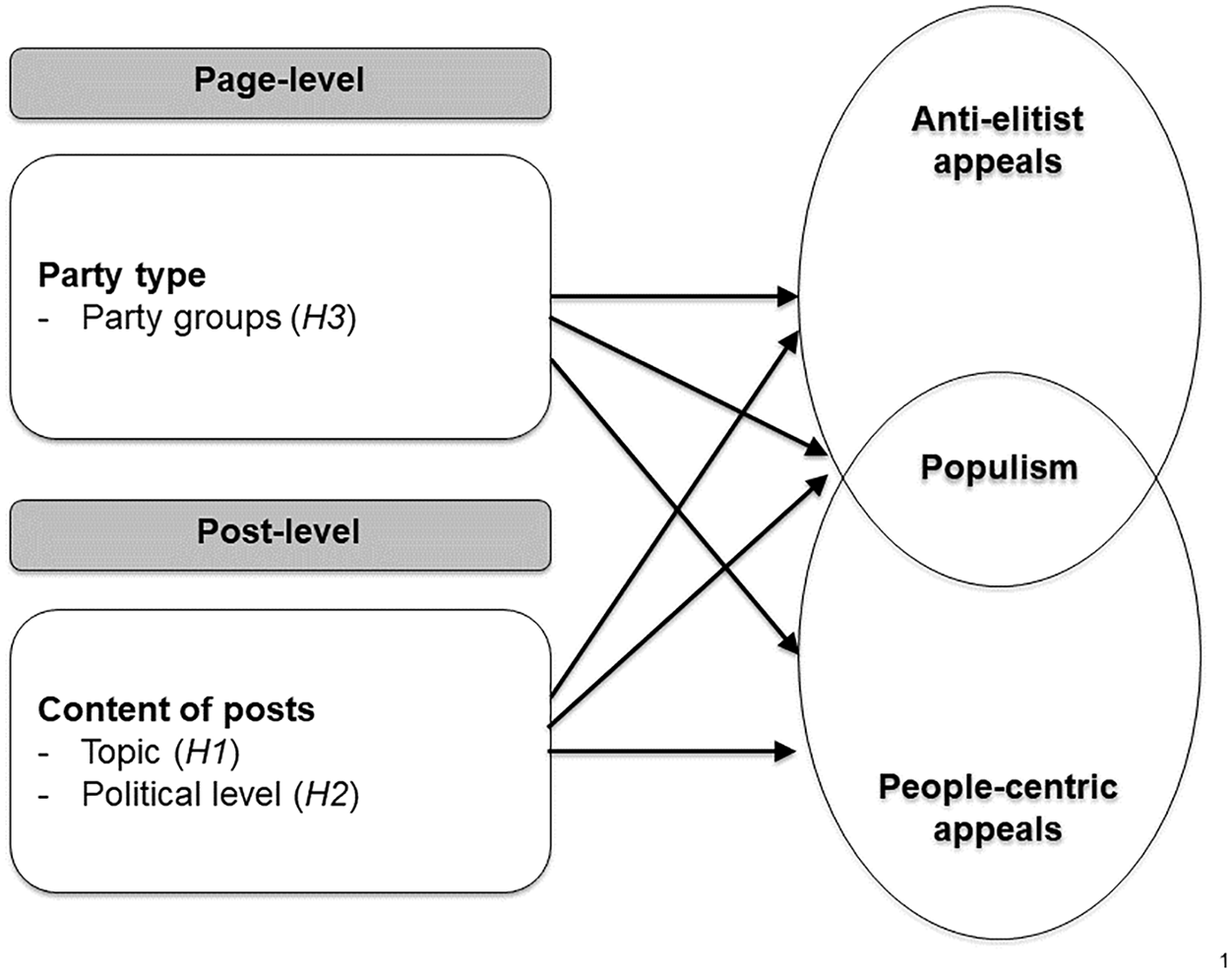
Overview of factors assumed to be associated with populism.
On the content level, we argue that the 2019 European Election campaign created an especially suitable context for populist campaigning. The key topics of the campaign (see below) can be framed particularly well with populist arguments, whereas the EU is often considered a detached elite and thus a highly attractive target of populist communication and appeals. On the party level, the European Election yields a unique opportunity to investigate ideology-based differences across parties (Doroshenko 2018): The EP party groups’ ideological classification is based on parties’ self-selections with covering a wide spectrum of contemporary political ideologies. We argue that party ideology matters, but it does not mean that populist appeals and communication are limited to far-right or far-left populist actors. In short, our main argument, which we deploy below, is that four key topics and the European level promoted the usage of populist appeals and populist communication, but mainstream parties did this mainly in a fragmented way, whereas extreme parties did in a full-fledged way.
Post Level: Content of Posts
A Facebook post from a political party usually has (a) a topical focus which is (b) discussed on certain political levels (e.g., local, national, and EU level). Based on the literature, we can expect that certain topics and political levels are more frequently associated with populist appeals and communication than others, which underpins our hypotheses presented below. While posts can have further content-related features, we focus on these as the emergence of European populism is frequently connected with them (e.g., De Bruycker and Rooduijn 2021; Stier et al. 2017).
Topics
Studies show that populists actors’ communication is often strategically combined with policy issues, and the appearance of populist appeals is not equally distributed across policy areas (De Bruycker and Rooduijn 2021). When it comes to topics, however, most studies embrace an actor-centric approach and investigate what policy issues populist actors focus on in general rather than connecting populist appeals with topics (e.g., Stier et al. 2017, but as an exception see Klinger and Koc-Michalska 2022). However, as it is not only populist actors who utilize populist appeals (Mazzoleni and Bracciale 2018), it is important to adopt a communication-centric approach and investigate the links between policy issues and populist communication in general.
Our study concentrates on four distinct topics of the EP campaign—economy, labor/social policy, immigration, and environment—since these were the most important issues for voters in this period: Polls show that people were mostly concerned with these issues 1 and wished that the European Election campaigns should have been about these issues. 2 Also our data justifies that these topics were at the forefront during the 2019 EP campaign, being the most frequently mentioned topics of parties’ Facebook campaigns (Supplemental Table A2). As described below, we expect these topics to be associated with certain populist appeals for different reasons, and thereby they can be “incubators” of different types of populist communication.
Economy and social policy are traditional key issues in the political competition of left-wing and right-wing parties in Europe: In many countries, left-wing parties are the issue owners of social policy, while the economy is “owned” by right-wing parties (Schwarzbözl 2020; Wagner and Meyer 2014). The economy is salient in every election campaign, but due to its complexity, it is difficult to “sell” to voters, especially on SNPs where interest in economy-related posts is proven to be low (Bene et al. 2022). Populist appeals can simplify economic issues and make them salient to the lived experiences of ordinary people. For example, anti-elitist framing of economic issues may be able to increase the emotional appeal of economic policy statements as anti-elitist messages are effective in provoking anger among recipients. Furthermore, the economy is highly suitable for the conflict between pure people’s and corrupt elites’ interests to be effectively articulated in populist communication (Benczes 2022). Labor and social policy is also a popular election topic that is closely connected to people’s welfare and thus can be effectively communicated with people-centric appeals (Mughan et al. 2003). Literature shows both economy and labor/social policy feature less in the communication of populist actors (Stier et al. 2017; Tóth 2020), but such studies did not investigate if these topics are communicated in a more populist way than other topics within the wider political sphere.
However, populists often focus their attention on “hot,” divisive topics (De Bruycker and Rooduijn 2021). In the 2019 European Election, these were immigration and the environment. While the first has traditionally been owned by far-right and the latter by green parties (Wagner and Meyer 2014), they are not limited to these actors anymore since they became “hot” topics. Immigration has rather become a key issue for right-wing parties more generally (Hutter and Kriesi 2022), while the environment is more employed by left-wing parties (van der Brug et al. 2022). We argue that immigration, the leading topic for right-wing populist actors in contemporary Europe (Štětka et al. 2021), is suitable to add weight to messages accusing elites of allowing mass-level immigration and privileging outsiders over pure people who should be protected against this threat. Furthermore, although right-wing populist actors (Lockwood 2018) and people with populist attitudes (Huber 2020) seem to be less interested in and more skeptical toward environmental policy, this topic may be more effectively communicated through an anti-elitist and people-centric framing even by non-populist actors. As the concepts of environmental populism (Buzogány and Mohamed-Klotzbach 2022) and green populism (Davies 2020) capture, environmental interests are often presented as the interests of ordinary people contrasted with those of political/economic elites (Beeson 2019). This idea argues that the environmental crisis is the result of the self-interest driven, narrow-minded behavior of political and economic elites who do not care about the future fate of ordinary people.
H1.1: Anti-elite messages are more likely to be associated with the topics of (a) economy, (b) immigration, and (c) environment.
H1.2: People-centrist messages are more likely to be associated with the topics of (a) economy, (b) labor/social policy, (c) immigration, and (d) environment.
H1.3: Populist messages are more likely to be associated with the topics of (a) economy, (b) immigration, and (c) environment.
Political Level
We expect that populist appeals will also differ between posts focusing on issues at the European versus national level as the former seems to be a particularly attractive sphere for populist and anti-elitist communication. The EU is often criticized for its excessive bureaucracy and widely acknowledged democratic deficit (Follesdal and Hix 2006). This makes it an easy target for anti-elitist rhetoric (Stier et al. 2017), being characterized as out of touch and responsible for promoting international economic interests whose negative implications are translated to people’s everyday experiences. The attractiveness of the European level for populist communication is further strengthened by the fact that European elites and institutions have limited opportunities to refute simplified populist arguments effectively due to their widespread inability to join national political debates. At the same time, while the European level is strategically appealing for anti-establishment rhetoric, when it is articulated in separation from the anti-elite arguments, the “people” is probably more beneficial to be addressed at the national level as citizens vote for parties on this level, also in EP elections.
H2.1: (a) Anti-elite and (b) populist messages are more likely to be associated with the European than with the national level.
H2.2: People-centrist messages are more likely to be associated with the national than with the European level.
Party Level: Type of Parties
Research indicates that the application of populist communication is not only shaped by the communication content but also by the political context. We expect that parties will use populist appeals to a different extent based on their ideology.
Differences in the level of populist communication across party types have been addressed by some research, but these mostly focused on variations between populists and non-populists or mainstream and extreme parties (Ernst et al. 2019; Schmuck and Hameleers 2020). The context of EP elections allows for more sophisticated comparisons across the political spectrum which finds expression in the membership of European party groups. These party groups are organized by ideology from the far-left (European United Left/Nordic Green Left [GUE/NGL]) through mainstream left-wing (Greens-European Free Allience [Greens/EFA], Socialists & Democrats [S&D]) and right-wing groups (Renew Europe, European People’s Party [EPP]) to the conservative (European Conservatives and Reformists [ECR]) and extreme far-right fractions (Identity and Democracy [ID]). Besides these party groups, there are Independents who rejected joining party groups—an ideologically mixed group of parties, a third of which consists of extreme national parties. 3
In the literature, a potential contagious effect of populist communication (Järviniemi 2022) has been discussed, meaning that not only more extreme parties labeled as populist but increasingly also mainstream parties use populist communication (Mazzoleni and Bracciale 2018). Empirical findings confirming such an effect are, however, scarce (Schwörer 2021). Rather, there is empirical evidence that mainstream parties use populist appeals but often to a significantly lower degree than fringe parties (Järviniemi 2022).
Just because of that, we argue that it is worthwhile to take a closer look at the fragmented usage of populist appeals which can be a strategically advantageous strategy in our current political communication environment also for mainstream parties (Engesser et al. 2017). Arguably, a fragmented usage of populist appeals may save political actors from being perceived as populists and discredited through being labeled as such while being able to reap the benefits of populist communication. We assume that the true boundary line between mainstream and more extreme party groups lies in the combined use of populist appeals: populist parties are more likely to use populist rhetoric, combining the different populist appeals, in line with Jagers and Walgrave (2007) who found populist elements in several parties’ communication but their combined usage was typical only to the Belgian populist party, Vlaams Blok.
H3.1: Parties belonging to more extreme party groups (GUE/NGL, ECR, ID, Independents) are more active in posting populist messages (combining anti-elite and people-centric appeals) than mainstream parties (Greens/EFA, S&D, Renew Europe, EPP).
Party ideology, however, can be a determining force when it comes to specific types of populist appeals. Traditionally, left-wing political thought is characterized by stronger anti-establishment positions, while right-wing ideologies are more positive toward authorities. People-centrist communication, by contrast, may be less related to party ideology, as it can be easily articulated within any “thick” ideology.
H3.2: Left-wing parties (both populist and mainstream) are more active in posting anti-elite messages than right-wing parties.
Method
Sample and Data Collection
To test our hypotheses, we conducted a quantitative content analysis of parties’ Facebook posts during the 2019 EP election. We coded posts from national parties, as these parties are responsible for election campaigns in EU member states and for sending Members of the European Parliament (MEPs), and the voters vote at the national level.
According to Gerring (2017), our research can be classified as a descriptive study following a diverse case strategy when selecting countries. We selected twelve countries purposively that are “intended to capture the diversity of a subject” (Gerring 2017: 58) in our case, Facebook campaigns of national parties in the 2019 EP elections: Austria, Denmark, France, Germany, Hungary, Ireland, Italy, Poland, Romania, Spain, Sweden, and the United Kingdom. These twelve countries represent 82 percent of the European population and 72 percent (540) of the EP’s 751 seats before the 2019 EP election. In all twelve countries, Facebook is the most popular SNP (Newman et al. 2021). Having in mind that SNP strategies may be affected by many different factors, we compiled a country sample that is structurally as diverse as possible (Supplemental Table A1). We included countries from all geographical regions across the EU (Northern, Western, Southern, Central, and Central/Eastern Europe) with different governmental and media systems, reflecting general framework conditions, which might affect SNP strategies. The different duration of EU/EC membership reflects different histories with the EU. If a country held national elections the same year, this may lead to a close connection between the European and the national campaign and thus affect the use of populist communication compared to countries without national elections. Besides, we considered several factors that might affect the chances of success of populist communication on the part of citizens, particularly when directed against the EU: Different net contributions to the EU might lead to different feelings of being benefited/disadvantaged by the EU. The number of seats in the EP mirrors different influences at the EU level, which might affect feelings of power (lessness). Varying attitudes of the citizens toward the EU (as measured by trust in the EU, shares of citizens with a positive versus negative image of the EU, and degrees of feeling as EU citizens) matter since rather negative feelings could make populist appeals appear strategically more beneficial. Since our country sample shows a solid amount of variation in all these factors, we assume that the Facebook campaigns we observe in our study, taken together, stand for the diversity of Facebook campaigns in the (then) twenty-eight EU countries (see also Gerring 2017).
The Facebook posts of all parties (N = 67) from the twelve countries that reached more than 5 percent of votes in the 2019 EP election were collected during a 4-week investigation period prior to the election (including the election day) in each country (UK: April 25 to May 23; Ireland: April 26 to May 24; all other countries: April 28 to May 26). Each day of the sampling period, all available posts from each party’s Facebook page were scraped using the tool Facepager (Jünger and Keyling 2019) and CrowdTangle (in Denmark and Romania). Based on the coding capacities of national teams, not all of the captured Facebook posts were coded in Denmark, France, Poland, Sweden, and the United Kingdom, but an appropriate random sample of posts was drawn for each country. Overall, 10,698 posts were manually coded, including all visual elements. After data cleaning, the sample comprises 8,074 posts 4 published by sixty-seven parties (see Table A1 for the number of coded posts per country and Table A3 per party). Ethics approval was not considered necessary since we only used publicly available materials published on the parties’ official Facebook accounts.
Posts were manually coded by twenty-nine coders. The national coder teams consisted of 1 to 5 coders (Austria, Hungary, Poland, Spain, and Sweden: 1; Denmark, France, Ireland, Italy, and UK: 3; Germany and Romania: 4). Coders were trained in their respective country based on a joint coding scheme using both English language posts and posts in the national language. Since it was important to test cross-country reliability and a collective understanding of the categories among all coders, we conducted a reliability test with a random sample of forty-eight EP election posts from European parties or parliamentary groups, which were coded by all coders. Coding these posts (which were in English) did neither require country-specific language skills nor country-specific knowledge. The reliability test showed a common understanding of the categories (all Holsti ≥ 0.7, see details in Table A2 in the Supplemental Information file). To assure a common understanding of the categories in a national context, the categories and critical cases were intensively discussed among the team leaders of the collaboration project.
Measures and Analyses
The unit of analysis was the Facebook post. Each of the following categories was binary coded for their presence (=1) or absence (=0). Each variable was considered independently from the others, meaning that, for example, several topics or political levels could be coded for each post (for a full description and the descriptive statistics of the variables see Table A2).
To measure populism in Facebook posts, we drew from established semantic constructs of populist ideology (Reinemann et al. 2016), which we measured as (1) criticism of the elite (2) and reference to “the people.” (1) Criticism of the elite could be targeted at (a) political actors/the political system, (b) bureaucrats/public administration (when explicitly addressed as an elite), (c) the economic elite, (d) media, journalists, pundits, and polling companies, and (e) supranational elites (e.g., EU, Nato). Coding criticism of any elite as present required that the post made explicit that the elite acted against the interest of the people. For our further analyses, these targets of criticism were merged into a binary variable measuring whether criticism of elites was present in a post or not. (2) References to “the people”—as a homogenous group—were coded when a post referred to the people as a national community or the political sovereign in a political or ethnic sense. Indicators for such use included terms such as “our nation” or “our country,” appealing to the “general will of the people” but not formulations like “we want” or simple addresses to the public or the electorate. This unitarity of people had to be presented as socially or politically distinct from other entities (e.g., any form of elite/other groups) and/or the source of the post had to appear as speaking in the name of “the people” as described above. This binary category was applied in a rather conservative way since the coding scheme instructed coders to code this category as “absent” when there was doubt. Posts which contained both anti-elitist and people-centric appeals were recoded into “populist” posts.
To determine post topics, we differentiated ten policy topics, but in this analysis, we include only four key issues: (1) economy/finance, (2) labor/social issues, (3) immigration, and (4) environment/energy. As soon as one of these topics was mentioned in a post, it was coded as present.
For every post, we coded the political level at which these topics were discussed. We differentiated (1) local/regional, (2) national, (3) EU, (4) global, and (5) other level (e.g., bilateral relations). While we use EU level as an independent variable, local/regional, global, and other levels were also entered into the models as control variables in order to directly contrast EU level with the reference category national level. Global and other levels were merged into one category due to the low number of cases in these categories. Last, we coded all parties based on their affiliation with EP party groups after the election.
We controlled for parties’ overall Facebook activity, measured by the number of posts they published during the campaign. To capture the factors that are associated with only the specific appeals, for the models explaining the usage of anti-elitist and people-centric appeals, we controlled for the other populist appeal to filter out associations that resulted from the co-occurrence of these elements. On party level, we also controlled for if the given party is in opposition or government position in the national political sphere since Ernst et al. (2017) empirically demonstrated that opposition politicians use more populist communication.
To test our hypotheses, we ran binary logistic regression models with dependent variables measuring the presence or lack of the two populist appeals and populist posts where the two co-exist. Given the nested nature of our dataset, we ran our models with random intercept on the level of parties. Two models belong to each dependent variable (models 1–2: anti-elitist appeals; models 3–4: people-centric appeals; models 5–6: populist communication). The respective first models (models 1/3/5) include only the post-level and control variables, whereas the second models (models 2/4/6) contain both post- and party-level predictors.
Findings
In line with the literature, our data show that populist appeals are popular in parties’ Facebook communication, but populist posts are more exceptional. Fifteen percent of posts included anti-elite messages and 10 percent people-centric appeals, but only three percent of posts contained anti-elitist and people-centric arguments at the same time. Economy and social policy are still key topics in the campaign, they appeared in the 13 and 18 percent of all posts, respectively. Also, immigration and environment were truly “hot” topics of the campaign: seven percent of the posts focused on immigration and nine percent of them touched upon the issue of environment. While the European Election campaign still predominantly focuses on the national level (57% of posts), the European level is also at the forefront with 42 percent of the posts (for the descriptives see Table A2 in the Supplemental Information file). Moving beyond the descriptives, Table 1 shows the findings of our regression models.
Multilevel logistic regression models with random intercepts on the level of Facebook pages.
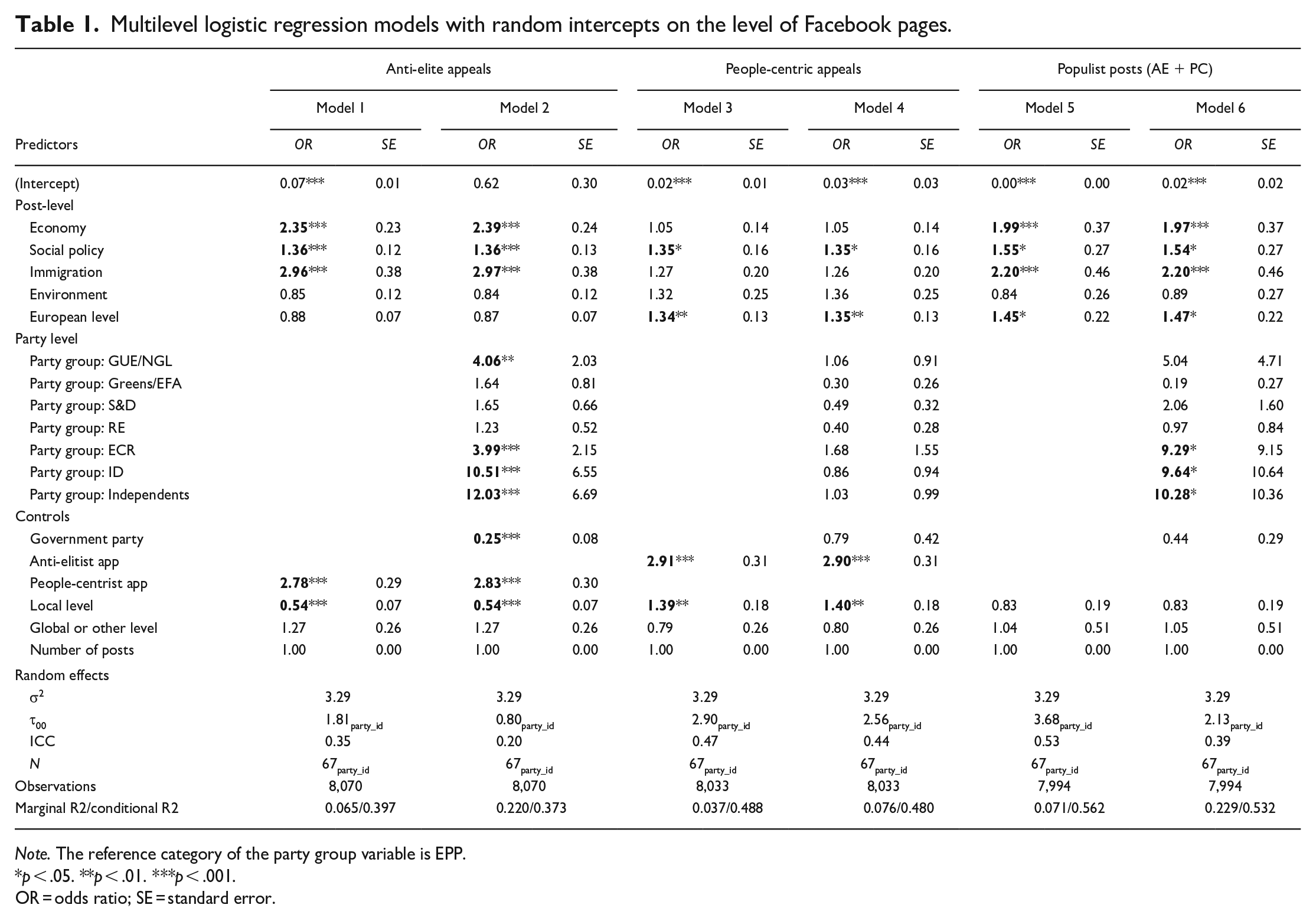
Note. The reference category of the party group variable is EPP.
p < .05. **p < .01. ***p < .001.
OR = odds ratio; SE = standard error.
Post Level: Content of Posts
Topics
Anti-elitism as the first element of populist communication is more likely to be significantly associated with economy (H1.1a confirmed) and immigration (H1.1b confirmed) but not with the environment (H1.1c rejected). An additional finding that was not addressed in our hypotheses is that posts on labor/social issues often include anti-elitism. Concerning the second element of populism, people-centrism, we find that social policy is more likely to be presented with people-centric appeals (H1.2b confirmed). However, we do not find any significant relationships between people-centrism and economy, immigration, and environment (H1.2a, H1.2c, H1.2d rejected), that is, these topics are not discussed in a people-centric way. Last, economy-focused posts seem more likely to confront “the people” explicitly with the elites (H1.3a confirmed), which is also true for immigration- (H1.3b confirmed) and social policy-related content. However, environmental posts are not more likely to apply populist communication (H1.3c rejected).
Political Level
Contrary to expectations, focusing on the EU level is not more related to anti-elitist messages than focusing on the national level (H2.1a rejected). However, EU-focused posts are more frequently framed in a populist way by drawing an explicit contrast between “the people” and elites (H2.1b confirmed). Interestingly, contrary to our hypothesis, people-centric messages are even more related to the EU level than the national level (H2.2 rejected).
Party Level: Type of Parties
Party Groups
The first factor that we investigate at the party level is the party groups (see Table 1, Figure 2; for models with different reference categories see Supplemental Tables A4–A10). Our models show that more extreme party groups (GUE/NGL, ECR, ID, Independents) do not use significantly more people-centric messages than mainstream party groups (EPP, RE, S&D, Greens/EFA), but they employ anti-elitist messages more often. Actually, when it comes to people-centric appeals, there are not any significant differences between any of the parties indicating that this is a widespread and ideology-free communication strategy. However, ID-parties and Independents use significantly more anti-elitist messages than all mainstream party groups, whereas ECR and GUE/NGL parties are more anti-elitist than EPP and RE parties, but not significantly differ from the Greens and the S&D. Nonetheless, the dividing line is the mainstream-extreme division as there are not significant differences between the four more extreme party groups and between the four mainstream groups. This means that H3.2 is rejected since the differences between parties in the usage of anti-elitist appeals are not based on their ideology. The cross-party differences in terms of the usage of anti-elitist appeals are summarized in Table 2.
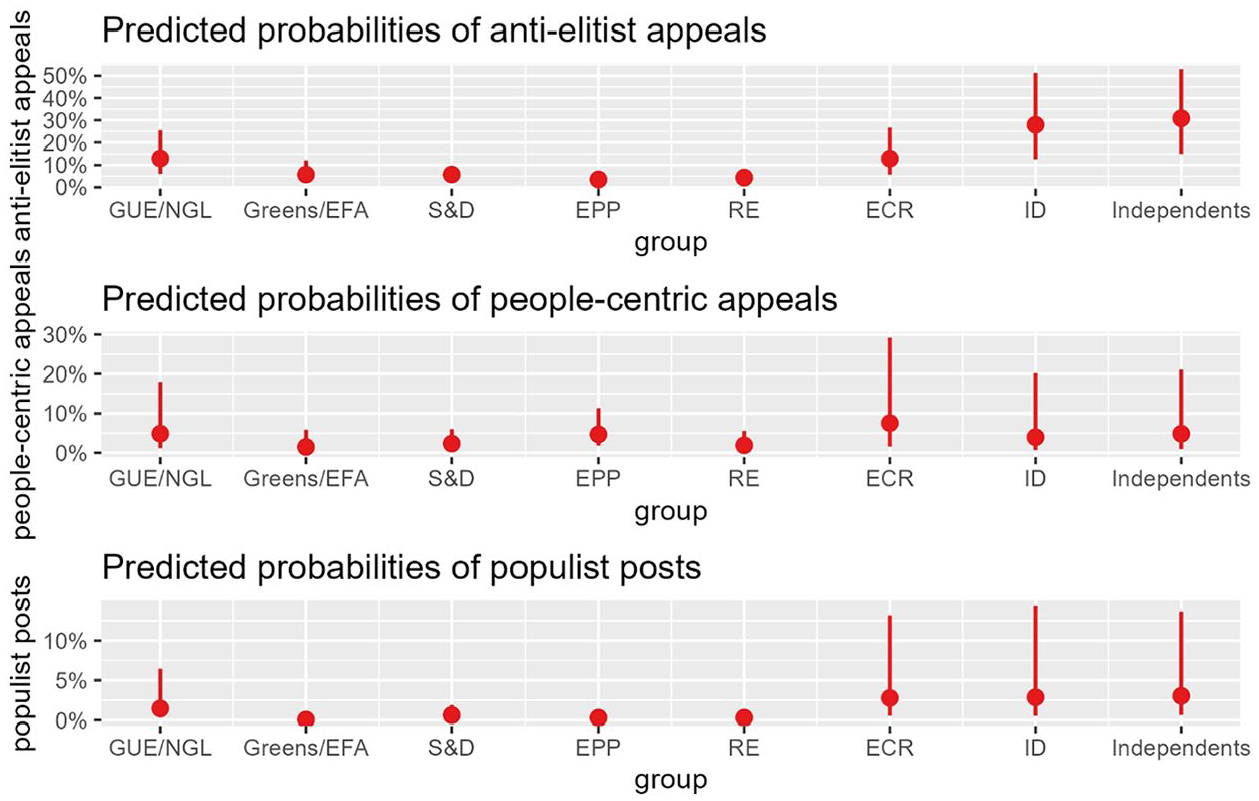
Predicted probabilities of populist appeals and posts by party group.
Significant differences across party groups in the usage of anti-elitist appeals.
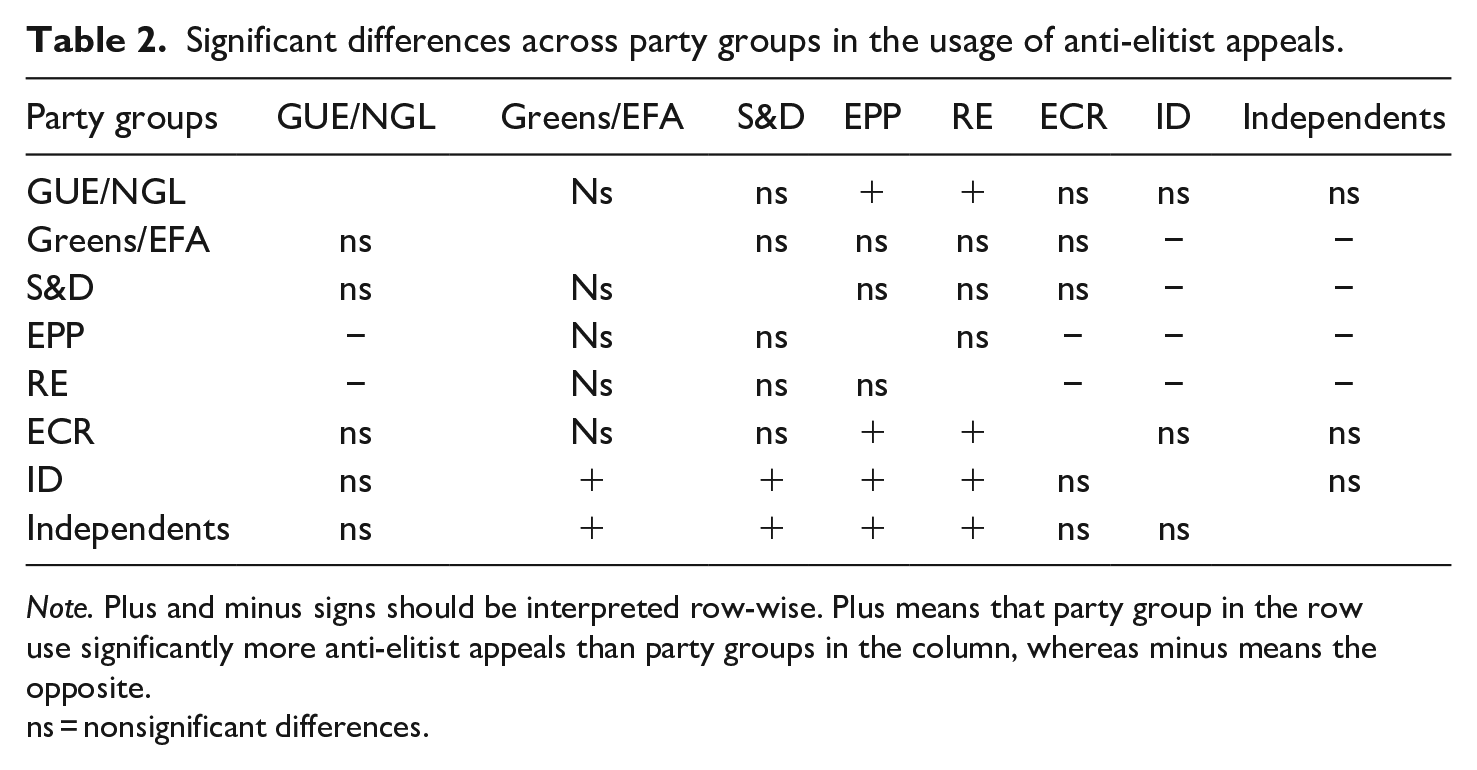
Note. Plus and minus signs should be interpreted row-wise. Plus means that party group in the row use significantly more anti-elitist appeals than party groups in the column, whereas minus means the opposite.
ns = nonsignificant differences.
When it comes to populist posts, the patterns are relatively complex, but this is partly due to the small number of populist posts, which resulted in large confidence intervals and fewer significant differences. It seems that extreme parties post more populist posts than mainstream parties, but the differences are not significant for each pair of comparisons. The Greens are less populist than any of the extreme party groups, and EPP posts fewer populist posts than the Independents, the ID and the ECR. RE does significantly differ from the Independents and ECR, while S&D does not differ from any other party groups. While in a less clear form than in the case of anti-elitist appeals, the line is largely between extreme and mainstream parties in populist posts since there are no within-group differences in any of these blocks, but there are several differences across the blocks. However, S&D, and to a smaller extent, GUE/NGL are in a bridging position from this respect (H3.1 is partly supported). The cross-party differences in terms of the usage of populist posts are summarized in Table 3.
Significant differences across party groups in the usage of populist posts.
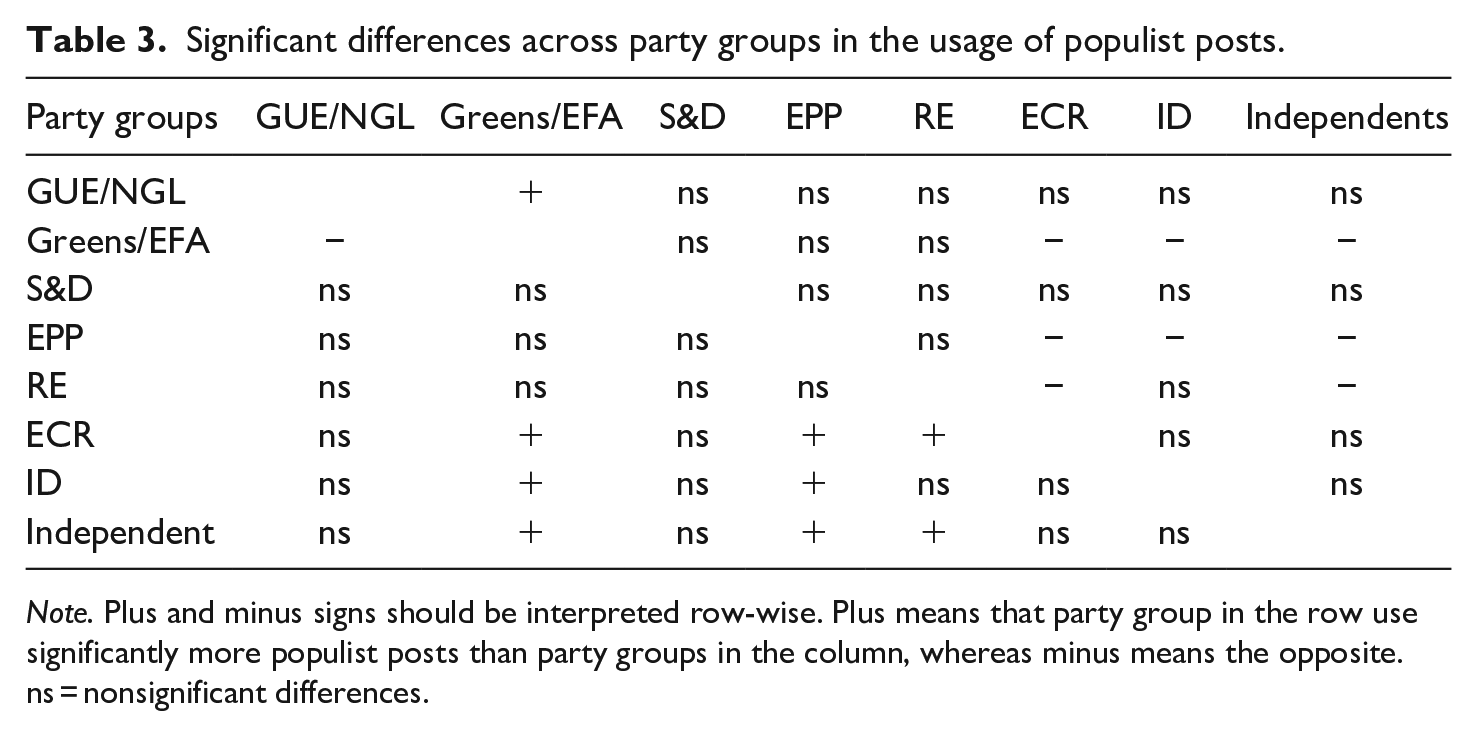
Note. Plus and minus signs should be interpreted row-wise. Plus means that party group in the row use significantly more populist posts than party groups in the column, whereas minus means the opposite.
ns = nonsignificant differences.
Discussion and Conclusions
Populist communication is a type of strategic, “intentional and objectives-driven” (Kiousis and Strömbäck 2014) communication. So far, research on populism has mainly focused on the prevalence of populist communication in political discourse but widely neglected the question of which conditions make the occurrence of populist communication on social media more or less likely. To shed light thereon, we investigated the relationship between populist appeals and communication in party Facebook posts on the one hand and both post-level and party-level factors on the other hand.
We find that the topic makes a difference for the type of populism applied: immigration and economy is often associated with anti-elitist (but not people-centric) messages, while social policy with anti-elite and people-centric messages. Economy, social policy, and immigration seem to be crucial topics of full-fledged populist communication where both people-centric and anti-elitist appeals are present at the same time. Thus, all three topics facilitate the emergence of populist appeals, but it depends on the topic in which form of populist communication is used. By contrast, it seems that environment is not a populist topic since its presence in parties’ communication is not related significantly to the use of populist appeals. While it is already demonstrated that populist actors (at least on the right-wing, Lockwood 2018) and people (Huber 2020) are more skeptical toward environmental concerns, mainstream parties seem to also refrain from using populist appeals to “sell” the issue to the wider public. This finding mitigates the concerns of “green populism,” namely that environmental problems are often “sold” by populist framing (Klinger and Koc-Michalska 2022; Nordensvard and Ketola 2021).
Contrary to our expectations, people-centric messages were more likely to be associated with the EU level while anti-elite messages were not. However, when a post focused on the EU level, populist rhetoric was more common. Therefore, it seems that EU is an easy target for populist communication, but its more polarizing component, namely the anti-elitist rhetoric, is not typically used separately to frame EU politics.
By analyzing the Facebook posts of political parties with different ideologies from twelve European nations, our results on the party level show that populist appeals on Facebook are not limited to extreme right-wing and left-wing parties, but they generally more actively use anti-elitist and full-fledged populist communication. People-centric messages were found at equal levels in the Facebook campaign strategies of all party groups. Nonetheless, in the case of anti-elitist and populist communication, the boundary is not related to the left-right distinction, but rather the more extreme-moderate dimension. Anti-elitist rhetoric is more typical to the more extreme right- and left-wing parties. To a lesser extent, this is also true for populist communication. Thus, our findings add to the research contradicting the arguments about the contagious effect of populism (Järviniemi 2022). Here, even if mainstream parties go in a more populist direction in terms of people-centrism, we still witness daylight between more extreme and mainstream parties in their communication.
To sum up, it seems that different forms of populist communication are used in strategically different ways and appear in different communication contexts. Anti-elitist messages are articulated in relation to economy, labor and social policy and immigration mostly by extreme parties. People-centrism is frequently used in relation to labor and social policy, and in European-focused posts all over the political landscape. Full-fledged populist communication appears in posts related to economy, social policy, immigration, and the EU level mostly from extreme parties’ communication.
As with any investigation, this study has some limitations. First, we investigate party strategies by means of content analysis. While this gives indications of strategies at a manifest level, it does not tell us the story of party strategies from the inside. Investigating these would require, for example, interviews with the parties. Second, we only included one EP election campaign. Future studies should apply our coding scheme in national and regional election campaigns, in future EP election campaigns, and in countries outside Europe to test how far our findings can be transferred to other contexts. Finally, since we only investigated Facebook, it is unclear how far the patterns we found are transferrable to other social media platforms such as Instagram or Twitter. However, while Facebook is a central campaigning tool in Europe, this is not the case in other parts of the world. In such regions, similar questions will need to be asked of other platforms in future research. Finally, even though Facebook became a pivotal campaigning tool in many countries over the last decade, we must not forget that SNPs are still only one communication tool in today’s complex election campaigns. Future studies should, therefore, contextualize SNP campaigns by putting them into context with more traditional campaigning tools such as campaign posters, TV spots, or campaign speeches.
The 2019 EP election showed the highest voter turnout in EP elections in 20 years. For the first time since the first direct EP elections in 1979, voter turnout increased. Obviously, parties were able to mobilize their voters—at least to a certain extent and in certain countries. This may at least partly have been a merit of their SNP campaigns, and the populist communication utilized there. However, the precise effect of SNP campaigns and populist communication is a complex, hard to answer question. To answer it, much more research is needed that must not only focus on parties but also include citizens.
Supplemental Material
sj-docx-1-hij-10.1177_19401612231196158 – Supplemental material for Populism in Context: A Cross-Country Investigation of the Facebook Usage of Populist Appeals During the 2019 European Parliament Elections
Supplemental material, sj-docx-1-hij-10.1177_19401612231196158 for Populism in Context: A Cross-Country Investigation of the Facebook Usage of Populist Appeals During the 2019 European Parliament Elections by Márton Bene, Melanie Magin, Jörg Haßler, Uta Russmann, Darren Lilleker, Simon Kruschinski, Daniel Jackson, Vicente Fenoll, Xénia Farkas, Paweł Baranowski and Delia Balaban in The International Journal of Press/Politics
Footnotes
Declaration of Conflicting Interests
The authors declared no potential conflicts of interest with respect to the research, authorship, and/or publication of this article.
Funding
The authors disclosed receipt of the following financial support for the research, authorship, and/or publication of this article: This publication is part of the work of the junior research group “DigiDeMo,” which is funded by the Bavarian State Ministry of Science and the Arts and coordinated by the Bavarian Research Institute for Digital Transformation (bidt) and also supported by the Incubator program of the Center for Social Sciences, Eötvös Loránd Research Network (project number: 03013645) and Bolyai János Research Fellowship awarded by the Hungarian Academy of Sciences (BO/334_20).

Supplemental Material
Supplemental material for this article is available online.
Notes
Author Biographies
References
Supplementary Material
Please find the following supplemental material available below.
For Open Access articles published under a Creative Commons License, all supplemental material carries the same license as the article it is associated with.
For non-Open Access articles published, all supplemental material carries a non-exclusive license, and permission requests for re-use of supplemental material or any part of supplemental material shall be sent directly to the copyright owner as specified in the copyright notice associated with the article.
