



Abstract
Are Eurosceptic parties more likely to run negative, uncivil and emotional campaigns, as it is often intuitively argued? And with what consequences? In this article, we shed light on the effectiveness of these campaign strategies for Eurosceptic parties during the 2019 European elections. We argue that ‘harsher’ campaigns are ‘in character’ for Eurosceptic parties, and are as such more likely to be electorally successful for them. We use data from the 2019 European Parliament Elections Expert Survey, covering 191 unique parties, and show that, indeed, Eurosceptic parties are more likely to campaign in a harsh way, and more likely than Europhile parties to benefit electorally from it. All data and materials are openly available for replication.
Introduction
An element that has a prominent place in the political narrative during the decade between the global financial crisis of the late 2000s and the outbreak of the COVID-19 pandemic in 2020 is the rise of populism and anti-establishment parties. Fuelled by economic anxieties, political cynicism and a cultural backlash against ‘cosmopolitan elites’ (Norris and Inglehart, 2019; Oliver and Rahn, 2016), anti-establishment movements have often taken the lion's share of the media attention around the globe (e.g. Bos et al., 2010). The rise of anti-establishment movements seem to go hand in hand with the development of a darker and more controversial form of political competition: election campaigns are getting increasingly harsher – that is, they rely on political attacks against the opponents (Geer, 2012; Nai and Walter, 2015), are increasingly uncivil (Brooks and Geer, 2007; Maier and Renner, 2018), and promote emotional appeals intended to trigger fear and anxiety in the public at large (Brader, 2005; Crigler et al., 2006).
Circumstantial evidence linking populists and anti-establishment movements with more negative, uncivil and emotional (‘harsher’) campaigns is not hard to find. Donald Trump unquestionably used a rather dark and uncompromising rhetoric during his tenure; the ‘fear’ framing of the immigration issue, for instance in terms of increased crime and violence, is rather common among far-right parties (Allen, 2017; Wodak, 2015), and populists have been shown to use a more aggressive rhetoric against their opponents than mainstream actors (Immerzeel and Pickup, 2015; Nai, 2021). Yet, only scarce systematic and comparative evidence exists that links anti-establishment parties with the use of harsher rhetoric during election campaigns. Even less evidence exists to suggest that such a marriage is electorally successful. Are anti-establishment parties rewarded when they campaign more harshly – that is, relying more on political attacks, incivility, and fearmongering? We test these questions within the framework of the 2019 election of the European Parliament (EP).
The 2019 EP elections were set against the backdrop of rising polarisation around the world (Iyengar et al., 2019); a phenomenon that also manifested itself in these elections, fuelled by the multifaceted crises that the EU had recently undergone (see Pellegata and Visconti, 2021). Yet, a clear symptom of polarisation in the EU can be portrayed by the divide linked to European integration, an issue that tends to be much more salient for Eurosceptics than for Europhiles (Spoon and Williams, 2017). While the political voices that have attacked the EU have grown louder, so have those who aim to defend it, setting up a fiery antagonism between Eurosceptics and Europhiles that often drives the media coverage of EU matters (Bobba and Seddone, 2018; Pirro and Van Kessel, 2018; Vasilopoulou, 2018). Many observers were expecting the 2019 EP elections to produce a ‘surge’ of Eurosceptic MEPs (The Economist, 2019), but the electoral results were in fact quite disappointing for Eurosceptic parties, with perhaps the exception of the Lega in Italy. The big winners of these elections were arguably the Liberal and Green parties; two political blocs that tend to be staunchly Europhile. To what extent are these electoral results a function of the campaigning choices of Eurosceptic and Europhile parties? We answer this question via data from the 2019 EP Elections Expert Survey, covering 191 parties having competed in the election. Our results show that Eurosceptic parties were more likely to campaign in a harsh way, and more likely than Europhile parties to benefit electorally from it.
Euroscepticism, harsh campaigns and electoral results
Euroscepticism and election campaigning
Eurosceptic parties are often accused to run harsh campaigns (The Telegraph, 2016). Three good reasons exist to support this intuition. First, negative campaign messages, fearmongering, and even incivility are in line with the ‘style’ of Eurosceptic movements, which often includes a strong populist discourse (Arzheimer, 2015; Krouwel and Abts, 2007). Populist rhetoric tends to reflect a more ‘transgressive political style’ (Oliver and Rahn, 2016: 191) that ‘emphasises agitation, spectacular acts, exaggeration, calculated provocations, and the intended breech of political and socio-cultural taboos’ (Heinisch, 2003: 94). Populists often display an overt willingness to subvert standard social norms by displaying ‘bad manners’ (Moffitt, 2016) and introducing ‘a more negative, hardened tone to the debate’ (Immerzeel and Pickup, 2015: 350). Recent evidence shows indeed that populists display a more confrontational and aggressive personality (Nai and Martinez i Coma, 2019) and use more negative and emotional campaigns (Nai, 2021). In this sense, harsher campaigns are ‘in character’ for Eurosceptics. Second, most Eurosceptic parties are aligned on the (often radical) right of the political spectrum; evidence in the US and in elections worldwide seems to suggest that parties on the right are more likely to use negative campaigns (Lau and Pomper, 2001). Third, Eurosceptic movements are usually smaller opposition parties; research has shown that negative campaigning can usually be expected from parties in the opposition (Lau and Pomper, 2004). Similarly, evidence suggests that parties unlikely to win tend to go negative on their rivals (Walter et al., 2014).
It is important to note that the three reasons discussed above do not apply to all Eurosceptic parties at once. First, not all Eurosceptic parties are populist; for instance, the Communist Party of Greece (KKE), Denmark's nonpartisan People's Movement against the EU (N) or Poland's KORWiN, while being resolutely anti-European, do not necessarily rely on the classical populist playbook (but see Lipiński and Stępińska, 2019). Second, not all Eurosceptic parties are right-wing; La France Insoumise (FI), the Dutch Socialist Party (SP), the Czech Communist Party of Bohemia and Moravia (KSČM) or Déi Lénk in Luxembourg, are all (far) left political movements with overt anti-Europeanism (or, at least, strong Euroscepticism) in their rhetoric. Third, of course, not all Eurosceptic parties are marginal from an electoral standpoint; Law and Justice (PiS) in Poland, Fidesz in Hungary, the Rassemblement National (RN) in France, and of course the Brexit party in the UK, not only performed quite well in the 2019 EP elections but obtained a plurality of votes in their respective countries. Yet, overall, the confluence of the three reasons described above suggests that Eurosceptic parties should be expected to rely on harsher campaigns.
H1: Campaigns of Eurosceptic parties are more likely to be harsher (stronger presence of negativity, incivility and fear appeals) than campaigns of Europhile parties.
Electoral success
A large body of research indicates that ‘harsh’ campaigns are a risky business. Voters dislike attack politics (Fridkin and Kenney, 2011), and actors that excessively criticize or even belittle their opponents face a significant risk of backlash (Fridkin and Kenney, 2004; Roese and Sande, 1993). In this sense, parties face incentives to carefully assess the inherent risks associated with excessively harsh campaigns. Yet, reasons exist to expect that not all parties are equal before the risk of backlash. Recent research suggests that some voters are ‘immune’ to the negative repercussions of attack politics. Maier and Faas (2015) show for instance that attack politics is particularly effective for voters with a low level of conflict avoidance – that is, voters who do not tend to distance themselves from social and political conflicts. Similarly, Weinschenk and Panagopoulos (2014) suggest that voters who score low on agreeableness react more positively to negative campaigning. And recent evidence based on a sample of US citizens (Nai and Maier, 2020) shows that the backlash effect associated with negative and harsh campaigns is attenuated for respondents with high tolerance to negativity and low conflict avoidance. All in all, these studies suggest that for some voters negative and harsh campaigns can generate more positive opinions of the sponsor. Some citizens are ‘hardwired’ to like attack politics, and reward parties and candidates that go negative accordingly. Importantly, that this ‘attack-friendly’ share of the electorate seems more likely to support extreme and anti-establishment parties. For instance, Bakker et al. (2016) show that voters scoring low on agreeableness are significantly more likely to support populist parties. Similarly, Chirumbolo and Leone (2010) show that low agreeableness and low honesty-humility (a trait not dissimilar from high psychopathy) are conducive to a right-wing political orientation, and Nielsen (2016) shows that respondents high in neuroticism tend to be more Eurosceptic. Thus, because Eurosceptic parties are more likely to attract the type of voters that tend not to show distaste for attack politics, harsh campaigns are theoretically less likely to backlash against them. Negativity, in other terms, plays into the rulebook of Euroscepticism.
We expect a reverse effect for Europhile parties. Most of the research tends to focus on Euroscepticism (e.g. Kopecký and Mudde, 2002; Van Spanje and de Vreese, 2011), and usually little attention is granted to Europhile parties – usually more centrist, consensual and mainstream than Eurosceptic parties (Jolly, 2007; Marks et al., 2002). We believe that Europhile parties can be expected to be more likely to attract voters that tend to dislike attack politics. In light of recent evidence suggesting that political intolerance is less likely among moderated political actors (van Prooijen and Krouwel, 2019) and that the language of extremists is angrier and more negative in tone (Frimer et al., 2019), we might expect that negative and harsh campaigns should be less likely to be successful for Europhiles. Negativity is ‘out of character’ for them, and thus potentially likely to backlash.
H2: Harsher campaigns are associated with a better electoral performance for Eurosceptic parties, and with a worse performance for Europhile parties.
Data and methods
The dataset
We test these expectations via the 2019 European Parliament Election Expert Survey dataset (EPEES_19), which is based on an original expert survey administered directly after the 2019 EP election. Following the procedure developed for national elections worldwide (Nai, 2020), for each of the 28 EU member states country-specific samples of scholars with relevant expertise (electoral politics, political communication, politics in their country) were contacted by the research team in the days after the EP elections and asked to fill in a standardised questionnaire. Experts were asked to rate the campaigns of competing parties in terms of, for instance, their tone and use of emotional appeals, and their position on issues related to EU integration. Expert surveys are not a novel instrument to assess, among others the position of parties on issues (e.g. Bakker et al., 2015; Benoit and Laver, 2007). Yet, the dataset introduced in this article is, to the best of our knowledge, the first to provide a systematic picture of campaign styles of competing parties across countries for a single event.
While expert surveys have been the target of important methodological critiques (Budge, 2000; McDonald et al., 2007), the scholarship has shown that there is generally a high level of coherence between expert respondents regarding the positioning of parties, even on specific issues (Hooghe et al., 2010; Whitefield et al., 2007). Ultimately, expert surveys align quite well with the perceptions of citizens (Bakker et al., 2015). Overall, we have strong reasons to believe that experts can provide a valid and reliable rating of campaign tone. Using a separate dataset for the 2018 US Senate election midterms, which relies on the same protocol for expert ratings of negativity as the one discussed on this article, we report elsewhere (Maier and Nai, 2020) the results of a triangulation check that compares expert ratings of negativity with two independent data sources: the tone of the candidates’ campaign on Twitter, and the percentage of negative TV ads of competing candidates in the midterms elections. The triangulation shows that, even when controlling for important covariates for the profile of the candidate and the state, negativity in our expert data significantly and positively correlates with negativity in Twitter and TV ads. We have no reasons to believe that this should not be the case for our European experts as well.
Experts were contacted on 27 May 2019, one day after the last day of voting for the EP elections. Two reminders were sent out at 1-week intervals, respectively, on 3 June and 10 June. In total, 381 of the 2525 experts contacted answered the questionnaire, leading to a response rate of about 15% and 13.6 experts per country on average. The number of expert ratings collected varies considerably across the 28 countries (see the Online appendix). The largest number of responses was collected for Germany (47 out of the 310 German experts contacted), whereas the lowest number of responses collected was for Luxembourg (2 out of 37 experts contacted). The highest response rate was registered for Malta, where 10 experts answered the questionnaire out of the 39 contacted (41.7%); at 7.8%, France has the lowest response rate (10 experts out of 158 answered the questionnaire).
Looking at the composition of the experts that answered the questionnaire, 90.5% are citizens of the country for which they participated in the questionnaire, 28.4% are female, and 94% held a PhD at the moment of the study. On the whole, experts tend towards the left on a self-reporting scale from 0 to 10 (mean (M) = 4.0, standard deviation (SD) = 1.7), and are somewhat in favour of promoting EU unification even further (M = 6.8, SD = 1.9, where 10 means that the EU unification ‘should be pushed further’). On average, experts rated themselves as very familiar with election campaigns in their country (M = 7.6, SD = 1.9) and estimated that the questions in the survey were not overly complicated to answer (M = 5.0, SD = 2.2). Experts were asked which discipline represents a field on which they have an expertise with multiple possible responses; 191 experts (50.1%) indicated an expertise in politics in their country, 164 (43.0%) in comparative politics, 161 (42.2%) in elections and electoral behaviour, 125 (32.8%) in party politics, 107 (28.1%) in European politics, 103 (27.0%) in methods and research design, 92 (24.1%) in political communication, 64 (16.8%) in media studies and journalism, 44 (11.5%) in political psychology, 36 (9.4%) in sociology and anthropology.
Experts were also asked to rate the campaign content and position on a handful of issues for the most important parties having competed in the EP election in their country. The selection of parties included in the questionnaire accounted for their relative strength in pre-electoral polls (e.g. POLITICO's ‘Poll of Polls’ 1 ) and recent national elections, in order to exclude excessively small and marginal parties. Depending on the nature of the electoral competition in the country surveyed, up to a maximum of 10 parties were included in the questionnaire; this was the case for Belgium, the Netherlands and the UK. Only three parties were included in the questionnaire for Malta (reflecting the quasi-bipartisan political system in the country), and four for Ireland. Importantly, the selection of parties covers a substantial proportion of the votes cast in the 2019 EP election: on average across all countries, the selected parties represent 87.1% of the votes cast; the lowest coverage is for Croatia (59.2%), and the highest is for Finland (99.3%).
In total, the dataset covers 191 parties having competed in the 2019 EP election. The Online appendix lists all the parties included, by country. The data is available for replication at the following OSF repository: https://osf.io/5hxpb/
Measures
Campaign harshness
We define campaign harshness as: (a) the use of messages with a more ‘negative’ tone – that is, attacking the opponents instead of promoting one's own record or agenda (Geer, 2006; Lau and Pomper, 2002); (b) the use of language that intentionally lacks respect for the opponents and ‘violates some agreed upon standard of society’ (Maisel, 2013: 204), usually referred to as campaign incivility (e.g. Brooks and Geer, 2007; Maier and Renner, 2018); and (c) the use of negative emotionality such as appeals intended to trigger fear and anxiety in the electorate (e.g. Brader, 2005; Crigler et al., 2006). Tone, incivility and emotionality are the three campaigns dimensions included in our expert survey. First, experts had to rate the ‘tone’ of the campaign on a scale ranging from −10 ‘very negative’ to + 10 ‘very positive’, which we recoded into a 0 to 10 measure of ‘negative tone’. The party average on this scale is 5.1 points (SD = 1.9). This general measure of campaign negativity is, however, only accounting for the valence (or direction) of the campaign and does not include a measure of how ‘disrespectful’ the campaign was. Thus, experts had also to evaluate the extent to which the parties’ campaign was ‘uncivil’, on a 0 to 10 scale. The mean incivility across the 191 parties is slightly lower than average (M = 3.9, SD = 2.0). On top of this, experts also had to assess the emotionality of the parties’ campaigns, and more specifically the extent to which parties used ‘fear’ and ‘feel good’ (enthusiasm) appeals, also on a 0 to 10 scale. On average, our experts estimated that parties used rather more fear than enthusiasm appeals in their campaigns – respectively, M = 5.5 (SD = 1.9) for fear and M = 4.6 (SD = 1.7) for enthusiasm.
These separate dimensions of campaign ‘negativity’ are, of course, both theoretically and empirically related (Gerstlé and Nai, 2019); for instance, the correlation between incivility and the use of fear messages is r(189) = 0.86, p < 0.001. Principal component analysis revealed the existence of a unique underlying dimension, Eigenvalue = 3.48, % variance = 0.87 (see the Online appendix). After reversing the coding for enthusiasm, we thus computed an additive index of campaign harshness (α = 0.95), ranging between 0 ‘very low’ and 10 ‘very high’ (M = 4.9, SD = 1.7). Due to the strong association between all campaign dimensions, this additive index of campaign harshness is the main independent variable in our analyses. The Online appendix reports separate analyses for the different campaign dimensions.
Among the parties that score the lowest on the additive index of harshness, we find ‘centrist’ parties such as the Social Democratic Party of Finland, the New Austria and Liberal Forum, the Social Democratic Party of Germany, Progressive Slovakia and several Green parties (e.g. Luxembourg, Germany, Finland). On the other end of the scale, having run very ‘harsh’ campaigns, we find many far-right parties such as UKIP, Belgium's Vlaams Belang, Hungary's Fidesz, France's RN (former National Front), the Netherland's Party for Freedom (PVV) as well as the ‘new entry’ Forum for Democracy, and the Freedom Party of Austria (FPÖ). The single highest score on campaign harshness out of all parties in the dataset (a whopping 8.9 out of 10) is obtained by Greece's Golden Dawn (XA), an extreme-right party nostalgic of the country's former dictatorships and notoriously using symbols reminiscent of Nazism overtly.
Figure 1 presents the average campaign harshness for each of the 28 European countries. Beyond differences in their average level of harshness, the member states also differ with regards to how similarly (or differently) their parties campaigned. For instance, the campaign harshness of parties in Romania was quite similar (and high), as illustrated by the relatively low SD among their harshness levels (SD = 0.5, on a scale ranging theoretically between 0 and 10); this is also the case for Denmark (SD = 0.8), but this time reflecting a more generalised low harshness. Inversely, greater differences among parties existed, for example, in Germany (SD = 2.1) and the Netherlands (SD = 2.2); in this latter, the difference in harshness is particularly drastic between the far-right Party for Freedom (8.14) and the centrist D66 (2.69). All scores are reported in the Online appendix.
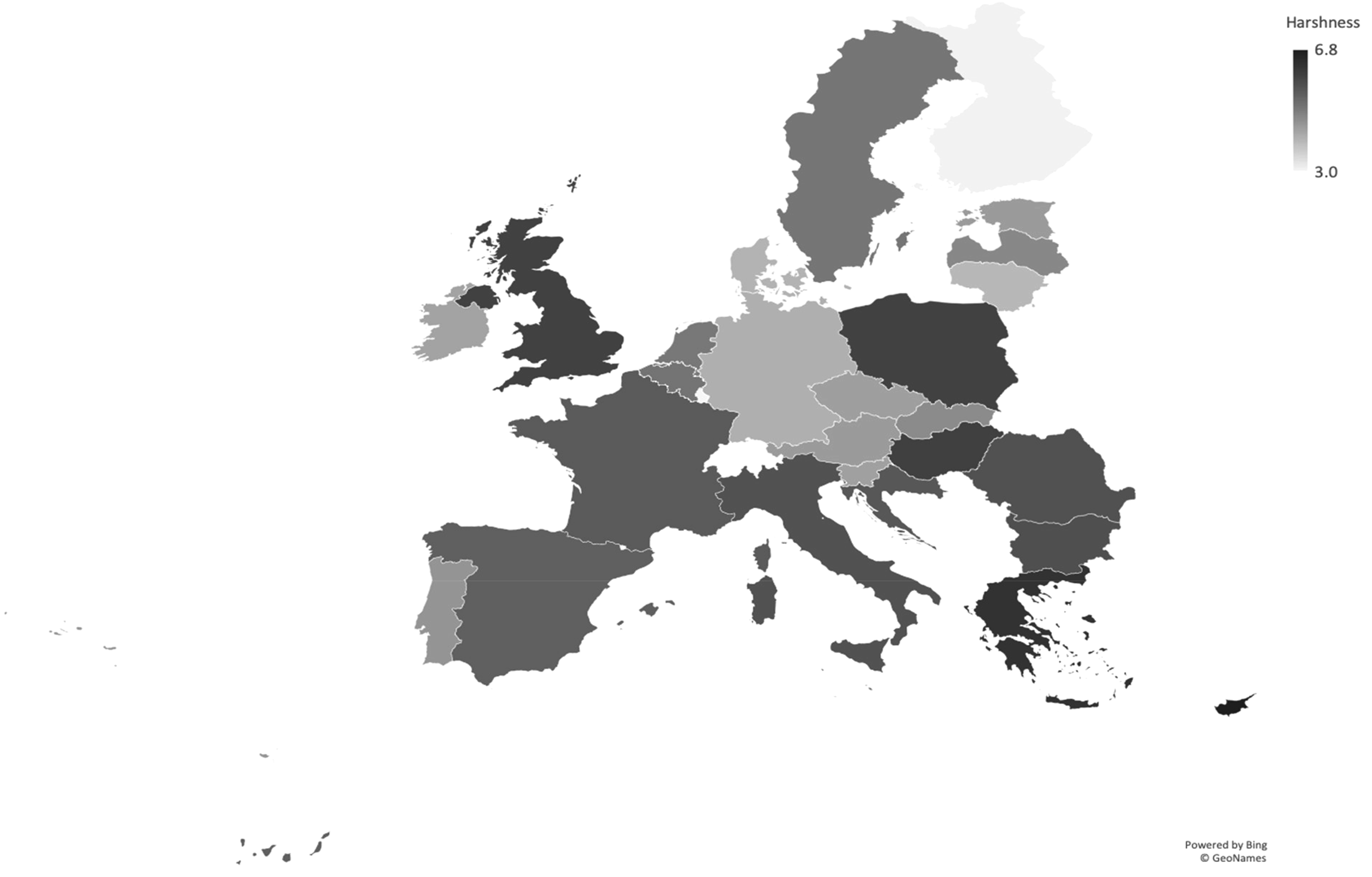
Campaign harshness, country averages.
Perceptions of EU integration
Experts also had to position the parties in terms of their support for EU integration. More specifically, experts had to rate the position of the competing parties in terms of two main indicators (Adam et al., 2016): how parties evaluate in their campaigns the ‘general idea of European integration’ (from 0 ‘very negatively’ to 10 ‘very positively’), and the ‘actual current functioning of the European Union’ (also from 0 ‘very negatively’ to 10 ‘very positively’). These two positional measures are of course strongly correlated, r(188) = 0.95, p < 0.001. We thus computed an additive index of EU perceptions (α = 0.97), ranging between 0 ‘very negative’ and 10 ‘very positive’ (M = 5.2, SD = 2.4). 2 This additive index correlates very strongly with a binary variable identifying ‘Eurosceptic’ parties, based on the information present on the Wikipedia pages of each party; r(188) = −0.76, p < 0.001. The index furthermore correlates extremely strongly with the values for EU positioning in the 2017 CHES dataset (flash survey; Polk et al., 2017), r(88) = 0.95, p < 0.001.
Among the parties that score the lowest on the additive index of EU perceptions, we find France's RN, the Communist Party of Greece (KKE), both UKIP and the Brexit Party, and Italy's Lega. On the other end of the scale, among the most Europhile parties, we find Italy's aptly named More Europe Party (Più Europa), Poland's Civic Platform (PO), Hungary's Democratic Coalition (DK), and UK's Liberal Democrats (LibDems). Figure 2 presents the average EU perception for each of the 28 European countries.
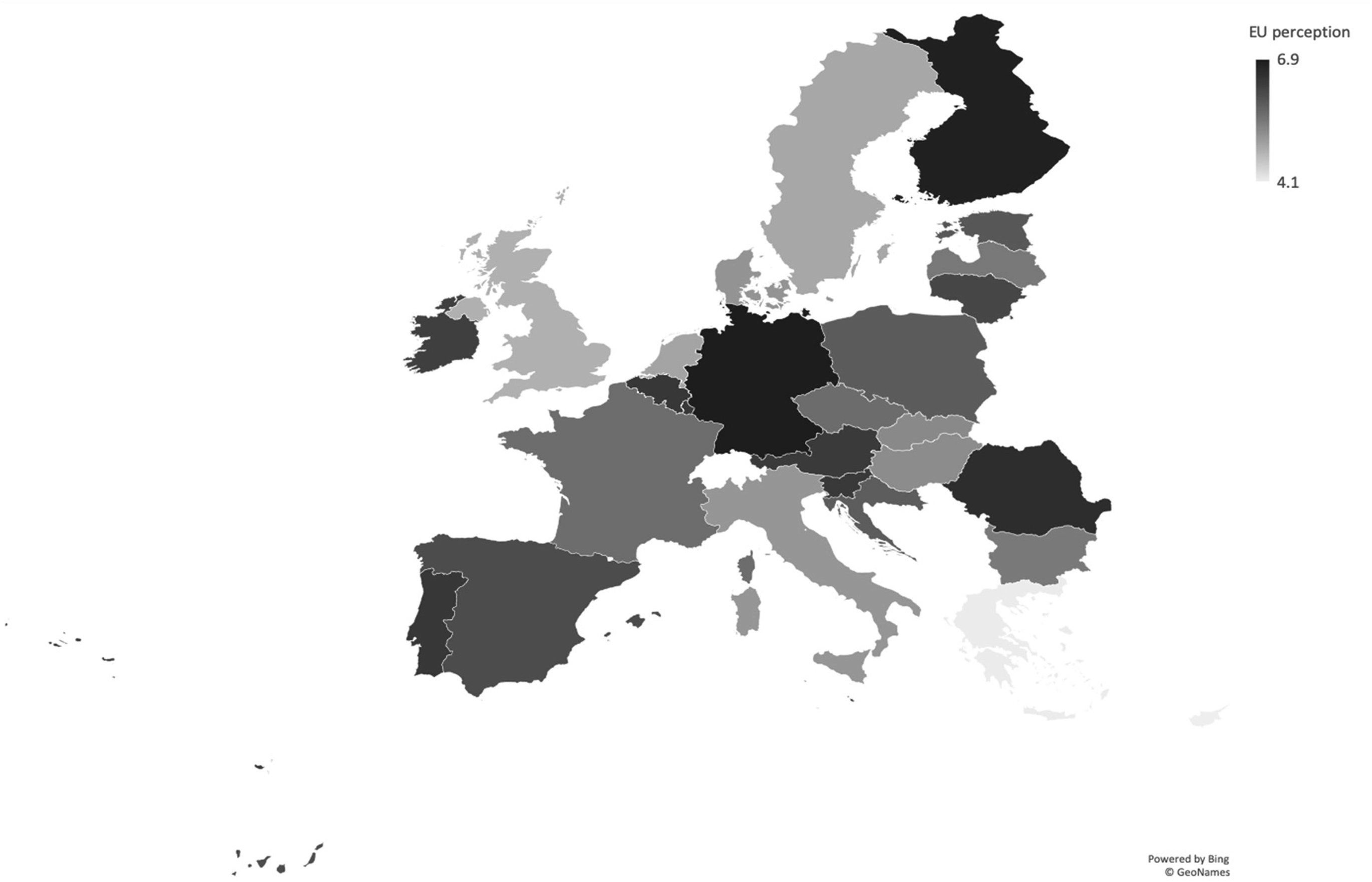
EU perceptions, country averages.
Election results
We retrieved the election results for each of the competing parties from the website of the EP. 3 We use in our analysis the percentage of votes obtained by each party in the election, which we take as a direct continuous measure of electoral success. Of course, the absolute percentage of votes that any given party can receive from the electorate is also a function of the political offer at play, and more specifically of the number of competing parties; obtaining 30% of the votes in a quasi-bipartisan system (for instance, Malta) is rather lackluster, whereas it represents an impressive success in a country where 15+ parties competed (e.g. the Netherlands). To address this issue, we adjust our models by adding the ‘effective’ number of competing parties (ENP), which is a standardised measure of party competition that yields for each country the number of competing parties with similar strength (Laakso and Taagepera, 1979). Furthermore, we will replicate our models using an alternative ‘relative’ measure of electoral success: the ratio between the percent of votes for a party and the percentage that the ‘average’ party should have received based on how many ‘effective’ parties were competing (100% divided by the effective number of parties; see Berggren et al., 2010). As we will discuss below, our results are robust even when using this more restrictive measure.
Party and country covariates
Our models also adjust, at the party level, for the party's membership to national government at the time of the EP election, left-right ideology, percentage of votes received in the previous national election, and years of foundation. The last three of these variables were coded using information provided in the parties’ Wikipedia webpage (for a critical assessment of the use of this source of information for party characteristics see Brown, 2011). 4 Based on the information available, left-right was coded into a 7-point scale, ranging from ‘far left’ to ‘far right’. Adjusting our models by the percentage of votes the party received in the last national election in their country is an indirect way to control for party size, which can be an important characteristic for electoral success. Albeit the lapse of time between the last national election and the 2019 EP election varies across countries (from a month for Finland and Spain to 5 years for Belgium), this information reflects the importance of the party in the national legislature at the time of the EP election, and as such is a good proxy for parties comparative standing at the national level.
At the country level, our models control for the geographical region of the country (respectively, Western, Eastern, Northern, and Southern Europe), as party systems have been shown to be structured differently along geographical regions (e.g. Marks et al., 2006). We also control for country turnout during the 2019 EP election (a proxy of election competitiveness), and three indicators of the social and economic situation of the country: unemployment rate (percentage of labour force), relative GDP per capita (compared to average GDP per capita at the EU 28 level) and country's intake of asylum seekers and first-time asylum applicants (based on aggregated data for the 2014–2018 period compared to the country's population). These three last indicators are based on data available form Eurostat. 5 Lastly, as previously mentioned, we adjust for the effective number of parties (ENP).
Descriptive statistics for all variables in our models are presented in the Online appendix.
Results
We test our expectations via a two-pronged empirical strategy. In a first step, we test the hypothesis that Euroscepticism is associated with harsher campaigns, both directly and looking at some composition effects. In a second step, we test whether the electoral success of Eurosceptic parties during the 2019 EP election is a function of the harshness of their campaigns. We find broad support for our expectations overall.
Euroscepticism and negative campaigning
To what extent are Eurosceptic parties campaigning more harshly than Europhiles? The descriptive presentation of the two variables in the methodological section already suggested some trends, as several parties scoring the highest on campaign harshness are also among the more Eurosceptic ones. Indeed, the zero-order relationship between the two variables is particularly strong, r(188) = −0.79, p < 0.001. Figure 3 illustrates this association.
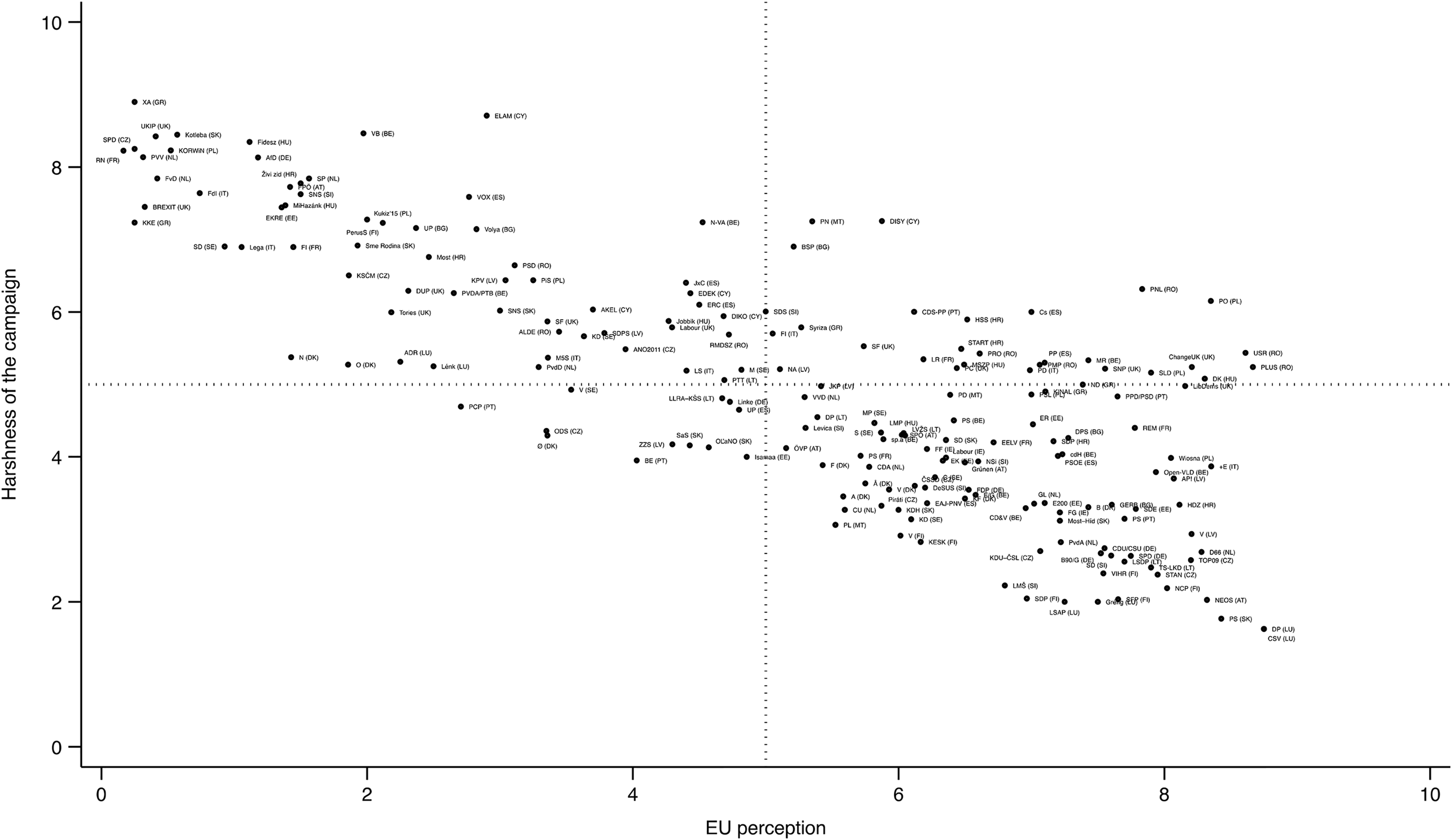
Campaign harshness and EU perceptions for all parties.
Anti-establishment far-right parties, from Golden Dawn (XA) to UKIP, France's RN, Hungary's Fidesz, the Alternative for Germany, the FPÖ, Netherlands’ Party for Freedom (PVV), Italy's Brothers of Italy (FdI), Slovakia's Kotleba (People's Party Our Slovakia), and several others clearly appear on the top-left quadrant, characterised by negative EU perceptions and a harsh campaign content.
Table 1 regresses the party score on the ‘harshness’ index on its profile and the characteristics of the context. In line with research on negative campaigning, parties on the right-hand of the ideological spectrum are more likely to go negative on their rivals (Lau and Pomper, 2001), and incumbents − in this case, members of the national government – are substantially less likely to campaign with negative elements (Lau and Pomper, 2004; Ridout and Searles, 2011).
Euroscepticism and campaign content (additive index of ‘harshness’).
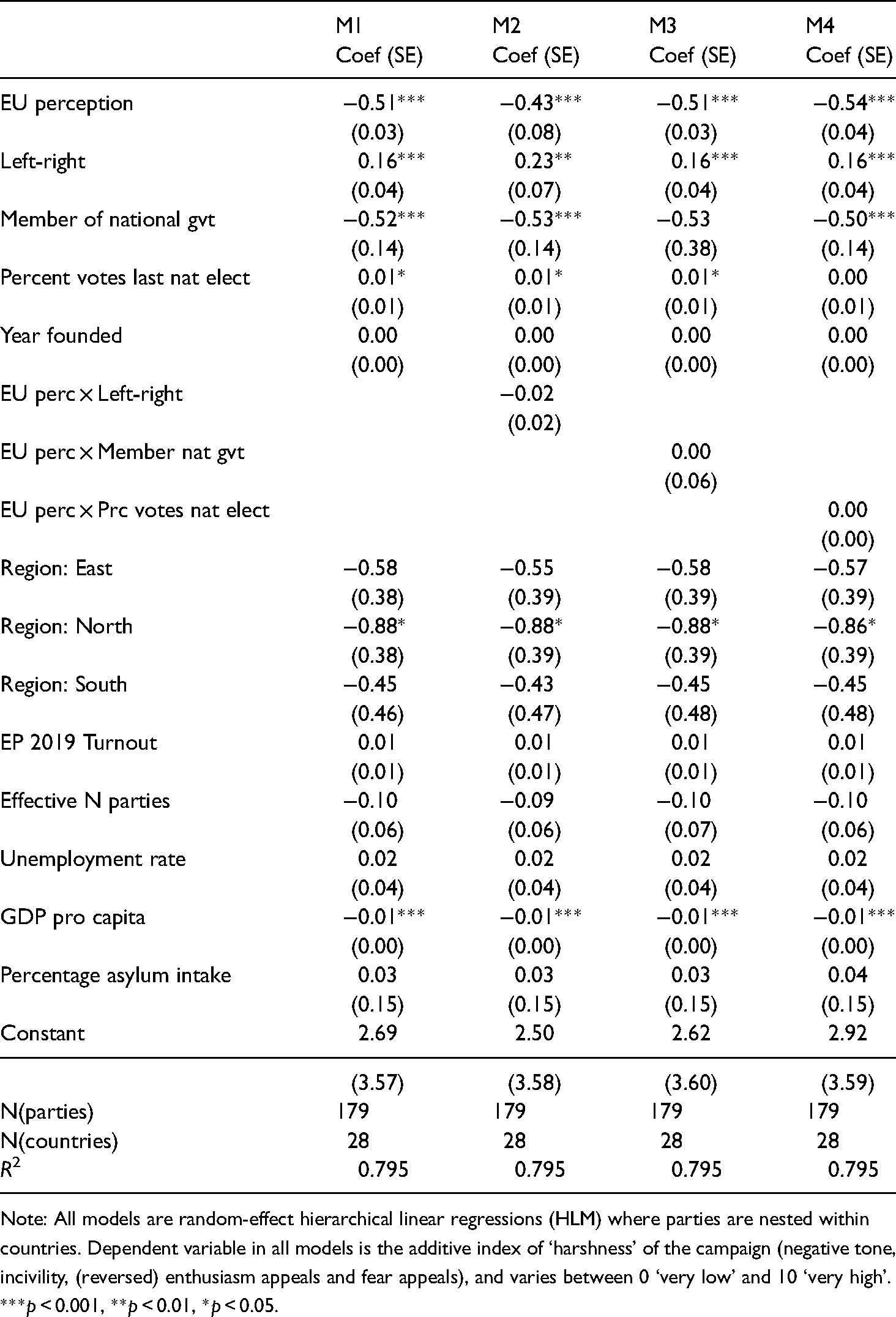
Note: All models are random-effect hierarchical linear regressions (HLM) where parties are nested within countries. Dependent variable in all models is the additive index of ‘harshness’ of the campaign (negative tone, incivility, (reversed) enthusiasm appeals and fear appeals), and varies between 0 ‘very low’ and 10 ‘very high’.
***p < 0.001, **p < 0.01, *p < 0.05.
The first model confirms that Eurosceptic parties are significantly more likely to use harsh election campaigns, in line with our expectations (H1). This effect does however not seem to be contingent on the particular profile of the party – that is, it is not more intense for parties on the right, in the opposition, or founded more recently (M2 to M4).
We present in the Online appendix models where we disentangle the effects for each of the four dimensions of campaign ‘harshness’; results confirm that Eurosceptic parties are more likely to use negativity, incivility and fear appeals, and are less likely to use enthusiasm appeals, even controlling for the party profile and context characteristics.
Electoral success
Eurosceptics tend to campaign harsher. But, beyond this being ‘on brand’, does it help them securing a better result? We test here the extent to which harsher election campaigns matter for electoral performance, and whether this is especially the case for Eurosceptic parties. Table 2 tests for the direct effect of the additive index of campaign harshness on election results (M1). The table shows, unsurprisingly, that the single most important factor explaining results in the EP election is the party performance during the last national election, suggesting that EP elections tend to reflect national party competition; in the words of Ferrara and Weishaupt (2004: 284), due to the ‘second-order’ nature of EP elections voters are ‘likely to vote with an eye to the national political arena’. Looking at the direct effect of campaign harshness, we find no significant results. Across the board, and regardless of the type of party, harsh campaigns do not promote a better electoral performance – but also, they do not lead to a backlash against the sponsor, as some argue (Fridkin and Kenney, 2004; Roese and Sande, 1993). Evidence in the Online appendix tests the direct effect of the four campaign dimensions, separately. In line with results in Gerstlé and Nai (2019), parties using enthusiasm appeals are more likely to receive a larger share of votes, ceteris paribus. Negative tone, incivility and fear appeals, taken separately, do not significantly contribute to a better electoral performance – but also do not harm parties’ electoral fortunes. In all three cases, the effect is positive, but beyond the significance threshold.
Election result by Euroscepticism and campaign content (additive index of ‘harshness’).
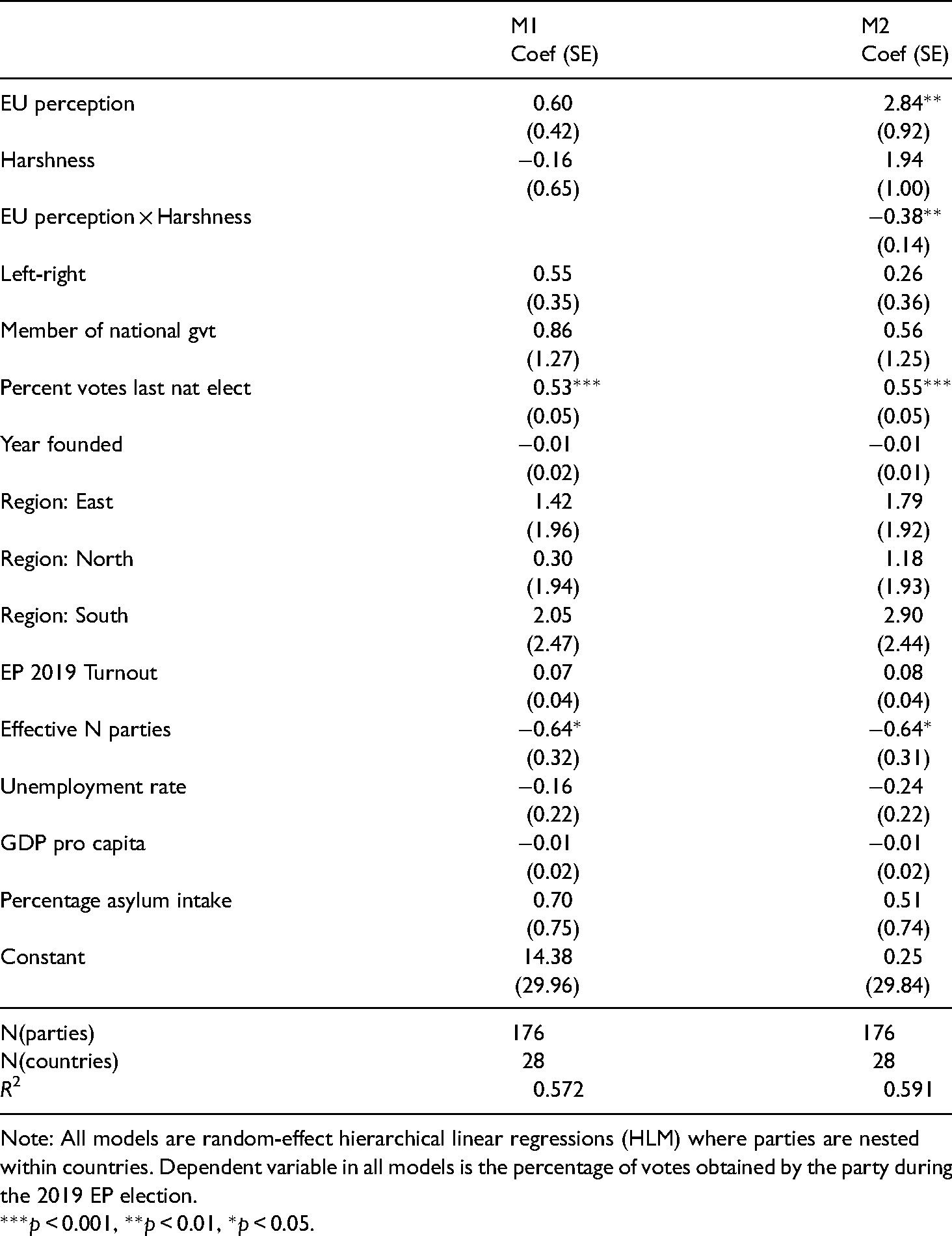
Note: All models are random-effect hierarchical linear regressions (HLM) where parties are nested within countries. Dependent variable in all models is the percentage of votes obtained by the party during the 2019 EP election.
***p < 0.001, **p < 0.01, *p < 0.05.
Model 2 in Table 2 adds the interaction effect of campaign harshness and EU perceptions. The statistically significant results suggest that campaigns have an heterogeneous effect on different types of parties.
As the visualisation of the interaction in Figure 4 displays, Europhiles tend to perform better when campaigning in a gentler fashion. A positive tone is shown to significantly decrease vote share for Europhile parties by almost 10% from one end of the harshness scale to the other (from 19.2% to 9.5% of votes received in the election on average). As for Eurosceptic parties – that is, parties that score low on the ‘EU perceptions’ – the figure displays that they perform better when using a harsher rhetoric.
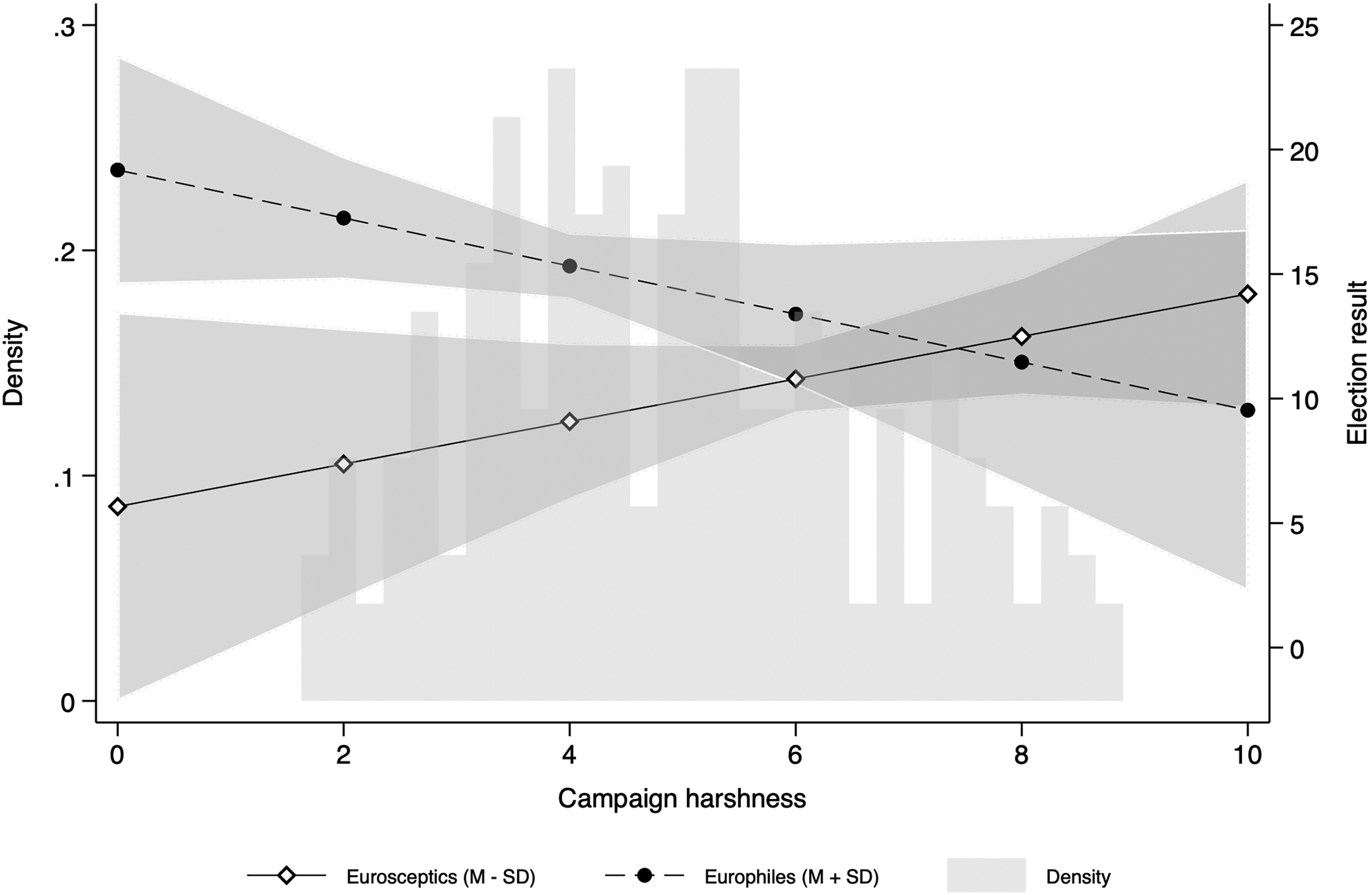
Election result by Euroscepticism and campaign harshness.
Specifically, there vote share increases by almost 9% from one end of the harshness scale to the other. Evidence in the Online appendix shows that the contrast between Europhiles and Eurosceptics is significant at lower levels of campaign harshness, suggesting that it is particularly Europhile parties that benefit from positive campaigns. All in all, nonetheless, and in direct confirmation of our expectation, harsher campaigns can be beneficial to Eurosceptic parties, whereas they are more likely to be detrimental for Europhiles (H2).
Robustness checks
The Online appendix presents the results of several robustness checks. First, we replicated the models for electoral success but used – contrarily to the ‘absolute’ measure used in the main analyses, which simply reflected the share of votes each party received in the election – a ‘relative’ measure. This alternative measure was computed as the ratio between the percent of votes for a party and the percentage that the ‘average’ party should have received based on how many ‘effective’ parties were competing. Results align with the main results above, suggesting that they are not driven by the manner in which election success is measured – nor are they a function of the number of parties that competed in the election.
Second, it is often argued whether experts can rate (political) phenomena objectively (e.g. Curini, 2010), especially in light of evidence that scholars tend to lean ideologically towards the left (Maranto and Woessner, 2012). To address this issue, we replicated the main analyses in the article but controlling also for the average expert profile, in terms of left-right self-positioning, perceptions of EU integration, self-reported familiarity with elections in the country, difficulties of answering the questionnaire, percent of experts that are citizens of the country they had to rate, and percent of female experts. As the tables show, the average expert profile only marginally comes into play.Even more importantly, all of the results described above are robust after controlling for sample composition. Nonetheless, to exclude the effects of expert ideology even further, we have replicated the main analyses using an ‘adjusted’ measure of campaign harshness, inspired by a procedure described in Walter and Van der Eijk (2019). The adjusted measure is obtained, for each party, by: (a) regressing their value on the campaign harshness index on the difference between the average expert left-right position and the party's ideological profile (i.e. a measure of how ‘ideologically distant’ the expert sample and the party they evaluated are); and (b) store the regression residuals – that is, the part of the dependent variable that is not explained by that ideological distance – into a new variable. This adjusted measure of campaign harshness is thus independent of the ideological proximity or distance of the (average) expert from the ideological position of the party. Models using this adjusted version of campaign harshness show results are at times somewhat weaker, but generally robust.
The Online appendix also presents further evidence about the profile of experts (e.g. ideology, EU position, gender) and its effects. We show, for each party in the dataset, the degree of ‘agreement’ among experts when it comes to the four dimensions of campaign harshness (negative tone, incivility, enthusiasm and fear appeals). We estimated the level of agreement among experts as a function of the average profile of experts, plus controls. Results show only scattered and marginal effects – for instance, that greater average familiarity tends to yield more consensual scores on the use of enthusiasm appeals. Most notably, the table shows the absence of any effect played by the average ideology of experts, suggesting again that the role of ideological biases should not be overestimated.
Finally, given the high correlation between EU position and campaign harshness we have also replicated our models by adding a squared term for EU position, to verify whether the main interactive effect discussed above between the two factors is in reality driven by position extremity. The interaction term in the new models is no longer significant, but the direction of the main effect is the same – especially in terms of contrast between Eurosceptics and Europhiles at higher levels of harshness. Split analyses for Europhiles and Eurosceptics 6 show again similar trends: campaign harshness is detrimental for Europhiles, but not so for Eurosceptics (even if the effect is not significant for the latter, most likely due to decreasing sample size). Furthermore, replicating all main models using an independent measure of EU position (from the 2017 CHES flash survey; Polk et al., 2017) yields again similar results to our initial analyses in Tables 1 and 2.
Conclusion and discussion
On top of all international challenges, the great European experiment is increasingly challenged from within by national and transnational Eurosceptic movements. No observer of the Brexit process, even the least attentive among them, will ever advocate that Euroscepticism is a toothless menace for European unity (Hobolt et al., 2021). However, beyond this anecdotal achievement of the UK Eurosceptics, the larger question related to the broad success of Euroscepticism as a political movement is still unresolved. This article contributes to this debate by zooming in on a particular dimension of Euroscepticism: the relationship between its rhetoric and its electoral success.
The results of our analyses point to three main findings. Firstly, the analyses show that on average Eurosceptic parties do in fact tend to use harsh, negative campaign styles. Secondly, and in contrast to the electoral experience of the PVV in 2019, our findings demonstrate that this tends to be a successful vote winning strategy for Eurosceptic parties. On average, the harsher the campaign tone taken by Eurosceptic parties, the greater the share of the votes that they were able to win in the 2019 EP elections. Finally, the analyses show a reverse relationship between the harshness of the campaign tone and electoral success for Europhile parties. The more negative pro-Europe parties were in their campaigning, the fewer the votes they received.
The fact that the strategy utilised rather successfully by Eurosceptics − to campaign in a harsh, negative style – is counterproductive for Europhile parties nuances previous research that has cast doubts on the effectiveness of political attacks to win votes (see Lau et al., 2007). Campaign harshness can be successful for some parties and detrimental for other ones. We argue that this follows from harsher campaigns being more ‘in character’ for some actors, and thus more likely to be successful. Transposed on the electorate, these results could indicate that a proportion of the electorate is attracted to more negative, uncivil and emotional campaigns, whereas others are repulsed by it – in line with recent experimental research (e.g. Nai and Maier, 2020). Further research needs to account for this heterogeneous relationship between party, campaign tone and electoral success – particularly keeping in mind that the targets of political attacks, which we were unable to investigate here, are likely to matter as well. Increasing evidence shows that the dynamics of attack politics are interactive ones (Dolezal et al., 2016; Somer-Topcu and Weitzel, 2020), and that the effectiveness of political attacks depends on the characteristics of both the sponsor of the attacks and their target.
Of course, the durability of electoral success for harsh campaigns remains to be seen. While the Great Recession of the late 2000s and the migrant crisis of the mid-2010s were arguably a powerful fuel for Euroscepticism, the COVID-19 crisis potentially brings forth a new sociopolitical landscape. A generalised socioeconomic crisis that has had strong repercussions on all EU members, and that has highlighted their financial and economic interdependence, might lead to shining a positive light on European cooperation. As pro (and anti) EU sentiments are dynamic (Anderson and Hecht, 2018; Nissen, 2014), it would be interesting to investigate how negative campaigning would fare for Eurosceptic parties in a more EU-positive era; especially considering that they have a core of supporters who are attracted to such messages.
Supplemental Material
sj-docx-1-eup-10.1177_14651165211035675 - Supplemental material for Euroscepticism and the use of negative, uncivil and emotional campaigns in the 2019 European Parliament election: A winning combination
Supplemental material, sj-docx-1-eup-10.1177_14651165211035675 for Euroscepticism and the use of negative, uncivil and emotional campaigns in the 2019 European Parliament election: A winning combination by Alessandro Nai, Mike Medeiros, Michaela Maier and Jürgen Maier in European Union Politics
Supplemental Material
sj-do-2-eup-10.1177_14651165211035675 - Supplemental material for Euroscepticism and the use of negative, uncivil and emotional campaigns in the 2019 European Parliament election: A winning combination
Supplemental material, sj-do-2-eup-10.1177_14651165211035675 for Euroscepticism and the use of negative, uncivil and emotional campaigns in the 2019 European Parliament election: A winning combination by Alessandro Nai, Mike Medeiros, Michaela Maier and Jürgen Maier in European Union Politics
Supplemental Material
sj-dta-3-eup-10.1177_14651165211035675 - Supplemental material for Euroscepticism and the use of negative, uncivil and emotional campaigns in the 2019 European Parliament election: A winning combination
Supplemental material, sj-dta-3-eup-10.1177_14651165211035675 for Euroscepticism and the use of negative, uncivil and emotional campaigns in the 2019 European Parliament election: A winning combination by Alessandro Nai, Mike Medeiros, Michaela Maier and Jürgen Maier in European Union Politics
Supplemental Material
sj-xlsx-4-eup-10.1177_14651165211035675 - Supplemental material for Euroscepticism and the use of negative, uncivil and emotional campaigns in the 2019 European Parliament election: A winning combination
Supplemental material, sj-xlsx-4-eup-10.1177_14651165211035675 for Euroscepticism and the use of negative, uncivil and emotional campaigns in the 2019 European Parliament election: A winning combination by Alessandro Nai, Mike Medeiros, Michaela Maier and Jürgen Maier in European Union Politics
Footnotes
Acknowledgements
We are very grateful to the editors and anonymous reviewers for their constructive comments and insights. A preliminary version of this article was presented during the Amsterdam Centre for European Studies (ACES) workshop “The European Elections 2019” organized by Wouter van der Brug, Katjana Gattermann and Claes de Vreese; many thanks to the workshop conveners and participants for their excellent inputs. The authors also wish to thank all experts that have generously donated their time to participate in our comparative survey.
Funding
The authors received no financial support for the research, authorship and/or publication of this article.

Supplemental material
Notes
References
Supplementary Material
Please find the following supplemental material available below.
For Open Access articles published under a Creative Commons License, all supplemental material carries the same license as the article it is associated with.
For non-Open Access articles published, all supplemental material carries a non-exclusive license, and permission requests for re-use of supplemental material or any part of supplemental material shall be sent directly to the copyright owner as specified in the copyright notice associated with the article.
