




Abstract
In many countries across the globe, the number of vote switchers is quite high. An under-researched dimension of this phenomenon is the impact of ambivalent political attitudes. Ambivalence describes the situation in which a person simultaneously has positive attitudes toward more than one political party or more than one political leader. Whilst the effects of party and leader ambivalence on vote switching have been investigated in the American political system, their application to multi-party systems is rare. This article aims to fill this gap. Before doing so, however, the article focuses on the development of party and leader ambivalent attitudes and system features of multi-party systems influencing ambivalence. For this research purpose, the article uses data from the Comparative Study of Electoral Systems covering 195 elections in 52 multi-party systems between 1996 and 2020. The results, among others, demonstrate that ambivalence increases voters’ probability to switch parties between elections.
Introduction
Studies of citizens' attitudes and intentions are widely published in newspapers, reports and academic papers. The implicit assumption is that citizens have clear and unambiguous ideas about what they are being asked. In reality, however, they are often ambiguous - people have mixed feelings. This issue is even more important given that elections are increasingly volatile and voters change their vote frequently. This article argues that we need to look more closely at ambivalent political attitudes if we are to fully understand voter behavior.
Ambivalent political attitudes – also referred to as ambivalence in this article – represent an attitudinal conflict characterized by competing positive and negative considerations regarding one or more objects of interest (Basinger and Lavine, 2005; Lavine, 2001: 915). While the effects of ambivalence on voters’ behavior have been studied primarily in the U.S. two-party system (TPS) (Basinger and Lavine, 2005; Haddock, 2003; Hillygus and Shields, 2008; Lavine, 2001; Lavine et al., 2012; Smidt, 2017; Thornton, 2009, 2014), this article aims to build on early work by Dentler (2023a, 2023b) investigating the impact of ambivalence in multi-party systems (MPS) where voters can be expected to be particularly likely to hold and develop ambivalent attitudes. The key message of the article is that the influence of ambivalence on voting behavior should also be studied more thoroughly in MPS (Dentler, 2023a, 2023b; Steenbergen, 2020; Thornton, 2009: 126).
The main contributions of this article lie first in broadening the context and generalizing earlier results, which, however, were of little value due to the limited selection of MPS. While Dentler (2023a, 2023b) focused exclusively on Austria, Germany, and the United Kingdom, this article extends the analysis to about 52 MPS across the globe. It builds on the earlier argument that studying the effects of ambivalence on vote switching in MPS that differ from U.S. TPS is important and useful (Steenbergen, 2020; Thornton, 2009: 126). Second, the article delves a bit deeper into the underlying mechanisms that lead to ambivalent attitudes in MPS, suggesting that ambivalent attitudes are more likely to be present in these systems due to factors such as a different number of parties, the presence of coalition-building processes, strategic voting, the entry of new parties, and the interaction of parties and their leaders. For example, ambivalence might be more pronounced in MPS because the range of parties in these systems offers voters more viable alternatives at election times (Johnson, 2014: 509; Steenbergen, 2020: 155). If the number of parties is larger, parties are likely to be closer ideologically as they place themselves on the ideological scale, which then provides less space for each party. When parties are closer together on the ideological scale, there is a greater likelihood that policy proposals and opinions will overlap. This, in turn, increases the likelihood of developing similar positive attitudes toward multiple parties. This can lead to an increased likelihood of becoming ambivalent. The two research questions of this article are: How do voters develop ambivalent political attitudes in MPS and do these ambivalent political attitudes influence voter switching in MPS across the globe?
To get to the bottom of these research questions, the analysis uses data from the Comparative Study of Electoral Systems (CSES). The CSES includes a variety of democratic countries with stable and well-established MPS. The party systems of those countries offer the party menu that is of interest for investigating the development and impact of ambivalence. From the CSES, the article uses the Integrated Module Dataset (IMD) and the fourth advance release of Module 5. The data enables to investigate the impact of party and leader ambivalence on vote switching in 52 MPS for 195 national elections between 1996 and 2020.
The results support two pathways in which voters in MPS become politically ambivalent. First, the larger the number of parties, the smaller the ideological distance tends to be between the two parties that are ideologically closest to voters, which in turn increases the likelihood that voters develop party ambivalent attitudes. Second, the larger the number of parties, the more likely it is that voters show party-leader ambivalent attitudes. Voters who have conflicting party-leader attitudes are then more likely to be party and leader ambivalent. The results related to the effects of ambivalence on vote switching in MPS demonstrate that higher levels of party and leader ambivalence in MPS lead to a higher probability of engaging in vote switching between elections. The three robustness checks provide support in terms of theory and measurement. In sum, the article shows that ambivalent political attitudes are more prevalent in MPS than in TPS, and that they have strong effects on electoral changes in MPS around the world. Ambivalence is therefore useful in explaining recent trends in electoral volatility.
Electoral volatility, vote switching and ambivalence
Electoral volatility
The current literature on vote switching focuses on a variety of factors to explain electoral volatility and can be divided into aggregated and individual level analyses. Whilst work on the aggregate level focuses on comparative study of official election results, individual level studies rely primarily on data gathered in survey data of respondents (Schoen, 2014). There are three main branches trying to explain volatility: the sociological paradigm, socio-psychological approaches, and rational choice explanations. Looking at the influence of political attitudes on individual voter behavior falls into the socio-psychological approach. In this branch, other studies have identified other motivations besides ambivalence to investigate vote switching. Those studies have shown that voters vary in their party support because they are either unaware of or indifferent between party alternatives (Converse, 1962; Hillygus and Shields, 2008; Kelley, 1983; Mayer, 2008; Zaller, 2004). Scholars have found that volatility is related to voters being independent, less informed, and less sophisticated (Schoen, 2004; Zaller, 2004). Blumenstiel and Plischke (2015) show that voters’ motivations can change over time, and that inter- and intra-individual heterogeneity affects processes of decision-making. At some election, a voter might be candidate-oriented and at another one issue-oriented. As mentioned above, despite much ink being spilled over the dynamics underlying vote switching, a hereto under-researched dimension of this phenomenon is the impact of ambivalence.
Ambivalent political attitudes and their impact on people’s behavior
Ambivalence is an attitude conflict that is characterized by competing considerations and describes the state of having simultaneously positive and negative feelings or contradictory ideas about an object or a person (Kaplan, 1972; Lavine, 2001; Thompson et al., 1995; Zaller and Feldman, 1992).1,2 Most of the work on ambivalence focuses on policy issues, candidates or parties (Basinger and Lavine, 2005; Lavine, 2001; McGraw et al., 2003) where individuals can be ambivalent toward one or multiple objects (Lavine, 2001). For example, individuals are ambivalent toward one object if they have similar negative and positive feelings or considerations toward one party. Ambivalence toward multiple objects can then be found if individuals have negative and positive feelings toward two or more parties. The balance between these positive and negative feelings is expected to lead to the strength of ambivalence. For example, voters who have equally strong positive and negative feelings toward a party are expected to be highly ambivalent (e.g., a 50:50 ratio), while voters who have significantly more positive than negative feelings or more negative than positive feelings toward the party (e.g., a 70:30 ratio) should be less ambivalent. The article captures two types of ambivalence: Party ambivalence and leader ambivalence. Whereas the previous literature focuses on either party or leader ambivalence, this article considers both types of ambivalence at the same time. Whilst party ambivalence examines ambivalence between two parties, leader ambivalence is based on ambivalence between two leaders.
Research shows that ambivalence substantially affects electoral behavior. Ambivalence impacts people’s political opinions and evaluations. It influences individuals’ evaluations of candidates (Blumenstiel and Gavras, 2015; Guge, 1999; Lavine, 2001, 2004; Meffert et al., 2004; Schoen, 2010) and how strongly individuals approve or disapprove with the president (Meffert et al., 2004). Ambivalence also affects people’s decisions in different facets of their voting behavior. Ambivalent individuals are more likely to vote based on competence and valence issues (Thornton, 2009). Basinger and Lavine (2005) show that ambivalent partisans lacking political knowledge are more likely to engage in economic voting, while ambivalent partisans who show a high political knowledge are more likely to engage in ideological voting. Lavine et al. (2012: 161) demonstrate that while partisanship is the dominant influence on vote choice for univalent partisans, their ambivalent counterparts are more affected by political issues and less by partisanship (see also Blumenstiel, 2014: 32). Ambivalence also leads voters to make up their minds later (He, 2016; Lavine, 2001, 2004: 100; Mutz, 2002; Nir, 2005; Plischke, 2014, 213; Schmitt-Beck and Partheymüller, 2016), destabilize the relation between vote intention and vote choice (Lavine, 2004: 106) making the vote intention less predictable (Blumenstiel, 2014; Lavine, 2001).
Like research on ambivalence more generally, the literature on the effects of ambivalence on vote switching is dominated by a focus on the United States. Support for the impact of ambivalence comes from Smidt (2017: 375) demonstrating that ambivalence leads to a higher probability of switching for US elections between 1957 and 2004. Lavine et al. (2012) find that ambivalent partisanship facilitates three types of electoral volatility: defection, ticket-splitting and third-party voting. Hillygus and Shields (2008) find that defection strongly increases among ambivalent or cross-pressured partisans if they are exposed to campaign information on issues relevant to them. Conversely, Thornton’s (2014: 193) results rarely show significant effects for ambivalence on switching. Thornton’s (2009: 103) previous work also yields some counter-evidence where he does not find effects of ambivalence on switching at all. However, presidential elections in the US might be the least likely scenario in which one could expect ambivalence to influence voting behavior due to polarization (Thornton, 2009: 125, 2014: 196). Thornton (2009: 126) suggests pushing the frontiers and to explore ambivalence voting in more contexts (see also Johnson, 2014; Keele and Wolak, 2006; Pappi, 1996: 256). In a first related attempt, Dentler (2023a) shows that ambivalence increases voters’ probability to switch parties during the pre-election campaigning period and between two consecutive elections for the 2013, 2017 and 2021 German federal elections. Recent results from another article (Dentler, 2023b) demonstrate for several Austrian, British, and German general elections that respondents with higher ambivalence values are more likely to engage in vote switching. Highly ambivalent voters in Germany were nearly about 30% more likely to switch parties compared to voters with the lowest ambivalence value. Highly ambivalent voters in Austria were about 25% more likely to switch parties and about 20% in the United Kingdom. Both articles demonstrate that party and leader ambivalence exert a strong impact on switching not only in the TPS of the United States but also in MPS. The replication and generalization of these results for a variety of MPS is one contribution of this article.
Ambivalence in a multi-party setting
Before testing any impact of ambivalence on vote switching, we should theorize and investigate how MPS factors are expected to lead to ambivalence and how system features might cause changes in it. Therefore, it is important and necessary to investigate the question how do people become political ambivalent in MPS? This is also relevant as voters in MPS might be more likely to hold ambivalent attitudes. People can become ambivalent based on a variety of cognitive processes provoked by internal and external sources. Internal sources are characteristics of individuals influencing the development of ambivalent attitudes. They therefore vary across all individuals. One internal source is the information affinity, people who enjoy systematically processing information are more likely to be ambivalent (Rudolph and Popp, 2007). External sources are factors beyond the individual, such as electoral contexts or networks. The focus of this article is the party system, particularly MPS.
External source: Party system
The two underlying pathways that increase the likelihood of voters in MPS displaying ambivalent attitudes are roughly outlined in Figure 1. Previous research shows that a higher number of alternatives, be it parties or leaders, leads to a larger size of individuals’ consideration sets (Johnson, 2014: 509; Oscarsson and Rosema, 2019; Wilson, 2008). Consideration sets are built when voters apply heuristics to reduce their choice sets (Lavine et al., 2012; Oscarsson and Rosema, 2019; Wilson, 2008: 162). Choice sets consist of all viable alternatives. Whilst the choice set in TPS is a maximum of two, the choice set size of individuals in MPS is larger by default (Oscarsson and Rosema, 2019: 257). A larger number of parties in MPS leading to larger choice and consideration sets ends up making decision making more difficult in two ways: The ideological distance between parties decreases, and trade-offs between assessment dimensions become increasingly complicated. Both are caused by larger choice sets leading to a higher decision difficulty in MPS and thus, an increased likelihood of holding ambivalent attitudes. Graphical Illustration of the underlying mechanisms leading to ambivalence.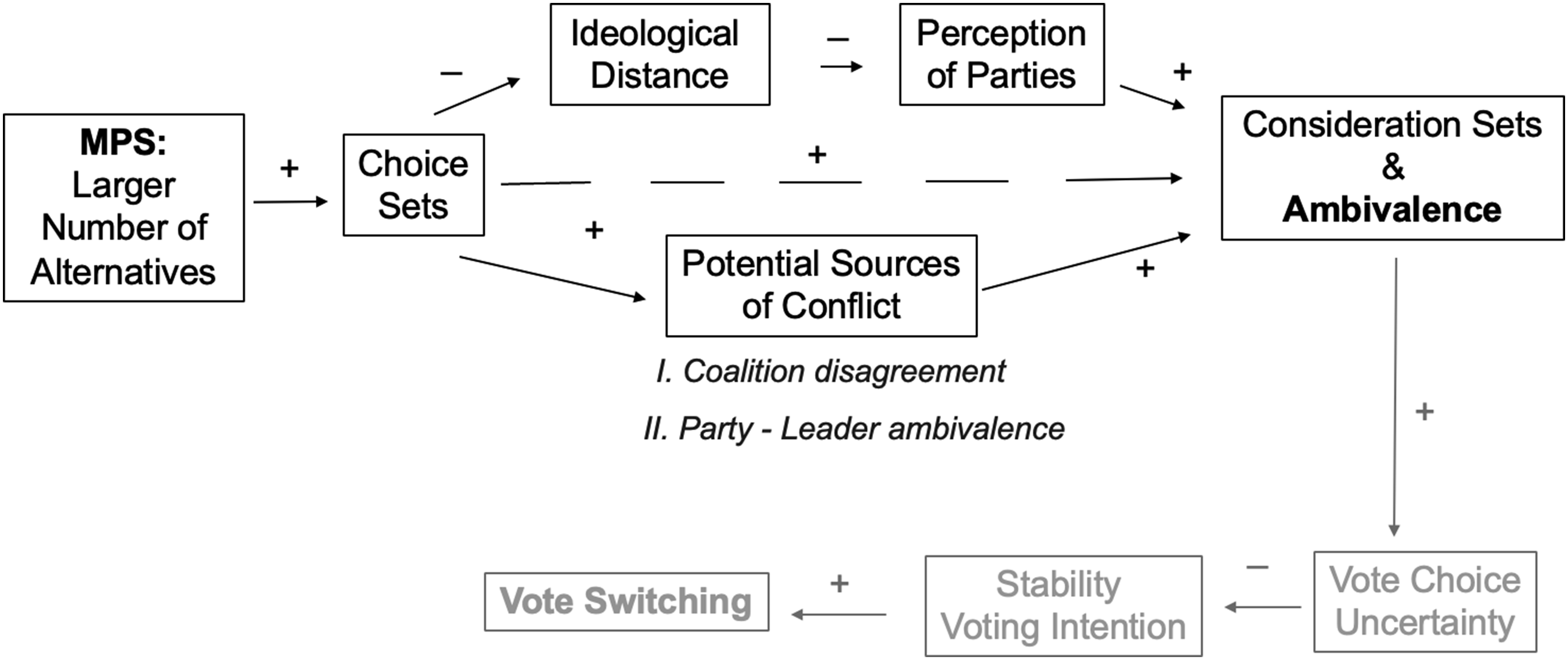
Turning to the above path, the ideological distance between parties is affected by the number of parties and the polarization of the party system. It is likely that the more parties compete, the ideologically closer they become, and the greater becomes their overlap in content (Plischke, 2014: 125). However, a high number of parties does not necessarily mean that distances between parties are small (Dalton, 2008). If ideological distances become smaller in MPS, the overlaps in content also mean that parties with similar programs can cooperate if they pursue common goals. They may even be forced to form coalitions to achieve government majorities (Schoen, 2010). In coalition governments, parties cannot implement their pure programs but must make compromises that further reduce the discriminatory power of the two coalition partners' perceptions (Plischke, 2014: 125). This makes certain parties appear more similar (Plischke, 2014: 125). The comparison of positions of the parties would therefore not reveal too many differences from whose evaluation a decision could be derived. This could then cause an increased decision difficulty along with a higher likelihood of showing ambivalent attitudes. The following two hypotheses test whether a higher number of parties affects the degree of closeness between a respondent’s two closest parties (H1a) and whether the distance between the two closest parties increases the likelihood of showing party ambivalent attitudes (H1b).
H1a: The higher the number of effective parties in an election, the closer the two parties that are ideologically closest to the respondent.
H1b: The smaller the ideological distance between a voter’s two closest parties, the more party ambivalent is the respondent. Complicated trade-offs between assessment dimensions display the below pathway in which larger consideration sets could be expected to lead to a higher decision difficulty and more ambivalence in MPS. The article focuses on two types of assessment dimensions: (1) between a favourite party and a potential coalition partner and (2) between a party and its leader. Starting with the first one, voters may become conflicted if they show a clear party favourite but strongly disagree with its potential coalition partner. If the voters’ dislike is strong enough, voters may consider to vote for their second most liked party. This can only be observed in MPS. The second trade-off type and focus of this article deals with party-leader ambivalence. Party-leader ambivalence describes a situation in which voters prefer a leader of a party other than their favorite party. For instance, the leader of party A may be preferred to the leader of party B, while party B is assigned a higher competence or more liked than party A. Party-leader ambivalent voters do thus face a greater decision difficulty and are trapped between voting for their favorite party or favorite leader (Daoust et al., 2021; Quinlan and McAllister, 2022; Wagner and Weßels, 2012). As pointed out by the previous literature (Wagner and Weßels, 2012), we should not solely look at party and leader evaluations separately but pay more attention to the interplay between both. For the German Federal elections between 1998 and 2009, Wagner and Weßels (2012) strengthen this argument by showing that leader and party evaluations reinforce each other, and that the match between a party and its leader is what matters most for vote choice. Daoust et al. (2021) find in their research that 17% of the voters preferred a leader from another party. Party-leader ambivalence is thus not rare and could be an important factor influencing the existence of party and leader ambivalent attitudes, and vote choices. To test this mechanism leading from a larger number of parties to ambivalence, the article empirically tests two more observable implications. First, voters should be more likely to show party-leader ambivalent attitudes if they face a higher number of parties in an election (H2a). Second, voters should be more likely to show party ambivalent and leader ambivalent attitudes if they hold party-leader ambivalent attitudes (H2b).
H2a: The higher the number of effective parties in an election, the higher is the respondents' likelihood of showing party-leader ambivalent attitudes.
H2b: Voters who are party-leader ambivalent are more likely to show party (leader) ambivalent attitudes. In summary, individuals in MPS can be expected to have larger consideration sets than individuals in TPS. Whilst the choice sets of individuals in TPS is two by default, individuals in MPS are offered more alternatives to choose from. Combined with the two above described arguments of ideological distance and complicated trade-offs, one can expect voters in MPS to show larger consideration sets and thus to be more likely to hold ambivalent attitudes than voters in TPS. The effect of ambivalence on vote switching is then likely to vary depending on the size of the party system – namely the number of parties (leaders).
Ambivalence and vote switching in multi-party systems
After having looked at the party system influencing political ambivalence, the article examines how ambivalence affects to vote switching (see Figure 2). First, the article expects voters who find themselves in a difficult decision-making situation and are thus torn between party or leader alternatives should be less certain of their vote choice. Those voters should hence be more likely to show a higher vote choice uncertainty before an election. Graphical Illustration of the Causal mechanisms leading to vote switching.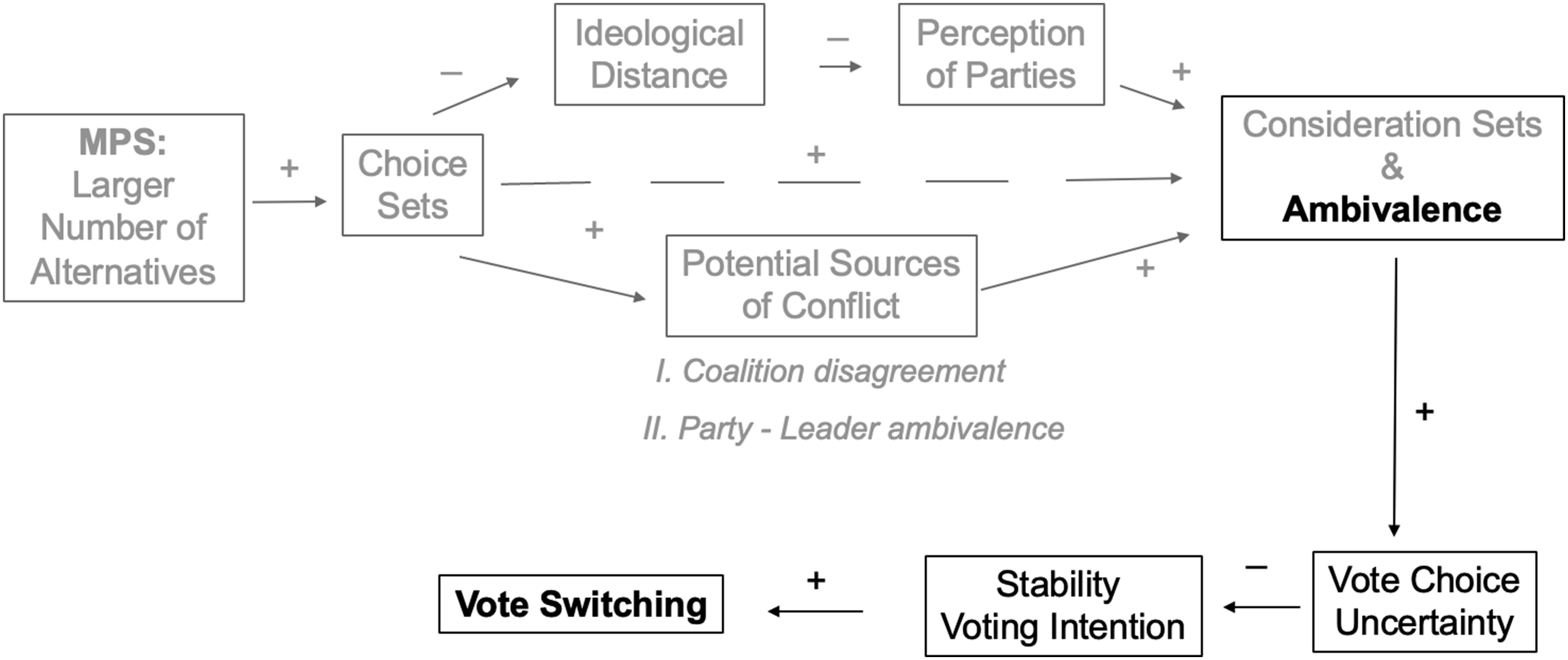
Second, a more uncertain vote choice in turn leads to more unstable as well as delayed voting intentions. Previous literature shows that ambivalence weakens the relation between vote intention and vote choice (Lavine, 2004: 106) and leads to forming vote intentions later during the campaigning period (Lavine, 2001, 2004: 100; Mutz, 2002; Nir, 2005; Plischke, 2014; Schmitt-Beck and Partheymüller, 2016). This demonstrates that voters’ vote choice with ambivalent preferences are less predictable (Blumenstiel, 2014; Lavine, 2001).
Third, an unstable or delayed voting intention indicates that the individual finds himself in an ambivalent decision situation then increasing the likelihood of engaging in vote switching on the election day. In contrast, non-ambivalent voters are expected to show an early and certain vote choice, and stable vote intentions. Hence, they should be less likely to switch parties. Intervening in the above described mechanism, the psychological threshold of switching is lower in MPS. In MPS, the closer two parties are to each other ideologically, the more likely it is for a supporter of one party to consider switching to the other (Schoen, 2004: 11). In contrast, parties in TPS tend to be more polarized and distinct and voters must make ‘larger steps’ in order to switch form one party to the other (Schoen, 2004: 11). In summary, the article expects that voters with a higher ambivalence are more likely to engage in vote switching at an election than voters with a lower ambivalence. The article derives hypothesis H3 to test this impact of ambivalence on vote switching as it was likewise investigated in the US American context.
H3: Voters with higher party (leader) ambivalence values are more likely to switch parties at two consecutive elections than voters with lower party (leader) ambivalence values.
Research design
For this research agenda, the article unpacks the above-described issues by using data from The Comparative Study of Electoral Systems (CSES). The CSES includes a variety of democratic countries with stable and well-established MPS. The party systems of those countries offer the party menu that is of interest for investigating the impact of ambivalence. From the CSES, the article uses the Integrated Module Dataset (IMD) and the fourth advance release of Module 5. Overall, both comprise about 357,000 respondents of 57 polities from which 52 polities can be understood as MPS. The data enables to investigate the impact of party ambivalence and leader ambivalence on vote switching in MPS for 195 national elections across the globe between 1996 and 2020. The only TPS are the United States with six national elections in 1996, 2004, 2008, 2012, 2016 and 2020.
To measure ambivalence, the article uses feeling thermometer ratings of a respondent’s two highest rated parties and leaders (Johnson, 2014). It thus captures ambivalence between multiple parties. Measuring ambivalence with feeling thermometer ratings is not new and has been done in the multi-party context by other scholars as well (Blumenstiel, 2014; Çakır, 2022; Schmitt-Beck and Partheymüller, 2012). On the feeling thermometer, respondents rate parties and leaders on an 11- point scale from strongly dislike to strongly like. Following previous studies (Basinger and Lavine, 2005; Çakır, 2022; Johnson, 2014; Schmitt-Beck and Partheymüller, 2012), the ambivalence measures take Griffin’s formula of ambivalence as a starting point for the calculations of the indexes (Thompson et al., 1995). Based on the rating of the two most liked parties or leaders (Blumenstiel, 2014), two indexes are calculated demonstrating respondents’ degree of party ambivalence and leader ambivalence. The indexes range from −5 to 10, with 10 being the value of respondents who are most ambivalent and −5 being the value of respondents who are least ambivalent. Respondents who rate two parties on the feeling thermometer with the highest possible score of 10 (strongly like) would yield a score of 10 (party ambivalence = (10 + 10)/2 - (|10 - 10|)). The lowest value of ambivalence is achieved by respondents who have a clear favorite and rate one party with a 10 (strongly like) and the other with a 0 (strongly dislike). Applying the formula, these respondents obtain the lowest ambivalence value of −5 (party ambivalence = (10 + 0)/2 - (|10 - 0|)).
Party-leader ambivalence is also based on the feeling thermometer ratings. Respondents are classified as being party-leader ambivalent if they show a different leader than party favourite based on their like/dislikes. For instance, respondents rating both Party A (e.g., PartyA = 9, PartyB = 7) and the leader of Party A (e.g., LeaderA = 9, LeaderB = 7) highest among all alternatives would be classified as not party- leader ambivalent. Whereas, respondents rating Party A highest among all parties (e.g., PartyA = 9, PartyB = 7) but the leader of Party B highest among all leaders (e.g., LeaderA = 7, LeaderB = 9), would be classified as being party-leader ambivalent. Party-leader ambivalence is thus a dummy variable coded as 0 if the respondents’ favorite party and leader are congruent, and coded as 1 if they are not congruent meaning that respondents show two different favorites.
Vote switching is a dummy variable indicating whether respondents voted in two consecutive national elections for the same party, coded as 0, or whether they voted for two different parties, coded as 1. A detailed operationalization of all variables, as well as descriptive statistics and a comprehensive list of all elections included in the analyses, can be found in the Appendix 1 and 2. For the models with binary dependent variables, like vote switching, the article uses logistic multivariate regressions. For the models with continuous variables, like party ambivalence, it uses linear multivariate regressions. All models using the CSES include country and year fixed effects and standard errors clustered by country.
To assess the robustness of the findings, the article performs three checks. The first check (Models 8 to 10 in Table A3.1 in Appendix 3) replicates the original models of party and leader ambivalence and vote switching (Table 2 Model 5) but focuses on a subsample of respondents. This subsample only includes respondents that still rate the party that they have voted for in the previous election among their first two most liked parties. This differentiation is important because voters who do not favor the party of their previous vote choice anymore should be highly likely to switch at the current election, independent of their level of ambivalence among two other parties as the party of their previous choice would not be included in the calculation anyways. Based on this, the impact of ambivalence on switching is likely to be underestimated in the original models including all respondents. In the second robustness check (Model 11 in Table A3.1 in Appendix 3), the article compares and replicates the results from the feeling thermometer ambivalence measurement of Johnson (2014) with the MPS ambivalence measurement of Schmitt-Beck and Partheymüller (2012) to provide support in terms of measurement. However, smaller effects can be expected as the measurement does not focus on the two highest evaluated parties but at the general party system as the formula includes all parties. In the last methodological robustness check (Appendix 3), Tables A3.2 to A3.4 replicate all country-year fixed effects models with random intercept multi-level models to account for the nested structure of the data.
Results
External source: Party system
Figure 3 provides an overview of the distribution of party and leader ambivalence in MPS and TPS. The lemon-yellow shaded bars show the number of ambivalent voters, the dark grey shaded bars show the ambivalent voters, and the colour in between represents the overlap. These two figures show that voters in the MPS have much higher party and leader ambivalence scores on average than voters in the TPS. While party and leader ambivalence in MPS has a mean of 5, the mean in TPS is 0.4 for party and −1 for leader ambivalence. Two independent t-tests for party and leader ambivalence, grouped by party system, are both significant and confirm that the means of the two system types differ. Particularly striking is the large number of voters in TPS who score an ambivalence value of −5. A closer look at the U.S., the only TPS in the data, shows a steady decline in ambivalent attitudes among leaders and parties across the six presidential elections. Whereas in 1996 the median and mean were 2, in 2020 the median was −3.5 and the mean was −2 on the leader ambivalence index. Although this is not explored further in this article, it may be indicative of increasing polarization in U.S. elections in recent decades. Overall, the two figures support the earlier argument that voters in MPS tend to have more ambivalent attitudes in the first place. Frequency of leader and party ambivalence for MPS and TPS.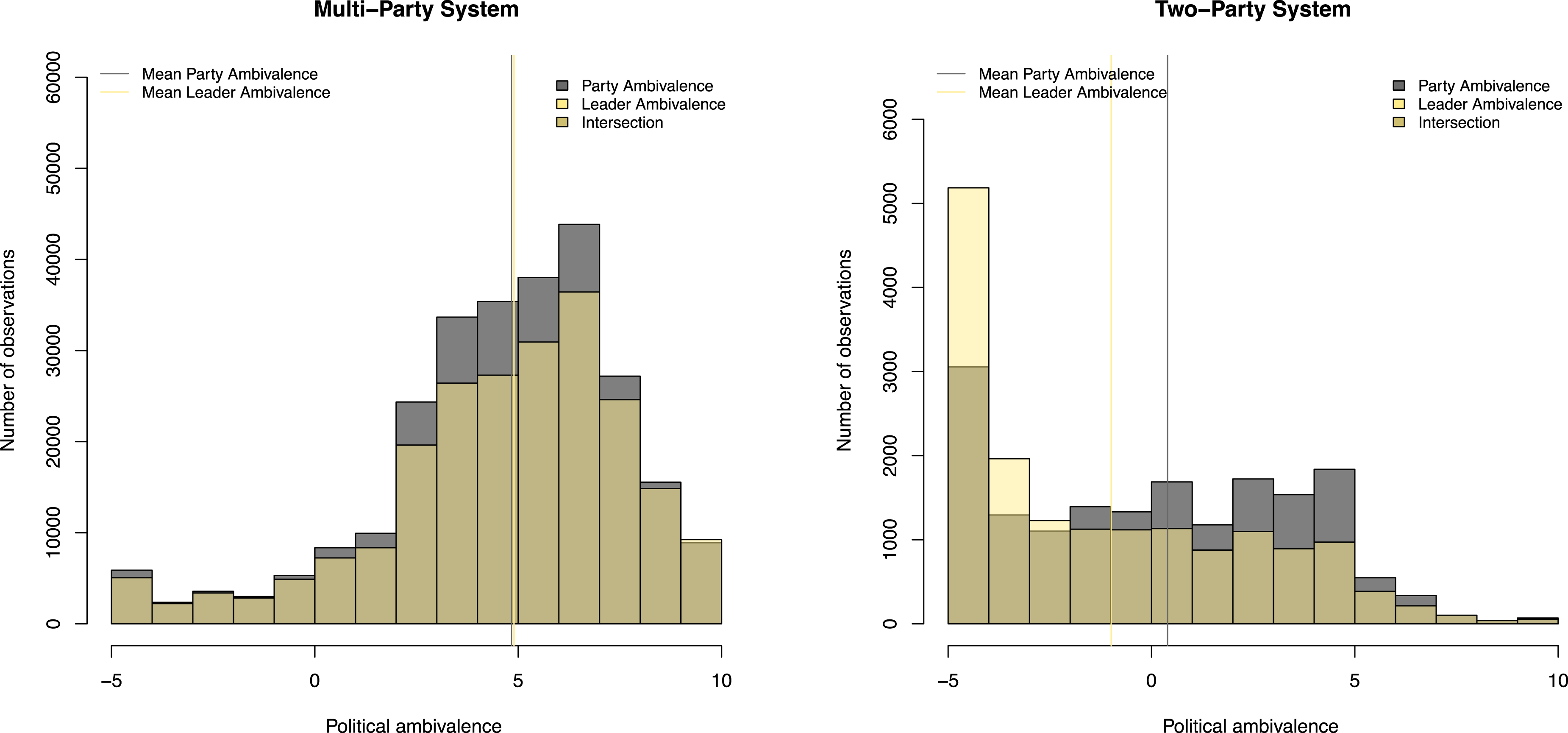
The figures also demonstrate that studying the effects of ambivalence is a highly relevant topic, especially in the MPS, as it affects many voters.
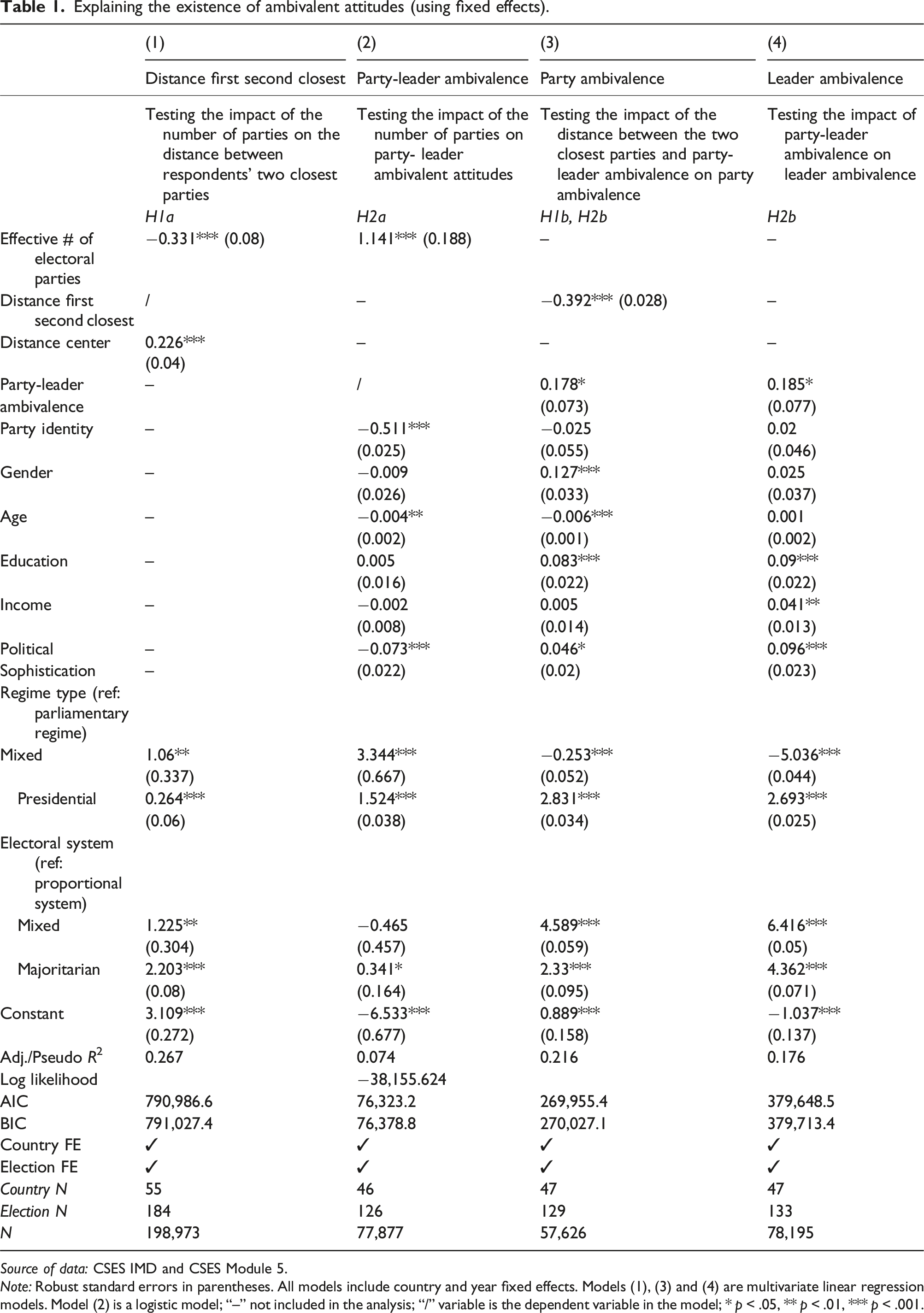
Explaining the existence of ambivalent attitudes (using fixed effects).
Source of data: CSES IMD and CSES Module 5.
Note: Robust standard errors in parentheses. All models include country and year fixed effects. Models (1), (3) and (4) are multivariate linear regression models. Model (2) is a logistic model; “–” not included in the analysis; “/” variable is the dependent variable in the model; * p < .05, ** p < .01, *** p < .001.
Models three and four investigate the second step of both pathways by looking at the effects of ideological distances between the two closest parties (H1b) and holding party-leader ambivalent attitudes (H2b) on the likelihood of showing an increase in either party or leader ambivalence. Whist the impact of party-leader ambivalence is tested for both types of ambivalence, the influence of ideological distances is solely tested for party ambivalence as the distance variable measures distances between parties and not leaders. Models three and four do not include the number of parties and distance center because both variables are only relevant for the first two models. Model three reveals the negative significant impact of the ideological distance and the positive significant impact on party-leader ambivalence on the existence of party ambivalence. With a one-unit increase in the ideological distance between the two closest parties, voters’ party ambivalence decreases on average by 0.4 units. If voters are party-leader ambivalent, their party ambivalence increases on average by 0.2 units. In Model 4, we see similar strong and significant effects for party-leader ambivalence on the existence of leader ambivalence. Although the effects are rather small, both models support hypotheses H1b and H2b and therefore, the second part of the expected pathways leading to the existence of ambivalent attitudes.
Overall, contextual factors have a considerable influence and a stronger impact on ambivalence than individual factors. Party identity and Distance First Second Closest are the only rather strong individual factors. Party identity only shows significant effects in Model 2, which is understandable as Distance First Second Closest captures its effect in Model three and it is less relevant in Model 4. As for the context variables, the analysis shows the importance of the Number of parties, the Regime type and the Electoral system. The former variable has already been explained above. With regard to the latter two variables, individuals in parliamentary systems show closer party favorites, a lower probability of holding party-leader ambivalent attitudes, and higher scores for party and leader ambivalence. Similarly, individuals in proportional systems show closer party favorites, are less likely to show party-leader ambivalence, and have lower scores on party and leader ambivalence.
Ambivalence and vote switching in multi-party systems
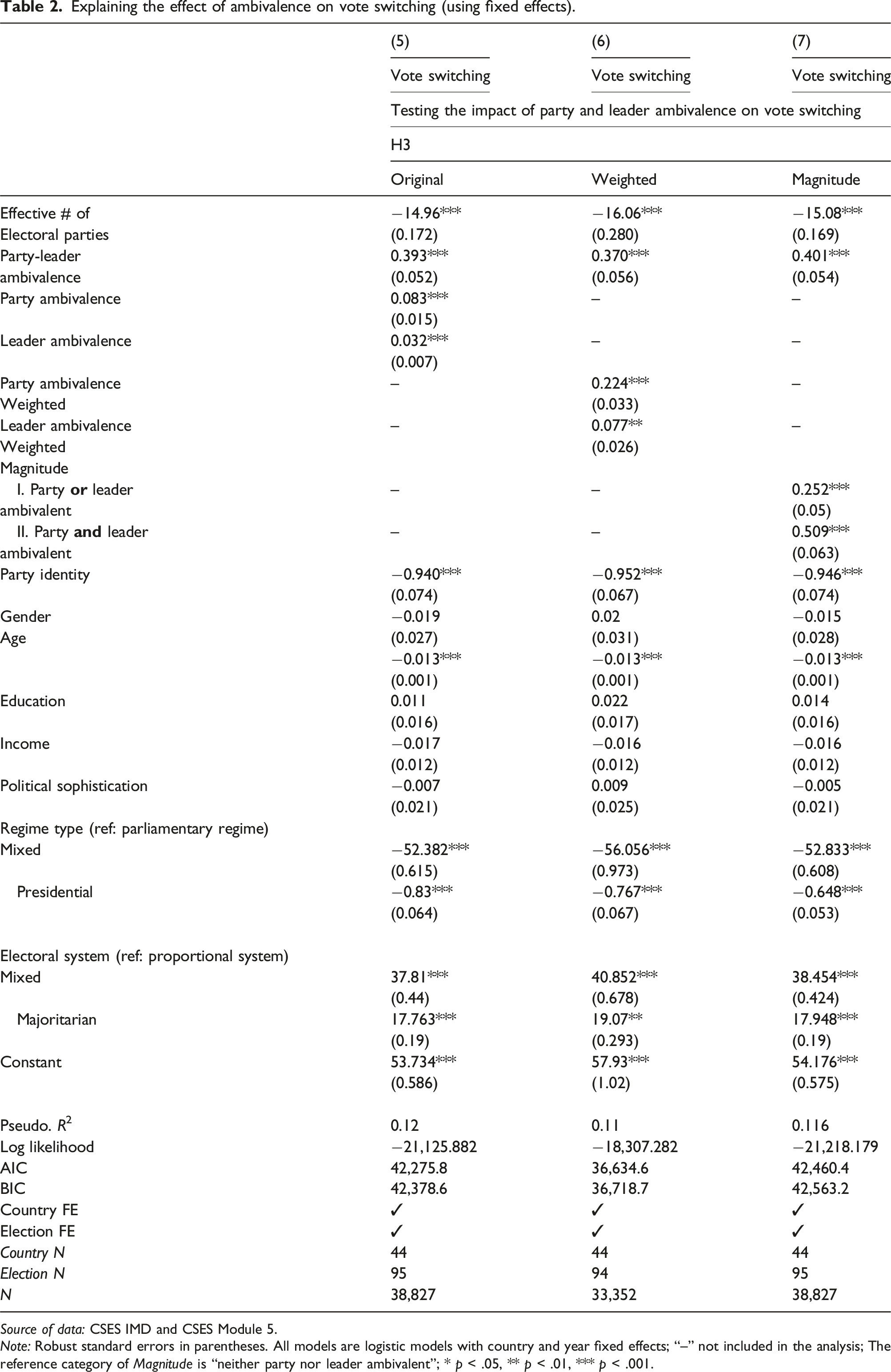
Explaining the effect of ambivalence on vote switching (using fixed effects).
Source of data: CSES IMD and CSES Module 5.
Note: Robust standard errors in parentheses. All models are logistic models with country and year fixed effects; “–” not included in the analysis; The reference category of Magnitude is “neither party nor leader ambivalent”; * p < .05, ** p < .01, *** p < .001.
Figure 4 displays two meaningful quantities of interest based on Model 5. Both graphs show the predicted probabilities of vote switching given different levels of party and leader ambivalence. Whilst we see positive effects for both, the impact of party ambivalence on vote switching is considerably stronger. Voters with the highest value on party ambivalence compared to voters with the lowest value are about 20 percentage points more likely to switch parties. Voters with the highest value on leader ambivalence compared to voters with the lowest value are about 10 percentage points more likely to switch parties. These results are not particularly surprising, but they are shown here for the first time in a non-American context.
3
They also contribute to the ongoing debate about the importance of parties and leaders by showing that parties appear to continue to have a stronger influence on citizens' voting behavior. Predicted probabilities of vote switching for party and leader ambivalence.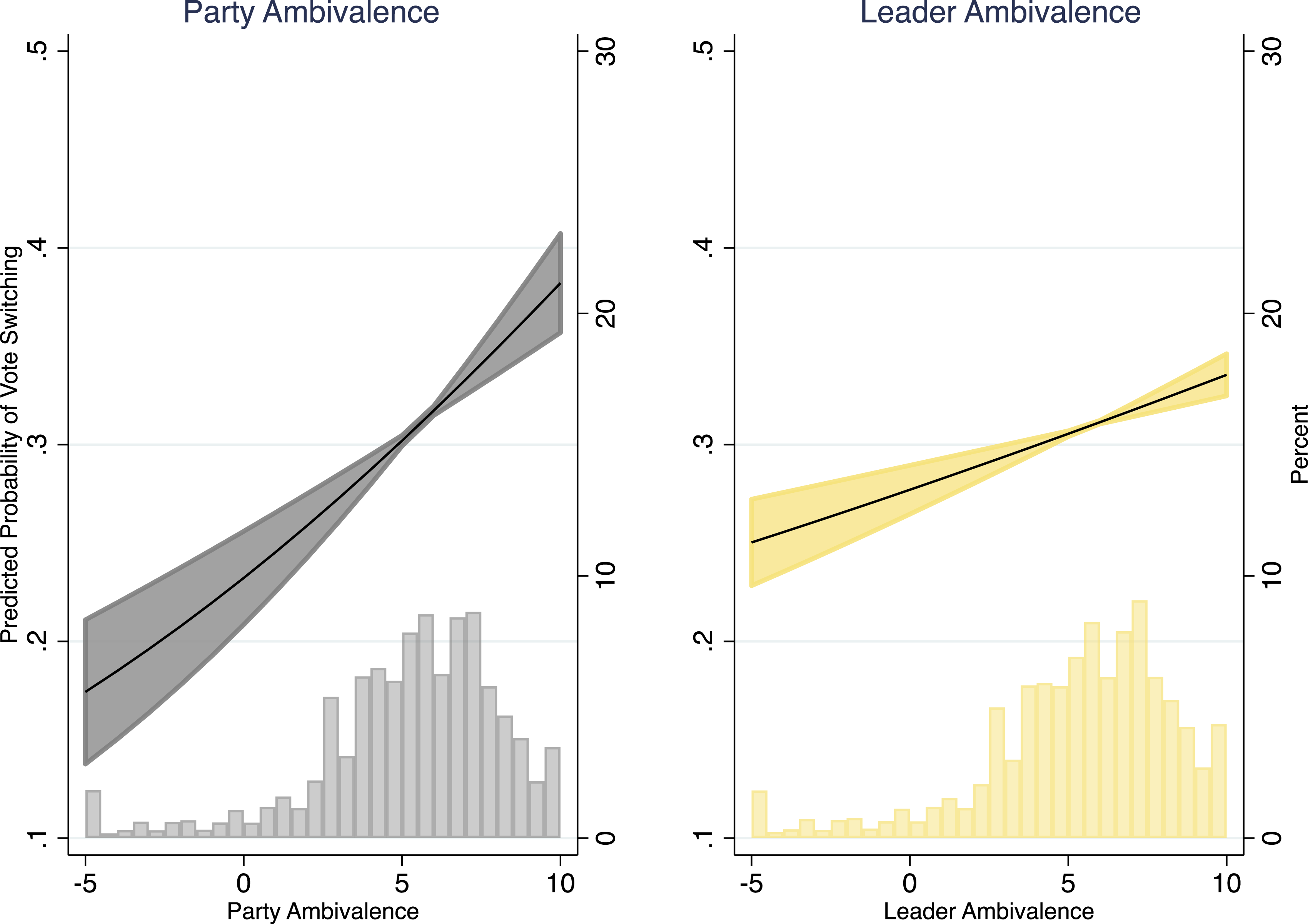
Model six includes two alternative ambivalence measures that consist of the original measures but are weighted by the respective parties’ strength. While the original measures treat all parties and leaders as equal, the alternative measures account for different strengths by weighting the respondents’ ambivalence values by the percent vote share that each party gained in the respective election.
4
The results show that the effects of party and leader ambivalence are more than doubled compared to the original measures. This immense increase is also visualized in Figure 5 that illustrates a much larger difference for low and high party ambivalent voters and a smaller difference for leader ambivalent voters compared to Figure 4. Predicted probabilities of vote switching for party and leader ambivalence (weighted).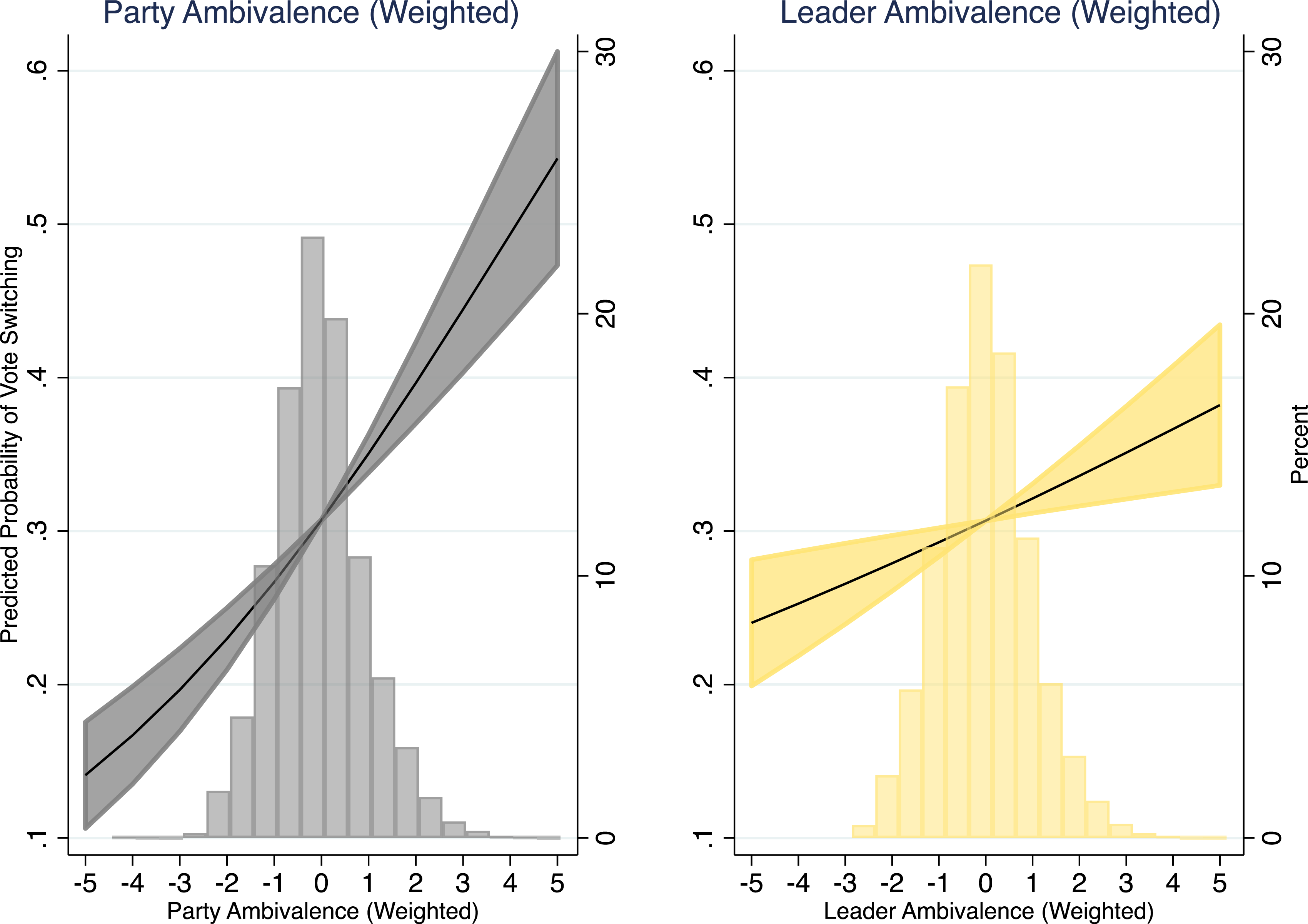
Model seven does not look at party and leader ambivalence separately but combines both into one measure.
5
This additional analysis underlines that it is necessary to look at party and leader ambivalence simultaneously. The results support this assumption demonstrating that voters who are party
Conclusion
This article examined political ambivalence and its impact on vote switching. Using data from the CSES, several hypotheses were tested. The first set of hypotheses addressed the upper and lower pathway that explain why voters in MPS hold political ambivalent attitudes (H1a, H1b, H2a, H2b). The results support both pathways. First, the larger the number of parties, the smaller the ideological distance tends to be between the two parties that are ideologically closest to voters, which in turn increases the likelihood that voters hold party ambivalent attitudes. Second, the larger the number of parties, the more likely it is that voters have ambivalent attitudes toward party leaders. Voters who have conflicting party-leader attitudes are then more likely to be both party and leader ambivalent.
The last hypothesis focused on the effects of political ambivalence on vote switching (H3). Whilst the results demonstrate positive effects for party and leader ambivalence, the impact of party ambivalence on vote switching is considerably stronger. Voters with the highest value on party ambivalence compared to voters with the lowest value are about 20 percentage points more likely to switch parties. Voters with the highest value on leader ambivalence compared to voters with the lowest value are about 10 percentage points more likely to switch parties. In addition, the article emphasizes the importance of considering party strengths when examining the effects of ambivalence on vote switching, and of considering party and leader ambivalence not only separately but also simultaneously. In sum, this article shows that ambivalent political attitudes are more present in MPS than in TPS, and that party and leader ambivalence have a substantial impact on vote switching in the context of MPS. Ambivalence is thus useful to explain the recent trends in electoral volatility. This supports the major argument that investigating ambivalence in MPS is highly relevant and should gain more attention in future research.
The analysis offered important and new insights into the effects and emergence of political ambivalence. Nevertheless, the article should also acknowledge some limitations. The article was not able to test in detail the expected underlying mechanisms leading to the development of ambivalent attitudes in MPS. A more detailed investigation would be beneficial for future research. In addition, the use of panel data could be useful to examine changes in individuals' behaviors and attitudes over time in more detail as well. It is particularly advisable to examine the impact of a new party or change in leadership in order to investigate dynamic changes besides static ones. Finally, the article did not spend much time on possible differences between party and leader ambivalence. However, there may be important differences to consider.
Ultimately, the question remains as to what the results essentially mean. The article argues that these findings provide valuable insights for practical politics, intra-party politics, and for research on parties and leaders in general. First, it shows that ambivalence has a considerable impact on the stability of elections. This underlines the relevance of, for example, coalition signals and trends such as party convergence that influence ambivalent attitudes. The article highlights differences in system flexibility and how these lead to different incentives for parties. Essentially, parties should be more responsive to voters' needs in political systems with a larger number of parties, as these systems lead to more ambivalence and thus more vote switching. If voters are less party-affiliated, this in turn creates further incentives for parties to try to win over these voters at the next election. Second, the article repeatedly points out the importance of leaders themselves and the interaction between them and parties. The results show that leaders can have a decisive influence on voting behavior. Voters who prefer a leader from a party other than their favorite party are more likely to hold party ambivalent and leader ambivalent attitudes. The implications of this result are somewhat ambiguous and lead to different possible strategies for parties. On one hand, parties should try to ensure that their voters also prefer their own leader in order to reduce the likelihood of losing voters due to party-leader ambivalent attitudes, leading to a higher party ambivalence and in turn increasing the likelihood that voters engage in vote switching. On the other hand, one could argue that parties should opt for a leader who is more attractive to voters outside their normal comfort zone. This could lead to a leader deviating somewhat from the party’s ideological position or to parties electing charismatic but less qualified leaders. Even if voters then do not favor the party itself, the leader could secure some additional votes for the party by increasing the likelihood of holding party-leader ambivalent attitudes. This seems to be a trade-off that parties have to decide on. In summary, the relationship between leaders and parties can have a decisive influence on voters' attitudes and voting behavior in general.
Supplemental Material
Supplemental Material - Ambivalence across the globe: Investigating political ambivalence and its impact on vote switching in 52 multi-party systems
Supplemental Material for Ambivalence across the globe: Investigating political ambivalence and its impact on vote switching in 52 multi-party systems by Klara Dentler in Party Politics
Footnotes
Acknowledgements
I would like to thank Semih Çakır (University of Vienna, Austria) for his expertise and methodological support, which greatly improved this article.
Declaration of conflicting interests
The author(s) declared no potential conflicts of interest with respect to the research, authorship, and/or publication of this article.
Funding
The author(s) received no financial support for the research, authorship, and/or publication of this article.

Supplemental Material
Supplemental material for this article is available online.
Notes
Author biography
References
Supplementary Material
Please find the following supplemental material available below.
For Open Access articles published under a Creative Commons License, all supplemental material carries the same license as the article it is associated with.
For non-Open Access articles published, all supplemental material carries a non-exclusive license, and permission requests for re-use of supplemental material or any part of supplemental material shall be sent directly to the copyright owner as specified in the copyright notice associated with the article.
