




Abstract
Constitutional hardball is when partisan actors engage in legal tactics that violate democratic norms for political advantage. The Republican Party seems to have engaged in hardball more than the Democratic Party in recent years, which is surprising as both parties should be similarly incentivized to use hardball. This asymmetry in elite behavior could reflect differences in what each parties’ coalitions tolerate. For example, non-white voters might oppose hardball tactics more than white voters for reasons such as hardball historically being used to enforce racial hierarchies. If true, that could constrain on Democratic elites’ actions more Republican elites due to Democrats’ more racially diverse base. I draw on a long line of research on partisanship and group interest to argue instead that both white and non-white voters of both parties should be similarly disposed towards hardball. This article then marshals data from the American National Election Survey (ANES) and original surveys to test that argument. In support of my hypotheses, I find white and non-white members of both parties have similar levels of support and similar motivations for hardball. Political elites are likely free to engage in undemocratic acts such as hardball with little fear of backlash from their supporters.
Introduction
Since Donald Trump’s 2020 loss the Republican Party has focused on achieving future victories by changing the rules of the game (Bacon Jr. 2021). Republican state legislatures have passed numerous bills aimed at restricting voting access to increase their chances of winning, such as through stricter voter id requirements, reducing voter registration opportunities, and purging voter rolls (Mickey 2022). The Republican Party has also been consolidating power over election administration and certification to help overturn any losses they suffer despite these tactics (Goldberg 2021). That is, Republicans are engaging in increasingly extreme forms of constitutional hardball—acts that, though legal, violate democratic norms for partisan ends (Tushnet Forthcoming). Hardball is a form of partisan entrenchment, where partisan control of one part of the government is used to gain or perpetuate control over another (Tushnet 2004). While hardball can disrupt the basic governmental functioning and erode people’s trust in democracy, to some degree we might expect it out of politicians, whose motivations include reelection and power (Mayhew 2004). What is surprising is that the Democratic Party does not seem to have reciprocated Republican hardball, at least to the same extent (Fishkin and Pozen 2018).
For example, Republican legislatures have engaged in very extensive gerrymanders in states like North Carolina (Beauchamp 2021), Ohio (Tebben 2022), and Wisconsin (Wines 2022) that give them power extremely disproportionate to their share of the electoral vote. While New York Democrats have attempted similar gerrymanders (Fandos 2023), the party has generally ceded power to independent, non-partisan commissions even when that meant losing out on potential seats (Itkowitz 2021; Mutnick 2021). More generally, Republican control of a state legislature is strongly predictive of declining democratic performance at the state level, such as a greater difficulty in voting, more restrictions on civil liberties, and reductions in responsiveness to public opinion (Grumbach 2022). At the federal level, scholars have generally argued the Republican Party currently engages in greater hardball, using more extreme tactics and refusing to conform to democratic norms (Fishkin and Pozen 2018; Mann and Ornstein 2016; Mickey 2022). Both parties have historically engaged in hardball involving the court system for instance, such as Democrats’ breaking precedent to change Senate filibuster rules for judicial appointments (Kane 2013) or Republicans refusing to hold hearings or a vote for Merrick Garland (DeBonis and Kane 2016). However, since the Trump era the Republican Party has increasingly relied on the court system to win political battles that could not be accomplished legislatively (Vladeck 2023).
This elite asymmetry in hardball is unusual as past work often finds both sides engage in partisan biases at the mass level (Ditto et al., 2019). The Republican Party’s greater use of hardball may be because they need to utilize it more. The Republican position on many issues such as taxes, the minimum wage, and Wall Street regulation is unpopular, making it harder for them to win the popular vote and forcing them to rely on hardball tactics to win elections or exert power (Hacker and Pierson 2020). The Democratic Party may not pursue hardball to the same degree as Republicans because they view it as unnecessary, assuming that the popularity of their positions will translate in electoral victories (Helmke, Kroeger, and Paine 2022).
Aside from such strategic considerations, another factor to consider is the potential role of race. Hardball has a long history of being used to entrench white hegemony (Fording and Schram 2020). This negative history may make non-white voters reluctant to support hardball, which could explain the Democratic Party’s reluctance to engage in hardball as being constrained by the wishes of their racially heterogeneous base. However, there are plausible arguments that these same experiences would make non-white voters more supportive of hardball, due to feeling greater material consequences from a lost election. It is important to understand how people’s partisanship and race shape their support for such hardball in order to better counter hardball’s negative effects on democracy.
In particular, this paper argues the elite asymmetry in the use of hardball is not reflected at the mass level. Past findings of Republican voters holding more anti-democratic attitudes than Democratic ones are likely a result of bias caused by question wording effects or not accounting for the political context respondents are operating in (Bartels 2020; Smith and Park 2013). Once the partisan implications (i.e., who benefits from upholding vs. violating norms) are made clear, these asymmetries substantially decrease, if not disappear, supporting work showing Democrats and Republicans are equally willing to embrace anti-democratic attitudes (Graham and Svolik 2020). In the real world, the partisan implications of any specific act are almost certainly shaped by political elites, suggesting interventions aimed at changing elite discourse or action would have a more immediate impact on changing support for hardball and other anti-democratic attitudes compared to trying to prompt voters to constrain elites.
The racial symmetry in support for hardball also suggests little willingness among voters to rebuke elites, as non-white partisans were equally supportive of tactics that historically they have been the victim of. The greater racial diversity of its coalition is unlikely to limit the Democratic Party’s freedom to engage in hardball tactics if they wish to do so. If Democratic elites’ messages on this issue change, then their voters will almost surely follow them. I conclude the paper by discussing the normative implications of trying to use these findings to ensure democratic health.
Constitutional Hardball
Constitutional hardball consists of acts that, while not violating the law, go against democratic norms and thus strain the limits of democracy (Tushnet Forthcoming). What determines whether an act counts as hardball is the motivation behind enacting it. Ostensibly legal acts can violate the spirit of the law if done to ensure one-party control, such as when legislatures intentionally seek to make it harder for minorities to vote through carefully crafted voter id laws or targeted closings of polling stations (Biggers and Hanmer 2017; Odujinrin 2021). Politicians have at times even stately explicitly the partisan intent and expected electoral benefit behind these actions (Helmke, Kroeger, and Paine 2022; Tervo 2020). Hardball tactics like these raise the stakes of political conflict, as the winners can entrench their side’s power and leave the losers with little ability to regain power (Balkin and Levinson 2001).
Norms such as “mutual tolerance” (treating political opponents as rivals, not enemies) and “forbearance” (not exercising their full power for sake of fairness) have traditionally discouraged politicians from engaging in hardball excessively (Helmke, Kroeger, and Paine 2022; Levitsky and Ziblatt 2018). The use of hardball undermines existing norms, which often leads to more extreme tactics becoming routine as those norms were what prevented hardball in the first place. Hardball is often used to remove the constraints that would serve as accountability mechanisms, such as removing rules that prevent election manipulation or limit increases in executive authority (Grillo et al., 2023). Successful use of hardball can give partisans a stronger and more entrenched position to go further in the future, such as using gerrymandering to secure a majority, and then using that majority to enact an even more gerrymandered map in the next election (Woodward-Burns 2021).
The voting public’s reaction to the initial use of hardball shapes politicians’ incentives concerning future use, with an approving (or even merely indifferent) public encouraging politicians to engage in hardball tactics more in the future (Druckman 2024). While voters can and do give co-partisan politicians more leeway (Graham and Svolik 2020), there is evidence voters will punish hardball acts that push constitutional boundaries in at least some situations (Becher and Brouard 2022). It is important to note that even a citizenry willing to constrain elites may fail to do so, such as when anti-democratic elites take advantage of voters’ status-quo bias to slowly shift what is considered acceptable and make acts like hardball become normalized (Grillo and Prato 2023). The public’s willingness and ability to constrain elites’ use of hardball is an important determinant of democratic health and whether democratic backsliding will occur (Miller 2021).
Hardball can also lead to escalation, with partisan biases fostering a cycle of retaliation as each side justifies their own hardball tactics to themselves, while resenting the opposing party’s acts of hardball (Tushnet 2004). Hardball degrades perceptions of the government’s legitimacy and disrupts its ability to function properly which can cause citizens to lose their trust in the democratic process (Hetherington and Rudolph 2015). That loss of trust can make citizens more open to authoritarian leadership and anti-democratic acts to resolve the problems that hardball has prevented from being solved in the first place (Druckman 2024; Mickey 2022).
Elite Asymmetries in Hardball
While hardball has historically been used by members of both parties (Tushnet Forthcoming; Woodward-Burns 2021), scholars have generally found that the Republican Party has been more likely to engage in constitutional hardball over the past decade at both the state (Grumbach 2022) and federal level (Fishkin and Pozen 2018; Mann and Ornstein 2016). At the state-level, the Republican Party has moved election administration from the purview of independent officials to Republican-controlled state-legislatures, sought to suppress turnout from voters likely to vote Democratic through a variety of measures (Biggers and Hanmer 2017), and intentionally weakened the political power of institutions that could oppose these changes (Mickey 2022). Republican control of statehouses is also a key predictor of democratic backsliding in a way that more party-neutral factors, like ideological polarization or election competitiveness, are not (Grumbach 2022).
Part of this asymmetry reflects differences in the composition and geographic distribution of each party’s electoral base making it easier to suppress Democratic voters legally compared to Republican ones (Helmke, Kroeger, and Paine 2022). These differences have been enhanced by social sorting, as minority voters who are more easily targeted legally (e.g., through voter id laws; Barreto et al., 2019) heavily sorted into the Democratic Party (Mason 2018). At the same time, there are few predominantly Republican groups whose votes can be suppressed in ways that do not also impact a key Democratic constituency (e.g., curtailing early voting through churches depresses turnout among both evangelical and Black voters; Helmke, Kroeger, and Paine 2022). This Republican advantage has been a relatively recent change, with the efficiency gaps in redistricting being a pattern that occurred mainly over the past decade (Stephanopoulos and McGhee 2015).
As this occurred, the Republican Party has increasingly pursued an unpopular economic agenda that likely requires hardball tactics to implement (Grumbach 2022; Hacker and Pierson 2020), while becoming less committed to the procedural norms that would constrain the use of hardball (Levitsky and Ziblatt 2018; Woodward-Burns 2021). However, we have also seen numerous instances of Democratic leadership rejecting calls for hardball tactics from younger politicians even in areas where the Democratic Party currently has the capacity to utilize them, such as using executive orders to make quick, unilateral advances on their policy agenda or abandoning the blue slip system that limits judicial appointments (Everett and Wu 2023).
Partisan Motivations of Hardball
While partisan elites may have different strategic constraints, at the mass level we should expect voters on both sides to support the use of hardball due to how partisanship drives support for anti-democratic attitudes (Druckman 2024; Kingzette et al., 2021). People’s party identification also serves as a screen through which they interpret information, filtering it in ways that advantage their party (Campbell et al., 1980; Converse 2006). Partisan cues (i.e., which party supports or opposes something), exert a bigger influence on people’s attitudes towards an issue than the merits of the issue or the quality of each sides’ argument (Druckman, Peterson, and Slothuus 2013). Partisans’ tendency to use motivated reasoning to justify their party’s actions should give political elites a great deal of leeway to utilize hardball without reprisal (Graham and Svolik 2020; Grillo and Pratto 2023Grillo & Prato, 2023).
Partisan identification has such a profound impact on people’s perception of politics because party is a social identity (Green, Palmquist, and Schickler 2004; Huddy and Bankert 2017). People use their party to fulfill important expressive needs, such as a sense of belonging (Huddy, Mason, and Aaroe 2015). Partisans derive self-esteem from their side’s victory, and thus mainly care that their “team” wins at all, not how they won (Mason 2018). Motivated reasoning should prompt partisans to view any hardball tactics that help them achieve victory as acceptable (Lodge and Taber 2013), just as revelations of their team cheating do not affect sports fans’ positive views of their favored team (Chien, Kelly, and Weeks 2016). Partisans are also likely to frame their own side’s use of hardball as justified retaliation to their opponent’s initial norm violations (Tushnet Forthcoming). This prior research suggests concerns about “fairness” are unlikely to dissuade the use of hardball and that inter-party discussions over the definition and justifications of hardball will not turn on reasoned debate.
Indeed, partisanship’s influence has only increased as people’s other identities have overlapped with each other, with race and religion all predicting party affiliation in the same direction in modern American society (Mason 2018). Well-sorted partisans should view election losses as more threatening, because the more they see the parties as different the more consequential the election should seem (e.g., if both parties hold the same position then who wins should not matter) and as electoral losses affect more aspects of their identity (Mason 2018). Both of these factors should make partisans, from either side, more willing to accept the use of hardball to avoid the material or psychological costs of defeat. Hardball is more likely the higher the stakes, where existing norms are seen as stopping actions important to survival, but partisanship can make people see every political battle as having high stakes (Tushnet Forthcoming). If every election is the “most important of our lifetime” or the “last chance to save democracy” then anything should be permissible (Bump 2016).
Another reason for partisans to approve of hardball is they simply dislike the opposing party. Partisans have been found to both favor members of their own party and discriminate against members of the opposing party, even in non-political aspects of their lives (Huber and Malhotra 2017). Feelings towards the opposing party have become increasingly negative, and this animosity seems to be what is driving much of the affective polarization we see in American politics (Iyengar et al., 2019). Partisans increasingly view the opposing side as an enemy to be defeated and punished (Abramowitz and Webster 2018; Kalmoe and Mason 2022). These increasing feelings of anger, frustration, and even fear toward the other side should make it easier for partisans to rationalize and justify any act of hardball to themselves (Kingzette et al. 2021).
Hardball Through the Lens of Race
Besides partisanship, another potential determinant of support for hardball is voters’ racial identity given the large role race plays in structuring U.S. politics. Hardball tactics have a long history of being used by whites seeking to push back against gains by minority voters (Bentele and O’Brien 2013). These tactics are not just a relic of Jim Crow, but are still used today, often in the same places, to limit the political power of non-white voters (Freeman 2021). The Republican Party has increasingly centered its messaging around appealing to whites’ racial resentment, and these types of messages are likely to justify the type of tactics necessary to achieve minority rule in a racially diverse country (Bartels 2020; Fording and Schram 2020). Republican-controlled legislatures intentionally seek to raise the barriers minority voters face in trying to vote, hoping that voter suppression and demobilization will improve their chances of political victory (Hajnal, Ladjevardi, and Nielson 2017). For example, voter identification laws often allow forms of identification that whites (as expected Republican voters) typically have, such as gun licenses, while not allowing forms of identification more commonly held by African Americans and Latinos (e.g., social service cards; Barreto, Nuño, Sanchez, and Walker 2019).
Even if these tactics fail to achieve the desired outcome (e.g., voter id laws’ impact is very contested; see Grimmer et al. 2018 for a review), the experience of having to clear such hurdles could lead non-whites to have a moral objection to engaging in the types of tactics they have suffered from. Given the Democratic Party’s reliance on minority voters to win elections, any objections to hardball from those voters could certainly explain the party’s reluctance to engage in hardball. However, non-white voters may conversely be more motivated to engage in hardball due to perceiving elections as having higher stakes (e.g., they are the ones whose rights are curtailed under Republican administrations). Given the very real consequences of electoral loss for their group and plausible reasons to believe the rules are stacked against them, it would not be unreasonable for African-American Democrats to be more supportive of hardball than their white counterparts (Vandermass-Peeler et al. 2018).
This should be especially true if opposing hardball runs counter to norms of group interest or solidarity, as people may face reputational sanctions through their social network if they vote in ways seen as hurting the group (White and Laird 2020). Even if a voter may feel any particular hardball tactic is unfair, they could counter those doubts by focusing on how they would defend forgoing it to their family or friends given the costs of losing an election. There is an extensive literature showing voters often make political decisions on what they think to be in their racial group’s interest, particularly the role of group consciousness and linked fate in mobilizing voters (Dawson 1995). While studies on linked fate originally focused on its effects among African-Americans, it has been found among other non-white groups such as Asian-Americans and Latinos (Gay, Hochschild, and White 2016). Perceptions of group interest and group status can also influence white voters’ attitudes, separately from their personal experiences or economic fortunes (Mutz 2018; Sides, Tesler, and Vavreck 2018).
Study 1
Study 1 uses the American National Election Studies (ANES) to do an initial exploration of attitudes relating to support for hardball in 2020.
Measurement
Full Question Text-ANES.
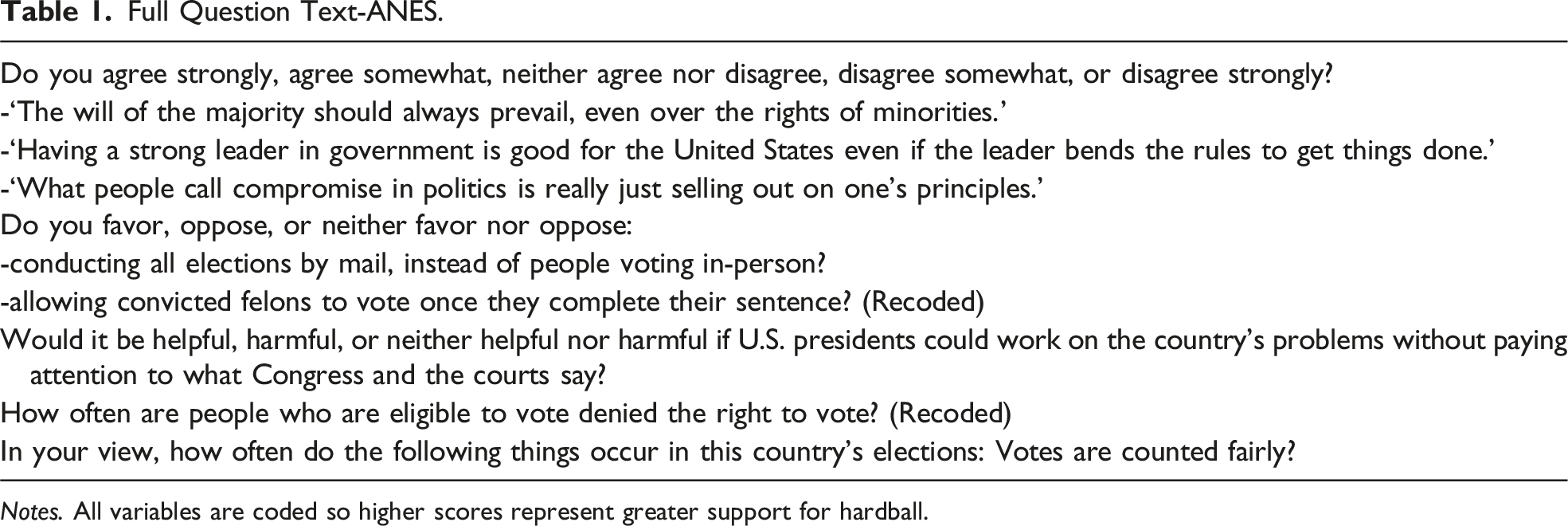
Notes. All variables are coded so higher scores represent greater support for hardball.
I also look at how often respondents think people are denied the right to vote and how often votes are counted fairly or not, which should tap into whether respondents feel the political system is fair or not. In an unfair system hardball tactics should be seen as more necessary.
I use views towards compromise (is it good or “selling out”) as another indicator of how willing respondents should be to support hardball, as those who feel legislative compromises are not furthering their interests should be more supportive of alternate methods of accomplishing their goals including the use of tactics normally considered out-of-bounds (Graham and Svolik 2020; Levitsky and Ziblatt 2018). Many acts of hardball involve an in-group leader acting unilaterally, overriding other parts of the government that are seen to speak for the opposing side. Thus, to measure attitudes towards minority rights and leaders I look at whether respondents think the president should ignore Congress and the Courts to get things done, if a strong leader who bends the rules is good or not, and if the majority will should always prevail.
The EFA shows a one factor solution performs well, further supported by the items having a fairly high alpha level when collapsed into a single scale (0.749; See the Supplemental Materials for the full EFA results). The final measure of support for hardball is coded from 0 to 1, with higher scores representing support for hardball, while lower scores represent opposition to it. As is common in the literature (Druckman and Levendusky 2019; Kingzette et al. 2021; Mason and Wronski 2018), I exclude Pure Independents from my analyses as they should not feel the psychological attachment to either party that is theorized to motivate attitudes towards hardball.
Hypotheses
Due to the differences in the partisan implications of the ANES question wording, as well as the corresponding differences in elite messaging, I expect to see clear partisan differences in support for hardball in the ANES sample, with Republicans showing greater support for hardball than Democrats (Hypothesis 1). There are plausible theoretical reasons for non-white partisans to be more or less supportive of hardball than white partisans, which makes it harder to predict whether there will be a racial symmetry (Hypothesis 2a) or asymmetry (Hypothesis 2b) when it comes to white and non-white partisans’ support for hardball. However, I do expect that there should at least be symmetry when it comes to the psychological predictors of support for hardball, given that both white and non-white respondents should have the same partisan motivations for hardball. In particular, I expect respondents whose party affiliation is more important to their identity, respondents whose partisanship and ideology are better sorted 1 and thus more attuned to elite cues, and respondents with higher levels of affective polarization 2 to show less support for hardball if they are Democrats and more support for hardball if they are Republicans, regardless of their race (Hypothesis 3).
Results
Support for Hardball Across Subgroups
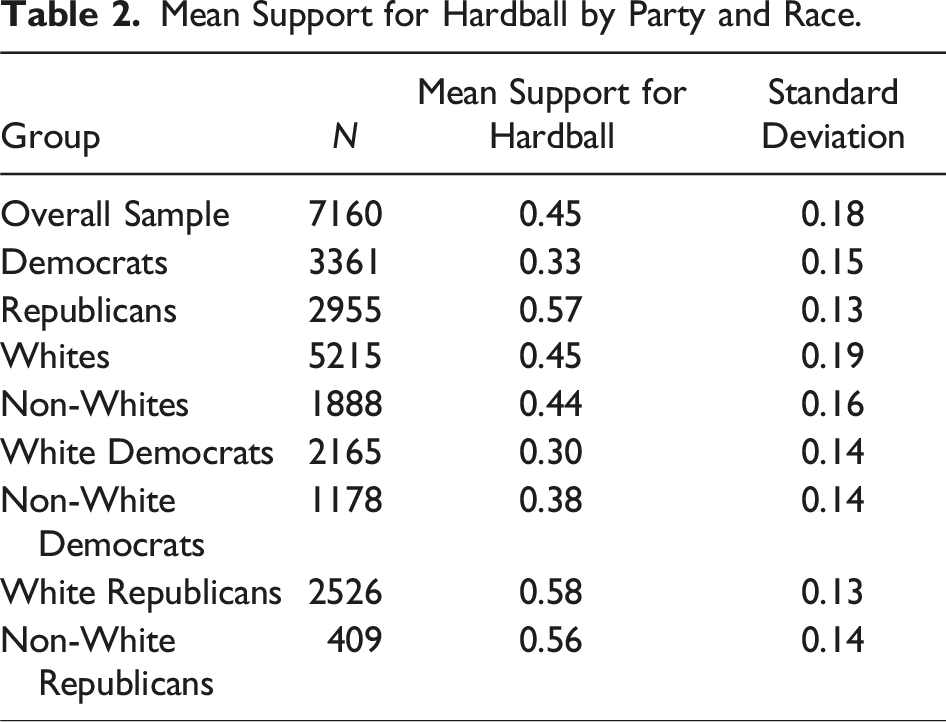
Mean Support for Hardball by Party and Race.
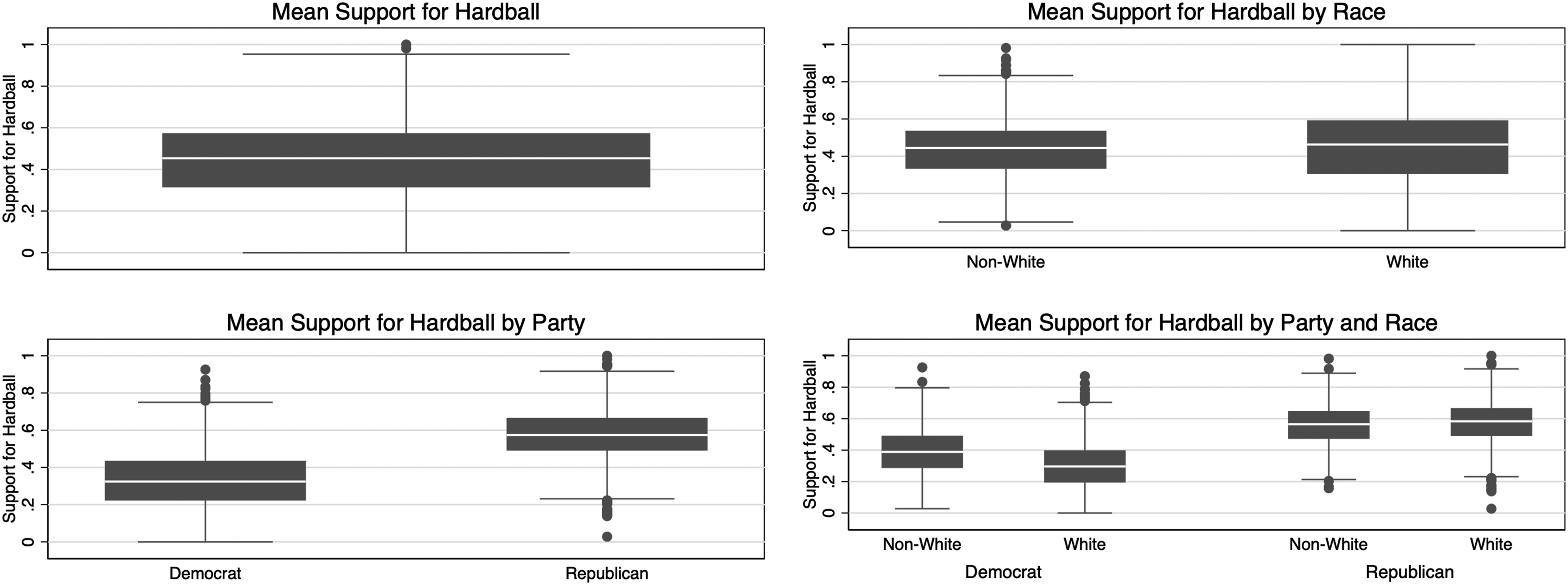
Mean for support for hardball by party and race, ANES.
Though statistically significant, the racial difference in support for hardball is not substantive (See Figure 1; Table 7 in the Supplemental Materials), with white respondents being only about 1% more supportive of hardball than non-white respondents ([t] = 3.24, p < 0.01). The pattern of results is more complicated when looking at party and race together. Non-white Democrats are 8% more supportive of hardball than white-Democrats ([t] = 15.73, p < 0.001), while the racial difference among Republicans is significant but quite small, with white Republicans being 1.6% more supportive of hardball than non-white Republicans ([t] = 2.38, p = 0.017). These comparisons should be treated with caution due to the relatively small number of non-white partisans in the sample (5215 white vs. 1888 non-white respondents), with a particularly low proportion of non-white Republicans (2526 white Republicans vs. 409 non-white Republicans). There also seems to be much greater symmetry in the predictors of that support with party affiliation, affective polarization, and partisan-ideological sorting having similar sized relationships, in terms of direction and size, among white vs non-white Democrats and among white vs non-white Republicans (See Figures 2 and 3; Tables 8 and 9 in the Supplemental Materials). The small size of the differences when comparing across race along with the symmetry in partisan motivations for hardball provide a greater case for racial symmetry, supporting Hypothesis 2a. Regressions results showing the relationship between partisanship and support for hardball among Democrats in the ANES, separated by race. See Table 8 in the Supplemental Materials. Regressions results showing the relationship between partisanship and support for hardball among Republicans in the ANES, separated by race. See Table 9 in the Supplemental Materials.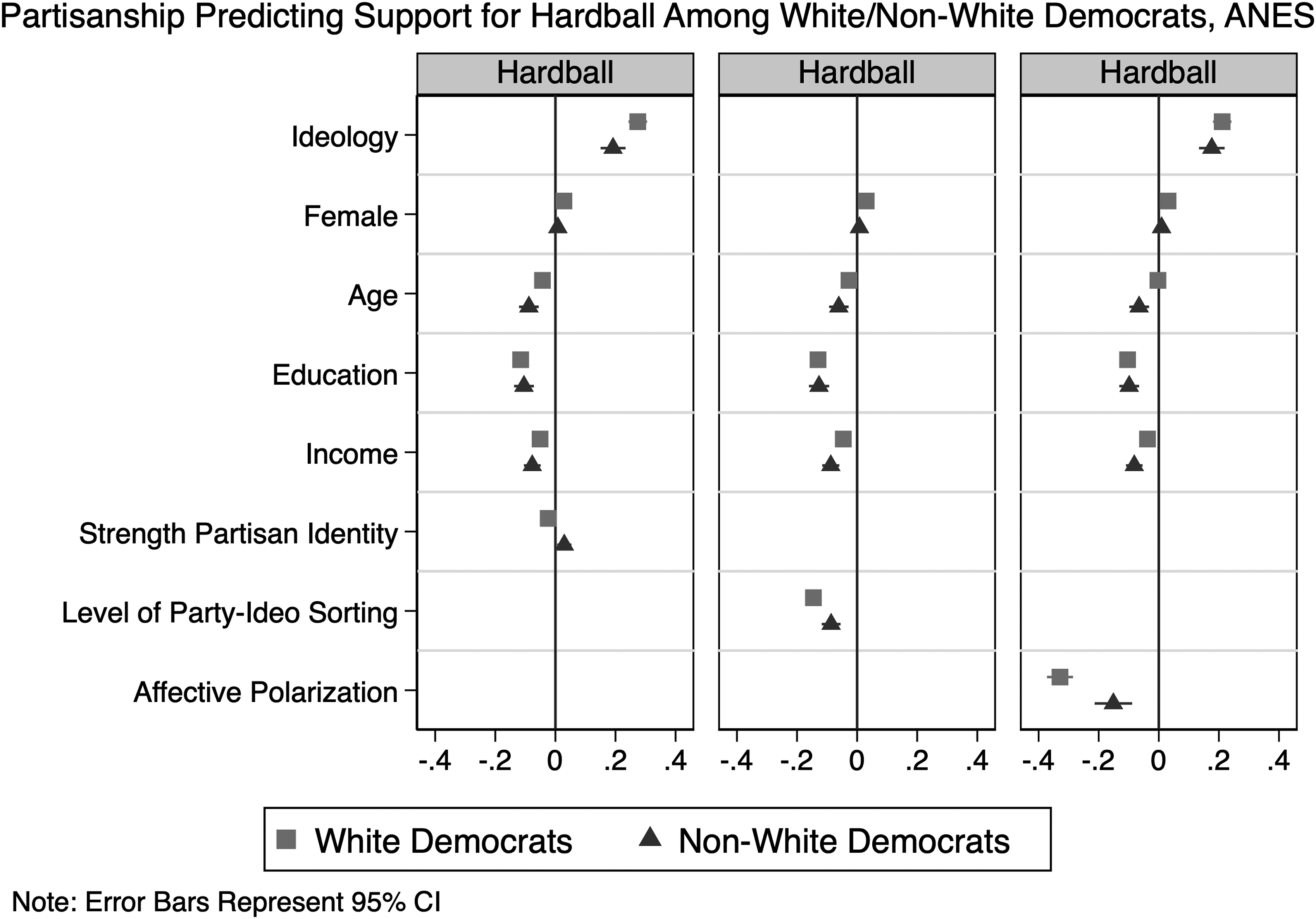
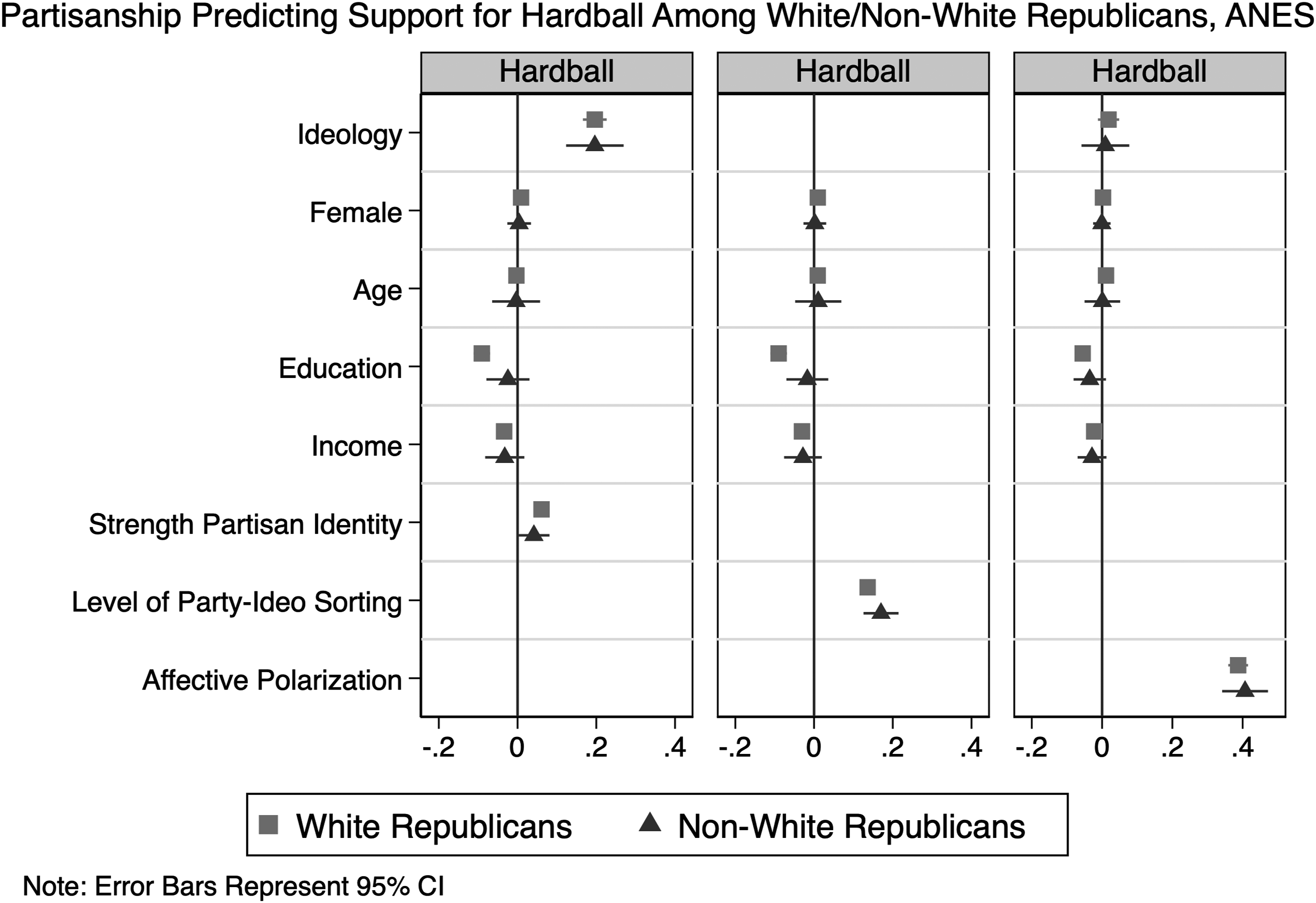
Partisanship Predicting Hardball
All analyses of the relationships between partisanship and hardball included standards controls for gender, age, education, income, and ideology (except for analyses that used partisan-ideological sorting, as ideology was used to build the independent variable), and all variables were recoded to run from 0 to 1 for ease of comparison. White Democrats who felt their party affiliation was very important to their identity were more opposed to hardball (b = −0.02, p = 0.003) compared to white Democrats who felt their party affiliation was not important to their identity. Contrary to expectations, non-white Democrats who felt their party affiliation was very important to their identity were less opposed to hardball (b = 0.03, p = 0.015) compared to non-white Democrats who felt their party affiliation was not important to their identity. Both white (b = 0.06, p < 0.001) and non-white (b = 0.04, p = 0.039) Republicans who felt their party affiliation was very important to their identity were more supportive of hardball compared to Republicans who felt their party affiliation was not important to their identity.
Well-sorted white (b = −0.15, p < 0.001) and non-white (b = −0.09, p < 0.001) Democrats were more opposed to hardball, compared to non-sorted Democrats. Likewise, well-sorted white (b = 0.14, p < 0.001) and non-white (b = 0.17, p < 0.001) Republicans were more supportive of hardball compared to non-sorted Republicans. White (b = −0.33, p < 0.001) and non-white (b = −0.15, p < 0.001) Democrats high in affective polarization were both more opposed to hardball compared to Democrats low in affective polarization. Both white (b = 0.39, p < 0.001) and non-white (b = 0.41, p < 0.001) Republicans high in affective polarization were more supportive of hardball compared to Republicans low in affective polarization. Overall, these results provide fairly strong support for Hypothesis 3.
Summary of Results and Limitations
Republicans were more supportive of hardball than Democrats in line with what we would expect based on differences in elite messaging and question wording in the ANES. Stronger partisanship motivated both sides’ position on hardball in the expected directions, predicting opposition among Democrats and support among Republicans for hardball tactics that generally favored the Republican Party, at that time. There were small differences in support for hardball by race, with the largest difference being that non-white Democrats were more supportive of hardball than their white counterparts, but overall both white and non-white partisans seemed to respond similarly.
A likely factor in explaining the partisan asymmetry is that the implications of the ANES questions are not consistent across party. Members of each party are likely receiving very different cues on issues like mail-in voting or voter suppression, and whether their side benefits from them or not. If the partisan implications and political context were made equivalent, we should see a symmetry in support for hardball the same way we do for other forms of partisan bias (Ditto et al., 2019). Supporting this idea is the fact that the partisan motivations for hardball were roughly the same for both parties, with partisan identity, partisan-ideological sorting, and affective polarization being significant predictors among members of both parties.
Another issue is that principled and partisan motives may be confounded as normatively desirable behavior can still be driven by partisan self-interest (Helmke, Kroeger, and Paine, 2022). For example, Democratic support for letting ex-felons vote could be because they have been told those laws were intentionally designed around disenfranchising African-Americans (Aviram, Bragg, and Lewis 2017; Kelley 2017). But since African-Americans are consistent Democratic voters, Democratic respondents may expect letting felons vote is to their partisan advantage. If they learn they are mistaken about this assumption (e.g., many ex-felons are white men without college degrees, a group likely to vote Republican), would they still support this position? And would Republican support for felon disenfranchisement decrease if they thought it was denying their side votes?
The direction of what differences we do see between racial groups in support for hardball also warrants further analysis. White voters being more supportive of hardball compared to non-white voters would have been a plausible explanation for the asymmetry we see in the real world. That is, the Democratic Party’s reluctance to engage in hardball could be driven by the greater racial diversity of its base giving Democratic elites different constraints in how much they can pursue hardball compared to Republican elites whose predominantly white base would have not cared. The fact that non-white voters were more supportive of hardball, even if by a small amount, undercuts that idea.
Study 2
To answer these questions, I collected original survey data where the partisan implications of hardball were made equivalent for both Democrats and Republicans. Making it clear that hardball benefits your side or harms the opposing side should hopefully mitigate the potential effects of differing elite messages on partisans’ overall support.
Methodology
Data was collected through Lucid, an online survey platform, as part of a multi-investigator survey during August 2021 (N = 838, 54% female; mean age = 39.16, SD = 23.15; 76% white). Lucid samples are commonly used to measure public opinion and have been found to be comparable to national probability samples like the ANES (Coppock and McClellan 2019; Holliday et al. 2021). That there tends to be less heterogeneity within partisan groups than there is between them (Clifford, Jewell, and Waggoner 2015) also lets us be more confident when comparing the results for the same party (e.g., Democrat to Democrat) across samples. Respondents first answered simple demographic questions as well as their party affiliation. This worked to both ease respondents into the survey as well as limit any demand characteristics from asking participants their party affiliation at the beginning of the survey (which was needed for later survey logic). Respondents were then asked several questions about both their partisan and racial identities.
Respondents rated how important their party affiliation and race were to their identity. They also rated whether they had a favorable or unfavorable opinion of the Democratic and Republican parties and of Joe Biden and Donald Trump. Reporting higher favorability ratings of the in-party over the out-party was coded as higher scores in affective polarization. As a measure of linked fate, respondents were asked whether they think what happens to other members of their race affects what happens in their own life or not (Dawson 1995). Respondents were also asked how much they thought various groups in the country experienced discrimination. As a measure of political engagement, respondents were asked how likely they were to vote in the 2022 midterms using a set of questions that increases the amount of time they would have to stand in line to vote until they say they would not vote or say they would vote no matter how long it took. This was based on Slaughter’s (2021) measure of racial resilience.
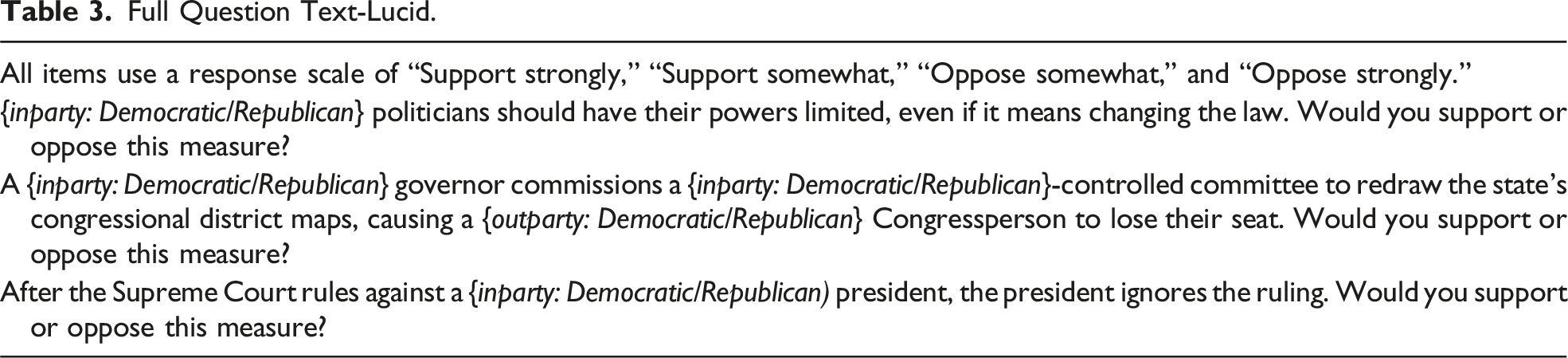
Full Question Text-Lucid.
Hypotheses
With the partisan benefit of hardball being made explicit there should be similar levels of support for hardball among both Democrats and Republicans (Hypothesis 4). I also expect to replicate the role of partisanship from Study 1 with the importance of partisan identity, partisan-ideological sorting, and affective polarization predicting greater support for hardball. As another measure, I also test political engagement, expecting that respondents who express more determination to vote will show greater support for hardball as partisans willing to incur greater costs to support their party should want their win no matter what. Respondents who have a stronger sense of racial identity should be more supportive of hardball (Hypothesis 5). While this has clear implications for non-white Democrats and white Republicans, white Democrats may feel cross-pressured between their race and party. Thus their racial identity could either predict more support for hardball like their fellow non-white co-partisans or could predict less support for hardball to feeling a greater racial affinity with the Republican Party due to their focusing on their whiteness.
Results
As the hardball tactics show a high alpha level (0.69) even now that the partisan benefit is explicit, I again collapse them into a single scale and use that as my dependent variable. Now that the partisan benefits of hardball are explicit, Democrats are 7% more supportive of hardball than Republicans, [t] = 3.70, p < 0.001 (See Table 10 in the Supplemental Materials). Democrats are much more supportive of hardball when it is stated to benefit them, compared to the ANES when similar tactics were likely conceived of as being to their disadvantage, with the mean support in the Lucid sample among Democrats being 59% compared to the 33% level of support in the ANES. While there is still a significant difference between the two parties, making the partisan benefit explicit reduces that difference, and it now goes in the opposite direction compared to the ANES. This pattern provides at least partial support for Hypothesis 4.
Replicating the Role of Partisanship
Due to the small number of non-white Republicans in the sample (N = 46), analyses on partisan and racial attitudes were conducted for only Democrats (N = 328 White; 157 Non-White) and white Republicans (N = 309). Both white and non-white Democrats who felt their party affiliation was very important to their identity were 31%, p < 0.001, and 17%, p = 0.001, more supportive of hardball, respectively, compared to Democrats who felt their party affiliation was not important to their identity. White Republicans who felt their party affiliation was very important to their identity were 19%, p < 0.001, more supportive of hardball, compared to white Republicans who felt their party affiliation was not important to their identity. Well-sorted white and non-white Democrats were 13%, p < 0.001, and 11%, p = 0.017, more supportive of hardball, respectively, compared to non-sorted Democrats. There was a similar pattern among Republicans, with well-sorted white Republicans being 14%, p < 0.001, more supportive of hardball, respectively, compared to non-sorted white Republicans.
Unlike in Study 1, affective polarization was not a significant predictor of support for hardball among either white or non-white Democrats, p’s > 0.25. However, white Republicans high in affective polarization were 49% more supportive of hardball, p < 0.001, compared to white Republicans low in affective polarization. In addition to the measures used in Study 1, respondents’ political engagement was a significant predictor of support for hardball. The most politically engaged white and non-white Democrats were 14%, p = 0.003, and 22%, p < 0.001, more supportive of hardball, respectively, compared to Democrats who were the least politically engaged. Surprisingly, the most politically engaged white Republicans were not significantly more supportive of hardball, compared to white Republicans who were the least politically engaged (p = 0.163). Overall, the role of partisanship in motivating support for hardball is replicated providing more support for Hypothesis 3 (See Figure 4; Table 11 in the Supplemental Materials). Regressions results showing the relationship between partisanship and support for hardball in the first Lucid sample, separated by party affiliation and race. See Table 11 in the Supplemental Materials.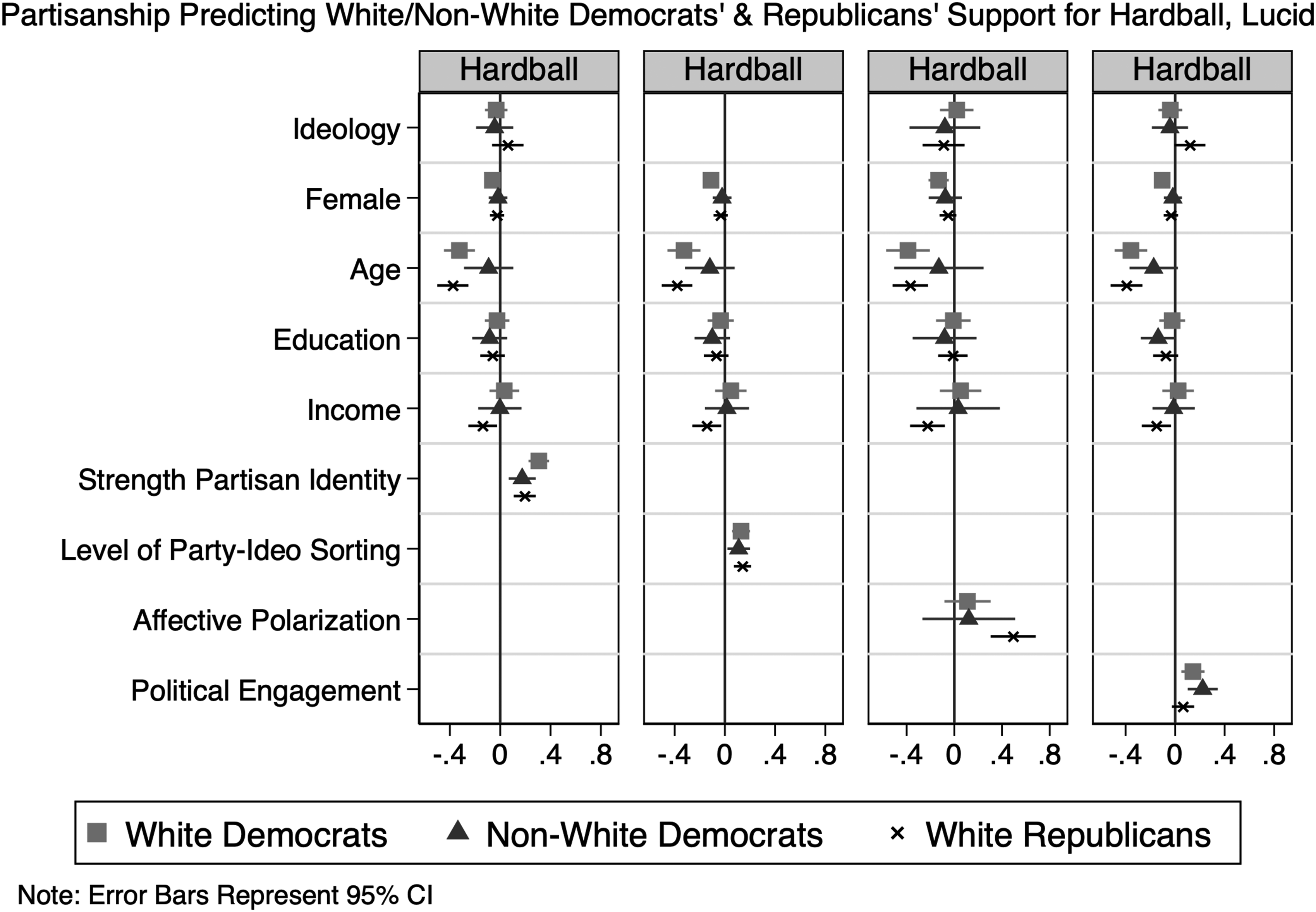
Role of Racial Attitudes and Identity
Across multiple measures, respondents’ racial identity were significant predictors of support for hardball (See Figure 5; Table 12 in the Supplemental Materials). Non-white Democrats who felt their race was very important to their identity were 29%, p < 0.001, more supportive of hardball compared to those who felt it was not important. Non-white Democrats who felt a sense of linked fate with other members of their race were 12%, p = 0.019, more supportive of hardball compared to those who did not. Non-white Democrats who felt their racial group was discriminated against were 18%, p = 0.003, more supportive of hardball than those who felt other racial groups experienced more discrimination. Regressions results showing the relationship between racial identity and support for hardball in the first Lucid sample, separated by party affiliation and race. See Table 12 in the Supplemental Materials.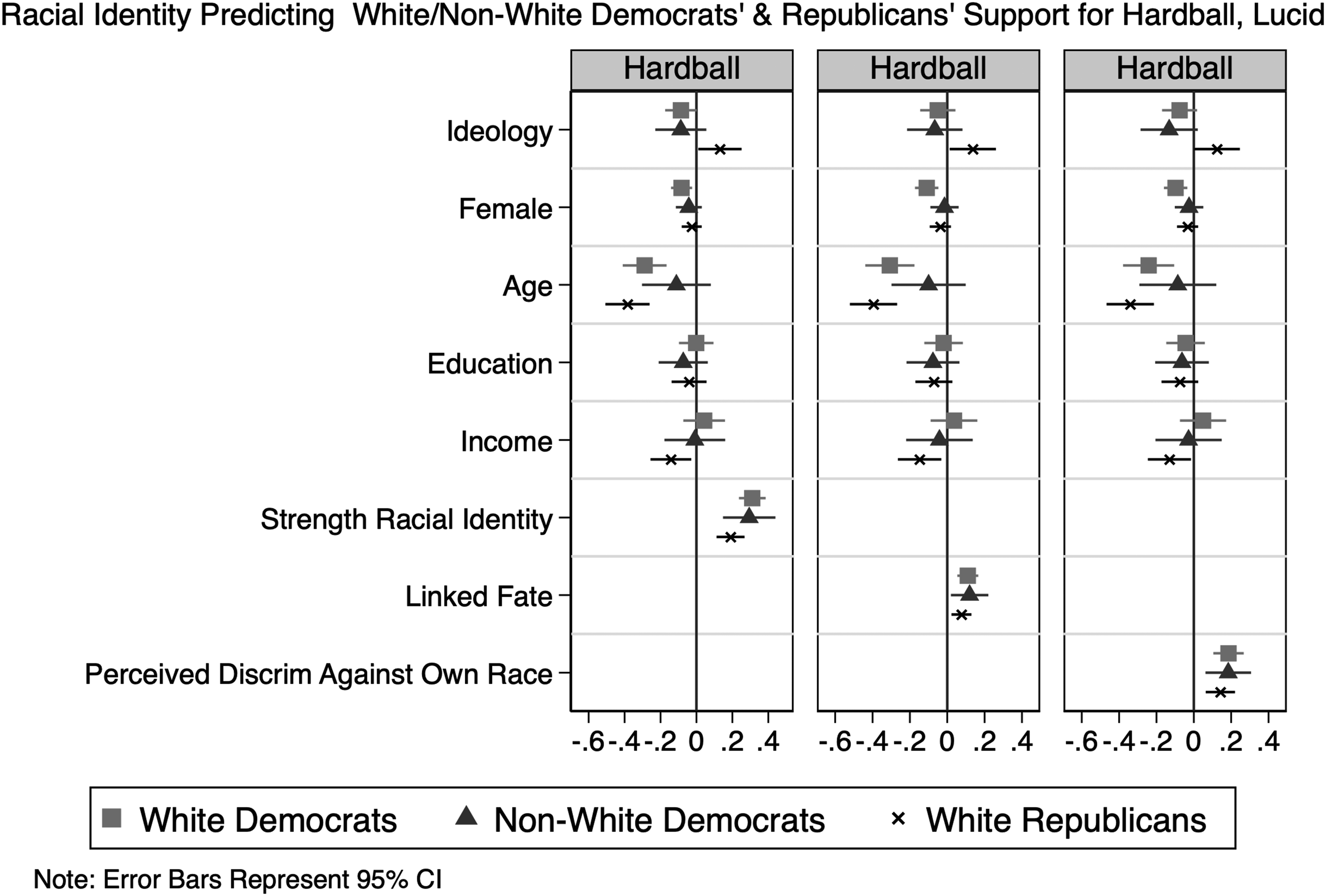
The results for white Republicans similarly matched expectations. White Republicans who felt their race was very important to their identity were 19%, p < 0.001, more supportive of hardball compared to those who felt it was not important. White Republicans who felt a sense of linked fate with other members of their race were 8%, p = 0.005, more supportive of hardball compared to those who did not. White Republicans who felt their racial group was discriminated against were 14%, p < 0.001, more supportive of hardball than those who felt other racial groups faced more discrimination.
While it was plausible for white Democrats to feel cross-pressured, with a stronger racial identity leading them to be less supportive of hardball, instead they reacted similarly to their non-white counterparts. White Democrats who felt their race was very important to their identity were 31%, p < 0.001, more supportive of hardball compared to those who felt it was not important. White Democrats who felt a sense of linked fate with other members of their race were 11%, p < 0.001, more supportive of hardball compared to those who did not. White Democrats were felt their racial group was discriminated against were 19%, p < 0.001, more supportive of hardball than those who felt other groups faced more discrimination. Overall, the results provide strong support for Hypothesis 5.
Study 3
Study 2 strengthens the idea that both parties should have equal capacity for hardball. When the partisan benefits of hardball were made explicit in the question wording, support among Democrats greatly increased compared to Study 1 where hardball was likely interpreted as harming Democrats. In addition, partisanship was a powerful and consistent predictor of support for hardball among both Democrats and Republicans, who both displayed more similar levels of support when it was clear hardball was to their side’s advantage. Stronger racial identity also predicted more support for hardball among respondents from both parties and of multiple races further undermining the possibility that the real world asymmetry we see is due to a difference in the racial make-up of the parties constraining elite behavior. Study 3 sought to replicate these results for greater confidence in the effects of equalizing the partisan implications of hardball on partisans’ attitudes.
Methodology
Data was again collected through Lucid (N = 421, 51% female; mean age = 39.67, SD = 24.15; 76% white) during June 2022. Respondents were asked their party affiliation at the beginning of the survey along with standard demographic items. Partisanship was measured using Huddy, Mason, and Aaroe’s (2015) expressive partisanship scale, looking at Democratic respondents’ identification with the Democratic Party and Republican respondents’ identification with the Republican Party. Respondents also completed feeling thermometers about the Democratic and Republican Parties as well about Joe Biden and Donald Trump, which were coded into a measure of affective polarization by subtracting their feelings towards the opposing party and candidate from their feelings towards their own party and candidate. Political engagement was again measured using willingness to vote in the 2022 midterms despite wait times (Slaughter 2021).
Support for hardball was again measured with items asking about both real world tactics and general attitudes on respondents’ views of politics. The specific tactics asked about included: requiring voters to show proof of residence when voting which would reduce out-party turnout, limiting the powers of out-party politicians even if it meant changing the laws, and an in-party legislature passing a law preventing ex-felons (who are likely to vote for the opposing party) from voting. For more general attitudes, respondents were asked whether their party needs a strong leader who is willing to bend the rules. As in Study 2, question wording made it clear that hardball was to the benefit of respondents’ party 3 .
Hypotheses
Replicating Studies 1 and 2, I expect stronger partisanship to drive support for hardball, which I test using multiple indicators such as expressive partisanship, partisan-ideological sorting, affective polarization, and political engagement.
Results
As in the previous studies, the composite measure of the hardball items showed a fairly high alpha level (α = 0.65), and is thus used as the main dependent variable. Analyses controlled for income, age, gender, education, race (white vs. non-white) and ideology (from 1 – Extremely Liberal to 7 – Extremely Conservative). All analyses are run separately for Democrats and Republicans for ease of comparison. All independent and dependent variables were recoded to run from 0 to 1 to allow for comparison across different scales and for ease of interpretation.
Partisanship
Overall, partisanship was a strong predictor of support for hardball among members of both parties replicating the results from Studies 1 and 2 (See Figure 6; Tables 13–16 in the Supplemental Materials). Expressive partisanship predicted greater support for hardball among both Democrats (b = 0.32, p < 0.001) and Republicans (b = 0.34, p < 0.001). Partisan-ideological sorting had similar effects, with better sorted Democrats (b = 0.26, p < 0.001) and Republicans (b = 0.21 p = 0.001) being more supportive of hardball. However, affective polarization only predicted more support for hardball among Republicans (b = 0.35, p =0.001). Contrary to expectations affective polarization predicted less support for hardball among Democrats (b = −0.27, p = 0.001). More engaged partisans were also more supportive of hardball. Political engagement predicted support for hardball among both Democrats (b = 0.11, p = 0.043) and Republicans (b = 0.11, p = 0.065). The results again provide strong support for Hypothesis 3. Regressions results showing the relationship between partisanship and support for hardball in the second Lucid sample, separated by party affiliation. See Tables 13–16 in the Supplemental Materials.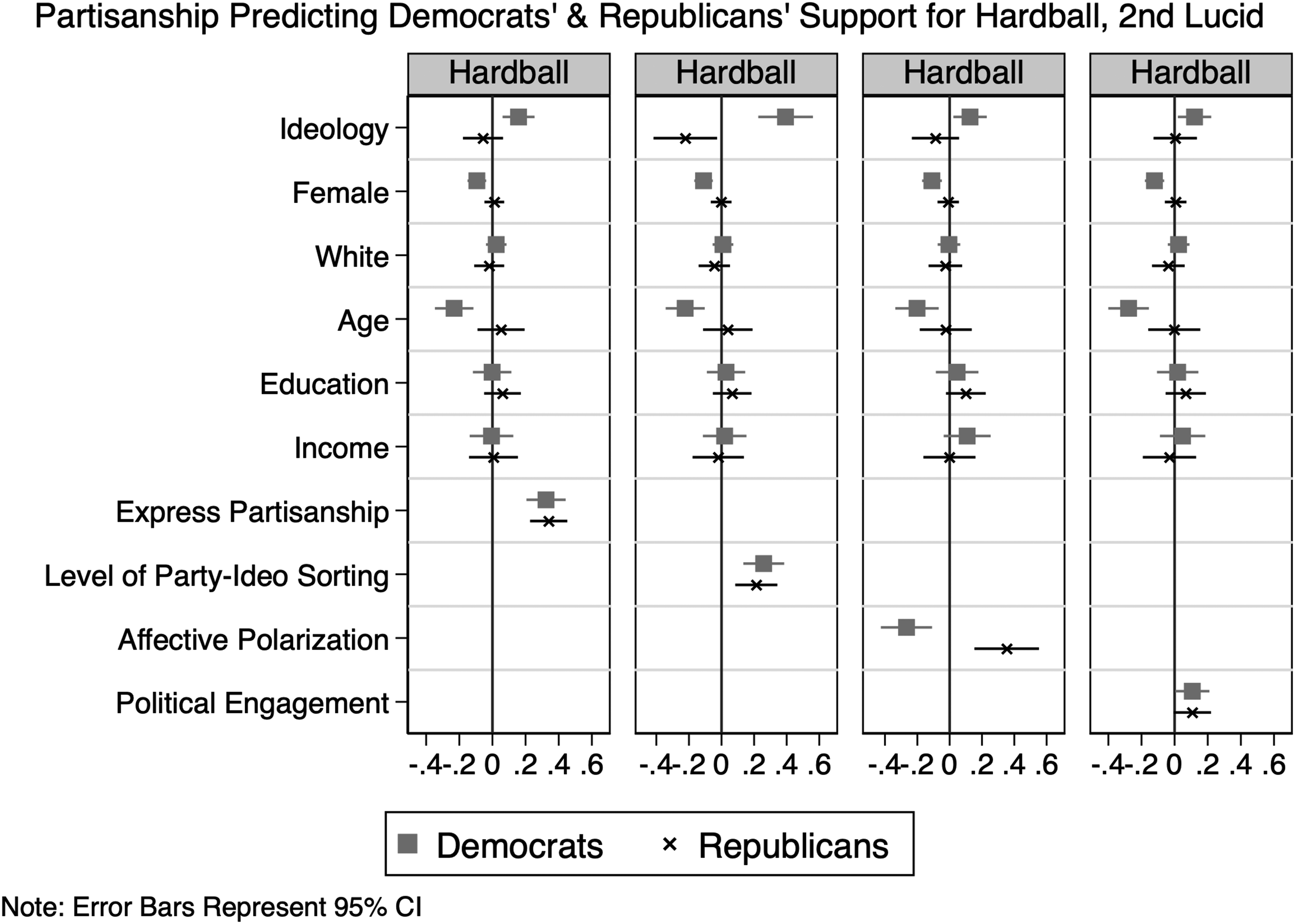
General Discussion
The Republican Party has shown much greater willingness to engage in hardball following their 2020 loss, mobilizing their voters to extreme and often anti-democratic actions. Democratic elites have mostly refused to respond in kind, stressing bipartisanship and rejecting calls for institutional changes such as abolishing the filibuster or expanding the Supreme Court. This is unusual given both past work showing both sides have equal capacity for radical partisanship (Kalmoe and Mason 2022) as well as the findings presented here that Democratic voters do not seem to show this same hesitation. Once the question wording makes it clear hardball will benefit one’s party, voters from both parties show very similar levels of support. Support for hardball was also motivated by identity- and group-based factors similarly among both Democrats and Republicans. Differences between white and non-white partisans were also either non-significant or non-substantive, so it is unlikely that the Democratic Party’s reluctance is due to its higher proportion of non-white members.
Together, these results support the idea that elites using or forgoing anti-democratic tactics like hardball is primarily an issue of their own willingness to engage in those acts rather than a question of them being constrained by voters (Bartels 2023). We should focus on partisan elites to better understand the real world asymmetries we see between the parties. For example, Democratic elites may simply believe that they lose more than Republicans from escalation on tactics like gerrymandering, and thus forgoing hardball is in their strategic interests (Helmke, Kroeger, and Paine 2022). The leaders of the Democratic Party are also older than the average Democratic voter and so may be more invested in the current status-quo due to greater wealth or job security as well as having different formative experiences in politics compared to their younger supporters (Bacon Jr. 2022). Alternately, the Democratic Party may not be ideologically unified enough to engage in the coordination across the levels and branches of government that hardball can require (Grossman and Hopkins 2016; Mickey 2022). Overall, this paper suggests that if Democratic elites choose to pursue hardball tactics, their base would almost certainly follow them.
The sizeable effect of partisanship when it came to increasing support for hardball among members of both parties suggests that even if voters do care about abstract democratic norms, they would likely abandon those concerns if forced to choose between them and their party identity. The strength of partisanship’s effects matches the ineffectiveness of real-world attempts by Democratic elites to make norms-based appeals, such as trying to shame Republicans who supported the January 6th insurrection (Cramer 2021). Most elections are won by a greater margin than the percent of voters who are willing to cross party lines, so if voters do not punish in-party candidates for endorsing anti-democratic actions then most candidates are effectively free to violate democratic principles without penalty (Graham and Svolik 2020). If norms-based appeals do not reduce Republican hardball but do signal to Democratic voters that hardball is objectionable, then Democratic elites may merely be demobilizing their own voters at while also encouraging their opponents to pursue a strategy of maximum hardball as they signal they will not retaliate. One factor in maintaining democratic norms like mutual forbearance is the tit-for-tat retaliation in the use of hardball, which can serve as a deterrence mechanism to either side going too far (Helmke, Kroeger, and Paine 2022; Miller 2021). The health of democratic norms may ironically be better served by Democrats reciprocating Republican hardball.
Given the potential for democratic erosion, it is important to determine how best to strengthen American democracy to weather the ongoing escalation of partisan conflict and use of hardball tactics. Based on the prominent role identity, both partisan and racial, plays in driving support for hardball, this research suggests future interventions focus on manipulating elite messages as voters are unlikely to be a constraint if elites decide to pursue such tactics. A better understanding of elite decision making when it comes to political tactics, as well as the other avenues of future research discussed here, will help us better understand how to bolster democratic norms and reduce support for hardball, as well as anti-democratic attitudes more broadly.
Supplemental Material
Supplemental Material - Partisan (A)Symmetries in Hardball: Mass Level Support of Hardball Equivalent Across Party and Race
Supplemental Material for Partisan (A)Symmetries in Hardball: Mass Level Support of Hardball Equivalent Across Party and Race by William Kidd in Political Research Quarterly.
Footnotes
Declaration of Conflicting Interests
The author(s) declared no potential conflicts of interest with respect to the research, authorship, and/or publication of this article.
Funding
The author(s) received no financial support for the research, authorship, and/or publication of this article.
Supplemental Material

Notes
References
Supplementary Material
Please find the following supplemental material available below.
For Open Access articles published under a Creative Commons License, all supplemental material carries the same license as the article it is associated with.
For non-Open Access articles published, all supplemental material carries a non-exclusive license, and permission requests for re-use of supplemental material or any part of supplemental material shall be sent directly to the copyright owner as specified in the copyright notice associated with the article.
