




Abstract
While positive party identification is one of the most used concepts in election studies, negative partisanship (NPID) is rarely analyzed. Evidence from two-party systems or settings with majority voting shows that hostility towards one of the other parties has its own unique impact on voting behavior. However, this effect has not been analyzed in the context of European multi-party systems with proportional voting. In this paper, I utilize data from the Comparative Study of Electoral Systems, Module 3, which demonstrates that negative partisanship has its own positive effect on turnout (about nine percentage points). In addition, negative partisanship affects vote choice by 2–6 percentage points. However, contrary to previous findings, NPID does not always affect voting for one of the other parties; no significant relationship was found between NPID and vote choice for Conservative/Christian Democratic and Liberal parties. The results of this study add to the growing literature on negative partisanship and demonstrate its importance in the analysis of voting behavior in multi-party systems.
Keywords
Introduction
Since the 1960s, party identification has been one of the most used concepts in election studies (Johnston, 2006). Despite the vast amount of literature on positive party identification (PPID), negative partisanship (NPID) has received less attention. The few existing studies indicate that NPID has its own unique effect on vote choice (e.g. Abramowitz and Webster, 2016; Caruana et al., 2015; Maggiotto and Piereson, 1977; Medeiros and Noël, 2014; Richardson, 1991; Vlachová, 2001). However, this so-called “hostility hypothesis” coined first by Maggiotto and Piereson (1977), has been analyzed almost exclusively in countries with majority vote systems, where voters mainly vote for (district) candidates, but not for party lists. Hence, it is of particular interest to determine whether these effects can be confirmed in other political contexts.
To do so, this paper analyzes the impact of NPID on voting behavior in European multi-party systems. While previous research on NPID has focused mainly on bipolar majority party systems such as the United States, this paper focuses on those European multi-party systems where the higher prevalence of party collaboration and coalition governments might mean a different role for NPID in voting behavior. The Comparative Study of Electoral Systems (CSES) provides quantitative data for several dozen countries and offers a valuable database for such an approach. For a meaningful comparison, the analysis has been restricted to 17 European party systems with proportional vote systems that share the same main axis of party competition – the socio-economic divide (Berglund et al., 2004; Lo et al., 2014: 208–209). This cleavage consists of party competition among the Conservatives/Christian Democrats, Liberals, and Socialists/Social Democrats, which draw the greatest number of votes in the majority of countries. After discussing the current state of the art in negative partisanship research, I analyze the effects of negative partisanship on turnout, partisan loyalty, and voting behavior.
Theoretical background
The original notion of PPID dates back to the 1950s (Campbell et al., 1960). In this situation, the political party serves as the group in which the individual develops: “an identification, positive or negative, of some degree of intensity” (Campbell et al., 1960: 122). According to this conceptualization, PPID denotes a long-standing, psychological affiliation with a political party (Campbell et al., 1960: 121). PPID has both a direct and an indirect effect, through candidate and issue evaluations, on the adherent’s voting decision (Campbell et al., 1960: 133). Today, party identification is becoming increasingly conceptualized within the social identity framework, a further elaboration of reference group theory that was used by Campbell et al. (1960), with the party as one of the individual’s in-group identifications (e.g. Green et al., 2002; Greene, 1999; Mayer, 2015). However, authors relying on rational choice theory (e.g. Fiorina, 1981; Popkin et al., 1976) have tried to shift the focus from partisanship as a long-standing psychological attachment to partisanship as a dynamic running tally of current/retrospective evaluations of political events. Despite their differences both the psychological/social identity and the rational choice notions of partisanship are prevalent in research (Johnston, 2006).
Although the original understanding of partisanship encompasses negative identifications, Campbell et al. (1960) mentioned it only in passing, without any elaboration concerning the concept or possible ways of measuring it. In the first analysis of negative partisanship, Maggiotto and Piereson (1977) showed that negative partisan affect has its own effect on vote choice in the United States: the more hostile partisans feel towards the opposing party, the more likely they will vote according to their own partisan identification. The strongest effect was found for weak identifiers (Maggiotto and Piereson, 1977: 747) 1 and other authors were able to successfully replicate these findings (Caruana et al., 2015; McGregor et al., 2015; Medeiros and Noël, 2014; Richardson, 1991; Vlachová, 2001). As part of that research, NPID was found to increase the probability of voting for the other party by 10 percentage points on average, but had a lower effect size than PPIDs (Medeiros and Noël, 2014: 14, 18). Related to this research on NPID, several recent studies have pointed to a growing antipathy between Democratic and Republican adherents in the United States (e.g. Abramowitz and Webster, 2016; Iyengar et al., 2012; Mason, 2015).
While the literature has offered compelling conceptualizations of PPID and NPID as well as tested their effects, it has paid less attention to how NPID might function differently in different types of party systems. Most previous studies of NPID have analyzed either the case of the United States (Iyengar et al., 2012; Maggiotto and Piereson, 1977; Mason, 2015) or other similarly bipolar majority party systems (Medeiros and Noël, 2014). Only a few studies have focused on multi-party systems. This is despite the fact that findings from bipolar systems might have limited generalizability to multi-party systems where, among other differences, party collaboration and coalition governments are more common. Looking only at the multi-party systems in the Netherlands and Germany, Richardson (1991: 760) found that inter-party hostility was usually highest between opposing parties of the same cleavage such as labor–capital. Examining a different case of a multi-party system, Canada, Caruana et al. (2015) and McGregor et al. (2015) demonstrated that NPID significantly affects voting behavior in that setting. However, Canada has an unusual multi-party system. Whereas most multi-party systems are characterized by plurality voting and coalition governments, with parties from different ideological families working closely together, the Canadian party system is characterized by single-member district plurality voting and single-party governments (Hooghe and Marks, 2001; Lo et al., 2014). Other studies (Rose and Mishler, 1998; Vlachová, 2001) have looked at PPID and NPID in multi-party systems in post-communist countries. Rose and Mishler (1998) analyzed post-communist countries almost directly after their democratic transformation, however at this time these party systems were still highly volatile; PPID was not as prevalent as in older democracies, so the effect of NPID was probably over-estimated. Thus of particular interest is the role of NPID in stable, multi-party contexts with plurality voting systems.
This paper will explore the impact of NPID in these contexts on three electoral phenomena. First, it is known that in general, partisans are more likely to vote than non-partisans, since they are politically more involved, and have a strong interest in ensuring that their party succeeds at the polls (e.g. Campbell et al., 1960; Johnston, 2006). In their study of Canada, Caruana et al. (2015) found that NPID has its own effect on turnout, even when PPID is controlled for, since voters seem to believe that the party one dislikes should be prevented from succeeding at the polls. This paper tests this assumption in European multi-party systems (Hypothesis 1).
Second, Abramowitz and Webster (2016) recently showed that negative partisanship increases loyal voting of partisans in the United States: party adherents with a NPID are more likely to vote for their own identification party. This is in line with previous studies; Maggiotto and Piereson (1977: 747) found that NPID increases the likelihood of voting for the identification party. The strongest effect was observed for weak identifiers: in this case, loyal voting may be not so much induced by PPID as by NPID (see also Note 1). Thus, this paper will test whether having a NPID increases the likelihood that partisans vote for their identification party, even when partisan strength is controlled for, in European multi-party systems (Hypothesis 2).
Lastly, the impact of NPID on vote choice is explored in detail for all voters. Caruana et al. (2015) showed that NPID has a positive significant effect (at least on the 10 percent level) on voting for one of the other parties. I argue that NPID toward the other parties does not always positively affect vote choice; rather, this phenomenon depends on the position of parties on ideological cleavages, as demonstrated by Richardson (1991). The most dominant cleavage in European party systems and the major axis of party competition is the socio-economic divide, which originates from class cleavage (Berglund et al. 2004; Hooghe and Marks, 2001: 166; Lo et al., 2014: 208–209). This cleavage is closely connected to the main European party families 2 – Conservative/Christian Democrats, Liberals, and Socialist/Social Democrats (Kriesi et al., 2006: 921). In most countries, Conservative/Christian Democrats and Socialist/Social Democrats are the major opposing parties on the sides of the divide (Kriesi et al., 2006: 921). This is further enforced by coalition governments that take place mostly within one side of the cleavage, when vote shares allow it. The expectation in this analysis is that NPID toward a leftist party will have a significant positive impact on voting among Conservatives or Christian Democrats, and vice versa (Hypothesis 3a). Because liberal parties are more often allied with Conservatives or Christian Democrats than with leftist parties, it is assumed that a liberal NPID will not have a significant effect on voting for the Conservatives or Christian Democrats. However, it is expected that NPID toward a liberal party will have a positive effect on voting among Social Democrats and Socialists, and vice versa (Hypothesis 3b).
Data and method
To test these hypotheses, I utilized data for all European parliamentary systems from the CSES, Module 3 (2006–2011) that was fully released in 2015. Ireland was excluded, since in this case, the party a voter identified with was only recorded for strong partisans.
Drawing on Von Beyme’s (1984) system of party families, the CSES provides classification for each party’s ideological family. Although most party systems have at least one other party (e.g. an agrarian, ecological, regional or nationalist party), for the purposes of this comparative analysis, only the parties from the Conservative, Christian Democratic, Right Liberal, Liberal, Left Liberal, Social Democratic, and Socialist party families are included. With the exception of Poland and Estonia, the two biggest parties are always part of these families. Even though the Polish Prawo i Sprawiedliwość is classified as a Nationalist Party in the CSES, it was treated as a Conservative Party in this article, since it is a member of the Alliance of European Conservatives and Reformists in the European parliament. Seat shares for these main party families are on average about 79 percent, varying between 54.5 percent (Switzerland) and 99 percent (Estonia).
Not every party family is part of every country’s political system (see online Appendix Table O1; for party names see online Appendix Table O8). For example, Slovenia does not have a Conservative party, and three countries (Czech Republic, Finland, and Spain) do not have a Liberal party.
The sample for this study encompasses 26,339 respondents from 17 countries; the structure of the data is therefore hierarchical. This needs to be accounted for since the observations are very likely to be correlated within groups. While it is theoretically possible to pool the data, estimate a single model, and cluster the standard errors by country, the number of countries is too small for this approach, and standard errors would be biased downwards (Cameron and Miller, 2015). Thus, a country fixed-effects approach was used for this study; this included country dummies as fixed effects to control for all other, non-observed country-level factors (Bryan and Jenkins, 2016: 5–6). This approach is similar to using a random intercepts model. However, it does not allow the variation of the effects by country. Therefore, for a further exploration of the results, random effects logit regression models are estimated that allow for the variation of the effects of PPID and NPID by country. As the number of level 2 units is rather small (17), it is very likely that country random variances and standard errors are biased. Nevertheless, individual-level fixed parameters are assumed to be unbiased, so this should not matter for this analysis (Bryan and Jenkins, 2016).
The CSES closeness item was used for the operationalization of PPID (“Do you usually think of yourself as close to any particular party?”). PPID strength was measured on a three-point rating scale (see the online appendix for full question texts and exceptions), ranging from “not very close” to “very close”. Two different operationalizations for NPID have been used in previous studies: affective measures such as party feeling thermometers (e.g. Maggiotto and Piereson, 1977; Richardson, 1991); and behavioral intentions, such as the question asking which party an individual would never vote for (Medeiros and Noël, 2014; Rose and Mishler, 1998). McGregor et al. (2015) suggested a combination of both measures to accurately identify individuals with hostile feelings towards a party which was used in this study; only individuals who dislike a party (values 0 to 4 on an 11-point scale) and never intend to vote for it were classified as hostile towards this party 3 (this indicator is dichotomous). Thus, every individual could hold only one PPID; however, he/she could have several NPIDs. For the comparative analyses, NPIDs for similar party families, Conservative and Christian Democratic (CONS/CD), Socialist and Social Democratic (SOC/SD), and Right Liberal, Liberal and Left Liberal (LIB) were grouped together because not every party family exists in every country. In countries with more than one party for a grouped party family, it was sufficient if an individual had a NPID toward at least one party of a party family to be classified as a negative partisan towards this party family.
Turnout was measured with a dichotomous item to indicate whether a respondent did or did not vote in the previous election since almost all countries included the CSES items in the post-election survey. In addition, vote choice was measured by the question of which party the respondent voted for in the last election. Also, controls were included for age, education, and gender, as well as placement on an 11-point left–right scale to control for ideological positions. Finally, to distinguish between negative feelings towards a political party and a generalized negative feeling against the political system, satisfaction with the political system was used as an additional control variable, measured on a four point scale (ranging from 1 “very satisfied” to 4 “not at all satisfied”).
Results
Of the 26,339 respondents, 40 percent held neither NPID nor PPID, 28 percent held only PPID, 14 percent only NPID, and 18 percent held both NPID and PPID.
The effects of NPID on turnout
Estimates of electoral turnout in election studies are usually biased due to over-reporting. In the case of the 17 countries analyzed in this study, reported and actual turnout differed to a considerable degree – between 4 percentage points in Spain and 20 percentage points in Finland and Switzerland (see online Appendix, Table O2). However, no more precise indicator was available for these analyses. Civic orientations – such as the belief that voting is a civic duty – are usually a strong confounder for turnout (Campbell et al., 1960; Green et al., 2002). However, civic orientations were not available in the CSES, so could not be included as a control. Previous research has shown that partisans are more likely to vote than non-partisans, no matter with which party a voter identifies. Therefore, only the presence/absence of PPID and NPID with one of the main parties (CONS/CD, LIB, SOC/SD) was included in the model. Logistic regression analysis was used to estimate the effects on turnout (see online Appendix, Table O3). Both PPID and NPID were found to have an independent effect on turnout. The interaction of both was found not to be significant. In addition, dissatisfaction with democracy had, as expected, a negative effect, while age and education had a positive effect on turnout. Similar results were obtained by using a multi-level random effects logit model with PPID and NPID as random effects on the country level without the Central and Eastern Europe (CEE) dummy (see online Appendix, Table O4). Both predictors, PPID and NPID, were found to have significant effects on turnout (p < 0.001).
Probabilities for turnout were predicted based on PPID, NPID and origin (see Figure 1; estimates by country can be found in the online Appendix, Figure O1) by using the observed-value approach for all other variables (Hanmer and Kalkan, 2013). While the average marginal effect of NPID on turnout was about 9 percentage points, the marginal effect of PPID was more than twice as high (21 percentage points). By contrast, Caruna et al. (2015) found that, in Canada, NPID had a marginal effect on turnout of 3 percentage points. This was probably due to the fact that they were able to control for civic orientations, which were not available in the CSES.

Predicted probabilities for turnout by positive party identification (PPID) and negative partisanship (NPID).
Since CEE countries have much lower turnout rates than other European countries (Enyedi and Lewis, 2006: 235), the effects of NPID are displayed separately. For non-partisans, having a NPID increases the probability of voting by 13 percentage points in non-CEE countries, and by 18 percentage points in CEE countries. Because there is already a high probability of voting among partisans, even weak ones, the effect of NPID is lower: the likelihood of voting increases for weak partisans by 8 and 12 percentage points (non-CEE and CEE), among those with a NPID. The effect of inter-party hostility further decreases for strong partisans, ranging between 2 and 4 percentage points (non-CEE and CEE). Nevertheless, Hypothesis 1 can be confirmed: NPID has its own effect on turnout.
The effects of NPID on partisan loyal voting
Next, I examine the importance of NPID for party adherents’ loyalty. The share of partisans voting for their identification party varies between 54 (Poland) and 85 percent (Austria). A logistic regression model was estimated for all respondents that identify with a political party (see Table 1). PPID strength and NPID have an independent, significant effect on voting for one’s identification party. In addition, age and education are additional positive factors for loyal voting, whereas democratic dissatisfaction has a significant negative impact, as it already had for turnout. Very similar results were found by using a random effects logit model. PPID strength and NPID were both found to have a significant effect on partisan loyal voting (see online Appendix, Table O5).
Logistic regression on partisan loyal voting for all partisans.
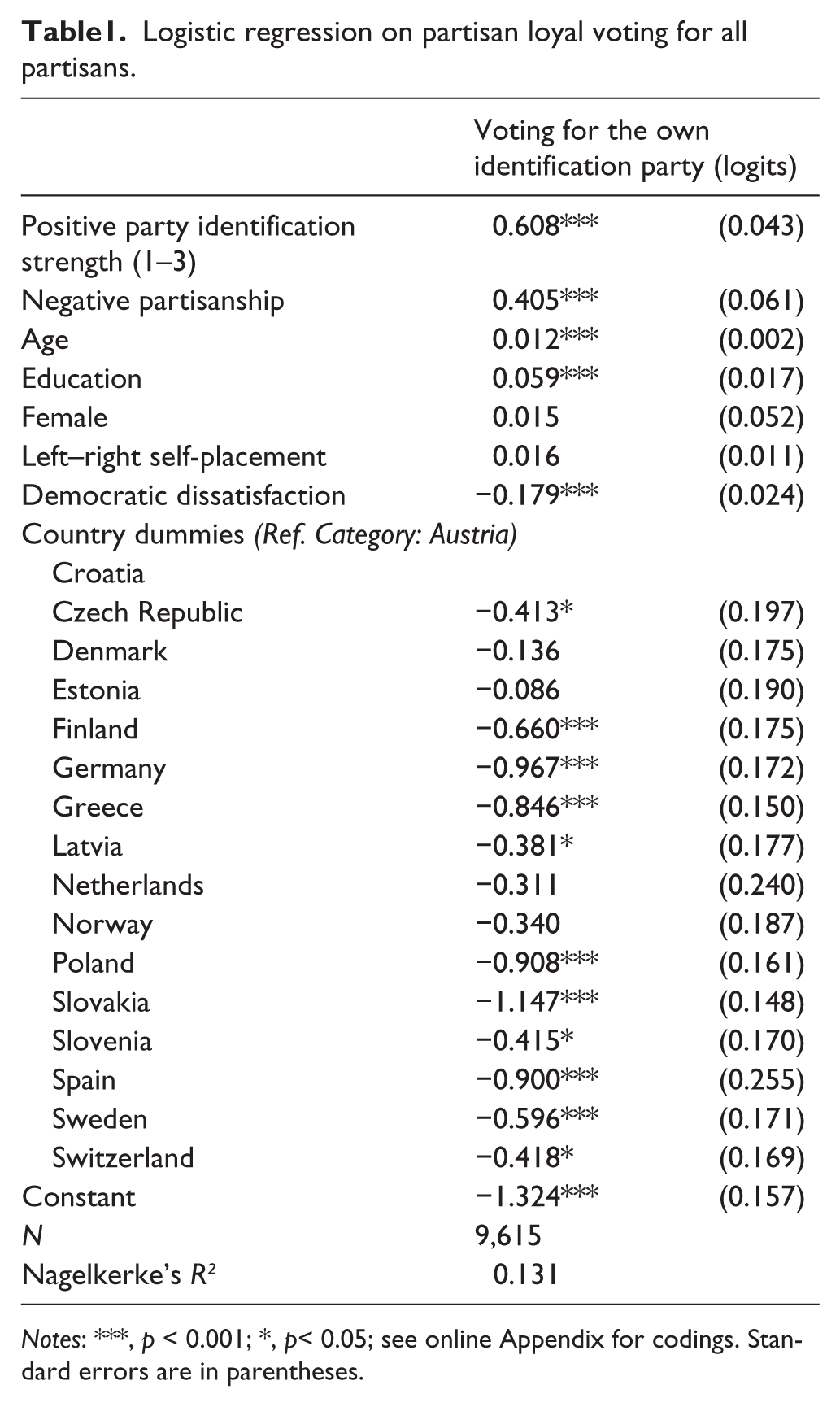
Notes: ***, p < 0.001; *, p< 0.05; see online Appendix for codings. Standard errors are in parentheses.
The average marginal effect of NPID varies for the three different strength categories of PPID: having a NPID changes the probability of voting for one’s preferred party by about 8 percentages points for weak partisans and decreases to 6 and 4 percentage points for moderate and strong partisans (all differences significant p < 0.001). Hypothesis 2 can be confirmed: NPID has its own impact on partisan loyal voting, even when PPID strength is controlled for.
The effects of NPID on vote choice
Finally, the effects of NPID on vote choice for the different parties were explored for all voters. Multinomial logistic regression models were estimated with “Other Parties” as the base category (see online Appendix, Table O6) for all countries with parties from all three major party families. As expected, PPID always had a positive, highly significant effect on voting for the identification party, compared to one of the other parties. Conversely, and also as expected, NPID always had a negative, significant effect on vote choice for the negative identification party. Additionally, left–right self-placement was positively related to vote choice for the CONS/CD, compared to others, whereas it was negatively related to vote choice for the SOC/SD and LIB. Moreover, democratic dissatisfaction had a negative effect on voting for a major party, compared to the other parties. In other words, dissatisfaction with the current state of democracy in one’s country increased the likelihood of voting for one of the other, non-major parties.
Based on the regression results, the average marginal effects for the different outcomes – voting Others, CONS/CD, SOC/SD, and LIB – were calculated and are displayed in Table 2. The results indicate that PPID and NPID have their own impact on vote choice. Each category of PPID increases the likelihood of voting for this party by 15 to 20 percentage points. Having a NPID decreases the probability of voting for this party by 12 to 13 percentage points. This is consistent with previous studies (e.g. Maggiotto and Piereson, 1977; Medeiros and Noël, 2014), which show that the effect of PPID is stronger than the effect of negative partisan attitudes.
Average marginal effects for the different voting outcomes (PPID, positive party identification; NPID, negative partisanship).
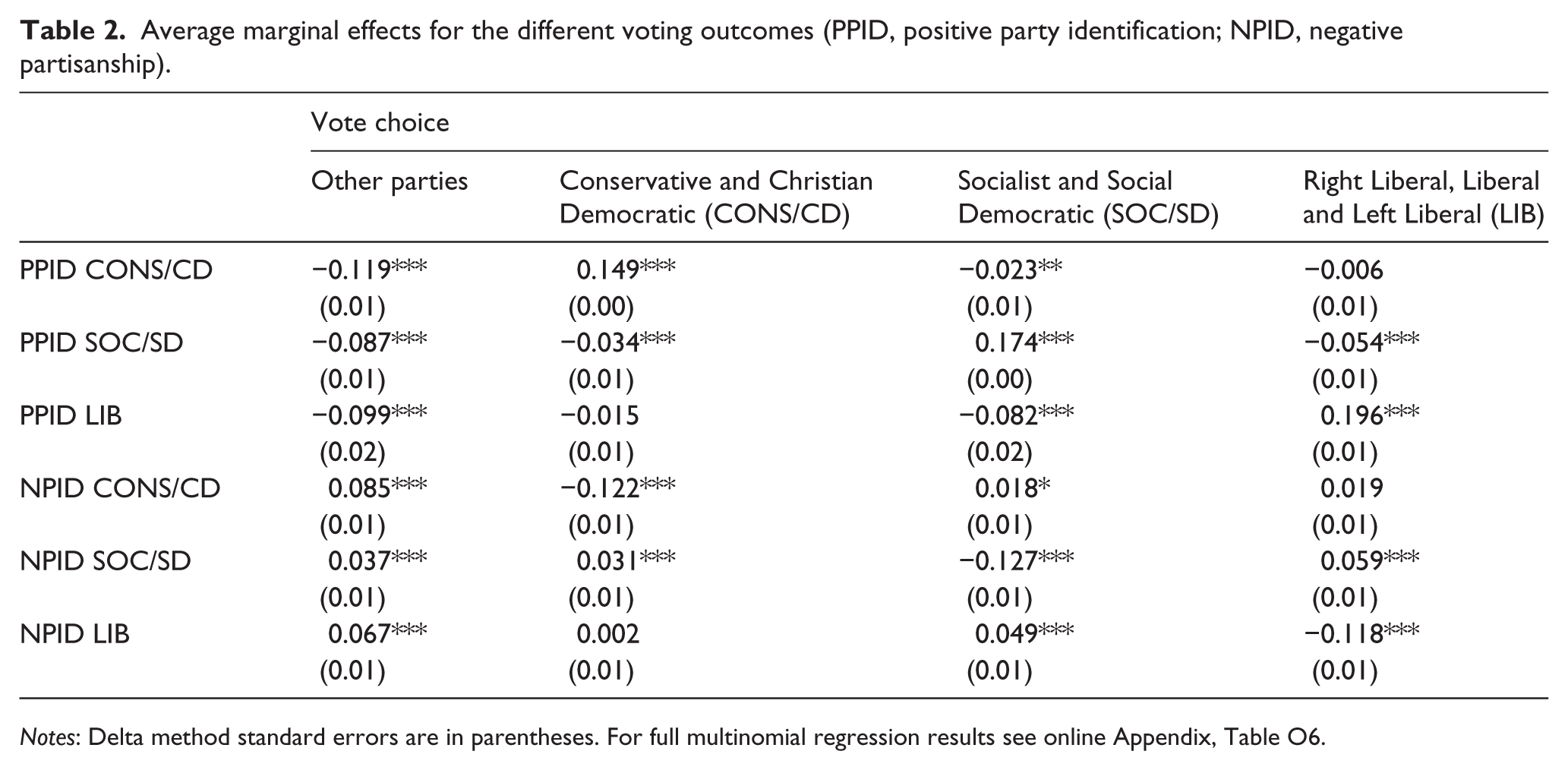
Notes: Delta method standard errors are in parentheses. For full multinomial regression results see online Appendix, Table O6.
Thus, it is clear that not every NPID with another party has a significant and/or positive effect on voting for a party. NPID toward CONS/CD increases the probability of voting SOC/SD by 2 percentage points. Analogously, NPID toward SOC/SD increases the likelihood of voting CONS/CD by 3 percentage points. However, this effect could not be replicated by using a random effects logit model (see online Appendix Table O7). Thus, Hypothesis 3a can only be partly confirmed.
With regard to the relationship of NPID toward LIB and voting CONS/CD, and vice versa, the effect was found to be close to zero, and not significant. Since these parties are often closer to each other than to the parties on the left, it is not surprising that no effect could be found (other results from an analysis by Mayer (2017) for German voters support this view). Additionally, NPID toward LIB increases the probability of voting SOC/SD by 5 percentage points, and vice versa (6 percentage points). Similar results were obtained by using a random effects logit model for the effect of NPID LIB on voting SOC/SD, and vice versa. Therefore, Hypothesis 3b can also be confirmed.
Conclusion
This article has explored the effects of NPID on voting behavior in European multi-party systems with proportional voting. Using data from the CSES, I analyzed the effects in 17 European countries. The results demonstrate that NPID increases voting turnout by about 9 percentage points, even when PPID is controlled for. This change is highest among non-partisans since they also have the lowest turnout rates. In addition, NPID was found to be a significant factor for vote choice, along ideological lines. NPID toward the CONS/CD had a significant positive impact on voting SOC/SD, and vice versa by about 2 to 3 percentage points. In addition, NPID toward a liberal party increased the probability of voting SOC/SD by 5 to 6 percentage points, and vice versa. No relationship was found between CONS/CD and LIB.
To further support the findings, these analyses should be repeated with data from the CSES, Module 4, when they are available in 2017, so that the time-invariance of the effects can be analyzed. These results add to the growing body of research on NPID and demonstrate that its effects are significant in national contexts and electoral systems beyond those explored in prior research. In conclusion, negative partisanship is an important predictor for voting behavior that should be widely included in electoral analyses.
Footnotes
Acknowledgements
The author is grateful to the editors and anonymous reviewers for their helpful comments, and to Hans-Peter Schreiber for research assistance. An earlier version of this article was presented at the 2015 Annual Meeting of the Midwest Political Science Association and the 2015 European Political Science Association Conference in Vienna. Thank is owed to the participants and the discussants Till Weber and Heiko Giebler for helpful comments and suggestions.
Correction (June 2026):
Declaration of conflicting interest
The author declares that there is no conflict of interest.
Funding
This research received no specific grant from any funding agency in the public, commercial, or not-for-profit sectors.
Supplementary material
The online appendix is available at: http://journals.sagepub.com/doi/suppl/10.1177/2053168016686636. The replication files can be found at 
Notes
Carnegie Corporation of New York Grant
This publication was made possible (in part) by a grant from Carnegie Corporation of New York. The statements made and views expressed are solely the responsibility of the author.
References
Supplementary Material
Please find the following supplemental material available below.
For Open Access articles published under a Creative Commons License, all supplemental material carries the same license as the article it is associated with.
For non-Open Access articles published, all supplemental material carries a non-exclusive license, and permission requests for re-use of supplemental material or any part of supplemental material shall be sent directly to the copyright owner as specified in the copyright notice associated with the article.
