




Abstract
Political scientists have studied extensively the gap between winners and losers of democratic elections with regard to satisfaction with democracy. We ask whether the winner–loser gap extends beyond the political domain to subjective health and well-being as well. Building on insights from biology and coalitional psychology, we hypothesize that winning and losing elections could affect one’s outlook on life, happiness, and subjective health. We comprehensively test these theoretical propositions with cross-sectional data from the 2012 and 2018 waves of the European Social Survey. We document significant gaps between winners and losers with respect to measures of subjective personal well-being. To further probe the causal nature of these winner–loser effects, we trace changes in well-being following election wins and losses using a panel dataset from the Netherlands, where we find weaker supportive evidence. Overall, our results suggest that winning and losing democratic elections can have much wider-reaching consequences than previously recognized.
Introduction
In democracies, losing free and fair elections is a normal part of politics. Being on the winning or the losing side of elections can lead to important changes in attitudes of citizens toward democracy and the political game (Anderson et al., 2005). But can these effects of elections spillover to affect citizens’ perceived health, well-being, and outlook on life? Can losing elections make you feel anxious, unhappy, or even sick? This article extends our understanding about the possibly far-reaching consequences of election outcomes by suggesting that—in addition to affecting a plethora of political system evaluations—winning or losing elections can have significant effects on the social and psychological well-being of citizens as well.
Many studies document the existence of a winner–loser gap in satisfaction with democracy across a variety of time periods, geographic areas, and institutional contexts (inter alia Blais et al., 2017; Curini et al., 2012; Farrer and Zingher, 2019; Loveless, 2020; Martini and Quaranta, 2019). While it is still unclear what mechanisms open up the gap—whether it is winners increasing their satisfaction, or losers decreasing it, or both (cf. Esaiasson, 2011; Hansen et al., 2019; Van der Meer and Steenvoorden, 2018), differences between election winners and losers are found across different empirical contexts and with different research designs, including panel survey data (i.e. Gärtner et al., 2020).
Some of the mechanisms that underpin the winner–loser gap in satisfaction with democracy have relevance beyond the domain of politics. For example, a winner effect has been extensively documented in sport competitions where winning leads to physiological reactions, such as increased levels of testosterone (Longman et al., 2018; McAuley et al., 1983; McCaul et al., 1992; Oliveira et al., 2009), which in their turn influence the psychological state and behavior of winners (Carré et al., 2013; Knight and Mehta, 2014). In fact, the winner effect is found not only in humans but throughout the animal kingdom. Importantly, losing competitions can also have broad psychological and behavioral effects (Buser, 2016; Vongas and Hajj, 2015).
As competition in sports, politics involves coalition building, that is, people forming alliances for different purposes (Boyer, 2018: 33–65). Given the coalitional psychology and physiological responses to losing, we hypothesize that the effects of winning or losing democratic elections spill over to outlook on life and perceptions of well-being. The vast majority of existing literature has been focused on the winner–loser gap in satisfaction with democracy in particular, with several studies analyzing political trust, efficacy, and other closely related variables as well (Anderson et al., 2005; Davis and Hitt, 2016; Gärtner et al., 2020; Hooghe and Stiers, 2016; Van der Meer and Steenvoorden, 2018). But in light of the well-documented psycho-somatic responses to losing in different domains, we can expect that losing in elections—where the stakes seem higher than in sports—will affect a much wider set of attitudes, beliefs, and perceptions, including the subjective well-being of individuals. Moreover, building on the existing literature on tribalism and the winner–loser gap, we hypothesize that the effects of winning and/or losing should be stronger for citizens with strong attachment to a political party (Clark et al., 2019; Plescia, 2019; Singh, 2014)—those who are more invested in the winning or losing of their coalition.
Empirically, we test these propositions using survey data on public opinion from two waves of the European Social Survey (ESS), fielded in 2012 and 2018, that cover 25 different countries and close to 100,000 respondents. We test for the hypothesized effects using multilevel statistical models with fixed-effect demographic controls and random effects at the country level. We also analyze a panel dataset from the Netherlands (Longitudinal Internet studies for the Social Sciences (LISS)), which allows us to track changes in the same individuals over time, this probing further the causal nature of the winner–loser effects.
Our results from the cross-sectional analyses suggest that winner–loser gaps exist for people’s outlook on life, self-perceived health, happiness, and life satisfaction. As expected, most of these gaps are greater for citizens with strong party attachments. We find evidence that many of the gaps between winners and losers are greater in new democracies. However, evidence in support of winner–loser effects on well-being in the Dutch panel data is weaker: while there are some possible effects (e.g. on changes in subjective health and feeling connected to society), these are small and not very robust. This suggests that in mature, consociational democracies, the negative effects of losing elections on well-being can be avoided.
Our results contribute to existing knowledge in a number of ways. First, we propose a new mechanism based on the literature on coalitional psychology to explain the effects of winning and losing democratic elections, which adds to the emerging literature on the emotional and other biological effects of elections and politics more generally (Lench et al., 2019; Pierce et al., 2016; Pinto et al., 2021; Valentino et al., 2011). Second, we significantly extend the empirical scope of the literature on the winner–loser gap by studying a much wider set of outcomes in the domains of socio-political life and individual well-being than done previously. By showing that the effects of winning and losing possibly spillover from the domain of politics to outlook on life, life satisfaction and even health, across a large number of European countries, our study raises concerns about the general impact of losing elections on the well-being of citizens and democratic societies, particularly because decreased subjective well-being is associated with lower political participation and voting for extreme parties (Kavanagh et al., 2021). Importantly, we provide empirical evidence for winner–loser gaps in subjective health and well-being beyond the case of the US, which is characterized by extreme polarization of the party system and the electorate and the first-past-the-post system. While it remains to be studied how permanent the changes in attitudes induced by winning and losing are and how they translate into changes in behavior, our results uncover potentially important consequences of democratic elections that have until now remained hidden.
The Effects of Winning and Losing Elections: Theoretical Expectations
The existing literature makes it clear that the effects of winning and losing democratic elections on satisfaction with democracy and some related political attitudes are rather general, robust, and well-documented. This is consistent with the idea that the effects are underpinned by some fundamental physiological and psychological processes.
Fundamental Physiological and Psychological Mechanisms
A large literature examines winner/loser effects in animals and in humans from an evolutionary perspective (for a review of evolutionary theoretical models, see Mesterton-Gibbons et al., 2016). The evolutionary explanations of human behavior emphasize the function of tribalism throughout human history (Clark et al., 2019). They suggest that political competition nowadays activates pro-tribe cognitive tendencies, which lead to divergent evaluations of socio-political reality depending on a given coalitional constellation. In addition to these cognitive tendencies related to partisanship, physiological studies detected, for example, that winning can alter testosterone levels in men (McCaul et al., 1992). Testosterone increases were found even after a “victory” manipulated by the researchers and were shown to affect mating behavior of male rowers (Longman et al., 2018) and to mediate future aggressive behavior in men (Carré et al., 2013). Women were shown to experience testosterone increases following winning too (Oliveira et al., 2009). Importantly, there is evidence that the perceived level of control over winning is important in shaping the emotions experienced by the winners (McAuley et al., 1983).
Most of this empirical evidence (at least, when humans are concerned) comes from sports competitions. However, one analysis of voters’ testosterone responses in the aftermath of the 2008 US Presidential election found that male voters for the winning candidate had stable testosterone levels after the election, while voters for the losing candidates exhibited drops in testosterone levels. 1 The conclusion was that “male voters exhibit biological responses to the realignment of a country’s dominance hierarchy.” (Stanton et al., 2009:1) Overall, there is increasing evidence for a reciprocal relationship between hormones and perceived social status of individuals (for an overview, see Knight and Mehta, 2014). Schreiner (2021) finds that indicators of well-being fall at the time of elections. Most of this evidence, however, comes from the US, which is a rather specific case given extreme levels of polarization, so it is an open question whether they generalize to less polarized electorates, proportional electoral systems, and consociational types of democracies.
The physiological responses to losing, also in the context of elections, can be explained by coalitional psychology. Elections provide a cue about what the winning coalition in society is. Through elections, individuals learn whether they are in majority or minority, whether they lost or gained control over distribution of resources, and whether their social position improved or worsened—information that can affect fundamental processes related to coalitional psychology (Boyer et al., 2015). Being part of a losing coalition can have serious physiological effects. As coalitional threat is a recurring problem in human environment, humans, like other mammals, have evolved neurophysiological responses to such direct challenges (Gunnar and Quevedo, 2006). In humans, being in a losing coalition can result in the release of epinephrine (adrenaline) or cortisol (stress hormone) and if experienced repeatedly, negatively affect health and well-being (Sapolsky, 2007).
If the mechanisms underpinning winner and loser effects are so fundamental, affecting physiological processes and psychological states such as emotions, we would expect that the effects of winning or losing elections spill over from the domain of political attitudes to other, more general, social attitudes and even to subjective well-being and health. According to a study by Yan et al., after the 2016 US Presidential elections, “there were 54.6 million more days of poor mental health among adults in December 2016, the month following the election, compared to October 2016 in the states that voted for the losing candidate” (Yan et al., 2020). The authors of this study conclude that “elections could cause at least transitory increases in poor mental health.” Powdthavee et al. (2019) suggest that winners at the Brexit referendum on leaving the European Union experienced an increase in life satisfaction. Lench et al. (2019) report that in the aftermath of the 2016 Presidential elections in the US, supporters of the winner (Trump) experienced improved well-being, while supporters of the losing candidates experienced the opposite, with the effects lasting up to 6 months. Pinto et al. (2021) also focus on the US presidential elections in 2016 and 2020 and find negative effects for losers, but no positive effects for winners (see also Pierce et al., 2016). All this evidence comes, however, from majoritarian electoral systems with polarized and adversarial politics, and it is unclear whether the results will generalize to proportional electoral systems. But, overall, theory and some existing literature suggests that we should observe such effects beyond the narrow set of political attitudes examined in the literature so far. In the remainder of this section, we take up this insight and develop concrete hypotheses that can be tested empirically.
Winner–Loser Effects on Subjective Well-Being
As argued above, there are good reasons to expect that the winner–loser gap extends beyond the political domain. Losing can also affect feelings of optimism about your own future, the state of society and the future of the world. Getting a party you did not support to form a government means that your hopes for desired policy reforms would not materialize; moreover, you realize that these hopes are not shared by a majority of the people in the country.
Such feelings and perceptions can generalize to the overall well-being of people. Losing can decrease feelings of safety (both directly because you know that most people do not share your views and indirectly via ineffective government actions to ensure safety). Losing can also negatively affect (perceived) health via the physiological effects it has on the body, promoting stress, aggression, and anxiety (Yan et al., 2020).
Ultimately, a gap between winners and losers of election can appear with regard to feelings of happiness, life satisfaction, and perceived place in society. Losing means that your political and policy goals are not going to be realized. To the extent that one cares about political and policy goals, this should lead to a negative correction in perceptions of personal fulfillment and one’s place in society.
Individual-Level and Country-Level Moderators: Types of Winners, New and Old Democracies, Electoral Systems
At the individual level, we hypothesize that the winner–loser gap will be greater for citizens with more political engagement and allegiance to political parties (Plescia, 2019; Singh, 2014). The amplifying effects (Anderson et al., 2005: 73–89) should be most visible among the subset of citizens who feel very strongly attached to a political party, less so for the subset of people who have voted, which includes voters who do not feel very strongly attached to a political party, and even less so in the general population, which includes non-voters as well.
At the country level, these effects should be stronger in new democracies (and non-democracies) (Anderson and Tverdova, 2001; Farrer and Zingher, 2019; Fuchs et al., 1995). In established democracies, citizens have experienced multiple changes of parties in government and are less likely to perceive an election loss as an irreversible change. The existing literature finds a complex set of effects, however: while the effect of the proximity of democratic transition is negative in Europe, Asia, and Latin America, it is positive in Africa (Farrer and Zingher, 2019).
Institutional features possibly moderate the effect of elections. We expect that the winner–loser effects should be stronger in majoritarian democracies and more disproportional electoral systems rather than systems based on proportional representation (Anderson and Guillory, 1997; Davis, 2014; Farrer and Zingher, 2019; Hooghe and Stiers, 2016). Majoritarian systems produce more clear winners and losers from elections (Plescia, 2019). In addition, winners get more direct and unconstrained access to government. In proportional systems, multiple parties can be perceived as winners and losers based on their relative gains. Furthermore, coalition governments being the norm, it is harder for citizens to attribute both blame and credit for policies to individual parties. Hence, the level of proportionality of the political system should moderate the size of the winner–loser gap.
Note, however, that Dahlberg and Linde (2016) find that it is institutional quality and performance that matters, rather than the type of institutional arrangements. When institutions work well, losers are more satisfied with democracy, and winners experience a smaller boost from their victory (Nadeau et al., 2021).
Most studies that look into the duration of the gap find that the effect is stable rather than short lived (Dahlberg and Linde, 2017; Hansen et al., 2019; Loveless, 2020; Mazepus and Toshkov, 2021). The strength of the election effects peak shortly after the elections take place and might even become apparent in the week before due to anticipation (Gärtner et al., 2020; Van der Meer and Steenvoorden, 2018). As more time passes after the election, the boost that winners experience wears off, while the attitudes of losers rebound (Davis and Hitt, 2016). It is, however, not clear, how long it takes for this recalibration to take place. A recent comparative study concludes that “both the levels of and the difference between satisfaction levels of ‘winners’ and ‘losers’ do not attenuate quickly but rather last almost 5 years” (Loveless, 2020). By contrast, data from Germany (Gärtner et al., 2020) show only very small and short-lived effects of winning (note, however, that this panel data have a very high dropout rate, which might bias against finding any effects if disappointed voters are more likely to drop from the survey). Relatedly, Chang et al. (2014) argue that the winner–loser status in past elections, as well as expectations for the future matter for the gap as well (see also Delgado, 2016).
Research Design, Data, and Method of Analysis
We use cross-sectional data for 25 European countries and panel data from the Netherlands to study these relationships. In the cross-sectional analyses, we test the hypotheses identified above on comparative survey data of public attitudes from the two waves of the ESS 2 : Wave 6 (2012) and Wave 9 (2018), which feature a number of relevant outcome variables. Some of these variables are measured in both waves of the survey and others only in one. We chose the 2012 wave because it features an additional extended module on political attitudes and the 2018 wave because it is the most recent available. In this part of the analyses, we compare whether winners of democratic election have higher subjective well-being, life satisfaction, and more optimistic outlook on life than other citizens, voters (citizens who voted in the elections), and partisans (voters with strong party attachments). While this approach can successfully identify gaps between winners and losers, these gaps could be due to pre-existing differences between the types of people who would vote for winning and losing parties. We can address this issue by including possible confounding variables, such as age, education, sex, self-placement on left–right scale of political ideology, and the extremity of the left–right positions. Still, the comparisons remain between rather than within individual respondents.
Therefore, in addition to analyzing the cross-sectional data from both waves, we perform a second set of analyses based on panel data from the Netherlands (LISS) 3 . Panel data allow us to track changes in relevant measures of subjective health and well-being rather than make static comparisons only. This provides for a much stronger test of the causal nature of the relationships we are studying, because we can compare how the outcome variables of interest change before and after election and government formation events differentially for people who voted for winning or losing parties. Panel data come with its own set of limitations, related to non-random dropout rates between survey waves and imperfect timing of data collection with respect to the election and government formation events. In addition, the Netherlands can be considered one of the least likely cases to find effects of election wins and losses, because institutional quality is high, the political system in the country is not very polarized, the government formation process produces large coalition governments where parties who suffered electoral losses can still participate, and the overall governance course of the country is quite stable even in the aftermath of elections, which rarely produce radical shifts in the nature of governing coalitions. Our choice to analyze the Dutch case is driven primarily by practical concerns about data availability: panel surveys that are fielded often enough to coincide with periods before and after parliamentary elections and feature both political and health-related variables are hard to come by. From a research design perspective, this choice implies that even if we do not find the effects of interest in this case, they might still exist in countries with more favorable conditions for sizable winner–loser gaps (i.e. countries where elections produce clearer winners and losers).
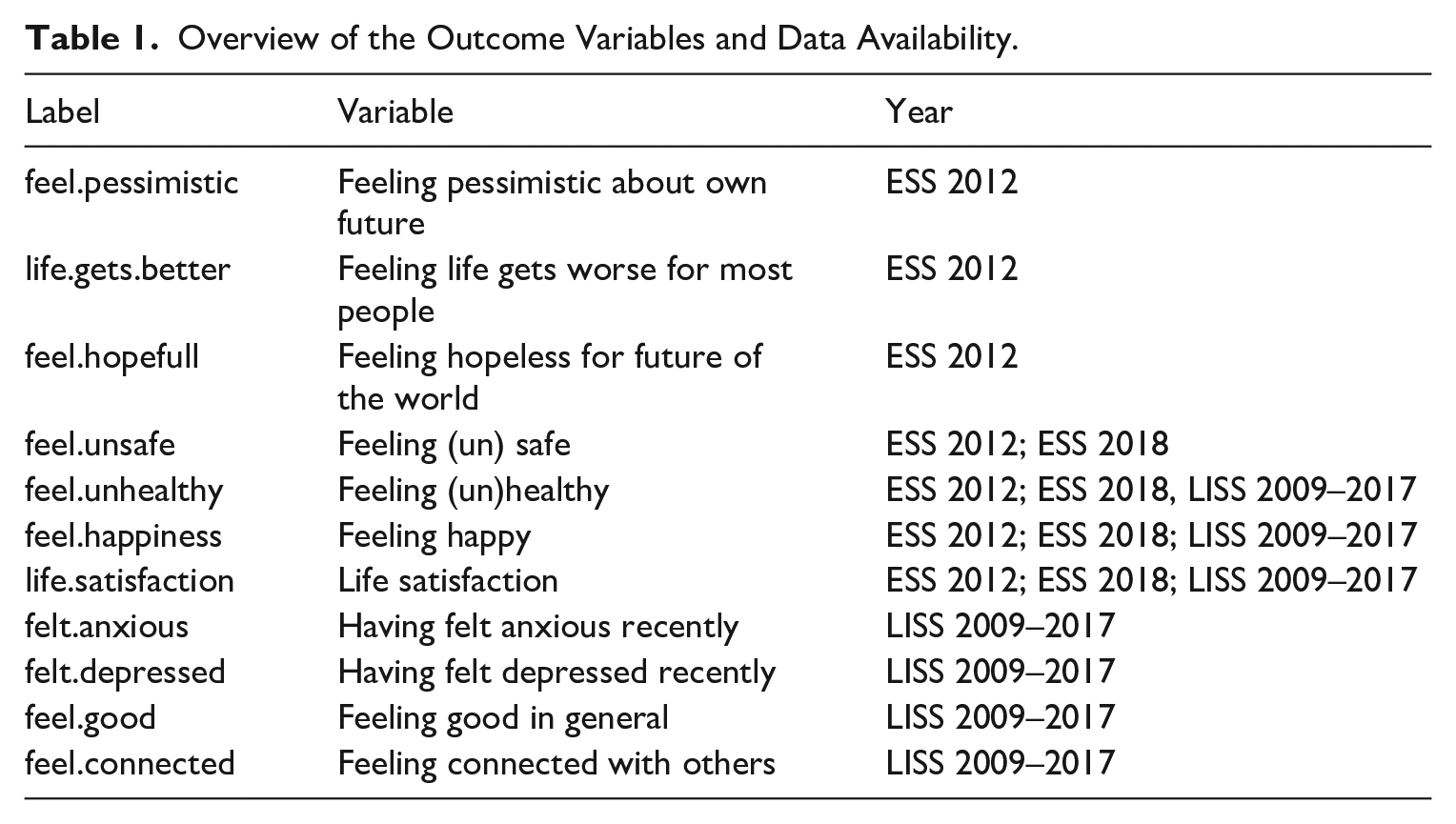
Table 1 presents an overview of the data availability for the outcome variables of interest. The exact wording for all variables is available in Part A2 of the Supplemental Appendix. For the cross-sectional analysis, we identify winners and losers of elections by matching the reported vote choice of the respondent at the latest national elections to the parties in government at the moment of collecting the survey information (Singh et al., 2012). We include those who voted for any of the parties in the governing coalition, however small, as winners and the rest as losers. Hence, we do not focus on relative electoral gains nor on the absolute size of the vote share, but only on whether the party ended up in government or not (cf. Daoust et al., 2021; Gärtner et al., 2020; Singh, 2014; Stiers et al., 2018).
Overview of the Outcome Variables and Data Availability.
Defined in this way, the group of “losers” includes citizens who voted for parties which did not make it into government and non-voters as well. These two groups could have different reactions to the electoral results, so we also re-estimate the models for the sub-population of voters. Furthermore, we re-estimate the models for the subpopulation of respondents with strong partisan attachments, or partisans. These are people who feel close or very close to at least one of the parties competing at the latest national elections, thus excluding citizens who do not feel close to any party, even if they have voted for one.
In the analysis of Dutch panel data, we identify winners as voters of parties that join and losers as voters of parties that leave the government. This is in line with the operationalization of the outcome variables, which also track changes between the panel waves. In an additional analysis reported in the Appendix, we employ a definition of “winners” as those who voted for a party that is part of the next government.
In the cross-sectional analyses we also use the variables ‘disproportionality’ of the electoral system and ‘time’. Disproportionality is measured with the Gallagher index (Gallagher, 1991). To test whether the effects persist over time, we measured the time elapsed between the latest parliamentary elections and the day of data collection for all respondents in Wave 6 of the survey.
Method of Analysis
We model the cross-sectional data with multilevel (mixed-effects) linear regression models. We combine both waves of the survey data in a single pooled dataset. The baseline models include demographic (age, gender, education, and occupation) and political (left–right position and the extremity of the position) controls as fixed effects, and country intercepts and slopes for the main effect of interest as random effects. We model each outcome variable separately. This is because we are not interested in the impact of the winner–loser status on, say, life satisfaction conditional on the respondent’s political trust and other attitudes. To test the moderating effects of new democracy, we include interactions of this variable with the winner–loser status. To test the moderating effect of different types of winners, we estimate all models for three groups of respondents: citizens (all respondents in the survey no matter whether they voted or not), voters, and partisans. Descriptive statistics for the outcome variables are available in Part A3 of the Supplemental Appendix.
Empirical Results
Part I: Cross-Sectional Analyses of ESS Data
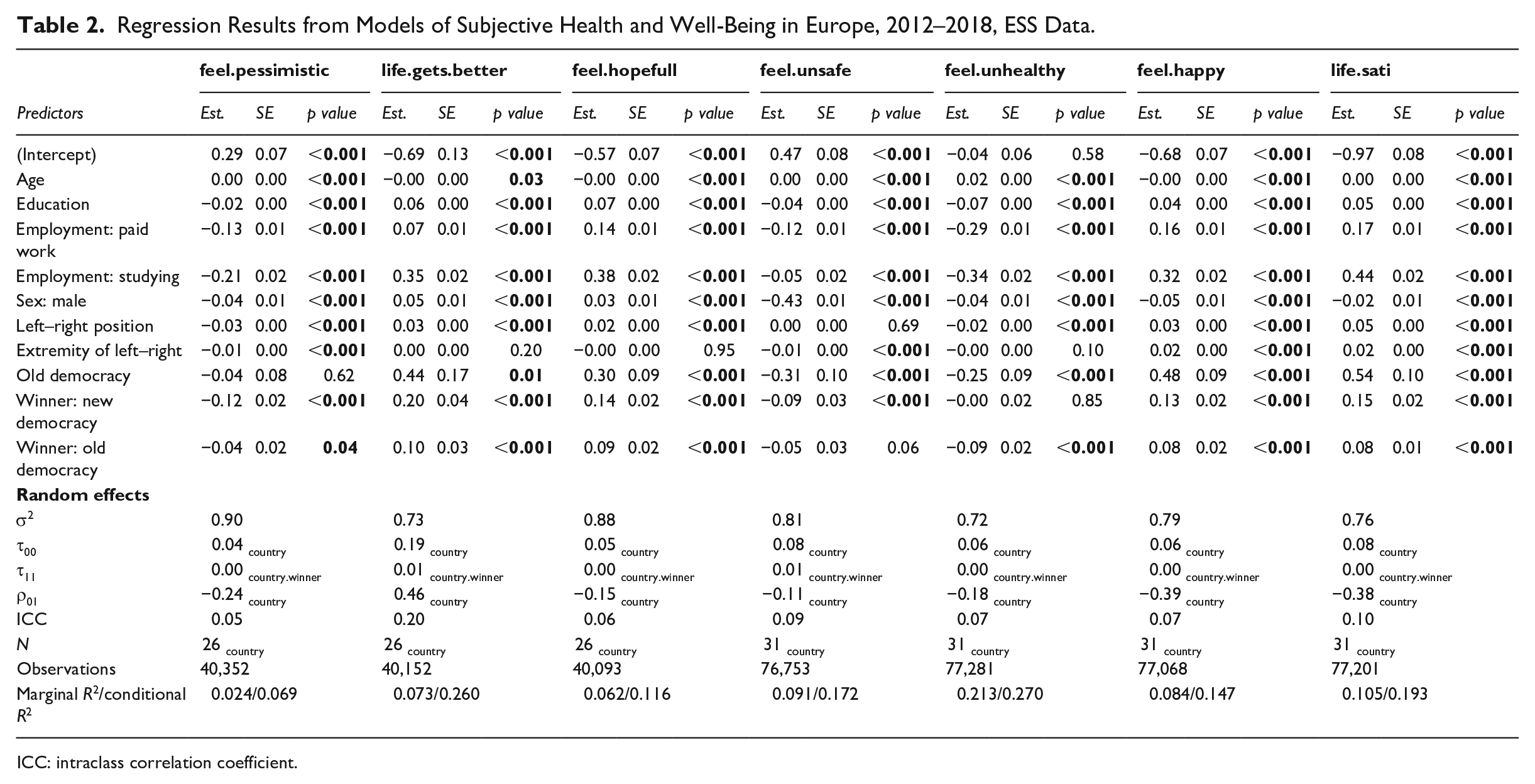
Table 2 shows the results for seven outcome variables. These baseline models feature the main variable of interest—winner status and demographic characteristics as individual-level fixed effects, new/old democracy as a country-level fixed effect, the interaction between winner status and new/old democracy, random intercepts for country, and random slopes for the effect of winner status by country. In these analyses, the outcome variables have been centered (scaled to have a mean of 0) and standardized to have a standard deviation of 1. Hence, the size of the effects is directly comparable across the different outcome variables. The models in Table 2 are estimated on all respondents for which there is valid information in the combined dataset (hence, all “citizens”).
Regression Results from Models of Subjective Health and Well-Being in Europe, 2012–2018, ESS Data.
ICC: intraclass correlation coefficient.
Table 2 shows that the winner status has a positive significant effect on the three indicators of outlook on life (feeling optimistic, life gets better, feeling hopeful), life satisfaction, and happiness, in new and old democracies alike, in line with our hypotheses.
The winner status is associated with lower levels of feeling unsafe in old democracies (p-value of 0.06 in new democracies) and with lower levels of feeling unhealthly in new democracies. To remind, these effects are net of the demographic and political controls included in the models, so they cannot be attributed to, for example, age or the extreme political positions of the respondent.
A relatively large part of the variance is accounted for by the random country intercepts (τ00): greatest in the case of the “life gets better” variable and smallest in the case of feeling pessimistic. The random slopes for the effect of winner status (τ11) are related to only small parts of the variation for all outcome variables. Altogether, the grouping structure in the data (at the country level) explains 20% of the variance in the case of “life gets better” and only 5% in the case of feeling pessimistic (see the row in the table reporting the intraclass correlation coefficient, ICC). In all models, there is significant (mostly negative, with one exception) correlation (ρ01) between the country intercepts and slopes, meaning that the higher the average values of “life gets better” variable, etc., the lower the effect of winner status in that country, relative to the average effects of winner status in the entire sample.
Figure 1 illustrates the effects of interest by showing the estimated coefficients and 95% confidence intervals for the effects of voting for a winning party among citizens in old and new (post-1989) democracies on the seven outcome variables of interest. We can see that in some cases the effects in old and new democracies are quite different, for example, with respect to feeling pessimistic.
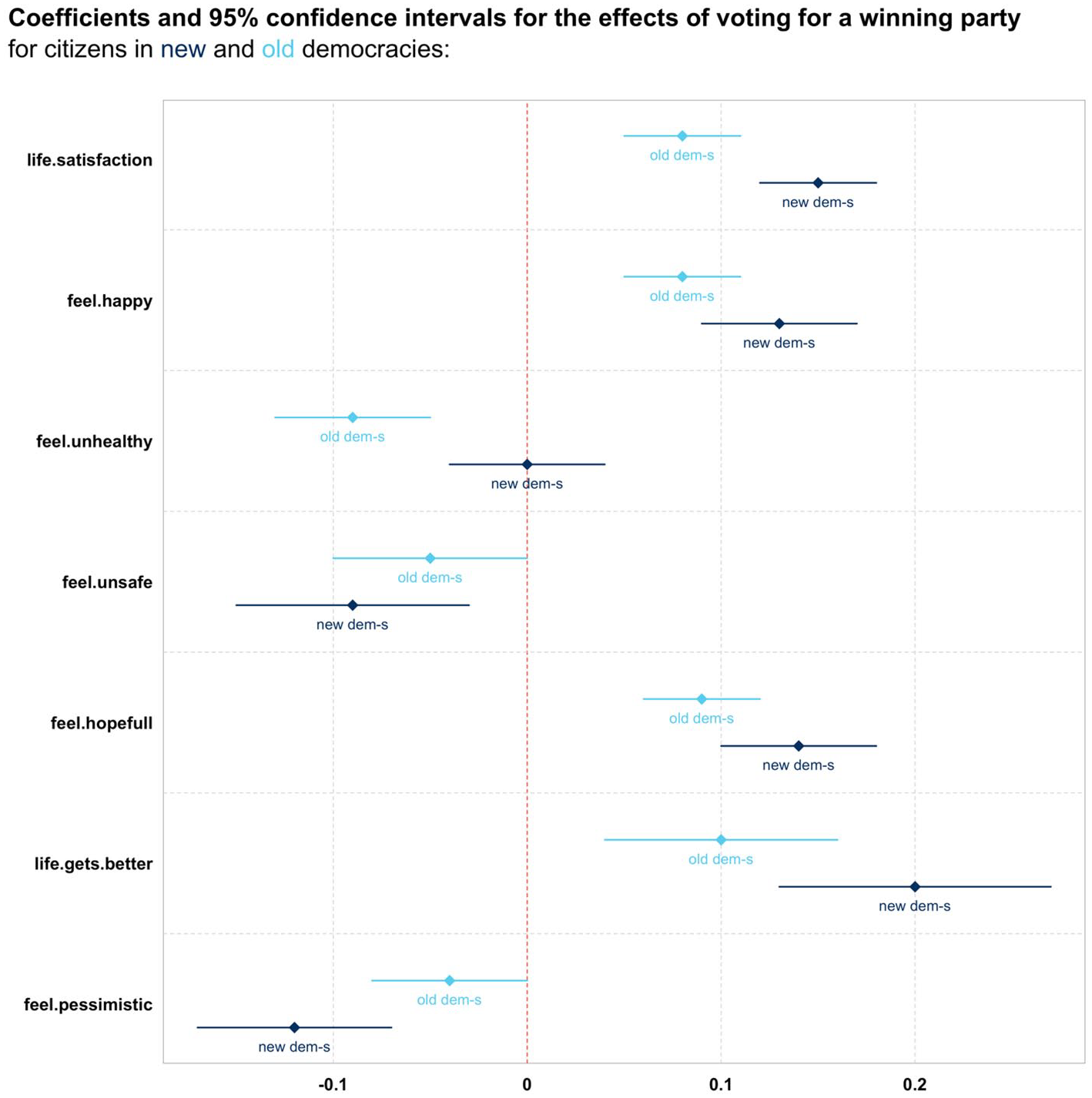
Coefficients and 95% Confidence Intervals for the Effects of Voting for a Winning Party among Citizens in Old and New (Post-1989) Democracies.
To examine whether the effects of winner status differ for voters and partisans, we re-estimate the models reported in Table 2 for the subpopulations of people who voted and people who have strong party attachments (we drop the interaction with new/old democracy to ease interpretation, but we keep the demographic and political controls).
We summarize the effects graphically in Figure 2 by plotting the estimated coefficients of winner status for each outcome variable of interest, and then for citizens, voters, and partisans. The figure shows that the effects are larger in the subset of partisans, for all outcome variables, and in some cases significantly so (“life gets better,” feeling hopeful and pessimistic, life satisfaction). The effects among voters are in some cases smaller than for all citizens, because non-voters tend to be less healthy and optimistic than voters for losing parties, in some cases. Note that the samples are smaller for voters (66,005) and partisans (29,830), compared with all citizens (a total of 92,232).
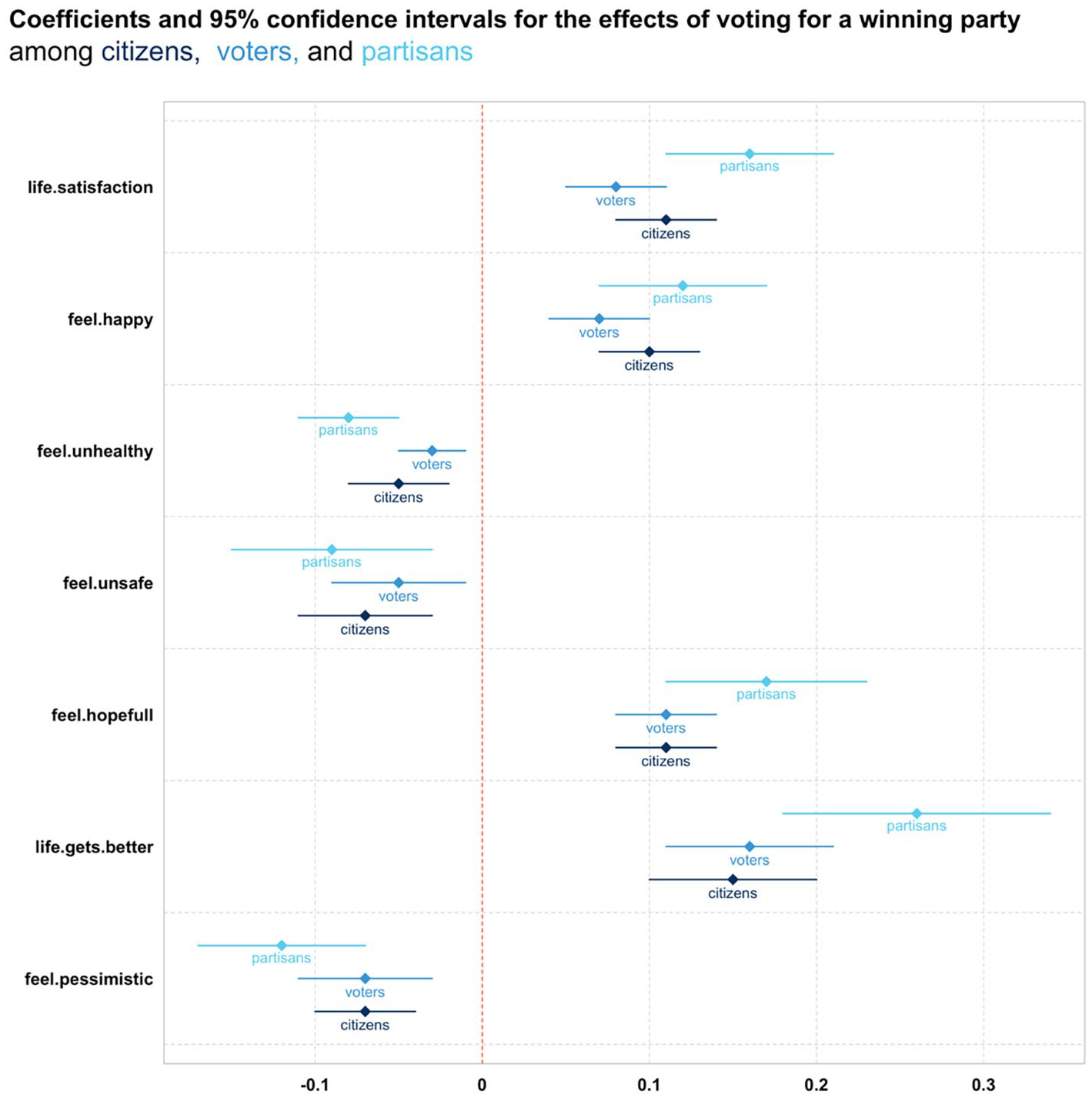
Coefficients and 95% Confidence Intervals for the Effects of Voting for a Winning Party among Citizens, Voters, and Partisans.
We do not find evidence that the disproportionality of the electoral system moderates the effects of winning and losing. We test for the effects by interacting disproportionality (after scaling the variable) with “winner” status, but for none of the outcome variables do the coefficients of the interaction turn out to be statistically significant (for details of the model results, see Table A4 in the Supplemental Appendix).
We also tested whether the effect of winner status declines over time. When we interact this variable with “winner” status, we find some evidence for possible moderation effects: the negative effect on feeling pessimistic grows over time (gets even more negative), while the positive effect on feeling happy increases (gets even more positive). At the very least, there is no evidence that the effects of winning are greater when the elections have been closer to the moment of data collection.
Part II: Panel Data Analyses of LISS Data
The results from the cross-sectional analyses lend significant support for the hypotheses about the effects of winning election on life outlooks, subjective well-being, and health. Still, despite the number of demographic and politic controls included, the gaps between winners and losers that we find can be driven to some extent by prior differences in the people who vote for winning parties. Therefore, we complement the cross-sectional analyses with data from the Dutch LISS panel.
We focus on the Dutch parliamentary elections in 2010, 2012, and 2017, and we identify the panel survey waves fielded before and after these election moments (see Part A1 of the Supplemental Appendix for the exact dates of elections, government formation and survey fieldwork). Then we calculate the change in relative indicators of well-being and health for the respondents, and we use these changes as the outcome variables of interest. The main explanatory variables are winner status (having voted for a party that joins the government) and loser status (having voted for a party that leaves the government in the aftermath of the elections). The baseline category then comprises of people who either did not vote or voted for parties that did not change their government status. We also add the age and sex of the respondent as controls. Clustering the standard errors at the level of the panel survey respondent does not affect the results substantially.
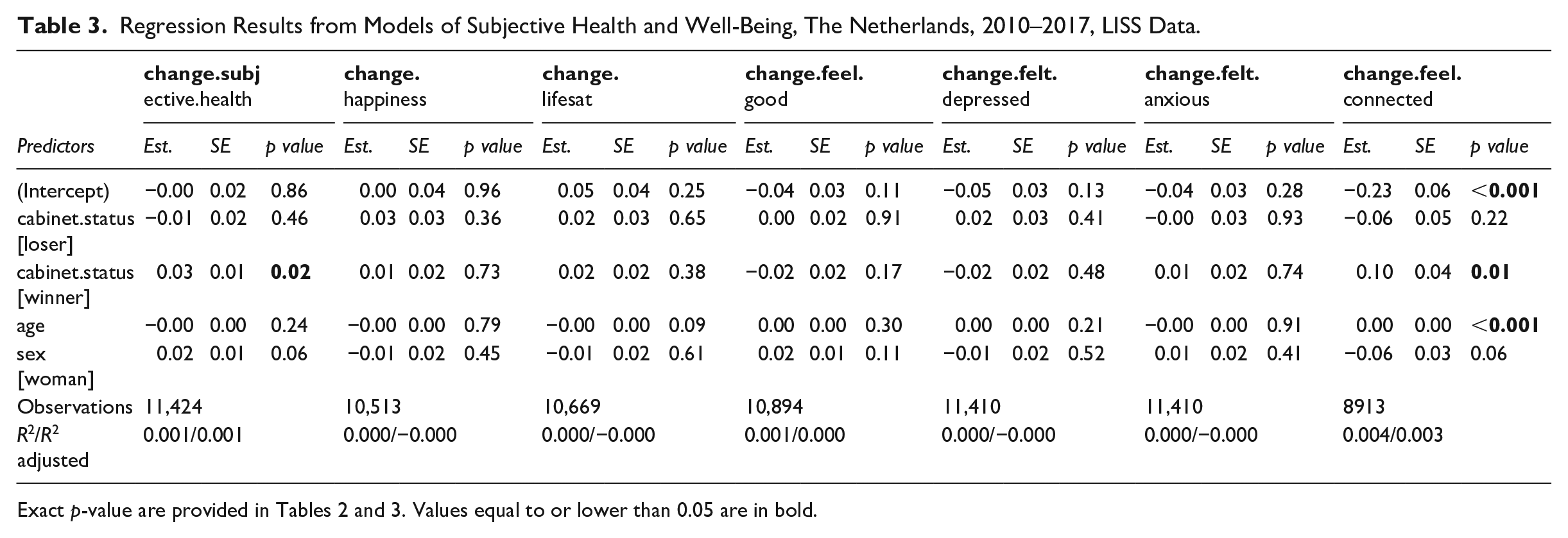
Table 3 reports the results from ordinary least square (OLS) regressions (the data for the three election moments have been pooled together). Altogether, the models do not capture very well the variation in the outcome variables (which is challenging since most of these indicators are rather stable over the period of 1 year for the same person). In five out of seven models, there is no evidence for significant effects of winner and loser status. There is also no evidence for moderating effect of political interest in the Netherlands (models not shown).
Regression Results from Models of Subjective Health and Well-Being, The Netherlands, 2010–2017, LISS Data.
Exact p-value are provided in Tables 2 and 3. Values equal to or lower than 0.05 are in bold.
When it comes to changes in subjective health, the winner effect is positive and significant. Similarly, changes in how connected people feel to others are positive and significant for winners as well. But even these two effects are small in substantive terms and not very robust to different specifications of the statistical models (e.g. the effect of winners on health is mostly driven by the 2017 election). When we apply a different definition of winners (voters for parties that form the next government), we find a positive effect in change in subjective health, but no other significant effects (see Supplemental Table A6).
There are several reasons which might explain why we do not find strong evidence for effects in the Netherlands. First, the dropout rate of participants between consecutive survey waves is considerable and, more importantly, it is related to the health status itself in a way that participants who are feeling unhealthy are much more likely to drop from the panel (see Table A6 from the Supplemental Appendix). So, it could be that the participants who do experience deteriorating health and well-being due to election losses are less likely to participate in the survey wave after the elections. This is consistent with the fact that we do find large differences in self-reported health between non-voters and supporters of parties that have very little chance of being in government (PVV, SP, PvdD), on one hand, and those who are frequently part of the government coalitions (VVD, CDA), on the other hand (see Part A7 of the Supplemental Appendix for details). Second, the way the health and well-being variables are measured might introduce ceiling effects, because if most supporters of a winning party already report the extreme value of, say, happiness, or complete absence of anxiety, the electoral win cannot increase the level of happiness even further or make the person even less anxious. Third, the timing of the survey waves is not ideal given the way the questions are phrased to capture the effects of election and cabinet formation moments. For example, the questions on anxiety and depression ask whether the respondents experienced these “in the past month,” while the election could have taken place earlier than that. Fourth, and finally, the Netherlands is a difficult context to find winner and loser effects because of the relative lack of extreme political polarization and the various ways for parties to be “winners” (getting more votes or getting in government despite getting fewer votes or getting out of a government that was unpopular with the party’s supporters). Recent research also finds that media framing might have a role to play in defining who is a winner after elections (Gattermann et al., 2021).
Conclusion
This article presented a comprehensive study of the effects of winning and losing democratic elections on life outlook, subjective health, and well-being. In addition to the well-documented effects on satisfaction with democracy and other political variables, we find that the effects extend to less studied and conceptually more distant constructs. Outside the domain of politics, we uncover significant gaps between winners and losers with respect to a number of indicators related to subjective well-being. Even if these gaps between winners and loser are not strictly speaking caused by winning or losing at the latest election, but reflect to some extent prior and more fundamental personal differences, they remain substantively important.
The gap between winners and losers is greater when we consider the subset of people with strong party attachments (partisans), for almost all outcomes. In line with coalitional psychology expectations, the more invested you are in the political game, the harder it is to lose, with consequences for everything from satisfaction with democracy to satisfaction with your own life. Hence, our results add to the existing evidence about the impact of politics and elections on emotions and other biological responses in majoritarian political systems, such as the US and the UK (Lench et al., 2019; Pierce et al., 2016; Pinto et al., 2021; Valentino et al., 2011), and we show that such effects can be found even in the European parliamentary democracies, many of which have proportional electoral systems. Yet, we do not find that the proportionality of the electoral system moderates the gaps, so it could be that it is institutional quality that matters rather than institutional types (cf. Dahlberg and Linde, 2016).
If being on the losing side of democratic politics is systematically related to being less happy, optimistic, satisfied in life, and even healthy, then it is not surprising for people to turn to anti-systemic parties or become politically disengaged altogether (Nowakowski, 2020). Such effects can also create vicious feedback loops, because poor subjective health and well-being is predictive of voting for right-wing populist parties (Kavanagh et al., 2021), which have a lower chance of winning a place in government, due to the existence of cordon sanitaire around these parties in many countries in Europe.
It is also noteworthy that most effects we see are weaker in old, established democracies. Thus, the moderating effect of the experience with democracy found by Anderson et al. (2005) with data from 1999 persists, although even the “new” democracies in our sample have transitioned from authoritarian rule more than 20 years before the data were collected. This implies that democracies might take very long to mature. At the same time, the fact that we find much weaker evidence for effects of elections on well-being in the Netherlands suggests that such effects can be muted or disappear altogether in the stable, coalitional politics of mature consociational democracies, especially when institutional quality is high. The Dutch case being a priori a hard case to find winner–loser effects, researchers should also examine panel evidence from countries with more confrontational styles of politics, lower institutional quality and more clear-cut changes in government in the follow-up of elections. This is challenging, however, given the scarcity of data sources that track both political and (subjective) health and well-being-related variables.
Further research is also needed to establish whether the effects we find stem from winners getting more positive, losers getting more negative and pessimistic about their future, or both; whether the effects are cumulative over time; and how long they last. It would also be valuable to test the hypotheses with other kinds of data and research designs to probe both the generalizability of the findings to other geographical regions. Our findings suggest that empirical political scientists should cast a much wider net when they consider the consequences of winning and losing elections. In theoretical terms, seeking explanations for the effects of elections should continue integrating insights from other disciplines, such as cognitive and social psychology, biology, and physiology. This can help to build more comprehensive theory of why and how political outcomes, like winning or losing elections, affect citizens’ socio-political worldview, psychological well-being, and health.
To conclude, the consent of losers is necessary for the well-being of democracy, but it hurts to be an election loser, and apparently this can affect anything from your assessment of the importance of democracy to how happy, healthy, and optimistic you feel. If repeated losing has detrimental psycho-somatic consequences, this finding raises important concerns about the sustainability of democratic societies, in which some citizens consistently find themselves on the losing side of politics.
Supplemental Material
sj-docx-1-psw-10.1177_14789299221124735 – Supplemental material for Does the Election Winner–Loser Gap Extend to Subjective Health and Well-Being?
Supplemental material, sj-docx-1-psw-10.1177_14789299221124735 for Does the Election Winner–Loser Gap Extend to Subjective Health and Well-Being? by Dimiter Toshkov and Honorata Mazepus in Political Studies Review
Footnotes
Declaration of conflicting interests
The author(s) declared no potential conflicts of interest with respect to the research, authorship, and/or publication of this article.
Funding
The author(s) received no financial support for the research, authorship, and/or publication of this article.

Supplemental material
Notes
Author Biographies
References
Supplementary Material
Please find the following supplemental material available below.
For Open Access articles published under a Creative Commons License, all supplemental material carries the same license as the article it is associated with.
For non-Open Access articles published, all supplemental material carries a non-exclusive license, and permission requests for re-use of supplemental material or any part of supplemental material shall be sent directly to the copyright owner as specified in the copyright notice associated with the article.
