




Abstract
Far-right parties often depict their ideas as ‘common sense’ and as self-evident, natural, just, and proper. This article examines the extent to which there is a uniform ‘far-right common sense’. Using a mixed-methods computational approach, we analysed Twitter posts mentioning ‘common sense’ from the accounts of far-right parties in the UK, France, Italy, and the USA between 2008 and 2022. Results from our comparative study suggest that uniformity in far-right constructions of common sense is limited by varying socio-economic/political contexts. Meanwhile, our analysis also opens the door for future research on the role of mainstream actors in the legitimisation of reactionary common sense narratives.
Introduction
The past decades have witnessed several instances of far-right politicians claiming to be torchbearers for ‘common sense’ and/or ‘sensible politics’. While a shaping of common sense narratives is not exclusive to the far-right (Crehan, 2018), the use of such discourse by a political entity whose ‘politics of fear’ (Wodak, 2020) either derive from or are strongly influenced by fascist ideology (Richardson and Wodak, 2009), constitutes a particularly insidious challenge to democracy. Specifically, the use of social media platforms by far-right parties in different countries to depict reactionary politics as ‘self-evident, natural, just, and proper’ (Pasieska, 2022), represents a specific puzzle regarding the transnational element of far-right constructions of common sense. Indeed, the extent to there is uniformity in terms of themes and discourse, represents an under-researched area in the field of populism and far-right studies. Our paper poses the following research question: To what extent did populist far-right parties construct a uniform common sense narrative via Twitter between 2008 and 2022?
This question holds significant implications in terms of the mainstreaming and normalisation of far-right politics which has accelerated in many Western democracies in recent years (Mondon and Winter, 2020; Brown et al., 2023). To address the question, our article analyses the social media narrative of populist far-right parties, specifically focusing on Twitter, in four countries - the UK, France, Italy, and the USA. These are all examples of liberal democracies in which over the past two decades, populist far-right parties/individuals have either held office and/or significantly influenced the position of the so-called liberal mainstream. However, from an institutional point of view, the four countries are very different. The UK employs a parliamentary democracy with a constitutional monarchy, France has a parliamentary system with a semi-presidential model, Italy adopts a parliamentary multiparty democracy, and the USA utilizes a presidential democracy with a majoritarian electoral system and a two-party structure. To examine phrases containing ‘common sense’ and/or ‘sensible’ from the official Twitter accounts of populist far-right parties in these countries, we blend mixed methods computational language analysis with a Gramscian-inspired ontology regarding common sense.
The first section is concerned with establishing essential definitions for analysing the populist far-right, common sense, and how social media can be used as a tool to mainstream far-right ideology. Having established these ontological framings, section two introduces the mixed methods approach and outlines the data collection technique and case study selection based on the four chosen countries. Section three presents our findings from this analysis prior to discussing the main convergences and divergences which emerge in terms of far-right framings and constructions of common sense in four different countries. To conclude, section four reflects on the implications of this study, offering insights into future avenues of research which might examine how far-right common sense narratives have been employed by the liberal mainstream.
Populist far-right, common sense, social media
In this article we use ‘populist far-right’ to refer to parties which espouse a racist ideology which is, at times, articulated via a populist discourse. This is an ontological and epistemological choice inspired by ethical approaches to analysing the far-right which focus principally on racist ideology, while recognising the secondary role of populism as a political logic/discourse (Mondon, 2022; Mondon and Winter, 2020; Vaughan et al., 2024). The semantic ordering of this paradigm (i.e., ‘populist far-right’ as opposed to ‘far-right populist’), reflects this, interpreting populism is secondary feature of these parties’ politics, with far-right ideology forming their main raison d’être (Mudde, 2007).
The term far-right, has been identified as an umbrella term for ‘radical right’ and ‘extreme right’ movements (Pirro, 2022; Mudde, 2019) thus re-emphasising a binary between these two definitions. Although this approach helps ‘categorise notable differences […] we also need to avoid “becoming overly preoccupied with ‘fundamental’ or ‘essential’ ideological differences” between and within far-right parties and movements’ (Shroufi, 2024: 15–16; see also Copsey, 2018: 117). While acknowledging that there are limitations to any analytical framework (Shroufi, 2024), we believe the paradigm which currently comes closest to addressing this is that of Mondon and Winter’s (2020) definition of far-right as “movements and parties that espouse a racist ideology, […], notably by focusing on culture and/or occupying the space between illiberal and liberal racisms, between the extreme and mainstream” (2020, p.19).
Defined here as ‘an ideology which divides humans into distinct ‘races’, racism creates ‘in-groups’ and ‘out-groups’ via a process of racialization i.e., ‘the instigation of “groupness”, and ascription of’ (physical and/or cultural) ‘characteristics as if they were natural and innate to each member’ (Garner and Selod, 2015). 1 As part of a ‘politics of fear’ i.e., the construal of ‘an ethnic/religious/linguistic/political minority’ as ‘dangerous and a threat to ‘us’ and ‘our nation’ (Wodak, 2020) the racist ideology of the far-right is complemented by nativist and authoritarian discourse. Regarding nativism, this can prove a useful concept as ‘a precise way of identifying a specific form of racism’ (Brown, 2023: 27). Nativism is defined here as a racist discourse structured around an exclusionary vision of the nation, that juxtaposes the native - as a disadvantaged and threatened ‘in-group’ - against a racialised non-native ‘out-group’ (Newth, 2023: 172). This discourse helps account for how the figure of ‘the immigrant’ has been consistently depicted as an ‘existential threat’ to the nation-state in far-right ideology (Sengul, 2022: 50). This often takes the form of Great Replacement narratives which depict immigration as an ‘invasive stratagem’ orchestrated by a ‘globalist elite’ (Ekman, 2022).
Authoritarianism meanwhile is a “set of practices centred around a rigid notion of authority that is characterised by the employment of actions/policies that aim to consolidate a strictly ordered society, limit accountability and counter deviance” (Katsambekis, 2023).
Such practices may entail advocating for ‘moral’ or ‘traditional values’ regarding ‘family, sexuality and law and order’ (Mudde, 2019: 29–30; Zaslove, 2011: 107), the reinforcement of traditional gender roles (Donà, 2021) and the targeting of LBGTQ + communities (Blee, 2020). Further to these exclusionary logics, however, far-right parties often articulate their ideology as embodying ‘the people’ as the ‘underdog’, juxtaposed against ‘the ruling class’ or ‘the establishment’ (Rodi et al., 2023). This brings us to populism. The prefix ‘populist’ in our paradigm refers to “a dichotomic discourse in which […] “the people” is discursively constructed as a large powerless group through opposition to “the elite” conceived as a small and illegitimately powerful group” (Stavrakakis and De Cleen, 2017: 310). Far-right actors may, therefore, at times construct the people as an ‘exclusive collective subject, united through references to a common ethnic origin, language, heritage and religion’ (Katsambekis, 2017). The focus on populist language as social practice, which is at the heart of this discursive approach, holds affinities with existing scholarly work on far-right parties’ populist communication strategies via social media (Pérez-Curiel et al., 2021; Rivas-de-Roca et al 2022). 2 Prior to examining this, we turn to how acting in the name of a ‘reactionary people’ can be used to ‘legitimise certain reactionary positions’ (Mondon 2022) via an exaltation of ‘common sense’.
Common sense, populism, and the far-right
Common sense discourse in politics is by no means a new development. In 1776, Thomas Paine’s pamphlet entitled ‘Common Sense’ advocated for American Independence (Epstein, 2018). Common sense was articulated as ‘a basic, instinctive, immediate, and irrefutable form of perception and judgment natural to all humans […] a critical source of incontrovertible and self-evident knowledge’ (Rosenfeld, 2014: 142). It is this emphasis on ‘self-evident knowledge’ which tends to prevail in everyday understandings of common sense as tantamount to ‘wisdom, reason, and authority’ (Hall and O’Shea, 2013). In this article, we instead draw on Antonio Gramsci’s term senso comune which differs from its direct English translation of common sense insofar as ‘it refers to that accumulation of taken-for-granted “knowledge” to be found in every human community’ (Crehan, 2018). Senso comune emphasises common sense’s reactionary, incoherent, and contradictory nature, while distinguishing it from ‘good sense’ and/or ‘perceived wisdom’. Common sense, therefore, manifests itself as the incoherent stratification of worldviews, prejudices, and beliefs […] the plurality and incoherence of common sense contribute to reproducing domination, because they fragment individual wills and prevent the formation of collective wills as an alternative to the dominant one
3
(Filippini 2017: 110).
This incoherence means that it can ‘encompass contradiction and facts that shift over time’ (Crehan, 2018: 278). Furthermore, common sense holds a ‘crudely neophobe and conservative nature’ (Gramsci, 1971: 423), meaning it contains ‘the most reactionary ideas’ (Filippini, 2017: 110; Scott, 2022: 333). In terms of how this Gramscian understanding of common sense is evident in both populist and far-right discourses, we consider not only the incoherent and reactionary components, but also the ‘theft of Gramsci’ by far-right actors (Pasieska, 2022). As Scott highlights, populist actors “rely on the incoherence of common sense to bind together a loose alliance of disaggregated groups […], but all of whom consider their own knowledge as ‘common sense’” (2022, p. 333). Meanwhile, Wodak (2020: 2) highlights how such ‘appeals to common-sense and anti-intellectualism mark a return to pre-modernist or pre-Enlightenment thinking’, an endorsement of ‘what can be recognized as the “arrogance of ignorance”
However, the role of common sense narratives in far-right politics goes beyond a people versus elites dichotomy. As Mondon (2015: 392) notes, a growing acceptance of far-right ‘“common sense” is the result of very carefully crafted strategies put in place by extreme right thinkers since the 1980s’. In making ‘racist rhetoric appear to be an extension of a common-sense knowledge shared by many’ (Garcia-Jaramillo et al., 2023; Loftsdottir, 2021) far right parties use what Alain de Benoist referred to as a ‘Gramscian of the Right’ strategy 4 (Pasieska, 2022), which relies on common sense’s reactionary, fragmentary and incoherent nature. As a form of ‘calculated ambivalence’ (Wodak, 2003) 5 common sense becomes a euphemism which serves to ‘extend the limits of what kind of political rhetoric is acceptable and thus enable the normalization and institutionalization of racism in the public sphere’ (Hatakka et al., 2017; see also Engel and Wodak, 2013). Common sense discourse therefore holds the potential to contribute to wider processes of normalisation and mainstreaming of reactionary politics (Brown et al., 2023; Mondon and Winter, 2020, see also Krzyzanowski, 2020). Such discursive processes often take place via social media, to which this article now turns.
Social media, and the populist far-right
Social media offers political actors ‘an environment that [...] serves the creation of meaning and the dissemination of value’ (Battista, 2023: 118) thus, providing fertile ground to discursively (re)construct their identities. Far-right actors have also been beneficiaries of ‘the vague [regulatory] policies and the algorithmic clustering of social media content and groups’ which facilitate the ‘distribution of hostile and racist content’ (Ekman 2019; Nikunen 2018: 13). The result has been a disproportionate amplification of far-right ideas which contributes to a further blurring of the boundaries between the extreme and the mainstream (Ekman, 2019; Gallaher, 2021). Perez-Curiel et al. (2021) and Rivas-de-Roca et al. (2022) highlight how far-right actors use Twitter to present ‘opinion as facts’ and gain ‘direct contact with “the people”’. The veneer of direct communication between users and political figures caters to the far-right’s frequent self-depiction as the vox populi, thus compounding this process of normalisation of far-right politics (Engesser et al., 2017; Mondon and Winter. 2020).
For the far-right the Internet offers a powerful tool to reach followers and spread their ideology’ amongst like-minded groups (Heritage and Koller, 2020; Klein and Muis, 2019) while also enabling a transnational communication of far-right actors and communities via social media (Froio and Ganesh, 2019). Indeed, social media platforms such as Facebook and Twitter, enable the far-right to connect with a larger audience than ever before’ and ‘content shared via these networks [...] includes the construction of interpretive frames which help to define the issues around which to mobilise’ (McSwiney, 2021). One key interpretive frame is that of new constructions of common sense, purportedly offering ‘frameworks of meaning with which to make sense of the world’ (Hall and O’Shea, 2013). Far-right actors have sought to shape their narratives via social media, while delegitimising the EU and rearticulating fascist narratives (Zappetini and Maccaferri, 2021). Furthermore, as Padovani (2018) illustrates, the leader of the Lega, Matteo Salvini used Twitter to reinforce ‘hegemonic forms of immigration discourse’ via the promotion of an anti-immigration march in 2014. The mainstreaming of far-right conspiracy theories such as ‘great replacement’ as common sense narratives also owes much to the online communication facilitated by YouTube (Awad et al., 2022; Ekman, 2022). Meanwhile, Krzyzanowski (2018) via the Polish far-right law and justice party’s Twitter account, identified the “peak” moments when debates on immigration and the relevant discourse intensified’ to examine a normalisation of anti-immigrant discourse. Existing literature on populist far-right parties and social media tends to analyse how populist far-right politicians including Donald Trump (Crehan, 2018), Jair Bolsonaro (Lugo-Ocando, 2020) and Nigel Farage (Pitcher, 2019) have attempted to shape far-right common sense. Such studies, underscoring the importance of leader discourse, analyse politicians’ personal social media accounts (Pérez Curiel, 2020). The following section outlines how this article breaks with this trend: to focus on a period spanning more than 10 years, we focus not on personal Twitter handles of party leaders (which are subject to change), but those of the official party account.
Cases, context, and methodology
In line with our conceptual framework, we selected four cases from the UK, USA, France, and Italy. Regarding the UK, both the UK Independence Party (UKIP) and the British National Party (BNP), while holding different origins, share common populist and far-right repertoires of discourse and action. For the USA, the Republican Party has in recent years been increasingly examined as both populist and far-right. Meanwhile in France and Italy respectively, the Front National/Rassemblement National (FN/RN); and Fratelli d’Italia (FdI), and the Lega represent paradigmatic cases of populist far-right parties.
Populist far-right parties.
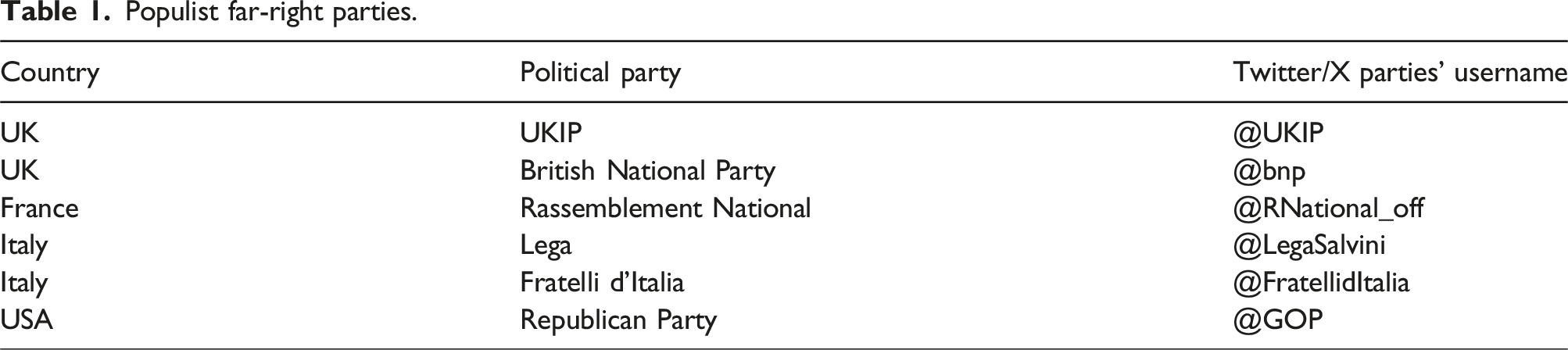
Twitter/X in particular remains a crucial communication tool for all parties, enabling them to bypass the mainstream media and directly connect with their electorate, free from intermediary filters or third-party delegations (Stier et al., 2018). We collected data exclusively from the official Twitter accounts of all ‘relevant’ political parties in the UK, France, Italy, and the USA. To determine relevance, we used political parties mentioned by the Poll of Polls provided in the POLITICO website as a point of reference.
6
The data collection period for our study extended from the first tweets published by these accounts to the most recent date at the beginning of our data collection, encompassing the period from 02/02/2008 to 24/10/2022. To filter the tweets associated with the ‘common sense’ discourse, we employed a dictionary-based analysis, using specific keywords and hashtags such as “common sense”, “#commonsense”, “sensible”, and “#sensible”. As a result, we identified 4241 tweets in total, including 506 tweets from the UK, 610 tweets from France, 1928 tweets from Italy, and 238 tweets from the USA. Figure 1 below illustrates the distribution of tweets containing ‘common sense’ discourse across party families in all four countries. This indicates that populist far-right parties, here referred as “Nationalist and radical right parties” from the Comparative Manifesto Project, have been dominant in publishing ‘common sense’ narratives since 2018.
6
Number of ‘Common-Sense’ tweets published on Twitter.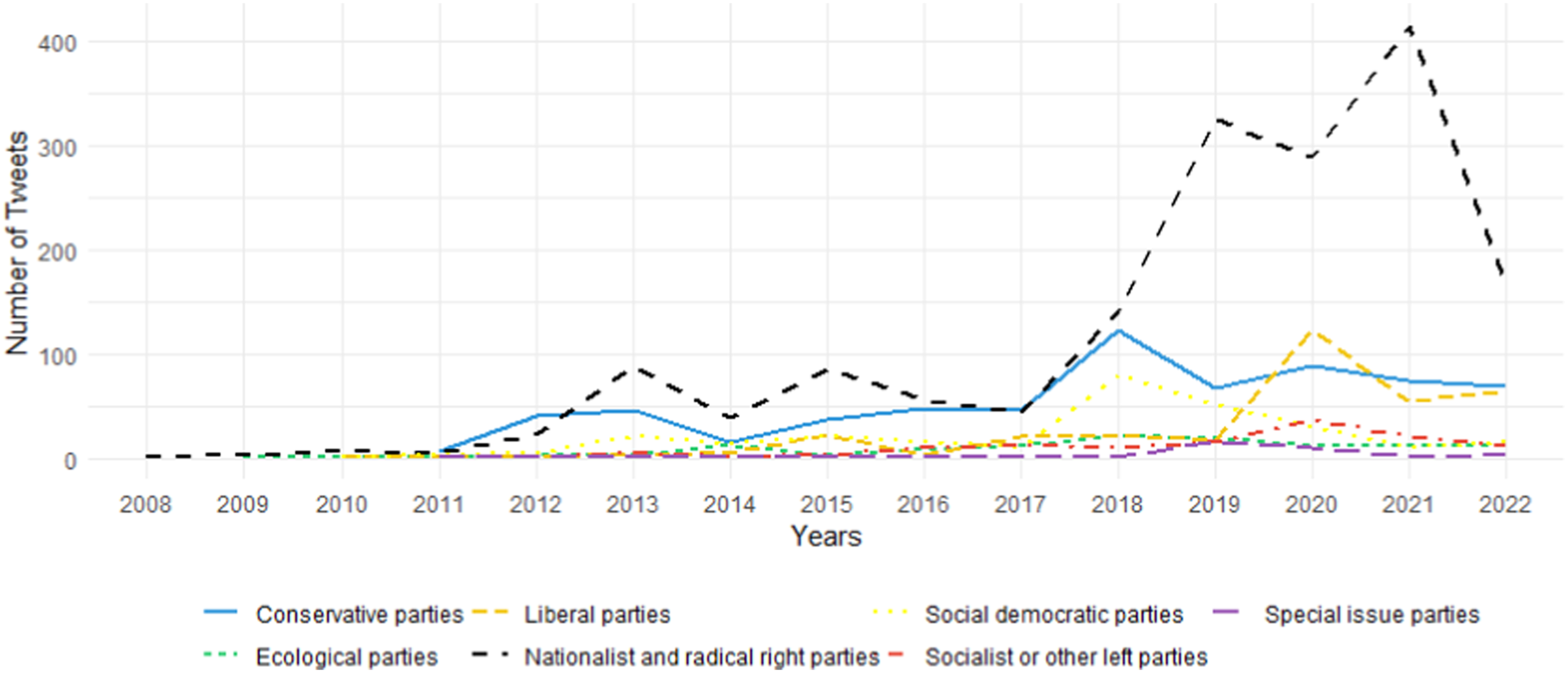
List of keywords associated with populist far-right discourses.
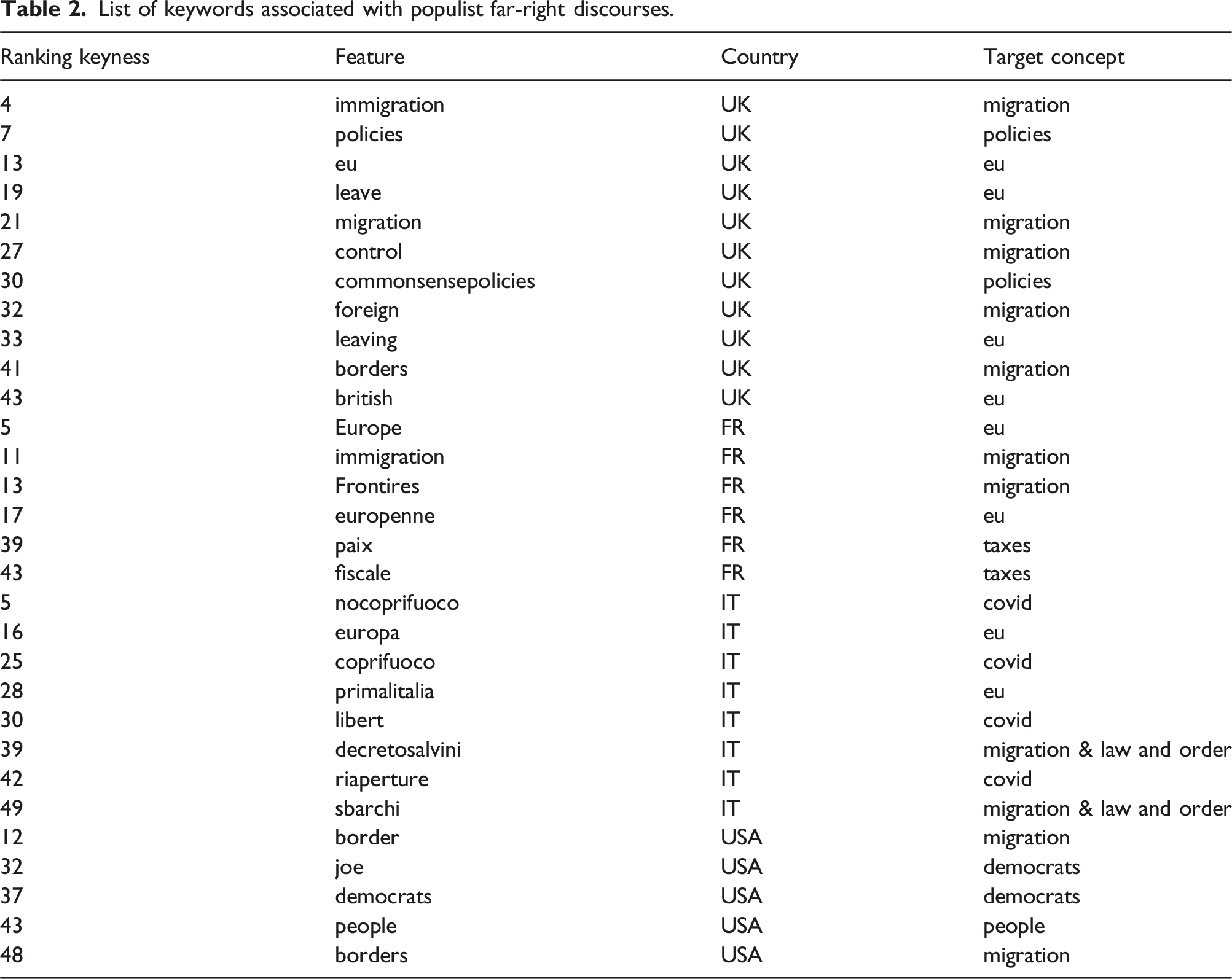
Following this, we used co-occurrence networks in which nodes represent features that most frequently co-occur with our target feature, and the edges represent the frequency of co-occurrence. This visual representation aids our understanding of how the far-right addresses the target feature (or concept) highlighting differences and similarities between the case studies.
Results
Far-right common sense in the UK
Analysis of the UK far-right’s construction of common sense via Twitter draws on analysis of the key words of policies, migration and the EU.
Figure 2 illustrates how both the BNP (@bnp) and UKIP (@UKIP) positioned themselves as ‘a common sense party’ with and urged voters to choose ‘common sense policies’ that will ‘make Britain better’ or ‘make Britain great again’. These often referred to racist notions of ‘dealing with Islamists’, ‘a ban on non-Brits buying social housing’, ‘defending British culture’ and ‘sensible/common sense immigration policies’ to ‘end the madness of mass immigration’. While the BNP stated that ‘a moratorium on immigration is needed immediately. #BNP policies: Pure common sense, UKIP argued claimed it was ‘not against a sensible, balanced, immigration policy but wants to stop having an open door!’. Co-occurrence network of target_policies in UK.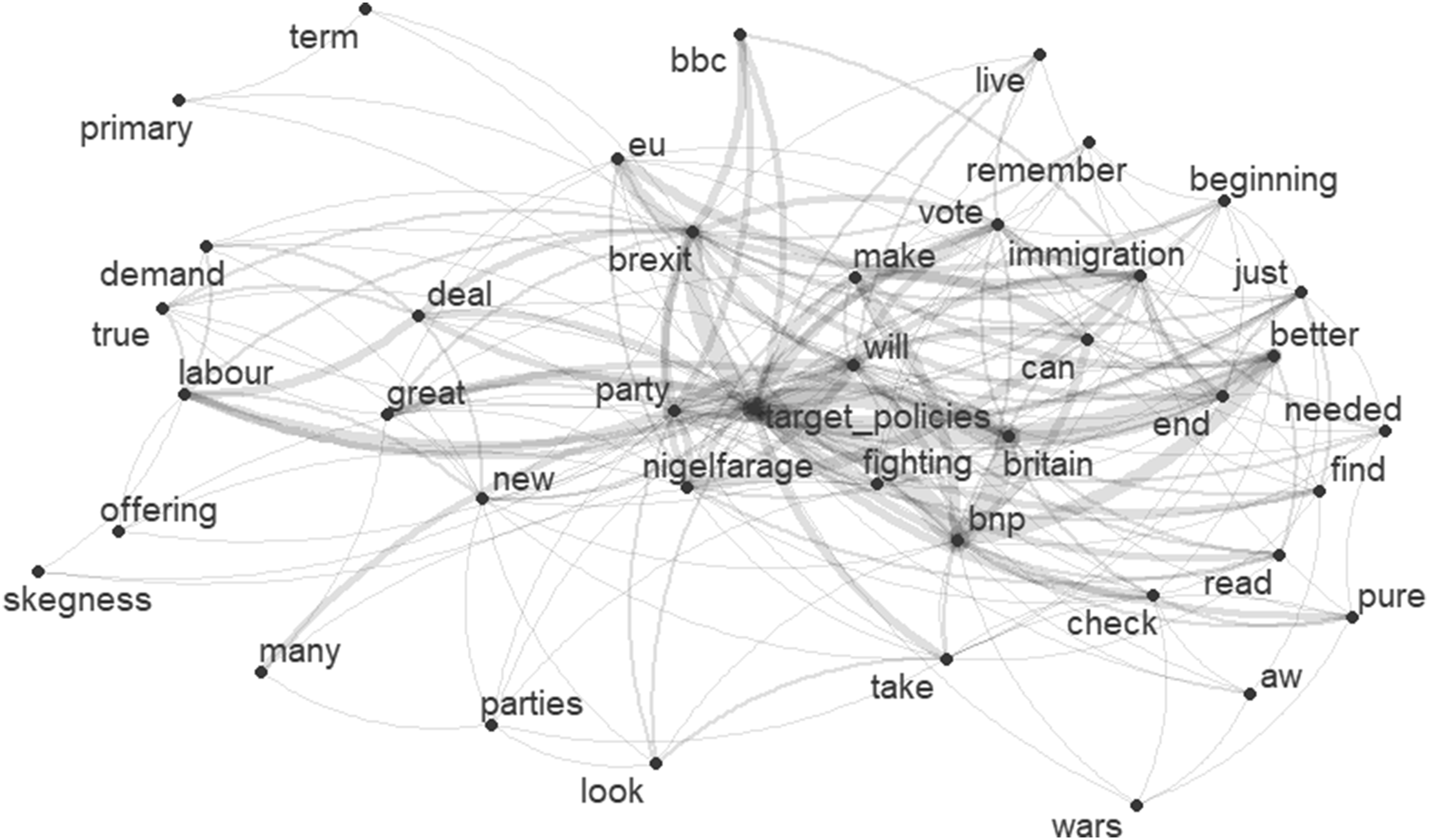
Two clusters to the right of Figure 3 refer to the release of a campaign video with a tagline of, ‘controlling your borders and looking after your own people first isn't right-wing or left-wing, it’s plain common sense’. In an ‘outright denial of racism’ (Lentin, 2020: 55), this video stated that ‘concerns with excessive immigration, are nothing to do with race’ but instead about ‘space, resources, schools and hospitals’ and that ‘it’s not racism, its realism’. UKIP claimed that its ‘immigration policy […] is based on fairness, and common sense and later that it wanted to ‘introduce a sensible Australian style points based immigration system’. Meanwhile towards the top of the cluster are ideas of a housing crisis caused by migration. With UKIP stating that ‘if you want to solve the housing crisis you need to control migration. It’s common sense’. Co-occurrence network of target_migration in UK.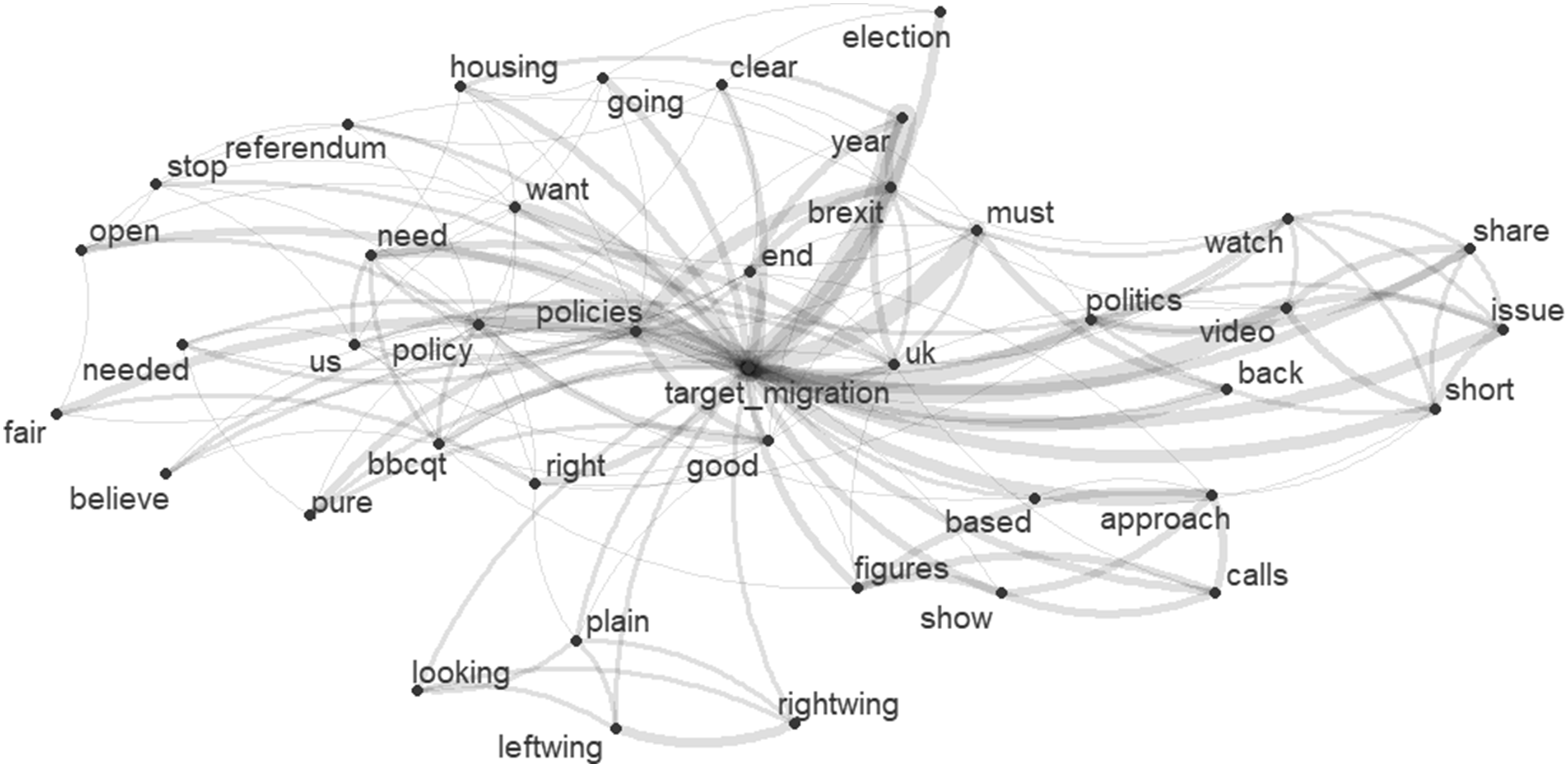
Migration represented a significant overlap with the target word EU in Figure 4. UKIP argued that ‘only by voting to Leave the EU in the forthcoming referendum can we have a system of controlled immigration at sensible levels’. Indeed, the word ‘voting’ indicates the centrality of the 2016 referendum to the far-right construction of common sense in the UK. relates to tweets that ‘staying in the EU risks our NHS – voting leave isn’t a risky choice, it’s the sensible one’, that ‘voting to leave the EU is the only sensible option’. The UK far-right depicted Brussels as ‘running scared of British common sense’. Meanwhile, the victory of the Leave campaign instigated a paradigm shift. UKIP now argued it was ‘perfectly sensible to leave the customs union completely’ and that EU negotiators were ‘EU nationalists’ who were insistent on ‘declaring war on any sensible negotiation process’. The focus of an irrational set of enemies intent on waging a war against common sense/sensible politics was not exclusive to the UK, emerging also in the US case study to which this article now turns. Co-occurrence network of target_eu in UK.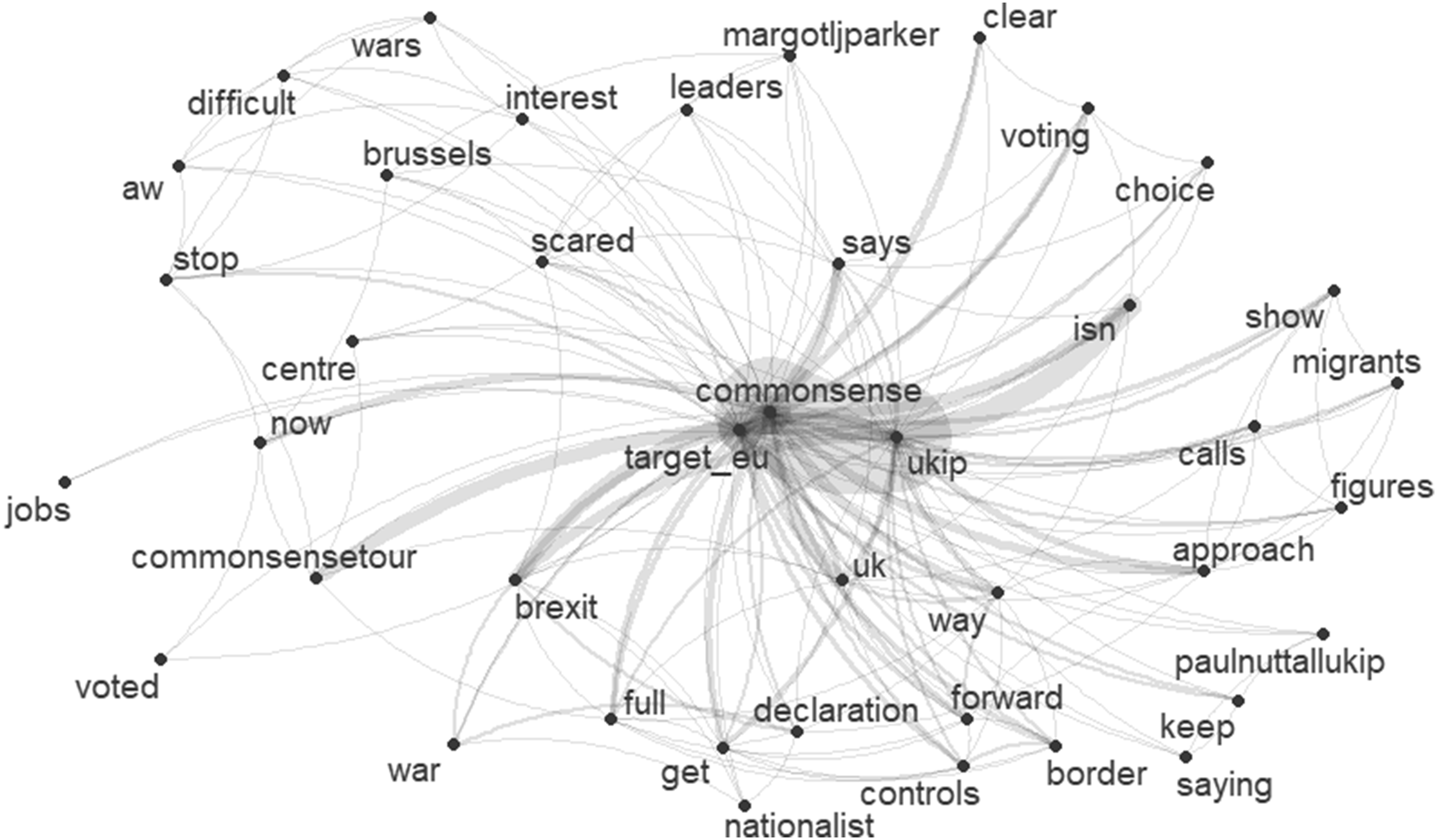
Far-right common sense in the USA
The following analysis focuses on Republican (@GOP) constructions of common sense around the target words, of ‘the people’, ‘borders’ and ‘democrats’.
Figure 5 focuses mainly on tweets linking ‘common sense’ to the ‘American people’. A retweeted interview of Vice President, Mike Pence states that ‘The American people are going to continue to be drawn to this President’s consistent, common sense, conservative leadership’. Later, in 2021, Republican Party chairwoman Ronna McDaniel claimed Republican gains in mid-term elections reflected a ‘common sense ballot’ and that the ’American people were with the Republicans’. Republican candidates were referred to as ‘common sense business people’, juxtaposing these candidates against what they depicted as Democrats’ calls for ‘socialism’. The majority of tweets represented here overlap with Figure 6 insofar as they relate both to ‘bipartisanship’ and ‘borders’. One significant cluster in the cluster in the centre of the matrix, refers to ‘common sense protection of borders’ and the claim that ‘this makes common sense to the American people - that if someone has broken the law, is here illegally, comes back five times - that is why folks want the wall built.” Co-occurrence network of target_people in USA. Co-occurrence network of target_democrats in USA.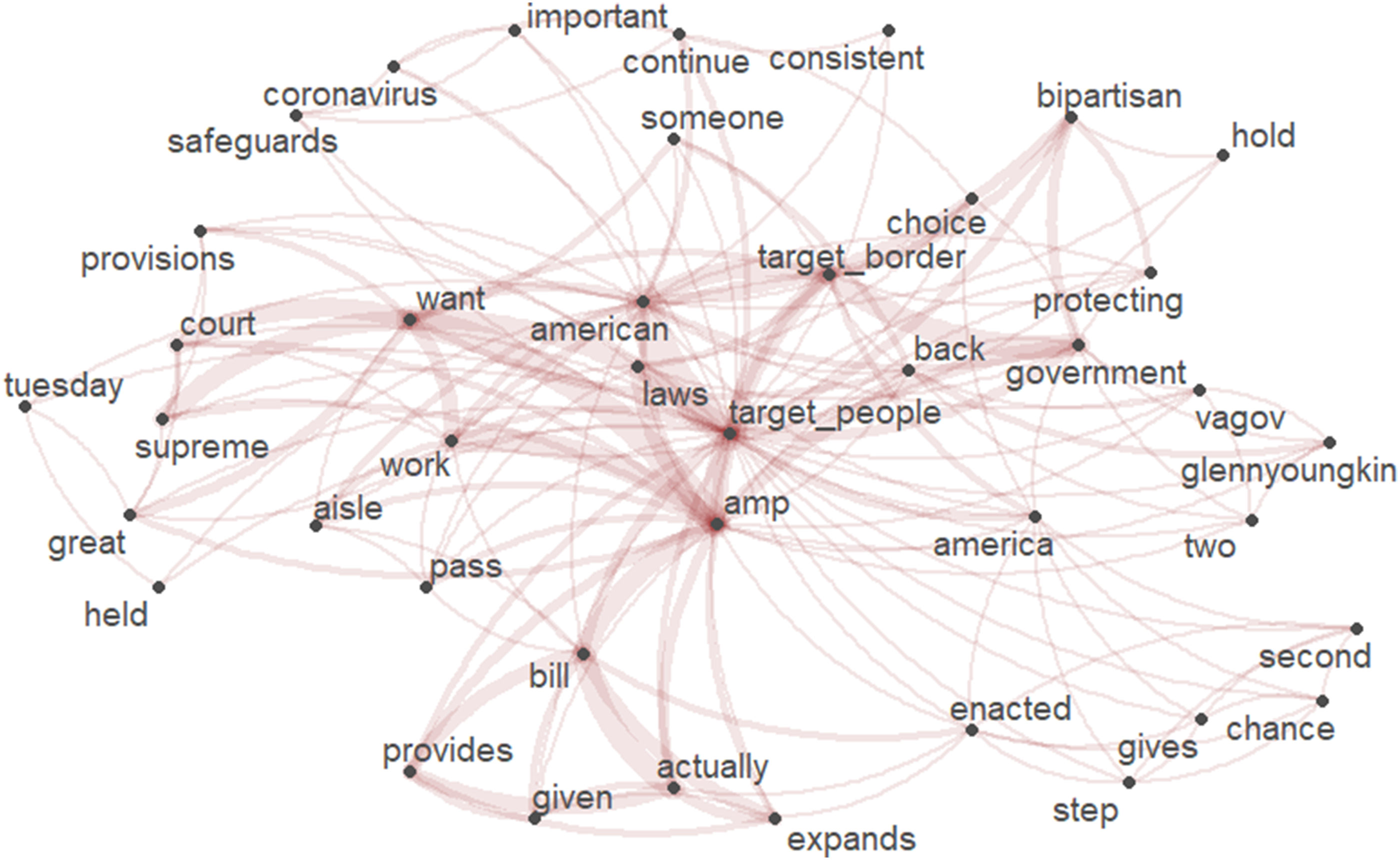
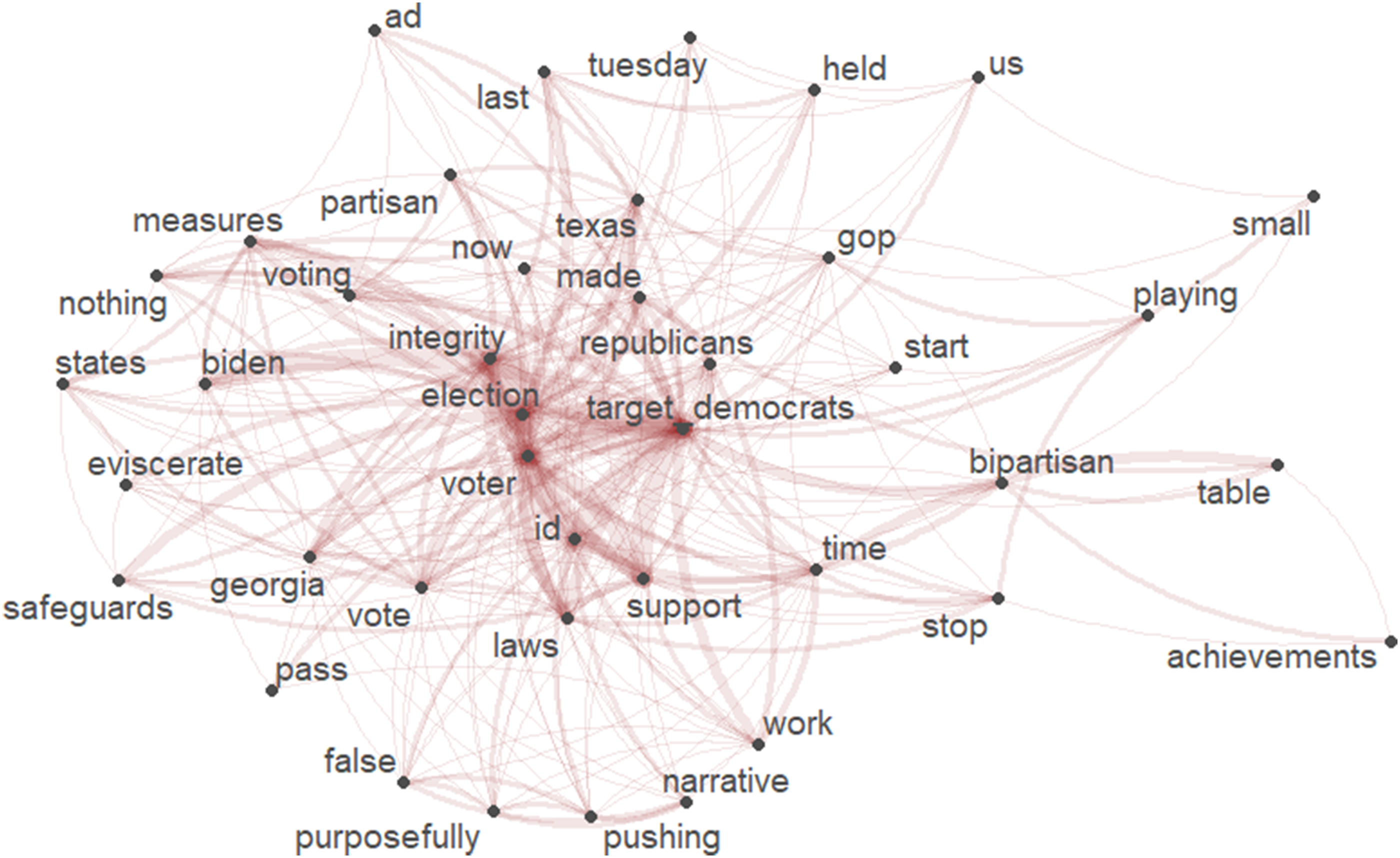
Figure 6 centres on the target word border which relates predominantly to humanitarian crisis at the US-Mexico border. Trump’s ‘zero tolerance’ approach to migration were depicted as ‘neither left nor right’ but a ‘common sense compromise’. This centred on the argument that ‘One would think that securing our homeland, controlling our borders, and protecting the American people would be uncontroversial, common sense, bipartisan priorities’. Tweets centring around the words ‘President’ and ‘@realDonaldTrump’ depicted Trump as making a ‘common sense offer to fix our border crisis’ and that Republicans would ‘offer common sense, bipartisan solutions [...] if Democrats will come to the table’. This depicted the Republicans as reasonable, rational actors, while presenting the Democrats as intransigently opposed to common sense measures.
The centrality of the word ‘integrity’ Figure 7 relates to the Election Integrity Act of 2021 - a Republican effort to reform voting laws in the southern state of Georgia
7
. This law - widely viewed by critics as an act of voter suppression targeting Black communities made it harder to vote by mail, and gave the state legislature more power over elections. This was an extension of the ‘stop the steal’ narrative inspired by the far-right Q-Anon movement, which depicted Donald Trump as the rightful winner of the 2020 presidential elections. The Republicans accused Democrats of a ‘power grab’ and an attempt to ‘eviscerate’ democracy: stating that ‘Biden and the Democrats are weaponizing the Department of Justice to attack commonsense election integrity laws’. The Republican Party framed Democrats opposition to ‘common sense voter ID laws’ as ‘bad faith attacks’ and against ‘what the vast majority of the American people’ think. This construction of a reactionary people via common sense narratives is also present in the case of the far-right in France. Co-occurrence network of target_border in USA.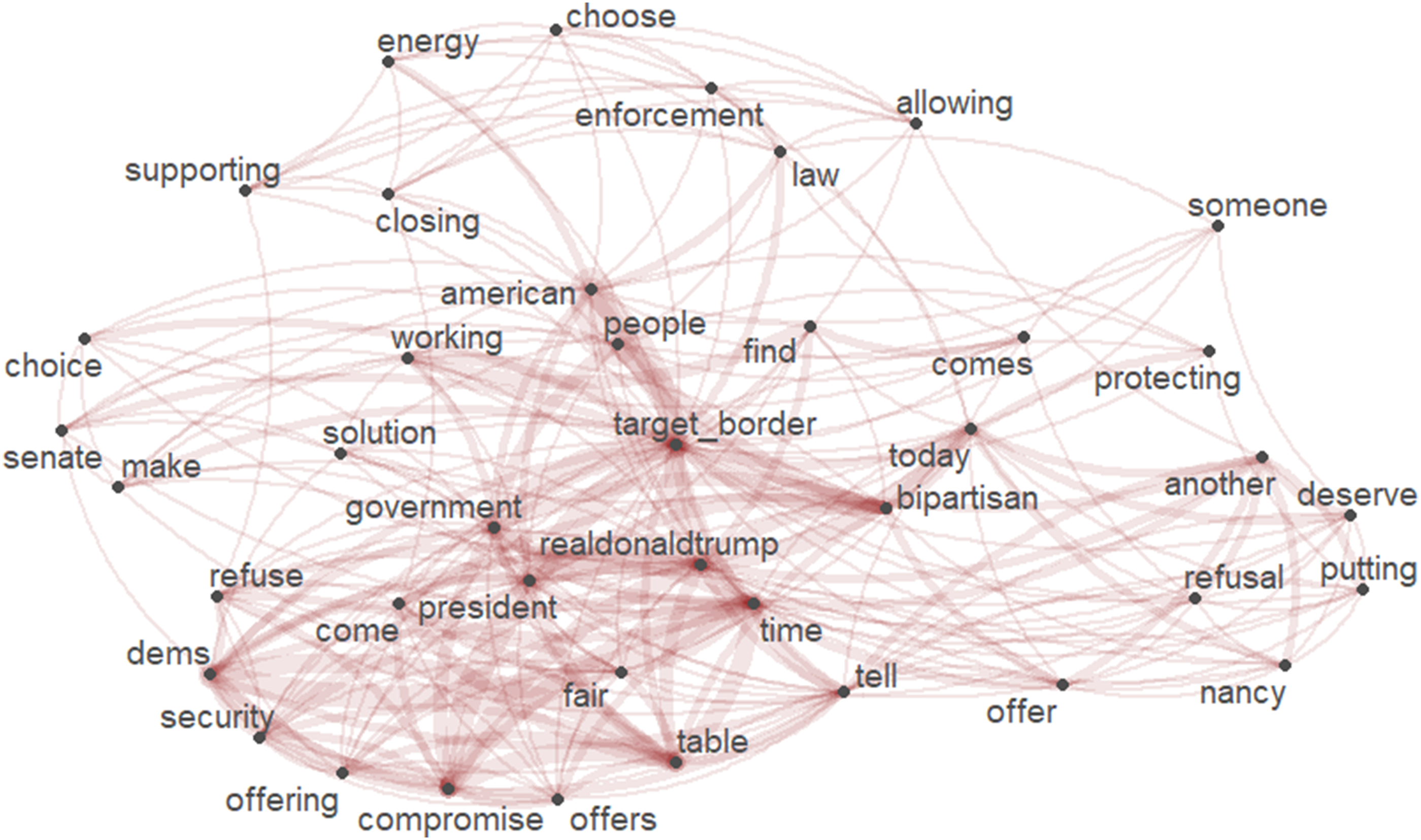
Far-right common sense in France
Analysis of the RN’s (@RNational_off) social media discourse reveals three significant target words relating to common sense: ‘EU’, ‘migration’ and ‘taxes’.
Figure 8 highlights features such as ‘nations’, ‘Macron,’ ‘français’, and ‘peuples’, constructing a clear distinction between “a Europe of common sense” - which promotes and normalises racist concepts like ethnopluralism, closed borders, and national sovereignty versus the federalist project of the European Union or “Macron’s Europe”. There is a significant overlap with ‘migration’: during the Covid-19 Pandemic the RN stated ‘the technocrats of Brussels refuse to leave their ideological system! Closure of borders and containment measures: the European Nations have compensated for the inaction of the EU with measures COMMON SENSE!'. Tweets calling for a ‘common sense revolution’, via ‘the general mobilization of European patriots'. This is presented as a solution to the perceived problems and deficiencies of the existing European system and its elites aiming to “return power to the people”. Co-occurrence network of target_eu in France.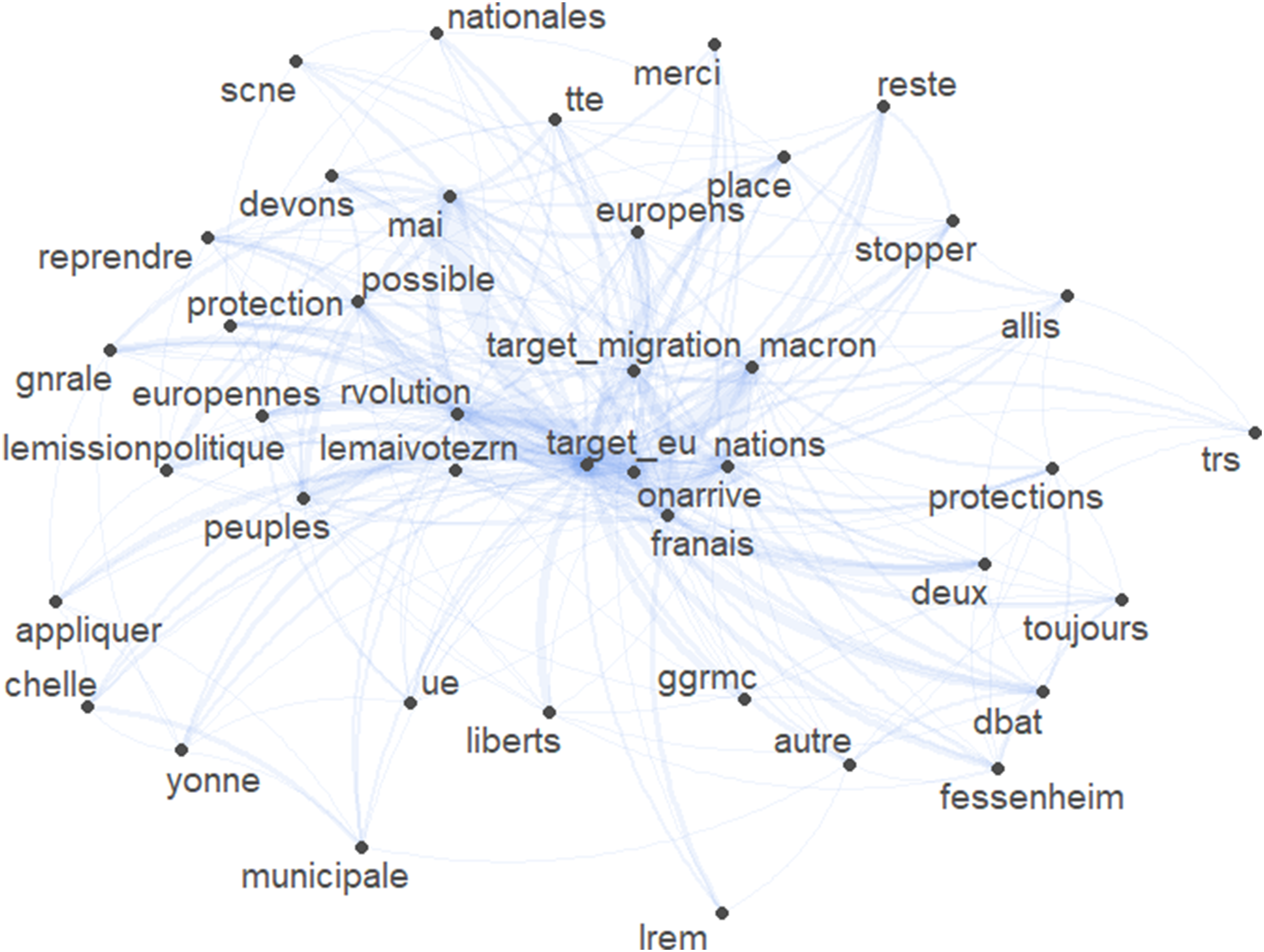
Meanwhile, words in Figure 9 such as ‘rétablir’, ‘protéger’, and ‘migratoire’ frame the immigration issue in a language of fear arguing ‘Let’s stop the migratory submersion, restoring national borders that protect, cutting off the tap of social aid to the whole Earth, that’s called COMMON SENSE!’. Tweets relating to migration also overlap with ‘common sense’ approaches to fiscal issues, stating that ‘there are common sense savings to be made before always hitting the same tax points: the European Union, mass immigration, tax evasion […], the tax gifts given to the richest’. This includes immigration issues, as exemplified by the feature “PJLAsileImmigration”, which refers to a proposed bill regarding asylum for immigrants. Forging a link between economic matters such as tax reduction for support for small and medium-sized enterprises (SMEs) and immigration, the RN stated that ‘support for SMEs or stopping immigration is not left or right: it's common sense!’. This emphasises that ‘common sense’ policies should benefit exclusively what the party depicts as ‘native’ French citizens. Co-occurrence network of target_migration in France.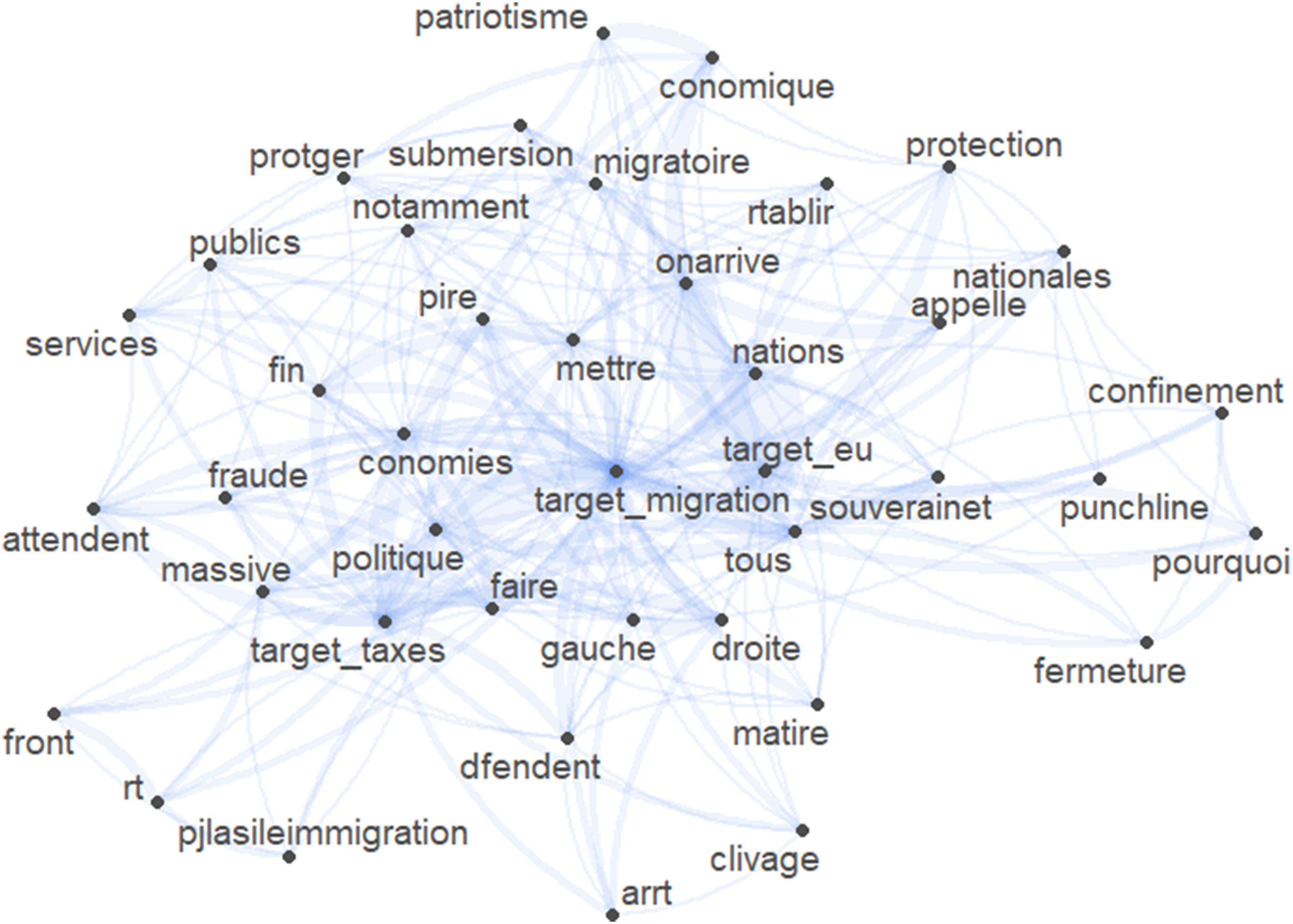
In Figure 10, the RN depict a new ‘divide today [that] is no longer between the left and the right, but between the globalists and the patriots who, like us [(RN)], defend the Nation, common sense, fiscal peace and stopping immigration’. Claiming the mantle of ‘patriots’, RN claimed ‘the French are waiting for a policy of common sense, fiscal peace, much more democracy, public services in rural areas, and the end of immigration'. The right hand side of Figure 10 illustrates the RN’s connection with the rural areas of the country and promotion of policies to purportedly empower rural areas by ensuring adequate allocation of resources and public services. The RN aims to link economic disparities to uncontrolled immigration and foster a more inclusive society for ‘native’ French people, which the party depicts as disadvantaged and under threat. This depiction of immigration as a threat links to the following case study of Italy where the far-right argued for a ‘common sense naval blockade’ against migration. Co-occurrence network of target_taxes in France.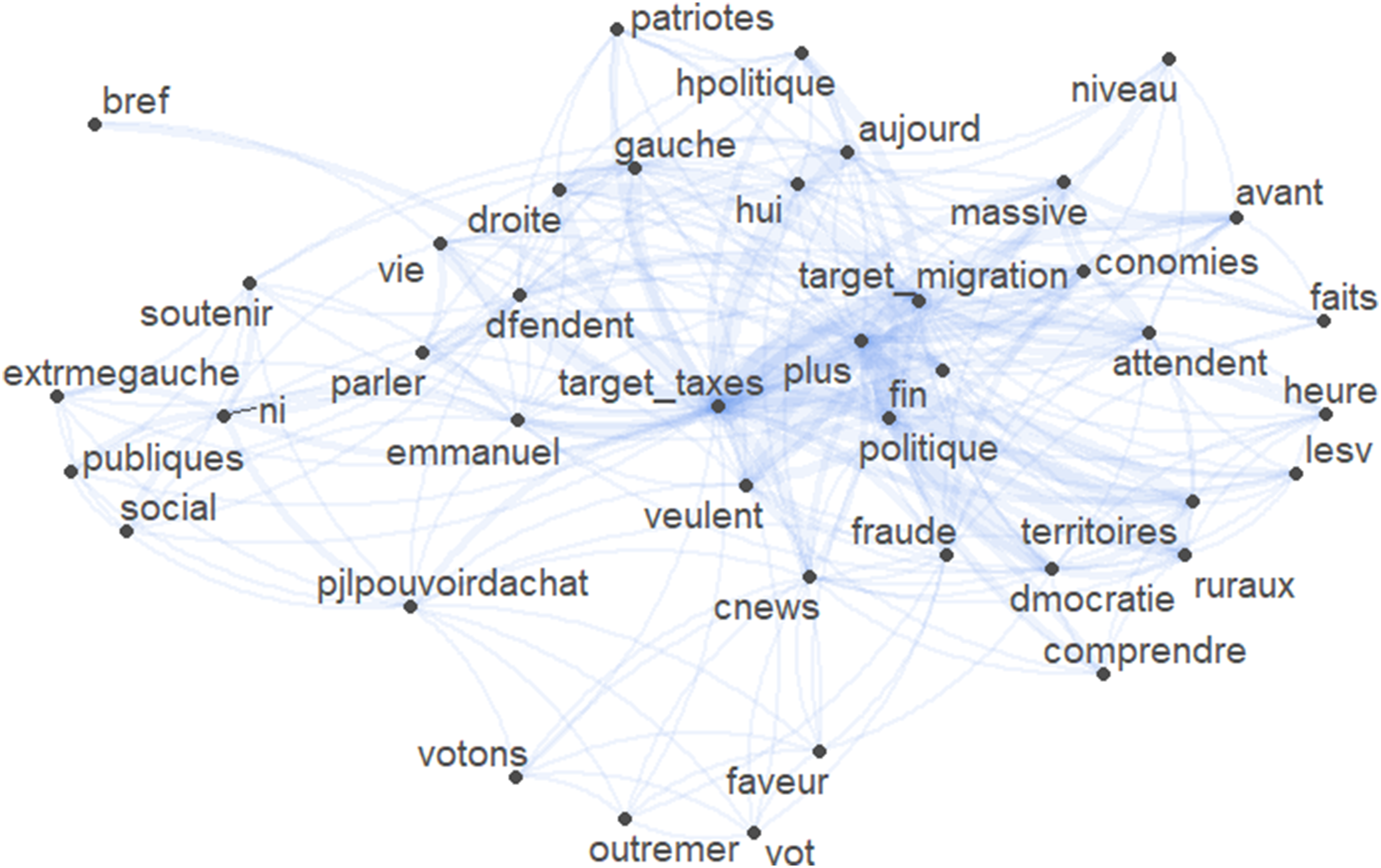
Far-right common sense in Italy
The Italian populist far-right’s (@LegaSalvini and @FratellidItalia) discourses about common sense on Twitter between 2008 and 2022, reveals three significant target words: ‘covid', ‘EU’ and ‘migration & law and order’.
Figure 11 relates to a denunciation of the lockdown measures of the ‘Conte II administration’ due to the closure of businesses and a perceived impingement on individual freedoms. The far-right argued for the abolishment of ‘the senseless #curfew, eliminate the obligation to wear a mask if outdoors and socially distanced'. The Lega accused the Five Star Movement/Democratic Party government of damaging the Italian economy through measures cancelling ‘the reopening of shopping centres on weekends […]: another slap in the face to common sense, to work, to freedom, to agreements'. Regarding ‘individual freedoms’ FdI claimed that the government ‘rejects a common-sense proposal to move the start of the curfew [… while FdI] does not give up, we will not bend to this authoritarian and libertarian drift'. This confirms observations of how the populist far-right parties depicted the protection of individual freedoms as common sense during the pandemic (Pirro 2022). Co-occurrence network of target_covid in Italy.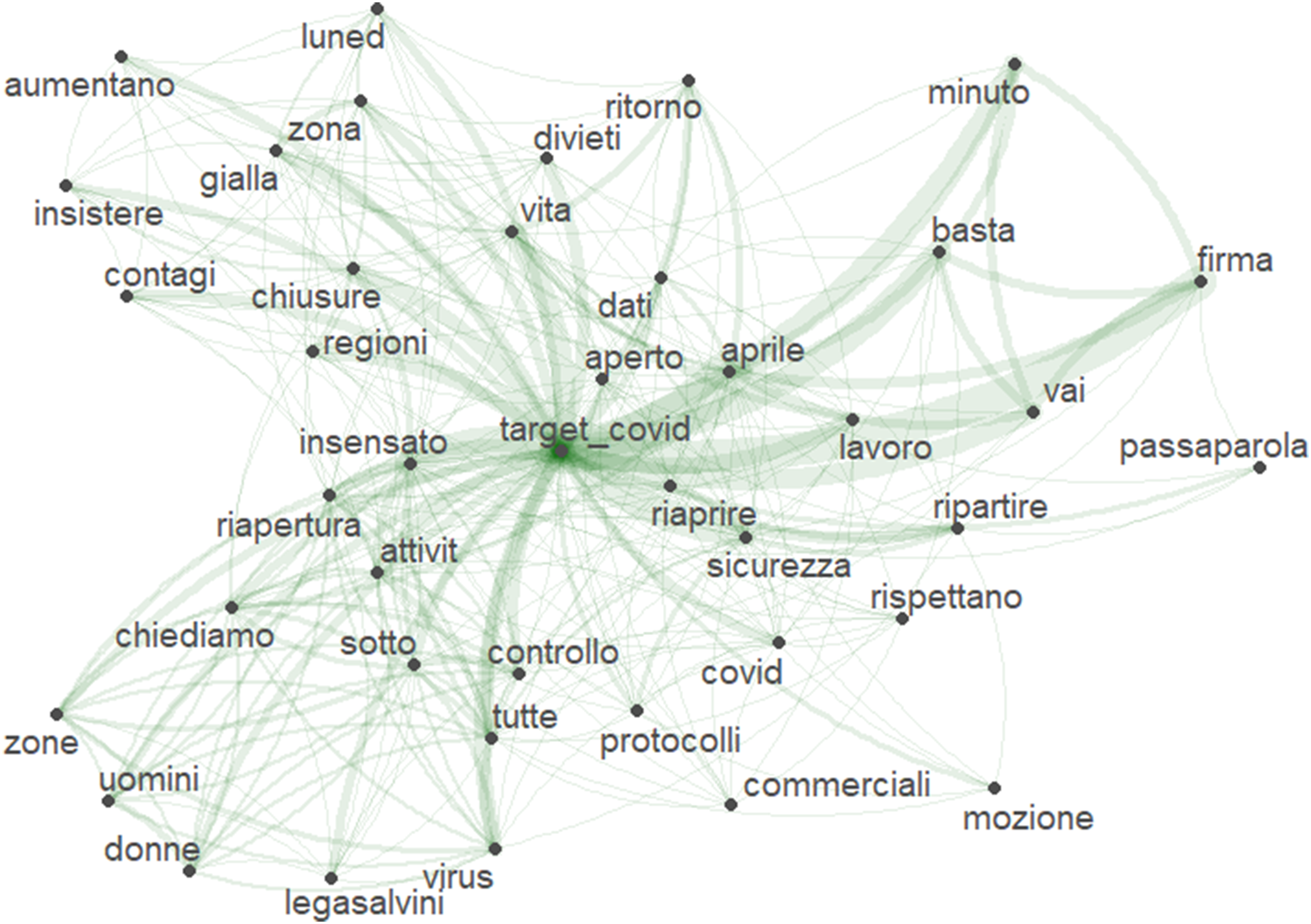
Regarding Figure 12 tweets relate to the Lega and the European Parliamentary (EP) elections held while Lega leader, Matteo Salvini was Interior Minister of the Five Star Movement/Lega administration Multiple tweets refer to a transnational cleavage embodied by Lega’s European allies and co-signatories to a ‘contract’ which pledged commitment to a ‘Common Sense Europe’ within the European group Identity and Democracy. Salvini emphasises the willingness to collaborate and work together towards a ‘common sense Europe’, thus underscoring the importance of considering transnational divisions and prioritising Italy’s interests and the welfare of its citizens. During this campaign the main slogan of Lega was based on stopping what it labelled as ‘the four B’s: burocrati (bureaucrats), buonisti (do-gooders), banchieri (bankers) and barconi (immigrants’ boats). Salvini calls for Europe’s support in ‘stopping’ immigration, criticising the European institutions for a perceived inefficiency and/or a ‘do-gooder’ attitude. Co-occurrence network of target_eu in Italy.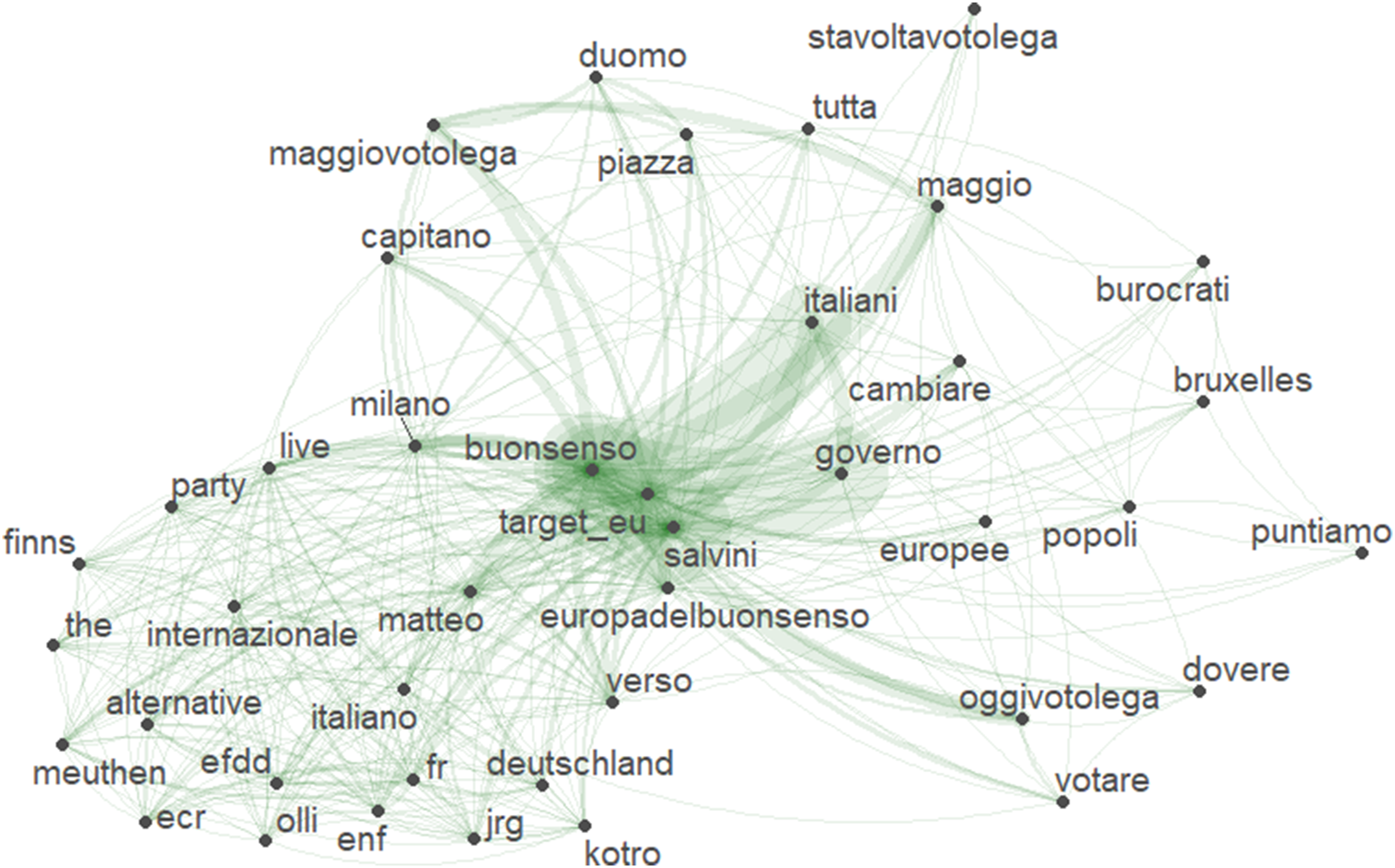
Figure 13 illustrates how the Italian far-right links issues of immigration and security with the tweets analysed mainly revolving around the approval of the so-called Salvini Decree (Decreto Salvini) on security and immigration. The approval of the decree, which stopped asylum seekers from accessing reception centres and introduced a fast-track expulsion system for so-called ‘“dangerous” asylum seekers’ (Dennison and Geddes, 2022: 450), is depicted as a significant step towards secure management of immigration. Additionally, there are references to the revocation of citizenship for immigrants accused of terrorism with Salvini arguing, for instance, that ‘taking away citizenship from those convicted of terrorism is common sense. Moreover, it claims to target so-called ‘fake refugees’, while also preventing potential abuses within the reception and integration system. Giorgia Meloni, on the other hand, argues that ‘the only sensible way to solve the problem of landings is to prevent the barges from setting out to sea and the. #NavalBloackade'. Via ‘common sense’ the Italian far-right, therefore, positioned themselves as defenders of individual liberties, proponents of a Europe of Nations, and advocates for stringent immigration and security measures. Co-occurrence network of target_nativismlaworder in Italy.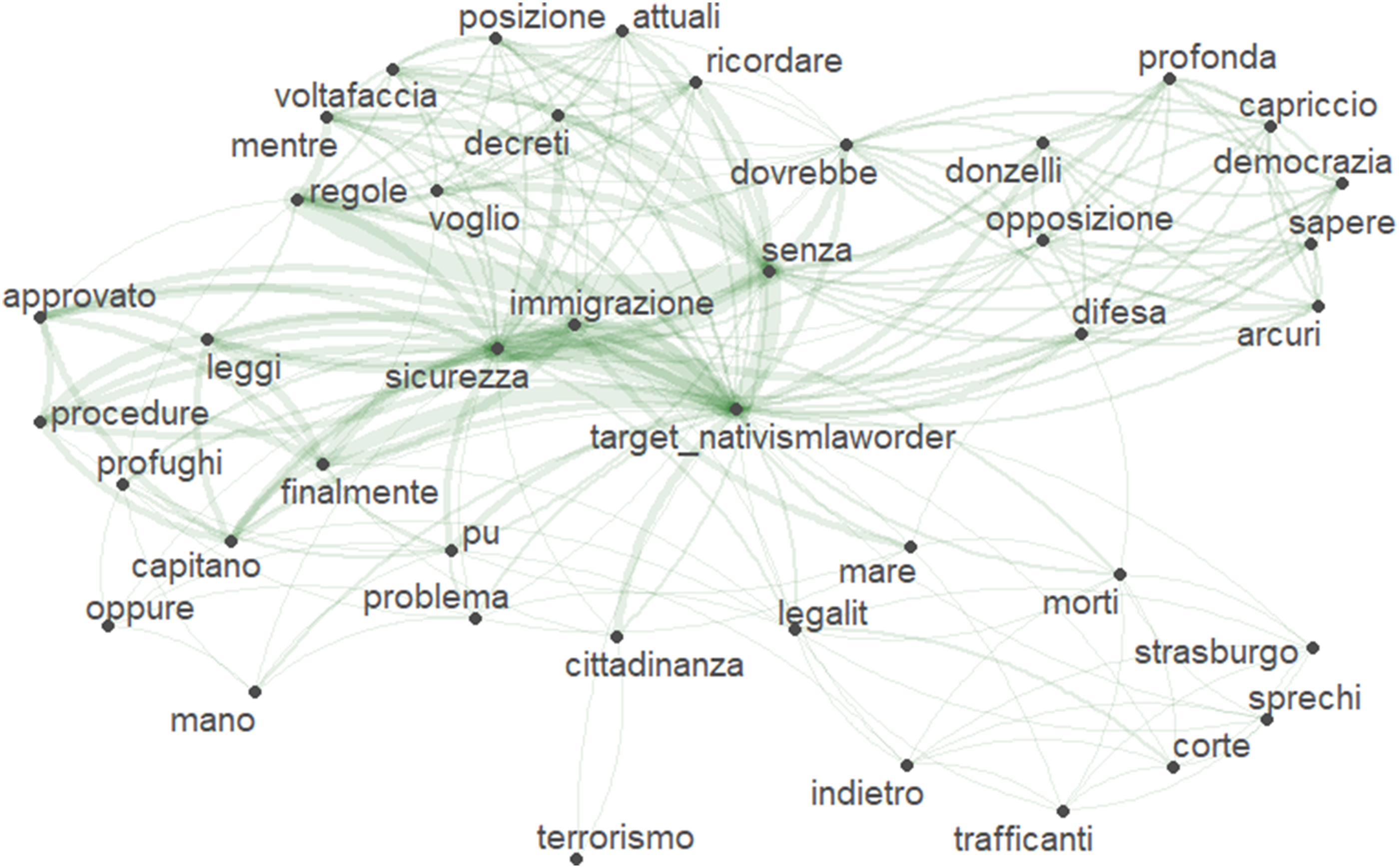
Discussion and conclusion
Our analysis above reveals how populist far-right parties in the UK, France, Italy and the USA, engaged explicitly with a strategy of depicting certain ideas as sensible/common sense. Returning to the question posed at the start of the article, a nuanced picture emerges regarding the extent to which there is a uniform far-right common sense. On the one hand, the reactionary nature of common sense means that there are inevitable crossovers in terms of the themes framed by the far-right. On the other hand, the two other main characteristics of common sense i.e., incoherence and contradiction, means that each far-right party prioritises a common sense specific to their geographical, socio-political, and socio-economic context. Responding to our research question we focus on three interlinked themes; namely, a racialised and securitised notion of the nation-state, and the respective notions of rationality and conspiracy.
Common sense framings in all case studies included a strictly racialised and securitised notion of the nation-state as common sense with a clear exclusionary politics against immigration and a racialised ‘other’. This emphasised closed borders, and opposition to multiculturalism as ‘common sense’. This is hardly surprising considering the racist ideology at the heart of the far-right’s political ethos and the fact that immigration is often used as a proxy for race (Balibar and Wallenstein, 1991). There were, however, variations in the articulation of this common sense narrative. For the US far-right, Trump’s campaign promise to ‘build a wall’ translated into pledges for ‘common sense border control’ and ‘common sense law enforcement’ in his administration. The RN distinguished itself from the other case studies using fiscal matters as a proxy for racist discourses. By portraying themselves as ‘patriots’ that dedicate most of their fights to the interest of native French citizens and to the detriment of immigrants or those considered ‘non-native’. Meanwhile, the ‘Salvini decree’ and, later the ‘Naval Blockade’ claimed to be ‘common sense responses’ to what was constructed as a specifically Italian problem i.e., the proximity of Lampedusa to refugees arriving from Libya and other north African countries. The British far-right, meanwhile, focused on immigration from the European Union and promised ‘common sense Australian style border rules’ which they claimed would be a key benefit of leaving the EU. The depiction of such ‘common sense border controls’ as responding to demands of ‘the people’ links to the second issue relating to a depiction of politics as a zero-sum game.
All case studies also illustrated how the far-right used common sense narratives to claim the mantle of ‘rationality’. This presents politics as a zero-sum game in which there is only one way of doing politics. Indeed, the claim of being ‘neither left or right’ but ‘simple common sense’, was present in all case studies. Be it the Democrats in the USA, or the EU in the UK, France, and Italy, political parties and/or supranational organisations are dismissed as opposed to common sense thinking. However, important contextual differences emerge. In the USA, for instance, the focus on the Democrats and the notion of bipartisanship reflects the US congressional system; calls for ‘common sense bipartisanship’ were particular to the US system and, thus, absent from other cases. Furthermore, the ‘common sense Europe’ campaign was a ‘post-Brexit’ phenomenon and aimed for a ‘different type of Europe’. It was, therefore, different in nature to the UK far-right which highlighted how the EU acted against common sense politics with the view of leaving Europe altogether. This provides an important cross-over with the notion of common sense uncovering surrounding conspiracy.
A further link between each case study is the notion of conspiracy. As noted in the paragraphs above, one key area of coherence between the case studies is the depiction of Great Replacement narratives as common sense. For instance, while the far-right in the UK framed this in terms of ‘space’ and ‘resources’ around housing allocation and/or a perceived Islamisation of Britain in France, ‘common sense’ border controls were often depicted as protecting France against an ‘immigration project’. Beyond Great Replacement, however, there are important country-specific differences in how conspiracy was framed using common sense. In relation to the COVID-19 pandemic, the Italian populist far-right parties distinguish themselves from the other countries providing the most consistent discursive links between COVID-19 and common sense. Such discourse centres around reopening businesses and criticising lockdown measures and therefore relied on the conspiracy that Covid-19 was at best exaggerated, and at worse a hoax. Meanwhile, in the USA, the depiction of voter reform represented a specific issue related to ‘stop the steal’ and its reformulation into a more ‘respectable’ form of ‘voter integrity’ framed as common sense voter reform. In the UK, the far-right put forward a claim specific to the British context that there was a conspiracy to implement ‘Brexit in name only’.
Uniformity in far-right constructions of common sense is, therefore, limited by varying contexts. Such incoherence and contradiction do not mean, however, that such narrative construction should not be taken seriously. On the contrary, these features mean that common sense can act as a ‘floating signifier’ and thus be applied to several far-right policies/ideas depending on the socio-economic or socio-political context.
Continuous interrogation of and resistance to such narratives, therefore, form an essential part of scholarly research. While our findings have illuminated how populist far-right parties use common sense narratives they are, nevertheless, constrained by limitations; namely, a relative lack of both generalizability and comparative analysis with mainstream parties, and a focus solely on predominantly ‘common sense’ and ‘sensible’ as self-referential strategies. We, therefore, propose three potential avenues for future work on the far-right and common sense. First, to broaden the comparative scope, including regions like Latin America and Eastern Europe. Second, an examination of how mainstream actors’ have reproduced the far-right ‘common sense narratives’. A wider examination of how various party families adopt far-right common sense discourse would contribute to research on the mainstream helps normalise the far-right. (Brown et al; Brown, 2023; Krzyżanowski 2020). Third, an analysis of how common sense narratives form part of a wider repertoire of euphemistic self-referential devices used by the far-right to depict themselves as ‘not racist’ and ‘not far-right’. Examination of these themes offer ways to build on our research and contribute to our knowledge of how common sense narratives are contributing to a resurgence in reactionary politics.
Supplemental Material
Supplemental Material - Common sense, populism, and reactionary politics on Twitter: An analysis of populist far-right common sense narratives between 2008 and 2022
Supplemental Material for Common sense, populism, and reactionary politics on Twitter: An analysis of populist far-right common sense narratives between 2008 and 2022 by George Newth and Alessio Scopelliti in Party Politics
Footnotes
Acknowledgements
The authors would like to thank the editor and the reviewers for their insightful reviews on earlier drafts of this paper. Thanks also to the Reactionary Politics Research Group at University of Bath and Polidemos Research Group at UCSC Milan, for hosting presentations of this research.
Declaration of conflicting interests
The author(s) declared no potential conflicts of interest with respect to the research, authorship, and/or publication of this article.
Funding
The author(s) received no financial support for the research, authorship, and/or publication of this article.
Correction (February 2024):

Supplemental Material
Supplemental material for this article is available online.
Notes
Author biographies
References
Supplementary Material
Please find the following supplemental material available below.
For Open Access articles published under a Creative Commons License, all supplemental material carries the same license as the article it is associated with.
For non-Open Access articles published, all supplemental material carries a non-exclusive license, and permission requests for re-use of supplemental material or any part of supplemental material shall be sent directly to the copyright owner as specified in the copyright notice associated with the article.
