



Abstract
The first aim of this study is to put the Finns Party on the academic map of the European far-right. Whilst averaging almost one-fifth of the vote over the last four general elections, it has been curiously absent from the comparative parties’ literature. The second aim is to consider how the search for an appropriate classification of the Finns Party might help to navigate a way through the terminological maze of parties parading under the European far-right umbrella. The starting point is a simple, working definition of the two main sub-types – radical right and extreme right – which the article provides. It also canvasses wider recognition of the intraparty dynamics and coalitional character of far-right parties and the need to incorporate a greater role for social media into work on party classification, not least in providing a mouthpiece for extremist elements. In the Finns Party’s case, an online extreme-right faction was able to exert disproportionate influence within, and ultimately capture the party.
Introduction
The Finns Party at the polls, 1999-2023.
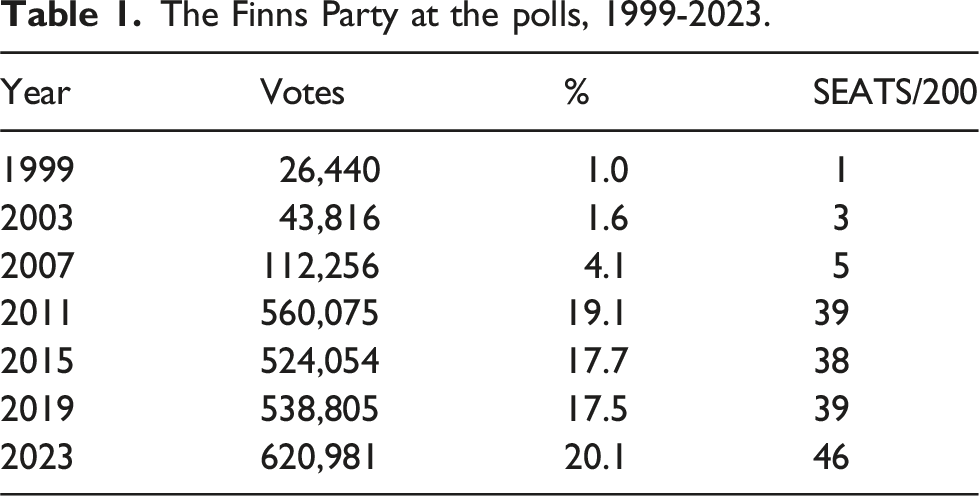
In the cartography of the European far-right the PS has been curiously neglected. Before its unprecedented breakthrough at the 2011 general election, Arter (2010) made a case for the PS as “another West European populist radical right party” although shortly thereafter Mudde (2013) wrote that only three of the 17 West European national parliaments lacked a populist radical right party and one of them was the Finnish Eduskunta – along with the Norwegian Storting and Icelandic Althing. In his volume The Far Right Today (Mudde, 2019), there is not a single mention of the Finns Party. This is a curious omission, which begs the central research questions in this article: (i) How should the Finns Party be classified and, equally importantly, (ii) How might the search for a suitable classification of the Finns Party help navigate a way through the taxonomical jungle of the European far-right?
To the best of my knowledge, this is the first study to set the PS in the wider far-right literature and it seeks to contribute to existing work in at least three ways. First, whilst recognizing that the radical right and extreme right share core ideological underpinnings, the paper provides a simple, working definition distinguishing between the two types based on the permissibility of the social integration of the ethnic ‘other’. Second, it argues for a wider recognition of the intraparty dynamics and coalition character of far-right parties and views the PS from an ‘internalist perspective’ (Pirro, 2023) as well as its supply-side public face. Finally, it makes the case for incorporating a greater role for social media into work on party classification.
Empirically, the study concentrates on the Finns Party in the run-up to, and aftermath of the 2023 general election. It draws on the September 2022 Finnishness programme; four policy papers in preparation for the general election - on i) immigration, ii) the economy, iii) energy and climate policy and iv) law and order; the contribution of the Finns Party leader Riikka Purra in the televised party leader debates; articles in the party organs Suomen Uutiset and Perussuomalainen and the proceedings of the August 2023 party conference. There is also comparative reference to earlier PS programmes (Suomalaisille Sopivin, 2011) and press coverage of events.
Ultimately, it is argued that the Finns Party is Janus-faced. In its programmatic output, in parliament and on the campaign trail, it appears a typical radical right party, with Finnishness as its core concept and occupying populist niche positions on immigration, climate policy and [anti]-wokeness. On social media, however, individual candidates give more than a nod and a wink to their xenophobic extreme-right supporters. Put another way, in an open-list PR voting system, in which candidates seek a personal vote and organize their own campaign teams, there are obvious electoral incentives to blog what their (extremist) supporters want to read.
The article proceeds as follows. The first section reviews the literature on the far-right and the nexus of sub-types within it and points to the way country specialists have often failed to agree on classifying individual cases. The second presents simple definitions with which to distinguish between radical right and extreme right parties. The empirical sections apply these definitions to make a case for the Finns Party as a populist radical right party, albeit containing an extreme right ‘party within a party’. The concluding remarks revisit the article’s primary aim of whether an appropriate classification of the Finns Party can clear a way through the dense undergrowth that is the European far-right.
The far-right as an umbrella concept
Extensively covered in the literature (Golder, 2016; Mudde, 2019; Pirro, 2023), Mudde (2019, 175) claims the far-right is here to stay. As an umbrella concept, it is conventionally viewed as comprising two sub-types – an extreme right party family (Carter, 2005; Hainsworth, 2008; Ignazi, 1992; Mudde, 2000; Von Beyme, 1988; Widfeldt, 2014) and a radical right party family (Art, 2011; Kitschelt, 2007; Kitschelt and Mc Gann, 1985; Minkenberg, 2000; Mudde, 2007, 2016; Rydgren, 2005, 2018). Both have a history dating back to the end of the Second World War. The ‘old extreme right’ (Von Beyme, 1988) has links to inter-war fascism whereas the new variety emerged in the final quarter of the last century, grounded in an exclusionary ethnic nationalism (Ignazi, 1992; Voerman and Lucardie, 1992). Then, the extreme-right party family was characterized by Eatwell (2000, 413) as espousing ‘holistic nationalism’ which stresses the “conversion, expulsion or worse of the ‘other’ and the defence of the traditional concept of community”.
Research has focused more recently on the [populist] radical right and parties previously presented as extreme right have been rebranded radical right (Rydgren, 2004, 2005, 2007; Widfeldt, 2014, 2018). Adding to the far-right lexicon, there is also a body of work on a radical right-wing populist party family (Akkerman, De Lange & Rooduijn, 2016; Jungar, 2016) although populism (Taggart 1995, 2017) is not confined in ideological space and can be associated with leftist and centrist parties (Zulianellio, 2020). In sum, the taxonomy of the European far-right and the placement of parties on a continuum running from radical right to extreme right is challenging and it appears far from straightforward to draw a neat-and-tidy dividing line between the two.
Gattinara (2020) points out that “the contours of classification are blurred, since activists of radical right-wing parties often have close contacts with extreme-right groups and networks, which makes it difficult in practice to draw a watertight distinction between the two subtypes. Given the problems of drawing clear conceptual boundaries, Pirro (2023) makes a case for the systematic use of the generic term ‘far right’. The far right, he suggests, “includes all those ultranationalist collective actors sharing a common exclusionary and authoritarian worldview – predominantly determined on socio-cultural criteria – yet with varying allegiances to democracy” (Pirro 2023, 103).
In some cases, to be sure, the boundaries seem clear-cut. Few academics would question the characterization of Golden Dawn, which was the third largest party in the January and September 2015 Greek general elections, as a case of right-wing extremism. An overtly racist party and Holocaust-denier, it was a ‘militia-like party’ (Duverger, 1963), organized on the Führer prinzip, which committed acts of violence against migrants, refugees, Muslims, Jews and the LGBTQ community (Georgiadou, 2020). Its ‘national solution’ (Vasipoulou and Halikiopoulou, 2015) placed it firmly in the extreme right camp.
Other cases, however, are less straightforward. Take the Alternative für Deutschland – The Alternative for Germany (AfD). Analysing the party and its voters at the 2021 Federal election, Hansen and Olsen (2022) conclude that the AfD is “Germany’s first successful populist radical right party”. In contrast, Witting (2023) cites the view of the Bavarian political scientist Ursula Münch that AfD has “evolved into a far-right party that is extremist, antisemitic and racist”. Indeed, in March 2021 the Federal Office for the Protection of the Constitution (BfV) classified the AfD as a case of ‘suspected right-wing extremism’ and the Der Flügel faction eligible to be placed under state surveillance. Even so, in 2022 Flügel secured a formal majority on the party executive for the first time (Pytlas and Bartek, 2023).
Parties within the far-right category may of course change ideologically and/or strategically over time, so limiting the utility of once-and-for all characterization. When the Front National was renamed the Rassemblement National in 2018, Marine Le Pen sought to soften its image and she was facilitated, albeit indirectly, in this task by a fellow candidate in the April 2022 presidential campaign, Éric Zemmour, representing Reconquête, who was known for his extreme views on immigration and Islam and had been convicted three times for racial hatred (Ivaldi, 2023). Indeed, Mayer (2022) has viewed the Rassemblement as a populist radical right party.
Giorgia Meloni’s Brothers of Italy (Fratelli d’Italia) was formed as a splinter party from the People of Freedom (Popolo della Libertà) and traces a lineage to the National Alliance (Alleanza Nazionale) but it has evolved to be viewed by Puleo and Piccolino (2023) as the most prominent member of the European populist radical right party family. For Baldini and Trunconi (2023), too, the Brothers of Italy is “yet another populist party”.
On occasions the sub-types within the far-right have been conflated. Carvalho (2019) begins his discussion of mainstream party strategies at the 2007 and 2012 French presidential election by writing that “the extreme right party family – also labelled the populist radical right – is considered the fastest-growing party family in the post-war period”. So, can, and if so how can, radical right and extreme-right parties be distinguished?
Distinguishing radical right and extreme right
The [populist] radical right party
Nativism
The prototype populist radical right party as defined by Mudde (2007) possesses three distinguishing features – nativism, authoritarianism and populism. Similarly, Rydgren (2018, 23) notes that the radical right shares a core of ethno-nationalism and anti-establishment populism and adds that this ideological core is often embedded in a general socio-cultural authoritarianism that stresses themes such as law and order and family values. Kešić and Duyvendak (2019) prefer the term nativism to nationalism, arguing that nativism is “an intense opposition to an internal minority that is seen as a threat to the nation on the grounds of foreignness (Kešić and Duyvendak 2019, 445). They add that when nationalism is confronted with an internal-threatening foreignness, it is transformed into nativism (Kešić and Duyvendak 2019, 462). Authoritarianism
Most writers view authoritarianism as a core component of radical right parties (Carter, 2018; Mudde, 2019). Authoritarianism denotes a belief in a strictly ordered society in which infringements of authority – especially those committed by the ‘other’ – are to be heavily punished. There should be a strict line on law and order inter alia adequate policing, sentences that fit the crime and the deportation of foreign nationals committing serious crimes. Authoritarianism has also professed the values of the traditional social order and support for familialism (Ennser-Jedenastik, 2021) – that is, supporting the family in its caring function along with the right of mothers to bring up their pre-school children from home. Populism
Not all radical right parties are populist but populist radical right parties are so by definition. Populism is not the exclusive preserve of the radical right but whether regarded as a ‘communication phenomenon’ (De Vreese, 2018) or a ‘thin ideology’ (Mudde, 2007) populism involves ‘othering’. This involves the separation of society into two homogenous and antagonistic groups and the identification of an in-group by ‘othering’ an out-group. The ‘other’ may be the political mainstream and the adoption of populist niche-policy positions at odds with the mainstream along a socio-cultural axis (Wagner and Meyer, 2017; Widfeldt, 2010). Typically, this might be an anti-consensus stance on climate policy.
Radical right parties often articulate a form of anti-woke populism, which Cammaerts (2020) defines as “the strategic and persistent abnormalisation of those who contest and fight racist, sexist and fascist ideologies”. The Brothers of Italy leader Meloni was patently anti-woke when insisting that “defending the family and our identity means defending our children from the aggression of gender ideology, which seeks to erase the differences between a man and a woman and impose the absurd utopia of the gender-neutral and the insanity of adoptions for homosexual couples in our society” (Baldini and Trunconi, 2023). The British prime minister, Rishi Sunak, has insisted that “I shall be incredibly robust in standing up against the woke culture that is trying to cancel our history, our values and indeed our women” (Davies and MacRae 2023, 22). In similar vein, Evelin Poolamets, a parliamentarian representing the radical rightist Estonian Conservative People’s Party (Eesti Konservatiivine Rahvaerakond), describing herself as a national conservative opposed to the multicultural model of society, has stated that: “I want to stand for our children who are being indoctrinated with gay propaganda and doubts about their biological sex already in school textbooks. Instead, children should be raised to be patriotic. I want to stand for women’s rights; women should not be represented by radical feminists” (Kasekamp et al., 2018; Petsinis, 2019; Saarts et al., 2021)
Pulling the threads together, a simple, working definition might run that populist radical right parties are nationalist and authoritarian and deploy a populist style to communicate niche policy positions. The nationalism of the radical right privileges the native population but allows for the strictly conditional integration of the ethnic ‘other’. Typically, this involves a working competence in the national language and a readiness to live by the cultural standards of the native population. Loosely put, the expectation is that ‘when in Rome, do as the Romans do’. The extreme right in contrast does not accept that the social integration of the ethnic other is possible, still less desirable (Leidig, 2020).
The extreme right party
Xenophobia
Whilst nationalism has been viewed as a common denominator in both extreme right and radical right parties (Halikiopoulos and Vlandas, 2019), some writers have distinguished the two on the basis of the type of nationalism. Eatwell (2000) infers that the extreme right is grounded in extremist nationalism – the aforementioned ‘holistic nationalism’ – whereas ‘liberal nationalism’ is “rationalistic, individualistic, pluralistic and concerned with tolerance and rights” (Eatwell 2000, 413). Halikiopouou (2018) argues that extreme right parties are associated with an ethnic nationalist narrative focusing on “blood, creed and common descent” whereas radical right parties articulate a type of civic nationalism, which is essentially cultural and more palatable to a general public. Golder (2016) writes that “civic nationalism is inclusionary, ethnic nationalism is exclusionary”.
The nationalism of the extreme right is xenophobic which, it is suggested here, is its distinguishing trait. Husbands (2000) refers to xenophobic parties in the Swiss context, albeit without a clear elaboration of the type. For our purposes, xenophobia entails the fear, contempt and hatred of the ‘ethnic stranger’, who represents a threat to the authentic identity of the nation-state. By extension the extreme right is mired in conspiracy theories such as the Great Replacement, which sees ethnic white Western populations being replaced, demographically and culturally, by non-whites, particularly from Muslim-majority countries.
The “patriarch of the European extreme right”, Jean-Marie Le Pen, repeatedly warned that, as a consequence of immigration and demographic decline, France was living on borrowed time (Zúquete 2008, 357). Thierry Baudet of the Dutch Forum for Democracy (FvD) has stated that: “I don’t want Europe to be Africanized…I am just saying what I see as desirable and undesirable. What I feel undesirable is that, more and more, we are looking like other parts of the world. I want Europe to remain dominant, white and culturally as it is” (Kešić and Duyvendak 2019, 455). The basic premise of Pauline Hanson’s ‘One Nation Party’, launched in 1996, was that “Australia is in danger of being swamped by Muslims who bear a culture and ideology that is incompatible with our own”. She claimed that multi-culturalism was leading to the ‘Asianisation of Australia’. Clearly, One Nation’s racist and xenophobic rhetoric placed it firmly in the category of right-wing extremism.
In the case of the renamed Rassemblement National (RN) under Marine Le Pen, Cremer (2022) notes that the party has become secularized and more concerned with Christendom as a civilian antidote to Islam than with Christianity as a faith. He cites the former RN vice-president Gollnisch: “Our identity is under demographic threat because of the population replacement. It is threatened culturally and physically by the push of Islam. When people react against that, they are brought closer to the Christian identity of their country” (Cremer 2022, 48). Joppke (2018, 238), too, has viewed Christianity in the hands of extreme right parties as simply a club to beat Islam.
Caparrós (2019) writes that in Spain, Vox “has claimed a monopoly of nationhood, arrogantly proclaiming what the nation is and who its true citizens are and are not”. However, the essence of the extreme right is best captured by a candidate for the Blue-Black Movement (sinimustan liike) at the 2023 Finnish general election (Koskela, 2023). “I don’t care if immigrants are good citizens and taxpayers. The essential thing is – are they Finns? There is only one nation, one country, one language – exclude the ‘others’. Exclusion is natural for people.”
Anti-democracy
The difference between the two sub-types of far-right party has also been located in their approaches to the values and procedures of democracy. Eatwell (2000, 410-411) has distinguished between a dangerously anti-democratic extreme right and a radical right which questions fundamental aspects of the rule of law but does not ultimately seek its displacement. Mudde (2019, 30) builds on this. “The extreme right rejects the essence of democracy – the idea of political equality and government by popular majority – whereas the (populist) radical right supports democracy at least in theory but fundamentally challenges key institutions and values of liberal democracy, including minority rights, rule of law and separation of powers.”
As a working definition, therefore, this article proposes that extreme right parties are xenophobic, based on a holistic nationalism and the demonization and expulsion of the ‘other’. They do not necessarily have links to fascism but they are anti-democratic in questioning the values, if not the procedures of democracy. Rather than the radical right’s ‘when in Rome do as the Romans do’, the extreme right contends that ‘Rome is for Romans only’ and the ‘other’ should have no place in it or access to it.
All things being equal, of course, one would expect extreme right parties in pluralist democracies to attract only limited and/or ephemeral support. Equally, parties are not monoliths. As Rose (1964) observed in a seminal article, they are internal coalitions of factions, tendencies and non-aligned partisans, whilst for Sartori (1976) “the nature of a party is in the nature of its fractions”. In this connection, Pirro (2023) has canvassed an “internalist perspective” and an analysis of the “alliance structures” within a party. It is plausible to argue that there is an extreme right in the British Conservative Party, voiced by the former Home Secretary Suella Braverman who has argued that “multiculturalism has failed and the nation must be protected. You can see it play out on the streets of cities all over Europe, from Malmö to Paris and Brussels to London (Braverman, 2023)
Indeed, within these internal coalitions extreme-right groups can exert disproportionate influence, even to the point of becoming a ‘party in a party’. Analysing the dynamics of intraparty competition in the AfD, Pytlas and Biehler (2023) have shown how, although relatively small, the extreme-rightist Flügel faction achieved an ideational dominance that led to the party’s radicalization. In Finland at least two factors have appeared to facilitate a comparable development: (i) the spread of social media as channels for the mobilization and organization of xenophobic sentiment; (ii) an open-list voting system which has incentivized candidates to pander to their extreme right supporters.
Classifying the Finns party
In the following empirical sections, the above-mentioned definitions are applied (i) to make a case for viewing the Finns Party as a populist radical right party and (ii) to identify an extreme right ‘party within a party’. As a populist radical right party, the Finns Party is nationalist in proceeding from Finnishness (suomalaisuus) as its pre-eminent concept whilst defending the nation’s Christian heritage against the religious ‘other’. It is authoritarian in professing the authority and legitimacy of the traditional social order against the permissive ‘other’. It is populist in occupying niche positions on immigration and climate policy and in decrying Establishment ‘wokeness’. Crucially, however, whilst the nationalism of the Finns Party privileges the native population it does allow for the strictly conditional integration of the ethnic ‘other’.
The PS as a populist radical right party
Nativism
On numerous occasions during the party leaders’ debate in the run-up to the 2023 general election, the Finns Party leader Purra declared that ‘Finnishness is a value in itself’. Indeed, Finnishness has been the ideological core of the Finns Party throughout its existence. The PS’ 2009 European Parliament manifesto stated that ‘Finnishness is cultural capital that should be capitalized on’. The 2022 Finnishness programme (2022a) was still more unequivocal: ‘Finnishness is Finland’s history and Finland’s future and how these are understood. A nation cannot live without a sense of where we came from, who we are and where we are heading. The Finnish nation means ordinary Finns, living with their neighbours, sharing a common language and so constituting a well-integrated community. The Finnish language is the cornerstone of the national community, and its distinctive feature, and without our language we could not exist.’
It follows that the ‘ethnic other’ comprises all those persons who do not, or cannot, speak Finnish and that has also included an internal ‘other’ in the shape of members of the Swedish-speaking national language minority or so-called ‘Finland Swedes’ (cf Svraka, 2023). The 2022 Finnishness programme holds that Finland is not a bilingual country – despite the constitutional protection afforded the second national language – in the sense that the requirement of Swedish-language proficiency for entry into the sixth form in schools and institutions of higher and technical education is in practice observed. Dedicated public services for Swedish-speakers should, therefore, be organized without the Swedish language requirement. Native Finnish-speaking students should be instructed to take English as their first foreign language, since it is the language of international discourse, although there is a need to distinguish between English-language competence and its potentially harmful impact on Finnish. The Finnish language should not be sacrificed on the altar of English.
‘Ethnic others’ do not, of course, comprise only the minority of ‘Finland Swedes’ but rather include asylum-seekers, refugees and work-based immigrants – external ‘others’ - and during the 2023 election campaign the Finns Party carved out a distinctive niche on immigration which, whilst implicitly discriminatory, appeared prima facie non-racist. Put another way, the PS stood outside the cross-party consensus that, in view of the chronic labour shortages, work-based immigration should be encouraged. According to the party’s 2023 immigration policy programme, the only way to mitigate the negative consequences of immigration was substantially to reduce, by legal and administrative means, the flow of immigration from outside the European Union (EU) and European Economic Area (EEA). Work-based immigration from outside the EU should be restricted to highly educated persons whose salaries corresponded to the median Finnish income. Throughout the election campaign it was stated that immigration from outside the EU was not the answer. Work-based immigration, moreover, would not materially boost public finances since most so-called ‘new Finns’ went into low-paid jobs and required social-services’ support in addition to their wages. In the health-care sector, it was argued, immigrants’ lack of Finnish-language skills was putting patients at serious risk and driving trained [Finnish] carers out of the profession.
For the PS, ‘culturalising Christianity’ (Joppke, 2018) has meant seeing Christian values as part of the Finnish culture and tradition – its very Finnishness – and something to be preserved and protected from non-Finnish religious practices. In an era of accentuated secularization and individualization (Arter, 2024), the Finns Party has sought to appeal to cultural Christians – those who rarely, if ever, attend a church service but live by broadly Christian standards – by pointing to the threat to their traditional values posed by Islam. Reference is made to ‘harmful immigration’ (haittamaahanmuutto) from Muslim-majority countries and the concomitant ghettoization of schools and neighbourhoods. The personal security risk from ‘harmful immigration’ has been emphasized whilst Iraqis, Afghans and Somalis are said to be overrepresented in the sexual-crime statistics.
Overall, for the Finns Party it is the nation’s Christian heritage and tradition – rather than Christian religion per se – that can be deployed in the otherization of Islam. In short, the Finns Party has pursued a religious identity politics strategy (Cremer, 2022; Haugen, 2015; Minkenberg, 2018; Zúquete, 2008) the thrust of which has been that Christianity is integral to the national culture whereas Islam is alien to it. Religious belonging - though less religious believing - has been used as a secularized cultural identity marker (Brubaker 2017, 1204).
Authoritarianism
The PS’ authoritarianism has taken the form of a tough ‘zero tolerance’ line on drugs and alcohol abuse, and it has demanded proportionately punitive measures to deal with a deteriorating situation ‘on the streets’, including more resources on policing. The PS’s 2022 ‘criminal policy programme’ (2022b) held that the punishment should fit the crime and there should be harsher sentences for murder, acts of violence and rape. Prison sentences should be served in full and life sentences lengthened. “12 years is not life”. Foreigners committing serious crimes should be deported, banned from returning to Finland and their Finnish citizenship withdrawn (if granted earlier). “Finland cannot be allowed to become a Sweden-type of country in which burning cars and street shootings are everyday occurrences.” (2023a)
From the outset the Finns Party has been authoritarian in espousing the authority and legitimacy of a society grounded in traditional family values. It has set its face against the ‘permissive society’ and those insidious forces eroding its sound ethical base. Authoritarianism has meant the adoption of a position – contrary to the mainstream consensus – in favour of familialism, that is, supporting the family in its caring function (Ennser-Jedenastik, 2021) Purra even claimed before the 2023 general election that the alarmist excesses of the ‘climate change-mongers’ had depressed the Finnish birth rate and that the Finns Party would seek to reverse this trend by providing incentives for mothers to stay at home and have more children (2023b). Defamilialism, and expanding child care, has been conspicuous by its absence in Finns Party programmes (Giuliano, 2023).
Populism
During recent election campaigns the Finns Party has turned its fire on the climate-change ‘brigade’, othering the ‘green-left’ (Greens, Social Democrats and Left Alliance) on the home front, along with the faceless martinets in the International Panel on Climate Change (IPCC). In December 2018 all the parliamentary groups except the Finns Party undertook to ensure that Finland played its part in meeting the IPCC target of restricting global warming by 1.5%. The PS, however, attacked the moral hysteria of the climate change lobby and, as one of the party’s deputy-chair’s put it: “if every Finn shot himself, it would do nothing to arrest climate change”. Using similar populist hyperbole, Kristian Laakso was successful in his bid to become an MP in 2019, claiming that “even if Finns stopped driving cars, it would delay global Armageddon by perhaps 1 minute!” The PS was particularly dismissive of the creation in 2019 of a dedicated ‘climate minister’ portfolio and the government’s commitment to achieving a carbon-neutral Finland by 2035. Throughout the 2023 general election campaign, Purra claimed that 2050 would be soon enough.
This foot-dragging, which stopped short of outright climate-change denial, was designed not to discomfort the typical PS voter, whom the former leader Timo Soini described as loving ‘sausage, sauna and motor sport’. The PS’ 2023 energy and climate policy paper (2023c) stated that climate policy should be realistic, based on an achievable timetable and it should be effective. Low-emission technology should be encouraged but it must not entail the collapse of the nation and the economy. Again, the Finns Party stood outside the cross-party consensus, seeking to postpone the goal of achieving a carbon-neutral Finland to the mid-point of the 21st century”
The PS’ defence of authority and traditional values against the permissive orthodoxy of the green-left parties has spawned a form of anti-woke populism. Purra has referred dismissively to the [present] “golden age of woke” whilst, according to the PS’ 2022 Finnishness programme, a foremost threat to the Finnish way of life and cultural heritage is the ‘cancel culture’ and woke thinking, which seeks to distance people from traditional family values and gender roles and posits the need for alternative values. Particular contempt was reserved for intersectional feminism and structural racism. The PS’ anti-woke populism could be coded, discreet and integrated into a wide-ranging critique of the status quo. In March 2023, less than 1 month before the general election (and thus part of the campaign), Purra (2023) wrote in the party organ Suomen Uutiset thus: “I don’t know if earlier everything was simpler. At least at some point there were no bread queues, old people on the floor and young people coming out of secondary school without being able to read. Nobody claimed that a man could give birth or that a crucial question was to get persons from distant cultures to clean up our rubbish and prepare our food.”
Similarly, in Perussuomalainen an editorial read: “The words ‘man’ and ‘woman’ have been expunged from the statute book and even traffic lights are now gender neutral. Priority is given to Pride banners, Green hysteria and transphobia. (Turkkila, 2023).
Summing up, in its programmatic output and on the campaign trail the Finns Party appears a radical right party, with Finnishness as its core concept whilst occupying populist niche positions on immigration, climate policy and wokeness. However, it is two-faced in that social media and an open-list PR voting system have combined to create incentives for PS candidates to give more than a nod and wink to their xenophobic, extreme-right ‘followers’.
An extreme right ‘party within a party’
Social media provide a fertile channel and breeding ground for a toxic mix of racists, bigots and miscellaneous extremists and, in the Finnish case, these hardliners were provided with a mouthpiece when in April 2006 the academic Jussi-Halla-aho created his Scripta blog. In the month of November 2008 alone this was estimated to have 46,000 followers. Halla-aho closed the controversial Scripta in 2009 but in 2012 he was convicted of incitement to racial hatred, having claimed inter alia that the prophet Mohammed was a paedophile and Islam a paedophile-sanctioning religion. In December 2008 an alternative social media outlet for hardliners Hommaforum was created by Matias Turkkila, currently the editor-in-chief of the Finns Party organ Suomen Uutiset. Indeed, before the Finns Party’s seismic breakthrough at the 2011 general election, there had developed a parallel digital constituency of extreme rightist elements, which Soini, the party chair, sought to contain but whose votes the party needed. The PS’ internal cohesion in short became increasingly strained by competing tendencies – an extreme right, which increasingly took on a factional form, co-ordinated by Halla-aho, and a social-left imbued with the predecessor Finnish Rural Party’s welfare chauvinist tradition of working for the needy and deprived in society (Kovala et al., 2022).
Importantly, the Finns Party’s extreme right has been well served by an open-list PR voting system – which requires citizens opt for a single candidate on a party list – since this incentivizes intra-party (co-partisan) competition for personal votes, allowing the hardliners to operate as ‘a party within a party’ by running their own dedicated candidates, purveying harsh ethno-nationalist views. In the run-up to the 2011 general election the Halla-aho faction issued what amounted to a separate manifesto – the so-called ‘Nuiva manifesto’ – which railed against multiculturalism and immigration policy and backed preferred candidates. Of the 13 signatories to the Nuiva manifesto, all Finns Party activists, six were elected, although James Hirvisaari was later expelled from the party for giving one of his visitors a Nazi salute in parliament.
The influence of the party’s extreme right grew almost by stealth and the internal balance of power shifted. Mortality among veterans from the days of the predecessor Finnish Rural Party meant their number declined; the members Soini recruited before the 2008 municipal election became less active; and there was growing grassroots criticism of Soini’s domineering leadership style. A former moderate-wing PS MP, Tiina Elovaara, recalled that she was surprised at how well Halla-aho was received at the 2015 party conference. By the time the party split in 2017 (Arter, 2020), with Halla-aho’s election as chair (in effect an extreme rightist coup), xenophobic elements were openly parading their wares, largely regardless of the consequences.
In July 2015 in an English-language Facebook entry, Olli Immonen, chair of the extreme rightist Suomen Sisu organization, called for a fight against the ‘nightmare of multiculturalism’: “I’m dreaming of a strong, brave nation that will defeat this nightmare called multiculturalism. This ugly bubble that our enemies live in, will soon enough burst into a million pieces. I have strong belief in my fellow fighters. We will fight until the end for our homeland and one true Finnish nation.”
Immonen was expelled from the parliamentary group for 2 months but then returned to the fold. Also in 2015 another Suomen Sisu member, Juha Mäenpää, who describes himself as “a patriot, nationalist, Christian-socialist and right-wing conservative”, openly gloated over a fire in a local reception centre for asylum-seekers. In 2019 the state prosecutor requested parliamentary permission to charge Mäenpää with incitement against an ethnic group when he compared immigrants to harmful insects – “an invasive species” – in an Eduskunta speech. A vote to remove his parliamentary immunity was backed by 128 MPs but failed to reach the necessary five-sixths majority.
The Finns Party MEP, Teuvo Hakkarainen, has repeatedly voiced the Great Replacement Theory on the floor of the Brussels assembly, insisting that “these are the last moments to prevent the Near-Easternisation and Africanisation of Europe. “Alien cultures are destroying contemporary Europe and the process will not necessarily take all that long”. He claimed that “not all Muslims are terrorists but all terrorists are Muslims”. Junnila’s extreme right links, that forced his resignation as a minister, have already been noted, as too, Riikka Purra’s reluctant apology for blog comments she made 15 years ago. However, Purra has refused to apologise for a blog on her website in 2019 in which she referred to Muslim women as ‘black sacks’. She wrote that “walking the streets of the capital are unrecognizable black sacks, verifiable as people only by the fact that dragging behind them are small persons”. Ville Tavio, the Finns Party’s foreign trade and development minister, alluded to the Great Replacement Theory several times on the floor of the Eduskunta during the 2019-2023 session. Sebastian Tynkkynen, who was re-elected a party chair at the 2023 party conference, has three convictions for online race hate, one of which read “the fewer Muslims in Finland the better”.
A post-2023 general election survey of Finns Party municipal councillors revealed that whilst many did not accept that the party condoned racism, a number admitted there are those who deploy racist language on social media (Vasantola, 2023). Indeed, in a ‘personalized electoral system’ (Renwick and Pilet, 2016) campaigns are candidate-centred and candidate-organised and through social media channels candidates will be incentivized to give more than a little encouragement to their ‘followers’, including those with hardline, xenophobic sentiments.
Concluding remarks
This study’s first aim has been to put the Finns Party on the academic map of the European far-right. It gained not a single mention in Mudde’s (2019) volume on the far-right and it has been conspicuous by its absence in much of the other comparative parties’ literature. In contrast, shortly after the 2023 general election the BBC’s Europe correspondent listed the Finns Party alongside the Brothers of Italy, the Sweden Democrats, Vox Party in Spain, the Alternative for Germany and Marine Le Pen’s Rassemblement National as a far-right party.
The second, corollary aim, in view of the summer 2023 revelations of online racism, conspiracy theories and ministerial ties to proscribed, militant, extreme-right organisations, was to consider the topical question of what type of party the PS really is. This became the foremost matter for political debate in Finland over summer 2023 and lent the party undoubted notoriety in the foreign press. Even the president expressed concern about the PS’ prospective damage to Finland’s reputation abroad. One of the first acts of the autumn 2023 session of the Eduskunta was to debate votes of no confidence in two Finns Party ministers with a history of extreme-right blogs (they survived).
However, the main body of the article has been concerned to consider how an approach to classifying the Finns Party might help navigate a route through the taxonomical minefield of the European far-right. Extreme-right parties have been rebranded radical right with a minimum of explanation; the extreme-right and radical-right sub-types readily conflated; and country specialists have failed to agree on a characterization of individual far-right parties. Moreover, whilst there is broad recognition that the common denominator in far-right parties is nationalism, and the difference between radical right and extreme right parties linked to the type of nationalism – inclusionary/exclusionary; and whilst it may be reasonable to see extreme nationalism as a property of the extreme right, it is difficult to locate working definitions with which to differentiate party types within the labyrinth of far-right parties.
An important contribution of this article has thus been to produce a simple ‘acid test’, based on the permissiveness of the integration of the ethnic ‘other’. The nationalism of the radical right privileges the native population but allows for the strictly conditional integration of the ethnic ‘other’; the extreme right is xenophobic and rejects the integration of non-natives unequivocally. The difference is between limited and conditional access (‘when in Rome’) – often based on the criterion of economic utility – and ‘no entry’ whatsoever (‘for Romans only’). Whilst these ideal-types should facilitate party classification in principle, two practical caveats must be entered: parties are rarely unitary actors and parties have multiple voices.
On the latter point, the evidential base for party classification when viewed from a supply-side perspective is complicated when the supply takes the form not only of programmatic output (manifestos, policy statements etc) but also the social media messages of individual candidates. In personalized electoral systems in particular, where candidates are incentivized to attract individual votes, these messages may diverge from official party policies (in nuance or substance) and the central party may have in practice little control over them. In Sweden, where a personal vote option was introduced at the 1998 general election, the leader of the Sweden Democrats, Jimmie Åkesson, has sought to ‘domesticate’ the party and manage its extreme-right elements by running a single, national slate of thoroughly vetted candidates.
Approaches to classification should capture the intraparty dynamics and fundamentally coalitional character of far-right parties and to recognize that extremist factions, like the numerically small flügel in the German AfD, can exert disproportionate influence to the point of becoming ‘a party within a party’. They also need to build a greater role for social media into the classification process. In the Finns Party’s case, social media provided a platform for xenophobic activists to conspire and in effect capture the party, although the party has contrived a respectable public face during election campaigns. Only when entering government in June 2023 have skeletons in cupboards – or in blog posts – alerted the electorate and indeed fellow governing parties to the ‘other face’ of the Finns Party.
Ultimately, the Finns Party is Janus-faced: it is a populist radical right party prima facie but with a xenophobic extreme right core operating within it. Whilst this paper has distinguished between - and defined - the radical right and extreme right, parties are rarely unitary actors – pure party types - and the Finns Party has been no exception. It has a legitimate place in the European far-right literature, although its heterogeneous intraparty dynamics have pointed to the limitations of a lumpen ‘this or that’ classification within the far-right umbrella. The conclusion may seem anticlimactic, but the Finns Party is probably best viewed simply as a far-right party, albeit one containing influential elements for whom ‘Rome is for Romans only’.
Footnotes
Declaration of conflicting interests
The author(s) declared no potential conflicts of interest with respect to the research, authorship, and/or publication of this article.
Funding
The author(s) received no financial support for the research, authorship, and/or publication of this article.
