




Abstract
The theory of promissory representation (Mansbridge, 2003) proposes that voters select parties based on the pledges they made during the campaign. The elected parties then fulfill their promises and at the next election, voters reward or sanction the parties based on their pledge-fulfillment record. However, a fundamental assumption of promissory representation remains to be tested. If voters use party pledges to decide which party to vote for, they need to know which party made which pledges. To test the degree of awareness of citizens to party pledges (a factor we dub pledge awareness), we included a module in the 2019 Canadian Election Study (CES) that tasks citizens to associate correctly six pledges found in the different electoral platforms with their respective parties. We find that while citizens may not know all six pledges included in our study, nonetheless, the most frequently selected answers to our pledge awareness questions are the correct ones. We also find that party identification and the information resources at the disposal of citizens play a large role in the citizen’s capacity to succeed at this matching task. Our study indicates that respondents tend to be more aware of the pledges made by the party they identify with, and well-informed respondents are more aware of pledges made by the other parties.
Introduction
The theory of promissory representation (Mansbridge, 2003) holds that parties make promises during election campaigns, which they try to fulfill if elected to power. The theory also holds that, at the next election, citizens reward or punish the incumbent party based on its record of keeping or breaking promises. Both propositions have received scholarly attention. We know that elected parties do work to fulfill their campaign pledges (see Thomson et al., 2017 for comparative results, and Pétry and Duval, 2018 for Canadian results) and that citizens do a fair job of distinguishing fulfilled from broken pledges (see e.g., Thomson, 2011; or Duval and Pétry, 2020; for Canadian results).
However, a fundamental assumption of promissory representation remains to be tested. If voters are to use party pledges to decide which party to vote for during an election, they need to know which party made which pledges. There is no published research about citizens’ pledge awareness. The objective of the proposed research is to test Canadian citizens’ ability to identify pledges were made by specific parties during the 2019 election. To achieve this objective, we included a module in the CES2019 post-electoral survey. This module consists of six specific party pledges and asks respondents to identify which party (or parties) made these pledges.
The evidence we find is mixed. The most common answers amongst our respondents are the correct ones. However, we still observe that most of our respondents are not very aware of which party is behind which pledges. The informational resources at the disposal of respondents, that is, their level of political knowledge, news exposure, and their interest in the election, all appear to have a significant positive impact on their ability to associate correctly pledges with the party that made them. Perhaps more interestingly, we find evidence to support the conclusion that pledge awareness can be party specific, that is that those citizens who correctly identify party pledges tend to be more aware of the pledges made by their favoured party.
Literature review
Mansbridge’s promissory representation (2003) outlines a relatively simple model with several explicit and implicit assumptions. At its core, promissory representation is a three-step process. Voters select parties based on the pledges made during the campaign (1). Parties fulfill their promises once elected (2). At the next election, voters have the option to reward the parties that fulfilled their election pledges by re-electing them or to sanction the parties that fail to fulfill their election pledges by not re-electing them (3).
This model has several implications, though not all have received attention. Perhaps the core assumption, and the one that has received the most attention, is that parties, once elected, do try to fulfill their electoral promises. This idea is central not only to promissory representation but also to mandate theories in general (though it is generally called program-to-policy linkage in that literature as opposed to pledge fulfillment). A strong program-to-policy linkage is central to the mandate theory of democracy and the responsible party model (see e.g., Downs, 1957; Klingemann et al., 1994). There is a vast literature on citizens’ evaluation of government performance and the factors affecting those evaluations (see e.g., Fiorina, 1981; Lewis-Beck and Stegmaier, 2000; Powell and Whitten, 1993). The idea that citizens can hold their representatives accountable is at the heart of the many approaches dubbed, “retrospective voting. Though it is to be noted that there are criticisms of the “retrospective voting” approaches and more broadly speaking of the “folk theory of democracy” (see e.g., Achen and Bartels, 2017).
The general takeaway of the pledge fulfillment research is rather encouraging for democracy; parties do keep many of their pledges once elected and voters do have some awareness of party pledges. This has been shown in the Canadian context at both the federal and provincial levels (Pétry and Duval, 2018; Pétry et al., 2020), as well as comparatively across 12 countries encompassing over twenty thousand electoral pledges in 12 countries and over 50 elections by Thomson et al. (2017; see also Naurin et al., 2019). This area of research has also received attention in a variety of countries across the world, such as the United States (Pomper and Lederman, 1980; Royed, 1996), Germany, the United Kingdom (Rallings, 1987; Royed, 1996), Sweden (Naurin, 2011, 2014, 2016), the Netherlands (Thomson, 2001), France (Bouillaud et al., 2017), Ireland (Costello and Thomson, 2008; Mansergh, 2004; Mansergh and Thomson, 2007), Spain (Artés, 2013; Artés and Bustos, 2008), Greece (Kalogeropoulou, 1989), Bulgaria (Kostadinova, 2013), Norway (Sandvold, 2008), Portugal (Moury and Fernandes, 2016), Italy (Moury, 2011), Austria (Scherman and Ennser-Jedenastik, 2012) and Turkey (Toros, 2015).
A second assumption that has received a fair amount of attention is the idea is that citizens can distinguish fulfilled from unfulfilled (broken) pledges when it is time to reward or sanction the incumbent party. These studies are modeled upon Thomson’s (2011) study in Ireland: they rely on surveys that ask citizens whether pledges made during the last election were fulfilled or not and compare those evaluations with expert assessment. Citizens, at least at the aggregate level, do a fair job of distinguishing broken from fulfilled pledges, though they are also often unaware of the actual level of pledge fulfillment (Naurin and Oscarsson, 2017; Pétry and Duval, 2017; Thomson, 2011; Thomson and Brandenburg, 2018). Mellon et al., 2023, working paper) suggest that awareness of the extent of a party’s fulfillment of campaign promises depends upon the relative importance of different pledges in citizens’ minds.
One final assumption to be tested is the degree to which voters punish unfulfilled pledges. Again, the evidence to support the degree to which voters factor failed promises into their voting decisions remains mixed. Based on current studies, it seems party supporters do sanction the party’s inability to fulfill pledges but there appears to be a sizeable asymmetry in how much importance citizens give to broken pledges compared to fulfilled ones (Naurin et al., 2019; see also König and Siewert (2020) for a theoretical discussion as to why voters do not reward pledge keeping). However, at the aggregate country level, comparing 69 governments’ pledge-keeping records in 14 countries, Matthieß (2020) finds that governments with a good pledge fulfillment record appear to be more likely to be re-elected.
The third main area of pledge research has focused on the information resources at the disposal of citizens, specifically the news coverage electoral pledges do receive. Among studies focusing upon news coverage of electoral pledges during the election campaigns, Costello and Thomson found that the pledges by the main parties in the 2002 Irish election, the Fianna Fáil and the Fianna Gael, were well covered in the media, with respectively 51% and 92% of their pledges mentioned at least once. These percentages, however, dropped considerably when the authors looked at pledges mentioned more than once: only 31% and 18% of party pledges were covered on more than one occasion (Costello and Thomson, 2008: 246). Kostadinova, 2017 provides a grimmer outlook. Looking at seven elections in Bulgaria, she reports low percentages of pledges being covered by the media, even for the top contenders. The Bulgaria Socialist Party, which had the highest share of the popular vote in 1990, 1991, 1994, and 2005, had only 6%, 2.8%, 35.7%, and 20% of their pledges covered at least once by the media during those four campaigns. The National Movement Simeon the Second (highest share of the popular vote in 2001) and the Citizens for European Development of Bulgaria (highest share of the popular vote in 2009) had 47.9% and 22.4% of their promises covered by the media, respectively (Kostadinova, 2017). Going beyond the descriptive analysis, Kostadinova also finds that some pledges are more likely to get coverage than others. She finds that economic pledges are more likely to be reported by the media and that more complex ones—such as EU membership or economic transition—are seldom reported (Kostadinova, 2017). Kostadinova (2018) also finds that when electoral pledges receive more news coverage, they are subsequently more likely to be fulfilled. This last area of research is perhaps the most directly relevant to this manuscript. As we aim to measure the degree to which citizens recognize the pledges made by the different parties during an election and the extent to which they were covered and exposed in the news are key factors. It would be unreasonable to expect citizens to read electoral platforms (which averaged over 100 pages each in the 2019 election), budgets, bills, or other government documents and more reasonable to assume that they obtain most of the information they need for their vote choices from the media (Andersen et al., 2005; Walgrave and De Swert, 2007). This holds for the different stages of promissory representation; citizens need information for their initial vote (1) and for the reward/sanction stage (3; see Müller, 2020 or Duval, 2019 for studies looking at the coverage of pledges during the mandates).
One assumption that has yet to be tested is that citizens know what the parties promised during the election (1). This is problematic given that promissory representation relies, to a good extent, on the notion that the initial vote choice is affected by what the parties promised. (Costello and Thomson, 2008; Kostadinova, 2017) confirm that most pledges do not receive very extensive coverage in the news during the campaign, which raises questions as to how citizens would would be aware of those pledges. At a more general level, this also is of key importance for mandate theories, are citizens even aware of the proposed programs put forward by the different parties?
Hypotheses
Promissory representation contains both retrospective and prospective elements. On the one hand, the theoretical context of this approach can be found in the different theories surrounding government responsiveness to citizen preferences and the role of information in those mechanisms. While such approaches are not without their critics (see e.g., Achen and Bartels, 2017), we generally subscribe to the general idea that “the electorate in its great, and perhaps principal, role [acts as] an appraiser of past events, past performance, and past actions. It judges retrospectively; it commands prospectively only insofar as it expresses either approval or disapproval of that which has happened before” as expressed by V.O. Key (1966: 61). In this retrospective account of democracy and accountability, voters do need at least some degree of political knowledge to evaluate the performance of governments. On the other hand, like much of the vote-choice literature, we also mobilize prospective approaches. Proponents of this approach propose that citizens also base their voting decision on their perceived proximity with party platforms (e.g., Dalton, 2002). Which in turns means that voters develop their own opinions on issues, and inform themselves about the positions of political parties (Walgrave and de Swert, 2007). In this prospective account of vote choice, do need at least some degree of political knowledge to evaluate the programs proposed by parties.
Our main concern is to assess whether citizens can correctly identify which party made which promises. This is a fundamental assumption of promissory representation, as this is the core of the power relation between the voters and the representative. As Mansbridge puts it “By exacting a promise, the voter at Time 1 (the election) exercises power, or tries to exercise power, over the representative at Time 2 (the governing period)” (Mansbridge, 2003: 516). This model cannot properly function without the voters’ awareness of what was promised. As such, we propose:
Citizens are aware of the pledges made by the different parties during the campaign.
One potential caveat with this hypothesis is that so far, the only other paper that has touched on awareness of specific (narrow) pledges found relatively low levels of knowledge. In her 2016 article, Naurin measured how much party representatives knew about their own party’s pledges and found that their knowledge was rather limited (Naurin, 2016). Another potential caveat is that this is a very strict, or at least demanding, interpretation of promissory representation. An alternate interpretation could be that while general knowledge of pledges is important the actual requirement for promissory representation is that voters only need to be aware of some pledges, the ones that affect them directly or the ones they consider important. 1
We divide the key explanatory factors of interest in this paper into two categories. The first covers the sources of biases and it is composed only of Party Identification (more on that below. The second is the informational resources at the disposal of citizens and regroups Political Knowledge, Interest in the Election, and News Exposure.
Party identification
While this is by no means explicitly stated, it would be fair to assume that promissory representation is based on a rational choice approach at least to a minimal extent. Such an approach would suggest that citizens make accurate evaluations of the government’s performance, and that party identification is merely a consequence of these evaluations (Downs, 1957; Fiorina, 1981). Given the central role of retrospective evaluations citizens must make to reward or sanction after the mandate and the assumption that new pledges will affect voter choice, it would be reasonable to consider that citizen’s party identification would function as a “running tally” of present and past evaluations. However, the existing literature favours something perhaps more akin to Michigan’s school model which predicts that party ID is a stable affective attachment between citizens and their preferred party. This affective attachment constitutes a filter, a “perceptual screen” through which citizens interpret political events in ways favourable to their parties (Campbell et al., 1960: 133). This latter approach is what we seem to observe with citizens’ evaluations of pledge fulfillment at the reward and sanction stage (3). As shown by Pétry and Duval in Québec (2017) and again in Canada (Duval and Pétry, 2020), party identification appears to be a source of biases, where party identifiers give more positive evaluations regardless of the actual level of fulfillment and non-identifiers give more negative evaluations, again, regardless of the actual level of fulfillment. If we were to ground our hypothesis in a rational approach, we’d posit the following:
Party identification does not increase the citizen’s awareness of the pledges made during the campaign.
However, given the previous results highlighted above, a more reasonable hypothesis would be that the biases caused by Party Identification will cause an asymmetric level of attention and or information seeking that favours information relating to their party of choice. Setting classic models of party identification aside, this approach also finds support in two areas of political communication. The first looks at the information citizens seek. Broadly speaking we know citizens consume information coming from their preferred side of the political spectrum (see e.g., Garrett, 2009; Iyengar and Hahn, 2009) which can focus disproportionally on certain parties and sometimes, with more polarizing sources, misrepresents the positions of parties at the other end of the political spectrum (see e.g., Gentzkow and Shapiro, 2006) though mainstream news is mostly unbiased (see e.g., Budak et al., 2016).
The second area of research that interests us moves beyond media transmission and looks at how information is relayed socially. Testing Katz and Lazarsfelds’ social transmission of information model in the political context, Carlson demonstrates that individuals retained much more information when it came from someone sharing their party preferences (Carlson, 2019), but that information exchanged this way was often ideologically biased (Carlson, 2018, 2019). While those two studies are experimental, there’s also a body of work that finds that individuals are more likely to share information that conforms to the opinions of their local networks (e.g., Spears et al., 1990), again reinforcing the idea that most of the socially transmitted information at the disposal of citizens is ideologically filtered, if not biased.
Given the results of previous studies in addition to the political communication literature briefly summarized above, we propose the following, much more likely hypotheses as an alternative to the null presented above:
Citizens are more aware of the pledges made by the party they identify with.
Information resources
Our other three explanatory factors of interest are more straightforward as they all relate directly to the level of information respondents have at their disposal. Past research found that media exposure and political knowledge both improve the accuracy of citizens’ retrospective evaluation of pledge fulfillment at the end of a government mandate (Belchior, 2019; Duval and Pétry, 2020; Naurin and Oscarsson, 2017; Pétry and Duval, 2017; Thomson, 2011; Thomson and Brandenburg, 2018). The amount of political knowledge that people possess is directly relevant to their ability to correctly assess which party made which promises. As suggested by the body of work cited above, we propose that well-informed citizens hold a greater amount of information about politics and can better accomplish the task we devised for them. There is also evidence that media exposure, particularly reading newspapers, has a positive effect on public learning (Prior, 2005), although the precise mechanism through which this is accomplished is not clear (see e.g., Norris, 2000; Patterson, 1993). Either way, the positive association of media exposure with political knowledge leads us to expect that media exposure will increase accurate associations.
We use a prospective approach and test whether these same variables used in the pledge evaluation literature also improve citizens’ awareness of party pledges at the start of a government mandate. We also included an additional explanatory factor, Interest in the current election, as a factor that should similarly affect the information resources at the disposal of our respondents.
Information resources (political knowledge, media exposure, and interest in the election) all increase the citizens’ level of pledge awareness.
Methods
Dependent variable
To assess citizens’ ability to accurately match the different parties with their respective pledges, we added a module to the 2019 Canadian Election Study’s online survey.
2
Our module presented 975 respondents with six pledges taken from the election platforms and asked them which party made each one. This is what we label “Pledge awareness”. We prompted respondents with the following item: “Next, we would like to see how widely known some party campaign promises are. Please answer off the top of your head without checking online. (Please select all that apply.)”:
3
(1) Which parties, if any, have promised to “increase the immigration target to 350,000 by 2021” made by the Liberals (2) Which parties, if any, have promised to “reduce emissions without imposing a federal carbon tax”? made by the Conservatives (3) Which parties, if any, have promised to “bring in mixed-member proportional representation”? made by the NDP (4) Which parties, if any, have promised to “overturn federal legislation restricting the movement of oil tankers in northern B.C.”? made by the Conservatives (5) Which parties, if any, have promised to “suspend the Safe Third Country Agreement, which prevents refugees who made asylum claims in the U.S. from making claims in Canada”? made by the NDP (6) “Introduce a national ban on all military-style assault rifles” made by the Liberals
With the third promise, to bring in mixed-member proportional representation, the Green Party had also promised something similar (“Legislate the end of first-past-the-post voting”) and as such we also considered the Green Party an accurate answer. Similarly, the People’s Alliance (they pledged to repeal bills C-48, C-69 and more generally to “[allow the oil and gas industry] to grow, export its products, and bring prosperity to our country” and as such we also accepted this answer as an accurate one for our fourth promise. It is to be noted that in both cases, these statements are not the same, but it is probably not reasonable to hold citizens to such high scrutiny. This more generous approach to coding pledge awareness hardly affected our results, as we’ll see later.
Immigration thresholds, and more broadly immigration, has always been a key issue differentiating between the Liberals and NDP on one side and the Conservatives on the other. Pledge 1 specifically addresses this contentious issue; immigration thresholds are a recurring salient area of dispute in Canadian elections and the 2019 elections did not avoid this trend. Relatedly, pledge 5 addresses this issue, but through the angle of irregular immigration and asylum seeking. The “loophole” created by the Safe Third Country Agreement led to a sharp increase in the number of irregular migrants crossing into Canada from the United States, often using the Roxham Road. Much like the thresholds, this is a highly divisive and oft-discussed topic.
The conservative’s objection to any and all forms of Carbon taxation has been a recurring talking point, present in all elections since at least 2008 when the Liberals led by Dion proposed a Green Shift. Every election gets its new conservative pledge to either stop, lower or cancel carbon taxation and 2019 was no exception with pledge 2. Pledge 5 also taps in a similar issue; this pledge was the Conservatives’ bid to overturn the tankers ban on the North Coast. Measures favouring the exploitation or exportation of Alberta’s oil are an extremely salient and divisive area of the Conservatives’ wheelhouse.
In the 2015 election, Trudeau’s Liberal Party promised to end first-past-the-post voting, a promise they later reneged upon. This was considered a key promise by many observers and the Liberal Party created quite the debate when they abandoned it. Without much surprise, this broken promise was still at the forefront of the 2019 election and the Greens and NDP pledged to follow through on that reform (Pledge 3).
Pledge 6 responds to a sharp increase in gun violence in Canada, especially in the urban areas of Toronto and Vancouver. This was, and still is, a prominent issue in campaign debates. With the left-leaning parties proposing measures such as gun bans, more social workers, gun buy-back programs, etc. and the Conservatives seeing it as a policing issue. This has also rapidly turned into an urban versus rural issues with the Conservatives claiming this was a war against hunters. Historically, this promise also comes after Harper’s fulfilled pledge of destroying the long-gun registry which meant to cater to hunters and was also highly contested.
The questions were designed to give the reader some context into the pledges in our study. We also wanted the questions to focus upon pledges with distinct party positions that seemed salient to voters. Given that this selection occurred during the campaign, days after the different platforms were released, it was impossible to guess which promises would gain the most traction. In order to avoid devising a difficult questionnaire for respondents, we made sure the pledges were at least relatively well covered in news media. To do this, we used DowJones’ Factiva newspaper databas, which allowed us to search across a large variety of Canadian newspapers including the majority of major news outlets (The Globe and Mail, The Star, etc.,) as well as a plethora of regional news outlets. We aimed to capture pledges that we thought would be at least somewhat important thorough the campaign. However, as mentioned before, the time frame to devise these items was short occurring in the days right after the manifestos were released. While we aimed to capture important pledges, we do realize this is by no means a simple test. To be clear, what we tried to devise here can be considered a most-likely-type of design: we have chosen pledges that we hoped were likely to be familiar to respondents that are interested in politics and highly educated.
It should also be noted that all of the selected pledges are specific (narrow) as opposed to vague (Naurin and Oscarsson, 2017), that is, they contain a measurable benchmark. Thus, “We will facilitate homeownership,” would be considered vague, whereas “we will extend the HBP repayment period to 20 years” would be considered specific (narrow). As much as possible, we used the exact wording of each pledge.
The respondent’s answers to these six items were then recoded on a scale ranging from 0 to 6 where each right answer was worth one point. This awareness score is our dependent variable in the upcoming models. Figure A1 in the Appendix presents the distribution of this variable.
Independent variables
Party Identification was coded from the “In federal politics, do you usually think of yourself as a:” item of the CES. For our purposes and models, given the low number of respondents who selected these options--“Bloc Québécois”, “People’s Party”, “Another party” and “None of these” -- were recoded as “Others”. The Liberal Party served as our comparison category.
Political Knowledge was built as a 5-point scale (0–4) using four items that asked respondents to identify correctly the name of the Governor-General, the name of their provincial premier, the name of the finance minister, and the name of the president of Russia.
Media exposure is a 6-point scale (1–6) derived from the item “On average, how much time do you usually spend watching, reading, and listening to the news each day?” which had six possible answers ranging from “none” to “over 2 h”. It should, however, be noted that news consumption was part of a module that was not administered to all our respondents, as such our models including this variable have only 425 complete cases as opposed to 856 without (accounting for missingness as our original sample was initially 975 respondents). As such, we present the models both with and without this variable, the statistical significance and direction of our key coefficients are not meaningfully different in both cases as shown in appendix A.
Interest in the current election is an 11-point scale built using the “How interested are you in this federal election? Set the slider to a number from 0 to 10, where 0 means no interest, and 10 means a great deal of interest” item of the CES.
For our second model, which includes sociodemographic controls, we included age (raw number), gender (categorical with the options “A man”, “A Woman” and “Other (e.g., Trans, non-binary, two-spirit, genderqueer)”, where man is the reference category for our models. Lastly, education, which is an 11-point scale ranging from “No schooling” (1) to “Professional degree or doctorate” (11).
Results
As we can see in Figure 1, which presents the raw answers to our six items, the respondents’ awareness of pledge items varies across our six different pledges. For our Immigration Target pledge, we find that 407 respondents correctly answered that it was made by the Liberal Party, 107 answered that it was the NDP that made that pledge, 30 said the Greens, 21 picked Conservatives, eight People’s Party, two Bloc Québécois. In this case, we can see that the correct answer is the answer most frequently selected. This is the case for five out of our six pledges. Respondents’ answers to the six pledge awareness items.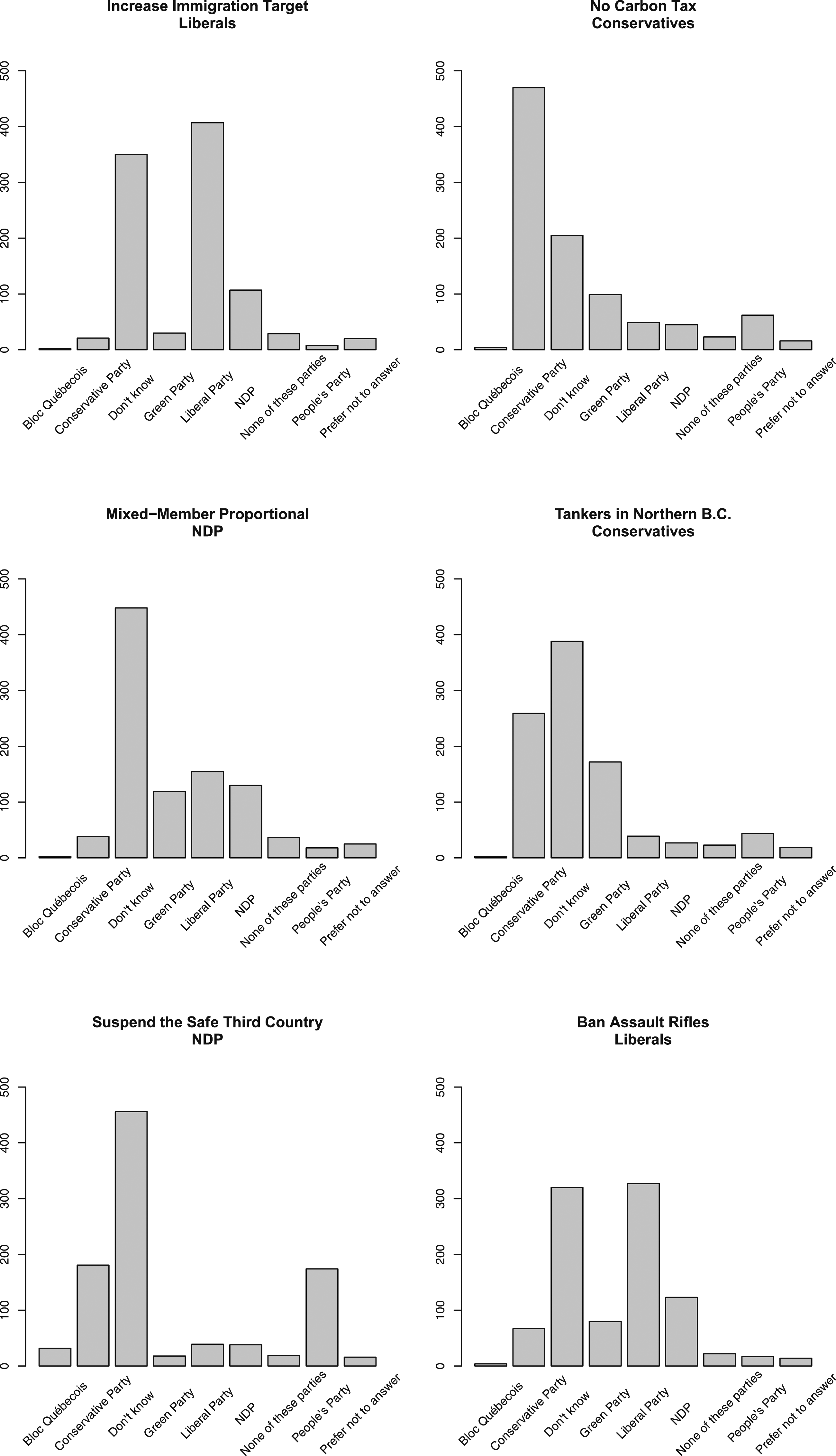
For our No Carbon Tax pledge, 470 answered correctly that it was a Conservative Party pledge. For our Mixed-member proportional pledge, 249 correctly answered NDP or Green, for the Tankers pledge, 276 respondents correctly answered Conservative or People’s, for the Rifles Ban pledge 327 correctly answered the Liberal. The only case where this did not occur is the Safe Third Country pledge, where the most common answer is the Conservatives with 181 respondents, closely trailed by another incorrect answer, the People’s Party, with 174 respondents.
However, this summary of our raw answers did not consider “Don’t know” answers, effectively treating them as missing data. We believe that in our context, it makes sense to take these “Don’t Know” answers at face value. In other words, we assume that these respondents were not aware of which parties made that specific pledge. When we consider “Don’t Know” answers, things change a bit. As an example, for our Increase Immigration Target pledge mentioned above, 42% (407) of correct answers concerned a pledge made by the Liberal Party, while 36% (350) did not know and the remaining 20% (197) gave incorrect parties or refused to answer (20%–2%). For the rest of the analysis, “Don’t Know” answers will be considered as incorrect answers.
Out of our six promises, the most alarming results concern to the pledge to Suspend the Safe Third Country Agreement, made by the NDP. This pledge was only answered correctly by 4% (38) respondents. While this pledge could be one of the tougher ones given its roots in a very specific international policy, it also tells us that at least a proportion of our respondents tried to answer using shortcuts (heuristics) as opposed to actual factual knowledge. This makes sense given what we know of citizens’ evaluation of pledges (see e.g., Pétry and Duval, 2017 for more on heuristics shortcuts and their shortcomings). The negative wording of the pledge might explain why so many respondents answered that a pledge involving the termination of an agreement relating to asylum seekers was made by the Conservative or the People’s Party (36.5%) (despite this showing a complete misunderstanding of what the Safe Third Countries agreement is).
With that said, our results suggest that the most often selected answers to our pledge awareness questions tend to be the correct ones. This appears to indicate there is a “signal” in the “noise”. These descriptive results are pretty similar to what studies asking citizens about pledge-fulfillment (see e.g., Duval and Pétry, 2020, or Pétry and Duval, 2017 in the Canadian context). These studies also find high levels of “Don’t know” for some pledge, a plurality of correct answers though not the majority we’d hope for.
As highlighted above, party identification plays a big role in the citizen’s evaluations of pledge fulfillment after the mandate ended (Belchior, 2019; Duval and Pétry, 2019; Naurin and Oscarsson, 2017; Pétry and Duval, 2017; Thomson, 2011; Thomson and Brandenburg, 2018) and as such it is reasonable to hypothesize that similar dynamics are at play during the initial election. More precisely, party identifiers should know what their party of choice promised more so than other parties.
Figure 2 presents each of our six pledge awareness items, contrasting the evaluations of party identifiers to those of every other respondent. The most salient result is that the proportion of incorrect answers is higher than the number of correct ones in all but one case. Most Conservative Party identifiers (62.3%) correctly associated the pledge to “reduce emissions without imposing a federal carbon tax” to the Conservative Party. However, this is not the main purpose of this comparison, as the relatively low proportion of correct answers was discussed earlier. What we observe here, related to party identification, is that party identifiers had a higher proportion of correct answers. There is, however, one notable exception, and that is that Liberal Party identifiers fared no better than non-identifiers at correctly associating the Immigration Targets pledge (−11.9%). This gives some support to our hypothesis that citizens are more aware of the pledges made by the party they identify with. Pledge awareness by pledge and party identification.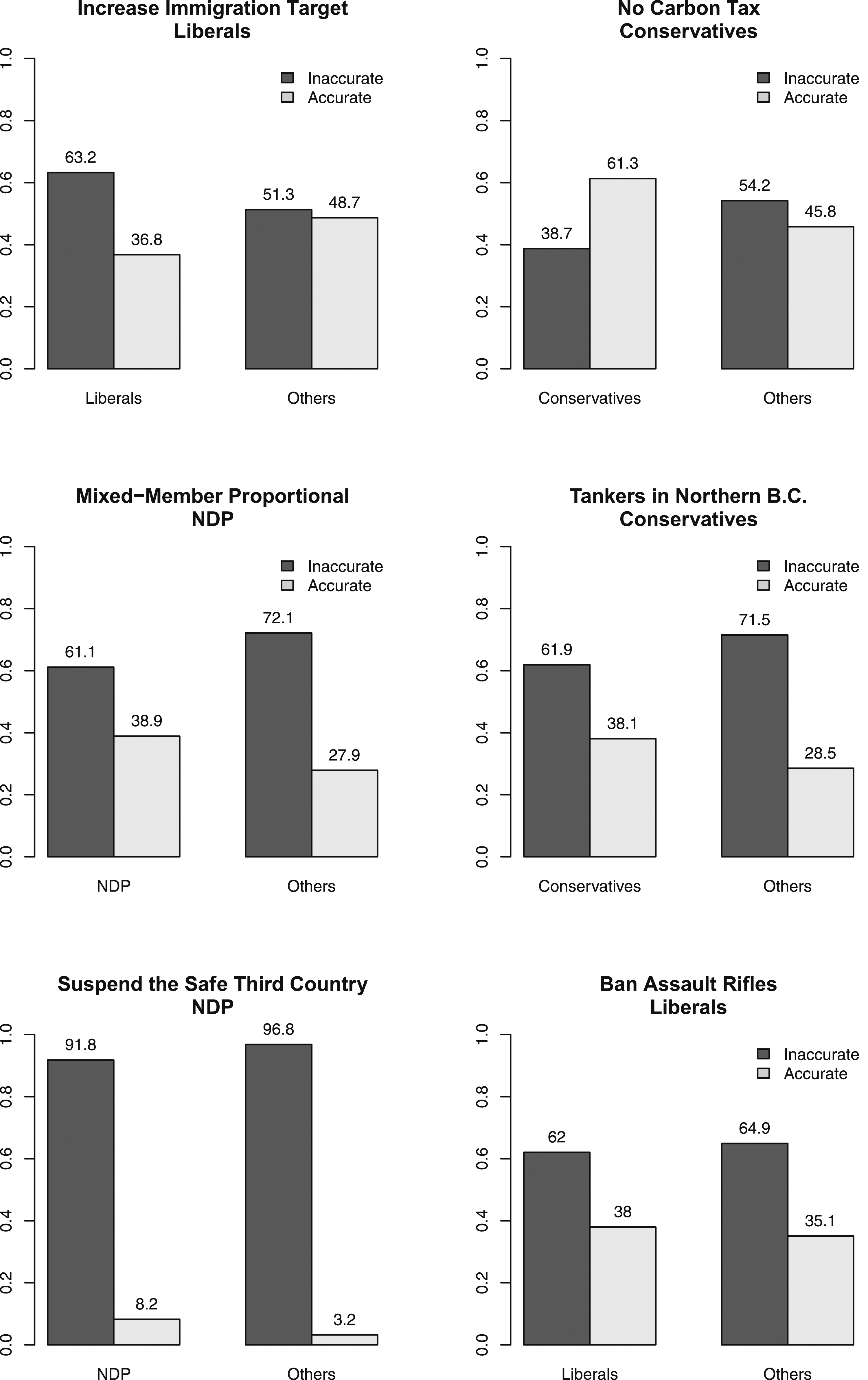
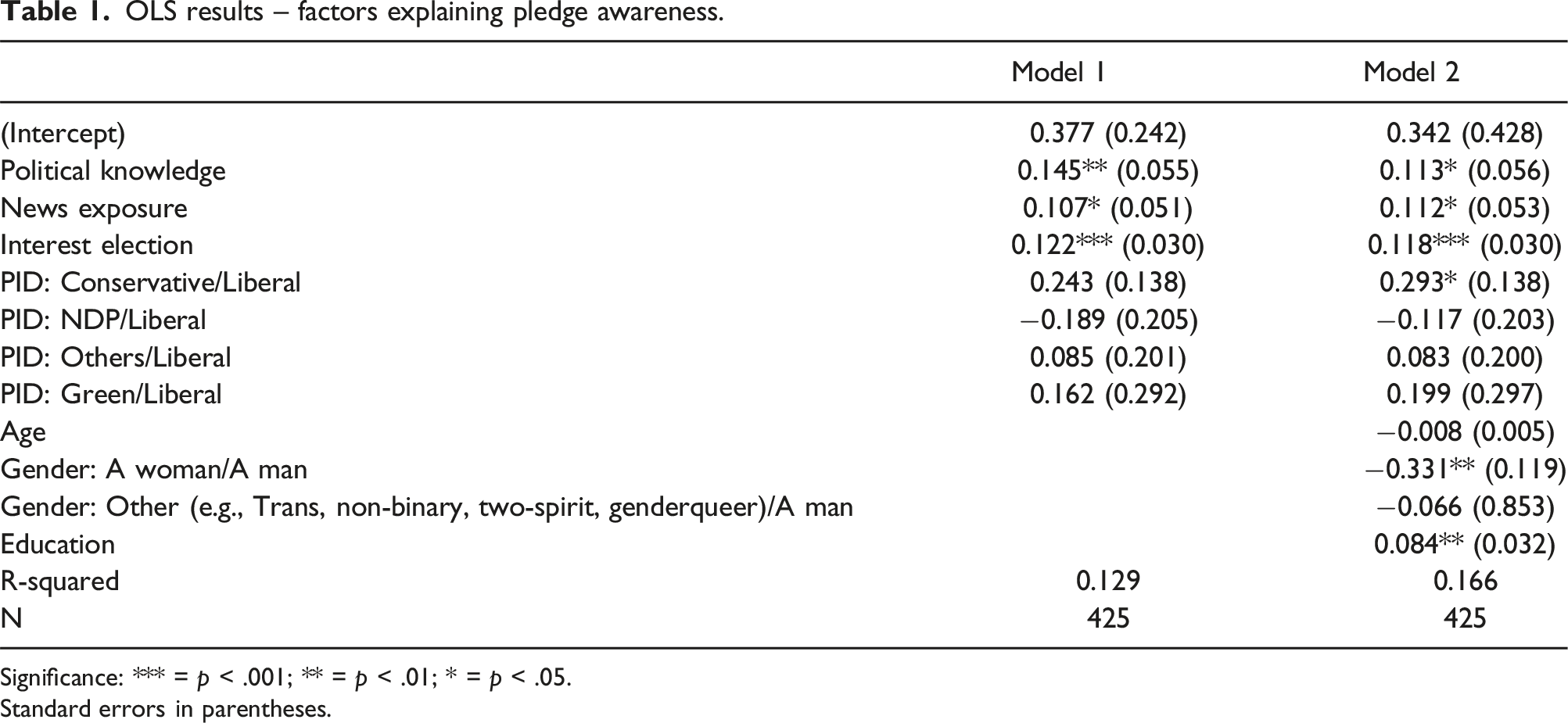
OLS results – factors explaining pledge awareness.
Significance: *** = p < .001; ** = p < .01; * = p < .05.
Standard errors in parentheses.
Figure 3 presents the average predicted effects of our three variables of interest on the citizen’s aggregated pledge awareness scores. As we can see, Political Knowledge, News Exposure, and Interest in the Election all have small but meaningful effects on the citizen’s ability to associate correctly pledges with the parties who made them. This supports our hypothesis that information resources (political knowledge, media exposure, and interest in the election) all increase citizens’ level of pledge awareness. Average predicted effects of political knowledge, news exposure and interest on the citizen’s awareness of election pledges (model 1).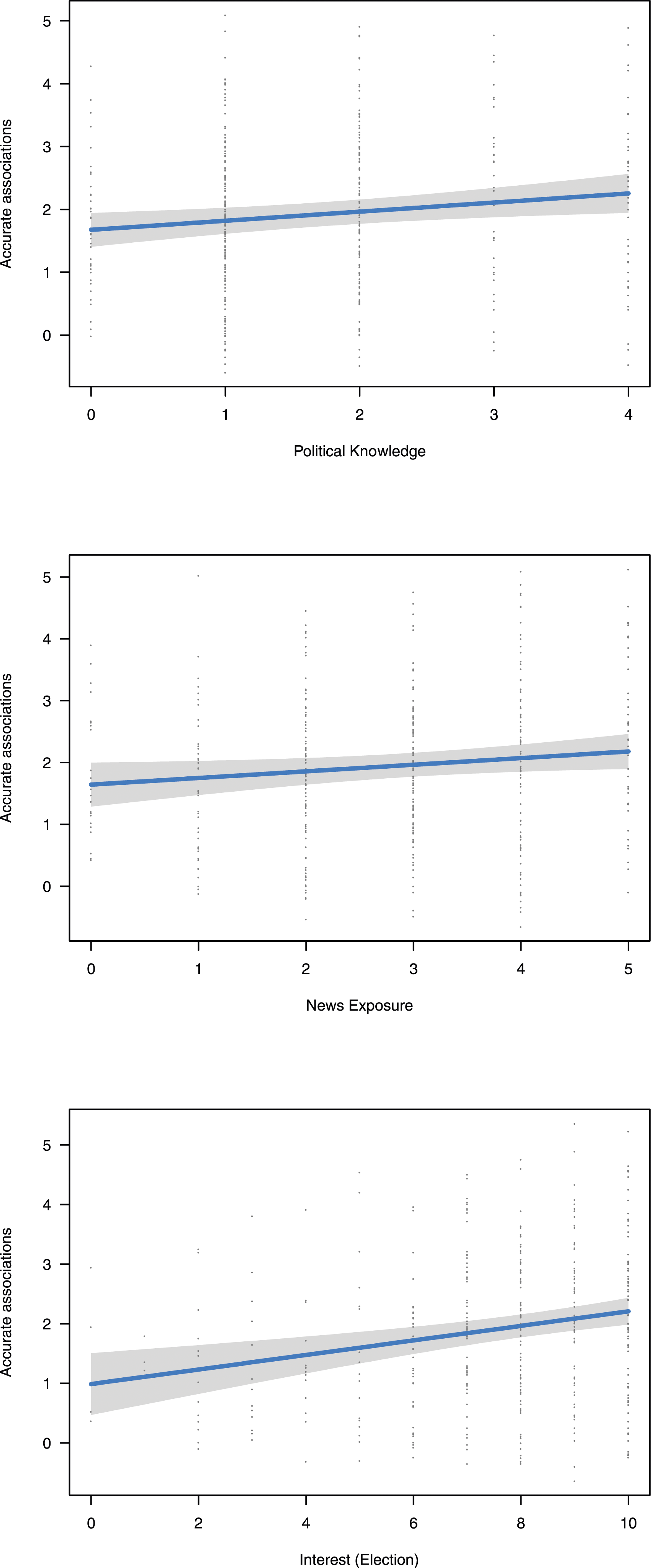
Logit results – factors explaining pledge awareness (per pledge).
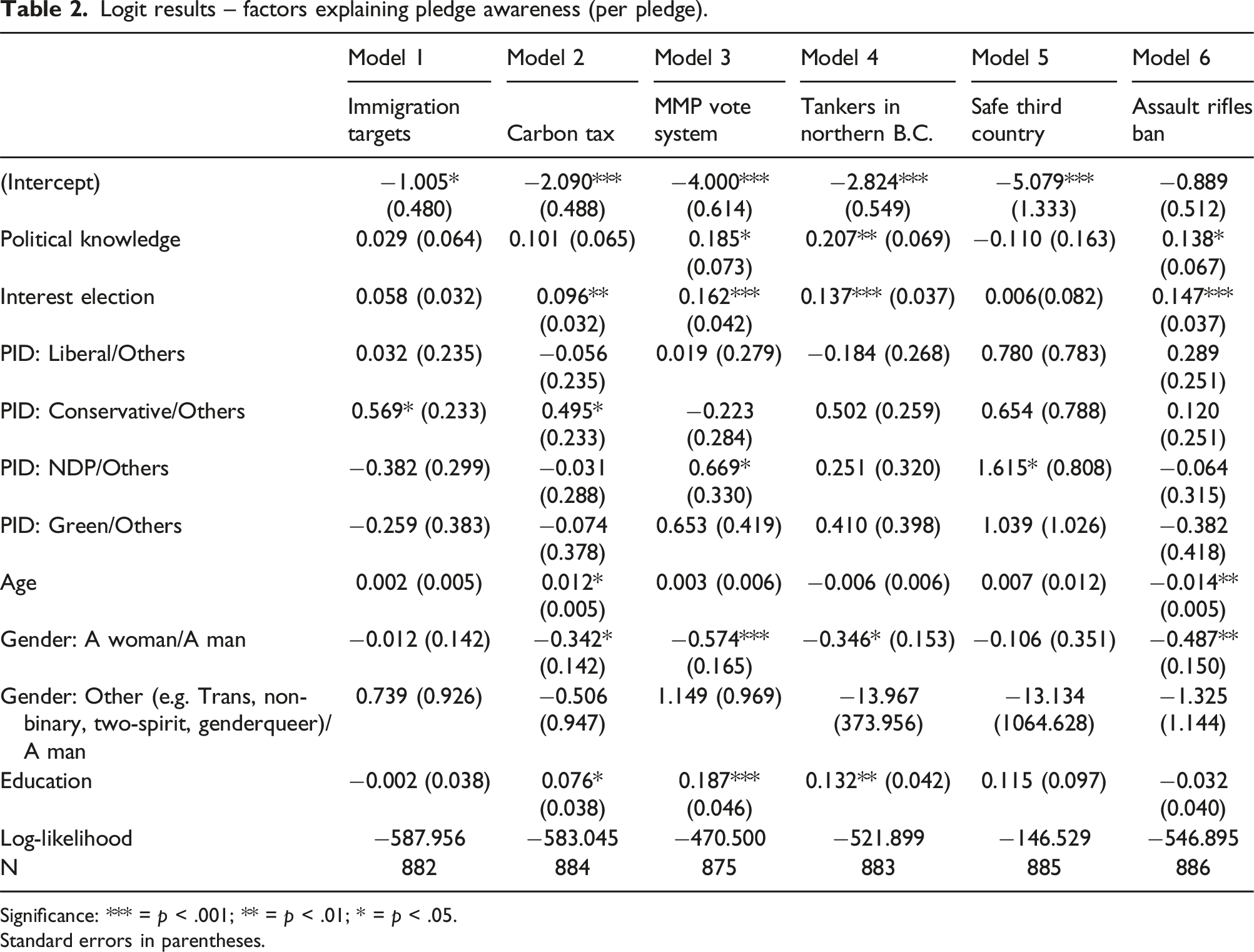
Significance: *** = p < .001; ** = p < .01; * = p < .05.
Standard errors in parentheses.
Our Conservative Party identifiers seem more likely to associate accurately the “No Carbon Tax” with the Conservative Party. Similarly, NDP identifiers also seem more likely to associate correctly their party of choice with the “Suspend Safe Third Countries Agreement” and the “Mixed-Member Proportional voting system” pledges. Out of our six pledges, this represents only three conclusive cases. Liberal Party identifiers appear to have failed our pledge awareness in both cases. Somewhat surprisingly, the respondents who fared better at associating the pledge to raise immigration targets to the Liberal Party were the conservative identifiers, which is most likely an indication of how important this issue or policy area is to them. There is perhaps some solace to be found in the fact that in our models, party identification never appears to incorrectly bias pledge awareness. In other words, none of our statistically significant coefficients are negative. This appears to indicate that voters misidentify pledges when they lack information. Such a scenario might be corrected for with better information resources.
Discussion
While we do not find that citizens are perfectly aware of all six pledges in our study, we do see that the most selected answers are usually the correct ones. In many ways, our results are similar to those of the studies of citizens’ evaluation of pledge fulfillment. Similarly, our findings also support studies that indicate that well-informed voters fare well on platform knowledge tests and that people tend to know more about their preferred party. The task we devised to test whether citizens know electoral pledges was an inherently hard one. There are reassurances to be found in the fact that the most picked answers to our pledge awareness questions are the correct ones. While this is perhaps an overly optimistic way to look at it, this appears to indicate there is a “signal” in the “noise”.
We do recognize that our selection of pledges does have some effect on the results. While we tried to devise a “most-likely-type” of design, it does appear that some of our pledge were extremely hard to associate with the right party for our respondents. This can be seen in the number of incorrect answers but also in the amount of “don’t know” answers for certain pledges. This also has theoretical and generalizability implications. In hindsight, not having easier pledges, despite our efforts, makes this task a test for pundits more so than a test for the average citizen. As such, we must be careful about trying to generalize these results since they are, at least in part, affected by the case selection. In hindsight, asking citizens about specific policy issues, such as the Safe Third Country Agreement proved too difficult even though asylum seekers were a prominent topic during the campaign. More generally, even if a policy issue is extensively discussed in the campaign and most citizens generally know where the parties stand, it does not mean citizens will be able to parse the specific “policy jargon” in a pledge made to address this issue.
Short of asking citizens about every single pledge, selecting only a few (even though we ensured they were at least minimally salient in the news media) comes with its limitations. As Mellon et al., 2023 show in their conjoint experiment, citizens do not care about all pledges equally. This is further complexified by the fact that even what citizens consider a pledge can vary a lot (Krishnarajan and Jensen, 2022; Naurin, 2011). The fact that Conservative Party identifiers fared better at correctly associating the “Raise immigration targets” pledge with the Liberal Party than the Liberal Party identifiers most likely reflects the varying degrees of importance different voters give to different pledges. As mentioned in our hypothesis section, a less demanding interpretation of promissory representation, would be that voters need to know pledges that are important to them and that they don’t necessarily need information about all the other pledges. Testing this minimal assumption, and testing whether citizens can find information about pledges that interest them, or could interest them, could prove interesting.
Another promising avenue of research related to this one would be to investigate the level of satisfaction party identifiers have with the pledges made by their party. Or put otherwise, how much they agree – or do not agree – with their preferred party’s proposed program. This is not something that has received any attention and yet it would probably shed some light on the mixed findings we often get when we ask citizens about pledges.
Last, pledge awareness is a key assumption of the promissory representation model, and we believe it warrants further investigation. We encourage other scholars interested in electoral pledges to investigate this important issue in other contexts and perhaps with different designs. For example, it would be interesting to devise a conjoint experiment that would ensure better coverage of an array of different electoral pledges to circumvent the inherent limitations of choosing only six pledges, as we have done here due to financial limitations. Another avenue of research would be to further investigate the different factors potentially biasing or improving pledge awareness, going beyond the explanatory factors we examined in this study of party identification and informational resources.
Supplemental Material
Supplemental Material - Citizens’ awareness of electoral campaign pledges
Supplemental Material for Citizens’ awareness of electoral campaign pledges by Dominic Duval and François Pétry in Party Politics
Footnotes
Declaration of Conflicting Interests
The author(s) declared no potential conflicts of interest with respect to the research, authorship, and/or publication of this article.
Funding
The author(s) received no financial support for the research, authorship, and/or publication of this article.

Supplemental Material
Supplemental material for this article is available online.
Notes
Author biographies
References
Supplementary Material
Please find the following supplemental material available below.
For Open Access articles published under a Creative Commons License, all supplemental material carries the same license as the article it is associated with.
For non-Open Access articles published, all supplemental material carries a non-exclusive license, and permission requests for re-use of supplemental material or any part of supplemental material shall be sent directly to the copyright owner as specified in the copyright notice associated with the article.
