



Abstract
According to widely held views on good democratic practice, when political parties are in government, they should generally keep the promises they made to voters during the previous election campaigns that brought them to power. But what happens when things change dramatically between the times of promising and governing? We develop and test a theory of how economic uncertainty and change affects promise keeping. We argue that when parties formulate election pledges amid high levels of uncertainty, they make promises that can be kept even when significant negative economic changes transpire. We test the implications of the theory using a mixed methods approach, including a quantitative analysis of over 9000 election pledges made by parties from 13 countries. We also present new quantitative and qualitative evidence on pledge fulfillment by Australian parties, which offers a highly relevant test of the impact of unexpected events.
Introduction
When holding government office, parties are generally supposed to follow through on the promises they made to voters in the previous election campaigns that brought them to power. The connection between parties’ policy stances, which inform their campaign promises, and subsequent public policies is a link in the longer chain of democratic command and control (Crisp et al., 2020; Downs, 1957). This chain encapsulates a view of democracy that highlights substantive representation, a view which states that good democratic representation means that citizens’ policy preferences are reflected in public policies (Saward, 1998: 51). For this to happen, each of the links in the chain must be strong. Citizens must be able to vote based on the match between their own policy preferences and parties’ policies. Then the election results in the form of legislative seats or presidential power must reflect the relative public support for candidates and parties accurately. Finally, when parties hold executive power after elections, they must make policies that align with the promises they previously made. It is this last part of the chain on which we focus here. The importance and prominence of the link between parties’ promises and subsequent public policies is reflected in the fact that this understanding of democracy is referred to as “promissory representation” (Mansbridge, 2003: 516). When governing parties fulfill their campaign promises, often with great fanfare, they loudly claim to have received a mandate to have done so (Pitkin, 1967: 146).
The theoretical contribution in this paper addresses one of the remaining major gaps in knowledge regarding promissory representation. What are the impacts of radical changes in circumstances, particularly economic conditions, between election campaigns and subsequent governing periods on the fulfillment of election pledges? In other words, how do unexpected events affect the extent to which governing parties keep their campaign promises? We detail our theoretical explanation in the next section, which focuses on how the interaction between uncertainty and economic downturns affects pledge fulfillment. This focus is central to the juxtaposition of the delegate model that is implied in promissory representation and the main alternative trustee model of representation. The delegate model posits that when citizens cast their votes for a party, they essentially instruct that party to carry out the policies that it proposed during election campaigns; voters “delegate” authority to parties through elections, and parties are obliged to follow those instructions when in government. This implies a “forward-looking concept of power” with respect to the relationship between voters and parties, in that voters control parties’ future behavior (Mansbridge, 2003: 516). It also implies a forward-looking concept of power with respect to the relationship between parties and public policies, because it assumes that parties can anticipate which policies are realistic to implement in the next governing period.
In contrast to the delegate model, the alternative trustee model holds that parties should be free to exercise their judgment on behalf of citizens, unconstrained by specific instructions. If parties do make campaign promises, the trustee model gives parties the discretion to break them if required to do so. One of the main justifications for the trustee model concerns the difficulty of anticipating which policies will be in the general public’s interest in the future, as well as which policies are possible or appropriate to implement in the future. When it is exceedingly difficult for policymakers to anticipate future circumstances, it may not be appropriate to make specific policy commitments or to keep promises that were made. This concern with the impact of unexpected events on democratic representation is particularly relevant nowadays, given recent disruptions caused by financial crises, natural disasters, military confrontations and pandemics.
The empirical contribution of this paper is to test our theoretical explanation of the impact of unexpected events and uncertainty on pledge fulfillment in a mixed-methods research design. In the first step of the analysis, we conduct a cross-national quantitative comparative analysis of an established dataset on promise making and keeping (Naurin et al., 2019; Thomson et al., 2017). This builds on a growing body of research on election pledges, which until now has not systematically considered the impact of unexpected events on pledge fulfillment. Instead, this research field has focused mainly on the impacts of different government institutions, for instance power-sharing arrangements and the allocation of ministerial portfolios. We also add new evidence on four recent Australian governments, 2010-22. In the second step of the analysis, we examine this new evidence on Australian politics in more detail, paying particular attention to the 2019-22 governing period. This governing period provides a particularly rich testing ground for investigating the impact of unexpected events on pledge fulfillment, as the circumstances prior to the May 2019 election campaign changed dramatically mainly due to the pandemic.
Fulfillment, unexpected events, and uncertainty
The main focus of our analysis is whether or not election pledges are fulfilled. While we use the terms campaign promises, commitments and pledges interchangeably, we follow an established definition of election pledges, and associated coding procedures, that have become the standard in comparative research in this field (Thomson et al., 2017). Our definition highlights the “testability” criterion for statements to be considered election pledges. Pledges may refer to concrete actions or outcomes, such as changing particular tax rates or welfare regulations, changing spending by specified amounts, or achieving certain macroeconomic outcomes such as deficits or employment numbers. Pledges are therefore quite distinct from general rhetoric, support for broad principles, attacks on the character and competence of political opponents, and other types of speech that are important parts of election campaigns.
Unexpected events have a broad range of origins, forms and consequences, including natural disasters, military confrontations and pandemics. Birkland (2006: 2-3) defines a “potential focusing event” as one that is “sudden, relatively uncommon… and that is known to policy makers and the public simultaneously” (2006: 2-3). Given that unexpected events are sudden and uncommon, governments are largely limited to responding to them after they begin to unfold. Here, we are mainly interested in unexpected events that have significant negative consequences for economic conditions. Unexpected events, even those not of a financial nature, are likely to have negative economic consequences. The COVID-19 pandemic is one obvious example. We also focus on events that consume governments’ attention and alter their policy agenda. We suggest that events which produce negative economic consequences and require governments to shift their attention are the most likely to affect the fulfillment of pledges.
We foresee two main mechanisms through which unexpected events reduce the likelihood of promise keeping. First, negative economic consequences put pressure on the public revenues required to fulfill many campaign promises. Some pledges are themselves about increasing public expenditure, such as increasing public spending on health or defense. Other pledges refer to actions, such as employing more nurses in public hospitals, which very likely require more spending. Similarly, pledges to cut taxes involve forfeiting revenues. To the extent that events put pressure on public finances, they will reduce the likelihood that governing parties fulfill their previously made campaign promises. Studies conducted on the period of the 2007-9 Global Financial Crisis found less pledge fulfillment compared to other periods, mainly due to the inevitable pressures this put on public finances (Pétry and Duval, 2019: 134).
The second related mechanism concerns the demands that events make on governments’ limited scope of attention. This idea has been explored extensively in the field of comparative policy agendas that examines how the composition of governments’ policy agendas – the set of issues to which they attend – changes over time (Baumgartner and Jones, 1993). Significant and unexpected events may cause a “punctuation” or disruption of an established policy agenda, forcing some issues to more prominent places in the agenda while dislodging others. Unexpected events, whether they be economic or not, lead to the prioritization of new issues that ultimately reduces the likelihood of promise keeping. For instance, pandemics that cause governments to be consumed with measures to prevent virus spread and promote economic recovery may draw attention away from issues that seemed important at the time of the pre-pandemic election campaign. An unexpected event or crisis may bring about a policy “paradigm shift” that would be unlikely in absence of the event, and governments may even use unexpected events as justifications for breaking previous campaign promises (Boin et al., 2008). There are conceivably scenarios in which an unexpected event may lead to a campaign promise receiving a higher priority than it otherwise would have. However, we expect the effect of changing government agendas to be negative for the fulfillment for most pledges. These two mechanisms lead to the first baseline hypothesis: H1: Governing parties are less likely to fulfill election pledges when unexpected events with negative economic consequences occurred after they took office.
According to our theory, this negative effect of unexpected events is mitigated by high levels of uncertainty at the time at which parties formulate their campaign promises. Scholars and practitioners recognize the impact of uncertainty on political decision-making (e.g. Dahl, 1989: 337). Here, uncertainty refers to heightened and widely shared concerns that future economic downturns are possible or likely. These concerns need not manifest themselves in current economic conditions or particular forecasts. Uncertainty may, for instance, be due to prevailing views on underlying economic imbalances and vulnerabilities, including but certainly not limited to concerns regarding over-inflated property prices or over-reliance on particular export markets. While acknowledging that uncertainty is widespread, our definition highlights that it occurs at different levels across countries and years. This aligns with recent political economy research on uncertainty that has produced a useful comparative measure of this concept, which we discuss and use later in this paper (Ahir et al., 2022).
Somewhat counterintuitively, uncertainty is a gift when it comes to mitigating the negative impact of unexpected events on pledge fulfillment. Parties have incentives to make pledges that can realistically be fulfilled, as voters do not look favorably on parties that have been habitual promise breakers (Schedler, 1998: 199). As uncertainty about future economic conditions increases, parties become more cautious about what can realistically be achieved in government.
In the face of uncertainty, parties may adjust their election appeals in different ways. One way is to be deliberately vague about their future policy priorities if elected to govern. This provides parties with greater room to maneuver in office amid heightened uncertainty during the formulation of policies (Aragonès and Neeman, 2000). However, ambiguity poses risks as it can evoke negative responses from voters under certain conditions (Martin, 2019; Rovny, 2012; Shepsle, 1972). Moreover, mainstream parties that are viable contenders for government are expected to have a clear and consistent blueprint for governing, which limits the extent to which they can use ambiguous language in response to uncertainty (Lefevere, 2024).
Rather than being ambiguous about their future policies, we suggest that parties calibrate the ambition or magnitude of their electoral appeals so that what they promise can be delivered even if economic conditions deteriorate, therefore avoiding the negative electoral consequences of broken promises. When parties enter election campaigns amid low levels of uncertainty, they make more ambitious promises that require significant public finances and political attention. Consequently, when economic downturns occur following pre-election periods of relatively low uncertainty, campaign promises are less likely to be kept. Therefore, our second hypothesis is: H2: High (low) levels of uncertainty at the time of election campaigns mitigate (exacerbate) the negative impact of post-election economic downturns on pledge fulfillment.
While our main theoretical contribution is to focus on the impact of economic downturns and uncertainty on pledge fulfillment, many other factors play a role too. We build on an established program of comparative research that has considered many of these (see Naurin et al., 2019 for a review). As detailed in the following sections, our analyses take into account these other explanations of pledge fulfillment, such as institutions that compel parties to share power in coalitions, whether the governing party received the chief executive and/or relevant ministry in coalition governments, and the duration of the government. Our explanation, which focuses on the conditional effect of unexpected events that bring significant negative changes in economic conditions, is distinct from these existing explanations. It is important that we test it while considering these other related factors.
Research design
We examine an existing dataset on election pledges and expand this dataset with new information on Australian parties’ election pledges. This existing dataset was developed by the Comparative Pledges Project (CPP) and has been examined in a wide range of previous comparative analyses (Naurin et al., 2019; Thomson et al., 2017). The latest published version of the CPP dataset consists of information on election pledges in 12 countries and the details of the elections and governments included are reported in the Supplemental Information at the end of this paper. To this dataset we add information on pledge making and fulfillment in Australia, bringing the number of countries we compare to 13. In the main part of the quantitative comparative analysis below, we focus on the fulfillment of pledges made by parties that went on to hold executive power after elections. We refer to these as “governing” parties, while noting that many of these parties were not in government at the time of the election campaign in which they made the pledges.
The main advantage of the CPP dataset is that it includes comparable measures of election pledges and fulfillment in a broad range of institutional contexts and economic conditions. CPP researchers used the same definitions of election pledges when identifying which statements to include as pledges and followed the same detailed coding procedures. A pledge is “a statement committing a party to one specific action or outcome that can be clearly determined to have occurred or not” (Naurin et al., 2019: 24). This definition is a “narrow” one, and all researchers in the comparative project agree that statements which meet this definition are pledges. This is also the definition we follow in our own data collection on Australian parties.
The categories for assessing fulfillment distinguish between “unfulfilled,” “partially fulfilled” and “fully fulfilled” pledges. A pledge is partially fulfilled if some action is taken in the direction of the promise that falls short of full fulfillment, such as reducing a tax rate from 20% to 18% when a reduction to 15% was promised. The evidence gathered to assess fulfillment depends on the substance of what was promised, including changes to legislation, budget allocations or data on socioeconomic outcomes. Most of the quantitative comparative analyses focus on a dichotomous measure that distinguishes between fully and partially fulfilled pledges on the one hand and unfulfilled pledges on the other. This is appropriate given that the way in which a pledge is formulated may affect the likelihood that it is fully or partially fulfilled.
We add two key explanatory variables to the CPP dataset to test our argument on the effects of uncertainty and unexpected events. The first and most noteworthy is a comparative measure of uncertainty developed by Ahir et al. (2022) called the World Uncertainty Index. This index provides measures of the degree of political and economic uncertainty in each country in each year. The index is based on the standardized frequency of words “uncertainty,” “uncertain” and “uncertainties” in the Economist Intelligence Unit’s quarterly country reports. This measurement approach has the advantage that it is based on standardized reports by country specialists focusing on economic and political developments in each country. Ahir et al. (2022) provide a set of validation tests of the uncertainty index, which demonstrate that the index is significantly associated with a range of plausible outcomes including stock market volatility, disagreement among economic forecasters and lower GDP growth. The face validity of the measure is indicated by the fact that it spikes around events such as the Gulf War, the Euro debt crisis, Brexit and the COVID pandemic. This new measure of uncertainty has, and continues to be, utilized by international financial institutions, world governments and in peer reviewed journals. We take the average of the WUI across the quarterly reports in the relevant country’s election year as our preferred measure of uncertainty in the year of the election.
The second key variable we add to the CPP dataset to test our argument is the fall in GDP growth from the year of the election to the average of the first 2 years of the subsequent governing period. This provides a quantitative indicator of unexpected economic events. The logic of our main hypothesis implies that pledge fulfillment will be relatively less likely when uncertainty is low and there is a large fall in economic growth. The theory directs our attention specifically to the effect of falls in economic growth, as distinct from increases in economic growth. The reason for taking the first 2 years of the governing period is that most pledges are either fulfilled or unfulfilled within the first 2 years of each government.
In addition to the effects of uncertainty and changes in economic conditions, the quantitative comparative analyses consider a range of alternative explanations of pledge fulfillment that have been examined in previous studies. One of these alternative explanations is the effect of power sharing in coalitions compared to single-party governments, as single-party governments are generally more likely to fulfill election pledges. The model also includes agreement between parties, because this generally increases the likelihood of pledge fulfillment. We distinguish between parties that had recent governing experience and those that did not when they formulated their pledges, because opposition parties without recent experience are generally less likely to keep their promises if they enter government after the elections. The model includes fixed effects for countries, which controls for characteristics of countries that may affect the likelihood of pledge fulfillment.
We complement the quantitative analysis of the expanded CPP dataset with a focused analysis of new evidence on Australian parties’ election pledges. Australia is a parliamentary democracy with a dominant two-party system, consisting of the center-left Australian Labor Party (ALP) and the center-right party grouping called the Coalition, which consists of the Liberal and National Parties. The Liberal and National Parties do not issue separate manifestos or compete with each other in the same constituencies for the most part, and for comparative purposes it is appropriate to consider them together as a broad center-right party. A preferential-majoritarian election system in the lower house has produced single-party majority governments in Australia on all but one occasion in the post-war period, the minority government of Labor in 2010-2013, which we include in our study.
The new information on Australian parties’ election pledges follows the same procedure as that followed by the CPP. We include election pledges made by the main parties at the 2010, 2013, 2016 and 2019 national election campaigns. Unlike most parties in other countries that have been included in comparative research on election pledges, Australian parties do not issue manifestos or election platforms in the form of separate published documents. However, in the time period we consider, the parties published websites with comprehensive discussions of all electorally salient policy areas that closely resemble manifestos of parties in other countries.
The Australian case is a particularly appropriate testing ground for studying the effects of unexpected events on pledge fulfillment. Following the election campaign for the May 2019 election, the government was confronted by two separate highly unexpected developments. From August 2019 to January 2020 catastrophic bushfires spread across Australia’s Eastern states, resulting in hundreds of deaths (Borchers Arriagada et al., 2020). In January 2020, Australia recorded its first case of the novel coronavirus (COVID-19), by March the first wave of infections spread across the country, and successive highly disruptive waves of infection continued into 2022 (Storen and Corrigan, 2020).
Quantitative comparative analysis
Figure 1 summarizes the quantitative evidence that we examine. The figure depicts the aggregate performance of governments in terms of pledge fulfillment in the 12 countries included in the currently available CPP dataset, along with the new data we add on Australian parties’ pledges. This broad cross-national comparison reveals some of the main findings that have featured prominently in previous comparative analyses. First, parties make many testable promises during election campaigns and fulfill what many observers consider to be substantial proportions of those promises. Of the 9838 pledges made by parties that went on to hold executive power after elections, 61% were classified as partially or fully fulfilled by researchers. The fact that governing parties fulfilled a clear majority of pledges at least partially and in many contexts fulfilled substantially higher percentages of pledges, contrasts with the conventional wisdom that all parties are habitual promise breakers. The fulfillment of election pledges in 13 countries compared. Note: Refers to pledges made by parties that “governed” after the elections – that is held executive office. With the exception of Australia, data from the Comparative Pledges Project summarized in Naurin et al., (2019); Thomson et al., (2017). Data on Australia collected by the authors. Details of governments are listed in the Supplemental Information.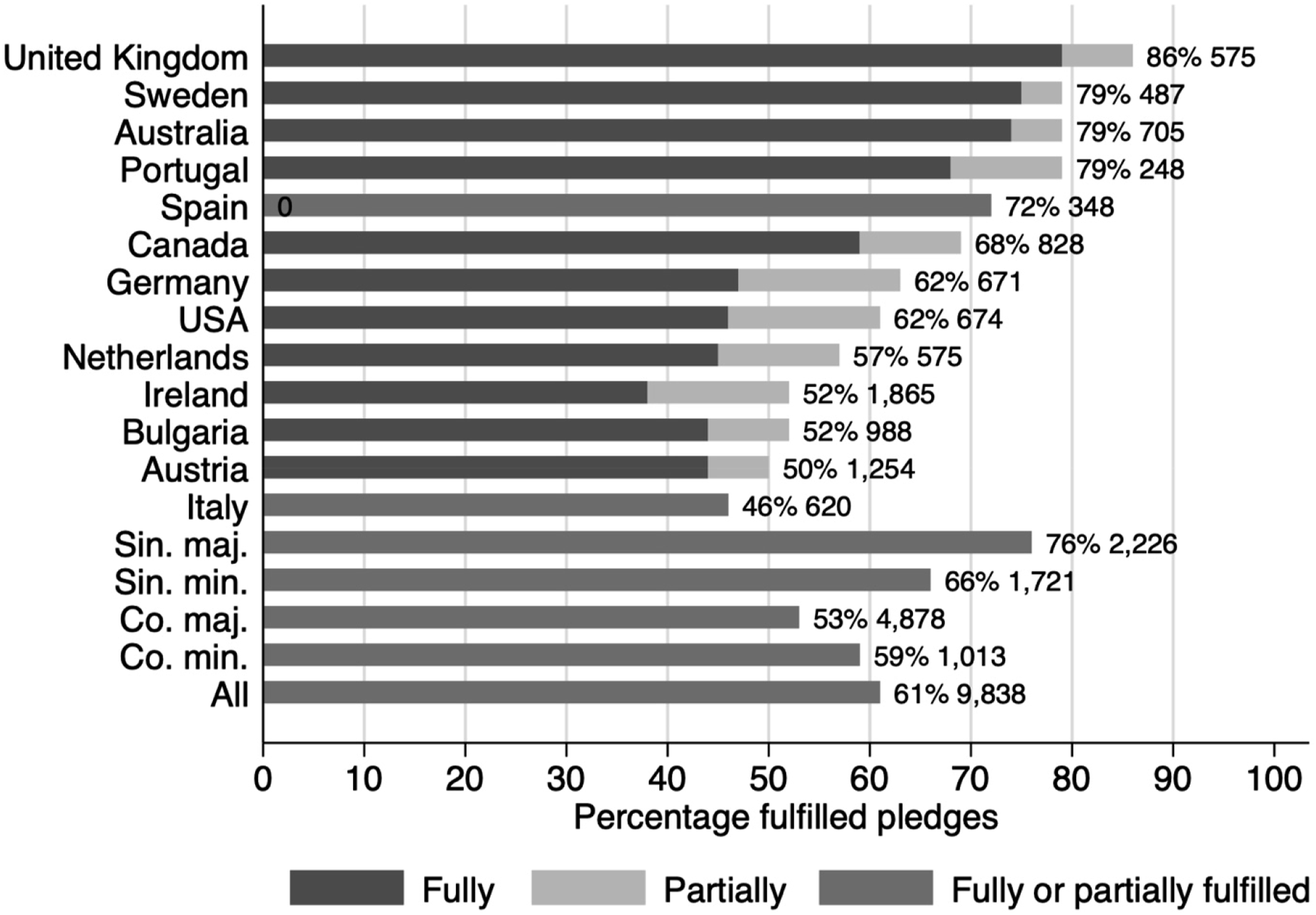
Second, the cross-country comparisons show higher rates of pledge fulfillment for governing parties in countries where single-party governments are the norm, and lower rates where coalitions and other forms of power sharing are common. The UK’s single-party majority governments exhibit comparatively high levels of pledge fulfillment. As expected, the new data on single-party governments in Australia indicate relatively high rates of pledge fulfillment in line with other countries where single-party governments are the norm. However, Australian parties’ performance in terms of pledge fulfillment is somewhat lower than that of the UK, which is consistent with the greater institutional constraints to which Australian governing parties are subject, not least Australia’s federal system of government.
Figure 2 presents the main results from a statistical model of pledge fulfillment. The model includes all 12 countries from the existing CPP dataset and Australia. The dichotomous dependent variable in this logit model is Pledge Fulfillment, which indicates whether the pledge was unfulfilled (0) or partially/fully fulfilled (1). The exponentiated coefficients in Figure 2 summarize the effects of our key explanatory variables, Uncertainty and Fall in Growth, as well as the effects of a range of other explanatory variables that have featured in previous studies. The full model, which is reported in the Supplemental Information to this paper, includes country fixed effects, which account for characteristics of countries that may impact on aggregate levels of pledge fulfillment. These include institutional structures, such as federalism, presidentialism, and EU membership. Consequently, this model is a particularly demanding test of our argument regarding the conditional effects of unexpected events on promise keeping. The number of cases in the model is 7953, which is lower than the total numbers of pledges reported for governing parties in Figure 1. This is because we exclude pledges to maintain the status quo, which are almost always fulfilled, and count a pledge only once if essentially the same pledge is made by two or more parties that enter a governing coalition. Falls in growth, economic uncertainty and the fulfillment of election pledges. Note: The graph depicts the impact of each variable on pledge fulfillment. The dots refer to the odds ratio for each variable and the lines its 95% confidence interval. Coefficients (odds ratios) are from a logit model of pledge fulfillment by governing parties (n = 7953) with partially/fully fulfilled versus not fulfilled as the dependent variable. The model includes country fixed effects and robust standard errors clustered by party platform/manifesto. The full model is reported in the Supplemental Information.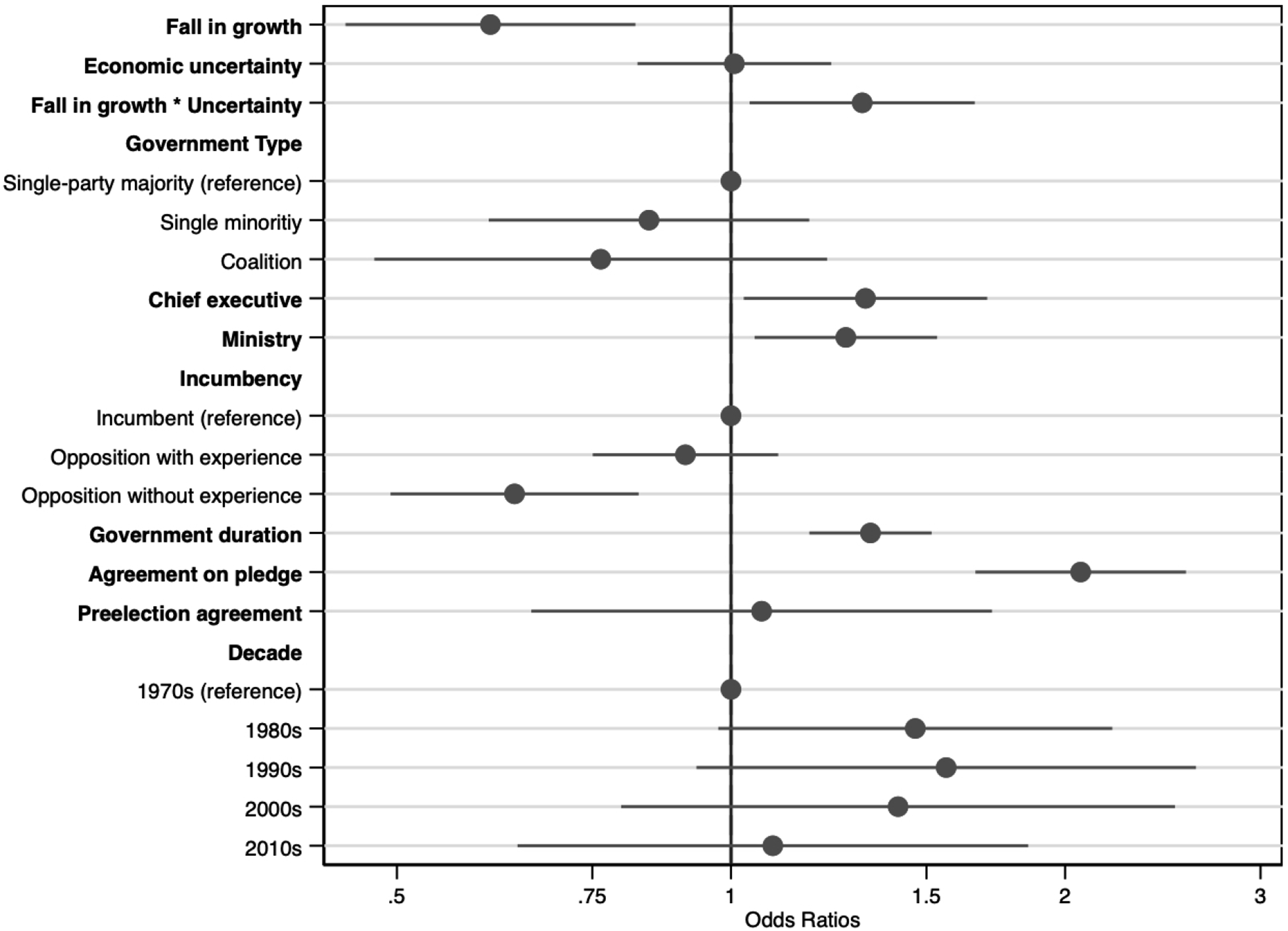
In line with our argument, the effect of Fall in Growth on Pledge Fulfillment differs significantly depending on the level of the variable Uncertainty. 1 At low levels of Uncertainty, Fall in Growth has a strong, significant and negative impact on Pledge Fulfillment. However, at higher levels of Uncertainty, Fall in Growth has a negligible impact on Pledge Fulfillment. The coefficients in Figure 2 are odds ratios, which means that values less than one indicate negative effects and values above one indicate positive effects. The odds ratio associated with Fall in Growth in Figure 2 is 0.61, which is the effect of fall in growth when there is no uncertainty, that is when the variable Uncertainty has a value of zero. The odds ratio of 0.61 means that a one unit increase in Fall in Growth, indicating a deterioration of economic conditions, reduces the odds of pledge fulfillment by 39%. There is a significant positive interaction effect between Fall in Growth and Uncertainty. This means that as the level of Uncertainty increases, the negative effect of Fall in Growth is neutralized. Uncertainty itself has no direct effect, meaning that when there is no fall in growth (i.e. when fall in growth has a value of zero), the level of uncertainty is not associated with any differences between the probability of fulfillment.
This contingent effect of Fall in Growth is depicted in Figure 3, which shows the change in the size and significance of the negative effect of Fall in Growth at different levels of Uncertainty. Figure 3 depicts the non-exponentiated b coefficients, so values of below zero indicate a negative effect. At low levels of Uncertainty, Fall in Growth has a strong and significant negative effect on pledge fulfillment. However, at higher levels of Uncertainty, the effects of falling growth are insignificant. Falls in growth have a negative effect on pledge fulfillment at low levels of economic uncertainty. Note: The graph depicts the impact of falls in economic growth (between the election year and first 2 years of governing) on pledge fulfillment at different levels of economic uncertainty in the election year. The dots refer to the coefficient (b) estimates and the lines the 95% confidence intervals. Estimates derived from the model summarized in Figure 2 and reported in the Supplemental Information.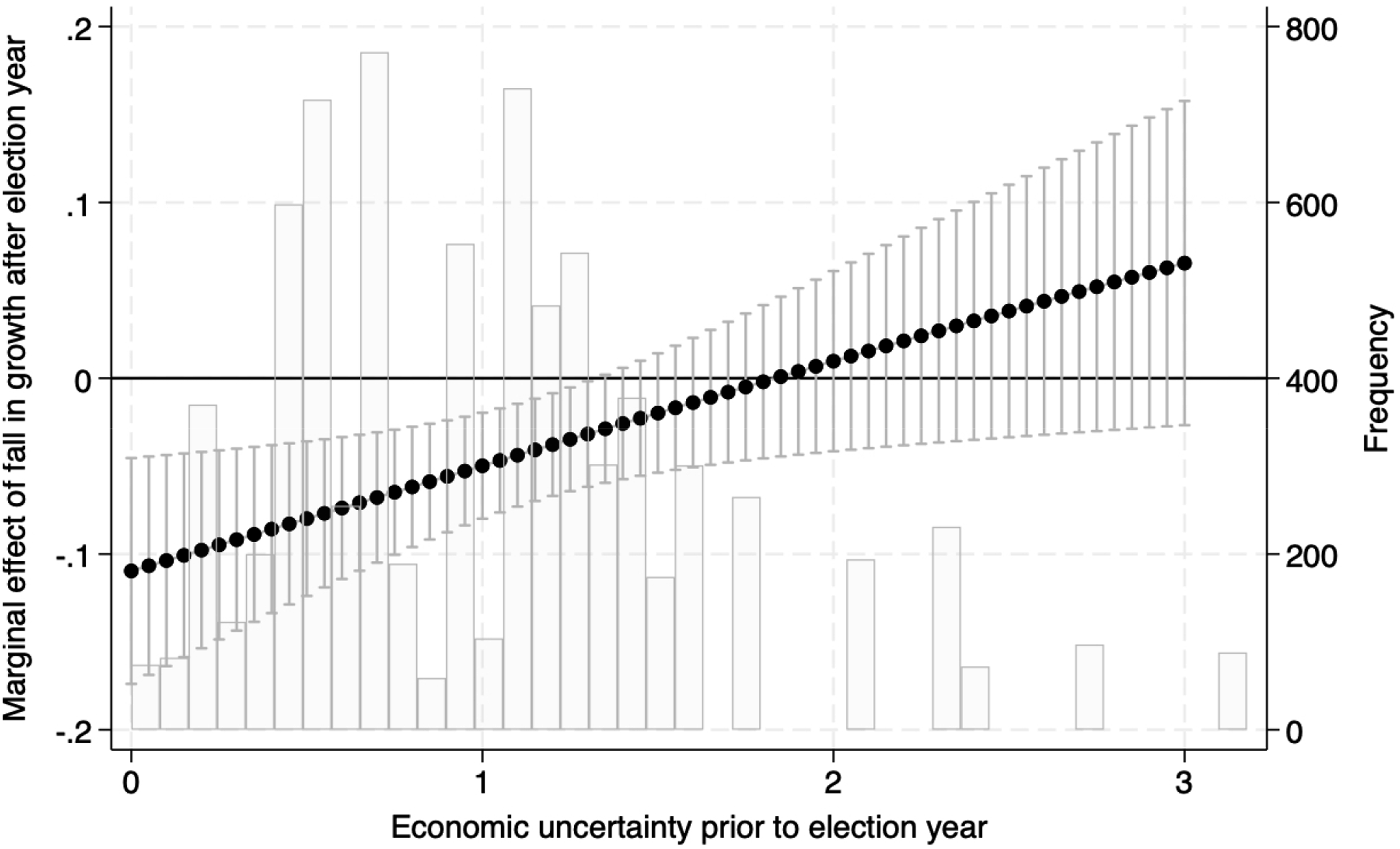
The size of this contingent effect of Fall in Growth can be described intuitively with predicted probabilities, which are shown in Figure 4. When there is no fall, as displayed on the left of Figure 4, the likelihood of fulfillment is very similar regardless of the level of uncertainty. Therefore, when economic times align with parties’ expectations, parties accurately calibrate the level of ambition in their election promises. Consider next the case of low uncertainty represented by the diamonds in Figure 4, when the variable Uncertainty has its minimum value of zero. In this scenario, when there is no fall in growth, the probability that a pledge is at least partially fulfilled is 0.61, holding the other variables in the model at their mean values. However, low uncertainty combined with a high value of Fall in Growth, corresponding to a fall in growth of 6.39 percentage points, is associated with a probability of pledge fulfillment of only 0.36. In other words, the probability of pledge fulfillment falls dramatically. While this of course represents a very large fall in growth, several hundred (468) pledges in our dataset were made before such dramatic falls took place. Probability of pledge fulfillment at different levels of falls in growth and economic uncertainty. Note: Estimates derived from the model summarized in Figure 2 and reported in the Supplemental Information.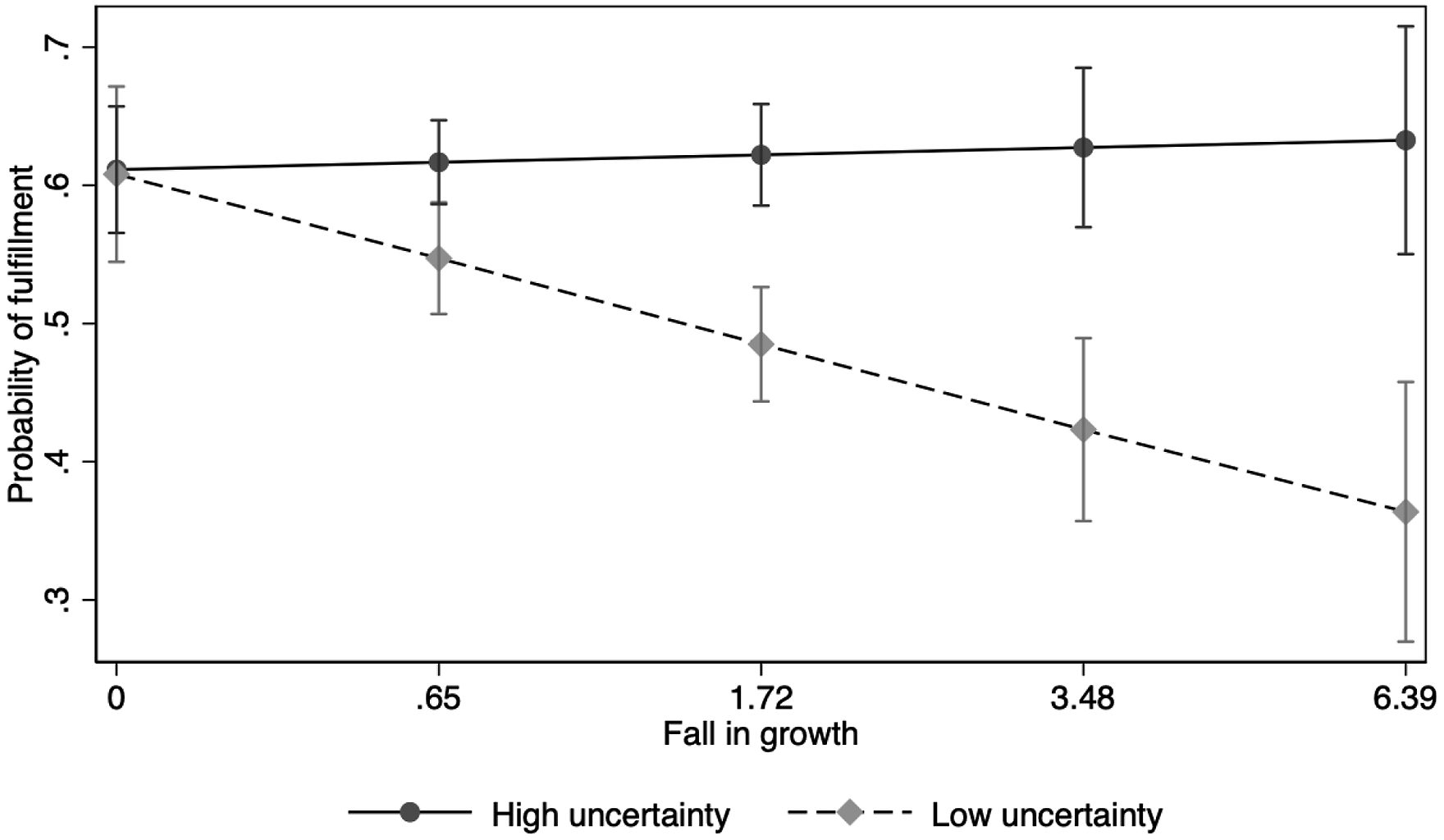
The Irish pledges of 2007 which were made just prior to the worst effects of the financial crisis are among these. Relatively large declines in growth, albeit with less damaging consequences, also took place in the UK after 1979 and Sweden after 2010. The situation is very different at relatively high levels of uncertainty represented by the circles in Figure 4, which show probabilities of fulfillment when our variable Uncertainty has a high value of 1.5 standard deviations above the average. In this scenario, greater falls in growth do not lead to lower (or higher) probabilities of pledge fulfillment. When uncertainty is high, pledge fulfillment is not impacted negatively by falling growth.
These main findings are robust to alternative model specifications and measures. For instance, the main analyses transformed the original measures of Fall in Growth and Uncertainty to logged scales due to the presence of outliers that may distort the findings. Using the originally scaled measures gives the same results. Recent research suggests that countries’ integration into the international system may impede promise keeping (Schneider and Thomson, 2024). Moreover, there is reason to believe that globalization may bring added uncertainty. The results are, however, robust to the inclusion of an established measure of economic globalization. The results are also robust to the inclusion of the level of economic growth, which of course conceptually distinct from the change in level of growth. However, given that falls in growth are strongly correlated with levels of growth, we prefer the specification that includes only our variable of theoretical interest. Furthermore, the effects of the other explanatory variables we consider, which are summarized in Figure 2, are consistent with findings from previous research. Parties that hold the chief executive and relevant ministries fulfill more pledges, which is of course true for all parties in single-party governments. Parties that take on executive power with little experience have a hard time keeping their promises, as do parties in governments that are relatively short in duration, although we exclude very short-lived governments. Finally, agreement between parties increases the likelihood of pledge fulfillment.
Unexpected events and pledge fulfillment in Australia
Australian governments are at the relatively high end of pledge fulfillment according to the international comparative evidence summarized in Figure 1. Figure 5 displays the level of promise fulfillment of the four individual Australian government’s that we add to the existing field of research. What is most striking in Figure 5 is that we find high levels of pledge fulfillment in the 2019-22 period compared to the previous periods. This high level of pledge fulfillment took place despite the unprecedented unexpected events that occurred after the 2019 election. Due to word constraints, we limit our discussion to examining the 2019-22 government in more detail, with a view to understanding why many promises were kept despite unexpected events. Pledge fulfillment by governing parties in Australia. Note: Data compiled by the authors. Coal is the Liberal-National Coalition. Labor is the Australian Labor Party.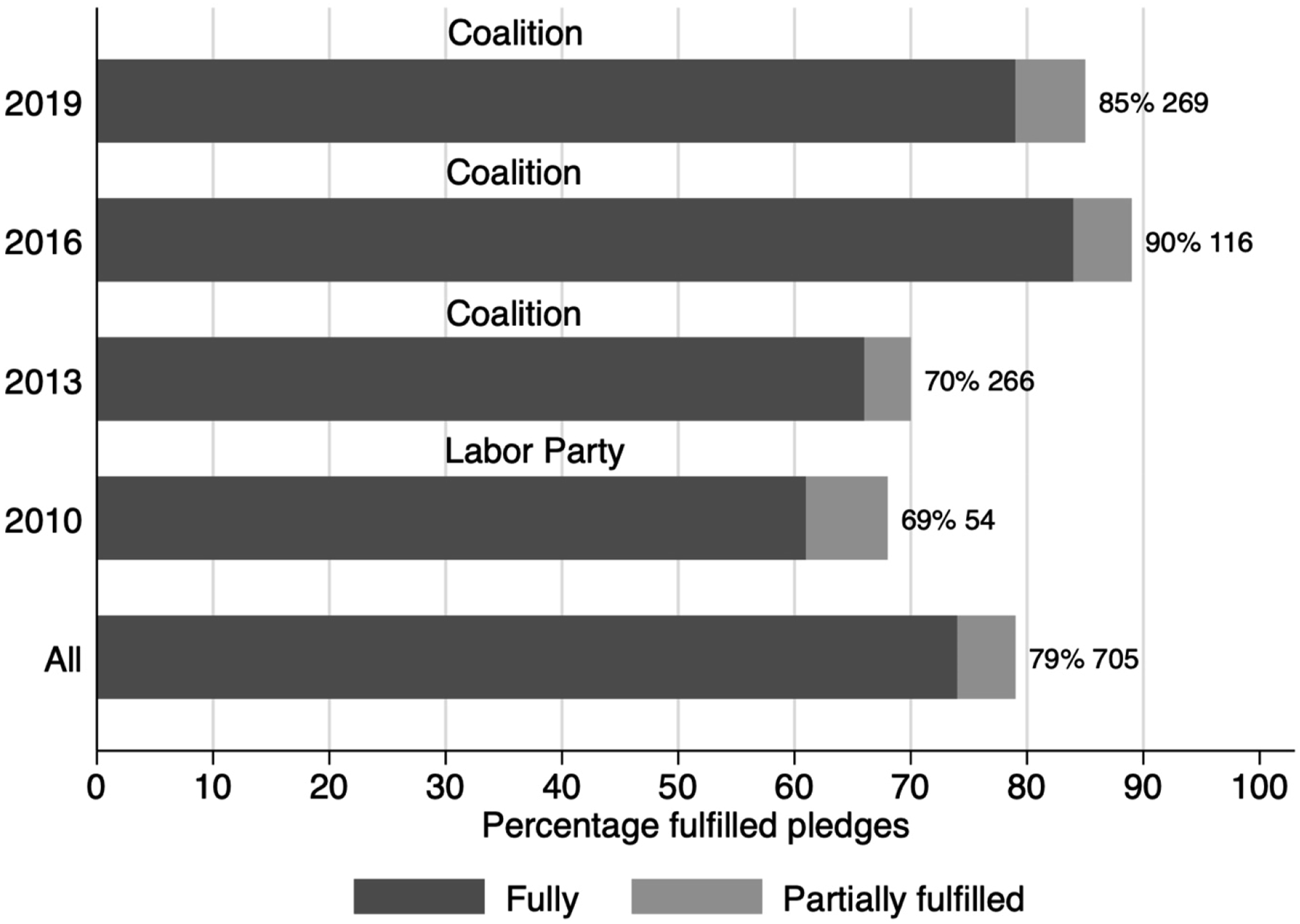
The 2019-22 Coalition government is very much a test case of how uncertainty and unexpected events impact on promise fulfillment. The extreme bushfire season of 2019-20 and the worldwide pandemic from early 2020 were unprecedented in scale, particularly the latter. While these particular events were in no way anticipated at the time of the May 2019 elections, an extremely high level of uncertainty existed. In the quarter of the 2019 election, the measure of uncertainty used in the above quantitative analysis had a significantly higher value than average. 2 This uncertainty was also on display in national and international commentary on the state of Australia’s economy. While acknowledging the extended period of growth enjoyed by the Australian economy, many analysts feared that the economy was “overdue a fall,” warning of the dangers of overinflated house prices and imbalances in the economy (Economist, 2019). It was in this highly uncertain context that the Coalition entered the 2019 election campaign. Many of the Coalition’s election promises were in line with ongoing policies. One author noted that a key similarity between the 2016 and 2019 Coalition election campaigns was the lack of “major” policy announcements (Barry, 2020: 296). Of the election pledges made by the Coalition in 2019, 85% were partially or fully fulfilled. In the following subsection we discuss the main policy events in the 2019-22 period and a broad selection of pledges with a view to understanding what accounts for this high level of fulfillment.
The 2019-22 coalition government’s record of promise keeping 3
The first unexpected event was the 2019-20 bushfires. The unprecedented scale of these fires prompted the government to take significant new policy measures, including deploying the Australian Defence Force and mobilizing army reserves to assist emergency services for the first time in the nation’s history. In terms of recovering from the bushfires, the government announced a new National Bushfire Recovery Agency with AU$2bn in funding. While the fires led to significant new government policies that were not foreshadowed by election pledges, we observed only a few obvious examples of the fires impacting upon the fulfillment or non-fulfillment of particular pledges.
As in several other countries, the government’s response to the COVID-19 pandemic involved policy interventions on an unprecedented scale, none of which could have been imagined at the time of the 2019 election campaign. To contain the virus, the government imposed travel restrictions on all non-residents entering Australia, and the country entered its first widespread “lockdown” in March 2020 (Stobart and Duckett, 2022: 96). In the same month, the federal government announced a AU$2.4bn health care package, including an ongoing agreement with the states and territories to fund hospital care in response to the pandemic. To date the federal government has spent $8bn on the vaccination rollout with nearly 95% of the population now fully vaccinated.
The government also delivered a range of policies to address the economic fallout from the pandemic. In March 2020 it announced a range of measures to provide financial support that was estimated to cost 9.5% of GDP. These included AU$130bn for the JobKeeper wage subsidy, a figure that was later revised down, along with a AU$39bn support package for businesses and AU$25bn in support payments for people in financial stress. By the end of 2021, the federal government had allocated over $300bn in direct economic support. Like the responses to the bushfires but on a much larger scale, few of these policy interventions could have been foreseen at the time of the 2019 election campaign and as such were not present in the election promises of the Coalition.
One explanation of why the Coalition was able to fulfill a high percentage of its 2019 campaign pledges is that the Coalition offered modest election promises in terms of levels of ambition. This interpretation is fully in line with the main argument we make in this paper. By calibrating their 2019 promises to match the prevailing uncertain economic conditions, the Coalition made promises that could be fulfilled even when the unexpected happened, and even when these unexpected events took on vast proportions. This does not imply that the promises were unimportant as the following examples illustrate. Instead, it implies that the promises were realistic, in the sense that they could be implemented even under trying circumstances. We make no claims about the wisdom of these promises. That is a judgement to be made in other analyses. Here, we are simply interested in whether the promises were kept. The following discussion provides a detailed examination of how the fulfillment of election promises are impacted by an unexpected event.
Among the promises that were kept by the Coalition was the pledge to establish the First Home Loan Deposit Scheme, which featured in leader Scott Morrison’s pre-election speech. A centerpiece of the Coalition’s campaign pitch, the scheme was designed to help first-time buyers enter Australia’s notoriously expensive property market. The relevant legislation passed parliament in September of 2019 and was put into operation in January of 2020. Evidently this particular pledge was fulfilled in the midst of the bushfire season, but before the pandemic began. This suggests that one simple way in which a government might at least partially evade the negative effects of unexpected events is to be quick off the mark. This is consistent with the findings of Duval and Pétry, 2019, who conclude that most pledges are either fulfilled or unfulfilled within the first 2 years of governing. However, the mechanism we observe here is that a government can avoid the negative effects of changing conditions by acting immediately upon taking office.
Income tax reform was a central component of the Coalition’s 2019 election appeal (Simms, 2020: 23). Like the First Home Loan Deposit Scheme, the government acted early and decisively to fulfill a pledge to lower the middle-income tax rate. Shortly after the election, in July of 2019 the Government legislated the proposed tax cut as pledged. While the pandemic did not appear to affect the fulfillment of this tax pledge, it may have softened the Labor Party’s opposition to the Coalition’s pledge. During the 2019 election campaign, the opposition strongly opposed these changes. By July of 2021, after the full effects of the pandemic were felt, the opposition shifted its stance to support the legislation in full. Labor may have felt compelled to shift its stance to compensate for the downward pressure on incomes caused by the pandemic.
The fulfillment of some of the Coalition’s 2019 pledges appear to have been supported by the government’s policy responses to the pandemic. This is illustrated by the Coalition’s pledge to provide new funding for telehealth access to psychological services in regional areas. On several occasions throughout the 2019-22 governing period, funding for and access to these services was expanded. In January 2020, Health Minister Greg Hunt announced AU$29.6m in funding to expand the Better Access Telehealth Initiative for those affected by the bushfires. In response to the pandemic, in March 2020 Prime Minister Scott Morrison announced AU$669m to expand telehealth services, including those related to mental health, to all Australians. Additionally, in the October 2020 federal budget, the government doubled the number of Medicare-funded psychological services from 10 to 20. The government contemplated rolling back some of these extensions at the end of 2021, however, in response to the surge of the new Omicron variant across Australia, the government temporarily extended these measures again until June 2022, after the end of the 2019-22 government.
Other Coalition promises were kept despite the effects of the pandemic. A prominent fulfilled pledge was the commitment on defense spending, a typical center-right issue. Despite the immense fiscal pressures, the Coalition were still able to fulfill its promise to raise defense spending to 2% of GDP. This suggests that the salience of the issue on which the pledge was made, which is partly a reflection of the centrality of the issue to parties’ ideologies, may help parties to prioritize fulfillment even under difficult circumstances. Another consideration is that the budget deficit was blown out anyway due to massive pandemic related expenditure, which made additional investments in defense relatively uncontentious.
This brings us to a discussion of unfulfilled pledges, starting with the highest-profile pledge of all, the Coalition’s 2019 pledge to return public finances to surplus. It is noteworthy that the Coalition appeared to be on track to fulfill the budget-surplus promise before the pandemic. The delivery of a surplus was clearly thrown off course by the massive increase in government expenditure combined with a collapse in revenues brought on by the pandemic. Consequently, the government recorded a deficit of AU$85.3bn in 2020. Shifting public finances is difficult at the best of times and is something that is not directly under the control of government, in contrast to introducing a new piece of legislation for instance. The budget surplus pledge therefore illustrates that not all pledges were cautiously calibrated, and that when they are not, unexpected events can make them impossible to keep.
Some of the Coalition’s unfulfilled pledges may have been more indirectly affected by the consequences of the pandemic, as they received less priority or appeared less appropriate as circumstances changed. The Coalition’s support for a federal-level ICAC was stated in December 2018, long before the campaign for the May 2019 election, and it was not repeated in the detailed policies that the Coalition put to voters during the campaign. It is therefore not one of the Coalition pledges we include in our overall assessment (in Figures 1 and 5). However, it is appropriate to mention this commitment here, as it was a promise that the Labor Party matched in the 2019 campaign. In addition, the Coalition’s lack of progress on this commitment was highly salient throughout the governing period and the 2022 federal election. Throughout the 2019-22 governing period, government representatives blamed the pandemic for the delays in introducing the federal ICAC. Prime Minister Morrison stated he did not want “one public servant diverted” from managing the pandemic when commenting on the lack of action on a federal ICAC (Murphy and Karp, 2020).
A complementary explanation for the government’s lack of progress on the federal ICAC proposal is that it was politically expedient to drop the policy, and that the demands of the pandemic provided a convenient cover for blame avoidance. The Coalition has been the subject of several controversies, including allegations of targeting public funds to selected constituencies for electoral gain. Several high-profile figures of the Coalition, including the Prime Minister, argued against the mode of the ICAC seemingly preferred by most advocates. This clearly implies that a shift of priorities caused by the pandemic was not the only reason for the Coalition’s lack of enthusiasm for establishing the federal integrity commission. Had there been sufficient political will to introduce a federal ICAC, the government would likely have succeeded. Over 90 bills passed parliament in 2020 alone, many of which bore no obvious relation to the bushfires or the pandemic responses.
Conclusions
We find evidence of high levels of pledge fulfillment even in the context of changing circumstances between election campaigns and subsequent governing periods. This finding addresses one of the main critiques of the idea of promissory representation, that promises made during election campaigns may not be appropriate during subsequent governing periods due to changing conditions. This, critics of promissory representation may argue, means that promise keeping is often unrealistic or undesirable, and that elected representatives should be free to act without the restriction of a policy mandate. On the contrary, our evidence shows that there can be high levels of promise keeping even when the unexpected happens. The mechanism that makes this possible involves uncertainty. When election campaigns take place amid uncertainty, many parties calibrate their promises accordingly, so that those promises can be kept if conditions, particularly economic conditions, deteriorate. A characteristic of responsible parties is that they formulate policies that are realistic and implementable, that they make promises they can keep. Calibrating promises in response to uncertainty bears the cost of presenting relatively modest promises that may be characterized as lacking ambition. Responsibility and ambition are not incompatible, but too much of one may weaken the other.
The new evidence on Australian politics illustrates this mechanism and, moreover, reveals several expected and unexpected findings. It is surprising that the most recent Australian government, 2019-22, fulfilled a relatively high percentage of its promises. We explain this by the uncertainty that characterized economic conditions at the time of the 2019 election. Accordingly, the Coalition presented a modest set of promises, but nonetheless promises that had substantial implications for the people affected. What is most noteworthy about the 2019-22 period is that the worldwide pandemic led the government to implement unprecedented major policy interventions that obviously could not have been anticipated at the time of the 2019 election campaign. The implication is that unexpected events compel governing parties to do many things they did not promise, but do not necessarily prevent them from doing many of the things they did promise. This suggests that the trustee and delegate models are not as incommensurate as theorists imply. Governments can exercise their judgment in response to changing circumstances, while still keeping most of their previous campaign promises.
The cases of pledges that were unfulfilled during Australia’s 2019-22 governing period illustrate four distinct mechanisms that could inform future research in this field. First and most obviously, unexpected events divert resources that could otherwise have been used to keep promises. The high-profile broken promise to return to budget surpluses is a broad case in point, a case that also illustrates how breaking a promise may be necessary in the public interest. Further research may consider whether the public accept that certain promises indeed ought to be broken. Second, pervasive crises consume the limited stock of political attention, pushing some promises off the agenda. Third, unexpected events may be used as an excuse to backtrack on promises that have become politically inconvenient. This last mechanism highlights that policymakers are not only victims of circumstances, but can instead use unexpected events to further their own interests, in the time-honored tradition of never letting a good crisis go to waste.
Supplemental Material
Supplemental Material - Tales of the unexpected: Promissory representation in times of uncertainty and economic downturn
Supplemental Material for Tales of the unexpected: Promissory representation in times of uncertainty and economic downturn by Frank Algra-Maschio, Sonam Thomas and Robert Thomson in Party Politics
Footnotes
Acknowledgements
The research presented here is part of a project funded by the Australian Research Council, Promissory Democratic Representation: Campaign Promises in Australia (DP210102480). The project was led by Robert Thomson, Lisa Waller and Patrick Dumont. We thank Freda Meng for research assistance and members of the Comparative Pledges Project network for feedback, support and data sharing.
Declaration of conflicting interests
The author(s) declared no potential conflicts of interest with respect to the research, authorship, and/or publication of this article.
Funding
The author(s) disclosed receipt of the following financial support for the research, authorship, and/or publication of this article: This work was supported by the Australian Research Council, Promissory Democratic Representation: Campaign Promises in Australia (DP210102480).

Supplemental Material
Supplemental material for this article is available online.
Notes
Author biographies
References
Supplementary Material
Please find the following supplemental material available below.
For Open Access articles published under a Creative Commons License, all supplemental material carries the same license as the article it is associated with.
For non-Open Access articles published, all supplemental material carries a non-exclusive license, and permission requests for re-use of supplemental material or any part of supplemental material shall be sent directly to the copyright owner as specified in the copyright notice associated with the article.
