




Abstract
What happens to an Islamist party after moderating its behaviour and ideology? Existing work on Islamist parties has elaborated the varied causes of moderation. Yet, the mixed findings do not capture the full range of Islamist dynamics. This article draws on a multiyear, interview-based study of the Tunisian Islamist party Ennahda to interrogate the process of intraparty change after moderation. Islamist parties face a two-level problem with external and internal trade-offs. I argue that the intraparty characteristics that enable moderation may also contribute to undermining a party’s institutional structure and identity as it responds to an uncertain political context. These findings bring processual evidence from Islamist parties into broader explanations of party change and highlight the ongoing effects of moderation, not just its causes.
Introduction
What happens to an Islamist party after moderating its behaviour and ideology? Much existing work on Islamist moderation examines causal explanations, ranging from the institutional constraints of political participation (Brocker and Künkler, 2013; El-Ghobashy, 2005; Wickham, 2004), to the pursuit of swing voters (Kurzman and Naqvi, 2010), intra-party debates (Schwedler, 2006), and economic liberalization (Yildirim, 2016). Yet, this inclusion-moderation approach is not seamless. ‘Moderation’ is a slippery concept (Schwedler, 2011), and Islamists in the Middle East and North Africa usually operate under authoritarian regimes, without the democratic constraints that first shaped the theory (Huntington, 1991; Przeworski and Sprague, 1986). What looks like moderation may instead be merely ‘domestication’ (Tezcür, 2010b). In the face of uncertainty, parties veer between moderation and immoderation (Wuthrich and Ciftci, 2022), or retreat into authoritarian techniques of rule (Yardımcı-Geyikçi and Yavuzyilmaz, 2022).
As Islamist parties dilute their original totalizing ideology in favour of pragmatic policies, their adaptations are influenced by a range of variables, including party goals, electoral performance, factional contests, and leadership autonomy. But current theories of Islamism pay little attention to differences in how parties balance rival interests, maintain institutionalization, or distribute incentives. In this article, I bridge work on party change developed in established democracies with findings on electoral Islamist parties in the Middle East and North Africa to develop an explanatory account of Islamist adaptation. I draw on a multiyear, interview-based study of the Tunisian Islamist party Ennahda to interrogate the process of intraparty change in the years after behavioural and ideological moderation. Attention to the ‘internal life’ (Katz, 2002) of Islamist parties provides new explanatory leverage and reaches beyond the success or failure dichotomy which characterizes much work on Islamists (Cesari, 2021).
I argue that the intraparty characteristics that enable Islamist moderation may also contribute to undermining a party’s institutional structure and identity as it responds to an uncertain environment. Islamist parties like Ennahda face a two-level problem with external and internal trade-offs. They are likely to adapt to a polarized, fragmented political environment by pursuing a risk-averse strategic conciliation with rivals, even at the cost of electoral support. Internally, party leaders must choose between allowing internal debate over these decisions, at the expense of valuable leadership autonomy, or imposing cohesion, which risks over-centralizing the leadership and provoking party defections. In the case of Ennahda, the party moderated behaviour and ideology and then pursued strategic conciliation with its political rivals. But as it imposed these decisions it emerged institutionally weaker, with a return to personalized leadership, a loss of identity, a decline in vote share, and significant membership defections.
These findings make three contributions that help explain how Islamist parties change over time. First, I connect findings on party change in democratic contexts to the case of Islamists in the Middle East, a region often seen as anomalous because of the prevalence of religion in politics and the resilience of authoritarian regimes. The Tunisian case is valuable for its democratic context, to which the findings of the literature on political parties ought to apply more readily. Second, I go beyond work on inclusion-moderation to examine what happens after key behavioural and ideological change. I examine the processes that shape Islamist party change over time to consider the ongoing effects of moderation, not just its causes. Third, I build on work which draws new attention to the significance of party politics in the Middle East (Cavatorta and Storm, 2018; Hinnebusch, 2017; Storm, 2014).
The article proceeds as follows. First, I connect explanations of political party change with findings on Islamist experiences. Second, I theorize how Islamist parties respond to new challenges in a democratizing environment. I then explain case selection and research methods, before conducting a process tracing analysis of the Ennahda case study. Finally, I discuss the implications of the findings.
Intra-party dynamics, party change, and Islamism
Although the inclusion-moderation framework has produced a rich array of causal explanations for Islamist party change (Clark, 2006; Schwedler, 2006; Wickham, 2004), recent work pays attention to the nuances and ambiguities this approach tends to occlude (Brocker and Künkler, 2013; Steuer, 2023). It is not just that the concept of ‘moderation’ as a relative term is hard to specify (Wickham, 2013: 5–6), or that the processes that connect behavioural, ideological, and individual moderation are difficult to pin down (Schwedler, 2011). Inclusion alone may not be enough to produce moderation (Dalacoura, 2011: 136; Schwedler, 2006: 194–197), and exclusion may produce surprisingly similar outcomes (Cavatorta and Merone, 2013). Other factors may be just as important to consider, including change in voter preferences (Yildirim, 2016) and the porosity between movement and party organizations (Munteanu, 2020). Increasingly, scholars disaggregate the inclusion-moderation process to capture a wider range of change across time and contexts (Wickham, 2013), between Islamists and other actors (Gana et al., 2023), and with granular attention to internal party debates (Wagemakers, 2020a).
Analyzing intra-party dynamics develops this approach by reorienting the focus away from the causes of moderation towards a processual explanation of party adaptation. An organizational focus explains how leaders and activists accommodate varied motivations within the constraints of the party system (Giannetti and Benoit, 2009). A new democracy brings uncertainty, whether over economic challenges, the rules of political interaction, or the risk of authoritarian reversal (Lupu and Riedl, 2013). A new party system means parties are likely to be unstable, internally and in forging alliances (Ibenskas and Sikk, 2017). Successful adaptation may depend on the skills of party elites, as with former Communist parties in East Central Europe (Grzymala-Busse, 2002), or on a breadth of resources, whether involving party memberships or political brands, as in Latin America (Cyr, 2017; Lupu, 2014). Yet, these adaptations are mediated by organizational structures, which shape party responses to changes in the political and economic environment (Levitsky, 2003; Rosenblatt, 2018).
Taking an organizational approach to party change focuses attention on the relations between the leadership and party members. Parties are commonly understood to institutionalize on two broad dimensions: when internally they exhibit routinized interactions and value infusion beyond individual self-interest, and when externally they demonstrate decisional autonomy and reification in the public imagination (Levitsky, 1998; Randall and Svåsand, 2002). Institutionalization might seem to bring stability and durability, but when external challenges require rapid adaptation then a less institutionalized, more autonomous leadership can offer valuable flexibility (Grzymala-Busse, 2002; Levitsky, 2003). Similarly for Islamists, an autonomous leadership is more likely to be able to implement the difficult changes required for moderation (Kalyvas, 2000; Wuthrich and Ciftci, 2022). Yet, leadership flexibility is not solely a question of autonomy, but also of leadership renewal. For an adaptive party, new leadership teams need a chance of winning control (Seawright, 2012: 25; Wills-Otero, 2016). In the case of entrepreneurial European right-wing parties, durability depended on finding different leaders to respond to different stages in a party’s institutionalization (Harmel et al., 2018). Leadership renovation is important not just because entrenched old guard leaders are likely to resist far-reaching change (Levitsky, 2003: 13), but because parties need to accommodate the ambitions and ideas of their next generation (Kitschelt, 1994: 212; Rosenblatt, 2018: 9).
Contemporary Islamist parties are conservative denominational mass parties, with some catch all features in their wide appeal to voters (Gunther and Diamond, 2003; Ozzano, 2013). Their ‘genetic’ origins as social movements are likely to imprint lasting characteristics, including charismatic leadership and societal rootedness through an ‘electorate of belonging’ (Panebianco, 1988: 20, 26). Despite their adaptations, Islamist parties today face serious challenges, from widespread authoritarian reversion, to low public trust in political institutions and Islamist-secularist polarization (Kilavuz and Sumaktoyo, 2020; Spierings, 2017). Islamist parties face a variety of internal disputes, over the adoption of inclusive norms (Gumuscu, 2023), party character, identity, and openness (Wagemakers, 2020b), and responses to repression (Ardovini and Biagini, 2021). In this context, reaching beyond the inclusion-moderation framework captures a fuller range of Islamist dynamics.
Theorizing Islamist party change
What explains Islamist party change after moderation? Although Islamists long campaigned for inclusion in a democratic political process, when the opportunity came it proved highly challenging. In the face of uncertainty, Islamist leaders must respond to the ‘pluralism of positions’ within their organizations (Brocker and Künkler, 2013: 173). I conceptualize these challenges as a two-level problem in which an Islamist party faces external and internal trade offs.
First, an Islamist party must respond to changes in its external environment. Elsewhere this has often meant labour-based parties responding to economic crisis or market-oriented policies (Levitsky, 2003), or former communist parties responding to the arrival of capitalism and democracy (Grzymala-Busse, 2002). However, contemporary Islamist parties have accommodated neoliberal policy agendas (Saif and Abu Rumman, 2012). Instead, the greater priority for Islamists has been overcoming mistrust and polarization, which has often required self-limiting concessions (Lynch, 2016: 15–16) and conciliatory alliances with rivals. These alliances dilute the party’s identity and policy-seeking ambitions, a problem encountered by both Christian democrats (Kalyvas and van Kersbergen, 2010: 188) and socialist parties (Przeworski and Sprague, 1986). However, the Islamist experience suggests the problem is not solely a loss of identity, but also the costly strategic conciliation required to reassure political rivals.
Ennahda sought acceptance by cooperating with its former opponents, even to the point of taking weak positions within governing coalitions. When strategic conciliation failed to produce the anticipated electoral benefits, the party leadership clung to its strategy as its vote share declined, contrary to expectations (Budge et al., 2010). What explains this choice? Strategic conciliation was not simply cross-party cooperation as ideological moderation (Clark, 2006), nor an office-seeking agenda, anticipating the spoils of power (Laver and Schofield, 1990: 41). Instead, Ennahda sought self-preservation in response to the uncertainty of a region where authoritarian regimes often demonize Islamists to reinforce their own legitimacy. Electoral calculations are likely to make Islamist parties risk averse (Tezcür, 2010a), because polarization has frequently brought repression, as in Tunisia and Algeria in the 1990s (Willis, 2012) and Egypt in 2013 (Al-Anani, 2015).
The second trade-off is internal, when the leadership must keep the loyalty of its membership even as it reaches out to make alliances with political rivals. Here there is a distinction between unity, in which a leadership strives to keep all factions within the party despite their different preferences, and cohesion, in which a leadership keeps all factions strictly to the party line either through consent or enforced discipline (Ceron, 2019: 5). A party leadership favouring unity could allow internal debate, giving voice to internal party institutions and so reducing the risk of splits. But this would come at the expense of the autonomy of the dominant leadership coalition. Alternatively, the leadership could favour cohesion, either in hope of widespread internal support or by imposing its strategic choice. Such discipline would reinforce the dominant coalition in the style of democratic centralism, but at the risk of forfeiting membership loyalty.
Ennahda’s leadership chose to impose cohesion, requiring members to behave in a homogenous way. Although Ennahda appeared well institutionalized, what mattered was the relative autonomy of the leadership. Party members who disapproved of the new strategic choice found they were unable to constrain the leadership or to promote an alternative candidate. Ennahda’s leader, Rached Ghannouchi, benefitted from direct election through a wide selectorate of hundreds of party members at the party congress, which reinforced his autonomy (Ceron, 2019). His position was enhanced by his perceived charisma as the founder who was simultaneously religious figure and political activist. The outcome was a return to a personalized leadership. Some frustrated party members resigned individually; others formed a faction which eventually resigned to set up a new political party. Ennahda emerged institutionally weaker, with a loss of identity, a decline in vote share, and having suffered significant defections.
Research design
I examine these arguments through a qualitative research design, using within-case process tracing to interrogate Islamist party change. A processual analysis is valuable in explaining what happens inside Islamist parties because reliable quantitative measures are hard to obtain: accurate membership numbers for parties like Ennahda are rarely available, without access to membership lists there have been no party membership surveys, and there are no available party records identifying factional strength or voting histories, beyond headline figures. Qualitative techniques add vital leverage. First, open-ended interviews capture variation in individual experiences, preferences, and perceptions across different levels of party hierarchy, where individuals might have varied access to incentives. Second, to understand party change as a process, repeated interviews with participants were conducted over several years to capture internal party dynamics, which provide the contextually-specific ‘mechanistic evidence’ of causal processes (Beach and Pedersen, 2019: 4), paying attention to sequences and conjunctures of events (Bennett and Checkel, 2015: 7). In the case of Ennahda, many internal critics were initially reluctant to speak about their experiences for fear of appearing disloyal, and only in later years began to voice their concerns more openly.
The article focuses in depth on the Tunisian Islamist party Ennahda, which I select as a critical case in explaining party change (Flyvbjerg, 2006). Ennahda is a valuable case because it offers evidence of change over an extended period and because the party is often identified in the literature as a compelling example of Islamist moderation. It was one of the earliest Islamist parties to accept democratic principles, and to adopt a discourse of equal rights (McCarthy, 2018; Meijer, 2021). Ideologically, it has drawn on Ghannouchi’s own writings, especially on Islamist participation in non-Islamic regimes and on Islamic concepts of democracy (Ghannouchi, 1993; 2022). In the post-2011 democratic transition, Ennahda spent a decade in government and made both policy and strategic concessions. By 2016, Ghannouchi announced the party had relinquished its Islamist and social movement past to become a party of ‘Muslim democrats’, embracing a democratic, civil state and supporting individual freedoms (Bobin, 2016). A detailed within-case analysis demonstrates how Ennahda’s leadership continued to pursue conciliation, even though it secured the party few rewards and was accompanied by electoral decline, intra-party divisions, and leadership personalization.
As evidence, I conducted interviews with 50 men and women who were current or former members of Ennahda. I used both a snowball sampling strategy, using trusted referrals to access interviewees in a hard-to-reach group, and I sampled for range, to examine breadth of views among different levels of central, regional, and local leadership within the party and among those who had left the party (Cammett, 2006; Small, 2009). Interviews were conducted during the period 2013–22 in Tunis and Sousse, Tunisia’s third largest city, and almost always in Arabic. I protect the anonymity of my interviewees, to enable them to speak freely at a time when many political activists, including Islamists, have been targeted for arrest and detention after a 2021 coup. Further details are contained in the Supplementary Material File. Interviews and observations in the field were supplemented with primary source material including Ennahda party documents, published statements, social media postings, and Arabic and French language news reports.
Strategic conciliation
During a decade of transition, Ennahda prioritized organizational survival by pursuing conciliatory cross-ideological alliances. The calculation was not a vote-maximizing attempt to gain power, but rather to secure acceptance in the system. At first, after the fall of the authoritarian regime in January 2011, Ennahda pursued policy goals aligned with its Islamist identity. It proposed introducing Islamic shariʿa law as a source of legislation in the new constitution, argued for the criminalization of blasphemy, and demanded the political exclusion of senior members of the former ruling party, the Democratic Constitutional Rally (RCD) (Harakat al-Nahda, 2012b; McCarthy, 2018: 130–131). However, from 2013 the party leadership imposed an abrupt shift towards a much more conciliatory strategy for organizational survival. Ennahda leaders argued that this new ‘consensus approach’ (nahj al-tawāfuq) was essential to defuse ideological conflict among the political elites (al-Naqati, 2014), framing the choice as between ‘coexistence, partnership and unity’ and ‘hatred, exclusion and division’ (Bhiri, 2014). One senior leader, ahead of the 2019 elections, said the alternative was to risk popular protest and instability: ‘Tunisia can only be governed by consensus otherwise other parties will pass the baton to the street and stop the work of building the state and democracy. Even if Tunisia moves more slowly, we need a consensus of parties, a coalition with concessions.’ 1
Election results in Tunisia, 2011–19.
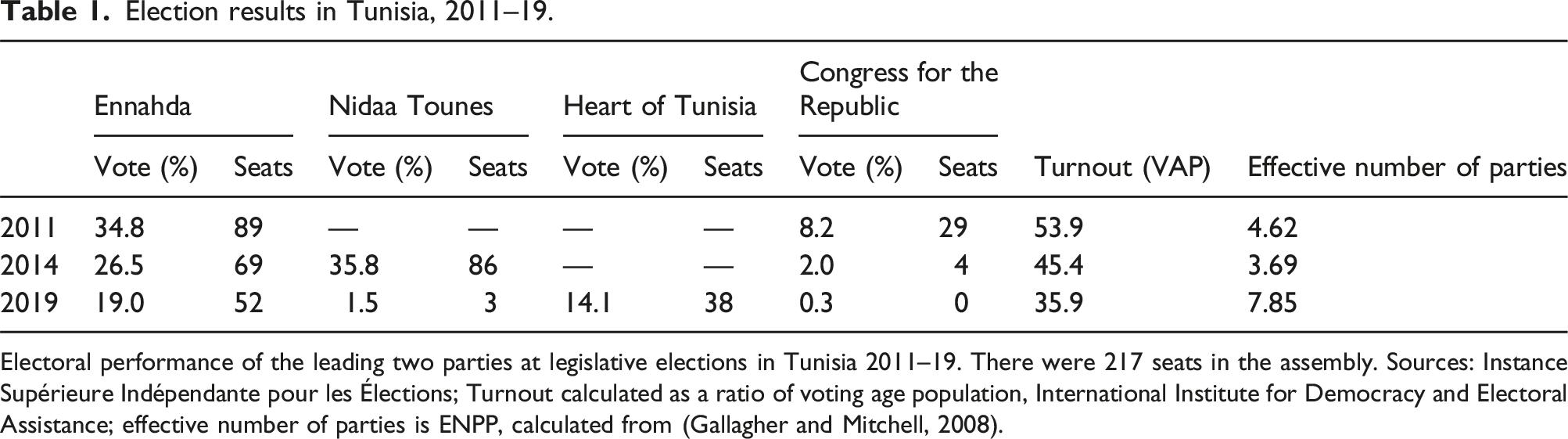
Electoral performance of the leading two parties at legislative elections in Tunisia 2011–19. There were 217 seats in the assembly. Sources: Instance Supérieure Indépendante pour les Élections; Turnout calculated as a ratio of voting age population, International Institute for Democracy and Electoral Assistance; effective number of parties is ENPP, calculated from (Gallagher and Mitchell, 2008).
Internal debates quickly emerged over the cost of conciliation. First, some argued that the party ought to have moved into opposition after losing the 2014 election to channel popular demands for social and economic reforms, reflecting the preferences of the party’s membership. One senior leader described unsuccessfully proposing a ‘responsible opposition’ strategy, voting in favour of the government’s policies but from the opposition benches: ‘Why did we stay in power? It was the obsession of those who fought the dictatorship … They couldn’t see that staying in the opposition was a possibility. They saw it as a weakness.’ 6 Second, others argued that even if a strategic conciliation was the right response to uncertainty, the outcome was merely a ‘false’ consensus in which policy goals were sacrificed for inclusion. 7 ‘It’s the management of the consensus that was the basis of the conflict,’ said one leader. 8 Others were more critical: ‘With time, Ennahda became a prisoner of rule’, said one senior Ennahda leader, who resigned in 2020. 9 Another leader who remained in the party put it the same way: ‘We became prisoners of the priority of maintaining the stability of government over having a clear position’. 10 Third, the critique targeted Ghannouchi’s centralized control, which in turn precipitated a second dispute over leadership autonomy. It was Ghannouchi and Beji Caid Essebsi, the Nidaa Tounes founder and later president of the republic, who had met privately in a Paris hotel in August 2013 in a pre-electoral coordination between the Islamists and the nationalist project. This personalized approach continued for many months. ‘It was like parallel decision making,’ said one former Ennahda senior leader. 11 Many were aggrieved that the key beneficiary of consensus seemed to be Ghannouchi himself, who was elected for the first time in 2019 and became speaker of the parliament. 12 These were not debates over ideology or policy moderation, but disagreements over strategy.
Internal critiques provoked individual resignations, including from senior leaders. Hamadi Jebali, a former prime minister, resigned complaining that the strategic shift had created an ‘imbalance’ of political forces (Brésillon, 2014). Abdelhamid Jelassi, a former party vice president, resigned after describing the coalition with Nidaa Tounes as ‘the deal of the gullible’ (Khadhraoui, 2016). Others at lower levels also resigned, including a local bureau leader from a prominent Islamist family in Sousse, who left in 2015, arguing the party should have entered opposition and become more technocratic, ‘a party with a modern structure, using modern techniques’. 13 A faction developed after the 2016 party congress, calling for a more independent strategy. In an open letter published in September 2020, 100 members of Ennahda, including members of the Political Bureau, the Shura Council, and party MPs, insisted Ghannouchi resign (Dilou et al., 2020). The letter complained of tactical confusion, declining electoral performance, and paralysis of internal institutions. It argued for ‘leadership alternation’ so that a new generation could be elected to revive the party (Dilou et al., 2020). However, rather than responding to these concerns, the leadership argued that the urgency of the political crisis overrode any requirement for organizational change.
Ultimately the faction was not strong enough to change the party’s strategy. In September 2021, around 100 members of Ennahda resigned, including most of those who had signed the letter. Among them was Abdellatif Mekki, a former health minister, who argued the alliance with Nidaa Tounes had stifled social and economic reforms. 14 Within a year, he had set up a new group, the Party of Work and Achievement, which described itself as ‘nationalist, conservative, social, democratic’ (Al-ʿAmal wa-l-Injaz, 2022). The Ennahda leadership downplayed the split: ‘There is a new party but there is not a new idea,’ said Ghannouchi. 15
Leadership autonomy
The Ennahda leadership did not merely dismiss its internal critics, but instead overrode institutional structures to become increasingly autonomous, and to impose cohesion on the party. Ennahda, like other Islamist parties, is often assumed to have a loyal membership forged by collective suffering and sub-cultural identity so that members may debate difficult decisions but not exit the party (Netterstrøm, 2015: 17). However, in this case an increasingly personalized and autonomous leadership pushed many senior figures to distance themselves from party activities or to resign.
As the democratic transition began, the party appeared well institutionalized. Founded in 1981 as the Islamic Tendency Movement (MTI), it quickly developed a hierarchical internal structure, with a president, an Executive Bureau of two dozen top leaders, a Political Bureau, a 150-member Shura Council which functioned as an internal parliament, local and regional bureaux across the country, a party congress every 4 years, and internal regulations. The party was dismantled during two decades of repression in the 1990s and 2000s, but after 2011 it rapidly re-established itself and returned to routinized behaviours, with regular local branch meetings, clear value infusion, and a decision-making structure (Randall and Svåsand, 2002). However, Ennahda was simultaneously re-consolidating itself and institutionalizing itself. The organisation’s early hierarchical model of charismatic leadership, in which members had sworn an oath of loyalty to their leader, enabled flexibility in the early stages of the transition. Even the organization’s formal name, the Party of the Movement of Ennahda (Hizb Harakat al-Nahda), captured the ambiguity of a group which presented itself externally as a party while mobilizing internally through communities of belonging and identity. ‘The problem is the failure of Ennahda to transform from a group [jamaʿa] into a political party, as a result of the attempt by some leaders to control the regulations,’ said one former senior leader. 16 A hierarchical structure was not sufficient to consolidate party institutionalization.
The party leadership centralized in several dimensions. First, many of the student Islamist activists from the 1980s, now second-tier leaders, complained that their input was ignored. In May 2016, during the party congress, there was a debate about the selection of the Executive Bureau, which determined day-to-day policy. The bureau was selected by Ennahda’s president, Ghannouchi, with each candidate then approved by a majority vote in the Shura Council. However, some prominent voices proposed that half the bureau should be elected by the Shura Council, in the interests of greater representation and especially to allow the opportunity to challenge the strategic conciliation approach. Their proposal came as the party’s own written evaluation of its performance identified problems of ‘weak institutionalization’ and ‘excessive centralization’ in the leadership (Harakat al-Nahda, 2016). As one critic said: ‘The question was how to take decisions: do we take collective decisions or does someone take decisions and we obey?’ 17 Ghannouchi resisted the change, reinforcing his power to appoint a loyal Executive Bureau and thereby keep to his strategic choices. ‘We were asking if the Ennahda movement had a leader, or if this was a leader with a movement,’ said one former senior Figure. 18 This was interpreted by the second-tier leadership as stifling their ambitions and incentives. ‘We felt there was a generational blockage (insidād). There was no access for young people to the leadership,’ said one former Shura Council member. 19 Ghannouchi was re-elected as president of the party, through a vote of congress participants, winning 800 votes to 229 for his nearest rival. Several of those who were frustrated with the 2016 decisions were among those who later left the party.
Declining political trust in Tunisia, 2011–21.
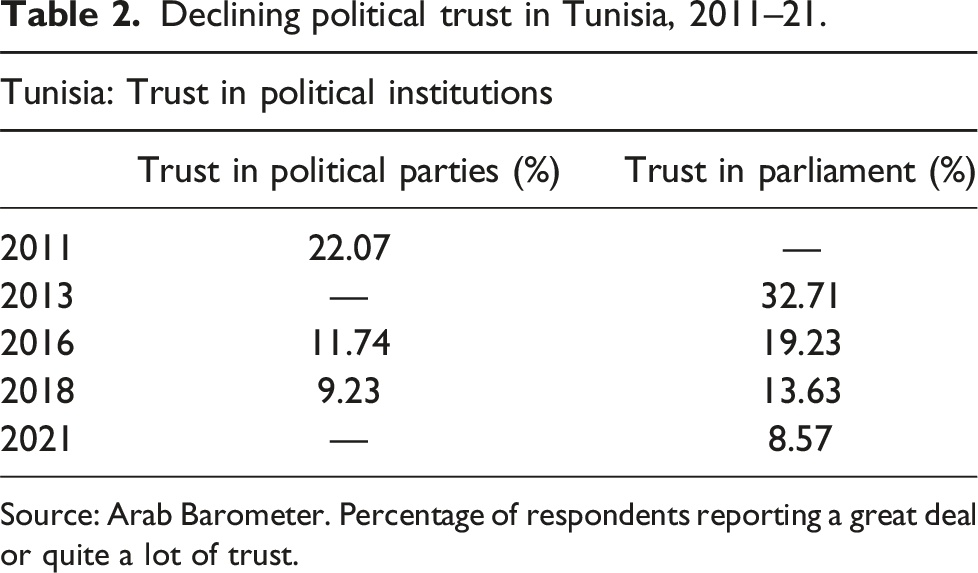
Source: Arab Barometer. Percentage of respondents reporting a great deal or quite a lot of trust.
Party identification in Tunisia, 2018–22.
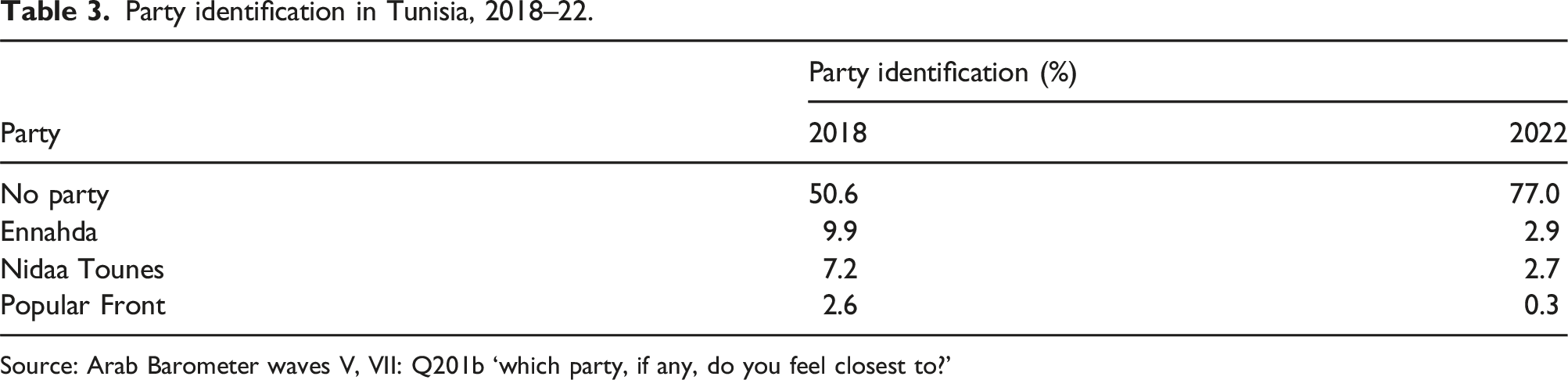
Source: Arab Barometer waves V, VII: Q201b ‘which party, if any, do you feel closest to?’
Third, the next congress of the party, which had been due in 2020, was repeatedly delayed. The congress was to elect a new leader, because Ghannouchi would have by then completed the two consecutive terms permitted under Article 31 of the party’s statutes. However, the leadership refused to hold the congress, blaming first the Covid-19 pandemic and then the coup of President Kais Saied in July 2021, which was followed by a new, hyper-presidential constitution and a wave of arrests of senior Ennahda leaders, including, in April 2023, Ghannouchi himself. Many senior figures within the party admitted frustration with the delay. ‘After the coup was an opportunity for Ennahda to accelerate a change in its leadership, change its discourse, and present self-criticism,’ said one senior leader. 22 Effectively, the party was unable to institutionalize the process of leadership renovation.
Ideological flattening
To what extent were these internal party divisions fuelled by ideological disputes? Findings from Islamist case studies elsewhere in the region demonstrate that Islamist political behaviour cannot merely be explained by interest-based calculations but that it is also motivated by ideological change and contestation (Al-Anani, 2016: 144; Wickham, 2013: 285–286). However, in the case of Ennahda, I argue that although there was a range of views within the party, ideology was not the core internal contest in the transitional period. The ideological moderation of the party had largely taken place before 2011 (Allani, 2009; Cavatorta and Merone, 2013). Ennahda’s leadership then flattened its ideological distinctiveness into a broad set of consensual values which it then used to legitimize its conciliatory strategic choices and its cross-ideological alliances.
At its origins, the organization that became Ennahda espoused a classic Islamist ideology, committing to implement ‘the contemporary image of an Islamic system of rule’ in 1981 (Harakat al-Ittijah al-Islami, 2012: 15). Immediately after the 2011 uprising, the party seemed to revive that Islamizing ambition. However, in line with its strategic shift the leadership soon reversed itself. Ennahda embraced as its new reference the 2014 constitution, which it considered as having resolved polarizing identity debates about the role of Islam in public life (Ghannouchi, 2016). In 2016, Ennahda published revised party statutes which reconciled the Islamic reference with the rights and obligations of the new republic, defined in the constitution as a civil, not Islamic, state (Harakat al-Nahda, 2016). The party argued for a public role for religion, but only as providing national identity and moral authority. The state, it said, should preserve the ‘moderate values’ (al-qiyam al-wasaṭiyya) of religion, enhance the power of the Zaytuna mosque-university, support religious education, and revive religious endowments (awqāf) (Harakat al-Nahda, 2016). The state was to be civil, but not secular.
Ennahda’s leadership did not seek to impose a cohesive ideological position, as it had with its strategic conciliation strategy. Some leaders tried to present the party as technocratic, hoping to defuse polarization and to distance themselves from violent radical groups. As one senior leader put it: ‘The ideological side is shrinking gradually and Ennahda is on the road to becoming a national party, serving the citizens and solving the problems of the country’. 23 Yet, others defended a more socially conservative position. In its congress in 2012, Ennahda proposed criminalizing blasphemy (Harakat al-Nahda, 2012a), and some Ennahda deputies later argued for removing freedom of conscience (McCarthy, 2018: 135). In 2018, Ennahda’s Shura Council rejected a proposal to bring gender equality into a reformed inheritance law, which it condemned as a contradiction of religious teachings and a threat to the family unit (Harakat al-Nahda, 2018). In its new party statutes, Ennahda endorsed this ideological ambiguity by shifting away from a literalist application of shariʿa rulings to prioritise the higher objectives of shariʿa law (maqāṣid al-shariʿa), broadly interpreted as freedom, dignity, work, justice, tolerance, consultation, solidarity, moderation, reform, and integrity (Harakat al-Nahda, 2016). This was understood within Ennahda as a set of consensual moral and ethical values. As one long-serving Ennahda member said: ‘Even as it becomes a political party, Ennahda will always be linked to religious and Islamic values … It’s not possible for me to overstep the religious dimension and my values in taking decisions.’ 24 A reinterpretation of the Islamic reference as a broad package of consensual values was designed to legitimize the party’s conciliatory strategy, even as considerable latitude was given to members to voice a range of different ideological positions.
Ennahda’s critics rarely cited ideological cleavage as a cause of splits. As one former senior leader, who left to establish the new Party of Work and Achievement, argued: ‘We don’t need an ideology that would submerge everything. This experience showed that we were too immersed in ideology’. 25 The new party did not draw on an Islamic reference and instead aligned itself with a socially conservative electorate. As the new party leader, Mekki, put it: ‘Our role is not to change the culture or religion of a people but their political, economic, and social reality … Islam has become a source of cleavage. Conservatism is a way of opening a new vision’. 26 Other internal Ennahda critics identified their mistake not as a problem of ideology but rather a lack of a distinct policy programme, caused by the conciliatory alliance-seeking strategy. ‘We don’t have any political vision. This is the problem of consensus,’ said one youth leader who left the party. 27
Conclusion
This article reaches beyond the inclusion-moderation framework which has guided so much research on Islamist parties in the Middle East and North Africa, to instead examine the ongoing process of intraparty dynamics that shape Islamist responses to continuing challenges. Islamist parties like Ennahda face a two-level problem with external and internal trade-offs. Once Islamists have diluted their ideological ambitions and gained inclusion in the political system, they must still negotiate with political competitors in an uncertain environment with a high risk of authoritarian reversal. But they must also balance rival interests within the party. The leadership autonomy and flexibility which helped enable moderation can also come to undermine a party’s institutional structure and identity, as it did in the case of Tunisia’s Ennahda.
Ennahda’s leadership pursued strategic conciliation, prioritizing inclusion in government, even when its position in coalition cabinets was weak and its vote share in decline. This strategy was intended to protect the party from the risk of repression and was framed as necessary to protect the viability of the democratic transition. The party’s ideological vision was rearticulated as a package of consensus values to accompany this strategic conciliation. However, within the party these strategic choices provoked sharp debate and disputes. Not only were strategic leadership decisions contested, but so too was the internal organizational structure that allowed such a centralized, autonomous leadership to develop. Ennahda’s leadership chose to impose its strategic choice on the membership, but this eroded the party’s institutionalized routines, resulting in public divisions, resignations, and a split. Although Ennahda survived, it emerged institutionally weaker, with a return to personalized leadership, a loss of identity, and a decline in vote share.
The evidence from this case study demonstrates how political uncertainty drives Islamist parties to prioritize normalization in the political system. This has an enduring effect, which reaches beyond the key decisions over moderation, and which produces unwieldy cross-ideological coalitions, which in turn can slow the pace of political and economic reforms in a transition. The findings indicate that even though Islamist parties have strong linkage with their membership, forged by communities of identity, belonging, and shared experience of repression, this value infusion has its limits. The weakening links between leaders and the party base become more apparent as the party struggles to find its place in a competitive, polarized political system, where parties are routinely blamed for acute shortcomings in governance. Whereas the party membership once mobilized around a charismatic leadership, when the organization was more movement than party, over time this autonomous leadership structure becomes less relevant. Instead, others within the party demand a say in decision-making and want their ambitions for promotion to be acknowledged. Answering these internal pressures becomes a central challenge for party elites. Political parties in the authoritarian context of the Middle East may appear less significant than their counterparts in democratic political systems elsewhere. However, these internal party debates, as seen in the case of Ennahda, are crucial in shaping debates over key societal questions, including the role of religion in public life, and in constructing stable party systems that might better channel popular demands for change.
Ennahda’s internal challenges proved particularly problematic when democratic backsliding halted the Tunisian transition, bringing the authoritarian reversal that the Islamists and other political actors had hoped to avert. In July 2021, the elected president, Kais Saied, staged a coup, concentrating power in his own hands, rewriting the constitution, and banning parties from fielding or funding candidates in the December 2022 elections. Ennahda was in a weakened position: in a wave of arrests of political dissidents more than a dozen top Ennahda officials were detained and the party’s offices were closed. Political parties were unable to coordinate a unified pro-democracy movement in the face of a polarized political atmosphere and a collapse trust in political parties. Political inclusion and moderation are thus not the end of the Islamist party trajectory, but instead introduce a new stage of complex trade-offs, in which intra-party dynamics shape how the party responds to new challenges.
Supplemental Material
Supplemental Material - Islamism, party change, and strategic conciliation: Evidence from Tunisia
Supplemental Material for Islamism, party change, and strategic conciliation: Evidence from Tunisia by Rory McCarthy in Party Politics.
Footnotes
Declaration of conflicting interests
The author(s) declared no potential conflicts of interest with respect to the research, authorship, and/or publication of this article.
Funding
The author(s) disclosed receipt of the following financial support for the research, authorship, and/or publication of this article: This work was supported by the British Academy (SG2122\210707).

Supplemental Material
Supplemental material for this article is available online.
Notes
Author biography
References
Supplementary Material
Please find the following supplemental material available below.
For Open Access articles published under a Creative Commons License, all supplemental material carries the same license as the article it is associated with.
For non-Open Access articles published, all supplemental material carries a non-exclusive license, and permission requests for re-use of supplemental material or any part of supplemental material shall be sent directly to the copyright owner as specified in the copyright notice associated with the article.
