




Abstract
This study analyses professional policy experts in political parties. While recent studies have described the characteristics of ‘unelected politicians’, the drivers for their emergence and impact on democracy have not yet been fully elaborated. We examine these aspects via Finnish party elite interviews (n=79). We challenge the traditional party professionalization narrative where parties’ increasing publicity management efforts diminish intra-party democracy (IPD) and parties’ political ambitions. We find that in addition to campaign, media, and democratic needs, political parties in Finland are concerned especially by their policymaking capacity that has shifted to experts of public administration and lobbyists, and which parties seek to strengthen with the recruitment of more political employees. This elevates the role of partisan policy professionals within political parties, a perspective that has been downplayed in party organisation literature. We call this the imperative of expertise and conclude that while it likely limits traditional IPD, it can improve representative democracy by enhancing parties’ policy control against the technocratic tendencies of contemporary democracy.
Introduction
The organisation of political parties has been a central question to representative democracy. It is wrought with the tension between the policymaking function of parties facing the state and the democratic function of parties facing citizens. Professionalization of parties has been conceived as a threat to intra-party democracy (IPD) that ideally extends democratic representation beyond legislatures.
This study analyses an emerging aspect of party professionalization: the proliferation of party-based policy professionals. Until recently, party scholars paid little attention to ‘party staffers’ apart from using them as a variable in measuring intra-party power dynamics (Webb and Keith 2017) and their association with campaign professionalisation and ‘de-politicization’ of parties (e.g. Panebianco 1988). However, in the 2010s, empirical evidence from other fields has pointed out the importance of policy professionals in legislatures (Hertel-Fernandez et al. 2019; Pegan 2017), executives (Shaw and Eichbaum, 2018; Maley 2000) and public administration (Hustedt and Salomonsen, 2017; Selling and Svallfors 2019; Svallfors, 2017, 2020). Most recent party organisation studies have also detected the emergence of party-affiliated and professionalised policymaking experts, the ‘unelected politicians’ (Karlsen and Saglie 2017). The emerging literature has focused on describing their basic characteristics and organizational ties, including social backgrounds (Webb and Fisher 2003; Webb and Kolodny 2006), technical superiority (Karlsen, 2010), loyalty and activism (Karlsen and Saglie 2017; Moens 2021, 2022a) and impact on intra-party power distribution (Moens 2022b).
This study takes off from these important observations whose drivers and broader relevance, we believe, have not yet been fully acknowledged. Two theoretical biases can explain the neglect. First, regarding parties’ organizational functions and adaptation, party scholars’ excessive focus on media relations and communication in recent decades has downplayed the relevance of parties’ policymaking role and capacities. While the organizational impacts of mediatization have been studied extensively, little has been written about parties’ organizational responses to the increasing complexity and technicality of policymaking caused by internationalization and ‘technocratization’ of politics. Second, due to the heavy theoretical and normative legacy of the mass party model, the field has continued to prioritize party members and IPD when framing, assessing and interpreting party changes. While providing essential information on the internal life of parties, the IPD-centred perspective is too narrow to illuminate changes in parties’ broader democratic role. After all, parties represent non-members, too.
Guided by these critical reflections, this study develops a novel perspective on the staffing dilemmas of contemporary parties. Besides utilizing a broader theoretical lens, we depart from the field’s survey-centred methodology that may over-emphasize the viewpoints of party activist. We follow Webb and Kolodny’s (2006) call and examine the emergence, qualities and impacts of ‘unelected politicians’ through extensive interview material. We utilize 79 in-depth elite interviews from national level elected and non-elected party officials representing all organizational levels of all major Finnish parties, including ministers, party chairpersons and parliamentary leaders. Data was collected in a development project led by the government-owned and parliament-governed state think tank SITRA in collaboration with the Parliament of Finland and was exclusively licenced for academic use in this study. Purposively sampled elite interviews from a single country present rare in-depth access to top echelons of political parties, making the interviews theory-generating rather than claiming statistical representativeness of party members or generalizability to other countries.
Finland is a good country case for a theory-developing case analysis of party organisation. It is one of the original ‘cartelized’ party systems analysed by Katz and Mair (1995). Finland’s socio-political development (regarding gentrification, mediatization and internationalization of politics) and the general trends in party organizations (the decline of mass membership and ground organizations, the ‘parliamentarization’ and ‘governmentalization’ of party resources and leadership, etc.) correspond well with general developmental party models (Niemi et al. 2017; Koskimaa 2017, 2020). Reflecting common North European style Finland’s administrative culture is characterized by corporatist and bureaucratic ethos. Below, we provide more detailed information on these tendencies to contextualize our analysis and interpretations.
We seek to answer three interrelated research questions: (1) What are the external pressures that drive the use of party staff resources? (2) How are party staffers used in various party arenas to respond to these pressures? (3) What parties’ new staff strategies mean for party organisations and democracy?
Overall, and contrary to the largely ‘de-politicized’ ethos of the traditional party professionalization narrative, our results show that parties continue to attach major importance to their policy impact. To maintain their leading position in the strongly expert-driven policymaking context, elected politicians need loyal and highly skilled experts. Otherwise parties’ policymaking efforts get overshadowed by civil servants and other non-elected policy experts. We introduce the concept expertise imperative to capture these pressures that push parties to emphasise the cultivation of high-level policy skills in their organizational strategies. The development poses challenges to IPD, as parties have become heavily dependent on the experts while the experts enjoy significant autonomy through their expertise and independence from parties’ formal accountability channels. Meanwhile, the experts arguably enhance parties’ control over policymaking.
We start by presenting our analytical framework that details these concepts, developments and critiques that guide our empirical analysis and interpretation. We then describe our data and methods, addressing the validity and reliability of the data set. Empirical findings are presented in three sections that each answer different research questions. We conclude by assessing the broader relevance of our findings, empirical caveats of our case, and ideas it raises for further research.
Party resources, professionalization, and new expert staffs
For party organizations, the quality and extent of resources has always been a central concern, as they determine parties’ capacity to respond to and survive through topical challenges. Party resources generally consist of decision-making processes and capacities, means of production (money, manpower, communication technologies, etc.) and competencies and contacts, and because parties’ competitive context changes all the time the exact features and proportions always varies. (Panebianco 1988: 33–36).
The ‘grand narrative’ of party professionalisation that has offered a standard framing for empirical party analysis suggests that professionalisation has de-democratised and de-politicised parties. The power position of parties’ field activists that built on controlling extra-parliamentary campaign organizations (Duverger 1954) jeopardized in the mid-1900s when societal gentrification weakened voters’ partisan desires and television broadcasting lifted campaigning from intra-party networks (Kirchheimer 1966; Epstein 1967). To address changing challenges, party leaders sought to replace ideologically dedicated ‘party men’ with professional publicity experts whose careerist and technical orientation diluted partisan political desires and ambition in party organizations. (Panebianco 1988: 224–232). Through the generalization of public party subsidies the state compensated the resources formerly provided by parties’ mass membership organizations, cutting parties’ dependence on party activists while increasing their dependence on electoral fortunes and professional campaigning (Katz and Mair 1995).
With this turn professionalized campaigning and publicity management became parties’ main activities and a perilous nature was associated to party professionalisation as the pronounced attention on median voter and national media downplayed the importance of policymaking and IPD, the central virtues of the mass party model which had developed into a normative anchor for party organisations in the early-1900s. Although the mass party model has been pronounced dead many times (e.g., Katz and Mair 2009), the “perils-of-professionalization” narrative continues to echo in party organization studies through the ongoing excessive focus given to party members and IPD whose relevance should have died with the mass party model. For example, even the recent studies on parties’ policy professionals focus largely on aspects connected to party communities and membership organizations (organizational ties, loyalty, activism, etc.) (e.g., Karlsen and Saglie 2017; Moens 2021, 2022a, 2022b).
Meanwhile, party studies have overlooked parties’ policymaking role and resources. The waning of partisan conflicts that brought established parties closer to each other and the changing orientation from confined party camps to national level politics and, more recently, to international arenas were noted in the ‘grand narrative’. Often, however, changes in parties’ policymaking context and organization were interpreted through the IPD perspective, emphasising effects on intra-party power distribution that allegedly shifted from activist-driven extra-parliamentary parties (EPO) to parliamentary party groups (PPG), ministerial groups and ‘presidentialized’ party leaderships (Katz and Mair 1995; Katz 2002; Raunio 2002; Poguntke and Webb 2005; Katz and Mair 2009).
The internationalization of politics can arguably centralize authority within parties but changing policymaking context bears other noteworthy intra-organizational ramifications, too. Much like the effect that changing media landscape had on professionalization of publicity management, changing political landscape demands more general expertise – i.e., skills that are not confined to specific partisan contexts – from parties. The common denominator in the shifts from national interventionism to supranational regulation (Majone, 1997) and ‘government to governance’ (Rhodes 1996) is the growing prominence of non-elected experts in creating substance for and managing the policy processes. To advance partisan positions under the technocratic guise of objectivism, rationality and ‘scientifity’ without retorting to populist simplification (Caramani 2017), parties need experts that possess skills and credibility to ‘compete’ with the non-elected policy experts of public administration and organized interest.
Party scholars have recently charted the general features and organizational linkages of parties’ ‘unelected politicians’, the highly skilled and relatively autonomous officials looking after parties’ interests (Karlsen and Saglie 2017). Combining insights of several recent studies, Moens (2021, 4) has defined parties’ political staffers as “individuals with a remunerated, unelected position that have been politically recruited within a party’s central office, parliamentary party group or ministerial office”. Besides emphasising the position’s job-like quality by noting the financial compensation, Moens’ definition recognizes unelected staffers’ subordinate role vis-à-vis elected politicians that have recruited them. It also recognises that political staffers as a group span from party central offices to legislatures and the government. Previous studies have shown that party staffers typically progress in ascending career cycle from more junior positions as party office employees and parliamentary aides towards more demanding positions, such as ministerial advisers and senior party officials (Svallfors 2020; Yong and Hazell 2014). To highlight staffers’ professionality, however, their careerist motivation rarely leads to pursuing of elected office, but instead they prefer to continue professional careers in the vicinity of politics like consulting, public affairs, think tanks, and NGOs (Yong and Hazell 2014; Askim et al. 2021; Svallfors 2016, 2017). Another important characteristic of political party staffers is that they typically combine expertise with deep partisanship – especially in more highly ranked jobs where staffers’ judgment matters more (Karlsen and Saglie 2017; Moens 2021). Overall, by combining careerism and expertise with ideological devotion, and focusing on policymaking instead of campaigning, party-affiliated policy experts differ significantly from the earlier ideas of ‘de-politicized publicity professionals.
The functions performed by political staffers are not uniform across the different organisational centres of political parties although staffers frequently move between them. Party staffers of extra-parliamentary party organisation, i.e., staffs of parties’ central offices at national level parties, are the most extensively researched group due to its centrality in the historical developmental narrative of party organisations, but instead of policy-related issues today their tasks concentrate on campaign activities and organizational administration. Mostly, political capacities are developed and utilized in other organizational facets. Party staffers in legislatures consist of MPs’ personal aides and the assistants of the parliamentary groups (Webb and Keith 2017). Personal aides perform secretarial tasks, serve as gatekeepers, manage communications, draft texts, and speeches, summarize information, perform limited research, liaise with stakeholders, and perform constituent and representational services (Aula and Konttinen 2020; Busby and Belcacem 2013; Snagovsky and Kerby 2019; Pegan 2017). According to Heidar and Koole (2000, 12) political staff that serves PPGs as a collective constitutes a unique professional resource contributing towards day-to-day politics and policymaking, providing for prospective party policy experts a significantly more detailed conception of salient policy issues and processes. Finally, party staffers within the government are typically personal aides to cabinet ministers (Dahlström, 2009). The professional functions of the ministerial aides revolve around a common set of concerns: they advise elected politicians on political tactics and strategy, support parties’ policy development, aid in negotiations, monitor coalition partners, enforce ministerial will in bureaucracy, and manage public relations (Askim, Karlsen and Kolltveit, 2017; Connaughton, 2010; Maley, 2000; Shaw and Eichbaum, 2018). Compared to legislative party experts, ministerial aides perform more demanding and autonomous tasks. They also link more directly to political work of their principals that represent the apex of parties, i.e., their national leaderships that become or select cabinet ministers.
We argue that the above-discussed recruitment and roles of political staffers should be analysed as a unified phenomenon that cuts through parties’ organizational layers. We propose that the new drivers and party staff patterns constitute what we call the imperative of expertise.
The changing Finnish political system and parties
Finland has experienced all major societal changes that general party models recognize as causes for party change and professionalization: rapid industrialization and gentrification, decreasing political activity and increasing volatility, and heavy mediatization and internationalization of politics. In line with the Cartel Party thesis (Katz and Mair 1995), Finnish parties rely on the state to counter these challenges. The number of local branches and memberships of Finnish parties have halved since the early 1980s, public subsidies make 90% of party income, and concentration of power to PPGs and ministerial offices has effectively ‘presidentialized’ Finnish parties. (Koskimaa 2017). Since the turn of the 1970s, PPGs have received a separate and increasing financial subsidy based on the number of MPs, leading to a steady increase in the number of party staffers in PPGs. MPs have also been granted single full-time aides since 1999. Number of special advisers to ministers has substantially grown in the 2000s and 2020s, with all ministers having at least two advisers and some employing up to six political appointees.
Because these developments converge with the ‘environmental’ push factors recognized in the classical theories of party change and adaptation, a case study of Finland provides theory-generating value beyond the original national context and the findings of this study can be reflected and further explored in comparative research.
Some unique aspects of the Finnish political system, however, should be kept in mind when interpreting the findings and comparing them with other countries. First, the Finnish political system has strong corporatist history with central employer and labour organisations being key government stakeholders since the turn of the 1970s. Save for the nationalist-populist Finns party that consolidated into a major electoral force in the 2010s all major Finnish parties have strong links to specific interest organizations (Raunio and Laine 2017). Second, aside the Finns Partythe same political parties have dominated Finnish politics since the early 20th century. Inter-party competition is tight with largest parties typically receiving just over 20% vote share and the pole position that earns prime minister’s position gets often decided within few percent margin, leading to ideologically broad government coalitions that foster consensual policymaking practices. These factors make the Finnish case relatively similar with other Northern European multi-party systems, but distance it from countries that have two-party or dominating party systems, adversarial political culture, no corporatist history, or whose party systems have changed significantly. Thirdly, the legalistic and bureaucratic administrative style allots broad discretion for tenured civil servants (Murto 2014; Koskimaa et al. 2021). Prominence of independent civil service distances Finland from countries with more politicised administrative systems.
Data and methods
Thematic in-depth interviews with top-level politicians and party staffers form the primary empirical data of the study. Use of interviews to study party organisation has been recently called by Webb and Kolodny (2006), because they allow researchers to reveal organisational dynamics that formal institutional analysis or quantitative measurement can rarely offer. Studies of party staffers in other fields have routinely employed interview-based methodologies (e.g. Svallfors 2020; Yong and Hazell 2014) because the full range of the roles and influence of political staffers can be difficult to capture through surveys, job descriptions, and numbers in specific branches of government or party.
The data consists of 79 in-depth interviews conducted by Finnish Innovation Fund SITRA in collaboration with the Finnish government as part of a review of policymaking practices in Finland. The data set was licensed for research use with written consent from all interviewees. Detailed description of the data, distribution of the interviewees by gender and party affiliation, and its original use is provided in Appendix 1. The sampling strategy was purposive: interviews are not meant to be statistically representative, but interviewees were drawn from across parties and positions to enhance the comprehensiveness of perspectives and general reliability and validity.
Interviews were conducted in two waves. The first wave was conducted in 2017 during tenure of Juha Sipilä’s coalition government (2015 – 2019). Important events influencing the interviews were the decrease in the number of political staffers by Sipilä government and the split of the Finns Party into two separate parties only months prior to the interviews. The first wave consisted of 40 interviews with party leaders, ministers, leaders of PPGs, and party staffers across the parties. The semi-structured interviews concentrated on Finnish policymaking practices, state of political parties, and relationship between government, parliament, and parties. The second wave was conducted between January and June 2020 during the tenure of Sanna Marin’s (2019-2023) coalition government. The second wave concentrated on the role of expertise, evidence, and information in Finnish policymaking, especially in the Parliament of Finland. 39 interviews were conducted with backbench MPs, parliamentary aides, party employees, parliamentary officials, and experts frequently participating in Finnish policymaking. All interviews were transcribed verbatim.
Several factors pose challenges for interpreting elite interviews. Interviewees can be selective, deflect questions, exacerbate, or try to use the interviews to their own ends (Berry 2002). Because of this variance in reliability, analysis of elite interviews aims at synthetising a bigger picture rather than simply reporting what the interviewees say. Interviews were analysed using qualitative coding, drawing from structural coding and theory-informed coding (Saldana 2021). Interviews were first coded structurally to consolidate findings on different parts of party organisation. Pressures and challenges of party organisation were coded at this stage, coded units being both explicit observations by the interviewees (e.g. interviewee saying ministers lack control over bureaucracy) and broader themes (e.g. interviewee discussing how parties are in decline). In the second stage, the data was analysed with theory-informed coding, drawing from literature on party organisation and political staff. Coding identified explicit and implicit evidence on use of staffers (e.g. PPGs focus on subject-matter expertise), and purposes of using staffers (e.g. state secretaries deputise ministers). Explicit evidence refers to interviewees directly referring to a specific task performed by staffers whereas implicit evidence includes more general discussion on functions of party organisation.
Interviews were coded by a single author per the confidentiality requirements of the research data license. Although intercoder-reliability could not be tested, several steps were taken to improve validity and reliability. The person coding and analysing the data was also a member of the original team collecting and analysing the interview data, the key findings therefore being validated by the original team working on the data set. Key empirical findings are publicly available in policy reports published by SITRA, 1 therefore being subject to scrutiny by the informants and the public and allowing triangulation with the findings presented here. For more information on the original use of the data, see Appendix 1.
Empirical findings
What external pressures drive the use of party staffers?
Based on the interviews, and contrary to what the perils-of-professionalisation narrative leads to expect, leading Finnish politicians are deeply concerned of the policymaking capacity of Finnish parties. In their view, politicians and political parties no longer hold an exclusive position in channelling citizen’s preferences into policy or designing new policy initiatives. All party leaders, and PPG chairpersons interviewed for the study agreed that the importance of EPOs was in decline and power had shifted to the policy-focused work in PPGs and government. All four party secretaries interviewed for the study confirmed the development. Overall, much of policymaking power was believed to have has shifted to unelected actors such as bureaucrats and interest groups that are beyond the direct control of elected politicians, although politicians still formally determine governmental agenda. These observations are corroborated by recent evidence on ex-politicians and ex-staffers moving to communications consulting (Ylönen, Mannevuo, and Kari, 2022).
Crucially, the interviewees framed the strengthening of political parties as a step to reverse the decline of parties and regain some of the policymaking power they had lost. The general ethos among the interviewees was simple: if democratic politics are to have a deciding role in contemporary policymaking, elected politicians need the support of partisan experts. Not a single politician or party employee interviewed for the study proposed decreasing the number of either ministerial or parliamentary aides. No politician or party employee in the first wave of interviews believed that Sipilä Government’s decision to cut the number of aides was a good idea. Notably, even interviewees from opposition parties and more anti-establishment parties believed the decrease was a mistake.
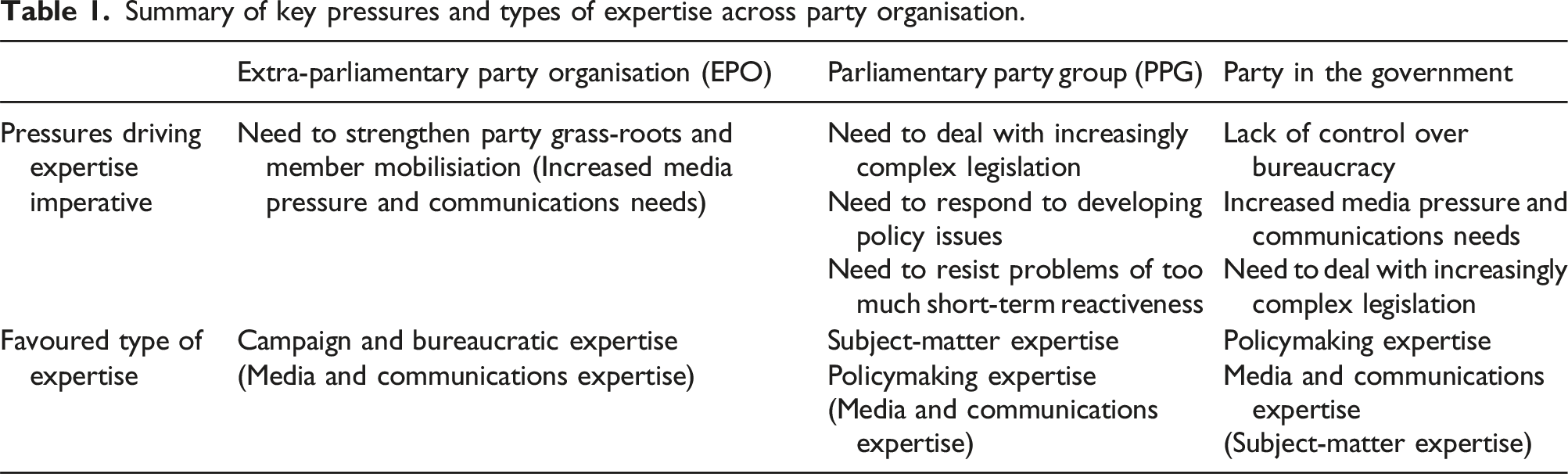
In addition to the general need to reverse the decline of political parties, the pressures driving the need for more expert political staff were identified to be sixfold: 1) lack of ministerial and governmental control over bureaucracy, 2) need to cope with increased media pressure and new communications needs, especially for ministers, 3) need to deal with increasingly complex legislation, 4) need to react quickly to developing policy issues, especially in PPGs and 5) need to resist succumbing into short-term reactiveness and loss of control over agenda, 6) need to strengthen party grass-roots with new mobilisation strategies. In this paper these pressures make up the expertise imperative that drives political parties towards recruitment and cultivation of expert staff.
The first two pressures were widely cited by all politicians and party employees regardless of their background and they also fit with earlier evidence on ministerial aides(e.g. Shaw and Eichbaum, 2018; Askim et al., 2021. From interviewees serving as ministers (N=6), five explicitly noted that more ministerial staffers are needed to control the work of civil servants, a perspective that has been also common among other politicians (c.f. Yong and Hazell 2014). The third and fourth pressures were mentioned as the driving force behind the shift of resources and power from EPO to PPG. They were discussed especially by EPO and PPG employees as well as party chairpersons and PPG leaders, who proposed that resources had been shifted from organisational and programmatic capacities to policymaking and legislative capacity (c.f. Heidar and Koole 2000; Katz and Mair 1995). The fifth pressure was voiced especially by elected politicians, ministers, and party leaders. Being forced to reactivity rather than driving public debate and policy agenda was also associated with loss of control to bureaucracy and interest groups, and in the Parliament as loss of initiative to the government. The sixth pressure, which aligns with earlier literature on IPD, was discussed especially by party chairpersons and party general secretaries who wanted to use new mobilisation strategies to overcome stiff party hierarchies. Why would these pressures need a partisan response that coincides with need for expertise? Overall, the interviewees expected successful political staffers to combine partisanship with expertise. Little evidence was found on Finnish party staffers being mercenaries that shift political allegiances, although previous evidence suggests that many staffers later work in non-partisan public relations with shifting client bases (Ylönen, Mannevuo, and Kari, 2022). Furthermore, ministers and other leading politicians stressed the need of state secretaries and personal aides to independently perform partisan negotiation, which requires high trust and close partisan alignment. The findings support recent research on political staffers (e.g. Karlsen and Saglie, 2017; Moens, 2021), highlighting that expert political staff was considered useful precisely because of their partisanship. The only staffers who were not necessarily expected to be committed party members were personal aides to MPs, a finding confirmed in interviews with personal aides themselves, but even aides were pressured towards more partisan roles as will be discussed below.
While classic party theories described professionalization of parties as a depoliticising process, the interviews provided no supporting evidence for this argument. If interviewees discussed depoliticization of political parties, it was associated with the overall weakening of EPOs, ideologies, membership base, and programmatic work. While it is possible to associate weakening of ideologies with de-politicisation, the interviews rather suggest that it marks a shift from politics as broad ideology to politics in more detailed policy. In fact, the interviewees believed that not increasing the staff resources leads to depoliticization because it empowers technocracy in policymaking. Furthermore, some interviewees were worried that increasing the number of ministerial advisers leads to over-politicisation of policymaking, but no interviewee believed it would lead to de-politicisation.
How are party staffers used within party organisation?
The interviews suggest that EPOs, PPGs, and ministerial offices accumulate different types of expertise, but all varieties are necessary for building a robust party organisation. The imperative of expertise can take different forms, but the need for professionalisation and expertise is felt throughout the party organisation.
Summary of key pressures and types of expertise across party organisation.
Party staffers in the EPO
According to the interviewees, contemporary central party office concentrates on upholding the basic functions of the party organizations – administration, campaigning, member mobilization, and communications. The expertise imperative therefore leads EPOs to prioritise campaign and bureaucratic expertise, and to some extent media and communications expertise. The interviewees did not suggest that either policymaking expertise or subject-matter expertise were important for EPOs. Likewise, interviewees associated the pressures relating to EPO with the goal to reverse the decline of parties, the need to resist short-term reactiveness, and some links to the increased importance of communications. EPOs’ overall personnel resources were thought to be low, eclipsed by both the PPGs and the ministerial offices as discussed above.
Interviewees routinely used the phrase ‘electoral organisation’ to describe central party offices and, interestingly, this framing often carried a negative connotation: EPOs were said to have become ‘mere’ electoral organisations. The development is supported by over-time analysis of party personnel and finance data (Koskimaa 2021). Rather than framing the development in positive terms, electoral focus was mostly discussed as an impoverishment of the ideological role of parties – much in the vein of the professionalization narrative. Media and communications expertise was recognized to be part of EPO staff, but somewhat surprisingly it received only little attention in the interviews. Nevertheless, both Koskimaa (2021) and Ylönen, Mannevuo, and Kari (2022) suggest that media and communications experts play an increasing role in Finnish EPOs.
The interviews yielded mixed findings on the importance of recruiting more staff to EPOs to lead ideological and programmatic work. Contrasted with the views on parties’ policymaking efforts, these insights present a more nuanced idea of the political roles of various party organizational facets. Four out of five party chairpersons, four out of eight PPG chairpersons, and two out of four party general secretaries explicitly called for more resources for programmatic work within EPOs. However, based on interviews with PPG staff, programmatic work in most parties was led by elected politicians and supported by PPG staff rather than being exclusively coordinated by the EPO. Furthermore, party chairpersons, party general secretaries, and PPG staff felt positively about new strategies to link PPGs directly to the membership base and circumvent formal party hierarchies. PPG staff and politicians could therefore hold a key role even in attempts that were overtly meant to strengthen the EPO. Interviewees from large and traditionally dominant parties, such as Social Democratic Party and Centre Party, party were more likely than others to critique party bureaucracy despite recognizing its electoral importance, underscoring the need for new participatory practices. On the other hand, interviewees from emerging parties such as the Green Party and Finns Party were more likely to emphasise the importance of building a strong party platforms and campaign organisation.
Party staffers in the PPG
In the parliament, the functional purpose of party staffers differed depending on whether the focus is on personal aides or PPGs. Overall, we found that the expertise imperative was driving aides and PPG staff towards increased subject-matter expertise and policymaking expertise, with some need for communications expertise. These types of expertise responded to the need to deal with increasingly complex legislation, need of PPGs to respond to developing policy issues, and need to resist problems of too much short-term reactiveness. Interviewees associated these needs especially with opposition parties due to their reliance on PPGs in presenting alternatives to government policymaking. Especially subject-matter expertise was seen as a priority area that most PPGs tried to develop. PPG staff also noted that it was natural to concentrate subject-matter expertise to PPGs, because this division of labour was driven by MPs having responsibility over specific policy areas in the party (see also Mykkänen, 2010).
The goal of increasing subject-matter expertise took two different forms in the interviews. First, most parties sought to recruit paid subject-matter experts to work in the PPG. Almost all PPGs had paid specialists in financial and economic policy and larger PPGs could have expert staff in additional priority areas. Party staffers with subject-matter expertise were understood by interviewees to improve PPG capability to scrutinize incoming legislation, draft policy papers, liaise with expert networks of the party, and support party’s policy preparation. Especially opposition party interviewees emphasised the subject-matter expertise in the PPG, explaining that lack of access to civil service expertise requires opposition parties to develop alternative sources of expertise.
Second, the goal of cultivating subject-matter expertise was the driving force in some parties reorganising parliamentary aides as a collective support for the PPG rather than personal aides to MPs. The interviewees explained that the collective model makes some aides work as personal aides to several MPs simultaneously, freeing others to specialise in specific policy areas and over time acquire subject-matter expertise. Based on the interviews, the collective model of parliamentary aides has allowed PPGs to strengthen staff resources despite direct financial resources remaining stagnant. The interviews suggested that all parties felt the pressure to adopt the collective model although some parties had decided not to adopt it.
Party staffers in ministries
As already suggested above, politicians and party staff interviewed for the study were in broad agreement with the need to increase political staff resources in ministries. Overall, the evidence suggests that parties try to allocate their best staff talent as state secretaries and special advisers, for example by promoting experienced EPO and PPG staff and parliamentary aides to ministerial offices or inviting experienced former staff or even former MPs to the newly opened positions when entering government. This was driven by the need to control bureaucracy, increased media pressure, and increasing complexity of legislation.
The findings on ministerial staffers confirmed for Finland what has already been said of special advisers elsewhere (e.g. Askim, Karlsen and Kolltveit, 2017; Shaw and Eichbaum, 2018; Young and Hazell, 2014). To strengthen policymaking, ministers appoint state secretaries and policy-focused special advisers. Interviewed ministers and party leadership commonly emphasised the need to delegate ministerial authority to political staffers to independently supervise policy development and participate in political negotiations. Interviewees preferred state secretaries to be senior partisan policymakers, whereas special advisers could have more variation in their experience. The interviews provided no conclusive evidence on whether subject-matter expertise was important for state secretaries and special advisers. Interviewees did not explicitly propose it as a requirement, but poor policy expertise and too much on ‘politicking’ were identified as problems by several interviewees. The need for staff with communications expertise was related to the need for partisan political communication rather than official governmental communication. Politicians therefore allocated some of their partisan special advisers to focus on media relations, but also proposed appointing separate political spokespersons for senior ministers as a new type of political staff.
What parties’ new staff strategies mean for party organisations and democracy?
The differentiated responses to expertise imperative have implications for party organisation more broadly. Across the party spectrum and organizational levels, the interviewees were in broad consensus that the ministerial team forms the heart of contemporary Finnish political parties, and the recruitment of ministerial aides further strengthens it (cf. Poguntke and Webb 2005). The importance of ministerial offices is further strengthened by often employing the most experienced members of party staff. The findings suggest that PPGs also benefit from the increasing role of partisan policy experts because they increase PPGs’ independent policymaking capacity. Policymaking resources and subject matter expertise of the party are concentrated in the PPG especially in opposition parties, elevating its role within the party. Overall, our findings support the shift of power to the elected politicians within the party (c.f. Katz and Mair 2002, 2018; Heidar and Koole 2000) but refine the practical and theoretical implications of this shift.
On the other hand, some interviewees felt that the strengthening of PPGs at the cost of EPOs has shifted party focus to ‘daily politics’ and deprioritised long-term programmatic work. Interviewee descriptions of party staff work in PPGs were indeed typically focused to the immediate needs of their political principals. Considering the increased role of PPG staff in supporting programmatic work of the EPO, we interpret these findings to mean that subject-matter and policymaking expertise in PPGs might not address the decline of ideological and value-based foundations of parties.
Nevertheless, the findings underscore that the shift of focus from partisan ideology to partisan policymaking should not be conflated with the idea of the de-politicising effects of campaign professionalisation. In other words, the interviews suggest that erosion of ideologies does not mean that parties want to give up on partisan policymaking. Partisan expert resources strengthen the policymaking capacity of political parties, and partisanship is a pre-condition for successful careers as political staffers even when they have expert roles. We interpret this to mean that expertise imperative can strengthen EPO focus on campaigning without contradicting the policy-focused manifestation in PPGs and ministerial office because of their organizational differentiation.
Lastly, the findings suggest that electoral success seems to benefit the building of expert-led party organisation. Very simply: due to heavy reliance on state subsidies, higher vote-share translates to more party staffers. Benefits of electoral success are further increased if parties are part of the government coalition because ministerial aides support the overall policymaking capacity and expertise of the party. Moreover, higher number of political staffers within a party seem to foster specialisation and more efficient organisational practices, which allows bigger parties to benefit from political staffers in ways that smaller parties cannot. For example, cases of fully-fledged systems of expert policy staff in PPGs or policy-based organisation of parliamentary aides were found to be mostly restricted to the largest parties. Smaller parties faced difficulties in building a party organisation based on expertise and policy specialization, which disadvantages them in policymaking. This finding is supported by campaign professionalisation in Finland being associated with party size, centralization, and catch-all strategy (Mykkänen, Nord and Moring, 2022).
Discussion and conclusions
To address the calls to explore parties’ personnel resources beyond their sheer numbers, titles, and locations (e.g. Webb and Keith, 2017; Webb and Kolodny 2006), this study took off from the important finding of recent party staff studies on the emergence of ‘unelected politicians’ and studied it from an alternative perspective. We challenged the old theoretical narrative where party professionalization ‘automatically’ risks IPD and depoliticises parties which also reflects in the membership-oriented framing of recent party staff studies.
We propose that political parties increasingly face what we call the imperative of expertise. Stemming from the ‘realities’ of contemporary policymaking, the expertise imperative strongly incentivises parties to recruit and promote political staff based on their skills and competence rather than partisan loyalty alone. Furthermore, the imperative pushes EPOs, PPGs, and ministerial offices to favour different types of expertise according to their functional needs, making differentiation complementary rather than a zero-sum game of power within political parties. We thus believe the expertise imperative captures a novel organizational dynamic that is not present in the traditional analytical frameworks that conceive parties via distinct organisational layers and the expected ongoing struggle between them. Through enhanced policymaking capacity, that should also benefit parties electorally and thus impact their overall incomes, the expertise imperative benefits all organisational layers to some extent.
Regarding demands placed on party organizations by the current pressures (RQ1) and parties’ responses to these pressures (RQ2), we found that contemporary logics of party professionalisation extend far beyond the communication-heavy and campaign-focused view of the classical party professionalization studies (Kirchheimer 1966; Epstein 1967; Panebianco 1988) that also echo in newer party models (e.g., Carty 2004; Katz and Mair 2018). More than anything, Finnish party elites see the cultivation of expertise as an attempt to regain lost ground in policymaking – a party function whose relevance has been undervalued in party organizational research. While attempting to push their agendas through an expert-driven policy processes, parties face a sustained pressure to emphasise the services of highly skilled and loyal partisan experts. Overall, with this study we wanted to emphasise that parties are still not only campaign or participatory organizations, but they also attempt to change societies – and, importantly, this should also be conceived as major factor impacting their organisations. Regarding RQ3, our findings suggest that concentrating subject-matter expertise to PPGs and senior policymaking expertise to ministerial office leads to these two organs becoming even more prominent within political parties. While this helps parties strengthen their policymaking capacity to overcome technocratic and interest group domination, it does not solve problems in the decline of membership base or ideological foundations.
What are the implications of these findings for IPD and representative democracy more generally? As it is well known, the two do not necessarily cumulate and may even contradict each other. Effects of the expertise imperative further complicate this problem. On one hand, cultivation of expertise and policymaking capacity enhances parties’ ability to control the policy process, increasing democratic control of the government. On the other hand, more power exercised by experts in PPGs and ministerial office weakens the policy-related aspects of IPD, therefore weakening internal party control mechanisms and emphasising electoral accountability. Expertise imperative in its policy-related form therefore presents a challenge for democratic control through party-channels but overall might increase the democratic control of parties over bureaucracy. Tension between the two effects presents a conceptual challengeto IPD literature.
Because party funding in Finland comes primarily from public resources, the findings suggest a reassessment of the cartel party thesis (Katz and Mair 1995): integration between parties and the state might not be a universal threat to democracy. To serve as a democratic link between citizens and the state, politicians believe they need improved policymaking capacity, whereas not doing so would itself be a threat to democracy. The findings therefore challenge the idea that political parties can democratise policymaking by concentrating solely on IPD. Because expertise imperative is particularly strong regarding policymaking needs, the theory and practice of IPD must confront the reality that democratic control of the government very likely cannot be achieved without ‘unelected politicians’ and hierarchies of knowledge among party members, employees, and politicians. The theoretical challenge of the expertise imperative to IPD is whether and how parties can balance the partisan democratic aspect of parties with the hierarchic professional specialisation.
We conclude with few caveats and suggestions. The purposive sampling strategy of interviewing elites means that the study is exploratory and theory-generating rather than representative and generalizable. Thus, future studies should elaborate on these initial findings and explore possible different configurations of expertise within political parties, in different political systems, with case studies and comparative strategies. The initial formulation in this paper is based on the Finnish case study and earlier evidence from Northern Europe, suggesting that that the phenomenon might apply especially to multi-party parliamentary systems. At the same time, we recognize that some peculiarities of the Finnish political system can skew the results. The sample of interviewees is skewed towards senior politicians who might be more preoccupied with policymaking than backbench MPs and party organisation staff. The tendency to emphasise policymaking could therefore be less pronounced among MPs more broadly and in EPOs. We also acknowledge that the lack of direct quotes limits the ability of the study to demonstrate the reasoning and rationales of the interviewees. Furthermore, because our argument is based on the rationales given by politicians with subjective motivations, we welcome debate on whether this perspective is self-serving despite its democratic intentions. Finally, the interview sample did not include politicians or party staffers from regional and local levels. Such interviews could provide contrasting evidence the policymaking and media focus of the political elites.
Supplemental Material
Supplemental Material - The imperative of expertise: why and how the professionalisation of policymaking transforms political parties?
Supplemental Material for The imperative of expertise: why and how the professionalisation of policymaking transforms political parties? by Ville Aula and Vesa Koskimaa in Party Politics
Footnotes
Acknowledgements
The authors wish to thank Tapio Raunio for comments on an earlier version of the manuscript, as well as the productive comments of three anonymous reviewers. Ville Aula wishes to thank Jouni Backman, Lea Konttinen, and Joonas Leppänen of SITRA for research collaboration and access to the data set, and University of California, San Diego for support during research visit.
Declaration of conflicting interests
The author(s) declared no potential conflicts of interest with respect to the research, authorship, and/or publication of this article.
Funding
The author(s) disclosed receipt of the following financial support for the research, authorship, and/or publication of this article: This work was supported by the Fulbright Suomi -säätiö and the Academy of Finland (333013).

Supplemental Material
Supplemental material for this article is available online.
Note
Author biographies
References
Supplementary Material
Please find the following supplemental material available below.
For Open Access articles published under a Creative Commons License, all supplemental material carries the same license as the article it is associated with.
For non-Open Access articles published, all supplemental material carries a non-exclusive license, and permission requests for re-use of supplemental material or any part of supplemental material shall be sent directly to the copyright owner as specified in the copyright notice associated with the article.
