



Abstract
Scholars connect the rise of populist parties and the growing importance of social media platforms for political communication as the emerging social media logic seems well-suited to populist communication. The following research note presents a novel dataset that connects Facebook accounts to party-level populism data from the POPPA database. Over 600,000 posts from 226 parties between 2017 and 2019 were analysed. The results show that in most European countries, populist parties are more active than non-populist parties on Facebook. However, high variation in the frequency of posts emphasises that country-specific aspects play an important role. Generally, Italian parties are much more active than those from other countries, whereas those in Northern and Western Europe are the least active. The most active party in Europe, the Italian right-wing populist Lega, showed the most extreme level of activity: its daily activity is around 20 times higher than the median. Furthermore, this analysis highlights why researchers should carefully check Facebook data for implausible inactivity and how connecting different data resources can help overcome potential biases resulting from missing data. Future studies analysing any party communication on Facebook will benefit from the insights and the list of party accounts featured herein.
Introduction
Many observers connect the rise of populist parties to the increasing relevance of social media in political communication (De Vreese et al., 2018; Kriesi, 2014: 366–367), as data-driven social media campaigns play a crucial role (Roemmele and Gibson, 2020). This development favours populists, as the emerging social media logic seems well-suited to populist communication (Engesser et al., 2017). Populists use social media platforms to bypass the established media, which they feel mistreats them (Krämer, 2017: 1303). This is in congruence with populist voters, who prefer news from social media over that produced by mass media outlets (Pew Research Center, 2018). Among the various platforms, many assume that Facebook, the most popular platform with almost three Billion monthly active users (DataReportal, 2021), offers ideal opportunity structures for populists. Many young users recently left the platform (Pew Research Center, 2022), presumably in protest against the platform algorithm’s fostering of polarisation (Barrett et al., 2021). However, few comparative empirical studies have analysed whether populist parties are actually more active on Facebook. The following research note offers insight into the post frequency of 226 European parties by covering over 600,000 posts between 2017 and 2019, connected with party-level datasets. It also problematises Facebook data quality and offers possible solutions. The list of party accounts published along with this research note (Thomeczek, 2023) facilitates future studies on Facebook communication.
Social media communication: an effective tool for populist parties
Research suggests that the shift from mass media to social media communication has created a favourable communication environment for populists. Comparing the inherent logic of social and mass media exemplifies this (Klinger and Svensson, 2015). Historically, populists have propagated direct communication with “the people”, which fits well with social media’s logic of distribution (Engesser et al., 2017: 1113). Furthermore, given the logic of usage, social media enables populists to reach many voters who have turned their back on traditional outlets (Pew Research Center, 2018). Those users pass populist messages on like chain letters, to other users with similar preferences (Jacobs and Spierings, 2018: 1686; Klinger and Svensson, 2015: 1248–1249). In line with the logic of production, populist parties also use social media to circumvent the evaluation of journalistic gatekeepers (Engesser et al., 2017: 1110, 1113; Jacobs and Spierings, 2018: 1685). Although no party can control political mass media communication, given that the outlet chooses the message’s framing (De Jonge, 2019), it is primarily populists who distrust the mainstream media (Krämer, 2017: 1303). In fact, research on the relationship between the media and populist parties shows that in many countries, populists receive more critical coverage than other parties (De Jonge, 2019; Ernst, et al., 2019a, Esser, et al., 2019b: 183), even in tabloid media (Rooduijn et al., 2014). This prompts populists to seek out alternative avenues of communication. Manucci (2017) differentiates between indirect and direct political communication against the backdrop of the party-voter relationship. Typical interactions between mass media and parties are indirect communication, while social media interaction is a form of direct communication. Accordingly, indirect communication is characterised by dependency on intermediaries, as the outlet decides whether the party’s message will be distributed. Ultimately, potential voters will only see the framed (i.e., mediated) message. In contrast, direct communication allows parties to send out unmediated messages to their supporters. Here, no intermediaries evaluate, process or change the message that parties seek to send out. Populists, who would otherwise be evaluated more critically when using indirect communication channels, can avoid these journalistic gatekeepers by focusing on direct communication strategies (Jacobs and Spierings, 2018: 1685).
Multiple studies have found empirical evidence that populist actors put more emphasis on political social media communication than non-populist actors. Ceccobelli (2018) has shown that populist politicians use social media regularly, while the activity of non-populist politicians is strongly focused on campaigns. This suggests that populists dedicate more attention to their social media communication. For populists, social media is an important communication channel for spreading populist content (Bracciale and Martella, 2017; Engesser et al., 2017). Furthermore, studies have suggested that populist content is more closely associated with Facebook than Twitter (Ernst, et al., 2019b; Jacobs and Spierings, 2018), where populist actors get, on average, more likes and spark more attention (Ceccobelli et al., 2020). Facebook’s text-centred posts are an ideal alternative to mass media communication and provide populists with an unmediated platform to voice their demands in a way that character-limited Tweets do not. Furthermore, Facebook, as the most widespread social media platform, offers the opportunity to communicate with a comparatively broad audience that more closely represents “the people”. In contrast, the audience of other networks is quite specific. For example, Instagram clearly has a target group under 34 (DataReportal, 2021). However, thus far, there is little comparative research on the Facebook activity of populist parties, a research gap that the following analysis seeks to tackle.
Defining and measuring populism
The following analysis relies on the populism index from the Populism and Political Parties Expert Survey (POPPA, Meijers and Zaslove, 2020). The dataset is based on the so-called ideational approach to populism and covers different variables on the subdimensions of populism. The ideational approach, which has become widespread in empirical analyses, defines it as a “unique set of ideas” (Hawkins and Kaltwasser, 2018: 3) centred on the idea that politics is a Manichaean struggle between the “good people” and the “bad elite” (Mudde and Rovira Kaltwasser, 2013). The independent variable for the following analysis is POPPA’s populism score (range: 0–10), which is derived from a factor analysis of the variables measuring the elements of this definition (people-centrism, anti-elitism, people homogeneity, general will, Manichaean worldview). POPPA data was collected in 2018 for 249 parties in 28 European countries. The continuous populism score enables an analysis of the correlation between party-level populism and activity, addressing the question: Are populist parties more active on Facebook than non-populist parties?
Facebook data
I collected Facebook data in 2022 using Crowdtangle, a platform designed to facilitate academic access to Facebook data (Garmur et al., 2019). The year range of 2017–2019 was selected as it includes the year before and after POPPA was conducted based on the assumption that party-level populism did not differ drastically between those years. The Facebook activity for all parties was linked to the POPPA dataset (see Thomeczek, 2023 and Table A4, Appendix). However, there are several caveats in terms of data collection. Firstly, in three cases, the official party websites referenced only the accounts of their leaders (Lega, PVV, DLF), although the parties also had their own accounts. As the goal is to compare party activity, leader accounts were disregarded (but see Figure A5, Appendix for a comparison of the three parties with the activity for their leaders). Secondly, no data could be collected for some parties primarily because of the absence or deletion of accounts (see Appendix, Table A4). Thirdly, access was sometimes restricted to certain geographical areas (geo-blocking). 1 The German SPD is a prominent example of a geo-blocked account. A manual check of account activity over time revealed “activity gaps” that could indicate such restrictions. Therefore, the data was simultaneously collected via the Facebook API access by Germany-based Facepager (Jünger and Keyling, 2019) to minimise the problems arising from missing data. As Crowdtangle’s data is not affected by the Facebook API limit (Ho, 2020), it served as a baseline (574,026 posts). In the second stage, the missing posts collected using Facepager were added to the Crowdtangle dataset (53,913). The final dataset included 627,711 posts from 226 accounts. 2 The monthly activity pattern of all parties can be found in the Appendix (Figures A1-A4).
Analysis
Distribution of populism score and number of posts (aggregated by year).

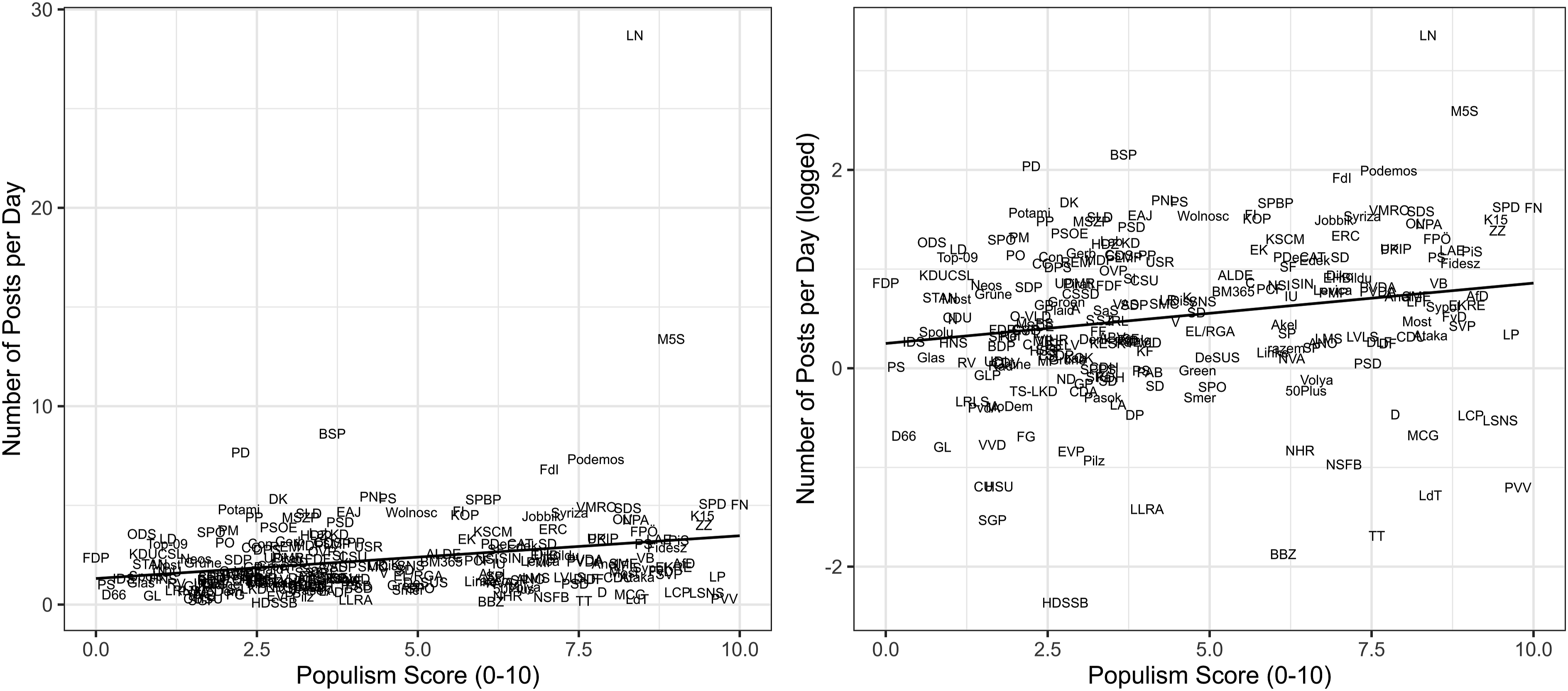
Post Frequency of Parties in Europe (2017-2019).
Correlation between post activity and populism by Country.
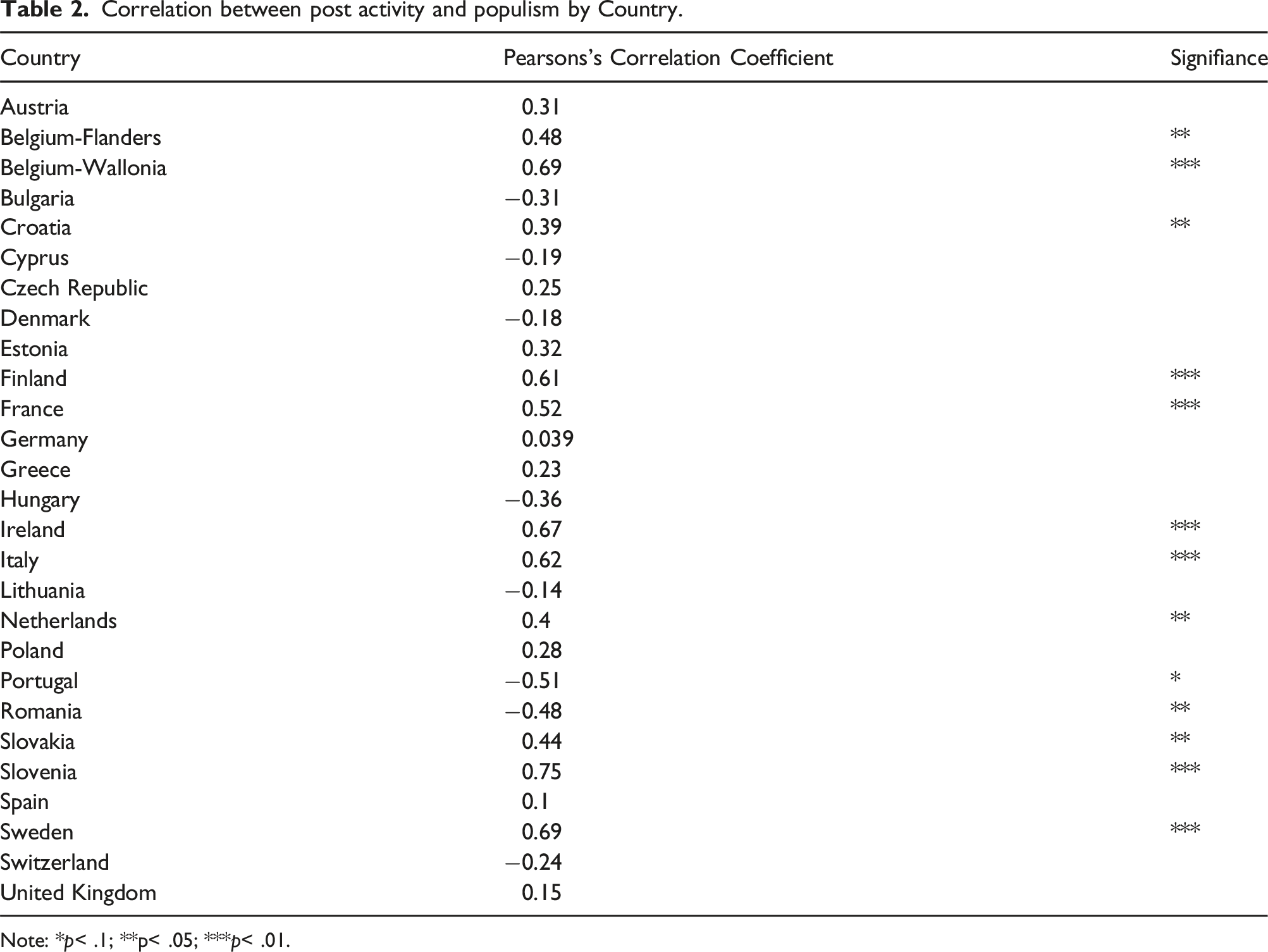
Note: *p< .1; **p< .05; ***p< .01.
Figure 2 illustrates the relationship between populism and the number of daily posts in Western Europe. The Y-axes of the following figures are scaled differently based on the country-specific minimum/maximum activities. Overall, Western Europe is the region with the strongest correlation between populism and Facebook activity (significant in five countries, Table 2). This is most consistent in the Netherlands, Belgium and France. The most active parties in Western Europe were located in the UK, France and Austria, where populist parties posted five to six times per day. In contrast, parties in Germany and Belgium were about half as active. In some countries, populist parties were less active than non-populist parties in parliamentary election years (Austria, 2017; Germany, 2017; UK, 2017). However, there is counter-evidence from Switzerland: the right-wing populist SVP was more active than the other parties in the year of the Swiss elections (2019). The British UKIP showed a high level of activity in 2019. The monthly activity pattern indicates that the party focused on the European campaign (Appendix, Figure A1). In contrast, in Germany, the AfD’s low level of activity suggests that it was almost entirely inactive during the EU election campaign. Frequency of Posts in Western Europe. 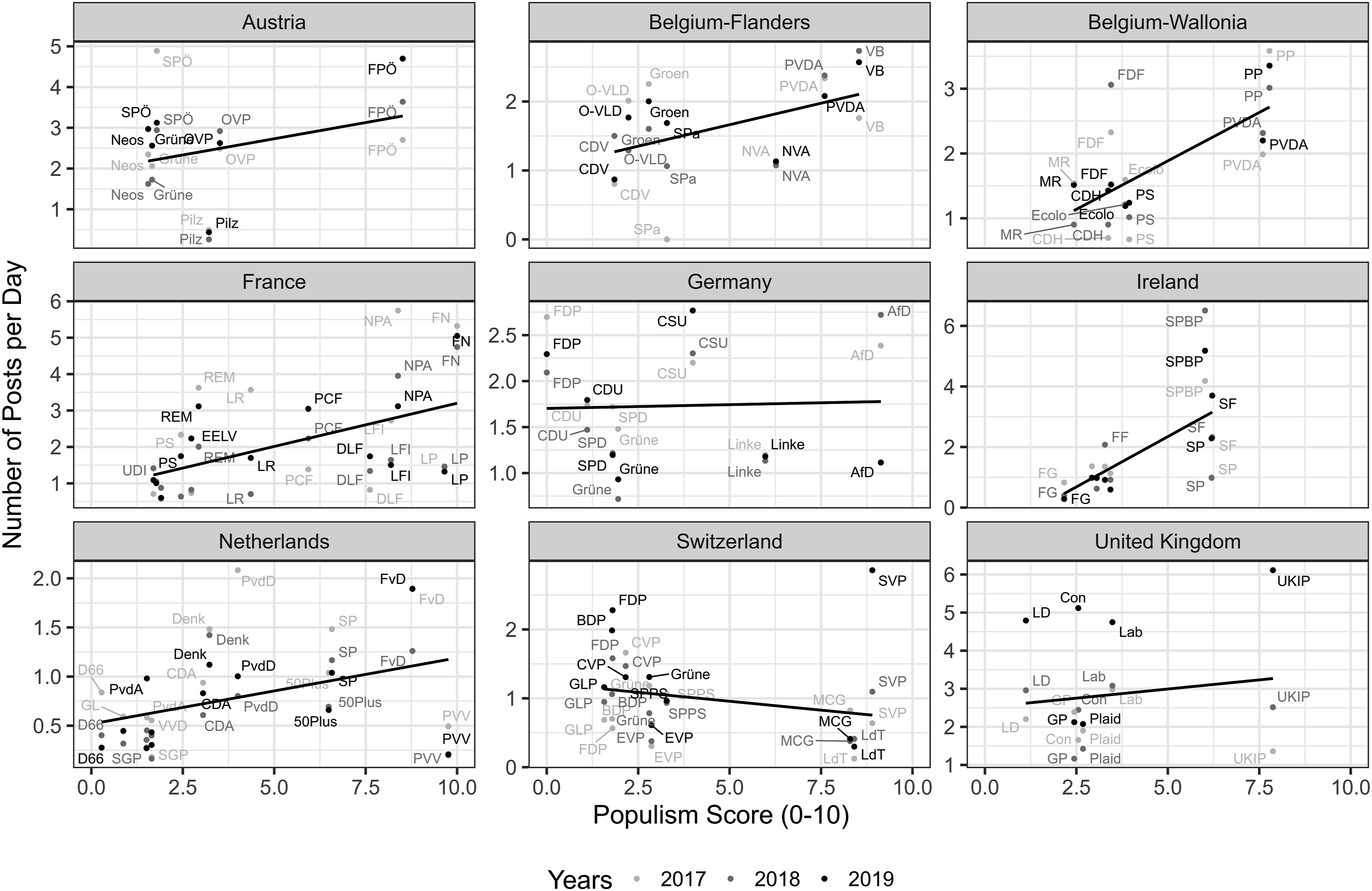
The trend for Central and Eastern Europe is displayed in Figure 3. Generally, post activity was higher than in Western Europe. In five countries, there is a positive correlation between the frequency of posts and party-level populism that is significant for Croatia, Slovakia and Slovenia (Table 2). In Czechia, the two most populist parties showed divergent trends. In Hungary, Romania and Bulgaria, higher populism scores were associated with less activity (significant in Romania). However, in Bulgaria, this was mainly driven by the high activity of the BSP party. In all three countries, the most populist parties governed at least some of the time between 2017 and 2019, which may explain their low activity level, as they had access to government accounts. This trend is also supported by Poland’s governing populist party PiS. On the contrary, governing SDS was Slovenia’s most active party on Facebook. The Polish right-wing populist Kukiz’15 became less active over time, especially after the European elections in 2019 (Appendix, Figure A2). In Slovakia, the positive correlation between populism and Facebook activity seems to decrease over time, but this figure is skewed by the far-right populist LSNS, which only created its Facebook page in late 2019. Overall, some parties in Central and Eastern Europe showed remarkable phases of inactivity (Appendix, Figure A2). In most cases, this was related to newly created pages or the dissolution of parties and, in other cases, to activities strongly focused on election campaigns. Frequency of Posts in Central/Eastern Europe. 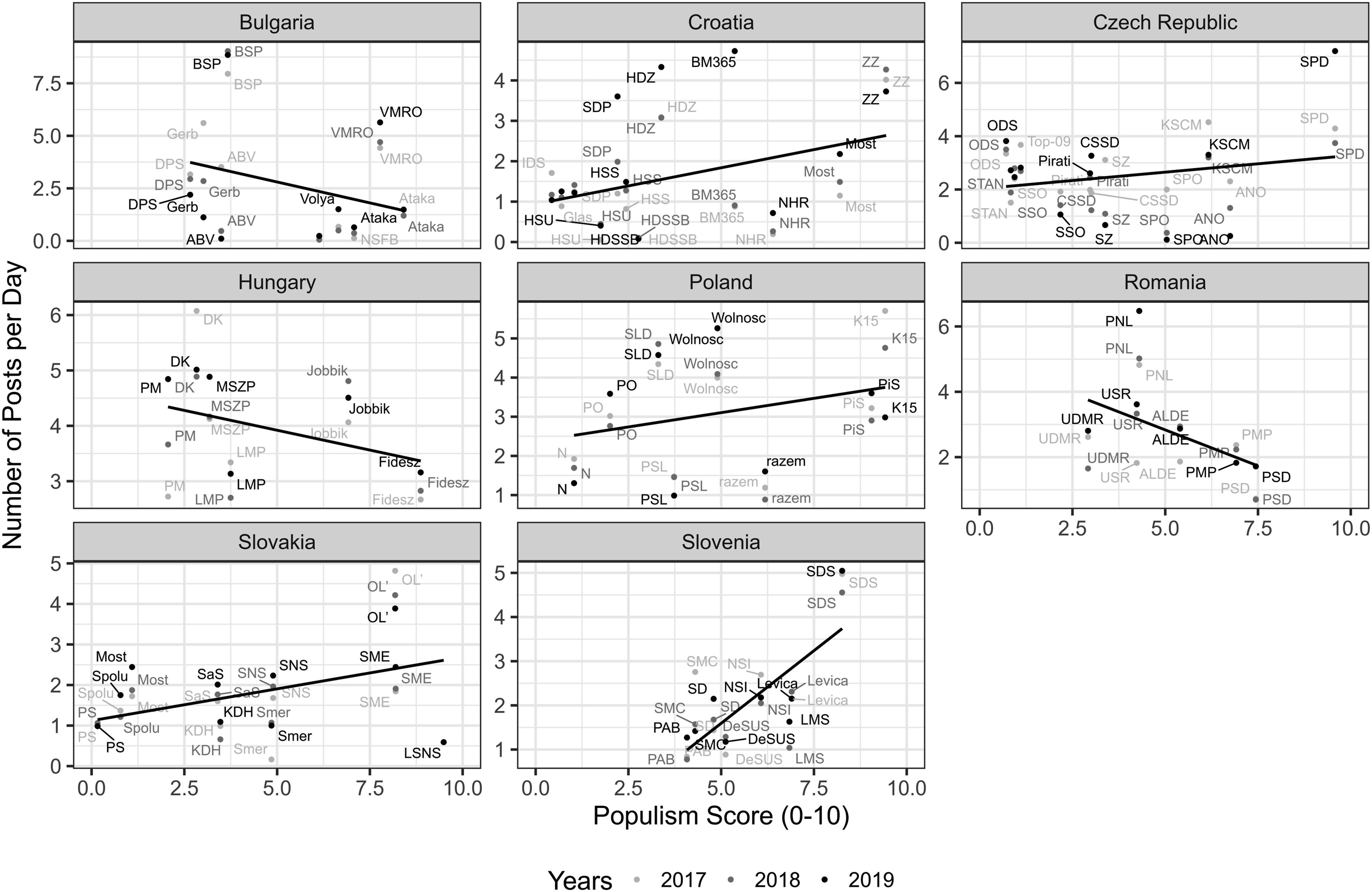
In Southern Europe, populist parties were more active than other parties in Italy and Greece (Figure 4), but the correlation is only significant in Italy (Table 2). The two most populist Italian parties, Lega and M5S, were also the most active in Europe, whereas the two parties classified as (slightly) less populist, the FdI and FI, were only moderately more active than the non-populist parties. The correlation is negative in Cyprus, but the variation of post frequency in Cyprus was high, while the range of populism scores was small. The situation is similar in Portugal (significant negative correlation), although the most populist party, the CDU, showed highly irregular activities before 2019, which could indicate gating (Appendix, Figure A3). Furthermore, the left-wing populist Bloco de Esquerda is not included in the analysis, as the party only created its account in 2020. In Greece, populist parties were generally more active, although the populist ANEL and non-populist Potami deviated from that trend. A closer examination of the activity patterns reveals that those Greek parties drastically reduced their Facebook activity around the national elections in 2019. ANEL did not compete in the elections, and Potami was dissolved in late 2019. In Spain, the left-wing populist Podemos was the most active party, while the regional populist parties were relatively inactive. This may be related to their regional focus. Moreover, the trend was reversed in 2019 when Spain had two general elections. Here, the two largest parties, the PP and PSOE, which probably had more resources, were unusually active, while the populist parties were less active. Frequency of Posts in Southern Europe. 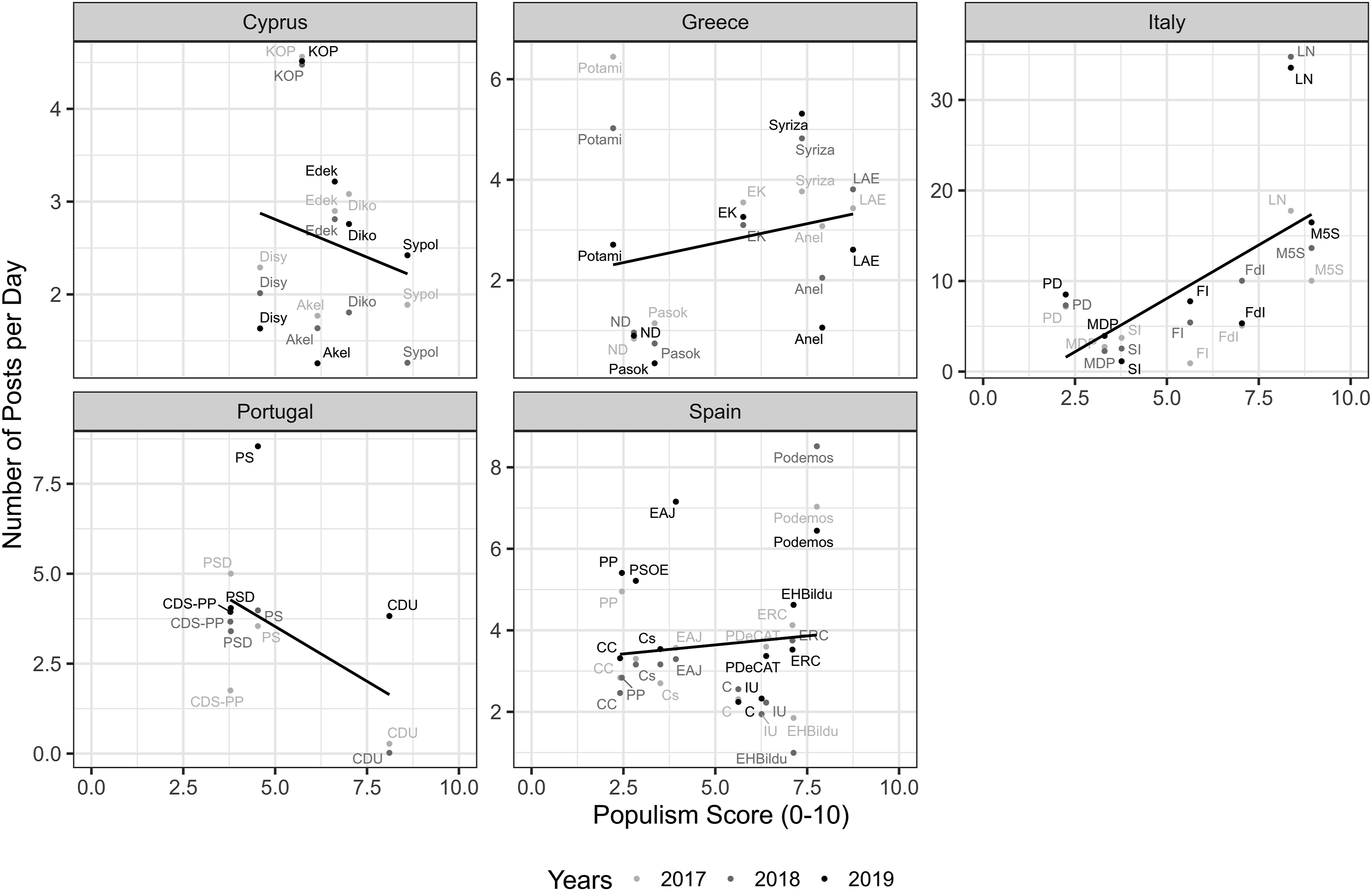
Finally, Figure 5 shows the activity in Northern Europe, which was the lowest of all four regions overall. On average, the most active Nordic parties sent out around three posts per day. Populist parties were more active in Estonia (not significant), Finland and Sweden (both with significant correlations). The relationship is strongest in Sweden, where the Swedish Democrats (SD) were highly active, and in Finland, although here, the most active were the non-populist Christian Democrats (KD). In Denmark, the right-wing populist DF was highly active on Facebook only in 2019, the year of the European and Danish general elections, while right-wing populist newcomer Nye Borgerlige (D) was quite inactive. Nevertheless, both populist parties posted more content before the Danish elections in June 2019 (Appendix, Figure A4). In Lithuania, the three populist parties show very different levels of Facebook activity. While the TT (dissolved in 2020) was almost inactive and the LVLS was highly active, the LCP’s number of posts was not different from the other parties. However, the data for TT is likely incomplete as there is no recorded activity for 2018. Overall, the Lithuanian parties were the least active European parties on Facebook. Frequency of Posts in Northern Europe. 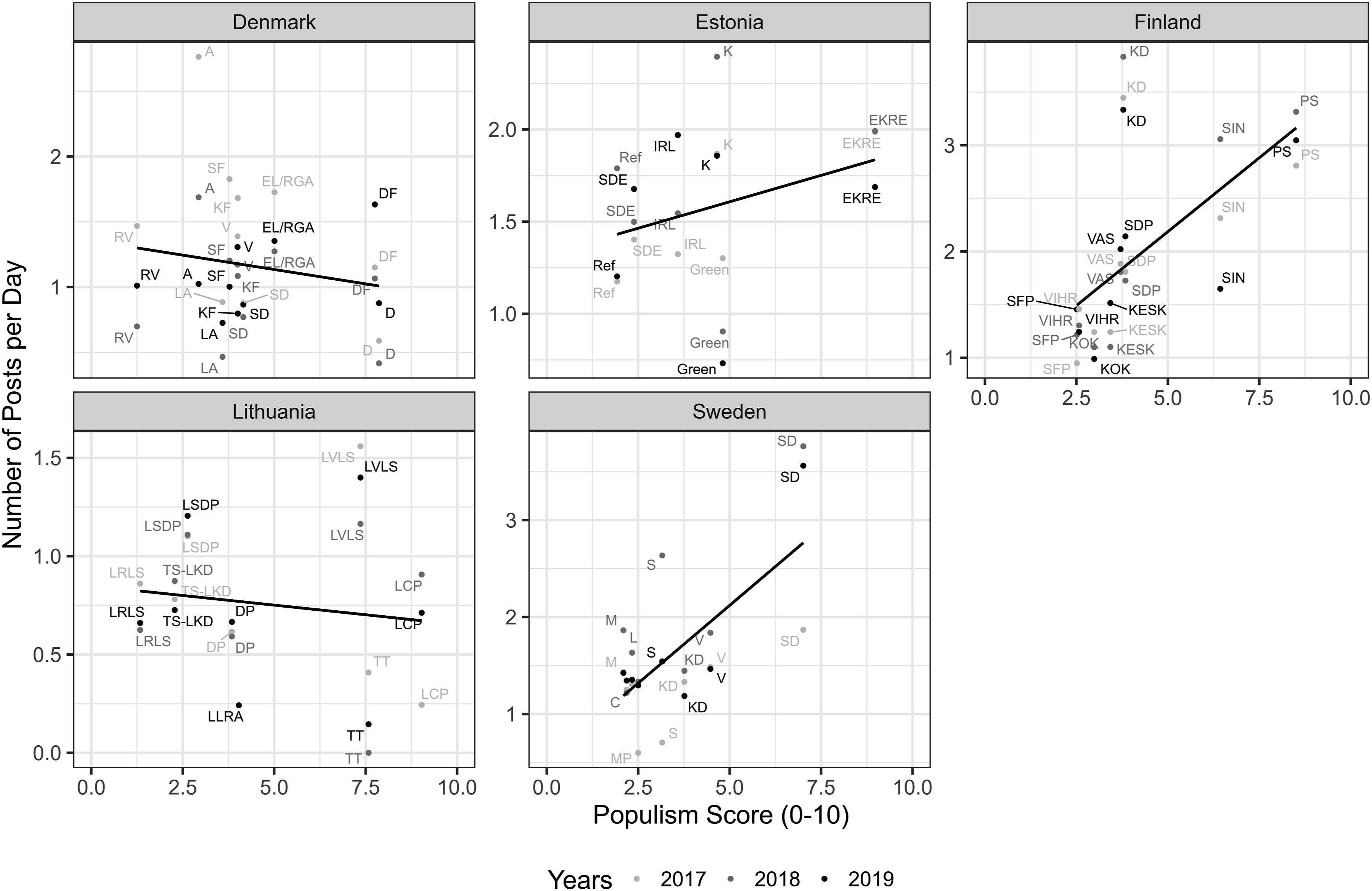
As the findings from Figures 2–5 and Ceccobelli (2018) suggest that populism is not the only factor explaining Facebook activity, multivariate models that control for additional variables can be found in Table A3 (Appendix). Furthermore, I check the robustness of the results using an alternative, binary classification of populist parties based on the PopuList (Rooduijn et al., 2020). The results show that, regardless of the control factors introduced or how populism is measured, the higher average activity of populist parties is confirmed. The models also show that being in government has a negative effect on the number of posts, while a higher seat share positively impacts activity. Furthermore, radicalism positively affects the activity level, which also aligns with the visual evidence that both far-left and far-right populist parties are more active.
Discussion
This research note has tracked whether populist parties are more active on Facebook, something which is often assumed but rarely comparatively tested. To this end, this study has analysed more than 600,000 Facebook posts of 226 European parties.
Overall, in most countries, party-level populism positively correlates with Facebook activity. This relationship is clearest in Western Europe. These results are robust after controlling for factors related to ideology, government status, election campaigns and parliamentary strength. However, the results also highlight several issues and caveats for future studies. Firstly, Facebook activity varied strongly between countries. Generally, party accounts from Western and Northern Europe were the least active, while those from Southern and Eastern Europe showed higher activity. Italy, the country with the most active parties on Facebook, deviated strongly from the European average. Lega, the most active European party, was 20 times more active than the European median party. Secondly, there are several additional factors that should be accounted for in future studies. Election campaigns can affect activity level dynamics, although in various directions. In some countries, the non-populist parties became more active during campaigns (e.g., in Austria); in others, the populist parties became more active before elections (e.g., in Switzerland). Other factors to consider are seat share, government status and ideological radicalism. Thirdly, data should be evaluated critically and cross-checked. There are some apparent “activity gaps”. Most of these gaps in the dataset occurred when parties were dissolved or new accounts were created. However, in other cases, content has likely been restricted or deleted. Combining different data resources helps to tackle this problem but cannot fully solve it. Once deleted, posts cannot be obtained anymore. Although large-n analyses are promising, researchers must perform manual checks and seek to understand deviating patterns. The activities of the German parties in 2019 are a good example. The patterns suggest that the AfD was not as active on Facebook as the other parties during the EU election campaign, but the almost total inactivity during that time is highly implausible. Furthermore, relying only on Crowdtangle data would mean that the SPD activity cannot be accessed.
Overall, many of the most well-known populist parties in Europe are among the most active parties on Facebook in their countries. This is empirical evidence of the theorised connection between populism and social media in general and Facebook in particular. It is quite astonishing as these populist parties differ in many other characteristics, such as ideology, government status and age. Nevertheless, other factors could explain why these parties have turned to social media and future research should focus on whether, for example, the media landscape could play a role. Populist parties may have fewer incentives to use social media if they have more direct mass media access, such as Hungarian Fidesz. Furthermore, Facebook activity is only one facet of social media performance. Research would benefit from a broader approach that includes more social media platforms and different aspects of social media communication. Against the backdrop of the social media logic, it may also be interesting to investigate whether some parties have adapted to the users’ needs more effectively. Elements of interest related to this question include post length, emojis and media usage, which may contribute to simplification and polarisation. Finally, future studies should be more critical of the data obtained and be sure to perform manual checks, as missing data can systematically bias the results.
Supplemental Material
Supplemental Material - Political communication on Facebook: Do populist parties send out more posts?
Supplemental Material for Political communication on Facebook: Do populist parties send out more posts? by Jan Philipp Thomeczek in Party Politics
Footnotes
Declaration of conflicting interests
The author(s) declared no potential conflicts of interest with respect to the research, authorship, and/or publication of this article.
Funding
The author(s) received financial support for the research from the Volkswagen Foundation (Az. 96 999).

Supplemental Material
Supplemental material for this article is available online.
Notes
Author biography
References
Supplementary Material
Please find the following supplemental material available below.
For Open Access articles published under a Creative Commons License, all supplemental material carries the same license as the article it is associated with.
For non-Open Access articles published, all supplemental material carries a non-exclusive license, and permission requests for re-use of supplemental material or any part of supplemental material shall be sent directly to the copyright owner as specified in the copyright notice associated with the article.
