



Abstract
Populist parties place the people at the centre of polity and politics. Such parties refer to direct democracy as a suitable avenue to involve people in the decision-making process but much less is known about their approaches towards deliberation. This article seeks to address this gap in the literature and analyses how populist parties talk about deliberation in their election manifestos. It tests empirically how much they speak about deliberation and whether they have a generic discourse as opposed to specific references to forms of deliberation and levels of implementation. Our qualitative content analysis draws on the election manifestos of 84 political parties from the Manifesto Project Dataset in 23 European democracies in the national elections between 1996 and 2021. The results indicate that populists talk considerably less and use vague language about the levels of implementation compared to non-populists.
Introduction
The growing citizens’ disaffection with representative democracy, eroding confidence in political institutions, and lower levels of participation (Dalton, 2019; Norris, 2011) have determined many polities to adopt participatory practices that can improve the quality of democracy. These practices enable the non-mediated participation of ordinary citizens in the decision-making process through either direct or deliberative practices (Geissel and Newton, 2012; Smith, 2009). There is increasing demand within the public for these participatory practices (Bedock and Pilet, 2020; Christensen and von Schoultz, 2019), which has been reflected in the high use of diverse forms at local, regional, and national levels in the last two decades (Elstub and Escobar, 2019; Morel and Qvortrup, 2017). In parallel with the increasing popularity of participatory mechanisms, there is a surge in the number of populist parties that bring a strong critique to traditional politics and promote a general distrust of institutions and political elites of representative democracy (Kaltwasser et al., 2017). The populist critique against representative democracy rests on different grounds and principles compared to the participatory practices, but it has two things in common with them: the orientation towards democratic renewal and emphasis on people as central actors in the decision-making process.
Based on these similarities, we would expect in theory to have a positive relationship between populist political parties and practices of participatory democracy. The populist rhetoric for greater citizen engagement is built on the grounds of popular sovereignty, frustration with representation, and desire to replace archaic political institutions. The reasons for such an expectation are stronger if we add their similar positioning towards mainstream political parties. On one hand, the mainstream political parties may feel their functions and legitimacy threatened by participatory arrangements – since they are bypassed in the decision-making process – and thus be less inclined to support them (Mair, 2013). On the other hand, populist parties have a strong anti-establishment rhetoric in which they often antagonise with mainstream parties to highlight their weaknesses and corrupt old style politics (Taggart, 2004). In practice, there is mixed evidence for the relationship between populist parties and direct democracy and no information about the relationship with deliberative democracy. Populists frequently express appreciation for direct democracy due to its potential to enable the ‘pure’ people to express their policy preferences without the meddling of corrupt elite (Barney and Laycock, 1999; Canovan, 1999). And yet, populist parties rarely speak more about or use more often direct democracy compared to non-populist parties (Gherghina and Pilet, 2021; Gherghina and Silagadze, 2020). This unclear relationship does not provide clues for the populist parties’ approach towards deliberative democracy, which is currently under-investigated.
This article aims to fill this void in the literature and analyses the ways in which populist parties refer to deliberative democracy in comparison to non-populist parties. We focus on their rhetoric in the manifestos drafted for the national legislative elections and we structure the analysis on three analytical dimensions: how much they talk about deliberation, how specific their discourse is about forms of deliberation, and how specific they are about the level of implementation for deliberative democracy. The study uses data from the Comparative Manifesto Project from 84 political parties (out of which 15 are populist) in Europe between 1996 and 2021. We use election manifestos for the analysis because they often include more content than public or parliamentary speeches. Since these documents are crafted for elections, political parties put much effort into drafting them to appeal to voters. As such, manifestos are usually the result of a longer process of elaboration in which parties include a synthesis of their positions. We use qualitative content analysis to identify the statements about deliberation and the analysis covers only those manifestos – 221 in total – in which political parties make references to deliberation.
Understanding the relationship between political parties and deliberative democracy contributes to the literature on political institutions and democracy in two ways. First, it sheds light on how populists refer to a model of democracy that promotes self-government through collective reasoning and thus works on different principles than direct democracy. Knowing their position towards deliberation will complement the research on direct democracy and will complete the picture about how populists refer to models based on non-mediated citizen engagement. Second, it informs whether populist parties have a specific approach towards deliberation or they follow the lines identified for the non-populist parties by earlier research. So far, we know that political parties use deliberation both internally to engage their members and externally to appeal to the electorate, and that particular party ideologies favour the development of participatory institutions (Font and Motos, 2023; Gherghina et al., 2020). Our study will indicate if populist parties avoid deliberation because this could weaken their ability to control the decision-making process (Núñez et al., 2016), or develop a particular position towards deliberation to reflect their values.
The following section reviews the literature about populism and deliberative democracy and formulates three testable hypotheses about the differences between populist and non-populist parties. The third section explains the case selection, data collection, and methods of data analysis. Next, we present and interpret the main results of our analysis. The conclusion summarises the implications of our findings and identifies avenues for further research.
Populists and deliberative democracy: Theory and hypotheses
Deliberative democracy refers to those practices in which ordinary people converse with each other to find appropriate answers to problems or to exchange knowledge that might influence a stakeholder to choose a course of action. Its basic principles entail the existence of free and equal citizens who engage in public debates / collective reasoning to self-govern their community. Genuine debates are characterised by being fair, thorough, diligent, educational, and substantive (Cohen, 2009; Fishkin, 2011; Fishkin and Luskin, 2005; Habermas, 1996). Deliberation is a fair process that gives citizens a voice and produce results that balance better the civic and political interests, educates the citizenry by strengthening people’s sense of community and willingness to engage, and can improve the quality of democracy and have been the subject of extensive research (Bächtiger et al., 2018; Cooke, 2000; Fishkin et al., 2010).
The deliberative model flourished, among others, because the institutional mechanisms of representative democracy do not (fully) ensure that the opinions of those affected by policies, particularly marginalised or vulnerable groups in society, are effectively incorporated into the political decision-making process. Both normatively, in the sense that democracy is not upholding its own values, and practically, in terms of output, this is considered as damaging because it is expected that incorporating various perspectives into policy-making will produce better results (Ansell et al., 2017; Bherer et al., 2016). This idea of people’s participation in public life is consistent with populist appeals.
Moving beyond the debates about populism as ideology vs discourse vs political style (Moffitt and Tormey, 2014) or about inclusionary vs exclusionary characteristics (Mudde and Kaltwasser, 2013), there is a general consensus that populism places people at the centre of politics based on an antagonistic division between them and the corrupt elite (Kaltwasser and Taggart, 2016; Mudde, 2004). The general will of the people must prevail in a form that is ‘governed directly by the views, preferences, or interests of its subjects, the populus, unmediated and unencumbered by social elites and political experts’ (Sharon, 2019). In spite of their shared focus on citizens’ engagement, the relationship between the populism and deliberative democracy has been studied mainly in the abstract (Batory and Svensson, 2019). Some effort has been paid to compare the philosophical foundations of populism and deliberative democracy (Sharon, 2019). To date, no study investigates the empirical relationship between the two. Our article makes one step in that direction and tests three theoretical expectations: frequency of references to deliberation, generality as opposed to details about the forms of deliberation, and vagueness about the level of implementation.
First, we argue that populists will make few references to deliberative democracy because (1) the populists’ creed in citizenry rests on simplistic grounds compared to the complex role assigned to citizens by deliberative democracy, (2) populist use emotions extensively in their communication while deliberation emphasises motivated reasoning, and (3) populists rely on divisions in society while deliberation favours consensus and dialogue. To begin with the role allocated to the people, one ideal form of popular participation for populists refers to gatherings or political meetings where ‘the people express their will by cheering their leaders and acclaiming the proposals put forward’ or, in the modern era, public opinion polls or new media technologies (Abts and Rummens, 2007: 416). This approach limits the people to reactions and passive roles, with politicians in the driver’s seat when it comes to initiatives and decisions. Such an approach is not accidental since populists are more successful electorally among the passive receivers of news (Groshek and Koc-Michalska, 2017). In deliberative democracy, the people are the key engine: they are active participants who make proposals, engage in discussions and provide substantive arguments (Dryzek, 2010; Fishkin, 2011). The participants actively engage in multi-directional discussions.
Another difference lies in the level of emotionality: populists use emotional appeals to their voters especially the negative ones such as anger, fear, or sadness (Nai, 2021; Widmann, 2021), while deliberation is characterised by rationality assumptions (Fishkin and Luskin, 2005; Habermas, 1996). Finally, populism increases polarisation in society through an anti-establishment rhetoric, politicisation of new issue dimensions, and contestation of democratic norms (Roberts, 2022). Deliberative democracy builds on the idea of plurality of interests and mutual respect between participants in its quest to reach understanding (Habermas, 1996; Mansbridge et al., 2010). The compromise promoted by the consensus-seeking deliberation opposes the divisive and polarising features of populism.
Second, we expect populists to refer in general terms to deliberation because their rhetoric paints with a broad brush. Populists reduce complex issues to simple answers, use impactful slogans and metaphors, propose wide – and often out of context – interpretations and identifications (Bischof and Senninger, 2018; Norris and Inglehart, 2019; Wodak, 2005). They use ambiguity with several purposes: to favour misinterpretation, to maintain uncertainty, to augment the negative traits of the political elite, or to address the widest possible constituency (Biancalana and Mazzoleni, 2020). The degree of generality is a long-lasting strategy of populist discourse through which they seek to avoid the alienation of any segments of society, and to unify the people beyond differences (Canovan, 1981). Generality and ambiguity are part of the populists’ repertoire because these allow them to play with messages, to oscillate between irony and severe critiques, to use emotions in a creative and unexpected manner (Weaver, 2022). In line with these arguments, we expect that populists are likely – or at least more likely than the other parties – to refer to deliberation in a general way. Instead of discussing about specific forms of deliberation such as mini-publics or participatory budgeting (Bächtiger et al., 2018; Dias et al., 2019), populists would go for a broad rhetoric about deliberative practices that presents the big picture rather than focus on details.
Third, populists may also avoid references to the levels at which deliberation is implemented (local, regional, or national) and use instead vague rhetoric about deliberation as a means to engage the electorate. Such an approach is consistent with previous arguments in the literature explaining that populists operate opportunistically rather than consistently pursuing programmatic orientations (Weyland, 2021). Populists take opportunistic policy positions aimed to attract voters rather than complex positions that are well balanced (Mudde, 2004). In doing so, the language is broad and with few details. Since deliberation is on rising public demand (Christensen and von Schoultz, 2019; Pilet et al., 2023), the populists approach it similarly to their take on other policies. The non-populist parties could use more specific rhetoric in which the levels of implementation are specified because some of them, especially the left-wing parties, were actively involved in deliberative practices at either local or national levels (Biard et al., 2020; Gherghina et al., 2020). These parties could use their manifestos to outline their deliberative experience. The latter would indicate their openness to alternative models of democracy and reform, which may be appealing to some voters. Second, many non-populists have considerably more frequent presence in local or national governments compared to populists. It may be simpler for these parties to identify the levels at which deliberative practices are necessary and where they would be effective and efficient outcomes. Based on these arguments, we hypothesise that
H1: Populists make fewer references to deliberative democracy than the non-populists
H2: Populists use more general references to deliberation than the non-populists (that may refer to specific forms)
H3: Populists use more vague references about the level of deliberation than the non-populists
Cases and data
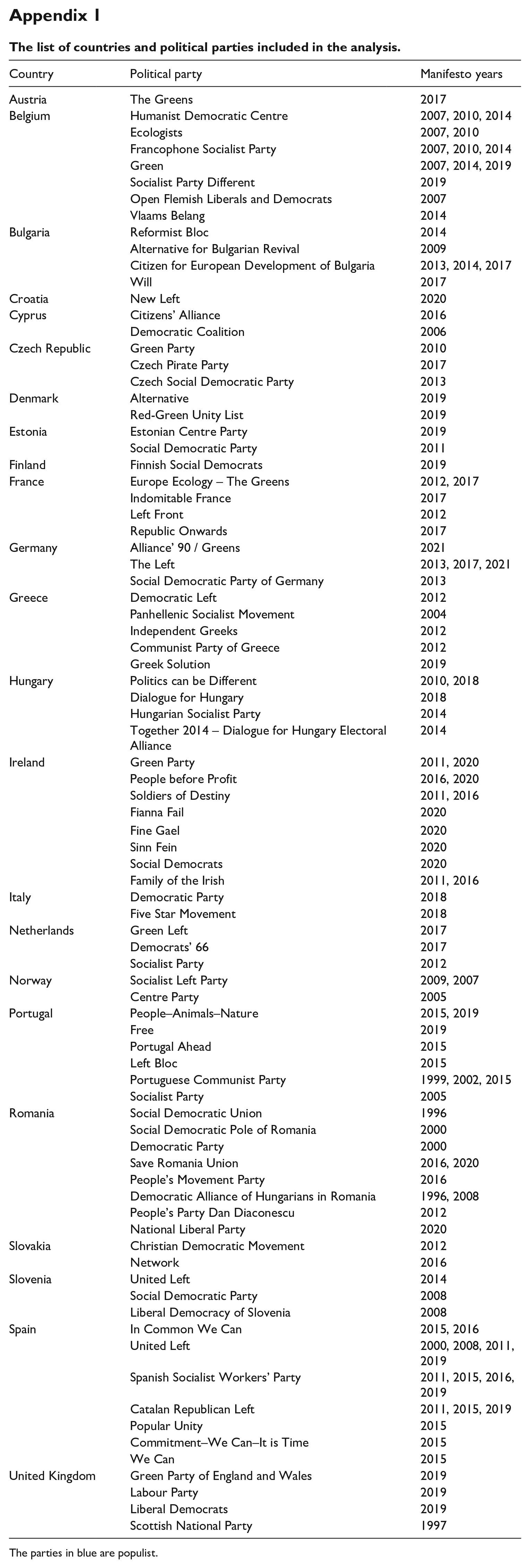
To test these hypotheses, we use the content of party manifestos in 22 Member States of the European Union (EU) to which we added Norway and the United Kingdom between 1996 and 2021. Our initial universe of cases were the countries in the European Economic Area, but we excluded those who do not have populist parties or where any party made references to deliberative democracy. As such, we excluded the following countries from the analysis: Iceland, Latvia, Lithuania, Luxembourg, Malta, Poland, Sweden, and Switzerland. The starting point in each country differs because our point of reference is the moment when deliberative democracy started being covered by political parties in that country. For example, the starting point for Spain is 2000 because that is the first time when a political party mentioned deliberation in its manifesto, while for France the starting year is 2012. We covered the election manifestos of all parties represented in the national parliaments and used the database of the Comparative Manifesto Project (a complete list of the countries and parties covered is available in Appendix 1).
To identify how parties speak about deliberative democracy, we conducted a qualitative content analysis using a basic dictionary including five keywords in the national language of the manifesto: ‘deliberation’, ‘consultation’, ‘participatory’, ‘assembly’, ‘mini-public’, and ‘jury’. We have selected these keywords to be in line with the logic behind deliberation, its key mechanisms, and previous endeavours in the same direction (Bächtiger et al., 2018; Fishkin, 2011; Gronlund et al., 2014; Pascolo, 2020). The use of broader terms allowed for an inclusive approach, but we used this approach to avoid conceptual stretching. More precisely, when searching for general terms like ‘consultation’, we selected those statements that referred explicitly to elements of deliberation or participatory democracy with deliberative components. We included in the analysis only those manifestos that referred to deliberation in one of the forms captured by the keywords listed above. To make sure that this dictionary does not limit the search or omits references to deliberative democracy that could use different phrasing, we did a thorough reading of the manifestos of all parliamentary parties in 10 elections selected randomly in countries that vary according to the number of references to deliberation (low, moderate, and high). We relied on the help of party politics scholars who were native speakers of the languages in which the manifestos were written. This detailed search did not provide supplementary references to deliberative democracy.
The excerpts from the manifestos were coded using the procedures of deductive thematic analysis (Kiger and Varpio, 2020) in which the themes correspond to elements included in the hypotheses: form of deliberation and polity level at which deliberation takes place. The sentence was the unit of analysis and sentences were grouped into these themes according to their meaning. For example, the sentences in manifestos were coded into three categories relative to the references they made about deliberation: (1) general statements such as ‘We support diverse political civic activities and public opinion polls, referendums, participatory web, deliberative voting, planning workshops and inclusive budgeting’ (Estonian Centre Party, 2011); (2) statements about citizens’ consultation such as ‘Ensure that there is full public consultation on, and enquiry into, the environmental impact of major projects and government policies’ (Scottish National Party (SNP), 1997); and (3) statements about specific forms of deliberation such as mini-publics or participatory budgeting. For example,
Hold a Citizens Assembly on a directly-elected executive mayor of a new regional authority for Dublin, followed by a plebiscite within the four Dublin local authorities, so that the new executive Mayor of Dublin can be in place immediately after the 2024 local elections. (Green Party in Ireland, 2020)
Several manifestos were complex and included references to deliberation that fall into each of these categories; they were added up and we created new categories, see the analysis section. We also coded the manifestos with respect to the policy level at which the deliberation was intended: (1) general, (2) local level, or (3) national level
The authors of this study coded the content of the manifestos. In those countries where the authors were not masters of the national language in which the manifestos were written, the coding was done in collaboration with national experts – both early career and established scholars – from the country by combining the excerpts in the original language and their translation into English. We used double-blind coding for many countries, with more than two coders per country. The percentage of agreement was higher than 90% in all countries and all the cases of disagreement were discussed by the authors to decide on the appropriate coding. The study covers only those manifestos that make references to deliberative democracy. In total, our analysis covers 120 party manifestos out of which 17 belong to 15 populist parties and 103 belong to 69 non-populist parties. We extracted in total 221 sentences about deliberative democracy from all these manifestos. The list of populist parties is taken from the PopuList project (Rooduijn et al., 2019), which was adjusted based on the arguments provided by earlier research (Gherghina and Pilet, 2021). For example, we considered SNP as populist and the Citizens for European Development of Bulgaria as non-populist although the PopuList project has the opposite assessment: the former as non-populist and the latter as populist. All but one manifesto referred to deliberative democracy external to the party; the only exception was the manifesto of the Democratic Party in 2018 that refers to deliberative democracy used for internal procedures, that is, a party merger. All references to deliberation were either positive or neutral, no political party covered in this analysis made any statement against deliberative democracy.
Analysis and results
We start with an overview about references to deliberation at national level, which informs about its popularity among parties per country and provides evidence to test H1. Figure 1 summarises the frequency of sentences about deliberation in each country for both populist and non-populist parties. In total, there are 221 statements about deliberative democracy, but more than one-third of these come from two countries (Belgium and Spain). In many countries, the discourse about deliberation is limited. This observation is valid across (1) established (Denmark or Norway) or newer democracies (e.g. Czechia or Slovakia), (2) countries with few populists in parliament (Cyprus or Germany) and in countries with frequent or high presence of populists in government (Austria, Greece, or Italy), and (3) countries with experience in deliberative practices such as France or the Netherlands and countries with very limited experience such as Croatia or Estonia. Several countries have political parties showing much interest in deliberative democracy. This group is as heterogeneous as the group with very few references to deliberation in terms of experience with democracy or regular presence of populists in government. For example, countries like Hungary or Spain in which populist parties gained momentum in the last decade are among the countries with the highest number of references to deliberative democracy next to Portugal – with isolated instances of populists in Parliament – or Romania in which populists were in government only in mid-1990s and had limited presence in Parliament in the last four elections.
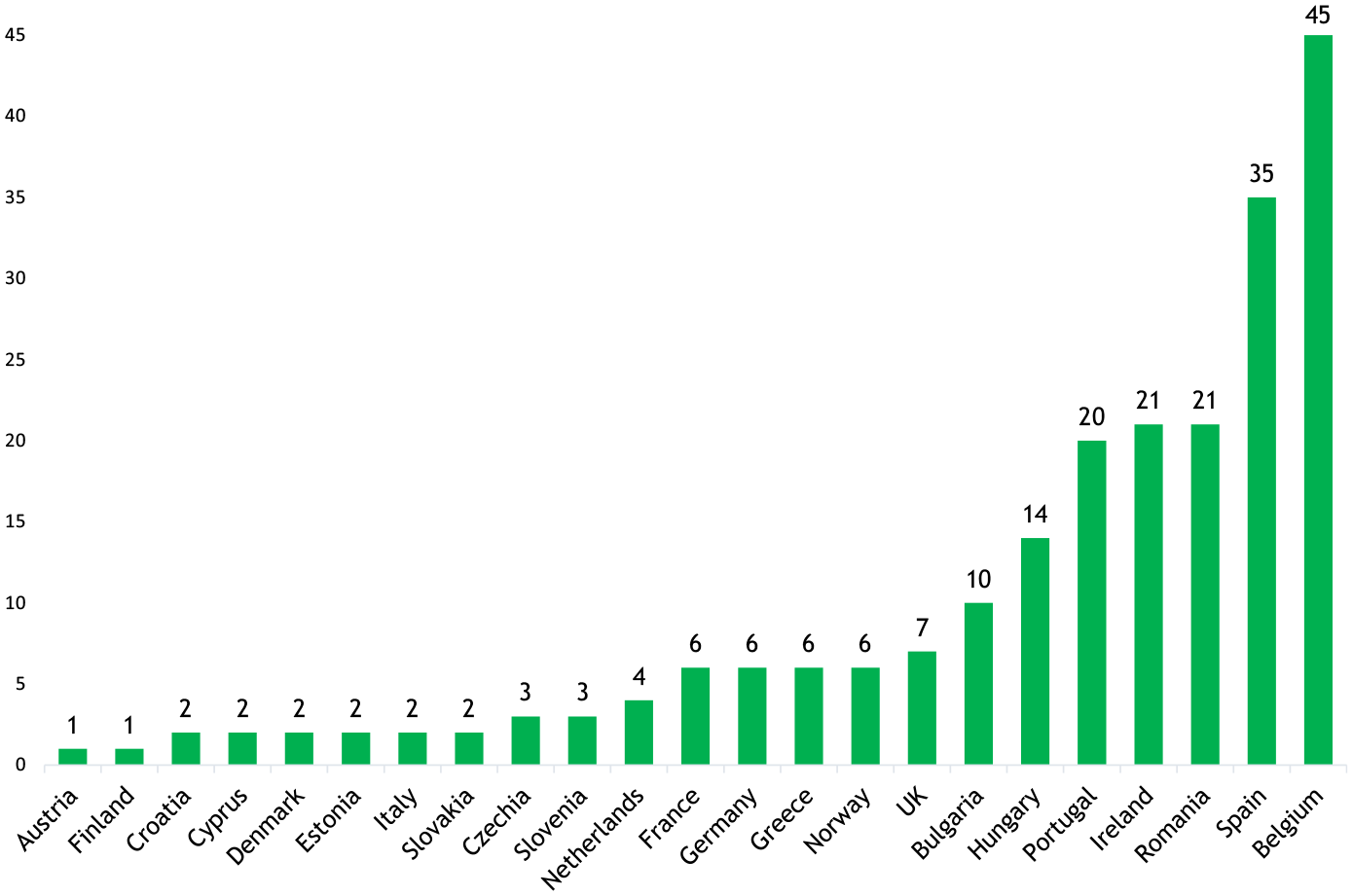
The number of references to deliberative democracy per country (N = 23).
The number of sentences about deliberation in the manifestos belonging to the populist parties indicate that non-populists talk more about deliberation. At the aggregate level, there are 28 sentences belonging to populists out of the total of 221 analysed in the article. This indicates that roughly 1 in 10 sentences about deliberation belongs to populists. On average, in the analysed countries, one in five political parties is populist, which reflects their lower discursive appetite for deliberation compared to non-populists. Figure 2 depicts the percentage of sentences about deliberative democracy included in the populist manifestos out of the total sentences in all manifestos in one country. For example, if Slovenia has three statements (see Figure 1) and one of them belongs to a populist party, then the percentage is 33.33.
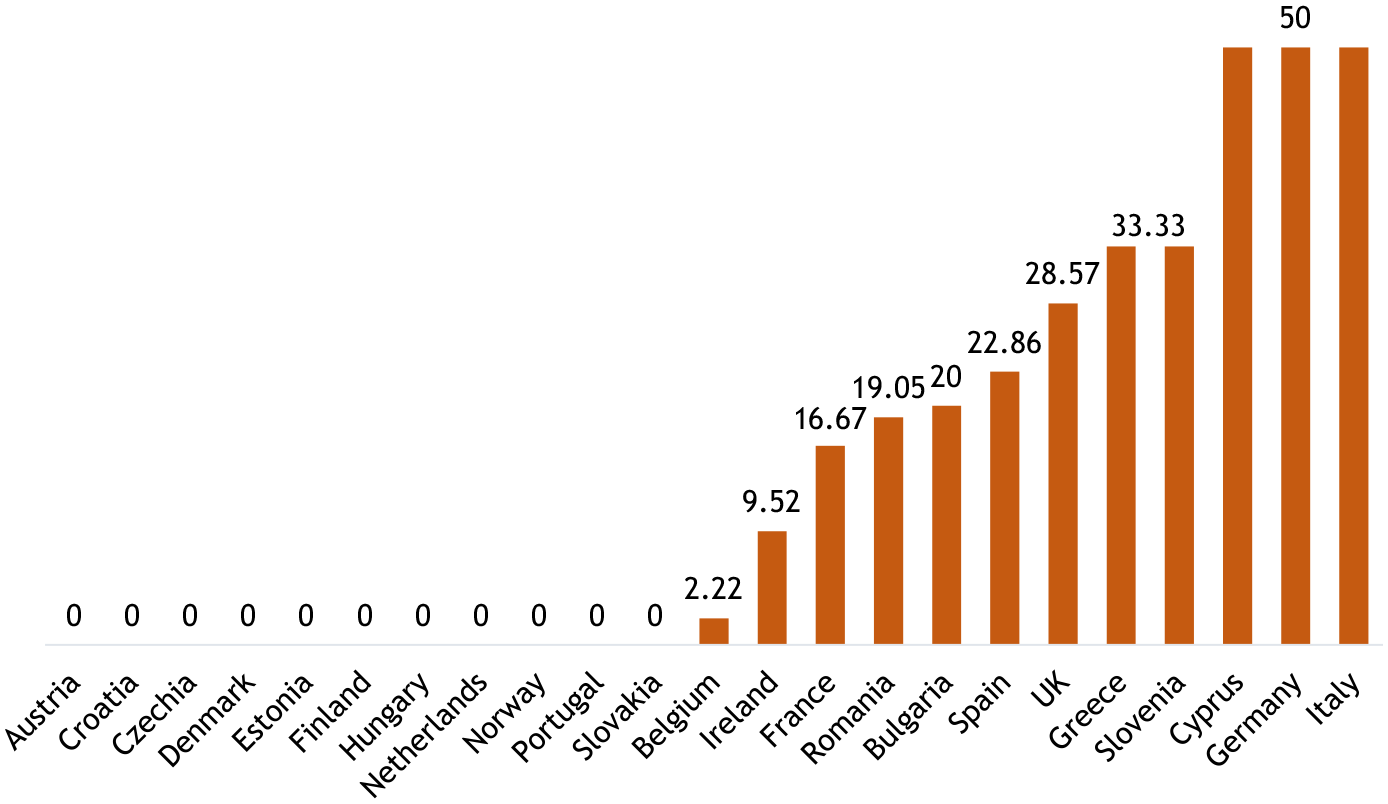
The percentage of sentences about deliberation for populists per country.
This distribution allows making two main observations. First, populists’ messages about deliberative democracy are limited across the board, but they are more visible in those countries that show little interest in deliberation overall. For example, in Germany and Italy, half of the references to deliberation are made by populists, but these are calculated out of a total of six sentences in Germany and two sentences in Italy. The countries in which political parties show great interest in deliberation have considerably lower percentages of populists talking about it. For example, Belgium is the uncontested leader in terms of references to deliberative democracy and roughly 2% of those references are made by populists. In Ireland, another country with many references to deliberation, only 10% of those are made by populists. Second, the populists are completely absent from the electoral discourse about deliberative democracy in approximately half of the analysed countries. None of the references made in the party manifestos to deliberative democracy belongs to populists. Some of these countries, such as Hungary or Portugal, have among the highest number of references to deliberation among the countries covered by this study.
This idea is strengthened by Figure 3 that depicts the difference between the share of populist references to deliberation and share of populists in country parliaments. This difference provides a comparable view across the countries by providing a standardised measure. This measure has two components: the percentage of populist references to deliberative democracy from the total of references in that country (see Figure 2) and the percentage of populist parties in parliament. For example, if there are five parliamentary parties out of which one is populist, the percentage is 20%. We calculate the percentage for every parliamentary term in which there are manifestos with references to deliberative democracy. The country percentage is the average between these percentages. For example, if the percentages are 20% for the elections in 2000, 30% for the elections in 2004, and 22% for the elections in 2008, the country percentage is 24%. We subtract the country percentage of populists in parliament from the percentage of populist references to deliberative democracy to identify if the populists refer to deliberative democracy proportional to their presence in the parliamentary system.
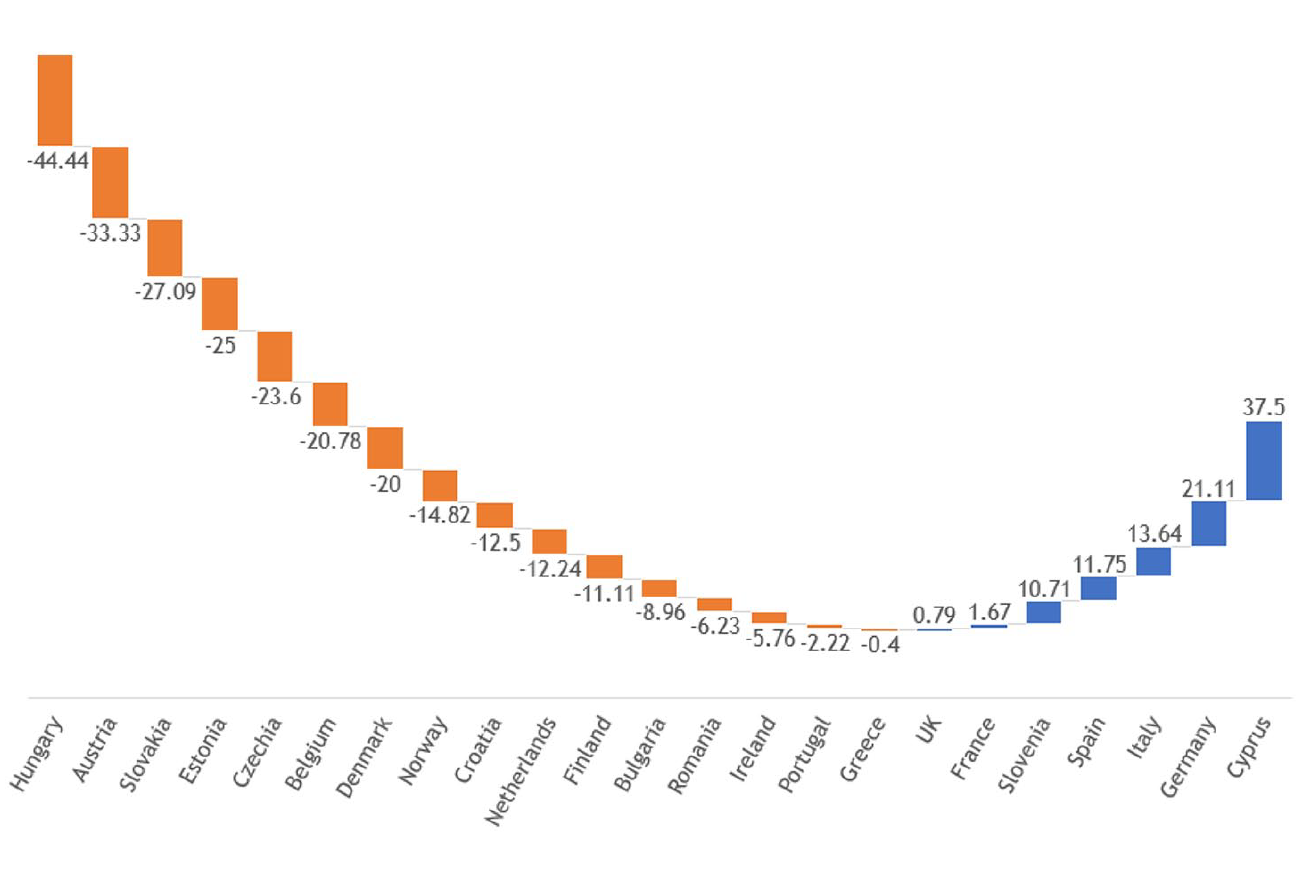
Populist references to deliberation versus share of populists in country parliaments.
The distribution in Figure 3 illustrates that in most countries analysed here, the populists talk considerably less about deliberative democracy compared to non-populist parties. This happens not only in countries like Belgium, Denmark, or Netherlands where the presence of populists in parliament is continuous and high in the last two decades, but also in countries like Austria, Hungary, or Finland where populists have been in government several times. In four countries (Portugal, Greece, United Kingdom, and France), the populists have a proportional discourse with their presence in parliament, which means that they refer to deliberation to the same extent as non-populists. In a handful of countries, the populists talk more about deliberative democracy than non-populists, but in four countries (Cyprus, Germany, Italy, and Slovenia) there are very few references to deliberation overall (see Figure 1). Spain is the only country in this group in which deliberative democracy receives high attention from political parties. All these provide empirical support to H1 according to which populist parties talk less about deliberative democracy compared to non-populist parties.
Figure 4 presents a comparison between the forms of deliberation addressed by populist and non-populist parties in their manifestos. This distribution, which is expressed in percentages calculated out of the total references to deliberation for each party, provides limited empirical support to H2. The percentages in Figure 4 are calculated out of the total of references to deliberative democracy provided by each category of political parties. Almost half of the total references made by both populist and non-populist parties to deliberative democracy are general. Both types of political parties reflect in their party manifestos the idea of deliberation as a means to improve the country’s representative democracy or to shift from a representative democracy to more participatory practices. However, the content of their general rhetoric has several nuanced differences. On one hand, many populist parties place the citizens at the core. For example, the manifesto of the Citizens’ Alliance (2016) in Cyprus reads as follows: ‘the continuous upgrading of the role of citizens, the vision of participatory democracy will be realized’. Most of the populist parties included in the analysis refer to deliberation in a descriptive way, their arguments revolving around the idea that these instruments are a necessity and calling for greater citizen involvement. Sometimes, they mixed this description with specific domains in which they could be used. For example, In Common We Can (2015) in Spain argues that ‘A basic, fairer, more egalitarian, supportive, clean, participatory democracy that permeates all areas of our society, especially all those that have to do with the common good’. Sinn Fein (2020) in Ireland explains that it ‘supports the recommendation of the Citizens’ Assembly to increase bus lanes, cycling lanes and park and ride facilities and that much greater priority should be given to these modes over private car use’.
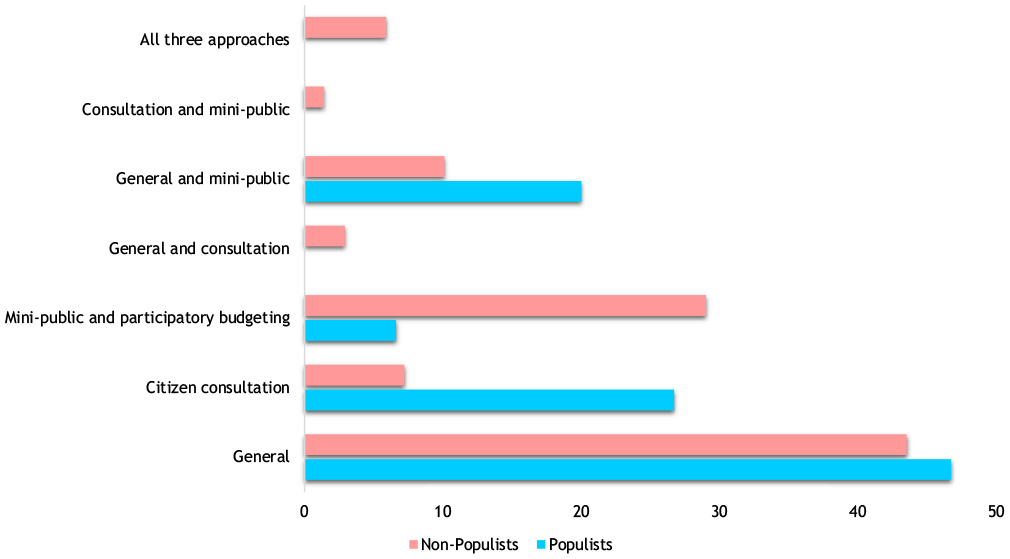
The forms of deliberation discussed by political parties (percentages, N = 221).
On the other hand, many non-populists focused on institutions and how deliberation can create change or improve the quality of democracy. For example, the Ecologists in Belgium (2007) explain in their manifesto: ‘Opening up the deliberative process to citizens and creating a culture of participation calls for the continuous irrigation of the political system through multiple channels, which can be, depending on the case, punctual or recurrent, far-reaching or less ambitious’. Non-populists speak about a link between deliberation and quality of democracy, mentioning that these two are connected and can help switch from a representative democracy to a more participatory one: ‘a renewed vision of participatory democracy, which it sees as a natural extension of representative institutions and intermediary bodies such as political parties, social partners, and associations; an extension that must therefore be organised in phase with these institutions and places of democratic mediation. (Francophone Socialist Party, Belgium, 2007).
The use of deliberation for citizen consultation is very popular among the populists, but rarely used by non-populist political parties. Most parties in this category refer to stronger connections between institutions, political parties, and citizens in order to formulate policies that fit the population. In this sense, there is no major content difference between the two types of parties. For example, one populist party in Belgium argues that deliberation could ‘Transform the Flemish Community Commission into a consultative body’ (Vlaams Belang, 2014), while a non-populist party in Ireland has a similar claim but in more detail
In the event that the initial referendum on establishing a citizens assembly was rejected, the Green Party in Government would then act to bring forward individual proposals for constitutional change to address public concern about specific aspects of the Constitution within 12 months. (Green Party, 2011)
The two types of parties also differ in the extent to which they refer to mini-publics such as citizen assemblies, citizen juries, or students’ parliaments, and to participatory budgeting. There are four populist parties that included a form of mini-public in their manifestos: The Left in Germany, Sinn Fein in Ireland, and the two Spanish parties In Common We Can and We Can. The mini-publics are considerably more popular among the non-populist parties that often refer to them as avenues to increase the citizens’ involvement in the decision-making process and the levels at which these should be implemented. For example, the Austrian Greens (2017) explain that ‘Upgrading and legal anchoring of student parliaments: The concerns of young people must be given greater consideration and the development of participatory instruments must be expanded’. Similarly, the Labour Party (2019) in the United Kingdom explicitly states in its manifesto ‘The renewal of our Parliament will be subject to recommendations made by a UK-wide Constitutional Convention, led by a citizens’ assembly’. In general, populists have simpler statements about the forms of deliberation, which is reflected in Figure 4 in the percentages of statements that combine one of the three approaches. One-fifth of the non-populists mix the general approach towards deliberation with specific references about mini-publics, but the populist parties do not use any other combination. Only non-populists use references to deliberation in the form of both consultations and mini-publics in the same manifestos or they mix all the three approaches.
Moving on to H3, we test the existence of differences between the references about the level of implementation for deliberative democracy. Figure 5 provides the distribution of statements about levels of deliberation, calculated as percentages from the total number of references of each type of parties. The evidence indicates that populists talk in more general terms about deliberation rather than focusing on the level at which this can take place. We start with the first category in which the parties do not mention any level, and for this reason we consider these as vague statements. For example, the populist Independent Greeks (2012) have a sentence in their manifesto in which they want the political process ‘will then be shaped by open processes of participatory democracy and dialogue’. Another example from the populists comes from In Common We Can (2016). In Spain, that refers to the use of ‘tools such as DemocracyOS (deliberative democracy) to involve citizens in debates, voting or the presentation of parliamentary initiatives’. The non-populist Politics Can Be Different (2014) in Hungary speaks similarly about a support ‘for the development of institutions of social participation and participatory democracy in public interest decisions’. Overall, the populist parties make considerably more vague statements about the level of deliberative implementation compared to non-populists. Two-thirds of the populists are characterised by such statements in comparison to roughly 40% of the non-populists.
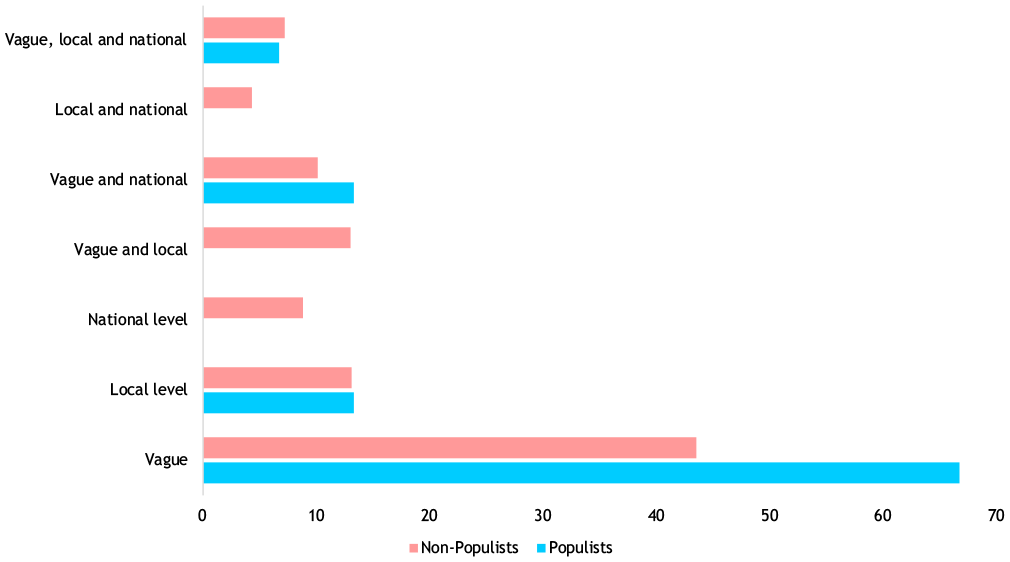
The references about the levels of deliberation (percentages, N = 221).
Populists and non-populists refer to a similar – and limited – extent to the use of deliberation exclusively at the local level. For example, the Greek Solution (2019) argues that ‘Elected local self-government bodies will be publicly accountable before an assembly of citizens and will automatically be removed from office in the event of a criminal conviction for the offenses provided for in the relevant accountability law’. Among the non-populists, a similar approach was used by the Republic Onwards (2017) in France ‘We will encourage local authorities to develop participatory budgets, i.e., to consult citizens directly on the use of public money’ and the Czech Pirate Party (2017): ‘We will support the sharing of good practice and the exchange of experience, for example the participatory budgeting projects introduced by our representatives in Brno’. Overall, non-populists refer more to the implementation of deliberative democracy at local level and they also combine references to these with vague statements. For example, the Catalan Republican Left (2011) refers both to the idea of higher participatory role for people within municipalities and to a broader necessity to empower citizens and engage them in the decision-making process through consultations without specifying at which level.
There is no populist party outlining the implementation of deliberative democracy exclusively at national level, but some of them refer to this among other vague statements. For example, Sinn Fein (2020) in Ireland proposes a clear form of mini-public and mention their goal they want to achieve and the national level: ‘Establish an all-island representative Citizens’ Assembly or appropriate forum to discuss and plan for Irish Unity’. In the same manifesto, the party refers to its support for the recommendations of the Citizens’ Assembly. The only populist party that combines all three levels (vague, local, and national) is The Left (2013) in Germany, which focuses on the involvement of citizens in decision-making especially at municipal level, also giving some examples of procedures (planning cells or participatory councils) that could increase the number of citizens in the process of decision-making. The party gives specific examples of policies in which the deliberation can happen: ‘people should also be able to participate and have a say directly in matters of finance, economics, the development of cultural life and education, and the shaping of administration’.
Non-populist parties pay more attention to the level of deliberation in their rhetoric, but also to specific policies that could be influenced through deliberation. The specificity of their discourse contrasts with the vagueness often encountered among the populists. For example, Family of the Irish (2016) speaks about ‘New Mortgage Rules: We support the Central Bank review of the new rules, including a public consultation, to assess their impact and to propose recommendations on foot of its findings’.
We run a t-test to confirm these observations regarding the theoretical expectations. The results in Table 1 indicate empirical support for H1 and H3: there is a statistically significant difference between the two groups of parties with respect to the number of statements about deliberation and about the level of implementation for deliberation. In line with the theoretical expectation, non-populists make more references to deliberation and are more specific about the level of implementation. Populist parties are more schematic about deliberation and maintain a vague rhetoric about these practices. The difference between the two groups of parties regarding the statements about the forms of deliberation is not statistically significant. As illustrated before, the populists place more emphasis on the deliberation as citizen consultation, while non-populists refer more to mini-publics and participatory budgeting as forms of deliberation. Also, the non-populists combine the discourses about several forms of deliberation more than populists. In spite of these nuanced differences, both types of political actors speak similarly in general terms about deliberation, with little focus on the forms.
T-tests for the differences between populist and non-populist parties.
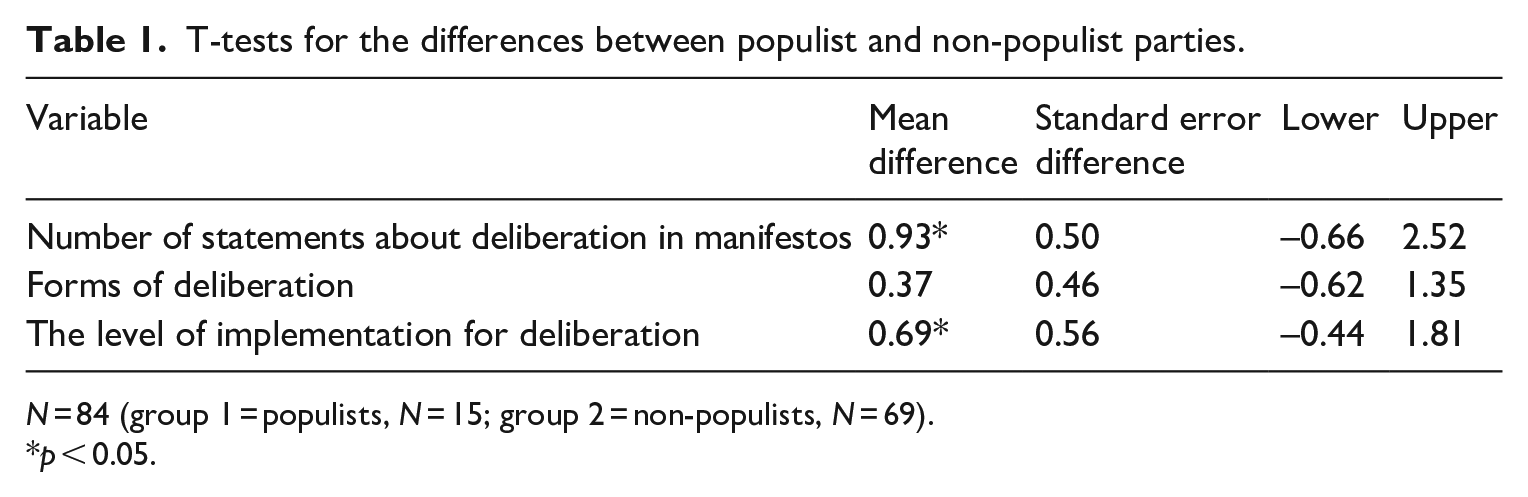
N = 84 (group 1 = populists, N = 15; group 2 = non-populists, N = 69).
p < 0.05.
Conclusion
This article aimed to identify the ways in which European populist parties talk about deliberative democracy in their manifestos for national legislative elections. Our main findings indicate that populists talk considerably less than non-populists about deliberative democracy. In half of the analysed countries, no populist party addresses the topic of deliberation although this is on the political agenda of non-populist competitors. This observation holds true across established democracies, new democracies, and countries characterised by democratic backsliding, which means that the relationship between populism and deliberation is not driven by the existing problems of representative democracy. We also find that populists use more ambiguous language than non-populists about the levels of implementation, with isolated references to the local level. Since most deliberative practices take place at the local level, despite a surge in national-level practices in the last decade, it means that the deliberative logic and functioning remain somewhat unfamiliar to populists. These results show how far the populists are from the deliberative system perspective (Parkinson and Mansbridge, 2012) in which effects occur in the political system at large rather than in its components, and the limited attention paid to preferences generated by rational discussions and meaningful consideration of reasons.
In addition to the general references that characterise most of their discourse about deliberation, the populists place emphasis on citizens’ consultation as a specific form of deliberation. While this perspective contradicts the role that populists often assign to people as passive receivers of their messages, it is also quite far from the basic deliberative principles of democratic self-determination and self-government (Lafont, 2020). The consultation is limited to reactions and the expression of opinions without providing citizens control or pluralist interest representation in the decision-making process. While non-populists talk more than the populists about deliberative mini-publics and participatory budgeting that enhance the participatory governance, the share of references is much lower than their general statements about deliberation. Such an approach illustrates limited interest in the open, inclusive, well-considered, and rational process of will formation and decision-making in specific forms of deliberation.
These findings open the door to further enquiries that can move beyond the exploratory character of this study. One potential avenue for research could expand the sources of data to parliamentary speeches or party press releases that include references to deliberative democracy. The low number of references to deliberation in manifestos did not allow a comparison per election in a country, which could be possible by including more sources of party generated documents. A future analysis could also compare how parties refer to deliberation in an elaborate document such as the manifesto versus references to deliberation in daily documents such as press releases or public speeches. Building on our results, further studies could also seek to explain the variation in the number of references to deliberative democracy. Since our focus was the comparison between populists and non-populists, we could not reflect on the importance of incumbency or opposition in addressing deliberative democracy since the vast majority of populists were in opposition. An explanatory approach could include several institutional variables to examine the major differences in addressing deliberative democracy, its forms and levels of implementation.
Footnotes
Appendix
The list of countries and political parties included in the analysis.
| Country | Political party | Manifesto years |
|---|---|---|
| Austria | The Greens | 2017 |
| Belgium | Humanist Democratic Centre | 2007, 2010, 2014 |
| Ecologists | 2007, 2010 | |
| Francophone Socialist Party | 2007, 2010, 2014 | |
| Green | 2007, 2014, 2019 | |
| Socialist Party Different | 2019 | |
| Open Flemish Liberals and Democrats | 2007 | |
| Vlaams Belang | 2014 | |
| Bulgaria | Reformist Bloc | 2014 |
| Alternative for Bulgarian Revival | 2009 | |
| Citizen for European Development of Bulgaria | 2013, 2014, 2017 | |
| Will | 2017 | |
| Croatia | New Left | 2020 |
| Cyprus | Citizens’ Alliance | 2016 |
| Democratic Coalition | 2006 | |
| Czech Republic | Green Party | 2010 |
| Czech Pirate Party | 2017 | |
| Czech Social Democratic Party | 2013 | |
| Denmark | Alternative | 2019 |
| Red-Green Unity List | 2019 | |
| Estonia | Estonian Centre Party | 2019 |
| Social Democratic Party | 2011 | |
| Finland | Finnish Social Democrats | 2019 |
| France | Europe Ecology – The Greens | 2012, 2017 |
| Indomitable France | 2017 | |
| Left Front | 2012 | |
| Republic Onwards | 2017 | |
| Germany | Alliance’ 90 / Greens | 2021 |
| The Left | 2013, 2017, 2021 | |
| Social Democratic Party of Germany | 2013 | |
| Greece | Democratic Left | 2012 |
| Panhellenic Socialist Movement | 2004 | |
| Independent Greeks | 2012 | |
| Communist Party of Greece | 2012 | |
| Greek Solution | 2019 | |
| Hungary | Politics can be Different | 2010, 2018 |
| Dialogue for Hungary | 2018 | |
| Hungarian Socialist Party | 2014 | |
| Together 2014 – Dialogue for Hungary Electoral Alliance | 2014 | |
| Ireland | Green Party | 2011, 2020 |
| People before Profit | 2016, 2020 | |
| Soldiers of Destiny | 2011, 2016 | |
| Fianna Fail | 2020 | |
| Fine Gael | 2020 | |
| Sinn Fein | 2020 | |
| Social Democrats | 2020 | |
| Family of the Irish | 2011, 2016 | |
| Italy | Democratic Party | 2018 |
| Five Star Movement | 2018 | |
| Netherlands | Green Left | 2017 |
| Democrats’ 66 | 2017 | |
| Socialist Party | 2012 | |
| Norway | Socialist Left Party | 2009, 2007 |
| Centre Party | 2005 | |
| Portugal | People–Animals–Nature | 2015, 2019 |
| Free | 2019 | |
| Portugal Ahead | 2015 | |
| Left Bloc | 2015 | |
| Portuguese Communist Party | 1999, 2002, 2015 | |
| Socialist Party | 2005 | |
| Romania | Social Democratic Union | 1996 |
| Social Democratic Pole of Romania | 2000 | |
| Democratic Party | 2000 | |
| Save Romania Union | 2016, 2020 | |
| People’s Movement Party | 2016 | |
| Democratic Alliance of Hungarians in Romania | 1996, 2008 | |
| People’s Party Dan Diaconescu | 2012 | |
| National Liberal Party | 2020 | |
| Slovakia | Christian Democratic Movement | 2012 |
| Network | 2016 | |
| Slovenia | United Left | 2014 |
| Social Democratic Party | 2008 | |
| Liberal Democracy of Slovenia | 2008 | |
| Spain | In Common We Can | 2015, 2016 |
| United Left | 2000, 2008, 2011, 2019 | |
| Spanish Socialist Workers’ Party | 2011, 2015, 2016, 2019 | |
| Catalan Republican Left | 2011, 2015, 2019 | |
| Popular Unity | 2015 | |
| Commitment–We Can–It is Time | 2015 | |
| We Can | 2015 | |
| United Kingdom | Green Party of England and Wales | 2019 |
| Labour Party | 2019 | |
| Liberal Democrats | 2019 | |
| Scottish National Party | 1997 |
The parties in blue are populist.
Funding
The author(s) received no financial support for the research, authorship, and/or publication of this article.
