




Abstract
Integrating insights from party politics, social movement and political communication literatures, with a qualitative discussion of hybrid party behaviours observable in different contexts and regions, the article offers an original typology of four models of partisan mobilisation and focuses on a novel possibility, the activist party. Referring to parties that combine a professionalised organisation with the deployment of movement-like tactics to achieve electoral goals, the article points to current resources reducing the organisational trade-offs previously assumed to restrict the combination of electoral appeal with partisan militancy. Through this argument, the article challenges the thesis that under democratic conditions political parties should be expected to abandon outsider strategies for insider ones, while providing an analytical account of emerging patterns of organisational innovation and partisan behaviour being witnessed in contemporary party politics.
Introduction
Though claims that the mediating function of political parties is being eroded are not new, concerns have accentuated in the last years given the success of populist parties and candidates from beyond the establishment, and a discernible tendency for partisan campaigns to be framed in movement-like terms: as representing excluded sectors of the population or as alternatives to conventional political ideologies and elites. These tendencies are noticeable in a variety of contexts: from outsider figures reaching power in the United States, Brazil and Ukraine, to the success of populist, radical and new movement parties across Europe, to effective conservative party-civil society alliances in South America. These developments have stimulated not only a new round of debate about the decay of liberal democracy, the rise of populism and the dangers of protest politics, but growing arguments pointing to the ‘hybridisation’ of party behaviours, combining electoral appeal with extra-institutional mobilisation (Gerbaudo, 2019; Krastev, 2016; Kriesi, 2014; Mudde, 2016). 1
These hybrid behaviours challenge conventional expectations in political science that as democratic systems consolidate, political parties should abandon outsider tactics for insider ones, switching from non-institutional repertoires seeking to gain public visibility and legitimacy to more formal structures to access institutionalised opportunities and gain the attention of elites (Pettinicchio, 2012). Historically, this expectation resulted from the evolution of political participation in liberal ‘movement societies’, with parties moving away from the street and settling within the electoral arena, and social movements becoming the preferred organisational vehicle for contentious claim-making (Hutter et al., 2019; Meyer and Tarrow, 1998; Tilly, 2004). At the same time, this supported a view where hybrid party formations, such as movement parties, were considered transient and unstable forms emerging due to a crisis of representation or ‘linkage failure’, bound to disappear though processes of democratic learning, oligarchisation and incorporation (Kitschelt, 2006; Lawson, 1988). 2
In recent years, however, a growing body of work has challenged the validity of this thesis, claiming that parties are returning to the contentious arena and/or increasingly acting as social movement actors, prompting that movement-like behaviours are no longer exclusive to new, weak or outsider parties. Anria (2019: 12), for example, highlighted the case of the Bolivian MAS, ‘an organizational “anomaly” in comparative politics’, to argue that movement-based parties can retain movement-like qualities, such as grassroots input, even after prolonged periods in government. In Europe, Pirro and Castelli Gattinara (2018) and Della Porta et al. (2017) explored the electoral success of new hybrid anti-establishment parties, be this on the left (SYRIZA, Podemos), centre (Movimento 5 Stelle – M5S) or far-right (Jobbik), while examining Green and Pirate parties in Germany and Sweden, Blings (2018) observed that niche parties can electorally benefit from maintaining programmatic alignment with their social movement roots. In the United States, Heaney and Rojas (2015) argued that the peace movement effectively acted as the (Democratic) ‘party in the street’ during Obama’s campaign, while Paul Almeida (2010: 177) used the term ‘social movement partyism’ to describe Latin American parties that coalesced with social movement causes and use social movement strategies to establish ‘a constituency on issues with widespread opinion support that eventuates in greater electoral power’.
This article seeks to conceptually integrate and nuance these analyses under a novel typological framework that considers organisational modalities of partisan mobilisation. While party typologies are abundant in the literature, and can result in conceptual over-proliferation and stretching, they are useful when they offer heuristically effective categories to comprehend complex notions and serve as ‘baselines for comparison involving real-life cases’ (Gunther and Diamond, 2003: 171). The proposed typology aims to do so by considering the resources political parties can use to engage in conventional electoral mobilisation or in non-conventional contentious action. By focusing on this resources and repertoires in a combined manner, this typology clarifies different instances of hybrid partisan behaviour often discussed under overlapping and often loaded designations – that is, new politics parties, challenger parties, movement parties, populist parties, anti-establishment parties and so on (Barr, 2009; McDonnell and Newell, 2011; Taggart, 1995; Zulianello, 2019).
To make this argument, the first part of the article presents the puzzle of parties returning to the contentious arena and adopting movement-like repertoires. It does so by reviewing the historical process through which parties moved away from the street and acquired resources beyond civil society, and resulting expectations in the party literature regarding how established parties should behave and the limitations of hybrid behaviours. These expectations, it is claimed, support the divide between the field of party politics, concerned with ‘routine’ politics and electoral mobilisation, and social movement studies, dealing with contentious activism and protest politics. Instead, this article views party and movement politics as co-evolving and overlapping fields of action susceptible of study on the basis of shared hypotheses and models (Hutter, 2014; McAdam and Tarrow, 2013; Peña and Davies, 2017; Ramiro and Morales, 2014). Accordingly, in the second part, I draw insight from the social movement and political communication literatures to develop a new typological framework that brings attention to an organisational possibility not adequately captured by mainstream categories, ‘the activist party’: a party that relies on professional resources to act as a social movement actor but without mobilising a militant base. In the last section, a brief proof-of-concept illustration is provided in relation to the Brexit Party, prior to discussing analytical expectations and further areas for inquiry.
Methodologically, the article follows a Weberian model of typological theorisation, combining theoretical argumentation through the analysis of established concepts and models in different sets of academic literatures, with inferences from empirical evidence about party behaviours drawn from different countries and contexts.
Away From the Street: From Militants to Voters
Prior to outlining the proposed typology, it is necessary to understand why conventional party classifications provide an incomplete view of the repertoires of partisan mobilisation and tend to obscure parties’ potential to act as social movement organisations (SMOs).
In general terms, the distancing of political parties from the protest arena is explained on the basis of two processes that shaped Western democracies since the 1950s, de-encadrement and electorisation, which saw party organisations mutate into more autonomous bureaucracies concerned with maximising electoral appeal (Duverger, 1954; Panebianco, 1995 [1982]). As put by Katz and Mair (1993: 603), the mass party of integration, the typical form assumed by large European parties during the first half of the 20th century, was predicated on a logic that was ‘less about differential rates of conversion than [. . .] about differential rates of mobilization’ of the disenfranchised segments of society, compensating with membership what it lacked in patronage and elite access. The widening of political participation and the erosion of traditional social boundaries in the post-war period resulted in the gradual de-encadrement of citizens from bounded social and cultural segments, and from associated partisan ‘niches’ rooted on class or religion (Koole, 1996: 512). According to the cartelisation hypothesis, adaptation to these changes resulted in a more autonomous ‘party in public office’ that sought to compensate the volatility of partisan identities in diversified political markets through state aid and inter-party collusion (Katz and Mair, 1995, 2009). Though this hypothesis has detractors, it is generally accepted that the turn towards the voter (and towards the state) involved the distancing of mass-based parties from sources of civil society support. This was partly a response to the loss of control by parties over the tools to attract, mobilise and ‘encapsulate’ supporters, such as clear party brands, patronage mechanisms, and material inducements, partly due to the emergence of media technologies enabling more direct messaging between party organisations and a dispersed and more plural electorate (Allern and Bale, 2012; Katz and Mair, 2012; Kitschelt, 2000a).
The rise of catch-all parties and the proliferation of other vote- and office-seeking party configurations entailed changes in how party elites understood the citizenry and in the internal organisation of party structures, as these moved to supplant the labour-intensive resources provided by the ‘party on the ground’ – the core of regular activists and loyal voters, irrespective of whether they are formal members (Katz and Mair, 1993: 597) – with professionalised bureaucracies and more detached forms of membership (Gauja, 2015; Hopkin and Paolucci, 1999; Van Biezen and Poguntke, 2014). This professionalisation of parties entailed the transformation of parties into electoral organisations: as party elites changed their mind about the benefits of contentious and extra-institutional action for gaining resources and attracting people to the voting booth, party organisations could take distance from their more ideological, less compromising and troublesome ‘activist layer’ (Carty, 2004: 17).
The de-mobilisation of this layer and the associated reduction of memberships weakened parties’ capacity to behave as SMOs. This relevant transformation affected both mass-based and catch-all parties as well as smaller niche ones seeking to become koalitionsfähig (acceptable for coalitions), given that, as pointed out by Wolinetz (2002: 153), office-seeking is a strategy unlikely to ‘attract or retain political activists whose primary concern is policy’. In Europe, the eighties and nineties saw this process extend to socialist and communist parties, with the radical left experiencing ‘a process of profound de-radicalisation, under the pressures of transforming from agents of a defunct international movement into viable national parties’ (Keith and March, 2016: 16). Simultaneously, pragmatic factions transformed younger movement parties (i.e. the German Greens) and single-issue radical parties into more popular electoral vehicles, expanding their agendas and moderating their positions and tactics in order to break out of their electoral niches (Kaelberer, 1998; Kitschelt and McGann, 1997) – even if some, like the Italian Lega Nord, managed to maintain a ‘one foot in one foot out’ approach (McDonnell and Newell, 2011: 447).
Shaped mainly by developments in Europe, the conventional view of party behaviours converged with the idea of routine insider politics: parties are professional organisations ‘without partisans’ specialised in maximising electoral appeal, offering broad ideological and programmatic agendas while diversifying relations with interest groups (Dalton and Wattenberg, 2000; Mair et al., 2004). This distancing from civil society and the activist layer has received repeated confirmation. Comparative studies indicate that party-society relations in Western parliamentary democracies have become organisationally shallower, more ad hoc and more diversified, with formal alliances and corporatist arrangements being replaced by (or co-existing with) less committed modes of interaction (Allern and Verge, 2017; Poguntke et al., 2016). However, a similar trajectory was observed in Latin America following the dealignment of partisan loyalties experienced with neoliberalisation during the nineties, which resulted in the fall of stable ‘partyocracies’ and machine parties in countries such as Colombia, Venezuela and Argentina, and the erosion of traditional patron-client networks (Lupu, 2014; Sanchez, 2008). 3
The conceptual implication of this evolution is that ‘protesting parties’ became anomalies in the party politics literature, associated with deficits of resources or deficits in the party system. In liberal democracies, (hybrid) movement and challenger parties were associated with ‘new politics’ agendas and/or with the tactics of radical parties (in Europe, usually right-wing) acting on the fringes of the political system (Ignazi, 1996; Kitschelt, 2006). In other regions, they were viewed as symptoms of immature democracy and late processes of political incorporation where important sectors were still learning ‘[. . .] democratic politics through repeated efforts of mobilization and electoral competition’ (Kitschelt et al., 2010: 8) – a thesis that received further support when post-Communist countries saw declining partisan contention during the nineties (Bernhagen and Marsh, 2007). 4 In either case, the conventional notion was that established parties do not need to protest, thus supporting a sceptical if not negative view of contentious partisan mobilisation still visible in contemporary analyses linking the rise of populist and movement-like parties with a crisis of democracy – in line with Peter Mair’s (2002: 89) dictum that ‘populist democracy primarily tends towards partyless democracy’.
While these expectations may have been overstretched, given the Euro-centrism of the party literature (Katz and Mair, 2009: 754) and its propensity to assume that ‘homogenizing trends are under way’ (Wolinetz, 2002: 147), a booming literature on the appeal of party populism and social movement-style politics notes the increasing electoral appeal of hybrid party repertoires (Della Porta et al., 2017; Kriesi, 2014; Mounk, 2014; Mudde, 2016; Pirro, 2019). This represents a dual analytical and empirical puzzle, because if in their shift from the activist to the voter most party organisations lost their organisational capacities (and interest) to ‘transform party supporters into activists or militantes’ (Roberts, 2014: 27), what are the resources and organisational logics supporting the current hybridisation of partisan strategies?
This puzzle is not trivial. A well-established finding in social movement theory is that contentious mobilisation requires specific resources and skills to appropriate collective grievances, broker with individuals and groups, and devise collective action frames and new identities among supporters and bystanders (Benford and Snow, 2000; McAdam et al., 2002). Accordingly, if party organisations geared at electoral politics were to pursue contentious tactics, they would be expected to face important challenges. Furthermore, not only (re)generating a militant layer is a laborious time-consuming task, but balancing electoral appeal and activism is problematic, given trade-offs that emerge from mixing strategies aimed at mobilising individual voters with those intending to stimulate more committed forms of engagement (Kitschelt, 2000b: 853–855). Studies of parties that successfully, even if temporally, managed to balance these demands, for example, by forming party-movement alliances, suggest that these are more likely when there is already a pre-existent layer of brokers and/or influential ‘dual-identity’ members, usually sustained by personalised loyalties arduous to build in the short-term (Almeida, 2010; Heaney and Rojas, 2015). Hence, in the Latin America left, where some resilient alliances can be found, these have been explained by the dual militancy of party leaders and core figures (e.g. Lula Da Silva and Evo Morales were established trade union leaders), or by the presence of encapsulating civil society networks, enabling the alignment of allegiances and the reproduction of loyalties (Roberts, 2002; Silva and Rossi, 2018). Schlozman’s (2015) historical analysis of party-movement alliances in the United States arrives to a similar conclusion, noting that the brokers behind party-movement alliances generally tap either into rooted partisan affinities (as with the Republicans and the Christian Right), or exploit connections between ‘old pals from earlier battles’ (as those linking Democrats with industrial workers, African Americans, women or the anti-war movement).
Parties lacking these hybrid brokers find barriers to create social movement links from above. For example, attempts by Forza Italia in the nineties to convert into a ‘party of activists’ ended in failure (Hopkin and Paolucci, 1999: 330), and so did the efforts of the British Labour Party to recreate an activist base through community-organising between 2011 and 2015, which exceeded the survival of its leadership (Chadwick and Stromer-Galley, 2016). As discussed in the next section, small niche parties may be better positioned to adopt movement-like repertoires, given the closer relationship between the identities of their supporters and core policy issues, with evidence indicating that European radical right and left parties can become particularly contentious when these core issues are threatened (Hutter, 2014). But electoral competition put pressure on the balancing of activist commitments with electoral goals. Many radical left parties in Southern Europe, for example, while pursuing strategies to reconnect with their natural collectivities, have struggled to preserve their links with social movements and trade unions when in government (as happened to the Cypriot AKEL) or if aspiring to join a ruling coalition (Tsakatika and Lisi, 2013). Della Porta et al. (2017: 76) point to SYRIZA as a niche party that experienced the re-mobilisation of its membership in the early 2000s, with young cadres becoming familiar with confrontational politics and participating in other social movements – although this was temporary, and the party virtually demobilised after gaining office in 2015.
Digital Technologies and Partisan Mobilisation
Nonetheless, findings in political sociology and communication studies indicate that these organisational limits and trade-offs may be reducing, due to changes in social preferences and the possibilities offered by new communication technologies. The personalisation of politics and the decline of the electoral channel that worried Peter Mair (2002), combined with the associative capabilities granted by digital media technologies, are viewed in this literature to be shaping new patterns of social mobilisation that minimise the role of traditional broker and intermediary actors (Bennett, 2012; Castells, 2015; Gerbaudo, 2019). The famous ‘connective action’ thesis by Bennett and Sagerberg (2013) precisely proposes that social media allows mediating organisations, including political parties, to step back ‘from projecting strong agendas, political brands, and collective identities in favor of using resources to deploy social technologies enabling loose public networks to form around personalized action themes’ (Bennett and Segerberg, 2012: 757).
Moreover, while early on digital technologies were envisioned as a tool contributing to invigorate grassroots politics, it is evident that political parties have rapidly adapted to this new environment, developing new organisational repertoires to diversify and deepen partisan engagement. 5 Thus, on one hand, digital technologies are being used to strengthen parties’ preferred organisational strategies: allowing electoral catch-all parties to better scrutinise electoral dynamics and individualise their segmentation strategies and campaigns (Kreiss, 2016), movement and niche parties to access alternative support groups (Barberà et al., 2018) and populists to be better populists, as mentioned ahead (Kriesi, 2014). On the other hand, these technologies facilitate organisational and tactical innovations for parties to reconnect with civil society, ‘hybridizing repertoires of party activism but [. . .] also promoting a hybridization of party activists, bringing together older and newer types of participants who may have different views of party engagement and different reasons for taking part in it’. (Vaccari and Valeriani, 2016: 305). On this basis, Susan Scarrow (2015: 32–34) claimed that the reduction of affiliation costs and the pluralisation of engagement modes facilitated by Internet technologies resulted in ‘multi-speed memberships’ formats, meaning parties can now offer an array of offline and online ways for supporters to engage and be active on their behalf, with differential expectations in terms of commitment and militancy. Other authors speak of the emergence of ‘techno-populist’ parties (Bickerton and Invernizzi Accetti, 2018), ‘technoparties’ (Deseriis, 2015) or ‘connective parties’ (Bennett et al., 2018), such as Podemos, the M5S and others, that combine technocratic, charismatic and movement-like conceptions of political representation, and that use digital platforms to complement core bureaucratic functions or support partisan activities beyond voting.
At the same time, there has been growing recognition of the synergy between digitally mediated models of mobilisation and protest populism, as social media technologies help parties reconnect ‘back-stage’ with ‘front-stage politics’, augment the visibility of charismatic figures and spread politicisation and contention beyond the party system (De Blasio and Sorice, 2018; Gerbaudo, 2018; Kriesi, 2014: 367). This synergy has been observed among different types of parties irrespective of their ideological inclination. While earlier scholarship approached Internet technologies as a natural complement of left-wing agendas and movement party projects, helping to reconcile grassroots grievances, horizontal organisation and electoral preferences (Chadwick, 2006; Mosca and Quaranta, 2017), recent comparative and sociological analyses point to the more effective use by the right, as right-wing parties leverage the more direct emotional appeal of authoritarian and exclusive messages with conservative voter preferences for centralised organisation and vertical leadership (Bennett et al., 2018; Pirro and Castelli Gattinara, 2018). Moreover, despite changing voters’ demands and new patterns of collective action, most parties still privilege organisational autonomy and centralised internal hierarchy over returning influence to partisan activists, and thus use social media technologies mainly for top-down campaigning strategies rather than for more laborious and expensive participatory functions (Bennett et al., 2018; Gerbaudo, 2019).
In conclusion, digital technologies are recognised to be offering parties additional opportunities to act and talk like SMOs without necessarily facing the costs of recreating the membership structures of mass-based parties or the dual loyalties of party-movement alliances, while potentially reducing the trade-offs of combining electoral appeal with mechanisms of collective alignment. This possibility, where parties can use professional resources to engage in non-conventional tactics to mobilise support, can be addressed through a new typological perspective of organisational models of partisan mobilisation.
Organisational Models of Partisan Mobilisation
This section poses that a distinct view of parties’ positioning in relation to electoral and contentious arenas can be gained from extrapolating from models of SMO. While examining organisational change among non-partisan environmental groups, Diani and Donati (1999: 15) considered that ‘most political organizations are shaped by their response to two basic functional requirements: resource mobilization and political efficacy’. The first requirement allowed them to distinguish between SMOs integrated by professional or semi-professional staff oriented towards the mobilisation of large passive audiences, and participatory organisations seeking to mobilise the ‘time’ of smaller and more committed activists, capable of performing more demanding militant tasks. The second requirement pointed to preference for more institutionalised tactics to achieve political ends, such as lobbying, or more disruptive ones, such as protest. Drawing on social movement theory, these authors considered that different repertoires of action emerged as organisational properties and not as mere strategic decisions, as they involved the possession of specific organisational cultures, ‘as activists have to regard [unconventional practices] as an obvious choice’, and of specific relational and organisational resources that supported those cultures (Diani and Donati, 1999: 16). On these dimensions, they outlined four SMO models: two inclined towards ‘conventional pressure’ tactics, the (professional) public interest lobby and the rank-and-file pressure group, and two geared towards ‘protest organisation’, either via professional activism or through grassroots mobilisation.
My claim is that this typology can be mapped onto four organisational models of partisan mobilisation, which integrate major aspects of conventional party types while shedding light on relevant considerations regarding hybrid behaviours. Following the above, the professional-participatory axis can be equated with different ways in which parties organise the relationship with their supporters and members, a common category of analysis in the party literature. According to Ponce and Scarrow (2016), this relationship ranges from more diffused and distant modes, as those parties establish with voters with limited or no party identification, to more proximate, dedicated and participatory modes, as those maintained with formal members, militants and ‘partisan activists’. 6 As explained before, in general terms, while the latter type of relationship can be found in mass-based and movement parties, and smaller niche ones, the former is more typical among professional catch-all parties, specialised in mobilising ‘money’ to maximise electoral appeal. The second axis distinguished by Diani and Donati points to parties’ potential use of institutionalised and contentious repertoires of action. In the domain of party strategies, the first reasonably refers to routine repertoires geared mainly at electoral campaigning and gaining funding, while the second covers hybrid extra-institutional practices often associated with movement and radical parties looking to recruit new members, signal discontent or maintain the commitment of their base. This includes the sponsoring of disruptive actions and other forms of extra-institutional agitation, the activation of political identities beyond the electoral arena and/or engagement in adversarial populist mobilisation (Almeida, 2010; Aslanidis, 2016; Kitschelt, 2006; McAdam and Tarrow, 2010). It is relevant to state that as most parties under democracy pursue some electoral goals in one way or another, this axis evaluates the extent to which parties engage in contentious repertoires irrespective of their ultimate purpose, which can well be to complement an electoral strategy as well as to induce activist mobilisation for other purposes.
These considerations result in a 2 × 2 matrix. As shown in Figure 1, I rely on two conventional categories, electoralist and niche, to refer to the more institutionalised (and familiar) party models, and on two ad hoc categories, militant and activist, to distinguish the more contentious alternatives. As explained ahead, the first two map rather straightforwardly with mainstream party behaviours and party types, that is, parties that do not protest and pursue their goals mainly through routine practices. The latter two, however, consider party organisations that engage in contentious practices by mobilising either professionalised or participatory resources. As explained ahead, by contrasting ‘type of action repertoire’ against ‘type of resource mobilisation’, it becomes feasible to distinguish a number of particularities not fully captured by conventional categories covering hybrid party-movement behaviours, either because they presume a direct relationship or alliance between a party and a movement, as with movement parties and new politics parties, or because they connect hybrid repertoires with particular ideologies or forms of political messaging, such as populism (Barr, 2009; Gunther and Diamond, 2003).
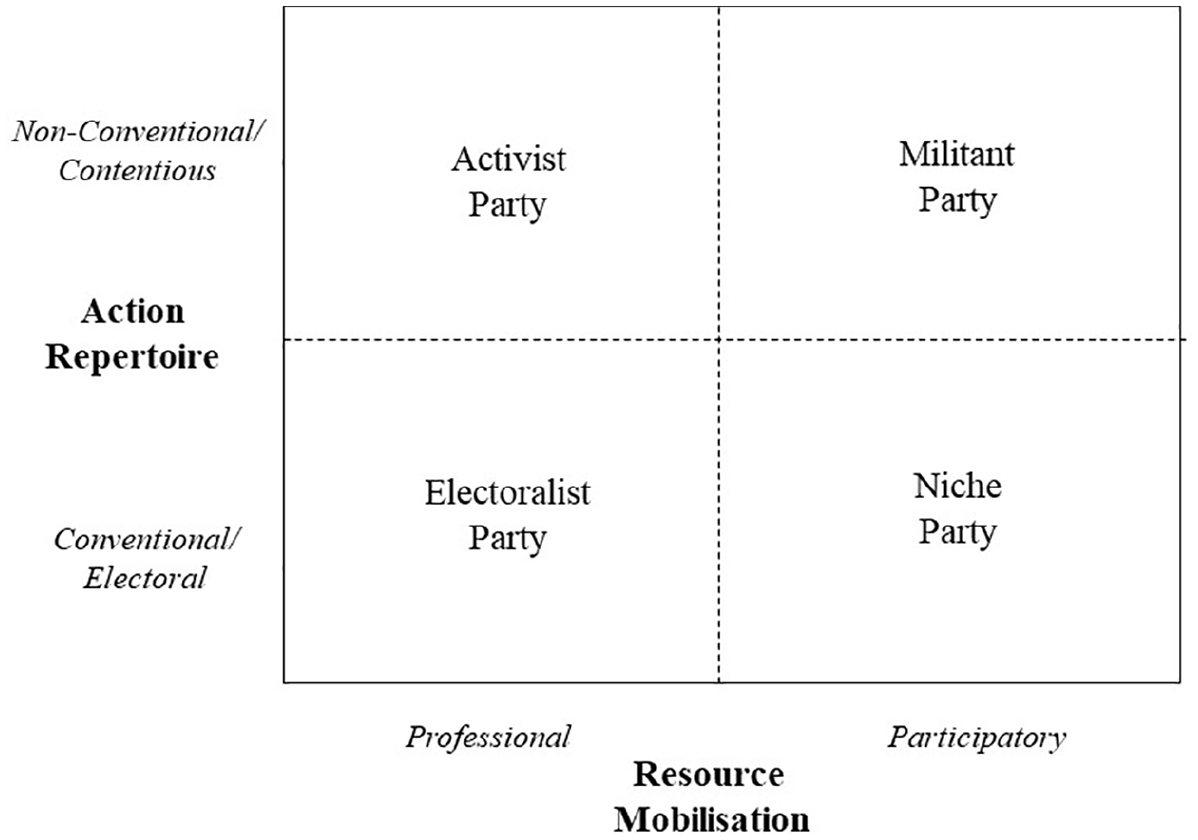
Organisational Models of Partisan Mobilisation.
The first professional/conventional quadrant corresponds neatly with the mainstream electoralist party type, that is, parties that mobilise money and professional resources to maximise their appeal vis-à-vis a wide pool of loosely committed voters, mainly through marketing communications and tactics to be deployed during electoral competition (i.e. campaign advertising, segmented media presence and candidate offerings). Not seeking to forge restrictive partisan identities or lasting organisational bonds with civil society, these parties do not spend time and effort in setting up structures geared at supporting partisan loyalties or generating lasting commitments from their voters (Gunther and Diamond, 2003: 185). This is the dominant model across liberal democracies, be this in catch-all, programmatic or personalistic variants, with emblematic examples being ‘memberless parties’ such as Berlusconi’s Forza Italia, whose electoral platform is guided fundamentally by political marketing considerations, or the Dutch PVV, which enjoys significant electoral success even if counting with a sole member, its leader Geert Wilders.
Now, if parties continue to privilege conventional electoral strategies but rely on a more committed and participatory type of alignment with their bases, I consider this approximates to the niche party type, following Richard Katz’s (2017: 222) minimalist definition that ‘Like niche firms in economic markets, niche parties do not try to broaden their appeal but try to monopolise a limited segment of the electorate’. 7 While the literature considers that the common way in which niche parties do so is by privileging some (non-economic) programmatic issues beyond mainstream lines of political division (Wagner, 2012), empirical analyses indicate that niche parties tend to display a positive correlation between their policy focus, their electoral niche and the inclusivity of their membership structures, showing lower responsiveness to median voter demands in order to maintain base commitment or civil society alignment (Bischof and Wagner, 2017; Blings, 2018; Lehrer, 2012; Scarrow, 2015). This means that if niche parties were to sacrifice base alignment for a more professional model geared at widening electoral appeal, under this definition, they should be considered under the electoralist type. The German Greens, for example, did so in the nineties when they abandoned their earlier ‘purist’ environmentalist position for a ‘rainbow-type’ catch-all model appealing to broader groups of voters (Kaelberer, 1998), while under Marine Le Pen, the once fringe French Front National (now Rassemblement National) mutated into a nation-wide electoralist party – albeit never possessing significant participatory structures.
Moving to the upper section, we encounter two models where parties engage in non-conventional repertoires by mobilising either participatory or professional resources. The participatory/contentious quadrant represents then what can be called militant parties. Though the term ‘militant’ connotes the idea of radicalism, and has been applied to fascist, Leninist and revolutionary parties that embraced violence as a strategy, I use the term in a more generic fashion to indicate those parties that combine a durable and active engagement with their supporters beyond electoral moments, with a substantive inclination to engage in contentious mobilisation (even if also engaging in the electoral game). In this sense, under this category are subsumed behaviours generally attributed in the literature to movement parties and early ‘mass-based’ socialist and labour parties, as well as other party-movement configurations such as Latin American national-popular movement fronts – that is, Argentine Peronism, the Brazilian Workers’ Party or the Bolivian MAS – or militant organisations-turned-parties, such the PLO, Sinn Féin and the Basque Herri Batasuna (Acosta, 2014; Levitsky and Roberts, 2011). Militant parties can approximate to electoralist or niche types if they were to abandon contentious tactics to gain acceptance in institutionalised politics, though this transition can be expected to create some internal tensions. This is the case, for example, with secessionist parties that sought to rebrand themselves as ‘responsible political actors’ to participate in regional-level coalitions or to appear competent in government roles, as has been the case of the Basque PNV and the Scottish SNP, clashing with their more radical supporters in the process (Elias and Tronconi, 2011).
The fourth type, occupying the professional/contentious quadrant, is the activist party. This is the less intuitive category as it describes parties that use professional resources not only to gain electoral appeal but to deploy movement-like repertories – be these openly contentious, such as the organisation of protests, or partially so, such as issue polarisation or signalling through non-electoral campaigning – but without substantially increasing organisational access to militants or privileging alignment with specific constituencies. This makes activist parties organisationally different from militant, as their activist traits does not follow from a committed militant base or the possession of dedicated base-aligning structures, and organisationally and strategically different from electoralist and niche parties, as they dedicate professional resources to organise contentious activities, viewing these as an effective form to mobilise partisan sympathy in the public. 8 In line with Diani and Donati (1999: 17), the activist party can be said to function as a ‘professional protest organisation’: professionalised units capable of engaging in routine and contentious activities in order to gain visibility, command resources from the public and/or increase electoral appeal, but without relying on a mass membership or a mobilised base to do so.
This last type represents the main conceptual proposition this article advances, on several grounds. First, because it outlines an organisational model that the mainstream party literature has considered void, as the increasing professionalisation of party organisations was considered to imply the abandonment of non-conventional repertoires, as explained in the first section. Second, because it facilitates bridging discussions about party types with insights from other literatures about new patterns of social mobilisation and political participation, including the role of social media. Third, because by considering the relationship between organisational structures and repertoires of action, it provides a novel perspective of an emerging party behaviour that is either under- or overdetermined in discussions about populism, outsider parties and new protest parties, where ‘too often different terms describe the same phenomenon, and the same terms describe different phenomena’ (Barr, 2009: 30).
In the final section, I briefly engage with one example, the Brexit Party, to illustrate how the idea of the activist party supplements electoralist, niche and militant models, while adding nuance to certain aspects of party organisation and behaviour conflated under conventional categories concerning movement parties, party populism and hybrid party-movement configurations. Moreover, this example is used to expand some general analytical expectations regarding how activist parties can be identified while discussing instances of apparent activist behaviour observable in different countries and contexts.
A Preliminary Discussion: Activists, Populists and Social Media
In the spring of 2019, the Eurosceptic Brexit Party won the UK’s European elections with 31.6% of the votes. A few months later, in the context of the UK general election, its leader and founder Nigel Farage decided to stand down Brexit Party candidates in 317 Conservative-held seats to facilitate the election of Brexit-supporting Conservative candidates, and buttress the victory of Boris Johnson – a strategy that proved successful, as the percentage of ‘Leavers’ backing the Conservative Party increased from 36% to 71% (Cutts et al., 2020). Described as ‘a mixture between a business startup and a social movement’ (Davies, 2019) and with Farage himself declaring that he was running ‘a company, not a political party’, the party became active in January 2019 and was registered in the UK Electoral Commission a month later, as the non-official successor of the collapsing UK Independence Party. 9
For the purpose of this article, the organisation and behaviour of the Brexit Party are illustrative of a party that does not adjust to conventional understandings of electoralist, niche or militant party models. On one hand, its internal structure is highly centralised and professional, with resources being used to organise events and rallies, develop media content and run social media campaigns, usually highly provoking and seeking political polarisation. In this sense, the Brexit Party differs from the traditional electoralist type and some sub-types, such as business firm parties, as these tend to be ideologically undefined and lacking coherent social relations constraining their messaging and policy positions (Hopkin and Paolucci, 1999). On the contrary, the Brexit Party campaigned for a very clear aim, to ‘get Brexit done’, and gave this aim higher priority than winning votes or entering office, preferring to support the ‘right’ Conservatives over its own electoral results. On the other hand, the Brexit Party did not originate from a grassroot movement or is part of party-movement alliance (Brexit remains an elite-led political project, organised from above) nor did it create structures to stimulate and organise an activist base. Notably, Farage declared that membership parties were old and ineffective structures, and even when recognising as inspirations both the unipersonal Dutch PVV and the Italian M5S, a party that allows members to vote proposals through an online participatory platform, the Brexit Party never implemented any participatory mechanism – during the campaign ‘registered supporters’ (around 100,000) merely provided the party with a £25 contribution and their personal details (albeit wealthy donors contributed far more) (McTague, 2019; Malnick, 2019).
The Brexit Party, in this sense, emerges as a party with no militants or members but that behaves as representative of a grassroot movement. Its political efficacy rested in the capacity of a rather small and well-resourced group to agitate discontent and mobilise non-partisan alignments in the British electorate (i.e. Leavers vs Remainers) across conventional partisan identities – resulting, interestingly enough, in the emergence of a ‘counter-movement’ party, the pro-European Change UK party, that included former Labour and Tory politicians (and that failed dramatically and lasted only 10 months). This professional activist strategy enabled Farage to achieve what any political entrepreneur or social movement actor ultimately aspires to: to position an outsider issue within mainstream political competition and debate (Westlake, 2017).
Beyond its particular specificities and contextual features, this example highlights a number of analytical expectations regarding how an activist party could be expected to look like and behave. Relevantly, when Diani and Donati (1999) illustrated a professional protest organisation the example used was Greenpeace, a SMO whose spectacular disruptive actions are not intended to stimulate grassroot activism, but to get financial resources from the public. In a similar line, activist parties would use professional resources to disentangle ‘protest and confrontation from mass, grass-roots participation’, seeking to generate feelings of ‘vicarious activism’ among sympathetic supporters without imposing the cost and commitment of militancy (Diani and Donati, 1999: 23–24). Activist parties can be expected to do so by mimicking the discursive strategies used by new protest movements and SMOs, without granting members greater influence nor investing in formal structures of collective alignment. Rather, professional resources would be devoted to exploit the mentioned synergy between social media and connective mobilisation, promoting low-commitment engagement via political communications characterised by an emotionally laden and often polarised ‘language of protest’ (Krastev, 2014: 17) – seeking to extend political conflict beyond the party system and/or to position the party as representative of a social movement, independently if this exists as such. These communicational strategies can be populist or not. As recognised in the literature, populist parties can accommodate different organisational forms and political ideologies, but they are distinguished by their use of a Manichean rhetoric (i.e. Us vs Them, People vs Elite) that emphasises a plebiscitarian connection with the citizenship, often on the basis of some positional issue (nationalism, immigration, corruption, etc.) (Barr, 2009; Mudde and Rovira Kaltwasser, 2013; Zulianello, 2019). 10
Accordingly, we can see populist parties as militant or activist, depending on the type of resources dedicated to organising the relationship with their supporters. Thus, while a populist militant party would seek to gain legitimacy by incorporating the views of the rank and file, a populist activist party is expected to prioritise outcomes over representation, claiming to deliver what supporters want ‘for them’ (Barr, 2009: 35). Simultaneously, activist parties do not need to be populist, as parties can use alternative discursive strategies to promote partisan mobilisation or adopt a social movement stance. Emmanuel Macron’s En Marche party, created in 2016 and obtaining 66% of the votes in the 2017 French elections, was set up as a progressive technocratic ‘neither left, nor right’ anti-establishment party (Chamorel, 2019) – using significant resources early on to mobilise over 5000 volunteers (the ‘Grand Marche’ campaign) to conduct in-depth interviews with 25,000 people across the country, seeking to create a database of priorities and put the public in contact with the ‘movement’ (Chwalisz, 2019). The anti-status quo campaign of Volodymyr Zelensky for the Ukrainian presidency, instead, targeted the corruption of Ukrainian political system and the high polarisation of society, appealing to Russian-speaking regions, and was run almost entirely online, with no public speeches, rallies or press conferences (Karatnycky, 2019). 11
The proposed framework also allows evaluating changes in organisational types, towards or away from the activist party. Podemos, for example, is a (populist) party that was founded on a strong militant model (crowdfunding through social media) but that over the years has become increasingly activist, insofar as its electoral success has led it to abandon participatory mechanisms in favour of professionalised structures, even if maintaining a social movement identity and style of communication. The German AfD can be said to have evolved from niche Eurosceptic party to national activist one, acting as a ‘right-wing movement in the making’ partly through a selective mirroring of the protest discourses used by the anti-immigration PEGIDA movement, with whom it shared a substantial Facebook base (Berbuir et al., 2015: 173). Similarly, in Italy, the Lega Salvini Premier (former Lega Nord) broke out from its regionalist niche through Salvini’s agitation of nativist nationalism, becoming more vertical and more populist with the help of a skilled social media strategy (Albertazzi et al., 2018: 651). However, electoralist parties, insofar as they dedicate increasing political marketing resources to promote social movement discourses and activate sectors of the population, could be viewed to be acting as activist parties, even if this is not permanent. This could be said of Macron’s party, but also, for example, of the behaviour of the conservative Propuesta Republicana (PRO) party in Argentina, which adopted a very contentious movement-like stance when confronting the left-wing Kirchnerist government during and after 2012–2013 protest wave (Gold and Peña, 2019).
Conclusion
This argument challenges the negative relationship conventionally presumed between electoral and contentious mobilisation, posing that partisan activism may no longer be just an instrument of weak, underdeveloped or radical parties but an increasingly available and potentially effective organisational model enabled by new resources available to parties to hybridise their repertoires of action. Connecting insights and evidence from different literatures and contexts, the article offers a novel typology of organisational models of partisan activism that illuminates the manner in which parties can use participatory and professional resources to engage in conventional and non-conventional mobilisation. This new typology allows singling out the activist party, an overlooked possibility in the party literature, considering it captures with greater clarity certain hybrid behaviours displayed by many contemporary parties beyond conventional ideas of movement parties or party populism. In the last section, I sought to provide a preliminary validation of this novel concept by pointing to the Brexit Party and other examples, while highlighting analytical considerations and expectations.
As a typological argument, the article integrates prior ideas and findings and uses them to offer a departure point for future discussion and analysis regarding the validity of the activist party model. As such, the article invites further theoretical elaboration and hopes to inform subsequent hypothesis-making and case and comparative studies, both qualitatively and quantitatively. Hence, it would be relevant to hybrid partisan configurations and patterns of activist behaviour in different locations, and assess the scope conditions that could be incentivising parties to adopt hybrid militant or activist models – such as high polarisation, which has shown to favour the emotional salience of ideological messages (Lachat, 2008), or prolonged periods in the opposition, as opposition parties have less constraints to adopt non-conventional tactics and more incentives to react to citizen’s demands and media coverage (Hutter and Vliegenthart, 2018).
On a more general level, it is important to explore the implications of hybrid partisan behaviours for democratic politics. What effects are hybrid and activist behaviours having over routine politics? Do they contribute to the polarisation of party politics, or push conventional electoralist and niche parties to adopt more movement-like discourses and tactics? Simultaneously, is the adoption of hybrid strategies responding to long-term changes in the way party elites understand the citizenry and organise linkage opportunities, or is rather the outcome of tactical adaptation to newly-found connective possibilities, such as social media? Is the activist party a transient organisational state or a more durable party ‘type’: a new generation of protesting party? These are important questions inviting further research, but as Kriesi (2015) noted, they require a flexible interdisciplinary scope to bridge a temporal divide often sidelined in party politics analyses, as while party behaviours are considered responsive to short-term shocks, social movement patterns are generally associated with long-term structural trends in society.
Footnotes
Acknowledgements
I would like to thank Ignacio Jurado, Dan Keith, Swen Hutter, Larissa Meier and the attendants of the 2019 Kick-off Workshop of the WZB Center of Civil Society Research for their feedback on previous versions of the paper. I also extend my thanks to the anonymous reviewers at PRS for constructive and detailed comments, and to a reviewer in another journal who provided me with a critical idea to present the current argument.
Declaration of conflicting interests
The author(s) declared no potential conflicts of interest with respect to the research, authorship and/or publication of this article.
Funding
The author(s) received no financial support for the research, authorship and/or publication of this article.
