



Abstract
Parties are the nucleus of modern parliaments. Therefore it is crucial to understand cooperation and competition within parties. In most parliaments, we can observe some form of cooperation, like cosponsorship. In this paper, cosponsorship is used to identify the relationships of MPs within their parliamentary party group, and to infer whether this relational position has an effect on their reselection. Are better embedded and connected MPs more likely to be reselected? Do peers matter in reselection? This question is also of theoretical interest in the light of competing principals (Carey, 2007). The empirical analysis first replicates the model of MP renomination by Baumann et al. (2017), adding a new data set from the German Bundestag, used to provide the relational independent variables of cosponsorship centrality. The key finding of the analysis is that cosponsorship closeness is a significant predictor of MP reselection and can be seen as a compelling complement to the model by Baumann et al. With cooperation shown to be significant when it comes to renomination, the understanding of peer-induced competition, competing principals theory can be further developed to aid our understanding of MP cooperation and competition, delegation, agency and collective principals in modern parties.
Parliaments are arenas of competition. Competing ideas are put forward by competing members of parliament (MPs), and after a series of different competitive processes, parliamentary action may be engaged. Yet, in most modern parliaments little can be done alone. Questions, motions, legislative proposals and basically most other parliamentary instruments are cooperative devices, let alone the final act of setting legislation: the vote. Parties are the main facilitator of cooperation necessary in parliament and beyond, yet, coordinating MPs is not an enterprise without conflicts, and therefore parties are also, at times, arenas of competition. When it comes to elections, parties find themselves entrenched in competition, but before MPs can seek reelection, they must be reselected.
Renomination is one of the central processes at the interlink of parties, parliaments, members of parliament and the electorate: Before reelection, most electoral processes require a reselection process to compile the ballot. In the German case, where this analysis is situated, district and state party assemblies are required to select candidates before they will end up as either a district candidate or on the state party list.
To model and explain the relationship between MPs and their party, scholars lately embraced the notion of competing principals theory (CPT) to structure MP actions in a principal agent (PA) framework (Carey, 2007), but yet have to fully explore the theoretical implications (Sieberer, 2015; Katz, 2014). Nomination can be seen as the act of delegation in this theoretical framework, whereas for most reselected candidates it should be seen as re-delegation. Candidates often already served in the assembly they are being renominated for, and therefore the party as principal is able to hold them accountable for prior parliamentary actions.
Recently Baumann et al. (2017) studied parties monitoring MPs parliamentary speechmaking and were able to show an effect for MPs deviating from the party line in these speeches on their renomination. Here, the monitoring capabilities of the party, or more precisely of party leadership are obvious. There are many more different opportunities for party leadership to monitor MPs, Louwerse and Van Vonno (2021) note that parliamentary activity itself is one of these that is often overlooked. Yet, Schmuck and Hohendorf (2022) find mixed results for parliamentary as predictor for renomination.
Extending this, I argue that parliamentary activity is not just an additional metric for the above mentioned monitoring by party leadership, but that parliamentary activity is crucial for MP monitoring by their peers. Again, taking the German case as illustration: The multilevel setup of institutions makes it hard to delineate principals and agents, since roles and functions are not separated across institutions: Non party-leadership MPs of the national assemblies can be party leadership members on the state party level, influencing the election lists for the national assembly that are compiled on the state level. Therefore the reselecting and potentially delegating principal can also be seen as one of the 16 state parties and their party assemblies, complementary to PPG leadership or district assemblies. It is then a conceptual question whether we are seeing a type of collective principal (Kiewiet and McCubbins, 1991), where peers are part of the delegating actor, or whether one of the competing principals relies on a form of peer-monitoring, which would introduce a form of competition that is peer-induced.
To assess peer-induced competition, we must not study parliamentary activity on the individual or aggregated level, but have to perceive cooperation as meso level phenomenon. This then means studying the networks emerging from these cooperative patterns (Metz and Jäckle, 2016). Researching these cooperative devices is promising, since cooperation is always also a relational statement of underlying social structures between members of parliament (Bratton and Rouse, 2011). This can be illustrated using cosponsorship as parliamentary activity, which is found in many assemblies for different parliamentary instruments, for example motions. While the mere number of motions cosponsored is indeed easy to report and would therefore be easy to monitor for party leadership, monitoring the network of MPs in detail seems to be beyond its capabilities.
The research question originating from this theoretical reflection is straightforward: Do peers matter in MP reselection? Are better embedded and connected MPs in the social network of parliamentary action more likely reselected? This contribution tries to further our theoretical understanding of this question by proposing an new relational variable of peer-induced competition and testing it empirically, using a prior analysis as framework (Baumann et al., 2017) and reusing its dependent variable, candidate reselection. Two new independent variables are introduced into this model: Cosponsorship activity will reflect the parliamentary activity discussed above, as observable by PPG or party leadership. Cosponsorship closeness reflects the position of a MP within the cooperative network of its peers, acting as relational metric of centrality in cosponsorship across the legislative term. Two competing hypotheses will be presented accordingly.
In this paper, the network of cosponsorship is used to identify the relationship of MPs within their parliamentary party group, and to infer whether this relational position has an effect on their reselection by respective party commissions. This network is both a theoretical tool and an empirical data structure. This is reflected in the structure of this inquiry: First, the theoretical framework will discuss the above outlined argument, restating the theoretical challenge of collective or competing principals and their identification. Here, the concepts of leadership-induced and peer-induced competition will be presented. Second, the method, data and descriptive statistics are presented. This section will take special care in introducing the concept of cosponsorship closeness as operationalization for peer-induced competition. Third, the analysis itself tests both hypotheses and annotates the findings. For the sake of replication, this is not presented as inferential network analysis. The article concludes with a discussion of the results and an outlook for further inquiry.
Theoretical framework
The relationship between parliamentary actors can be characterized, in a rational principal agent perspective (PA), as the need to solve or at least face multiple agency problems, from the design of the delegation itself and its contract, to screening, monitoring and further institutional checks (Kiewiet and McCubbins, 1991; Saalfeld, 2000).
To answer the first and very fundamental task of identifying the principal in this regard, Carey (2007) proposed to model not one, but multiple principals to explain MP actions and constraints. Treating voters, the party, party leadership, or PPG leadership as principal of MPs, often embedded in a chain of delegation and accountability (Auel, 2007), has proven beneficially in understanding MP actions. It also enables us to focus on the principals in the parliament, while the theory stays open for external principals like the voters. Therefore, if we focus on selection and not election, the party is a central principal.
For the case of the German Bundestag, this means that one of 16 state party groups is a potential delegator for each party, since state party assemblies will compile a Bundestag election list for each state, besides the district party assemblies nomination of a candidate per district. For the list tier, this means that the national party leadership, the parliamentary party group leadership, the state party group leadership, and in some cases the parliamentary state party group chapter will influence a candidates placement on this list. This is further complicated by the fact that most groups mentioned above are collectives with non-exclusive and often overlapping membership. Kiewiet and McCubbins (1991) characterize this situation as problem of collective principals and prescribe these types of actors basically the same aformentioned set of agency problems, but internally.
The classical solution to this conceptual puzzle of collective principals put forward by rational PA theories is to posit an unitary actor assumption, and as useful as this is to pull relations and connections between actors into the center of an inquiry, this sometimes seem to focus too much on this singular or prototypical relationship (Katz, 2014).
A solution put forward by Baumann et al. (2017) is to seek the source of competition. The answer to the question of who causes competition among MPs can also be an answer to the question of who delegates effectively. The analytical frames used by the authors were twofold: leadership-induced competition hypothesized intra-party competition for renomination when deviating from the party line, as observed by party leadership; constituent-induced competition hypothesized intra-party competition for renomination when the mostly local selectorate is dissatisfied. The analysis for the first hypothesis finds significant effects for MP reselection when deviating from the party line in parliamentary speeches.
The parliamentary activity of speech-making is well suited for this analysis: By design parliamentary speeches are observable, and therefore the costs of monitoring for PPG leadership is relatively low. The demonstrated position of the MP speaking is also, most of the time, explicit and deliberate. If anything, this deliberative notion of exposing ones position explicitly is hinting at a scarce and constrained monitoring opportunity. There is no question that additional prospects for monitoring MPs exists and it seems beneficial to add these to the analysis using the introduced framework.
The argument made in this contribution is that beyond agency slack and competition, effective cooperation will predict renomination. Using the lens introduced above, I theorize that there is peer-induced competition, monitoring MPs cooperativeness in parliamentary activities. The same conceptual challenges denoted above apply. When policy positions are partly hidden information and delegators are collective principals (Kiewiet and McCubbins, 1991), the theoretical motivation for peer-induced competition is found reflecting about the problem of monitoring MPs and screening candidates for selection. Since we are interested in re-selection and not in selection in general, screening potential candidates and monitoring prior selected successful candidates can be seen as the same central problem and is used synonymous for this study.
Louwerse and Van Vonno (2021) discuss that parliamentary activity is often simply overlooked and that we can learn from these behavioral patterns. They can show that the number of given speeches in the Dutch lower house of Parliament is a significant predictor for reselection. Rehmert (2020) finds that parties are incentivized to select candidates optimizing the fit into parliamentary networks to maximize party unity after election. Parliamentary networks seem to be an appropriate arena to inquire on MP cooperation. These cooperative patterns have been shown to be structured on varying dimensions, such as social dimensions (Bratton and Rouse, 2011; Wojcik and Mullenax, 2017), the specialization and fields of expertise of MPs (Louwerse and Otjes, 2015), and geographical dimensions (Koger, 2003: p. 237), amongst others. Metz and Jäckle (2016) are able to infer cooperative patterns by studying parliamentary networks of the Bundestag, Aránguiz and Navia (2020) argue for the Chilean Chamber of Deputies, that individual networking in cosponsorship networks serve as tool for career advancement of legislators. Bernhard and Sulkin (2013, p. 483) find that cosponsors will also vote in favor of the bill signed and subsequently describe cosponsorship as institutionalized ‘commitment mechanism’. An illustration of a extraparliamentary function of cosponsorship is the study by Rocca and Gordon (2010). The authors can show a connection between cosponsorship and interest group interests. Ultimately, parliamentary networks, especially inter-parliamentary networks, are also expected to lead to a framework of peer accountability (Papadopoulos, 2007: p. 480 – 483).
For this analysis, cosponsorship of motions fulfill the requirements of a cooperative parliamentary activity. The theoretical core is that is MPs use cosponsorship for signaling to other legislators (Kessler and Krehbiel, 1996), which in turn means that the recipients are in fact screening their peers. Indeed, Crisp et al. (2004) also use cosponsorship to model a market of reputation, where MPs trade support needed for reelection. The case at hand, the full 17th electoral session of the German Bundestag lasts a 4 year cycle, in which the opposition parties produce several hundred motions, creating just as many opportunities for their respective MPs to signal support or to abstain.
Two interlinked hypotheses can be extracted out of the above theoretical arguments. The first hypothesis tests parliamentary activity as predictor of reselection, without taking the network structure into account. The second hypothesis then tests for peer-induced competition by taking the networked structure into account.
The less abstract and maybe more robust hypothesis on reselection revolves around the concept of parliamentary activity per se. It is more robust in the sense that it does not need to theorize large resources for the PPG leadership in estimating the position of an MP. Instead it focuses on activity alone. In light of recent and somewhat limited findings (Schmuck and Hohendorf, 2022), the activity hypothesis acts more as a control for the second hypothesis in this study. Quantifying overall cosponsorship activity is trivial, some parliamentary documentation systems are able to automatically display the number of cosponsored activities. Yet, this first hypothesis can also be seen as of interest on its own (Louwerse and Van Vonno, 2021).
The second hypothesis assumes, as theorized above, MPs signaling cooperativeness to each other in cosponsoring motions. The resulting network from all these relationships is a proxy for the social PPG network of MPs. In contrast to the first hypothesis, the position within the network is not easily quantifiable and therefore not observable by party leadership. Consequentially, any effect we see must be peer-induced competition. It also holds information about personal relations, shared opportunity structures, as well as second order information on close peers, especially on their positions and other information. The centrality metric we choose to quantify centrality is closeness, as will be discussed in the section below. This position is in fact influenced by the positions of any actor connected to an MP. It should generally considered as a multidimensional and multi-domain information space. The resulting hypothesis is basically a relational hypothesis: The better embedded an MP is in this social network, the more likely she will find success in renomination.
At last, the main difference between cosponsorship activity and cosponsorship closeness is about the cost and feasibility of obtaining this information for any actor. While activity can be obtained by counting sponsorships, closeness is a more complex metric. While it may be conceivable that party leaders discuss especially the absence of sponsorship activity, I doubt that the calculation of abstract network metrics is a criteria on party leaders scorecards for renomination. I therefore argue that cosponsorship closeness is peer-induced competition. In testing this hypothesis against cosponsorship activity we can contrast this network-bound variable by using the same underlying actions, but with different conceptualizations.
Data and methods
This section illustrates the sources of data and the methods used to further the analysis of the hypotheses presented above. For this, first we briefly look into the aforementioned analysis by Baumann et al. (2017), from which this analysis borrows its dependent variable, renomination success, as well as several control variables and one central independent variable: deviation from the party line. Second, this chapter will continue to discuss the data source for both hypotheses: Cosponsorship of motions in the German Bundestag and characterize the network constructed of it. As specific centrality measure, the chapter selects closeness as operationalization for the second hypothesis. It concludes with a brief overview of the descriptive statistics for the aforementioned main variables.
Renomination and deviation from the party line
As discussed in the theoretical section, the base model for this study is acquired from Baumann et al. (2017). This contribution is based on one of their central dependent variables: Baumann et al. (2017) are able to quantify renomination by calculating relative changes in party lists posted for the subsequent electoral process by each state party. While the authors also quantify renomination on district level for their analysis of constituent-induced competition, peer-induced competition seems to be best contrasted against leadership-induced competition.
The analysis of Baumann et al. (2017) was computed in Stata, so first the models were reproduced in R (R Core Team, 2013) using the MASS package (Venables and Ripley, 2002), to employ a proportional odds logistic regression.
Since the below discussed constraints render German cosponsorship data not suitable for parties in government, models were then calculated for opposition parties only. This basically also removes one central party variable dummy for government coalition. Each step was controlled for stability of the findings as suggested by the overall model, and indeed subgrouping the analysis did not show any deviating effects.
The main independent variable of interest for leadership-induced competition is the deviation from the party line in parliamentary speeches. Baumann et al. (2017) measured this using automatic text analysis based on WordScores (Laver et al., 2003). The first column in Figure 2 shows the distribution of deviation. Cosponsorship network of the green party in the 17th electoral period. MPs are placed using Saff and Kuijlaars (1997). A tie between two MPs is recorded once both sponsor the same motion. These connections are weighted for cosponsorship frequency, stronger ties imply cosponsoring more often.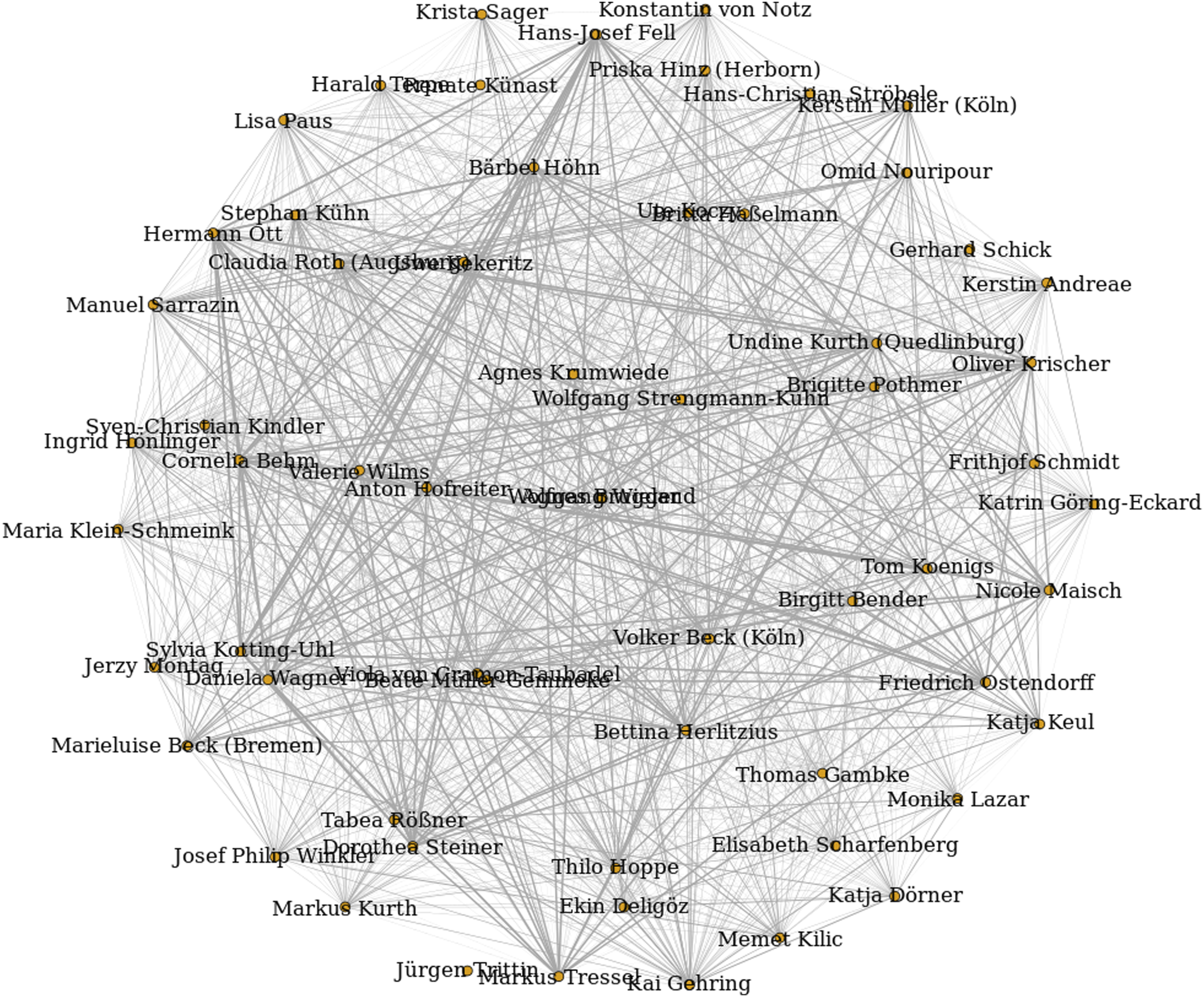
Cosponsorship closeness in the 17th Bundestag
The closeness calculation for the variable testing peer-induced competition is based on the networks of cosponsorship in the opposition of the 17th Bundestag. It is inferred from the official parliamentary documentation as published by the parliament. The data was parsed directly out of these documents, since the search engine provided by the Bundestag was not able to provide a full list of signees. Instead, the full collection of documents where first parsed for their type, and thereafter for sponsors and parties involved. The type of a document is disjunct and unambiguous, the selected type is a motion (Antrag), submitted by a single party in opposition. It is a remarkable feature of the Bundestag that the layout of the parliamentary documentation is extremely stable. The same approach, indeed the same routines, could be used to request information from bills since 1949. The selected parsing strategy was adaptive to errors in the documents and followed a multi-stage setup: Only if the program would find information in an expected shape, a document could ‘graduate’ to the next level of processing, with failed documents to be reviewed and adapted to automatically accept the former failed piece of information. While the observed order of cosponsors was preserved in the base data set, the networks constructed from it dismisses this information and codes just cooccurrence.
This is a very time consuming strategy, the reliability of the final data set benefits from it. For instance, this is true especially for the names of the MPs: Even though their own parties are responsible for the list of names included, quite some noise was found in the published lists. MPs leaving or entering the parliament mid-term were excluded from the analysis. In the meantime, more convenient ways to acquire this data have become available (Remschel and Kroeber, 2022).
This data was then used to construct the network of cosponsors for each party using the iGraph R package (Csardi and Nepusz, 2006). Figure 1 gives a rough idea of this data structure. The iGraph package was also used to compute the centrality score. Social network analysis established multiple centrality scores, for this analysis, the concept of closeness seemed most appropriate to operationalize the theoretical implications as discussed above. Descriptive statistics for the independent variables. From left to right: Histograms for deviation from the party line in speeches, histograms for the overall weighted cosponsorship activity, histograms for closeness score for the respective network of cosponsors, and finally the plotted correlation of deviation and closeness scores. For all three analyses, the intercorrelation between cosponsorship closeness and deviation from the party line in speeches is low (Left: 0.03, SPD: 0.07, Greens: −0.3).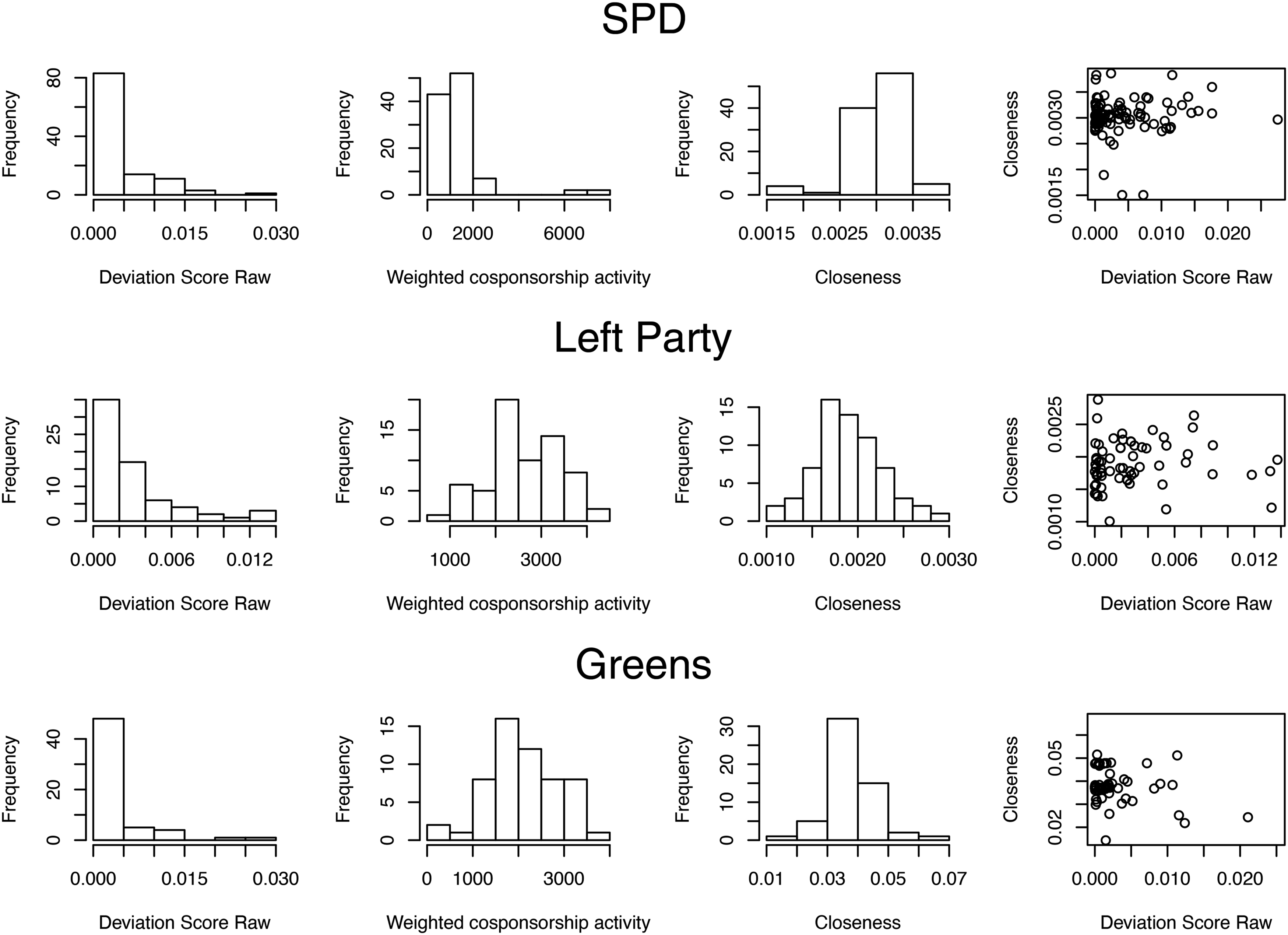
In social network analysis, closeness (Freeman, 1978) is a measure of centrality: Specifically, closeness is calculated by the number of steps needed to “visit” any other node in the network. For weighted networks, the weight of the ties is interpreted as distance and therefore the closeness calculation itself is weighted.
In the case of the cosponsorship network at the heart of this inquiry, closeness can be described as operationalization of social centrality as follows: MPs are connected in the network of cosponsors once they sponsor the same motion. The more often this is the case, the higher this connection is weighted, in fact this weight is a simple count of such cooperative acts. Closeness calculates the number of connections that must be minimally used to “visit” any other MP, so cosponsoring frequent cosponsors will add to the closeness score, yet at the same time closeness is not maximized by simply signing with frequent signees, but more by distributing sponsorship across the network to “reach” more MPs more directly. In the case of a valued network representing the frequency of cosponsorhips, we may adopt the interpretation of closeness as efficiency of access (Brandes et al., 2016). While closeness could therefore be calculated for the entire network of cosponsorship in the Bundestag, it seems more viable to measure it within party networks.
One can not reach a perfect closeness centrality score by cosponsoring every motion, but must rely on every other actor in the network to do the same. Just then, closeness centrality could reach 100 per cent. This illustrates the relational aspect of this measurement, actors are always dependent on every other actor in the same network. For the German case, cosponsoring indeed shows enough variance to assume MPs within such a network are able to choose when to sponsor, without imminent penalties by party leadership similar to deviate in a vote, for example.
As discussed above, the network of cosponsors in the Bundestag is expected to be structured in several different dimensions. Cospecialization (Louwerse and Otjes, 2015) is among the most central dimensions and is therefore also a central concern when it comes to the question of measurement validity. Cosponsorship networks can be expected to cluster, among others, into communities of specialists. The sizes of such cluster vary with their subjects, with some policy spaces being more prominent than others. Choosing closeness to assess centrality moderates this, since closeness centrality is dependent on the distances to every MP in the network and will therefore be not too sensitive for specialists that are primarily connected to co-specialists. In this regard, closeness reflects one of the most prominent hypothesis of network analysis, in that it emphasises the strength of weak ties (Granovetter, 1973).
Descriptive statistics
Before inspecting the descriptive statistics, Figure 1 displays one of the three networks in this analysis: Cosponsors in the green party are most likely to have cosponsored with every other MP at some point in the electoral cycle, yet the frequency of cosponsoring is not evenly distributed. While the graph shows some clustering and placement of nodes in more and less central positions, inferring from this visualization is hard, and it is used here solely for illustrative purpose.
Figure 2 shows the more conventional visualizations of the central descriptive statistics used in the analysis below. The first column re-illustrates the variable from (Baumann et al., 2017), the deviation from the party line in parliamentary speeches, shown here for the subset used in this analysis.
The next two columns describe the metrics based on cosponsorship. Generally, the descriptive statistics for cosponsorship in the 17th term of the Bundestag show overall similarity across parties of the opposition, although there is a counterintuitive relationship between the size of a party and its cosponsorship activity. The 138 MPs from the Social Democrats produced 8331 signatures on 417 motions, with the median motion being sponsored by 17 MPs (m = 19.98, Q1 = 15, Q3 = 22). Yet, both smaller parties produced more motions. With 576 motions the Greens are leading in this category, although they sport the smallest body of MPs. Their 62 MPs sponsored 9419 times nevertheless, with motions receiving up to 54 signatures and the median motion being cosponsored 17 times as well (m = 16.35, Q1 = 13, Q3 = 19). The most cosponsorships are produced by the Left, 570 motions were cosponsored 9628 times by their 72 MPs, with the median motion counting 16 members of the left party parliamentary group (m = 16.89, Q1 = 11, Q3 = 20).
Cosponsorship activity is used in its relational weighted form, basically counting the weighted edges within each party network. Having overall more MPs does not translate to more signees per motion for the Social Democrats, and even though their signatures are distributed among fewer motions, the Green party passes them showing a higher concentration. The stratification for the Left Party and the Social Democrats are quite similar, especially when one considers their lower values for both motions and signatures.
Cosponsorship closeness is distributed fundamentally differently to deviation. And while the Social Democrats and the Left are showing closeness metrics on a similar scale, MPs of the Green Party seem to be generally closer to each other. This can be seen as an indicator of their more decentralized cooperation patterns (Metz and Jäckle, 2016). Contrasted with deviation, we see that both cosponsorship based metrics show more variance.
To conclude the descriptive statistics, Figure 2 again shows the histogram for the three main variables. The last column also shows the correlation for cosponsorship closeness and deviation from the party line. Here we find first evidence of the two variables are measuring different phenomena. For all three parties, the intercorrelation between cosponsorship closeness and deviation from the party line in speeches is low (Left: 0.03, SPD: 0.07) and for the case of the Greens (−0.3), a visual inspection supports the idea of no systematic relationship further. Not shown is the correlation of closeness and cosponsorship activity. Because of the conceptual similarity and the fact that closeness is partially based on the same measurements, including both terms in the same model seems problematic.
Analysis
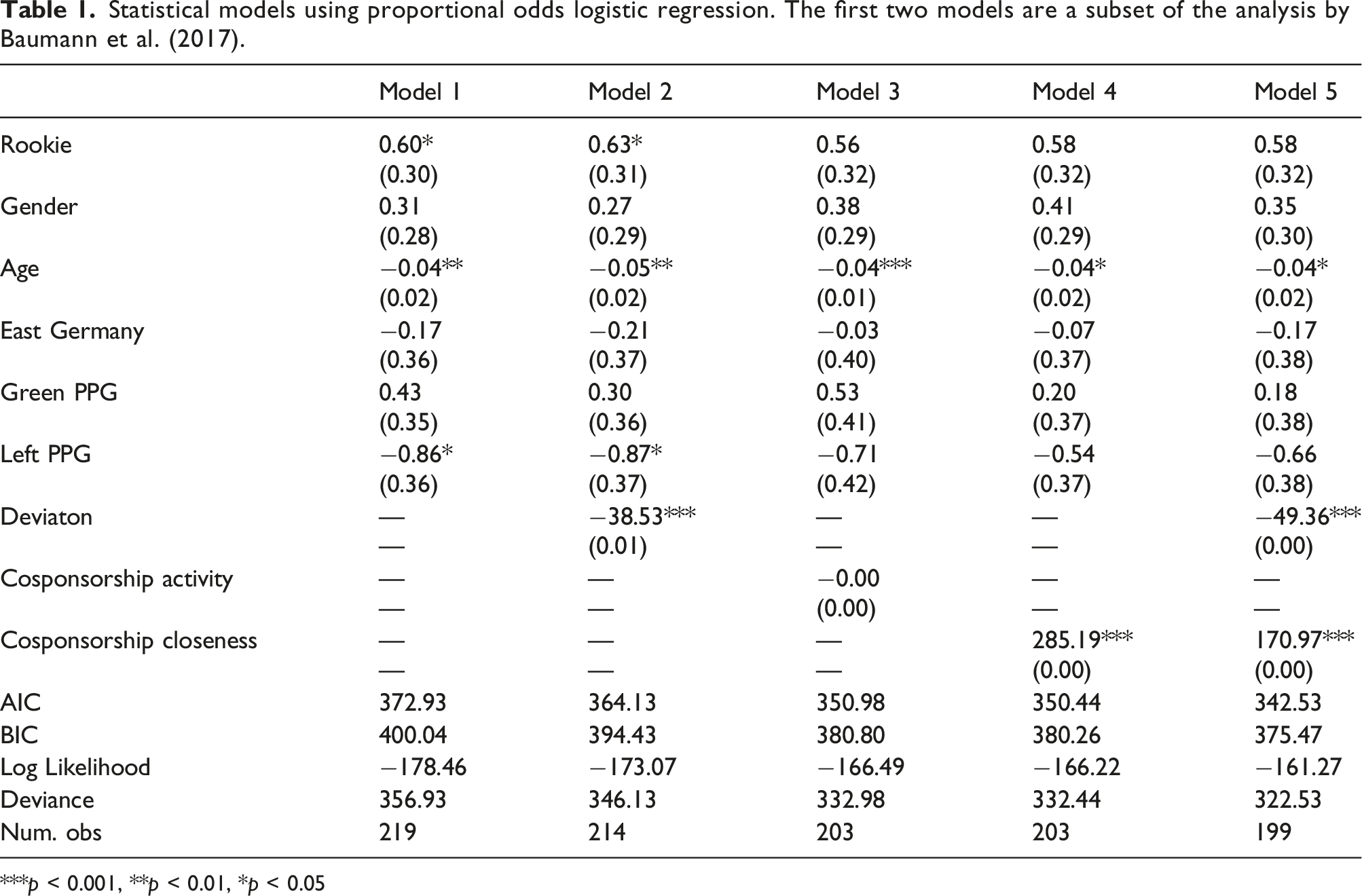
Statistical models using proportional odds logistic regression. The first two models are a subset of the analysis by Baumann et al. (2017).
***p < 0.001, **p < 0.01, *p < 0.05
Model 1 is the base model, including only the control variables for being a first term MP (rookie), variables for gender and age, as well as a dummy variable for an East German district. These variables are reproduced from Baumann et al. (2017). The dummy variable for committee chairs is left out of this analysis, since committee chairs have a special bureaucratic role in sponsoring motions. When included, committee chairs do not interact or substantially alter the findings of the selected models. At last, all models also use a dummy variable for the three parties. As the biggest party, the Social Democrats act as reference category.
Model 2 replicates the aforementioned analysis for a better overview and reconfirms the effect of deviation from the party line on renomination for this sub-sample.
Model 3 displays the effects for the cosponsorship activity as described in hypothesis 1. There is no significant effect of cosponsoring per se, in fact no effect is detectable at all. Cosponsoring more often and in bigger communities has no direct effect on the chance of renomination. This is in line with findings by Louwerse and Van Vonno (2021) for motions in the dutch case, and add to the mixed findings of Schmuck and Hohendorf (2022) in the Bundestag sample.
As obtainable from Model 4, cosponsorship closeness is a significant predictor of MP renomination. Therefore, the second hypothesis must be accepted. Following the theoretical argument above, peer-induced competition is at play in MP renomination, arguing for competing or collective principals when it comes to reselection. Especially when comparing the information criteria, this model is performing best among the three explanations containing only single independent variables. Since both cosponsorship variables are conceptually intertwined and also to some extend based on the same metrics, a model combining the two would violate the assumption of independent observation.
Ultimately, model 5 shows the combined effects for deviation and closeness. The interplay of these both variables and their relative stability when compared to the exclusive models suggests that we see two relatively independent effects at play. Both information criteria recommend this full model. The residual interaction of deviation and closeness can be expected on a theoretical level, since MPs deviating from the party line may also cosponsor rather selectively or cosponsor less overall. Since the effect of closeness diminishes and the effect of deviation is even stronger, one possible interpretation may be that cooperativeness cannot “heal” deviation, but alternative interpretations are possible and should surely be explored in future research.
In summary, we find strong and significant empirical evidence for closeness in the social network of cosponsors, as single predictor or combined with deviation from the party line, when forecasting success in reselection for German opposition MPs. Cosponsorship activity alone seems to have no effect at all. Therefore, hypothesis 1 must be declined, while hypothesis 2 can be accepted. The empirical evidence shown above paints a very clear picture in selecting models for the second hypothesis with the introduced variable cosponsorship closeness. Both, as single addition to the base models, and in combination with the deviation variable from Baumann et al. (2017) are throughly acceptable explanations. It demonstrates that the analysis of the aforementioned authors is not only a very good base for such an endeavor, but that it could be the fundament for a framework of further analyses for MP renomination for the German case.
Figure 3 shows the marginal effects for the main predictors of the selected explanation from model 5. For each possible outcome of the categorial dependent variable, the chances for a worse, better or equivalent placement relative to the previous list are displayed. Note again, as shown before for the descriptive illustration, the variance of cosponsorship closeness and deviation from the party line differ profoundly. Effects display the direction as expected for the corners of the grid, better integration in the network of MPs will decrease the probability of being placed worse (upper left plot), and increase the chance of being placed higher on the party list (upper right plot). Deviation from the party line has complementary effects, with more distance to the party line heightening the chance of being placed worse (lower left plot), and decreasing the probability of being better placed than previously (lower right plot). Remaining on the same list place than before is overall the most unlikely outcome, with just 24 MPs populating this category in the first place. Both variables show little influence for these cases. Marginal effects from the selected model 5 for cosponsorship closeness and deviation from the party line for the categorial outcomes of being placed worse, same or better on the party election lists respectively. The predictors are held constant at their proportions (Lüdecke, 2022). Darker areas display the 0.95 confidence intervals.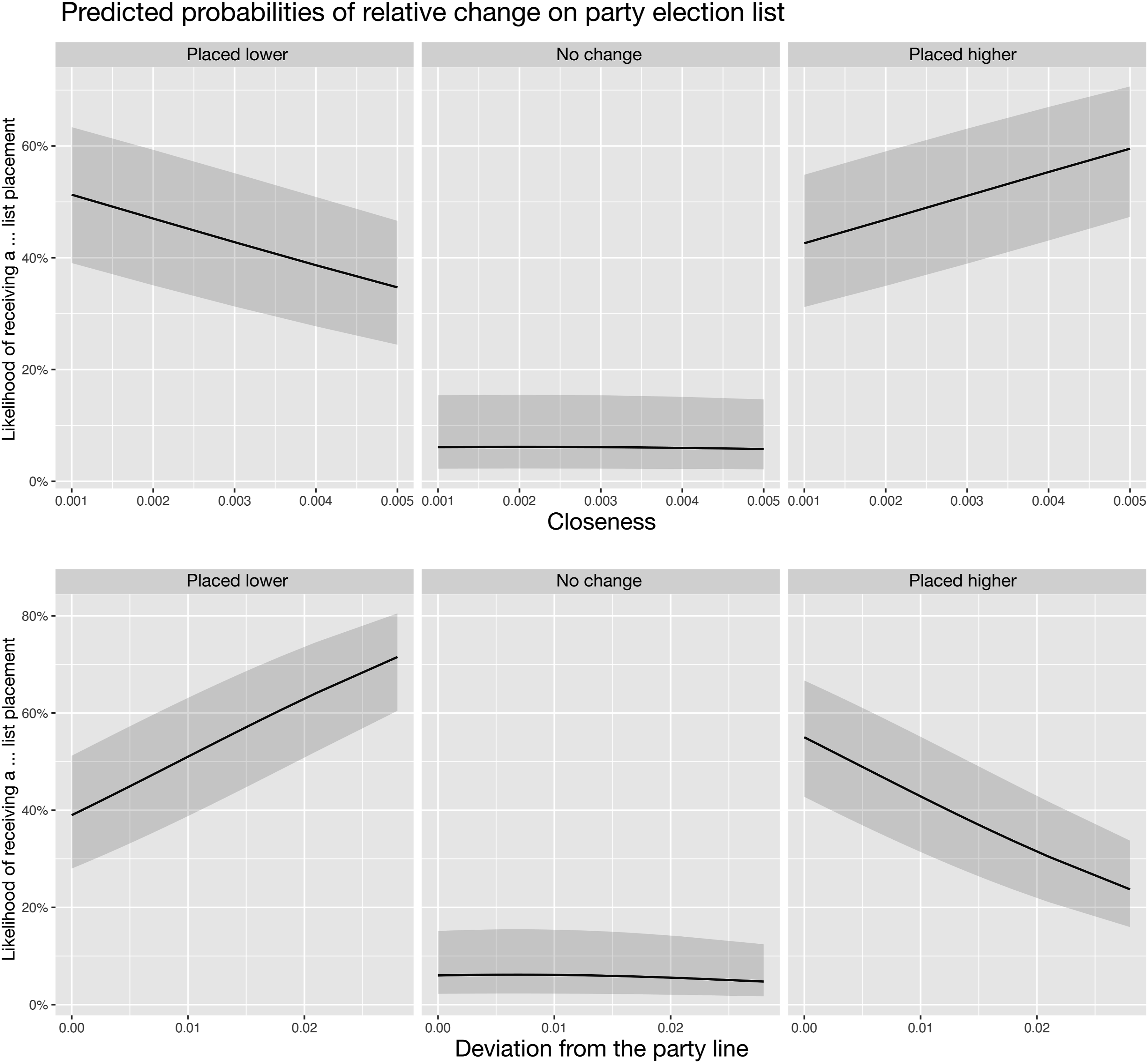
Comparing the two main effects for the outcomes of changed list placement, deviating from the party line is more effectual, especially for a worse placement. This enhanced impact furthermore can be seen as a pointer to observability as one of the underlying mechanisms at work.
As forecasted in the descriptive statistics by examining the regression, deviation from the party line in parliamentary speeches and cosponsorship closeness are more complementary variables than just different measurements for similar concepts. Revisiting the theoretical argument made above, expecting deviation as leadership-induced competition and closeness as peer-induced competition seem to be compatible with the explanation suggested by model 5.
Conclusion
Parties are not just arenas of competition, but also facilitators of cooperation. The presented study discusses this duality and the interaction of both functions, by extending a competition focused explanation of MP renomination (Baumann et al., 2017) with a network bound cooperative variable.
When it comes to candidate selection, events of deviation from the party line can be seen to be of equal importance to the cooperative behavior throughout the legislative term.
The position of a given MP in the intra-party network of cosponsors is a significant predictor for reselection. Specifically, the closeness of a MP, quantifying the diversification of peers cosponsored with. This finding is corroborated by also testing for cosponsorship activity with no significant effect. Cosponsorship closeness marginally interacts with deviation from the party line as predictor, suggesting that both act as complementary variables predicting reselection. When it comes to renomination, we indeed see a survival of the social.
In the context of the symposium (Put and Coffé, 2023), we are not only able to detect competition and cooperation in the post-electoral stage of intra-party competition, but also see a clear link of post-electoral behaviour to the stage of nomination.
This contribution speaks to the scholar of cosponsorship and parliamentary networks. It adds a first account of cosponsorship affecting parliamentary behavior in the Bundestag, and in that regard an addition to the scholar of cooperation in European parliaments. Most work on cosponsoring is centered on US assemblies, especially established theories. This applicability is a testament to the utility of signaling theory of cosponsorship (Kessler and Krehbiel, 1996), developed for the more obvious function of coordinating legislative support. The empirical evidence found above adds additional support for signaling in renomination (Crisp et al., 2004). It can furthermore be seen as complementary to inference by Rehmert (2020), corroborating the perpetual cycle of party unity as goal for reselection criteria and as outcome of cooperation. We indeed find both insignificant effects for cosponsorship activity and significant effects for cosponsorship closeness, deepening the understanding of parliamentary activity as predictor for renomination (Louwerse and Van Vonno, 2021; Schmuck and Hohendorf, 2022), and encouraging the inclusion of relational perspectives on instruments that are cooperative.
Combining competition and cooperation in a single theoretical framework is challenging. Using the framework of Baumann et al. (2017), this study demonstrated not only the feasibility of such an enterprise, but also the utility. Introducing peer-induced competition as reframing of cooperativeness addresses the challenges of both competing principals theory (Carey, 2007), as well as collective actors as principals (Kiewiet and McCubbins, 1991). On a broader theoretical level, this finding supports the critique of Katz (2014), showing that the assumption of the party or PPG as unitary actor may be too strict when studying MPs. While Baumann et al. (2017) are able to categorize the renominating principals by leadership-induced and constituent-induced competition, extending this taxonomy with peer-induced competition once more highlights the conceptual challenges of delegation based theories. Specifically, it adds the dimension of observability to the discourse, since peer-induced competition in this case must be categorized as extremely costly to observe by party or PPG leadership. The finding at hand suggests that we must be open for reconceptualization and that future work is necessary, both empirically and theoretically. Moreover, it validates the multi-actor model of intra-party competition by Put and Coffé (2023).
Furthermore, this study might serve as pointer for further avenues for explaining MP renomination, especially for peer-induced competition: While this work contributed a relational variable, it did abstain from introducing relational inference methods, the reason for this is the enhanced comparability and easier connection to existing literature. Using relational information as independent variable within an established model should be seen as one more link to existing literature outside the field of cosponsorship. For the Bundestag, this is one of the first accounts of a relational variable predicting MP success. Besides more methodological advanced inquiries, replicating this analysis in a comparative design can be seen as logical next step, as data becomes more and more available (Briatte, 2016; Remschel and Kroeber, 2022). With the empirical evidence presented here, further inquiry into parliamentary social networks seems more beneficial than before.
As a broad and diverse variable, the parliamentary network is a proxy for many different phenomena, including cospecialiszation (Louwerse and Otjes, 2015), and more sociological processes (Bratton and Rouse, 2011), among other dimensions (Koger, 2003: p. 237). Furthering our studies of parliamentary networks will not only enhance our understanding of cooperation in parliaments, but can be seen as avenue of research into additional arenas of competition.
Footnotes
Declaration of conflicting interests
The author(s) declared no potential conflicts of interest with respect to the research, authorship, and/or publication of this article.
Funding
The author(s) received no financial support for the research, authorship, and/or publication of this article.
