




Abstract
In contemporary representative democracies, political competition is not only taking place between political parties but also within parties. Hitherto, research on such intra-party competition has been mostly focused on the electoral dimension, mainly looking at the distribution of preference votes among co-partisans running on the same party list. In this introduction to our symposium on intra-party competition, we argue that intra-party competition occurs in other stages of the electoral cycle than elections and involves the strategic behaviour of more actors than electoral candidates. We present an original conceptual model that introduces a multi-stage and multi-actor perspective on intra-party competition, including three stages (the nomination stage, the electoral stage and the post-electoral stage) and three key actors (voters, politicians and parties). Based on our novel conceptual model, we provide examples of strategic behaviour of each actor in each of the stages. We further introduce each contribution of this symposium and present how each contribution relates to our multi-stage and multi-actor model of intra-party competition.
Introduction
In contemporary representative democracies, political competition is not only taking place between political parties but also within parties. Carey and Shugart (1995) argued that, depending on the electoral formula and district magnitude, elections can sometimes even be conceived more as a contest within parties than a contest between parties (see also: Crisp et al., 2007; Passarelli, 2020). Given the personalization of politics and growing centrality of individual actors at the expense of collective entities such as political parties (Karvonen, 2010; Balmas et al., 2014), the importance of the intra-party dimension of political competition has significantly increased. This trend is further intensified by the emergence of inclusive intra-party procedures for the selection of electoral candidates and party leaders (Cross and Katz, 2013; Sandri et al., 2015), which increases the likelihood of intra-party battles between individual politicians or party factions.
To date, most research published under the label “intra-party competition” has focused on the electoral dimension, suggesting a strong and almost exclusive theoretical and empirical connection between intra-party competition and the electoral arena. In these studies, the focus lies on intra-party competition measured by the distribution of preference votes among co-partisans running on the same party list (e.g. Wildgen, 1985; Villodres, 2003; Bergman et al., 2013; Cheibub and Sin, 2020; Dodeigne and Pilet, 2021; Dodeigne et al., 2023).
However, intra-party competition occurs in other stages of the electoral cycle than elections, and involves the strategic behaviour of more actors than electoral candidates. For example, the level of power and status that groups and factions within political parties have strongly affect many dimensions of intra-party politics, including party strategies, policy proposals and party manifestos (Polk and Kölln, 2017), cohesion in roll-call votes (Close and Gherghina, 2019), and party formation or termination (Bolleyer et al. 2019). Moreover, the power and status of intra-party factions may also affect the outcome of intra-party nomination processes so that the preferred candidates of a particular faction are included on the ballot (Ceron, 2015).
Hence, we advocate a broader conceptualization of intra-party competition, which encompasses all circumstances in which intra-party actors compete for power and status and define intra-party competition as the battle for power and status within political parties between co-partisans, groups of co-partisans or party factions. By taking this broader perspective, we are able to bring together previously disconnected literature on various aspects of intra-party politics, including candidate selection processes, preference voting and legislative behaviour.
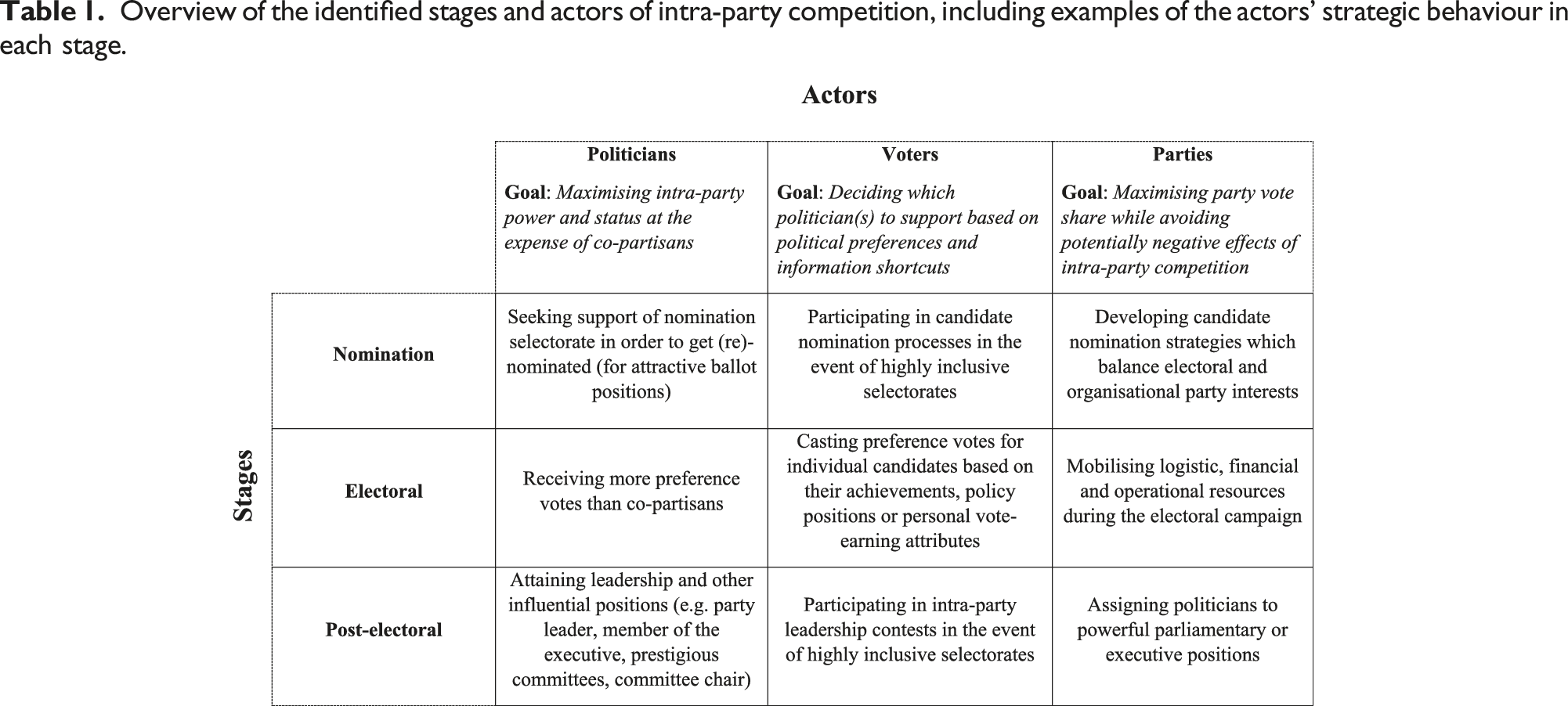
The current symposium includes articles that cover intra-party competition focusing on different stages of the electoral cycle and different actors. Before introducing the articles, this editorial introduction presents a novel model that introduces a multi-stage and multi-actor perspective on intra-party competition. We describe how intra-party competition occurs in three stages: (1) the nomination stage, (2) the electoral stage, and (3) the post-electoral stage. Next, we discuss the strategic behaviour of three key actors within the context of intra-party competition: (1) voters, (2) politicians, and (3) parties. We also provide examples of strategic behaviour of each actor in each of the stages. While these different aspects of intra-party competition have already been studied, they have rarely been published under the label “intra-party competition”, even though they directly relate to the issue of competition within parties. In addition, the different aspects of intra-party competition have been mostly studied separately, as such lacking a broad and integrated perspective on intra-party competition. While our ambition is not to provide an exhaustive and detailed account of all possible ways in which intra-party competition may occur, we aim to provide a general overview of when and where intra-party competition can be seen and give some illustrative examples.
A conceptual multi-stage and multi-actor model of intra-party competition
Figure 1 shows our multi-stage and multi-actor model of intra-party competition. The left-hand side of the model identifies three stages of the electoral cycle where intra-party competition might emerge: nomination, electoral and post-electoral. The right-hand side lists the three crucial actors of intra-party competition in representative democracies: voters, politicians and parties. In addition, the model includes two factors which moderate the link between the stages and actors of intra-party competition: electoral institutions and electoral vulnerability. The model is a simple presentation of a more complicated process with interactions between the different stages and actors. It does not aim at providing a detailed overview of all possible interactions, but proposes a basic and straightforward presentation of the stages and actors involved in the process of intra-party competition. Multi-stage and multi-actor model of intra-party competition.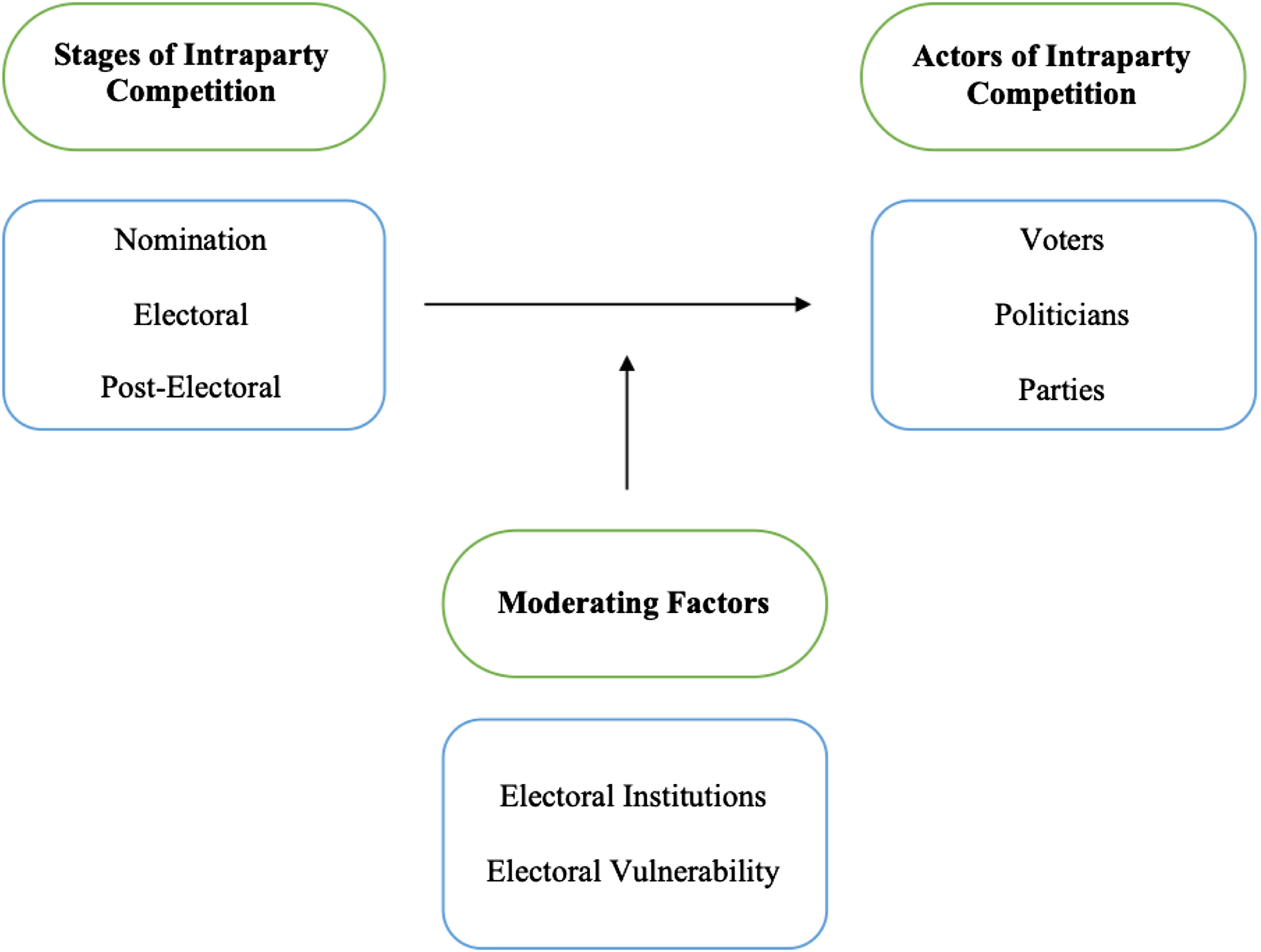
Three stages in the electoral cycle
In the nomination stage, the aim of intra-party actors (i.e. candidates, groups of candidates, party factions) competing against one another is to get (re-)nominated for the next election. In this stage and depending on the type of electoral system, not only (re-)nomination in general but also getting access to the most attractive ballot positions can be considered a focus of intra-party competition. A considerable body of literature has already examined which candidates get the most attractive positions on the ballot, and has pointed out that prior political and electoral experience, demographic characteristics such as gender, age, education, and candidate’s wealth have an important impact on the likelihood of being nominated (e.g. Gherghina and Chiru, 2010; Put and Maddens, 2013; Chiru and Popescu, 2017; Ceyhan, 2018; Put et al., 2021). The majority of these studies focus on closed and flexible-list PR systems where pre-electoral rank order largely determines who gets elected. However, even in open-list PR and free list systems (with or without alphabetically ordered lists), higher list positions are known to increase the number of preference votes and thus the chance of being elected (Lutz, 2010; Söderlund et al., 2021). The nomination stage does not only include the formal candidate selection procedures applied by parties, but also the informal talks and negotiations, which take place in the weeks and months prior to the formal selection process. This makes pinpointing the empirical starting point of the nomination stage highly challenging: the timing of these informal aspects of candidate nomination processes varies over different parties and, more often than not, public information on such aspects is unavailable. The empirical end point of the nomination stage, however, is more straightforward to identify and coincides with the final approval of the selected candidates running for public office under the party label.
In the electoral stage of intra-party competition, 1 the focus lies on the competition between electoral candidates belonging to the same party and the distribution of preference votes between them. Analysing the determinants of intra-party electoral success is a core focus of this stage. The electoral stage also addresses the strategic behaviour of actors during the election campaign and how such behaviour affects the electoral success of election candidates, measured in terms of the distribution of preference votes. 2 In our understanding, the second stage of intra-party competition can thus be empirically studied only in electoral contexts where candidates can receive individual preference votes and compete electorally with co-partisan candidates. The vast majority of existing studies focus in particular on preferential list PR cases (e.g. Marcinkiewicz and Stegmaier, 2015; Van Erkel and Thijssen, 2016; Von Schoultz and Papageorgiou, 2021; Isotalo et al., 2020). These studies highlight the importance of candidates’ ballot position, local-level experience, incumbency status, media attention, celebrity status and ideological positioning vis-à-vis their party for their individual electoral score. The electoral stage starts when the electoral candidates running for the party are formally nominated and ends on election day.
Finally, the post-electoral stage of intra-party competition refers to the continued battle for power and status between politicians after elections have taken place. In line with Katz and Mair’s (1993) classic work on the organisational faces of political parties, we identify three loci of post-electoral intra-party competition: the party in public office, which refers to both the parliamentary representatives and the government members of the party; the party in central office, which refers to the extra-parliamentary party organisation (including professional party staffers) responsible for the coordination of political and electoral activities; and the party on the ground, which is represented by local party sections, party members and grassroots links with society.
Intra-party competition within the party in public office refers to competition between co-partisans who assume public office in central democratic institutions such as the executive and parliament, after elections have taken place. For example, competition may occur among elected MPs for leadership positions in their parliamentary group or for membership of the most prestigious parliamentary committees. Previous research has for example shown how gender affects committee membership, with women being best represented on committees handling issues of family, health and social policy and least well represented on more prestigious and powerful committees handling issues of foreign affairs, defence and economics (e.g. Coffé et al., 2019). Another example of intra-party competition in the party in public office is competition over cabinet positions. Research has highlighted the importance of factors such as screening and selection mechanisms (Fleischer and Seyfried, 2015), balancing between intra-party factions (Dowding and Dumont, 2009), the dominant principal (i.e. prime minister, party or coalition as a collective entity) to which the individual cabinet member responds (Bäck et al., 2016) or descriptive characteristics such as gender (Claveria, 2014; Goddard, 2021) for the likelihood of being appointed to a cabinet position.
Besides competing over intra-party power and status while having a position in public office, co-partisans can also compete over power and status within the party in central office after the election. The most well-known example of trying to achieve power and status in central office is to participate in party leadership contests. These contests typically take place during the post-electoral stage, temporally well-removed from the elections and parliamentary nomination processes (So, 2021). As regards intra-party competition in the party on the ground, co-partisans who do not hold public office but may want to improve their status within the party could gain membership in civil society organisations (Arter, 2013) or attain local political office (Put and Maddens, 2015) in-between elections.
In our model, intra-party competition is thus a continuous concern for politicians throughout the entire electoral cycle; it starts during the nomination stage and continues during the electoral and post-electoral stages. Intra-party competition is not limited to receiving the highest number of preference votes on election day. Assuming that intra-party competition would only occur during the electoral stage would imply that intra-party competition is completely non-existent in the context of closed-list PR systems, where voters are not able to cast preference votes. Yet, even in such systems, intra-party competition occurs, for example between co-partisans interested in being nominated or between parliamentarians who want to be members of a prestigious committee. 3
The strategic behaviour of voters, politicians and parties within the context of intra-party competition
The above discussion of the three stages where intra-party competition may occur shows clearly that politicians, in their roles of (potential) electoral candidates, elected MPs or aspiring cabinet members, are crucial actors in each stage. It also illustrates that the focus of the specific group of politicians differs between the different stages, and the group itself becomes narrower during the electoral cycle: all aspirant candidates in the nomination stage; only those who made it to the party list in the electoral stage; elected MPs and cabinet members in the post-electoral stage. In each of the three stages, the politicians’ goal is to maximise their own success, often at the expense of their co-partisans who are campaigning, running for election or holding office for the same political party. To gain intra-party success, politicians may engage in personalised political activities throughout each stage of the electoral cycle. During the nomination process, potential candidates will try to get the attention of the selectorate for example by highlighting their relevant experience or previous engagements within the party. As electoral candidates, politicians aim to dominate the campaign vis-à-vis their co-partisan candidates via higher personal campaign spending or highly personalised campaign messages or styles (Zittel and Gschwend, 2008; Zittel, 2015). Furthermore, elected MPs can engage in personalised parliamentary activities hoping that such activities will lead to a more dominant position within the party group, or to electoral gains or selectoral rewards in subsequent nomination processes and elections (Papp, 2019; Däubler et al., 2018; Yildirim et al., 2019; Louwerse and Van Vonno, 2022).
A second important actor in our model of intra-party competition is the voter. In a context of intense intra-party competition where preference voting is possible, voters will be more inclined to cast preference votes for individual candidates than elsewhere (André et al., 2012; Passarelli, 2020). When making their decision about which candidate to support, voters will rely on various types of cues or shortcuts to guide them (Lau and Redlawsk, 2006). These shortcuts will reduce the time and effort to decide which individual politician to support. Examples of such shortcuts include candidates’ political experience, party affiliation, personality traits, appearance, visibility and local roots (Berggren et al., 2010; Clifford, 2014; Järvi et al., 2021; Coffé and Von Schoultz, 2021; Collignon and Sajuria, 2018; Lenz and Lawson, 2011; Shugart et al., 2005).
The third and final central actor in our model of intra-party competition is the political party, whose primary goal within the context of intra-party competition is to maximise its vote share while avoiding potentially negative effects of intra-party competition, such as internal divisions, ideological incoherence and weakened party labels (Cheibub and Sin, 2020). To find the balance between these two concerns and to foster their desired outcome, parties will be inclined to manage internal competition. Management of intra-party competition can be achieved by developing specific candidate nomination strategies that prefer certain candidate types over others (Nemoto and Shugart, 2013; Arter, 2013), or by mobilising logistic, financial or operational resources which help the party’s preferred individual candidates to win the intra-party race (Cheibub and Sin, 2020; Put et al., 2022). Examples of these resources arranged by the party organisation are offering financial transfers, media attention and training to preferred candidates, or allocating more speech time to specific MPs during plenary parliamentary sessions.
While the parties’ overall goal is maximising party vote share, parties should not be considered as unitary actors in this context. In fact, the specific actor within the party in charge of managing internal competition may vary over the three stages identified in our model: the selectorate within the nomination stage, those responsible for the mobilisation of logistic and financial resources in the electoral stage, and those responsible for the nomination of, for example, ministerial positions and committee membership in the post-electoral stage. The nature of these different actors may also differ depending on the internal party regulations and procedures. For example, depending on the degree of inclusiveness, the nomination selectorate consists of a single party leader, an elected or non-elected party agency, party members or - in the case of open primaries - all voters.
While the three actors (politicians, voters and parties) have different roles and strategies within the context of intra-party competition, they do not act in a vacuum but strategically interact with one another. For instance, Gschwend and Zittel (2015) show that voters need to be asked by candidates to personalise their votes in the context of intra-party competition; suggesting an interaction between voters and politicians in the electoral stage. Furthermore, party selectorates may choose to reward candidates with strong electoral track records in previous elections with more attractive ballot positions for future elections (André et al., 2017). This example corresponds to strategic interaction between political parties and politicians during the nomination stage of intra-party competition, but also between parties and voters as parties appear responsive to voter preferences.
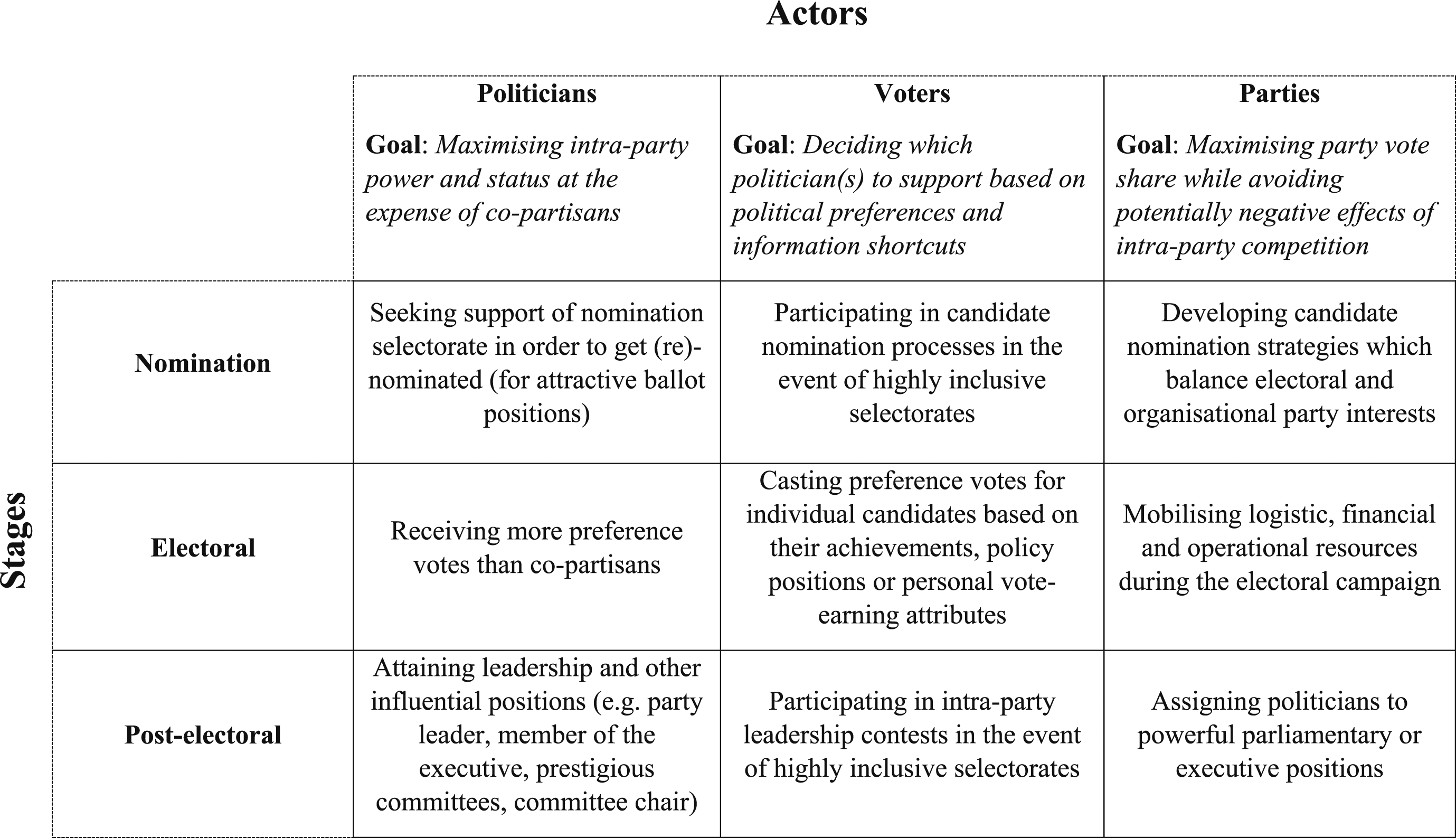
Overview of the identified stages and actors of intra-party competition, including examples of the actors’ strategic behaviour in each stage.
The moderating effect of electoral institutions and electoral vulnerability
Our model identifies three separate stages in which intra-party competition takes place, and three key actors who behave and interact strategically within the context of intra-party competition. We acknowledge, however, that the electoral context strongly moderates the nature of intra-party competition over the various stages and the behaviour of the actors in each stage. We particularly highlight the importance of electoral institutions and electoral vulnerability in this regard, based on a set of examples.
A large body of literature describes the importance of electoral system dimensions in explaining various types of politicians’ legislative and electoral behaviour (Carey and Shugart, 1995; Shugart et al., 2005André et al., 2012; Selb and Lutz, 2015; Sieberer, 2006; Zittel, 2015). This similarly holds for strategic behaviour within the context of intra-party competition, as several aspects of the electoral system can be linked to the degree of intra-party competition. Ballot type, for instance, is related to the degree of party control over who gets elected. According to some scholars, open list PR systems are more conducive to ‘rampant’ intra-party competition and may lead to corruption and patronage (Chang and Golden, 2007) or weakening party labels and organisations (Mershon, 2020).
Another example of a relevant electoral institution within the context of intra-party competition is the distinction between single versus multiple preference votes. It is argued that candidates face stronger incentives to cultivate personal votes in systems where voters can only cast a preference vote for a single candidate (Carey and Shugart, 1995). This feature is considered to foster fierce competition within party lists, as co-partisans compete for the indivisible support of the individual voter. Conversely, in systems where voters are able to cast multiple preference votes, intra-party competition is expected to thrive at a lower level. In an experimental study on the use of the multiple preference voting option, Nagtzaam and van Erkel (2017) find partial evidence that lower ranked candidates on the list benefit from the multiple preference voting option, which creates a more level playing field between co-partisans.
Furthermore, parties in electoral systems with vote pooling (i.e. where votes cast for an individual candidate of the party are taken into account in the party total vote in the district, as in open List-PR) might have lower incentives to strictly coordinate personal vote totals of their candidates than in non-pooling systems such as Single Non-Transferable Vote (SNTV) (Bergman et al., 2013).
An additional example of how the electoral system may influence intra-party competition is the difference between Single Member District (SMD) and Proportional List (PR) systems. The electoral system is, for instance with regard to the gender dimension of internal competition, a critical institution shaping men’s and women’s odds of winning office, with women being better represented in countries with PR electoral systems compared to countries with SMD electoral systems (Iversen and Rosenbluth, 2010), or women being more likely to be elected as list MPs compared with district MPs in Mixed Member Proportional (MMP) systems (Coffé and Davidson-Schmich, 2020). Hence, the intra-party competition between women and men candidates and elected MPs will be affected by the electoral system used, with stronger competition in PR compared with SMD systems.
A final example of an institutional characteristic that may influence the internal competition - in particular between candidates - is positive action measures such as quotas or reserved seats, aiming to increase the representation of politically underrepresented groups. When such measures are introduced, this obviously intensifies the competition between those traditionally overrepresented in parliament and the marginalised groups, e.g. women and men in case of gender quotas or ethnic majority and minority candidates in case of reserved seats for ethnic minority groups.
Besides electoral institutions, electoral threats or losses are expected to influence the strategic behaviour of the different actors in the context of intra-party competition. Parties may, for example, compose lists differently after an electoral loss, hoping to attract new voters with new - and possibly more diverse - candidates. Weeks et al. (2023), for example, introduce a novel concept of strategic descriptive representation which suggests that parties will increase their number of women MPs after an electoral loss with large gender gaps in voter support to attract previously untapped women voters. They empirically confirm this strategy among European radical right populist parties. In a context of intra-party competition, candidates campaigning for parties facing an electoral loss may also be more inclined to plan a personalised campaign, to focus as such on their own merits rather than their party’s with the aim of winning a seat despite their party’s anticipated loss. A final example of how electoral threat may influence the intra-party competition relates to the competition between elected MPs over committee memberships or positions as chairs. After an electoral loss, a parliamentary party group will have fewer committee chairs and memberships in prestigious committees to distribute, which increases the competition between MPs for the chair positions and membership in the most prestigious committees.
Content of the symposium
The studies included in the current symposium focus on the strategic behaviour of the three actors of intra-party competition and cover the different stages we have identified in this editorial introduction. Starting with the articles focusing primarily on politicians, Söderlund and von Schoultz focus on politicians during the electoral stage of intra-party competition and investigate the vote trajectories of electoral candidates over six consecutive parliamentary elections in the Finnish open-list PR system. Based on a longitudinal data set on more than 1700 candidates, the authors find that candidates’ demographic characteristics and personal vote-earning attributes affect the development of their personal electoral support base throughout their careers.
Also looking at preference voting, Dodeigne and Pilet seek to test how candidate-level, list-level and district-level factors affect the distribution of preference votes across candidates. Relying on an original dataset of actual ballot papers cast for the 2018 Belgian local elections, they highlight how some ‘subtop’ candidates attract support from voters who do not support the leader of the list, suggesting a pattern of what they refer to as “oligarchized personalization.”
The focus of Bucher’s contribution lies on politicians’ behaviour during the post-electoral stage of intra-party competition and how it affects renomination. More specifically, it shows how MPs’ cooperative efforts in the German Bundestag positively affect renomination chances for the subsequent election. As such, Bucher draws attention to the importance of politicians’ cooperative behaviour and position in parliamentary networks to achieve power and status within political parties, instead of engaging in fierce intra-party battles through competitive and zero-sum behaviour.
Moving on to the studies that focus on the role of voters within the context of intra-party competition, Wauters conducts a study on how voters deal with intra-party competition in the context of multi-level states. More specifically, the analysis of preference voting patterns in local elections in Flanders (Belgium) reveals that personalisation at national elections can have an impact on voting behaviour at the local level.
Bräuninger et al. examine the extent to which incumbent MPs enjoy an electoral advantage over outsiders under Preferential-List Proportional Representation (PLPR). Also focusing on the case of Belgium, their survey data reveal that while the performance of incumbent MPs with high visibility in the media does not vary greatly among voters, incumbent MPs with low visibility enjoy an electoral bonus over regular candidates among politically knowledgeable citizens.
A final set of papers concentrates on the role of parties within the context of intra-party competition. Vandeleene analyses the trade-off between different selection criteria (i.e. partisanship, electoral popularity and political competence) during the nomination stage of intra-party competition. Based on in-depth interviews with party selectors from three Belgian political parties, the study describes how selectors balance their choices between candidates in a PR list context where the group equilibrium is almost as important as individual assets.
The contribution of Reiser focuses on the role of informal candidate selection rules and how these have a significant impact on intra-party competition. By studying the case of district nominations in Germany, five central informal rules are identified which shape the expectation and behaviour of actors involved in candidate selection. More specifically, these rules affect the number of aspirants, reduce intra-party conflict, and highlight the role of local party leaders in these selection processes.
Footnotes
Declaration of conflicting interests
The author(s) declared no potential conflicts of interest with respect to the research, authorship, and/or publication of this article.
Funding
The author(s) received no financial support for the research, authorship, and/or publication of this article.
