




Abstract
With growing public distrust toward European institutions, Eurosceptic populist radical-right parties make up almost a third of MEPs in the current European Parliament. As part of the larger scholarly debate on populist parties’ success, this article examines intra-party selection logic for the ‘perfect’ populist radical-right MEP candidate. Using original data from participant observation and interviews with Alternative for Germany delegates during the 2018/2019 European Election Assembly, this study suggests that party members were more likely to be selected as candidates if they (1) possessed extensive network with right-wing social movements to strengthen their electoral mobilization; (2) and showed strong commitment to party cohesion and good reputation to fend off accusations of racism and Nazism.
Keywords
Introduction
European Parliament (EP) elections have experienced decline in participation, with less than half of eligible EU citizens voting for the past 15 years. However, the 2014 and 2019 elections have seen a growing support for populist Eurosceptic parties. Populist parties are especially interested in EP elections. First, one of their core policy goals-dissolution of the EU-is more attainable once such parties participate in the European Parliament. Second, small opposition parties could benefit from the electoral results and EP representation to further their appeal to citizens at national and local elections. The increasing involvement of populist parties in the European Parliament raises an exciting question about their candidate selection procedures for EP elections. What kind of candidates do populist selectors like to see on EP party lists? Focusing on this issue is important for two reasons: first, unpacking the populist selectorate logic behind a successful candidate; and second, setting the initial investigation of whether populist parties exhibit diverging preferences from the mainstream parties in candidate lists.
Scholars have previously examined candidate selection processes and their political consequences in mainstream parties (Hazan and Rahat, 2010; Kenig et al., 2015), and recently in populist parties (Caiani et al., 2021; Höhne, 2021). However, the question of what candidate characteristics populist parties prefer remains insufficiently answered. To unveil the selectorate logic for the European Parliament candidate lists, I take the populist radical-right Alternative for Germany (AfD) as a case study and examine selectorate behavior, using novel interview and participant observation data from the 2018/2019 Federal Assembly.
Theoretically, this article emphasizes the distinct preferences of populist radical-right parties during candidate selection: (1) the perceived importance of right-wing social movements in electoral mobilization; and (2) the necessity for such parties to navigate carefully around social stigmatization stemming from Nazi legacy and extremist activities. Methodologically, the study contributes to previous scholarship by expanding the data to all party nominees in the selection process, instead of analyzing only the finalized candidate list. Also, unlike studies employing conjoint experiments (Berz and Jankowski, 2022; Rehmert, 2022), here the interview and participant observation design allows for examining delegates in their ‘natural environment’, considering specific personal factors and party dynamics that may influence the selectorate.
Intra-party road to European Parliament mandate
Populist radical-right (PRR) parties share the electoral competition arena with mainstream parties and face similar challenges of balancing vote-, office-, and policy-seeking goals. First, I discuss candidate criteria, shared by mainstream parties, such as party involvement and previous legislative experience. Second, I propose a theoretical argument that PRR selectorate decisions are shaped and constrained by the elements of populism and radical-right ideology.
Party involvement and legislative experience as candidate criteria
Candidate selection would depend on the selectorates’ political goals: obtaining office would require competence and unity; vote maximization would favor electability; while policy prioritization would focus on candidates representing the policy preferences of party members (Vandeleene and Van Haute, 2021). Research on candidate selection in mainstream parties shows that selectorates have adopted specific formal and informal conditions such as membership seniority, party involvement, support from party factions, previous legislative experience, and incumbency (Hazan and Rahat 2010; Pilet et al., 2015).
Selectorates frequently prioritize candidates with established commitment to the organization, indicated by membership seniority and party office positions. Seniority measured as membership duration may be interpreted as a sign of party loyalty, while holding party office demonstrates reliability, as nominees have committed to managing the party organization and establishing internal networks. Studies on Germany, Italy, and Spain show varying results. A deciding factor for candidate selection in Spanish parties is active party involvement, with rank-and-file members first moving up the ladder of party offices before being considered for electoral lists (Coller et al., 2018). Similarly, party officers were overrepresented in top-list positions for the 2013 Italian general election (Galasso and Nannicini, 2015). However, in Germany, seniority and party office did not increase candidates’ chance of obtaining list positions for the 2013 Bundestag election (Ceyhan, 2018).
Decisions over political personnel may also depend on factional dynamics, where different subgroups aim for top-list positions while the party attempts to establish a balanced ticket. In the French Socialist Party, belonging to a faction is necessary for members to gain political office, and patronage of faction leaders is especially important for becoming an MEP candidate (Hertner, 2018). Over time, German parties such as the CDU, SPD, and the Greens have established informal quotas to include candidates from intra-party groups and factions (Reiser, 2014).
Voters also prefer parties with experienced candidates for national and EP elections (Hobolt and Høyland, 2011; Pemstein et al., 2015). Responding to popular demand, selectorates tend to favor MEP nominees with prior legislative experience over newcomers (Frech, 2016; Pilet et al., 2015). German parties favor Bundestag incumbents or nominees with previous political office at the local or state level (Ceyhan, 2018; Rehmert, 2022). For the 2019 EP election in Italy, sixty percent of the MEPs from the radical-right Lega and thirty-five percent from the populist Five Star Movement had previous political offices, mostly from local mandates (Rombi and Seddone, 2019).
Distinct preferences of the populist radical-right selectorate
Involvement with local communities and social movements
In times of economic and social crises when major parties have ignored or actively marginalized non-elite interests, citizens turn to populist ideas to show their dissatisfaction with the establishment and the current state of democracy. In response, populist parties mobilize popular discontent, promising to defend ‘the people’ from the ‘corrupt elite’ and appropriately address their local grievances (Mudde, 2004; Kriesi, 2014).
Additionally, populist radical-right parties focus on particular economic and cultural demands. Nostalgia for the industrial past and fear of economic decline, especially among working-class people in coal-mining communities, as well as perceptions of cultural threat such as immigration and LGBTQ + rights are closely related to PRR support (Arzheimer and Berning, 2019; Thorleifsson, 2019).
As voters value politicians with local roots (Campbell and Cowley, 2014; Jankowski, 2016), PRR selectorates may prioritize candidate who have shown responsiveness to citizens’ demands by actively organizing grassroots events and maintaining ties with local communities. Such a strategy may directly strengthen the parties’ ‘populist promise’ of appearing close to the people and being their ‘true’ representative. Also, one could expect radical-right politicians to share similar life trajectories with their electorate. For instance, Sweden Democrats candidates have comparable experiences of economic precariousness with their voters, such as increasing job insecurity and disposable-income losses (Dal Bó et al., 2021). Also, German radical-right and radical-left selectorates are more likely to nominate working-class candidates than mainstream parties (Matthews and Kerevel, 2022).
In their pursuit for voter mobilization, populist parties have also engaged with social movements. Populist movements have given rise to political organizations in the case of the Spanish Podemos or re-shaped existing political parties such as the Tea Party impact on U.S. Republicans (Della Porta et al., 2017; Skocpol and Williamson, 2012). Movement-party interactions have also significantly affected the radical-right: for instance, the impact of extremist Ordre Nouveau (ON) on the establishment of the French National Front in the early 1970s (Ignazi, 2003), or the close relations between the neo-fascist movement Casa Pound Italia (CPI) and the Italian Lega (Pirro and Castelli Gattinara, 2018).
Radical-right parties and collective actors can create a symbiotic relationship, where on one hand, movements would use such parties as institutional channels to spread their message and eventually impact policies. On the other hand, PRR parties would strengthen their legitimacy and electoral performance, as they appear responsive to grassroots protest, while borrowing the established networks and material resources of far-right movements (Castelli Gattinara et al., 2021; Weisskircher et al., 2022).
Thus, I argue that close engagement with local communities and social movements are important candidate selection criteria. AfD delegates would prefer candidates with close contact to coal-mining districts in the East and West, and with personal commitment in religiously conservative areas in the South. In addition to local ties, the selectorate would favor candidates with established cooperation with diverse right-wing groups. In East Germany, the AfD has closely worked with nationalist and radical-right movements such as PEGIDA, the Identitarian Movement, and Future Homeland (Zukunft Heimat). In the South, the party has engaged with traditional family organizations and conservative evangelical networks.
Party cohesion and good reputation
In pursuit for voting maximization and obtaining office, political parties also focus on preservation of internal cohesion and good reputation. Voters strive to choose a ‘good type’ of political leader, and thus place high value on candidates with principles and consistency (Fearon 1999).
Party cohesion can ensure survival, while divisions could lead to poor electoral performance (Boucek, 2012). Agreement and loyalty are highly valued, while party exits are described as the “ultimate lack of cohesion” (Nielsen et al., 2019). Another process that may damage cohesion is ‘voicing discontent’. Internal expressions of dissatisfaction about policies or allocation of resources are part of intra-party democracy; however, such infighting can become detrimental to the party image if made public, and even lead to party collapse (Boucek, 2012).
Stigmatization has also been recognized as a major obstacle to the electoral success of radical-right parties. Presence of extremist activists has contributed to the electoral failure of radical-right parties, damaging their ability to appear legitimate and attract a wider sector of the electorate (Art, 2011). It can even lower support for such parties among voters with existing anti-immigrant attitudes (Van Spanje and Azrout, 2019).
PRR parties can face both a political ‘cordon sanitaire’, where mainstream actors refuse to cooperate with parties with fascist legacy, and ‘demonizing’ media coverage, exposing information about ties to neo-Nazi groups and anti-democratic behavior (Art, 2011; Van Spanje and Azrout, 2019). For instance, the radical-right in France, Germany, and Sweden has experienced systemic political exclusion as a response to their extremist past (Art, 2011; Ivaldi, 2016; McDonnell et al., 2021). German society has implemented containment of such parties “close to perfection”, bringing them to organizational and electoral atrophy (Art, 2011: 79).
Extremist past and perceptions of bad reputation can also influence the PRR’s ability to join political groups in the European Parliament. For instance, in 2014, the radical-right Danish People’s Party and the Finns Party refused to accept the Sweden Democrats in their ECR group because of perceived domestic reputation costs (McDonnell and Werner, 2018).
PRR parties have adopted diverse strategies to create a ‘reputational shield’ and battle accusations of racism and extremism (Ivarsflaten, 2006). A prominent example of strengthening the French National Front’s legitimacy was Marine Le Pen’s consistent efforts to distance the party from extreme statements, exclude radical members, and attract competent candidates (Ivaldi, 2016). Other strategies to counter allegations of racism have involved selecting ethnic minority candidates, such as the recruitment of Sikh by the British National Party (Goodwin, 2010).
The AfD has experienced frequent incidents of extremist behavior from party members such as revisionist statements about the Nazi period and collaboration with neo-Nazi groups. In addition, numerous collective exits have disturbed party cohesion and costed the AfD political mandates: (1) in 2015, founder Bernd Lucke and moderate followers established the ‘Liberal Conservative Reformers’; (2) in 2017, party leader Frauke Petry and conservative members founded the ‘Blue Party’; (3) in January 2019, Saxony Anhalt’s regional leader Andre Poggenburg formed the radical-right party ‘Awakening of German Patriots’. Thus, to maintain party cohesion, AfD delegates use the candidate selection process as a tool of disciplining nominees who have shown support for former party leaders or contributed to weakening unity. As stigmatization can have detrimental electoral impact on the AfD, I also expect the selectorate to favor candidates with no public scandals and extremist involvement, discrediting the party reputation.
Methodology
Case selection
Unlike earlier radical-right parties which have enjoyed only ephemeral success and failed to gain more than a handful of elected representatives in local and state parliaments, the AfD has managed to build a sizeable legislative base. In the 19th Bundestag term, the party was the third largest political group with 89 MPs; it also has 225 incumbent state representatives among 15 state parliaments and 11 Members of the European Parliament.
The AfD started as a soft-Eurosceptic in 2013, but took a radical turn since 2015, incorporating nativist language and developing ties to extremist groups. Because of frequent incidents of radicalization, some intra-party groups and individuals have gone under observation by the Federal Office for the Protection of the Constitution. The political consequences of such surveillance can be highly damaging, further stigmatizing the party in the eyes of the public, potentially reducing its electoral support and leading to exodus of rank-and-file members.
Formal selection rules
In Germany, candidate nomination processes are governed by Federal Party Law and Electoral Law, which emphasize intra-party democracy and give members or delegates the final authority over party decisions. However, the precise details of candidate selection remain a prerogative of the parties. Formally, the AfD operates within the boundaries of German law, holding delegate conventions for candidate lists for Bundestag and European Parliament.
The AfD federal statute requires candidates to (1) prove at least 5 years of professional experience outside politics (Bundessatzung der AfD, 2017: §19) and (2) submit a police certificate of good conduct before the convention (§5). Additional formal rules are decided in the beginning of each convention. During the 2018/2019 Federal Assembly for the European Elections (Europawahlversammlung), delegates asked for all nominees to (3) share their membership year and (4) give a 7-min speech with three follow-up questions.
Data collection
In addition to codified rules in German law and party statutes, recruitment processes are shaped by informal practices. To explore the ‘secret garden’ of candidate selection in the AfD, I draw upon original semi-structured interviews with party delegates and participant observation at the 2018/2019 Federal Assembly. For two weekends in November 2018 and January 2019, the East German cities Magdeburg and Riesa hosted AfD delegates to select candidates and finalize the party program for the 2019 EP election. Between 450 and 550 delegates participated each day. Around 140 nominees were running for thirty candidate positions.
This study’s primary data is part of a broader 12-month fieldwork in Germany from September 2018 to August 2019, examining intra-party organization and grassroots activities of AfD members. Before gaining access to the Federal Assembly, I contacted via email local, state, and federal politicians for formal interviews. Consequently, some of these politicians extended invitations to observe their local party meetings and introduced me to rank-and-file members. Building trust with radical-right activists is especially challenging because of the ideological distance between them and the researcher (Damhuis and De Jonge, 2022). For instance, in the first 2 months of fieldwork, some AfD members perceived me as a “suspicious left-wing academic” and took time to provide meaningful information. Others directly rejected interactions, afraid that our conversations may be shared with anti-fascist activists and journalists.
Engaging in radical-right activities carries both ethical dilemmas and research opportunities. Researchers may distort their objective position to analyze interactions or run the risk of amplifying the agenda of such parties. However, establishing durable contact and rapport can help get the endorsement by influential party members. I was able to gain unrestricted access to delegates at the Federal Assembly because of a referral by a high-ranking member from the North Rhine Westphalia state leadership.
This study uses direct quotes from twenty delegates, representing a wide range of activists who took part in the selectorate, including local leaders, state and federal politicians, and rank-and-file members. The sample was dominated by ‘founding’ members who joined the AfD in 2013/2014 and members who explicitly identified with a faction or an interest group. I relied heavily on snowball sampling, as delegates whom I met before the Assembly introduced me to their colleagues at the event. Although such technique can provide skewed data, it is also an effective way to reach out to skeptical population, unwilling to share inside information about party processes.
Some delegates were interviewed twice: an initial interview before and a conversation during the Assembly, or a conversation during the Assembly and a scheduled interview a few months later. 1 Data from repeated interactions with delegates provided detailed understanding of the candidate selection process, showing selectorate motivations before, as well as perceptions during and after the selection was concluded. Interview questions were open-ended, focusing on several topics: 1. Formal procedures and informal selection rules; 2. Probing questions about which candidate the delegate would personally favor; 3. Tactics of cooperation between delegates to elect their candidate; 4. Avoiding Nazi stigma and managing internal dissent.
Written or verbal consent was obtained from the participants. Interviewees are given pseudonyms for confidentiality protection, as many AfD members face social risks, such as losing their employment or having their workplace/homes targeted by anti-fascist groups. Some interviews were audio-recorded; only fieldnotes were taken from the Assembly conversations upon delegates’ request. This research project was approved by Boston University’s Institutional Review Board.
Official party documents, internal party correspondence (provided by interviewees), and press archives from April 2013 to January 2019 were used to extract additional information on the profiles of AfD nominees. 2 Background data was gathered on 136 unique nominees for list positions 2 to 30. Position 1 was dropped from the study because it was a coronation of the only nominee-Jörg Meuthen-then an MEP and a federal party leader.
Analysis: candidate selection logic inside the AfD
Characteristics of AfD nominees for the EP election. a
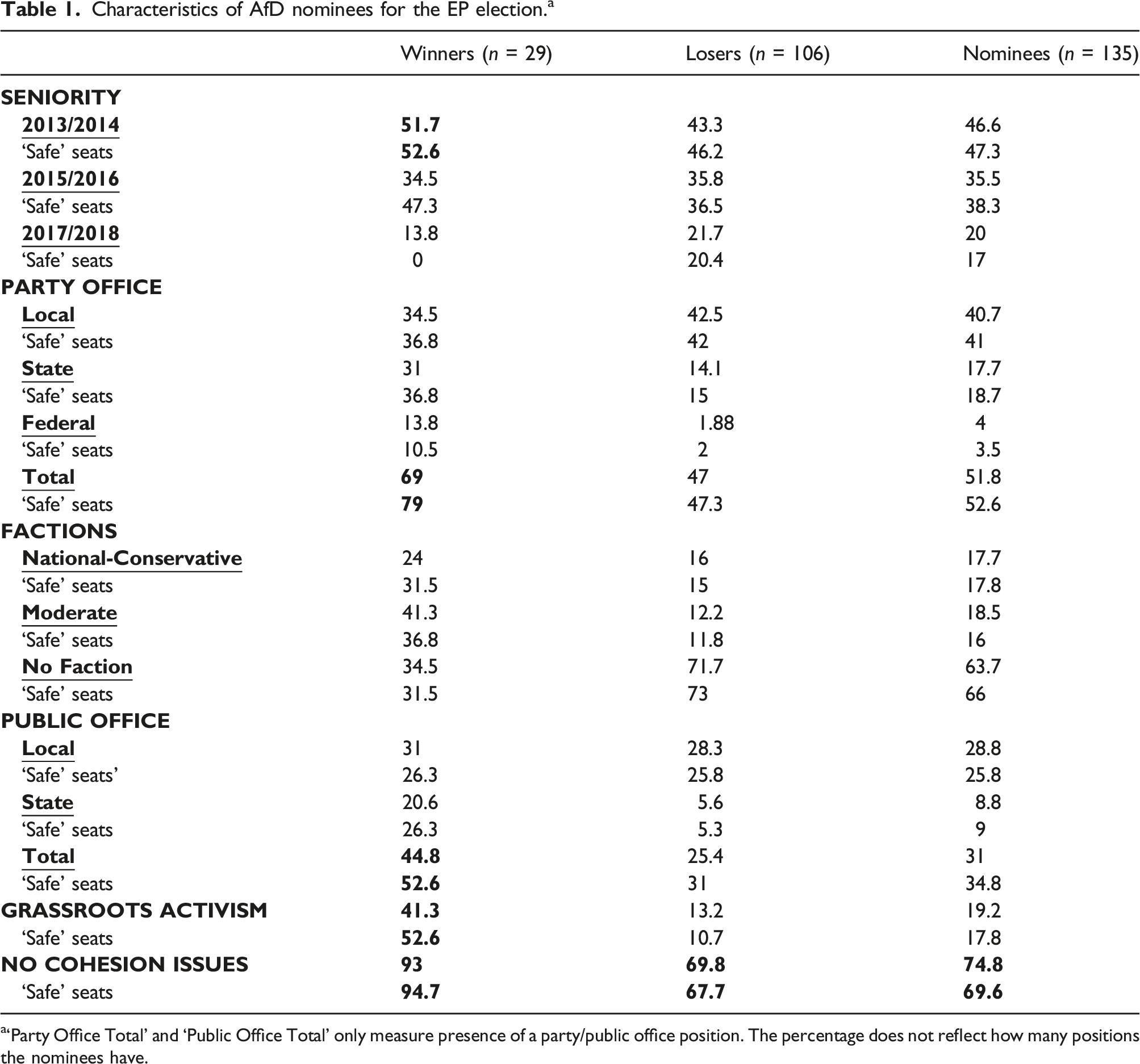
‘Party Office Total' and ‘Public Office Total' only measure presence of a party/public office position. The percentage does not reflect how many positions the nominees have.
Older members were slightly more represented among the winners (51.7 percent) and ‘safe’ seats. Nominees with party office also dominated the winning pool (69 percent). Many nominees did not exhibit open allegiance to a faction; however, ‘moderates’ (41.3 percent), ‘national-conservative Flügel’ (24 percent), and factionless members (34.5 percent) were all among the winners. In line with extant literature (Ceyhan, 2018; Rehmert, 2022), winners were more likely to have held public office than losers, with ‘safe’ seats dominated by members with legislative experience (52.6 percent).”
Grassroots activism and absence of cohesion problems may have also played a role in the candidate selection. The winning pool, especially among ‘safe’ seats, was dominated by nominees with documented engagement in social movements and local communities (41.3/52.6 percent). Also, only 7 percent of the winners were involved in public or intra-party scandals that can damage the party reputation.
The next sections explore delegates’ perceptions and experiences during the European Elections Assembly to examine whether these observed patterns of nominee characteristics have played a vital part in the delegates’ selection logic.
Party involvement and legislative experience
Membership length was used as a sign of loyalty during the selection. Delegates frequently questioned the commitment of nominees who joined the AfD after 2017 and remained non-member supporters [Förderer
5
] for a long period of time. One delegate confirmed about the existence of unwritten rules on party seniority: “The founding members of 2013 are perceived as the ‘golden ones’ – high-class, smart, professionals. Everyone who joined later, especially in 2017–2018, are perceived as ‘lower-class members’ because it took them too long to join the AfD and they remained in the opponent mainstream parties for too long.”
Indeed, more than half of the winners were members from 2013/2014, and used their seniority as a key speech point, sharing their unique membership number and role in establishing state-level party branches.
Delegates also focused on the importance of holding party office positions to evaluate party commitment. Interviewees often shared their frustration that party conventions were time-consuming and exhausting, because “strangers come to the stage” “In the Ruhr region, we had people working at city councils and they left with Mr. Lucke. Until today, nobody represents the AfD. That’s why, we try to have a good look at the candidates and make sure you have known their involvement for several years. Because if someone has joined the party last month and now, they want to go to Brussels, we don’t care. What do we know about him-maybe if he joins the AfD, tomorrow he will choose his job over the party or maybe go to another party.”
Interestingly, almost half of the nominees (48 percent) were normal rank-and-file members. This finding is not surprising because the AfD as a young party with limited resources may be willing to send less experienced members to the EP and keep the ones with leadership skills for electoral mobilization on state and federal levels. East German party branches seem to have adopted this logic as they did not perceive the 2014 and 2019 EP elections as a priority: “…would have been a mistake to send strong personnel from the East to play backbenchers in the rarely noticed European Parliament. We needed our people on the ground to develop strong links with local communities and win local and state elections.”
Aside from addressing diverging preferences for party involvement, delegates were also concerned about balancing factional interests. Interviewees described the candidate selection as a game of dominance between the two main factions-the ‘Moderates’ under federal party leader Jörg Meuthen and the far-right ‘Flügel’ under Thuringia’s state leader Björn Höcke. Being somewhat geographically distributed, Flügel nominees came from East Germany, Bavaria, and Hessen, while moderate nominees represented Baden-Württemberg and North Rhine-Westphalia.
Out of twenty-nine candidates, 12 were Moderates and seven were Flügel. The remaining ten winners did not show explicit loyalty to a faction, neither were perceived a threat to the faction-balance of the candidate list “Flügel mobilizes the people better than the rest. So, the relative weight of them is much higher than it is, party-wise. They are like 20% or so of the party but cause 90% of the problems we have.”
Delegates from East Germany voiced their concerns with the scarcity of Flügel candidates on the list, especially because that faction was responsible for party success “The list was very skewed and did not have enough representatives from the Eastern associations which I think is problematic. Voters in the East will not vote for us because they will see the AfD as a Western party. Not close enough to the Eastern [local] communities.”
Lastly, legislative experience was not a priority for all delegates. It was common practice for nominees in local or state public office to be asked whether they would manage both mandates once in European Parliament. Only delegates from the Youth Wing group were especially wary of members with current mandates. Lukas expressed frustration with nominees who already had the responsibility of political office, but instead of focusing on party work there, wanted to move to the EP: “We try to avoid concentration of power in the hands of a few. If you already are a mandate holder or have a high-level party position, you actually have heaps of work. Do not run for another mandate!”
Similar to mainstream parties, the AfD selectorate considered factors reflecting involvement in the party. Both membership seniority and holding party offices were essential in selection decisions. Whether factional distribution played a significant part is hard to determine since a large majority of the nominees did not belong to a specific internal group. Interestingly, a large minority of winners have held public office, but delegates did not put much emphasis on legislative experience.
Involvement with local communities and social movements
As part of a larger movement-party mobilization strategy (Heinze and Weisskircher, 2021), delegates prioritized nominees with extensive involvement in local communities. Close engagement with citizens and social movements may have contributed to the success of a significant group of list position winners. The AfD was perceived not only an ideological alternative for voters, but also a “responsive home” for citizens to share their concerns. Gerhard, a former CDU member for ten years, claimed mainstream parties had reduced their engagement with local communities only to times of electoral campaigning: “Local CDU associations have degraded us to voting cattle and local politicians act like lords, forgetting they have to serve the citizens.”
To differentiate themselves from the establishment, AfD members were expected to show extensive involvement with citizens and awareness of local grievances before running for office. Delegates from East Germany were particularly averse to political experts, and preferred nominees “who know the local problems and who come from the working class”
In a similar vein, “party celebrities with the grassroots” were more likely to be selected
Similarly, Maximillian Krah, a long-time CDU activist, has been actively involved in another AfD stronghold-Lusatia. In 2016, just before joining the AfD, Krah led a ‘Time to Go’ Initiative (Zeit zu gehen), calling for Brandenburg and Saxony CDU members to join the AfD. More than a hundred CDU activists followed Krah
Social movements can also provide an effective way of electoral mobilization. Since its foundation, the AfD has quickly established contact with right-wing movements. Delegates consistently pointed out collaboration with movements made the AfD a “true democratic alternative” to the mainstream parties “We need these networks to entrench ourselves on the local level. We need their bottom-up structures for mobilization.”
This view is not surprising as AfD functionaries have already depicted East German protesters, such as the 2018 Silent March participants in Chemnitz, as “revolutionaries” and the rallies as “justifiable resistance” similar to the 1968 democratic protests against the GDR regime (Miller-Idriss and Köhler, 2018). At a Brandenburg party convention in February 2019, Birgit Bessin, a Brandenburg state parliament member, also highlighted the importance of radical-right movements: “I don’t see the AfD as a pure parliamentary party… I rely on our independent citizens' movements. I stand by PEGIDA. I stand by Zukunft Heimat in Cottbus, which has made significant contribution to the fact that the South [Brandenburg] has become strong.”
Since the AfD does not shy away from marching with PEGIDA and Pro-Chemnitz, delegates, expectedly, preferred candidates with extensive organizational experience in protests and connections with radical-right movements. List position winners have participated or co-organized rallies with the Identitarian Movement, PEGIDA, LEGIDA, and the ‘One Percent’ citizens’ initiative: Christine Anderson, Maximillain Krah, Mike Monscek, Thorsten Weiss, and Hans-Thomas Tillschneider. Others such as Christoph Brighan and Christoph Radl have been members of the ‘Deutsche Burschenschaft’-a right-wing association of student fraternities in Austria and Germany (Behrens, 2019). The Deutsche Burschenshaft has served as personnel resource for the CDU, but also for extreme-right National Democratic Party (NPD), and populist right-wing parties such as the Republikaner, and now the AfD (Kurth and Weidinger, 2017).
The AfD has also been actively engaged in the Russian-German and traditional family communities in the West and South. To attract Christian conservative voters, Baden-Württemberg activists founded the intra-party group ‘Christians in the AfD’ in 2013, and established strong connections with pro-life and traditional family networks such as the Demonstrations for All (‘Demos für Alle’) and Initiative for the Protection of the Family (‘Initiative Familienschutz’) (Althoff, 2018).
The party has actively targeted ethnic German resettlers from the former Soviet Union-one of the largest immigrant-background groups with the right to vote-by establishing the interest group ‘Russian-Germans in the AfD’ and having Soviet-born Bundestag representatives. AfD functionaries have also participated at numerous foreign electoral observations in Russia, deemed illegitimate: the 2018 observation mission in Russia, Crimea, the Donetsk People’s Republic, and the Lugansk People’s Republic; the 2019 mission in Abkhazia; and the 2020 plebiscite election mission in Crimea (Shekhovtsov, 2018, 2019, 2020).
Some of the selected candidates for the European Parliament reflect the party’s desire to maintain ties with conservative Christian and Russian-German communities. Joachim Kuhs and Michael Adam are founding members and hold managing positions in the ‘Christians in the AfD’. Additionally, Kuhs has been actively involved in the Demonstrations for All movement. Uta Opelt was also selected as a representative of the Russian-German party group. Although unable to win a list position, Leyla Bilge, a prominent women’s rights activist and an “ex-Muslim, converted Christian and proud to be German”, was also favored by delegates. She is frequently the party face for women initiatives against Islamization such as the 2018 Women’s March (‘Frauenmarsch’).
Delegates also preferred nominees who had ties with pro-Kremlin actors. For instance, Rainer Rothfuß is a co-organizer of the Druzhba Russian-German Friendship Initiative 11 collecting donations to send members on annual ‘peace trips’ to Russia. In 2016, Druzhba members met with the Night Wolves, a pro-Putin biker movement, and officials of the ruling United Russia party, and visited occupied Crimea (Laruelle and Rivera, 2019). Hugh Bronson, another favored nominee, participated in AfD delegation to annexed Crimea in 2018. During his nomination speech at the Assembly, Bronson described Crimean annexation as “fake news” and EU sanctions on Russia as “breaking the trust of the Russian-Germans”.
Party cohesion and good reputation
To be electorally competitive, the AfD needs to address two important intra-party issues: cohesion, which could be problematic for a young party with competing factions; and party image, void of scandals pertaining to extremism and Nazism. During its short existence, the party has gone through three major splits. Many former members took away precious mandates, weakening AfD’s political influence. Some followers of Lucke and Petry chose to stay in the AfD, but were often perceived as disloyal and untrustworthy because of their connections with the former leaders: “We are a fermented bunch, we argue over positions and strategies, but at the end of the day we stay loyal to the party…Not like some who switched allegiance quickly-they were Lucke’s friends and now they’re not?” “Markus [Pretzell]
12
is seen as a traitor because he left the party and kept both of his mandates. The same for Frauke, she kept a mandate in Saxony and the Bundestag. And we hate this. We simply hate this.”
North Rhine-Westphalia delegates were concerned their nominees would not have a realistic chance for selection because their party branch still carried the stigma of Petry’s exit
Youth Wing delegates most frequently criticized the relationship between certain nominees and Frauke Petry. It was their mission to exclude people who sided with Petry and Pretzell because they “were not loyal enough and can turn their backs on the party any time” “We work hard on the ground, distributing flyers, putting posters, helping candidates campaign…We make the party strong. But here comes Petry’s friend and wants to get elected? Go to the Blue Party if you want a European seat!”
Delegates were also against members who publicly shared intra-party disagreements. Such an instance was the 2018 Stuttgart Appeal (‘Stuttgarter Aufruf’) organized by Baden-Württemberg activists. The initiative was launched in response to the federal leadership recommendation for party members to avoid participating in non-AfD organized rallies, especially by PEGIDA and other radical-right groups. Signed by 1200 members across Germany, the Stuttgart Appeal warned against leadership’s attempts of ‘political paternalism’ and repression on freedom of expression and assembly.
13
Some supporters even described the leadership as “Stasi regime” and suspected machinations to “remove internal opponents”
Some state leaders responded swiftly to the initiative to reduce damage on party cohesion. Saxony-Anhalt urged members to avoid showing support for the ‘Appeal’ on social media “Every minute we lose in internal struggles, we need in the fight against the political competition for Germany’s future!…The Stuttgart Appeal fuels mistrust of the party's organs. Such an approach is divisive, harmful and undignified.”
Observing this unified response from several party branches, one can expect delegates at the Assembly to be wary of allowing ‘Appeal’ supporters the opportunity to win European mandates. Two of the initial ‘Appeal’ signatories, Christiane Christen and Georg Hock, reached the run-offs but unable to win a position. Delegates perceived their involvement in the ‘Appeal’ as weakening cohesion and potentially damaging the party’s electoral success: “Internally everyone can say anything anyway. It must stay that way, but to the outside the party must appear as a strong, united body.” “There must be minimal consensus inside the party what the party program is and what you are talking about. We must give the people the impression we know what we are doing.”
In addition to party cohesion issues, the AfD faces yet another challenge. PRR parties operate in a social environment requiring an ‘acceptable’ version of nationalism for the wider population to participate in it-a version of nationalism that does not carry violence, Nazism, and fascism. The AfD has attempted to dissociate from activities considered National Socialist, just like the French National Front distanced itself from anti-Semitic behavior (Ivaldi, 2016)
Since 2015, when the AfD took a radical nativist turn, members have experienced consistent social and political backlash from media, mainstream parties, and anti-fascist movements. With electoral success in the East, the term “Dark Germany” (‘Dunkeldeutschland’)
15
has resurfaced to metaphorically describe the rise of racism, xenophobia, and violence against foreigners in the Eastern states. In February 2016, the Hamburg Morning Post
16
featured a map of Germany with Saxony in brown, alluding to the “Brownshirts” paramilitary wing of the Nazi Party. This was one of numerous instances AfD delegates mentioned when they described being hit by the so-called ‘Auschwitz-cudgel’ (‘Auschwitzkeule’
17
) because of their political ideas: “It means if I don’t have any good argument against you, I take the Auschwitzkeule out and hit you with: “You are anti-Semite, you are a Nazi.” “In nowadays Germany, since the 1990s, it has become common to use the Auschwitzkeule in political debate. This is a problem because in some cases it may be justified, but you cannot use this as the killer argument all the time.”
Although AfD activists fulminated against the ‘Auschwitzkeule’ used on them, they also understood that for the party to be a socially and political tolerated electoral alternative, they should carefully choose candidates with no public scandals: “We need candidates that can survive the Auschwitzkeule. Everyone who is an immigration critic will be marginalized and defamed. Not only ignored, but will be titled as “Nazis”. And this is vicious because “Nazi” is the worst label you can give a German.” “We can talk about the history from 1935 to 1945 but it doesn’t bring us one vote. It doesn’t help us in any way. It only makes us vulnerable to attacks from all other sides.”
Delegates were not particularly against the discussion of Nazi history because the AfD was “a place of tolerance for debate of controversial ideas”
Specifically referring to anti-Semitic statements made by Wolfgang Gedeon in 201,6
18
(then a Baden-Württemberg parliament member), Johan described the destructiveness of such rhetoric on party reputation: “It does not have to be that somebody says something crazy, but that it gets cut to pieces by the media and is presented as wrong. I cannot just say anything that comes to my mind, without considering what that means for the party and maybe the others [members] do not stand at all behind it.”
Indeed, during the Assembly, delegates have openly questioned nominees’ involvement in scandals such as Christian Christen and Stephan Räpple. At the time, Christen was facing exclusion proceedings because of close contact with former NPD party official Sasha Wagner
The AfD has attempted to disconnect itself from racism accusations and ideological ties with fascism, as delegates disproved of nominees who participated in neo-Nazi conventions (Arnulf Froelich) or made anti-Semitic statements (Reiner Gross; Georg Hock; and Felix Thiessen). Interestingly, although Holocaust denial and extremism have led to party exclusions, collaboration with anti-immigrant and nationalistic movements is still part of the recipe for a successful political career.
Conclusion
This study suggests that delegates favor nominees with strong party commitment and cooperation with social movements. Members, rarely active at the grassroots level, relatively new to the party, not having a party office, and having damaged party reputation or unity are likely to be rejected. To a certain extent, delegates use membership seniority and party office positions to evaluate members’ loyalty and experience with organizational tasks. The selectorate also puts great emphasis on nominees’ ability to maintain relations with civil society groups and local communities, a particularly important factor for carrying out the populist promise of being ‘close to the people’. A last key characteristic in the selection logic is whether nominees can strengthen the party image of a competent political force by avoiding involvement in party infighting and public scandals. Populist radical-right parties especially suffer from internal fights and negative reputation related to anti-Semitic and extremist behavior. Thus, party delegates favored candidates who could appear socially ‘acceptable’ to the wider public.
These findings, while only stemming from a single PRR party, contribute to a growing scholarship addressing the role of parties as gatekeepers in deciding the compositions of elected institutions. This article addresses two important issues. First, it aims to unpack populist parties’ internal processes in candidate selection. Second, it brings new light to how such actors seek access to the European legislative arena. Building on this study, future research on populist radical-right parties can focus on examining whether and to what extent RRPs are adapting to the electoral and political game of mainstream parties, instead of challenging and reforming the rules. The AfD selectorate has exhibited preferences for their candidates that could make an outsider stigmatized radical party appear acceptable, legitimate, and competent. Also, analyzing comparatively the candidate selection logic of other populist parties can shed light on whether such parties may actually contribute to reducing the perceptions of democratic deficit and increasing the trust in EU institutions among Eurosceptic voters.
Supplemental Material
Supplemental Material - The road to European parliament mandate for populist radical-right parties: Selecting the ‘perfect’ AfD candidate
Supplemental Material for The road to European parliament mandate for populist radical-right parties: Selecting the ‘perfect’ AfD candidate by Valeriya Kamenova in Party Politics
Supplemental Material
Supplemental Material - The road to European parliament mandate for populist radical-right parties: Selecting the ‘perfect’ AfD candidate
Supplemental Material for The road to European parliament mandate for populist radical-right parties: Selecting the ‘perfect’ AfD candidate by Valeriya Kamenova in Party Politics
Footnotes
Acknowledgements
The author would like to thank Sofia Perez, Taylor Boas, Jeremy Menchik, David Art, Sahar Abi Hassan, Farah Jan, and Tomoharu Nishino for useful discussions and advice. The author also thanks Liah Greenfeld and Vivien Schmidt for thoughtful feedback in constructing the fieldwork methodology plan of this research project. I also extend my deepest gratitude to interview participants in Germany, who generously shared their time and knowledge.
Declaration of conflicting interests
The author(s) declared no potential conflicts of interest with respect to the research, authorship, and/or publication of this article.
Funding
The author(s) disclosed receipt of the following financial support for the research, authorship, and/or publication of this article: This work was supported by the Boston University.
Data availability
Sharing raw data-interview audio-recordings, transcripts or field notes-may reveal the identity of participants, violating the promises of confidentiality. Radical-right party members can be particularly “at risk” as they may suffer stigmatization (discussed on Page 9 of the article) if their verbatim statements and identities are made public. Requests to access the qualitative data can be directed to the author

Supplemental Material
Supplemental material for this article is available online.
Notes
Author biography
References
Supplementary Material
Please find the following supplemental material available below.
For Open Access articles published under a Creative Commons License, all supplemental material carries the same license as the article it is associated with.
For non-Open Access articles published, all supplemental material carries a non-exclusive license, and permission requests for re-use of supplemental material or any part of supplemental material shall be sent directly to the copyright owner as specified in the copyright notice associated with the article.
