



Abstract
While the gender gap among populist radical right (PRR) voters and representatives has been extensively investigated, little is known about the extent to which women are active as PRR party members. To examine this, I ask: How and why does party activism in PRR parties differ between women and men? Based on the literature on gender and party politics, I expect women PRR party members to be less active than men because they have less motivations to participate, are less embedded in party networks, and are more sensitive to stigma. Drawing on original survey data from thousands of members of the League in Italy and the Sweden Democrats, I find that women PRR party members are overall more active than men because they are more embedded in party networks. This surprising result has important implications for our understanding of women’s participation in parties and the growing normalisation of PRR politics.
The fact that women are less active than men in political parties is one of the most consistent findings in the literature of gender and party politics (Coffé & Bolzendahl, 2010; Verba et al., 1978; Burns et al., 2001). Not only are women less likely to become party members; but even when they join parties, they are not as involved in them as their men counterparts (Cross, 2019; Devroe et al., 2019; Webb et al., 2020). If the gender gap in party activism is an established feature of mainstream parties, it should be even more so in populist radical right (PRR) ones. After all, these have been characterised as Männerparteien (‘men’s parties’) because of the overrepresentation of men among their voters, members, and leaders (Mudde, 2007). We do not know, however, whether men in PRR parties are actually overrepresented among active party members. This is because, on the one hand, studies of party activism tend to focus on mainstream parties, also due to the difficulties of securing cooperation from PRR party officials to obtain membership data (Gauja & Kosiara-Pedersen, 2021; Mudde, 2019). On the other, the literature on women’s participation in the populist radical right has looked primarily at women voters and MPs, rather than party members (Coffé, 2018; Erzeel & Rashkova, 2017). In this study I investigate women’s activism in PRR parties, drawing on original survey data from thousands of members of the League in Italy and the Sweden Democrats (SD). Specifically, I ask: How and why does party activism in populist radical right parties differ between women and men?
Based on the literature on gender and party politics, we would expect women PRR party members to be less active than men due to a series of ‘supply-side’ factors (Norris & Lovenduski, 1995). 1 In addition, the more intense the activity is in terms of the time, interactions, and skills it requires, the larger the gender gap in activism (Coffé & Bolzendahl, 2010; Verba et al., 1978; Webb et al., 2020). Two key sets of supply-side factors which are said to hinder women’s activism are motivations and networks (Norris & Lovenduski, 1995; Verge, 2023). Accordingly, I develop two hypotheses: that women PRR party members will be less active than men because 1) they are less motivated to engage in party activism, for instance when it comes to their sense of political efficacy and electoral ambition; and 2) they are less embedded in personal networks within their parties. While these hypotheses can refer to any party, they are especially pertinent to PRR ones due to, first, the lack of effort that these have traditionally put into promoting women’s party activism (Caul, 1999; Kittilson, 2013); and second, the sexism that characterises their supporters (hence, likely, their party members and elites) (Anduiza & Rico, 2023; Off, 2023). Besides the above hypotheses, I develop a third one based on studies on the gender gap in PRR voting (Harteveld et al., 2017; Oshri et al., 2023): that women will be less active than men because 3) they are more sensitive to the stigma surrounding their membership.
I test these hypotheses on the memberships of the League and the SD. The two PRR parties differ across several country-level features - such as legislative gender quotas and party system - and party-level ones - such as voluntary gender quotas and party origins - which can influence women’s party activism and the role of supply-side factors therein. This ‘diverse case’ research design is well suited to account for the variety of contexts in which women PRR party members are embedded, and provide a solid basis to generalise my findings to other Western European PRR parties (Seawright & Gerring, 2008). The outcome of interest is party activism, that is, ‘activities […] aimed at influencing the policies or the personnel of the state and government’ (Whiteley & Seyd, 2002, 1) and which are carried out by members of political parties. To investigate how and why party activism differs between women and men PRR party members, I use data from original membership surveys conducted between 2021 and 2022 with thousands of party members of the League (N = 1,223) and the SD (N = 9,154). Specifically, I use causal mediation analysis (CMA) (Baron & Kenny, 1986; Tingley et al., 2014) to test the mediating effects of motivations, networks, and stigma in the relationship between gender and party activism.
The surveys reveal a very unexpected finding: women PRR party members are in fact more active than men in low- and medium-intensity party activities (posting/sharing party content online, attending party meetings, distributing flyers) and at least as active as men in high-intensity ones (taking up intra-party offices, standing as candidates). No matter how demanding an activity is, therefore, or how stigmatised the PRR party in question is: differently from mainstream parties, these ‘men’s parties’ can count on a very active women’s grassroots base. In addition, the CMA shows that the relationship between gender and activism is partially mediated by party networks: women PRR party members are more likely than men to have been recruited by the party and to have made new friends in the party since joining, and this helps explain their higher levels of activism. These results are robust for distinct sample subsets, under different variable specifications, and testing for alternative explanations.
The article makes several contributions to our knowledge of gender in political parties and gender and PRR politics. The key contribution is empirical: by showing that women party members are more active than men in PRR parties, my results counter one of the most robust findings of the literature on gender and party politics. That this occurs in ‘men’s parties’ invites us to re-think what we know more generally about women’s participation at the grassroots of political parties, and how it might affect their representation in the organisation’s higher ranks. Theoretically, in focusing on a step of the political recruitment ladder that has received less attention in comparison to voters and elites, namely party members, the article answers recent calls to better integrate the study of gender politics with that of ‘mainstream’ scholarship on parties, such as party membership studies (Kenny et al., 2022; Kenny & Verge, 2016). Finally, my research draws on the first ever comparative survey of PRR party members. This is worth mentioning, given that PRR parties are particularly secretive when it comes to membership data (Ellinas, 2021; Mudde, 2019), and in fact refuse to cooperate with researchers for membership studies more often than other parties (Gauja & Kosiara-Pedersen, 2021; see also Art, 2011). My survey thus represents a unique source of insights into those actors who constitute the ideological and organisational backbone of the PRR party family.
This research has important consequences for our understanding of the electoral growth and normalisation of PRR parties. Scholars have argued that, as PRR ideas and policies become less stigmatised, these parties may be increasingly attractive to women (Blee, 2020; Miller-Idriss & Pilkington, 2017). Reflecting this is recent empirical evidence showing that women are participating more than ever in PRR parties. For instance, since the 1980s, the gender gap among PRR voters has decreased, despite remaining the largest of any party family (Weeks et al., 2022; see also Chueri & Damerow, 2022). Additionally, in the same time-span, the PRR party family has witnessed a rise in the numbers of women elected to national parliaments (Weeks et al., 2022) and women party leaders (Mudde, 2019, 154). My findings help interpret these trends: on the one hand, women PRR party members are active in mobilising more women to vote for PRR parties; on the other, they are enlarging the pool of candidates which PRR parties select from when filling public and party offices. These dynamics are noteworthy, considering that women in the populist radical right can ‘soften’ the image of their parties and increase support for their agendas among the public, especially women (Ben-Shitrit et al., 2022). In other words, gender is a key variable to assess how PRR parties are turning into more socially accepted actors, and gaining popularity in Europe and beyond. Research which adopts a ‘gendered lens’ (Kenny et al., 2022) to the study of PRR parties is needed, therefore, in order to make sense of one of the defining political phenomena of our century.
Women’s Activism in PRR Parties: The Role of Motivations, Networks, and Stigma
While mainstream parties’ memberships have been shrinking for decades (Mair & van Biezen, 2001; van Biezen et al., 2012), PRR parties have witnessed an increase in their numbers of grassroots members (Bardi et al., 2017). In part, this is because some of them have adopted organisational features recalling the mass party model, for instance by developing locally rooted organisations which foster members’ collective identity (van Biezen et al., 2012, 40; Heinisch & Mazzoleni, 2016; van Kessel & Albertazzi, 2021). Sustaining a stable presence on the ground is important for PRR parties since it provides legitimacy for their claim that they are parties of ‘the people’, as opposed to mainstream ones which are said to be evermore detached from ordinary citizens (Albertazzi & van Kessel, 2023; Katz & Mair, 2018). In addition, grassroots members can be valuable ‘ambassadors to the community’ (Scarrow, 1994) who help PRR parties overcome the perceived hostility of the media and provide outreach benefits through their daily contacts (Favero & Zulianello, 2023). While the relevance of grassroots members in established party families may be diminishing, therefore, this does not seem to be the case for PRR parties. Accordingly, membership studies of the PRR party family can offer valuable perspectives on these parties’ organisational expansion and normalisation, at a time when mainstream parties are often withdrawing from the ground and losing public legitimacy (Mair, 2013).
This article focuses on women’s activism as PRR party members. In countries as diverse as Belgium, Brazil, Canada, South Korea and the United Kingdom, women members of mainstream parties are less involved than men in a variety of party activities, from organising party meetings to speaking in them, from leading local party branches to standing as candidates (Cross, 2019; Devroe et al., 2019; Koo, 2021; Ribeiro & do Amaral, 2019; Webb et al., 2020). This trend is consistent not only across world’s regions, but also across the political spectrum, and reflects how women have traditionally participated less than men in party politics. While party membership studies tell us little about the reasons for this, research on women’s political underrepresentation provides important insights on why women party members are not as active as their men counterparts. Explanations for women’s lower levels of party activism include both ‘supply-side’ mechanisms, which refer to gender differences in motivations and networks to participate, and ‘demand-side’ ones, which relate instead to political parties’ rules, norms and practices – for instance in terms of the timing of party activities, gendered division of labour within the party organisation, and (lack of) gender quotas (Krook, 2010a; Norris & Lovenduski, 1995; Verge, 2015). The two sets of mechanisms interact with one another in determining men’s overrepresentation amongst active party members (Kenny & Verge, 2016). Furthermore, both the supply and the demand of women active in parties are shaped by the party context in which women are embedded (Verge, 2023). With regards to party membership and activism in particular, party ideology represents a key variable. Left-wing parties have historically been far more encouraging towards women’s activism than right-wing ones, for instance by adopting gender quotas and establishing women’s party wings (Allern & Verge, 2017; Kittilson, 2006; Norris & Lovenduski, 1995). Accordingly, left-wing parties display smaller gender gaps in their party memberships (Heidar & Wauters, 2019; van Haute & Gauja, 2015), and elect and employ higher proportions of women than their right-wing counterparts (Childs & Kittilson, 2016; Kittilson, 2006; Yong & Hazell, 2014).
In this sense, PRR parties should represent the least encouraging party context for women to be active members. These parties are the least likely to adopt gender quotas, establish women’s wings, and elect women MPs (Allern & Verge, 2017; Childs & Kittilson, 2016; Weeks et al., 2022). All these factors – lack of quotas and women’s wings, and fewer women ‘role models’ as party legislators – should negatively affect both the supply and the demand of active women members. Therefore, even though ‘we know nearly nothing about the role that [PRR] women play […] as party members’ (Erzeel & Rashkova, 2017, 814; see also Coffé, 2018, 209), it seems safe to expect that, as in any other party family, women in PRR parties too will be less involved than men at the party grassroots. The first hypothesis thus states that:
Women PRR party members will be less active than men. At the same time, party activities vary considerably according to their ‘intensity’, which is a function of the social interactions and organisational skills one needs to carry them out (Whiteley & Seyd, 2002). Scholars have identified three categories in this regard. Low-intensity acts are those which ‘do not require party members to walk out of their front door, or have any direct contact with others’, such as social media activity or signing a petition; medium-intensity ones ‘require that individual party members step out of the comfort zone of home and interact […] with others’, for instance when they go to attend meetings and deliver leaflets; finally, high-intensity tasks ‘carry with them a higher level of political and organizational responsibility’, such as standing as candidates or running a local party committee (Bale et al., 2020, pp. 100-101; see also Whiteley & Seyd, 2002). This distinction is relevant for the gender gap in party activism. The more intense an activity is, the more motivations, networks, and exposure it involves, hence the least likely it should be that women will participate in it. Empirical evidence from membership studies provides support for this claim. For instance, Webb et al. (2020) find that women members of British parties tend to get involved in ‘private’ forms of activism which can be done from home, while men are especially active in ‘public’, more intense activities. Echoing this, in her study of party membership in three Asian democracies, Koo (2021) shows that women are almost as likely as men to make financial contributions to their party, but are significantly less likely to attend local and national party meetings. In a similar vein, Cross (2019, 27) writes of party members in Canada: ‘While women […] are underrepresented among party members generally, their presence falls off even more dramatically among activist members, members of local executive bodies, local party presidents and general election candidates’ – all of which can be considered medium- or high-intensity activities. Although this evidence is drawn from members of mainstream parties, one can expect the same trends to be at play among PRR party memberships: more intense party activities necessarily require stronger motivations, networks and greater visibility, regardless of party family. Accordingly, the second hypothesis posits the following:
The more intense is the party activity, the larger is the gender gap in PRR party activism. In the remainder of this section, I develop three further hypotheses on why women PRR party members should be less involved in party activities than their men counterparts, focusing on supply-side factors. The next two hypotheses are drawn from the literature on gender and party politics. Even though they apply to any political party, I emphasise why the mechanisms underpinning them should be exacerbated in PRR ones. The last hypothesis, by contrast, is based on research on gender and the populist radical right, and concerns a supply-side factor – stigma – which is inherent to activism in PRR parties. The first set of supply-side factors which is likely to affect women’s activism in PRR parties are motivations, which relate to the psychological orientations of individuals towards politics. Two motivations in particular shape the supply of members who decide to be active within their parties: political efficacy and electoral ambition (Whiteley & Seyd, 2002). Political efficacy can be defined as ‘the feeling that individual action does have, or can have, an impact upon the political process’ (Campbell et al., 1954, 187), while electoral ambition is ‘the embryonic or potential interest in office seeking that precedes the actual decision to enter a specific political contest’ (Fox & Lawless, 2005, 643). Due to ‘long-standing patterns of traditional socialisation which associate men with the public realm and women with the private’ (Krook, 2010b, 158), women – both as members of the public (Allen & Cutts, 2018; Fox & Lawless, 2005; Oser et al., 2023; Verba et al., 1997) and as party members (Ammassari et al., 2023; Bale et al., 2018; Davidson-Schmich, 2016; Kjaer & Kosiara-Pedersen, 2019) – tend to display lower levels of political efficacy and electoral ambition than men. For women party members in particular, these gender differences in motivations are further exacerbated by parties themselves, whose rules, norms, and practices tend to put women at disadvantage (Kenny & Verge, 2016). For example, during party meetings men tend to dominate conversations while women’s points are dismissed as irrelevant; if women members hold leadership positions, their legitimacy is often questioned and challenged; and they can get sanctioned if they show overt ambition and assertiveness (Kantola & Lombardo, 2019; Kenny, 2013; Verge & de la Fuente, 2014). The functioning of political parties, therefore, is characterised by a series of formal and informal institutions which reinforce the idea that ‘the individual fulfilling the “ideal” party member […] is by definition a man’ (Verge, 2015, 758). This awareness, in turn, further hinders women’s motivations and discourages them from getting involved in party activities. If political parties are inherently gendered organisations, PRR parties are especially likely to be so. As observed by Daddow and Hertner (2021, 749), PRR parties are ‘noticeably concerned that traditional masculinity is under threat’ and this concern is reproduced in their practices, policies, and discourse. Similarly, Xydias (2020, 105) notes that ‘many parties on the far right do not merely espouse different routes to gender equality. […] Instead, they actively promote patriarchal messages and policies on women’s rights’. From the point of view of PRR voters, recent studies have found sexism and opposition to gender equality to be strong predictors of PRR support (Anduiza & Rico, 2023; Coffé et al., 2023; Off, 2023), and if sexist attitudes abound among the PRR electorate at large, it is likely that they will characterise also the more committed people who actually join these parties. Hence, we might expect the intra-party practices discriminating against women described above to be further aggravated in PRR parties, due to the distinctive mixture of hegemonic masculinity and sexism which characterises their party ideology (as opposed to that of mainstream parties, even on the right). These practices, in turn, can undermine women PRR party members’ political efficacy and electoral ambition, and ultimately deter them from participating in party activities. Moreover, PRR parties have ‘consistently elected amongst the lowest percentages of women MPs of any party family in Europe’ (Weeks et al., 2022, 5). The scarcity of women ‘role models’ in the party top ranks is also likely to depress women members’ ambition and, therefore, activism (Ponce et al., 2020). Based on these considerations, the third hypothesis posits that:
Women PRR party members will be less active than men because they are less motivated to participate.
The second set of supply-side factors which I focus on are networks. The extent to which members are embedded in social networks within their parties, during both the recruitment and retention phases, can affect their involvement in party activities.
2
For example, members who are recruited with ‘a personal touch’ (Pettitt, 2020, 28) by a party official or another member tend to be more involved in party activities than ‘self-recruits’, that is, those who contacted themselves the party in order to join. Or, as Pettitt (2020, 79-80) puts it: ‘Being asked personally to become active in the party […] is far more likely to produce actual attendance’. Moreover, once they have joined, the most active members are usually those who enjoy the social incentives of party membership, including a sense of camaraderie and the possibility of meeting like-minded people (Pettitt, 2020; Webb et al., 2020; Whiteley & Seyd, 2002). Notably, party networks are heavily gendered, and men’s privileged access to them is considered a major barrier to women’s political recruitment and representation (Bjarnegård, 2013; Kenny, 2013). The evidence in this regard comes primarily from the literature on candidate recruitment. Party gatekeepers, who are disproportionally men, tend to recruit candidates from within their insular, men-dominated networks (Crowder-Meyer, 2013; Sanbonmatsu, 2006). As a result, women are less likely than men to be encouraged to run for public office (Cheng & Tavits, 2011; Lawless & Fox, 2010). Even though member recruitment and candidate recruitment are different processes, it seems plausible that similar gendered mechanisms will be at play. Men outnumber women amongst party members, and even more so amongst active party members. If they recruit members from their networks of men, less women than men should be asked to join parties. This, in turn, would explain why women party members are less active than men. Moreover, even beyond the recruitment phase, men party members tend to network with other men, leading to the creation of what (Bjarnegård, 2013) defines as ‘homosocial capital’. As she explains, ‘men often perceive other men to be more competent and reliable and more like themselves – and therefore more comfortable to cooperate with’ (Bjarnegård, 2013, 28-29). This men-dominated networking, which has been found in parties from left to right, and in senior party organisations as well as party youth wings (Kantola & Lombardo, 2019; McDonnell, 2021; Verge & de la Fuente, 2014), is likely to reduce the social benefits of party membership for women members, thus depressing their activism. Similarly to what was discussed in the build-up to H3, if these informal practices are present in any political party, it seems likely that they will be exacerbated in PRR ones. To begin with, the latter have traditionally done little to promote women’s participation within their ranks (Caul, 1999; Kittilson, 2013), so it is unlikely that they will be particularly concerned with recruiting women as party members. Even though PRR parties might seek to improve women’s descriptive representation amongst their legislators in order to be perceived as legitimate political actors (Erzeel & Rashkova, 2017) and/or to attract more women voters (Weeks et al., 2022), party members are not as visible as MPs. Targeted recruitment of women party members, therefore, seems a very costly strategy with no short-term gains in terms of legitimation and electoral support. Furthermore, as mentioned earlier, the informal practices of PRR parties are informed by the idea that traditional masculinity is in danger, and that men’s power must be upheld (Daddow & Hertner, 2021). The creation of ‘homosocial capital’ is a perfect example of these practices, and as such can be expected to be widespread amongst PRR party members. The scarce likelihood of being recruited by the party, and the reduced social incentives resulting from men-dominated informal networking, will negatively affect women’s activism in PRR parties. The fourth hypothesis therefore states that:
Women PRR party members will be less active than men because they are less embedded in social networks within their parties.
The final supply-side factor that is likely to influence women’s PRR party activism is the extent to which they are sensitive to the stigma surrounding their party. As Harteveld et al. (2019, 298) explain, ‘a party experiences stigma if it is regarded as unacceptable’ in a specific social context. Stigma has long characterised the PRR party family, especially parties with a history of extremism and/or anti-Semitism like the Sweden Democrats or the French National Front (Art, 2011; Rydgren, 2005). Because of their nativist agendas, PRR parties are perceived as violating a strong social norm that Global North publics have internalised after the Second World War – the norm of not discriminating against ‘out-groups’ on the basis of their race, ethnicity and/or religion (Blinder et al., 2013). As a result, PRR supporters can face harsh social sanctions, including exclusion from family and friends, troubles with one’s business, and loss of jobs or employment opportunities (Ammassari, 2023; Art, 2011; Favero & Zulianello, 2023). Stigma is thus a considerable disincentive for both joining and being active in PRR parties. Recent studies have demonstrated that women are more sensitive than men to the stigma surrounding PRR support. For example, Harteveld et al. (2017) show that across 28 European countries, the level of societal stigma attached to a party deters women voters more strongly than men. Similarly, in their research on the gender gap in PRR voting in Western Europe, Oshri et al. (2023) find that women perceive a higher social risk than men in supporting politically marginalised (thus, stigmatised) PRR parties. While these studies examine why women steer away from the populist radical right in the first place (i.e. why women do not vote for PRR parties), they nonetheless illustrate that, for a variety of socio-psychological factors, women are more susceptible to PRR stigma than men. The fear of social sanctions, in turn, will deter women members to a greater extent than men from becoming active in their parties. Accordingly, the fifth and final hypothesis reads as follows:
Women PRR party members will be less active than men because they are more sensitive to the stigma surrounding their membership.
Figure 1 below summarises the theoretical framework. Overall, I expect women PRR grassroots members to be less active than men, and the gender gap to become larger the more intense a party activity is (not in the figure). Gender differences in activism can be explained by gender differences in supply-side factors. Motivations and networks are positively correlated with PRR party activism. Since I expect women PRR party members to have less motivations and networks than men, this should help explain why they are less active at the grassroots. In addition, stigma is negatively correlated with PRR party activism, and women are more sensitive than men to it. This relationship too should contribute to the account of why women are less involved in PRR party activities. Finally, since more intense activities require more motivations and networks to participate, while also being more public and thus entailing higher levels of stigma, the mediating effect of supply-side factors in the relationship between gender and PRR party activism should be larger the more intense an activity is.
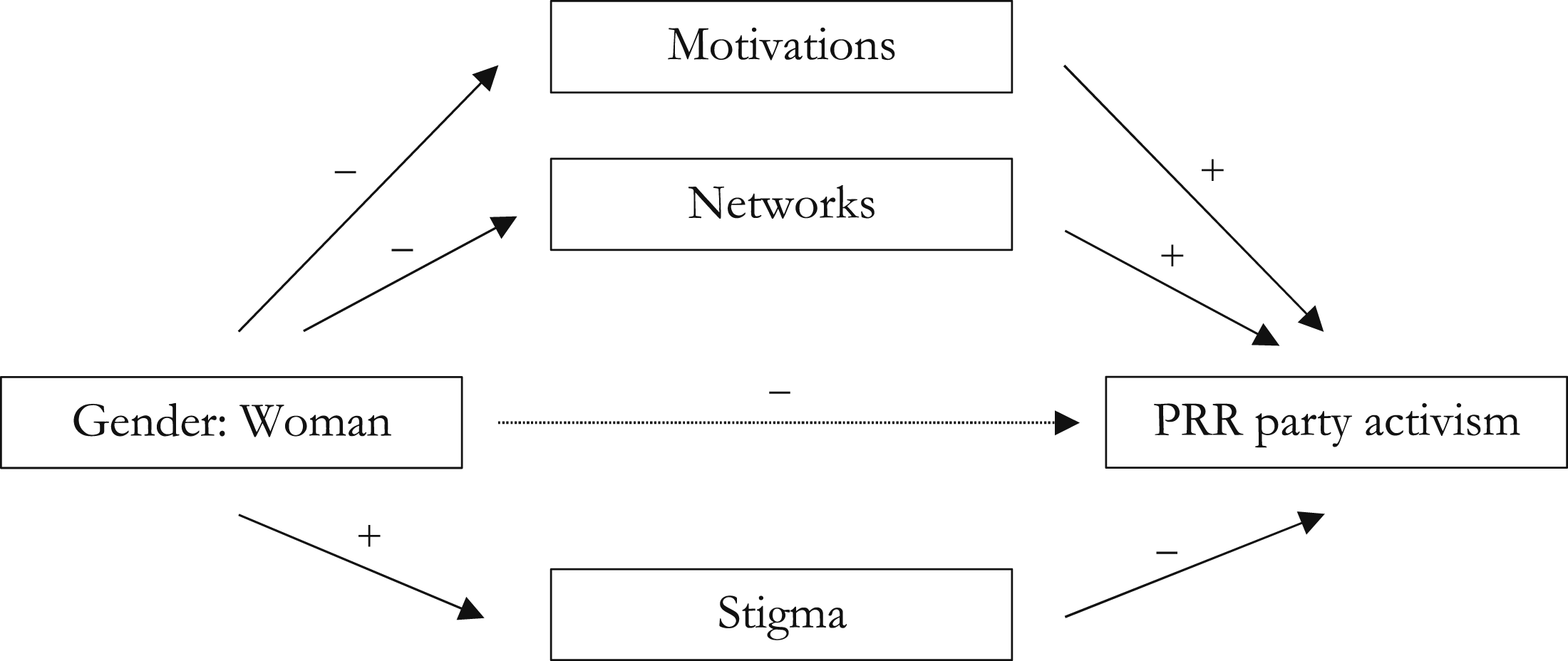
Theoretical model of the gender gap in PRR party activism.
Research Design
Cases
I test my five hypotheses on the membership bases of two PRR parties: the League in Italy and the Sweden Democrats (SD) (Art, 2011; Heinisch & Mazzoleni, 2016; Mudde, 2007). Both share a core ideology which combines nativism, authoritarianism and populism (Mudde, 2007). Specifically, they each cast non-natives, especially Muslims, as representing a threat to the nation’s culture, security and welfare; they advocate for strict law-and-order provisions to crack down on crime, which is alleged to be perpetrated primarily by non-natives; and they claim to represent the voice of the ordinary people, accusing mainstream parties, the European Union, and other elites such as the media of acting against the interests of the nation (Albertazzi & McDonnell, 2015; Ammassari, 2024; Hellström & Petterson, 2024; Jungar & Jupskas, 2014). This PRR supply is reflected in their electorates, which hold strong anti-immigration and authoritarian views and tend to be distrustful of political institutions (Jylhä et al., 2019; Passarelli & Tuorto, 2018). By virtue of their PRR ideology, both the League and the SD promote a traditional understanding of gender roles and consider the heteronormative family as the foundation of society and the nation (Feo & Lavizzari, 2021; Jungar, 2018). Moreover, since the mid-2000s, they have both employed a femonationalist discourse by which they portray themselves as defenders of gender equality to stigmatise Muslim men and oppose immigration from Muslim countries (Farris & Scrinzi, 2018; Jungar & Jupskås, 2024). At the same time, the two can be considered as ‘diverse’ cases of PRR parties (Seawright & Gerring, 2008) in terms of both the socio-political environments in which they operate, and the party context they provide to women members who wish to be active. Below I give a brief overview of country-level and party-level differences between the two cases, focusing on aspects which are likely to influence the decision of women members of the League and the SD to get involved in their parties. In Appendix A, I discuss these at length.
If we consider country-level differences between Italy and Sweden, the latter represents a much more conducive environment for women who want to participate in politics. To begin with, the Swedish ‘social democratic’ welfare state model allows women to pursue a professional career, more than the Italian ‘conservative/corporatist’ one for which families, and women in particular, are supposed to be responsible for the care of children and the elderly (Esping-Andersen, 1990). Moreover, Sweden’s proportional representation electoral system and stable party system are positive for the election of women and party institutionalisation, which in turn can drive substantial party reforms like the introduction of gender quotas; by contrast, a mixed electoral system and volatile party system like those which characterise Italy can hinder women’s political advancement (Kittilson, 2006; Lovenduski & Norris, 1993). It is thus not surprising that, even though Italy adopted legislative gender quotas for candidate lists in 2017, women’s representation amongst party leaders, MPs, and party members has consistently been lower in Italy than in Sweden (which does not have such quotas) (Gauja & van Haute, 2015; Heidar et al., 2020; Widfeldt, 1998).
On the other hand, if we look at party-level differences between the League and the SD, the former should be a more appealing party organisation for women members who want to get actively involved. Insofar as party competition may favour women’s political participation (Krook, 2018), the League has more incentives to recruit women members than the SD, because it competes for votes with Brothers of Italy; while the SD has no such electoral threat on its right. Furthermore, the League has voluntary gender party quotas for its main intra-party bodies and intra-party elected offices; the SD instead opposes quotas because they are perceived as discriminating against men (Jungar, 2018). While the SD, contrary to the League, has an official women’s wing (the SD-kvinnor), women’s wings do not necessarily foster women’s party activism (Ponce et al., 2020). Finally, the League’s origins in a regionalist movement have since the beginning provided the party with a ‘reputational shield’ (Ivarsflaten, 2006) from accusations of extremism – something that the SD, with its origins in Sweden’s extreme right milieu, could not afford for most of its existence.
In sum, the League and the SD represent two very different environments for women members, both in terms of their historical, political, and organisational features, but also given the countries they operate in. This ‘diverse case’ research design aims to account for the disparate contexts in which women PRR party members can become active, in order to identify which supply-side (i.e. individual-level) factors influence trends in their activism; it does not seek to uncover the country-level and party-level factors which affect women’s activism in the populist radical right. While one needs to be cautious about generalising my findings beyond the two cases, if we were to find similar mechanisms at play in both the League and the SD, this would provide a solid basis for generalisation within the PRR party family in Western Europe (Seawright & Gerring, 2008).
Survey Method
My empirical analysis is based on original membership surveys of the League and the SD – the first ever comparative survey of PRR party members. The surveys were fielded between 2021 and 2022 and hosted on the online platform LimeSurvey. Given that the League does not keep a central record with the contact details of all its party members, I sought to conduct a census by contacting the Organisational Secretary in every Italian region, and asking them to distribute the survey among their regional members via their mailing lists and/or WhatsApp groups. 10 out of 20 regions agreed to take part in the survey; of these, six used regional mailing lists to send the survey to their members, while four used official party WhatsApp groups. This led to 1223 responses (818 from men and 405 from women) collected between May 2021 and June 2022, with an average response rate of 16 per cent among the regions which sent the survey via mail. This response rate is in line with membership surveys of other Italian parties (see Sandri et al., 2015). By contrast, the SD maintains a central register with the contact details of all its party members, meaning that a census was feasible. Therefore, between October and December 2021, the party central secretariat distributed the link to my survey three times via mail to the whole membership (which, according to the party, consisted of approximately 36,000 people). 9154 party members did the survey, which resulted in a high response rate (25 per cent) in comparison to other studies of party membership, including in Sweden (cf. Kölln & Polk, 2017). Of these members, 6926 were men and 2228 were women. 3
As is the norm in party membership research, my study is based on a non-random sample of PRR party members, meaning that I cannot exclude there are systematic differences between those who participated and those who did not. This is especially the case for the League, since I could not target the whole population of party members. At the same time, the descriptive statistics of the sample are representative of what we know about party members generally, given that the respondents are mostly men, middle-aged, relatively educated, and employed, and many of them are not particularly active in the party (Bale et al., 2020; Heidar & Wauters, 2019; van Haute & Gauja, 2015). 4 Furthermore, the descriptive statistics are also in line with what we would expect from PRR party members in particular, in that the proportion of women members is especially low in comparison to other political parties (Heidar & Wauters, 2019; van Haute & Gauja, 2015); and respondents are less likely to have completed tertiary education than members of mainstream parties in Italy and Sweden (Kölln & Polk, 2017; Sandri et al., 2015). Finally, I obtained good geographical coverage of both countries, and most importantly for the League survey, with an adequate representation of both the north of Italy, which is the traditional stronghold of the party, and the centre-south, where the party organisation is weaker (Zulianello, 2021). Overall, these considerations are reassuring of the representativeness of the sample.
Variables and Models
The dependent variable of interest for this study is party activism. 5 In this article, I focus on one low-intensity activity (online activism), two medium-intensity (party meetings attendance, distributing flyers) and two high-intensity ones (holding an intra-party office, standing as a candidate) which are crucial to sustain the party organisation. Activism in low- and medium-intensity activities was gauged by asking respondents how often they posted/shared party content online, attended party meetings, and distributed flyers for their party (outside election campaigns). 6 Their answers to each question were grouped into three categories: 0 = ‘Never’; 1 = ‘Rarely’; 2 = ‘Monthly’. Activism in the two high-intensity activities was measured by asking respondents if they had ever held a party office and stood as candidates (‘Yes’, coded as 1 or ‘No’, coded as 0, in both questions). In addition, I also created a continuous variable obtained from a principal component analysis (PCA) of the five dependent variables, to gauge the overall levels of activism of PRR grassroots members. This PCA resulted in one factor with an Eigenvalue larger than one (1.75) and explaining over 60 per cent of the total variance. All variables except for ‘online activism’ loaded higher than the generally accepted lower bound of 0.45. I thus deleted the ‘online activism’ since it loaded insufficiently (0.32) on the overall activism factor. 7
The main independent variable of the analysis is the gender of PRR party members, coded as 1 for women and 0 for men. To test my hypotheses, I created a number of variables gauging the motivations, networks and stigma of respondents. To assess motivations, I used two variables measuring respondents’ sense of political efficacy and electoral ambition, respectively. Networks were examined by asking respondents whether they had been recruited by the party in order to join, and whether they agreed that they had made new friends in the party since joining. Stigma was gauged by asking members whether they agreed that it is not easy to publicly admit they are a member of their party. Finally, I included some standard controls for party activism – age, age squared, education, occupational status, and length of membership in years – as well as a dummy variable indicating which party respondents belonged to (coded as 1 for SD, and 0 for League). 8
To assess the statistical effects of gender on PRR party activism, I performed five logistic regressions: three ordinal models for the three medium-intensity activities, and two binomial models for the two high-intensity ones. To account for the non-independence of observations within the same party, I computed robust standard errors clustered at the party level. Finally, given the imbalance between the number of respondents in the League and in the SD, I used sampling weights in my survey analysis, in order for the two membership bases to weigh the same. To compute the causal mediation analysis (CMA), I used the continuous variable measuring overall activism obtained from the PCA. The CMA is explained more in-depth in the results section.
How and Why Women PRR Party Members are More Active than Men
In this section, I use the survey data to test my hypotheses on women’s activism in PRR parties. 9 In the first part of the section, I start by running bivariate models between gender and the dependent variables measuring activism in five different activities. I then run regression models including other predictors of activism – motivations, networks, and stigma – as well as the control variables, to assess whether the relationship between gender and PRR party activism holds. In the second part of the section, I employ CMA to examine which supply-side factors, if any, mediate this relationship.
Gender Differences in PRR Party Activism
Bivariate Regressions Predicting PRR Party Activism.
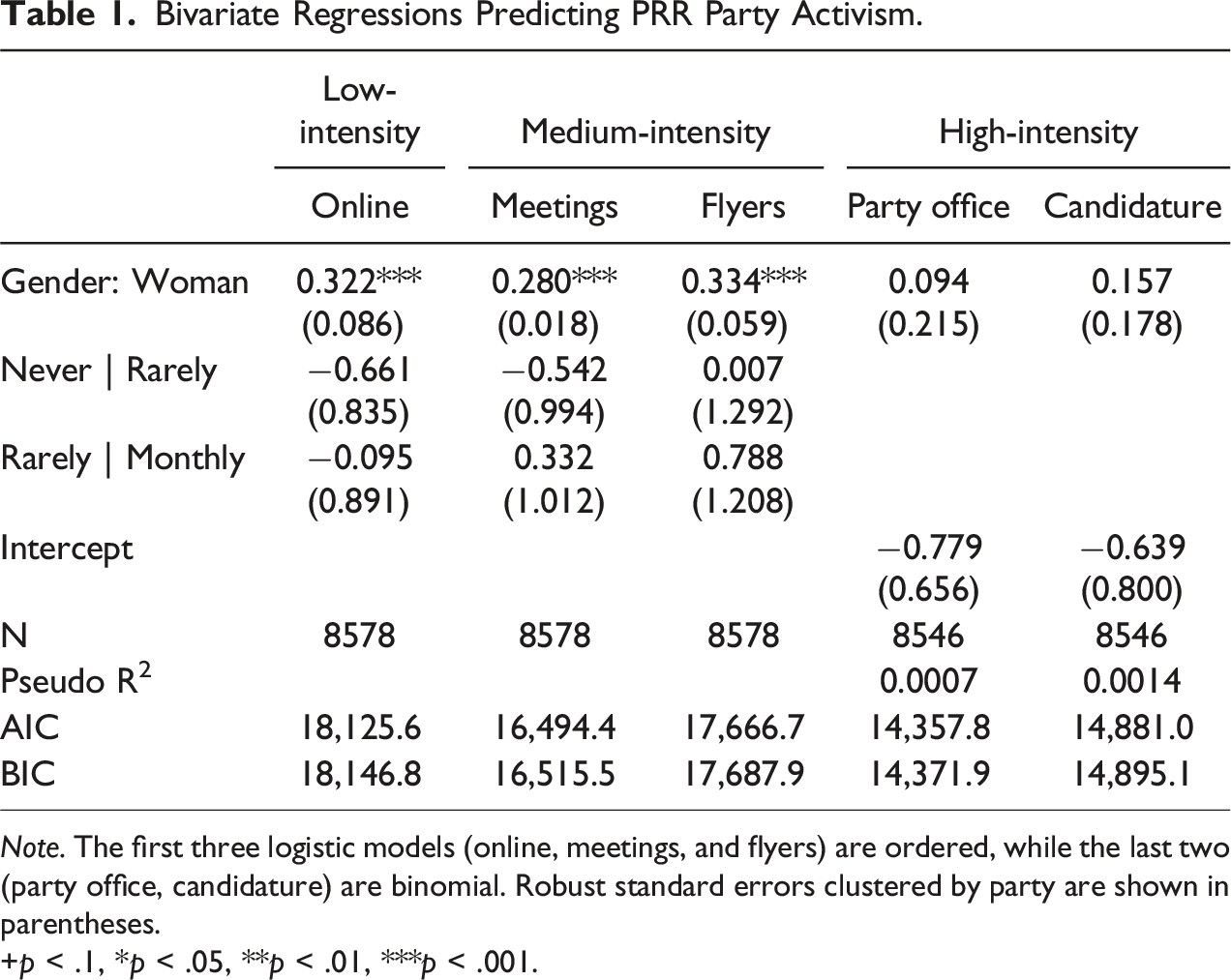
Note. The first three logistic models (online, meetings, and flyers) are ordered, while the last two (party office, candidature) are binomial. Robust standard errors clustered by party are shown in parentheses.
+p < .1, *p < .05, **p < .01, ***p < .001.
To assess whether this ‘reverse’ gender gap holds also when considering the motivations, networks and feelings of stigma of PRR grassroots members, as well as other controls, I re-run the five models by including all these variables. The stepwise models for each party activity can be found in Tables E3-E7, Appendix E. In Figure 2 below, I report the coefficient estimates of gender and the main predictors of interest, i.e. motivations (political efficacy, electoral ambition), networks (party recruitment, new friends since joining) and stigma, as they appear in the full models containing all variables. As Figure 2 shows, even after controlling for supply-side drivers of activism and socio-demographic variables, being a woman remains positively and significantly correlated with participating in three activities out of five (posting/sharing party content online, attending party meetings, and distributing flyers). In addition, similarly to what was observed in Table 1, the figure illustrates that the coefficient of gender in the models predicting high-intensity activism (party office and candidature) is positive, although it does not reach statistical significance in either. In other words, the survey results provide strong evidence that women PRR grassroots members participate more often than men in a series of low- and medium-intensity activities, and are as likely as men to take part in high-intensity ones. Based on these unexpected findings, both H1 and H2 are rejected. Regression models predicting activism of PRR grassroots members. Source: Models 5 of Tables E3-E7, Appendix E. Note: The figures show coefficient estimates with 95 per cent confidence intervals. Only the coefficients of the main predictors of interest are displayed.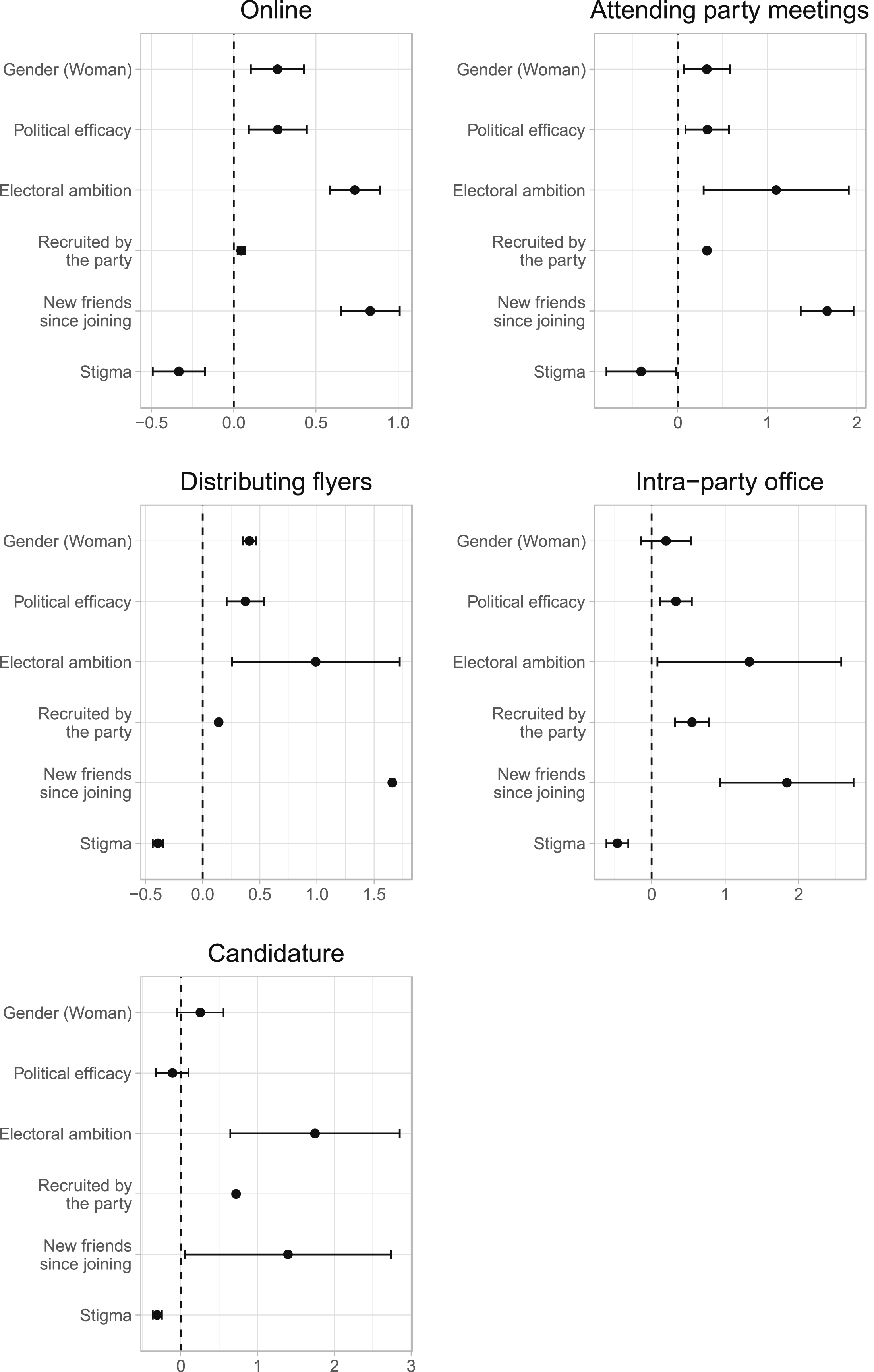
In addition to gender, Figure 2 shows that the supply-side factors identified in the theoretical framework are strong predictors of PRR party activism. Starting from members’ motivations, political efficacy is positively and significantly correlated with getting involved in all party activities except for running as candidates, while the coefficient of electoral ambition is positive and significant in all five models. Therefore, PRR party members who want to achieve public office, and those who think that they can have an influence in party policy, are more likely to get involved in party activities, as observed in mainstream parties (Bale et al., 2020; Whiteley & Seyd, 2002). Being embedded in party networks too is a key driver of PRR party activism. Members who have been recruited by the party, and members who have made new friends in the party since they joined, are more active than the rest of respondents, in line with evidence from other membership studies (Pettitt, 2020; Webb et al., 2020). So are those who are not sensitive to the stigma surrounding their membership, suggesting that stigma works as a deterrent to party activism (Ammassari, 2025a; Art, 2011).
To corroborate the robustness of my findings, I performed several checks for distinct sample subsets and under different variable specifications, which can be found in Appendix F. First, I re-estimated all five regressions for the League (Table F1) and the SD (Table F2) separately, to ensure that the results are not driven by either party. Second, one may argue that League respondents who received the survey via WhatsApp are more active than the average member, since they are interested in obtaining regular information from local branches. By contrast, regional mailing lists contain the whole population of regional party members, therefore those who received the survey via mail are plausibly more representative of the overall League membership, and more comparable with the SD sample. To make sure my results are not biased because of different survey distribution strategies, I re-ran the regressions by excluding League respondents from the regions which distributed the survey via WhatsApp (Table F3). Third, for the SD, since I was able to conduct a census, I carried out some sensitivity tests by firstly excluding each of the three most populous counties (Skåne, Stockholm, and Västra Götaland) one at a time, and then excluding all three together (Tables F4-F7). Fourth, to ensure that my results are not sensitive to the categorisations of my dependent variables, I also ran an OLS regression on the continuous variable measuring overall activism based on the PCA (Tables F8-F9). The results discussed above are further corroborated by these tests: overall, women members of PRR parties are more active than their men counterparts in low- and medium-intensity activities, and they are at least as likely as men to take on intra-party offices and stand as candidates. In fact, in the SD, women are more likely to participate even in these two high-intensity acts. Finally, to rule out that women might over-report their levels of activism due to a greater sense of diligence towards the party or social desirability bias, I checked gender differences in responses to survey questions regarding members’ willingness to stand as candidates and work for the party, their thoughts about leaving, and perceptions of stigma (Tables F19-F22). According to my survey, women PRR grassroots members are significantly less likely than men to say they would like to stand as candidates and work for the party in the future, while at the same time being significantly more likely to admit they have thought about leaving the party and find it uneasy to say in public they are a member of their parties. These results suggest that women’s self-reported levels of activism are not the product of ‘diligence’ or social desirability bias towards their own party.
The Mediating Role of Motivations, Networks and Stigma
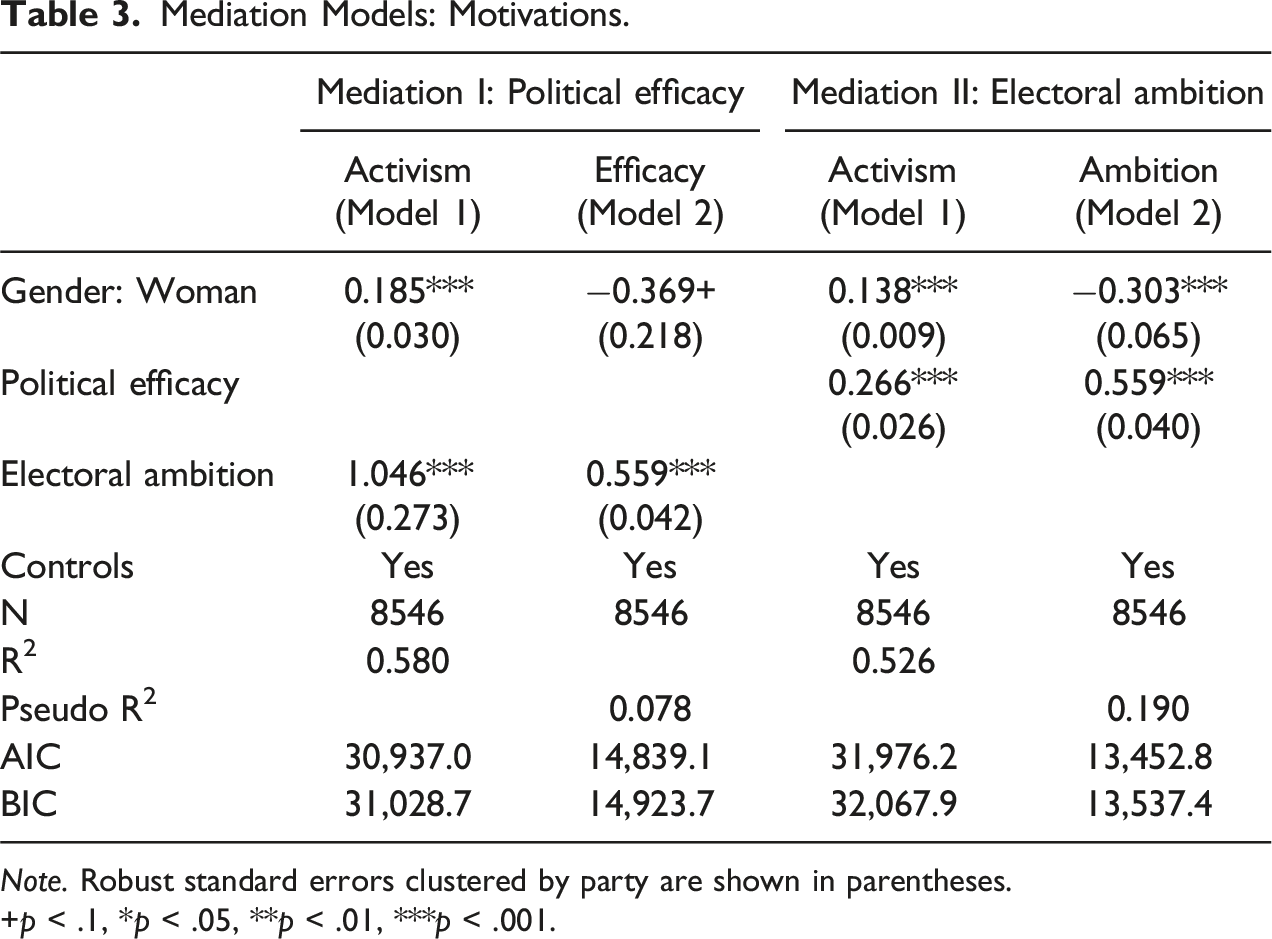
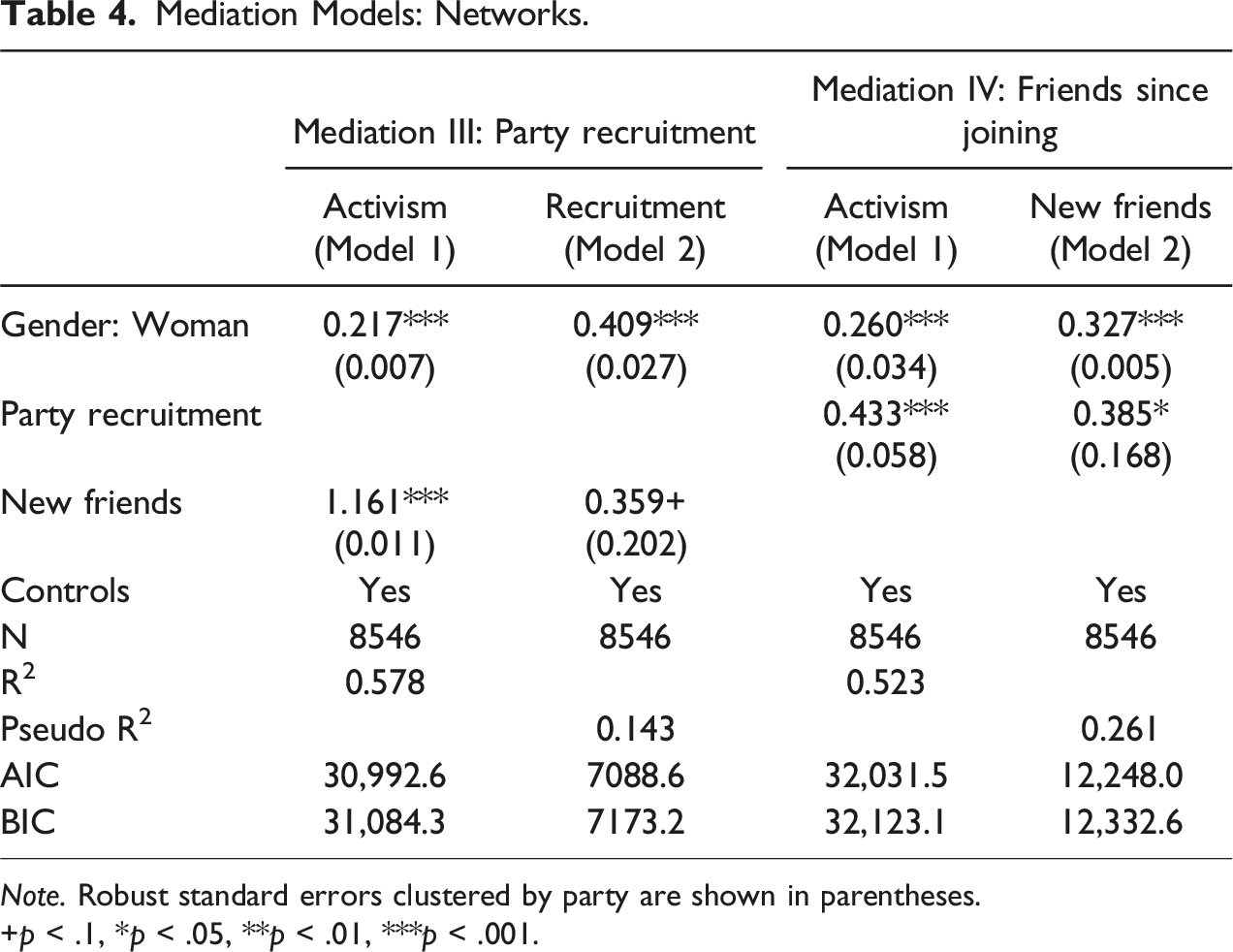
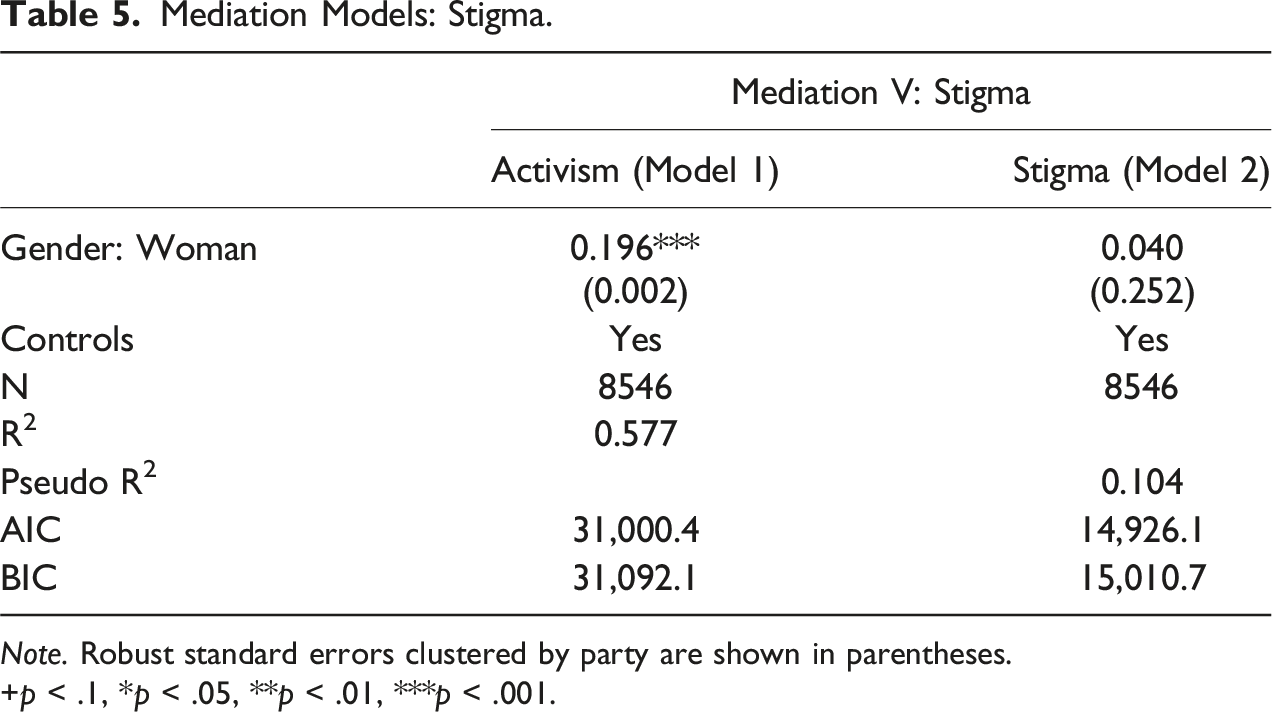
Even though these findings imply that I have found no support for my hypotheses, it is worth investigating which supply-side factors mediate the unexpectedly positive relationship between gender and levels of PRR party activism, with the aim to discover why women at the grassroots of PRR parties are actually more active than men. To do so, I use causal mediation analysis (CMA). According to Baron and Kenny (1986), a mediation effect can be gauged in four steps throughout three regressions: • Model 1: the main independent variable (in this case, gender) is significantly correlated with the dependent variable (PRR party activism) without controlling for the mediators (motivations, networks, and stigma); • Model 2: the main independent variable is significanly correlated with the mediators; • Model 3: the mediators are significanly correlated with the dependent variable, controlling for the main independent variable; • In Model 3, the effect of the main independent variable should be close to zero (full mediation) or smaller than it was in Model 1 (partial mediation).
OLS Regression Predicting Overall Activism of PRR Party Members.
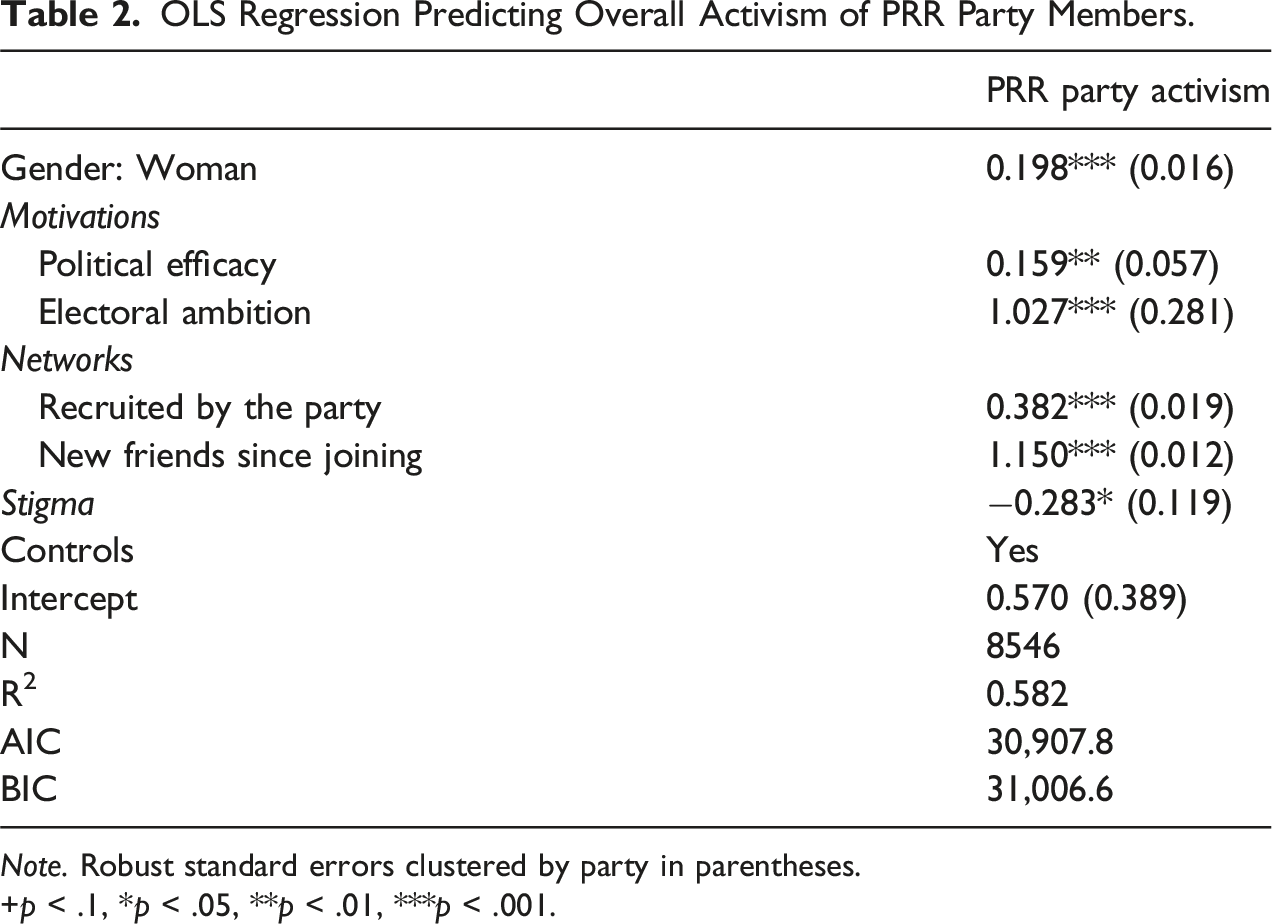
Note. Robust standard errors clustered by party in parentheses.
+p < .1, *p < .05, **p < .01, ***p < .001.
Mediation Models: Motivations.
Note. Robust standard errors clustered by party are shown in parentheses.
+p < .1, *p < .05, **p < .01, ***p < .001.
Mediation Models: Networks.
Note. Robust standard errors clustered by party are shown in parentheses.
+p < .1, *p < .05, **p < .01, ***p < .001.
To ensure that the mediation effect is significant, I use bootstrapping (Preacher & Hayes, 2004) with the mediation R package (Tingley et al., 2014) to calculate the indirect effect of gender on PRR party activism (which corresponds to the effect of gender on networks multiplied by the effect of networks on PRR party activism). As Figure 3 shows, this computation reveals that the mediation effects (ACME, or Average Causal Mediation Effects) of both party networks are statistically different from zero. Specifically, party recruitment mediates the total effect of gender on PRR party activism by 7 per cent (Table E8, Appendix E), and having made new friends in the party mediates it by 23 per cent (Table E9, Appendix E). In other words, part of the reason why women PRR grassroots members are more active than men is because they are more embedded in party networks in both the recruitment and retention phases of their memberships. In addition, Tables E10-E11 in Appendix E report the CMA results for the three activities which recorded a gender gap in Table 1: posting/sharing party content online, attending party meetings, and distributing flyers. As envisaged in the theoretical framework (see text below Figure 1), the mediation effects of both types of networks are larger for the two medium-intensity activities than for the low-intensity one. This reflects how more intense activities require greater networks to participate, as mentioned in the build-up to H2. Causal mediation analysis: gender and networks. Note: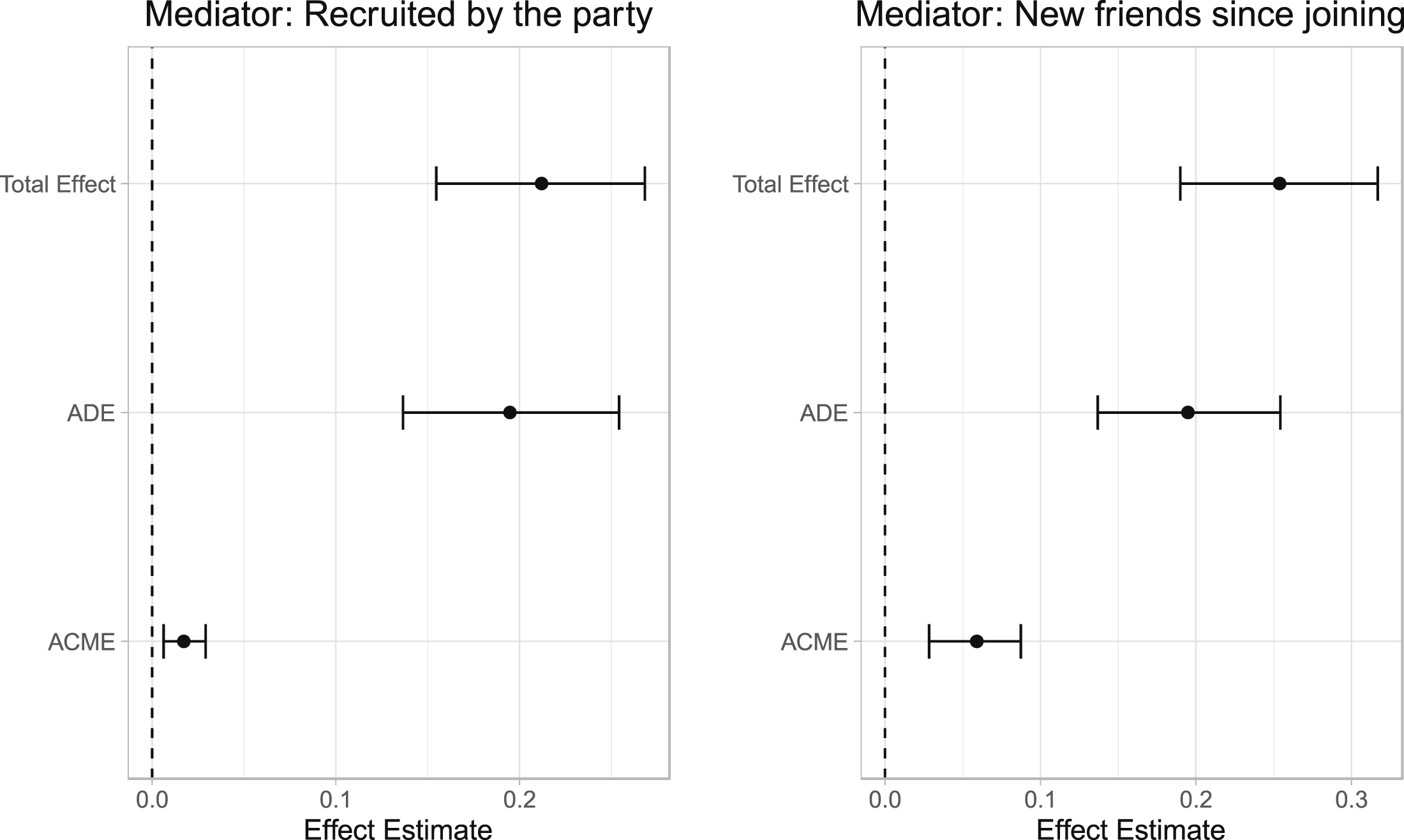
Mediation Models: Stigma.
Note. Robust standard errors clustered by party are shown in parentheses. +p < .1, *p < .05, **p < .01, ***p < .001.
To test the robustness of these findings, I re-computed the CMAs on the memberships of the League and the SD separately. The mediation models and bootstrapping outcomes can be found in Tables F10-F18, Appendix F. Overall, the main findings of the above analysis are supported, in that there is a mediation effect of party networks, but not of motivations and stigma. In the League, likely due to the smaller sample size, this effect is significant at the 90 per cent confidence interval only for party recruitment. Nonetheless, the main takeaway holds: women in both PRR parties are more likely to be recruited by the party and to build contacts in the party organisation after joining, and this partly explains their higher levels of activism in comparison to men. The mechanism uncovered in the analysis is displayed in Figure 4 below. Relationship between gender, networks and PRR party activism.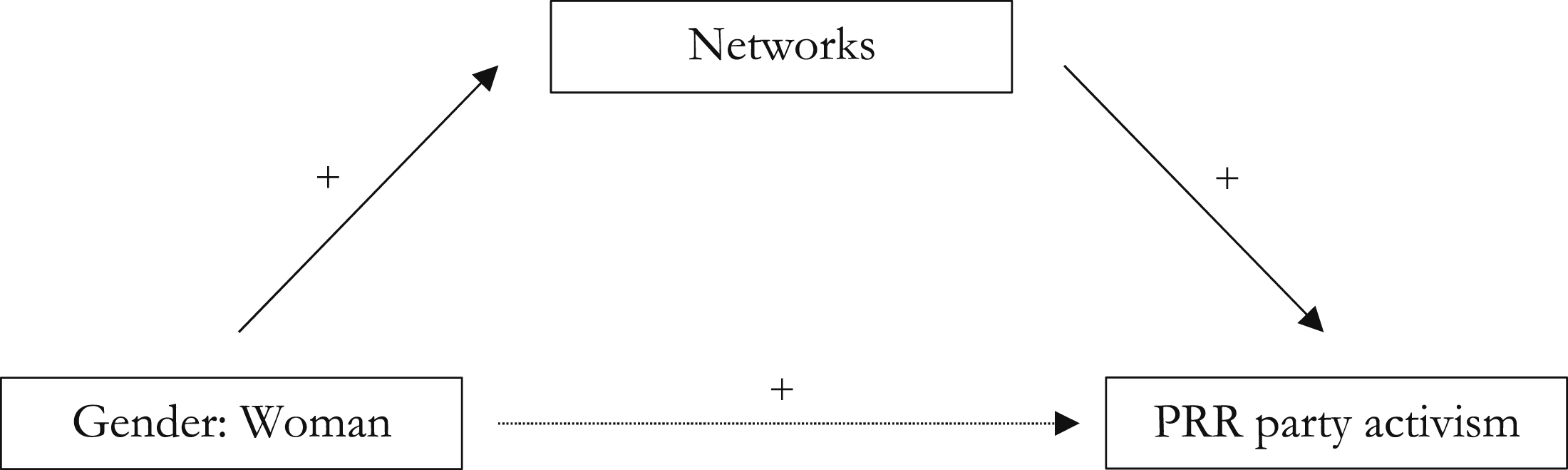
An alternative explanation for my results is that women, especially women on the populist radical right, might over-report the social, ‘network’ character of their activism as a justification for it (see e.g. Xydias, 2020, 117-118, on the ‘origin stories’ of Alternative for Germany women officeholders). To rule this out, I examined whether women and men differ in the extent to which they say they socialise with other members in non-political, social gatherings like coffees and dinners. Table F23 in Appendix F shows that there are no significant gender differences in this regard.
A second alternative explanation for why women might be more active than men is that they have more time for party activities due to gender differences in occupational status, with men being more likely to be employed. Relatedly, if women members of PRR parties – in line with their traditional gender ideology – were more likely than women members of mainstream parties to be outside the workforce, this would also explain why my findings differ from those of membership studies of mainstream parties. The descriptive statistics in Tables C3 and C4 in Appendix C indeed show that 61 per cent of men PRR grassroots members are active in the labour force, as opposed to 51 per cent of women. To give a comparison, in Sweden, the percentage of women party members who are employed is slightly higher than that of men (73 vs 71 per cent, respectively) (Kölln & Polk, 2024). 10 Similarly, among grassroots members of the main Italian party of the left, the Democratic Party, women are more likely than men to be employed (54 per cent vs 49 per cent, respectively). 11 However, Table F8 in Appendix F shows that being employed is not a significant predictor of PRR party activism. That being the case, the third condition of the mediation effect is not met: the fact that women are more likely than men to be outside the workforce does not explain why they are more active members.
A third alternative explanation relates to the reasons why women become PRR party members, and how they differ from those of men. It could be the case that, in light of the stigma surrounding PRR support, only highly motivated women will take the step of joining. Table E10 in Appendix E provides preliminary evidence against this claim, since it shows that women and men are largely driven by the same incentives when enrolling. Nonetheless, it is still worth conducting a CMA to examine whether reasons for joining PRR parties mediate the relationship between gender and party activism. Table F24 in Appendix F shows that this could be possible only for two sets of incentives – material and group ones – since the other types of reasons are not significant predictors of PRR party activism. Table F25, however, shows that the conditions for a mediation effect are not met either for material or group reasons. In the former case (Mediation I), the coefficient for gender in Table F24 is larger than the one in Model 1, Table F25; while in the latter (Mediation II), gender is not a significant predictor of joining for group incentives (Model 2, Table F25). These tests rule out the possibility that women are more active than men in PRR parties because they are fundamentally different in terms of their motivations for getting involved.
Finally, it could be argued that party networks are endogenous to activism. On the one hand, the more people are embedded into party networks, the more they may be encouraged to get involved in party activities; on the other, the more that members get involved, the more they become embedded in networks. If the latter were indeed endogenous to activism, then we could not be so sure of the causal direction between the two variables displayed in Figure 4. While endogeneity is not as much of a concern for party recruitment, since joining a party necessarily comes before being an active party member, it could be so for the establishment of new friendships since joining. From the point of view of party membership studies, it has long been argued and empirically shown in both quantitative and qualitative work that meeting new like-minded people after joining a party is a strong incentive for becoming active in it (Bale et al., 2020; Pettitt, 2020; Whiteley & Seyd, 2002). Most party members join but choose to be inactive (Bale et al., 2020; Heidar & Kosiara-Pedersen, 2020; van Haute & Gauja, 2015); and those who decide to try out a few party meetings, to see how the atmosphere is, are more likely to become regularly involved if they encounter social incentives in the form of new friendships and camaraderie (Bruter & Harrison, 2009; Dommett & Power, 2018; Pettitt, 2020).
To provide support for this argument in relation to my survey data, I conducted two tests. First, I adopted an instrumental variable (IV) approach and ran a Two-Stage Least Squares (2SLS) regression to isolate the effect of the variable ‘New friends since joining’ on PRR party activism using the ivreg R package (Fox et al., 2024). The IV chosen is ‘Personal ties before joining’, which is measured by asking respondents whether they knew anyone from their immediate family and/or a friend in the party before joining (coded as 1 for yes, 0 for no). Having personal ties in the party should be related with making new friends since these ties might facilitate social interactions, however they are not necessarily related to party activism – after all, party membership can be a matter of family partisanship or something that one does to follow a partner or a friend, but with no real commitment behind it (Bruter & Harrison, 2009; Zuckerman et al., 2007). The 2SLS regression, which can be found in Tables F26a-b in Appendix F, shows that making new friends does indeed boost activism and there is no significant reverse influence. Second, to further reiterate the idea that networks precede and affect activism and that greater embeddedness in party networks mediates the relationship between gender and PRR party activism, I also ran a CMA with the variable ‘Personal ties before joining’ as the mediator variable. Having personal ties in the party before joining, like recruitment, necessarily comes before being an active party member. The CMA, which is displayed in Tables F27 and F28 in Appendix F, shows that also these pre-joining networks mediate the relationship between gender and PRR party activism. The fact that women are more likely than men to have someone close to them in the PRR party before joining partly explains why they are more active as members. Overall, these tests provide further support for the mechanisms illustrated in Figure 4.
Discussion and Conclusion
In this study I investigated how and why activism at the grassroots of PRR parties differs between women and men. Based on the literature on gender and party politics, I predicted that women PRR party members would be less active than men, and that this gender gap would widen as party activities become more intense. I tested three hypotheses on why women can be expected to get less involved: because they have less motivations to participate, are less embedded in party networks, and are more sensitive to the stigma surrounding their PRR party membership. Using original survey data from thousands of party members of the League and the SD, I uncovered a very surprising finding: women members of PRR parties are in fact more active than men in a variety of low- and medium-intensity party activities, from posting/sharing party content online to distributing flyers; and are as likely as men to participate in high-intensity acts, like holding an intra-party post and standing as candidates. In addition, I found that women are overall more active because they are more embedded in party networks: they are more likely to have been recruited by a party official or member, and to have built friendships in the party after joining. These findings have important implications for the study of the populist radical right and gender and party politics which I discuss below.
To begin with, my study sheds new light on the role that gender plays in the populist radical right. In an era where mainstream parties are seeing their membership numbers shrinking, and the (few) women members they have are not as involved as their men counterparts, PRR parties stand apart not only in their commitment to maintaining large membership bases (Albertazzi & van Kessel, 2023; Heinisch & Mazzoleni, 2016), but also because their women members, despite being a small minority, represent a very active component of their grassroots organisations. Moreover, differently from what happens in extreme right movements (Blee & Linden, 2012; Froio et al., 2020; Ralph-Morrow, 2022), women in the populist radical right are not merely involved in marginal, administrative tasks but are at the forefront of important external-facing activities, like distributing flyers and standing as candidates. Since active women PRR party members can make radical agendas seem ‘mainstream’ to the public (Ben-Shitrit et al., 2022), my findings suggest that women represent crucial actors behind the electoral expansion and growing normalisation of PRR politics. More research is needed to understand whether and how gender matters in PRR politics, beyond its role in the PRR party ideology and policy positions. For instance, future work could investigate whether women and men get involved in the populist radical right in similar ways and for similar ‘grievances’ and ‘triggers’ (Ammassari, 2024). This work would be very telling of the expanding societal appeal of this type of politics.
In addition, my study has shown that PRR parties recruit women members to a larger extent than men. On the one hand, this finding speaks to research on extreme right organisations, showing that men in these movements often recruit their wives and girlfriends as members (Blee & Linden, 2012; Froio et al., 2020; Pilkington, 2017). It could be the case that women in the populist radical right tend to be recruited in this way too. The role that spouses and partners play in the recruitment and retention of PRR party members would be an interesting venue for future work. On the other hand, if women were recruited by party officials rather than by their husbands and boyfriends, this would beg the question of why PRR parties are particularly interested in attracting more women within their ranks. Based on the existing literature, I argue that there are three plausible explanations. First, they might do so to fulfil their organisational needs. Party members represent the primary pool from which party candidates are recruited (Hazan & Rahat, 2010; Scarrow, 2015). In many countries, PRR parties are forced to fill legislative gender quotas when compiling candidate lists. Given how their memberships present the largest gender gaps of all party families, as PRR parties expand electorally they need far more women members than they currently have in order to contest increasing numbers of seats. Second, PRR parties might seek to recruit women to meet reputational concerns: in other words, it might be a strategy to show that they are not a ‘lunatic fringe’ of extremists and hooligans (Art, 2011, 105), but rather ‘standard’ political actors (Erzeel & Rashkova, 2017, 816) which can appeal to a variety of social constituencies. Third, PRR parties might be interested in recruiting women for electoral purposes. Women members might be perceived by PRR elites as key to reduce the gender gap characterising their electorate in two ways: directly, by mobilising women voters (Goyal, 2023) and indirectly, by standing as candidates and attracting women voters (Weeks et al., 2022). Research on how these three sets of considerations play out in PRR parties’ recruitment strategies would help us gain a deeper understanding of their goals and priorities.
Finally, a word on generalisability. The fact that my findings on low- and medium-intensity activism hold in both the League and the SD – two PRR parties which, as explained, operate in very different socio-political contexts and display distinctive party-level features – suggest that these results may travel to other PRR parties in Western Europe. To determine this more conclusively, however, and to better understand the extent to which women are engaged at the PRR party grassroots, future work should replicate my membership study on other cases. As for high-intensity activism, there are two possible explanations for why League women members are as active as men, while SD women members are more active. As mentioned, the League must meet legislative gender quotas in its candidate lists and has voluntary quotas for its intra-party offices. My results suggest that these quotas do help ensure that women and men are equally likely to participate in these activities. In the lack of quotas, and given the unfavourable party-level features highlighted in the research design section, the greater levels of high-intensity activism of women members in the SD seem due to the favourable country-level conditions that Sweden offers women who wish to be active in politics. More research is needed, with a larger number of cases, to identify which country- and party-level factors shape women’s decision to be active in the populist radical right – something which was beyond the scope of this article. Nonetheless, what this study has shown is that, in some of these ‘men’s parties’, men are actually not the most active group – a result which counters much of what we know about gender and party activism, and can help explain why the populist radical right is evermore normalised in our societies.
Supplemental Material
Supplemental Material - ‘Men’s Parties’, but With More Active Women: Gender and Party Activism in the Populist Radical Right
Supplemental Material for ‘Men’s Parties’, but With More Active Women: Gender and Party Activism in the Populist Radical Right by Sofia Ammassari in Comparative Political Studies
Footnotes
Acknowledgments
I would like to thank the participants of the 2023 ECPR General Conference, the 2023 AusPSA Annual Conference and the 2024 European Conference of Politics and Gender, as well as Eva Anduiza, Sarah Cameron, Léonie de Jonge, Max Grömping, Ferran Martinez i Coma, Duncan McDonnell and Lee Morgenbesser, for their feedback on previous drafts of this article.
Declaration of Conflicting Interests
The author(s) declared no potential conflicts of interest with respect to the research, authorship, and/or publication of this article.
Funding
The author(s) received no financial support for the research, authorship, and/or publication of this article.

Data Availability Statement
The data supporting the findings are available at: Ammassari, 2025b.
Supplemental Material
Supplemental material for this article is available online.
Notes
Author Biography
References
Supplementary Material
Please find the following supplemental material available below.
For Open Access articles published under a Creative Commons License, all supplemental material carries the same license as the article it is associated with.
For non-Open Access articles published, all supplemental material carries a non-exclusive license, and permission requests for re-use of supplemental material or any part of supplemental material shall be sent directly to the copyright owner as specified in the copyright notice associated with the article.
